Skip Content
You are currently on the new version of our website. Access the old version .

Atoms, Volume 7, Issue 4

2019 December - 15 articles

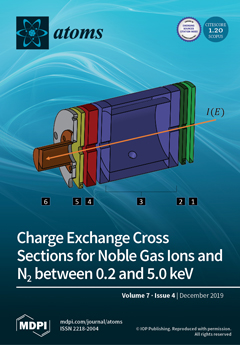
Cover Story: Charge exchange (CX) is important for understanding both astrophysical and atmospheric plasmas. CX experiments have focused primarily on understanding the total CX cross-section. Using a gas cell which features a short, high-pressure interaction region, we report total CX cross-sections via an attenuation method for noble gas ions (He, Ne, Ar, Kr) in collision with molecular nitrogen between 0.2 and 5.0 keV. In any CX measurement, the total cross-section may be complicated by elastic and inelastic reaction channels. The large angular acceptance of our apparatus limits the effect of this non-CX scatter, but comparisons to previous experiments are suggestive of a non-negligible contribution from large-angle (θ>13°) scattering. A second gas cell, featuring a novel deceleration scheme, is proposed for future CX measurements. View this paper
  • Issues are regarded as officially published after their release is announced to the table of contents alert mailing list .
  • You may sign up for email alerts to receive table of contents of newly released issues.
  • PDF is the official format for papers published in both, html and pdf forms. To view the papers in pdf format, click on the "PDF Full-text" link, and use the free Adobe Reader to open them.

Articles (15)

  • Article
  • Open Access
1 Citations
3,028 Views
16 Pages

New Energy Levels and Transitions of 5s25p2 (6d+7s) Configurations in Xe IV

  • Jorge Reyna Almandos,
  • Mónica Raineri,
  • Cesar J. B. Pagan and
  • Mario Gallardo

17 December 2019

Three-times ionized xenon Xe IV spectrum in the 1070–6400 Å region was analyzed using a pulsed discharge light source. A set of 163 transitions was classified for the first time, and 36 new energy levels belonging to the 5s25p26d and 5s25...

  • Article
  • Open Access
30 Citations
4,294 Views
15 Pages

Coulomb (Velocity) Gauge Recommended in Multiconfiguration Calculations of Transition Data Involving Rydberg Series

  • Asimina Papoulia,
  • Jörgen Ekman,
  • Gediminas Gaigalas,
  • Michel Godefroid,
  • Stefan Gustafsson,
  • Henrik Hartman,
  • Wenxian Li,
  • Laima Radžiūtė,
  • Pavel Rynkun and
  • Per Jönsson
  • + 2 authors

26 November 2019

Astronomical spectroscopy has recently expanded into the near-infrared (nIR) wavelength region, raising the demands on atomic transition data. The interpretation of the observed spectra largely relies on theoretical results, and progress towards the...

  • Article
  • Open Access
3 Citations
3,396 Views
11 Pages

The Belgian Repository of Fundamental Atomic Data and Stellar Spectra (BRASS)

  • Alex Lobel,
  • Pierre Royer,
  • Christophe Martayan,
  • Michael Laverick,
  • Thibault Merle,
  • Mathieu Van der Swaelmen,
  • Peter A. M. van Hoof,
  • Marc David,
  • Herman Hensberge and
  • Emmanuel Thienpont

22 November 2019

Background: BRASS (Belgian Repository of Fundamental Atomic Data and Stellar Spectra) is an international networking project for the development of a new public database providing accurate fundamental atomic data of vital importance for stellar spect...

  • Review
  • Open Access
8 Citations
4,455 Views
16 Pages

20 November 2019

From a turbulent history, the study of the abundances of elements in solar energetic particles (SEPs) has grown into an extensive field that probes the solar corona and physical processes of SEP acceleration and transport. Underlying SEPs are the abu...

  • Review
  • Open Access
9 Citations
3,242 Views
20 Pages

15 November 2019

In the interaction of fast ions with dense matter, the collision frequency is high enough to facilitate the simultaneous excitation of several electrons. Such multiply-excited few-electron systems have been exploited variously for plasma diagnostics....

  • Article
  • Open Access
11 Citations
3,712 Views
14 Pages

13 November 2019

Orthogonal operators can successfully be used to calculate eigenvalues and eigenvector compositions in complex spectra. Orthogonality ensures least correlation between the operators and thereby more stability in the fit, even for small interactions....

  • Article
  • Open Access
3,733 Views
15 Pages

4 November 2019

In this paper, we consider the temporal development of the optical density of the H α spectral line in a hydrogen laser-induced plasma. This is achieved by using the so-called duplication method in which the spectral line is re-imaged o...

  • Article
  • Open Access
4 Citations
2,947 Views
11 Pages

Topological Characterization of the Crystallographic Structure of Titanium Difluoride and Copper (I) Oxide

  • Hong Yang,
  • Mehwish Hussain Muhammad,
  • Muhammad Aamer Rashid,
  • Sarfraz Ahmad,
  • Muhammad Kamran Siddiqui and
  • Muhammad Naeem

1 November 2019

Owing to their distinguished properties, titanium difluoride (TiF2) and the crystallographic structure of Cu2O have attracted a great deal of attention in the field of quantitative structure–property relationships (QSPRs) in recent years. A top...

  • Article
  • Open Access
2 Citations
3,065 Views
9 Pages

31 October 2019

Results presented in this paper show a regular behaviour of Stark widths within the studied spectral series of potassium isoelectronic sequence. These regularities have been found and verified on the basis of the existing theoretical and experimental...

  • Article
  • Open Access
12 Citations
4,384 Views
15 Pages

Heavy Metals Detection in Zeolites Using the LIBS Method

  • Michaela Horňáčková,
  • Jozef Plavčan,
  • Michal Horňáček,
  • Pavol Hudec and
  • Pavel Veis

18 October 2019

In this study, a possibility of laser-induced breakdown spectroscopy (LIBS) for the analysis of zeolites containing copper, chromium, cobalt, cadmium, and lead in the concentration range of 0.05–0.5 wt.% is discussed. For the LIBS analysis, mic...

  • Article
  • Open Access
61 Citations
8,173 Views
11 Pages

Quantemol Electron Collisions (QEC): An Enhanced Expert System for Performing Electron Molecule Collision Calculations Using the R-Matrix Method

  • Bridgette Cooper,
  • Maria Tudorovskaya,
  • Sebastian Mohr,
  • Aran O’Hare,
  • Martin Hanicinec,
  • Anna Dzarasova,
  • Jimena D. Gorfinkiel,
  • Jakub Benda,
  • Zdeněk Mašín and
  • Jonathan Tennyson
  • + 2 authors

17 October 2019

Collisions of low energy electrons with molecules are important for understanding many aspects of the environment and technologies. Understanding the processes that occur in these types of collisions can give insights into plasma etching processes, e...

  • Article
  • Open Access
3 Citations
4,422 Views
8 Pages

Charge Exchange Cross Sections for Noble Gas Ions and N2 between 0.2 and 5.0 keV

  • Steven Bromley,
  • Corey Ahl,
  • Chad Sosolik and
  • Joan Marler

14 October 2019

Charge transfer of an electron from a neutral atom to an ion is a fundamental interaction that plays a dominant role in the energy balance of atmospheric and astrophysical plasmas. The present investigation measured the charge exchange cross sections...

  • Article
  • Open Access
15 Citations
2,806 Views
11 Pages

5 October 2019

In a previous paper, a variation of the Collision-time Statistics method was applied to identify the relevant perturbers for line broadening under the action of a constant magnetic field. As discussed, that version was simplified and inadequate for l...

  • Article
  • Open Access
6 Citations
3,741 Views
11 Pages

Modeling of the Hα Emission from ADITYA Tokamak Plasmas

  • Ritu Dey,
  • Malay B. Chowdhuri,
  • Joydeep Ghosh,
  • Ranjana Manchanda,
  • Nandini Yadava,
  • Umeshkumar C. Nagora,
  • Parveen K. Atrey,
  • Jayesh V. Raval,
  • Y. Shankara Joisa and
  • ADITYA Team
  • + 1 author

5 October 2019

The spatial profile of Hα spectrum is regularly measured using a high-resolution multi-track spectrometer in ADITYA tokamak to study the neutral particle behavior. The Monte Carlo neutral particle transport code DEGAS2 is used to model the expe...

Get Alerted

Add your email address to receive forthcoming issues of this journal.

XFacebookLinkedIn
Atoms - ISSN 2218-2004