



Universe, Volume 1, Issue 3 (December 2015) – 5 articles , Pages 307-475
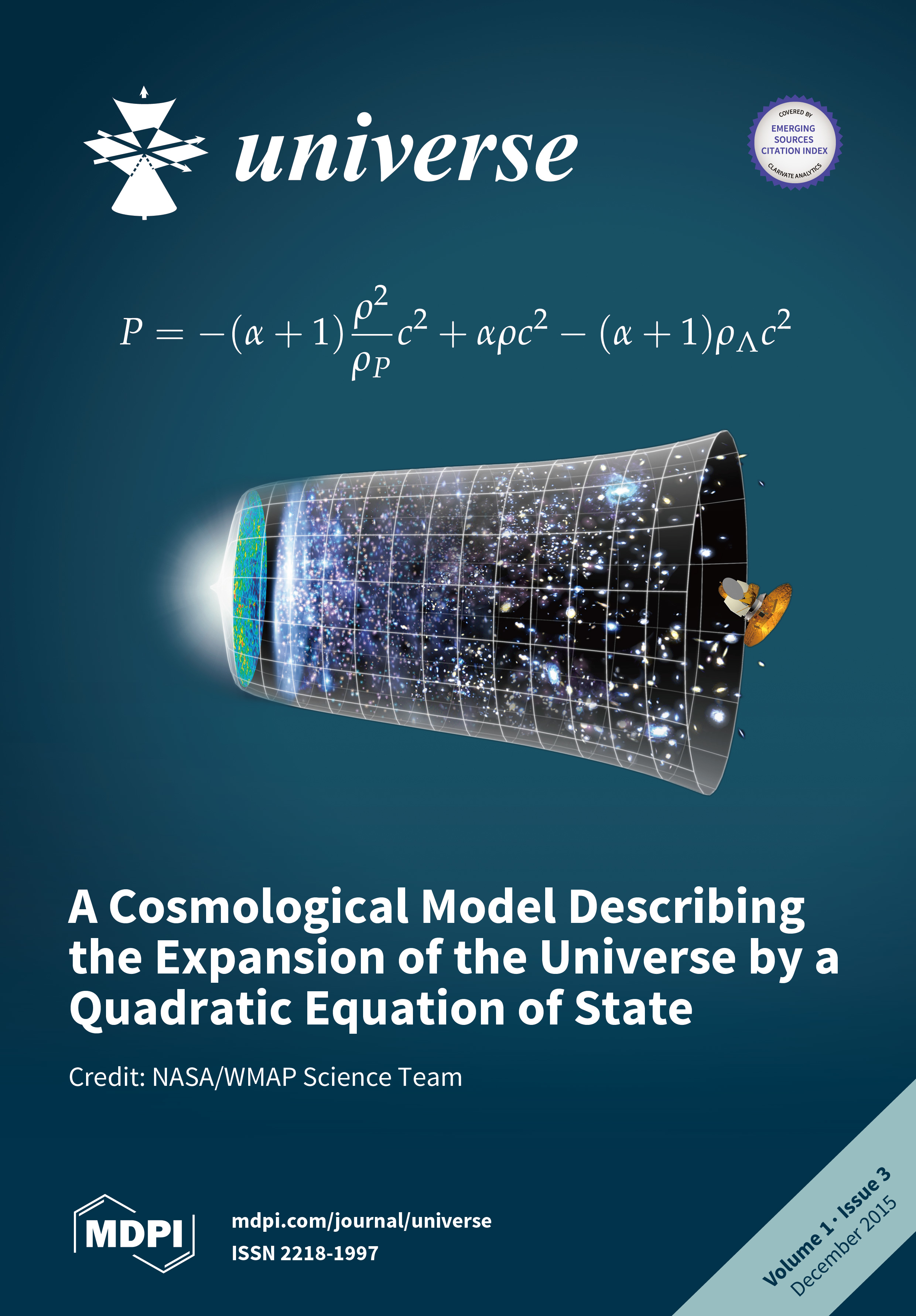
Cover Story (view full-size image):
The early inflation, the intermediate decelerating expansion and the late acceleration of the Universe can be described in a unified manner by a quadratic equation of state. The coefficients of this equation of state involve the Planck density ρP (vacuum energy) and the cosmological density ρΛ (dark energy). This equation of state provides a fully analytical solution of the Friedmann equations describing the whole cosmic history of the Universe from a primordial Planck era to a final de Sitter era. This cosmological model avoids the Big Bang singularity and leads to a smooth transition from the inflation era to the radiation era. It also exhibits a nice symmetry between the early and the late Universe. The Planck density ρP and the cosmological density ρΛ represent fundamental upper and lower density bounds differing by 123 orders of magnitude. View
- Issues are regarded as officially published after their release is announced to the table of contents alert mailing list.
- You may sign up for e-mail alerts to receive table of contents of newly released issues.
- PDF is the official format for papers published in both, html and pdf forms. To view the papers in pdf format, click on the "PDF Full-text" link, and use the free Adobe Reader to open them.
Previous Issue
Next Issue
