


Abstract
Islanded photovoltaic microgrids with limited inertial support can undergo steep frequency excursions after sudden generation loss or abrupt load changes. This paper develops and evaluates a synthetic inertia strategy supported by a supercapacitor energy storage unit for fast frequency containment in this type of system. The proposed approach commands rapid active-power injection or absorption from the measured rate of change of frequency, thereby emulating the immediate inertial contribution usually associated with rotating machines while preserving a simple and physically interpretable control structure. The supercapacitor is represented through a resistance–capacitance model that includes equivalent series resistance and is interfaced through a bidirectional buck–boost power converter subject to practical current, voltage, and power limits. Rather than claiming a fundamentally new storage-support concept, the contribution of this paper lies in providing a transparent and constraint-consistent benchmark that integrates measured operating profiles, explicit supercapacitor limits, hybrid frequency–RoCoF support, and stress-aware comparative assessment under a common set of plant assumptions. The methodology is assessed in time-domain simulations under representative benchmark disturbances, including an approximately ten percent photovoltaic generation loss, a ten percent load increase, and a combined event. Performance is evaluated through the peak rate of change of frequency, frequency nadir, integral error indices, time outside the admissible band, and supercapacitor stress indicators such as current peaks, voltage depletion, and energy throughput. An additional non-ideal assessment is also included to examine the behavior of the RoCoF-based support law under bounded frequency-measurement perturbations and delayed control action. A complementary variability-driven case based on a highly fluctuating measured irradiance window is also used to examine the behavior of the adaptive energy-management mechanism under repeated photovoltaic-power variations. A local small-signal analysis is also included to show that the selected gain region is dynamically plausible in the unsaturated regime. The results show that the proposed adaptive hybrid strategy improves the overall frequency response while maintaining admissible supercapacitor operation, thus providing a stronger methodological basis for rapid frequency support in islanded photovoltaic microgrids.
1. Introduction
The increasing penetration of converter-interfaced renewable generation is reducing the amount of naturally available rotational inertia and, with it, the intrinsic frequency-buffering capability of power systems. This issue becomes more severe in islanded photovoltaic microgrids, where abrupt power imbalances may produce large RoCoF values and deep frequency excursions because generation variability is high and the synchronous contribution is limited. Under these conditions, fast active-power support from storage devices has become a relevant option for improving short-term frequency containment [1,2,3,4]. Among the available technologies, supercapacitors are especially attractive for the earliest post-disturbance interval because they combine high power density, fast reversible power exchange, and relatively simple interfacing requirements [5,6].
The foundations of converter-based frequency support were established in the broader microgrid and virtual inertia literature. Hierarchical control frameworks clarified the interaction between primary, secondary, and tertiary layers in AC and DC microgrids [7,8], while synchronverter-based and distributed virtual inertia formulations showed that inertia-like and damping-like responses can be synthesized through control rather than through electromechanical storage alone [9,10]. Subsequent studies reported improved transient behavior and enhanced robustness in renewable-rich microgrids when converter support is properly tuned and constrained [11,12,13,14,15]. These contributions establish the relevance of synthetic inertia in low-inertia systems, but they do not in themselves define how a supercapacitor-based controller should be benchmarked under explicit device limits. A closely related body of work has focused on photovoltaic converter support and supercapacitor-assisted frequency regulation. Early formulations demonstrated that two-stage photovoltaic interfaces can provide primary frequency response and emulate inertial effects through control [16,17]. Later studies extended this idea to adjustable inertia support, hybrid photovoltaic–storage coordination, and implementation-oriented support schemes in weak and islanded grids [18,19,20,21,22]. In parallel, supercapacitor-specific studies showed that these devices can improve the transient response of isolated systems and renewable-dominated microgrids when used as fast support actuators [6,23,24,25,26,27,28,29,30]. Taken together, these studies strongly support the use of supercapacitors for short-term frequency stabilization, but they rarely compare alternative control laws within a single benchmark that also tracks current peaks, voltage depletion, and energy headroom. Derivative-based and RoCoF-oriented formulations are particularly relevant to the present study because they target the earliest stage of the frequency excursion. Prior work has shown that supplementary derivative action can improve the inertial response of supercapacitor-based support and that RoCoF-sensitive control can be effective for arresting the initial frequency slope [31,32,33,34,35,36,37,38]. At the same time, hybrid-storage and parameter-optimization studies have emphasized that the best dynamic response is not necessarily obtained from the most aggressive support setting once device stress and admissibility are taken into account [39,40,41,42,43,44,45,46,47]. This literature suggests that controller evaluation should jointly consider disturbance arrest, subsequent trajectory quality, and storage burden.
Despite these advances, fewer studies combine the following elements within a single constraint-consistent framework: an islanded photovoltaic operating point derived from measured profiles; an explicit supercapacitor model with equivalent series resistance and hard current/voltage limits; a RoCoF-sensitive control law evaluated together with droop-only, derivative-only, and fixed hybrid baselines; and a sensitivity analysis that relates controller aggressiveness to both frequency quality and device stress. This gap is not due to a lack of relevant ingredients in the literature but rather to the limited number of studies that integrate them within one transparent benchmark. To clarify the positioning of this study, Table 1 compares representative contributions against five features that are central here: islanded photovoltaic microgrid operation, explicit supercapacitor modeling, RoCoF-based support, multi-baseline benchmarking, and sensitivity-based trade-off analysis. The comparison shows that these features have been addressed individually in prior work, but their joint integration remains less common.
Table 1.
Positioning of the present work against representative studies. Y: yes; P: partially; N: not central.
The novelty claim of the present work should therefore be interpreted with precision. This paper does not argue that hybrid support, energy-aware modulation, or supercapacitor-based fast frequency support are individually unprecedented. Instead, its contribution lies in integrating these ingredients into a single benchmark that is physically constrained, reproducible, and directly anchored to measured operating conditions. Under this framing, this paper advances the literature by clarifying how an adaptive hybrid support law compares against representative alternatives when the same plant assumptions, actuator limits, and stress indicators are imposed on all of them.
The contributions of this study are fourfold:
- An energy-aware synthetic inertia controller is formulated for an islanded photovoltaic microgrid using frequency deviation and RoCoF signals together with an explicit supercapacitor model with equivalent series resistance and hard operating limits.
- A unified benchmark is established to compare the proposed controller against no fast support, droop-based support, derivative-only support, and fixed hybrid support under photovoltaic loss, load increase, and combined disturbances.
- A sensitivity analysis is developed to relate RoCoF gain and initial usable-energy headroom to both frequency-response quality and supercapacitor stress.
- A local small-signal assessment is included to verify that the retained gain region is consistent with stable closed-loop behavior in the unsaturated regime.
The remainder of this paper is organized as follows. Section 2 describes the system model, the controller formulations, the benchmark scenarios, and the performance metrics. It also makes the controller-tuning criterion explicit and introduces a local stability analysis. Section 3 presents the comparative results and the sensitivity analysis. Section 4 interprets the main findings and discusses the study limitations. Section 5 concludes this paper.
2. Materials and Methods
This study was formulated as a simulation benchmark to evaluate the extent to which a supercapacitor-based fast active-power actuator can improve frequency containment in an islanded photovoltaic microgrid. The methodological framework combines a reduced-order frequency-response model, an explicit supercapacitor representation with equivalent series resistance, a bidirectional buck–boost interface, and local measurements of frequency and RoCoF at the point of common coupling. The benchmark compares operation without fast support and with alternative synthetic inertia strategies under representative photovoltaic-loss, load-step, and combined disturbances.
2.1. Case Study and General Modeling Assumptions
The case study represents a low-inertia islanded photovoltaic microgrid with aggregated photovoltaic generation, aggregated load demand, synchronous support, and a fast supercapacitor branch connected through a bidirectional direct-current to direct-current interface. The model was implemented in MATLAB R2024b through a script-based workflow designed to remain fully reproducible and directly traceable to a Simulink-oriented formulation. Rather than pursuing a detailed electromagnetic switching model of the full laboratory installation, the methodology adopted a control-oriented reduced-order representation. This decision is appropriate for the present paper because the contribution is not the converter modulation itself but the effect of fast synthetic inertia support on the dominant frequency dynamics of the islanded system. Reduced-order frequency models are widely used for low-inertia studies, virtual inertia design, and synthetic inertia benchmarking because they preserve the imbalance-to-frequency mechanism while avoiding unnecessary switching complexity [2,48,49,50].
The present benchmark nevertheless retains several non-ideal features that are relevant for first-swing frequency support. In particular, the plant includes finite governor dynamics, filtered RoCoF estimation, supercapacitor equivalent-series-resistance losses, hard current/voltage/power saturation, and asymmetric energy headroom for discharge and charge actions. Accordingly, the model is reduced-order, but it is not an unconstrained algebraic power-injection surrogate. This distinction is important when interpreting the results since this study aims to compare control laws under realistic actuator limitations, even though switching-level and laboratory effects remain outside the scope of the present paper.
The aggregated active-power imbalance was represented by a swing-equation-type model written directly in the frequency domain. Let denote the nominal frequency, the instantaneous system frequency, and the frequency deviation. The dominant active-power dynamics are written as
where is the equivalent frequency inertia coefficient, is the aggregated damping coefficient, is the photovoltaic power variation, is the synchronous-support power variation, is the supercapacitor power injection, and is the load-power variation. Equation (1) is the reduced-order balance that links the net power mismatch to the instantaneous frequency slope and therefore to the rate of change of frequency, which is the quantity of interest in synthetic inertia studies [2,36,37,48,49]. The synchronous support term was retained because the selected benchmark operating point corresponds to a mixed operating condition in which photovoltaic generation and synchronous power coexist rather than to a purely converter-dominated extreme.
The photovoltaic and load disturbances were implemented as step-like perturbations around a pre-disturbance operating point extracted from measured seasonal profiles. If denotes the event time, the benchmark scenarios are represented as
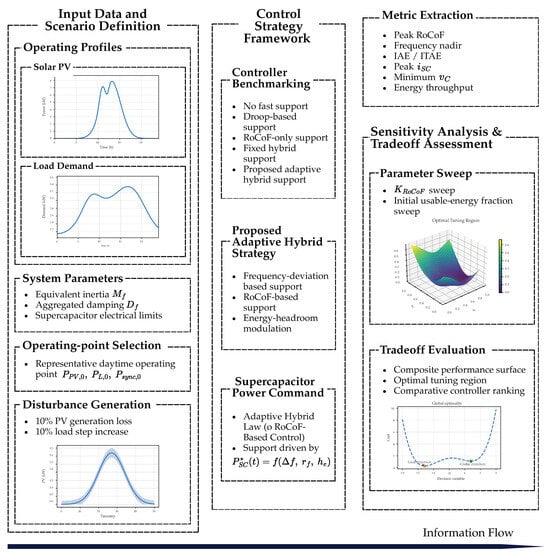
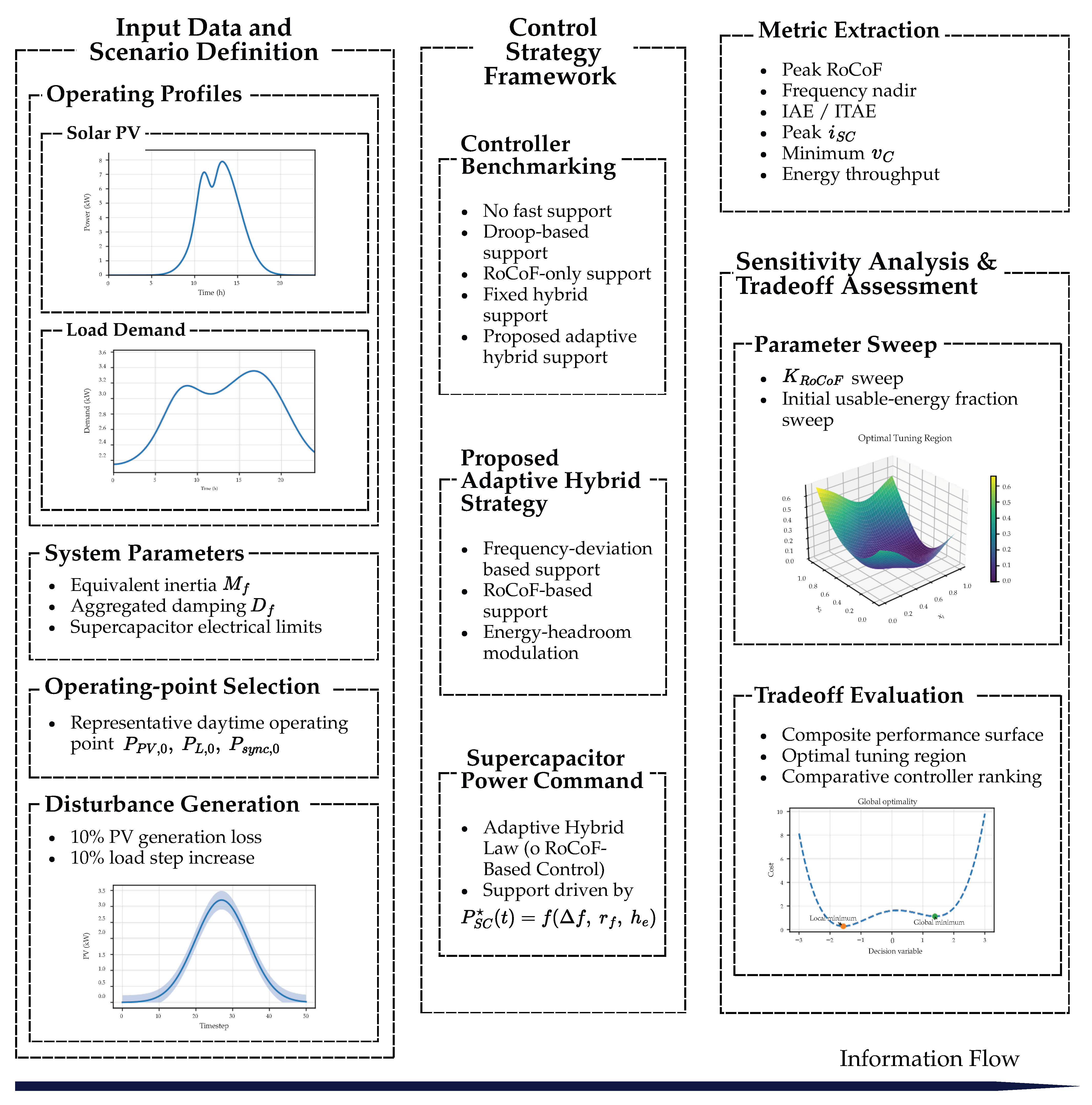
where is the Heaviside function, and are the pre-disturbance photovoltaic and load trajectories, and and define the disturbance magnitude. In the present benchmark, , which is consistent with the scenario family declared in the thesis documentation and provides a sufficiently severe but still realistic transient for comparative evaluation. This disturbance-oriented formulation is standard in low-inertia frequency-response studies because it isolates the causal effect of sudden power imbalance on rate of change of frequency, nadir, and recovery behavior [34,35,37]. Figure 1 summarizes the methodological workflow adopted in this study, linking profile selection, reduced-order modeling, controller benchmarking, and sensitivity analysis within a unified simulation framework.
Figure 1.
General methodological workflow of the proposed study, including operating-point selection, disturbance generation, controller benchmarking, metric extraction, and sensitivity analysis.
2.2. Supercapacitor and Bidirectional Interface Model
The supercapacitor branch was modeled through a first-order electrical representation with capacitance and equivalent series resistance . Let denote the capacitor voltage, the terminal voltage seen by the converter, and the supercapacitor current, defined as positive during discharge toward the alternating-current side. The electrical model is written as
where is the instantaneous supercapacitor power. Equations (4)–(6) are the standard control-oriented relations used to capture the fast power capability, voltage drop, and current stress of supercapacitor-based support devices without resorting to a full electrochemical model [5,6,28,40,41]. Substituting (4) into (6) yields the quadratic relation
from which the physically admissible current branch is selected according to the sign of commanded power. This step is important because the current, not only the exchanged power, determines the electrical effort experienced by the device during inertial support [27,40].
The stored energy is represented through the capacitor voltage as
and the corresponding usable-energy fraction is defined by
where and are the minimum and maximum admissible supercapacitor voltages, respectively. This normalized state variable is convenient because it links the electrical state of the supercapacitor directly to the remaining inertial headroom and therefore to the admissible support intensity. Energy-headroom formulations of this kind are common when the design objective is to prevent aggressive initial support from driving the storage device too deeply into its voltage limits [40,45,46].
The bidirectional buck–boost stage is represented by its averaged power exchange with saturation constraints rather than by switch-level states. Accordingly, the commanded supercapacitor power is limited between the maximum charging power and the maximum discharging power as
where is the maximum admissible supercapacitor current. These limits guarantee that every benchmark controller is evaluated under the same hardware envelope, which is essential for a fair comparison between control laws [5,6,40].
2.3. Frequency and Rate-of-Change-of-Frequency Estimation
The control signal was derived from local frequency measurements at the point of common coupling. The instantaneous frequency deviation is defined as
and the raw rate-of-change-of-frequency signal is obtained from the time derivative of . Since direct numerical differentiation can amplify high-frequency noise and initialization artifacts, the derivative channel is filtered through a first-order low-pass stage:
where denotes the filtered rate of change of frequency used by the controller and is the filter time constant. The right-hand side of (13) corresponds to the raw time derivative of the frequency deviation. This filtered-derivative formulation is a practical compromise widely adopted in rate-of-change-of-frequency-based synthetic inertia and derivative-support implementations because it preserves the very fast frequency information required for inertial emulation while avoiding spurious control effort caused by measurement noise or discrete-time differentiation [14,32,33,34]. The same local measurement structure was used for all controllers so that differences in performance are attributable to the control law itself rather than to the estimator.
2.4. Non-Ideal Measurement and Delayed Actuation Model
To extend the benchmark toward more realistic operating conditions, an additional non-ideal assessment was incorporated in the revised manuscript. The objective of this extension was to evaluate whether the filtered RoCoF-based support law preserves stable and meaningful behavior when the frequency measurement is no longer ideal and when the control action is not applied instantaneously.
The measured frequency signal is represented as
where is the true system frequency and is a bounded measurement perturbation. In the present benchmark, is modeled as a reproducible pseudo-noise signal composed of two sinusoidal components,
which allows the RoCoF estimator to be stressed under non-ideal sensing conditions without introducing non-reproducible random realizations.
Under this extension, the RoCoF estimator acts on the measured frequency rather than on the ideal internal frequency state. Accordingly, the filtered derivative channel becomes sensitive to both the true electromechanical transient and the time derivative of the measurement perturbation. This allows the benchmark to test whether the selected filtering stage remains sufficient to prevent spurious amplification of the support command.
To represent a finite effective delay in the control loop, the raw supercapacitor power reference is not applied directly to the actuator. Instead, the commanded support power is passed through a first-order lag:
where is the effective delay time constant. This lag is not intended to reproduce a detailed communication network but rather to represent the combined effect of finite measurement, signal-processing, communication, and actuation latency in a compact and control-oriented form.
The resulting non-ideal assessment therefore preserves the original benchmark structure while extending it in two practically relevant directions: imperfect frequency sensing and delayed actuation. The corresponding numerical results are reported in Section 3.5.
2.5. Benchmark Controller Families
To keep this paper aligned with the scope of the underlying degree project while still providing a sufficiently strong journal contribution, all controllers were derived from the same physical actuation channel and the same measurement pair . The generic command law is written as
where enforces (10), is the frequency-deviation gain, and is the rate-of-change-of-frequency gain. Equation (17) encompasses the three literature-inspired families considered in the benchmark. Setting produces the droop-type fast-frequency support controller; setting produces the rate-of-change-of-frequency-only synthetic inertia controller; and keeping and yields a fixed hybrid controller. These controller families were selected because they represent recurring design lines in recent virtual inertia, derivative-damping, and supercapacitor-based support studies [14,32,35,36,37].
The controller proposed in this paper preserves the same core structure but adds an energy-aware modulation so that the requested power becomes stronger when sufficient usable energy is available and more conservative as the supercapacitor approaches its lower-voltage region. The proposed command is written as
with
where is the energy-headroom modulation factor, and weight the frequency and rate-of-change-of-frequency channels, avoids complete control collapse at low energy headroom, and shapes the sensitivity of the adaptive factor. The key point is that (18) does not abandon the rate-of-change-of-frequency-based inertial logic stated in the thesis proposal; instead, it extends it into an energy-aware hybrid law that remains fully consistent with a supercapacitor actuator and with the same disturbance family while improving the global trade-off between transient quality and storage stress. Energy-aware synthetic inertia and hybrid storage coordination have been increasingly used to prevent the best frequency metrics from being achieved at the expense of excessive current peaks or overly deep voltage excursions [40,41,42,45].
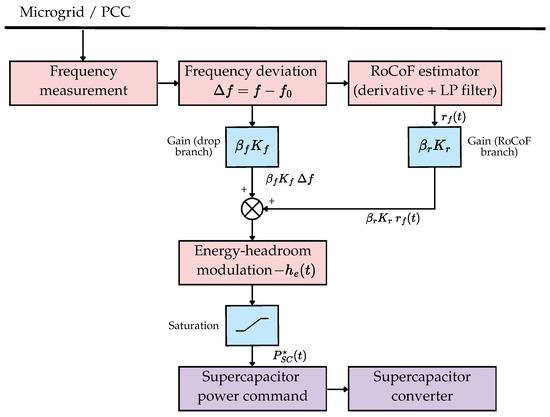
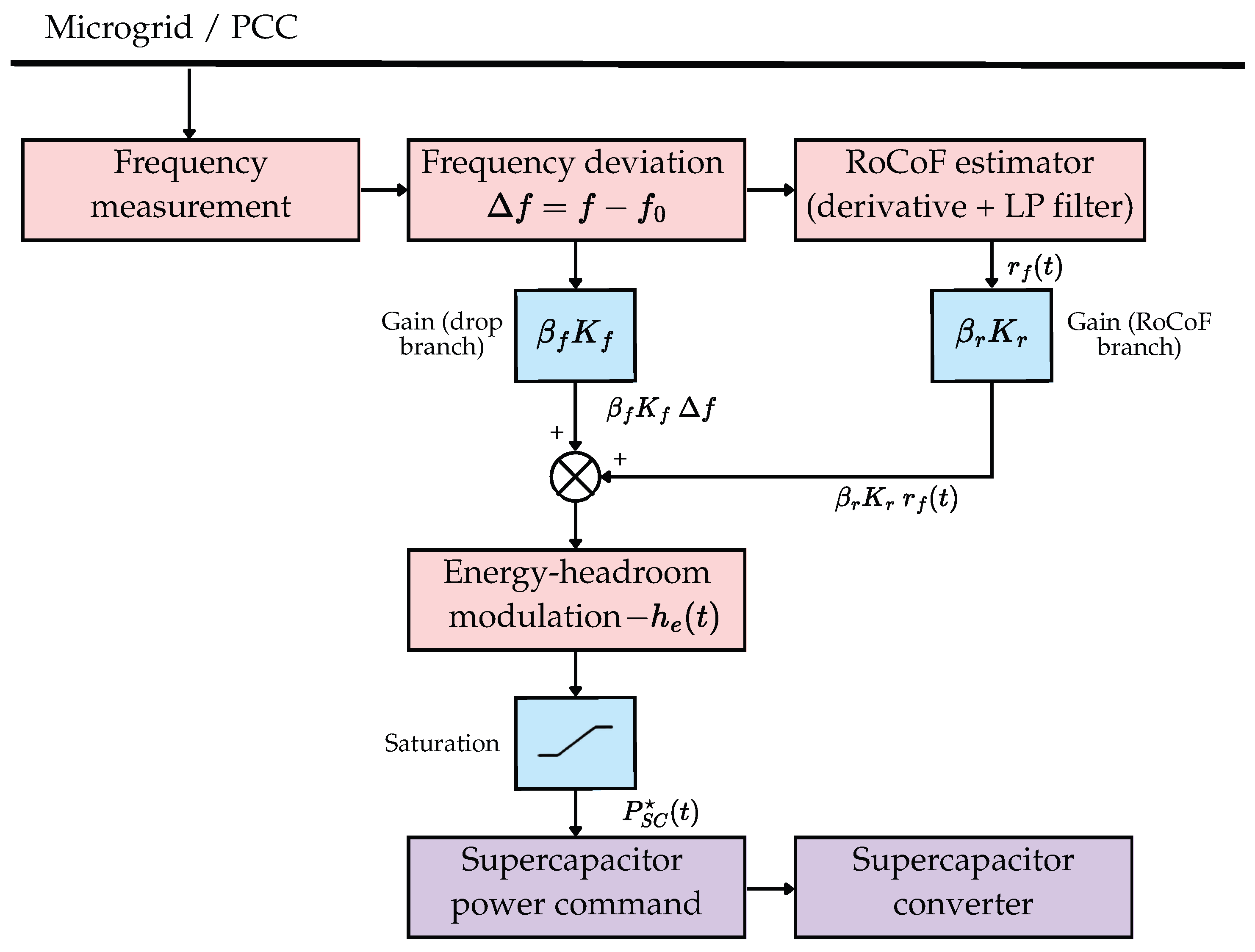
To better reflect the actual numerical implementation, the adaptive factor should be interpreted as a bounded headroom modifier of the hybrid command, not as an independent control channel. In other words, the controller does not switch between qualitatively different operating modes; rather, it continuously scales the same hybrid frequency–RoCoF action according to the instantaneous energy availability of the supercapacitor. This clarification is relevant because it explains why the proposed method preserves the favorable transient shape of a hybrid controller while avoiding overly aggressive actuation when the storage headroom becomes limited. Figure 2 shows the control structure of the proposed adaptive hybrid synthetic inertia strategy, including the frequency measurement, the rate-of-change-of-frequency estimation stage, the energy-headroom modulation, the saturation logic, and the resulting supercapacitor power command.
Figure 2.
Control structure of the proposed adaptive hybrid synthetic inertia strategy, including frequency measurement, rate-of-change-of-frequency estimation, energy-headroom modulation, saturation logic, and supercapacitor power command generation.
2.6. Operating-Point Selection, Disturbance Matrix, and Tuning Procedure
The benchmark was not evaluated at an arbitrary operating state. Instead, the simulations were anchored to measured seasonal profiles so that each event was applied around a realistic daytime condition where photovoltaic production, load demand, and synchronous support were simultaneously active. This decision is methodologically important because the inertial usefulness of the supercapacitor depends not only on the controller gains but also on the pre-disturbance headroom available in the underlying microgrid. Three benchmark disturbances were used. The first and main scenario was a sudden photovoltaic generation loss of approximately 10%, implemented through (2). The second scenario was a sudden load increase of approximately 10%, implemented through (3). The third scenario combined both events and therefore represented the most severe benchmark condition. This three-scenario matrix was chosen to remain aligned with the thesis objectives while also making this paper strong enough from a comparative viewpoint, since it forces the controllers to respond to source-side, load-side, and compounded disturbances using the same hardware limits. To complement these abrupt benchmark events, an additional variability-driven test was also considered in the revised manuscript. Rather than defining another synthetic step disturbance, this complementary case uses a one-hour irradiance window extracted from the measured daily dataset with one-minute resolution and selected for its high intra-window variability. The purpose of this additional case is not to replace the step-disturbance benchmark but to examine whether the adaptive energy-management mechanism remains well-behaved when the photovoltaic source undergoes repeated fluctuations over a short horizon.
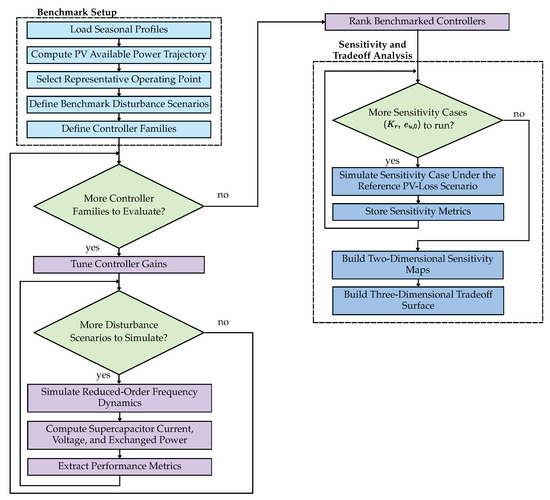
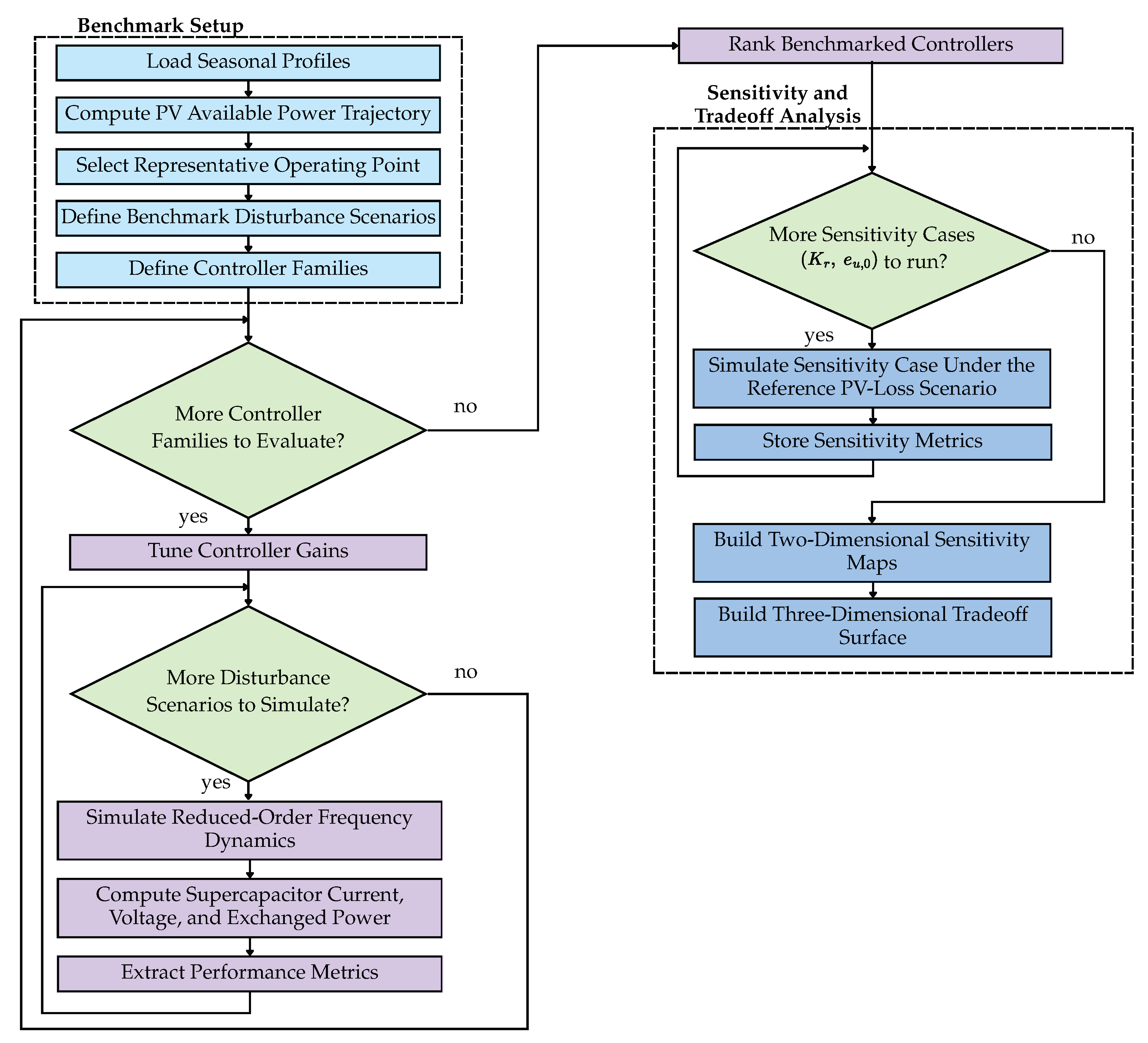
Controller gains were tuned by simulation sweeps under identical operating conditions and identical device constraints. For the rate-of-change-of-frequency sensitivity study, was swept from 0 to 8 kW/(Hz/s) in increments of 0.5, and the initial usable-energy fraction was swept from 0.3 to 0.9 in increments of 0.1. The literature-inspired controller families and the proposed adaptive hybrid law were then evaluated under the same benchmark scenarios. This design-oriented sweep is consistent with recent studies that frame virtual inertia tuning as a compromise between rate-of-change-of-frequency containment, nadir preservation, and storage stress rather than as the minimization of a single isolated metric [40,45,46,47]. To make the simulation workflow fully transparent, Figure 3 summarizes the sequence followed in the benchmark, from operating-point definition and disturbance generation to controller tuning, metric extraction, and comparative ranking. Algorithm 1 provides the same procedure in pseudocode form so that the numerical workflow can be reproduced step by step from the profile data to the final benchmark outputs.
Figure 3.
Flowchart of the simulation and benchmarking procedure used to evaluate the proposed controller and the literature-inspired baselines.
In the revised manuscript, the tuning step is made explicit through a composite screening criterion rather than being described only as a qualitative sweep. For each candidate gain pair, the post-disturbance response was evaluated through peak RoCoF, nadir deviation, ITAE, time out of band, and peak supercapacitor current. These terms were normalized over the explored grid and combined into a weighted score:
where . The retained gain set was not the one that minimized a single indicator in isolation but the one located in the low-score region of the explored grid while preserving admissible current and voltage behavior. This clarification is important for the fairness of the benchmark because all controller families were tuned under the same criterion and under the same plant and actuator assumptions.
| Algorithm 1 Benchmark evaluation and tuning workflow. | |
| Require: Seasonal profiles, controller parameter set, disturbance set | |
| Ensure: Benchmark tables, figures, sensitivity maps, and ranking metrics | |
| 1: | Load seasonal irradiance, temperature, and demand profiles |
| 2: | Compute photovoltaic available power trajectory |
| 3: | Select representative operating point from the December daytime profile |
| 4: | Define benchmark scenarios: photovoltaic trip, load step, and combined event |
| 5: | Define controller families: no fast support, droop, rate-of-change-of-frequency-only, fixed hybrid, and proposed adaptive hybrid |
| 6: | for each controller family do |
| 7: | Tune controller gains under identical device and operating constraints |
| 8: | for each disturbance scenario do |
| 9: | Simulate reduced-order frequency dynamics |
| 10: | Compute supercapacitor current, voltage, and exchanged power |
| 11: | Extract peak rate of change of frequency, nadir, integral error metrics, time out of band, and settling time |
| 12: | end for |
| 13: | end for |
| 14: | Rank benchmarked controllers using aggregated performance indicators |
| 15: | for each value of and initial usable-energy fraction do |
| 16: | Simulate sensitivity case under the reference photovoltaic-loss scenario |
| 17: | Store peak rate of change of frequency, nadir, peak current, minimum voltage, and throughput |
| 18: | end for |
| 19: | Build two-dimensional sensitivity maps |
| 20: | Build three-dimensional trade-off surface from normalized performance indices |
To improve reproducibility and make the tuning procedure fully explicit, Table 2 reports the plant, estimator, actuator, and controller settings retained for the benchmark. All controller families were tuned on the same operating point set, under the same disturbance matrix and the same hardware constraints, using the composite screening criterion introduced in (20). The selected parameter set should therefore be interpreted as the best compromise found within the explored grid rather than as the minimizer of a single isolated metric.
Table 2.
Final plant, estimator, actuator, and controller parameters used in the benchmark.
2.7. Performance Metrics and Comparative Criteria
The quantitative assessment was carried out on the post-disturbance window , where is the disturbance time and is the final simulation time. The main frequency metrics are defined as
where is the peak absolute rate of change of frequency, is the minimum frequency reached after the disturbance, is the integral of the absolute error, and is the integral of the time-weighted absolute error. These indicators jointly capture the steepest initial slope, the deepest excursion, and the accumulated transient burden; together they are more informative than any single metric when comparing synthetic inertia strategies [29,35,36,37].
To quantify frequency containment and recovery, the time out of band and the settling time are defined as
where is the indicator function, which takes the value 1 when the frequency deviation exceeds the admissible band and 0 otherwise, and is the adopted tolerance band. These two metrics are especially useful when two controllers show similar nadir values but differ in how long the system remains outside the admissible band [37,46].
The electrical effort imposed on the supercapacitor was quantified through
where is the peak absolute supercapacitor power, is the peak absolute supercapacitor current, is the minimum capacitor voltage during the transient, and is the energy throughput. These variables were monitored because an improvement in frequency quality is only meaningful if it is obtained within admissible current, voltage, and energy-throughput levels. This coupled reading of dynamic benefit and device stress is fundamental in supercapacitor-based support studies [5,27,40,41].
Finally, the sensitivity study is summarized with a composite trade-off surface based on normalized performance variables:
where x denotes any performance variable included in the composite trade-off analysis, and and are the minimum and maximum values of that variable over the sensitivity grid. Moreover, denotes the normalized nadir deviation . Lower values of indicate more favorable tuning regions. Equation (31) was not used to replace the detailed metrics but to synthesize the multi-objective compromise underlying the gain-selection process. This type of design-oriented scalarization is appropriate when tuning support laws that must simultaneously protect frequency quality and storage admissibility [40,45,46].
2.8. Local Small-Signal Assessment
To address the need for stronger theoretical support, a local small-signal analysis was carried out around the pre-disturbance operating point. The analysis was restricted to the unsaturated regime and to the initial support interval, where the adaptive headroom factor can be approximated by a frozen value . Under this assumption, the proposed controller behaves locally as a linear hybrid support law,
where
For the nominal proposed-controller settings and the retained initial headroom condition, the corresponding effective gains were computed directly from (33). The resulting values remain within the locally stable region identified for the proposed controller.
Using the state vector
the linearized closed-loop dynamics can be written as
with
For the selected nominal parameters, the eigenvalues of are
which lie in the open left half-plane. This confirms local asymptotic stability of the frozen-gain closed loop in the unsaturated regime. Although this result does not replace nonlinear large-signal validation under saturation, it does show that the retained gain region is not justified only by empirical ranking but is also compatible with a locally stable dynamic structure.
2.9. Implementation and Reproducibility
All simulations were executed with the same model structure, the same hardware limits, and the same disturbance set for every controller family. The script-based implementation automatically exported the benchmark tables, time-series figures, sensitivity maps, and ranking summaries used in this paper. This organization was adopted to ensure full reproducibility of the numerical results and to make the workflow auditable from operating-point selection to final metric extraction. Under this methodology, any improvement attributed to the proposed controller is not the result of changing the plant model or relaxing the device constraints but of modifying only the control law applied to the same islanded photovoltaic microgrid benchmark.
3. Results
This section reports the benchmark results in the same sequence used in the numerical workflow. First, the operating point used for all simulations is defined. Second, the proposed controller is compared against the case without fast support to isolate its net contribution. Third, the proposed controller is assessed against the baseline controllers under the three disturbance scenarios. Fourth, a sensitivity analysis is used to examine how performance changes with the RoCoF gain and the initial usable-energy fraction. Finally, the tuned-controller suite is condensed into an overall comparative ranking.
3.1. Operating Point and Benchmark Definition
All benchmark disturbances were applied around a representative daytime operating point extracted from the December profile. The selected condition corresponds to 12:13 and reflects a realistic islanded dispatch state in which photovoltaic generation, load demand, and synchronous support are simultaneously relevant. This avoids evaluating the controller at either a near-zero photovoltaic condition or an extreme irradiance point, both of which would be less informative for comparative purposes. The numerical values that define the operating point are summarized in Table 3. Starting from this condition, three benchmark disturbances were considered: a 10% photovoltaic generation loss, a 10% load increase, and a combined event in which both disturbances occur simultaneously.
Table 3.
Selected operating point used as reference for the benchmark simulations.
3.2. Improvement Relative to the No-Fast-Support Case
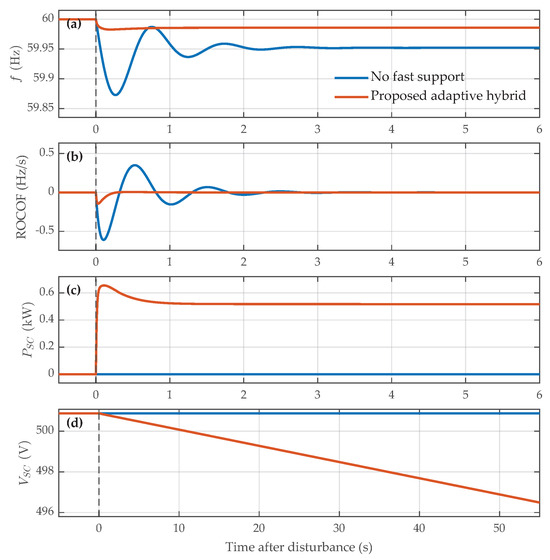
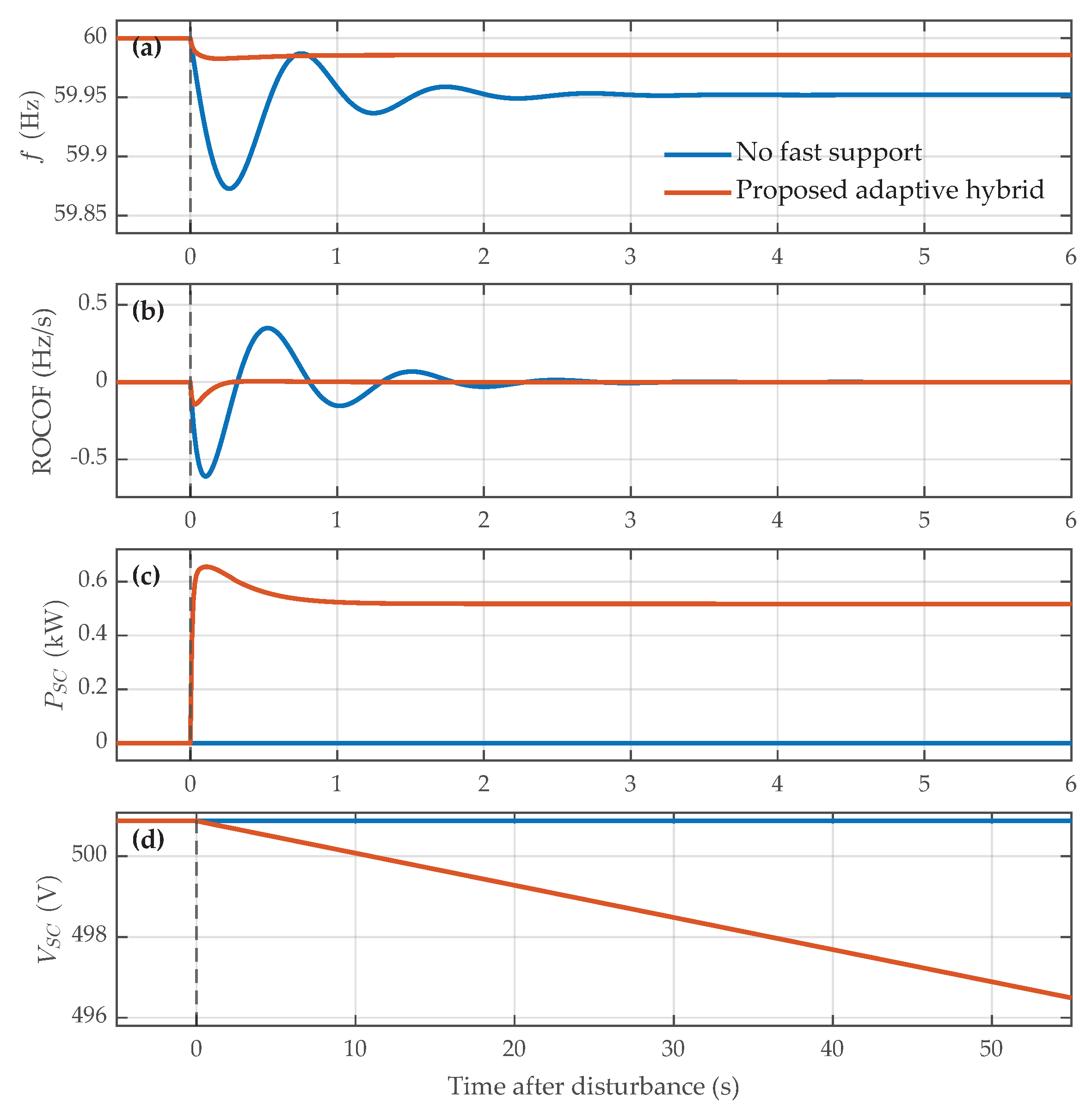
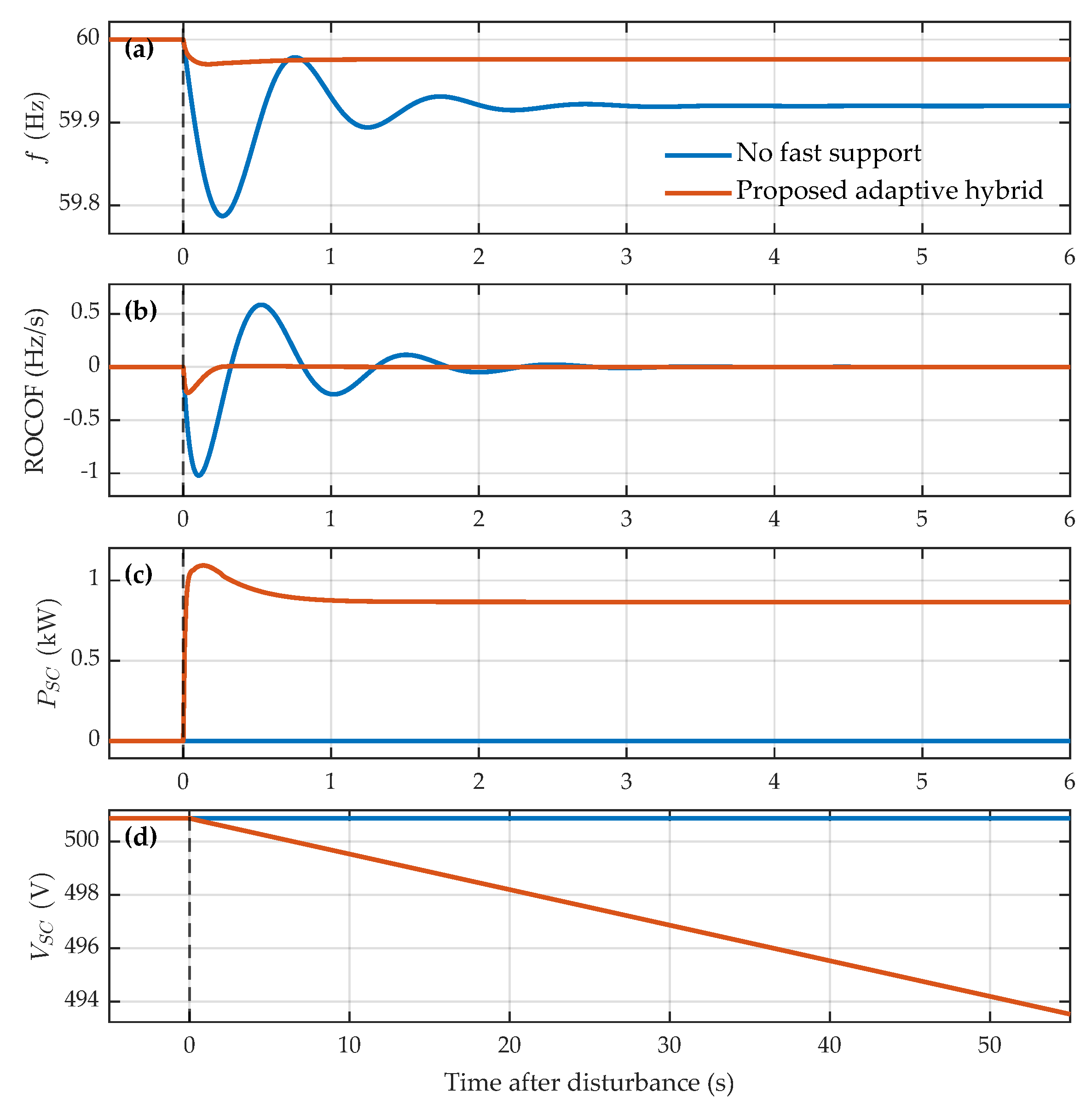
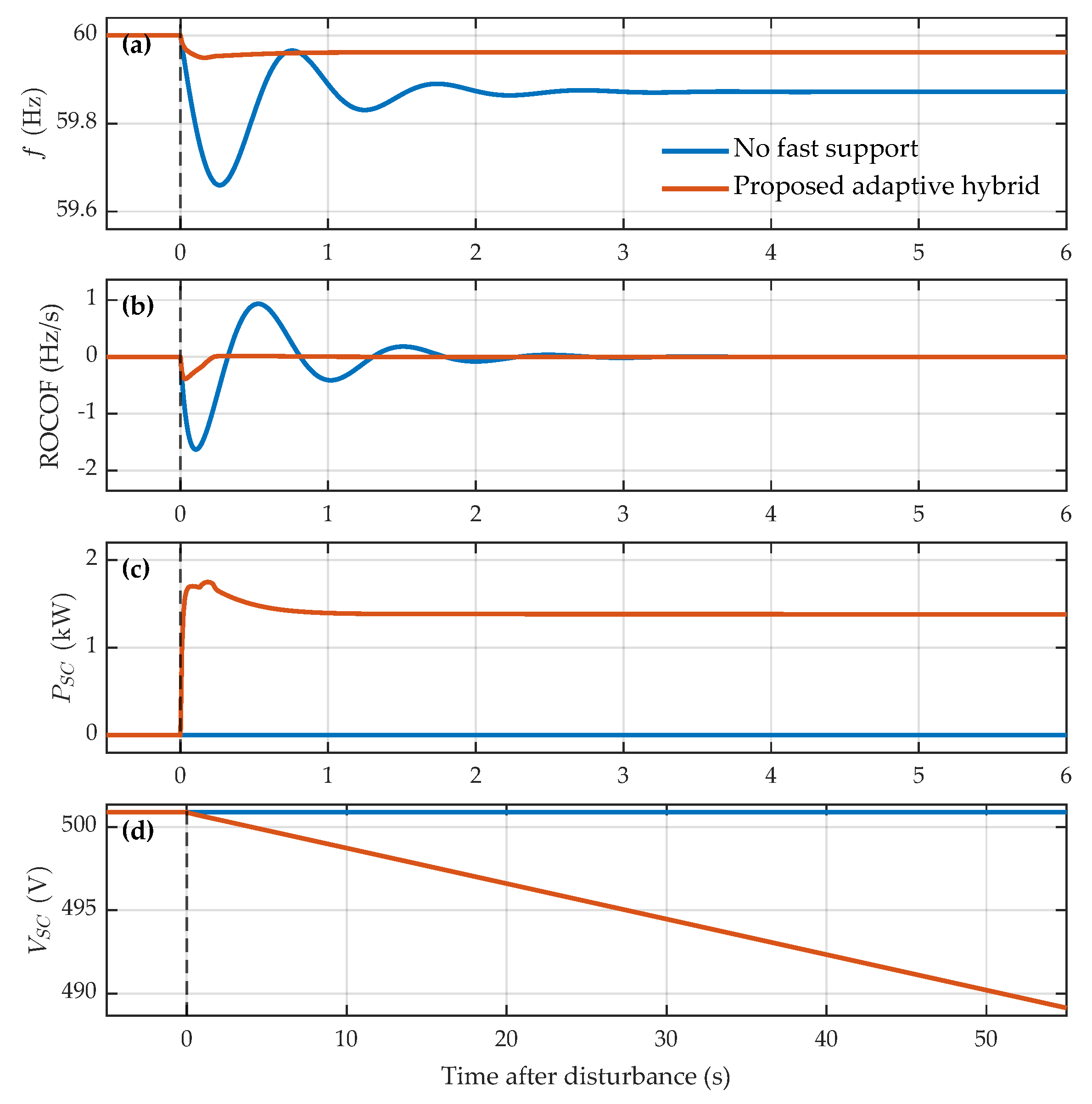
The first comparison isolates the contribution of the proposed controller by contrasting it with the case without fast supercapacitor support. Across the three disturbances, the proposed method produced a consistent reduction in the severity of the frequency excursion. Relative to the no-fast-support case, it reduced the peak RoCoF by about 76%, reduced the maximum absolute frequency deviation by about 85–86%, and reduced both IAE and ITAE by roughly 70%. The same pattern was observed for photovoltaic-side, load-side, and combined events, indicating that the improvement is not specific to a single disturbance type. Under the photovoltaic generation loss scenario, the peak RoCoF decreased from 0.610 to 0.145 Hz/s and the nadir increased from 59.873 to 59.983 Hz. Under the load increase scenario, the peak RoCoF decreased from 1.021 to 0.244 Hz/s and the nadir improved from 59.787 to 59.970 Hz. The combined event, which is the most severe case in the benchmark, showed the same qualitative behavior: the peak RoCoF decreased from 1.631 to 0.390 Hz/s and the nadir improved from 59.660 to 59.949 Hz. The associated reductions in maximum deviation, IAE, and ITAE indicate that the benefit is not limited to the initial slope arrest but extends to the subsequent transient trajectory.
These improvements should nevertheless be interpreted in comparative rather than absolute terms. The benchmark demonstrates that fast supercapacitor support can materially improve first-swing containment under the adopted plant assumptions, but it does not by itself prove field-ready performance. This clarification is important because this paper now positions the contribution as a stronger and fairer benchmark of controller behavior, not as a completed deployment study.
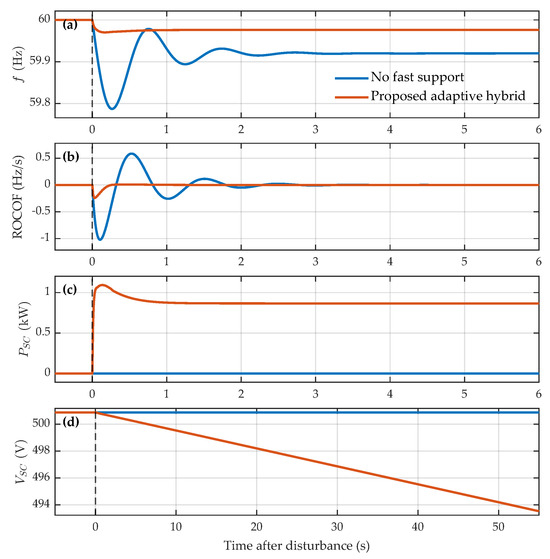
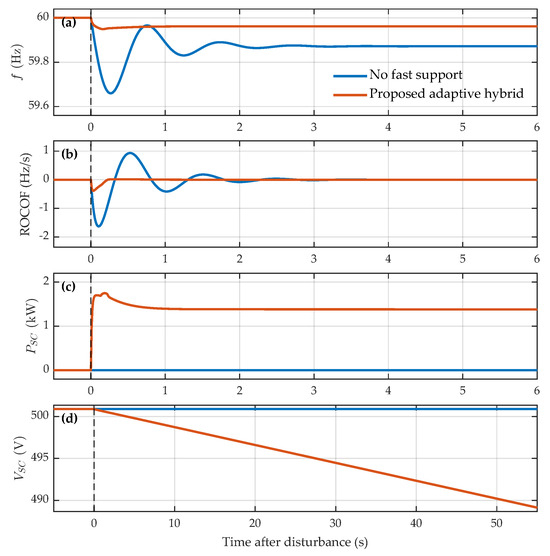
Table 4 summarizes these relative improvements, while Figure 4, Figure 5 and Figure 6 show the corresponding time-domain responses. The figures further indicate that the frequency improvement is achieved through a short and concentrated fast-power action from the supercapacitor rather than through a prolonged support interval. This behavior is consistent with the intended role of the device as a short-term actuator for early frequency containment.
Table 4.
Improvement achieved by the proposed adaptive hybrid strategy relative to the no-fast-support case.
Figure 4.
Base case and proposed method comparison under the photovoltaic generation loss scenario: (a) frequency response; (b) rate of change of frequency; (c) supercapacitor active-power support; and (d) supercapacitor voltage.
Figure 5.
Base case and proposed method comparison under the load increase scenario: (a) frequency response; (b) rate of change of frequency; (c) supercapacitor active-power support; and (d) supercapacitor voltage.
Figure 6.
Base case and proposed method comparison under the combined disturbance scenario: (a) frequency response; (b) rate of change of frequency; (c) supercapacitor active-power support; and (d) supercapacitor voltage.
3.3. Comparison with Baseline Controllers
Although the direct comparison with the reference case already demonstrates the effectiveness of the proposed strategy, a more demanding assessment requires comparison against representative benchmark controllers drawn from the literature. For this reason, the benchmark included a droop-based baseline, a derivative-only baseline, and a fixed hybrid baseline. These controller families reflect recurring formulations reported for supercapacitor-assisted frequency support, RoCoF-based synthetic inertia, and combined inertia–damping support in low-inertia microgrids [5,6,14,32,35,37]. The results reveal a stable ranking pattern across all scenarios. The fixed hybrid baseline achieved the lowest peak RoCoF in each case, whereas the proposed adaptive hybrid controller delivered the best overall transient quality when nadir, maximum absolute deviation, IAE, and ITAE are considered jointly.
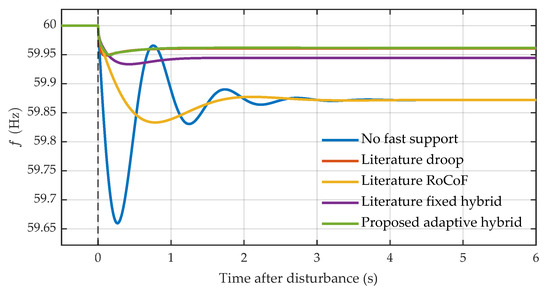
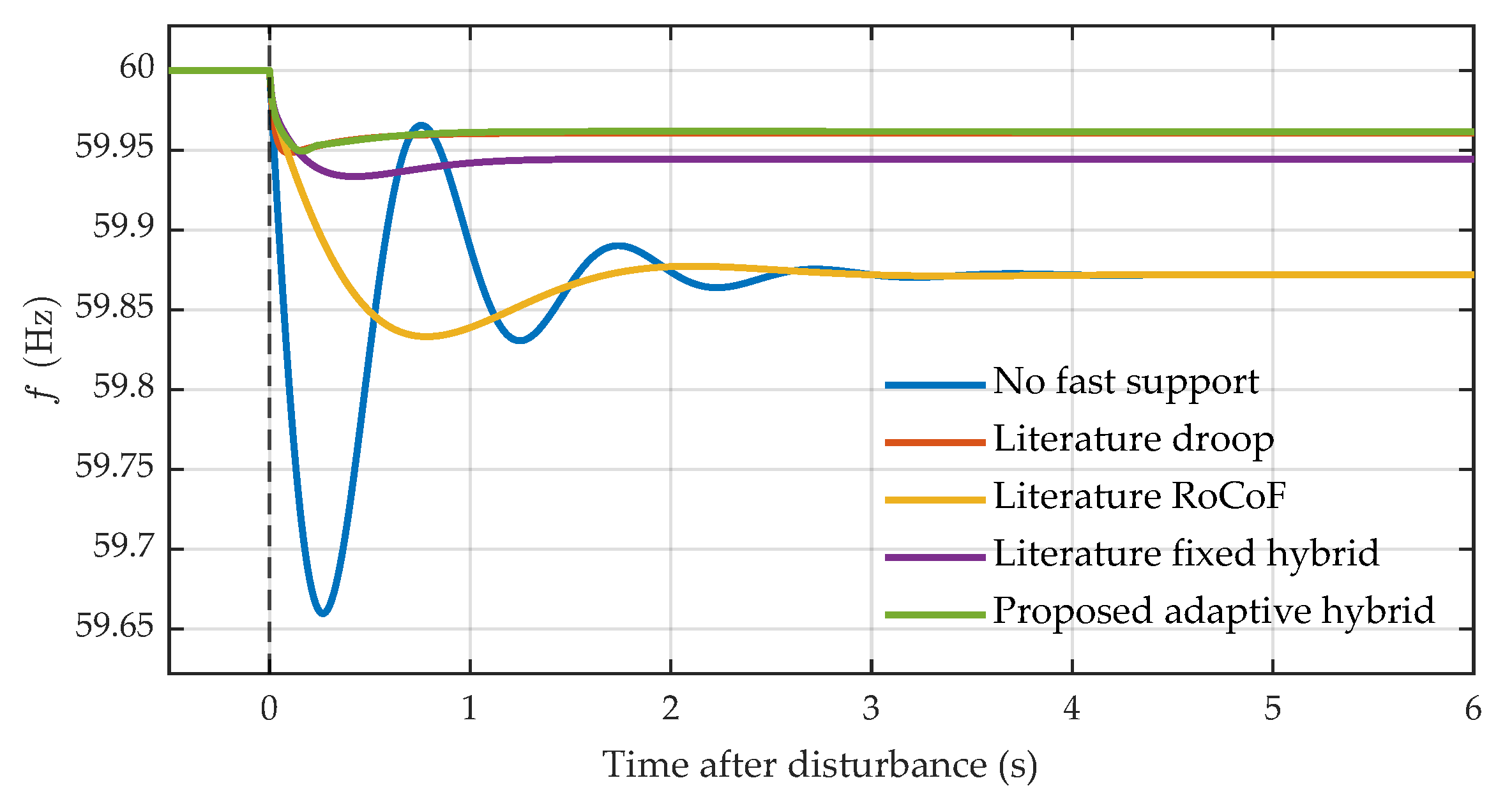
In the photovoltaic generation loss scenario, the fixed hybrid baseline attained the minimum peak RoCoF of 0.133 Hz/s, slightly below the 0.145 Hz/s obtained with the proposed controller. However, the proposed controller yielded the highest nadir and the lowest values of maximum absolute deviation, IAE, and ITAE. The same behavior remained visible in the load increase scenario and in the combined disturbance. Under the combined event, for example, the proposed controller did not produce the minimum peak RoCoF, but it matched the best nadir and yielded the lowest IAE and ITAE among the fast-support strategies. This indicates that the proposed law does not act as a pure slope minimizer; instead, it provides a more favorable balance between early disturbance arrest and subsequent transient recovery. The derivative-only baseline was effective at reducing the initial frequency slope, but its nadir and integral error indices remained comparatively poor, particularly in the more severe disturbances. The droop-based baseline showed a more balanced response than the derivative-only case but remained slightly behind the proposed controller in the aggregate frequency-quality metrics. These differences are visible in Table 5, Table 6 and Table 7 and are summarized graphically in Figure 7 for the combined event.
Table 5.
Detailed controller comparison under the photovoltaic generation loss scenario.
Table 6.
Detailed controller comparison under the sudden load increase scenario.
Table 7.
Detailed controller comparison under the combined disturbance scenario.
Figure 7.
Frequency trajectories of all benchmarked controllers under the combined disturbance scenario.
This scenario-by-scenario reading is important for the response to the reviewer because it clarifies the actual contribution of the proposed method. This paper does not claim that the proposed controller dominates every individual metric in every tested case. Instead, it shows that the proposed controller provides the most favorable aggregate compromise once first-swing containment, full-trajectory quality, and supercapacitor burden are read together. This is a more defensible claim than asserting unconditional superiority over all benchmarked alternatives.
3.4. Robustness-Oriented Assessment Under Parametric and Estimation Variations
To provide a more demanding assessment beyond the nominal benchmark, an additional robustness-oriented test was carried out on the most severe disturbance case, namely, the combined photovoltaic loss and load increase event. The objective of this complementary analysis was not to claim exhaustive uncertainty coverage but to verify whether the comparative ranking observed in the nominal case remains meaningful under moderate plant and estimator deviations. The tested variations were decreased by 20%, increased by 20%, decreased by 20%, increased by 20%, increased by 25%, and doubling of the RoCoF-filter time constant . The same tuned controller parameters were retained for both the proposed adaptive hybrid controller and the fixed hybrid baseline.
The results, summarized in Table 8, show that the fixed hybrid controller continues to provide slightly lower peak RoCoF values across the tested variants, whereas the proposed controller preserves the most favorable overall transient behavior. In particular, the proposed method maintained a higher nadir and a lower ITAE in all tested cases. Moreover, the proposed controller preserved a faster return toward the admissible operating region, which is consistent with its lower integral error and improved full-trajectory quality relative to the fixed hybrid baseline.
Table 8.
Robustness-oriented comparison between the proposed adaptive hybrid controller and the fixed hybrid baseline under moderate plant and estimator variations, using the combined disturbance scenario.
From a reviewer-response perspective, this additional test strengthens the credibility of the benchmark in two ways. First, it shows that the conclusions are not an artifact of a single nominal plant realization. Second, it indicates that the proposed controller remains competitive even when the frequency-support problem is made less favorable by slower primary dynamics or by less aggressive RoCoF estimation. The results therefore support a measured claim of robustness within the explored reduced-order uncertainty set, while still leaving switching-level and hardware-in-the-loop validation for future work.
3.5. Performance Under Measurement Noise and Delayed Actuation
To complement the nominal benchmark, an additional assessment was carried out under moderate frequency-measurement perturbations and delayed control action. This extension was introduced to verify whether the filtered RoCoF-based support strategy remains stable and practically effective when the measurement and actuation chain departs from ideal assumptions. The combined disturbance scenario was retained for this additional test because it remains the most demanding case in the benchmark.
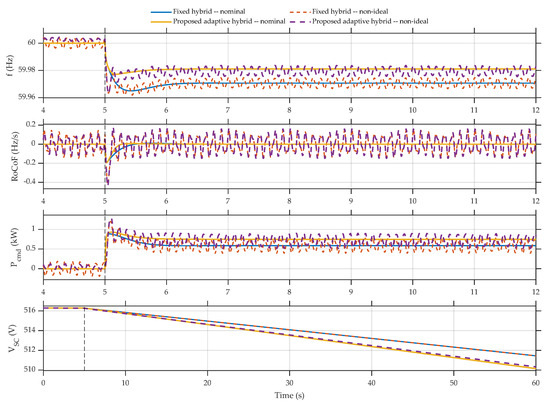
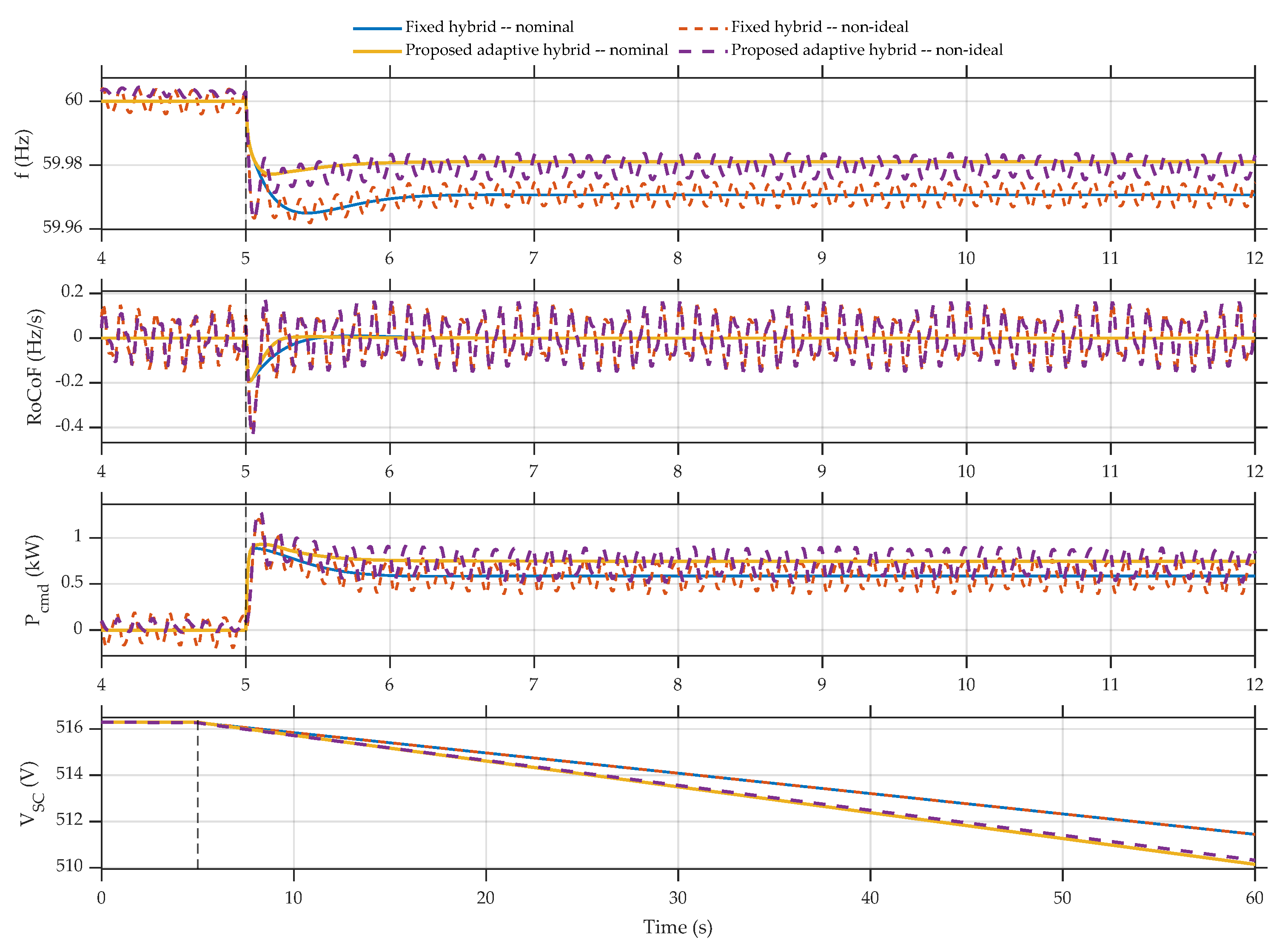
Figure 8 shows the nominal and non-ideal responses of the proposed adaptive hybrid controller under the combined event. The non-ideal case includes bounded frequency-measurement perturbations and delayed control action. As expected, the non-ideal case degrades the initial dynamic response. In particular, the peak RoCoF of the proposed controller increases from 0.19265 to 0.43739 Hz/s, while the ITAE increases from 3.8008 to 4.1281 Hz·s2. Even so, the controller preserves stable closed-loop behavior and admissible supercapacitor operation throughout the transient.
Figure 8.
Comparison of nominal and non-ideal responses under the combined disturbance scenario. The non-ideal case includes bounded frequency-measurement perturbations and delayed control action. Although the non-ideal conditions degrade the initial dynamic metrics, the proposed adaptive hybrid controller preserves stable closed-loop behavior and admissible supercapacitor operation.
Table 9 summarizes the corresponding performance metrics for both the fixed hybrid baseline and the proposed adaptive hybrid controller under nominal and non-ideal conditions. Under the same non-ideal conditions, the proposed adaptive hybrid controller still preserves a higher nadir and a lower ITAE than the fixed hybrid baseline. This additional test is not intended to replace converter-level or hardware-in-the-loop validation, but it does provide a more realistic intermediate step between an ideal control-oriented benchmark and full implementation-oriented studies.
Table 9.
Dynamic metrics under nominal and non-ideal conditions for the combined disturbance scenario.
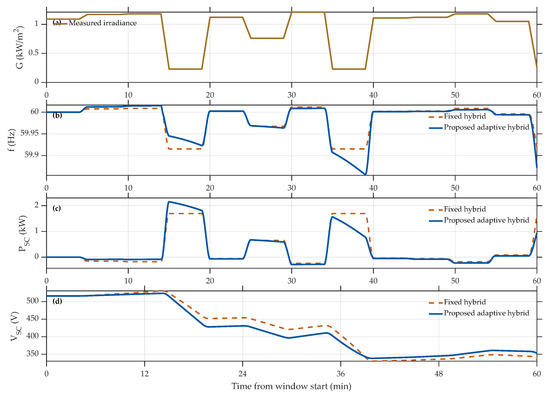
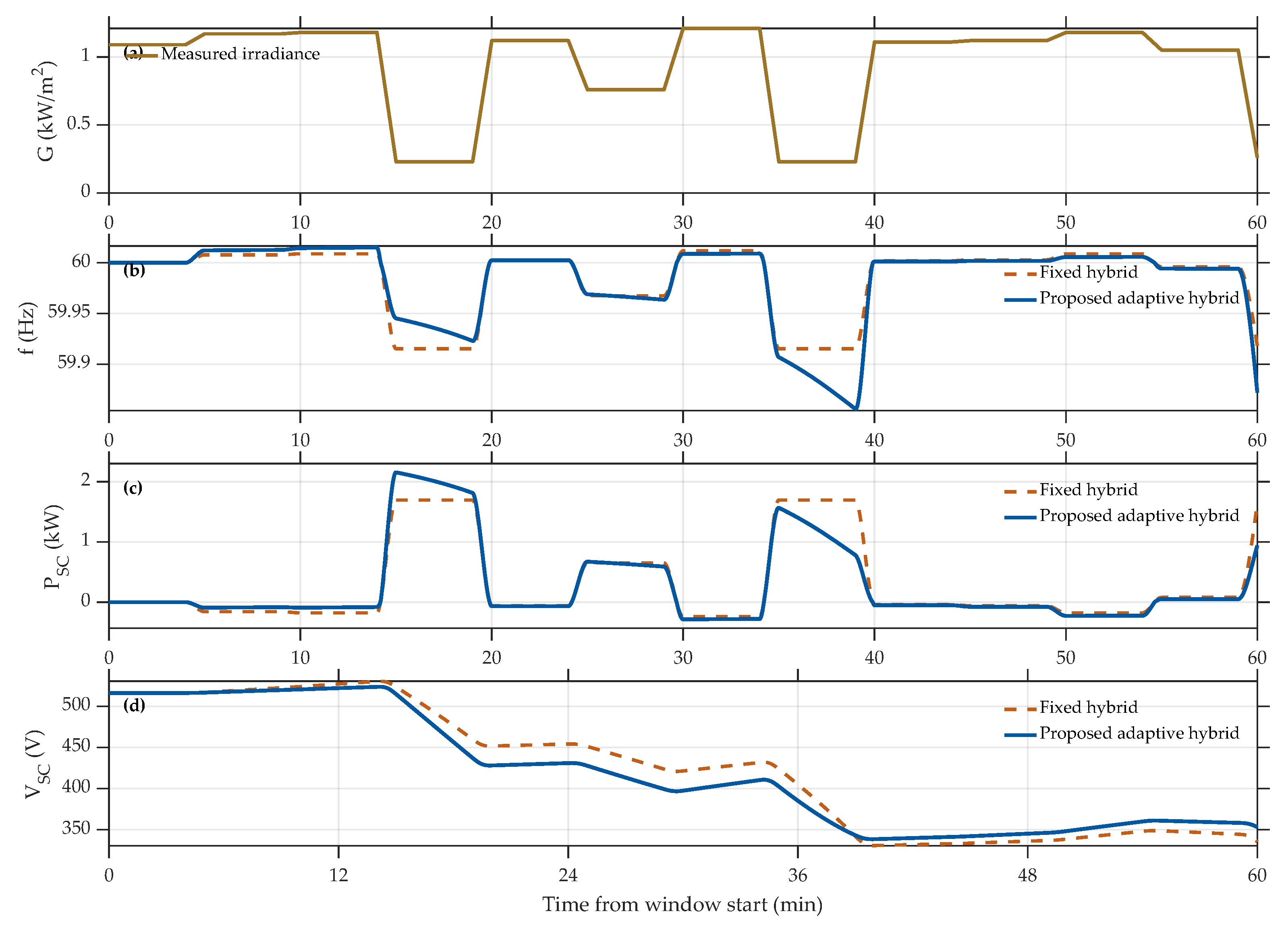
To further address the reviewer’s concern regarding disturbance realism, a complementary irradiance-variability case was also evaluated using a one-hour window extracted from the measured daily dataset with one-minute resolution. This window was selected for its pronounced intra-hour irradiance fluctuations and was used to stress the controller under repeated source-side variations rather than under a single abrupt event. Figure 9 summarizes the resulting behavior. In this case, the irradiance profile produces repeated variations in the available photovoltaic power, which in turn require multiple support actions from the supercapacitor. The results show that the proposed adaptive hybrid controller preserves a stable frequency response while coordinating repeated power exchanges without driving the supercapacitor voltage toward inadmissible behavior. This additional test is valuable because it complements the step-disturbance benchmark with a variability-driven operating condition in which the supercapacitor headroom is exercised repeatedly over time.
Figure 9.
Controller behavior under a highly variable measured irradiance window extracted from the daily dataset: (a) irradiance profile; (b) frequency response; (c) supercapacitor support power; and (d) supercapacitor voltage.
3.6. Sensitivity Analysis
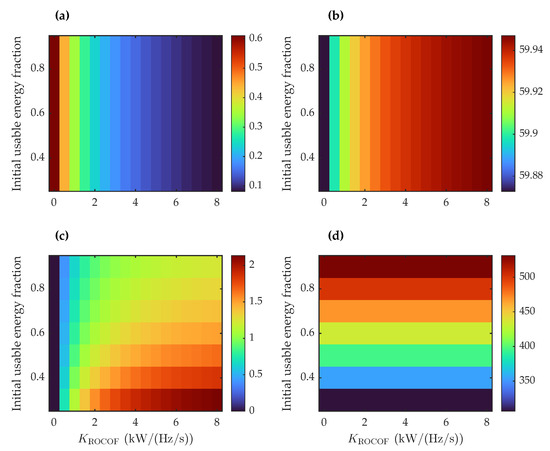
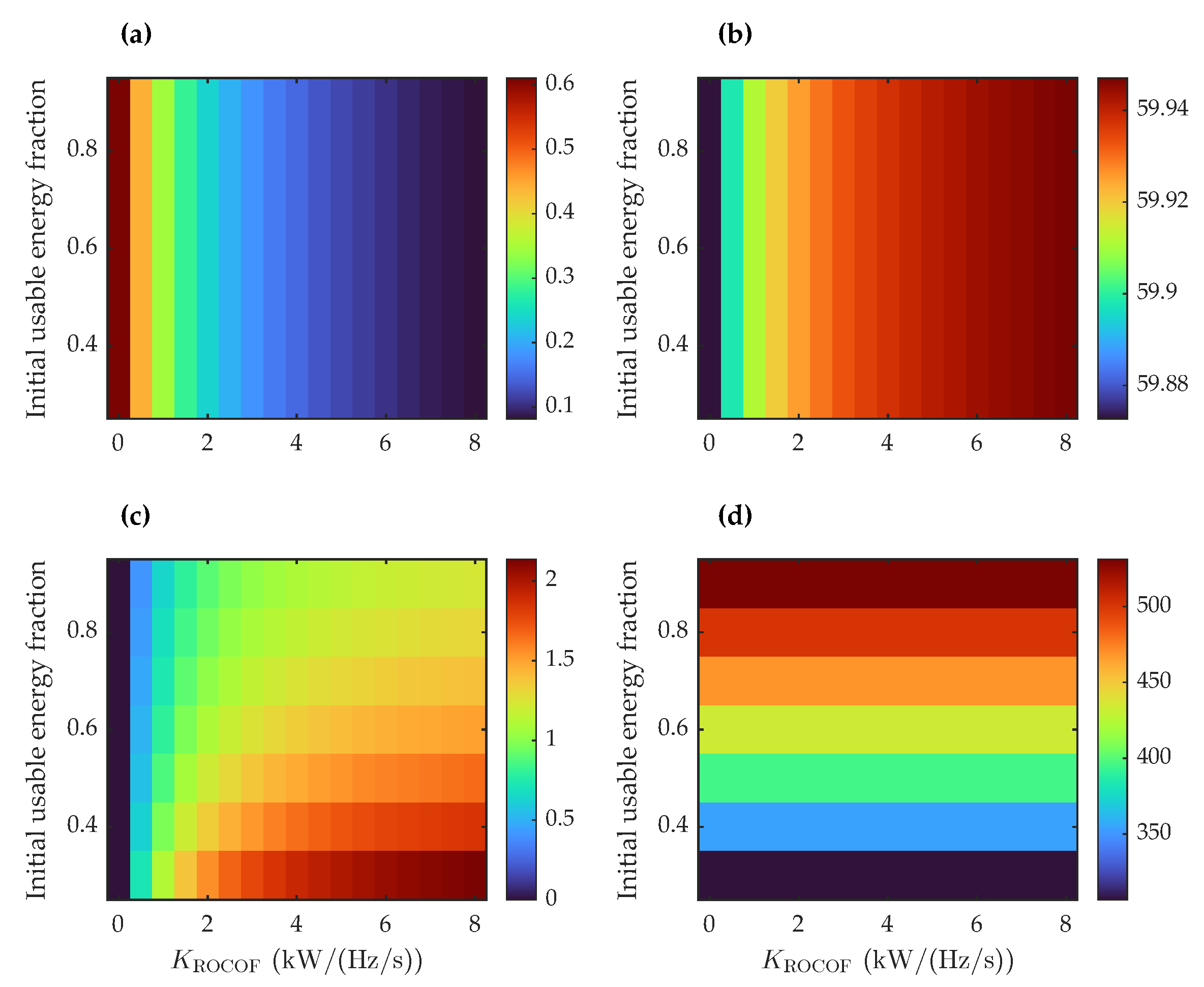
The sensitivity study was carried out over a RoCoF-gain grid from 0 to 8 in increments of 0.5 and an initial usable-energy-fraction grid from 0.3 to 0.9 in increments of 0.1, using the photovoltaic generation loss scenario as the reference disturbance. Figure 10 summarizes the results through four two-dimensional maps corresponding to peak absolute RoCoF, frequency nadir, peak supercapacitor current, and minimum supercapacitor voltage. These variables capture the essential design compromise between disturbance containment and device burden. The maps show a clear separation between two control roles. Increasing the RoCoF gain improves the early dynamic response by reducing the peak RoCoF and raising the nadir, but it also increases the peak supercapacitor current. By contrast, the minimum supercapacitor voltage depends much more strongly on the initial usable-energy fraction than on the gain itself. This indicates that the derivative gain primarily determines how aggressively the controller reacts to the initial imbalance, whereas the initial headroom determines how far the storage state can be pushed during the transient.
Figure 10.
Sensitivity analysis of the benchmark with respect to the RoCoF gain and the initial usable-energy fraction of the supercapacitor: (a) peak RoCoF; (b) frequency nadir; (c) peak supercapacitor current; and (d) minimum supercapacitor voltage.
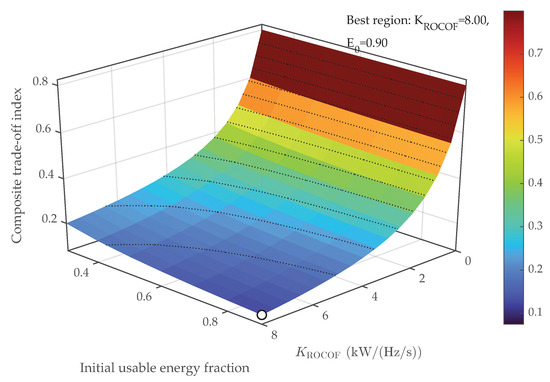
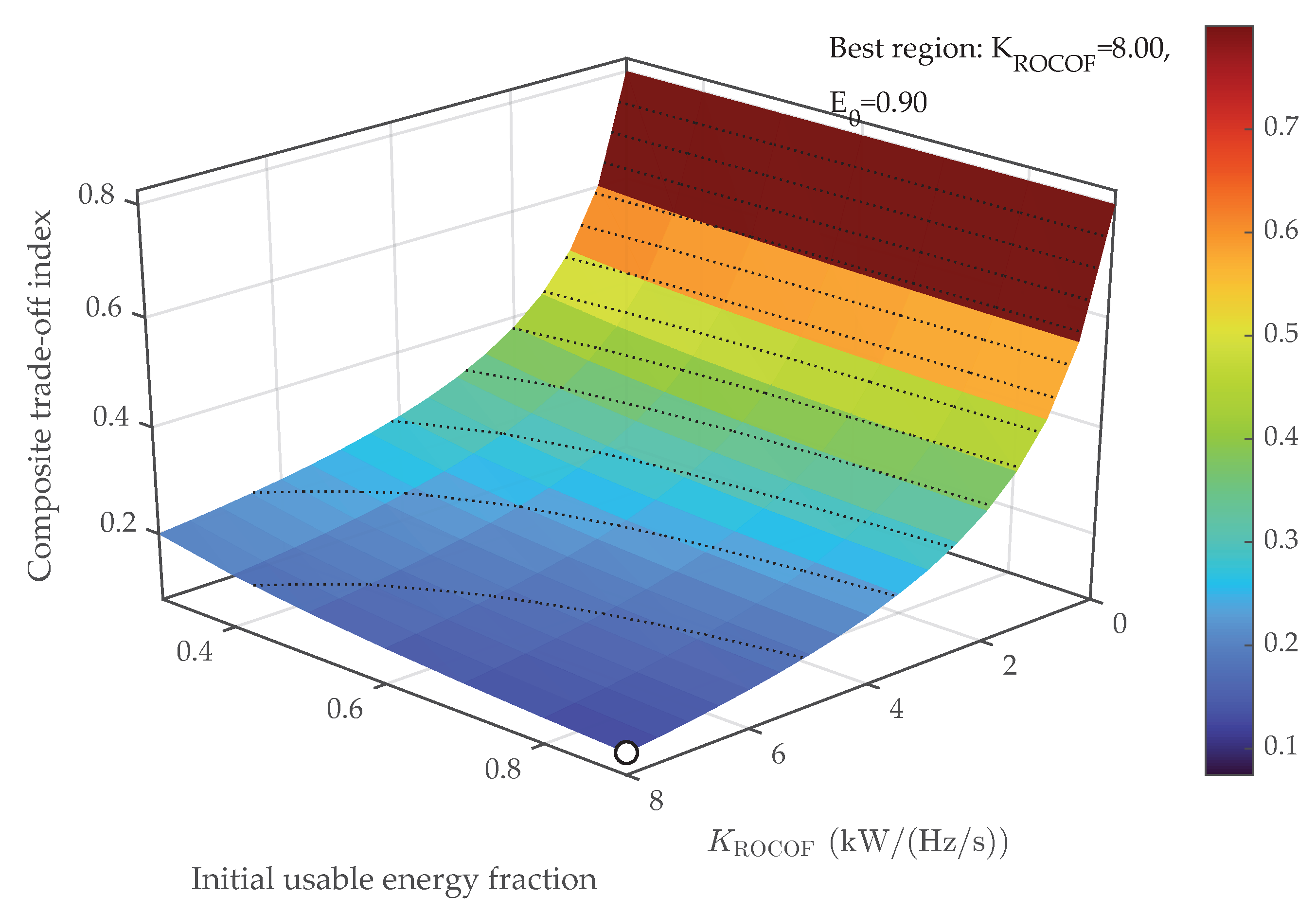
Figure 11 condenses the same information into a three-dimensional trade-off surface built from the normalized peak absolute RoCoF, nadir deviation, and peak supercapacitor current. Lower values correspond to more favorable tuning regions. The minimum of the explored surface lies toward the high-gain, high-headroom corner, but the low-index region extends over a broader upper-intermediate area rather than collapsing to a single isolated point. From a design perspective, this indicates that favorable tuning can be achieved within a practical parameter band, not only at the most aggressive setting.
Figure 11.
Three-dimensional trade-off surface relating the RoCoF gain, the initial usable-energy fraction of the supercapacitor, and a composite performance index that combines peak absolute RoCoF, nadir deviation, and peak supercapacitor current. Lower values indicate more favorable tuning regions.
This result is relevant for generalization. The proposed controller does not depend on a single fragile tuning point; rather, it performs well over a non-negligible region of the explored gain–headroom space. Although this does not replace broader seasonal or experimental validation, it does indicate that the reported behavior is not an artifact of one isolated parameter combination.
3.7. Overall Comparative Interpretation
The scenario-by-scenario comparison consistently shows that the proposed adaptive hybrid controller provides the most favorable aggregate compromise among the benchmarked fast-support strategies. Although the fixed hybrid baseline typically achieves the lowest peak RoCoF, the proposed controller preserves equal or better nadir behavior together with lower integral error indices in the most demanding cases. This pattern is consistent with the central interpretation of the manuscript: the proposed controller is not intended as a pure slope-minimization law but as a constraint-aware hybrid support strategy that balances first-swing containment, full-trajectory quality, and supercapacitor admissibility.
4. Discussion
The benchmark results show that the main advantage of the proposed controller lies in its balanced transient behavior rather than in the minimization of a single frequency indicator. This distinction is relevant in low-inertia microgrids because controller selection cannot be based only on the smallest peak RoCoF or the highest nadir. In practical operation, the preferred strategy is the one that arrests the disturbance rapidly, limits the depth and duration of the excursion, and remains compatible with the electrical limits of the storage device. Under this criterion, the proposed adaptive hybrid law consistently outperformed the no-fast-support case and provided the most favorable aggregate response among the benchmarked fast-support strategies.
The comparison with the fixed hybrid baseline is particularly informative. That controller achieved the lowest peak RoCoF in the scenario-by-scenario assessment, which confirms the effectiveness of a strong derivative component for the earliest stage of disturbance arrest. However, the proposed controller yielded better values of maximum frequency deviation, IAE, and ITAE while matching or improving the nadir across the tested scenarios. This result suggests that the best instantaneous slope reduction does not necessarily translate into the best overall transient. In other words, a controller can be highly effective during the first moments after an event and still produce a less favorable full trajectory once the subsequent frequency evolution is considered. The proposed method improved this broader response by coupling frequency and RoCoF support with an energy-aware modulation of the actuation effort. This behavior is physically consistent with the role of supercapacitors in frequency-support applications. Their main strength is the ability to exchange power almost immediately after a disturbance, which makes them well suited to the short interval in which frequency falls most rapidly. The time-domain responses confirm that the proposed controller exploits this fast support capability without relying on a prolonged power injection profile. At the same time, the results also show that aggressive inertial emulation is not cost-free. Faster support is associated with higher current peaks and deeper voltage excursions, so the controller must be interpreted as a compromise between dynamic benefit and storage admissibility rather than as a pure RoCoF-minimization mechanism.
The revised positioning of this manuscript is therefore intentionally measured. This paper does not claim to introduce a fundamentally new category of controller, nor does it claim experimental proof of deployment readiness. Its contribution is more specific: it shows that, within a common and constraint-consistent benchmark, an adaptive hybrid law that combines frequency deviation, filtered RoCoF, and instantaneous energy headroom can outperform representative alternatives in overall trajectory quality while remaining within the same actuator envelope. This framing is important because it responds directly to the reviewer’s concern about novelty. The added value lies in the integration, transparency, and fairness of the benchmark, together with the observation that the proposed controller performs favorably over a practical parameter region. In other words, this paper contributes a more transparent and constraint-consistent benchmark for supercapacitor-based synthetic inertia support, together with a controller structure that performs well within that benchmark.
The sensitivity analysis reinforces this interpretation. The derivative gain had the strongest influence on early dynamic containment, as reflected by the reduction in the peak RoCoF and the improvement in the frequency nadir. By contrast, the minimum supercapacitor voltage depended much more strongly on the initial usable-energy fraction than on the gain itself. This separation is physically meaningful because it assigns different design roles to the two main tuning variables: the derivative gain determines how strongly the controller reacts to the initial power imbalance, whereas the available headroom determines how far that reaction can be sustained without approaching the lower voltage bound. The three-dimensional trade-off surface supports the same conclusion: the most favorable operating region is not associated with the weakest support but neither is it obtained by indiscriminately increasing control aggressiveness.
The present work also addresses, at least partially, the reviewer’s concern regarding overly idealized validation. The model remains reduced-order and therefore does not capture switching harmonics, quantization, communication effects, or full converter inner-loop dynamics. Even so, it is not a purely ideal benchmark because it retains finite governor dynamics, filtered RoCoF estimation, supercapacitor equivalent-series-resistance losses, power/current/voltage saturation, and asymmetric headroom for discharge and charge actions. These features are the most relevant non-ideal elements for the first-swing transient targeted here. The added local stability assessment further shows that the retained gain region is theoretically plausible in the unsaturated regime and is not supported only by empirical plots.
At the same time, this manuscript should not overstate its validation level. This study remains simulation-based and relies on a control-oriented aggregated plant. For that reason, the results should be interpreted as benchmark-specific and as evidence of comparative merit under the adopted assumptions, not as a substitute for experimental proof. A hardware-in-the-loop campaign or laboratory implementation with converter inner loops, delays, and measurement noise is still required before deployment-oriented claims can be made. This limitation is now made explicit because it is central to the correct interpretation of the contribution.
From a broader application perspective, the results support the view that supercapacitor-based synthetic inertia in islanded photovoltaic microgrids should be designed as a constrained transient-support problem rather than as a pure inertial-emulation problem. In systems with limited rotational inertia, the relevant question is not only how much synthetic inertia can be imposed but how that support interacts with finite storage headroom and converter limits. The proposed controller addresses this issue by embedding both event severity and energy capability into the command law, which helps explain why it achieved the best overall benchmark score even without producing the lowest peak RoCoF. The combined evidence from the scenario comparison, the sensitivity maps, and the local stability analysis therefore supports a measured but technically defensible conclusion in favor of the proposed adaptive hybrid strategy.
A complementary non-ideal assessment was incorporated in the revised manuscript to partially bridge this gap. By introducing bounded frequency-measurement perturbations and delayed control action, the benchmark was extended toward more realistic sensing and actuation conditions without abandoning its reduced-order and reproducible structure. Although this extension still does not replace hardware-in-the-loop or laboratory validation, it provides a more demanding intermediate test of the RoCoF estimator and of the closed-loop support behavior.
A second complementary extension was introduced through a variability-driven irradiance case based on measured one-minute data. This test is relevant because it moves the assessment beyond isolated step events and toward repeated renewable fluctuations, under which the supercapacitor must deliver multiple support actions over a short horizon. The resulting response remained stable and admissible, which provides additional support for the practical robustness of the adaptive energy-management mechanism.
5. Conclusions
This paper presented a supercapacitor-based support strategy for an islanded photovoltaic microgrid, formulated around a hybrid frequency–RoCoF control law and evaluated through a reproducible benchmark built from measured operating profiles. This study used a reduced-order frequency model, an explicit RC-based supercapacitor representation with equivalent-series resistance, and a bidirectional support channel constrained by current, voltage, and power limits. The contribution of this paper is therefore best understood as a transparent and constraint-consistent benchmark of fast support strategies rather than as a claim of full experimental validation.
The results showed that the proposed adaptive hybrid strategy consistently improved the post-disturbance frequency response with respect to the no-fast-support case. Across the benchmark scenarios, the controller reduced the peak RoCoF by about 76%, reduced the maximum absolute frequency deviation by about 85–86%, and reduced both IAE and ITAE by roughly 70%. In the direct comparison with the benchmark controller families, the fixed-hybrid baseline delivered the best instantaneous RoCoF suppression, but the proposed strategy provided the most favorable aggregate compromise in terms of nadir, maximum deviation, integral error, and global benchmark score.
This paper also strengthened the methodological and theoretical support of this study by making the tuning rule explicit and by adding a local small-signal stability assessment of the frozen-gain closed loop. The gain-screening stage showed that favorable performance is obtained in a practical parameter region rather than at a single isolated point, whereas the local stability analysis confirmed left-half-plane poles for the selected proposed-controller settings in the unsaturated regime. These additions do not replace experimental validation, but they do provide a stronger justification for the selected parameter region and for the comparative claims made in this manuscript.
The main limitation remains the absence of hardware-in-the-loop or laboratory validation with converter inner loops, delays, and measurement imperfections. Consequently, future work should move toward real-time implementation, experimental verification, and broader operating-point coverage. Even so, the present benchmark already supports a clear engineering conclusion: in low-inertia islanded photovoltaic microgrids, fast supercapacitor support is more effective when the control law is designed as a compromise between disturbance severity, trajectory quality, and available energy headroom rather than as a pure RoCoF-minimization mechanism.
Author Contributions
Conceptualization, D.F.-R. and P.A.-C.; methodology, D.F.-R. and P.A.-C.; software, D.F.-R.; validation, D.F.-R. and P.A.-C.; formal analysis, D.F.-R. and P.A.-C.; investigation, D.F.-R. and P.A.-C.; resources, P.A.-C.; data curation, D.F.-R.; writing—original draft preparation, D.F.-R.; writing—review and editing, P.A.-C.; visualization, D.F.-R.; supervision, P.A.-C.; project administration, P.A.-C. All authors have read and agreed to the published version of the manuscript.
Funding
This research received no external funding.
Data Availability Statement
Data will be made available on request.
Acknowledgments
The authors thank Universidad de Cuenca (UCUENCA), Ecuador, for easing access to the facilities of the Micro-Grid Laboratory, Faculty of Engineering, for allowing the use of its equipment, and for providing technical support for the descriptive literature analysis included in this article. This article reports the findings of the project titled “Desarrollo de Herramientas Computacionales para la Gestión y Optimización de Microrredes Inteligentes”, winner of the “Convocatoria para la Aprobación y Financiamiento de Proyectos de Investigación Exclusiva para Docentes Contratados DIDE 2025–2026” of the Universidad Técnica de Ambato, Ecuador, and co-funded by the Vicerrectorado de Investigación e Innovación of the Universidad de Cuenca, Ecuador.
Conflicts of Interest
The authors declare no conflicts of interest.
Abbreviations
The following abbreviations are used in this manuscript:
| DEET | Department of Electrical, Electronics and Telecommunications Engineering |
| ESR | Equivalent Series Resistance |
| IAE | Integral of Absolute Error |
| ITAE | Integral of Time-Weighted Absolute Error |
| PCC | Point of Common Coupling |
| PV | Photovoltaic |
| RC | Resistance–Capacitance |
| RoCoF | Rate of Change of Frequency |
| SC | Supercapacitor |
| SOC | State of Charge |
| VSG | Virtual Synchronous Generator |
References
- Tielens, P.; Van Hertem, D. The relevance of inertia in power systems. Renew. Sustain. Energy Rev. 2016, 55, 999–1009. [Google Scholar] [CrossRef] [Scilit]
- Milano, F.; Dörfler, F.; Hug, G.; Hill, D.; Verbic, G. Foundations and Challenges of Low-Inertia Systems. In Proceedings of the 2018 Power Systems Computation Conference (PSCC), Dublin, Ireland, 11–15 June 2018; pp. 1–25. [Google Scholar] [CrossRef] [Scilit]
- Rezkalla, M.; Pertl, M.; Marinelli, M. Electric power system inertia: Requirements, challenges and solutions. Electr. Eng. 2018, 100, 2677–2693. [Google Scholar] [CrossRef] [Scilit]
- Ratnam, K.S.; Palanisamy, K.; Yang, G. Future low-inertia power systems: Requirements, issues, and solutions—A review. Renew. Sustain. Energy Rev. 2020, 124, 109773. [Google Scholar] [CrossRef] [Scilit]
- Karpana, S.; Batzelis, E.; Maiti, S.; Chakraborty, C. PV-supercapacitor cascaded topology for primary frequency responses and dynamic inertia emulation. Energies 2021, 14, 8347. [Google Scholar] [CrossRef] [Scilit]
- Mosa, M.A.; Yousef, M.Y.; El Masry, S.M.; Abdel Ghany, A.; Ali, A. Frequency support of AC microgrid with high penetration of photovoltaic using super-capacitor. Sustain. Energy Technol. Assessments 2022, 53, 102364. [Google Scholar] [CrossRef] [Scilit]
- Guerrero, J.; Vasquez, J.C.; Alcala, J.; Vicuna, L.; Castilla, M. Hierarchical Control of Droop-Controlled AC and DC Microgrids—A General Approach Toward Standardization. IEEE Trans. Ind. Electron. 2011, 58, 158–172. [Google Scholar] [CrossRef] [Scilit]
- Bidram, A.; Davoudi, A. Hierarchical Structure of Microgrids Control System. IEEE Trans. Smart Grid 2012, 3, 1963–1976. [Google Scholar] [CrossRef] [Scilit]
- Zhong, Q.C.; Weiss, G. Synchronverters: Inverters that mimic synchronous generators. IEEE Trans. Ind. Electron. 2011, 58, 1259–1267. [Google Scholar] [CrossRef] [Scilit]
- Fang, J.; Li, H.; Tang, Y.; Blaabjerg, F. Distributed Power System Virtual Inertia Implemented by Grid-Connected Power Converters. IEEE Trans. Power Electron. 2018, 33, 8488–8499. [Google Scholar] [CrossRef] [Scilit]
- Soni, N.; Doolla, S.; Chandorkar, M. Improvement of Transient Response in Microgrids Using Virtual Inertia. IEEE Trans. Power Deliv. 2013, 28, 1830–1838. [Google Scholar] [CrossRef] [Scilit]
- Kerdphol, T.; Rahman, F.S.; Mitani, Y.; Watanabe, M.; Kufeoglu, S. Robust Virtual Inertia Control of an Islanded Microgrid Considering High Penetration of Renewable Energy. IEEE Access 2018, 6, 625–636. [Google Scholar] [CrossRef] [Scilit]
- Kerdphol, T.; Watanabe, M.; Hongesombut, K.; Mitani, Y. Self-Adaptive Virtual Inertia Control-Based Fuzzy Logic to Improve Frequency Stability of Microgrid with High Renewable Penetration. IEEE Access 2019, 7, 76071–76083. [Google Scholar] [CrossRef] [Scilit]
- Kerdphol, T.; Rahman, F.S.; Watanabe, M.; Mitani, Y.; Turschner, D.; Beck, H.P. Enhanced Virtual Inertia Control Based on Derivative Technique to Emulate Simultaneous Inertia and Damping Properties for Microgrid Frequency Regulation. IEEE Access 2019, 7, 14422–14433. [Google Scholar] [CrossRef] [Scilit]
- Elwakil, M.M.; Zoghaby, H.M.E.; Sharaf, S.M.; Mosa, M.A. Adaptive virtual synchronous generator control using optimized bang-bang for islanded microgrid stability improvement. Prot. Control Mod. Power Syst. 2023, 8, 57. [Google Scholar] [CrossRef] [Scilit]
- Nanou, S.; Papakonstantinou, A.; Papathanassiou, S. A generic model of two-stage grid-connected PV systems with primary frequency response and inertia emulation. Electr. Power Syst. Res. 2015, 127, 186–196. [Google Scholar] [CrossRef] [Scilit]
- Huang, X.; Wang, K.; Li, G.; Zhang, H. Virtual inertia-based control strategy of two-stage photovoltaic inverters for frequency support in islanded micro-grid. Electronics 2018, 7, 340. [Google Scholar] [CrossRef] [Scilit]
- Yang, L.; Hu, Z.; Xie, S.; Kong, S.; Lin, W. Adjustable virtual inertia control of supercapacitors in PV-based AC microgrid cluster. Electr. Power Syst. Res. 2019, 173, 71–85. [Google Scholar] [CrossRef] [Scilit]
- Yang, L.; Hu, Z. Implementation of Dynamic Virtual Inertia Control of Supercapacitors for Multi-Area PV-Based Microgrid Clusters. Sustainability 2020, 12, 3299. [Google Scholar] [CrossRef] [Scilit]
- Sarojini, R.K.; Kaliannan, P.; Teekaraman, Y.; Nikolovski, S.; Baghaee, H.R. An enhanced emulated inertia control for grid-connected PV systems with HESS in a weak grid. Energies 2021, 14, 1721. [Google Scholar] [CrossRef] [Scilit]
- Behera, M.K.; Saikia, L.C. A Seamless Control of Grid-Connected PV System for Alleviating PV Penetration in Rural Grid Using Supercapacitor Accompanying with DSTATCOM and Improved CTF Control. IEEE Trans. Ind. Appl. 2024, 60, 3588–3602. [Google Scholar] [CrossRef] [Scilit]
- Rodriguez-Amenedo, J.L.; Montilla-DJesus, M.E.; Arnaltes, S.; Arredondo, F. RMS Modeling and Control of a Grid-Forming E-STATCOM for Power System Stability in Isolated Grids. Appl. Sci. 2025, 15, 3014. [Google Scholar] [CrossRef] [Scilit]
- Delille, G.; Francois, B.; Malarange, G. Dynamic frequency control support: A virtual inertia provided by distributed energy storage to isolated power systems. In Proceedings of the 2010 IEEE PES Innovative Smart Grid Technologies Conference Europe (ISGT Europe), Gothenburg, Sweden, 11–13 October 2010; pp. 1–8. [Google Scholar] [CrossRef] [Scilit]
- Delille, G.; Francois, B.; Malarange, G. Dynamic Frequency Control Support by Energy Storage to Reduce the Impact of Wind and Solar Generation on Isolated Power System’s Inertia. IEEE Trans. Sustain. Energy 2012, 3, 931–939. [Google Scholar] [CrossRef] [Scilit]
- Bensmaine, F.; Tnani, S.; Champenois, G.; Mouni, E. Modeling and parameter identification of supercapacitors using a bidirectional DC-AC converter. In Proceedings of the IECON 2013—39th Annual Conference of the IEEE Industrial Electronics Society, Vienna, Austria, 10–13 November 2013; pp. 1019–1024. [Google Scholar] [CrossRef] [Scilit]
- Jami, M.; Shafiee, Q.; Gholami, M.; Bevrani, H. Control of a super-capacitor energy storage system to mimic inertia and transient response improvement of a direct current micro-grid. J. Energy Storage 2020, 32, 101788. [Google Scholar] [CrossRef] [Scilit]
- Mahajan, S.; Verma, Y. Performance of fast responding ultracapacitor energy storage for virtual inertia emulation control. Energy Storage 2022, 4, e346. [Google Scholar] [CrossRef] [Scilit]
- Sarojini, R.K.; Palanisamy, K.; De Tuglie, E. A Fuzzy Logic-Based Emulated Inertia Control to a Supercapacitor System to Improve Inertia in a Low Inertia Grid with Renewables. Energies 2022, 15, 1333. [Google Scholar] [CrossRef] [Scilit]
- Mohan, A.; Shereef, R.; Vinod, V. Improvement of frequency response in remote area power supply systems using ultracapacitor with enhanced inertia support controller. Electr. Eng. 2024, 106, 111–123. [Google Scholar] [CrossRef] [Scilit]
- Abdullah, A.H.; Al-Anbary, K.M.; Hamad, Q.M.; Al Abboodi, H.M.A.; Gatte, M.T. Frequency response of microgrids with PV power generation and energy storage system (battery and supercapacitor). Bull. Electr. Eng. Inform. 2024, 13, 1–11. [Google Scholar] [CrossRef] [Scilit]
- Akram, U.; Mithulananthan, N.; Shah, R. Improving Synthetic Inertial Response of Supercapacitor Using Supplementary Control Signal. In Proceedings of the 2019 9th International Conference on Power and Energy Systems, ICPES 2019, Perth, Australia, 10–12 December 2019. [Google Scholar] [CrossRef] [Scilit]
- Akram, U.; Mithulananthan, N.; Shah, R.; Islam, R. Dynamic Derivative-Droop Control for Supercapacitor Synthetic Inertial Support. In Proceedings of the 2020 IEEE Industry Applications Society Annual Meeting, IAS 2020, Detroit, MI, USA, 11–15 October 2020; Volume 2020. [Google Scholar] [CrossRef] [Scilit]
- Akram, U.; Mithulananthan, N.; Raza, M.Q.; Shah, R.; Milano, F. RoCoF Restrictive Planning Framework and Wind Speed Forecast Informed Operation Strategy of Energy Storage System. IEEE Trans. Power Syst. 2021, 36, 224–234. [Google Scholar] [CrossRef] [Scilit]
- Liang, J.; Fan, H.; Deng, Z.; Zhu, J.; Yu, L.; Li, T.; Luo, P.; Gao, Z.; Wang, Y. Generic synthetic inertia scheme for voltage source inverters. IET Renew. Power Gener. 2023, 17, 696–705. [Google Scholar] [CrossRef] [Scilit]
- Mandal, R.; Chatterjee, K. Virtual inertia emulation and RoCoF control of a microgrid with high renewable power penetration. Electr. Power Syst. Res. 2021, 194, 107093. [Google Scholar] [CrossRef] [Scilit]
- Criollo, A.; Minchala-Avila, L.I.; Benavides, D.; Arévalo, P.; Tostado-Véliz, M.; Sánchez-Lozano, D.; Jurado, F. Enhancing Virtual Inertia Control in Microgrids: A Novel Frequency Response Model Based on Storage Systems. Batteries 2024, 10, 18. [Google Scholar] [CrossRef] [Scilit]
- Hardan, F.; Norman, R.; Tricoli, P. Virtual Inertia Methods for Supporting Frequency Stabilisation in Autonomous AC/DC Microgrids. Electronics 2025, 14, 91. [Google Scholar] [CrossRef] [Scilit]
- Malik, M.N.; Zhao, Q.; Wang, S. A Robust Stability Control Method Integrating Linear Quadratic Regulator and Proportional Integral for Islanded AC Microgrid. IEEE Access 2025, 13, 111982–111996. [Google Scholar] [CrossRef] [Scilit]
- Mohamed, M.M.; El Zoghby, H.M.; Sharaf, S.M.; Mosa, M.A. Optimal virtual synchronous generator control of battery/supercapacitor hybrid energy storage system for frequency response enhancement of photovoltaic/diesel microgrid. J. Energy Storage 2022, 51, 104317. [Google Scholar] [CrossRef] [Scilit]
- Yegon, P.; Singh, M. Optimization of battery/ultra-capacitor hybrid energy storage system for frequency response support in low-inertia microgrid. IET Power Electron. 2024, 17, 1713–1727. [Google Scholar] [CrossRef] [Scilit]
- Li, J.; Ao, G.; Song, C.; Lan, F. Optimal Dynamic Response Strategy for Supercapacitor Participating in Wind Power Frequency Regulation. Dianli Xitong Zidonghua/Automation Electr. Power Syst. 2024, 48, 46–55. [Google Scholar] [CrossRef]
- Yang, P.; Wang, L.; Zhang, R.; Su, C.; Cheng, Z. Integrated coordinated control and optimization of photovoltaic hybrid energy storage for primary frequency regulation. Front. Energy Res. 2025, 13, 1693093. [Google Scholar] [CrossRef] [Scilit]
- Cabrane, Z.; Choi, D.; Lee, S.H. Coordinated Control Strategy-Based Energy Management of a Hybrid AC-DC Microgrid Using a Battery–Supercapacitor. Batteries 2025, 11, 245. [Google Scholar] [CrossRef] [Scilit]
- Kascak, S.; Resutik, P.; Prazenica, M.; Frivaldsky, M. Design and verification of a hybrid energy storage system for a defined power profile. Electr. Eng. 2025, 107, 10457–10466. [Google Scholar] [CrossRef] [Scilit]
- Alonso Sørensen, D.; Vázquez Pombo, D.; Torres Iglesias, E. Energy storage sizing for virtual inertia contribution based on ROCOF and local frequency dynamics. Energy Strategy Rev. 2023, 47, 101094. [Google Scholar] [CrossRef] [Scilit]
- Hajiakbari Fini, M.; Hamedani Golshan, M.E. Determining optimal virtual inertia and frequency control parameters to preserve the frequency stability in islanded microgrids with high penetration of renewables. Electr. Power Syst. Res. 2018, 154, 13–22. [Google Scholar] [CrossRef] [Scilit]
- Hajiakbari Fini, M.; Hamedani Golshan, M.E.; Marti, J.R.; Ketabi, A. Determining the Required Frequency Control Reserve and Capacity and Location of Synchronous and Virtual Inertial Resources. IEEE Trans. Sustain. Energy 2023, 14, 27–38. [Google Scholar] [CrossRef] [Scilit]
- Fernández-Guillamón, A.; Gómez-Lázaro, E.; Muljadi, E.; Molina-García, Á. Power systems with high renewable energy sources: A review of inertia and frequency control strategies over time. Renew. Sustain. Energy Rev. 2019, 115, 109369. [Google Scholar] [CrossRef] [Scilit]
- Dreidy, M.; Mokhlis, H.; Mekhilef, S. Inertia response and frequency control techniques for renewable energy sources: A review. Renew. Sustain. Energy Rev. 2017, 69, 144–155. [Google Scholar] [CrossRef] [Scilit]
- Tamrakar, U.; Shrestha, D.; Maharjan, M.; Bhattarai, B.P.; Hansen, T.M.; Tonkoski, R. Virtual inertia: Current trends and future directions. Appl. Sci. 2017, 7, 654. [Google Scholar] [CrossRef] [Scilit]

Disclaimer/Publisher’s Note: The statements, opinions and data contained in all publications are solely those of the individual author(s) and contributor(s) and not of MDPI and/or the editor(s). MDPI and/or the editor(s) disclaim responsibility for any injury to people or property resulting from any ideas, methods, instructions or products referred to in the content. |
© 2026 by the authors. Licensee MDPI, Basel, Switzerland. This article is an open access article distributed under the terms and conditions of the Creative Commons Attribution (CC BY) license.