


Abstract
Accurate prediction of postoperative complications, such as acute myocardial injury (AMI) and acute kidney injury (AKI), is essential for informed clinical decision-making and improved patient outcomes. However, conventional machine learning approaches often exhibit degraded performance in this setting due to severe class imbalance and the need for extensive feature preprocessing. To address these challenges, we propose a retrieval-based disease prediction (RBD) framework that leverages language models for postoperative risk assessment. The proposed framework converts heterogeneous preoperative and intraoperative clinical data into textual representations and retrieves relevant disease information by comparing patient-specific descriptions with predefined disease definitions of AMI and AKI. This retrieval-based formulation reduces the dependence on complex data normalization and resampling strategies commonly required by traditional models. Experimental results demonstrate that the RBD framework consistently outperforms existing machine learning methods in predicting postoperative complications under imbalanced data conditions. These findings indicate that retrieval-based language model analytics provide a promising approach for clinical decision support in postoperative care.
1. Introduction
Accurate prediction of postoperative complications after noncardiac surgery is essential for improving patient management and clinical outcomes. Among these complications, acute myocardial injury (AMI) and acute kidney injury (AKI) are particularly critical, with substantial implications for morbidity, mortality, and healthcare utilization. AMI is defined by postoperative cardiac troponin elevation, even in the absence of overt ischemic symptoms, and is associated with increased short-term mortality [1,2,3,4]. Its clinical significance has been widely recognized in systematic reviews and international consensus statements, which emphasize its prognostic value in noncardiac surgical populations [5,6]. Likewise, AKI is a severe postoperative complication defined and staged by established consensus criteria, including RIFLE, AKIN, and KDIGO [7,8], and is strongly associated with prolonged hospitalization, increased costs, and adverse long-term outcomes [9,10].
Traditional machine-learning approaches, such as RandomForest and XGBoost, have been applied to postoperative risk prediction tasks but often struggle to handle heterogeneous clinical data and severe class imbalance [11,12,13,14]. Several studies have attempted to predict postoperative AMI or mortality using machine-learning-based models [15,16], yet these efforts were constrained by limited generalizability, imbalance-related performance degradation, and lack of interpretability. Similar limitations have also been reported in AKI prediction studies employing classical machine-learning methods, where the scarcity of positive cases substantially limits robust model training and reliable evaluation.
Meanwhile, advances in natural language processing (NLP) have introduced large language models (LLMs) capable of interpreting context-rich text data. Transformer architectures and BERT-style models have demonstrated strong performance across biomedical NLP tasks [17,18]. Domain-specific variants such as SciBERT, BioBERT, ClinicalBERT, and PubMedBERT further adapt these models to biomedical and clinical contexts [19,20,21,22,23]. Beyond classification, retrieval-based representation learning has shown effectiveness in aligning textual data with task-specific objectives, as exemplified by Sentence-BERT and dense passage retrieval [24,25]. More recently, embedding models such as OpenAI’s text-embedding-3-large provide higher-dimensional, semantically rich representations [25,26], enabling fine-grained semantic alignment between heterogeneous clinical descriptions and disease concepts.
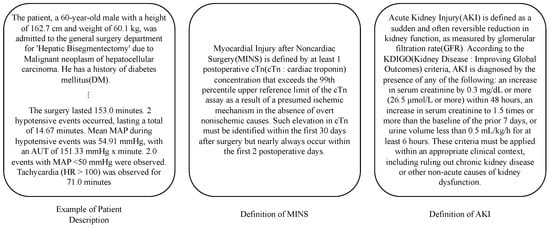
To illustrate the overall concept, Figure 1 shows how structured textual descriptions of patients can be aligned with disease definitions to support postoperative prediction tasks. The figure depicts an example patient description (left), the definition of acute myocardial injury (AMI) (middle), and the definition of acute kidney injury (AKI) (right), which together form the foundation of the proposed retrieval-based modeling framework.
Figure 1.
Example of patient description (left), definition of acute myocardial injury (AMI) (middle), and definition of acute kidney injury (AKI) (right).
Building on these foundations, our prior work introduced a retrieval-based disease prediction (RBD) framework for AMI, demonstrating improved performance compared to conventional machine-learning baselines [27]. In this study, we extend the RBD framework to simultaneously predict both AMI and AKI. The framework converts diverse preoperative and intraoperative variables into structured textual descriptions and evaluates their relevance to disease-specific definitions through semantic retrieval. By incorporating high-dimensional embeddings and multi-channel sentence-level representations with independent binary classifiers for each target condition, the proposed approach addresses class imbalance more effectively and enhances interpretability. Furthermore, it leverages insights from prior research on clinical predictive modeling [28,29,30,31], interpretability in healthcare AI [32,33,34], and narrative-driven retrieval frameworks [35], underscoring its potential as a clinically applicable and transparent decision-support tool in postoperative care.
2. Related Work
Postoperative risk prediction has been extensively studied using conventional machine learning and deep learning approaches. Tree-based models such as RandomForest [11] and gradient boosting methods including XGBoost [12] have been widely adopted due to their ability to handle heterogeneous clinical variables. However, prior studies have consistently reported that these models suffer from performance degradation under severe class imbalance, particularly when predicting rare postoperative complications [13,14]. In the context of myocardial injury after noncardiac surgery (MINS) and acute kidney injury (AKI), the scarcity of positive cases often leads to inflated accuracy while failing to adequately capture clinically critical events [15,16].
Recent advances in natural language processing (NLP) have enabled the application of pretrained language models to clinical prediction tasks. Transformer-based architectures [17] and BERT-style models [18] have demonstrated strong performance in biomedical text analysis. Domain-adapted variants such as SciBERT [19], BioBERT [20], ClinicalBERT [21], and PubMedBERT [22] further improve representation learning by incorporating biomedical and clinical corpora. These models have been applied to transform structured electronic health records into textual representations, enabling embedding-based prediction without extensive manual feature engineering.
Beyond classification-oriented approaches, retrieval-based representation learning has emerged as a promising paradigm for aligning input data with task-specific semantic objectives. Methods such as Sentence-BERT [23] and dense passage retrieval [24] explicitly model semantic similarity in an embedding space, facilitating relevance-based information selection. Recent work has suggested that such retrieval mechanisms can improve robustness and interpretability in downstream tasks [35]. Building on this line of research, our prior study introduced a retrieval-based disease prediction framework for myocardial injury after noncardiac surgery [36], demonstrating that aligning patient descriptions with disease definitions can mitigate class imbalance effects.
Despite these advances, existing approaches largely rely on single-channel embeddings or direct classification over global representations, limiting their ability to capture fine-grained clinical relevance. In this work, we extend retrieval-based modeling by incorporating multi-channel sentence-level embeddings and high-dimensional semantic representations, enabling more effective discrimination of rare postoperative complications under imbalanced clinical settings.
3. Dataset
This study utilizes a comprehensive clinical dataset consisting of records from 564 real-world patients who underwent noncardiac surgery at a single institution. The dataset comprises heterogeneous perioperative variables spanning multiple attribute types, including numerical features (e.g., preoperative and intraoperative vital signs, laboratory measurements such as hemoglobin levels, serum creatinine, and estimated glomerular filtration rate), categorical features (e.g., surgical department, detailed surgical procedures, and emergency versus elective surgery status), and binary indicators reflecting the presence or absence of chronic medical conditions (e.g., diabetes mellitus, hypertension, and chronic kidney disease).
The patient cohort exhibits a broad age distribution ranging from 20 to 90 years, with balanced representation across genders. Surgical cases span multiple clinical specialties, including orthopedic, vascular, general, and urological surgery, supporting the applicability of the dataset across diverse perioperative contexts.
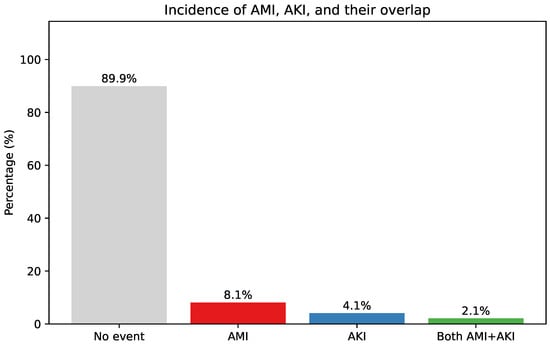
The prediction targets in this study are two major postoperative complications: acute myocardial injury (AMI), corresponding to myocardial injury after noncardiac surgery [3,4,5,6], and acute kidney injury (AKI) [7,8]. Among the 564 patients, 46 cases (approximately 8%) were associated with AMI, while 23 cases (approximately 4%) involved AKI. Additionally, 12 patients (approximately 2%) experienced both complications concurrently, resulting in a severely imbalanced class distribution. The imbalance between positive and negative cases is illustrated in Figure 2.
Figure 2.
Distribution of AMI and AKI occurrences in the dataset.
To ensure analytical reliability, standard preprocessing procedures were applied to the structured clinical data, including imputation of missing values, normalization of numerical features, and encoding of categorical variables. A comprehensive summary of all dataset attributes, along with their descriptions and data types, is provided in Table 1. This dataset serves as the foundation for evaluating predictive performance under realistic and highly imbalanced postoperative risk prediction settings.
Table 1.
Description of Variables.
4. Methods
This study employs the Retrieval-Based Disease Prediction (RBD) framework, a predictive approach inspired by retrieval-based methods originally developed in general-domain applications [31]. We adapt this retrieval paradigm to the context of medical predictive analytics and construct a clinical dataset based on records from 564 real-world patients who underwent noncardiac surgery.
In collaboration with medical experts, heterogeneous structured clinical variables collected during the preoperative and intraoperative periods are transformed from tabular formats into structured textual descriptions. This text-based representation facilitates improved interpretability and enables language models to process complex clinical information in a unified manner.
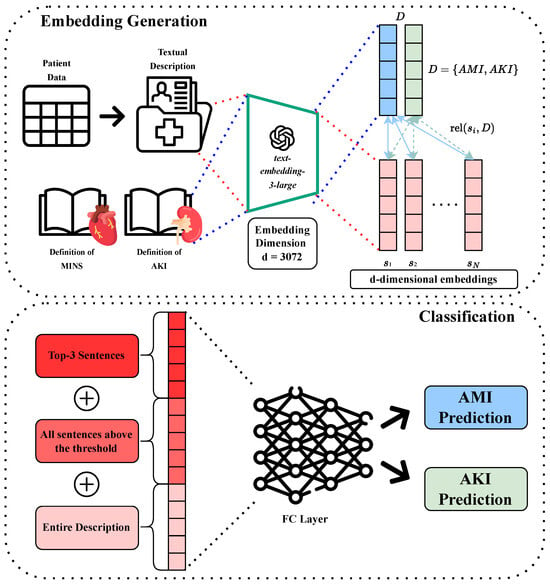
Figure 3 provides an overview of the proposed RBD framework for predicting acute myocardial injury (AMI) and acute kidney injury (AKI).
Figure 3.
Overview of the proposed RBD framework for AMI and AKI prediction. Each clinical sentence and disease definition is encoded using text-embedding-3-large, producing a d-dimensional embedding (). Five embedding channels—Top-1, Top-2, Top-3 sentences, all sentences above the similarity threshold, and the entire patient description—are concatenated into a single feature vector of dimension , which is then fed into the downstream classifier.
4.1. RBD Framework
An overview of the proposed RBD framework is presented in Figure 3. The framework is designed to predict two major postoperative complications: acute myocardial injury (AMI) and acute kidney injury (AKI). The definitions of both conditions were curated in collaboration with medical experts and are based on established clinical consensus and diagnostic criteria. The resulting dataset is highly imbalanced, with approximately 8% of patients experiencing AMI, around 4% experiencing AKI, and about 2% experiencing both conditions concurrently. This imbalance highlights the need for predictive methodologies tailored to rare clinical events. The RBD framework addresses this challenge by selecting clinically relevant patient information that is closely aligned with disease-specific definitions, thereby providing a principled basis for postoperative risk prediction.
4.1.1. Embedding Generation
A central component of the RBD framework is the embedding generation process, in which patient textual descriptions and disease definitions are mapped into a shared semantic vector space. In contrast to our previous work [30], which utilized PubMedBERT, the present study adopts OpenAI’s text-embedding-3-large model [22]. This model is trained on a large and diverse corpus and produces higher-dimensional embeddings, enabling more expressive semantic representations than those obtained with PubMedBERT.
Formally, let the set of disease definitions be denoted as . Each clinical sentence and each disease definition D are encoded as follows:
The increased embedding dimensionality allows the model to capture fine-grained clinical semantics. Cosine similarity is then used to quantify the relevance of each sentence to a given disease definition, enabling the selection of disease-specific textual information for downstream classification.
4.1.2. Classification
During the classification stage, embeddings obtained from the previous step are reorganized into multiple input channels before being passed to the classifier, as illustrated in Figure 3. Specifically, the framework constructs five channels: (1)–(3) embeddings of the top three sentences within the patient description exhibiting the highest cosine similarity to the target disease definition; (4) embeddings of all sentences whose similarity scores exceed a predefined threshold (set to in this study); and (5) an embedding of the full patient description representing global patient context. These channels are concatenated into a single feature vector, integrating both sentence-level relevance signals and holistic patient-level information.
In our prior work [30], the resulting embeddings were processed using a linear classifier. However, replacing PubMedBERT with text-embedding-3-large substantially increases the embedding dimensionality, rendering a linear classifier insufficient to model the resulting representation space. To accommodate this increased complexity, we employ a multi-layer perceptron (MLP) composed of multiple fully connected layers with ReLU activation. The MLP receives the concatenated multi-channel embeddings as input and progressively projects them into lower-dimensional representations prior to final classification. This nonlinear architecture enables the model to learn more expressive decision boundaries and improves predictive performance, particularly for minority outcomes such as AMI and AKI, where conventional machine-learning methods are challenged by severe class imbalance [11,12].
5. Experiments
5.1. Experimental Setup
To systematically evaluate the predictive performance of the proposed Retrieval-Based Disease Prediction (RBD) framework, we conducted comparative experiments against several established baseline methods. For traditional machine-learning baselines, we employed RandomForest and XGBoost models [11,12], which directly operate on structured tabular clinical data without altering the original data format. Categorical variables were preprocessed using label encoding to convert them into numerical representations, while numerical features were standardized using z-score normalization to ensure consistent feature scaling.
In addition to traditional machine-learning approaches, we included several widely used biomedical language models as comparative baselines, including BERT-base [15], SciBERT [16], ClinicalBERT [34], and BioBERT [17]. For these models, structured patient records were first transformed into textual descriptions, which were then encoded into dense vector representations using the corresponding pretrained language models. The resulting embeddings served as inputs to downstream classifiers. Unlike conventional machine-learning pipelines, this embedding-based approach does not require explicit feature scaling or normalization.
By contrast, the proposed RBD framework incorporates a retrieval-driven modeling strategy. As illustrated in Figure 3, patient descriptions and disease definitions are embedded into a shared semantic space, and clinically relevant information is selectively retrieved and reorganized into multiple input channels. These multi-channel embeddings are subsequently concatenated and provided to the classifier. This retrieval-guided representation enables the model to prioritize disease-relevant clinical signals, contributing to improved predictive performance compared with traditional machine-learning baselines [30,31].
5.2. Results
5.2.1. AMI Prediction
As shown in Table 2, traditional machine-learning baselines achieved relatively high overall accuracy (RandomForest: 0.9189; XGBoost: 0.9271). However, their macro-averaged F1-scores remained substantially lower (0.5734 and 0.6409, respectively), indicating limited effectiveness in identifying the minority class of AMI events. This discrepancy highlights a well-known limitation of accuracy-based evaluation in highly imbalanced settings, where models may achieve strong overall accuracy by correctly predicting the majority of non-event cases while failing to detect clinically important but infrequent events.
Table 2.
Performance comparison for AMI prediction over 10 random seeds. Values are reported as mean, and the numbers in parentheses indicate standard deviation (SD). The best results are highlighted in bold, and the second-best results are underlined.
Transformer-based baselines, including BERT, SciBERT, and PubMedBERT, exhibited moderate improvements in minority-class sensitivity, as reflected by higher macro recall values (e.g., text-embedding-3-large with 0.7894 and PubMedBERT with 0.7486). These results suggest that pretrained biomedical language models are better able to capture semantic signals associated with rare AMI events. Nevertheless, their overall accuracies (ranging from 0.8079 to 0.8614) remained lower than those achieved by traditional machine-learning baselines.
In contrast, the proposed RBD framework demonstrated consistently strong performance across all evaluation metrics. RBD achieved the highest overall accuracy (0.9498), the highest macro F1-score (0.7589), and the highest weighted F1-score (0.9396), indicating balanced improvements in both minority- and majority-class prediction. Compared with the best-performing machine-learning baseline (XGBoost, macro F1 = 0.6409), RBD improved macro F1 by 18.4% and weighted F1 by 3.2%. When compared with the strongest language-model baseline (PubMedBERT, macro F1 = 0.6569), RBD achieved a 15.6% gain in macro F1 and an 8.2% gain in weighted F1. These results demonstrate the effectiveness of the proposed framework in mitigating class imbalance and improving the detection of clinically critical AMI events.
5.2.2. AKI Prediction
As shown in Table 3, AKI prediction presents a more severe class imbalance scenario compared to AMI. Traditional machine-learning baselines achieved high overall accuracy (RandomForest: 0.9462; XGBoost: 0.9288); however, their macro F1-scores were substantially lower (0.4925 and 0.5858, respectively), indicating limited ability to correctly identify AKI events. This discrepancy underscores the limitations of accuracy-based evaluation in highly skewed datasets, where correct prediction of the majority non-AKI cases dominates performance metrics while rare but clinically significant AKI cases remain underdetected.
Table 3.
Performance comparison for AKI prediction over 10 random seeds. Values are reported as mean, and the numbers in parentheses indicate standard deviation (SD). The best results are highlighted in bold, and the second-best results are underlined.
Transformer-based language model baselines, including BERT, SciBERT, BioBERT, and PubMedBERT, demonstrated moderate improvements in minority-class sensitivity, as reflected by increased macro recall values (e.g., BioBERT with 0.6640 and PubMedBERT with 0.6390). Nevertheless, their macro F1-scores remained limited (ranging from 0.4650 to 0.5900), suggesting that gains in recall were often accompanied by reduced precision. Although weighted-average metrics for these models were relatively strong due to the predominance of negative cases, these scores masked their limited effectiveness in robustly identifying true AKI events.
In contrast, the proposed RBD framework achieved consistently strong and well-balanced performance across all evaluation metrics. RBD attained the highest overall accuracy (0.9618), the highest macro F1-score (0.7321), and the highest weighted F1-score (0.9593), indicating substantial improvements in both minority- and majority-class prediction. Compared with the best-performing machine-learning baseline (XGBoost, macro F1 = 0.5858), RBD improved macro F1 by 25.0% and weighted F1 by 3.5%. Relative to the strongest language-model baseline (BioBERT, macro F1 = 0.5900), RBD achieved a 24.1% gain in macro F1 and a 5.1% improvement in weighted F1. These results demonstrate that the proposed RBD framework effectively mitigates extreme class imbalance and enables reliable detection of rare but clinically critical AKI events that are frequently missed by existing approaches.
5.2.3. ROC Curve and AUC Analysis
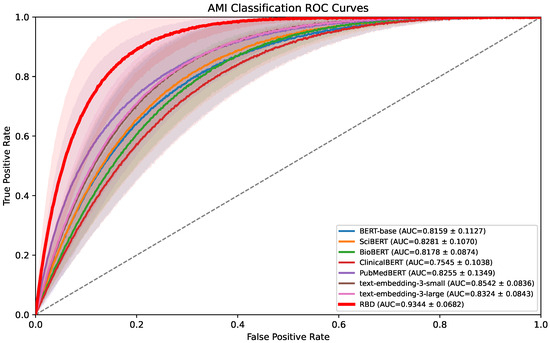
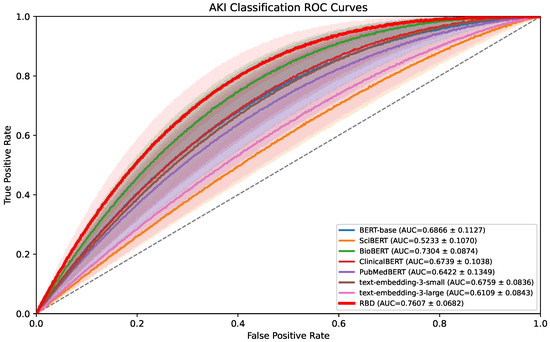
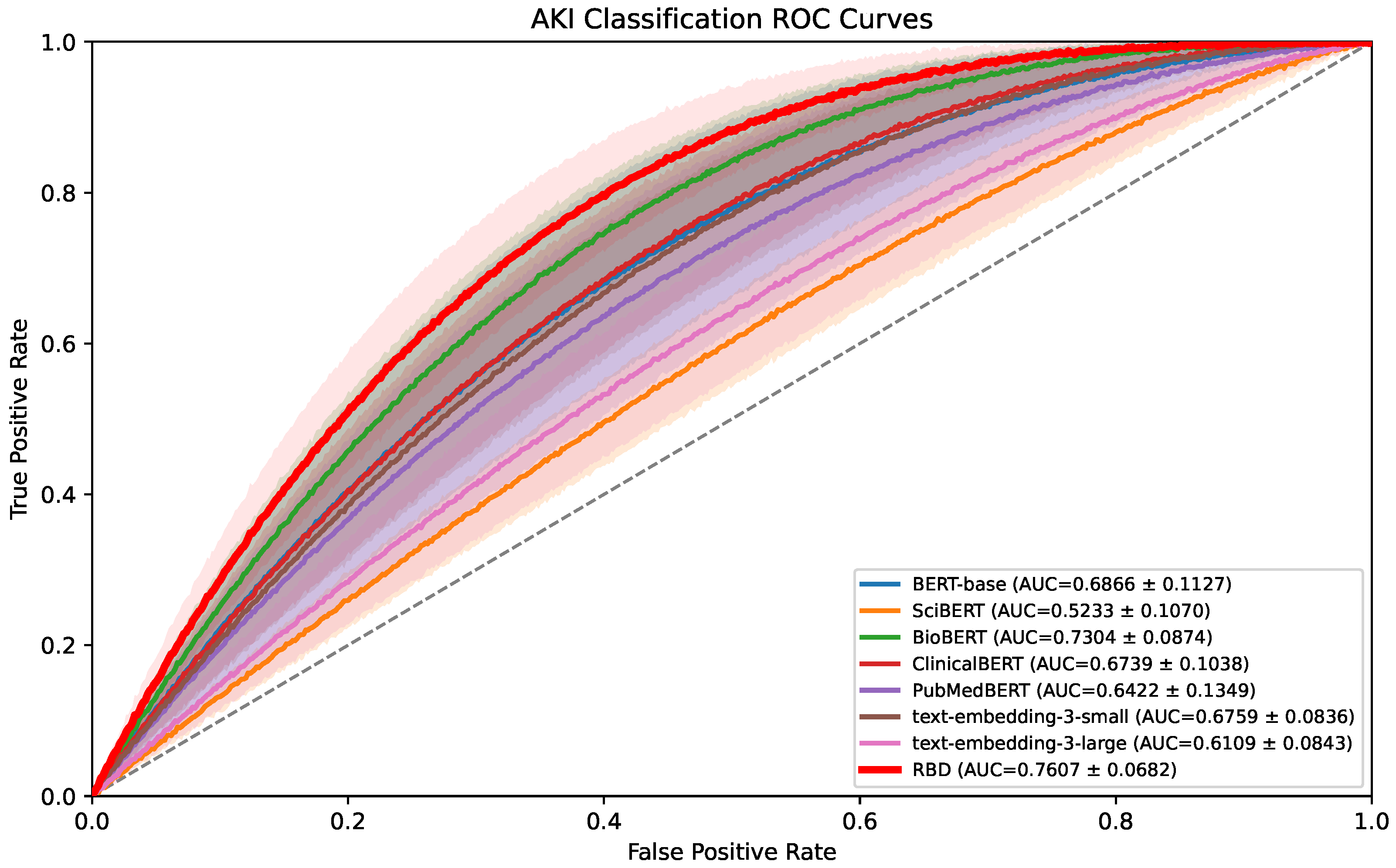
The receiver operating characteristic (ROC) curves for AMI and AKI classification are shown in Figure 4 and Figure 5, respectively. These figures present ROC curves averaged over 10 random seeds, providing an additional perspective on model discrimination performance beyond accuracy, precision, recall, and F1-score.
Figure 4.
ROC curves for AMI classification averaged over 10 random seeds. Shaded regions indicate variability across seeds, and the proposed RBD framework is highlighted with a bold red line.
Figure 5.
ROC curves for AKI classification averaged over 10 random seeds. Shaded regions indicate variability across seeds, and the proposed RBD framework is highlighted with a bold red line.
For AMI prediction (as shown in Figure 4), the proposed RBD model, highlighted by a bold red curve, achieved the highest area under the curve (AUC = 0.9344), substantially outperforming baseline language models such as BERT-base (AUC = 0.8159), SciBERT (AUC = 0.8281), BioBERT (AUC = 0.8178), ClinicalBERT (AUC = 0.7545), PubMedBERT (AUC = 0.8255), text-embedding-3-small (AUC = 0.8542), and text-embedding-3-large (AUC = 0.8324). While the baseline models exhibited relatively similar and moderate discriminative capability, the proposed framework consistently achieved higher true positive rates across a wide range of false positive rates. This improvement highlights the advantage of integrating disease-specific retrieval mechanisms with high-dimensional embeddings, enabling enhanced sensitivity without compromising specificity.
For AKI prediction (as shown in Figure 5), the classification task proved more challenging due to severe class imbalance. Most baseline models demonstrated limited discriminative power, with AUC values ranging from 0.5233 (SciBERT) to 0.7304 (BioBERT). In contrast, the proposed RBD model again achieved the best performance, attaining an AUC of 0.7463. Although this value is lower than that observed for AMI prediction, it nevertheless underscores the robustness of the proposed approach in rare-event scenarios, where baseline models struggled to adequately separate positive and negative cases.
Overall, the ROC and AUC analyses confirm that the proposed retrieval-based framework generalizes more effectively than conventional embedding-based models. While AMI prediction benefits from clearer class separability, the AKI results particularly emphasize the effectiveness of retrieval-based modeling in improving the identification of rare postoperative complications in highly imbalanced clinical datasets.
5.3. Similarity Threshold Sensitivity Analysis
To examine the robustness of the proposed RBD framework with respect to the similarity threshold used for sentence retrieval, we conducted a sensitivity analysis by varying the threshold from 0.20 to 0.40 in increments of 0.05. For each threshold setting, the entire training and evaluation process was repeated over 10 random seeds, and the mean performance along with standard deviation was reported.
Table 4 summarizes the results for AMI prediction. Among the evaluated thresholds, a similarity threshold of 0.30 consistently achieved the best overall performance across all evaluation metrics, including accuracy, macro F1-score, weighted F1-score, and AUROC. In particular, the macro F1-score peaked at 0.7986, indicating the most balanced trade-off between precision and recall for the minority AMI class. Lower thresholds (e.g., 0.20 and 0.25) tended to include a larger number of weakly related sentences, which diluted disease-specific signals and led to reduced macro-level performance. Conversely, higher thresholds (e.g., 0.35 and 0.40) were overly restrictive, excluding clinically relevant sentences and consequently degrading both macro F1 and AUROC. These results suggest that a threshold of 0.30 provides an optimal balance between sensitivity and specificity for AMI prediction.
Table 4.
Sensitivity analysis of similarity threshold for AMI prediction over 10 random seeds. Values are reported as mean, and the numbers in parentheses indicate standard deviation (SD). The best results are highlighted in bold, and the second-best results are underlined.
A similar trend was observed for AKI prediction, as shown in Table 5. Despite the more severe class imbalance in AKI, the threshold of 0.30 again yielded the best performance, achieving the highest macro F1-score (0.7321) and AUROC (0.7607). Thresholds below 0.30 resulted in insufficient discrimination between AKI and non-AKI cases, while higher thresholds led to unstable performance with increased variance, particularly in macro-level metrics. This behavior highlights the importance of appropriately controlling the degree of sentence selection to preserve clinically meaningful information under extreme imbalance.
Table 5.
Performance comparison for AKI prediction under different similarity thresholds. Values are reported as mean over 10 random seeds, with standard deviation (SD) shown in parentheses. The best results are highlighted in bold, and the second-best results are underlined.
Overall, this sensitivity analysis demonstrates that the proposed RBD framework is robust to moderate variations in the similarity threshold and that the empirically selected value of 0.30 consistently provides the most favorable balance across both AMI and AKI prediction tasks. These findings justify the use of a fixed threshold of 0.30 in subsequent experiments and confirm its effectiveness in retrieving disease-relevant clinical context without introducing excessive noise or information loss.
5.4. Ablation Study
To assess the contribution of intraoperative information in patient descriptions, we performed an ablation study by removing all intraoperative features while keeping preoperative information unchanged (As shown in Table 6). The results reveal a consistent performance drop across both AMI and AKI prediction tasks.
Table 6.
Ablation study results: effect of removing intraoperative features from patient descriptions. The best results are highlighted in bold.
For AMI prediction, the full model achieved an accuracy of 0.9381 with a macro F1-score of 0.7501. In contrast, the ablation model reached only 0.8761 accuracy and 0.5775 macro F1, corresponding to a decline of 17.2% in macro F1 and 6.0% in weighted F1. This illustrates that the loss of intraoperative data disproportionately impairs recognition of AMI events, which are rare but clinically critical.
For AKI prediction, the full model obtained an accuracy of 0.9598 and a macro F1 of 0.7107, while the ablation variant dropped to 0.8938 accuracy and 0.5431 macro F1. This represents a reduction of 23.6% in macro F1 and 4.7% in weighted F1. Although the decrease in overall accuracy appears moderate, the substantial drop in macro F1 again highlights the difficulty of identifying rare AKI cases without intraoperative evidence.
Overall, the ablation study confirms that intraoperative features provide essential predictive signals for both AMI and AKI. Their removal not only lowers overall performance but, more importantly, severely degrades the model’s ability to capture minority classes. These findings underscore the clinical value of intraoperative monitoring data in enhancing predictive precision for rare postoperative complications.
5.5. Discussion
The proposed Retrieval-Based Disease Prediction (RBD) framework offers advantages that extend beyond predictive performance and provide practical value for clinical applications. Unlike conventional machine learning pipelines or fine-tuned language models, RBD does not require complex preprocessing steps such as normalization or standardization of heterogeneous clinical variables. This property is particularly beneficial in healthcare environments, where clinical data are often incomplete, noisy, and heterogeneous across institutions, making it difficult to establish robust and standardized preprocessing pipelines. By transforming structured and unstructured clinical records into textual descriptions, the framework enables seamless integration of diverse patient information within a unified modeling paradigm.
Another key strength of the RBD framework lies in its interpretability. Because predictions are derived from sentences that exhibit the highest semantic similarity to predefined disease definitions, clinicians can directly inspect which clinical features contribute most to the prediction of acute myocardial injury (AMI) or acute kidney injury (AKI). This characteristic shifts the framework away from a purely black-box classifier toward a more transparent decision-support system, allowing clinicians to verify, contextualize, and complement the model’s outputs with their own expertise. Collectively, these attributes highlight the potential of the RBD framework not only to improve predictive performance but also to serve as a clinically practical and trustworthy tool for supporting postoperative decision-making.
6. Conclusions and Future Work
In this study, we proposed a Retrieval-Based Disease Prediction (RBD) framework for improving the prediction of postoperative complications, with a particular focus on myocardial injury after noncardiac surgery (MINS) and acute kidney injury (AKI). The proposed approach transforms heterogeneous preoperative and intraoperative clinical data into structured textual descriptions and leverages a high-dimensional embedding model (text-embedding-3-large) to align patient information with disease-specific definitions. By integrating relevance-based sentence selection with independent classifiers for each target condition, the framework consistently outperformed conventional machine learning models and domain-specific language models.
Experimental results demonstrated that the RBD framework achieves higher accuracy and more balanced performance across precision, recall, and F1-score, particularly under highly imbalanced data conditions. In addition, ablation analyses highlighted the critical role of intraoperative features in improving predictive sensitivity for rare but clinically significant postoperative outcomes. These findings indicate that selectively retrieving disease-relevant information can effectively mitigate class imbalance while preserving clinically meaningful signals.
Overall, this work underscores the adaptability and effectiveness of retrieval-based language model approaches for clinical prediction tasks and highlights their potential to enhance prognostic accuracy in postoperative care settings.
Due to the limited number of patients experiencing both AKI and AKI simultaneously, this study focused on predicting each complication independently. As larger and more diverse datasets become available, future work will extend the proposed framework to multi-label prediction settings, enabling the simultaneous identification of multiple postoperative complications. In parallel, we plan to evaluate the generalizability of the framework using external open datasets and multi-institutional patient records, thereby ensuring robustness across diverse clinical environments and strengthening its real-world applicability. Furthermore, beyond AMI and AKI, the framework can be naturally extended by incorporating definitions of additional postoperative complications.
Finally, while this study relied on manually curated textual descriptions to minimize the risk of hallucination, future research will explore the integration of generative AI techniques for automated description generation in close collaboration with clinical experts. This direction aims to improve scalability while maintaining clinical reliability and safety.
Author Contributions
The authors confirm contribution to the paper as follows: Conceptualization, N.P., J.K. and J.-G.S.; methodology, N.P., J.K. and J.-G.S.; software, N.P.; validation, N.P., S.K., J.K. and J.-G.S.; formal analysis, N.P., J.K. and J.-G.S.; investigation, N.P., J.K. and J.-G.S.; resources, N.P., S.K., J.K. and J.-G.S.; data curation, N.P., J.K. and J.-G.S.; writing—original draft preparation, N.P. and J.K.; writing—review and editing, N.P., S.K., J.K. and J.-G.S.; visualization, N.P., S.K., J.K. and J.-G.S.; supervision, J.K. and J.-G.S.; project administration, J.K. and J.-G.S.; funding acquisition, J.K. and J.-G.S. All authors have read and agreed to the published version of the manuscript.
Funding
This work was supported by the Medical Research Funds from Kangbuk Samsung Hospital and by the Basic Science Research Program of the National Research Foundation (NRF) funded by the Korean government (MSIT) (No. IITP-2025-RS-2024-00346737).
Institutional Review Board Statement
This retrospective study was approved by the Institutional Review Board of Kangbuk Samsung Hospital (Seoul, Republic of Korea) (IRB No. 2024-08-030-001; protocol code: 2024-08-030-001; date of approval: 26 September 2024), which also waived the requirement to obtain written informed consent from the patients.
Data Availability Statement
The data presented in this study are available on request from the corresponding authors due to privacy restrictions.
Conflicts of Interest
Jae-Geum Shim was employed by the company Kangbuk Samsung Hospital. The authors declare that this study received funding from Kangbuk Samsung Hospital. The funder was not involved in the study design, collection, analysis, interpretation of data, the writing of this article or the decision to submit it for publication.
References
- Devereaux, P.J.; Goldman, L.; Cook, D.J.; Gilbert, K.; Leslie, K.; Guyatt, G.H. Perioperative cardiac events in patients undergoing noncardiac surgery: Magnitude, pathophysiology, and risk communication. CMAJ 2005, 173, 627–634. [Google Scholar] [CrossRef] [Scilit] [PubMed]
- Devereaux, P.J.; Biccard, B.M.; Sigamani, A.; Xavier, D.; Chan, M.T.; Srinathan, S.K.; Walsh, M.; Abraham, V.; Pearse, R.; Wang, C.Y.; et al. Association between postoperative troponin levels and 30-day mortality among patients undergoing noncardiac surgery. JAMA 2012, 307, 2295–2304. [Google Scholar] [PubMed]
- Ruetzler, K.; Smilowitz, N.R.; Berger, J.S.; Devereaux, P.J.; Maron, B.A.; Newby, L.K.; de Jesus Perez, V.; Sessler, D.I.; Wijeysundera, D.N. Diagnosis and management of patients with myocardial injury after noncardiac surgery: A scientific statement from the American Heart Association. Circulation 2021, 144, e287–e305. [Google Scholar] [CrossRef] [Scilit] [PubMed]
- Khan, J.; Alonso-Coello, P.; Devereaux, P.J. Myocardial injury after noncardiac surgery. Curr. Opin. Cardiol. 2014, 29, 307–311. [Google Scholar] [CrossRef] [Scilit] [PubMed]
- Smilowitz, N.R.; Redel-Traub, G.; Hausvater, A.; Armanious, A.; Nicholson, J.; Puelacher, C.; Berger, J.S. Myocardial injury after non-cardiac surgery: A systematic review and meta-analysis. Cardiol. Rev. 2019, 27, 267–273. [Google Scholar] [CrossRef] [Scilit]
- Szczeklik, W.; Fronczek, J. Myocardial injury after noncardiac surgery—An update. Curr. Opin. Anesthesiol. 2021, 34, 381–386. [Google Scholar] [CrossRef] [Scilit]
- Palevsky, P.M. Endpoints for clinical trials of acute kidney injury. Nephron 2018, 140, 111–115. [Google Scholar] [CrossRef] [Scilit]
- Pereira, M.; Rodrigues, N.; Godinho, I.; Gameiro, J.; Neves, M.; Gouveia, J.; Silva, Z.C.e.; Lopes, J.A. Acute kidney injury in severe sepsis or septic shock: Comparison of RIFLE, AKIN and KDIGO. Clin. Kidney J. 2017, 10, 332–340. [Google Scholar]
- Muroya, Y.; He, X.; Fan, L.; Wang, S.; Xu, R.; Fan, F.; Roman, R.J. Enhanced renal ischemia–reperfusion injury in aging and diabetes. Am. J. Physiol. Renal Physiol. 2018, 315, F1843–F1854. [Google Scholar] [CrossRef] [Scilit]
- Zuber, K.; Davis, J. The ABCs of chronic kidney disease. JAAPA 2018, 31, 17–25. [Google Scholar] [CrossRef] [Scilit]
- Breiman, L. Random forests. Mach. Learn. 2001, 45, 5–32. [Google Scholar] [CrossRef] [Scilit]
- Chen, T.; Guestrin, C. XGBoost: A scalable tree boosting system. In Proceedings of the 22nd ACM SIGKDD, San Francisco, CA, USA, 13–17 August 2016; pp. 785–794. [Google Scholar]
- Saito, T.; Rehmsmeier, M. The precision–recall plot is more informative than the ROC plot on imbalanced datasets. PLoS ONE 2015, 10, e0118432. [Google Scholar] [CrossRef] [Scilit] [PubMed]
- Davis, J.; Goadrich, M. The relationship between Precision-Recall and ROC curves. In Proceedings of the ICML, Pittsburgh, PA, USA, 25–29 June 2006; pp. 233–240. [Google Scholar]
- Nolde, J.M.; Schlaich, M.P.; Sessler, D.I.; Mian, A.; Corcoran, T.B.; Chow, C.K.; Chan, M.T.V.; Borges, F.K.; McGillion, M.H.; Myles, P.S.; et al. Machine learning to predict myocardial injury and death after non-cardiac surgery. Anaesthesia 2023, 78, 853–860. [Google Scholar] [CrossRef] [Scilit]
- Oh, A.R.; Park, J.; Shin, S.J.; Choi, B.; Lee, J.H.; Lee, S.H.; Yang, K. Prediction model for myocardial injury after non-cardiac surgery using machine learning. Sci. Rep. 2023, 13, 1475. [Google Scholar] [CrossRef] [Scilit] [PubMed]
- Vaswani, A.; Shazeer, N.; Parmar, N.; Uszkoreit, J.; Jones, L.; Gomez, A.N.; Kaiser, Ł.; Polosukhin, I. Attention Is All You Need. In Proceedings of the NeurIPS, Long Beach, CA, USA, 4–9 December 2017. [Google Scholar]
- Devlin, J.; Chang, M.-W.; Lee, K.; Toutanova, K. BERT: Pre-training of Deep Bidirectional Transformers for Language Understanding. In Proceedings of the NAACL, Minneapolis, MN, USA, 2–7 June 2019. [Google Scholar]
- Beltagy, I.; Lo, K.; Cohan, A. SciBERT: A pretrained language model for scientific text. In Proceedings of the EMNLP, Hong Kong, China, 3–7 November 2019. [Google Scholar]
- Lee, J.; Yoon, W.; Kim, S.; Kim, D.; Kim, S.; So, C.H.; Kang, J. BioBERT: A pre-trained biomedical language representation model for biomedical text mining. Bioinformatics 2020, 36, 1234–1240. [Google Scholar] [CrossRef] [Scilit] [PubMed]
- Alsentzer, E.; Murphy, J.; Boag, W.; Weng, W.H.; Jindi, D.; Naumann, T.; McDermott, M. Publicly available clinical BERT embeddings. In Proceedings of the ClinicalNLP, Minnespolis, MN, USA, 7 June 2019. [Google Scholar]
- Gu, Y.; Tinn, R.; Cheng, H.; Lucas, M.; Usuyama, N.; Liu, X.; Naumann, T.; Gao, J.; Poon, H. Domain-specific language model pretraining for biomedical NLP. ACM Trans. Comput. Healthc. 2022, 3, 1–23. [Google Scholar] [CrossRef] [Scilit]
- Huang, K.; Altosaar, J.; Ranganath, R. ClinicalBERT: Modeling clinical notes and predicting hospital readmission. arXiv 2019, arXiv:1904.05342. [Google Scholar]
- Reimers, N.; Gurevych, I. Sentence-BERT: Sentence embeddings using Siamese BERT networks. In Proceedings of the EMNLP, Hong Kong, China, 3–7 November 2019. [Google Scholar]
- Karpukhin, V.; Oguz, B.; Min, S.; Lewis, P.S.; Wu, L.; Edunov, S.; Chen, D.; Yih, W.-T. Dense Passage Retrieval for open-domain QA. In Proceedings of the EMNLP, Online, 16–20 November 2020. [Google Scholar]
- Conneau, A.; Kiela, D. Supervised learning of universal sentence representations from NLI data. In Proceedings of the EMNLP, Copenhagen, Denmark, 7–11 September 2017. [Google Scholar]
- Park, N.; Ko, D.; Lee, D.; Kim, S.; Kim, J. Retrieval-based disease prediction for myocardial injury after noncardiac surgery: Leveraging language models as diagnostic tools. In Proceedings of the AAAI 2024 Spring Symposium on Clinical Foundation Models, Stanford, CA, USA, 25–27 March 2024. [Google Scholar]
- OpenAI, Text and Code Embeddings by OpenAI. 2024. Available online: https://platform.openai.com/docs/guides/embeddings (accessed on 1 January 2026).
- Rajkomar, A.; Oren, E.; Chen, K.; Dai, A.M.; Hajaj, N.; Hardt, M.; Liu, P.J.; Liu, X.; Marcus, J.; Sun, M.; et al. Scalable and accurate deep learning with electronic health records. NPJ Digit. Med. 2018, 1, 18. [Google Scholar] [CrossRef] [Scilit]
- Choi, E.; Schuetz, A.; Stewart, W.; Sun, J. Using recurrent neural network models for early detection of heart failure onset. JAMIA 2017, 24, 361–370. [Google Scholar] [CrossRef] [Scilit]
- Obermeyer, Z.; Emanuel, E.J. Predicting the future—Big data, machine learning, and clinical medicine. N. Engl. J. Med. 2016, 375, 1216–1219. [Google Scholar] [CrossRef] [Scilit]
- Miotto, M.; Wang, F.; Wang, S.; Jiang, X.; Dudley, J.T. Deep learning for healthcare: Review, opportunities and challenges. Brief. Bioinform. 2018, 19, 1236–1246. [Google Scholar] [CrossRef] [Scilit]
- Lundberg, S.M.; Nair, B.; Vavilala, M.S.; Horibe, M.; Eisses, M.J.; Adams, T.; Liston, D.E.; Low, D.K.-W.; Newman, S.-F.; Kim, J.; et al. Explainable machine-learning predictions for the prevention of hypoxaemia during surgery. Nat. Biomed. Eng. 2018, 2, 749–760. [Google Scholar] [CrossRef] [Scilit]
- Doshi-Velez, J.; Kim, B. Towards a rigorous science of interpretable machine learning. arXiv 2017, arXiv:1702.08608. [Google Scholar] [CrossRef] [Scilit]
- Frermann, L.; Li, J.; Khanehzar, S.; Mikolajczak, G. Conflicts, Villains, Resolutions: Towards models of Narrative Media Framing. In Proceedings of the ACL 2023 (Long Papers), Toronto, ON, Canada, 9–14 July 2023; pp. 8712–8732. [Google Scholar]
- Lipton, Z.C. The mythos of model interpretability. Commun. ACM 2018, 61, 36–43. [Google Scholar] [CrossRef] [Scilit]

Disclaimer/Publisher’s Note: The statements, opinions and data contained in all publications are solely those of the individual author(s) and contributor(s) and not of MDPI and/or the editor(s). MDPI and/or the editor(s) disclaim responsibility for any injury to people or property resulting from any ideas, methods, instructions or products referred to in the content. |
© 2026 by the authors. Licensee MDPI, Basel, Switzerland. This article is an open access article distributed under the terms and conditions of the Creative Commons Attribution (CC BY) license.