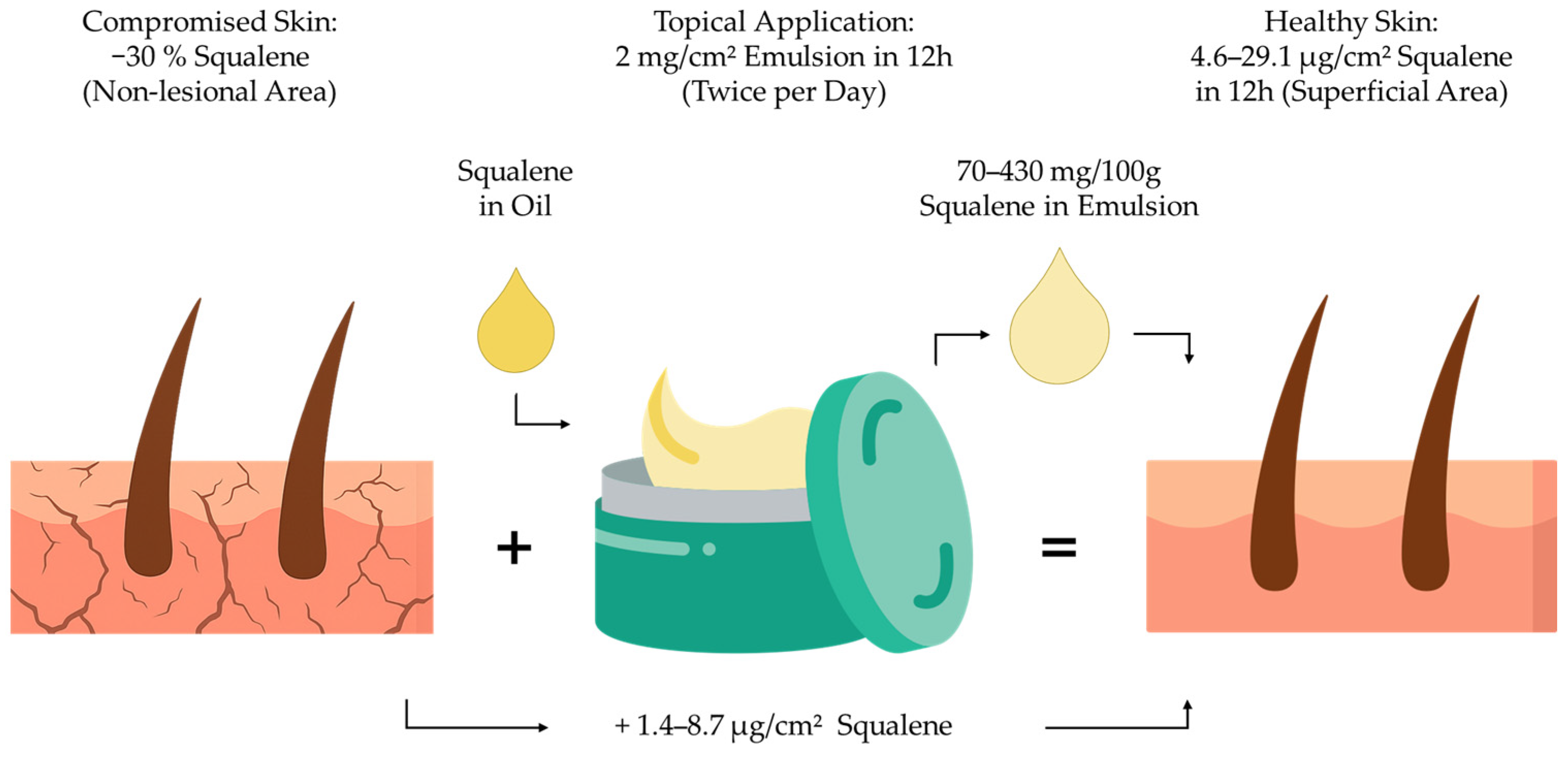


Squalene from Silphium perfoliatum: A Novel Source with Long-Term Stability and Applicability in Topical Formulations

Abstract
1. Introduction
2. Materials and Methods
3. Results and Discussion
3.1. Squalene Sources
3.2. Oxidative Stability
3.3. Potential for Skin-Care Products
4. Conclusions
5. Patents
Author Contributions
Funding
Institutional Review Board Statement
Informed Consent Statement
Data Availability Statement
Acknowledgments
Conflicts of Interest
Appendix A
Appendix A.1. Squalene Analysis in Silphium Seed Oil
- linearity: R2 = 0.9987 over the calibration range 0.046–18.6 mg/kg of squalene;
- repeatability (n = 7): RSD% = 0.2%;
- mean recovery: 102.0 ± 0.3% evaluated at two concentration levels (0.460 and 0.920 g/kg).

| Sample | Crop | Pressed | Packaging | Storage | Batch | Squalene [mg/100 g] |
|---|---|---|---|---|---|---|
| 1 | 2024 | April 2025 | HDPE | Dark, 15 °C | PA25048 | 3250 ± 50 |
| 2 | 2018 | April 2025 | HDPE | Dark, 15 °C | PA25050 | 3560 ± 1 |
| 3 | 2020 | April 2025 | HDPE | Dark, 15 °C | PA25049 | 3350 ± 70 |
| 4 | 2022 | 2022 | HDPE Can, later transferred to Green Glass | Dark, 15 °C | - | 3560 ± 80 |
| 5 | 2022 | 2022 | Glass | Dark, 15 °C | - | 3560 ± 4 |
| 6 | 2022 | 2022 | Glass | Office, Room Temperature | - | 3490 ± 30 |
| 7 | 2022 | 2022 | Glass | Dark, 15 °C | - | 3550 ± 20 |
Appendix A.2. Hexanal Analysis in Silphium Seed Oil
| Sample | Crop | Pressed | Packaging | Storage | Batch | Hexanal [ppm] |
|---|---|---|---|---|---|---|
| 1 | 2024 | April 2025 | HDPE | Dark, 15 °C | PA25048 | <1 |
| 2 | 2018 | April 2025 | HDPE | Dark, 15 °C | PA25050 | 2.3 |
| 3 | 2020 | April 2025 | HDPE | Dark, 15 °C | PA25049 | 1.1 |
| 4 | 2022 | 2022 | HDPE Can, later transferred to Glass | Dark, 15 °C | - | 1.2 |
| 5 | 2022 | 2022 | Glass | Dark, 15 °C | - | 1.4 |
| 6 | 2022 | 2022 | Glass | Office, Room Temperature | - | <1 |
| 7 | 2022 | 2022 | Glass | Dark, 15 °C | - | <1 |
Appendix A.3. Fatty Acid Analysis in Silphium Seed Oil
| Sample | Crop | Pressed | Batch | Palmitic Acid [%] | Stearic Acid [%] | Oleic Acid [%] | Linoleic Acid [%] |
|---|---|---|---|---|---|---|---|
| 1 | 2024 | April 2025 | PA25048 | 7.0 | 2.3 | 17.4 | 69.2 |
| 2 | 2018 | April 2025 | PA25050 | 7.7 | 3.2 | 19.8 | 65.0 |
| 3 | 2020 | April 2025 | PA25049 | 7.2 | 2.5 | 18.6 | 66.4 |
Appendix A.4. Application Potential of Silphium Seed Oil
References
- Pham, D.-M.; Boussouira, B.; Moyal, D.; Nguyen, Q.L. Oxidization of squalene, a human skin lipid: A new and reliable marker of environmental pollution studies. Int. J. Cosmet. Sci. 2015, 37, 357–365. [Google Scholar] [CrossRef] [Scilit]
- Kohno, Y.; Takahashi, M. Peroxidation in human skin and its prevention. J. Jpn. Oil Chem. Soc. 1995, 44, 248–255. [Google Scholar] [CrossRef] [Scilit]
- Auffray, B. Protection against singlet oxygen, the main actor of sebum squalene peroxidation during sun exposure, using Commiphora myrrha essential oil. Int. J. Cosmet. Sci. 2007, 29, 23–29. [Google Scholar] [CrossRef] [Scilit] [PubMed]
- Chiba, K.; Sone, T.; Kawakami, K.; Onoue, M. Skin roughness and wrinkle formation induced by repeated application of squalene-monohydroperoxide to the hairless mouse. Exp. Dermatol. 1999, 8, 471–479. [Google Scholar] [CrossRef] [Scilit]
- Chiba, K.; Yoshizawa, K.; Makino, I.; Kawakami, K.; Onoue, M. Comedogenicity of squalene monohydroperoxide in the skin after topical application. J. Toxicol. Sci. 2000, 25, 77–83. [Google Scholar] [CrossRef] [Scilit]
- Chiba, K.; Yoshizawa, K.; Makino, I.; Kawakami, K.; Onoue, M. Changes in the levels of glutathione after cellular and cutaneous damage induced by squalene monohydroperoxide. J. Biochem. Mol. Toxicol. 2001, 15, 150–158. [Google Scholar] [CrossRef] [Scilit] [PubMed]
- Chiba, K.; Kawakami, K.; Sone, T.; Onoue, M. Characteristics of skin wrinkling and dermal changes induced by repeated application of squalene monohydroperoxide to hairless mouse skin. Ski. Pharmacol. Appl. Ski. Physiol. 2003, 16, 242–251. [Google Scholar] [CrossRef] [Scilit]
- Uchino, T.; Tokunaga, H.; Onodera, H.; Ando, M. Effect of squalene monohydroperoxide on cytotoxicity and cytokine release in a three-dimensional human skin model and human epidermal keratinocytes. Biol. Pharm. Bull. 2002, 25, 605–610. [Google Scholar] [CrossRef] [Scilit] [PubMed]
- De Luca, C.; Valacchi, G. Surface lipids as multifunctional mediators of skin responses to environmental stimuli. Mediat. Inflamm. 2010, 2010, 321494. [Google Scholar] [CrossRef] [Scilit]
- Passi, S.; De Pità, O.; Grandinetti, M.; Simotti, C.; Littarru, G.P. The combined use of oral and topical lipophilic antioxidants increases their levels both in sebum and stratum corneum. Biofactors 2003, 18, 289–297. [Google Scholar] [CrossRef] [Scilit]
- Huang, Z.R.; Lin, Y.K.; Fang, J.Y. Biological and pharmacological activities of squalene and related compounds: Potential uses in cosmetic dermatology. Molecules 2009, 14, 540–554. [Google Scholar] [CrossRef] [Scilit] [PubMed]
- Rosales-Garcia, T.; Jimenez-Martinez, C.; Davila-Ortiz, G. Squalene Extraction: Biological Sources and Extraction Methods. Int. J. Environ. Agric. Biotechnol. 2017, 2, 1662–1670. [Google Scholar] [CrossRef] [Scilit]
- Kim, S.K.; Karadeniz, F. Biological Importance and Applications of Squalene and Squalane. In Advances in Food and Nutrition Research, 1st ed.; Elsevier Inc.: Amsterdam, The Netherlands, 2012; Volume 65, pp. 223–233. [Google Scholar] [CrossRef] [Scilit]
- Morgan, N.R.; Magalingam, K.B.; Radhakrishnan, A.K.; Arumugam, M.; Jamil, A.; Bhuvanendran, S. Explicating the Multifunctional Roles of Tocotrienol and Squalene in Promoting Skin Health. Ski. Health Dis. 2024, 4, ski2.448. [Google Scholar] [CrossRef] [Scilit] [PubMed]
- Micera, M.; Botto, A.; Geddo, F.; Antoniotti, S.; Bertea, C.M.; Levi, R.; Gallo, M.P.; Querio, G. Squalene: More than a Step toward Sterols. Antioxidants 2020, 9, 688. [Google Scholar] [CrossRef] [Scilit]
- Fiume, M.; Bergfeld, W.F.; Belsito, D.V.; Hill, R.A.; Klaassen, C.D.; Liebler, D.C.; Marks, J.G.; Shank, R.C.; Slaga, T.J.; Snyder, P.W.; et al. Squalane and Squalene. Int. J. Toxicol. 2023, 42, 107S–109S. [Google Scholar] [CrossRef] [Scilit] [PubMed]
- Fiume, M.M. Cosmetic Ingredient Review Expert Panel. In Safety Assessment of Squalane and Squalene as Used in Cosmetics; Cosmetic Ingredient Review: Washington, DC, USA, 2019; Available online: https://www.cir-safety.org/sites/default/files/Squalene%20and%20Squalane.pdf (accessed on 5 January 2026).
- Rathod, M.L.; Angadi, B.M.; Bhavi, I.G. A review on optimization of process parameters of cold pressed oil extraction for high output and for enhanced quality and retained nutrients. Food Humanit. 2025, 5, 100698. [Google Scholar] [CrossRef] [Scilit]
- Lozano-Grande, M.A.; Gorinstein, S.; Espitia-Rangel, E.; Dávila-Ortiz, G.; Martínez-Ayala, A.L. Plant Sources, Extraction Methods, and Uses of Squalene. Int. J. Agron. 2018, 2018, 1829160. [Google Scholar] [CrossRef] [Scilit]
- Tian, M.; Bai, Y.; Tian, H.; Zhao, X. The Chemical Composition and Health-Promoting Benefits of Vegetable Oils—A Review. Molecules 2023, 28, 6393. [Google Scholar] [CrossRef] [Scilit]
- Salvo, A.; La Torre, G.L.; Rotondo, A.; Mangano, V.; Casale, K.E.; Pellizzeri, V.; Clodoveo, M.L.; Corbo, F.; Cicero, N.; Dugo, G. Determination of squalene in organic extra virgin olive oils (EVOOs) by UPLC/PDA using a single-step SPE sample preparation. Food Anal. Methods 2017, 10, 1377–1385. [Google Scholar] [CrossRef] [Scilit]
- Hayakawa, T.; Yanagawa, M.; Yamamoto, A.; Aizawa, S.; Taga, A.; Mochizuki, N.; Itabashi, Y.; Uchida, H.; Ishihara, Y.; Kodama, S. A Simple Screening Method for Extra Virgin Olive Oil Adulteration by Determining Squalene and Tyrosol. J. Oleo Sci. 2020, 69, 677–684. [Google Scholar] [CrossRef] [Scilit]
- Akin, G.; Arslan, F.N.; Karuk Elmasa, S.N.; Yilmaz, I. Cold-pressed pumpkin seed (Cucurbita pepo L.) oils from the central Anatolia region of Turkey: Characterization of phytosterols, squalene, tocols, phenolic acids, carotenoids and fatty acid bioactive compounds. Grasas Aceites 2018, 69, e232. [Google Scholar] [CrossRef] [Scilit]
- Konopka, I.; Roszkowska, B.; Czaplicki, S.; Tańska, M. Optimization of Pumpkin Oil Recovery by Using Aqueous Enzymatic Extraction and Comparison of the Quality of the Obtained Oil with the Quality of Cold-Pressed Oil. Food Technol. Biotechnol. 2016, 54, 413–420. [Google Scholar] [CrossRef] [Scilit]
- Yuenyong, J.; Pokkanta, P.; Phuangsaijai, N.; Kittiwachana, S.; Mahatheeranont, S.; Sookwong, P. GC-MS and HPLC-DAD Analysis of Fatty Acid Profile and Functional Phytochemicals in Fifty Cold-Pressed Plant Oils in Thailand. Heliyon 2021, 7, e06304. [Google Scholar] [CrossRef] [Scilit]
- Bozorov, S.S.; Berdiev, N.S.; Ishimov, U.J.; Olimjonov, S.S.; Ziyavitdinov, J.F.; Asrorov, A.M.; Salikhov, S.I. Chemical Composition and Biological Activity of Seed Oil of Amaranth Varieties. Nova Biotechnol. Chim. 2018, 17, 66–73. [Google Scholar] [CrossRef] [Scilit]
- Mondor, M.; Melgar-Lalanne, G.; Hernández-Álvarez, A.J. Cold Pressed Amaranth (Amaranthus tricolor) Oil. In Cold Pressed Oils; Academic Press: London, UK, 2020; pp. 113–127. [Google Scholar]
- Pal, Y.P.; Pratap, A.P. Rice Bran Oil: A Versatile Source for Edible and Industrial Applications. J. Oleo Sci. 2017, 66, 551–556. [Google Scholar] [CrossRef] [Scilit]
- Pokkanta, P.; Sookwong, P.; Tanang, M.; Setchaiyan, S.; Boontakham, P.; Mahatheeranont, S. Simultaneous Determination of Tocols, γ-Oryzanols, Phytosterols, Squalene, Cholecalciferol and Phylloquinone in Rice Bran and Vegetable Oil Samples. Food Chem. 2018, 264, 424–433. [Google Scholar] [CrossRef] [Scilit]
- Wechsler, T.; Bakhshian, O.; Engelen, C.; Dag, A.; Ben-Ari, G.; Samach, A. Determining Reproductive Parameters, which Contribute to Variation in Yield of Olive Trees from Different Cultivars, Irrigation Regimes, Age and Location. Plants 2022, 11, 2414. [Google Scholar] [CrossRef] [Scilit]
- Kaniewski, D.; Marriner, N.; Terral, J.F.; Besnard, G.; Tsitsou, L.; Topsakal, J.; Morhange, C.; Otto, T.; Luce, F.; Cheddadi, R. Olive Production in the 21st Century Will Be Threatened by Water Stress and Declining Solar Activity. Commun. Earth Environ. 2025, 6, 268. [Google Scholar] [CrossRef] [Scilit]
- O’Neill, C.M.; Gill, S.; Hobbs, D.; Morgan, C.; Bancroft, I. Natural Variation for Seed Oil Composition in Arabidopsis thaliana. Phytochemistry 2003, 64, 1077–1090. [Google Scholar] [CrossRef] [Scilit]
- Kempinski, C.; Chappell, J. Engineering Triterpene Metabolism in the Oilseed of Arabidopsis thaliana. Plant Biotechnol. J. 2019, 17, 386–396. [Google Scholar] [CrossRef] [Scilit]
- Reinert, S.; Van Tassel, D.L.; Schlautman, B.; Kane, N.C.; Hulke, B.S. Assessment of the biogeographical variation of seed size and seed oil traits in wild Silphium integrifolium Michx. genotypes. Plant Genet. Resour. 2019, 17, 427–436. [Google Scholar] [CrossRef] [Scilit]
- Hwang, H.-S.; Liu, S.X.; Winkler-Moser, J.K.; Singh, M.; Van Tassel, D.L. Composition and oxidative stability of silflower (Silphium integrifolium) seed oil and its potential as a new source of squalene. J. Am. Oil Chem. Soc. 2024, 101, 663–674. [Google Scholar] [CrossRef] [Scilit]
- Thathsara, K.A.H.; Chinthaka, S.D.M. Characterization of seed oils of three Fabaceae species. In Proceedings of the Open University Research Sessions (OURS 2023); The Open University of Sri Lanka: Nawala, Sri Lanka, 2023; pp. 1–6. [Google Scholar]
- Prajapati, R.M.; Thakur, L.K.; Singh, U. Formulation and bio-efficacy of emulsifiable concentrates of Pongammia pinnata and Jatropha curcas seed oils against plant pathogens. Int. J. ChemTech Res. 2017, 10, 365–372. [Google Scholar]
- Panpraneecharoen, S.; Khamchum, C.; Vaithanomsat, P.; Thanasombat, M.; Punsuvon, V. Variability of oil content, fatty acid composition and karanjin content in Pongamia pinnata and its relationship with biodiesel quality. Annu. Res. Rev. Biol. 2014, 4, 2283–2294. [Google Scholar] [CrossRef] [Scilit]
- Li, C.; Ng, A.; Xie, L.; Mao, H.; Qiu, C.; Srinivasan, R.; Yin, Z.; Hong, Y. Engineering low phorbol ester Jatropha curcas seed by intercepting casbene biosynthesis. Plant Cell Rep. 2016, 35, 103–114. [Google Scholar] [CrossRef] [Scilit]
- Ashirov, M.Z.; Datkhayev, U.M.; Myrzakozha, D.A.; Sato, H.; Zhakipbekov, K.S.; Rakhymbayev, N.A.; Sadykov, B.N. Study of Cold-Pressed Tobacco Seed Oil Properties by Gas Chromatography Method. Sci. World J. 2020, 2020, 8852724. [Google Scholar] [CrossRef] [Scilit]
- Hou, X.; Zhang, H.; Zhang, Z.; Liang, H.; Fu, Y.; Fu, Q.; Mao, X.; Du, Y. Analysis of Tobacco Seed Oil and Its Antioxidant Activities in vivo. Chin. Tob. Sci. 2016, 37, 80–84. [Google Scholar]
- Matthäus, B.; Özcan, M.M. Fatty Acid, Tocopherol and Squalene Contents of Rosaceae Seed Oils. Bot. Stud. 2014, 55, 48. [Google Scholar] [CrossRef] [Scilit]
- Gansberger, M.; Montgomery, L.F.R.; Liebhard, P. Botanical characteristics, crop management and potential of Silphium perfoliatum L. as a renewable resource for biogas production: A review. Ind. Crops Prod. 2015, 63, 362–372. [Google Scholar] [CrossRef] [Scilit]
- Cosmile Europe. Silphium perfoliatum Seed Oil. Available online: https://cosmileeurope.eu/inci/detail/33460/silphium-perfoliatum-seed-oil/ (accessed on 9 May 2026).
- European Parliament; Council of the European Union. Regulation (EC) No 1223/2009 of the European Parliament and of the Council of 30 November 2009 on cosmetic products. Off. J. Eur. Union 2009, L342, 59–209. [Google Scholar]
- Mohd Hanafiah, K.; Abd Mutalib, A.H.; Miard, P.; Goh, C.S.; Mohd Sah, S.A.; Ruppert, N. Impact of Malaysian palm oil on sustainable development goals: Co-benefits and trade-offs across mitigation strategies. Sustain. Sci. 2022, 17, 1639–1661. [Google Scholar] [CrossRef] [Scilit]
- Amarowicz, R. Squalene: A natural antioxidant? Eur. J. Lipid Sci. Technol. 2009, 111, 411–412. [Google Scholar] [CrossRef] [Scilit]
- Psomiadou, E.; Tsimidou, M. On the role of squalene in olive oil stability. J. Agric. Food Chem. 1999, 47, 4025–4032. [Google Scholar] [CrossRef] [Scilit]
- Naziri, E.; Mitić, M.N.; Tsimidou, M.Z. Contribution of tocopherols and squalene to the oxidative stability of cold-pressed pumpkin seed oil (Cucurbita pepo L.). Eur. J. Lipid Sci. Technol. 2016, 118, 898–905. [Google Scholar] [CrossRef] [Scilit]
- Rastrelli, L.; Passi, S.; Ippolito, F.; Vacca, G.; De Simone, F. Rate of degradation of α-tocopherol, squalene, phenolics, and polyunsaturated fatty acids in olive oil during different storage conditions. J. Agric. Food Chem. 2002, 50, 5566–5570. [Google Scholar] [CrossRef] [Scilit]
- Malecka, M. The effect of squalene on the thermostability of rapeseed oil. Nahrung 1994, 38, 135–140. [Google Scholar] [CrossRef] [Scilit]
- Belitz, H.D.; Grosch, W.; Schieberle, P. Lehrbuch der Lebensmittelchemie, 6th ed.; Springer: Berlin/Heidelberg, Germany, 2013. [Google Scholar]
- Fritsch, C.W.; Gale, J.A. Hexanal as a measure of rancidity in low fat foods. J. Am. Oil Chem. Soc. 1977, 54, 225–228. [Google Scholar] [CrossRef] [Scilit]
- Ishak, W.M.W.; Katas, H.; Yuen, N.P.; Abdullah, M.A.; Zulfakar, M.H. Topical application of omega-3-, omega-6-, and omega-9-rich oil emulsions for cutaneous wound healing in rats. Drug Deliv. Transl. Res. 2019, 9, 418–433. [Google Scholar] [CrossRef] [Scilit]
- Naziri, E.; Consonni, R.; Tsimidou, M.Z. Squalene oxidation products: Monitoring the formation, characterisation and pro-oxidant activity. Eur. J. Lipid Sci. Technol. 2014, 116, 1400–1411. [Google Scholar] [CrossRef] [Scilit]
- Zhang, M.; Fan, L.; Liu, Y.; Li, J. Effects of interface generation, droplet size and antioxidant partitioning on the oxidation rate and oxidative stability of water–in–oil emulsions: A comparison of coarse emulsions and nanoemulsions. Food Hydrocoll. 2023, 136, 108227. [Google Scholar] [CrossRef] [Scilit]
- McClements, D.J.; Decker, E.A. Lipid oxidation in oil-in-water emulsions: Impact of molecular environment on chemical reactions in heterogeneous food systems. J. Food Sci. 2000, 65, 1270–1282. [Google Scholar] [CrossRef] [Scilit]
- Fox, C.B. Squalene Emulsions for Parenteral Vaccine and Drug Delivery. Molecules 2009, 14, 3286–3312. [Google Scholar] [CrossRef] [Scilit]
- Brito, L.A.; Chan, M.; Baudner, B.; Gallorini, S.; Santos, G.; O’Hagan, D.; Singh, M. An alternative renewable source of squalene for use in emulsion adjuvants. Vaccine 2011, 29, 6262–6268. [Google Scholar] [CrossRef] [Scilit]
- Chae, G.-E.; Kim, D.W.; Jin, H.-E. Development of Squalene-Based Oil-in-Water Emulsion Adjuvants Using a Self-Emulsifying Drug Delivery System for Enhanced Antigen-Specific Antibody Titers. Int. J. Nanomed. 2022, 17, 6221–6231. [Google Scholar] [CrossRef] [Scilit]
- Springer, A.; Ziegler, H. The Role of Preservatives and Multifunctionals on the Oxidation of Cosmetic O/W Emulsions. Cosmetics 2022, 9, 59. [Google Scholar] [CrossRef] [Scilit]
- Springer, A.; Ziegler, H.; Bach, K. The Influence of Antioxidant Plant Extracts on the Oxidation of O/W Emulsions. Cosmetics 2023, 10, 40. [Google Scholar] [CrossRef] [Scilit]
- Rosenow, P.; Destler, E.; Springer, A. The Search for Suitable Packaging for Cosmetics—A Case Study. Sofw. J. 2022, 148, 56–59. [Google Scholar]
- Styrczewska, M.; Zuk, M.; Boba, A.; Zalewski, I.; Kulma, A. Use of Natural Components Derived from Oil Seed Plants for Treatment of Inflammatory Skin Diseases. Curr. Pharm. Des. 2019, 25, 2241–2263. [Google Scholar] [CrossRef] [Scilit]
- Psomiadou, E.; Tsimidou, M.Z. Stability of virgin olive oil. 2. Photo-oxidation studies. J. Agric. Food Chem. 2002, 50, 722–727. [Google Scholar] [CrossRef] [Scilit]
- Dessi, M.A.; Deiana, M.; Day, B.W.; Rosa, A.; Banni, S.; Corongiu, F.P. Oxidative stability of polyunsaturated fatty acids: Effect of squalene. Eur. J. Lipid Sci. Technol. 2002, 104, 506–512. [Google Scholar] [CrossRef] [Scilit]
- Ferreira, M.J.; Fiadeiro, T.; Silvia, M.; Soares, A.P. Topical γ-linolenic acid therapy in atopic dermatitis. Allergo J. 1998, 7, 213–216. [Google Scholar] [CrossRef] [Scilit]
- Williams, H.C. Evening primrose oil for atopic dermatitis. BMJ 2003, 327, 1358–1359. [Google Scholar] [CrossRef] [Scilit]
- Kowalski, R. Studies of selected plant raw materials as alternative sources of triterpenes of oleanolic and ursolic acid types. J. Agric. Food Chem. 2007, 55, 656–662. [Google Scholar] [CrossRef] [Scilit] [PubMed]
- Kowalski, R.; Wierciński, J. Evaluation of chemical composition of some Silphium L. species seeds as alternative foodstuff raw materials. Pol. J. Food Nutr. Sci. 2004, 13, 349–354. [Google Scholar]
- Anghelache, A.M.; Kim, L.; Cuciureanu, A.; Bătrînescu, G.; Pascu, L.F. Rheological properties and stability of squalene emulsion prepared with non-ionic emulsifier. Rev. Chim. 2017, 68, 1681–1684. [Google Scholar] [CrossRef] [Scilit]
- Kumar, L.R.G.; Anas, K.K.; Tejpal, S.C.; Chatterjee, S.N.; Vishnu, V.K.; Asha, K.K.; Anandan, R.; Mathew, S. Chitosan: Whey Protein Isolate: An Effective Emulsifier for Stabilization of Squalene Based Emulsions. Waste Biomass Valoriz. 2020, 11, 3477–3483. [Google Scholar] [CrossRef] [Scilit]
- Fox, C.B.; Lin, S.; Sivananthan, S.J.; Dutill, T.S.; Forseth, K.T.; Reed, S.G.; Vedvick, T.S. Effects of emulsifier concentration, composition, and order of addition in squalene-phosphatidylcholine oil-in-water emulsions. Pharm. Dev. Technol. 2011, 16, 511–519. [Google Scholar] [CrossRef] [Scilit]
- Park, J.; Kang, D.H.; Woo, H.M. Microbial Bioprocess for Extracellular Squalene Production and Formulation of Nanoemulsions. ACS Sustain. Chem. Eng. 2021, 9, 14263–14276. [Google Scholar] [CrossRef] [Scilit]
- Greene, R.S.; Downing, D.T.; Pochi, P.E.; Strauss, J.S. Anatomical Variation in the Amount and Composition of Human Skin Surface Lipid. J. Investig. Dermatol. 1970, 54, 240–247. [Google Scholar] [CrossRef] [Scilit]
- Downing, D.T.; Stewart, M.E.; Strauss, J.S. Estimation of Sebum Production Rates in Man by Measurement of the Squalene Content of Skin Biopsies. J. Investig. Dermatol. 1981, 77, 358–360. [Google Scholar] [CrossRef] [Scilit] [PubMed]
- Luebberding, S.; Krueger, N.; Kerscher, M. Skin physiology in men and women: In vivo evaluation of 300 people including TEWL, SC hydration, sebum content and skin surface pH. Int. J. Cosmet. Sci. 2013, 35, 477–483. [Google Scholar] [CrossRef] [Scilit] [PubMed]
- European Commission. Commission Recommendation of 22 September 2006 on the Efficacy of Sunscreen Products and the Claims Made Relating Thereto (2006/647/EC). Off. J. Eur. Union 2006, L265, 39–43. [Google Scholar]
- Yin, H.; Qiu, Z.; Zhu, R.; Wang, S.; Gu, C.; Yao, X.; Li, W. Dysregulated lipidome of sebum in patients with atopic dermatitis. Allergy 2023, 78, 1524–1537. [Google Scholar] [CrossRef] [Scilit] [PubMed]

| Established Sources | Squalene Mean (Range) [mg/100 g] | Ref. |
|---|---|---|
| Extra Virgin Olive Oil (Olea europaea) 1,2 | 372 (145–747) | [21] |
| Olive Oil (Olea europaea) 3 | 438 (236–747) * | [22] |
| Pumpkin Seed Oil (Cucurbita pepo) 1 | 605 (591–633) | [23] |
| Pumpkin Seed Oil (Cucurbita pepo) 1 | 95 (95–96) | [24] |
| Amaranth oil 4 | 73 (67–79) | [25] |
| Amaranth Oil (Amaranthus hypochondriacus, Amaranthus cruentus) 2,4 | 5920 (5290–6790) | [26] |
| Amaranth Oil (Amaranthus tricolor) 1 | (6000–11,600) | [27] |
| Rice bran oil (Oryza sativa) | 326 (300–400) | [22,28] |
| Peanut Oil (Arachis hypogaea) 1 | 133 (132–134) | [29] |
| Sunflower Oil (Helianthus annuus) | 8 (3–12) * | [22] |
| New Sources | Oil Content [%] | Squalene Mean (Range) [mg/100 g] | Ref. |
|---|---|---|---|
| Arabidopsis thaliana | 34.6–46.0 | 46–65 * | [32,33] |
| Silphium perfoliatum | 15 | 3474 (3250–3560) | Appendix A.1 |
| Silphium integrifolium | 11.8–25.3 | 4890 ** | [34,35] |
| Pongamia pinnata | 26.7–33.1 | 1290–1860 ** | [36,37,38] |
| Jatropha curcas | 40 | 180 ** | [36,39] |
| Nicotiana spp. | 36.25–37.25 | 24 ** | [40,41] |
| Rosaceae seed oils | 3.49–46.15 | 88.4 (20–290) ** | [42] |
Disclaimer/Publisher’s Note: The statements, opinions and data contained in all publications are solely those of the individual author(s) and contributor(s) and not of MDPI and/or the editor(s). MDPI and/or the editor(s) disclaim responsibility for any injury to people or property resulting from any ideas, methods, instructions or products referred to in the content. |
© 2026 by the authors. Licensee MDPI, Basel, Switzerland. This article is an open access article distributed under the terms and conditions of the Creative Commons Attribution (CC BY) license.
Share and Cite
Springer, A.; Gras, C.; Moor, W. Squalene from Silphium perfoliatum: A Novel Source with Long-Term Stability and Applicability in Topical Formulations. Cosmetics 2026, 13, 148. https://doi.org/10.3390/cosmetics13030148
Springer A, Gras C, Moor W. Squalene from Silphium perfoliatum: A Novel Source with Long-Term Stability and Applicability in Topical Formulations. Cosmetics. 2026; 13(3):148. https://doi.org/10.3390/cosmetics13030148
Chicago/Turabian StyleSpringer, Arielle, Claudia Gras, and Willi Moor. 2026. "Squalene from Silphium perfoliatum: A Novel Source with Long-Term Stability and Applicability in Topical Formulations" Cosmetics 13, no. 3: 148. https://doi.org/10.3390/cosmetics13030148
APA StyleSpringer, A., Gras, C., & Moor, W. (2026). Squalene from Silphium perfoliatum: A Novel Source with Long-Term Stability and Applicability in Topical Formulations. Cosmetics, 13(3), 148. https://doi.org/10.3390/cosmetics13030148