Skip to Content
You are currently on the new version of our website. Access the old version .

Fibers, Volume 7, Issue 1

2019 January - 8 articles

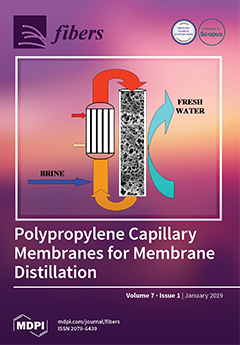
Cover Story: Polypropylene microporous hydrophobic membranes are applied in membrane distillation. In this process, water evaporates through the pores of non-wetted membranes, and as a result, the salts present in the feed water are retained; therefore, the quality of produced distillate is close to that of demineralized water. View this paper.
  • Issues are regarded as officially published after their release is announced to the table of contents alert mailing list .
  • You may sign up for email alerts to receive table of contents of newly released issues.
  • PDF is the official format for papers published in both, html and pdf forms. To view the papers in pdf format, click on the "PDF Full-text" link, and use the free Adobe Reader to open them.

Articles (8)

  • Article
  • Open Access
19 Citations
7,032 Views
8 Pages

Investigation on the Mechanical Properties and Post-Cracking Behavior of Polyolefin Fiber Reinforced Concrete

  • Suman Kumar Adhikary,
  • Zymantas Rudzionis,
  • Arvind Balakrishnan and
  • Vignesh Jayakumar

20 January 2019

This paper deals with the behavior of concrete’s self-compatibility in a fresh state and its compressive and flexural strength in a hardened state with the addition of polyolefin macro fibers. Four different amounts (3 kg/m3, 4.5 kg/m3, 6 kg/m3...

  • Article
  • Open Access
8 Citations
6,362 Views
20 Pages

Investigation of Chemical and Physical Surface Changes of Thermally Conditioned Glass Fibres

  • Peter G Jenkins,
  • Liu Yang,
  • James L Thomason,
  • Xinyong Chen,
  • John F Watts and
  • Steven J Hinder

15 January 2019

A number of analytical techniques were applied to investigate changes to the surface of unsized boron-free E-glass fibres after thermal conditioning at temperatures up to 700 °C. Novel systematic studies were carried out to investigate the fundamenta...

  • Article
  • Open Access
18 Citations
7,356 Views
10 Pages

One-Step Surface Functionalized Hydrophilic Polypropylene Meshes for Hernia Repair Using Bio-Inspired Polydopamine

  • Noor Sanbhal,
  • Xiakeer Saitaer,
  • Mazhar Peerzada,
  • Ali Habboush,
  • Fujun Wang and
  • Lu Wang

14 January 2019

An ideal hernia mesh is one that absorbs drugs and withstands muscle forces after mesh implantation. Polypropylene (PP) mesh devices have been accepted as a standard material to repair abdominal hernia, but the hydrophobicity of PP fibers makes them...

  • Article
  • Open Access
15 Citations
7,908 Views
17 Pages

4 January 2019

Olefin/paraffin separation is an important technological process. A promising alternative to conventional energy-consuming methods is employment of gas-liquid membrane contactors. In the present work, the membranes used were polysulfone (PSf) asymmet...

  • Article
  • Open Access
14 Citations
12,766 Views
20 Pages

Flammability Characteristics of Animal Fibers: Single Breed Wools, Alpaca/Wool, and Llama/Wool Blends

  • Mary L. Galaska,
  • Larry D. Sqrow,
  • J. Douglas Wolf and
  • Alexander B. Morgan

3 January 2019

Animal protein-based fibers used in textiles often are assumed to have uniform properties independent of source, and yet are different when considering texture, structure, and color. Differences between fibers from animal species have been studied in...

  • Communication
  • Open Access
4 Citations
7,005 Views
9 Pages

1 January 2019

A facile, solvent-minimized approach to functionalize commercial raw fabrics is described. Reactive vapor deposition of conjugated polymers followed by post-deposition functionalization transforms common, off-the-shelf textiles into distinctly hydrop...

Get Alerted

Add your email address to receive forthcoming issues of this journal.

XFacebookLinkedIn
Fibers - ISSN 2079-6439