



Next Issue
Volume 14, March
Previous Issue
Volume 14, January


Fibers, Volume 14, Issue 2 (February 2026) – 12 articles
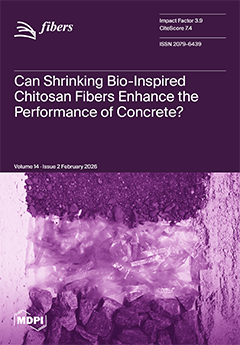
Cover Story (view full-size image): Chitosan-based shrinking fibers activated during the curing of cementitious materials represent a promising pathway toward developing “living” cementitious materials. Their continuous shrinkage under wetting–drying cycles introduces a curing-initiated mechanism with the potential to influence stress development and enable novel prestressing concepts in concrete. This study evaluates the effects of these fibers on the mechanical and durability properties of concrete. While the current fiber formulation led to a deterioration in performance, the findings establish a critical foundation for future optimization of chitosan-based fibers, guiding their compatibility, performance enhancement, and the development of transformative, curing-driven prestressing strategies in next-generation concrete materials. View this paper
  • Issues are regarded as officially published after their release is announced to the table of contents alert mailing list.
  • You may sign up for e-mail alerts to receive table of contents of newly released issues.
  • PDF is the official format for papers published in both, html and pdf forms. To view the papers in pdf format, click on the "PDF Full-text" link, and use the free Adobe Reader to open them.
Order results
Result details
Select all
Export citation of selected articles as:
20 pages, 4299 KB  
Article
Mechanical Behavior and Modeling of Flax Fiber-Reinforced Geopolymers in Comparison with Other Natural Fiber Composites
by Sana Ullah, Salvatore Benfratello, Carmelo Sanflippo and Luigi Palizzolo
Fibers 2026, 14(2), 27; https://doi.org/10.3390/fib14020027 - 14 Feb 2026
Viewed by 765
Abstract
The rising environmental concerns over cement-based construction materials have led to the development of sustainable alternatives. Among these, geopolymers represent a promising class of low-carbon binders offering environmental benefits and competitive mechanical properties; however, their intrinsic brittleness limits their tensile and post-cracking performance. [...] Read more.
The rising environmental concerns over cement-based construction materials have led to the development of sustainable alternatives. Among these, geopolymers represent a promising class of low-carbon binders offering environmental benefits and competitive mechanical properties; however, their intrinsic brittleness limits their tensile and post-cracking performance. This study investigates the adoption of flax fibers as natural reinforcement to enhance ductility and post-peak behavior of metakaolin-based geopolymers. The performance of metakaolin-based geopolymers with flax fibers (MKFLAX) was experimentally evaluated in terms of strength, stiffness, toughness, and failure behavior. The addition of flax fibers enhanced ductility, toughness, and post-peak load-carrying capacity while slightly improving stiffness due to the bridging of cracks and the fiber pull-out mechanism. In comparison with the available literature on sisal, flax, and jute fibers, flax fibers showed improved performance due to the better dispersion within the matrix and higher tensile modulus. These findings highlight that flax fiber-reinforced metakaolin geopolymers show enhanced post-cracking behavior at the laboratory scale and could be of interest for sustainable cementitious materials, subject to further validation at the structural scale. Furthermore, a nonlinear finite element model was adopted based on damage mechanics to simulate the damage localization, stress–strain response and post-peak behavior of geopolymer composites. The numerical results showed a reasonable agreement with the experimental trends, particularly in the elastic and early softening phases. The findings are limited to the studied material system, fiber content, and small-scale samples and should be viewed as trend-level observations rather than generalized performance claims. Full article
Show Figures

Figure 1

11 pages, 4244 KB  
Article
High-Power and Fiber-Solid Hybrid MOPA Nanosecond Laser for High-Efficiency 4H-SiC Wafers Slicing
by Chunquan Hong, Jincheng Wen, Huailiang Liu, Libo Wang, Lin Zhang and Xiuquan Ma
Fibers 2026, 14(2), 26; https://doi.org/10.3390/fib14020026 - 14 Feb 2026
Viewed by 676
Abstract
Laser slicing of 4H-SiC wafers offers high efficiency and minimal material loss. While nanosecond lasers are the preferred light source, simultaneously achieving high output power, excellent beam quality (M2 < 1.3), and broad operational tunability remains an outstanding challenge. This study developed [...] Read more.
Laser slicing of 4H-SiC wafers offers high efficiency and minimal material loss. While nanosecond lasers are the preferred light source, simultaneously achieving high output power, excellent beam quality (M2 < 1.3), and broad operational tunability remains an outstanding challenge. This study developed a highly efficient nanosecond laser source using hybrid fiber and solid-state multi-stage amplification architecture. With excellent beam quality (M2 < 1.3), it achieves the highest output power, widest continuously tunable pulse width range, and broadest repetition rate range currently reported for 4H-SiC laser slicing. This advancement is poised to advance the continued development of 4H-SiC slicing technology. Full article
Show Figures

Figure 1

16 pages, 3088 KB  
Article
Mechanical Characterization of Sustainable Fiber-Reinforced Plasters for Non-Structural Wall Application
by Buda Rocco and Pucinotti Raffaele
Fibers 2026, 14(2), 25; https://doi.org/10.3390/fib14020025 - 13 Feb 2026
Viewed by 530
Abstract
The seismic vulnerability of existing reinforced concrete buildings is often exacerbated by the inadequate mechanical performance of non-structural components, such as masonry infill walls, which may exhibit brittle behavior and limited deformation capacity under seismic actions. This issue highlights the need for innovative [...] Read more.
The seismic vulnerability of existing reinforced concrete buildings is often exacerbated by the inadequate mechanical performance of non-structural components, such as masonry infill walls, which may exhibit brittle behavior and limited deformation capacity under seismic actions. This issue highlights the need for innovative and compatible strengthening materials capable of improving ductility and damage tolerance while maintaining adequate mechanical strength. This study presents an experimental investigation aimed at developing a sustainable fiber-reinforced plaster manufactured exclusively from locally sourced natural materials from the Calabria region, including cork granules, broom fibers, and natural hydraulic lime. Following a preliminary experimental phase, the mixture containing 30% cork granules was selected as the reference matrix due to its favorable mechanical performance and deformability. In the present phase of the research, several composite formulations incorporating broom fibers were produced and experimentally characterized. Uniaxial tensile tests were conducted on broom fibers to assess their reinforcing potential, while compressive and flexural tests were performed on the plaster matrices. The experimental results show that the incorporation of broom fibers significantly enhances flexural behavior and post-cracking ductility, while maintaining compressive strength levels compatible with structural retrofit applications. The study demonstrates that the combined use of cork and broom fiber effectively enhances the mechanical performance of the plaster by promoting ductility, improving flexural behavior, and limiting crack initiation and propagation. The high tensile strength of the fibers promotes effective crack-bridging mechanisms and improved energy dissipation capacity. Overall, the combined use of cork aggregates and broom fibers results in a mechanically balanced plaster composite characterized by enhanced deformability and reduced brittleness. These features make the proposed material particularly suitable for the strengthening of masonry infill walls and for applications where improved ductility and damage tolerance are required, such as seismic retrofitting and restoration of existing buildings. Full article
Show Figures

Figure 1

22 pages, 10084 KB  
Article
Structural and Mechanical Characterisation of Five Agave Fibres for Sustainable Textile Applications
by Ramia Almohamad, Jean-Yves Drean, Laurence Peschel and Omar Harzallah
Fibers 2026, 14(2), 24; https://doi.org/10.3390/fib14020024 - 13 Feb 2026
Viewed by 793
Abstract
This study evaluates the textile potential of five underexplored Agave varieties (Agave salmiana crassispina, A. salmiana salmiana, A. ingens marginata, A. tecta, and A. mapisaga) through combined analyses of extraction behaviour, microstructure, and single-fibre mechanical performance. Fibres [...] Read more.
This study evaluates the textile potential of five underexplored Agave varieties (Agave salmiana crassispina, A. salmiana salmiana, A. ingens marginata, A. tecta, and A. mapisaga) through combined analyses of extraction behaviour, microstructure, and single-fibre mechanical performance. Fibres extracted from basal, middle, and upper leaf sections were characterised using scanning electron microscopy (SEM) and single-fibre tensile testing under controlled conditions. All varieties produced spinnable fibres and exhibited significant longitudinal variability in mechanical behaviour along the leaf axis (p < 0.05). Mechanical performance depended strongly on both species and leaf position, with fibres from the middle leaf section generally showing higher tenacity. Variations in Young’s modulus reflected differences in fibre maturity and internal microstructural organisation. Fractographic observations revealed predominantly brittle fracture with microfibrillar rupture and longitudinal fibrillation. Overall, the results demonstrate that agave species and leaf position are key parameters governing fibre performance. These agave varieties therefore represent promising candidates for sustainable textile applications, provided that appropriate fibre selection and blending strategies are implemented to ensure homogeneous yarn properties. Full article
Show Figures

Figure 1

25 pages, 5213 KB  
Article
Impact of Shear Deformations on the Response of Inflated Drop-Stitch Fabric Panels Subjected to Transverse Loads
by William G. Davids and Aidan G. McGlone
Fibers 2026, 14(2), 23; https://doi.org/10.3390/fib14020023 - 11 Feb 2026
Viewed by 630
Abstract
In this paper, the impact of shear deformations on the load–deflection response of transversely loaded inflatable panels made from drop-stitch fabric is explored. A nonlinear shear constitutive model was derived from torsion tests and integrated into Timoshenko beam theory to predict deflection components. [...] Read more.
In this paper, the impact of shear deformations on the load–deflection response of transversely loaded inflatable panels made from drop-stitch fabric is explored. A nonlinear shear constitutive model was derived from torsion tests and integrated into Timoshenko beam theory to predict deflection components. Four-point bend tests of the same panel are conducted at pressures of 34.5, 68.9, and 103 kPa and for span-to-depth ratios of 7.2, 12.5, and 17.8 to give load–deflection response with varying levels of shear deformation. Analytical, mechanics-based expressions are derived to quantify load–deflection response due to bending and shear, including deflections caused by the drop-stitch yarns. The resulting expressions are shown to predict the measured load–deflection behavior to within 20% at the theoretical wrinkling load while indicating that the midspan deflection caused by shear deformations including the effect of the drop-stitch yarns are 78% of the total panel deflection for the lowest inflation pressure and smallest span-to-depth ratio. An approach to reducing panel shear deformability through the incorporation of braided sidewalls is proposed, and a second panel with this modification is fabricated and tested in four-point bending to experimentally demonstrate effectiveness. For the smallest span-to-depth ratio, shear stiffening reduced panel midspan deflection by 17–22% depending on inflation pressure. Full article
Show Figures

Figure 1

41 pages, 120569 KB  
Review
Hydrogel Microcapsules for Stimuli-Responsive Textiles
by Chloe M. Taylor and Lucian A. Lucia
Fibers 2026, 14(2), 22; https://doi.org/10.3390/fib14020022 - 9 Feb 2026
Viewed by 1861
Abstract
Stimuli-responsive textiles are a rapidly evolving class of functional fiber-based materials that sense and adapt to environmental triggers. Within these enabling technologies, hydrogels and microcapsules are very illustrative, as they offer complementary mechanisms for moisture management, controlled release, and adaptive performance. Hydrogels provide [...] Read more.
Stimuli-responsive textiles are a rapidly evolving class of functional fiber-based materials that sense and adapt to environmental triggers. Within these enabling technologies, hydrogels and microcapsules are very illustrative, as they offer complementary mechanisms for moisture management, controlled release, and adaptive performance. Hydrogels provide soft, water-rich polymer networks with modifiable swelling, permeability, and mechanics, while microcapsules offer protection and targeted delivery of active agents through engineered shell structures. When integrated into fibrous networks, they impart dynamic detection responses for moisture, temperature, pH, mechanical stress, light, and chemical or biological agents. This review critically examines progress in design, synthesis, and textile integration of hydrogel- and microcapsule-based systems, with emphasis on materials that exhibit stimuli-responsive behavior rather than passive or extended-release functionality. Strategies for incorporating bulk hydrogels, micro- and nanogels, and stimuli-responsive microcapsules into fibers, yarns, and fabrics are discussed in addition to applications such as smart apparel, medical and hygienic textiles, controlled drug delivery, antimicrobial fabrics, and adaptive filtration media. Existing challenges for durability, washability, response kinetics, scalability, and sustainability are highlighted, while future research directions are proposed to advance the development of robust and intelligent textile systems at the nexus of soft matter science and fiber engineering. Full article
(This article belongs to the Collection Review Papers of Fibers)
Show Figures

Figure 1

25 pages, 8065 KB  
Article
Innovative Approach to Textile Pilling Assessment Using Uniform Digital Imaging
by Juro Živičnjak, Antoneta Tomljenović and Igor Zjakić
Fibers 2026, 14(2), 21; https://doi.org/10.3390/fib14020021 - 2 Feb 2026
Viewed by 1150
Abstract
During use, the surface of textile fabrics is prone to wear, which can cause changes such as pilling. Pilling (entanglement of fibers) is primarily assessed using the standard visual method EN ISO 12945-4:2020, but it can also be quantitatively measured by instrumental methods [...] Read more.
During use, the surface of textile fabrics is prone to wear, which can cause changes such as pilling. Pilling (entanglement of fibers) is primarily assessed using the standard visual method EN ISO 12945-4:2020, but it can also be quantitatively measured by instrumental methods with image analysis software. Due to non-uniform digital imaging conditions, such as variations in magnification and analyzed surface area, the assessed area is often inconsistent. As a result, the total percentage of the fabric specimen surface area covered with pills is often omitted. To ensure uniform digital imaging, an innovative apparatus was designed and constructed in this research and applied to woven fabrics made from 100% cotton, wool, viscose, polyamide 6.6, polyester, and acrylic fiber. Pilling in the fabric specimens was induced by rubbing with the Martindale pilling tester (EN ISO 12945-2:2020) using two different abradant materials, through predefined pilling rubs ranging from 125 to 30,000. Pilling assessment was conducted using both the visual method and the improved instrumental method, following established grading classes based on the total percentage of the fabric specimen surface area covered with pills. The research results highlight the importance of uniform digital imaging and digital grading, as these demonstrate the high comparability of pilling grades assigned by the standard visual method while providing better distinction between consecutive grades. Full article
Show Figures

Figure 1

13 pages, 1893 KB  
Article
Fracture Behavior Under Mode I Loading in Laminated Composite Materials Repaired with Structural Adhesives
by Paula Vigón, Antonio Argüelles, Miguel Lozano and Jaime Viña
Fibers 2026, 14(2), 20; https://doi.org/10.3390/fib14020020 - 2 Feb 2026
Viewed by 760
Abstract
One of the most critical damage modes affecting the structural performance of traditional composite materials, and therefore their durability, is the occurrence of interlaminar cracks (delamination), which are prone to grow under different loading conditions. In this study, the feasibility of repairing carbon [...] Read more.
One of the most critical damage modes affecting the structural performance of traditional composite materials, and therefore their durability, is the occurrence of interlaminar cracks (delamination), which are prone to grow under different loading conditions. In this study, the feasibility of repairing carbon fiber reinforced polymer (CFRP) laminates using structural adhesives was experimentally investigated by evaluating the Mode I interlaminar fracture toughness. Two unidirectional AS4 CFRP systems were analyzed, manufactured with epoxy 8552 and epoxy 3501-6 matrix resins. Mode I delamination behavior was characterized using Double Cantilever Beam (DCB) specimens. Three commercial structural adhesives were used in the repair process: two epoxy-based systems, (Loctite® EA 9460™, manufactured by Henkel adhesives (Düsseldorf, Germany), and Araldite® 2015 manufactured by Huntsman Advanced Materials (The Woodlands, TX, USA) and one low-odor acrylic adhesive, 3M Scotch-Weld® DP8810NS manufactured by 3M Company (St. Paul, MN, USA). Adhesive joints were applied to previously fractured specimens, and the results were compared with those obtained from baseline composite specimens. The results indicate that repaired joints based on the 8552 matrix exhibited higher strain energy release rate (GIc) values, approaching those of the original material. The 3501-6 system showed increased fiber bridging, contributing to higher apparent fracture toughness. Among the adhesives evaluated, the acrylic-based adhesive provided the highest delamination resistance for both composite systems. Full article
(This article belongs to the Topic Advanced Composite Materials)
Show Figures

Figure 1

12 pages, 2238 KB  
Article
Preparation of an ABS-ZnO Composite for 3D Printing and the Influence of Printing Process on Printing Quality
by Chao Du, Yali Zhao and Yong Li
Fibers 2026, 14(2), 19; https://doi.org/10.3390/fib14020019 - 2 Feb 2026
Cited by 1 | Viewed by 634
Abstract
In this study, the process of preparing ABS-ZnO (Acrylonitrile Butadiene Styrene-Zinc Oxide) composite materials as FDM printing materials was elaborated, and the influence of printing process parameters on the tensile properties and surface roughness of the materials was analyzed. It was concluded through [...] Read more.
In this study, the process of preparing ABS-ZnO (Acrylonitrile Butadiene Styrene-Zinc Oxide) composite materials as FDM printing materials was elaborated, and the influence of printing process parameters on the tensile properties and surface roughness of the materials was analyzed. It was concluded through orthogonal experiments that among all the parameters studied, the infill rate had the most significant effect on the tensile strength, followed by layer thickness and layer width, while the printing speed had the least effect. When the printing parameters were set as follows: infill rate (90%), layer thickness (0.2 mm), layer width (0.4 mm), and printing speed (200 mm/s), the tensile strength of the sample reached the maximum value of 48.37 MPa. Scanning electron microscopy (SEM) analysis revealed that a high infill rate could make the internal structure of the material denser and the bonding between fibers more sufficient. In contrast, with the increase in layer thickness and layer width, the internal structure of the material exhibited a porous morphology, which led to a decrease in tensile properties. By investigating the effects of printing temperature and layer thickness on the surface roughness of the samples, the optimal surface roughness was achieved when the printing temperature was set at 230 °C, and the layer thickness was 0.3 mm. Full article
Show Figures

Figure 1

22 pages, 18297 KB  
Article
Shrinking Chitosan Fibers in Concrete: A Macroscale Durability and Strength Assessment
by Mohammad A. Abdul Qader, Shannon Hughes, Dryver Huston and Mandar M. Dewoolkar
Fibers 2026, 14(2), 18; https://doi.org/10.3390/fib14020018 - 29 Jan 2026
Viewed by 921
Abstract
This study evaluates the mechanical properties and durability of novel self-shrinking chitosan fibers incorporated into a High-Performance Concrete (HPC) matrix. The cementitious system comprised a 75–25% blend of Portland Limestone Cement (PLC) and Ground Glass Pozzolan (GGP). Two variants of chitosan—food-grade and high-grade—were [...] Read more.
This study evaluates the mechanical properties and durability of novel self-shrinking chitosan fibers incorporated into a High-Performance Concrete (HPC) matrix. The cementitious system comprised a 75–25% blend of Portland Limestone Cement (PLC) and Ground Glass Pozzolan (GGP). Two variants of chitosan—food-grade and high-grade—were processed into fibers and integrated at dosages of 0.36%, 0.73%, and 1.45% by weight of binder, alongside a 0% control group. The experimental program assessed eight distinct mixtures through extended freeze–thaw testing (up to 602 cycles), electrical resistance monitoring, and compressive strength evaluation at 56 and 90 days. Results indicated that food-grade chitosan fibers caused a substantial reduction in compressive strength, ranging from 40% to 70% depending on the dosage. Despite this mechanical loss, these mixtures showed localized improvements in freeze–thaw resistance and electrical resistivity. Conversely, the high-grade chitosan fibers exhibited severe performance degradation under freeze–thaw cycling; all reinforced groups fell below 80% relative dynamic modulus, with two mixtures dropping below the 60% failure threshold. In comparison, the control mixture retained 98% of its dynamic modulus after 602 cycles. Ultimately, the findings suggest that, in their current formulation, self-shrinking chitosan fibers do not provide consistent or reliable enhancements to the structural integrity or durability of high-performance concrete. Full article
Show Figures

Figure 1

18 pages, 3836 KB  
Article
Technology of Mineral Insulation Waste Utilization
by Duman Dyussembinov, Zhanbolat Shakhmov, Rauan Lukpanov, Assel Jexembayeva and Adiya Zhumagulova
Fibers 2026, 14(2), 17; https://doi.org/10.3390/fib14020017 - 26 Jan 2026
Cited by 1 | Viewed by 589
Abstract
The article examines the waste management challenges associated with basalt fiber-based mineral insulation materials generated during the production of thermal insulation products. In response to the environmental and economic issues linked to their disposal, a chemical processing approach is proposed to convert this [...] Read more.
The article examines the waste management challenges associated with basalt fiber-based mineral insulation materials generated during the production of thermal insulation products. In response to the environmental and economic issues linked to their disposal, a chemical processing approach is proposed to convert this waste into a mineral powder suitable for construction applications, particularly as an additive in asphalt concrete. A detailed technological scheme of the chemical treatment process is presented, and the optimal proportions of waste, water, and electrolyte (sulfuric acid), along with the corresponding processing conditions, are identified. The chemical and mineralogical composition of the raw materials and the resulting powder are investigated, and laboratory tests are carried out confirming its suitability as an active mineral additive. The chemical and mineralogical characteristics of the raw waste and resulting product are analyzed using XRD, SEM-EDS, and standard physical tests. In addition, the proposed technology provides a notable reduction in waste volume, thereby decreasing the load on landfills and contributing to more sustainable resource utilization. Full article
Show Figures

Figure 1

12 pages, 1381 KB  
Article
Surface Free Energy Analysis Using the Washburn Capillary Rise Method to Improve the Accuracy of Measuring Carbon Fiber Interfacial Properties
by Dong-Kyu Kim, Woong Han, Young Chul Choi, Kwan-Woo Kim and Byung-Joo Kim
Fibers 2026, 14(2), 16; https://doi.org/10.3390/fib14020016 - 26 Jan 2026
Viewed by 802
Abstract
The wettability of a carbon fiber surface is an important factor that determines the strength of its bonding with matrices, and hence, an optimized criterion is required to accurately measure the wettability. In this study, the Washburn capillary rise method was used to [...] Read more.
The wettability of a carbon fiber surface is an important factor that determines the strength of its bonding with matrices, and hence, an optimized criterion is required to accurately measure the wettability. In this study, the Washburn capillary rise method was used to select the capillary constant with the minimal deviation among various carbon fiber lengths, and it was applied to determine the contact angle and surface free energy of each carbon fiber length according to the wetting liquid. The smallest deviation in the contact angle was observed for a carbon fiber length of 2 inches, and this observation was attributed to the pores in the fibers and the orientation of the carbon fibers packed inside the column. By reducing the number of pores and achieving favorable packing, the surface free energy of carbon fibers can be measured with a high degree of accuracy, contributing to an improved understanding of fiber–matrix interactions. Full article
Show Figures

Figure 1

Previous Issue
Next Issue
Back to TopTop
