


Abstract
Low-activity copper tailings (CTs) were mechanochemically activated and used to develop a copper tailings–slag–metakaolin grouting material (CSM). Mechanical grinding and Na2SO4 addition were first optimized, after which single-factor experiments and response surface methodology were used to evaluate the effects of the water-to-solid ratio, alkali activator dosage, and MCCT content on slurry properties and compressive strength. Grinding for 40 min with 3 wt% Na2SO4 relative to the dry CT mass produced the highest activity index of 84.5%. The optimized CSM mixture had a water-to-solid ratio of 0.69, an alkali activator dosage of 6.7 wt%, and an MCCT content of 35.5 wt% of the dry solid precursor. Validation experiments yielded a fluidity of 235 mm, a bleeding rate of 2.8%, a setting time of 165 min, and a 28 d compressive strength of 8.62 MPa, with prediction errors below 5%. Microstructural characterization indicated that mechanochemical activation refined the CT particles, increased their structural disorder, and contributed to the formation of Ca–Si–Al–O-rich binding phases and AFt-like crystals in the hardened matrix. Within the defined preliminary material-level system boundary, the embodied energy, greenhouse gas emissions, and material cost of CSM were estimated to be 67.86%, 82.87%, and 27.28% lower, respectively, than those of the 1 kg ordinary Portland cement (OPC) binder benchmark. These results indicate the potential of CSM as a filling and consolidation grout with reduced material-level environmental burdens and cost within the adopted assessment boundary.
1. Introduction
With the continuous expansion of engineering construction and the increasing complexity of engineering geological conditions, problems such as soft foundation settlement and uneven embankment deformation have become increasingly prominent, adversely affecting the safety, service performance, and durability of engineering structures [1,2]. Grouting, as an important technique for ground reinforcement and seepage control, is characterized by flexible construction, broad applicability, and effective reinforcement performance. It has been widely used in transportation infrastructure, hydraulic engineering, underground construction, and geological hazard prevention and control [3,4,5]. At present, cement-based grouting materials remain among the most widely used materials in engineering practice. However, under certain engineering conditions, they may suffer from insufficient fluidity regulation, susceptibility to bleeding or segregation, difficulty in precisely controlling setting time, and limited early strength development [6]. Although polymer-based grouting materials show certain advantages in rapid sealing and specialized reinforcement, their relatively high cost, uncertain long-term durability, and environmental impacts require further consideration [7]. Therefore, developing new green grouting materials with good workability, stable solidification capacity, appropriate mechanical properties, and a low environmental burden has become an important research direction in the field of grouting materials.
In recent years, the preparation of grouting materials using industrial solid wastes has attracted increasing attention. Shu et al. [8] prepared grouting materials with high-volume fly ash and steel slag and verified their engineering applicability as well as environmental and economic advantages. Xu et al. [9] developed a composite grouting material using electrolytic manganese residue, sulfoaluminate cement, fly ash, slag, and bentonite, and found that reaction products such as AFt, AH3, and C–S–H contributed to improving the microstructure of the hardened grouting material. Duan et al. [10] prepared an environmentally friendly geopolymer grouting material based on circulating fluidized bed fly ash, steel slag, and desulfurized gypsum, demonstrating its potential to replace conventional cement-based grouting materials. Gao et al. [11] prepared an erosion-resistant grouting material using red mud, silica fume, carbide slag, and desulfurized gypsum, thereby expanding the application of multi-source solid wastes in specialized grouting materials. Overall, existing studies on solid-waste-based grouting materials have mainly focused on industrial solid wastes with relatively well-established cementitious applications, such as fly ash, steel slag, slag, red mud, and carbide slag. In contrast, research on the efficient utilization of low-activity bulk solid wastes, such as tailings, in grouting materials remains relatively limited. In addition, grouting materials must simultaneously satisfy multiple performance requirements, including fluidity, stability, setting time, and strength, and these performance indices often constrain one another. In China, JGJ 79-2012, Technical Code for Ground Treatment of Buildings, provides technical provisions for the design, construction, and quality inspection of grouting reinforcement [12]. According to this code, the grouting scheme and corresponding performance requirements should be determined considering the ground conditions, treatment objectives, and engineering requirements, rather than by applying a single universal set of numerical limits to all grout systems. Accordingly, the CSM developed in this study was evaluated at the laboratory scale as a filling and consolidation grout for voids and weak ground, with fluidity, bleeding rate, setting time, and 28 d compressive strength selected as the principal performance-screening indices. Before engineering application, project-specific injectability, volume stability, durability, and reinforcement effectiveness should be further verified through field trials. Therefore, the synergistic regulation of multiple properties and mix proportion optimization of solid-waste-based grouting materials require further investigation.
Tailings are bulk industrial solid wastes generated during mining activities. Long-term stockpiling of tailings not only occupies land resources but may also cause environmental and engineering problems, such as dust dispersion, heavy metal migration, and safety risks associated with tailings ponds. Some tailings are rich in SiO2 and Al2O3 and therefore have potential as cementitious precursors or supplementary cementitious components. However, owing to their high mineral crystallinity, stable structure, and low particle reactivity, they generally cannot efficiently participate in cementitious reactions without pretreatment [13,14]. To enhance the potential reactivity of tailings, previous studies have modified tailings through mechanical activation, thermal activation, chemical activation, and their coupled approaches. Saedi et al. [15] improved the reactivity and material performance of lead–zinc tailings through mechanical activation. Hernández-Ramos et al. [16] reported that mechanical and thermal activation could enhance tailings reactivity by disturbing the crystal structure, reducing crystallite size, and increasing structural disorder. Chen et al. [17] activated gold tailings using a coupled mechanical–chemical–thermal method and demonstrated that synergistic activation helped reduce crystallinity and promote the release of reactive components. In addition, related studies have shown that the combined use of alkali–hydrothermally activated tailings and steel slag can alleviate the low reactivity of tailings and the volume stability issue of steel slag [18]. These studies indicate that activation treatment is an important approach for improving the cementitious utilization potential of tailings. However, systematic research is still lacking on the particle refinement, structural evolution, and activity enhancement of mechanochemically activated copper tailings, as well as the mechanisms governing their performance in solid-waste-based grouting materials. Previous studies have explored the use of copper tailings in ceramic products [19] and alkali-activated mortars [20], but these applications have primarily involved molded materials and have not addressed the simultaneous control of fluidity, bleeding rate, setting time, and strength required for injectable grouts. The novelty of the present study therefore lies in integrating Na2SO4-assisted mechanochemical activation of CT with multi-response RSM optimization, microstructural characterization, and a preliminary material-level sustainability assessment in a cement-free CT–SL–MK grout.
Based on the above considerations, this study adopted a Na2SO4-assisted mechanochemical activation method to improve the reactivity of copper tailings. A copper tailings–slag–metakaolin solid-waste-based grouting material (CSM) was prepared using mechanochemically activated copper tailings, slag, and metakaolin as the main precursors. Single-factor experiments and response surface methodology (RSM) were used to investigate the effects of the water-to-solid ratio, alkali activator dosage, and copper tailings content on the workability of the CSM slurry and the mechanical properties of the hardened grouting material, and the mix proportion was further optimized. SEM–EDS, XRD, and FTIR were employed to analyze the structural changes of copper tailings before and after activation and to reveal the microstructural mechanism of CSM. In addition, the embodied energy, greenhouse-gas emissions, and material cost of CSM were preliminarily evaluated within a defined assessment boundary. The results can provide a reference for the activation and utilization of low-activity copper tailings and the design of solid-waste-based grouting materials. Although CSM is not a conventional thin-film coating, the injectable slurry may fill cracks, pores, and weak interfaces and form an internal mineral sealing and consolidation layer after hardening. Its coating-related properties, including substrate adhesion, impermeability, and erosion resistance, were not directly evaluated in this study and require further investigation.
2. Materials and Methods
2.1. Materials
The copper tailings (CTs) used in this study were collected from a tailings pond in Liuyang, Hunan Province, China. The slag (SL) was an S95-grade blast-furnace slag powder supplied by Zhengzhou Longze Building Materials Co., Ltd. (Zhengzhou, Henan Province, China). According to the supplier’s technical documentation, the slag originated from molten blast-furnace slag generated during pig iron production. The molten slag was rapidly water-quenched to form granulated slag and was subsequently dried and ground to the required fineness. The metakaolin (MK) was manufactured by Jiaozuo Yukun Mining Co., Ltd. (Jiaozuo, Henan Province, China) and purchased through Henan Wanying New Materials Co., Ltd. (Gongyi, Henan, China). According to the product information provided by the manufacturer and supplier, MK was produced from natural kaolin ore through beneficiation, crushing, grinding, and calcination. The resulting product was a reactive aluminosilicate powder with a nominal fineness of 1250 mesh and a supplier-reported activity index of not less than 110%.
The alkali activator solution was prepared using analytical-grade sodium hydroxide (NaOH, nominal purity 96%) and industrial-grade sodium silicate solution (Na2O·nSiO2). The sodium silicate solution had an initial modulus of 3.30, with Na2O and SiO2 mass fractions of 8.54% and 27.30%, respectively. Before use, the silicate modulus was adjusted to 1.20 by adding analytical-grade solid NaOH. Anhydrous sodium sulfate was used as the mechanochemical activation additive during the mechanochemical treatment of CT. The reagent was analytical reagent-grade anhydrous Na2SO4 (purity ≥ 99.0%; CAS No. 7757-82-6; molar mass: 142.04 g mol−1) supplied by Tianjin Juhengda Chemical Co., Ltd. (Tianjin, China) and conformed to GB/T 9853-2008 [21]. According to the product specification, the reagent was supplied as colorless crystals or crystalline powder, was soluble in water, and had a pH of 5.0–8.0 for a 50 g L−1 aqueous solution at 25 °C.
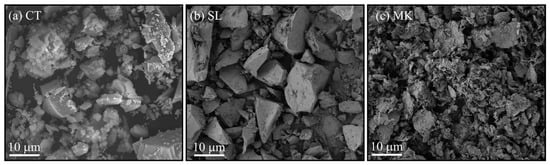
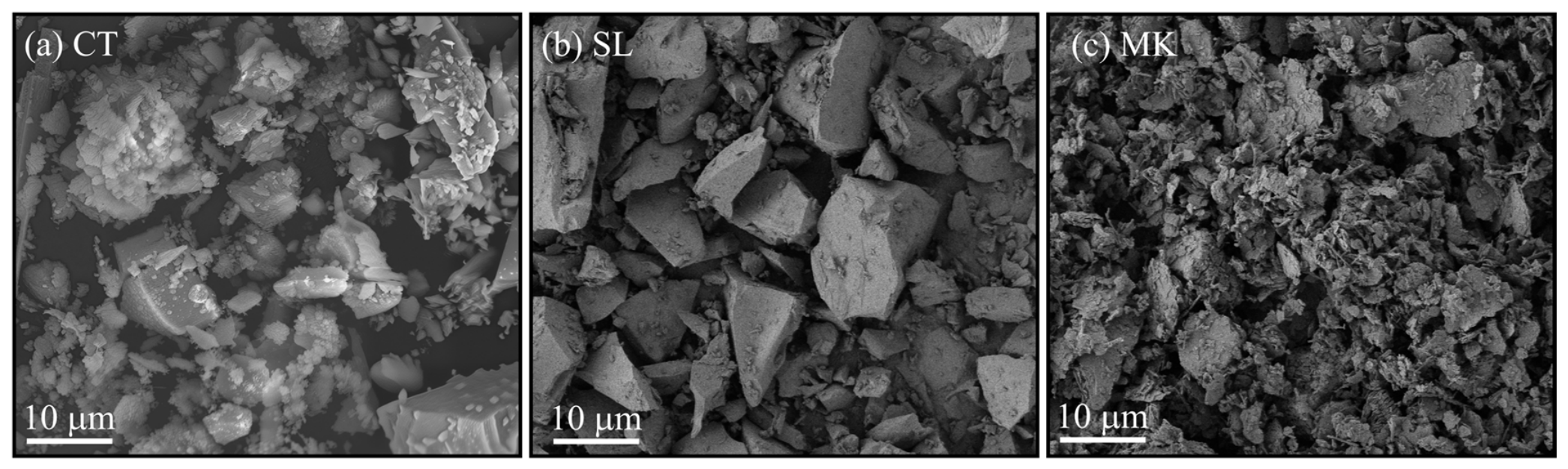
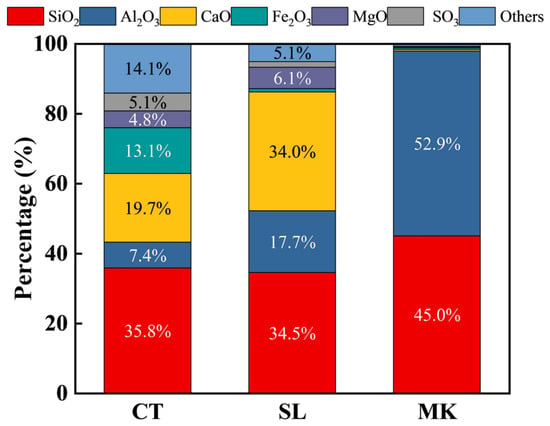
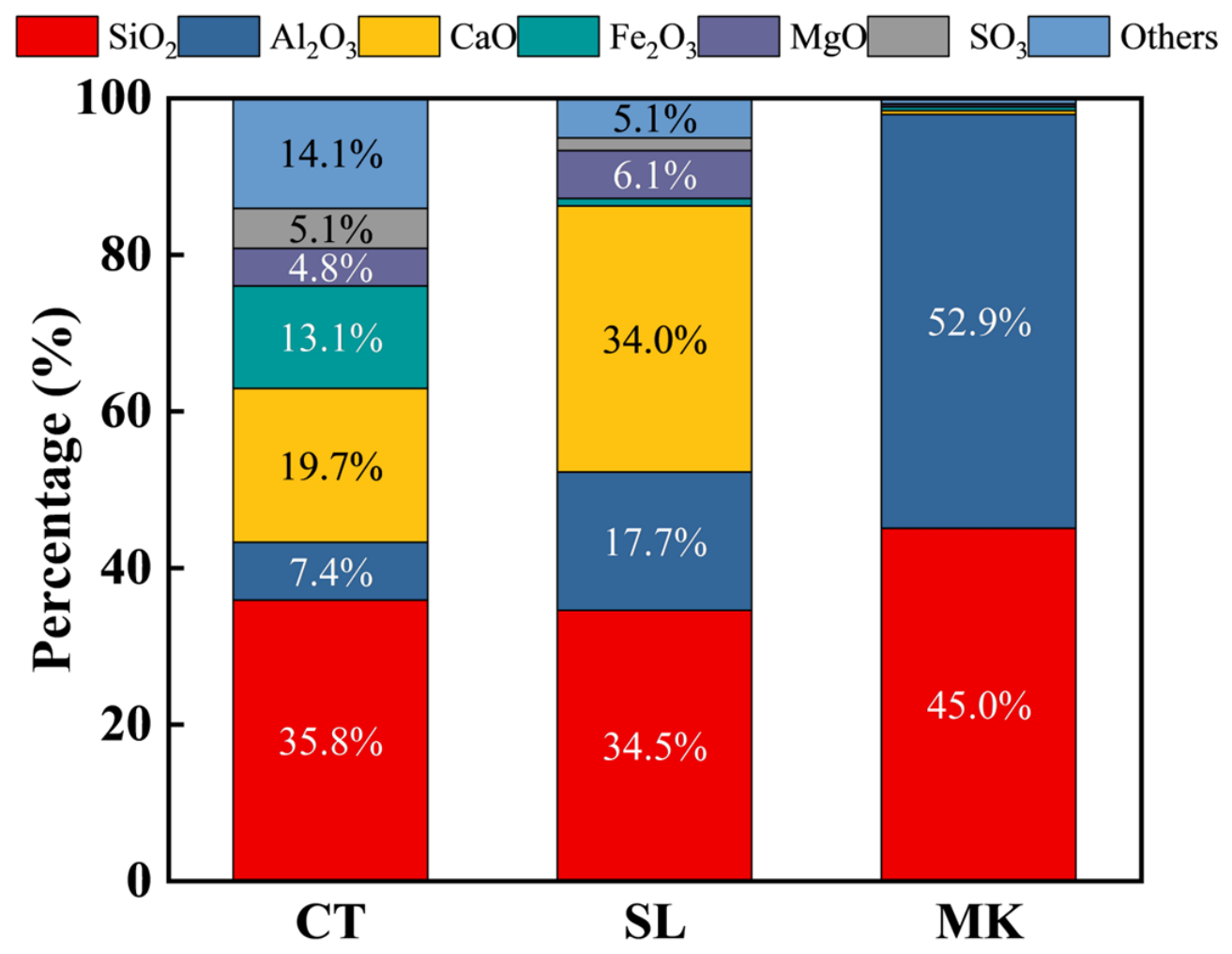
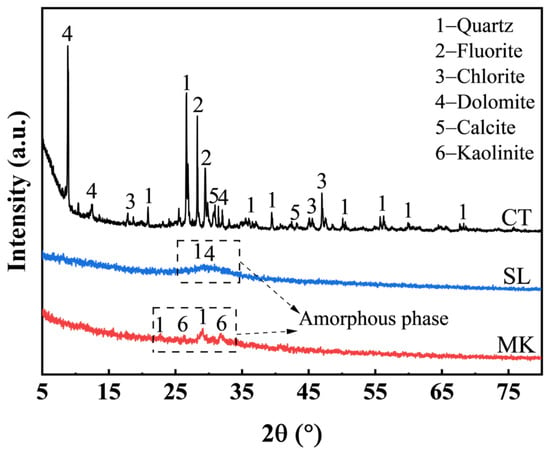
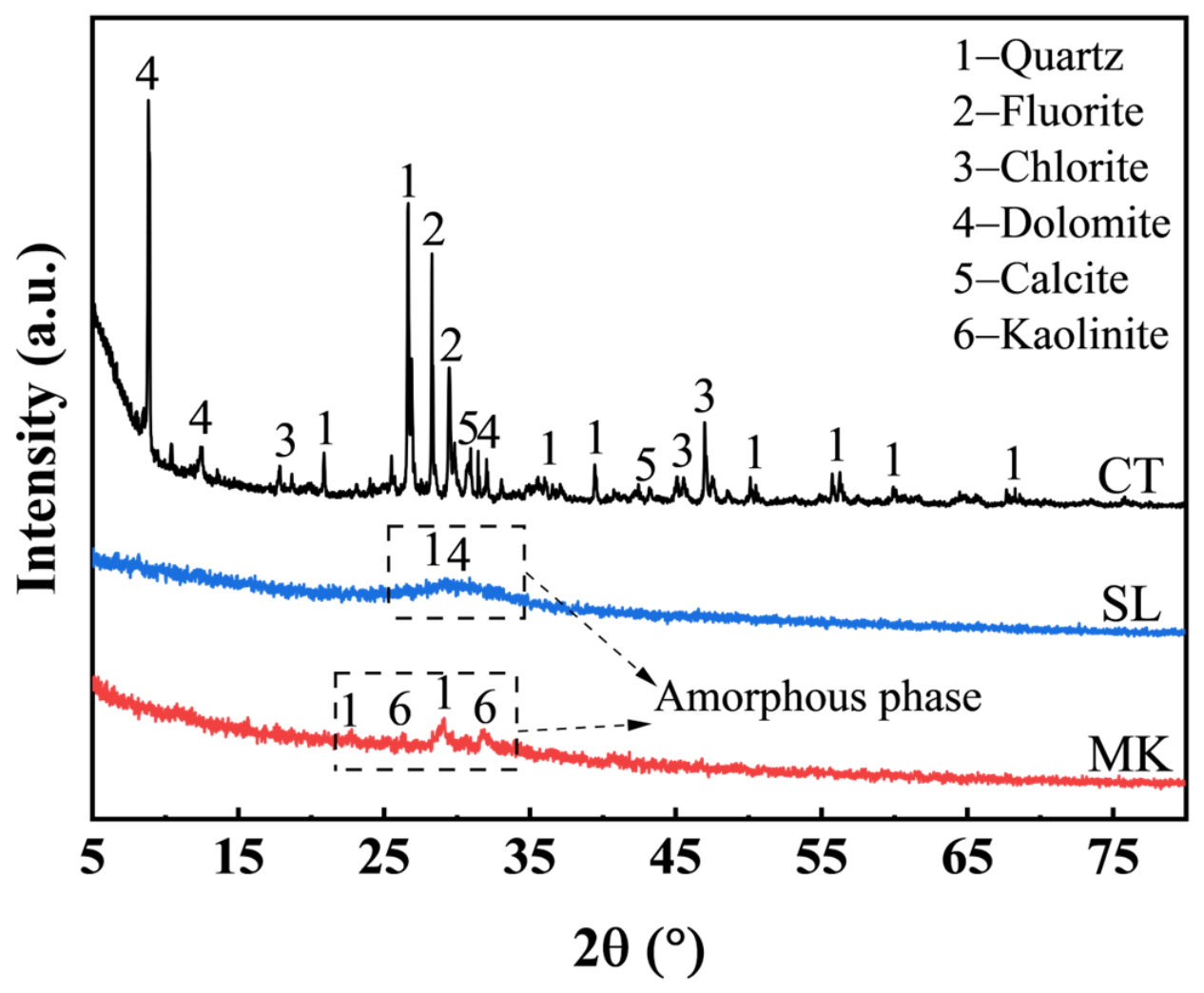
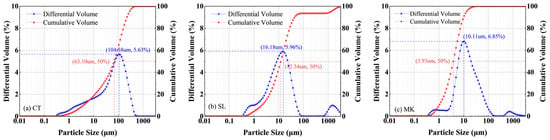
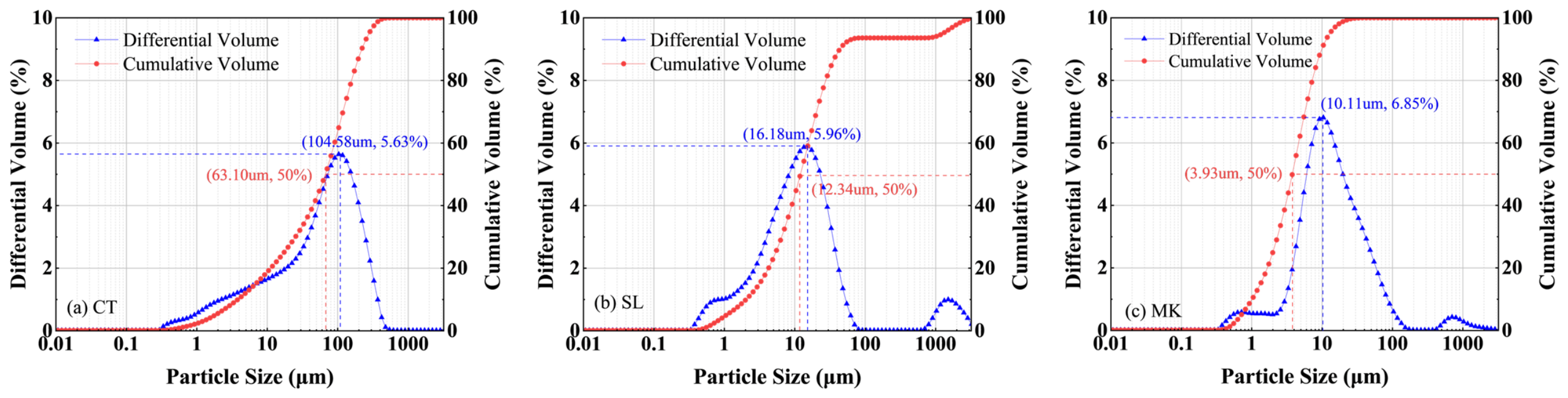
Figure 1, Figure 2, Figure 3 and Figure 4 present the particle morphology, chemical composition, mineral phases, and particle size distributions of the raw materials, respectively. CT consisted mainly of irregular particles and agglomerates, with a D50 of 63.10 μm. In comparison, SL exhibited angular blocky or polyhedral particles with a D50 of 12.34 μm, whereas MK comprised lamellar and flocculent aggregates with a D50 of 3.93 μm. As summarized in Table 1, CT was rich in SiO2, CaO, and Fe2O3; SL contained relatively high proportions of CaO, SiO2, and Al2O3; and MK consisted predominantly of SiO2 and Al2O3. The XRD patterns showed that CT contained pronounced crystalline phases, including quartz, dolomite, and calcite, which contributed to its limited direct reactivity. By contrast, the amorphous characteristics of SL and MK indicated their potential to supply reactive Ca, Si, and Al species during alkali activation. Consequently, CT required activation to enhance its reactivity, whereas SL and MK served as the principal reactive precursors in the CSM system.
Figure 1.
SEM images of raw materials: (a) CT, (b) SL, and (c) MK.
Figure 2.
Chemical compositions of raw materials.
Figure 3.
XRD patterns of raw materials.
Figure 4.
Particle size distributions of raw materials: (a) CT, (b) SL, and (c) MK.
Table 1.
XRF-derived chemical compositions of CT, SL, and MK (normalized wt%).
2.2. Specimen Preparation
The commercial sodium silicate solution, with an initial silicate modulus of 3.30, was modified with analytical-grade solid NaOH to obtain a final silicate modulus of 1.20. Based on the Na2O and SiO2 contents of the commercial sodium silicate solution and a nominal NaOH purity of 96%, the mass ratio of as-received solid NaOH to commercial sodium silicate solution was calculated as 0.201:1. The calculated amount of solid NaOH was slowly added directly to the commercial sodium silicate solution under continuous stirring until it was completely dissolved and a homogeneous solution was obtained. After cooling to room temperature, the modified sodium silicate solution was sealed and aged at room temperature for 24 h before use.
In this study, the alkali activator dosage was defined as the mass of the as-received commercial sodium silicate solution relative to the total dry mass of the solid precursor. The solid NaOH used for modulus adjustment was not included in the reported activator dosage; its mass was calculated separately as 0.201 times the mass of the commercial sodium silicate solution. All deionized mixing water was added separately during slurry preparation. In this study, the water-to-solid ratio was defined as the mass ratio of the separately added deionized water to the dry solid precursor; the water contained in the commercial sodium silicate solution was not included in this ratio. Considering both the Na2O contained in the commercial sodium silicate solution and the Na2O equivalent supplied by solid NaOH, the relationship between the Na2O-equivalent dosage and the reported alkali activator dosage was calculated as follows: Na2O-equivalent dosage (wt%) = 0.2349 × alkali activator dosage (wt%). Therefore, the optimized alkali activator dosage of 6.7 wt% corresponded to a Na2O-equivalent dosage of approximately 1.57 wt%.
CTs were mechanically ground in a planetary ball mill to obtain mechanically activated copper tailings (MCTs). A two-step experimental procedure was adopted to determine the mechanochemical activation conditions. First, CTs were ground for 0, 20, 40, 60, and 80 min to determine the appropriate grinding duration. Based on the activity index and compressive strength results, a grinding time of 40 min was selected for the subsequent additive screening experiment. CaO, CaCl2, CaSO4·2H2O, and anhydrous Na2SO4 were then separately added to the dry CT as candidate mechanochemical activation additives. For each additive, dosages of 1, 2, 3, 4, and 5 wt% were investigated, where the additive dosage was calculated relative to the dry mass of CT. Each CT–additive mixture was co-ground for 40 min at 500 r min−1 using a ball-to-powder mass ratio of 10:3. Based on the 28 d activity index results, anhydrous Na2SO4 at a dosage of 3 wt% was selected as the optimum mechanochemical activation additive. Accordingly, the mechanochemically activated copper tailings (MCCTs) used in all subsequent CSM mixtures were prepared by adding 3 wt% Na2SO4 to dry CTs and co-grinding the mixture for 40 min under the same milling conditions. Thus, the mass ratio of Na2SO4 to dry CT was 0.03:1. Subsequently, MCCTs, SL, and MK were weighed according to the designed mix proportions and dry-mixed uniformly to obtain the solid precursor. During slurry preparation, the solid precursor was thoroughly mixed with deionized water and the NaOH-modified sodium silicate solution, hereafter referred to as the alkali activator solution, to obtain the CSM slurry. Immediately after preparation, the fluidity, bleeding rate, and setting time of the slurry were tested. The slurry was then cast into 70.7 mm × 70.7 mm × 70.7 mm three-gang cubic molds. The specimens were cured at a temperature of (20 ± 2) °C and a relative humidity of not less than 95% for 24 h before demolding, and then further cured to the specified ages for compressive strength testing.
The CT, MCT, and MCCT powder samples were used for XRD and FTIR analyses to characterize the structural changes of copper tailings before and after activation, whereas the 28 d hardened CSM sample prepared using the optimized mixture was used for SEM–EDS analysis. The powder samples for XRD and FTIR were dried, ground, and passed through a 75 μm sieve before testing. For SEM–EDS, fragments were collected from the central region of the 28 d hardened optimized CSM specimen after compressive failure, and anhydrous ethanol was used to stop further reaction before drying. Fresh fracture surfaces were selected and gold-coated before SEM–EDS analysis.
2.3. Testing and Characterization
The performance tests of the grouting slurry and hardened grouting material mainly included fluidity, bleeding rate, setting time, compressive strength, and activity index. Fluidity was measured in accordance with the Chinese standard GB/T 8077-2012 [22], Methods for Testing Uniformity of Concrete Admixtures. The bleeding rate was determined with reference to the Chinese standard DL/T 5148-2021 [23], Technical Specification for Cement Grouting Construction of Hydraulic Structures. The setting time was tested according to the Chinese standard GB/T 1346-2024 [24], Test Methods for Water Requirement of Standard Consistency, Setting Time, and Soundness of Portland Cement. Compressive strength was measured with reference to the Chinese standard GB/T 17671-2021 [25], Test Method of Cement Mortar Strength (ISO Method). The activity index was evaluated with reference to GB/T 12957-2005 [26], Test Method for Activity of Industrial Waste Slag Used as Cement Admixture. Copper tailings samples treated under different activation conditions were used to replace 30% of cement by mass, while the control group consisted of reference cement specimens without copper tailings. The specimens were cured under standard curing conditions for 28 d, after which their compressive strength was tested.
For each test group, compressive strength was determined using three parallel specimens and reported as the mean value with the corresponding standard deviation. The activity index was calculated as the ratio of the mean 28 d compressive strength of the test group to that of the reference group, expressed as a percentage. No statistical outlier-removal procedure was applied to valid measurements. Tests affected by identifiable specimen-preparation defects or invalid loading were considered invalid and were repeated.
The raw materials, activated copper tailings powders, and hardened CSM samples were characterized using SEM–EDS, XRF, XRD, FTIR, and laser particle size analysis, as applicable. SEM observations were conducted using an EVO10 scanning electron microscope (Carl Zeiss Microscopy GmbH, Jena, Germany). XRF analysis was performed using an EDX-7000 X-ray fluorescence spectrometer (Shimadzu Corporation, Kyoto, Japan). XRD analysis was carried out using a D8 ADVANCE X-ray diffractometer (Bruker AXS GmbH, Karlsruhe, Germany). FTIR spectra were obtained using a Nicolet iS50 Fourier-transform infrared spectrometer (Thermo Fisher Scientific Inc., Waltham, MA, USA). Particle size distributions were measured using a Mastersizer 3000 laser particle-size analyzer (Malvern Panalytical Ltd., Malvern, UK). Compressive strength tests were conducted using a WDW-100E computer-controlled electronic universal testing machine (TIME Group Inc., Beijing, China).
The hardened CSM sample used for SEM–EDS analysis was prepared using the optimized mixture and collected after curing for 28 d. The XRD and FTIR analyses were performed on CT, MCT, and MCCT powders immediately after their respective treatments; therefore, no curing age was applicable to these powder samples.
2.4. Mix Design and Optimization
The mix design in this study was conducted by combining single-factor experiments with response surface methodology. The response surface experiments were designed using the Box–Behnken design (BBD) to analyze the effects of multiple factors and their interactions on the performance of CSM. In the experiments, the MK content was fixed at 10 wt%, while the SL content was adjusted according to the variation in copper tailings content. The MCCT, SL, and MK contents and the alkali activator dosage were all expressed relative to the total dry mass of the solid precursor. In this study, the term “copper tailings content” refers specifically to the mass percentage of MCCTs in the total dry solid precursor. First, single-factor experiments were conducted to investigate the effects of the water-to-solid ratio, alkali activator dosage, and copper tailings content on fluidity, bleeding rate, setting time, and 28 d compressive strength. Based on these results, the factor levels for the response surface experiments were determined, as shown in Table 2. Subsequently, a three-factor, three-level response surface experiment was carried out using the water-to-solid ratio (X1), alkali activator dosage (X2), and copper tailings content (X3) as independent variables, and fluidity (Y1), bleeding rate (Y2), setting time (Y3), and 28 d compressive strength (Y4) as response variables, as shown in Table 3. The main effects and interaction effects of the factors were analyzed, and the optimized mix proportion of CSM was determined.
Table 2.
Single-factor experimental design.
Table 3.
RSM factors and levels.
3. Results and Discussion
3.1. Particle Size Distribution
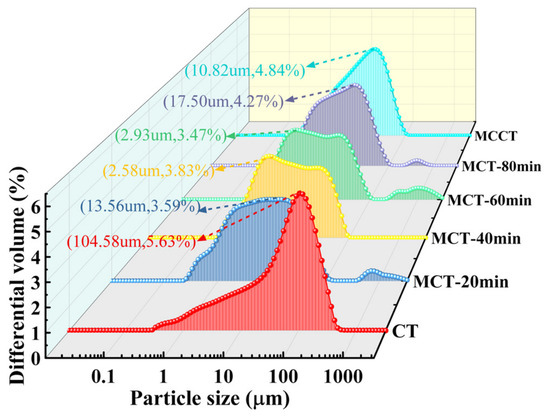
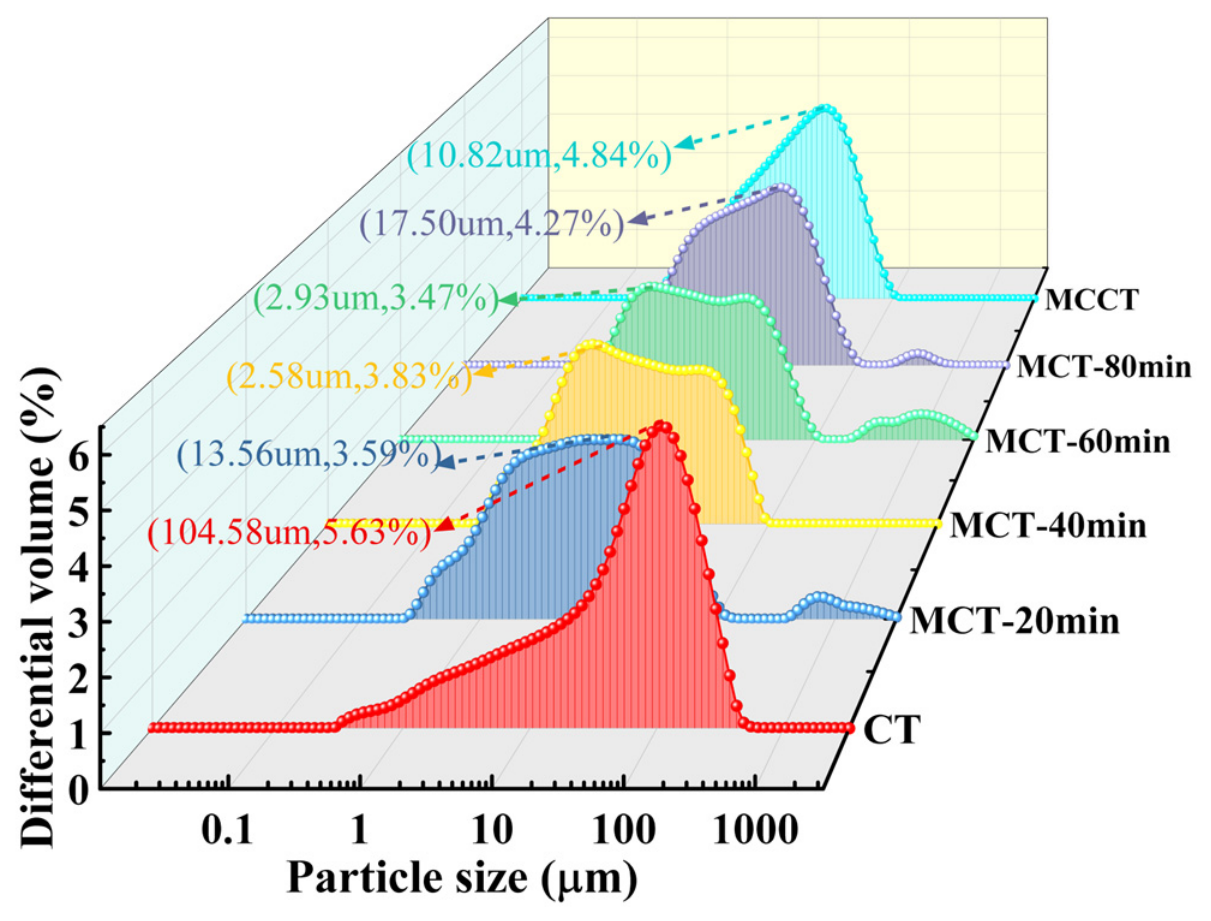
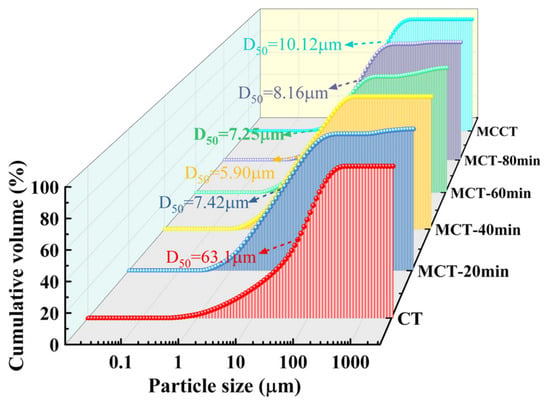
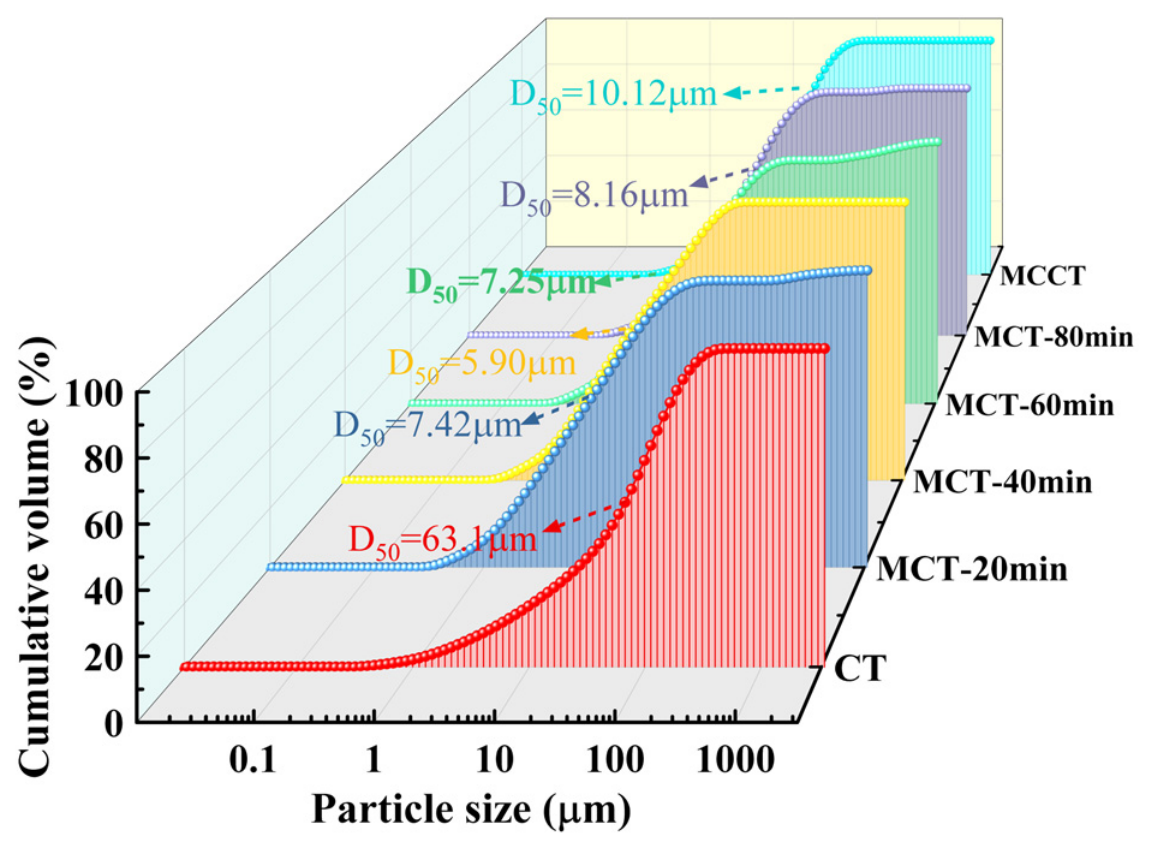
Figure 5 and Figure 6 present the differential and cumulative particle size distributions of copper tailings under different grinding times and mechanochemical activation conditions, respectively. The particle size of copper tailings decreased markedly after mechanical grinding, and the overall particle size distribution shifted toward finer particles. Specifically, the D50 of CTs was 63.10 μm, which decreased to 7.42 μm after grinding for 20 min and further decreased to 5.90 μm after grinding for 40 min. This indicates that mechanical grinding effectively fractured the copper tailings particles and substantially increased the proportion of fine particles. When the grinding time was further extended to 60 min and 80 min, the D50 increased to 7.25 μm and 8.16 μm, respectively, suggesting that excessive grinding may lead to secondary agglomeration or re-packing of fine particles, thereby weakening the further refinement effect.
Figure 5.
Differential particle size distributions of CTs after grinding and mechanochemical activation.
Figure 6.
Cumulative particle size distributions of CTs after grinding and mechanochemical activation.
From the differential particle size distribution, the peak particle size of CTs was approximately 104.58 μm, whereas the main peak shifted toward smaller particle sizes after mechanical grinding. Among the samples, the 40 min ground sample exhibited relatively low values of both D50 and peak particle size, indicating that this grinding duration produced the most effective particle breakage and refinement among the investigated durations. This provides a basis for subsequent activity evaluation and mix design. Compared with the MCT sample obtained by mechanical grinding alone for 40 min, the D50 of MCCT increased to 10.12 μm, and its peak particle size was approximately 10.82 μm. This suggests that the introduction of Na2SO4 may have altered the particle surface state and interparticle interactions, causing partial agglomeration or re-packing of fine particles. Overall, mechanical grinding is beneficial for particle refinement of copper tailings, whereas excessive grinding or the introduction of a mechanochemical activation additive may affect particle dispersion. Therefore, the grinding time and additive dosage should be properly controlled to obtain a suitably fine particle size distribution [27,28].
3.2. Compressive Strength and Activity Index
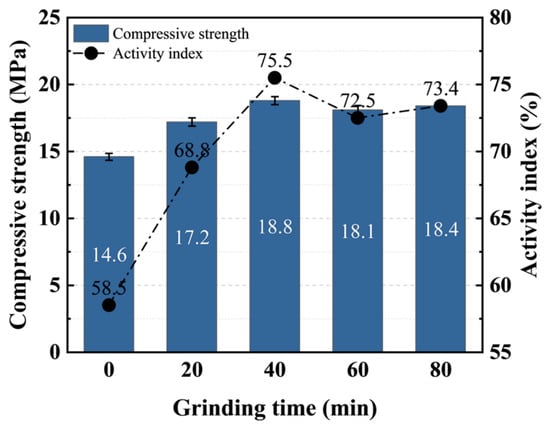
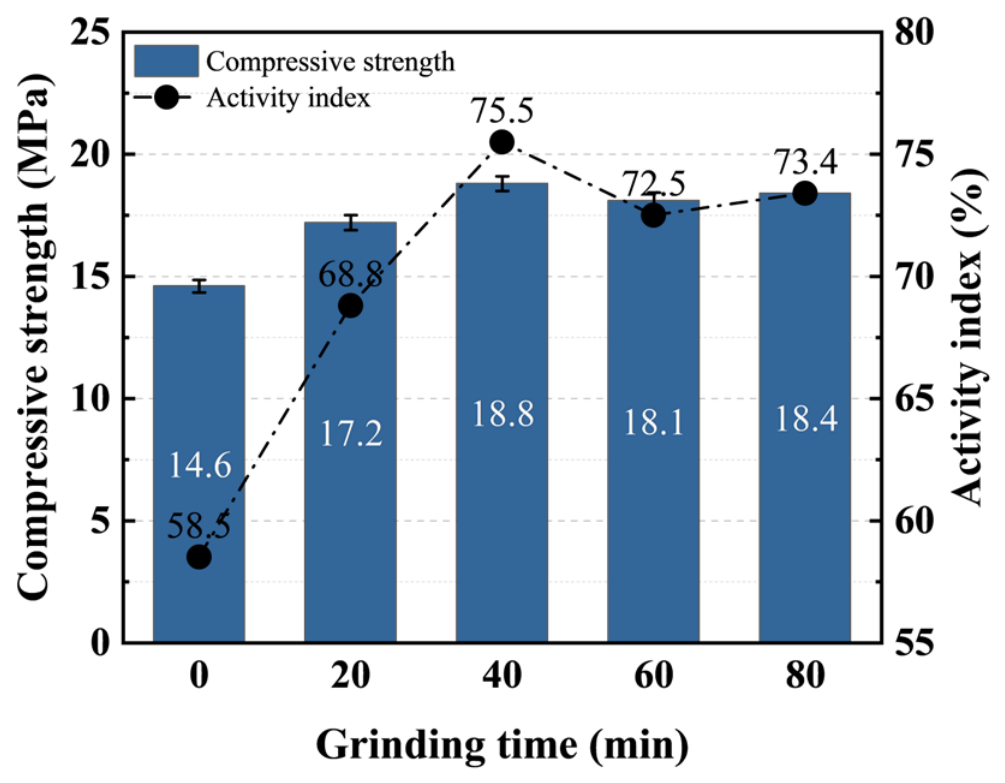
Figure 7 shows the variations in compressive strength and activity index of copper tailings under different grinding times. With increasing grinding time, both compressive strength and activity index increased to maxima at 40 min, decreased at 60 min, and then changed only slightly at 80 min. The compressive strength and activity index of the specimens containing unground copper tailings were 14.6 MPa and 58.5%, respectively. After grinding for 20 min, these values increased to 17.2 MPa and 68.8%, respectively. When the grinding time was extended to 40 min, the compressive strength and activity index reached their maximum values of 18.8 MPa and 75.5%, respectively. Combined with the particle size distribution results, these findings indicate that appropriate mechanical grinding can refine copper tailings particles, increase the exposure of reactive components, and possibly enhance their potential reactivity by increasing surface defects and the number of reactive sites [28,29,30]. When the grinding time was further extended to 60 min and 80 min, the compressive strength and activity index did not increase further, which may be associated with fine-particle agglomeration, particle re-packing, and reduced utilization of the effective specific surface area. Therefore, within the activity index and compressive strength evaluation system used in this study, 40 min can be regarded as the optimal grinding time for the mechanical activation of copper tailings.
Figure 7.
Effect of grinding time on compressive strength and activity index of CTs.
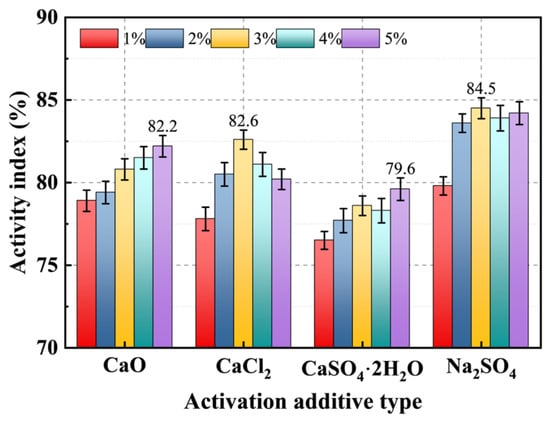
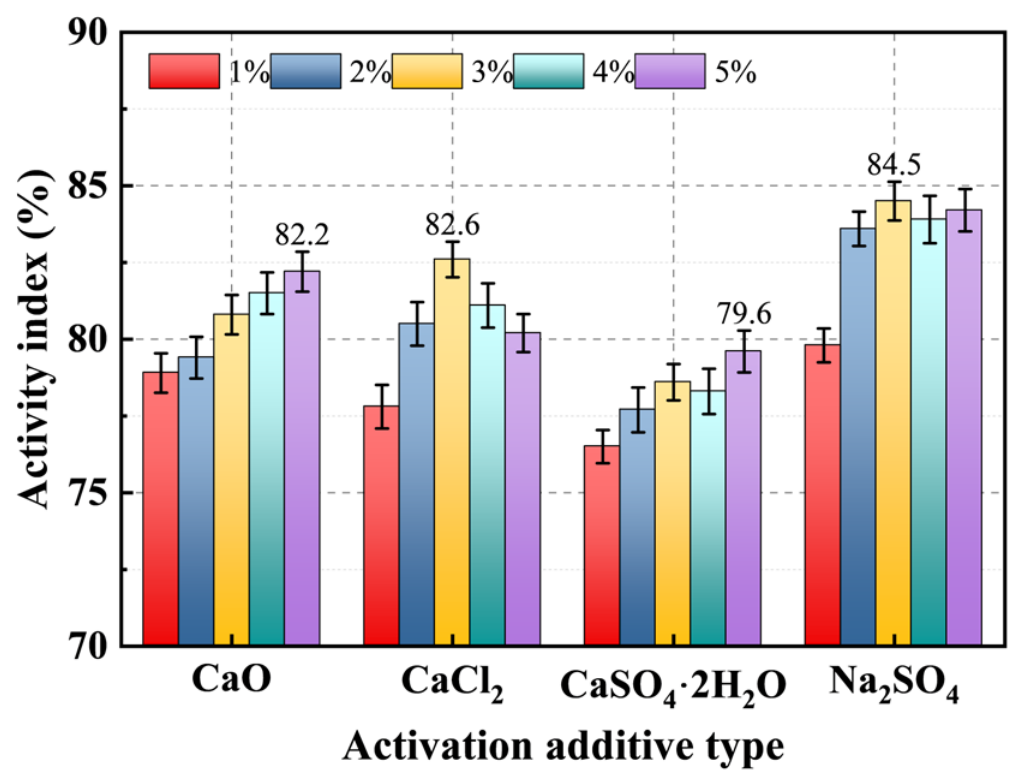
After determining the optimal grinding time, the effects of different mechanochemical activation additive types and dosages on the activity index were further compared, as shown in Figure 8. Overall, CaO, CaCl2, CaSO4·2H2O, and Na2SO4 all improved the activity of copper tailings to varying degrees, although their enhancement effects differed considerably. The activation effect of CaO gradually increased with increasing dosage, and the activity index reached 82.2% at a dosage of 5 wt% relative to the dry CT mass. Both CaCl2 and Na2SO4 showed a trend of first increasing and then decreasing or stabilizing, reaching 82.6% and 84.5%, respectively, at a dosage of 3 wt% relative to the dry CT mass. The enhancement effect of CaSO4·2H2O was relatively weaker, with a maximum activity index of 79.6%. In comparison, Na2SO4 showed a more pronounced improvement in the activity index. This effect may be related to the ability of SO42− to promote the participation of Ca- and Al-bearing components in the reaction and to provide favorable conditions for the subsequent formation of sulfate-related products or C–(A)–S–H-type gels [31,32]. Considering the compressive strength and activity index results together, grinding for 40 min with the addition of 3 wt% Na2SO4 relative to the dry CT mass can be identified as the optimal mechanochemical activation condition for copper tailings.
Figure 8.
Effects of mechanochemical activation additive type and dosage on 28 d activity index of CT.
3.3. Single-Factor Analysis
3.3.1. Effect of Water-to-Solid Ratio
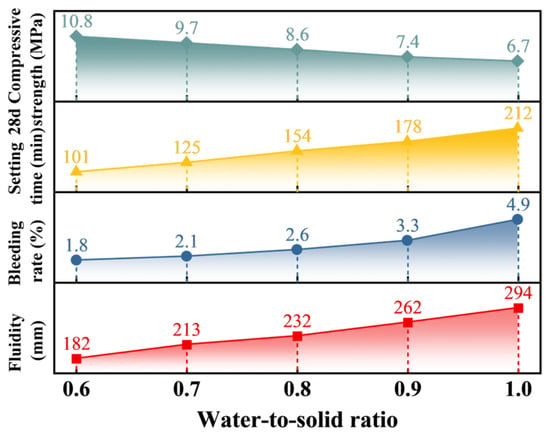
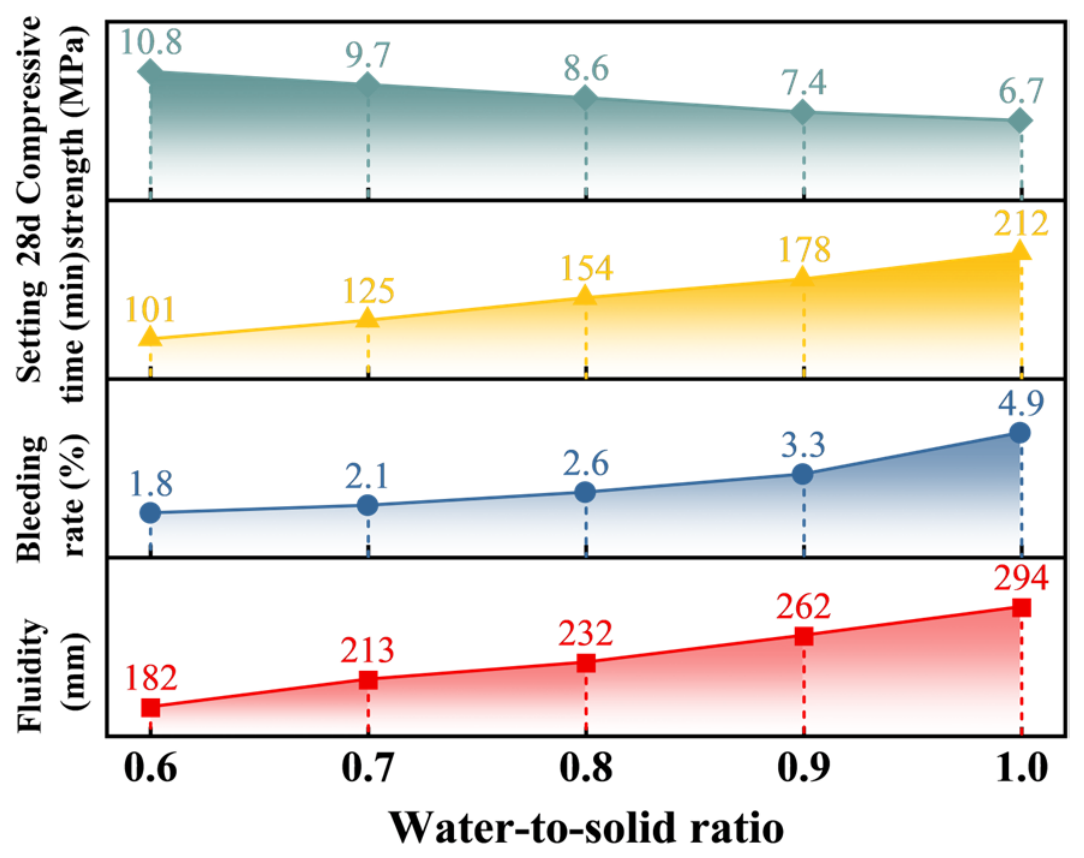
Figure 9 shows the effect of the water-to-solid ratio on the workability and mechanical properties of the CSM. As the water-to-solid ratio increased from 0.6 to 1.0, the fluidity of the slurry increased from 182 mm to 294 mm, indicating that an increase in the liquid phase content enhanced interparticle lubrication and reduced internal friction within the slurry, thereby improving slurry fluidity and injectability. However, increasing the water-to-solid ratio also increased the bleeding rate from 1.8% to 4.9%, prolonged the setting time from 101 min to 212 min, and reduced the 28 d compressive strength from 10.8 MPa to 6.7 MPa. These results indicate that an excessively high water-to-solid ratio weakens slurry stability, delays structural build-up, and reduces the strength of the hardened grouting material.
Figure 9.
Effect of water-to-solid ratio on CSM performance.
This can be attributed to the fact that a higher water-to-solid ratio increases the free water content and thickens the water film on particle surfaces, weakening particle contact and early flocculated structures; consequently, the slurry fluidity increases. However, excessive free water is difficult to effectively retain by solid particles and early reaction products, which can readily cause solid–liquid separation and increase the bleeding rate. In addition, excessive water dilutes the concentrations of OH− and reactive Si, Al, and Ca species in the system, which may reduce the rate of dissolution–polymerization reactions. After hardening, the escape of residual water may further increase the porosity of the hardened grouting material or the risk of connected pores, thereby reducing its compactness and compressive strength. Therefore, the water-to-solid ratio mainly governs the balance among fluidity, stability, and strength of the CSM and should be controlled within an appropriate range [33].
3.3.2. Effect of Alkali Activator Dosage
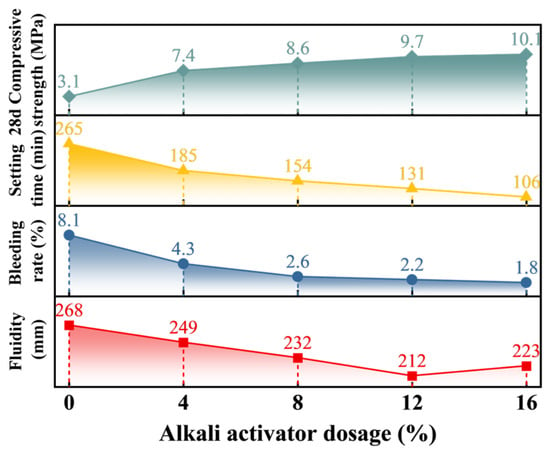
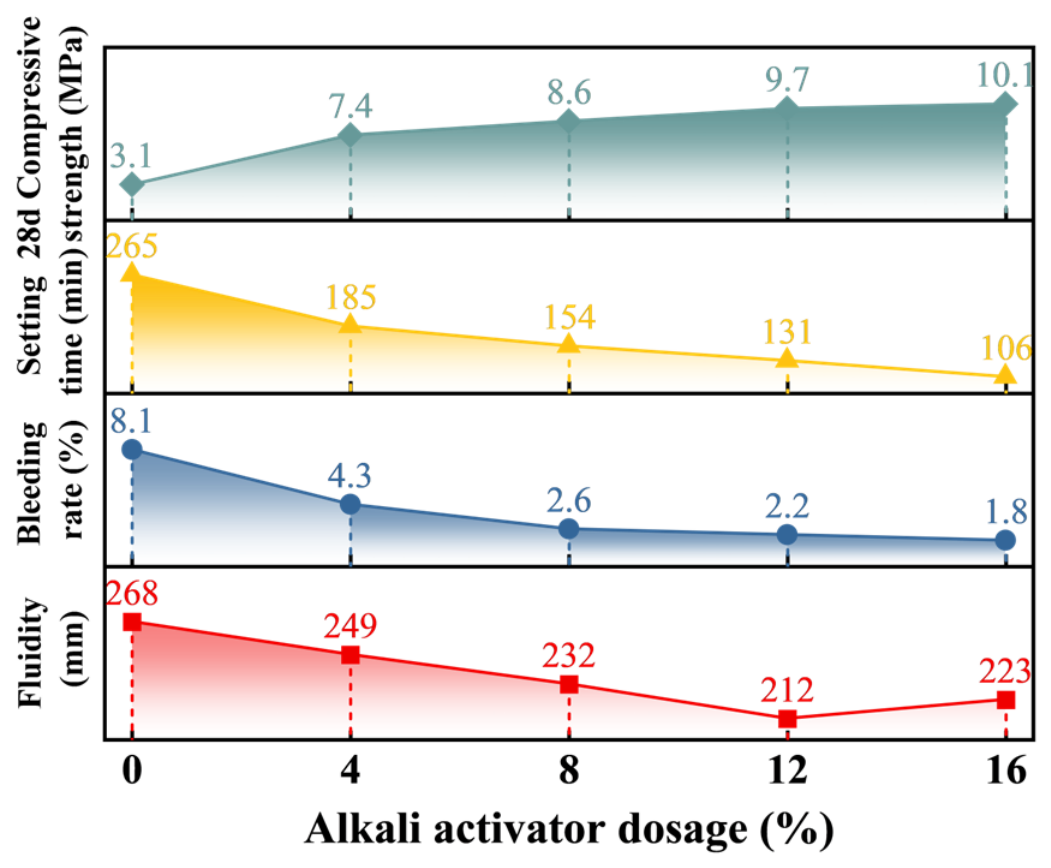
Figure 10 shows the effect of alkali activator dosage on the workability and mechanical properties of the CSM. As the alkali activator dosage increased from 0 to 16 wt%, the bleeding rate of the slurry decreased from 8.1% to 1.8%, the setting time shortened from 265 min to 106 min, and the 28 d compressive strength increased from 3.1 MPa to 10.1 MPa. These results indicate that increasing the alkali activator dosage is beneficial for improving slurry stability, accelerating the setting process, and promoting the strength development of the hardened grouting material. In contrast, fluidity showed a nonlinear trend with increasing alkali activator dosage, first decreasing and then slightly increasing. Specifically, the fluidity decreased from 268 mm at 0 wt% to 212 mm at 12 wt%, and then increased to 223 mm at 16 wt%. This suggests that the effect of alkali activator dosage on slurry fluidity is not governed by a simple dilution or thickening effect, but is jointly associated with the liquid-phase composition, early reaction rate, and interparticle interactions.
Figure 10.
Effect of alkali activator dosage on CSM performance.
From the perspective of the reaction mechanism, the alkali activator can increase the alkalinity of the system and provide a soluble silicon source, thereby promoting the dissolution of reactive Si, Al, and Ca species from MCCTs, SL, and MK. This may further lead to the formation of C–(A)–S–H-type gels [34,35]. The formation of these reaction products helps fill interparticle pores, enhance interparticle bonding, and improve the water-retention capacity of the slurry, thereby reducing the bleeding rate and increasing the strength of the hardened grouting material. However, as the alkali activator dosage increases, the increased liquid-phase viscosity and accelerated formation of early flocculated structures may restrict particle movement, resulting in reduced fluidity. When the dosage further increases, changes in the liquid-phase composition may improve slurry lubrication to some extent, leading to a slight recovery in fluidity. Overall, the alkali activator dosage should be controlled within an appropriate range to coordinate the fluidity, stability, setting time, and strength development of the CSM slurry.
3.3.3. Effect of Copper Tailings Content
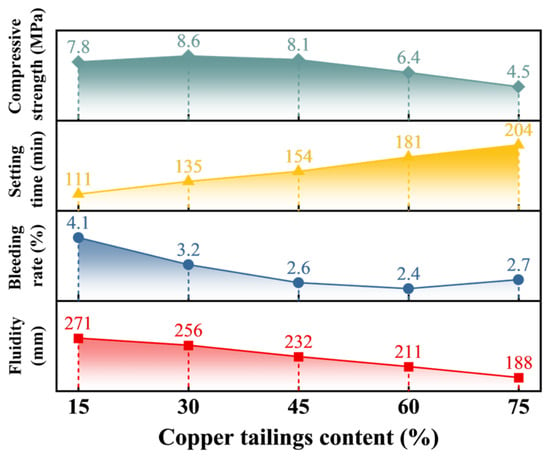
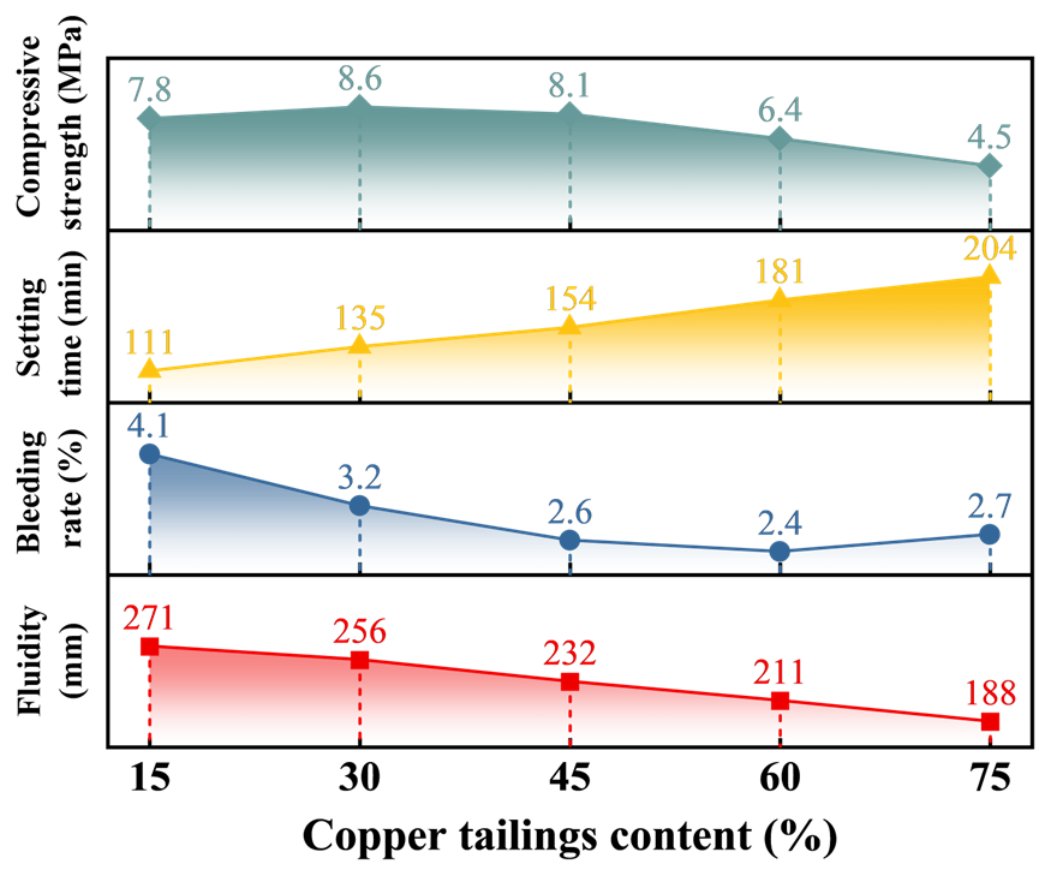
Figure 11 shows the effect of copper tailings content on the workability and mechanical properties of the CSM. As the copper tailings content increased from 15 to 75 wt%, the slurry fluidity decreased from 271 mm to 188 mm, and the setting time was prolonged from 111 min to 204 min. The bleeding rate first decreased from 4.1% at a copper tailings content of 15 wt% to 2.4% at 60 wt%, and then slightly increased to 2.7% at 75 wt%. The 28 d compressive strength first increased from 7.8 MPa to 8.6 MPa and then decreased to 4.5 MPa. These results indicate that an appropriate amount of copper tailings is beneficial for reducing the bleeding rate of the slurry and may improve the particle packing state. However, an excessively high copper tailings content reduces slurry fluidity, delays the setting process, and weakens the strength development of the hardened grouting material.
Figure 11.
Effect of copper tailings content on CSM performance.
The underlying mechanism can be attributed to the competition between the micro-filling effect and the reactivity dilution effect. At low to moderate dosages, the relatively fine particles of mechanochemically activated copper tailings can improve the particle packing state through the micro-filling effect and may increase the tortuosity of water migration pathways within the slurry, thereby reducing the bleeding rate [34]. Meanwhile, some Si- and Ca-bearing components in copper tailings may participate in the alkali activation reaction to a certain extent, contributing to the formation of cementitious products. However, as the copper tailings content further increases, the proportion of highly reactive precursors such as SL and MK decreases, reducing the supply of reactive Ca, Si, and Al species. This may result in insufficient formation of cementitious products and delayed structural build-up, ultimately leading to prolonged setting time and reduced compressive strength. Therefore, the copper tailings content should be controlled within an appropriate range and determined by comprehensively considering fluidity, bleeding rate, setting time, and strength development.
It should be noted that the compressive strength evaluation in the present single-factor analysis was limited to a curing age of 28 d. Although the 28 d strength provides an appropriate index for mixture screening and subsequent RSM optimization, it is insufficient to establish the long-term mechanical stability of the CSM. Waste-containing cementitious and alkali-activated materials may continue to develop strength beyond 28 d because of the gradual dissolution and reaction of slowly reactive aluminosilicate components, and the contribution of mechanically treated mineral waste may become more pronounced at extended curing ages [36]. Conversely, long-term changes in reaction products, carbonation, shrinkage, and moisture conditions may also affect mechanical performance. Therefore, the present results should be interpreted as representing the 28 d mechanical performance rather than the long-term stability of CSM. Further investigations at extended curing ages, particularly 90 and 365 d, are required.
3.4. RSM Modeling and Optimization
The RSM experimental results of the CSM are presented in Table 4.
Table 4.
RSM design and results.
3.4.1. ANOVA and Model Adequacy
Table 5 presents the analysis of variance (ANOVA) and model adequacy evaluation results for the response surface regression models. The quadratic models corresponding to the four responses were all highly significant (p < 0.0001), while the lack of fit was not significant (p > 0.05), indicating that the established models had good fitting performance and statistical reliability. The R2, Adj-R2, and Pred-R2 values of all models were relatively high, suggesting that the models could effectively explain the variations in the experimental data and had certain predictive capability. In addition, the adequate precision values were all greater than 4, and the C.V. values were relatively low, indicating high signal-to-noise ratios and low experimental dispersion. Therefore, these models can be used for response prediction and mix proportion optimization.
Table 5.
ANOVA and model adequacy statistics.
According to the significance results, all three factors had significant effects on the four responses, indicating that they were key factors governing the workability and mechanical properties of CSM. The significance of the interaction and quadratic terms varied among different responses. For fluidity Y1, X1X2 and X2X3 reached significant levels. For the bleeding rate Y2, X2X3 and X12 were significant. For the setting time Y3, the main interaction terms and quadratic terms were significant, indicating that the setting time was strongly affected by multi-factor coupling and nonlinear effects. For the 28 d compressive strength Y4, X1X2, X1X3, and all quadratic terms were significant. Overall, the established response surface regression models can effectively characterize the effects of different factors on CSM performance and can be used for subsequent response surface analysis and mix proportion optimization.
3.4.2. Effects of Two-Factor Interactions
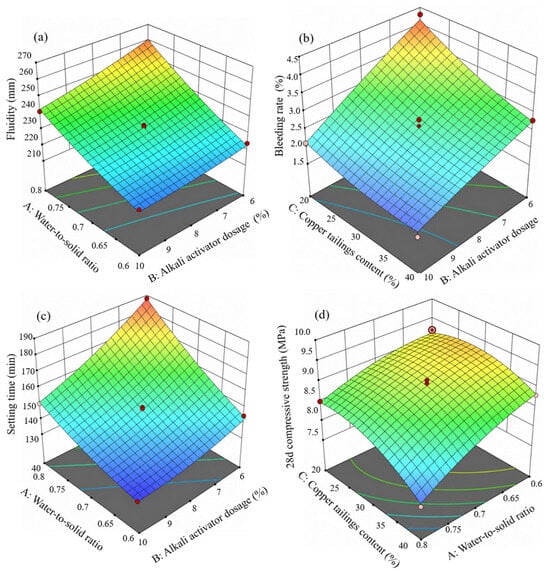
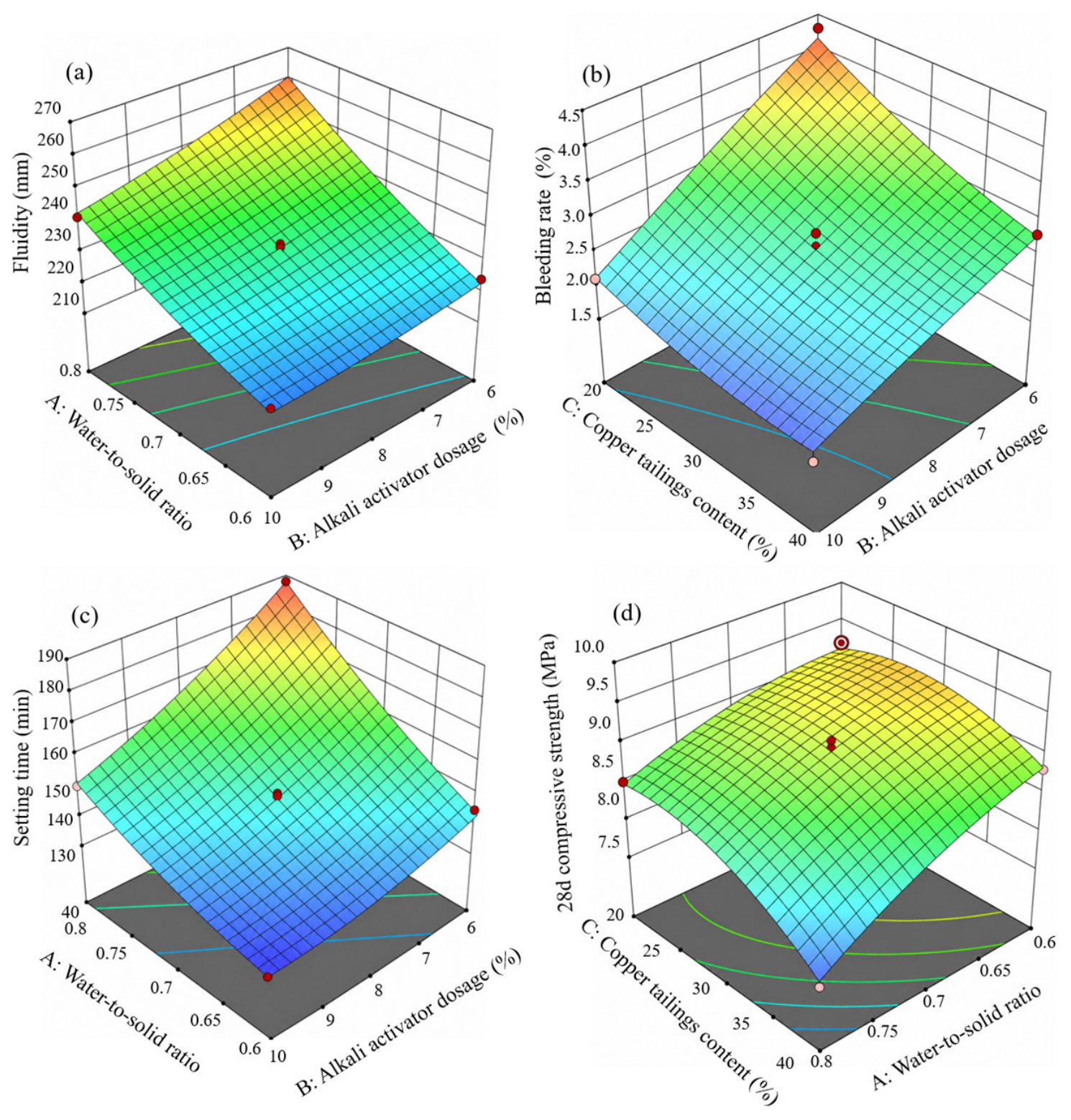
Figure 12 presents the representative two-factor interactions affecting the four CSM responses. In Figure 12a, fluidity increased with the water-to-solid ratio but decreased with the alkali activator dosage. The additional free water reduced interparticle friction, whereas the increased activator dosage increased liquid-phase viscosity and promoted early structural build-up. In Figure 12b, the bleeding rate generally decreased with increasing alkali activator dosage and MCCT content. This combined effect was associated with the formation of early reaction products and the filling effect of fine MCCT particles, both of which improved suspension stability. In Figure 12c, the setting time increased with the water-to-solid ratio but decreased with the alkali activator dosage. The former diluted the concentrations of reactive species, whereas the latter accelerated precursor dissolution and reaction-product formation. In Figure 12d, the 28 d compressive strength decreased with increasing water-to-solid ratio and varied nonlinearly with MCCT content. This behavior reflected the combined effects of water-induced porosity, particle filling, and dilution of the more reactive SL and MK components.
Figure 12.
Response surface plots of key factor interactions: (a) fluidity as a function of water-to-solid ratio and alkali activator dosage; (b) bleeding rate as a function of alkali activator dosage and copper tailings content; (c) setting time as a function of water-to-solid ratio and alkali activator dosage; and (d) 28 d compressive strength as a function of water-to-solid ratio and copper tailings content. Red and pink circular markers denote experimental design points above and below the fitted surface, respectively.
The curvature and changing slopes of the response surfaces confirm that the three factors did not act independently. Instead, their interactions altered the liquid-phase environment, particle-packing state, and reaction process. Coordinated control of the water-to-solid ratio, alkali activator dosage, and MCCT content was therefore necessary to balance fluidity, bleeding rate, setting time, and compressive strength.
3.4.3. Optimization and Model Validation
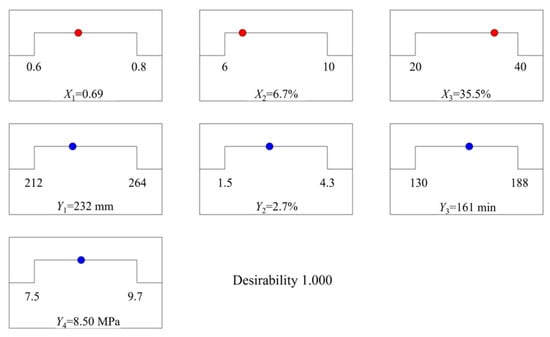
To identify a balanced combination of workability and mechanical performance within the investigated factor and response ranges, multi-response screening of the CSM mix proportions was performed using the desirability function in Design-Expert software (v13; Stat-Ease Inc., Minneapolis, MN, USA). The multi-objective optimization results and predicted responses are presented in Figure 13. The optimization results showed that the CSM achieved favorable overall performance at a water-to-solid ratio of 0.69, an alkali activator dosage of 6.7 wt%, and an MCCT content of 35.5 wt% of the dry solid precursor. Under these conditions, the overall desirability was 1.000, indicating that this mix proportion had a high level of overall desirability within the investigated factor and response ranges. The corresponding predicted response values were as follows: fluidity of 232 mm, bleeding rate of 2.7%, setting time of 161 min, and 28 d compressive strength of 8.50 MPa.
Figure 13.
Multi-objective optimization results and predicted responses of CSM. Red points indicate the optimized factor levels, blue points indicate the predicted response values, and the gray step-shaped profiles show the desirability functions and specified optimization ranges.
To verify the reliability of the model predictions, validation experiments were conducted under the optimized mix proportion described above. The experimental values were 235 mm, 2.8%, 165 min, and 8.62 MPa, respectively. The relative errors, calculated from the unrounded model predictions, were 1.51%, 2.90%, 2.69%, and 1.35%, respectively, all of which were less than 5%. These results indicate that the established response surface regression model had high prediction accuracy and good fitting and validation performance, providing a reliable basis for mix proportion optimization of the CSM.
The response surfaces also provide qualitative practical information regarding the sensitivity of the optimized mixture. Their slopes suggest that small variations in the water-to-solid ratio may noticeably affect fluidity and setting behavior, whereas variations in the alkali activator dosage may affect bleeding rate and strength development. Therefore, the optimized formulation should not be regarded as insensitive to field-batching variations. For field preparation, water and alkali activator should be controlled on a mass basis, the moisture introduced by the raw materials should be considered in the effective water-to-solid ratio, and the alkali activator composition, addition sequence, and mixing duration should be kept consistent. Pilot-scale mixing and trial grouting are required to establish acceptable field control tolerances before engineering application.
The response ranges used in the desirability analysis were laboratory screening ranges derived from the present experimental program rather than universal acceptance limits prescribed by JGJ 79-2012 [12]. Therefore, the resulting formulation should be regarded as an optimized laboratory mixture for the intended filling and consolidation application, and its compliance with project-specific requirements must be verified through field grouting trials.
3.5. Microstructural Analysis
3.5.1. SEM–EDS
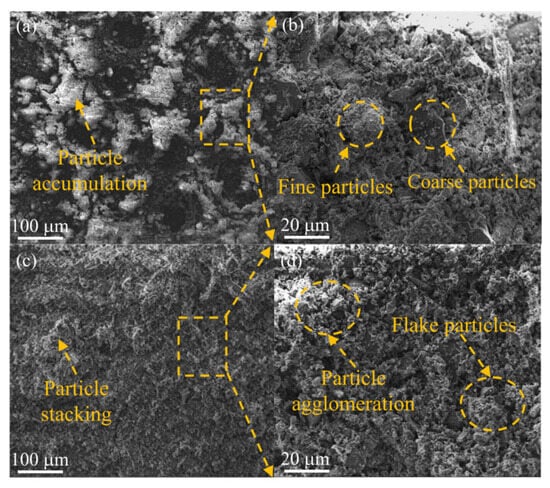
Figure 14 shows the SEM images of MCTs and MCCTs. Compared with the morphology of the original copper tailings, the CT particles were markedly refined after mechanical activation. In MCTs, a small number of coarse particles coexisted with a large number of fine particles. The fine particles were attached to the surfaces of coarse particles or filled the interparticle voids, indicating that mechanical grinding effectively fractured the copper tailings particles and produced characteristics of fine-particle enrichment and filling. In contrast, particle packing and local agglomeration were more pronounced in MCCTs, and flaky or lamellar particles were observed in some regions. This suggests that mechanical impact, shear action, and Na2SO4-assisted mechanochemical activation may have jointly altered the particle surface state and interparticle interactions, thereby affecting particle dispersion and agglomeration behavior [37].
Figure 14.
SEM images of MCTs and MCCTs: (a) low-magnification MCTs, (b) enlarged view of the dashed rectangular region in (a), (c) low-magnification MCCTs, and (d) enlarged view of the dashed rectangular region in (c). Yellow dashed circles and arrows indicate representative particle features.
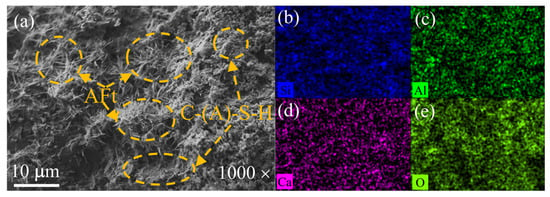
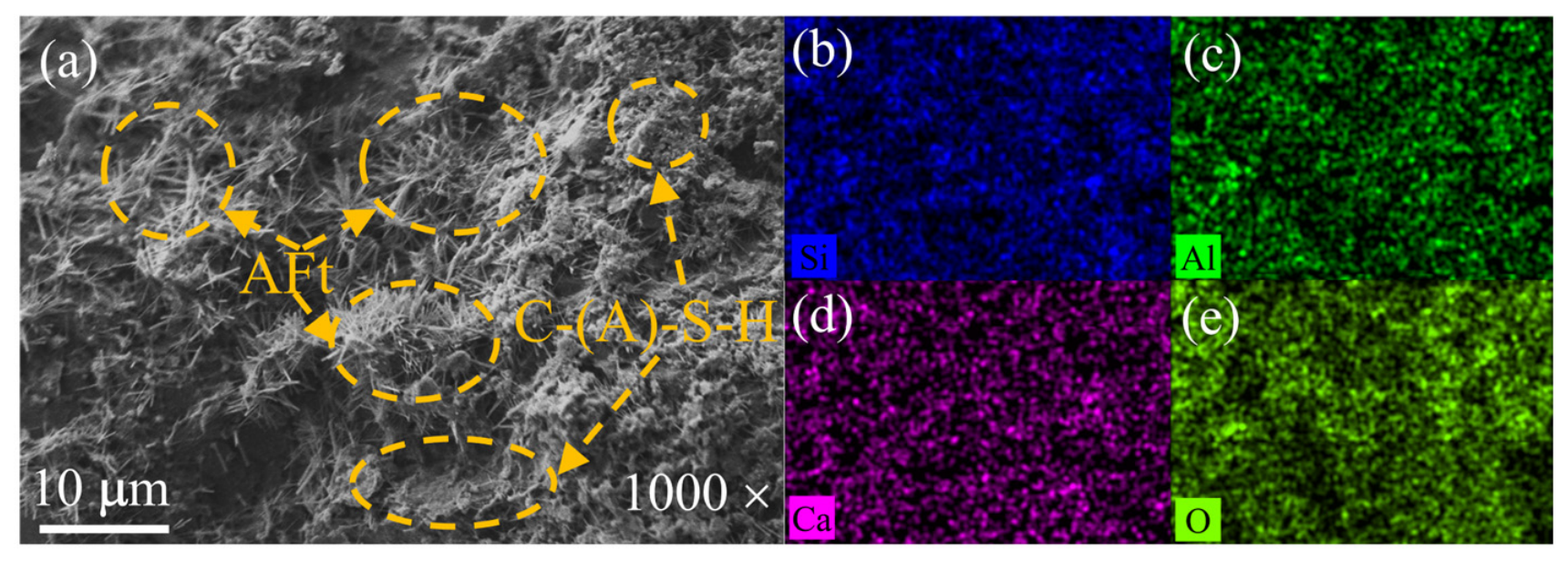
Figure 15 presents the SEM image and selected elemental maps of the 28 d hardened CSM matrix. As shown in Figure 15a, needle-bundle-like, flocculent, and gel-like reaction products were observed in local regions of the hardened matrix. These products were interwoven with incompletely reacted particles, resulting in a relatively compact microstructure in the observed area. Considering the reaction characteristics of alkali-activated slag and sulfate-activated systems, the needle-bundle-like products were tentatively assigned to AFt-like crystals, whereas the flocculent and gel-like products were associated with C–(A)–S–H-type gels [31,34]. The elemental maps in Figure 15b–e show that Si, Al, Ca, and O were widely distributed throughout the selected region, with substantial spatial overlap. This distribution is consistent with the formation of Ca–Si–Al–O-rich binding phases in the hardened matrix [38]. These binding phases can fill interparticle pores and enhance interparticle bonding, thereby improving the local compactness of the hardened matrix and providing a microstructural basis for its compressive strength development. Qualitative EDS analysis additionally detected weak signals tentatively assigned to Fe, Mg, and Pb, whereas the Au signal originated from the conductive gold coating and was therefore excluded from the interpretation of the intrinsic elemental composition. No distinct Cu signal was resolved in the selected region; however, owing to the local and semiquantitative nature of SEM–EDS, this observation does not indicate the complete absence of Cu from the original tailings or the hardened CSM matrix.
Figure 15.
SEM–EDS images of the 28 d hardened CSM matrix: (a) SEM image, and elemental maps of (b) Si, (c) Al, (d) Ca, and (e) O. Blue, green, magenta, and yellow-green represent Si, Al, Ca, and O, respectively; yellow dashed outlines and arrows mark regions tentatively assigned to AFt- and C–(A)–S–H-type reaction products.
3.5.2. XRD
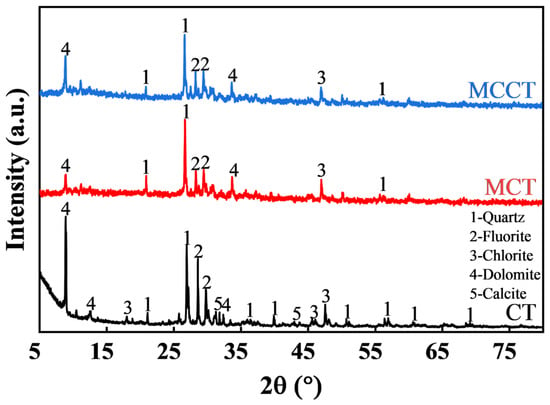
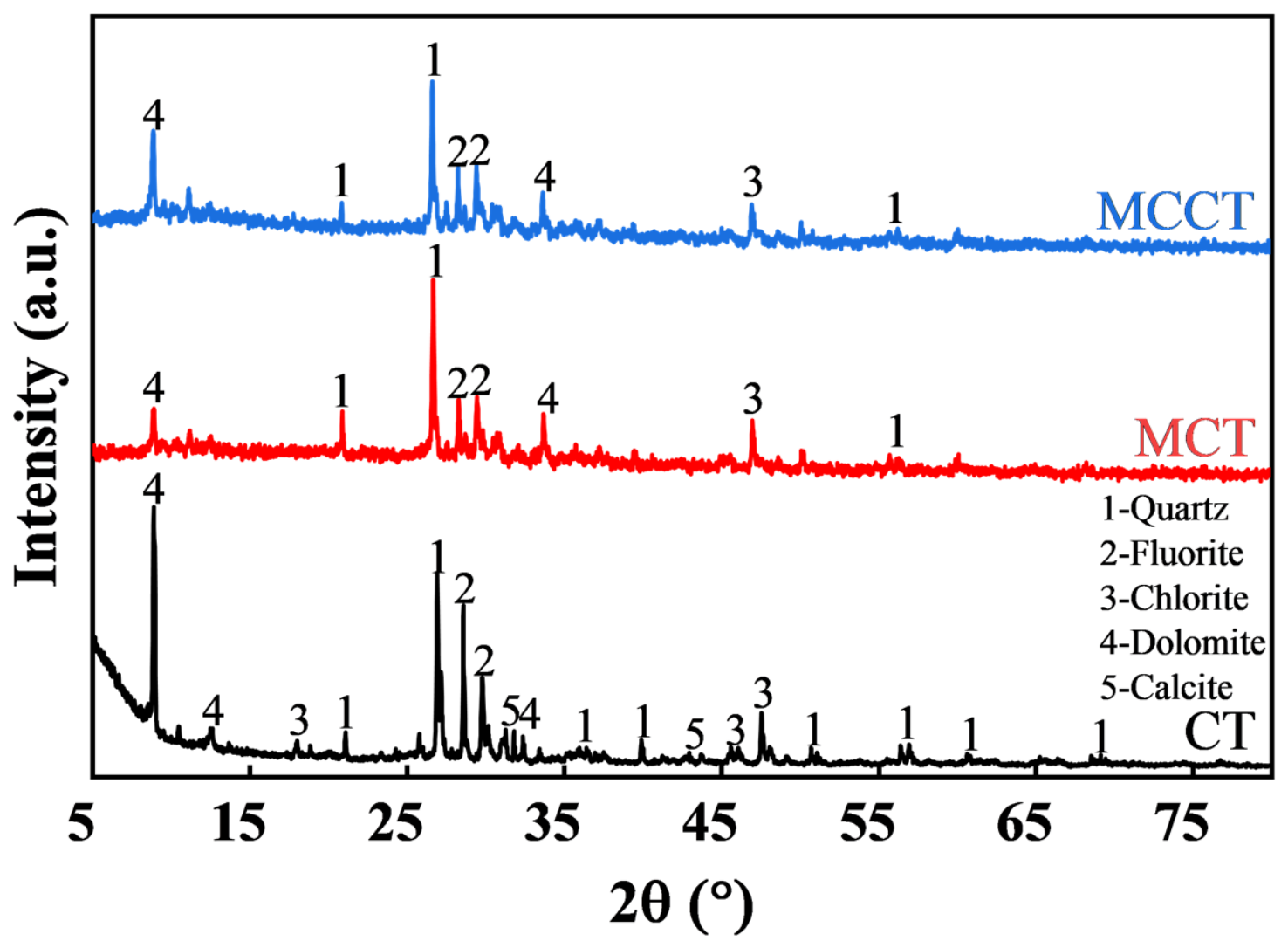
Figure 16 compares the XRD patterns of CTs, MCTs, and MCCTs. CTs exhibited pronounced diffraction peaks corresponding to quartz, fluorite, chlorite, dolomite, and calcite, confirming the predominance of relatively stable crystalline minerals and explaining its limited direct reactivity. After mechanical grinding, some quartz- and carbonate-related peaks in MCTs decreased in intensity and became broader, consistent with increased lattice defects, reduced crystal ordering, and greater structural disorder [15,37]. Further weakening of several crystalline peaks was observed in MCCTs, indicating that mechanical grinding combined with Na2SO4-assisted activation further disturbed the mineral structure and promoted the exposure of potentially reactive components [28,32].
Figure 16.
XRD patterns of CTs, MCTs, and MCCTs.
3.5.3. FTIR
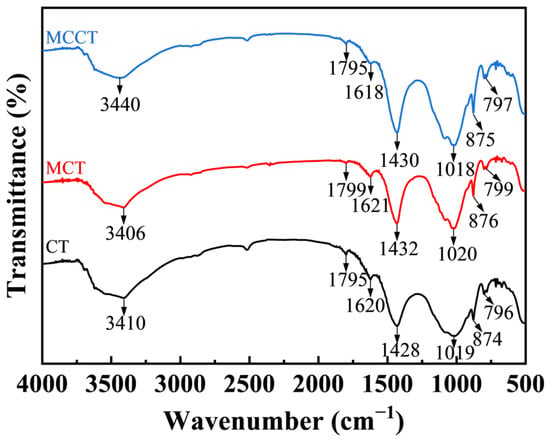
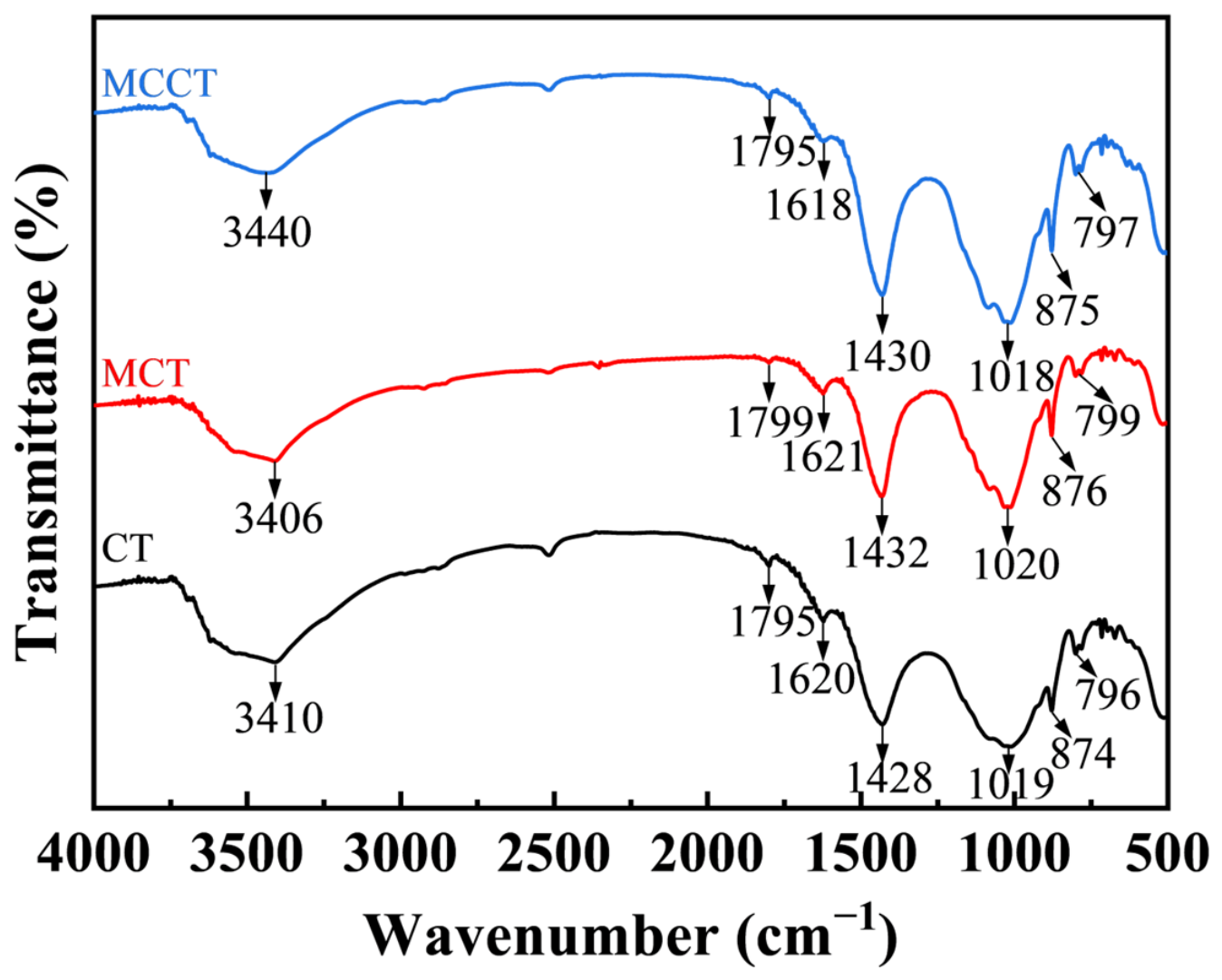
Figure 17 compares the FTIR spectra of CTs, MCTs, and MCCTs. The bands near 3410 and 1620 cm−1 were assigned to O–H stretching and H–O–H bending vibrations, respectively. The bands near 1428 and 876 cm−1 were associated with CO32− vibrations, confirming the presence of carbonate minerals such as calcite and dolomite [37]. The bands at 1018–1020 cm−1 were attributed to asymmetric Si–O–T stretching (T = Si or Al), whereas those at 796–799 cm−1 were associated with Si–O or Si–O–Si vibrations in quartz [39]. Compared with CTs, MCTs and MCCTs exhibited changes in the shapes and intensities of the Si–O–T- and CO32−-related bands, indicating modification of the local bonding environment and mineral surface structure. A weak shoulder near 1080 cm−1 in MCCTs may have resulted from the overlap of sulfate S–O and aluminosilicate Si–O–T vibrations, suggesting that Na2SO4 affected the surface chemical environment of the activated particles [40,41]. Together with the XRD results, these spectral changes support the increased structural disorder and enhanced exposure of potentially reactive components after mechanochemical activation.
Figure 17.
FTIR spectra of CTs, MCTs, and MCCTs.
A quantitative comparison of the particle size and activity results further supports the relationship between mechanochemical activation and macroscopic performance. Grinding CTs for 40 min decreased the D50 from 63.10 to 5.90 μm, corresponding to a reduction of approximately 90.6%. Meanwhile, the 28 d compressive strength of the specimens used for activity evaluation increased from 14.6 to 18.8 MPa, and the corresponding activity index increased from 58.5% to 75.5%. After co-grinding with 3 wt% Na2SO4, the D50 of MCCTs increased to 10.12 μm, consistent with partial fine-particle agglomeration, whereas the activity index further increased to 84.5%. This result indicates that the improvement in reactivity cannot be attributed solely to particle refinement and is also consistent with the increased structural disorder and changes in the local chemical-bonding environment indicated by XRD and FTIR. Particle refinement and the filling effect of fine particles may also contribute to suspension stability and reduced bleeding. Because quantitative XRD phase analysis, FTIR peak deconvolution, and independent porosity measurements were not performed, the phase and gel assignments and porosity-related interpretations remain qualitative.
3.6. Sustainability and Cost Assessment
To provide a preliminary material-level assessment of the environmental and economic performance of CSM, the calculation was conducted on the basis of 1 kg of dry solid precursor. For the optimized CSM mixture, the dry solid precursor consisted of 0.355 kg of MCCTs (35.5 wt%), 0.545 kg of SL (54.5 wt%), and 0.100 kg of MK (10.0 wt%). Because MCCTs were prepared by adding anhydrous Na2SO4 at 3 wt% relative to the dry CT mass, the 0.355 kg of MCCTs corresponded to approximately 0.3447 kg of dry CT and 0.0103 kg of Na2SO4. In addition, 0.067 kg of commercial sodium silicate solution and 0.0135 kg of solid NaOH were used per kilogram of dry solid precursor. The latter value was calculated using the 0.201:1 mass ratio of solid NaOH to commercial sodium silicate solution. The mixing-water demand was 0.690 kg per kilogram of dry solid precursor. The reference system was a 1 kg ordinary Portland cement (OPC) binder benchmark.
The embodied-energy factors and greenhouse gas (GHG) emission factors for OPC and commercial sodium silicate solution were obtained from McLellan et al. [42]. The environmental-burden factor assigned to CTs was determined with reference to Refs. [43,44], whereas the embodied-energy factors and GHG emission factors for SL and MK were obtained from Refs. [45,46], respectively. The unit prices of CTs, SL, MK, commercial sodium silicate solution, and OPC were obtained from supplier quotations collected in Henan Province, China. The material quantities, inventory factors, and unit prices are summarized in Table 6; the corresponding sources are identified above.
Table 6.
Material quantities and inventory factors used for the preliminary material-level comparison of CSM and the OPC binder benchmark.
The assessment was limited to an inventory-based comparison at the material level rather than a complete life-cycle assessment. The CT inventory factor was applied to the MCCT mass as a proxy. The separate contributions of Na2SO4, solid NaOH, mixing water, additional electricity consumed during laboratory-scale ball milling, raw-material transportation, slurry mixing, curing, pumping, and field construction, equipment manufacture, service life, and end-of-life treatment were excluded from the present system boundary. Therefore, the results should be interpreted as preliminary estimates within the defined system boundary.
Based on the material quantities and inventory factors listed in Table 6, the included inventory items of the optimized CSM mixture resulted in an embodied energy of 1.070 MJ, greenhouse-gas emissions of 0.148 kg CO2-eq, and a material cost of 0.420 CNY per kilogram of dry solid precursor. In comparison, the corresponding values for the 1 kg OPC binder benchmark were 3.330 MJ, 0.866 kg CO2-eq, and 0.578 CNY, respectively. Therefore, within the defined material-level system boundary, the optimized CSM mixture showed reductions of 67.86% in embodied energy, 82.87% in greenhouse gas emissions, and 27.28% in material cost relative to the OPC binder benchmark. These results demonstrate the potential environmental and economic benefits of using the CSM precursor system instead of the OPC binder within the adopted assessment boundary.
Chemical durability under aggressive environments and the leaching behavior of potentially toxic elements were not evaluated in the present study. Future work will investigate the resistance of CSM to sulfate attack and acidic groundwater and quantify the leaching of residual Cu, Pb, and other trace elements to further assess its long-term durability and environmental suitability.
4. Conclusions
This study used Na2SO4-assisted mechanochemical activation to improve the reactivity of copper tailings and develop a copper tailings–slag–metakaolin solid-waste-based grouting material (CSM). The main conclusions are as follows:
- (1)
- Mechanochemical activation effectively enhanced the potential reactivity of copper tailings. The optimum activation condition was grinding for 40 min with the addition of 3 wt% Na2SO4 relative to the dry CT mass, under which the activity index reached 84.5%. Appropriate grinding significantly refined the CT particles and enhanced their reactivity, whereas excessive grinding induced fine-particle agglomeration and re-packing, thereby limiting further activation.
- (2)
- The water-to-solid ratio primarily governed the balance between slurry fluidity and the compressive strength of the hardened grouting material. Increasing the alkali activator dosage promoted slurry stability and strength development, whereas the effect of copper tailings content reflected competition between particle filling and reactive-component dilution. Based on response surface optimization, the optimum mixture had a water-to-solid ratio of 0.69, an alkali activator dosage of 6.7 wt%, and an MCCT content of 35.5 wt% of the dry solid precursor. The validation experiment produced a fluidity of 235 mm, a bleeding rate of 2.8%, a setting time of 165 min, and a 28 d compressive strength of 8.62 MPa.
- (3)
- Microstructural analysis showed that mechanochemical activation refined the CT particles, reduced the structural ordering of some crystalline minerals, and altered their local chemical bonding environment. Under alkali activation, Ca–Si–Al–O-rich binding phases and AFt-like crystals were formed in the hardened CSM matrix. These reaction products filled interparticle pores and enhanced interparticle bonding, providing a microstructural basis for matrix densification and compressive strength development.
- (4)
- Within the defined preliminary material-level system boundary, the embodied energy, greenhouse gas emissions, and material cost associated with the included inventory items of CSM were estimated to be 1.070 MJ, 0.148 kg CO2-eq, and 0.420 CNY per kilogram of dry solid precursor, respectively. These values were 67.86%, 82.87%, and 27.28% lower, respectively, than those of the 1 kg OPC binder benchmark. The results demonstrate the potential environmental and economic benefits of the CSM formulation within the adopted assessment boundary.
From an engineering perspective, the optimized CSM may be considered a candidate material for the low-pressure filling and consolidation of underground voids, roadbed cavities, fractured or weak ground, and internal interfaces. Nevertheless, the present study was limited to copper tailings from a single source, laboratory-scale material preparation and curing, and mechanical performance evaluated primarily up to 28 d. Field-scale injectability, volume stability, long-term strength development, durability under aggressive groundwater, and the leaching behavior of potentially toxic elements remain to be verified. Although CSM is not a conventional thin-film coating, its injectable slurry may fill cracks, pores, and weak interfaces and form an internal mineral sealing and consolidation layer after hardening. Further research should evaluate its substrate adhesion, impermeability, shrinkage, erosion and abrasion resistance, chemical durability, long-term performance at 90 and 365 d, and field applicability before it is adapted as a functional cementitious coating or surface treatment material.
Author Contributions
Conceptualization, J.Y. and Z.H.; methodology, J.Y. and Z.H.; validation, J.Y. and T.X.; formal analysis, J.Y.; investigation, J.Y. and T.X.; resources, Z.H.; data curation, J.Y. and T.X.; writing—original draft preparation, J.Y.; writing—review and editing, Z.H. and T.X.; visualization, J.Y.; supervision, Z.H.; project administration, Z.H.; funding acquisition, Z.H. All authors have read and agreed to the published version of the manuscript.
Funding
This research was funded by the National Natural Science Foundation of China, grant number 52478437, and the Postgraduate Scientific Research Innovation Project of Hunan Province, grant number CX20261324.
Institutional Review Board Statement
Not applicable.
Informed Consent Statement
Not applicable.
Data Availability Statement
The raw experimental data supporting the single-factor tests, response surface modeling, validation experiments, and sustainability calculations are available in a structured spreadsheet format from the corresponding author upon reasonable request.
Conflicts of Interest
Author Tangxin Xie was employed by the company Hunan Provincial Expressway Group Co., Ltd. The remaining authors declare that the research was conducted in the absence of any commercial or financial relationships that could be construed as potential conflicts of interest.
References
- Wang, Z.; Zhu, J.; Ma, T. Review on monitoring of pavement subgrade settlement: Influencing factor, measurement and advancement. Measurement 2024, 237, 115225. [Google Scholar] [CrossRef] [Scilit]
- Chu, X.; Dawson, A.; Thom, N.; Chen, H.; Qin, L. Permanent deformation characteristics of unsaturated subgrade soils under cyclic loading. Case Stud. Constr. Mater. 2024, 20, e03099. [Google Scholar] [CrossRef] [Scilit]
- Sang, H.; Liu, B.; Liu, Q.; Kang, Y.; Lu, C. Study of grouting reinforcement mechanism in fractured rock mass and its engineering application. Int. J. Geomech. 2024, 24, 04024057. [Google Scholar] [CrossRef] [Scilit]
- Li, S.; Liu, R.; Zhang, Q.; Zhang, X. Protection against water or mud inrush in tunnels by grouting: A review. J. Rock Mech. Geotech. Eng. 2016, 8, 753–766. [Google Scholar] [CrossRef] [Scilit]
- Jiang, X.; Zhu, H.; Yan, Z.; Zhang, F.; Ye, F.; Li, P.; Zhang, X.; Dai, Z.; Bai, Y.; Huang, B. A state-of-art review on development and progress of backfill grouting materials for shield tunneling. Dev. Built Environ. 2023, 16, 100250. [Google Scholar] [CrossRef] [Scilit]
- da Rocha Gomes, S.; Ferrara, L.; Sánchez, L.; Moreno, M.S. A comprehensive review of cementitious grouts: Composition, properties, requirements and advanced performance. Constr. Build. Mater. 2023, 375, 130991. [Google Scholar] [CrossRef] [Scilit]
- Qin, L.; Kou, D.; Jiang, X.; Yang, S.; Hou, N.; Huang, F. Research progress on polyurethane-based grouting materials: Modification technologies, performance characterization, and engineering applications. Polymers 2025, 17, 2313. [Google Scholar] [CrossRef] [Scilit] [PubMed]
- Shu, B.; Zhou, M.; Yang, T.; Li, Y.; Song, P.; Chen, A.; Barbieri, D.M. Performance study and engineering application of grouting materials with a large content of solid waste. Constr. Build. Mater. 2021, 312, 125464. [Google Scholar] [CrossRef] [Scilit]
- Xu, C.; Lei, X.; Han, L.; Lang, L.; Chen, Z.; Fu, S.; Ding, Q.; Liu, X.; Wang, P.; Li, J. Investigation the engineering properties and environmental impact of electrolytic manganese residue-based grouting materials for karst application. Constr. Build. Mater. 2024, 457, 139344. [Google Scholar] [CrossRef] [Scilit]
- Duan, D.; Wu, H.; Wei, F.; Song, H.; Ma, Z.; Chen, Z.; Cheng, F. Preparation, characterization, and rheological analysis of eco-friendly geopolymer grouting cementitious materials based on industrial solid wastes. J. Build. Eng. 2023, 78, 107451. [Google Scholar] [CrossRef] [Scilit]
- Gao, Y.; Liu, X.; Li, Z.; Xin, G.; Mu, M.; Zhang, J. Preparation, characterisation, and properties of anti-erosion grouting materials from industrial solid waste. JOM 2023, 75, 5252–5263. [Google Scholar] [CrossRef] [Scilit]
- JGJ 79-2012; Technical Code for Ground Treatment of Buildings. China Architecture & Building Press: Beijing, China, 2012. (In Chinese)
- Adesina, A. Synthesis, characterization, and efficacy of alkali-activated materials from mine tailings: A review. Waste Manag. 2025, 191, 23–46. [Google Scholar] [CrossRef] [Scilit] [PubMed]
- Krishna, R.S.; Shaikh, F.U.A.; Mishra, J.; Lazorenko, G.; Kasprzhitskii, A. Mine tailings-based geopolymers: Properties, applications and industrial prospects. Ceram. Int. 2021, 47, 17826–17843. [Google Scholar] [CrossRef] [Scilit]
- Saedi, A.; Jamshidi-Zanjani, A.; Mohseni, M.; Khodadadi Darban, A.; Nejati, H. Mechanical activation of lead–zinc mine tailings as a substitution for cement in concrete construction. Constr. Build. Mater. 2023, 364, 129973. [Google Scholar] [CrossRef] [Scilit]
- Hernández-Ramos, S.M.; Trejo-Arroyo, D.L.; Cholico-González, D.F.; Rodríguez-Torres, G.M.; Zárate-Medina, J.; Vega-Azamar, R.E.; León-Patiño, C.A.; Ortíz-Lara, N. Characterization and effect of mechanical and thermal activation in mining tailings for use as supplementary cementitious material. Case Stud. Constr. Mater. 2024, 20, e02770. [Google Scholar] [CrossRef] [Scilit]
- Chen, B.; Pang, L.; Zhou, Z.; Chang, Q.; Fu, P. Study on the activation mechanism and hydration properties of gold tailings activated by mechanical-chemical-thermal coupling. J. Build. Eng. 2022, 48, 104014. [Google Scholar] [CrossRef] [Scilit]
- Huang, G.; Wang, M.; Liu, Q.; Zhao, S.; Liu, H.; Liu, F.; Feng, L.; Song, J. Simultaneous utilization of mine tailings and steel slag for producing geopolymers: Alkali-hydrothermal activation, workability, strength, and hydration mechanism. Constr. Build. Mater. 2024, 414, 135029. [Google Scholar] [CrossRef] [Scilit]
- Izak, P.; Delikhovskyi, Y.; Olszyna, A. Use of post-flotation solidified tailings from copper production for ceramic tile production. Materials 2023, 16, 132. [Google Scholar] [CrossRef] [Scilit] [PubMed]
- Mobili, A.; Blasi, E.; Maqbool, Q.; Tittarelli, F. Copper mine tailings and metakaolin as precursors for sustainable alkali-activated mortars. J. Build. Eng. 2025, 103, 112134. [Google Scholar] [CrossRef] [Scilit]
- GB/T 9853-2008; Chemical Reagent—Sodium Sulfate Anhydrous. Standards Press of China: Beijing, China, 2008. (In Chinese)
- GB/T 8077-2012; Methods for Testing Uniformity of Concrete Admixture. Standards Press of China: Beijing, China, 2012. (In Chinese)
- DL/T 5148-2021; Technical Specification for Cement Grouting Construction of Hydraulic Structures. China Electric Power Press: Beijing, China, 2021. (In Chinese)
- GB/T 1346-2024; Test Methods for Water Requirement of Standard Consistency, Setting Time and Soundness of Portland Cement. Standards Press of China: Beijing, China, 2024. (In Chinese)
- GB/T 17671-2021; Test Method of Cement Mortar Strength (ISO Method). Standards Press of China: Beijing, China, 2021. (In Chinese)
- GB/T 12957-2005; Test Method for Activity of Industrial Waste Slag Used as Addition to Cement. Standards Press of China: Beijing, China, 2005. (In Chinese)
- Ramanathan, S.; Perumal, P.; Illikainen, M.; Suraneni, P. Mechanically activated mine tailings for use as supplementary cementitious materials. RILEM Tech. Lett. 2021, 6, 61–69. [Google Scholar] [CrossRef] [Scilit]
- Tian, X.; Wang, C.; Asrah, H.; Han, L.C.; Zheng, Y. Investigating the grinding characteristics of vanadium-titanium iron ore tailings for sustainable utilization in cementitious material preparation. Alex. Eng. J. 2024, 101, 78–89. [Google Scholar] [CrossRef] [Scilit]
- Zhang, Y.; Liu, B.; Gu, X.; Nehdi, M.L.; Zhang, L.V. Mechanochemical activation of iron ore tailing-based ternary supplementary cementitious materials. Constr. Build. Mater. 2022, 346, 128420. [Google Scholar] [CrossRef] [Scilit]
- Yang, M.; Sun, J.; Dun, C.; Duan, Y.; Meng, Z. Cementitious activity optimization studies of iron tailings powder as a concrete admixture. Constr. Build. Mater. 2020, 265, 120760. [Google Scholar] [CrossRef] [Scilit]
- Yao, G.; Cui, T.; Zhang, J.; Wang, J.; Lyu, X. Effects of mechanical grinding on pozzolanic activity and hydration properties of quartz. Adv. Powder Technol. 2020, 31, 4500–4509. [Google Scholar] [CrossRef] [Scilit]
- Mobasher, N.; Bernal, S.A.; Provis, J.L. Structural evolution of an alkali sulfate activated slag cement. J. Nucl. Mater. 2016, 468, 97–104. [Google Scholar] [CrossRef] [Scilit]
- Yang, Y.; Yang, Z.; Cheng, Z.; Zhang, H. Effects of wet grinding combined with chemical activation on the activity of iron tailings powder. Case Stud. Constr. Mater. 2022, 17, e01385. [Google Scholar] [CrossRef] [Scilit]
- Qin, Z.; Shi, Q.; Qin, D.; Wang, H.; Luo, Y.; Wang, W. Performance comparison of geopolymer and clay-cement grouting pastes and goaf effect evaluation of grouting backfilling method. Front. Mater. 2023, 10, 1301504. [Google Scholar] [CrossRef] [Scilit]
- Fu, Q.; Bu, M.; Zhang, Z.; Xu, W.; Yuan, Q.; Niu, D. Hydration characteristics and microstructure of alkali-activated slag concrete: A review. Engineering 2023, 20, 162–179. [Google Scholar] [CrossRef] [Scilit]
- Stempkowska, A.; Gawenda, T.; Chajec, A.; Sadowski, Ł. Effect of granite powder grain size and grinding time of the properties of cementitious composites. Materials 2022, 15, 8837. [Google Scholar] [CrossRef] [Scilit] [PubMed]
- Wang, Z.; Chu, H.; Wang, J.; Feng, E.; Zhang, Y.; Lyu, X. Mechanical activation of siliceous tailings and its application as cement admixtures. Miner. Eng. 2022, 177, 107366. [Google Scholar] [CrossRef] [Scilit]
- Alharbi, N.A.; Hailstone, R.K.; Varela, B. EDS-based phase analysis of alkali activated slag. Microsc. Microanal. 2017, 23, 1094–1095. [Google Scholar] [CrossRef] [Scilit][Green Version]
- So, R.T.; Blair, N.E.; Masterson, A.L. Carbonate mineral identification and quantification in sediment matrices using diffuse reflectance infrared Fourier transform spectroscopy. Environ. Chem. Lett. 2020, 18, 1725–1730. [Google Scholar] [CrossRef] [Scilit]
- Onutai, S.; Osugi, T.; Sone, T. Alumino-silicate structural formation during alkali-activation of metakaolin: In-situ and ex-situ ATR-FTIR studies. Materials 2023, 16, 985. [Google Scholar] [CrossRef] [Scilit] [PubMed]
- Hu, Z.; Gu, X.; Cheng, B.; Wang, Q.; Liu, J.; Ge, X.; Yin, S. The role of chemical activation in strengthening iron ore tailings supplementary cementitious materials. Buildings 2024, 14, 963. [Google Scholar] [CrossRef] [Scilit]
- McLellan, B.C.; Williams, R.P.; Lay, J.; van Riessen, A.; Corder, G.D. Costs and carbon emissions for geopolymer pastes in comparison to ordinary portland cement. J. Clean. Prod. 2011, 19, 1080–1090. [Google Scholar] [CrossRef] [Scilit]
- Beylot, A.; Bodénan, F.; Guezennec, A.-G.; Muller, S. LCA as a support to more sustainable tailings management: Critical review, lessons learnt and potential way forward. Resour. Conserv. Recycl. 2022, 183, 106347. [Google Scholar] [CrossRef] [Scilit]
- Guo, Y.; Qu, F.; Li, W. Advancing circular economy and construction sustainability: Transforming mine tailings into high-value cementitious and alkali-activated concrete. npj Mater. Sustain. 2025, 3, 8. [Google Scholar] [CrossRef] [Scilit]
- Miller, S.A. Supplementary cementitious materials to mitigate greenhouse gas emissions from concrete: Can there be too much of a good thing? J. Clean. Prod. 2018, 178, 587–598. [Google Scholar] [CrossRef] [Scilit]
- Mehdipour, S.; Nikbin, I.M.; Dezhampanah, S.; Mohebbi, R.; Moghadam, H.H.; Charkhtab, S.; Moradi, A. Mechanical properties, durability and environmental evaluation of rubberized concrete incorporating steel fiber and metakaolin at elevated temperatures. J. Clean. Prod. 2020, 254, 120126. [Google Scholar] [CrossRef] [Scilit]

Disclaimer/Publisher’s Note: The statements, opinions and data contained in all publications are solely those of the individual author(s) and contributor(s) and not of MDPI and/or the editor(s). MDPI and/or the editor(s) disclaim responsibility for any injury to people or property resulting from any ideas, methods, instructions or products referred to in the content. |
© 2026 by the authors. Licensee MDPI, Basel, Switzerland. This article is an open access article distributed under the terms and conditions of the Creative Commons Attribution (CC BY) license.