


Highlights
- 8 mol% YbO1.5 balances phase stability, sintering resistance, insulation and tough-ness;
- Toughening changes from transformation to ferroelastic, then is lost in cubic materi-al;
- Gives a composition basis for the zirconia layer of thermal barrier coating systems.
Abstract
Yttria-stabilized zirconia (YSZ) thermal barrier coatings suffer from t′ phase destabilization and insufficient thermal insulation above 1200 °C. In this work, YbO1.5-stabilized ZrO2 powders (xYbSZ, x = 4–12 mol% YbO1.5 on a cation basis, equivalent to 2–6 mol% Yb2O3) were synthesized by chemical co-precipitation, consolidated by spark plasma sintering, and evaluated at 1300 °C in terms of phase stability, sintering behavior, thermal conductivity, and fracture toughness. A common compositional boundary near 8 mol% YbO1.5 was identified across all four responses. 8YbSZ retained the metastable t′ phase with a monoclinic content below 10 mol% after 300 h at 1300 °C, whereas grain coarsening accelerated markedly and the thermal conductivity reduction efficiency per unit doping at 1000 °C was approximately halved beyond this composition, with κ decreasing from 2.41 to 1.96 W·m−1·K−1 across the series. The toughness gain produced by thermal treatment fell from 34% (4YbSZ) to about 10% (10–12YbSZ) as the dominant toughening mechanism shifted from transformation and microcrack toughening (4–6 mol%) to ferroelastic domain switching (8 mol%), with both being lost in the compositions in which the cubic phase predominated. These results identify 8 mol% YbO1.5 as the optimal composition balancing phase stability, sintering resistance, thermal insulation, and mechanical integrity for TBC applications at 1300 °C.
1. Introduction
Thermal barrier coatings (TBCs) are essential for thermal protection in advanced aero-engines and industrial gas turbines [1,2]. However, as service temperatures continue to rise, conventional yttria-stabilized zirconia (YSZ) materials face significant limitations above 1200 °C [3,4]. The primary challenge is the destabilization of the tetragonal prime (t′) phase, which provides the optimal balance between thermal stability and mechanical toughness in ZrO2based TBCs. During prolonged high-temperature exposure, this destabilization proceeds in two steps that differ in nature. The compositionally homogeneous t′ phase first decomposes by cation diffusion into a solute-lean equilibrium tetragonal (t) phase and a solute-rich cubic (c) phase; the solute-lean t phase subsequently undergoes a martensitic transformation to the monoclinic (m) phase upon cooling, producing a volume expansion of 4%–5%, stress accumulation and accelerated coating degradation. This phase instability, combined with insufficient thermal insulation performance at elevated temperatures, substantially restricts the practical applications of YSZ. The enhancement in gas turbine efficiency requires combustion temperatures to be raised to 1300–1400 °C, so TBC materials with better phase and thermal stability than conventional YSZ must be designed [5].
Rare-earth zirconates with a pyrochlore or defect-fluorite structure, in particular La2Zr2O7 and Gd2Zr2O7, have been widely investigated for this purpose. They combine thermal conductivities of 1.5–1.8 W·m−1·K−1 with the absence of any phase transformation up to their melting points, compared to 2.2–2.5 W·m−1·K−1 for conventional 8YSZ at 1000 °C [6,7,8]. Their thermal expansion coefficients and fracture toughness are, however, lower than those of YSZ, which limits their use as stand-alone top coats and has led to their deployment as the outer layer of double-ceramic-layer architectures over a ZrO2 based inner layer [9,10]. ZrO2-based coatings therefore remain indispensable, and enhancing the stability of the t′ phase is critical for service at higher turbine inlet temperatures.
Extensive investigations of rare-earth-doped ZrO2 have established clear correlations between dopant characteristics and coating performance. The ionic radius, atomic mass and concentration of the dopant influence phase stability and thermal transport through distinct mechanisms. A systematic trend emerges from comparative studies: large-radius elements such as La3+ and Nd3+ provide good sintering resistance but reduced phase stability, whereas smaller-radius elements such as Sc3+, Er3+ and Yb3+ deliver superior phase stabilization [11]. Dong et al. showed that Sc2O3 doping effectively inhibits the decomposition of the t′ phase into cubic and tetragonal phases at 1200 °C [12], and Rahaman et al. reported that Gd2O3 doping markedly reduces thermal conductivity through enhanced phonon scattering [13]. These single-dopant studies provide the basis for the multi-component systems developed subsequently.
As a heavy rare-earth element, Yb3+ offers distinct advantages in stabilizing the ZrO2 structure and reducing thermal conductivity, owing to its small ionic radius of 0.985 Å and its large mass difference from Zr4+. At comparable stabilizer contents, Yb-stabilized ZrO2 retains the t′ phase longer than Y-stabilized ZrO2, an effect Jiang et al. attributed to the closer size match between Yb3+ and the Zr4+ host cation [11], and its thermal conductivity is the lower of the two because the mass contrast between Yb and Zr is far larger than that between Y and Zr [14]. In multi-component systems, Yb2O3 has become an important constituent for the same reasons [15,16,17]. Guo et al. reported that the Yb2O3 concentration significantly influences the thermomechanical properties of rare-earth co-doped YSZ [18], and Yan et al. found that in Yb2O3-Gd2-O3-Y2O3-ZrO2 the Yb2O3 content determines the balance between thermal conductivity reduction and mechanical property retention [19]. How these advantages evolve with Yb content is nevertheless not established, and in particular it is not known whether the composition that maximizes phase stability is also the one that optimizes sintering resistance, thermal insulation and toughness [20].
This work systematically examines the effect of YbO1.5 doping concentration on the phase stability, sintering behavior, thermal conductivity and mechanical properties of ZrO2 thermal barrier materials at 1300 °C, the surface temperature expected for ZrO2 top coats in turbines operating at the combustion temperatures above. Five compositions spanning 4–12 mol% YbO1.5 are examined and are denoted xYbSZ, with x being the YbO1.5 content in mol%. A common compositional boundary near 8 mol% is identified, at which all four properties change character. The results provide a composition-selection basis for the ZrO2-based layer of single- and double-layer TBC architectures produced by EB-PVD or plasma spraying.
2. Materials and Methods
2.1. Materials
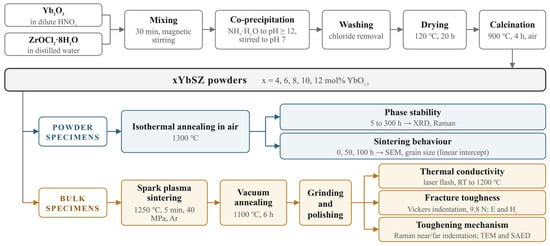
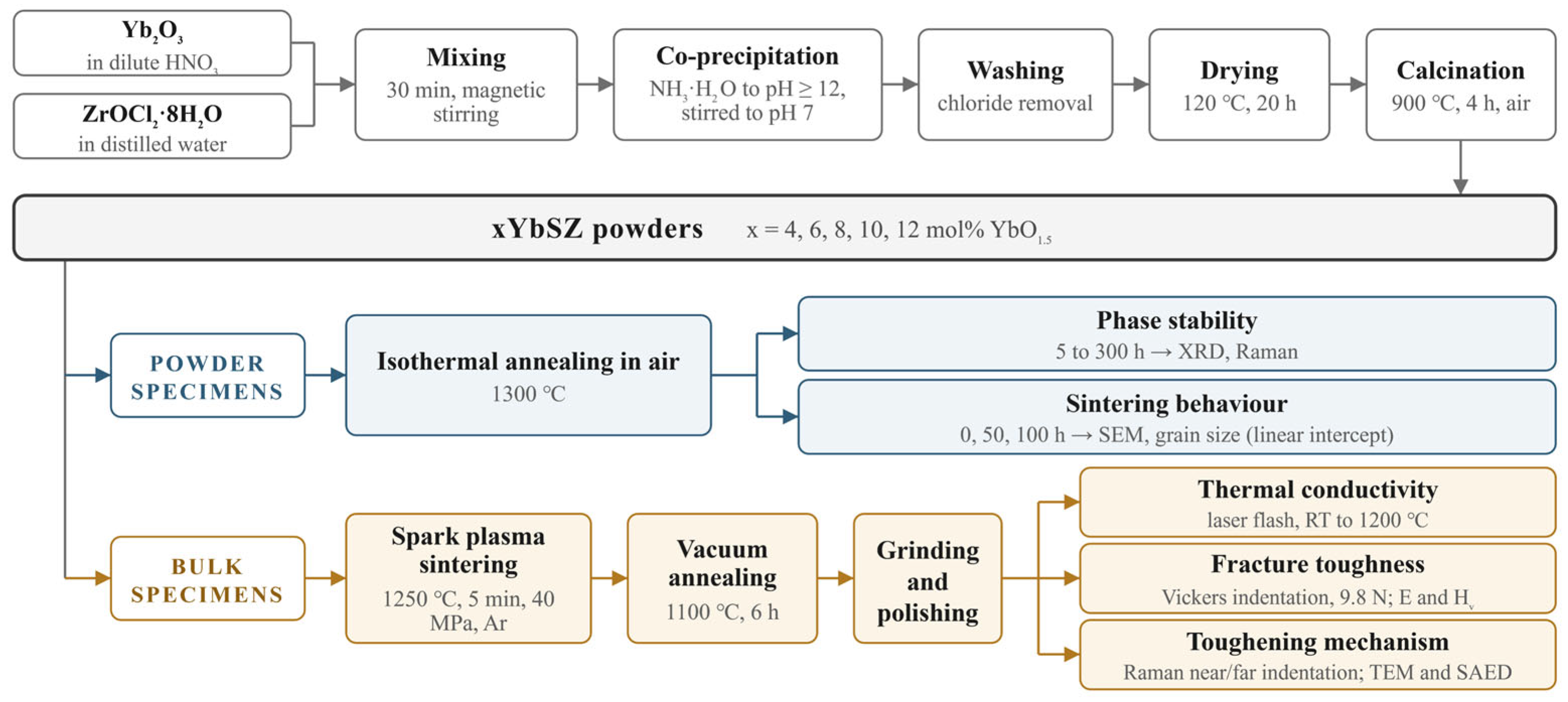
YbO1.5 doped ZrO2 powders with varying compositions (x = 4, 6, 8, 10, 12 mol%) were synthesized using the chemical co-precipitation method, as summarized in Figure 1. Yb2O3 (purity of 99.9%) was dissolved in dilute nitric acid solution, while ZrOCl2·8H2O (purity of 99.95%) was separately dissolved in distilled water. The two solutions were combined and thoroughly mixed for 30 min under magnetic stirring. Ammonia solution was gradually added to the mixed solution until reaching pH ≥ 12 to obtain a gel-like precipitate. The mixture was continuously stirred until reaching neutrality (pH = 7). The resulting precipitate was repeatedly washed with distilled water to remove residual chloride ions, followed by drying at 120 °C for 20 h. The dried powders were subsequently calcined at 900 °C for 4 h in air in a box furnace to achieve crystallization.
Figure 1.
Preparation route of the xYbSZ powders and bulk specimens: chemical co-precipitation, drying, calcination at 900 °C, spark plasma sintering at 1250 °C and vacuum annealing at 1100 °C, with the characterization performed on the powder and on the bulk specimens indicated separately.
To prepare dense ceramic specimens for thermal diffusivity and fracture toughness measurements, the calcined powders were consolidated using spark plasma sintering (SPS; a laboratory-built apparatus). The sintering process was conducted at 1250 °C for 5 min, under a pressure of 40 MPa in an argon atmosphere, at a heating rate of 100 °C·min−1 in a graphite die of 20 mm inner diameter. To eliminate residual stresses introduced during rapid sintering, the as-sintered specimens were annealed in a vacuum at 1100 °C for 6 h. After annealing, the specimens were ground and polished to dimensions appropriate for subsequent characterization. Three specimens were prepared for each composition and each thermal-treatment condition.
2.2. Methods
The morphology and microstructure of powders and sintered specimens were examined using scanning electron microscopy (SEM, JSM-7800F, JEOL, Tokyo, Japan). Ferroelastic domain structures and selected-area electron diffraction (SAED) patterns were investigated using transmission electron microscopy (TEM; Talos F200X G2, Thermo Fisher Scientific, Waltham, MA, USA) operated at 200 kV. TEM specimens were prepared by focused ion beam (FIB) milling.
Phase analysis was performed by X-ray diffraction (XRD; D8 Advance, Bruker, Karlsruhe, Germany) using Cu Kα radiation (λ = 1.5406 Å) at an acceleration voltage of 40 kV and current of 30 mA. The diffraction patterns were collected in the angular range of 20° to 80° (2θ) at a scan rate of 1°·min−1; the high-angle region (2θ = 72°–75°), used to separate the t, t′ and c reflections, was scanned with a step size of 0.02° and 2 s per step. The molar proportions of monoclinic (m), tetragonal (t), metastable tetragonal (t′), and cubic (c) phases were calculated using the following equations [21]:
The overlapping high-angle reflections were separated by profile fitting in Jade 6.5 (Materials Data Inc., Livermore, CA, USA) using pseudo-Voigt profiles on a linear background. The t and t′ (400) and (004) reflections and the c (400) reflection were fitted simultaneously, with the peak positions constrained to the tetragonality of each phase and equal widths imposed within each phase. The goodness of fit was R2 > 0.99 for all patterns.
Raman spectroscopy (inVia Qontor, Renishaw, Gloucester, UK) with a 532 nm laser excitation was used as a complementary technique to verify phase composition and structural evolution. Spectra were collected in the range of 100–800 cm−1 with an acquisition time of 60 s.
Thermal diffusivity (α) measurements were conducted using a laser flash apparatus (LFA 427, Netzsch, Selb, Germany) in flowing argon from room temperature to 1200 °C. Measurements were taken at 200 °C intervals, with three measurements averaged at each temperature point. The specimens were prepared as disks with a diameter of 12.6 ± 0.5 mm and a thickness of 2.0 ± 0.5 mm. Both surfaces were coated with a thin layer of graphite to ensure optimal laser absorption and emission. The diffusivity was evaluated with the Clark-Taylor radiation-loss model [22]; no correction for the semi-transparency of the ceramic was applied. Thermal conductivity (λ) was calculated using the equation:
where is the bulk density determined by Archimedes’ method and is the specific heat capacity calculated using the Kopp-Neumann rule based on the heat capacities and molar fractions of constituent oxides.
For phase stability evaluation, powder specimens were isothermally annealed in air at 1300 °C and characterized by XRD after each annealing interval. Intervals of 5, 30, 50, 100, and 300 h were used for 4YbSZ, whose transformation proceeded rapidly, and intervals of 50, 100, 150, 200, and 300 h were used for the other compositions.
The sintering behavior was evaluated through isothermal treatment of powder specimens at 1300 °C for durations up to 100 h in air, with microstructural evolution documented at intervals of 0, 50, and 100 h. Grain size measurements were performed from SEM micrographs using the linear intercept method, with a minimum of 200 grains counted for each specimen. Phase stability and sintering behavior were thus evaluated on powder specimens, whereas thermal conductivity and mechanical properties were measured on the SPS-consolidated bulk specimens.
Fracture toughness () was measured using the Vickers indentation method with a load of 9.8 N and a dwell time of 15 s. Five indentations were made on each specimen, fifteen per composition and thermal-treatment condition, with a spacing of at least five indentation diagonals, and the crack lengths were measured immediately after indentation using optical microscopy. The fracture toughness was calculated using the equation:
where E is the elastic modulus, Hv is the Vickers hardness, P is the applied load, and c is the crack length measured from the center of the indentation to the crack tip. The elastic modulus was determined by nanoindentation (Nano Indenter G200, Agilent, Santa Clara, CA, USA) using the continuous stiffness measurement technique with a Berkovich indenter to a maximum depth of 2000 nm at a constant strain rate of 0.05 s−1, with ten indents per specimen. Both E and Hv were determined separately for each composition and each thermal-treatment condition, and the state-specific values used in Equation (6).
3. Results and Discussion
3.1. Phase Composition and Structural Evolution at Elevated Temperature
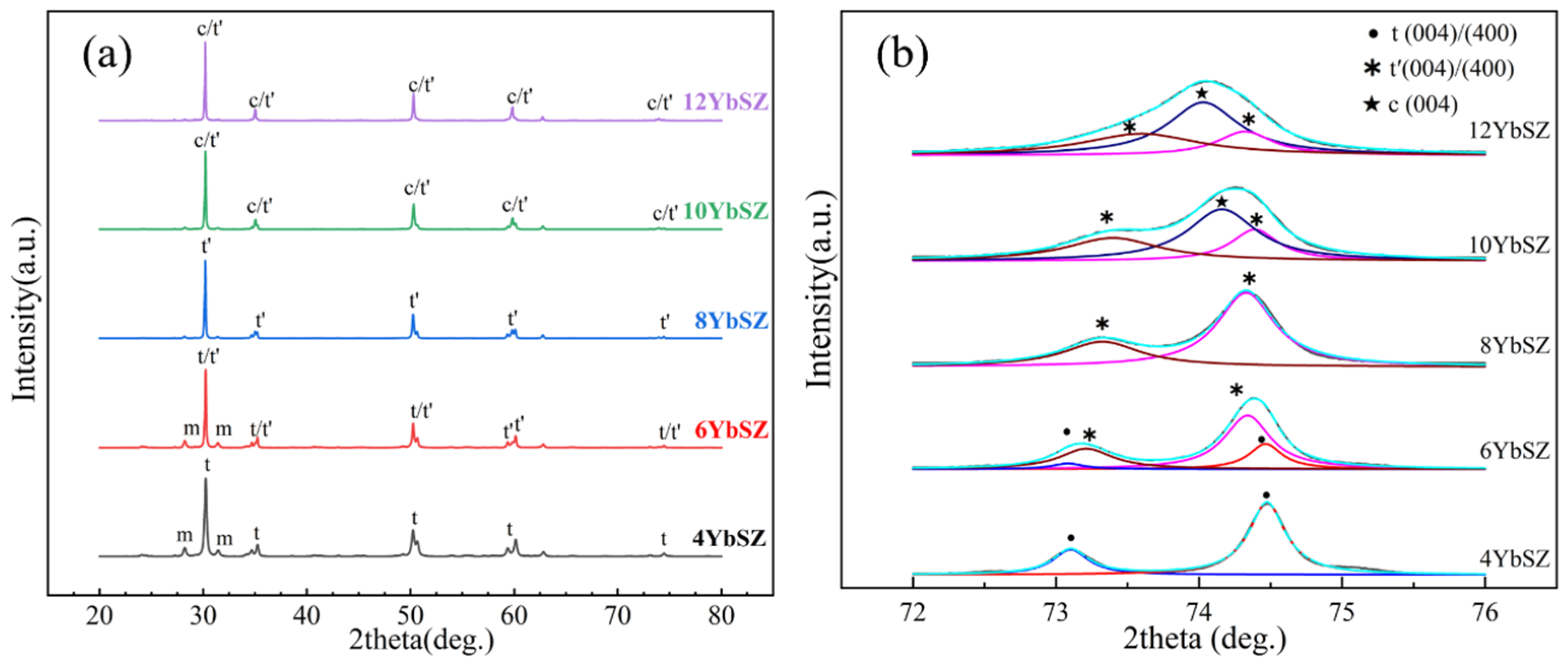
The phase composition of as-prepared xYbSZ powders was characterized by X-ray diffraction. As shown in Figure 2a, reflections of the monoclinic phase at 2θ = 28.2° (−111) and 31.4° (111) are observed in 4YbSZ and 6YbSZ, indicating incomplete stabilization of the tetragonal structure at these doping levels. These monoclinic reflections diminish progressively with increasing YbO1.5 content and become undetectable at 8 mol% and above, suggesting enhanced phase stabilization at higher dopant concentrations.
Figure 2.
XRD patterns of as-prepared xYbSZ powders (x = 4–12 mol%): (a) full patterns (2θ = 20°–80°) and (b) high-angle region (2θ = 72°–75°) in which the t′ (004)/(400) doublet progressively merges with increasing YbO1.5 content, indicating decreasing tetragonality.
The high-angle region (2θ = 72°–75°) in Figure 2b enables discrimination between the tetragonal phases (t and t′). In this region the t phase gives a resolved (400)/(004) doublet, the t′ phase a doublet whose separation is too small to be resolved and which therefore appears as a single broad reflection, and the c phase a single sharp (400) reflection at a slightly lower angle; the three contributions are labeled in the deconvoluted patterns of Figure 3d. For 4YbSZ, the clearly resolved (400)/(004) splitting reflects high tetragonality (c/a) characteristic of the transformable tetragonal phase, consistent with the minor monoclinic fraction seen in Figure 2a. In 6YbSZ, peak broadening and reduced splitting suggest the coexistence of t and t′ phases. At 8 mol% YbO1.5, a single broad peak centered at approximately 74.5° is observed. The breadth and position of this reflection are consistent with the metastable t′ phase in which the tetragonality (c/a ratio) is too small to produce resolved (400)/(004) splitting but remains distinct from the sharp singlet expected for a fully cubic structure. For 10YbSZ and 12YbSZ, progressive peak sharpening and a shift toward lower angles indicate increasing cubic phase content, as the cubic (400) reflection appears at slightly lower 2θ values compared to the tetragonal doublet.
Figure 3.
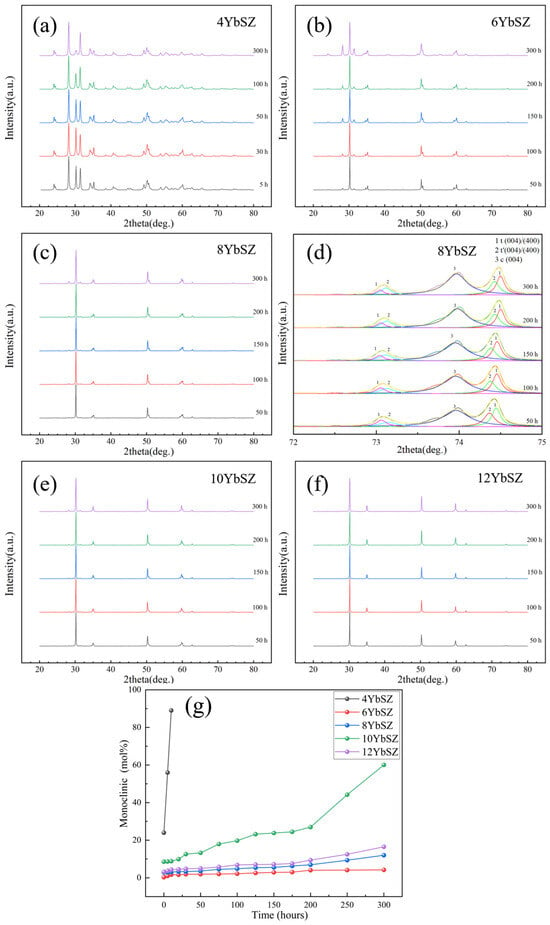
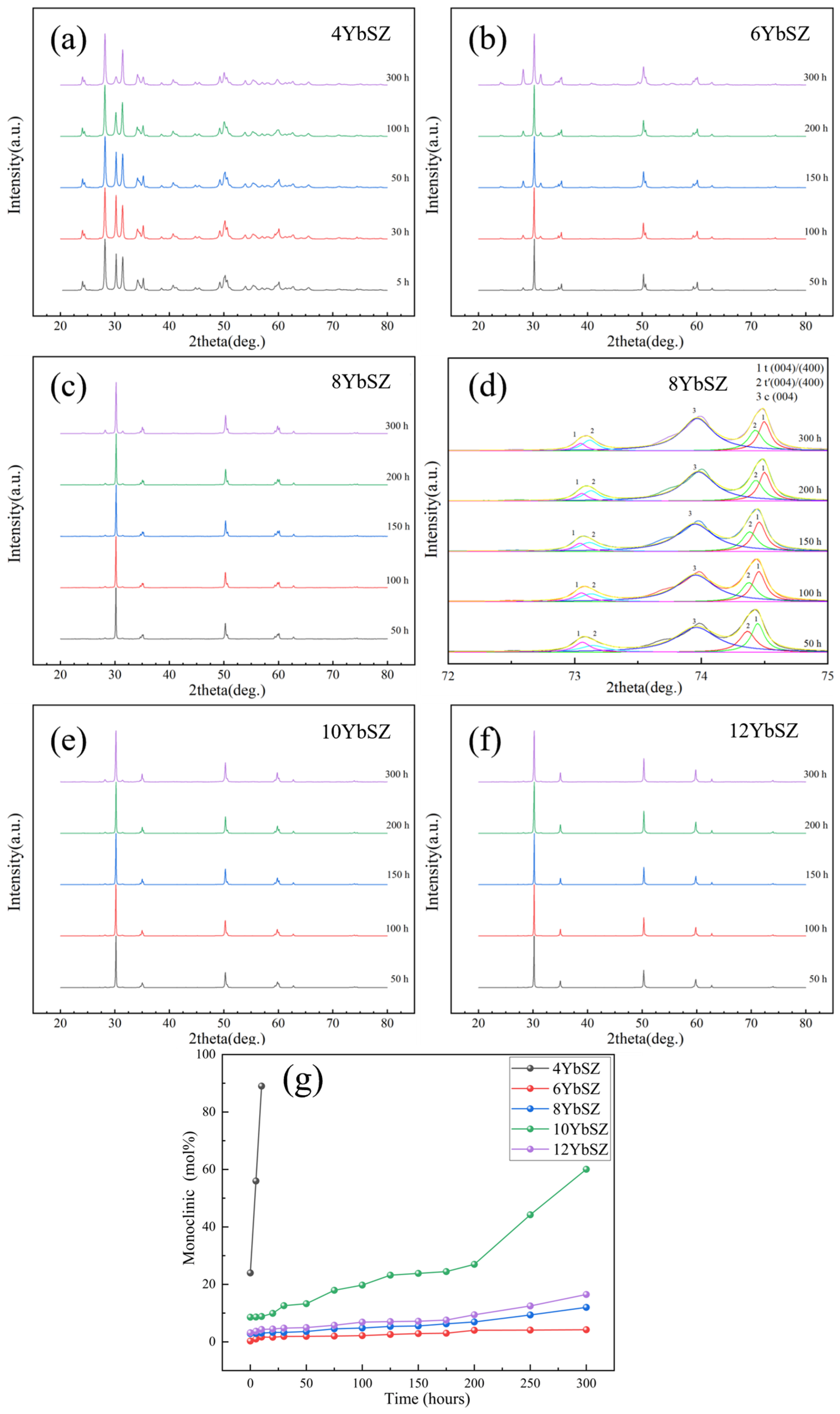
Phase evolution of xYbSZ during isothermal exposure at 1300 °C for up to 300 h: XRD patterns of (a) 4YbSZ; (b) 6YbSZ; (c) 8YbSZ; (d) high-angle region of 8YbSZ, in which the measured pattern (black), the fitted envelope (red) and the fitted t (004)/(400), t′ (004)/(400) and c (004) components are shown; (e) 10YbSZ; and (f) 12YbSZ. (g) Monoclinic phase fraction as a function of exposure time, determined from Equations (1)–(4).
The thermal stability of xYbSZ powders was evaluated through isothermal exposure at 1300 °C for up to 300 h. The XRD patterns (Figure 3a–f) and the corresponding quantitative phase analysis (Figure 3g) reveal three distinct regimes of phase behavior across the composition range. In the low-doping regime (4–6 mol% YbO1.5), rapid phase destabilization occurs. The 4YbSZ composition exhibits intense monoclinic (−111) and (111) reflections after only 5 h of thermal exposure at 1300 °C (Figure 3a), with the monoclinic phase fraction reaching approximately 80 mol% as estimated from XRD peak intensities using Equations (1)–(4). The 6YbSZ composition shows improved but still limited stability, accumulating over 20 mol% m phase after 100 h (Figure 3b,g). At 8 mol% YbO1.5, the phase stability improves markedly. The XRD patterns in Figure 3c show limited evolution over 300 h, and the high-angle analysis (Figure 3d) indicates retention of the t′ phase character throughout thermal exposure. The monoclinic phase content remains below 10 mol% after 300 h (Figure 3g), comparing favorably with conventional 8YSZ, which has been reported to undergo significant t′ phase decomposition above 1200 °C [23]. In the high-doping regime (10–12 mol% YbO1.5), monoclinic formation is effectively suppressed. However, the XRD patterns reveal progressive formation of the cubic phase with increasing thermal exposure time (Figure 3e). The cubic phase is thermodynamically stable and does not undergo monoclinic transformation upon cooling; however, its increasing proportion has direct implications for the mechanical behavior of the coating.
The composition dependence of the phase behavior maps directly onto the YbO1.5-ZrO2 phase field: at 4–6 mol% the stabilizer content is insufficient to retain a non-transformable tetragonal structure and the t phase partially reverts to being monoclinic; at 8 mol% the composition lies within the metastable t′ field and is retained without transformation; above 8 mol% it approaches the cubic stability field, consistent with the progressive cubic formation in 10YbSZ and 12YbSZ. Underlying this sequence, the aliovalent substitution of Yb3+ for Zr4+ generates oxygen vacancies for charge compensation; their concentration increases monotonically with doping and serves as the common compositional variable in the analyses that follow:
The oxygen vacancy concentration is thus [Vö] = x/2, where x is the YbO1.5 molar fraction. Accordingly, the vacancy concentrations range from 2.0 mol% for 4YbSZ to 6.0 mol% for 12YbSZ, with the critical 8YbSZ composition corresponding to [Vö] = 4.0 mol%.
A comparison with conventional 8YSZ—which shares the same vacancy concentration ([Vö] = 4 mol%) yet is reported to undergo significant t′ decomposition above 1200 °C [24]—separates the role of the dopant cation from that of the vacancy content. The smaller ionic radius of Yb3+ (0.985 Å) relative to Y3+ (1.019 Å) provides a closer size match to the Zr4+ host cation (0.84 Å), reducing the local lattice distortion associated with aliovalent substitution and thereby favoring retention of the t′ structure. At equal vacancy concentration, therefore, the size compatibility of the dopant—rather than the vacancy content alone—appears to play the dominant role in phase stability.
Taken together, the XRD phase analysis and the comparison with 8YSZ identify 8 mol% YbO1.5 as the composition at which the phase-stabilization behavior of the YbO1.5-ZrO2 system changes character. Whether this compositional boundary also governs the sintering, thermal transport, and mechanical responses is examined in the following sections.
3.2. Sintering Behavior as a Function of Dopant Concentration
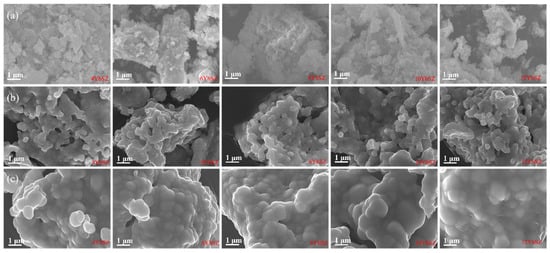
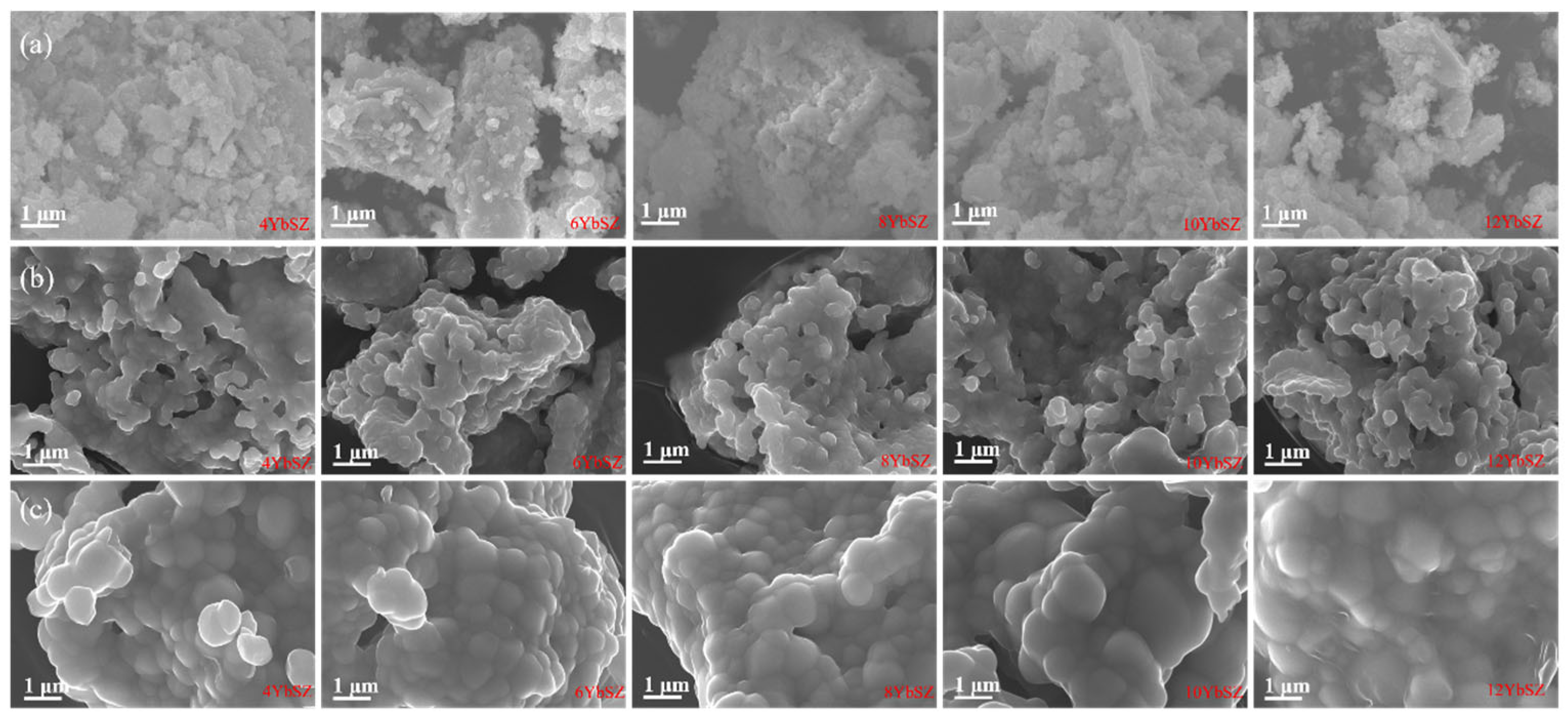
Sintering resistance is an important factor governing the durability of thermal barrier coatings, as grain coarsening and pore closure during high-temperature service can reduce strain tolerance and degrade thermal insulation performance. Figure 4 presents the microstructural evolution of the xYbSZ powders during isothermal treatment at 1300 °C.
Figure 4.
Microstructural evolution of xYbSZ powders during isothermal treatment at 1300 °C: SEM micrographs of (a) the as-prepared powder and after (b) 50 h and (c) 100 h of exposure.
After 50 h of thermal exposure at 1300 °C (Figure 4b), all compositions exhibit substantial grain coarsening relative to the as-prepared powder (Figure 4a). The as-prepared powders had an average grain size of approximately 25 nm, which increased to 0.41–0.79 μm after 50 h, with compositions containing lower YbO1.5 content showing finer microstructures. At this stage, the grains retain angular morphology with well-defined boundaries, and fine porosity remains uniformly distributed throughout the microstructure.
Extended treatment to 100 h (Figure 4c) reveals more pronounced differences among compositions. For 4–8 mol% YbO1.5 samples, the grain sizes increase to 1.21–1.41 μm while maintaining distinct boundaries and angular morphology. In contrast, the 10–12 mol% compositions show larger grain sizes of 1.79–2.13 μm with less distinct grain boundaries and evidence of grain boundary bridging. The grain morphology evolves from being angular to more rounded, which is generally associated with enhanced mass transport during the later stages of sintering.
Table 1 summarizes the grain sizes after 50 and 100 h of thermal treatment. The standard deviations listed there remain a comparable fraction of the mean grain size at all compositions and both durations, indicating that the accelerated coarsening above 8 mol% proceeds by uniform grain growth rather than abnormal grain growth.
Table 1.
Grain sizes (mean ± SD of the grain size distribution, linear intercept method, ≥200 grains per condition) of xYbSZ powders after 50 h and 100 h of isothermal treatment at 1300 °C, the corresponding oxygen vacancy concentrations, and comparisons with the parabolic growth model.
The parabolic grain-growth model:
where D is the average grain size at time t, D0 the initial grain size and k a rate constant, describing curvature-driven boundary migration in a dense polycrystal.
The model is used here as a reference against which the measured time dependence can be judged, not as a kinetic description of the present powder specimens. Because the initial size is smaller than the grain sizes measured after 50 h by more than an order of magnitude, the term is negligible and the model reduces to D ∝ , so that D100h/D50h would equal ≈ 1.41. The measured ratios lie between 2.67 and 2.95, well above this value. In powder specimens the apparent grain size evolves by inter-particle neck growth and coalescence as well as by boundary migration within the particles, and the acceleration between 50 and 100 h is consistent with the boundary bridging and grain rounding observed after 100 h (Figure 4c). A kinetic exponent therefore cannot be extracted from these data. The ratio itself varies by only about 10% across the series, so this departure from parabolic behavior is common to all compositions and is small compared with the change in composition sensitivity described below. The 100 h grain size, D100h, is therefore used directly as a comparative measure of sintering resistance.
The composition dependence of D100h reveals two features. First, D100h increases monotonically with YbO1.5 content across the entire composition range. Second, its rate of increase changes at 8 mol% YbO1.5: in the 4–8 mol% range D100h rises by approximately 0.05 μm per mol% YbO1.5, whereas above 8 mol% this rate increases nearly fourfold to approximately 0.18 μm per mol%. The same acceleration appears independently in the 50 h data, where the rate rises from 0.02 to 0.075 μm per mol%, and it exceeds the measurement scatter: the increase from 8YbSZ to 10YbSZ at 100 h (0.38 μm) exceeds even the sum of the standard deviations of the two grain size distributions (0.13 and 0.18 μm, Table 1), and is far larger than the standard errors of the means (≈0.01 μm for N ≥ 200). Together these observations indicate a marked increase in the composition sensitivity of grain coarsening at 8 mol%.
The monotonic increase in D100h across the series is consistent with the dependence of cation transport in stabilized zirconia on dopant concentration [25]. It does not, however, account for the change in slope at 8 mol%, since a smooth dependence of boundary mobility on dopant content, whether linear or sublinear, would give a correspondingly smooth variation in grain size with composition. The change in slope instead coincides with the composition at which the structure begins to cross from the t′ field toward the cubic field. Cubic zirconia coarsens considerably more readily than the tetragonal phase [26], so the accelerated coarsening above 8 mol% is attributed to the progressive formation of the cubic phase, an interpretation based on the phase evolution measured on the same powder specimens.
The sintering behavior changes at the same composition as the phase stability, but in a different sense. What changes at 8 mol% YbO1.5 is not the sintering resistance itself, which decreases monotonically across the whole series, but its sensitivity to composition, which increases nearly fourfold. This defines a trade-off within the high-doping regime: the 10–12 mol% compositions avoid the monoclinic transformation by stabilizing the cubic phase, but they are also the compositions that coarsen fastest. Since coarsening and densification during service stiffen the coating microstructure and increase residual thermal stresses [24], these compositions are expected to lose strain tolerance most rapidly when applied as coatings. This expectation concerns the ranking of the compositions rather than the absolute rates, since the measurements are made on powders.
Compositions in the 4–8 mol% range exhibit comparatively better sintering resistance. In particular, the 100 h grain size of 8YbSZ is only approximately 17% larger than that of 4YbSZ despite having twice the oxygen vacancy concentration. This moderate increase suggests that grain boundary migration in this composition range is not strongly accelerated by the additional vacancies. However, as discussed in Section 3.1, the lower-doped compositions (4–6 mol%) exhibit limited phase stability at 1300 °C, which constrains their practical applicability. The effects of dopant concentration on thermal conductivity and mechanical properties are examined in Section 3.3 and Section 3.4, respectively.
3.3. Thermal Conductivity Characteristics
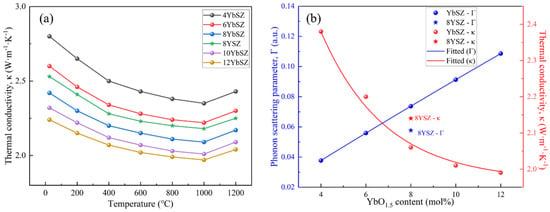
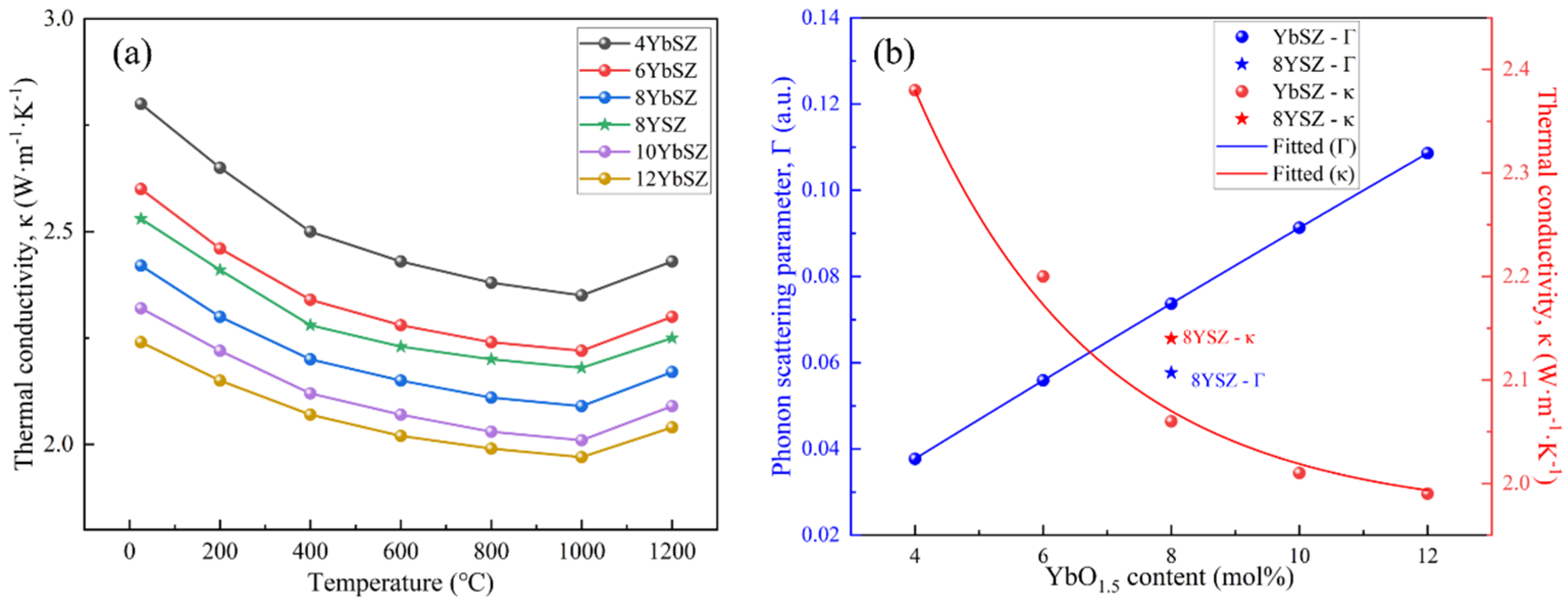
The thermal conductivity of xYbSZ ceramics was measured from room temperature to 1200 °C (Figure 5a). All compositions exhibit characteristic temperature dependence: thermal conductivity decreases with increasing temperature up to 800–1000 °C due to Umklapp phonon-phonon scattering, then increases slightly above 1000 °C, an upturn commonly attributed to radiative transport through the semi-transparent ceramic [27]. No correction for semi-transparency was applied to the laser-flash data (Section 2.2), so this contribution is retained in the values reported above 1000 °C; the quantitative comparison below is made at 1000 °C, at the onset of the upturn, where it is smallest. At 1000 °C, the thermal conductivity decreases monotonically from 2.41 W·m−1·K−1 for 4YbSZ to 1.96 W·m−1·K−1 for 12YbSZ, representing an approximately 19% reduction across the composition range.
Figure 5.
(a) Temperature-dependent thermal conductivity of xYbSZ ceramics from room temperature to 1200 °C. (b) Mass-disorder phonon scattering coefficient Γmass (left axis, solid symbols) and thermal conductivity at 1000 °C (right axis, open symbols) as a function of YbO1.5 content. Γmass is calculated from Equation (11) using known atomic masses without adjustable parameters. The star symbol indicates 8YSZ for comparison.
Three features of Figure 5 require explanation: the monotonic decrease in thermal conductivity with doping (Figure 5a), the diminishing rate of this decrease above 8 mol% YbO1.5, and the lower conductivity of 8YbSZ relative to 8YSZ at identical vacancy concentration, marked by the star symbol in Figure 5b. All three follow from the Klemens description of point-defect phonon scattering. When Yb3+ substitutes for Zr4+ in the ZrO2 lattice, phonon scattering arises from the mass and ionic radius mismatch between the dopant and host cations, as well as from the oxygen vacancies generated for charge compensation. The scattering coefficient for substitutional point defects is:
where x is the dopant fraction, ∆M and Δr are the differences in atomic mass and ionic radius between dopant and host cations, and are the corresponding average values, and ε is a phenomenological strain field parameter (typically 2–4 for oxides with a fluorite-type structure [28]). The total scattering coefficient includes contributions from both substitutional cations and oxygen vacancies:
The Klemens model treats dopants and vacancies as isolated, randomly distributed point defects—an assumption that becomes less accurate at the highest doping levels, where defect-defect interactions are non-negligible.
To avoid the uncertainty associated with the choice of ε, the mass-disorder scattering coefficient Γmass is introduced:
This quantity contains no adjustable parameters. For the Yb-Zr system, (/)2 = 0.384, while the strain term ε(Δr/)2 is estimated at 0.050–0.101 (ε = 2–4), corresponding to only 12%–21% of the total cation scattering coefficient. Since both terms share the same x(1 − x) dependence, Γmass captures the compositional trend without requiring a specific ε value.
Figure 5b presents Γmass (left axis) and the experimentally measured thermal conductivity at 1000 °C (right axis) as a function of YbO1.5 content. Γmass increases with dopant concentration following the x(1 − x) dependence. The thermal conductivity decreases correspondingly, although the rate of decrease diminishes at higher doping levels; this correspondence is qualitative: Γmass governs the compositional trend of the reduction, while its absolute magnitude follows the sublinear relation of Equation (12). The normalized thermal conductivity follows Equation (12), where κ0 is the thermal conductivity of the defect-free host lattice and u ∝ (Γtotal·κ0)1/2; since κ0 is common to all compositions in this series, u scales as (Γtotal)1/2. Because arctan(u)/u is a sublinear function, increasing Γtotal yields diminishing returns in thermal conductivity reduction.
Figure 5b also includes 8YSZ data, shown as a star symbol, for comparison. Both 8YbSZ and 8YSZ have [Vö] = 4 mol%, yet their Γmass values differ by a factor of approximately 580: (ΔM/)2 = 0.384 for Yb versus 0.00066 for Y, and 0.384/0.00066 ≈ 580. This difference directly reflects the atomic mass contrast (Yb: 173.04 amu; Y: 88.91 amu; Zr: 91.22 amu) and accounts for the lower thermal conductivity of 8YbSZ despite identical vacancy concentrations. Extending this comparison across the lanthanide series would be of interest but is beyond the scope of the present work.
To quantify this saturation, the conductivity reduction efficiency per unit doping, η = −Δκ/Δx, was calculated from the 1000 °C data for each composition interval, with x being the YbO1.5 content in mol%. In the 4–8 mol% range, η = 0.065–0.085 W·m−1·K−1 per mol% YbO1.5, averaging 0.075; above 8 mol%, η falls to 0.035–0.040 W·m−1·K−1 per mol%, averaging 0.038. The doping efficiency of conductivity reduction is thus approximately halved beyond 8 mol%, consistent with the sublinear dependence expressed by Equation (12).
These results have practical implications for composition selection. Increasing the YbO1.5 content from 8 to 12 mol% yields only an additional 0.15 W·m−1·K−1 reduction at 1000 °C (approximately 7% relative to 8YbSZ), despite a 50% increase in oxygen vacancy concentration. This diminishing return, combined with the accelerated grain coarsening at higher doping levels (Section 3.2), suggests that the incremental thermal conductivity benefit of exceeding 8 mol% YbO1.5 is limited relative to the trade-offs in other properties. The effects of dopant concentration on mechanical properties are examined in Section 3.4.
3.4. Mechanical Properties
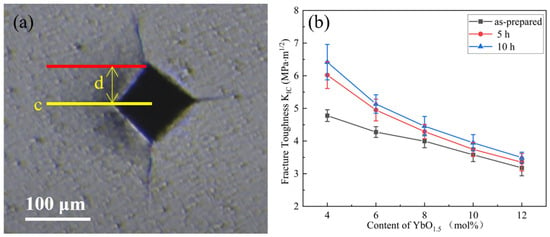
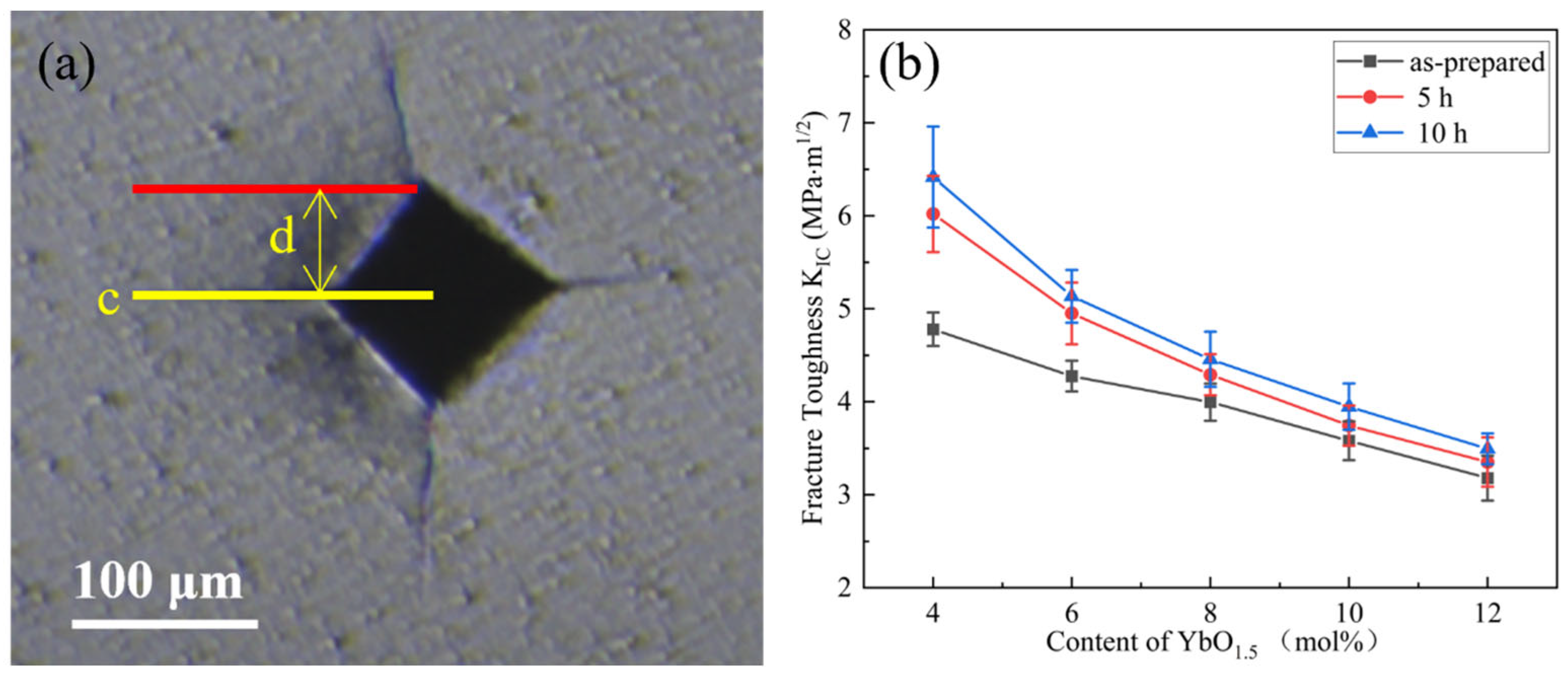
The phase and microstructural differences documented in Section 3.1 and Section 3.2 have direct consequences for mechanical performance. Figure 6 presents the fracture toughness of xYbSZ ceramics as a function of dopant concentration. In the as-prepared state, fracture toughness decreases monotonically from 4.78 ± 0.18 MPa·m1/2 for 4YbSZ to 3.18 ± 0.24 MPa·m1/2 for 12YbSZ. Thermal treatment at 1300 °C enhances the toughness of all compositions, but to markedly different degrees: after 10 h, 4YbSZ increases to 6.42 ± 0.54 MPa·m1/2, a gain of 1.64 MPa·m1/2 or 34%; 6YbSZ rises by 20% to 5.13 ± 0.28 MPa·m1/2; 8YbSZ increases by 12%, from 4.00 ± 0.20 to 4.46 ± 0.30 MPa·m1/2; whereas 10YbSZ and 12YbSZ increase by only about 10%, reaching 3.95 ± 0.25 and 3.49 ± 0.17 MPa·m1/2, respectively. The treatment-induced gain thus decreases monotonically with doping, and its magnitude tracks the availability of the toughening mechanisms identified below.
Figure 6.
Fracture toughness of xYbSZ ceramics: (a) representative Vickers indentation, in which c is the crack length measured from the centre of the indentation to the crack tip and d is the half-diagonal of the indentation; (b) KIC as a function of YbO1.5 content in the as-prepared state and after thermal treatment at 1300 °C for 5 h and 10 h, showing the monotonic decrease with dopant content and the composition-dependent toughness gain after thermal treatment.
The elastic modulus and Vickers hardness used in Equation (6) are listed in Table 2. Both decrease with dopant content from 228.6 to 202.8 GPa and from 13.50 to 11.85 GPa respectively in the as-prepared state, and they enter Equation (6) with opposite signs. Since KIC ∝ (E/Hv)1/2·c−3/2, the two contributions partly cancel: the factor (E/Hv)1/2 varies by less than 2% across the composition range in each treatment condition, and by lies between 4.08 and 4.18 for all compositions and treatment conditions. Against measured changes in KIC of between 10% and 46%, the elastic and hardness terms therefore account for at most a few percent of the variation. Both the decrease in toughness with dopant content and the gain produced by thermal treatment originate from the crack lengths measured at fixed indentation load, that is, from changes in crack resistance rather than from the elastic and hardness properties entering Equation (6).
Table 2.
Elastic modulus E and Vickers hardness Hv of xYbSZ ceramics in the as-prepared state and after thermal treatment at 1300 °C for 5 h and 10 h, as used in Equation (6). Both E and Hv decrease with dopant content and enter. E was determined by nanoindentation and Hv from the Vickers indentations.
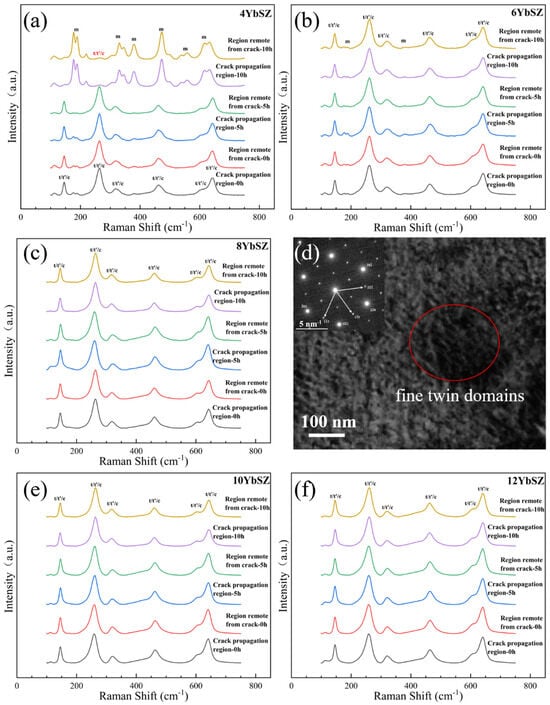
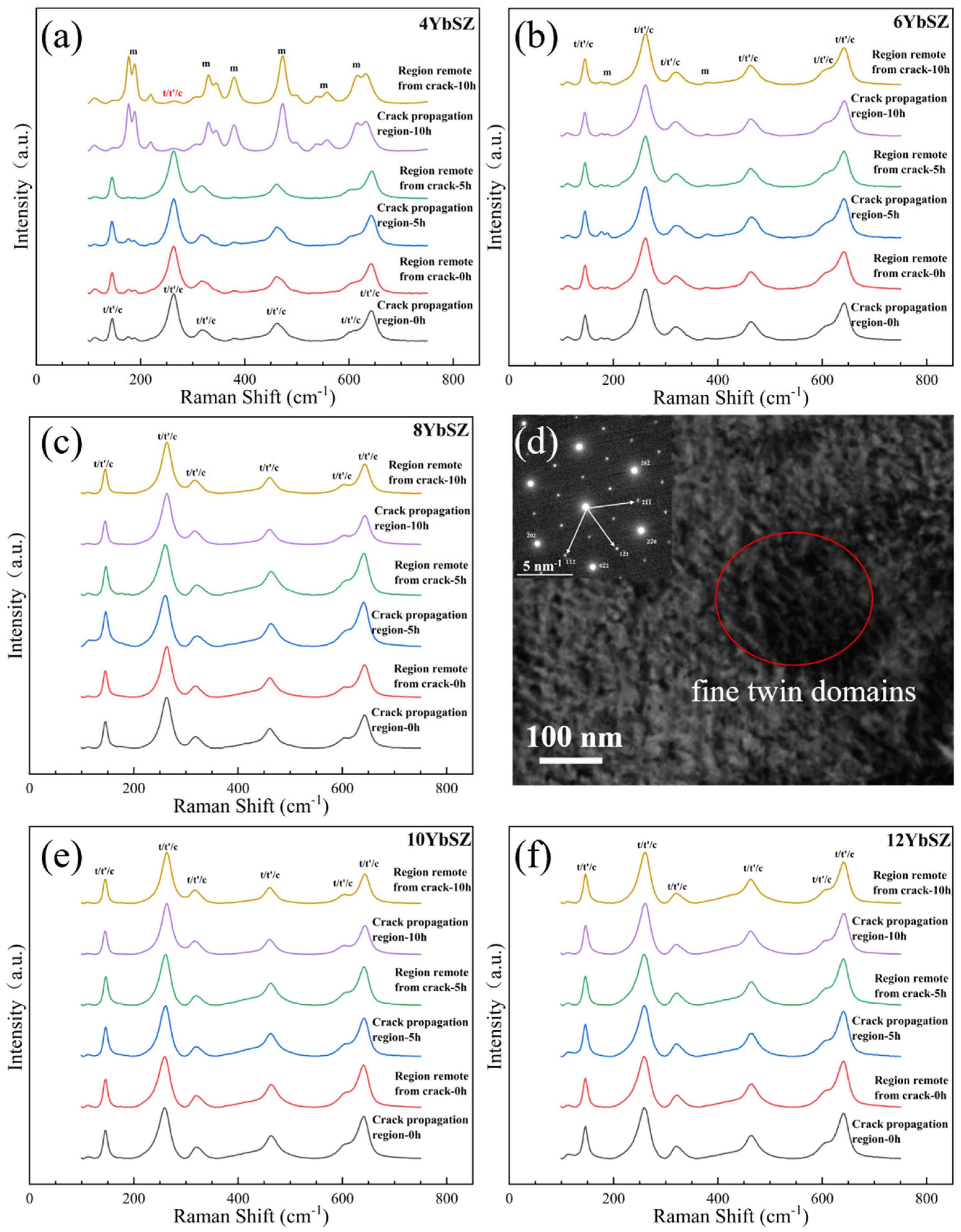
The underlying toughening mechanisms were examined by Raman spectroscopy acquired both adjacent to the Vickers indentations and in the far field (Figure 7a–c) for the as-prepared state and after thermal treatment for 5 h and 10 h. These spectra provide an independent phase characterization of the same bulk specimens on which KIC was measured, and are consistent with the phase assignments established on the powders: monoclinic-rich after thermal treatment in 4–6YbSZ, t′ in 8YbSZ, and predominantly cubic in 10–12YbSZ. The far-field spectra reflect the phase constitution produced by thermal exposure alone, so any additional intensity of the monoclinic bands in the near-indentation spectra can only originate from the indentation stress field, providing a direct signature of stress-induced t → m transformation. In 4YbSZ and 6YbSZ (Figure 7a,b), the near-indentation spectra exhibit enhanced monoclinic bands (~180/190 cm−1) relative to the corresponding far-field spectra, confirming that stress-induced transformation operates in these compositions; the associated 4%–5% volume expansion generates compressive stresses that shield the crack tip and increase the energy required for crack propagation, accounting for their pronounced toughness increase after thermal treatment (Figure 6b). The two compositions differ, however, in the persistence of this mechanism: the tetragonal band (~260 cm−1) in the far-field spectra remains clearly observable in 6YbSZ but is of very low intensity in 4YbSZ after thermal treatment, indicating that the transformable reservoir in 4YbSZ is largely consumed by thermal exposure. The sustained high toughness of 4YbSZ after 10 h is therefore attributed in part to microcrack toughening, in which the microcrack network generated by the extensive t → m transformation deflects and blunts propagating cracks [29].
Figure 7.
Toughening mechanism analysis of xYbSZ: (a–c) Raman spectra of 4YbSZ, 6YbSZ, and 8YbSZ acquired near the Vickers indentation and in the far field, in the as-prepared state and after thermal treatment at 1300 °C for 5 h and 10 h, with the tetragonal (~260 cm−1) and monoclinic (~180/190 cm−1) bands indicated; (d) TEM micrograph of 8YbSZ showing ferroelastic domains, together with the selected-area electron diffraction pattern recorded along a ⟨111⟩ zone axis, in which the indexed {112} reflections of the three orientation variants are marked; (e,f) Raman spectra of 10YbSZ and 12YbSZ.
For 8YbSZ, the near-indentation and far-field spectra show no comparable enhancement intensity of the monoclinic phase (Figure 7c), indicating that the t′ phase in the bulk specimens does not undergo stress-induced transformation, in line with the t′ stability observed for the powders (Section 3.1). The toughening in this composition instead arises from ferroelastic domain switching: the TEM micrograph in Figure 7d reveals characteristic domain structures, and the selected-area electron diffraction pattern recorded along a ⟨111⟩ zone axis contains the {112} superlattice reflections of all three orientation variants. These reflections are absent in the cubic fluorite structure, so their presence confirms both the tetragonal character of the phase and the existence of ferroelastic domains, whose switching under the crack-tip stress field is the established toughening pathway in t′ zirconia [30,31]. Such domain reorientation dissipates fracture energy without phase transformation, providing effective toughening while preserving phase stability, and explaining why 8YbSZ maintains higher toughness than the compositions in which the cubic phase predominates.
In 10YbSZ and 12YbSZ, the Raman spectra (Figure 7e,f) are consistent with a predominantly cubic structure, with no monoclinic formation either near or far from the indentations. Neither transformation toughening nor ferroelastic switching is therefore available: cubic symmetry lacks the tetragonality required for domain formation, and this absence of active toughening mechanisms explains both the low fracture toughness and weak response to thermal treatment (Figure 7b). The small residual increase after thermal treatment even in these compositions, by approximately 0.3–0.4 MPa·m1/2 or about 10%, indicates a minor baseline contribution from thermally induced microstructural relaxation common to all compositions; the far larger gain of 4YbSZ (1.64 MPa·m1/2) rises well above this baseline and is therefore attributed to the transformation-related mechanisms evidenced in Figure 7.
The monotonic decrease in fracture toughness with dopant concentration reveals a fundamental trade-off in TBC material design. Lower YbO1.5 concentrations (4–6 mol%) provide superior fracture toughness through transformation and microcrack toughening but suffer from phase instability at 1300 °C. Higher YbO1.5 content (10–12 mol%) offers phase stability through cubic phase formation but at the cost of reduced toughness and accelerated sintering. The 8YbSZ composition achieves an optimal balance among the competing requirements. It maintains adequate fracture toughness (4.46 MPa·m1/2 after thermal treatment) through ferroelastic mechanisms while providing phase stability at 1300 °C, moderate sintering resistance, and efficient thermal conductivity reduction. This combination of properties makes 8YbSZ suitable for applications requiring both mechanical resilience and thermal stability. The composition-dependent toughening mechanisms also enable application-specific material selection. For components subjected to high mechanical loads with moderate thermal cycling, 4–6 mol% YbO1.5 compositions offer superior toughness through transformation toughening. For stationary components operating nearly isothermally with few thermal cycles, the 10–12 mol% compositions may remain viable where the absence of monoclinic transformation and the lowest thermal conductivity outweigh their reduced toughness and sintering resistance; this trade-off must, however, be assessed against the specific duty cycle.
4. Conclusions
This study systematically investigated the effect of YbO1.5 doping concentration on the phase stability, sintering behavior, thermal conductivity, and mechanical properties of ZrO2-based thermal barrier coating materials. The conclusions are as follows:
- The 8 mol% YbO1.5 doping level emerged as an optimal balance for comprehensive performance in extreme environments. This composition maintained the metastable t′ phase during prolonged exposure at 1300 °C, with the monoclinic phase content remaining below 10 mol% after 300 h and limited cubic phase formation, while exhibiting moderate sintering resistance and acceptable fracture toughness.
- Compositions below 8 mol% demonstrated superior fracture toughness and sintering resistance but suffered from rapid phase destabilization at elevated temperatures. Compositions above 8 mol% maintained phase stability primarily through cubic phase formation and exhibited the lowest thermal conductivity—though with diminishing returns per additional dopant—but experienced accelerated sintering and reduced fracture toughness.
- The thermal conductivity of all compositions decreased with increasing YbO1.5 content. At 1000 °C, the thermal conductivity decreased monotonically from 2.41 W·m−1·K−1 (4YbSZ) to 1.96 W·m−1·K−1 (12YbSZ), and the conductivity reduction efficiency per unit dopant concentration was approximately halved above 8 mol%, consistent with the sublinear (saturating) dependence of phonon scattering on defect concentration.
Overall, the four property sets change character at a common composition near 8 mol% YbO1.5, in senses specific to each: phase stability passes through its optimum, the composition sensitivity of grain coarsening increases sharply, the conductivity reduction efficiency per unit doping is halved, and the dominant toughening mechanism switches from transformation-based to ferroelastic and then to none. The coincidence of these transitions with the crossover from the t′ to the cubic phase field suggests a common structural origin, although the present data establish correlation rather than causation. These findings highlight the importance of tailoring YbO1.5 content to specific service conditions. While 8 mol% offers an optimal balance for general thermal barrier applications, higher-doped compositions (10–12 mol%) may be considered for stationary components with few thermal cycles, provided that their reduced toughness and sintering resistance are acceptable for the intended duty cycle. Conversely, lower-doped compositions (4–6 mol%) may be advantageous in applications where mechanical resilience is prioritized over absolute high-temperature stability.
Further work should extend these results from powders and bulk specimens to deposited coatings. The 8YbSZ composition needs to be prepared by EB-PVD or plasma spraying and evaluated for thermal cycling life, sintering resistance and thermal insulation in the columnar or lamellar microstructure characteristic of a coating, in which the porosity and the interfaces alter both the sintering response and the strain tolerance.
Author Contributions
Conceptualization, L.H. and R.M.; methodology, H.T.; investigation, H.T.; formal analysis, H.T.; data curation, H.T.; writing—original draft preparation, H.T.; writing—review and editing, L.H. and R.M.; supervision, L.H. and R.M.; project administration, L.H.; funding acquisition, L.H. All authors have read and agreed to the published version of the manuscript.
Funding
This research was supported by AECC Beijing Institute of Aeronautical Materials.
Data Availability Statement
The data presented in this study are available on request from the corresponding author.
Acknowledgments
During the preparation of this manuscript, the authors used a generative AI tool for the purposes of checking grammar and spelling and improving the readability of the English language. The authors have reviewed and edited the output and take full responsibility for the content of this publication.
Conflicts of Interest
The authors declare no conflicts of interest.
References
- Cao, X.Q.; Vassen, R.; Stoever, D. Ceramic materials for thermal barrier coatings. J. Eur. Ceram. Soc. 2004, 24, 1–10. [Google Scholar] [CrossRef] [Scilit]
- Clarke, D.R.; Oechsner, M.; Padture, N.P. Thermal-barrier coatings for more efficient gas-turbine engines. MRS Bull. 2012, 37, 891–898. [Google Scholar] [CrossRef] [Scilit]
- Lima, R.S. Perspectives on Thermal Gradients in Porous ZrO2-7–8 wt.% Y2O3 (YSZ) Thermal Barrier Coatings (TBCs) Manu-factured by Air Plasma Spray (APS). Coatings 2020, 10, 812. [Google Scholar] [CrossRef] [Scilit]
- Jesuraj, S.A.; Kuppusami, P.; Tamilselvi, M.; Balam, S.K.; Rao, C.J.; Kirubaharan, A.K.; Parchovianský, M. Tailored columnar microstructure of 7YSZ TBCs using electron beam physical vapour deposition parameters: Impact on durability and isothermal oxidation performance. Appl. Surf. Sci. 2025, 690, 162433. [Google Scholar] [CrossRef] [Scilit]
- Clarke, D.R.; Levi, C.G. Materials Design for the Next Generation Thermal Barrier Coatings. Annu. Rev. Mater. Res. 2003, 33, 383–417. [Google Scholar] [CrossRef] [Scilit]
- Liu, L.; Dong, H.; Zhang, P.; Wang, S.; Qi, H.; Ding, M.; Li, Z.; Bai, Y.; Ma, W. Design and experimental investigation of potential low-thermal-conductivity high-entropy rare-earth zirconates. J. Adv. Ceram. 2024, 13, 1132–1142. [Google Scholar] [CrossRef] [Scilit]
- Yin, Q.; Shen, K.-H.; Wang, Y.; Xing, Y.-Z. Research progress of rare earth zirconate thermal barrier coating ceramic materials. Mater. Today Commun. 2025, 42, 111579. [Google Scholar] [CrossRef] [Scilit]
- Chi, L.; Zhilin, C.; Zheng, L.; Tian, Z.; Lv, B.; Li, B. Exploration of thermal properties and CMAS corrosion resistance of high-entropy rare-earth zirconates by high-throughput method. J. Eur. Ceram. Soc. 2025, 46, 118014. [Google Scholar] [CrossRef] [Scilit]
- Chen, Z.; Cui, X.; Wang, X.; Jing, Y.; Wang, X.; Fang, Y.; Zhang, Z.; Li, Q.; Ma, D.; Jin, G. Novel high-entropy (La0.35Gd0.35Y0.35Sm0.35Yb0.6)Zr2O7 thermal barrier coatings: Thermal cycling performance and failure behavior. Ceram. Int. 2024, 50, 54716–54727. [Google Scholar] [CrossRef] [Scilit]
- Zhao, S.; Wang, Z.; Cao, J.; Wang, W.; Wen, W. Study on high-entropy rare-earth zirconate ceramics for thermal barrier coatings: High-temperature phase stability, thermophysical and mechanical properties. J. Alloy Compd. 2024, 1010, 178047. [Google Scholar] [CrossRef] [Scilit]
- Jiang, K.; Liu, S.; Li, Y.; Li, Y. Effects of RE3+ Ionic Radius on Monoclinic Phase Content of 8 mol% REO1.5 Partially Stabilized ZrO2 (RE = Yb, Y, Gd, and Nd) Powder Compacts after Annealing at High Temperature. J. Am. Ceram. Soc. 2013, 97, 990–995. [Google Scholar] [CrossRef] [Scilit]
- Dong, Y.S.; Yan, C.L.; Li, J.; Jiang, Z.C.; Mo, W.L.; Zhang, Q.J. Study on thermal shock resistance of Sc2O3 and Y2O3 co-stabilized ZrO2 thermal barrier coatings. Ceram. Int. 2023, 49, 20034–20040. [Google Scholar] [CrossRef] [Scilit]
- Rahaman, M.N.; Gross, J.R.; Dutton, R.E.; Wang, H. Phase stability, sintering, and thermal conductivity of plasma-sprayed ZrO2–Gd2O3 compositions for potential thermal barrier coating applications. Acta Mater. 2006, 54, 1615–1621. [Google Scholar] [CrossRef] [Scilit]
- Feng, J.; Ren, X.; Wang, X.; Zhou, R.; Pan, W. Thermal conductivity of ytterbia-stabilized zirconia. Scr. Mater. 2012, 66, 41–44. [Google Scholar] [CrossRef] [Scilit]
- Gao, P.H.; Zeng, S.C.; Jin, C.; Zhang, B.; Chen, B.-Y.; Yang, Z.; Guo, Y.-C.; Liang, M.-X.; Li, J.-P.; Li, Q.-P.; et al. Effect of Gd2O3 Addition on the Microstructure and Properties of Gd2O3-Yb2O3-Y2O3-ZrO2 (GYYZO) Ceramics. Materials 2021, 14, 7470. [Google Scholar] [CrossRef] [Scilit] [PubMed]
- Yu, H.; Shi, Y.; Shi, M.; Bian, Q.; Xue, Z.; Zhang, S. High-Temperature Sintering Behavior of Gd2O3-Yb2O3Co-doped 8YSZ Ceramic for Thermal Barrier Coatings. J. Mater. Eng. Perform. 2023, 33, 1588–1595. [Google Scholar] [CrossRef] [Scilit]
- Shen, H.; Zhang, G.; Zhang, J.; Wang, L.; Wang, J. Comprehensive investigation on CMAS and steam corrosion resistance of quaternary rare earth oxide co-doped zirconia thermal barrier coating material. Corros. Sci. 2024, 244, 112631. [Google Scholar] [CrossRef] [Scilit]
- Guo, L.; Li, M.; Ye, F. Phase stability and thermal conductivity of RE2O3 (RE=La, Nd, Gd, Yb) and Yb2O3 co-doped Y2O3 stabilized ZrO2 ceramics. Ceram. Int. 2016, 42, 7360–7365. [Google Scholar] [CrossRef] [Scilit]
- Yan, Z.; Peng, H.; Yuan, K.; Zhang, X. Optimization of Yb2O3-Gd2O3-Y2O3 Co-Doped ZrO2 Agglomerated and Calcined Powders for Air Plasma Spraying. Coatings 2021, 11, 373. [Google Scholar] [CrossRef] [Scilit]
- Guo, L.; Zhang, C.; Xu, L.; Li, M.; Wang, Q.; Ye, F.; Dan, C.; Ji, V. Effects of TiO2 doping on the defect chemistry and thermo-physical properties of Yb2O3 stabilized ZrO2. J. Eur. Ceram. Soc. 2017, 37, 4163–4169. [Google Scholar] [CrossRef] [Scilit]
- Limarga, A.M.; Iveland, J.; Gentleman, M.; Lipkin, D.M.; Clarke, D.R. The use of Larson–Miller parameters to monitor the evolution of Raman lines of tetragonal zirconia with high temperature aging. Acta Mater. 2011, 59, 1162–1167. [Google Scholar] [CrossRef] [Scilit]
- Clark, L.M., III; Taylor, R.E. Radiation loss in the flash method for thermal diffusivity. J. Appl. Phys. 1975, 46, 714–719. [Google Scholar] [CrossRef] [Scilit]
- Krogstad, J.A.; Krämer, S.; Lipkin, D.M. Phase stability of t′-zirconia-based thermal barrier coatings: Mechanistic insights. J. Am. Ceram. Soc. 2011, 94, s168–s177. [Google Scholar] [CrossRef] [Scilit]
- Kilo, M.; Borchardt, G.; Lesage, B.; Kaitasov, O.; Weber, S.; Scherrer, S. Cation transport in yttria stabilized cubic zirconia: 96Zr tracer diffusion in (ZrxY1–x)O2–x/2 single crystals with 0.15 ≤ x ≤ 0.48. J. Eur. Ceram. Soc. 2000, 20, 2069–2077. [Google Scholar] [CrossRef] [Scilit]
- Matsui, K.; Yoshida, H.; Ikuhara, Y. Grain-boundary structure and microstructure development mechanism in 2–8 mol% yt-tria-stabilized zirconia polycrystals. Acta Mater. 2008, 56, 1315–1325. [Google Scholar] [CrossRef] [Scilit]
- Thompson, J.; Clyne, T. The effect of heat treatment on the stiffness of zirconia top coats in plasma-sprayed TBCs. Acta Mater. 2001, 49, 1565–1575. [Google Scholar] [CrossRef] [Scilit]
- Siegel, R.; Spuckler, C.M. Analysis of thermal radiation effects on temperatures in turbine engine thermal barrier coatings. Mater. Sci. Eng. A 1998, 245, 150–159. [Google Scholar] [CrossRef] [Scilit]
- Abeles, B. Lattice Thermal Conductivity of Disordered Semiconductor Alloys at High Temperatures. Phys. Rev. B 1963, 131, 1906–1911. [Google Scholar] [CrossRef] [Scilit]
- Hutchinson, J. Crack tip shielding by micro-cracking in brittle solids. Acta Met. 1987, 35, 1605–1619. [Google Scholar] [CrossRef] [Scilit]
- Virkar, A.V.; Matsumoto, R.L.K. Ferroelastic domain switching as a toughening mechanism in tetragonal zirconia. J. Am. Ceram. Soc. 1986, 69, C224–C226. [Google Scholar] [CrossRef] [Scilit]
- Mercer, C.; Williams, J.; Clarke, D.; Evans, A. On a ferroelastic mechanism governing the toughness of metastable tetragonal-prime (t′) yttria-stabilized zirconia. Proc. R. Soc. A Math. Phys. Eng. Sci. 2007, 463, 1393–1408. [Google Scholar] [CrossRef] [Scilit]

Disclaimer/Publisher’s Note: The statements, opinions and data contained in all publications are solely those of the individual author(s) and contributor(s) and not of MDPI and/or the editor(s). MDPI and/or the editor(s) disclaim responsibility for any injury to people or property resulting from any ideas, methods, instructions or products referred to in the content. |
© 2026 by the authors. Licensee MDPI, Basel, Switzerland. This article is an open access article distributed under the terms and conditions of the Creative Commons Attribution (CC BY) license.