


Abstract
Hydrogen represents a promising clean and renewable energy source. Therefore, improving the efficiency of electrocatalysts is essential for effective hydrogen production. In this work, Ni electrocatalysts were synthesized via the electrodeposition method from ethaline deep eutectic solvent (DES) at 45 °C, 55 °C, and 65 °C under perpendicular (B⊥) and parallel (B‖) magnetic field directions relative to the electrode surface. Scanning electron microscopy (SEM) was employed to investigate the morphological study, which shows that Ni deposits under B⊥ promote columnar grain growth, while B‖ favors lateral, compact structures. Furthermore, moderate temperature (55 °C) in the case of using B⊥ produced finer grains and smoother surfaces compared to other temperatures in the same direction, enhancing the catalytic performance for HER. Electrochemical techniques, including linear sweep voltammetry (LSV) and chronoamperometry, were employed to evaluate the catalytic performance for HER in 1 M NaOH and the adsorption–desorption process, respectively. The results suggest that efficient HER performance is associated with balanced hydrogen adsorption and desorption behavior. The Ni deposit at 55 °C under (B⊥) exhibited the lowest overpotential (−215 mV) compared to the deposits at 45 °C and 65 °C under the same magnetic field direction, indicating superior overall HER performance. This performance is attributed to balanced hydrogen adsorption–desorption behavior despite the relatively high Tafel slope value (298 mV·dec−1). However, the lowest Tafel slope among the whole samples prepared under both (B⊥) and (B‖) was found to be (219 mV·dec−1), reflecting faster kinetics, which was obtained for the sample deposited at 45 °C under (B‖).
1. Introduction
Electrodeposition is among the most significant techniques that are used for solid material fabrication. It has various industrial and commercial applications like electroplating, refining, and electroextraction [1,2]. The electrodeposition from ionic liquids has been used recently for the fabrication of different deposits with different shapes and different characteristics, which can be used for different functions [3]. The electrodeposition from ionic liquids and deep eutectic solvents has garnered increasing attention recently, as it allows for the deposition of reactive metals and alloys that are not possible to deposit from an aqueous solution. Moreover, it enhances the deposits with new structures, which cannot be obtained from aqueous solutions [4,5,6,7]. Deep eutectic solvents (DESs) are a type of environmentally friendly solvent that are formed between two substances, one of them is a hydrogen bond donor (HBD), and the other is a hydrogen bond acceptor (HBA), which interacts through hydrogen bonding to create an eutectic mixture with a low melting point. DESs are simple to make, usually just a mix of two common compounds, and they tend to be cheap, biodegradable, and easy to work with. They have shown a lot of promise [5,6]. A good example of deep eutectic solvents (DESs) is ethaline, which consists of choline chloride and ethylene glycol, with a 1:2 ratio [7]. Another interesting angle is a magnetic field applied during the deposition process. It influences the ion transport and the growth orientation of the deposits and the surface structures. It is not a new idea, but it remains insufficiently understood, especially in non-aqueous systems. When a magnetic field is introduced to an electrochemical system, magnetohydrodynamic (MHD) effects arise from the interaction between the ionic current and the magnetic field, which produces the Lorentz force, creating convection near the electrode surface. This enhanced convection can reduce concentration gradients, improve ion transport, and affect the nucleation and growth kinetics of the deposition process. As a result, magnetic field-assisted electrodeposition often has a significant impact on the deposit morphology, texture, grain size, and surface roughness. Magnetic fields also influence the electrochemical behavior and surface structure of the deposited films [8,9]. A superimposed magnetic field alters mass transport within the electrochemical system, thereby influencing both the kinetics of the electrochemical reactions and the structural properties of the deposited layer [8,9,10,11].
The primary mechanism governing the magnetic field effect is the Lorentz force, fₗ, which acts on moving ions according to Equation (1):
where j denotes the ionic flux (current density), and B represents the external magnetic flux density. When the magnetic field is applied perpendicular to the electric field lines, the Lorentz force reaches its maximum value. In contrast, when the magnetic field is parallel to the electric field, the Lorentz force becomes negligible. Nevertheless, concentration gradient forces (f∇c) may still arise due to gradients in the concentration of paramagnetic ions, as described by Equation (2) [12,13].
fₗ = j × B
f∇c = (χₘB2/2μ0) · ∇c
Recent studies have shown that the use of magnetic fields during electrodeposition, particularly under different field configurations, can improve deposit uniformity, refine grain size, and induce preferential crystallographic orientation in various systems, including Ni-based alloys and Co-based composite films deposited on both planar electrodes and three-dimensional or porous substrates.
Despite these advances, the mechanisms governing magnetic field-assisted electrodeposition in DESs remain insufficiently understood. Several articles have demonstrated the effect of magnetic fields on electrodeposition processes, reporting remarkable changes in morphology, wettability, and catalytic performance. Several studies, including our previous studies, have investigated the influence of the magnetic field during electrodeposition from different aqueous solutions and under various magnetic field strengths [14,15,16,17,18]. These studies showed the magnetic field influence on deposit morphology and electrocatalytic performance.
Additionally, temperature plays a big role in the electrodeposition in DESs due to their high viscosity and because heating them up tends to reduce the resistance and improve the ion mobility, thereby influencing the deposition rate and firm structures [19,20]. Nickel is one of the most interesting metals as it has a high abundance, is cheap, and has a lot of different applications because of its intrinsic properties, including good electrical conductivity, chemical stability in alkaline media, and intrinsic catalytic activity toward hydrogen-related reactions. It can be used for energy conversion, energy storage applications, and industrial applications [14,21,22,23]. Nickel-based electrocatalysts have received significant attention for the hydrogen evolution reaction (HER), especially in alkaline electrolytes. Their appeal lies in nickel’s abundance, stability, and decent catalytic activity compared to noble metals. However, the challenge lies in improving nickel’s activity and reducing the required overpotential to reach practical hydrogen production rates [24,25]. Recent advances in HER electrocatalyst development have focused on improving catalytic activity through electronic structure modulation, interface engineering, and nanostructure control. For example, Pt-decorated MoO2 catalysts have demonstrated enhanced HER activity in proton exchange membrane water electrolysis due to improved charge transfer and optimized active sites [26]. In addition, ruthenium-based metal chalcogenides have attracted considerable attention owing to their tunable electronic properties and effective regulation strategies for accelerating HER kinetics [27]. Liu et al. developed a Ni/Ni(OH)2 dual-phase electrocatalyst supported by nickel foam to address the weak hydrogen adsorption typically observed on Ni surfaces [28,29]. The fabricated coral-like Ni/Ni(OH)2 structure achieved an overpotential value of only 53 mV at a current density of 10 mA·cm−2 under alkaline conditions. Elsharkawy et al. synthesized Ni nanoparticles via electrodeposition from a deep eutectic solvent, which demonstrated a low overpotential of −154 mV to deliver a current density of 10 mA·cm−2 for HER [30]. Jin et al. employed a one-step electrochemical deposition of Ni3S2 onto graphene-modified nickel foam, producing an electrocatalyst with an overpotential value of 117 mV at 10 mA·cm−2 in alkaline solution [31]. Ce-doped NiFe-layered double hydroxide (LDH) prepared by Jadhav et al. achieved overpotential values of 147 mV for HER [32], while Shen et al. designed a porous NiFeO/NiMo electrocatalyst with a low overpotential value of 46 mV in alkaline media [33].
Deep eutectic solvents (DESs), particularly ethaline (a 1:2 mixture of choline chloride and ethylene glycol), have emerged as promising electrolytes for the electrodeposition of nanostructured nickel films with enhanced catalytic properties. These solvents allow for the electrodeposition of nickel under more flexible conditions, often resulting in deposits with a tunable morphology and surface area [13,14]. Several studies have demonstrated that Ni films deposited from DESs exhibit promising HER performance. For instance, nickel nanoparticles prepared from DESs have shown HER performance with an overpotential of 280 mV at 10 mA·cm−2 and a Tafel slope of 120 mV·dec−1, which compares well with many non-precious metal catalysts [16]. Similarly, nickel–phosphorus (Ni-P) alloys electrodeposited from a choline chloride–ethylene glycol mixture showed promising catalytic efficiency, achieving an overpotential of 105 mV at 50 mA·cm−2 with a Tafel slope of 72.9 mV·dec−1, indicating favorable reaction kinetics and surface reactivity [15]. Increasing the effective surface area electrochemically, along with the impact of the DES environment, is believed to enhance the hydrogen adsorption and desorption steps, thereby making these catalysts more efficient for HER. Bimetallic coatings have also exhibited improved electrocatalytic behavior. In one study, Ni-Co films electrodeposited from DESs onto 3D substrates displayed synergistic effects, significantly accelerating HER kinetics. Among the tested compositions, a Ni/Co/1:4-coated electrode produced the highest catalytic activity, highlighting the function of cobalt in adjusting the electronic structure and hydrogen binding energy [17]. Further improvements have been reported for Ni-W alloy films, where the incorporation of tungsten modified the microstructure and introduced additional catalytically active sites. These Ni-W films exhibited enhanced HER performance under optimized deposition conditions, demonstrating the potential of multi-element alloys derived from DESs for water splitting applications [18]. Moreover, the incorporation of small amounts of noble metals has also proven beneficial for the catalytic performance. For example, a Ni-Ru alloy film deposited from ethaline DES exhibited a Tafel slope of 120 mV·dec−1 in 1 M KOH. The analysis indicated that the Volmer step was the rate-determining step, while the presence of Ru significantly enhanced the reaction kinetics by facilitating hydrogen adsorption [19]. Together, these findings indicate that DES-based electrodeposition can yield highly tunable and efficient Ni-based HER catalysts. However, the field remains open for innovation, particularly in integrating external physical stimuli (such as magnetic fields or controlled deposition temperatures) during synthesis, which may further enhance the activity by manipulating texture and surface energy. In our prior studies, we studied the influence of the magnetic field during the electrodeposition procedures from diverse aqueous electrolytes and with different magnetic field intensities [14,16,18,23]. It shows how the magnetic field modifies the morphology and the hydrophobicity of the fabricated Ni films from different solutions and consequently boosts catalytic efficiency. Ni deposits from the citrate electrolytes possess an overpotential value of 230 mV·s−1 to reach a current density of 10 mA·cm−2, whereas Ni deposits from borate produce 380 mV·s−1 to reach a current density of 10 mA·cm−2 [23]. Nonetheless, there is limited work combining temperature control and magnetic field application during electrodeposition—variables known to influence deposit texture and orientation [9,10]. However, to date, there is no study on the magnetic field effect on the electrodeposition from DESs that combines the influence of temperature and magnetic field direction and examines how these parameters later affect electrocatalytic performance towards HER. Investigating these combined effects offers a pathway to further improve HER performance by optimizing structural and electronic features of the catalyst. In this work, the main objectives are to examine the role of both temperature and magnetic field direction on the electrodeposition of nickel from ethaline DES. The second objective is to analyze how these variables affect the morphology and surface characteristics of the nickel layers. Furthermore, this work investigates how these variables affect their performance as electrocatalysts for facilitating the hydrogen evolution reaction (HER). The overarching goal involves a deeper understanding of how to control the deposition process to produce more efficient materials for clean energy technologies.
2. Experimental
2.1. Chemicals and Electrolyte
Nickel chloride and nickel sulphate with a concentration of 0.2 M each were used as precursors for Ni ions, and ethaline solvent was used as the deep eutectic solvent electrolyte. The ethaline electrolyte was synthesized by heating a mixture of choline chloride and ethylene glycol in a 1:2 ratio at 60 °C, stirring until it became a transparent liquid. The electrodeposition process was performed on a Cu substrate from the ethaline electrolyte. A uniform external magnetic field with a fixed intensity of 0.5 T was applied during the electrodeposition experiments.
2.2. Electrodeposition of Ni Thin Films Using an Ethaline-Based Electrolyte
Ni thin films have been fabricated utilizing a three-electrode system, a Cu electrode was employed as a working electrode (WE), a saturated calomel electrode (SCE) was utilized as a reference electrode, and a Pt mesh was operated as the counter electrode. The working electrode (WE) is briefly polished for 15 s at 85 °C in an equal-volume (1:1:1) mixture of concentrated HNO3, H3PO4, and CH3COOH. [15,17]. Deposition for each sample was performed over 10 min using a Bio-Logic SAS Model SP-200 potentiostat, Seyssinet-Pariset, France; v10.44, applying the chronoamperometric technique. The optimization of the electrodeposition process has been studied. The electrodeposition of Ni films was performed at 45 °C in the absence and presence of the magnetic field at various deposition potentials (−1.1 V, −1.2 V, and −1.3 V) and assessed as electrocatalysts for HER. Secondly, the electrodeposition of Ni deposits at a set of three distinct temperatures, 45 °C, 55 °C, and 65 °C, under the role of the homogenous magnetic field has been analyzed. The electrodeposition was performed using two different orientations, perpendicular (B⊥) and parallel (B‖), respectively, to the working electrode with an intensity value of 0.5 T. An electromagnet, the LakeShore Model 642 Inc., Westerville, OH, USA, was employed to create a uniform external magnetic field. The field intensity was measured using a Gauss meter and maintained constant throughout each experiment. The magnetic field strength was kept constant at 0.5 T for all deposition experiments involving magnetic-field assistance. The selected intensity was based on our previous study on Ni deposition under the influence of different magnetic field intensities, where this value of 0.5 T produced the most significant effect and improvement for Ni deposits and enhanced its catalytic performance for HER.
2.3. The Thickness Measurements for the Deposited Films
The thickness of the fabricated Ni films was measured using two complementary methods. Firstly, the deposited mass was calculated from the mass difference in the working electrode before and after the electrodeposition process. The average film thickness (t) was calculated using:
where m is the mass of the deposited nickel, ρ is the density of nickel (8.90 g·cm−3), and A is the geometric surface area of the working electrode.
Additionally, the deposited mass was estimated from the total charge passed during electrodeposition using Faraday’s law:
As Q is the total charge transfer, M is the molar mass of Ni (58.69 g·mol−1), n is the number of electrons involved in the reduction reaction (n = 2 for Ni2+), and F is Faraday’s constant (96,485 C·mol−1). The thickness of each deposited film was measured by the same geometric surface area and density parameters. Both methods produce comparable thickness values, confirming the reliability of the thickness estimation.
2.4. Electrochemical Measurements
The synthesized Ni films were used as the working electrode for the HER study. Linear sweep voltammetry (LSV) was measured for 1 M NaOH at a sweep rate value of 5 mV·s−1 to study the electrocatalytic activity of the prepared films towards HER. Furthermore, the chronoamperometry experiment was used for 10 min for measuring the adsorption process at −1.1 V (vs. SCE), then to measure the desorption process, the potential was switched to 0 V for 10 min. For the stability measurements of the deposited Ni electrocatalyst, the chronopotentiometry technique was used for 13 h at a current density of 10 mA·cm−2.
2.5. Structural and Morphological Characterization
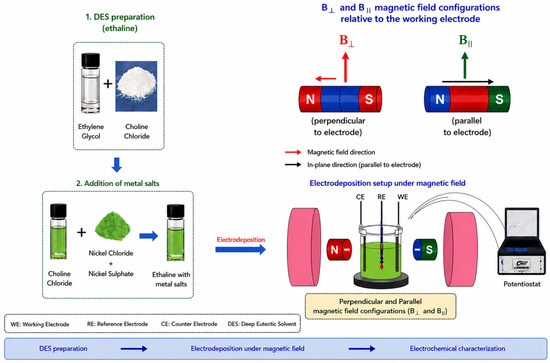
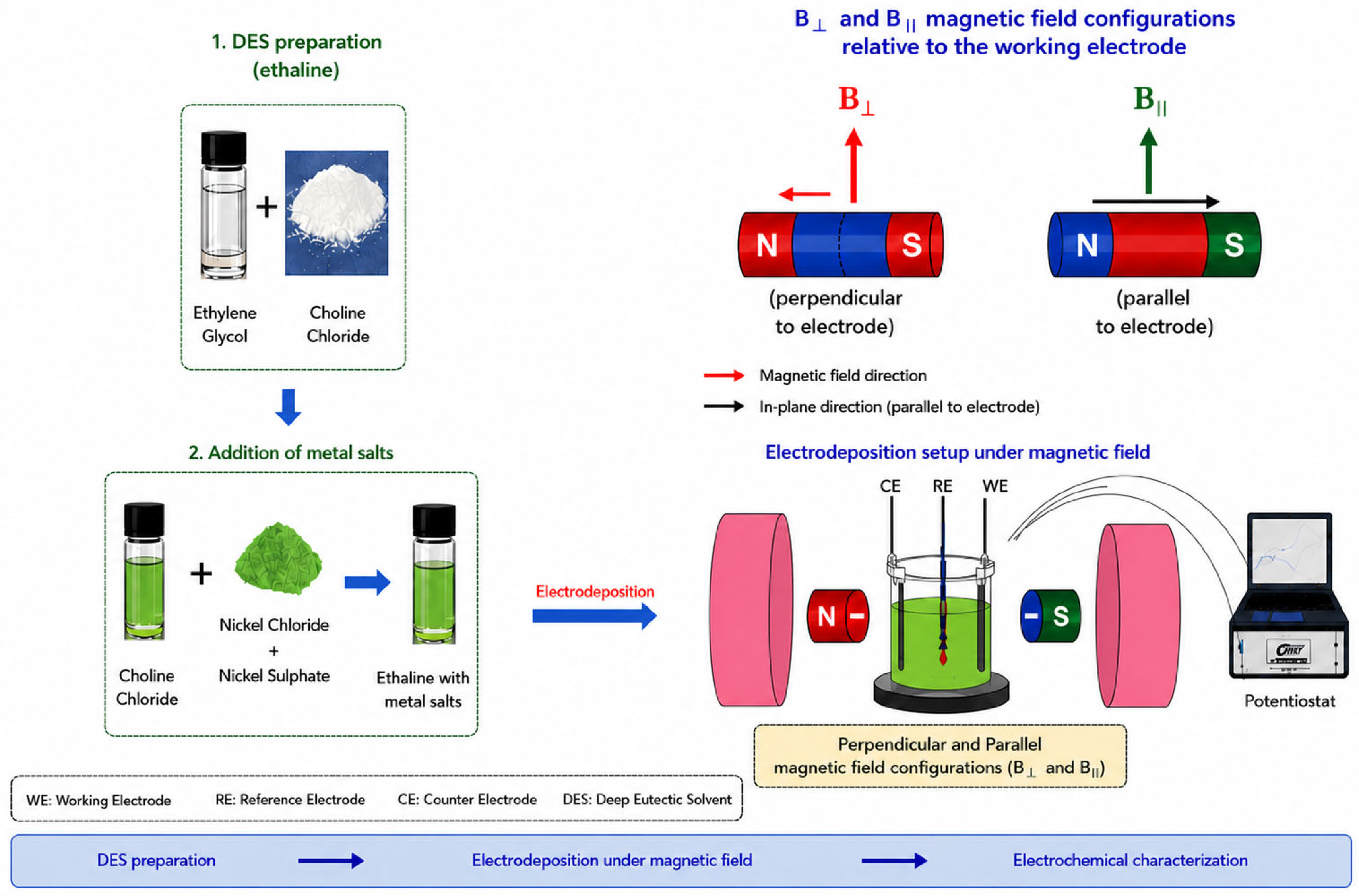
Scanning electron microscopy (SEM) was performed to investigate the different structures of the synthesized films under different deposition temperatures, with and without the magnetic field, to show how it impacts the surface morphology. X-ray diffraction (XRD) was employed to represent the crystalline structures of the prepared films. Furthermore, atomic force microscopy (AFM) was performed for the prepared Ni films under different temperatures with the magnetic field influence to study their roughness by changing the temperature during the electrodeposition. Scheme 1 represents the formation of ethaline DES, followed by the electrodeposition process of Ni deposits utilizing the magnetic field.
Scheme 1.
Ethaline DES preparation, followed by the electrodeposition setup under the magnetic field, and a picture of a real sample with SEM images.
3. Results and Discussion
3.1. Influence of the Deposition Potential and the Magnetic Field on Ni Thin Films Morphology
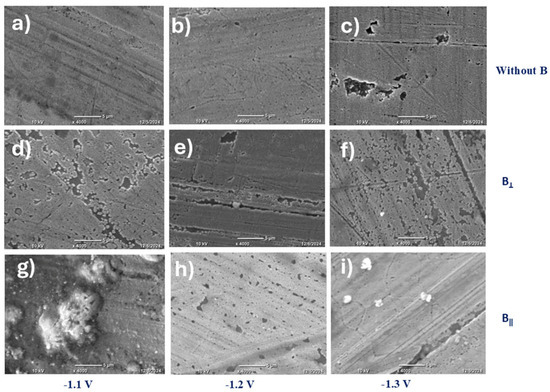
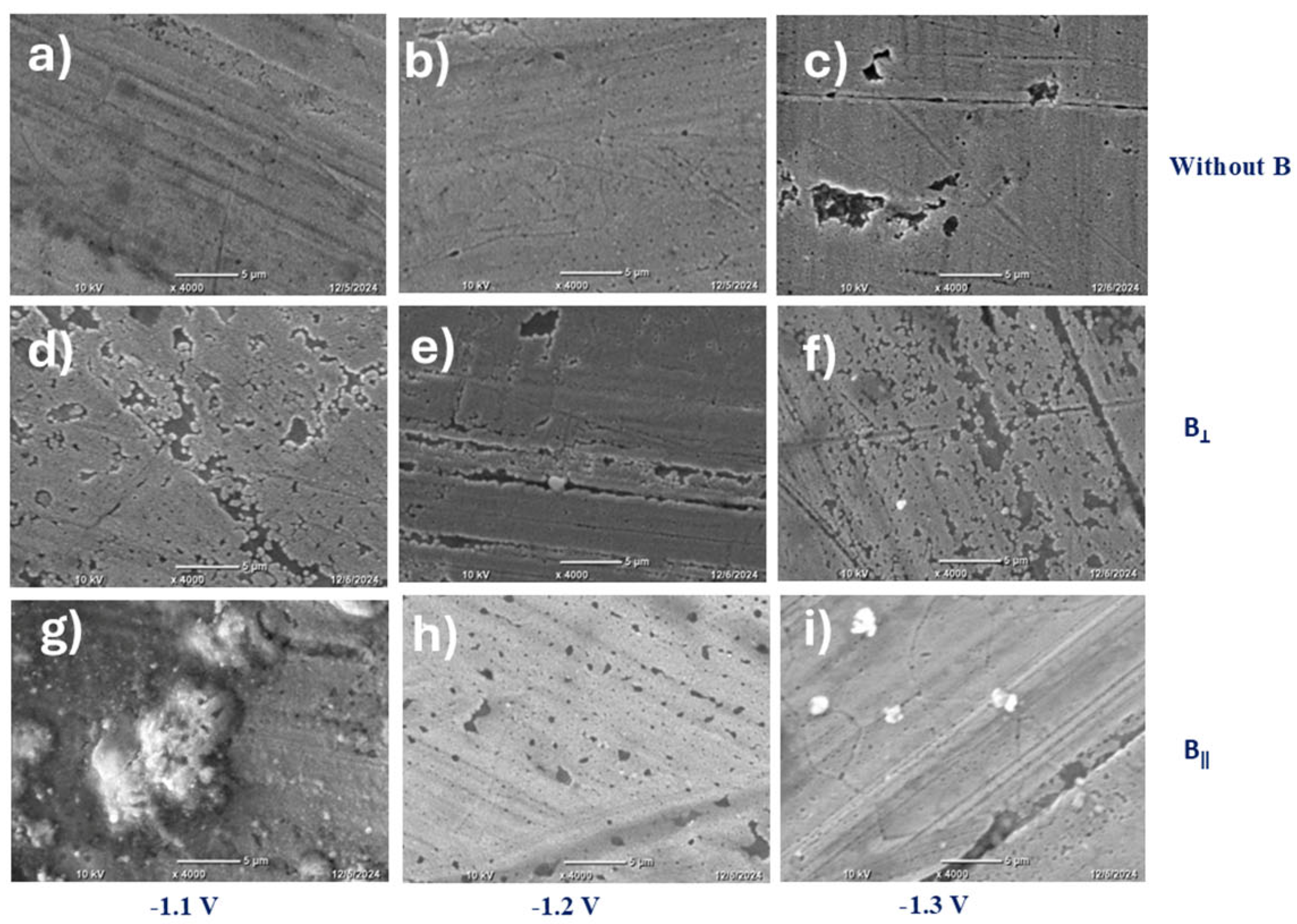
The synthesized Ni deposit morphology at the electrode surface was investigated by employing scanning electron microscopy (SEM), and the findings are shown in Figure 1a–i. The films were deposited at three different potentials (−1.1 V, −1.2 V, and −1.3 V) at 45 °C under three conditions: no magnetic field (Figure 1a–c), a perpendicular magnetic field direction (B⊥) (Figure 1d–f), and a parallel magnetic field (B‖) (Figure 1g–i). All SEM images were recorded at a magnification of 4000×; therefore, the appearance of the surface features could be compared uniformly. Surfaces without a magnetic field (Figure 1a–c) exhibit strong variations in the surface morphology as the deposition potential increases. At the voltage of −1.1 V (Figure 1a), the surface was relatively smooth, with little grain structure and polishing lines still present. Further raising the voltage up to −1.2 V (Figure 1b) resulted in a somewhat smoother surface with the appearance of non-uniform deposition patterns, indicating an increase in its nucleation process. At −1.3 V (Figure 1c), the film had become significantly rougher and had large voids and higher surface defects, which were probably caused by a greater hydrogen evolution and an uneven deposition of metal at higher overpotentials. The surface morphology was significantly improved regardless of the voltage when the perpendicular magnetic field (B⊥) was applied (Figure 1d–f). At −1.1 V (Figure 1d), the surface was flatter, there were no longer multiple voids, and the growth of the grains was more uniform than the growth of the fabricated film without the magnetic field. When the current was changed to −1.2 V (Figure 1e), the grain structure was more clearly defined, and the porosity was reduced. At −1.3 V (Figure 1f), there were still some surface defects, but the general structure was more compact and denser than the same condition without the magnetic field. The role of the parallel magnetic field (B‖) direction was similar but even stronger in the morphology of the Ni film (Figure 1g–i). At −1.1 V (Figure 1g), the surface was found to be more compact, but a slight agglomeration was found on certain spots. At −1.2 V (Figure 1h), the film had a significantly smoother surface with the fine grains being well-spread and the porosity being low. Lastly, the surface remained smooth and compact at −1.3 V (Figure 1j), and small sphere features appeared, which is evidence of the increased growth of the grains and minimization of the surface energy under the joint action of increasing overpotential and overlapping with the magnetic field. These observations confirm the strong influence of magnetic field orientation on the morphology of the deposited Ni films [34,35]. Mass transport is also promoted, leading to uniform nucleation and growth due to the magnetic field, causing a magnetohydrodynamic (MHD) convection. Once the magnetic field is exposed perpendicular to the substrate surface, the impact is even more pronounced due to the Lorentz force and mass transport, whereby the films become smoother and less defective, and the structures become smaller, especially at higher deposition voltages. Conversely, the deposition of films without a magnetic field is also likely to have a rougher surface, increased porosity, and a coarser grain with an increase in deposition voltage.
Figure 1.
SEM micrographs of Ni films in the absence of (B) (a–c), the appearance of (B⊥) (d–f), and the presence of (B‖) (g–i) with various voltages, respectively.
3.2. Effects of Temperature and Magnetic Field Orientation on Film Structure and Surface Morphology
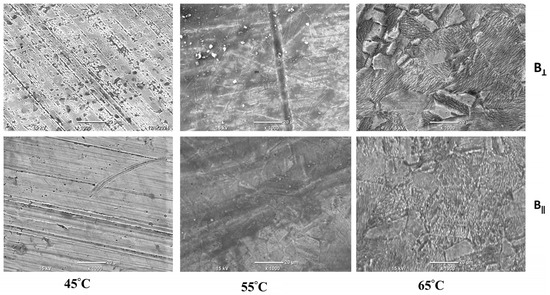
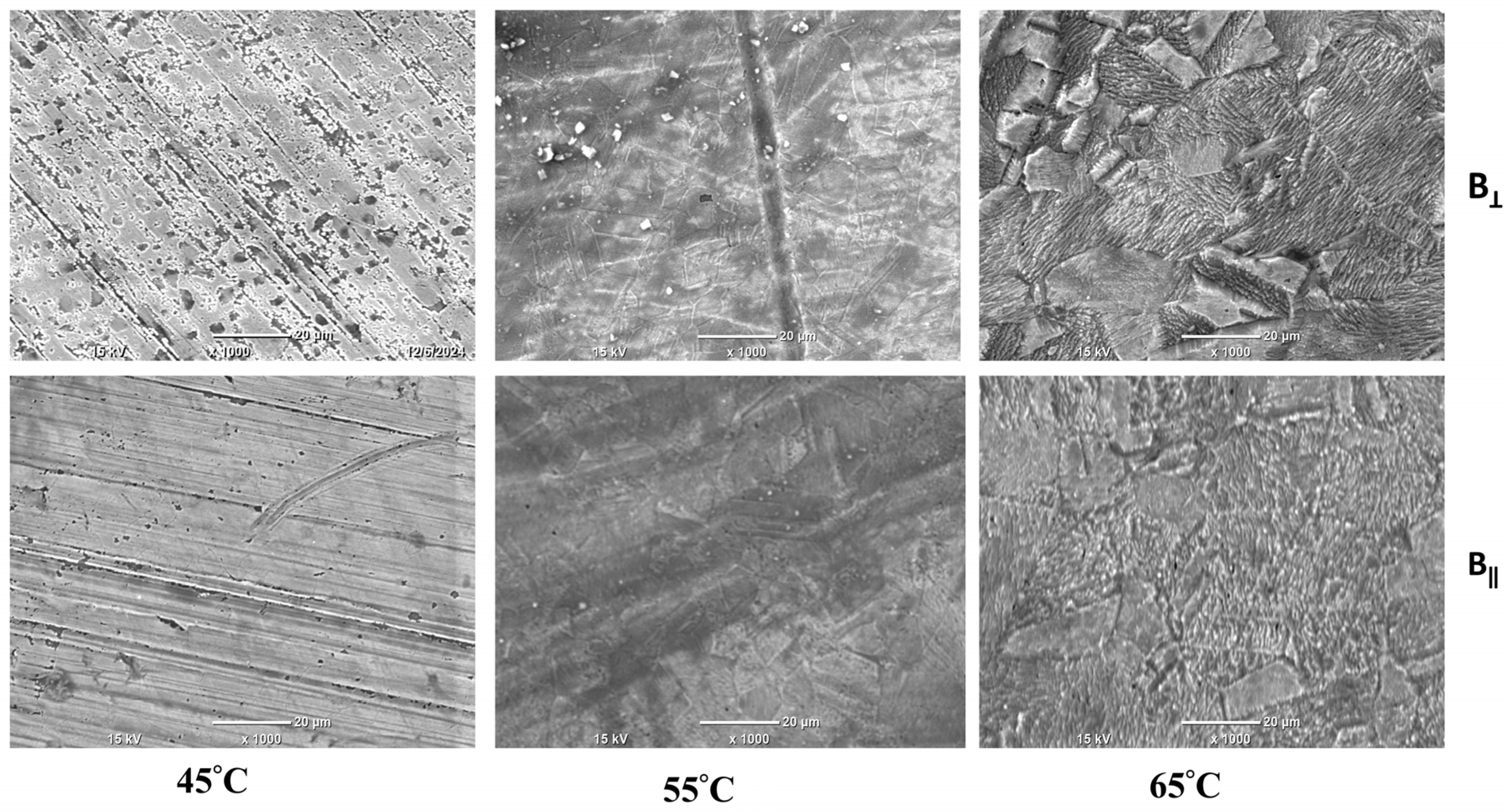
SEM was performed to analyze the surface morphology of the electrodeposited Ni thin films, and the results are provided in Figure 2. The films were prepared at three bath temperatures (45, 55, and 65 °C) in the presence of perpendicular (B⊥) and parallel (B‖) magnetic fields. All images were taken to show how the bath temperature and the magnetic field orientation affect the features of the film’s surface. The Ni films obtained at 45 °C under both (B⊥) and (B‖) conditions had relatively smooth surfaces with polishing lines from the Cu substrate that showed limited Ni coverage because of the low rate of the deposition process at this temperature. The deposits had the finest surface effects but incomplete grain development. As the deposition temperature was raised to 55 °C, considerable variations in the surface morphology were observed. The film deposited at 45 °C had a loose structure and more voids than the film deposited at (B⊥), which had a more defined grain structure. Conversely, in (B‖), the film showed larger grains and a more uniform surface, which suggests that parallel magnetic fields favor the lateral growth and the formation of finer grains at moderate temperatures. The Ni films at a temperature of 65 °C exhibited well-formed grain structures in both field orientations and proved that the higher the temperature, the faster the nucleation and growth. At (B⊥), the surface had greater columnar grains and more compact packing, which indicated that vertical convection induced by the perpendicular field facilitates columnar growth and a coalescence of the grains. At the same time, at (B‖), the Ni film demonstrated a more compact and finer-grained type of morphology, which means that the parallel magnetic field supports homogeneous lateral growth and does not allow excessive coarsening. The observed morphological differences under perpendicular (B⊥) and parallel (B‖) magnetic field orientations can be attributed to magnetohydrodynamic (MHD) effects generated during electrodeposition. The interaction between the applied magnetic field and the electric current produces a Lorentz force (), which generates electrolyte convection near the electrode surface. This convection affects the diffusion layer thickness, enhances mass transport, and influences the nucleation and growth behavior of the deposited Ni films. Under the B⊥, the convection produced by the Lorentz force is expected to be significantly stronger, producing a more uniform ion distribution during electrodeposition. On the other hand, under the B‖ configuration, the magnetic field is more closely aligned with the main current direction, which minimizes the strength of the Lorentz force. Therefore, the convection flow produced by parallel orientation is substantially weaker than the one produced by perpendicular direction. The enhanced mass transport affects the electrocrystallization process, leading to changes in composition and microstructure. The SEM images confirm this interpretation, as the high temperature of 65 °C under the B⊥ orientation promotes stronger convection, grain growth, and the formation of larger grains. As a result, the coating develops larger columnar-like features with a denser structure. Using the B‖ configuration generates weaker convection, which promotes more uniform lateral growth and produces a finer, more compact morphology. The higher temperature (65 °C) increases ionic mobility and convection intensity, whereas the lower temperature (45 °C) limits nucleation and growth kinetics, leading to incomplete surface coverage and visible polishing marks from the Cu substrate.
Figure 2.
SEM micrographs of Ni deposits with the presence of (B⊥) and the appearance of (B‖) at different temperatures.
Similar changes in morphology caused by magnetohydrodynamic (MHD) convection during magnetic field-assisted electrodeposition for Ni-based deposits have been reported [36,37,38,39].
3.3. Structural Characterization of Ni Deposits by XRD
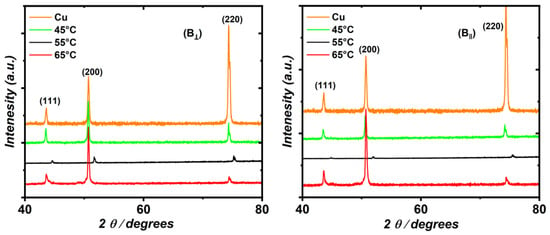
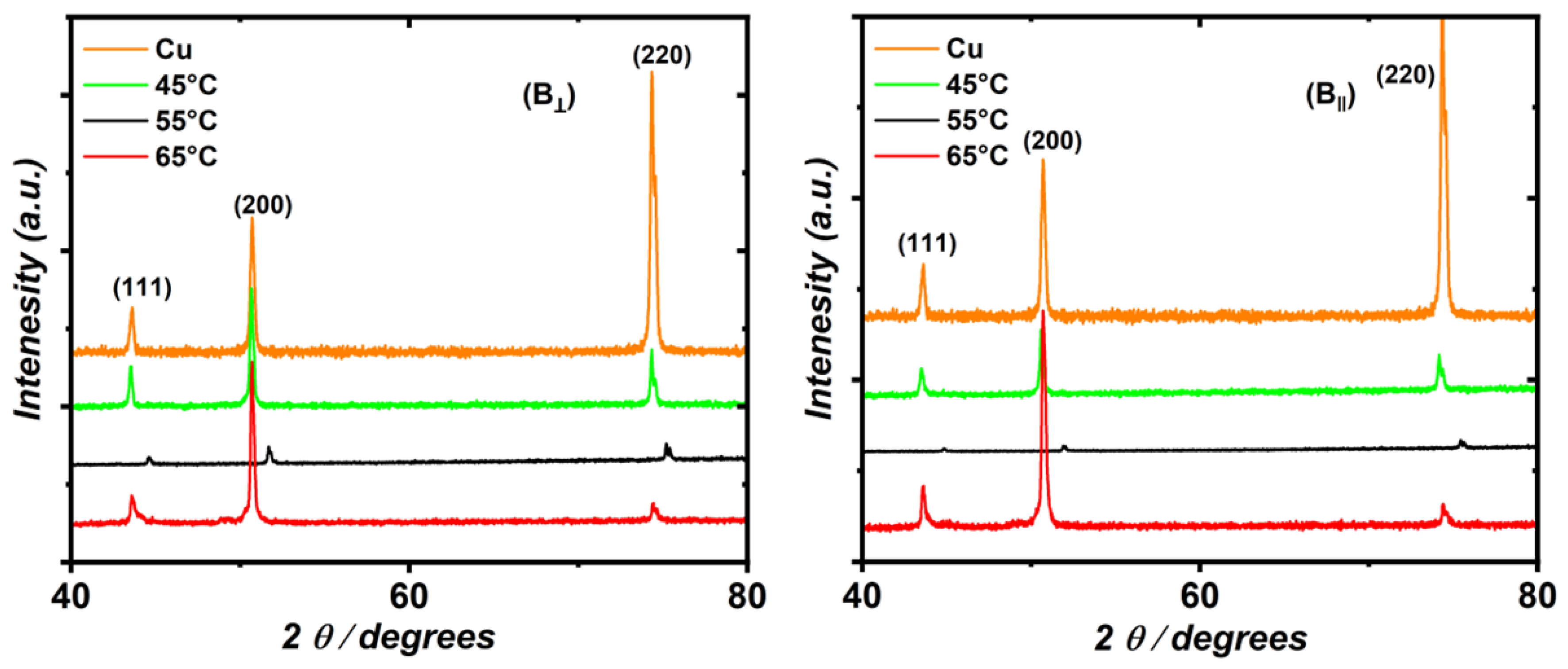
Figure 3 represents XRD profiles of Ni electrodeposited during three bath temperatures (45, 55, and 65 °C) in the presence of a magnetic field that is oriented perpendicular (B⊥) and parallel (B‖). Two sharp reflections at 2θ = 43.4, 50.68, and 74.3° are visible in every instance, corresponding to the diffraction planes (111), (200), and (220) of the Cu substrate, respectively (JCPDS card no. 00-001-1242). The Ni diffraction peaks are poorly defined across all magnetic field orientations and the deposition temperatures due to the overlap between the FCC reflections of Ni and Cu. This is explained by the fact that the deposited Ni films are relatively thin, in which the high-intensity peaks of the Cu substrate prevail and essentially cover the weaker reflections of the Ni peaks. The calculated thickness values of the deposited Ni films further support the notion that the coatings are sufficiently thin for the Cu substrate reflections to remain dominant in the XRD patterns. Although the peaks of Ni are not visible, the influence of the bath temperature influences the overall diffraction profile. At higher deposition temperatures (55–65 °C), the background intensity slightly decreases, and the Cu peaks become sharper, which suggests that a higher temperature promotes faster deposition and better crystallinity of the growing Ni layer, even if its diffraction signal remains overshadowed by the substrate [40]. Although variations in film thickness may influence the electrochemical response, the HER behavior observed in the present work does not correlate directly with thickness alone. The thickest deposited films did not consistently exhibit the best HER performance, indicating that the surface morphology, adsorption/desorption characteristics, and electrochemical kinetics also contribute significantly to the catalytic response. It has been observed that without using the magnetic field at 45 °C, the film thickness was calculated to be 0.21 µm. This small thickness value confirms the influence of the magnetohydrodynamic effect and the induced convection by Lorentz force, which enhances mass transport and hence increases the deposition thickness layer by using the magnetic field under both B⊥ and B‖.
Figure 3.
The XRD profiles of Ni deposits (JCDPS card no. 00-001-1242) at bath temperatures in the presence of (B‖) and (B⟂).
Table 1 shows the thickness values of the fabricated Ni thin coatings on the Cu substrate from ethaline at −1.1 V at different temperature values with different magnetic field directions.
Table 1.
The thickness values for the deposited Ni films under the influence of the different magnetic field directions and temperatures.
3.4. Effect of Magnetic Field and Deposition Temperature on Nickel Topography Roughness (AFM)
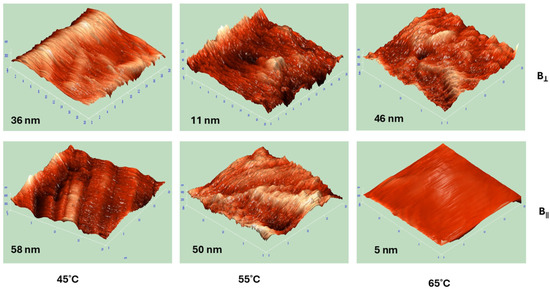
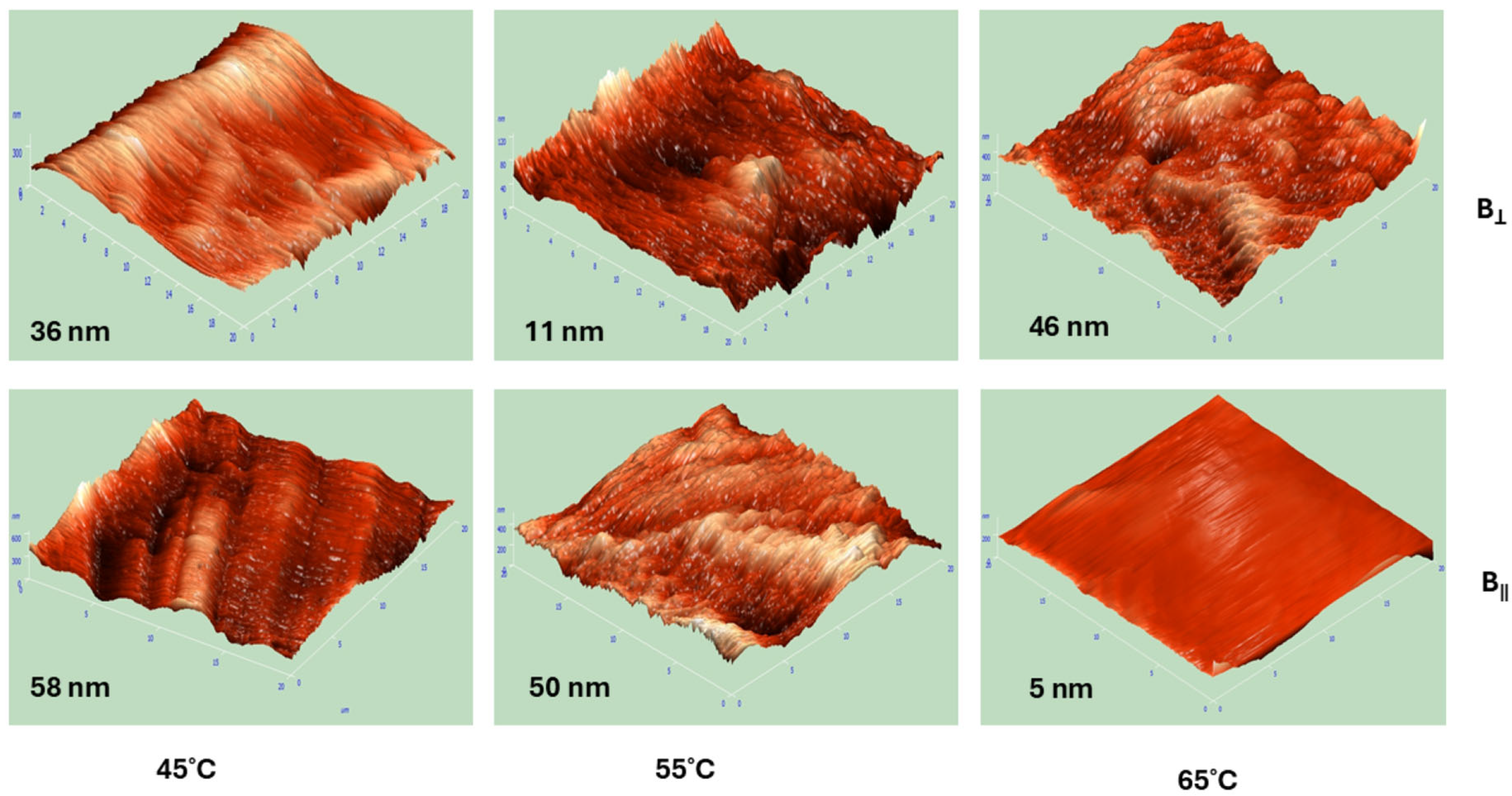
Figure 4 represents 3D topographic images of the fabricated nickel deposited from ethaline at distinct temperatures of 45 °C, 55 °C, and 65 °C with a deposition potential of −1.1 V in the presence of B⊥ and B‖ relative to the electrode surface. The fabricated Ni films under B⊥ at 45 °C exhibit a granular structure with a moderate roughness value of 36 nm. Raising the temperature to 55 °C, the surface becomes smoother with a finer grain size, and the roughness is decreased to 11 nm. Moreover, when increasing the temperature to 65 °C, the surface becomes rougher again with a value of 46 nm. The improved HER catalytic performance refers to the fabricated Ni with moderate roughness value, finer grain particles, and a balanced hydrogen adsorption–desorption behavior [41,42], which is fabricated at the mild temperature of 55 °C. Conversely, the deposited nickel films in B‖ show the surface at 45 °C with large grain structures and the highest roughness value of 58 nm, while raising the temperature to 55 °C and 65 °C, the surface becomes smoother and becomes extremely smooth at 65 °C, possibly due to increased atomic mobility aligning better along the field. The Ni films deposited at 45 °C and 65 °C under B‖ exhibit different HER characteristics. The sample fabricated at 45 °C shows the lowest Tafel slope, indicating faster reaction kinetics, whereas the sample deposited at 65 °C exhibits the lowest overpotential value. However, the catalytic activity for HER under B‖ does not directly follow the roughness trend, indicating that catalytic performance is also affected by adsorption–desorption behavior and charge-transfer kinetics, and it is not only controlled by the roughness value. To conclude, the surface roughness is influenced by the direction of the magnetic field and the applied temperature throughout the deposition process; however, the HER activity depends on the combined contribution of surface morphology, adsorption–desorption behavior, and electrochemical kinetics rather than the roughness alone. Furthermore, there is a nonlinear relationship between the roughness and the applied temperature in the case of the perpendicular magnetic field; however, in the case of the parallel direction, the roughness diminishes with increasing temperature.
Figure 4.
AFM topographic images for the deposited Ni films at various temperatures (45 °C, 55 °C, and 65 °C) controlled by the magnetic field with various orientations (B‖) and (B⊥).
3.5. Electrochemical Efficiency for Hydrogen Evolution Reaction: Role of Deposition Potential and Magnetic Field
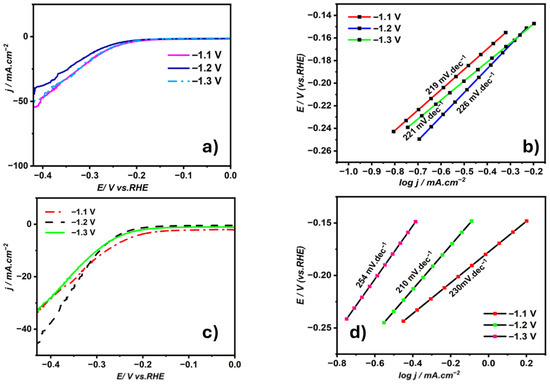
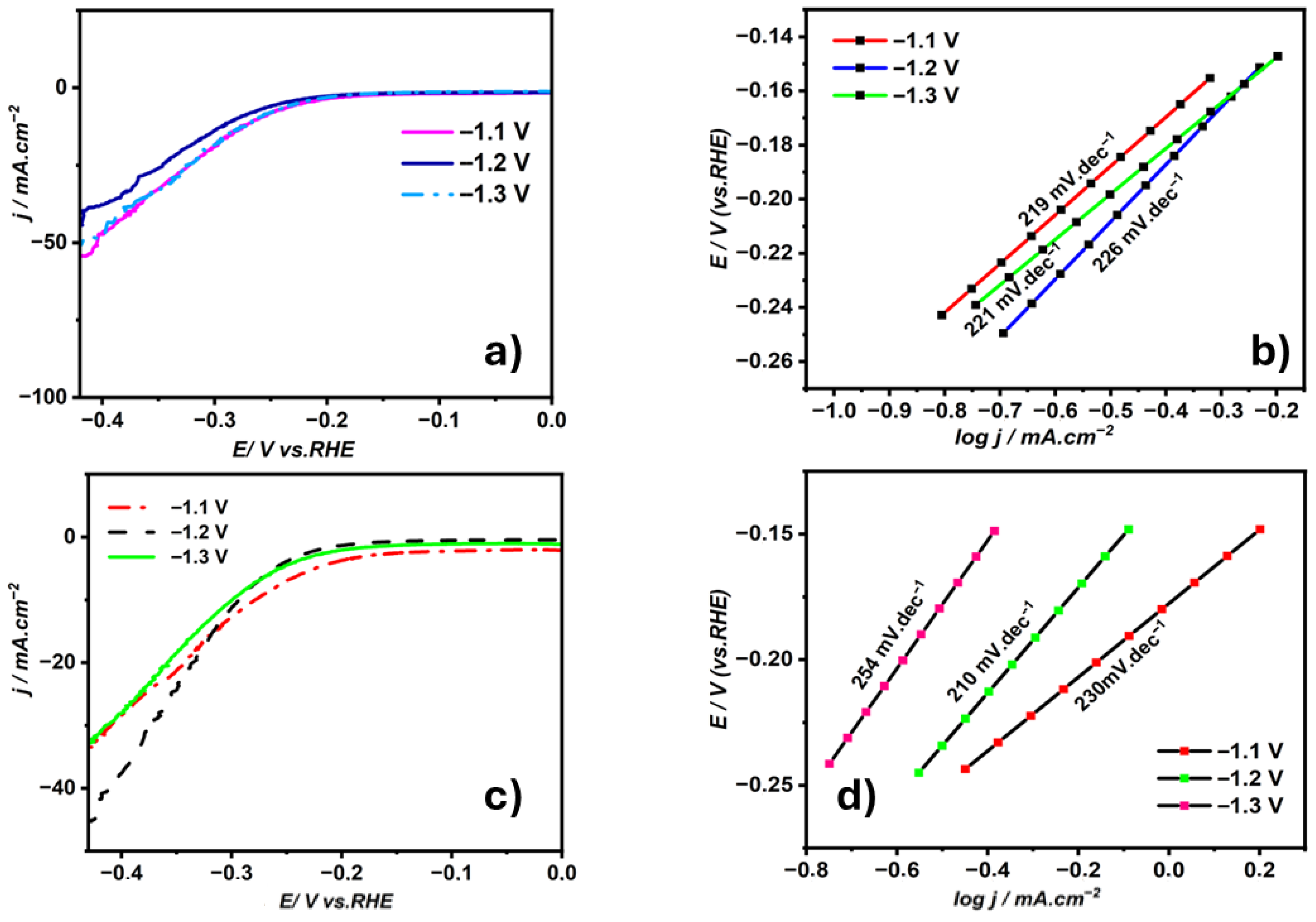
The electrodeposition potential affects the catalyst morphology, hence it affects the catalytic performance of HER [30,43]. Figure 5a represents cathodic polarization plots for 1 M NaOH at a sweep rate of 5 mV·s−1 for the fabricated Ni films from ethaline at 45 °C at various deposition voltages (−1.1 V, −1.2 V, and −1.3 V) in the presence of (B‖) on the electrode surface and (b) their Tafel plots. The smallest overpotential value to achieve −10 mA·cm−2 was −219 mV·s−1, and the current density was obtained from the film deposited at −1.1 V with the smallest Tafel slope value of 219 mV·dec−1, which can be attributed to a smoother compact morphology that favors charge transfer. On the other hand, as the potential shifts toward a more negative direction to reach −1.2 V, the overpotential value increased negatively to −277 mV with the highest Tafel slope value of 226 mV·dec−1, indicating sluggish kinetics due to rougher, porous films and possible hydrogen bubble entrapment. Furthermore, the film deposited at a higher negative potential value of −1.3 V shows the smallest overpotential value of −217 mV but has a higher Tafel slope of 221 mV·dec−1 compared to the Ni deposit at −1.1 V, indicating that although η10 is the lowest, the higher Tafel slope reflects less favorable kinetics. Figure 5c shows LSV for HER for the nickel deposits deposited from ethaline at 45 °C without the magnetic field and (d) their Tafel plots. It has been noticed that the smallest overpotential value to reach 10 mA·cm−2 is −275 mV, which refers to the deposited film at −1.3 V, but at the same time it gives the highest Tafel slope value of 254 mV·dec−1. However, the deposited film at −1.1 V yields an overpotential value of −291 mV to attain a current density of 10 mA·cm−2 and a moderate Tafel slope of 230 mV·dec−1, whereas the deposited film at −1.2 V results in the highest overpotential value of −298 mV; however, it has the smallest Tafel slope magnitude of 210 mV·dec−1. Relative to the deposited Ni exposed to the magnetic field, it is observed that the overpotential value (η10) decreases with an increasing voltage, but with a significant increase in the Tafel slope, which means the apparent enhancement in the overpotential values does not relate to the kinetics improvements. This mismatch reflects the defects in the SEM of the Ni films at a high voltage. Overall, it can be noticed that the Ni deposits deposited at 45 °C in the presence of the magnetic field exhibit an improved HER performance, which has a smaller overpotential magnitude and a smaller Tafel slope compared to the one without the magnetic field. Indicating that the application of the magnetic field stabilizes the deposition process, leading to films with improved kinetics towards the HER. This confirms the effective role of MHD effects in promoting uniform nucleation and bubble removal. Table 2 represents the overpotential measurements (η10) and Tafel slopes for nickel deposits with and without B‖ at 45 °C at different deposition potential values.
Figure 5.
The electrocatalytic performance of Ni films deposited from ethaline at 45 °C under different electrodeposition potentials. (a) Cathodic polarization plots and (b) corresponding Tafel plots in the presence of B‖. (c) Cathodic polarization curves and (d) corresponding Tafel plots without the magnetic field. The data highlight the effect of the deposition potential and magnetic field on overpotential (η10) and Tafel slope, reflecting the influence of morphology and MHD effects on HER activity.
Table 2.
The overpotential values and Tafel slope for 1 M NaOH of deposited Ni films with and without B at 45 °C from ethaline.
3.6. Temperature-Dependent HER Activity Under Different Magnetic Field Orientations
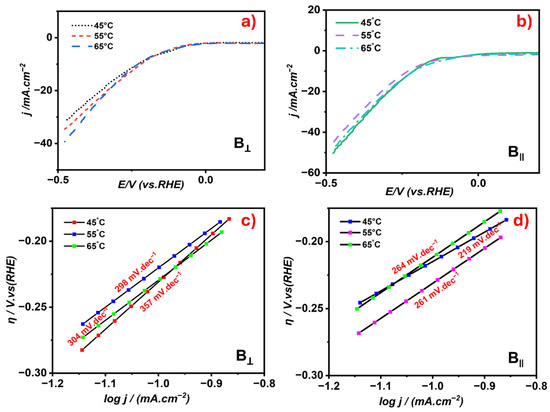
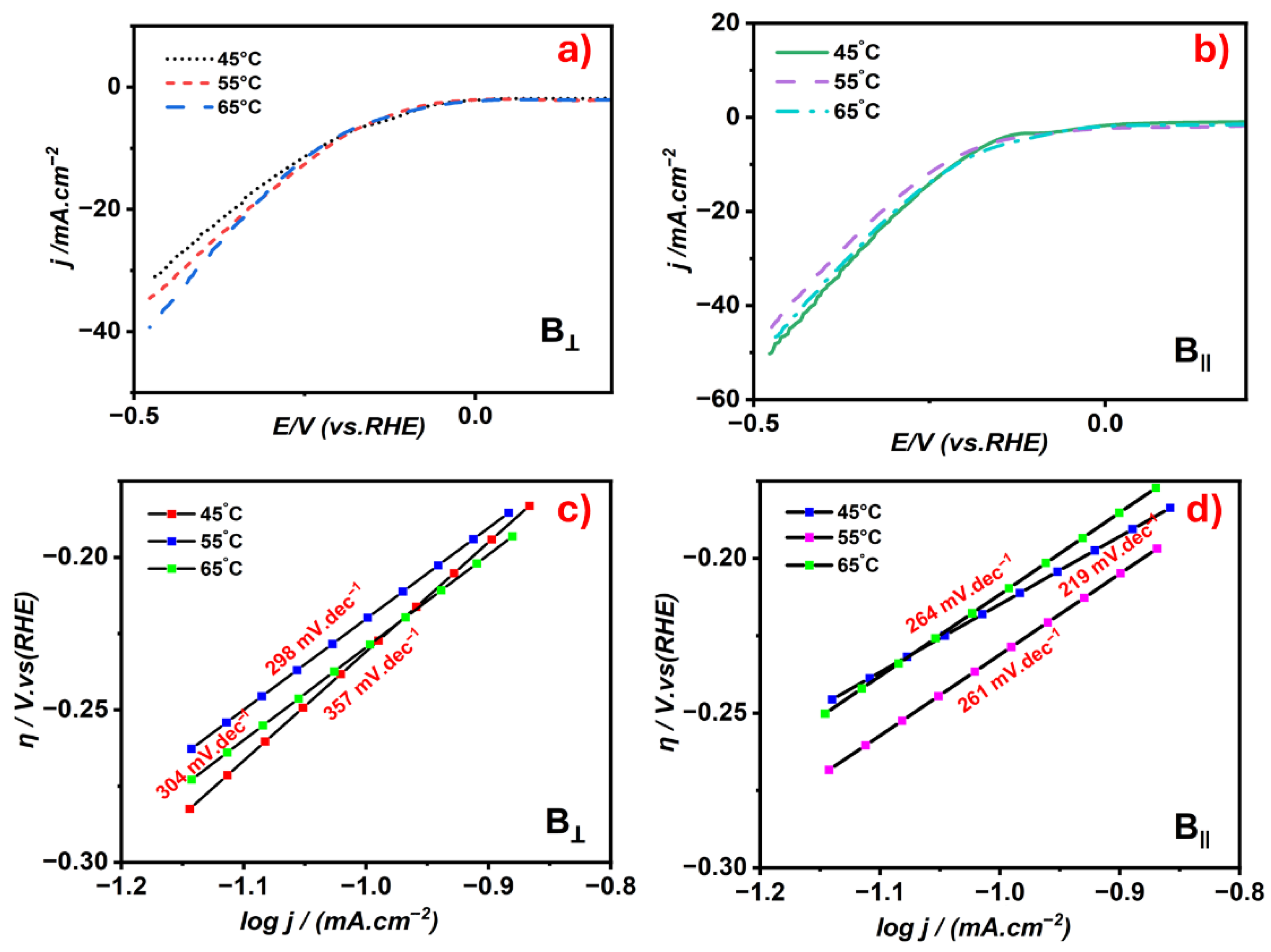
Figure 6a,b illustrates the cathodic polarization behavior for the hydrogen evolution reaction (HER) in 1 M NaOH at a sweep rate of 5 mV·s−1. The data refers to nickel films synthesized from ethaline at 45 °C, 55 °C, and 65 °C, with the magnetic field oriented either perpendicular (B⊥) or parallel (B‖) to the substrate surface. Figure 6c,d shows their corresponding Tafel plots. It is remarkable that in the case of nickel deposits under the influence of (B⊥) at (45 °C, 55 °C, and 65 °C), the overpotential values to reach a current density value of −10 mA·cm−2 are −224 mV, −215 mV, and −228 mV, respectively. The Ni film deposited at 55 °C exhibits the lowest overpotential (−215 mV), indicating improved HER behavior within the B⊥ group. Although the Tafel slope (298 mV·dec−1) remains relatively high, the overall performance suggests an optimal balance between the hydrogen adsorption and desorption processes. These results suggest that a moderate temperature favors the surface morphology and grain structure that enhance HER kinetics in this configuration. In contrast, for the samples deposited in the (B‖) configuration, the fabricated Ni film at the high temperature of 65 °C performs the smallest overpotential value of −203 mV relative to the other two temperatures of 45 °C and 55 °C, which have an overpotential value of −219 and −231 mV, respectively. The Tafel slope had the smallest value of 219 mV·dec−1 for the deposited film at the lowest temperature of 45 °C and the highest value of 264 mV·dec−1 for the deposited sample at 65 °C. This indicates that at 45 °C, Ni exhibits faster kinetics (and a lower Tafel slope), whereas at 65 °C, the reaction initiates at a lower overpotential but with slower kinetics. These findings suggest that both the magnetic field orientation and deposition temperature play critical roles in tuning the HER activity of Ni-based electrodes by influencing their structural and electrochemical properties. Table 1 and Table 2 show the overpotential values and Tafel slopes for the prepared nickel films at temperatures of 45 °C, 55 °C, and 65 °C with a deposition potential of −1.1 V in the presence of B⊥ and B‖ in the electrode system. The mechanism of HER usually happens in multiple steps in the alkaline media, in which the electrode surface can participate in the electrochemical process through the adsorption and desorption processes. There are two HER steps to occur: the first step is the Volmer step, in which the water molecules are adsorbed on the electrode surface and produce a H*-adsorbed intermediate (Equation (3)). The second step can occur through two pathways: the first one is the Heyrovsky step (Equation (4)), which includes a recombination that happens between H* and H2O, and the Tafel step, which includes a recombination between two H* species (Equation (5)) [44]. It is important to know the value of the Tafel slope, as it indicates the rate-determining step of the HER mechanism [45,46,47,48]. The theoretical values for the Volmer step are 120 mV·dec−1, 40 mV·dec−1 for the Heyrovsky step, and 30 mV·dec−1 for the Tafel step. Each value explains its role as a rate-determining step for the HER mechanism [49,50,51,52,53].
Volmer reaction: H2O + e− → H∗ + OH− (120 mV·dec−1)
Heyrovsky reaction: H2O + e− + H∗ → H2 + OH− (40 mV·dec−1)
Tafel reaction: H∗ + H∗ → H2 (30 mV·dec−1)
Figure 6.
The LSV of 1 M NaOH at a sweep rate of 5 mV·s−1 for the prepared nickel with and without (B⊥) and (B‖) and their Tafel plots. (a) cathodic polarization curves for B⊥, (b) cathodic polarization curves for B‖, (c) corresponding Tafel plots for B⊥, and (d) corresponding Tafel plots for B‖.
From the Tafel slopes of all prepared Ni thin films, synthesized at various temperatures and subjected to different magnetic field orientations, all of them show high Tafel slope values, which indicates that the Volmer step (water dissociation and the initial adsorption of hydrogen) is the rate-determining step [54]. These results are consistent with the chronoamperometric data, which exhibit the slow current density stabilization and strong and weak adsorption of some samples. Although the obtained Tafel slopes remain relatively high in comparison with the state-of-the-art electrocatalysts, indicating relatively sluggish HER kinetics, the present results demonstrate the influence of magnetic field orientation and deposition temperature on the HER behavior of electrodeposited Ni films in an ethaline medium. The observed differences in electrochemical performance are associated with variations in morphology, adsorption/desorption behavior, and electrochemical kinetics rather than direct evidence of superior intrinsic catalytic activity. Table 3 and Table 4 provide overpotential values and Tafel slopes for the HER of the deposited nickel with the impact of (B⊥) and (B‖) at various temperature values, respectively.
Table 3.
The HER activity of the Ni thin films deposited under B⊥ at different temperatures.
Table 4.
The HER activity of Ni thin films deposited under B‖ at different temperatures.
3.7. Chronoamperometric Analysis of Hydrogen Adsorption–Desorption in Ni-Based HER Catalysts
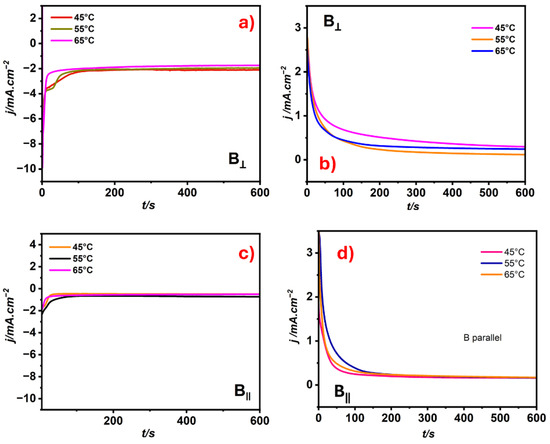
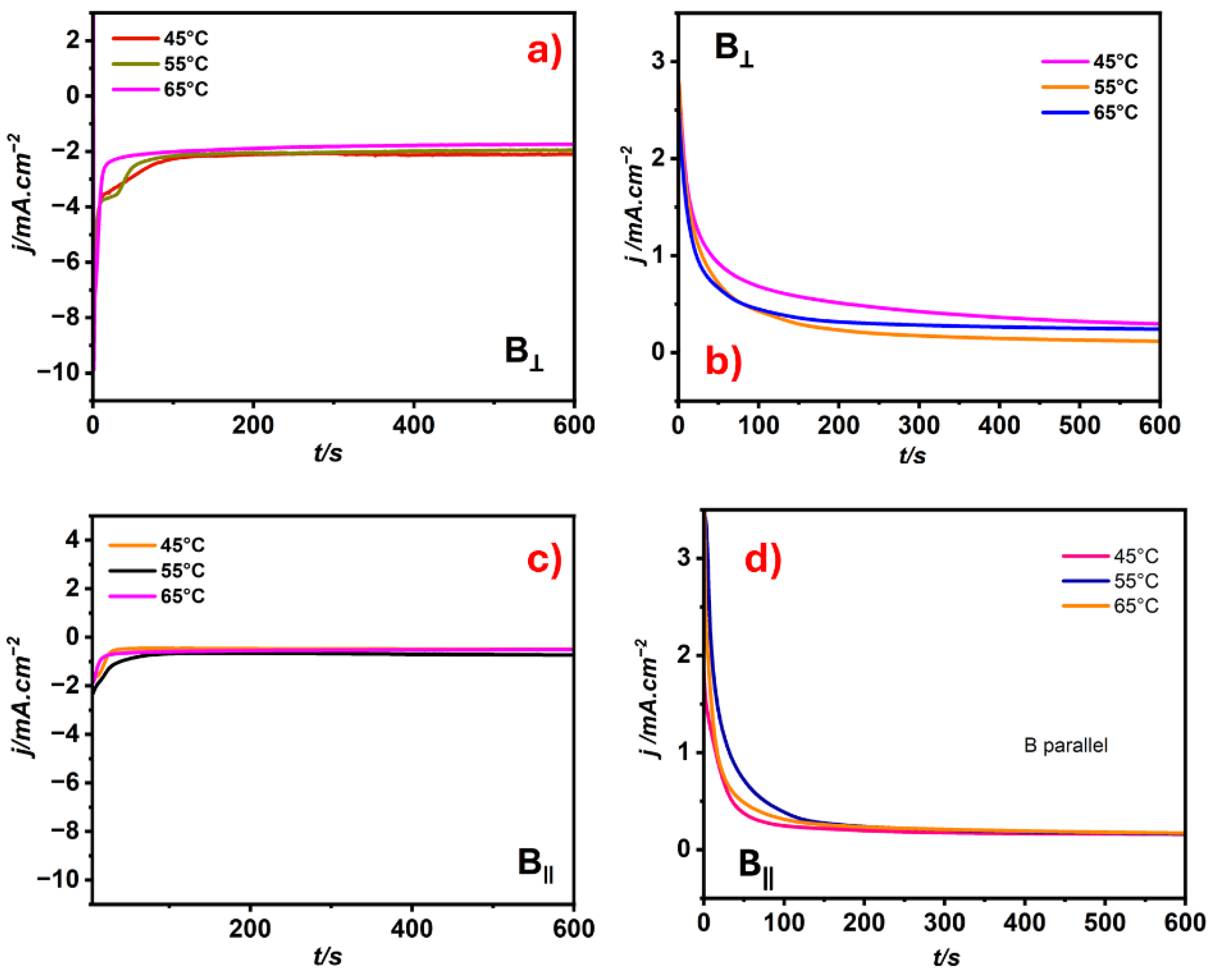
Figure 7a,b represents the chronoamperometric technique to measure the adsorption–desorption processes, respectively, for Ni deposits exposed to a perpendicular magnetic field and prepared across a range of temperatures (45 °C, 55 °C, and 65 °C). It can be noticed that the Ni samples in B⊥ deposited to the electrode surface at 65 °C display the maximum cathodic current density spike value of −10.1 mA·cm−2 and reach a stabilization plateau in 123.58 s. Conversely, the Ni thin film deposited at an intermediate temperature of 55 °C exhibits a moderate peak current density of −8.94 mA·cm−2 and attains a steady state after approximately 145.48 s. Furthermore, the Ni deposit at the lowest temperature value of 45 °C represents the smallest spike current density value of −8.38 mA·cm−2 and achieves stabilization after 218.56 s. It is remarkable that it is from these values that the Ni deposit at 45 °C possesses the smallest adsorption value of the H+ species, as it reaches the steady state after a long time and with the smallest initial current density, while the prepared Ni at 65 °C represents the maximum adsorption value, and 55 °C shows the intermediate value. For the desorption process, the potential is switched to 0 V for 600 s. It has been observed that the deposited Ni at 55 °C and 65 °C can release the adsorbed H* rapidly. They take almost (~55–57 s) to reach 0.63 mA·cm−2. On the other hand, the deposited Ni at 45 °C shows the slowest release of the adsorbed H* (124 s). Although the deposited Ni at a higher temperature value of 65 °C shows stronger adsorption, its slightly excessive binding slows hydrogen evolution at low overpotentials; the deposited Ni at 55 °C has a Tafel slope value of 298 mV·dec−1. Despite this relatively high value, it exhibits a good balance between the adsorption and desorption processes, achieving optimal HER kinetics overall. Figure 7c,d represents the adsorption–desorption curves, respectively, for the deposited Ni films under the effect of a parallel magnetic field (B‖) to the electrode surface. The chronoamperometric curves represent differences among the adsorption–desorption behavior for the three different catalysts. It can be noticed that the fabricated Ni at 45 °C possesses the smallest current spike value of −2.29 mA·cm−2 and the fastest current decay. It reaches stabilization after 39.3 s to achieve −0.49 mA cm−2, indicating that it has the weakest hydrogen adsorption, and the binding is relatively weak, and the surface does not accumulate an extensive coverage of H*. For the desorption process, it shows the smallest current spike value of 1.8 mA cm−2, and the current is gradually decreased to reach 0.18 mA·cm−2 after 300 s. This low desorption current density confirms that a few hydrogen species are retained on the electrode surface. While increasing the temperature for Ni electrodeposition to 55 °C, the adsorption–desorption process for HER was changed. The current spike became higher with a value of −3.2 mA·cm−2, which means it has a stronger adsorption, and the current has a slower decay after 71 s to reach −0.73 mA·cm−2. This suggests that the deposited Ni at 55 °C provides extensive hydrogen uptake and stronger binding compared to the fabricated Ni at 45 °C. For the desorption process, it shows a higher spike current density value of 4.1 mA·cm−2, followed by a long decay to 0.20 mA·cm−2 after 300 s. This indicates that there is a higher hydrogen coverage, but the slow release suggests a strong binding between the adsorbed H* and the electrode surface. That is why it has a high overpotential value of −261 mV, and the highest Tafel slope value of 231 mV·dec−1, which means it has the slowest kinetics for HER. The deposited Ni at 65 °C shows intermediate adsorption behavior, with a cathodic current density value of −2.92 mA·cm−2, which decays after 56 s to reach −0.61 mA·cm−2. This reflects an intermediate strong adsorption and a balanced surface coverage of H* species. For the desorption process, it shows the highest anodic current density spike value of 4.9 mA·cm−2, indicating substantial hydrogen coverage and current decays of 0.19 mA·cm−2 within 300 s. Showing that the adsorbed H* species are released more efficiently at this temperature. It can be noticed from the LSV experiment that the fabricated Ni at 65 °C possesses the smallest overpotential value of −203 mV, suggesting it has faster HER kinetics despite its relatively high Tafel slope value of 264 mV·dec−1. To conclude, the chronoamperometric study reveals a strong correlation between the adsorption–desorption behavior and overall HER kinetics performance. It can be observed that the Ni deposit at the moderate temperature value of 55° within the B⊥ group demonstrates the best catalytic performance for HER, which has the lowest overpotential value and the smallest Tafel slope, as it has a good balance between the adsorption of the H* species and its release compared to the fabricated Ni films at 45 °C and 65 °C, which represent weaker and stronger adsorption behavior, respectively. Similarly, for the deposited Ni at 65 °C in the case of (B‖) influence, it exhibits a moderate adsorption value, achieving a fast H2 release. Moreover, it has the smallest overpotential value among the other fabricated Ni films, which does not arise from the strongest adsorption but from the balance between the efficient adsorption and facile desorption. Therefore, the observed HER performance differences among the deposited Ni films cannot be attributed to a single parameter alone, but rather to the combined effects of film thickness, surface morphology, adsorption/desorption behavior, and electrochemical kinetics under different magnetic field orientations and deposition temperatures. Overall, these results confirm that an efficient catalyst should have a sufficient balance between the strong adsorption to activate H2O with an efficient desorption process to release H2 [55,56]. Table 5 summarizes the overpotential values, the Tafel slopes, the chronoamperometric data, and the rate-determining step (RDS) for the fabricated Ni films, further supporting the interpretation of the adsorption/desorption behavior. The desorption transient curves were analyzed by fitting the current decay profiles using a first-order exponential decay model according to Equation (6):
where is the transient current at time , is the initial current amplitude, is the steady-state current, and represents the characteristic decay time constant [57].
Figure 7.
The chronoamperometric analysis of hydrogen adsorption–desorption for nickel electrodeposited from ethaline at various temperatures under magnetic field orientations. (a) Adsorption curves for B⊥, (b) desorption curves for B⊥, (c) adsorption curves for B‖, and (d) desorption curves for B‖. The results show how temperature and magnetic field direction influence H* adsorption strength, desorption kinetics, and overall HER activity.
Table 5.
Kinetic parameters and adsorption/desorption characteristics of the electrodeposited Ni films under perpendicular (B⊥) and parallel (B‖) magnetic field configurations at different temperatures.
The calculated decay time constants () under B‖ were approximately 20.9 s, 15.0 s, and 8.6 s for the samples deposited at 45 °C, 55 °C, and 65 °C, respectively, while under B⊥ the corresponding values were 24.7 s, 18.2 s, and 13.1 s. In both magnetic field configurations, increasing the temperature resulted in a faster current stabilization and lower values, indicating accelerated desorption kinetics. The relatively longer decay times observed at the lower temperatures suggest a more sustained hydrogen interaction at the electrode surface, whereas the shorter decay times at higher temperatures indicate faster equilibration of the adsorption/desorption processes. These findings suggest that HER performance is influenced by differences in adsorption/desorption kinetics and surface interaction behavior among the deposited Ni films. However, the transient analysis provides qualitative kinetic insight rather than a direct measurement of hydrogen binding strength.
3.8. Long-Term Stability and Durability of Optimized Ni Electrocatalysts
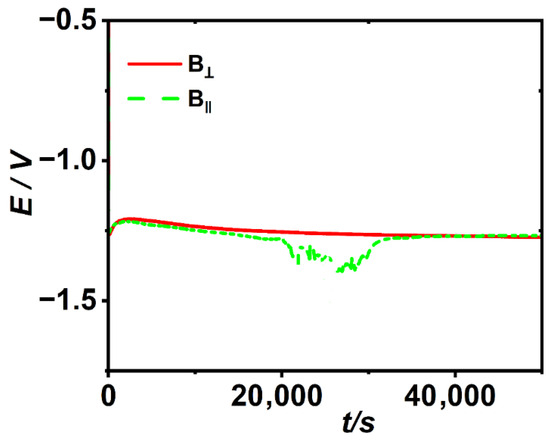
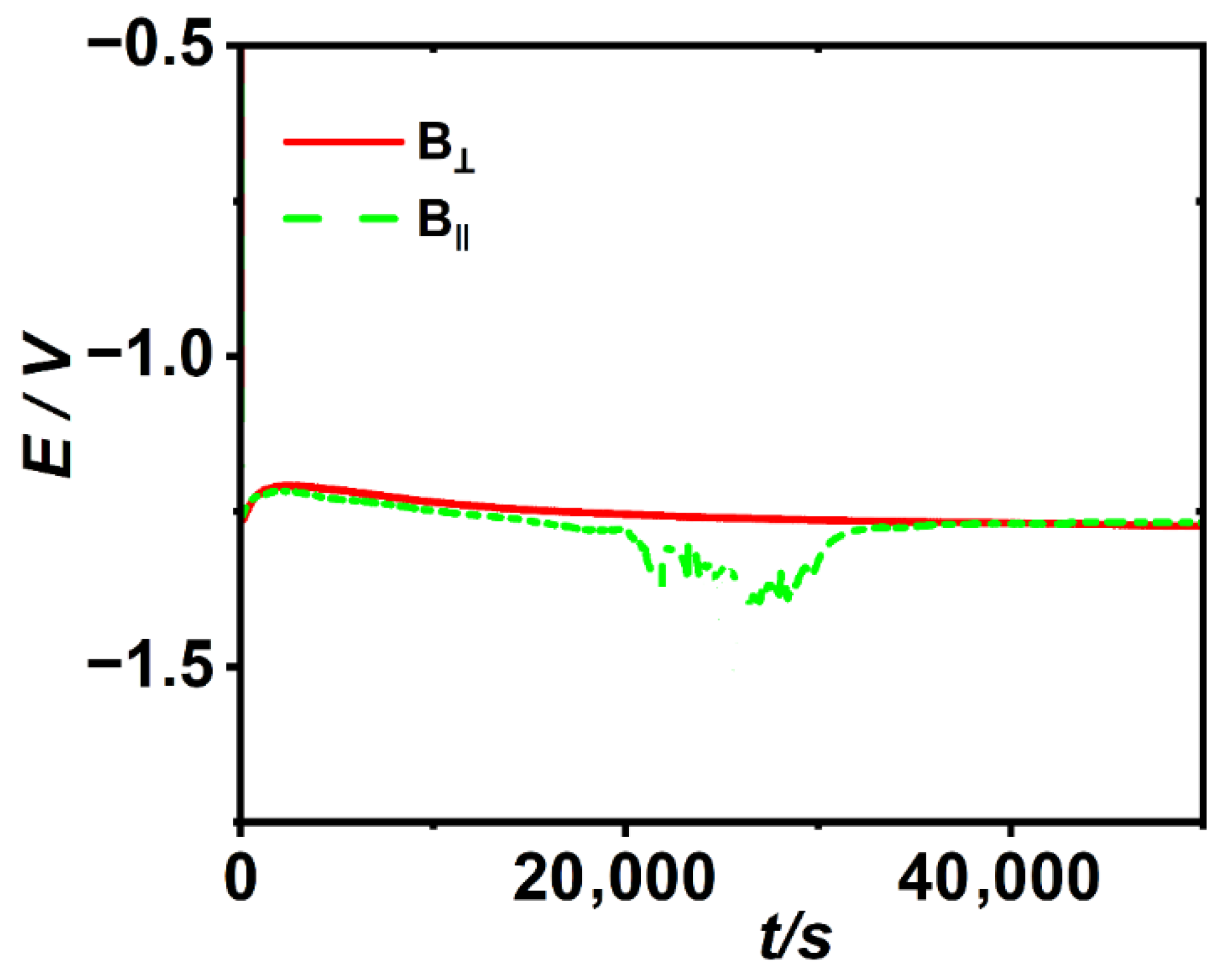
Figure 8 exhibits the chronopotentiometry technique at a current density value of −10 mA·cm−2 for 50,000 s for both deposited Ni films at 55 °C under the influence of the magnetic field in both parallel and perpendicular directions to show how much the direction of the magnetic field influences the characteristics of the electrocatalyst activity and stability. It can be observed that the deposited Ni under the B⊥ has a small potential drift from −1.25 V to −1.21 V after 6000 s, followed by a stabilization with a final potential of −1.27 V after 50,000 s, indicating strong HER activity and good stability over a long time. In contrast, the deposited Ni under the magnetic field in B‖ shows transient fluctuations between 15,000 s and 32,000 s, which requires a longer time to achieve a stable potential value of −1.26 V. These fluctuations may be caused by the accumulation of the hydrogen species on the electrode surface, which is consistent with the adsorption–desorption experiment, indicating it has a stronger adsorption compared to other electrodes. To conclude, these results indicate that the Ni electrocatalyst demonstrates slight long-term stability for HER compared to its parallel-field counterpart. Furthermore, it shows how the magnetic field orientation alters the surface properties, stability, and catalytic behavior for HER.
Figure 8.
The chronopotentiometry measurements of Ni thin films deposited at 55 °C under the influence of perpendicular (B⊥) and parallel (B‖) magnetic fields at a fixed value of current density −10 mA·cm−2 for 50,000 s. The plot demonstrates the long-term stability and durability of the electrocatalysts and highlights the effect of magnetic field orientation on potential drift and HER activity.
4. Conclusions
This study demonstrates that deposition temperature and magnetic field orientation have a significant influence on the morphology, surface properties, and HER catalytic activity of Ni electrocatalysts synthesized from ethaline solvent. The deposited samples under (B⊥) favor columnar grain growth, while parallel fields (B‖) promote lateral, compact structures. Moreover, the deposited Ni in case of (B⊥) at moderate temperature (55 °C) produces fine grains and smooth surfaces, and it shows improved HER behavior with the smallest overpotential value and a balanced adsorption–desorption process, despite a relatively high Tafel slope compared to the other catalysts prepared under the same magnetic field direction. Parallel-field films exhibit slightly lower overpotentials at higher temperatures of (65 °C) but require longer times to stabilize due to transient adsorption–desorption fluctuations. Although the electrochemically active surface area (ECSA) and double-layer capacitance were not included in the present manuscript, the observed HER behavior reflects the combined influence of morphology, film thickness, adsorption/desorption behavior, and electrochemical kinetics rather than direct evidence of intrinsic catalytic enhancement. Overall, these findings highlight that carefully controlling deposition temperature and magnetic field orientation provides a straightforward strategy to tailor Ni film morphology and optimize electrocatalytic performance.
Author Contributions
S.E.: Idea development, experimental design, experimental work, data management, analytical evaluation, graphical representation, and drafting of the manuscript. M.M.Y.: Experimental work, research design, data management, and manuscript revision and editing. P.Ż.: Guidance and editorial review of the manuscript. All authors have read and agreed to the published version of the manuscript.
Funding
Research project supported by the program “Excellence initiative—research university” for the AGH University of Krakow, project no. 10572. Projekt badawczy finansowany ze środków programu “Inicjatywa Doskonałości—Uczelnia Badawcza” w AGH, nr projektu 10572.
Institutional Review Board Statement
Not applicable.
Informed Consent Statement
Not applicable.
Data Availability Statement
The datasets necessary to replicate these findings are not available at this time, as they are part of a continuing study.
Conflicts of Interest
The authors declare no conflict of interest.
References
- Jafari, K.; Fatemi, M.H.; Estellé, P. Deep Eutectic Solvents (DESs): A Short Overview of the Thermophysical Properties and Current Use as Base Fluid for Heat Transfer Nanofluids. J. Mol. Liq. 2021, 321, 114752. [Google Scholar] [CrossRef] [Scilit]
- Meighen, E.; Yue, R. Hybrids of Chemical Derivatives of Escherichia Coli Alkaline Phosphatase. Biochim. Biophys. Acta 1975, 412, 262–272. [Google Scholar] [CrossRef] [Scilit]
- El Halawani, M.E.; Waibel, P.E. The Relative Importance of Monoamine Oxidase and Catechol-O-Methyl Transferase on the Physiologic Response to Administered Norepinephrine in the Turkey. Comp. Biochem. Physiol. C Comp. Pharmacol. 1975, 52, 35–39. [Google Scholar] [CrossRef] [Scilit]
- Popper, A.N.; Clarke, N.L. The Auditory System of the Goldfish (Carassius auratus): Effects of Intense Acoustic Stimulation. Comp. Biochem. Physiol. A Comp. Physiol. 1976, 53, 11–18. [Google Scholar] [CrossRef] [Scilit] [PubMed]
- Smith, E.L.; Abbott, A.P.; Ryder, K.S. Deep Eutectic Solvents (DESs) and Their Applications. Chem. Rev. 2014, 114, 11060–11082. [Google Scholar] [CrossRef] [Scilit]
- Palowska, R.; Marzec, M.M.; Sokołowski, K.; Yu, Z.; Liu, L.; Sulka, G.D.; Brzózka, A. Ni–Ru Electrodeposition from Ethaline Deep Eutectic Solvent: Material Preparation and Thermal Selenization. J. Phys. Chem. C 2024, 128, 16320–16333. [Google Scholar] [CrossRef] [Scilit]
- Hu, Y.; Wang, C. Electrodeposition of Nickel–Cobalt Alloys from Metal Chloride Deep Eutectic Solvent for the Hydrogen Evolution Reaction. J. Mater. Chem. A 2024, 12, 16769–16779. [Google Scholar] [CrossRef] [Scilit]
- Qi, J.; Wang, X.; Shao, Y.; Li, L.; Wang, C. Effects of Magnetic Field on Open-Circuit Potential of the Ni|HNO3 + NaCl System. Int. J. Electrochem. Sci. 2021, 16, 210521. [Google Scholar] [CrossRef] [Scilit]
- Sudibyo; How, M.B.; Aziz, N. Influences of Magnetic Field on the Fractal Morphology in Copper Electrodeposition. IOP Conf. Ser. Mater. Sci. Eng. 2018, 285, 012021. [Google Scholar] [CrossRef] [Scilit]
- Bund, A.; Ispas, A. Influence of a Static Magnetic Field on Nickel Electrodeposition Studied Using an Electrochemical Quartz Crystal Microbalance, Atomic Force Microscopy and Vibrating Sample Magnetometry. J. Electroanal. Chem. 2005, 575, 221–228. [Google Scholar] [CrossRef] [Scilit]
- Bund, A.; Koehler, S.; Kuehnlein, H.H.; Plieth, W. Magnetic Field Effects in Electrochemical Reactions. Electrochim. Acta 2003, 49, 147–152. [Google Scholar] [CrossRef] [Scilit]
- Mech, K.; Gajewska, M.; Marzec, M.; Szaciłowski, K. On the Influence of Magnetic Field on Electrodeposition of Ni–TiO2 Composites from a Citrate Baths. Mater. Chem. Phys. 2020, 255, 123550. [Google Scholar] [CrossRef] [Scilit]
- Xia, F.; Li, Q.; Ma, C.; Guo, X. Preparation and Characterization of Ni–AlN Nanocoatings Deposited by Magnetic Field Assisted Electrodeposition Technique. Ceram. Int. 2020, 46, 2500–2509. [Google Scholar] [CrossRef] [Scilit]
- Elsharkawy, S.; Kutyła, D.; Żabiński, P. The Influence of Homogenous Magnetic Field Intensity on Surface Properties of Ni Thin Films Deposited from Citrate Baths and Their Role in Hydrogen Production. Coatings 2024, 14, 1459. [Google Scholar] [CrossRef] [Scilit]
- Skibińska, K.; Dudek, K.; Elsharkawy, S.; Kutyła, D.; Żabiński, P. Influence of the Applied External Magnetic Field on Surface Area and Catalytic Activity of Electrodeposited Cu-Fe Alloys. Trans. IMF 2024, 102, 290–296. [Google Scholar] [CrossRef] [Scilit]
- Elsharkawy, S.; Kutyła, D.; Boryczko, B.; Żabiński, P. The Influence of Temperature and the Magnetic Field on Ni Electrodeposition from Citrate Bath and Its Electrocatalytic Performance towards Hydrogen Evolution Reaction. Arch. Civ. Mech. Eng. 2024, 24, 206. [Google Scholar] [CrossRef] [Scilit]
- Skibińska, K.; Elsharkawy, S.; Kutyła, D.; Boryczko, B.; Marzec, M.M.; Żabiński, P. Electrocatalytic Properties of Ni–Cu Structures Fabricated by Electrodeposition of Cu on Ni Cones. Arch. Civ. Mech. Eng. 2024, 24, 138. [Google Scholar] [CrossRef] [Scilit]
- Elsharkawy, S.; Kutyła, D.; Marzec, M.M.; Zabinski, P. Electrodeposition of Hydrophobic Ni Thin Films from Different Baths under the Influence of the Magnetic Field as Electrocatalysts for Hydrogen Production. Int. J. Hydrogen Energy 2024, 61, 873–882. [Google Scholar] [CrossRef] [Scilit]
- Bernasconi, R.; Panzeri, G.; Accogli, A.; Liberale, F.; Nobili, L.; Magagnin, L. Electrodeposition from Deep Eutectic Solvents. In Progress and Developments in Ionic Liquids; Handy, S., Ed.; InTechOpen: London, UK, 2017; ISBN 978-953-51-2901-1. [Google Scholar]
- Ushchapovskiy, D.; Vorobyova, V.; Vasyliev, G.; Linyucheva, O. Electrodeposition of Polyfunctional Ni Coatings from Deep Eutectic Solvent Based on Choline Chloride and Lactic Acid: Original Scientific Paper. J. Electrochem. Sci. Eng. 2022, 12, 1025–1039. [Google Scholar] [CrossRef] [Scilit]
- van Dam-Mieras, M.C.; Slotboom, A.J.; Pieterson, W.A.; de Haas, G.H. The Interaction of Phospholipase A2 with Micellar Interfaces. The Role of the N-Terminal Region. Biochemistry 1975, 14, 5387–5394. [Google Scholar] [CrossRef] [Scilit] [PubMed]
- Sobolev, V.I.; Pevnyĭ, S.A. Mechanisms of the thermogenic action of noradrenaline during adaptation to cold. Fiziol. Zhurnal SSSR Im. IM Sechenova 1975, 61, 1709–1714. [Google Scholar]
- Elsharkawy, S.; Kutyła, D.; Zabinski, P. The Influence of the Magnetic Field on Ni Thin Film Preparation by Electrodeposition Method and Its Electrocatalytic Activity towards Hydrogen Evolution Reaction. Coatings 2023, 13, 1816. [Google Scholar] [CrossRef] [Scilit]
- Perović, I.M.; Mitrović, S.D.; Brković, S.M.; Pašti, I.A. Advances in Nickel-Based Catalysts for Alkaline Water Electrolysis: Comprehensive Review of Current Research Direction for HER and OER Applications. Chem. Rec. 2025, 25, e202500049. [Google Scholar] [CrossRef] [Scilit] [PubMed]
- Tumiwa, J.R.; Mizik, T. Advancing Nickel-Based Catalysts for Enhanced Hydrogen Production: Innovations in Electrolysis and Catalyst Design. Int. J. Hydrogen Energy 2025, 109, 961–978. [Google Scholar] [CrossRef] [Scilit]
- Li, J.; Zhu, J.; Tang, Q.; Zhang, H. Designing Pt-Decorated MoO2 Catalysts for Enhanced Hydrogen Evolution Reaction in Proton Exchange Membrane Water Electrolysis. Electrochim. Acta 2026, 555, 148405. [Google Scholar] [CrossRef] [Scilit]
- Li, J.; Zhu, J.; Li, Y.; Tong, N.; Liu, G.; Wang, Y.; Wu, N.; Liu, X.; Lei, Y. Regulation Strategies in Ruthenium-Based Metal Chalcogenides for Enhanced Electrocatalytic Hydrogen Evolution. Chin. Chem. Lett. 2025, 111725. [Google Scholar] [CrossRef] [Scilit]
- Liu, Y.; Wang, J.; Tian, Q.; Liu, M.; Wang, X.; Li, P.; Li, W.; Cai, N.; Chen, W.; Yu, F. Papillae-like Morphology of Ni/Ni(OH)2 Hybrid Crystals by Stepwise Electrodeposition for Synergistically Improved HER. CrystEngComm 2019, 21, 3431–3438. [Google Scholar] [CrossRef] [Scilit]
- Huo, L.; Jin, C.; Jiang, K.; Bao, Q.; Hu, Z.; Chu, J. Applications of Nickel-Based Electrocatalysts for Hydrogen Evolution Reaction. Adv. Energy Sustain. Res. 2022, 3, 2100189. [Google Scholar] [CrossRef] [Scilit]
- Elsharkawya, S.; Hammad, S.; El-hallaga, I. Electrodeposition of Ni Nanoparticles from Deep Eutectic Solvent and Aqueous Solution Promoting High Stability Electrocatalyst for Hydrogen and Oxygen Evolution Reactions. J. Solid State Electrochem. 2022, 26, 1501–1517. [Google Scholar] [CrossRef] [Scilit]
- Jin, C.; Zhou, N.; Wang, Y.; Li, X.; Chen, M.; Dong, Y.; Yu, Z.; Liang, Y.; Qu, D.; Dong, Y.; et al. 3D Porous and Self-Supporting Ni foam@graphene@Ni3S2 as a Bifunctional Electrocatalyst for Overall Water Splitting in Al-kaline Solution. J. Electroanal. Chem. 2020, 858, 113795. [Google Scholar] [CrossRef] [Scilit]
- Jadhav, H.S.; Roy, A.; Desalegan, B.Z.; Seo, J.G. An Advanced and Highly Efficient Ce Assisted NiFe-LDH Electrocatalyst for Overall Water Splitting. Sustain. Energy Fuels 2020, 4, 312–323. [Google Scholar] [CrossRef] [Scilit]
- Shen, Y.; Wu, P.; Wang, C.; Yuan, W.; Yang, W.; Shang, X. Electrodeposition of Amorphous Ni–Fe–Mo Compo-site as a Binder-Free and High-Performance Electrocatalyst for Hydrogen Generation from Alkaline Water Electrolysis. Int. J. Hydrogen Energy 2023, 48, 33130–33138. [Google Scholar] [CrossRef] [Scilit]
- Kołodziejczyk, K.; Miękoś, E.; Zieliński, M.; Jaksender, M.; Szczukocki, D.; Czarny, K.; Krawczyk, B. Influence of Constant Magnetic Field on Electrodeposition of Metals, Alloys, Conductive Polymers, and Organic Reactions. J. Solid. State Electrochem. 2018, 22, 1629–1647. [Google Scholar] [CrossRef] [Scilit]
- Monzon, L.M.A.; Coey, J.M.D. Magnetic Fields in Electrochemistry: The Lorentz Force. A Mini-Review. Electrochem. Commun. 2014, 42, 38–41. [Google Scholar] [CrossRef] [Scilit]
- Ma, C.; He, H.; Zhang, H.; Li, Z.; Wei, L.; Xia, F. Impact of Magnetic Field Direction on Performance and Structure of Ni-Co-SiC Coatings Fabricated via Magnetic-Field-Induced Electrodeposition. Coatings 2024, 14, 672. [Google Scholar] [CrossRef] [Scilit]
- Abraham, J.S.; Rajasekaran, N. Review on Magneto-Electrodeposition: Tailoring Material Properties for Enhanced Functionalities and Applications. MetalMat 2025, 2, e70004. [Google Scholar] [CrossRef] [Scilit]
- Basori, B.; Soegijono, B.; Yudanto, S.D.; Nanto, D.; Susetyo, F.B. Effect of Low Magnetic Field during Nickel Electroplating on Morphology, Structure, and Hardness. J. Phys. Conf. Ser. 2023, 2596, 012014. [Google Scholar] [CrossRef] [Scilit]
- Na, T.; Jin, L.; Liyan, L.; Guo, J.; Xiufang, C.; Yang, W. Synthesis of Ni/Nano-Al2O3 Coatings by Brush Plating with Magnetic Fields. R. Soc. Open Sci. 2021, 8, 202089. [Google Scholar] [CrossRef] [Scilit]
- Naghash, A.R.; Etsell, T.H.; Xu, S. XRD and XPS Study of Cu−Ni Interactions on Reduced Copper−Nickel−Aluminum Oxide Solid Solution Catalysts. Chem. Mater. 2006, 18, 2480–2488. [Google Scholar] [CrossRef] [Scilit]
- Luo, Y.; Tang, L.; Khan, U.; Yu, Q.; Cheng, H.-M.; Zou, X.; Liu, B. Morphology and Surface Chemistry Engineering toward pH-Universal Catalysts for Hydrogen Evolution at High Current Density. Nat. Commun. 2019, 10, 269. [Google Scholar] [CrossRef] [Scilit]
- Benck, J.D.; Hellstern, T.R.; Kibsgaard, J.; Chakthranont, P.; Jaramillo, T.F. Catalyzing the Hydrogen Evolution Reaction (HER) with Molybdenum Sulfide Nanomaterials. ACS Catal. 2014, 4, 3957–3971. [Google Scholar] [CrossRef] [Scilit]
- El-Hallag, I.; Elsharkawy, S.; Hammad, S. The Effect of Electrodeposition Potential on Catalytic Properties of Ni Nanoparticles for Hydrogen Evolution Reaction (HER) in Alkaline Media. J. Appl. Electrochem. 2022, 52, 907–918. [Google Scholar] [CrossRef] [Scilit]
- Murthy, A.P.; Theerthagiri, J.; Madhavan, J. Insights on Tafel Constant in the Analysis of Hydrogen Evolution Reaction. J. Phys. Chem. C 2018, 122, 23943–23949. [Google Scholar] [CrossRef] [Scilit]
- Kong, D.; Cha, J.J.; Wang, H.; Lee, H.R.; Cui, Y. First-Row Transition Metal Dichalcogenide Catalysts for Hydrogen Evolution Reaction. Energy Environ. Sci. 2013, 6, 3553. [Google Scholar] [CrossRef] [Scilit]
- Lasia, A. Mechanism and Kinetics of the Hydrogen Evolution Reaction. Int. J. Hydrogen Energy 2019, 44, 19484–19518. [Google Scholar] [CrossRef] [Scilit]
- Schalenbach, M.; Tesch, R.; Kowalski, P.M.; Eichel, R.-A. The Electrocatalytic Activity for the Hydrogen Evolution Reaction on Alloys Is Determined by Element-Specific Adsorption Sites Rather than d-Band Properties. Phys. Chem. Chem. Phys. 2024, 26, 14171–14185. [Google Scholar] [CrossRef] [Scilit]
- Zou, X.; Zhang, Y. Noble Metal-Free Hydrogen Evolution Catalysts for Water Splitting. Chem. Soc. Rev. 2015, 44, 5148–5180. [Google Scholar] [CrossRef] [Scilit]
- Stamenkovic, V.R.; Strmcnik, D.; Lopes, P.P.; Markovic, N.M. Energy and Fuels from Electrochemical Interfaces. Nat. Mater. 2017, 16, 57–69. [Google Scholar] [CrossRef] [Scilit] [PubMed]
- Nocera, D.G. Solar Fuels and Solar Chemicals Industry. Acc. Chem. Res. 2017, 50, 616–619. [Google Scholar] [CrossRef] [Scilit]
- Zheng, Y.; Jiao, Y.; Jaroniec, M.; Qiao, S.Z. Advancing the Electrochemistry of the Hydrogen-Evolution Reaction through Combining Experiment and Theory. Angew. Chem. Int. Ed. 2015, 54, 52–65. [Google Scholar] [CrossRef] [Scilit] [PubMed]
- Liang, Y.; Li, Y.; Wang, H.; Dai, H. Strongly Coupled Inorganic/Nanocarbon Hybrid Materials for Advanced Electrocatalysis. J. Am. Chem. Soc. 2013, 135, 2013–2036. [Google Scholar] [CrossRef] [Scilit]
- Roger, I.; Shipman, M.A.; Symes, M.D. Earth-Abundant Catalysts for Electrochemical and Photoelectrochemical Water Splitting. Nat. Rev. Chem. 2017, 1, 0003. [Google Scholar] [CrossRef] [Scilit]
- Zhu, Y.; Chen, G.; Xu, X.; Yang, G.; Liu, M.; Shao, Z. Enhancing Electrocatalytic Activity for Hydrogen Evolution by Strongly Coupled Molybdenum Nitride@Nitrogen-Doped Carbon Porous Nano-Octahedrons. ACS Catal. 2017, 7, 3540–3547. [Google Scholar] [CrossRef] [Scilit]
- Durst, J.; Siebel, A.; Simon, C.; Hasché, F.; Herranz, J.; Gasteiger, H.A. New Insights into the Electrochemical Hydrogen Oxidation and Evolution Reaction Mechanism. Energy Environ. Sci. 2014, 7, 2255–2260. [Google Scholar] [CrossRef] [Scilit]
- McCrory, C.C.L.; Jung, S.; Ferrer, I.M.; Chatman, S.M.; Peters, J.C.; Jaramillo, T.F. Benchmarking Hydrogen Evolving Reaction and Oxygen Evolving Reaction Electrocatalysts for Solar Water Splitting Devices. J. Am. Chem. Soc. 2015, 137, 4347–4357. [Google Scholar] [CrossRef] [Scilit]
- Aikens, D.A. Electrochemical Methods, Fundamentals and Applications. J. Chem. Educ. 1983, 60, A25. [Google Scholar] [CrossRef] [Scilit]

Disclaimer/Publisher’s Note: The statements, opinions and data contained in all publications are solely those of the individual author(s) and contributor(s) and not of MDPI and/or the editor(s). MDPI and/or the editor(s) disclaim responsibility for any injury to people or property resulting from any ideas, methods, instructions or products referred to in the content. |
© 2026 by the authors. Licensee MDPI, Basel, Switzerland. This article is an open access article distributed under the terms and conditions of the Creative Commons Attribution (CC BY) license.