Tantalum/Tantalum Oxide Coatings for Cardiovascular Stents: Enhancing Mechanical Performance, Corrosion Resistance, and Hemocompatibility

 ,
,  , , , , and
Highlights
- Tantalum-based coatings evaluated as protective surface layers for cardiovascular stents.
- Reactive magnetron sputtering used to deposit Ta, Ta2O5 and Ta/Ta2O5 coatings on 316L steel.
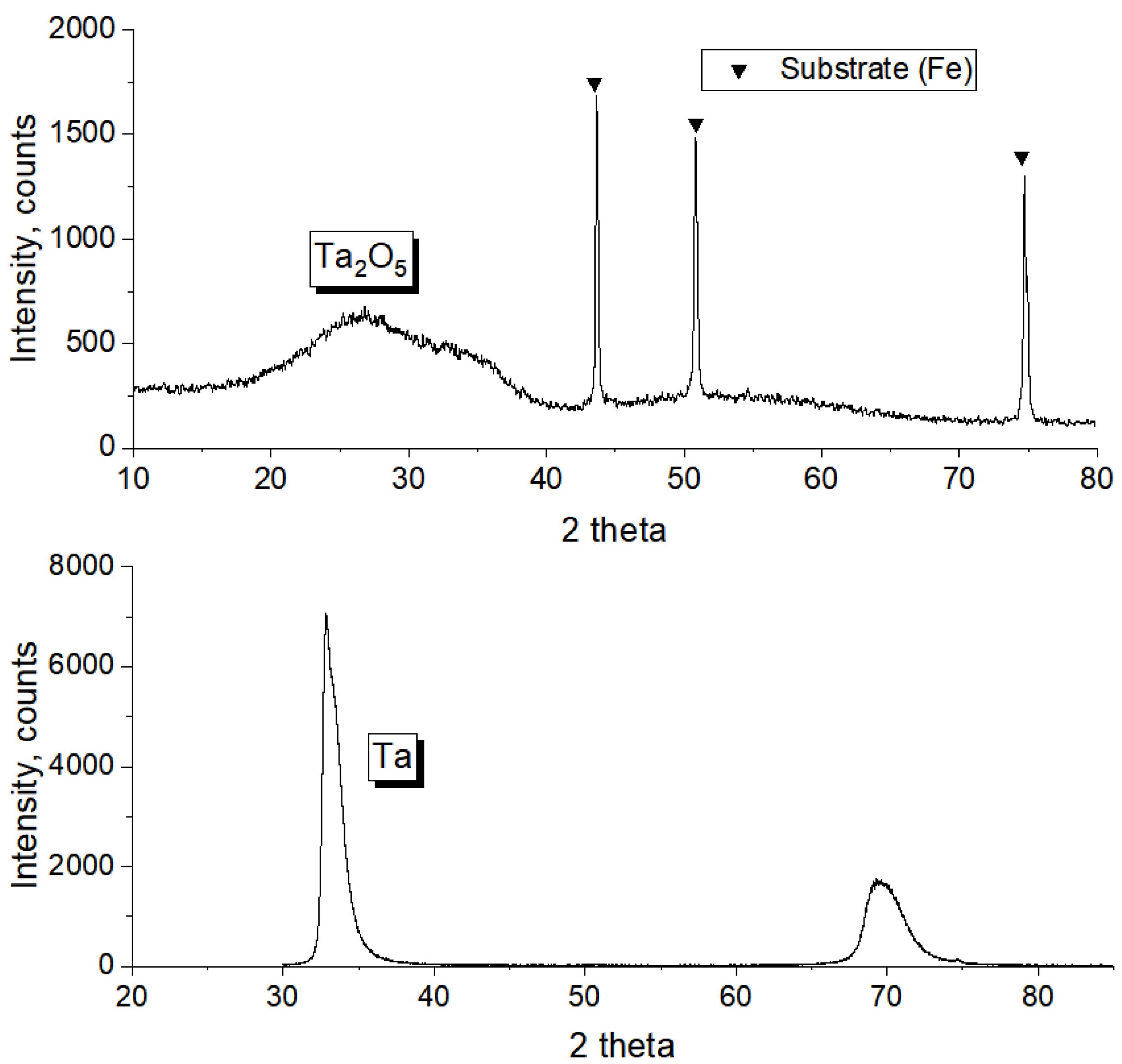
- Amorphous Ta2O5 coatings contrast with highly crystalline β-phase tantalum layers.
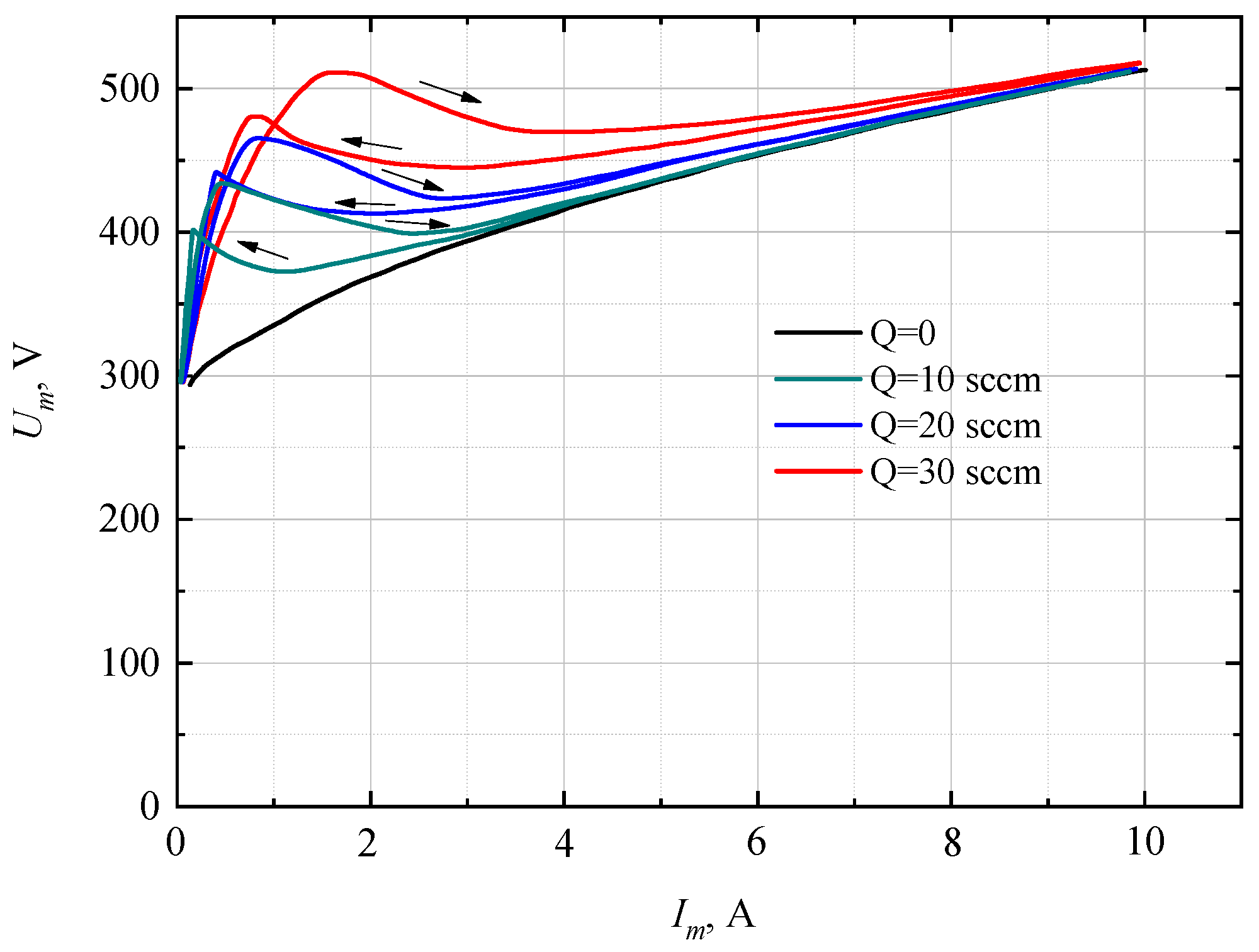
- Superior performance achieved with Ta/Ta2O5 bilayer due to combined mechanical and chemical effects.
- Ta-based coatings show hydrophilic character and surface energy supporting hemocompatibility.
- Synergistic effects in Ta/Ta2O5 bilayer maximize coating performance.
- Bilayer Ta/Ta2O5 coatings provide fracture resistance, corrosion protection and hemocompatibility.
- Integrated mechanical and chemical studies support next-generation stent coating design.
Abstract
1. Introduction
2. Materials and Methods
2.1. Deposition Technique
2.2. Mechanical, Wettability and Corrosion Measurements
3. Results
3.1. Structural Properties of the Ta and Ta2O5 Coatings
3.2. Mechanical Properties of the Ta, Ta2O5, and Ta/Ta2O5 Coatings
- The Ta/Ta2O5 bilayer coating exhibits the highest hardness (9.31 GPa) and superior derived mechanical ratios (H/E = 0.079; H3/E2 = 0.054 GPa), indicating enhanced resistance to both elastic and plastic deformation. These values suggest improved mechanical resilience, essential for maintaining coating integrity during stent expansion and cyclic loading. Despite its moderately high adhesion strength (LC3 = 15.9 N), the bilayer’s performance reflects an effective balance of stiffness, toughness, and interfacial stability.
- The Ta2O5 monolayer coating shows slightly lower hardness (9.15 GPa) but the strongest adhesion to the stainless-steel substrate (LC3 = 24.8 N), which is crucial in preventing delamination under physiological stress. Its relatively high H/E and H3/E2 values (0.078 and 0.054 GPa, respectively) affirm its capacity to withstand cracking while maintaining surface functionality. These metrics support its suitability in applications prioritizing mechanical compliance and strong substrate bonding.
- The pure Ta coating, although biocompatible and moderately hard (6.81 GPa), demonstrates lower toughness indicators (H/E = 0.054; H3/E2 = 0.019 GPa) and reduced adhesion strength (LC3 = 14.6 N). These factors suggest limited energy dissipation ability and reduced tolerance to mechanical strain, which may compromise its long-term protective role in dynamic vascular environments.
3.3. Wettability of Ta, Ta2O5, and Ta/Ta2O5 Coatings
3.4. Anti-Corrosive Properties of the Ta, Ta2O5, and Ta/Ta2O5 Coatings
4. Discussion
4.1. Deposition of Oxide Coatings
4.2. Functional Properties of Ta, Ta2O5, and Ta/Ta2O5 Coatings
- H/E ratio—reflects elastic strain to failure. A higher H/E ratio suggests superior elastic recoverability, allowing the coating to accommodate substrate deformation without cracking. Thus, increased H/E is generally associated with enhanced resistance to brittle fracture.
- H3/E2 ratio—quantifies the resistance to plastic deformation and is often interpreted as a toughness surrogate. It encapsulates the balance between material hardness and compliance, indicating the coating’s ability to absorb and dissipate mechanical energy. Higher values imply improved toughness and diminished risk of delamination or structural failure under load.
5. Conclusions
Author Contributions
Funding
Institutional Review Board Statement
Informed Consent Statement
Data Availability Statement
Conflicts of Interest
References
- Raikar, A.S.; Priya, S.; Bhilegaonkar, S.P.; Somnache, S.N.; Kalaskar, D.M. Surface Engineering of Bioactive Coatings for Improved Stent Hemocompatibility: A Comprehensive Review. Materials 2023, 16, 6940. [Google Scholar] [CrossRef]
- Udriște, A.S.; Burdușel, A.C.; Niculescu, A.-G.; Rădulescu, M.; Grumezescu, A.M. Coatings for Cardiovascular Stents—An Up-to-Date Review. Int. J. Mol. Sci. 2024, 25, 1078. [Google Scholar] [CrossRef]
- Korei, N.; Solouk, A.; Haghbin Nazarpak, M.; Nouri, A. A Review on Design Characteristics and Fabrication Methods of Metallic Cardiovascular Stents. Mater. Today Commun. 2022, 31, 103467. [Google Scholar] [CrossRef]
- Ahadi, F.; Azadi, M.; Biglari, M.; Bodaghi, M.; Khaleghian, A. Evaluation of Coronary Stents: A Review of Types, Materials, Processing Techniques, Design, and Problems. Heliyon 2023, 9, e13575. [Google Scholar] [CrossRef]
- Duan, X.; Yang, Y.; Zhang, T.; Zhu, B.; Wei, G.; Li, H. Research Progress of Metal Biomaterials with Potential Applications as Cardiovascular Stents and Their Surface Treatment Methods to Improve Biocompatibility. Heliyon 2024, 10, e25515. [Google Scholar] [CrossRef]
- Yeh, H.; Lu, S.; Tian, T.; Hong, R.; Lee, W.; Tsai, C. Comparison of Endothelial Cells Grown on Different Stent Materials. J. Biomed. Mater. Res 2006, 76A, 835–841. [Google Scholar] [CrossRef] [PubMed]
- Mosseri, M.; Tamari, I.; Plich, M.; Hasin, Y.; Brizines, M.; Frimerman, A.; Miller, H.; Jafari, J.; Guetta, V.; Solomon, M.; et al. Short- and Long-Term Outcomes of the Titanium-NO Stent Registry. Cardiovasc. Revascularization Med. 2005, 6, 2–6. [Google Scholar] [CrossRef] [PubMed]
- Tuomainen, P.O.; Ylitalo, A.; Niemelä, M.; Kervinen, K.; Pietilä, M.; Sia, J.; Nyman, K.; Nammas, W.; Airaksinen, K.E.J.; Karjalainen, P.P. Five-Year Clinical Outcome of Titanium-Nitride-Oxide-Coated Bioactive Stents versus Paclitaxel-Eluting Stents in Patients with Acute Myocardial Infarction: Long-Term Follow-up from the TITAX AMI Trial. Int. J. Cardiol. 2013, 168, 1214–1219. [Google Scholar] [CrossRef]
- Zhang, F.; Zheng, Z.; Chen, Y.; Liu, X.; Chen, A.; Jiang, Z. In Vivo Investigation of Blood Compatibility of Titanium Oxide Films. J. Biomed. Mater. Res. 1998, 42, 128–133. [Google Scholar] [CrossRef]
- Tsyganov, I.; Maitz, M.F.; Wieser, E.; Richter, E.; Reuther, H. Correlation between Blood Compatibility and Physical Surface Properties of Titanium-Based Coatings. Surf. Coat. Technol. 2005, 200, 1041–1044. [Google Scholar] [CrossRef]
- Windecker, S.; Simon, R.; Lins, M.; Klauss, V.; Eberli, F.R.; Roffi, M.; Pedrazzini, G.; Moccetti, T.; Wenaweser, P.; Togni, M.; et al. Randomized Comparison of a Titanium-Nitride-Oxide–Coated Stent with a Stainless Steel Stent for Coronary Revascularization: The TiNOX Trial. Circulation 2005, 111, 2617–2622. [Google Scholar] [CrossRef] [PubMed]
- Eisenbarth, E.; Velten, D.; Schenk-Meuser, K.; Linez, P.; Biehl, V.; Duschner, H.; Breme, J.; Hildebrand, H. Interactions between Cells and Titanium Surfaces. Biomol. Eng. 2002, 19, 243–249. [Google Scholar] [CrossRef]
- Dion, I.; Bordenave, L.; Lefebvre, F.; Bareille, R.; Baquey, C.; Monties, J.-R.; Havlik, P. Physico-Chemistry and Cytotoxicity of Ceramics: Part II Cytotoxicity of Ceramics. J. Mater. Sci. Mater. Med. 1994, 5, 18–24. [Google Scholar] [CrossRef]
- Ratner, B.D. New Ideas in Biomaterials Science—A Path to Engineered Biomaterials. J. Biomed. Mater. Res. 1993, 27, 837–850. [Google Scholar] [CrossRef]
- Velten, D.; Biehl, V.; Aubertin, F.; Valeske, B.; Possart, W.; Breme, J. Preparation of TiO2 Layers on cp-Ti and Ti6Al4V by Thermal and Anodic Oxidation and by Sol-gel Coating Techniques and Their Characterization. J. Biomed. Mater. Res. 2002, 59, 18–28. [Google Scholar] [CrossRef]
- Grosser, M.; Schmid, U. The Impact of Sputter Conditions on the Microstructure and on the Resistivity of Tantalum Thin Films. Thin Solid Film. 2009, 517, 4493–4496. [Google Scholar] [CrossRef]
- Hallmann, L.; Ulmer, P. Effect of Sputtering Parameters and Substrate Composition on the Structure of Tantalum Thin Films. Appl. Surf. Sci. 2013, 282, 1–6. [Google Scholar] [CrossRef]
- Myers, S.; Lin, J.; Souza, R.M.; Sproul, W.D.; Moore, J.J. The β to α Phase Transition of Tantalum Coatings Deposited by Modulated Pulsed Power Magnetron Sputtering. Surf. Coat. Technol. 2013, 214, 38–45. [Google Scholar] [CrossRef]
- Ren, H.; Sosnowski, M. Tantalum Thin Films Deposited by Ion Assisted Magnetron Sputtering. Thin Solid Film. 2008, 516, 1898–1905. [Google Scholar] [CrossRef]
- Li, Y.; Zhao, T.; Wei, S.; Xiang, Y.; Chen, H. Effect of Ta2O5/TiO2 Thin Film on Mechanical Properties, Corrosion and Cell Behavior of the NiTi Alloy Implanted with Tantalum. Mater. Sci. Eng. C 2010, 30, 1227–1235. [Google Scholar] [CrossRef]
- Todorova, Z.; Donkov, N.; Ristić, Z.; Bundaleski, N.; Petrović, S.; Petkov, M. Electrical and Optical Characteristics of Ta2O5 Thin Films Deposited by Electron-Beam Vapor Deposition. Plasma Process. Polym. 2006, 3, 174–178. [Google Scholar] [CrossRef]
- Macionczyk, F.; Gerold, B.; Thull, R. Repassivating Tantalum/Tantalum Oxide Surface Modification on Stainless Steel Implants. Surf. Coat. Technol. 2001, 142–144, 1084–1087. [Google Scholar] [CrossRef]
- Xu, G.; Shen, X.; Hu, Y.; Ma, P.; Cai, K. Fabrication of Tantalum Oxide Layers onto Titanium Substrates for Improved Corrosion Resistance and Cytocompatibility. Surf. Coat. Technol. 2015, 272, 58–65. [Google Scholar] [CrossRef]
- Jagadeesh Chandra, S.V.; Chandrasekhar, M.; Mohan Rao, G.; Uthanna, S. Substrate Bias Voltage Influenced Structural, Electrical and Optical Properties of Dc Magnetron Sputtered Ta2O5 Films. J. Mater. Sci. Mater. Electron. 2009, 20, 295–300. [Google Scholar] [CrossRef]
- Sun, Y.-S.; Chang, J.-H.; Huang, H.-H. Corrosion Resistance and Biocompatibility of Titanium Surface Coated with Amorphous Tantalum Pentoxide. Thin Solid Film. 2013, 528, 130–135. [Google Scholar] [CrossRef]
- Dudin, S.; Yakovin, S.; Zykov, A.; Yefymenko, N.; Dakhov, O. Corrosion Resistance of Tantalum-Based Coatings on Medical Implants. In Proceedings of the 2023 IEEE 13th International Conference Nanomaterials: Applications & Properties (NAP), Bratislava, Slovakia, 10–15 September 2023; IEEE: Piscataway, NJ, USA, 2023; pp. MTFC13-1–MTFC13-4. [Google Scholar]
- Pham, V.-H.; Lee, S.-H.; Li, Y.; Kim, H.-E.; Shin, K.-H.; Koh, Y.-H. Utility of Tantalum (Ta) Coating to Improve Surface Hardness in Vitro Bioactivity and Biocompatibility of Co–Cr. Thin Solid Film. 2013, 536, 269–274. [Google Scholar] [CrossRef]
- Cheng, Y.; Wei, C.; Gan, K.Y.; Zhao, L.C. Surface Modification of TiNi Alloy through Tantalum Immersion Ion Implantation. Surf. Coat. Technol. 2004, 176, 261–265. [Google Scholar] [CrossRef]
- Matsuno, H. Biocompatibility and Osteogenesis of Refractory Metal Implants, Titanium, Hafnium, Niobium, Tantalum and Rhenium. Biomaterials 2001, 22, 1253–1262. [Google Scholar] [CrossRef] [PubMed]
- Miyazaki, T.; Kim, H.-M.; Kokubo, T.; Ohtsuki, C.; Kato, H.; Nakamura, T. Mechanism of Bonelike Apatite Formation on Bioactive Tantalum Metal in a Simulated Body Fluid. Biomaterials 2002, 23, 827–832. [Google Scholar] [CrossRef] [PubMed]
- Soltanalipour, M.; Khalil-Allafi, J. Superior in Vitro Corrosion Resistance of the Novel Amorphous Ta/TaxOy Multilayer Coatings on Self-Expanding Nitinol Stents. Surf. Coat. Technol. 2022, 446, 128767. [Google Scholar] [CrossRef]
- Yakovin, S.; Dudin, S.; Zykov, A.; Farenik, V. Integral Cluster Set-Up for Complex Compound Composites Synthesis. Probl. At. Sci. Technol. 2011, 1, 152–154. [Google Scholar]
- Zykova, A.; Safonov, V.; Goltsev, A.; Dubrava, T.; Rossokha, I.; Smolik, J.; Rogovska, R.; Yakovin, S.; Kolesnikov, D.; Sudzhanskaya, I.; et al. The Effect of Surface Treatment of Ceramic Oxide Coatings Deposited by Magnetron Sputtering Method on the Adhesive and Proliferative Activity of Mesenchymal Stem Cells. Surf. Coat. Technol. 2016, 301, 114–120. [Google Scholar] [CrossRef]
- Donkov, N.; Walkowicz, J.; Zavaleyev, V.; Zykova, A.; Safonov, V.; Dudin, S.; Yakovin, S. Mechanical Properties of Tantalum-Based Ceramic Coatings for Biomedical Applications. J. Phys. Conf. Ser. 2018, 992, 012034. [Google Scholar] [CrossRef]
- Hollerweger, R.; Holec, D.; Paulitsch, J.; Rachbauer, R.; Polcik, P.; Mayrhofer, P.H. Magnetic Field Strength Influence on the Reactive Magnetron Sputter Deposition of Ta2O5. J. Phys. D Appl. Phys. 2013, 46, 335203. [Google Scholar] [CrossRef]
- EN ISO 26423:2016; Fine Ceramics (Advanced Ceramics, Advanced Technical Ceramics)—Determination of Coating Thickness by Crater-Grinding Method (ISO 26423:2009). CEN-CENELEC Management Centre: Brussels, Belgium, 2016.
- Bull, S.J.; Berasetegui, E.G. An Overview of the Potential of Quantitative Coating Adhesion Measurement by Scratch Testing. Tribol. Int. 2006, 39, 99–114. [Google Scholar] [CrossRef]
- VDI 3198; Verein Deutscher Ingenieure Normen. VDI: Dusseldorf, Germany, 1991.
- Vidakis, N.; Antoniadis, A.; Bilalis, N. The VDI 3198 Indentation Test Evaluation of a Reliable Qualitative Control for Layered Compounds. J. Mater. Process. Technol. 2003, 143–144, 481–485. [Google Scholar] [CrossRef]
- ISO 14577-1:2015(E); Metallic Materials—Instrumented Indentation Test for Hardness and Materials Parameters—Part 1: Test Method. ISO Copyright Office: Geneva, Switzerland, 2015.
- Oliver, W.C.; Pharr, G.M. An Improved Technique for Determining Hardness and Elastic Modulus Using Load and Displacement Sensing Indentation Experiments. J. Mater. Res. 1992, 7, 1564–1583. [Google Scholar] [CrossRef]
- Owens, D.K.; Wendt, R.C. Estimation of the Surface Free Energy of Polymers. J Appl. Polym. Sci 1969, 13, 1741–1747. [Google Scholar] [CrossRef]
- Walkowicz, J.; Zavaleyev, V.; Dobruchowska, E.; Murzynski, D.; Donkov, N.; Zykova, A.; Safonov, V.; Yakovin, S. Corrosion Properties of Zirconium-Based Ceramic Coatings for Micro-Bearing and Biomedical Applications. J. Phys. Conf. Ser. 2016, 700, 012026. [Google Scholar] [CrossRef]
- Chun, W.-J.; Ishikawa, A.; Fujisawa, H.; Takata, T.; Kondo, J.N.; Hara, M.; Kawai, M.; Matsumoto, Y.; Domen, K. Conduction and Valence Band Positions of Ta2O5, TaON, and Ta3N5 by UPS and Electrochemical Methods. J. Phys. Chem. B 2003, 107, 1798–1803. [Google Scholar] [CrossRef]
- Zykova, A.; Safonov, V.; Yakovin, S.; Dudin, S.; Melnikova, G.; Petrovskaya, A.; Tolstaya, T.; Kuznetsova, T.; Chizhik, S.A.; Donkov, N. Comparative Analysis of Platelets Adhesion to the Surface of Ta-Based Ceramic Coatings Deposited by Magnetron Sputtering. J. Phys. Conf. Ser. 2020, 1492, 012038. [Google Scholar] [CrossRef]
- Simpson, R.; White, R.G.; Watts, J.F.; Baker, M.A. XPS Investigation of Monatomic and Cluster Argon Ion Sputtering of Tantalum Pentoxide. Appl. Surf. Sci. 2017, 405, 79–87. [Google Scholar] [CrossRef]
- Li, T.-C.; Lwo, B.-J.; Pu, N.-W.; Yu, S.-P.; Kao, C.-H. The Effects of Nitrogen Partial Pressure on the Properties of the TaNx Films Deposited by Reactive Magnetron Sputtering. Surf. Coat. Technol. 2006, 201, 1031–1036. [Google Scholar] [CrossRef]
- Lenz-Habijan, T.; Bhogal, P.; Peters, M.; Bufe, A.; Martinez Moreno, R.; Bannewitz, C.; Monstadt, H.; Henkes, H. Hydrophilic Stent Coating Inhibits Platelet Adhesion on Stent Surfaces: Initial Results In Vitro. Cardiovasc. Interv. Radiol. 2018, 41, 1779–1785. [Google Scholar] [CrossRef]
- Chang, Y.-Y.; Huang, H.-L.; Chen, H.-J.; Lai, C.-H.; Wen, C.-Y. Antibacterial Properties and Cytocompatibility of Tantalum Oxide Coatings. Surf. Coat. Technol. 2014, 259, 193–198. [Google Scholar] [CrossRef]
- Zhao, Q.; Wang, S.; Müller-Steinhagen, H. Tailored Surface Free Energy of Membrane Diffusers to Minimize Microbial Adhesion. Appl. Surf. Sci. 2004, 230, 371–378. [Google Scholar] [CrossRef]
- Zhang, X.; Wang, L.; Levänen, E. Superhydrophobic Surfaces for the Reduction of Bacterial Adhesion. RSC Adv. 2013, 3, 12003. [Google Scholar] [CrossRef]
- Huang, H.-L.; Chang, Y.-Y.; Chen, H.-J.; Chou, Y.-K.; Lai, C.-H.; Chen, M.Y.C. Antibacterial Properties and Cytocompatibility of Tantalum Oxide Coatings with Different Silver Content. J. Vac. Sci. Technol. A Vac. Surf. Film. 2014, 32, 02B117. [Google Scholar] [CrossRef]
- Yang, H.; Yang, K.; Zhang, B. Pitting Corrosion Resistance of La Added 316L Stainless Steel in Simulated Body Fluids. Mater. Lett. 2007, 61, 1154–1157. [Google Scholar] [CrossRef]
- Sun, Y.; Haruman, E. Tribocorrosion Behaviour of Low Temperature Plasma Carburised 316L Stainless Steel in 0.5M NaCl Solution. Corros. Sci. 2011, 53, 4131–4140. [Google Scholar] [CrossRef]
- Ceschini, L.; Chiavari, C.; Lanzoni, E.; Martini, C. Low-Temperature Carburised AISI 316L Austenitic Stainless Steel: Wear and Corrosion Behaviour. Mater. Des. 2012, 38, 154–160. [Google Scholar] [CrossRef]
- Metikoš-Huković, M.; Ceraj-Cerić, M. p-Type and n-Type Behavior of Chromium Oxide as a Function of the Applied Potential. J. Electrochem. Soc. 1987, 134, 2193–2197. [Google Scholar] [CrossRef]
- Hu, W.; Xu, J.; Lu, X.; Hu, D.; Tao, H.; Munroe, P.; Xie, Z.-H. Corrosion and Wear Behaviours of a Reactive-Sputter-Deposited Ta2O5 Nanoceramic Coating. Appl. Surf. Sci. 2016, 368, 177–190. [Google Scholar] [CrossRef]
- Pourbaix, M. Significance of Protection Potential in Pitting and Intergranular Corrosion. Corrosion 1970, 26, 431–438. [Google Scholar] [CrossRef]
- Österlund, L.; Zoric-acute, I.; Kasemo, B. Dissociative Sticking of O 2 on Al(111). Phys. Rev. B 1997, 55, 15452–15455. [Google Scholar] [CrossRef]
- Behler, J.; Delley, B.; Lorenz, S.; Reuter, K.; Scheffler, M. Dissociation of O 2 at Al(111): The Role of Spin Selection Rules. Phys. Rev. Lett. 2005, 94, 036104. [Google Scholar] [CrossRef]
- Schneider, J.M.; Sproul, W.D. Handbook of Thin Film Process Technology; CRC Press: Boca Raton, FL, USA, 1998; Chapter pA5.1; pp. 1–12. [Google Scholar]
- Kharrazi Olsson, M.; Macák, K.; Helmersson, U.; Hjörvarsson, B. High Rate Reactive Dc Magnetron Sputter Deposition of Al2O3 Films. J. Vac. Sci. Technol. A Vac. Surf. Film. 1998, 16, 639–643. [Google Scholar] [CrossRef]
- Dudin, S.V.; Yakovin, S.D.; Zykov, A.V. The Effect of Plasma Activation of Reactive Gas in Reactive Magnetron Sputtering. East Eur. J. Phys. 2023, 606–612. [Google Scholar] [CrossRef]
- Zhang, S.; Deng, Z.; Wang, Y.; Zhao, C. A Review of Anticoagulant Surface Modification Strategies for Blood-Contacting Materials: From Inertness to Bioinspired and Biointegration. Coatings 2025, 15, 1486. [Google Scholar] [CrossRef]
- Han, J.; Xia, J.; Zhang, H.; Zhao, W.; San, H.; Liu, Y.; Ma, J.; Serdechnova, M.; Simka, W.; Lu, X.; et al. Coordinated Control of Drug Release and Corrosion Resistance for 3D-Printed Porous Mg Alloy in Bone Implant Applications. J. Magnes. Alloys 2025, 13, 6252–6273. [Google Scholar] [CrossRef]
- Tsui, T.Y.; Pharr, G.M.; Oliver, W.C.; Bhatia, C.S.; White, R.L.; Anders, S.; Anders, A.; Brown, I.G. Nanoindentation and Nanoscratching of Hard Carbon Coatings for Magnetic Disks. MRS Proc. 1995, 383, 447. [Google Scholar] [CrossRef]
- Musil, J.; Kunc, F.; Zeman, H.; Poláková, H. Relationships between Hardness, Young’s Modulus and Elastic Recovery in Hard Nanocomposite Coatings. Surf. Coat. Technol. 2002, 154, 304–313. [Google Scholar] [CrossRef]
- Leyland, A.; Matthews, A. On the Significance of the H/E Ratio in Wear Control: A Nanocomposite Coating Approach to Optimised Tribological Behaviour. Wear 2000, 246, 1–11. [Google Scholar] [CrossRef]
- Beake, B.D. The Influence of the H/E Ratio on Wear Resistance of Coating Systems—Insights from Small-Scale Testing. Surf. Coat. Technol. 2022, 442, 128272. [Google Scholar] [CrossRef]
- Musil, J.; Jirout, M. Toughness of Hard Nanostructured Ceramic Thin Films. Surf. Coat. Technol. 2007, 201, 5148–5152. [Google Scholar] [CrossRef]
- Jara, A.; Fraisse, B.; Flaud, V.; Fréty, N.; Gonzalez, G. Thin Film Deposition of Ta, TaN and Ta/TaN Bi-Layer on Ti and SS316-LVM Substrates by RF Sputtering. Surf. Coat. Technol. 2017, 309, 887–896. [Google Scholar] [CrossRef]
- Fenker, M.; Balzer, M.; Kappl, H. Corrosion Protection with Hard Coatings on Steel: Past Approaches and Current Research Efforts. Surf. Coat. Technol. 2014, 257, 182–205. [Google Scholar] [CrossRef]
- Gilewicz, A.; Chmielewska, P.; Murzynski, D.; Dobruchowska, E.; Warcholinski, B. Corrosion Resistance of CrN and CrCN/CrN Coatings Deposited Using Cathodic Arc Evaporation in Ringer’s and Hank’s Solutions. Surf. Coat. Technol. 2016, 299, 7–14. [Google Scholar] [CrossRef]
- Baier, R.E. Surface Behaviour of Biomaterials: The Theta Surface for Biocompatibility. J. Mater. Sci. Mater. Med. 2006, 17, 1057–1062. [Google Scholar] [CrossRef]
- Beshchasna, N.; Ho, A.Y.K.; Saqib, M.; Kraśkiewicz, H.; Wasyluk, Ł.; Kuzmin, O.; Duta, O.C.; Ficai, D.; Trusca, R.D.; Ficai, A.; et al. Surface Evaluation of Titanium Oxynitride Coatings Used for Developing Layered Cardiovascular Stents. Mater. Sci. Eng. C 2019, 99, 405–416. [Google Scholar] [CrossRef] [PubMed]





| Parameter/Coating | Ta | Ta2O5 | Ta/Ta2O5 |
|---|---|---|---|
| Argon pressure (Pa) | 0.12 | 0.12 | 0.12 |
| Magnetron voltage (V) | 465 | 508 | 465/505 |
| Magnetron current (A) | 7.7 | 5.9 | 7.7/6.1 |
| Oxygen gas flow (sccm) | 0 | 30 | 0/30 |
| Total pressure (Pa) | 0.12 | 0.16 | 0.12/0.16 |
| Layer thickness (μm) | 0.72 | 0.98 | 0.42/0.58 |
| Coating | Mechanical Parameters (Average Results of 10 Tests) | ||||
|---|---|---|---|---|---|
| Hardness, H (GPa) | Young Modulus, E (GPa) | H/E | H3/E2 (GPa) | Adhesion LC3 (N) | |
| 316L | 4.26 ± 0.29 | 169.6 ± 15 | 0.025 | 0.003 | - |
| Ta | 6.81 ± 0.13 | 127.3 ± 4 | 0.054 | 0.019 | 7.4 ± 0.4 |
| Ta2O5 | 9.15 ± 0.13 | 108.1 ± 11 | 0.078 | 0.052 | 24.1 ± 0.7 |
| Ta/Ta2O5 | 9.31 ± 0.19 | 109.0 ± 15 | 0.079 | 0.054 | 15.9 ± 0.5 |
| Coating | Critical Load (N) | ||
|---|---|---|---|
| LC1 | LC2 | LC3 | |
| Ta |  0.9 |  4.3 |  7.4 |
| Ta2O5 | 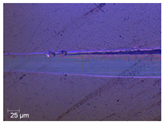 0.9 |  10.8 |  24.9 |
| Ta/Ta2O5 |  0.9 |  8.1 |  14.2 |
| Coating | Rockwell Test (HF1 ÷ HF6 Scale) | |
|---|---|---|
| Ta |  |  |
| HF2–HF3 | ||
| Ta2O5 |  |  |
| HF2 | ||
| Ta/Ta2O5 | 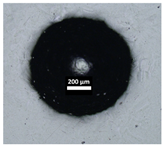 |  |
| HF1–HF2 | ||
| Coating | SFE and Its Polar and Dispersion Parts by Owens–Wendt–Rabel–Kaeble Method | ||
|---|---|---|---|
| γ (mN/m) | γd (mN/m) | γp (mN/m) | |
| Ta | 31.12 | 20.05 | 11.07 |
| Ta2O5 | 33.37 | 21.08 | 12.29 |
| Ta/Ta2O5 | 34.23 | 21.95 | 12.38 |
| Substrate/Coating | Ecorr (V) | Eb (V) | icorr (A/cm2) | Rpol (Ωcm2) |
|---|---|---|---|---|
| 316L | −0.292 ± 0.014 | 0.364 ± 0.016 | (3.0 ± 0.9) × 10−7 | (3.4 ± 1.1) × 105 |
| 316L/Ta | −0.198 ± 0.026 | 0.481 ± 0.079 | (1.0 ± 0.3) × 10−8 | (2.1 ± 0.2) × 106 |
| 316L/Ta2O5 | −0.181 ± 0.011 | 0.285 ± 0.007 | (1.2 ± 0.2) × 10−9 | (3.9 ± 1.0) × 107 |
| 316L/Ta/Ta2O5 | −0.320 ± 0.028 | 0.450 ± 0.069 | (3.3 ± 0.1) × 10−10 | - |
| Substrate/Coating | OCP After 12 h (V) |
|---|---|
| 316 | −0.194 |
| 316L/Ta | −0.084 |
| 316L/Ta2O5 | 0.049 |
| 316L/Ta/Ta2O5 | 0.093 |
Disclaimer/Publisher’s Note: The statements, opinions and data contained in all publications are solely those of the individual author(s) and contributor(s) and not of MDPI and/or the editor(s). MDPI and/or the editor(s) disclaim responsibility for any injury to people or property resulting from any ideas, methods, instructions or products referred to in the content. |
© 2026 by the authors. Licensee MDPI, Basel, Switzerland. This article is an open access article distributed under the terms and conditions of the Creative Commons Attribution (CC BY) license.
Share and Cite
Dobruchowska, E.; Zykova, A.; Walkowicz, J.; Safonov, V.; Dudin, S.; Yakovin, S.; Zavaleyev, V.; Pancielejko, M. Tantalum/Tantalum Oxide Coatings for Cardiovascular Stents: Enhancing Mechanical Performance, Corrosion Resistance, and Hemocompatibility. Coatings 2026, 16, 415. https://doi.org/10.3390/coatings16040415
Dobruchowska E, Zykova A, Walkowicz J, Safonov V, Dudin S, Yakovin S, Zavaleyev V, Pancielejko M. Tantalum/Tantalum Oxide Coatings for Cardiovascular Stents: Enhancing Mechanical Performance, Corrosion Resistance, and Hemocompatibility. Coatings. 2026; 16(4):415. https://doi.org/10.3390/coatings16040415
Chicago/Turabian StyleDobruchowska, Ewa, Anna Zykova, Jan Walkowicz, Vladimir Safonov, Stanislav Dudin, Stanislav Yakovin, Viktor Zavaleyev, and Mieczysław Pancielejko. 2026. "Tantalum/Tantalum Oxide Coatings for Cardiovascular Stents: Enhancing Mechanical Performance, Corrosion Resistance, and Hemocompatibility" Coatings 16, no. 4: 415. https://doi.org/10.3390/coatings16040415
APA StyleDobruchowska, E., Zykova, A., Walkowicz, J., Safonov, V., Dudin, S., Yakovin, S., Zavaleyev, V., & Pancielejko, M. (2026). Tantalum/Tantalum Oxide Coatings for Cardiovascular Stents: Enhancing Mechanical Performance, Corrosion Resistance, and Hemocompatibility. Coatings, 16(4), 415. https://doi.org/10.3390/coatings16040415