


Abstract
This study investigates the preparation and performance of ultra-high-performance concrete (UHPC) incorporating manufactured sand as a full replacement for quartz sand. The mix design was optimized by integrating the compressible packing model (CPM) with an orthogonal experimental design. The influence of stone powder content in manufactured sand—0, 5, 10, and 15% by mass of fine aggregate—on fresh-state fluidity and 7d-mechanical properties was systematically evaluated. Hydration products and microstructural features were analyzed using X-ray diffraction (XRD), scanning electron microscope (SEM), and mercury intrusion porosimetry (MIP). Results show that the manufactured sand-based UHPC achieved a fresh-state fluidity of 185 mm and a 7-day compressive strength of 152.4 MPa. Both fluidity and compressive strength exhibited a unimodal trend with increasing stone powder content, reaching maxima at 10%. Microstructural analysis revealed intimate interfacial bonding between unhydrated particles and calcium silicate hydrate (C–S–H) gel; notably, the UHPC matrix with 10% stone powder displayed the densest microstructure. MIP results further demonstrated that an optimal stone powder content effectively reduced total porosity, with the lowest overall porosity and the highest volume fractions of harmless (≤20 nm) and less harmful (20–100 nm) pores observed at 10%. These microstructural refinements collectively underpin the superior mechanical performance of manufactured sand-based UHPC.
1. Introduction
Ultra-high-performance concrete (UHPC) exhibits exceptional mechanical properties and durability [1,2], enabling structural weight reduction, enhanced load-carrying capacity of components, and extended service life. Consequently, UHPC has been increasingly deployed in critical engineering applications, including long-span bridges, nuclear containment structures, offshore wind turbine foundations, and seismic-resistant prefabricated systems, owing to its exceptional compressive strength (>120 MPa), high fracture energy, and superior resistance to chloride ingress, carbonation, and freeze–thaw cycling [1,2,3,4,5,6].
However, conventional UHPC formulations rely predominantly on quartz sand as the fine aggregate [7,8]. In China, natural quartz sand reserves are not only geographically constrained and economically depleted but also subject to increasingly stringent ecological regulation. Rising demand has exacerbated supply instability [9], thereby limiting the broader engineering deployment of UHPC.
Concurrently, large-scale earthwork excavation associated with mega-projects, such as inter-basin water transfer systems, high-speed rail networks, and national expressway corridors, produces vast quantities of excavated rock that can be processed and utilized as aggregate for concrete production. Among these by-products, mechanically processed fine aggregates in specified particle size distributions below 4.75 mm [10] are commonly classified as manufactured sand (MS). Manufactured sand features angular particle shapes, a rough surface texture, and mechanical strength comparable to that of the parent rock, while also offering economic advantages [11,12].
A growing number of researchers have adopted manufactured sand as fine aggregate in the formulation of UHPC. Xiong Hongrui et al. [13] substituted high-quality manufactured sand for quartz sand to produce Reactive Powder Concrete with enhanced mechanical properties (compressive strength > 100 MPa). Shen et al. [12] optimized the particle gradation and developed manufactured sand-based UHPC, achieving a compressive strength of 120 MPa. Kay et al. [14] employed manufactured sand with particle sizes below 1.2 mm sourced from various rock types to produce manufactured sand-based UHPC with a compressive strength of 200 MPa. Wang Quanchao et al. [15] developed manufactured sand-based UHPC exhibiting a slump flow of 680 mm, a compressive strength of 135.6 MPa, and a flexural strength of 25.8 MPa through the application of well-optimized gradation techniques. Liu Chen [16] reported that the particle morphology of manufactured sand exerts a dual effect on the performance of UHPC. Specifically, when granite-derived manufactured sand replaced 60% of natural sand, the resulting UHPC exhibited superior fresh-state workability and retained compressive and tensile strengths comparable to those of the natural sand reference mixture. Yang et al. [17] partially replaced river sand with manufactured sand in the preparation of UHPC. The study demonstrated that although the incorporation of manufactured sand decreases UHPC fluidity, it substantially improves compressive strength and increases autogenous shrinkage. Bian Chen et al. [18] found that the workability of manufactured sand-based UHPC and river sand-based UHPC decreased by 17.3% and 15.8%, respectively, while the compressive strength declined by 7.0% and 9.7%, correspondingly. Chu Hongyan et al. [19] replaced river sand with manufactured sand in UHPC, achieving compressive strength of 169.9 MPa (+5.2%), flexural strength of 18.8 MPa (+15.3%), and elastic modulus of 47.8 GPa (+5.8%)—all exceeding those of the river sand reference mixture.
The aforementioned research findings suggest that manufactured sand can function as a feasible alternative to quartz sand in the preparation of UHPC. However, the production process of manufactured sand typically results in a significant amount of stone powder (particle size below 0.075 mm), with content levels generally ranging from 5% to 20% [20,21]. Owing to its high specific surface area, stone powder significantly increases the water demand of concrete mixtures, thereby reducing fresh-state workability, impairing particle packing density and microstructural homogeneity, and ultimately hindering strength development [17,22]. Nevertheless, systematic investigations into the influence of stone powder on UHPC performance remain scarce in the current literature.
Given these considerations, this study adopts granite-derived manufactured sand—rather than quartz sand—as the fine aggregate in UHPC and systematically investigates its mix design, preparation, and performance. The work adopts a rigorously structured, three-phase technical framework—(1) theoretical design, (2) performance validation, and (3) mechanistic elucidation—to systematically investigate how stone powder modulates the properties of manufactured sand-based UHPC. First, guided by the dense particle packing theory, specifically the Compressible Packing Model (CPM) [23], the particle size distribution of manufactured sand and the composition of the UHPC binder system (Portland cement, silica fume, and fly ash) were jointly optimized via orthogonal experimental design to achieve synergistic densification. Second, the quantitative effects of stone powder content (0%, 5%, 10%, and 15% by mass of fine aggregate) on fresh-state fluidity and hardened-state mechanical properties (compressive strength, splitting tensile strength, and flexural strength) were systematically evaluated. Third, X-ray diffraction (XRD), scanning electron microscopy (SEM), and mercury intrusion porosimetry (MIP) were integrated to elucidate the hydration kinetics and microstructural evolution of manufactured sand UHPC, thereby revealing how stone powder governs macroscopic performance through hydration products and quantifiable modifications to pore structure (e.g., total porosity, critical pore diameter).
2. Materials and Methods
2.1. Material
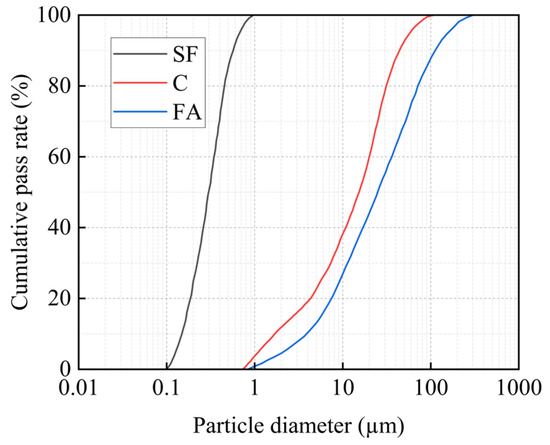
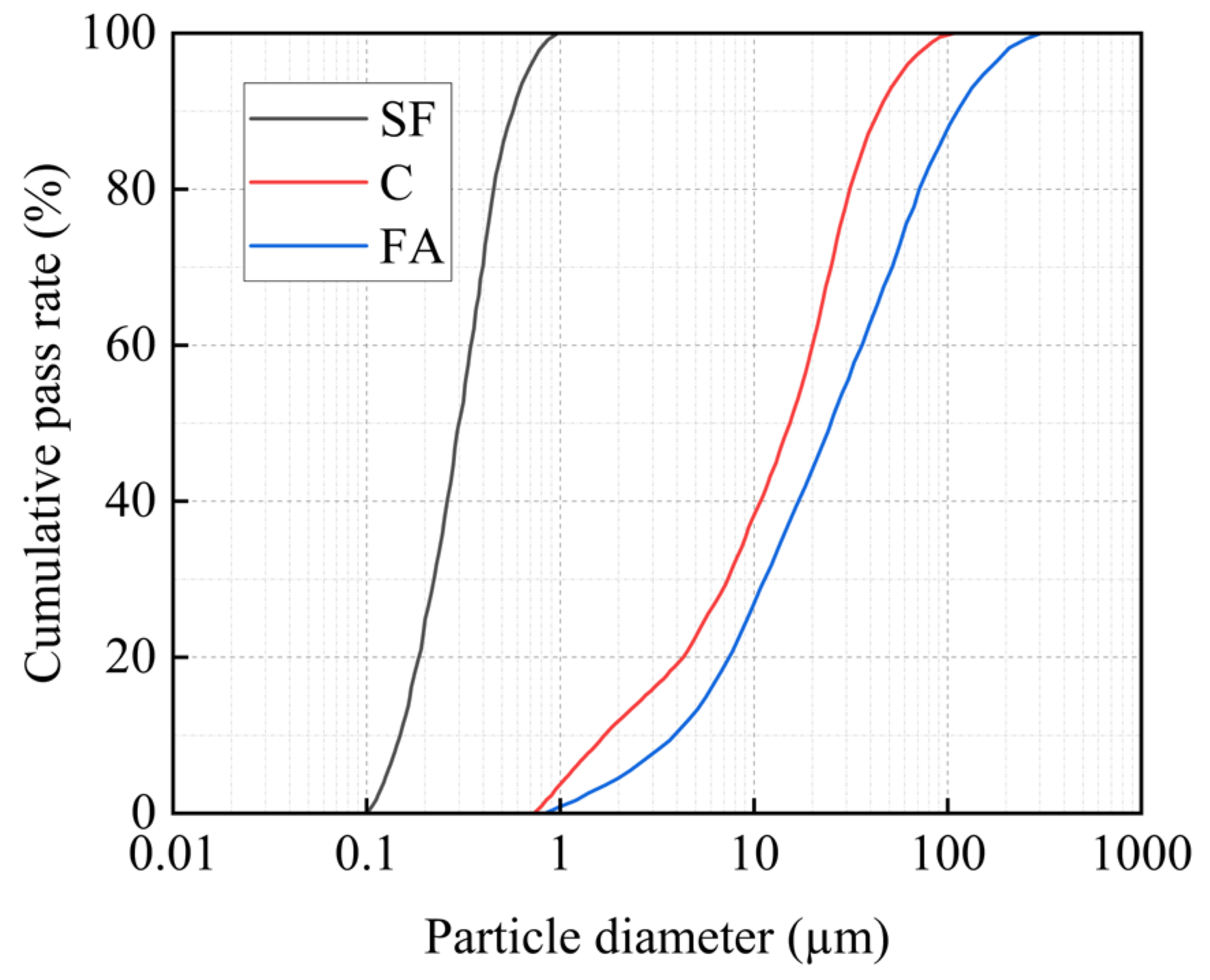
In this study, ordinary Portland cement (OPC) complying with GB 175–2023 [24], Grade 52.5, was used as the primary binder; its key physical properties are presented in Table 1. Supplementary cementitious materials comprised silica fume (SF) and fly ash (FA). The SF exhibited a density of 2220 kg/m3, a 7-day activity index of 105%, and a specific surface area of 23,453 m2/kg. The FA had a density of 2440 kg/m3 and a specific surface area of 545 m2/kg. Their respective chemical compositions and particle size distributions are reported in Table 2 and illustrated in Figure 1. To ensure adequate workability, a polycarboxylate-based superplasticizer (SP) with a water-reduction capacity of 35% was employed. The fine aggregate consisted of quartz sand (particle size range: 0.15–1.18 mm), supplied by Henan Mishang Environmental Technology Co., Ltd. (Zhengzhou, China) It features a SiO2 content of 98%, a fineness modulus of 2.6, and an apparent density of 2630 kg/m3.
Table 1.
Physical properties of cement.
Table 2.
Chemical composition of cement, silica fume, and fly ash (wt%).
Figure 1.
Particle size distribution of the cement, fly ash, and silica fume used in this study.
The manufactured sand used in this study was obtained by crushing granite at a construction site, followed by sieving to obtain particles within the size range of 0.15–1.18 mm. These particles were used as fine aggregate for the preparation of ultra-high-performance concrete (UHPC). The apparent density of the manufactured sand is 2650 kg/m3, with a fineness modulus of 2.83. The chemical composition of the manufactured sand is presented in Table 3. Stone powder is defined as the fraction of particles finer than 0.075 mm in manufactured sand, isolated via dry sieve analysis of the parent granite-derived manufactured sand. Manufactured sands with controlled stone powder contents (0, 5%, 10%, and 15% by mass of fine aggregate) were prepared by blending a stone powder fraction with the base manufactured sand (0.15–1.18 mm), both derived from the same granite parent material. Additionally, copper-plated micro-fine steel fibers were employed as reinforcement materials, and their performance characteristics are summarized in Table 4.
Table 3.
Chemical composition of manufactured sand (wt%).
Table 4.
Steel fiber performance characteristics.
2.2. Design for the Gradation of Manufactured Sand and Cementitious Material Mix Proportion Based on the Compressible Packing Model (CPM)
2.2.1. A Concise Overview of Compressible Packing Model (CPM)
The fundamental principle of UHPC formulation lies in the optimization of particle grading, which is based on the theory of dense compaction. This approach is intended to enhance the overall density of the UHPC mixture, thereby facilitating the attainment of ultra-high mechanical properties and superior durability [25,26,27]. To evaluate the packing density of concrete particles, researchers have developed various mathematical models aimed at guiding the improvement of material performance. These models include the Furnas model [28], the Aim and Goff model [29,30], the modified Toufar model [31], and the Dewar model [32].
De Larrard F. integrated principles of statistical mechanics with experimental data to develop the compressible packing model (CPM), which is derived from both the linear packing model and the solid suspension model. This model considers the interactions among particles of varying sizes and the influence of packing configuration on compaction density. The core formula is given in Equation (1) [23,33,34,35,36]:
Revision: In this model, represents the virtual packing density of the system when class i is prevailing; while denotes the residual packing density of class i under individual compaction; the parameter signifies the volumetric proportion of each size fraction relative to the total solid volume; the loosening and wall effect coefficients are expressed by and , respectively; diameters of particle classes i and j (based on sieve sizes) are denoted as and ; furthermore, stands for the compaction index, and defines the actual packing density of the particulate assembly.
2.2.2. Design Steps Based on Compressible Packing Model
The model is constructed based on a monodisperse particle system comprising continuous particle sizes classes. The characteristic particle size, denoted as and , along with its corresponding volume fraction , is obtained through a laser particle size analyzer. Based on the measured packing density, the virtual packing of the i-class compacted alone for each particle size is calculated using Equation (1) [37]. Different compaction indices, , corresponded to distinct packing processes, and the value of was selected in accordance with reference [38].
The gradation design of manufactured sand and the mix proportion design of cementitious materials are conducted as follows [34]: First, a MATLAB (2024)-based computational program is developed according to Equation (1). The characteristic particle sizes (di and dj) of each size fraction, along with its volume fraction (yi) and the virtual packing density (βi) of the i-th fraction compacted in isolation, are input into the program. The theoretical packing density (γi) of each fraction is then computed. Second, incorporating the experimentally determined compaction index K, the program calculates the actual packing density (∅) [34,38]. Finally, through iterative optimization of the manufactured sand gradation and the cementitious material composition ratio, the program identifies the combination that maximizes the overall packing density, thereby determining the optimal manufactured sand gradation and cementitious material proportion for achieving the densest possible microstructure.
2.3. Test Methods
2.3.1. Measurement of Fluidity of Fresh UHPC Mixture
The preparation of UHPC mixtures, including those with manufactured or quartz sand, followed a standardized procedure of mixing, casting, and vibrating. The dry components, comprising the binders (cement, SF, and FA) and fine aggregates, were first homogenized for 60 s. This was followed by the addition of the superplasticizer and 66% of the mixing water, with a subsequent 2 min blending period. In the final stage, the steel fibers and the residual water were incorporated, and the mixing continued for another 3 min, bringing the total duration to approximately 6 min. The fresh-state flowability was then determined adhering to the Chinese Standard GB/T 2419-2005 [39].
2.3.2. Assessment of Compressive, Tensile, Flexural, and Shear Strength of UHPC
To assess the mechanical performance (compressive, tensile, flexural, and shear strengths), various specimens were fabricated for each UHPC batch. These included six 100 mm cubes for compression testing and six dog-bone-shaped samples (total length 368 mm; tensile Section 100 mm × 50 mm × 50 mm), which were strengthened with carbon fiber fabric as per [40]. Additionally, seven prisms were cast, consisting of three units with a 100 mm × 100 mm × 400 mm geometry and four others measuring 100 mm × 100 mm × 300 mm.
After the UHPC mixture was uniformly mixed, it was poured into pre-prepared molds that had been coated with mold release oil to minimize interfacial friction between the molds and the mixture. The mixture was then compacted using a vibration table. The cast specimens were covered with plastic sheets prior to demolding to prevent moisture loss due to evaporation. The specimens were demolded 24 h after casting and subsequently transferred to a steam curing chamber. They were then heated at a rate of 10–15 °C/min to a temperature of 90 °C and maintained at this temperature for 72 h. Following this thermal curing phase, the specimens were gradually cooled to room temperature and then cured at a temperature of 20 ± 2 °C and a relative humidity of 95% (standard curing) until reaching the 7-day testing age.
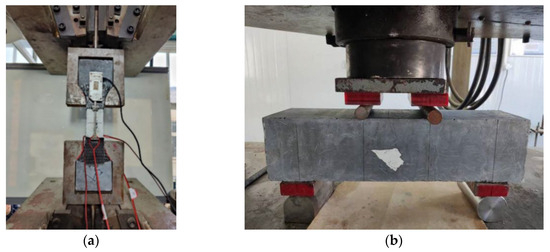
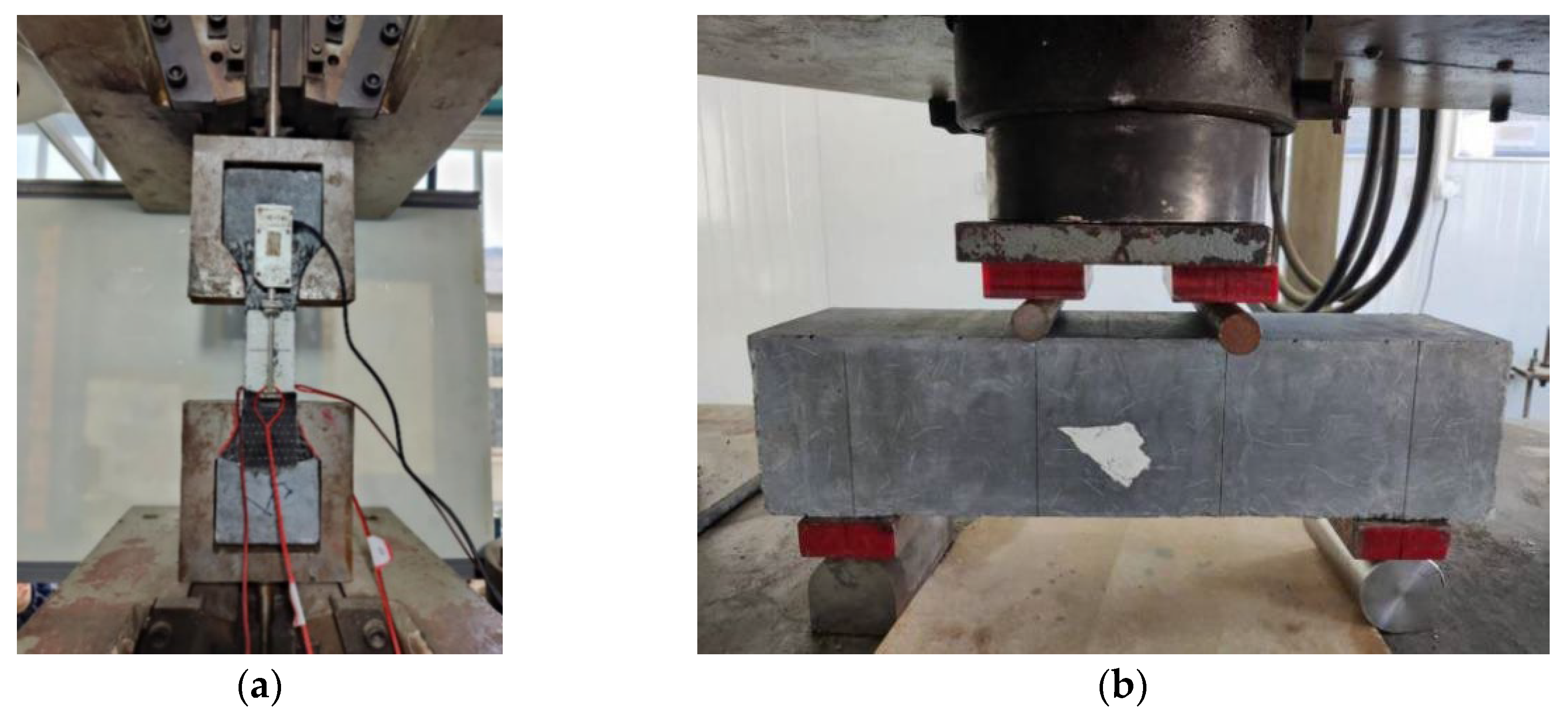
Mechanical characterization of the UHPC, specifically compressive and tensile strengths, was performed following the T/CBMF 37-2018 guidelines [41]. For compression, a YAW-Y2000F1W machine (Jinan Shijin Group Co., Ltd., Jinan, China) was utilized with a constant stress increase of 1.3 MPa/s. Tensile properties were determined using a WAW-Y1000C universal tester (Jinan Shijin Group Co., Ltd.) at a displacement-controlled rate of 0.1 mm/min. To ensure precise data collection, carbon fiber fabric was used to reinforce the variable cross-sections of the tensile specimens, while strain development was tracked via dual-sided strain gauges [42], as illustrated in Figure 2a.
Figure 2.
UHPC tensile and flexural strength tests: (a) Tensile strength; (b) Flexural strength.
Flexural strength testing was carried out in compliance with the Chinese standard GB/T 31387-2015, Reactive Powder Concrete [43], using prismatic specimens measuring 100 mm × 100 mm × 400 mm. The tests were conducted using a WAW-Y1000C universal testing machine at a loading rate of 0.1 MPa/s, as illustrated in Figure 2b.
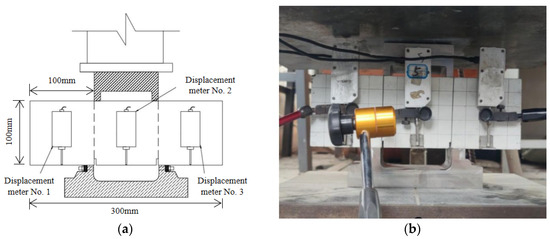
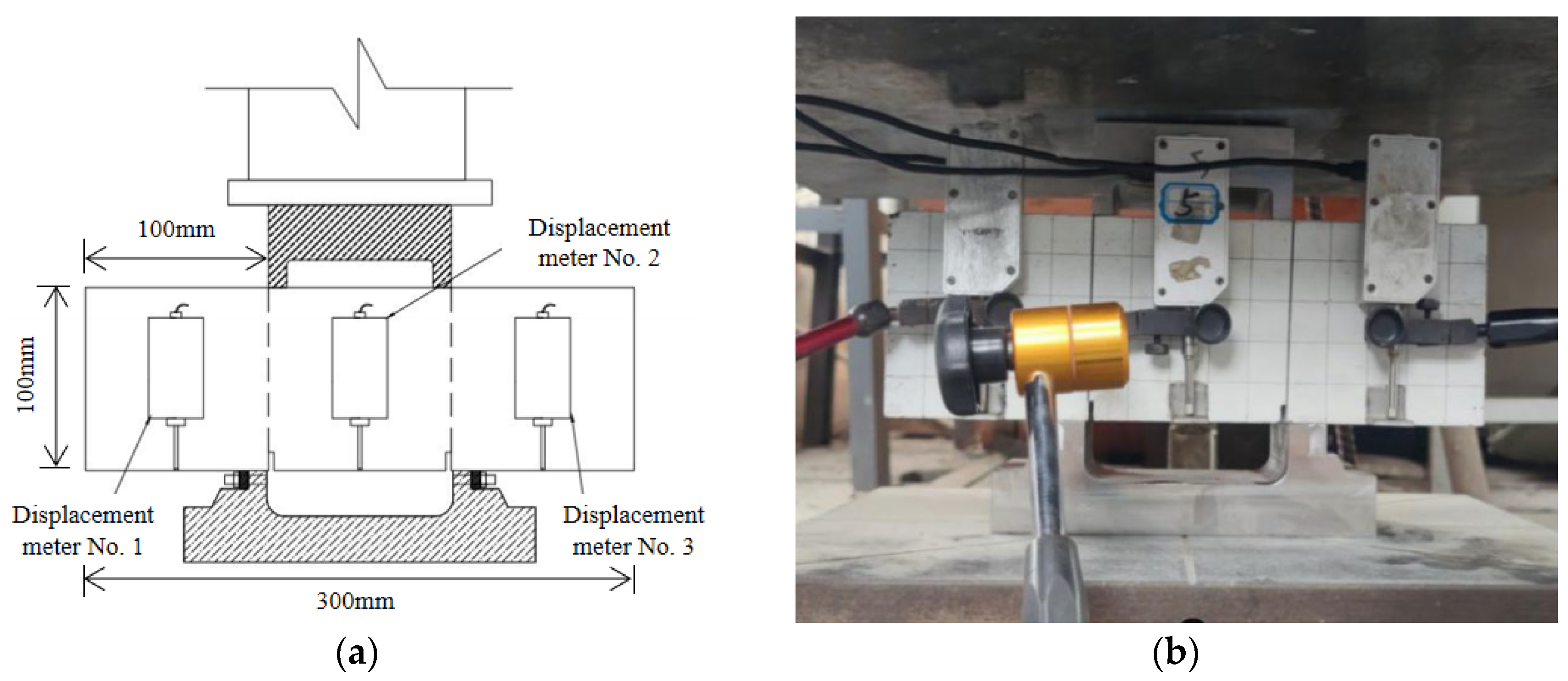
In accordance with the Chinese standard CECS 13-2009 [44], shear strength was evaluated using 100 mm × 100 mm × 300 mm prismatic specimens, with four replicates for each experimental group. The testing was performed on a YAW-Y2000F1W compression system, applying a constant stress rate of 0.08 Mpa/s. To facilitate the testing setup, each sample’s lateral surface was partitioned into three equal segments, and 2.5 mm wide, 10 mm deep grooves were machined at the base for angle iron reinforcement. As illustrated in Figure 3, three displacement transducers (LVDTs) were fixed via magnetic bases to track the deformation within the central shear region.
Figure 3.
UHPC shear strength test: (a) Shear test schematic diagram; (b) Actual photo of shear test.
2.3.3. Microstructure Examination
For microstructural characterization, samples were extracted from the core of 100 mm cubic specimens at the specified ages. To terminate the hydration process, these fragments were submerged in anhydrous ethanol for a minimum of 24 h, followed by vacuum drying at 40 °C for another 24 h. For XRD testing, the material was pulverized into a fine powder (particle size < 10 μm, Rigaku Corporation, Tokyo, Japan). In contrast, specimens for SEM and MIP analysis were carefully trimmed into small blocks of approximately 3 mm × 3 mm × 2 mm. Mineralogical phases were identified using a Bruker AXS D8-Advance diffractometer (scanning from 5° to 80° 2θ at a 0.02° step). Morphological observations were conducted via a JSM-7500F SEM (JEOL, Tokyo, Japan) at 20 kV. Additionally, pore structure features (4 nm to 400 μm) were quantified using an AutoPore IV-9500 mercury intrusion porosimeter (Micromeritics Instrument Corporation, Norcross, GA, USA).
3. Results and Discussion
3.1. Optimal Mix Proportion Design for UHPC Incorporating Manufactured Sand
3.1.1. Gradation Design of Manufactured Sand and Optimization of Cementitious Material Composition
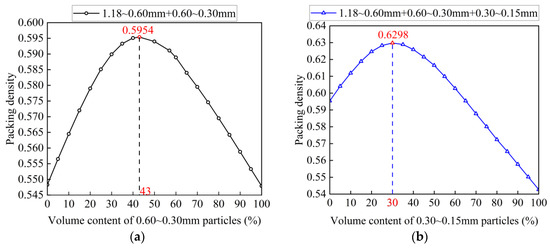
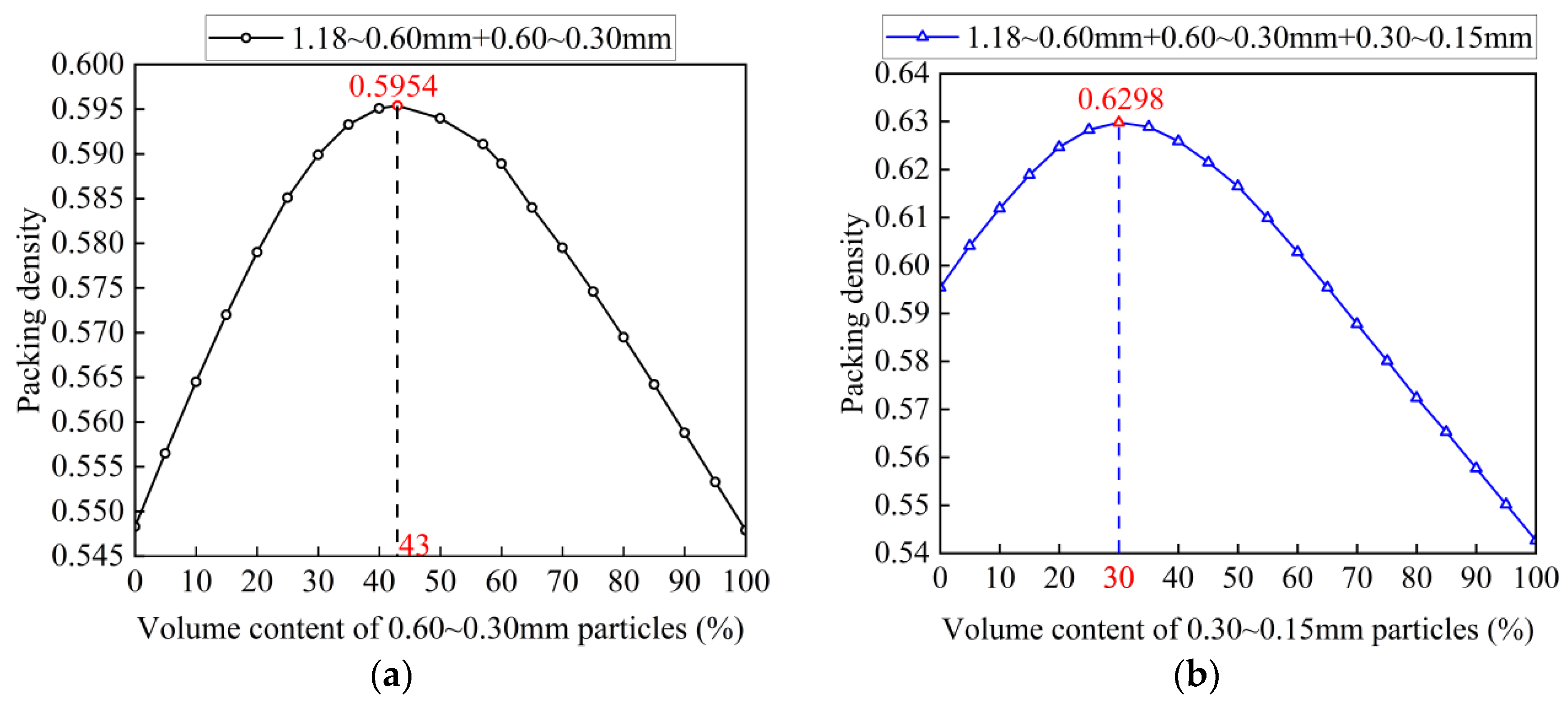
The manufactured sand listed in Table 3 was subjected to sieve analysis in accordance with GB/T 14684-2022 “Sand for construction” [10]. Particles within the size ranges of 1.18~0.60 mm, 0.60~0.30 mm, and 0.30~0.15 mm were selected and blended in varying volume proportions. Subsequently, the packing density of the resulting sand mixtures at each blending ratio was calculated based on the CPM using the method outlined in Section 2.2.2, with results presented in Figure 4.
Figure 4.
Packing density of manufactured sand composed of these different particle size intervals under various mixing ratios: (a) Binary particle size combinations (i.e., 1.18~0.60 mm and 0.60~0.30 mm); (b) Ternary particle size combinations (i.e., 1.18~0.60 mm, 0.60~0.30 mm, and 0.30~0.15 mm).
As shown in Figure 4, the packing density of blended manufactured sand exhibits a unimodal trend—increasing initially and then decreasing—with rising volume fraction of finer particles. For binary particle size combinations (1.18–0.60 mm and 0.60–0.30 mm; Figure 4a), the packing density peaks at 0.5954 when the volume fraction of the 0.60–0.30 mm fraction reaches 43%, corresponding to a volumetric ratio of 0.57:0.43. In ternary blends comprising 1.18–0.60 mm, 0.60–0.30 mm, and 0.30–0.15 mm fractions (Figure 4b), the maximum packing density of 0.6298 is achieved at a 30% volume fraction of the finest fraction (0.30–0.15 mm), with an optimized volumetric composition of 0.40:0.30:0.30. Given the apparent density difference among the three types of manufactured sand with particle sizes of 1.18–0.60 mm, 0.60–0.30 mm and 0.30–0.15 mm is less than 1.2%, the mass proportions of the three in the blended manufactured sand can also be taken as 0.40:0.30:0.30.
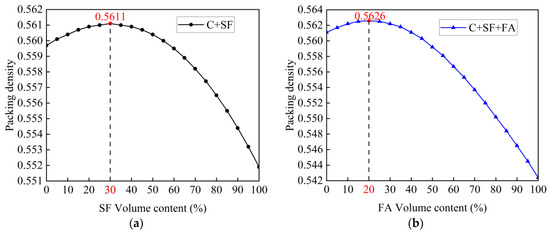
Similarly, based on the CPM method (see Section 2.2), the packing densities of cementitious material systems at various composition ratios can be determined. The results are presented in Figure 5. Specifically, Figure 5a illustrates the variation trend of packing density in the “cement + silica fume” binary system as a function of silica fume content, while Figure 5b depicts the corresponding trend for the “cement + silica fume + fly ash” ternary system with respect to fly ash content.
Figure 5.
Packing density of the cementitious material system as a function of supplementary cementitious material (SCM) content: (a) Binary system of cement (C) and silica fume (SF); (b) Ternary system of cement (C), silica fume (SF), and fly ash (FA).
As shown in Figure 5, the packing density of the cementitious material mixture first increases and then decreases with increasing supplementary cementitious material content. In the binary system (cement + silica fume), the maximum packing density of 0.5611 is achieved at a silica fume volume fraction of 30%, corresponding to a cement-to-silica fume volume ratio of 0.70:0.30. In the ternary system (cement + silica fume + fly ash), the maximum packing density of 0.5626 is attained at a fly ash volume fraction of 20%, with a volumetric composition of 0.56:0.24:0.20. Given the densities of cement, silica fume, and fly ash—3060 kg/m3, 2220 kg/m3, and 2440 kg/m3, respectively (Section 2.1)—the mass proportions of the ternary cementitious material system are 0.63:0.19:0.18.
3.1.2. Orthogonal Design of Mix Proportions for Manufactured Sand-Based UHPC
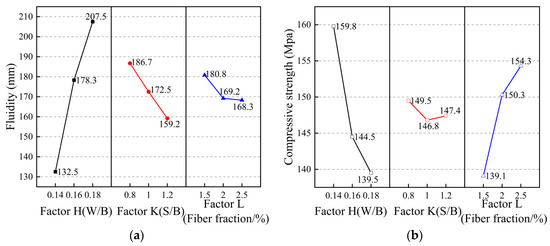
Based on the experimentally determined mass ratio of the blended manufactured sand and the mass ratio of the ternary cementitious material system (Section 3.1.1), three key factors—water-to-binder mass ratio (W/B), sand-to-binder mass ratio (S/B), and steel fiber volume fraction (Fiber fraction)—were selected as control factors for the orthogonal experimental design of manufactured sand-based ultra-high-performance concrete (UHPC) mixtures. The corresponding factor levels are listed in Table 5. All mixtures were proportioned using the absolute volume method, and their compositions are detailed in Table 6. UHPC specimens were prepared according to Table 6, and their fresh-state fluidity and 7d-compressive strength were evaluated. The results are presented in Figure 6.
Table 5.
Factor levels for orthogonal experimental design.
Table 6.
Orthogonal design of mix proportions for manufactured sand-based UHPC (kg/m3).
Figure 6.
Results of range analysis on the fluidity and compressive strength of manufactured sand UHPC: (a) Fluidity; (b) Compressive strength.
Based on the orthogonal test results, the water-binder ratio, sand-binder ratio, and steel fiber volume fraction were initially optimized at 0.16, 0.8, and 2.0%, respectively. However, Figure 6 reveals that increasing the steel fiber volume fraction from 2.0% to 2.5% induces negligible deterioration in UHPC fluidity while concurrently enhancing compressive strength. Furthermore, consistent with findings reported in references [45,46,47,48,49], elevating the steel fiber volume fraction to 2.5% yields substantial improvements in key mechanical properties—particularly tensile strength—with only a marginal reduction in fluidity. Given that both workability and mechanical performance are critical design objectives, and considering the favorable trade-off achieved at 2.5%, this value was adopted as the final optimized steel fiber volume fraction. Accordingly, the optimized UHPC reference mixture proportions are summarized in Table 7.
Table 7.
Reference mix proportion for manufactured sand-based UHPC (kg/m3).
3.2. Effect of Stone Powder Content on Fluidity and Mechanical Properties of UHPC Containing Manufactured Sand
Based on the reference mixture proportions in Table 7, an experimental study was conducted to investigate the effect of stone powder content in manufactured sand—varied at 0%, 5%, 10%, and 15% by mass of fine aggregate—on the fresh-state flowability and 7-day mechanical properties of ultra-high-performance concrete (UHPC), including compressive strength, tensile strength, flexural strength, and shear strength. To rigorously isolate and systematically quantify the independent effect of stone powder content on both fluidity and mechanical performance, the water dosage, water-binder ratio, polycarboxylate superplasticizer dosage, and all other constituent proportions were held constant across all mixtures. The corresponding mixture proportions are listed in Table 8. Manufactured sands with controlled stone powder contents (0, 5%, 10%, and 15% by mass) were prepared by blending a stone powder fraction with the base manufactured sand (0.15–1.18 mm). Furthermore, a control mixture designated as QS-0 was prepared by replacing the manufactured sand in the MS-0 mixture with an equivalent volume of quartz sand for comparative analysis.
Table 8.
Mix proportions of manufactured sand-based UHPC with varying stone powder contents (kg/m3).
3.2.1. Effect on Fluidity of UHPC
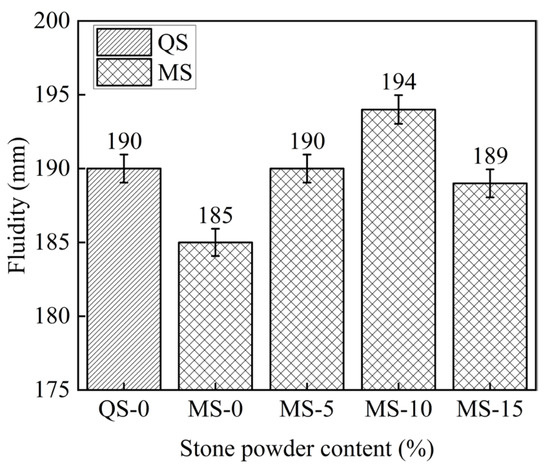
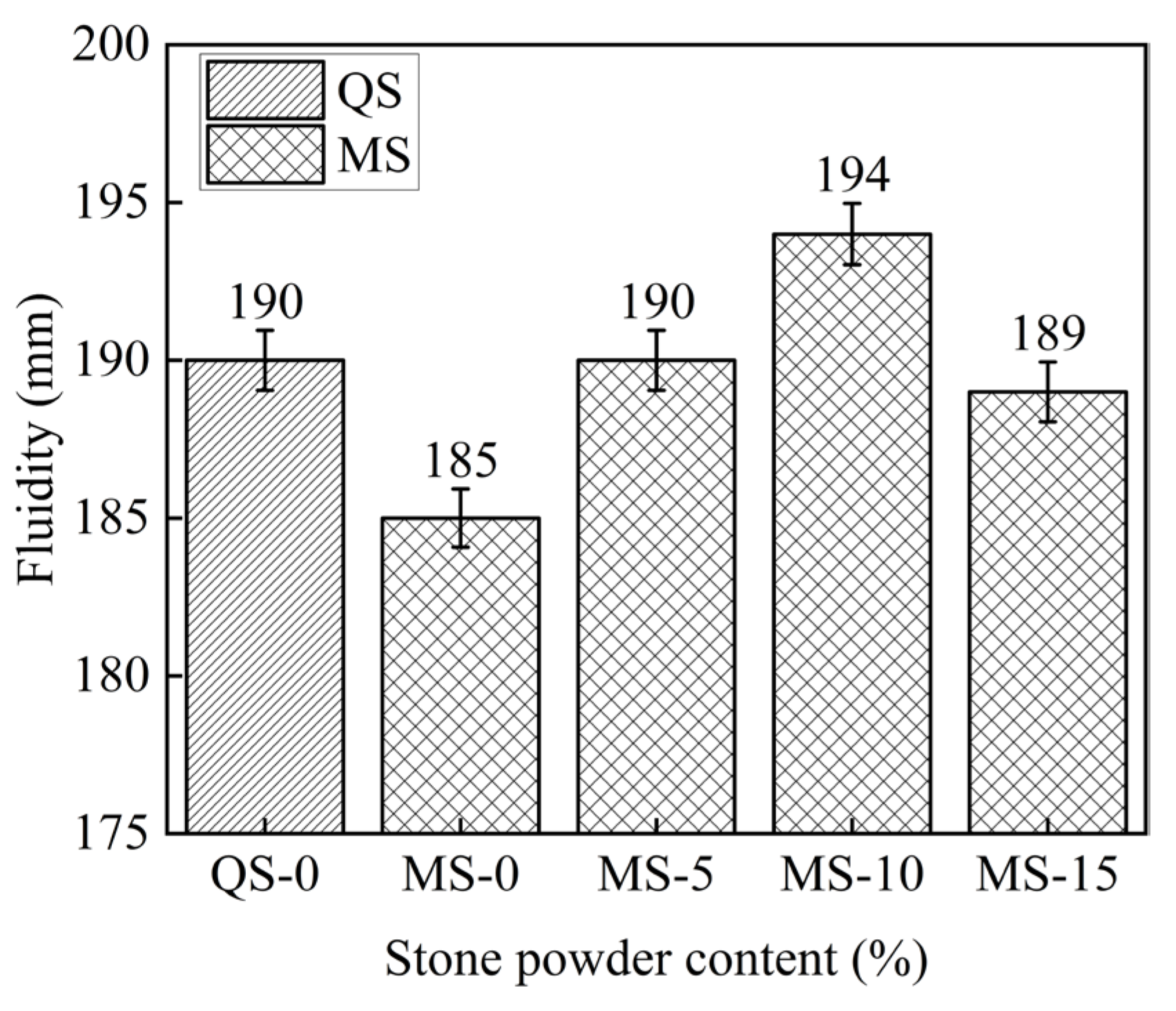
Figure 7 illustrates the effect of stone powder content in manufactured sand on the fluidity of ultra-high-performance concrete (UHPC). As shown in the figure, the fluidity of manufactured sand UHPC initially increases and subsequently decreases with increasing stone powder content, reaching a maximum at 10% stone powder content. The control group QS-0 (quartz sand-based UHPC, 0% stone powder content) exhibits a fluidity of 190 mm. For mixtures with 0%, 5%, 10%, and 15% stone powder content—designated as MS-0, MS-5, MS-10, and MS-15, respectively—the measured fluidity values are 185 mm, 190 mm, 194 mm, and 189 mm. Notably, the fluidity of Mixture MS-10 is 4.9% higher than that of MS-0 and 2.1% higher than that of QS-0. Mixtures MS-5 and MS-15 show improvements of 2.7% and 2.2%, respectively, compared to MS-0, with fluidity values close to that of the QS-0 reference.
Figure 7.
Effect of stone powder content on the fluidity of manufactured sand-based UHPC.
As the stone powder content increases, the proportion of fine particles in manufactured sand rises, whereas that of coarse particles declines correspondingly. These fine particles act as micro-fillers, enhancing particle packing density within the UHPC matrix and thereby improving its rheological behavior—specifically, reducing plastic viscosity and yield stress, which collectively contribute to a significant improvement in the fluidity of the fresh paste [30]. However, excessive stone powder can adsorb free water, increasing the paste’s water requirement and consequently impairing fluidity [17]. Furthermore, the fluidity of manufactured sand-based UHPC without stone powder (MS-0) is slightly lower than that of quartz sand-based UHPC (designated as QS-0), primarily due to the rough surface texture and pronounced angularity of manufactured sand particles, which result in higher internal friction. Therefore, an appropriate stone powder content can optimize the particle gradation, enhance packing density, reduce requirement demand, and consequently improve the fluidity of UHPC.
3.2.2. Effect on Mechanical Properties of UHPC
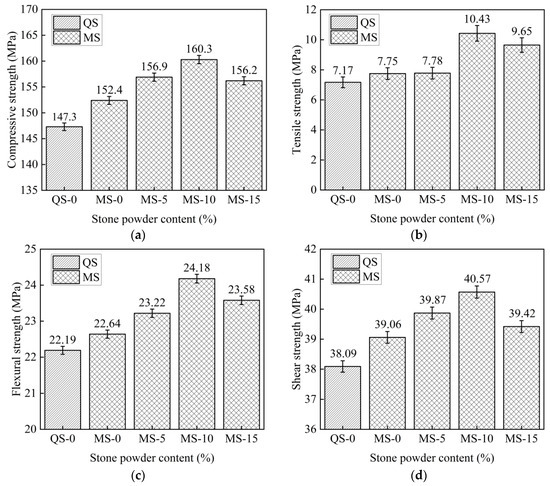
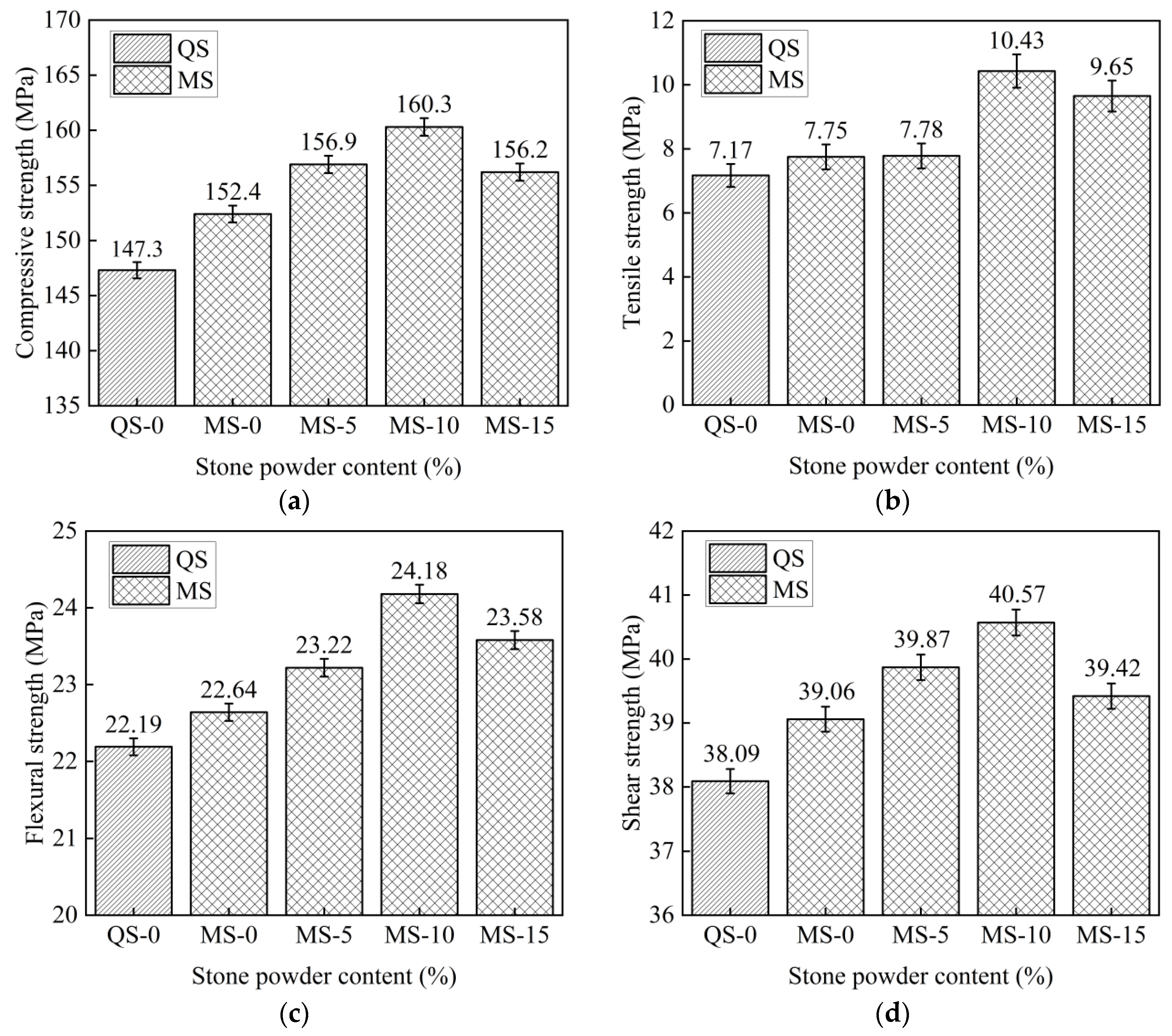
Figure 8 presents the effect of stone powder content on the mechanical properties of manufactured sand-based UHPC. As illustrated in the figure, with increasing stone powder content, all measured strength indices—including compressive strength, axial tensile strength, flexural strength, and shear strength—exhibit an initial increase followed by a subsequent decrease, reaching peak values at a stone powder content of 10%. Furthermore, the strength values of the stone powder-free mixture (MS-0) are slightly higher than those of the quartz sand-based reference UHPC (QS-0).
Figure 8.
Effect of stone powder content on the mechanical properties of manufactured sand-based UHPC: (a) Compressive strength; (b) Tensile strength; (c) Flexural strength; (d) Shear strength.
It can be noticed from Figure 8a that the compressive strength of quartz sand UHPC (QS-0) is measured at 147.3 MPa. For manufactured sand UHPC mixtures with stone powder contents of 0%, 5%, 10%, and 15% (denoted as MS-0, MS-5, MS-10, and MS-15, respectively), the corresponding compressive strengths are 152.4 MPa, 156.9 MPa, 160.3 MPa, and 156.2 MPa in sequence. Specifically, compared with MS-0 and QS-0, the compressive strength of MS-10 exhibits 5.2% and 8.8% increases respectively. In comparison with MS-0, the compressive strengths of MS-5 and MS-15 have increased by 3.0% and 2.5% respectively; when compared with QS-0, they have improved by 6.5% and 6.0% respectively. Furthermore, the compressive strength of MS-0 exceeds that of QS-0 by 3.5%. The trends in tensile strength, flexural strength, and shear strength as a function of stone powder content are broadly consistent with those observed for compressive strength.
The strength development of MS-UHPC follows a trend of initial growth followed by a decline as stone powder dosages increase, a phenomenon largely governed by the synergistic impact of the filling effect, nucleation sites, and chemical reactivity of the stone powder [50]. Specifically, the fine stone powder particles occupy the interstitial spaces among the larger manufactured sand grains. This micro-filling action refines the overall aggregate grading, which in turn enhances the packing density of the entire UHPC matrix [15]. Simultaneously, fine stone powder particles possess numerous surface-active sites that act as effective nucleation centers for cement hydration products, promoting the hydration process and accelerating the formation of hydrates to a certain extent [50,51]. Simultaneously, the rough surface texture and angular morphology of manufactured sand and stone powder enhance the interfacial bond strength between the cementitious paste and fine aggregates [52]. These characteristics also contribute to improved dispersion and mechanical anchoring of steel fibers within the matrix [53]. Consequently, when an appropriate amount of stone powder is incorporated, the compressive, tensile, flexural, and shear strengths of UHPC are all enhanced. However, excessive stone powder content may disrupt the optical aggregate gradation of the UHPC system, thereby reducing overall packing density. Furthermore, the water absorption capacity of stone powder can lead to moisture retention in the interfacial transition zone, which inhibits further cement hydration, weakens interfacial bond strength, and diminishes the aggregate skeleton’s load-bearing contribution, ultimately impairing mechanical performance [11,18,19]. Additionally, manufactured sand-based UHPC without stone powder (MS-0) exhibits slightly higher strength compared to quartz sand-based UHPC (QS-0), primarily attributed to the rough surface texture of manufactured sand particles, which enhances interfacial adhesion with cementitious materials and promotes mechanical interlocking with steel fibers [52].
3.3. Influence of Stone Powder Content on the Microstructure of Manufactured Sand-Based UHPC
3.3.1. XRD Analysis
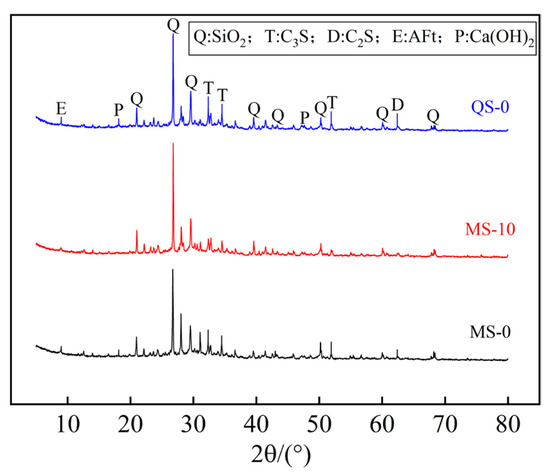
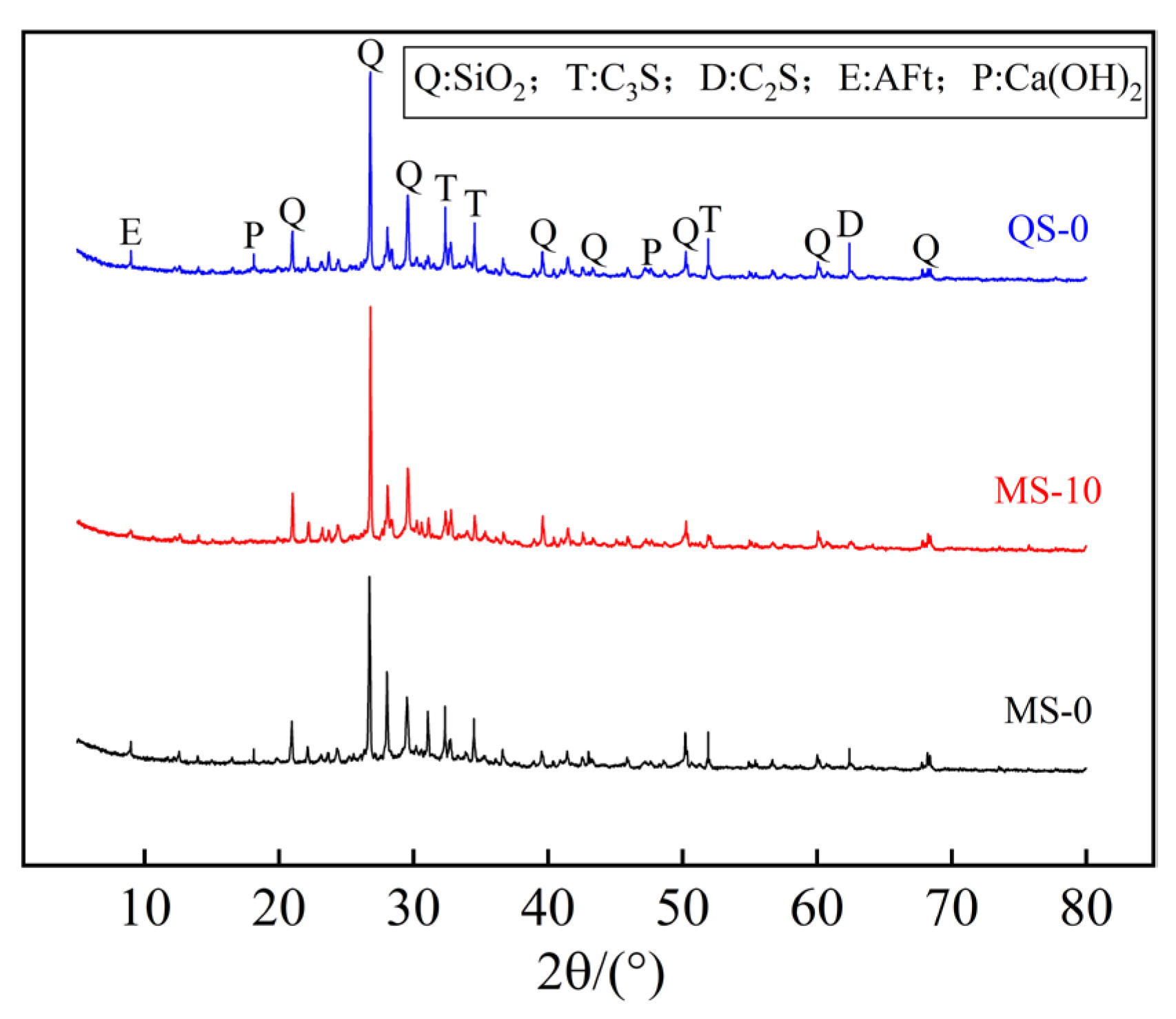
Figure 9 presents the XRD patterns of hydrated samples from the selected compositions of UHPC, namely, MS-0, MS-10 (manufactured sand-based UHPC containing 0% and 10% stone powder, respectively), and QS-0 (quartz sand-based UHPC).
Figure 9.
XRD patterns of UHPC hydration samples with varying mix proportions.
As illustrated in Figure 9, the main crystalline phases identified in the hydrated UHPC samples across different mix proportions include SiO2, unhydrated C3S and C2S minerals, as well as hydration products such as ettringite (AFt) and calcium hydroxide (Ca(OH)2), with the characteristic diffraction peaks of SiO2 exhibiting relatively high intensity. The quartz crystals (SiO2) originate from manufactured sand (Samples MS-0, and MS-10) or quartz sand (Sample QS-0), which contain 60% and 98% SiO2, respectively (see Section 2.1). This finding further confirms that manufactured sand and quartz sand particles can function as inert fillers in UHPC matrix, contributing to the densification of the particle packing [54]. Moreover, the XRD peak intensities of C3S and C2S in the MS-10 sample were lower than those in QS-0 and MS-0, supporting the hypothesis that the nucleation effect of stone powder can partially accelerate the hydration of cementitious materials [50,51]. Additionally, the diffraction peaks corresponding to Ca(OH)2 and AFt crystals were weak in all three hydrated samples. The reduced Ca(OH)2 content is primarily attributed to its extensive consumption during secondary hydration reactions involving high volumes of reactive mineral admixtures (e.g., silica fume, fly ash), particularly under steam curing conditions [55,56]. Conversely, the low AFt content may be due to restricted crystal growth caused by the system’s low porosity or possible thermal decomposition during the steam curing process [57,58,59].
3.3.2. SEM Analysis
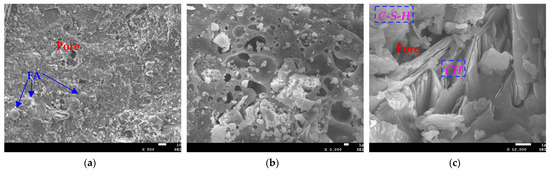
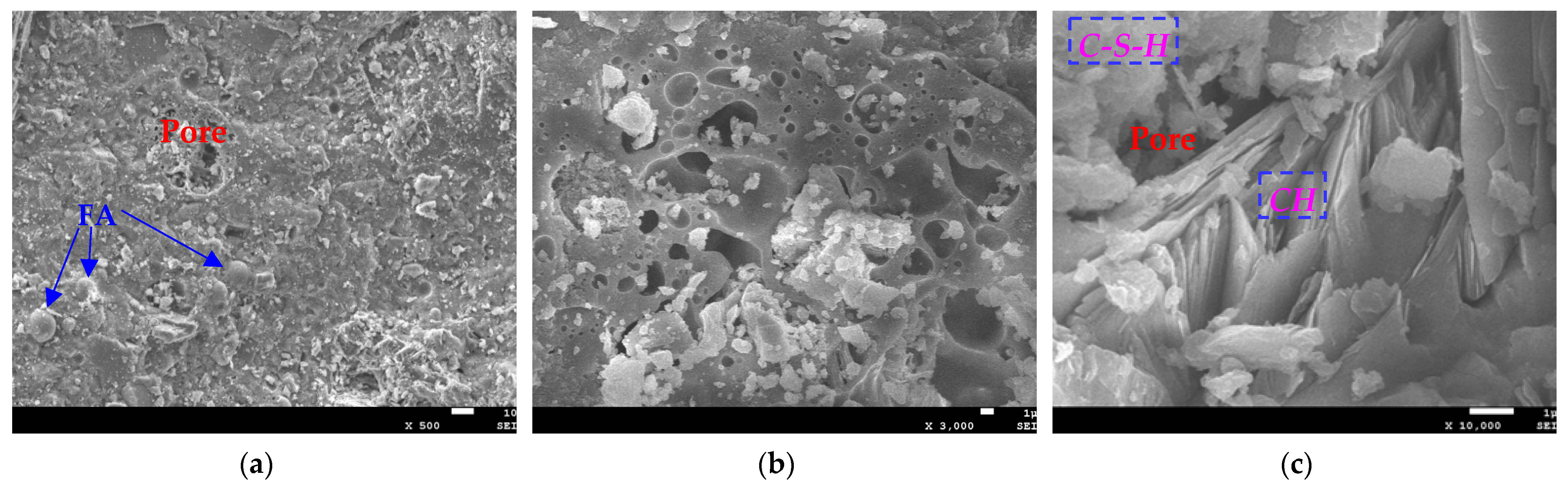
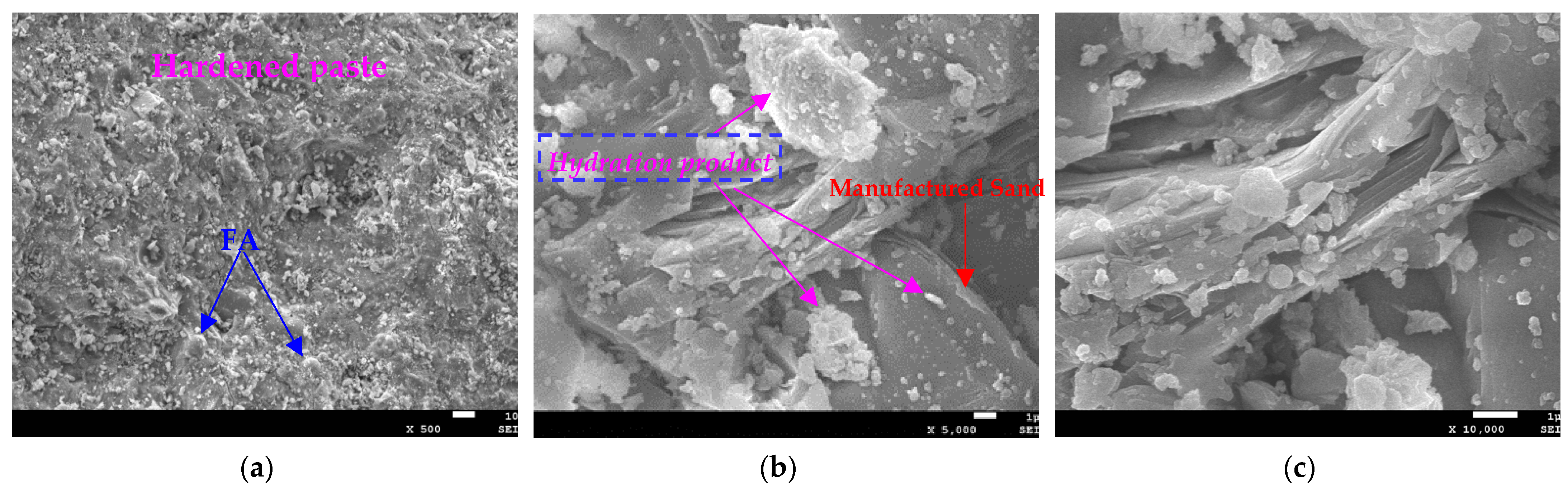
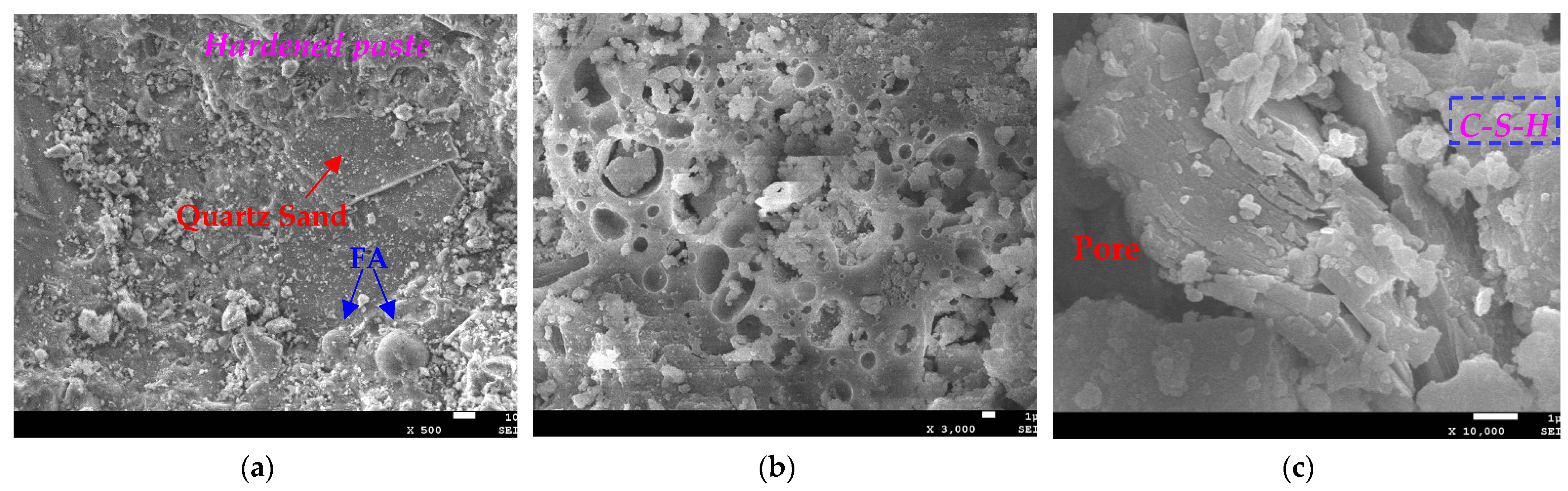
Figure 10, Figure 11 and Figure 12 display SEM images of hydrated samples from manufactured sand-based ultra-high-performance concrete (UHPC) mixtures MS-0 and MS-10, containing 0% and 10% stone powder, respectively, as well as quartz sand-based UHPC (QS-0).
Figure 10.
SEM image of manufactured sand-based UHPC with zero stone powder content (MS-0): (a) MS-0 (×500); (b) MS-0 (×3000); (c) MS-0 (×10,000).
Figure 11.
SEM image of manufactured sand-based UHPC with 10% stone powder content (MS-10): (a) MS-10 (×500); (b) MS-10 (×5000); (c) MS-10 (×10,000).
Figure 12.
SEM image of quartz sand-based UHPC (QS-0): (a) QS-0 (×500); (b) QS-0 (×3000); (c) QS-0 (×10,000).
Figure 10, Figure 11 and Figure 12 demonstrate that both manufactured sand-based UHPC and quartz sand-based UHPC exhibit highly dense microstructures. The hardened cement paste in both systems consists primarily of abundant hydration products, unhydrated cement particles, and a minimal volume of pores. These hydration products, predominantly calcium silicate hydrate (C-S-H) gel, tightly envelop supplementary cementitious materials such as fly ash and aggregate particles (Figure 10a, Figure 11a and Figure 12a), thereby enhancing the microstructural integrity of the cementitious matrix. In the case of the manufactured sand-based UHPC sample with 0% stone powder content (MS-0), Figure 10 illustrates that certain pores are filled with gel-like hydration products (Figure 10a) or calcium hydroxide (Ca(OH)2) crystals (Figure 10c), which is consistent with the XRD analysis results previously discussed for MS-0 (Figure 9). For the quartz sand-based UHPC sample (QS-0), although quartz particles are well-encapsulated by hydration products, distinct interfacial transition zones (ITZs) are observed between the particles and the surrounding cement paste due to the layered morphology of the quartz grains (Figure 12a), potentially compromising the overall structural density. Figure 11b reveals that in the manufactured sand-based UHPC sample containing 10% stone powder (MS-10), a limited number of fine hydration product nuclei have formed on the surface of the stone powder, confirming the nucleation effect associated with stone powder. This phenomenon contributes to the promotion of hydration reactions within the UHPC system, increasing the total amount of hydration products and further improving the microstructural characteristics [50,51].
In summary, it can be concluded that the filling and nucleation effects induced by an appropriate amount of stone powder in manufactured sand not only enhance the compaction density of the UHPC system [31], but also promote the hydration process to a certain extent. Consequently, this results in improved compactness of UHPC specimens and a reduction in porosity. This conclusion will be further supported by the mercury intrusion porosimetry analysis presented in Section 3.3.3.
3.3.3. MIP Analysis
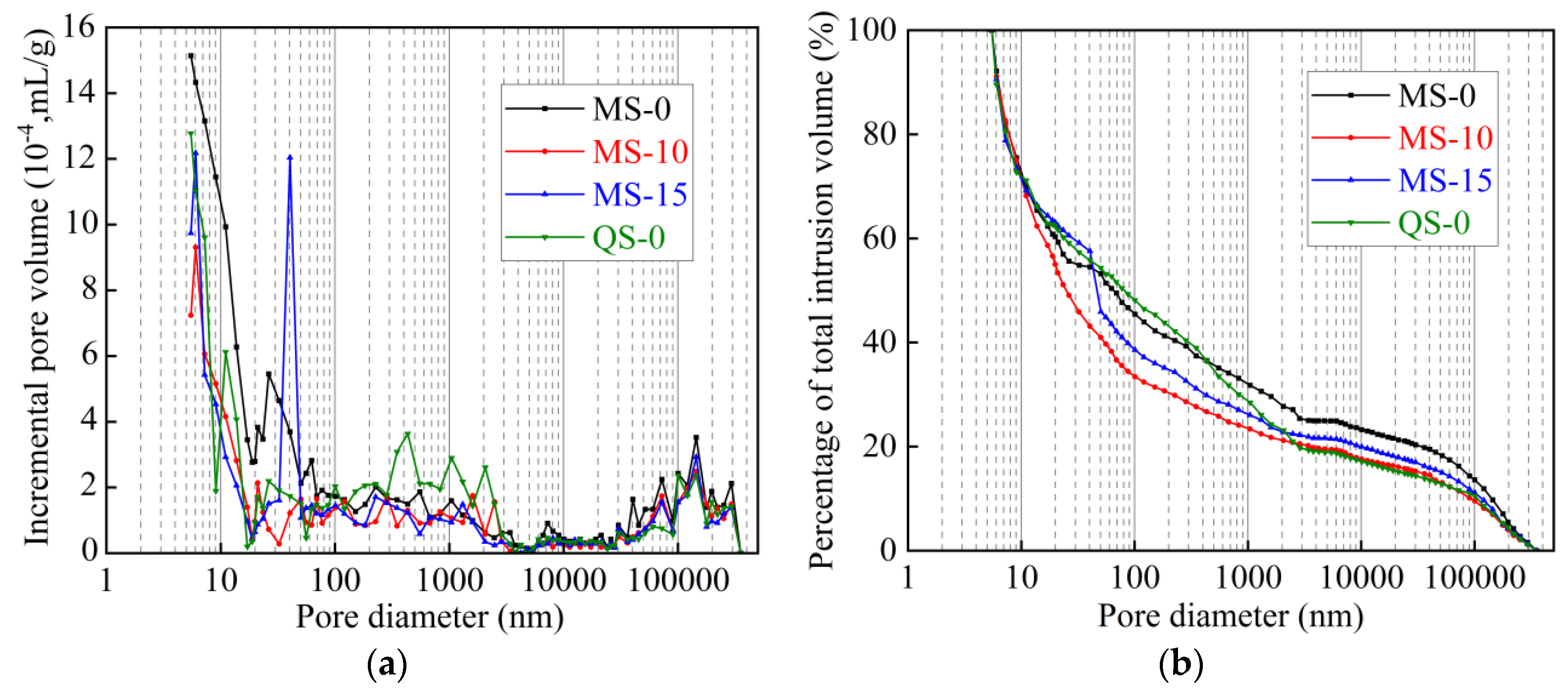
The mercury intrusion porosimetry (MIP) test results for manufactured sand-based UHPC with varying stone powder contents (MS-0, MS-10, and MS-15), as well as for the control group QS-0 (quartz sand-based UHPC), are presented in Figure 13 and Table 9.
Figure 13.
Mercury intrusion porosimetry (MIP) analysis results of pore structure in the selected UHPC specimens: (a) Incremental pore volume–pore diameter curve of UHPC specimens; (b) Percentage of total intrusion volume–pore diameter curve of UHPC specimens.
Table 9.
Porosity index of each UHPC specimen.
As illustrated by the data in Figure 13 and Table 9, the porosity of manufactured sand-based UHPC (MS-UHPC) follows a parabolic trend with increasing stone powder dosage, first declining and then rising. A minimum porosity of 2.06% was achieved at the 10% stone powder level. Notably, the peak pore frequency (most probable diameter) for all four groups remained below 6 nm. Based on the pore classification proposed in Reference [58]—comprising harmless (<20 nm), slightly harmful (20–100 nm), harmful (100–200 nm), and highly harmful pores (>200 nm)—the MS-10 group demonstrated the most optimized structure. Specifically, at 10% stone powder content, the cumulative volume of harmful and highly harmful pores reached their lowest points (30.4% and 3.1%), while the combined fraction of harmless and slightly harmful pores peaked at 66.5%. This trend can be attributed to two mechanisms: first, the filling effect of an appropriate amount of stone powder enhances the packing density of the UHPC matrix; second, the nucleation effect of stone powder particles promotes cement hydration, thereby increasing the formation of hydration products [50,51], which contributes to enhanced microstructural densification and improved mechanical properties. However, excessive stone powder may compromise the overall compactness of the system, resulting in reduced mechanical strength—a finding consistent with the compressive strength results presented in Section 3.2.2.
Furthermore, a comparative analysis of MIP results between quartz sand-based UHPC (QS-0) and manufactured sand-based UHPC reveals that the porosity of the latter with 0% stone powder content (MS-0) is 2.72%, lower than that of QS-0, which is 3.77%. Additionally, the volume fractions of highly harmful and harmful pores in all three manufactured sand-based UHPC mixtures (MS-0, MS-10, and MS-15) are lower than those in the quartz sand-based counterpart, with corresponding values of 43.2% and 5.0%, respectively. This difference is likely attributable to the predominantly flaky morphology of quartz sand particles, which may result in less favorable particle packing and higher interstitial porosity.
4. Conclusions
This study utilizes granite-derived manufactured sand as a complete quartz sand replacement in the formulation of ultra-high-performance concrete (UHPC). By integrating experimental evaluation of fresh-state workability and 7d-mechanical properties with quantitative microstructural characterization, the study systematically elucidates the influence mechanism of stone powder content in manufactured sand on UHPC performance. The principal findings are summarized as follows:
- (1)
- When the manufactured sand is graded into three size fractions—1.18–0.60 mm, 0.60–0.30 mm, and 0.30–0.15 mm—with a mass distribution of 40:30:30, and the cementitious system comprises Portland cement, silica fume, and fly ash in mass proportions of 63:19:18, ultra-high-performance concrete (UHPC) incorporating manufactured sand as the sole fine aggregate achieves excellent fresh-state workability and enhanced mechanical performance through an optimized mix design. The finalized composition is: Portland cement, 738 kg/m3; silica fume, 230 kg/m3; fly ash, 210 kg/m3; granite-derived manufactured sand, 943 kg/m3; straight steel fibers, 196 kg/m3; polycarboxylate-based superplasticizer, 24 kg/m3; and a water-to-binder ratio of 0.16. Under this formulation, the UHPC exhibits a fresh-state workability of 185 mm and attains a 7-day compressive strength of 152.4 MPa.
- (2)
- The stone powder content in manufactured sand exerts a pronounced influence on both the fresh-state workability and mechanical performance of UHPC, encompassing compressive, tensile, flexural, and shear strengths. As the stone powder content increases from 0% to 5%, 10%, and 15% by mass of fine aggregate, UHPC workability first rises then declines, peaking at 194 mm with 10% stone powder—exceeding that of the quartz sand reference mixture (prepared with quartz sand as the sole fine aggregate) by 2.1% under identical mix proportions. Concurrently, all four mechanical properties improve progressively with rising stone powder content and attain their maxima at 10%. Specifically, compressive strength reaches 160.3 MPa (+8.8%), tensile strength 10.43 MPa (+45.5%), flexural strength 24.18 MPa (+8.9%), and shear strength 40.57 MPa (+6.5%), relative to the quartz sand reference values of 147.3 MPa, 7.17 MPa, 22.19 MPa, and 38.09 MPa, respectively.
- (3)
- Microstructural characterization of manufactured sand-based ultra-high-performance concrete (MS-UHPC) reveals that an optimal stone powder content (10 wt.%) accelerates the hydration of the cementitious paste, thereby promoting the formation of calcium silicate hydrate (C-S-H) and other hydration products. Concurrently, it improves particle packing density, yielding a more homogeneous and densified microstructure in the hardened matrix. SEM and XRD results show that at a 10% stone powder content, the hydration of clinker phases, particularly C3S and C2S, is markedly accelerated; unhydrated particles are uniformly enveloped by a continuous C-S-H gel network, resulting in a compact and low-defect cementitious matrix. MIP further demonstrates that this stone powder dosage minimizes total porosity to 2.06%, while suppressing highly harmful pores (≥200 nm) and harmful pores (100–200 nm) to 30.4% and 3.1% of the total pore volume, respectively. In contrast, the combined volume fraction of slightly harmful (20–50 nm) and harmless (<20 nm) pores reaches its maximum of 66.5%. Collectively, these microstructural refinements—improved particle packing, and optimized pore structure—directly underpin the superior mechanical performance of MS-UHPC.
Author Contributions
Conceptualization, Methodology, Project administration, Supervision, Writing—review and editing, Y.P.; Investigation, Validation, Formal analysis, Writing—original draft, H.Y.; Formal analysis, Visualization, J.M.; Investigation, Validation, Z.B.; Funding acquisition, Project Administration, Resources, J.Y. and G.X. All authors have read and agreed to the published version of the manuscript.
Funding
This research was funded by the Natural Science Foundation of Hubei Province of China (grant number 2018CFB642), the Hubei Three Gorges Laboratory Opening & Innovation Fund project (grant number SC211006), the Program of Introducing Talents of Discipline to Universities (i.e., the 111 Project of China, grant number D20015), and the 111 Project of Hubei Province (grant number 2021EJD026). Their results were fundamental to this study.
Institutional Review Board Statement
Not applicable.
Informed Consent Statement
Not applicable.
Data Availability Statement
The original contributions presented in the study are included in the article, and further inquiries can be directed to the corresponding author.
Conflicts of Interest
The authors declare no conflicts of interest.
Abbreviations
The following abbreviations are used in this manuscript:
| UHPC | Ultra-high-Performance Concrete |
| MS | Manufactured Sand |
| QS | Quartz Sand |
| CPM | Compressible Packing Model |
| XRD | X-ray Diffraction |
| SEM | Scanning Electron Microscope |
| MIP | Mercury Intrusion Porosimetry |
References
- Huang, X.; Liu, T.S.; Ding, Q.J. Research summary of ultra-high performance concrete. Concrete 2019, 9, 36–38. [Google Scholar]
- Zhou, S.M.; Wang, W. Application of Ultra-High Performance Concrete Pavement System to Steel Bridge Deck. Bridge Constr. 2019, 49, 20–25. [Google Scholar]
- Ullah, R.; Yuan, Q.; Jawad, A. Ultra-High-Performance Concrete (UHPC): A State-of-the-Art Review. Materials 2022, 15, 4131. [Google Scholar] [CrossRef] [Scilit] [PubMed]
- Wu, C.; Li, J.; Su, Y. Development of Ultra-High Performance Concrete Against Blasts: From Materials to Structures; Woodhead Publishing: Cambridge, UK, 2018. [Google Scholar]
- Arulmoly, B.; Konthesingha, C.; Nanayakkara, A. Performance evaluation of cement mortar produced with manufactured sand and offshore sand as alternatives for river sand. Constr. Build. Mater. 2021, 297, 123784. [Google Scholar] [CrossRef] [Scilit]
- Shao, X.D.; Fan, W.; Huang, Z.Y. Application of Ultra-High-Performance Concrete in engineering structures. China Civ. Eng. J. 2021, 54, 1–13. [Google Scholar]
- Zheng, K.P.; Ge, H.S.; Li, Z.C.; Liu, G.Y.; Tian, G.W.; Wang, W.Z.; Xu, G.H.; Sun, Z.P. Influence and mechanism of river sand and quartz sand on properties of steam-cured ultra-high performance concrete. Mater. Rep. 2024, 38, 79–84. [Google Scholar]
- Jiao, Y.B.; Zhang, Y.; Guo, M. Mechanical and fracture properties of ultra-high performance concrete (UHPC) containing waste glass sand as partial replacement material. J. Clean. Prod. 2020, 277, 123501. [Google Scholar] [CrossRef] [Scilit]
- Han, Z.; Zhang, Y.S.; Zhang, W.H. Study on comprehensive morphological parameters of manufactured sand based on CT scanning and entropy method and its application in rheology of manufactured sand mortar. Constr. Build. Mater. 2023, 370, 130628. [Google Scholar] [CrossRef] [Scilit]
- GB/T 14684-2022; Sand for Construction. China Building Industry Press: Beijing, China, 2022.
- Ma, R.; Zhang, L.; Chen, Z. Utilization of solid waste from tunnel excavation as manufactured sand with different lithology and pre-washing process for preparation of eco-friendly ultra-high performance concretes: Properties and microstructural analysis. J. Build. Eng. 2024, 82, 108252. [Google Scholar] [CrossRef] [Scilit]
- Shen, W.; Liu, Y.; Cao, L. Mixing design and microstructure of ultra high strength concrete with manufactured sand. Constr. Build. Mater. 2017, 143, 312–321. [Google Scholar] [CrossRef] [Scilit]
- Xiong, H.R.; Chen, J.; Wu, W.X. Study on compressive and flexural properties of RPC100 prepared by machine-made sand. New Technol. Prod. China 2022, 13, 130–132. [Google Scholar]
- Wille, K.; Boisvert-Coyulio, C. Material efficiency in the design of ultra-high performance concrete. Constr. Build. Mater. 2015, 86, 33–43. [Google Scholar] [CrossRef] [Scilit]
- Wang, Q.C.; Zhou, Y.J.; Zhan, W. Experimental study on ultra high performance concrete (UHPC) with manufactured sand. Concr. Cem. Prod. 2022, 5, 26–29+45. [Google Scholar]
- Liu, C. Study on Bending Performance Test and Calculation Method of Manufactured Sand Ultra-High Performance Concrete Beam. Ph.D. Thesis, Southeast University, Dhaka, Bangladesh, 2021. [Google Scholar]
- Yang, R.; Yu, R.; Shui, Z.H. The physical and chemical impact of manufactured sand as a partial replacement material in Ultra-High Performance Concrete (UHPC). Cem. Concr. Compos. 2019, 99, 203–213. [Google Scholar] [CrossRef] [Scilit]
- Bian, C.; Guo, J.Y.; Xiao, J.Z.; Zhao, C.J. Effect of nano metakaolin and fine aggregate on mechanical properties of UHPC. Mater. Rep. 2023, 37, 55–59. [Google Scholar]
- Chu, H.Y.; Jiang, J.Y.; Li, H. Effects of Eco-friendly Fine Aggregates on Mechanical Properties of Ultra-high Performance Concrete. Mater. Rep. 2020, 34, 24029–24033. [Google Scholar]
- Fu, T.; Liang, J.; Lan, Y. Effect of stone powder content on mechanical properties of manufactured sand concrete. Iran. J. Sci. Technol. Trans. Civ. Eng. 2022, 46, 4255–4264. [Google Scholar] [CrossRef] [Scilit]
- Wang, J.L. Study on the Influence and Mechanism of Machine-Made sand Characteristics on Concrete Performance. Ph.D. Thesis, Wuhan University of Technology, Wuhan, China, 2008. [Google Scholar]
- Wang, J.; Li, B.X.; Yang, J.B. The effect of stone powder content and steel fiber length on the properties of ultra-high performance concrete with manufactured sand. Bull. Chin. Silic. Soc. 2020, 39, 2120–2126. [Google Scholar]
- De, L.F. Concrete Mixture Proportioning: A Scientific Approach; CRC Press: Boca Raton, FL, USA, 1999. [Google Scholar]
- GB 175-2023; Common Portland Cement. China Building Industry Press: BeiJing, China, 2023.
- Amario, M.; Rangel, C.S.; Pepe, M. Optimization of normal and high strength recycled aggregate concrete mixtures by using packing model. Cem. Concr. Compos. 2017, 84, 83–92. [Google Scholar] [CrossRef] [Scilit]
- Andeasen, A.H.M. The relationship between grain gradation and the clearance in products from loosening grains (with some experiments). Kolloid-Z 1930, 50, 217–228. [Google Scholar]
- Aim, R.B.; Le, G.P. Effet de paroi dans les empilements désordonnés de sphères et application à la porosité de mélanges binaires. Powder Technol. 1968, 1, 281–290. [Google Scholar] [CrossRef] [Scilit]
- Ng, T.S.; Foster, S.J. Development of a mix design methodology for high-performance geopolymer mortars. Struct. Concr. 2013, 14, 148–156. [Google Scholar] [CrossRef] [Scilit]
- Brouwers, H.J.H. Particle-size distribution and packing fraction of geometric random packings. Phys. Rev. E—Stat. Nonlinear Soft Matter Phys. 2006, 74, 031309. [Google Scholar] [CrossRef] [Scilit]
- Peng, Y.Z.; Chen, K.; Hu, S.G. Study on interfacial properties of ultra-high performance concrete containing steel slag powder and fly ash. Adv. Mater. Res. 2011, 194, 956–960. [Google Scholar] [CrossRef] [Scilit]
- Peng, Y.; Hu, S.; Ding, Q. Dense packing properties of mineral admixtures in cementitious material. Particuology 2009, 7, 399–402. [Google Scholar] [CrossRef] [Scilit]
- Peng, Y.; Hu, S.; Ding, Q. Preparation of reactive powder concrete using fly ash and steel slag powder. J. Wuhan Univ. Technol.-Mater. Sci. Ed. 2010, 25, 349–354. [Google Scholar] [CrossRef] [Scilit]
- de Larrard, F.; Sedran, T. Mixture-proportioning of high-performance concrete. Cem. Concr. Res. 2002, 32, 1699–1704. [Google Scholar]
- Peng, Y.Z.; Li, X.; Liu, Y.J. Optimization for Mix Proportion of Reactive Powder Concrete Containing Phosphorous Slag by Using Packing Model. J. Adv. Concr. Technol. 2020, 18, 481–492. [Google Scholar] [CrossRef] [Scilit]
- Chen, J.X. Study on the Properties of Green Concrete Materials Based on Compressible Packing Model. Ph.D. Thesis, Shenzhen University, Shenzhen, China, 2015. [Google Scholar]
- Mohaddam, T.B.; Baaj, H. Application of compressible packing model for optimization of asphalt concrete mix design. Constr. Build. Mater. 2018, 159, 530–539. [Google Scholar] [CrossRef] [Scilit]
- de Andrade, G.P.; de Castro Polisseni, G.; Pepe, M. Design of structural concrete mixtures containing fine recycled concrete aggregate using packing model. Constr. Build. Mater. 2020, 252, 119091. [Google Scholar] [CrossRef] [Scilit]
- Roqier, G. The 4-parameter Compressible Packing Model (CPM) including a new theory about wall effect and loosening effect for spheres. Powder Technol. 2016, 302, 247–253. [Google Scholar] [CrossRef] [Scilit]
- GB/T 2419-2005; Test Method for Fluidity of Cement Mortar. China Building Industry Press: Beijing, China, 2005.
- Xu, G.; Jia, N.; Li, Y. New method for uniaxial tensile test of UHPFRC. Eng. Fract. Mech. 2025, 316, 110900. [Google Scholar] [CrossRef] [Scilit]
- China Building Materials Federation; China Concrete and Cement Products Association. T/CBMF 37-2018; Fundamental Characteristics and Test Methods of Ultra-High Performance Concrete; China Building Materials Federation: Beijing, China, 2018. [Google Scholar]
- Yang, J.; Li, Y.; Chen, B.C.; Xu, G.; Huang, Q.W. Research on UHPC direct tensile test method and constitutive relationship. Mater. Rep. 2024, 38, 153–161. [Google Scholar]
- GB/T 31387-2015; Reactive Powder Concrete. China Building Industry Press: Beijing, China, 2015.
- China Engineering Construction Standardization Association. CECS 13-2009; Standard Test Methods for Fiber Reinforced Concrete; China Plan Publishing House: Beijing, China, 2010. [Google Scholar]
- Nie, J.; Li, C.X.; Qian, G.P.; Pan, R.S.; Pei, B.D.; Deng, S. Effect of Shape and Content of Steel Fiber on Workability and Mechanical Properties of Ultra-High Performance Concrete. Mater. Rep. 2021, 35, 4042–4052. [Google Scholar]
- Wu, Z.; Shi, C.; He, W. Effects of steel fiber content and shape on mechanical properties of ultra high performance concrete. Constr. Build. Mater. 2016, 103, 8–14. [Google Scholar] [CrossRef] [Scilit]
- Yang, S.; Tang, Z.; Zhong, W. Effects of steel fibers on the dynamic properties and failure process of ultra-high performance concrete. J. Build. Eng. 2022, 62, 105415. [Google Scholar] [CrossRef] [Scilit]
- Liu, K.; Song, R.; Li, J. Effect of steel fiber type and content on the dynamic tensile properties of ultra-high performance cementitious composites (UHPCC). Constr. Build. Mater. 2022, 342, 127908. [Google Scholar] [CrossRef] [Scilit]
- Yan, Y.M.; Gao, D.Y.; Yang, L. Evaluation method of shear toughness for steel fiber-reinforced concrete containing recycled coarse aggregate. Struct. Concr. 2023, 24, 2879–2893. [Google Scholar] [CrossRef] [Scilit]
- Wang, D.; Shi, C.; Farzadnia, N. A review on use of limestone powder in cement-based materials: Mechanism, hydration and microstructures. Constr. Build. Mater. 2018, 181, 659–672. [Google Scholar] [CrossRef] [Scilit]
- Cyr, M.; Lawrence, P.; Ringot, E. Efficiency of mineral admixtures in mortars: Quantification of the physical and chemical effects of fine admixtures in relation with compressive strength. Cem. Concr. Res. 2006, 36, 264–277. [Google Scholar] [CrossRef] [Scilit]
- Zhou, M.; Wu, Z.M.; OuYang, X.; Hu, X.; Shi, C.J. Effects of Composition and Aggregate Characteristics on the Flowability and Compressive Strength of UHPC Matrix. Mater. Rep. 2023, 37, 97–105. [Google Scholar]
- Lu, Z.; Feng, Z.G.; Yao, D.D.; Ji, H.R.; Qin, W.J.; Yu, L.M. Analysis of influencing factors on workability and strength of ultra-high performance concrete. Mater. Rep. 2020, 34, 203–208. [Google Scholar]
- Ragalwar, K.; Heard, W.F.; Williams, B.A. Significance of the particle size distribution modulus for strain-hardening-ultra-high performance concrete (SH-UHPC) matrix design. Constr. Build. Mater. 2020, 234, 117423. [Google Scholar] [CrossRef] [Scilit]
- Shen, P.L.; Lu, L.N.; He, Y.J. The effect of curing regimes on the mechanical properties, nano-mechanical properties and microstructure of ultra-high performance concrete. Cem. Concr. Res. 2019, 118, 1–13. [Google Scholar] [CrossRef] [Scilit]
- Xu, X.; Jin, Z.; Yu, Y. Impact properties of Ultra High Performance Concrete (UHPC) cured by steam curing and standard curing. Case Stud. Constr. Mater. 2022, 17, e01321. [Google Scholar] [CrossRef] [Scilit]
- Divet, L.; Randriambololona, R. Delayed ettringite formation: The effect of temperature and basicity on the interaction of sulphate and CSH phase. Cem. Concr. Res. 1998, 28, 357–363. [Google Scholar] [CrossRef] [Scilit]
- Wu, Z.W.; Lian, H.Z. High Performance Concrete; China Railway Publishing House: Beijing, China, 1999; pp. 1–30. [Google Scholar]
- Shen, P.; Lu, L.; He, Y. Experimental investigation on the autogenous shrinkage of steam cured ultra-high performance concrete. Constr. Build. Mater. 2018, 162, 512–522. [Google Scholar] [CrossRef] [Scilit]

Disclaimer/Publisher’s Note: The statements, opinions and data contained in all publications are solely those of the individual author(s) and contributor(s) and not of MDPI and/or the editor(s). MDPI and/or the editor(s) disclaim responsibility for any injury to people or property resulting from any ideas, methods, instructions or products referred to in the content. |
© 2026 by the authors. Licensee MDPI, Basel, Switzerland. This article is an open access article distributed under the terms and conditions of the Creative Commons Attribution (CC BY) license.