Article

A Practical Formulation Strategy for Spray-Applied Waterborne 2K Wood Coatings: Emulsion Design, Hardener Selection, and Rheology Tuning

1
Bioresource Technology Division, School of Industrial Technology, Universiti Sains Malaysia, Minden 11800, Penang, Malaysia
2
Green Biopolymer, Coatings & Packaging Cluster, School of Industrial Technology, Universiti Sains Malaysia, Minden 11800, Penang, Malaysia
*
Authors to whom correspondence should be addressed.
Coatings 2026, 16(4), 416; https://doi.org/10.3390/coatings16040416
Submission received: 4 March 2026 / Revised: 25 March 2026 / Accepted: 26 March 2026 / Published: 31 March 2026
(This article belongs to the Section High-Energy Beam Surface Engineering and Coatings)

Abstract

Waterborne two-component (2K) coatings are attractive for spray-applied wood finishing because crosslinking can provide durable films while reducing VOC emissions; however, practical use is often limited by short post-mixing workability, viscosity drift after activation, and restricted film-forming feasibility under ambient conditions. This study established a stepwise formulation strategy by sequentially screening emulsion Tg distribution, neutralizer–pH conditions, methacrylic acid (MAA) content, hardener type, and rheology packages. Increasing shell Tg progressively raised minimum film-forming temperature, whereas gel time increased sharply beyond an intermediate range, defining a practical trade-off between ambient film formation and post-mixing workability. Neutralizer identity strongly affected the gel time–pH response, and a practical condition around pH 6.6 was selected for subsequent screening. Increasing MAA reduced particle size but also increased viscosity and, above 3 wt%, caused pronounced foaming after activation. Hardener screening showed that film-forming viability had to be satisfied before viscosity stability could be used for ranking; an HDI/IPDI-based hardener gave the lowest viscosity drift among the film-forming candidates. Final validation showed stable appearance and largely unchanged film properties from 0 to 7 h after mixing, with the first measurable deviations appearing at 8 h.

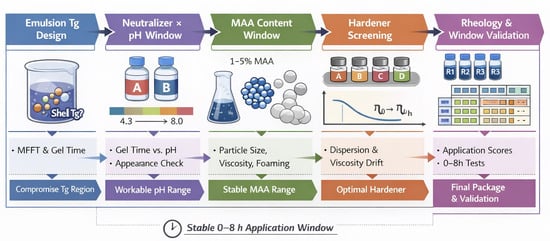
Graphical Abstract

1. Introduction

Industrial wood finishing increasingly demands coating uniformity, reproducible application performance, and reduced volatile organic compound emissions [1,2,3,4]. Spray application is an important practical scenario in furniture and panel finishing, where both coating appearance and formulation workability must be considered. However, translating laboratory-scale waterborne formulations into systems suitable for spray application remains challenging, because practical success depends not only on the final film properties but also on whether the coating can maintain stable behavior during application [5,6]. This challenge is particularly pronounced for reactive two-component systems, in which workable post-mixing time and viscosity stability must be balanced against film formation and surface quality [7,8].
Waterborne two-component (2K) systems, which combine hydroxyl-functional acrylic emulsions with water-dispersible polyisocyanate hardeners, are attractive for wood coatings because crosslinking can improve hardness, chemical resistance, and water resistance [9]. However, their practical use remains difficult because application workability must be maintained while the coating is undergoing post-mixing reactions [10]. A key challenge lies in controlling the usable time after mixing, since excessive viscosity build-up or premature gelation can quickly render the system unworkable [11]. At the same time, stable film formation under ambient conditions must also be ensured, because waterborne coatings are sensitive to the balance among minimum film-forming temperature (MFFT), drying rate, and the relative timing of coalescence and crosslinking [6]. Temperature and relative humidity can further influence latex film formation [12], highlighting the need for formulation strategies that remain practical under controlled ambient application conditions.
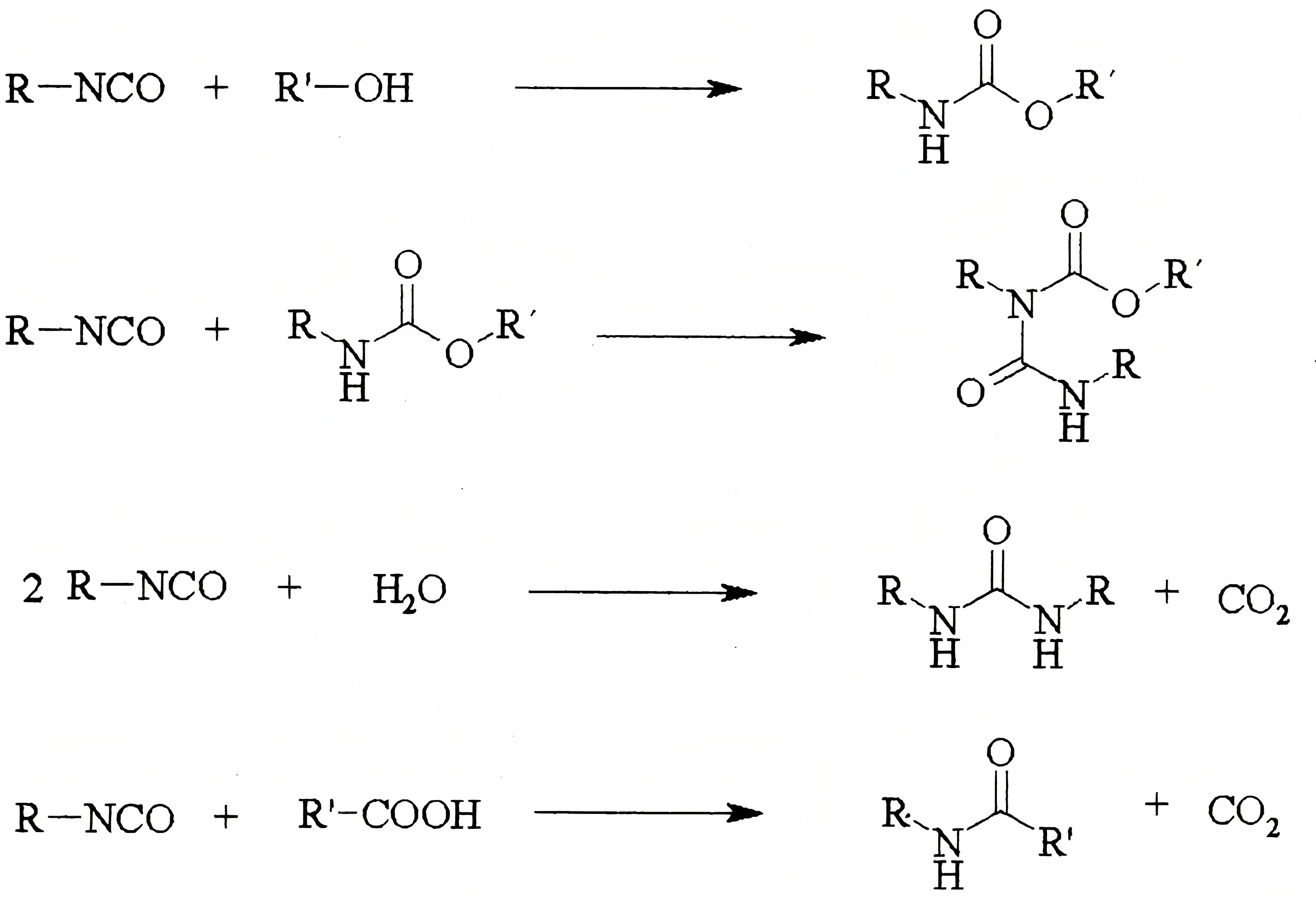
The instability of waterborne 2K systems after mixing arises from competing reaction pathways involving the isocyanate groups in the hardener and multiple reactive species present in the aqueous formulation [13,14]. The reaction between isocyanate and hydroxyl groups is the principal crosslinking pathway, but its practical outcome depends on how curing progresses relative to particle coalescence during film formation [15,16]. At the same time, isocyanate can also react with water, generating carbon dioxide and promoting foam formation, viscosity increase, and loss of application stability [17,18]. Additional interactions with carboxyl-containing species in the emulsion may further modify the reactivity of the system [19]. As a result, post-mixing behavior is governed not by a single reaction, but by a coupled balance among crosslinking, side reactions, and physical film formation. This makes variables such as pH, neutralizer type, and hardener selection particularly important, because they can influence reaction rate, viscosity evolution, and the useful working period of the coating [16,17,20]. Practical formulation therefore requires these factors to be coordinated so that adequate workability can be retained without compromising curing progress, film formation, or final coating performance [21]. These coupled relationships are summarized schematically in Figure 1.
One important manifestation of this coupling in waterborne 2K systems is the trade-off between ambient film formation and post-mixing stability [22]. Stable film formation generally requires a sufficiently low MFFT so that the coating can coalesce into a continuous film under ambient conditions [23,24]. In practice, lowering MFFT is often associated with a lower shell glass transition temperature (Tg) in the emulsion, which facilitates film formation but may also shorten the usable time after mixing by making the system more prone to viscosity build-up or premature gelation [25,26]. Conversely, increasing shell Tg can help extend gel time and improve post-mixing stability, but this usually raises MFFT and makes ambient film formation more difficult [25,27]. The formulation problem is therefore not to maximize either film formation or stability independently, but to identify a workable balance between them [28]. This balance is particularly important in spray-applied waterborne 2K coatings, where continuous film formation, adequate working time, and stable application behavior must be achieved simultaneously [29].
Beyond the MFFT–stability trade-off, the performance of waterborne 2K coatings is controlled by several interdependent formulation variables rather than by any single factor [30]. The emulsion Tg distribution defines the initial balance between ambient film formation and early-stage stability, while neutralizer type and pH affect colloidal behavior and post-mixing reactivity [31,32]. Acid monomer content can support dispersion stability but may also increase viscosity and foaming tendency, and hardener chemistry and dispersibility determine whether crosslinking proceeds in a controlled manner or is accompanied by rapid viscosity drift [33,34]. Rheology modifiers further complicate formulation design, because improvements in anti-sagging or atomization may be offset by losses in leveling or time-dependent stability [35,36]. These coupled effects indicate that practical formulation cannot be achieved through single-factor adjustment alone and instead requires a coordinated evaluation of multiple interacting variables.
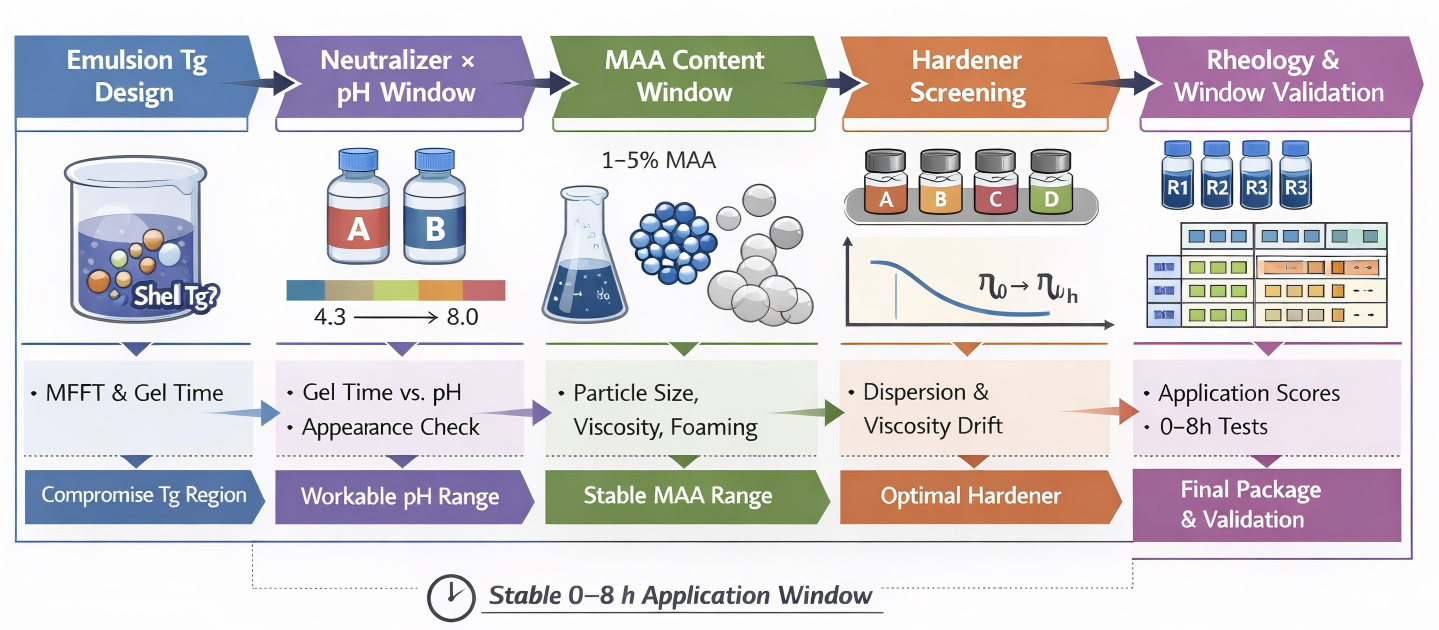
Despite extensive work on individual aspects of waterborne 2K coatings, an application-oriented formulation framework that simultaneously addresses ambient film formation, post-mixing workability, and stable application behavior remains insufficiently developed for wood coatings. The present study therefore aimed to establish a stepwise formulation strategy for spray-applied waterborne 2K wood coatings by examining the roles of emulsion Tg distribution, neutralizer type and pH, methacrylic acid content, hardener selection, and rheology modification. The goal was to identify a formulation route that could balance ambient film formation, adequate usable time after mixing, and stable spray application behavior. This study is expected to provide a useful reference for the design of waterborne 2K wood coatings under controlled ambient application conditions.

2. Materials and Methods

2.1. Materials

All raw materials and experimental samples were supplied by an industrial coatings manufacturer (Zhuhai Zhanchen New Materials Co., Ltd.) in Zhuhai, Guangdong Province, China. The main agent was a waterborne hydroxyl-functional acrylic emulsion (hydroxyl content: 1.8 wt%) designed for two-component crosslinking. For the emulsion-design screening, a series of hydroxyl-functional acrylic emulsion variants with different nominal shell glass transition temperatures (Tg) were supplied as experimental samples from the same acrylic emulsion platform. Methacrylic acid (MAA) was used as the ionizable comonomer in the emulsion design. Two commercially supplied neutralizers, denoted as Neutralizer A and Neutralizer B, were used for pH adjustment. Four commercially supplied water-dispersible polyisocyanate hardeners, denoted as Hardeners A–D, were evaluated as curing agents. These hardeners differed in chemistry and dispersibility; Hardener D was an HDI/IPDI-based curing agent with an NCO content of 14–16 wt%.
Rheology additives were used either individually or in combination. To avoid confusion with hardener codes, rheology modifiers are denoted as R1–R5. Among them, R1–R3 were associative polyurethane (PUR) thickeners targeting low-, medium-, and high-shear regimes, respectively; R4 was a polyether-polyol-based high-shear thickener; and R5 was an inorganic bentonite thickener.

2.2. Stepwise Screening Design

A stepwise screening design was adopted to establish a practical formulation route for spray-applied waterborne 2K wood coatings under controlled ambient conditions. Instead of varying all formulation factors simultaneously, key variable groups were screened sequentially so that the influence of each group could be assessed on the basis of a defined base system. At each stage, the selected conditions from the preceding step were carried forward, while the target variable group under evaluation was varied and the remaining key conditions were kept fixed. In this study, the shell Tg values used in the first screening step refer to the nominal Tg values of the supplied emulsion variants, which were screened against their resulting minimum film-forming temperature (MFFT) and gel-time responses. The screening design and corresponding decision responses used at each step are summarized in Table 1.

2.3. Formulation Preparation and Activation

Unless otherwise stated, all raw materials were equilibrated at room temperature (23–25 °C) overnight before use. Prior to formulation, the main agent was gently homogenized by low-speed stirring for 10 min to ensure uniformity while minimizing air entrainment. When pH adjustment was required, the designated neutralizer was added dropwise under stirring until the target pH was reached, and the adjusted system was allowed to equilibrate for 30 min before subsequent testing or activation. When rheology modifiers were used, the designated additives were first incorporated into the main agent and mixed until homogeneous.
Activated formulations were prepared by adding the curing agent to the main agent at a fixed equivalent ratio of n(NCO):n(OH) = 1.6. After curing-agent addition, the mixture was stirred for 3–5 min to ensure uniform dispersion while minimizing air entrainment. The moment of curing-agent addition was defined as time zero (t = 0) for all time-dependent measurements and film preparation. After activation, the formulation was transferred to a covered container and held at room temperature to limit evaporation and surface skin formation. Aliquots were withdrawn at the specified time points (0–8 h) for viscosity monitoring and coating preparation. When visible bubbles were present, the activated mixture was allowed to stand briefly before testing or spraying; this deaeration period did not alter the definition of t = 0.

2.4. Screening Measurements and Decision Criteria

The pH of the formulations was measured after neutralization using a calibrated benchtop pH meter (BGD 282, Biuged Precision Instruments Co., Ltd., Guangzhou, China). Minimum film-forming temperature (MFFT) was determined using an MFFT bar (BGD 452, Biuged Precision Instruments Co., Ltd., Guangzhou, China) following the principle of ASTM D2354 [37]. Gel time was measured from the moment of curing-agent addition and was determined by periodic manual observation of flow behavior under the prescribed test conditions. It was defined as the elapsed time required for the activated formulation to lose its liquid-like flowability and reach a gel-like state. Viscosity was evaluated as flow time(s) under constant measurement conditions, and the measured values were used to assess post-mixing viscosity stability during screening.
For neutralizer–pH screening, wet-film appearance and dry-film appearance were visually examined after application under identical preparation and curing conditions to exclude formulations showing obvious defects, such as poor coalescence, cracking, severe foaming, or other unacceptable surface irregularities. During rheology screening, leveling, anti-sagging, atomization quality, and viscosity stability were comparatively assessed under the same application conditions. Leveling was judged from surface smoothness and the absence of visible orange peel after drying. Anti-sagging was judged from the presence or absence of flow marks or sagging after application. Atomization quality was judged from the fineness and uniformity of the spray pattern during pneumatic spraying. Viscosity stability was judged from the extent of viscosity increase within the designated post-mixing period.

2.5. Spray Application Validation

Spray application validation was carried out using the final selected formulation over the 0–8 h post-mixing period. At each designated time point, the activated formulation was applied onto sanded wood panels (100 mm × 150 mm × 5 mm) using a gravity-feed pneumatic spray gun (W-71-2G, ANEST IWATA Corporation, Yokohama, Japan) equipped with a 1.3 mm nozzle at a constant atomizing pressure of 0.20–0.25 MPa. Prior to coating, the substrate surface was abraded with P400 sandpaper and wiped to remove dust. The coating was applied to a target wet-film thickness (WFT) of 80–120 μm, which was checked using a wet-film gauge (BGD 205, Biuged Precision Instruments Co., Ltd., Guangzhou, China). Spraying was performed at a gun-to-substrate distance of 15–20 cm using two cross passes, followed by a leveling period of 10 min. The coated panels were then cured for 48 h in the horizontal position under ambient conditions, protected from dust and direct airflow.
The cured films were evaluated at each time point for adhesion, pencil hardness, 60° gloss, chemical resistance, stain resistance, and surface appearance. Adhesion was assessed by cross-cut testing following the principle of ASTM D3359 [38], pencil hardness was measured according to ASTM D3363 [39], and gloss was measured at 60° according to ASTM D523 [40]. Chemical and stain resistance were assessed by spot/contact exposure following the principle of ASTM D1308 [41] using water (24 h), 50% ethanol solution (1 h), alkali solution (50 g/L, 24 h), 10% acetic acid solution (24 h), and coffee solution (40 g/L, 1 h). For each test, approximately 0.5 mL of the corresponding liquid was applied to the coating surface and immediately covered with a watch glass to minimize evaporation during exposure. After the specified exposure period, the liquid was removed and the test area was visually examined for discoloration, whitening, blistering, gloss loss, or other visible surface damage using the same rating basis for all time points. Surface appearance after curing was also recorded to confirm the absence of obvious film defects. Unless otherwise stated, all validation samples were prepared under the same spraying and curing conditions, and all observations were conducted using the same evaluation basis.

3. Results and Discussion

3.1. Emulsion and Activation-Condition Screening

3.1.1. Emulsion Tg Distribution, Film Formation, and Gel Time

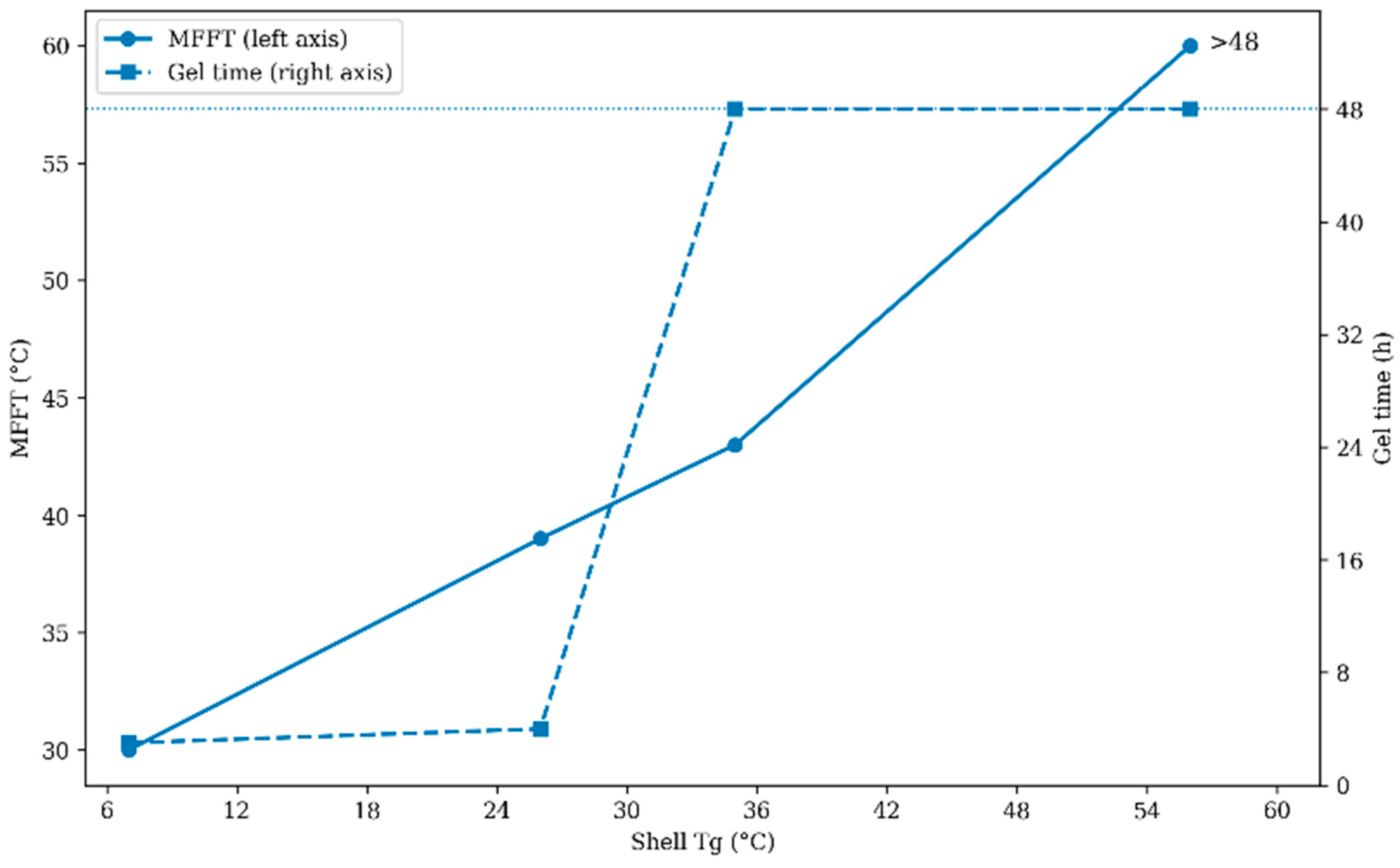
A series of emulsion variants differing in nominal shell glass transition temperature (Tg) was used in the first screening step. Emulsion Tg distribution strongly affected both minimum film-forming temperature (MFFT) and gel time, but the two responses changed in different ways as shell Tg increased, as shown in Figure 2. MFFT increased progressively across the investigated range, whereas gel time remained relatively short at lower shell Tg values and rose sharply once shell Tg approached approximately 36 °C.
Specifically, MFFT increased from about 30 °C to 60 °C as shell Tg increased from approximately 6 °C to 56 °C. This trend indicates that increasing shell Tg continuously raised the temperature threshold required for continuous film formation and therefore reduced film-forming feasibility under ambient conditions [42]. This behavior is consistent with the reduced deformability of a harder shell phase, which makes particle coalescence more difficult at room temperature. In contrast, gel time changed only slightly at lower shell Tg values but exceeded 48 h when shell Tg reached approximately 36 °C or above, indicating a marked slowing of the gelation process after activation. The abrupt increase in gel time suggests that the influence of shell Tg on post-mixing flow retention was not linear, but became much more pronounced once the shell phase reached a sufficiently rigid state [43].
These results show that shell Tg affected the two constraints in qualitatively different ways: film-forming feasibility deteriorated progressively, whereas post-mixing workability expanded sharply only after a threshold was reached. Very low shell Tg favored ambient film formation but provided only limited gel time, while very high shell Tg greatly extended gel time at the expense of an excessively high MFFT for the present application scenario. Accordingly, the subsequent screening was carried out in the intermediate Tg region, where neither response had yet shifted to an extreme.

3.1.2. Neutralizer–pH Effects on Gel Time and Film Appearance

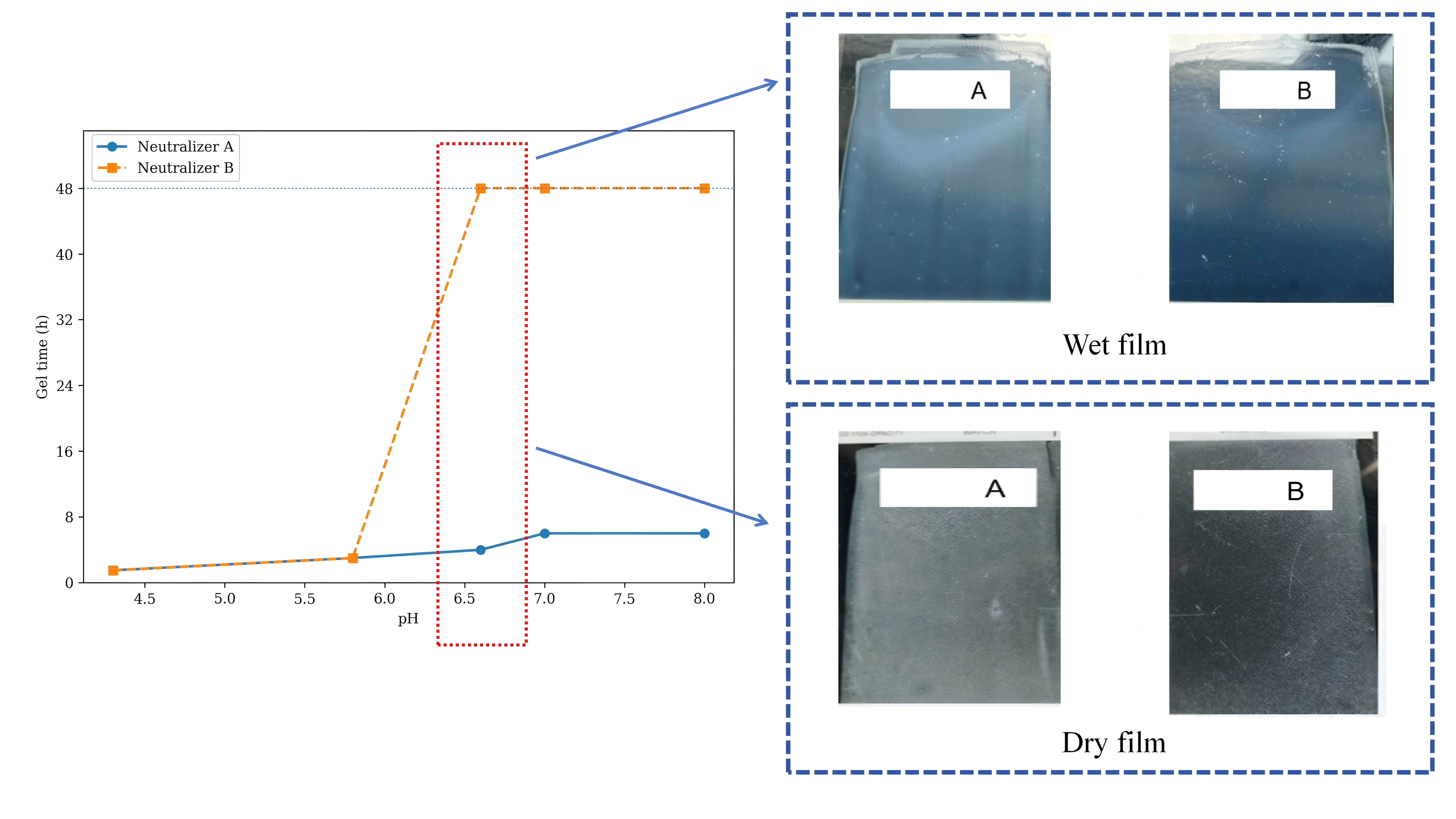
Neutralizer type and pH had a pronounced combined effect on gel time, but the response patterns differed substantially between the two neutralizers, as shown in Figure 3. Neutralizer A showed only a modest increase in gel time across the investigated pH range, remaining within a relatively narrow interval. In contrast, Neutralizer B exhibited a marked jump in gel time at around pH 6.6, after which the value remained at approximately 48 h. This result indicates that the response of the activated system to pH depended strongly on neutralizer identity rather than on pH alone. The two neutralizers did not merely shift the measured pH to different target values, but also altered the ionization environment and colloidal state of the activated formulation in different ways. As a result, the post-mixing reactivity of the system appeared to be more sensitive to pH adjustment when Neutralizer B was used. The abrupt increase in gel time near pH 6.6 therefore suggests a transition to a less rapidly gelling activation state, whereas Neutralizer A maintained a comparatively stable response over the tested range.
Representative wet- and dry-film appearances at pH 6.6 are also shown in Figure 3. Under this condition, both neutralizers produced films without obvious catastrophic defects, indicating that the system remained coatable at the selected comparison point. This visual comparison is important because gel time alone was not sufficient as a screening criterion: a longer workable time after activation was useful only if acceptable film formation could still be obtained after application and curing. In this respect, the pH 6.6 condition provided a practical comparison point at which the strong gel-time extension observed for Neutralizer B could be considered together with film appearance.
The results suggest that Neutralizer A provided a relatively insensitive gel-time response over the tested pH range, whereas Neutralizer B introduced a distinct transition near pH 6.6 that substantially extended gel time without excluding acceptable wet- and dry-film appearance at the representative comparison condition. For this reason, the Neutralizer B condition around pH 6.6 was considered the more useful basis for subsequent screening, as it provided a longer workable time after activation while remaining compatible with acceptable film appearance under the tested conditions.

3.1.3. MAA Content, Dispersion Stability, and Viscosity Build-Up

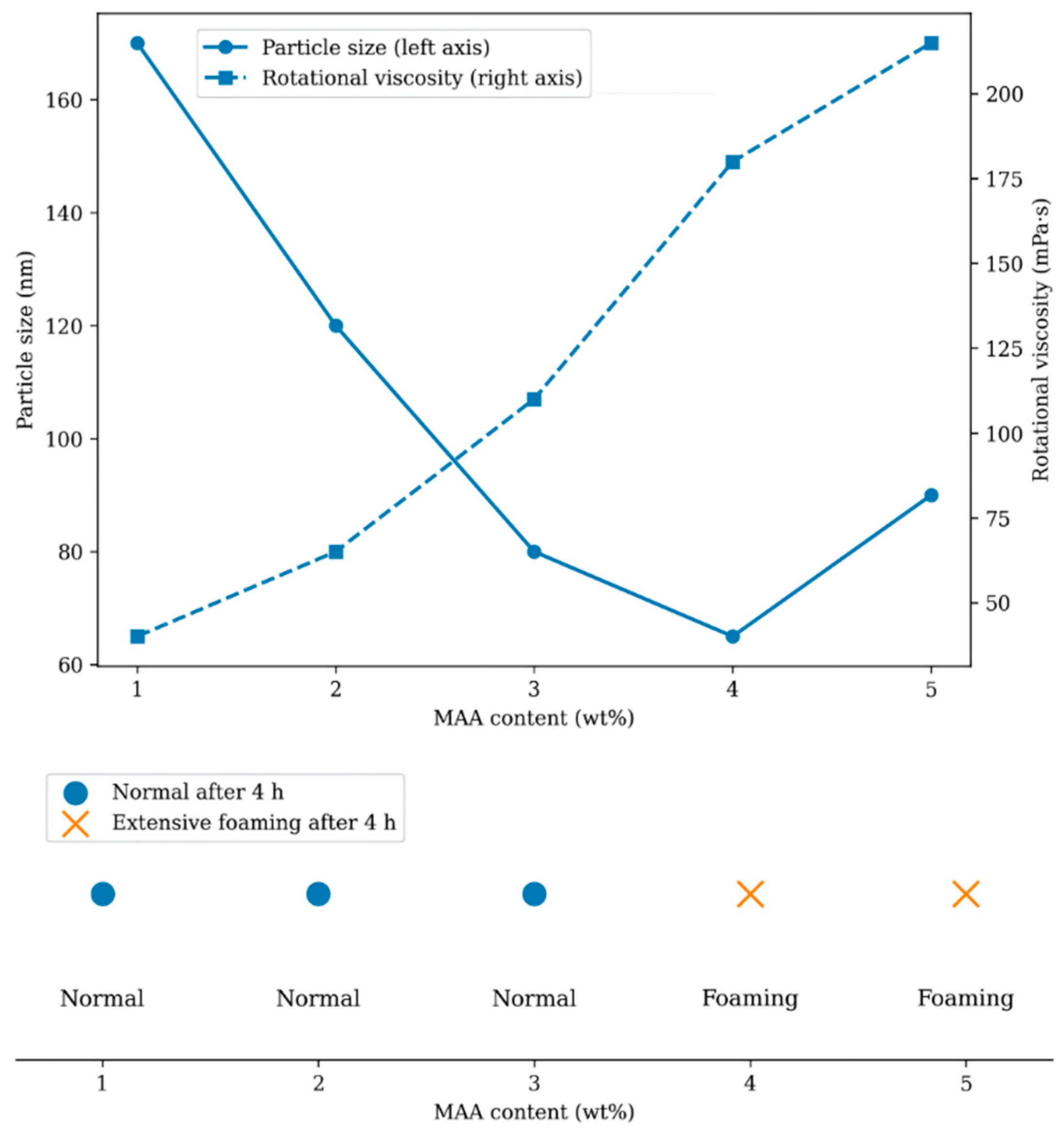
MAA content had a pronounced effect on particle size, rotational viscosity, and foaming tendency, as shown in Figure 4. As MAA content increased from 1 wt% to 4 wt%, particle size decreased markedly from approximately 170 nm to 65 nm, suggesting progressively finer dispersion of the emulsion system. At 5 wt%, however, particle size increased again to around 90 nm, indicating that the reduction trend was no longer maintained at the highest MAA level investigated. In contrast, rotational viscosity increased continuously with increasing MAA content, rising from approximately 40 mPa·s at 1 wt% to over 200 mPa·s at 5 wt%.
These results indicate that increasing MAA content improved dispersion fineness but simultaneously promoted viscosity build-up. The higher MAA content increased the ionizable fraction in the emulsion system, which favored finer particle dispersion but also strengthened intermolecular interactions after activation, thereby increasing resistance to flow. This trend is particularly relevant to spray-applied systems, because the benefit of finer dispersion can be offset if viscosity rises to a level that compromises atomization and flow.
The foaming observations further defined the practical upper boundary of this variable. Formulations containing 1–3 wt% MAA remained visually normal after 4 h, whereas extensive foaming was observed at 4 wt% and 5 wt%. This result shows that the practical limitation of high MAA content was not particle size itself, but the accompanying increase in viscosity and foaming tendency after activation. Accordingly, subsequent screening was restricted to the lower MAA region, and MAA contents above 3 wt% were excluded from further formulation design on practical application grounds.

3.2. Hardener and Rheology Selection

3.2.1. Hardener Screening Based on Viscosity Stability and Film-Forming Viability

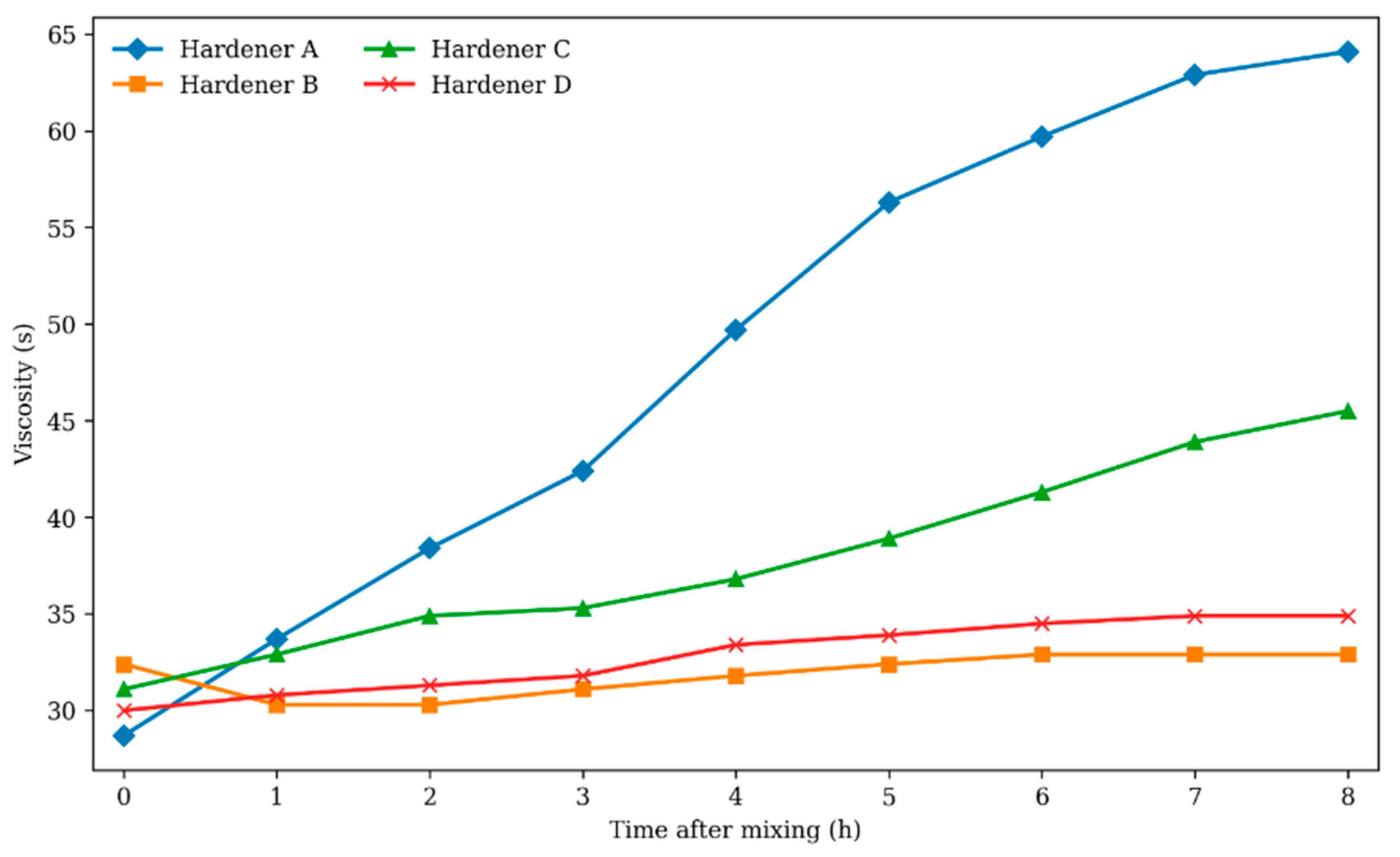
The activated formulations showed markedly different viscosity evolution profiles depending on hardener type, as shown in Figure 5. Hardener A exhibited the steepest increase over the 8 h observation period, whereas Hardener B remained nearly constant. Hardeners C and D showed intermediate responses, with Hardener D displaying the smallest increase among the film-forming candidates. The distinct viscosity profiles indicate that hardener choice directly influenced the post-mixing working window of the activated system and therefore had to be considered together with the film-forming outcome.
The hardener candidates also differed in mixing behavior and film-forming outcome after curing, in addition to their different viscosity evolution profiles, as shown in Table 2. Hardener A, although easy to mix with the main agent, showed the largest viscosity increase and was therefore excluded from the present formulation route. Hardener B showed the smallest viscosity drift, but no viable film was formed after 48 h of curing. This result shows that viscosity stability alone was not an adequate selection criterion, because a hardener that remained fluid after activation could still fail to deliver a viable cured film. Accordingly, film-forming viability was treated as the primary pass/fail criterion, and viscosity stability was used to rank the candidates that satisfied this requirement.
Among the hardeners that formed films after curing, Hardener C and Hardener D provided the most acceptable overall balance. However, Hardener D showed a smaller viscosity increase than Hardener C, with a lower Δη8h and a lower η8h/η0 ratio. This difference was practically important because a smaller viscosity increase after activation left more room for subsequent rheology adjustment without prematurely narrowing the usable application window. Thus, Hardener D was selected not because it showed the lowest viscosity drift overall, but because it showed the lowest drift among the hardeners that still produced acceptable films under the tested conditions.

3.2.2. Rheology Packages and Viscosity Stability

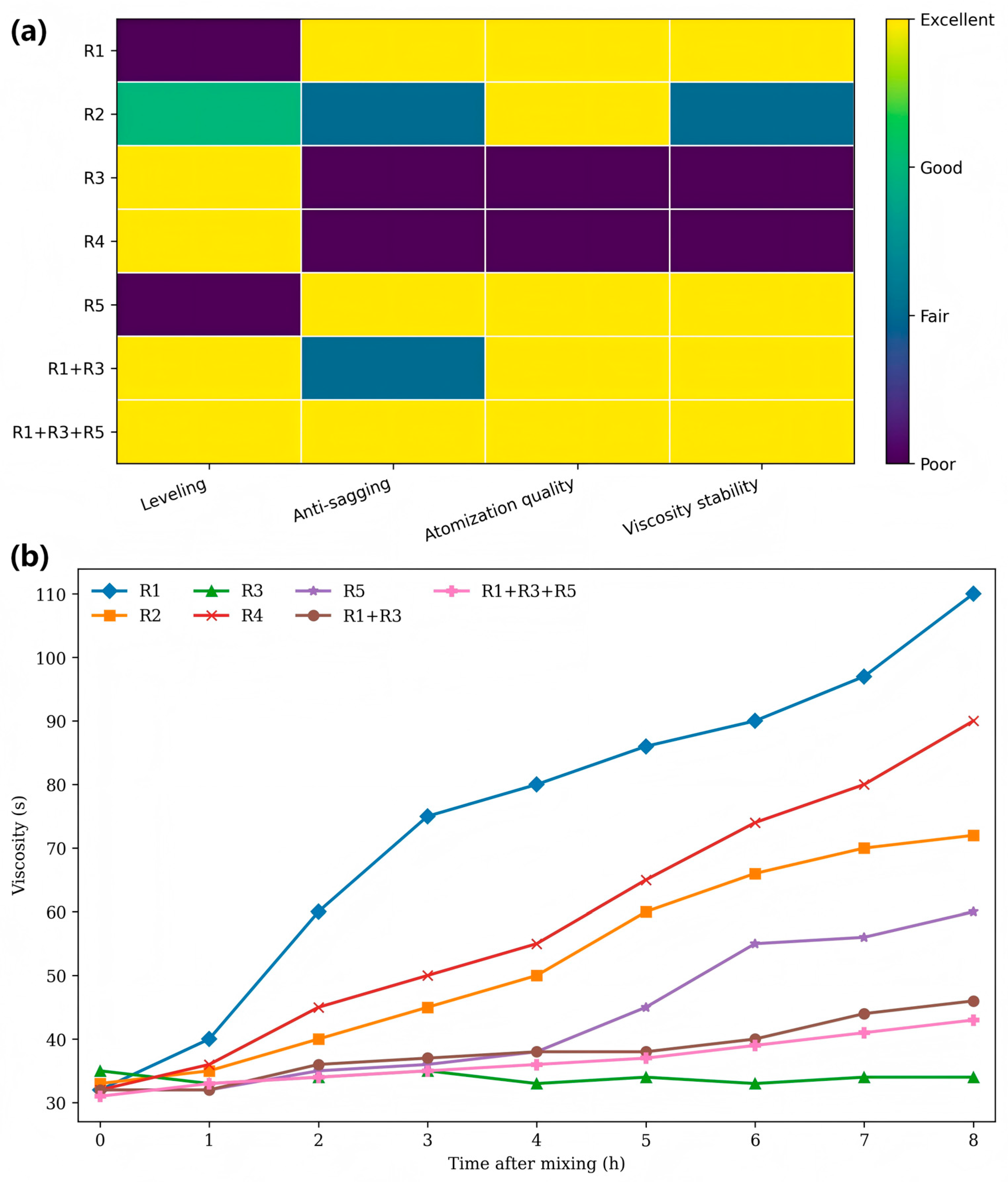
The ordered rating heat map in Figure 6a shows that the single-additive systems did not provide a balanced application profile across the four evaluated criteria. R1 and R5 performed well in anti-sagging, atomization quality, and viscosity stability, but both showed a clear limitation in leveling. By contrast, R3 and R4 gave excellent leveling but performed poorly in the other three criteria, indicating that they were not suitable as stand-alone rheology solutions for the present formulation route. R2 showed a more moderate profile, but still did not provide consistently high performance across all criteria. Overall, the single-additive conditions improved selected aspects of application behavior, but none achieved a uniformly favorable balance.
Figure 6b provides the second decision layer by showing the viscosity evolution of the selected rheology systems after activation. The single-additive formulations differed substantially in post-mixing viscosity behavior. R1 and R4 showed the strongest viscosity build-up over the 8 h period, indicating a high risk of narrowing the usable application window during practical use. R2 and R5 displayed intermediate increases, whereas R3 remained comparatively stable but, as shown in Figure 6a, did not provide an acceptable overall application profile when used alone. In contrast, the combined packages R1 + R3 and R1 + R3 + R5 both maintained much more controlled viscosity trajectories, remaining in the lower range of the tested systems throughout the observation period. These results indicate that satisfactory application-related ratings alone were not sufficient; the rheology package also had to preserve a stable viscosity profile after activation.
When the two layers of evidence are considered together, the advantage of the combined packages becomes clear. R1 + R3 improved the overall balance by correcting the leveling limitation of R1 while retaining favorable atomization quality and viscosity stability. The further addition of R5 led to the R1 + R3 + R5 package, which provided the most complete application profile in Figure 6a while still maintaining a restrained viscosity increase in Figure 6b. This combination was therefore considered the most suitable rheology package for subsequent spray-application validation. Its selection did not rest on a single outstanding criterion, but on the most balanced overall performance across both application-related behavior and post-mixing viscosity stability.

3.3. Spray Application-Window Validation

Table 3 summarizes the performance of the selected formulation when coatings were prepared at different times after mixing over the 0–8 h application window. Across this period, the coating maintained a stable visual outcome, with surface appearance remaining normal at all time points. The mechanical and optical indicators were also largely unchanged. Adhesion remained at grade 0 from 0 to 7 h and changed only slightly to grade 1 at 8 h, indicating that interfacial bonding was largely maintained across the tested window. Pencil hardness remained constant at F throughout, suggesting no obvious change in the cured film hardness with application time after activation. Gloss at 60° stayed within a narrow range of 24–26, consistent with the absence of visible defects and with stable surface development during the application window.
The chemical and stain resistance results show a similar pattern. Water resistance remained at grade 1 up to 7 h and changed only slightly to 1- at 8 h, while alkali resistance remained unchanged at grade 1 throughout. Alcohol resistance exhibited the clearest late-stage deviation, increasing from grade 2 to grade 3 at 8 h. Acetic acid resistance changed from grade 1 to grade 2 at 8 h, and coffee resistance decreased only slightly from grade 2 to 2- at the same time point. Taken together, these changes indicate that the first measurable performance deviations appeared at the end of the tested window, whereas coatings prepared within 0–7 h showed essentially stable performance across the evaluated properties. On this basis, the practical spray-application window of the selected formulation was considered to extend to 7 h, with 8 h representing the onset of performance drift under the tested conditions.

4. Conclusions

A stepwise formulation strategy was established for spray-applied waterborne two-component (2K) wood coatings by treating processability as a coupled problem involving film formation, post-mixing workability, and viscosity stability after activation. Emulsion Tg distribution defined the initial balance between minimum film-forming temperature and gel time, and the subsequent screening showed that an intermediate Tg region was more suitable for further formulation development than either extreme. Neutralizer identity and pH jointly affected gel-time behavior, and a practical condition around pH 6.6 was selected because it extended workable time without excluding acceptable wet- and dry-film appearance under the tested conditions. MAA content reduced particle size but also increased viscosity and, above 3 wt%, caused pronounced foaming after activation, thereby defining a practical upper boundary for subsequent screening. Hardener selection further showed that film-forming viability had to be satisfied before viscosity stability could be used to rank the viable candidates, leading to the selection of an HDI/IPDI-based hardener with the lowest viscosity drift among the film-forming systems. Rheology-package screening indicated that combined additives provided the most balanced overall profile in terms of leveling, anti-sagging, atomization quality, and viscosity stability. Final validation showed that the selected formulation maintained a stable appearance and largely unchanged film properties from 0 to 7 h after mixing, whereas the first measurable performance deviations appeared at 8 h. Under the tested conditions, these results provide a practical reference for the design of spray-applied waterborne 2K wood coatings on wood panels.

Author Contributions

Conceptualization, A.A.A. and Y.N.; methodology, G.L. and Y.N.; validation, G.L., Y.N. and A.A.A.; formal analysis, G.L. and Y.N.; investigation, G.L. and Y.N.; resources, A.A.A.; data curation, G.L. and Y.N.; writing—original draft preparation, G.L. and Y.N.; writing—review and editing, Y.N. and A.A.A.; visualization, G.L. and Y.N.; supervision, A.A.A.; project administration, A.A.A.; funding acquisition, A.A.A. All authors have read and agreed to the published version of the manuscript.

Funding

This research was funded by the Ministry of Higher Education Malaysia under the Fundamental Research Grant Scheme (FRGS), Project Code FRGS/1/2019/STG07/USM/02/18.

Institutional Review Board Statement

Not applicable.

Informed Consent Statement

Not applicable.

Data Availability Statement

The raw data supporting the conclusions of this article will be made available by the authors on request.

Conflicts of Interest

The authors declare no conflicts of interest.

Abbreviations

The following abbreviations are used in this manuscript:
2KTwo-component
DLSDynamic light scattering
DFTDry film thickness
HDIHexamethylene diisocyanate
IPDIIsophorone diisocyanate
MAAMethacrylic acid
MFFTMinimum film-forming temperature
NCOIsocyanate group
OHHydroxyl group
PURPolyurethane associative thickener
TgGlass transition temperature
VOCVolatile organic compounds
WFTWet film thickness

References

  1. Stockwell, C.E.; Coggon, M.M.; Gkatzelis, G.I.; Ortega, J.; McDonald, B.C.; Peischl, J.; Aikin, K.; Gilman, J.B.; Trainer, M.; Warneke, C. Volatile Organic Compound Emissions from Solvent- and Water-Borne Coatings—Compositional Differences and Tracer Compound Identifications. Atmos. Chem. Phys. 2021, 21, 6005–6022. [Google Scholar] [CrossRef]
  2. Pieters, K.; Mekonnen, T.H. Progress in Waterborne Polymer Dispersions for Coating Applications: Commercialized Systems and New Trends. RSC Sustain. 2024, 2, 3704–3729. [Google Scholar] [CrossRef]
  3. Hazir, E.; Koc, K.H. Evaluation of Wood-Based Coating Performance for Ultraviolet Roller and Conventional Air-Atomization Processes. Maderas. Cienc. Tecnol. 2021, 23, 1–10. [Google Scholar] [CrossRef]
  4. Zhang, J.; Qi, H.; Wu, J.J.; Mao, X.; Zhang, H.; Amin, N.; Xu, F.; Dong, C.; Wang, C.; Wang, P.; et al. Disposable Peptidoglycan-Specific Biosensor for Noninvasive Real-Time Detection of Broad-Spectrum Gram-Positive Bacteria in Exhaled Breath Condensates. Anal. Chem. 2024, 96, 9817–9825. [Google Scholar] [CrossRef]
  5. Geurink, P.J.A.; Scherer, T.; Buter, R.; Steenbergen, A.; Henderiks, H. A Complete New Design for Waterborne 2-Pack PUR Coatings with Robust Application Properties. Prog. Org. Coat. 2006, 55, 119–127. [Google Scholar] [CrossRef]
  6. Arjmandi, A.; Bi, H.; Nielsen, S.U.; Dam-Johansen, K. From Wet to Protective: Film Formation in Waterborne Coatings. ACS Appl. Mater. Interfaces 2024, 16, 58006–58028. [Google Scholar] [CrossRef] [PubMed]
  7. Melchiors, M.; Sonntag, M.; Kobusch, C.; Jürgens, E. Recent Developments in Aqueous Two-Component Polyurethane (2K-PUR) Coatings. Prog. Org. Coat. 2000, 40, 99–109. [Google Scholar] [CrossRef]
  8. Fiori, D.E. Two-Component Water Reducible Polyurethane Coatings. Prog. Org. Coat. 1997, 32, 65–71. [Google Scholar] [CrossRef]
  9. Kiil, S. Drying of Latex Films and Coatings: Reconsidering the Fundamental Mechanisms. Prog. Org. Coat. 2006, 57, 236–250. [Google Scholar] [CrossRef]
  10. Chen, X.; Fischer, S.; Men, Y. Temperature and Relative Humidity Dependency of Film Formation of Polymeric Latex Dispersions. Langmuir 2011, 27, 12807–12814. [Google Scholar] [CrossRef]
  11. Majumdar, P.; Christianson, D.A.; Webster, D.C. Automated Determination of Pot Life of Two-Component Reactive Coatings. Prog. Org. Coat. 2006, 57, 210–214. [Google Scholar] [CrossRef]
  12. Ersek, G.; Mehrabi Koushki, R.; Scheerder, J.; van Casteren, I.; Chen, Q.; Hermida-Merino, D.; Portale, G. Influence of the Airflow and Humidity on the Chain Aggregation during the Film-Formation in a Flexible Waterborne Polyurethane Formulation. J. Colloid. Interface Sci. 2025, 678, 446–455. [Google Scholar] [CrossRef] [PubMed]
  13. Dardouri, M.; ben Hadj Amor, A.; Meganem, F. Preparation, Characterization and Ion Adsorption Properties of Functionalized Polystyrene Modified with 1,4-Phenylene Diisocyanate and Diethylenetriamine. Chem. Pap. 2015, 69, 1617–1624. [Google Scholar] [CrossRef]
  14. Nabuurs, T.; Pears, D.; Overbeek, A. Defect Free Coatings from Two-Pack Isocyanate Curable Acrylic Dispersions. Prog. Org. Coat. 1999, 35, 129–140. [Google Scholar] [CrossRef]
  15. He, Z.A.; Blank, W.J.; Picci, M.E. A Selective Catalyst for Two-Component Waterborne Polyurethane Coatings. J. Coat. Technol. 2002, 74, 31–36. [Google Scholar] [CrossRef]
  16. Blank, W.J.; He, Z.A.; Hessell, E.T. Catalysis of the Isocyanate-Hydroxyl Reaction by Non-Tin Catalysts. Prog. Org. Coat. 1999, 35, 19–29. [Google Scholar] [CrossRef]
  17. Hawkins, C.A.; Sheppard, A.C.; Wood, T.G. Recent Advances in Aqueous Two-Component Systems for Heavy-Duty Metal Protection. Prog. Org. Coat. 1997, 32, 253–261. [Google Scholar] [CrossRef]
  18. Fiori, D.E.; Ley, D.A.; Quinn, R.J. Effect of Particle Size Distribution on the Performance of Two-Component Water-Reducible Acrylic Polyurethane Coatings Using Tertiary Polyisocyanate Crosslinkers. J. Coat. Technol. 2000, 72, 63–69. [Google Scholar] [CrossRef]
  19. Gürtler, C.; Danielmeier, K. A Catalyst System for the Reaction of Carboxylic Acids with Aliphatic Isocyanates. Tetrahedron Lett. 2004, 45, 2515–2521. [Google Scholar] [CrossRef]
  20. Otts, D.B.; Pereira, K.J.; Jarret, W.L.; Urban, M.W. Dynamic Colloidal Processes in Waterborne Two-Component Polyurethanes and Their Effects on Solution and Film Morphology. Polymer 2005, 46, 4776–4788. [Google Scholar] [CrossRef]
  21. Li, L.; Shao, Z.; Liu, W.; Liu, Y.; Zhao, S.; Wei, Y.; Zhang, J.; Wang, X.; Hou, H. Channel Microenvironment-Controlled Pillared MOF as Efficient Triboelectric Nanogenerator Material for Self-Powered Degradation of Organic Pollutants. Energy Environ. Mater. 2026, e70280. [Google Scholar] [CrossRef]
  22. Jiménez, N.; Ballard, N.; Asua, J.M. Hard Coatings from Soft Latexes: A Review of Routes to Overcome the Film Formation Dilemma. Macromol. Mater. Eng. 2024, 309, 2400026. [Google Scholar] [CrossRef]
  23. Voogt, B.; Huinink, H.P.; Erich, S.J.F.; Scheerder, J.; Venema, P.; Keddie, J.L.; Adan, O.C.G. Film Formation of High Tg Latex Using Hydroplasticization: Explanations from NMR Relaxometry. Langmuir 2019, 35, 12418–12427. [Google Scholar] [CrossRef] [PubMed]
  24. Toussaint, A.; De Wilde, M.; Molenaar, F.; Mulvihill, J. Calculation of Tg and MFFT Depression Due to Added Coalescing Agents. Prog. Org. Coat. 1997, 30, 179–184. [Google Scholar] [CrossRef]
  25. Hasanzadeh, I.; Mahdavian, A.R.; Salehi-Mobarakeh, H. Particle Size and Shell Composition as Effective Parameters on MFFT for Acrylic Core–Shell Particles Prepared via Seeded Emulsion Polymerization. Prog. Org. Coat. 2014, 77, 1874–1882. [Google Scholar] [CrossRef]
  26. Kong, X.; Luo, C.-H.; Qu, J.-Q.; Chen, H.-Q. Investigation into Pot Life of Waterborne Two-Component Polyurethane Coatings. J. South China Univ. Technol. (Nat. Sci.) 2009, 37, 85. [Google Scholar]
  27. Lopes Brito, E.; Ballard, N. Film Formation of Two-Stage Acrylic Latexes: Toward Soft-Core/Hard-Shell Systems. Macromol. Mater. Eng. 2024, 309, 2300287. [Google Scholar] [CrossRef]
  28. Guo, S.; Song, Y.; Wu, Y.; Hu, J.; Lu, J.; Wang, C.; Jia, Z.; Hua, L. Microscopic Mechanism of Enhanced Strength-Plasticity Synergy in Pre-Damaged TC11 Titanium Alloys via Novel Electroshock Treatment. J. Alloys Compd. 2026, 1052, 186139. [Google Scholar] [CrossRef]
  29. Routh, A.F.; Russel, W.B. Deformation Mechanisms During Latex Film Formation:  Experimental Evidence. Ind. Eng. Chem. Res. 2001, 40, 4302–4308. [Google Scholar] [CrossRef]
  30. Tran, K.; Liu, Y.; Soleimani, M.; Lucas, F.; Winnik, M.A. Waterborne 2-Component Polyurethane Coatings Based on Acrylic Polyols with Secondary Alcohols. Prog. Org. Coat. 2024, 190, 108374. [Google Scholar] [CrossRef]
  31. Steward, P.A.; Hearn, J.; Wilkinson, M.C. An Overview of Polymer Latex Film Formation and Properties. Adv. Colloid. Interface Sci. 2000, 86, 195–267. [Google Scholar] [CrossRef] [PubMed]
  32. dos Santos, Z.M.; Wanderley Neto, A.O.; Dantas, T.N.C.; Pereira, M.R.; Fonseca, J.L.C. Rheology of Acrylic Latices as a Function of Carboxyl Neutralization. Eur. Polym. J. 2007, 43, 3314–3324. [Google Scholar] [CrossRef]
  33. Reinhardt, R.A.; Heilen, W.; Walhorn, E.; Silber, S.; Adams, J.W. Defoamer Selection in Waterborne Coatings. J. Coat. Technol. 1998, 70, 157–160. [Google Scholar] [CrossRef]
  34. Zhou, H.; Liu, Y.; Zhang, M.; Lu, Y.; Arnett, L.P.; Soleimani, M.; Winnik, M.A. Characterization of an Aqueous Dispersion of a Hydrophilic Polyisocyanate for Waterborne Two-Pack Polyurethane Coatings. ACS Appl. Polym. Mater. 2020, 2, 1491–1499. [Google Scholar] [CrossRef]
  35. Reuvers, A.J. Control of Rheology of Water-Borne Paints Using Associative Thickeners. Prog. Org. Coat. 1999, 35, 171–181. [Google Scholar] [CrossRef]
  36. Fernando, R.H.; Xing, L.-L.; Glass, J.E. Rheology Parameters Controlling Spray Atomization and Roll Misting Behavior of Waterborne Coatings. Prog. Org. Coat. 2000, 40, 35–38. [Google Scholar] [CrossRef]
  37. ASTM D2354-10; Standard Test Method for Minimum Film Formation Temperature of Emulsion Vehicles. ASTM International: West Conshohocken, PA, USA, 2018.
  38. ASTM D3359-23; Standard Test Methods for Rating Adhesion by Tape Test. ASTM International: West Conshohocken, PA, USA, 2023.
  39. ASTM D3363-22; Standard Test Method for Film Hardness by Pencil Test. ASTM International: West Conshohocken, PA, USA, 2022.
  40. ASTM D523-14; Standard Test Method for Specular Gloss. ASTM International: West Conshohocken, PA, USA, 2018.
  41. ASTM D1308-20; Standard Test Method for Effect of Household Chemicals on Clear and Pigmented Coating Systems. ASTM International: West Conshohocken, PA, USA, 2025.
  42. Cheaburu-Yilmaz, C.N.; Ozkan, C.K.; Yilmaz, O. Synthesis and Application of Reactive Acrylic Latexes: Effect of Particle Morphology. Polymers 2022, 14, 2187. [Google Scholar] [CrossRef]
  43. Cakic, S.; Lacnjevac, C.; Stamenkovic, J.; Ristic, N.; Takic, L.; Barac, M.; Gligoric, M. Effects of the Acrylic Polyol Structure and the Selectivity of the Employed Catalyst on the Performance of Two-Component Aqueous Polyurethane Coatings. Sensors 2007, 7, 308–318. [Google Scholar] [CrossRef]
Figure 1. Schematic illustration of the competing reaction pathways and formulation constraints in waterborne 2K wood coatings.
Coatings 16 00416 g001
Figure 2. Effects of emulsion shell Tg on minimum film-forming temperature (MFFT) and gel time.
Coatings 16 00416 g002
Figure 3. Effect of neutralizer type and pH on gel time, with representative wet- and dry-film appearances.
Coatings 16 00416 g003
Figure 4. Effect of MAA content on particle size, viscosity, and foaming tendency.
Coatings 16 00416 g004
Figure 5. Viscosity drift of activated mixtures with different hardeners.
Coatings 16 00416 g005
Figure 6. Comparative evaluation of rheology packages based on application-related ratings and viscosity evolution after activation. (a) Four-level ordered rating heat map; (b) Viscosity evolution profiles over 0–8 h after mixing.
Coatings 16 00416 g006
Table 1. Variable-setting scheme and decision responses used in each step of the screening design.
Screening StepVariables VariedBase SystemFixed ParametersDecision Responses
Emulsion design screeningEmulsion Tg distributionAcrylic emulsion variants with different nominal shell Tg valuesStandard neutralization conditionMFFT; gel time
Neutralizer–pH screeningNeutralizer type; pHEmulsion selected from the previous stepEmulsion Tg distributionGel time; wet-/dry-film appearance
MAA screeningMAA contentFormulation selected from the previous stepsNeutralizer–pH conditionDispersion stability; foaming tendency; viscosity build-up
Hardener screeningHardener typeFormulation selected from the previous stepsn(NCO):n(OH) = 1.6Incorporation feasibility; film-forming viability; viscosity stability
Rheology screeningRheology modifier packageFormulation selected from the previous stepsSelected hardener system; n(NCO):n(OH) = 1.6Leveling; anti-sagging; atomization quality; viscosity stability
Application-window validationPost-mixing time (0–8 h)Final selected formulationFixed spray and curing conditionsAppearance; adhesion; hardness; gloss; chemical/stain resistance
Table 2. Hardener screening based on mixing behavior, film-forming outcome, and viscosity evolution after activation.
HardenerCuring Agent TypeNCO Content (wt%)Modification TypeEase of Mixing with Main Agentη0 → η8h (s)Δη8h (s)η8h/η0Film Formed After 48 h Curing
AHDI15–17AnionicEasy28.7 → 64.135.42.23No
BHDI14–16NonionicDifficult32.4 → 32.90.51.02No
CHDI14–16Anionic + nonionicModerate31.1 → 45.514.41.46Yes
DHDI + IPDI14–16Anionic + nonionicModerate30.0 → 34.94.91.16Yes
Table 3. Spray-application window validation of the selected formulation.
Property0 h1 h2 h3 h4 h5 h6 h7 h8 h
Adhesion (grade)000000001
Pencil hardnessFFFFFFFFF
Gloss (60°)252425252526262626
Water resistance (24 h)111111111-
Alcohol resistance (50%, 1 h)222222223
Alkali resistance (50 g/L, 24 h)111111111
Acetic acid resistance (10%, 24 h)111111112
Coffee resistance (40 g/L, 1 h)222222222-
Surface appearanceNormalNormalNormalNormalNormalNormalNormalNormalNormal
Disclaimer/Publisher’s Note: The statements, opinions and data contained in all publications are solely those of the individual author(s) and contributor(s) and not of MDPI and/or the editor(s). MDPI and/or the editor(s) disclaim responsibility for any injury to people or property resulting from any ideas, methods, instructions or products referred to in the content.