You are currently viewing a new version of our website. To view the old version click .

Antibiotics, Volume 13, Issue 9

September 2024 - 122 articles

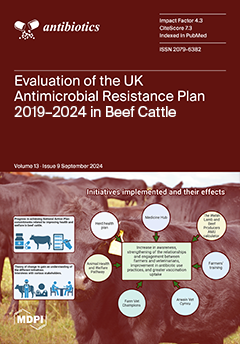
Cover Story: This study aimed to explore the progress made in the beef sub-sector in addressing commitment to the UK antimicrobial resistance (AMR) National Action Plan (2019–2024) related to improving animal health and welfare and responsible antimicrobial use (AMU). The findings show that progress has been made with various initiatives implemented targeting data collection, farmer and veterinarian engagement, and herd health planning. However, challenges remain, including the availability of AMU and AMR data that are crucial for assessing the impacts of these initiatives. Ensuring the adequacy of resources was found to be critical for sustaining effective efforts. Additionally, the importance of other outcomes such as developing and strengthening farmer–veterinarian relationships should not be underestimated as it is fundamental for addressing issues like AMR. View this paper
  • Issues are regarded as officially published after their release is announced to the table of contents alert mailing list .
  • You may sign up for email alerts to receive table of contents of newly released issues.
  • PDF is the official format for papers published in both, html and pdf forms. To view the papers in pdf format, click on the "PDF Full-text" link, and use the free Adobe Reader to open them.

Articles (122)

  • Article
  • Open Access
1,305 Views
11 Pages

Safety of Intraoperative Cell Salvage in Two-Stage Revision of Septic Hip Arthroplasties

  • Lara Krüger,
  • André Strahl,
  • Eva Goedecke,
  • Maximilian M. Delsmann,
  • Leon-Gordian Leonhardt,
  • Frank Timo Beil and
  • Jan Hubert

21 September 2024

(1) Background: The aim of this study was to evaluate the safety of intraoperative cell salvage (ICS) during reimplantation in the two-stage revision of septic hip arthroplasties. (2) Methods: As part of an internal quality control study, blood cultu...

  • Feature Paper
  • Article
  • Open Access
5 Citations
4,091 Views
12 Pages

Impact of ESKAPE Pathogens on Bacteremia: A Three-Year Surveillance Study at a Major Hospital in Southern Italy

  • Mariagrazia De Prisco,
  • Roberta Manente,
  • Biagio Santella,
  • Enrica Serretiello,
  • Federica Dell’Annunziata,
  • Emanuela Santoro,
  • Francesca F. Bernardi,
  • Chiara D’Amore,
  • Alessandro Perrella and
  • Pasquale Pagliano
  • + 3 authors

21 September 2024

Background/Objectives: ESKAPE pathogens (Enterococcus faecium, Staphylococcus aureus, Klebsiella pneumoniae, Acinetobacter baumannii, Pseudomonas aeruginosa, and Enterobacter spp.) pose a serious public health threat as they are resistant to multiple...

  • Article
  • Open Access
6 Citations
4,053 Views
12 Pages

Antibacterial and Antibiofilm Potential of Chlorophyllin Against Streptococcus mutans In Vitro and In Silico

  • Seemrose Khan,
  • Ihtisham Ul Haq,
  • Imran Ali,
  • Abdul Rehman,
  • Mazen Almehmadi,
  • Meshari A. Alsuwat,
  • Tariq Zaman and
  • Muhammad Qasim

20 September 2024

Background: Streptococcus mutans is a leading causative agent of dental caries and exerts pathogenicity by forming biofilms. Dental caries continues to be a significant public health issue worldwide, affecting an estimated 2.5 billion people, showing...

  • Article
  • Open Access
7 Citations
4,222 Views
13 Pages

Antimicrobial and Phylogenomic Characterization of Bacillus cereus Group Strains Isolated from Different Food Sources in Italy

  • Donatella Farina,
  • Angelica Bianco,
  • Viviana Manzulli,
  • Stefano Castellana,
  • Antonio Parisi,
  • Marta Caruso,
  • Rosa Fraccalvieri,
  • Luigina Serrecchia,
  • Valeria Rondinone and
  • Lorenzo Pace
  • + 6 authors

20 September 2024

Background: Bacillus cereus is a widespread environmental Gram-positive bacterium which is especially common in soil and dust. It produces two types of toxins that cause vomiting and diarrhea. At present, foodborne outbreaks due to Bacillus cere...

  • Article
  • Open Access
1 Citations
2,398 Views
16 Pages

Alkyl Pyridinol Compounds Exhibit Antimicrobial Effects against Gram-Positive Bacteria

  • Juan Canchola,
  • Gracious Yoofi Boafo Donkor,
  • Patrick Ofori Tawiah,
  • Ayoola Fasawe,
  • Emmanuel Ayim,
  • Martin F. Engelke and
  • Jan-Ulrik Dahl

20 September 2024

Background/Objectives. The rise of antibiotic-resistant pathogens represents a significant global challenge in infectious disease control, which is amplified by the decline in the discovery of novel antibiotics. Staphylococcus aureus continues to be...

  • Review
  • Open Access
24 Citations
13,437 Views
15 Pages

Preventing and Controlling Healthcare-Associated Infections: The First Principle of Every Antimicrobial Stewardship Program in Hospital Settings

  • Massimo Sartelli,
  • Corrado P. Marini,
  • John McNelis,
  • Federico Coccolini,
  • Caterina Rizzo,
  • Francesco M. Labricciosa and
  • Patrizio Petrone

20 September 2024

Antimicrobial resistance (AMR) is one of the main public health global burdens of the 21st century, responsible for over a million deaths every year. Hospital programs aimed at improving antibiotic use, referred to as antimicrobial stewardship progra...

  • Review
  • Open Access
6 Citations
3,328 Views
15 Pages

19 September 2024

In the context of global efforts to combat antimicrobial resistance (AMR), the importance of comprehensive AMR data is more crucial than ever. AMR surveillance networks, such as the European Antimicrobial Resistance Surveillance Network (EARS-Net) an...

  • Review
  • Open Access
4 Citations
11,766 Views
14 Pages

Appropriate Use of Antibiotics in Acute Pancreatitis: A Scoping Review

  • Josep M. Badia,
  • Sara Amador,
  • Carmen González-Sánchez,
  • Inés Rubio-Pérez,
  • Alba Manuel-Vázquez,
  • Montserrat Juvany,
  • Estela Membrilla,
  • José M. Balibrea and
  • Xavier Guirao

18 September 2024

Background: While selective use of antibiotics for infected pancreatic necrosis (IPN) in acute pancreatitis (AP) is recommended, studies indicate a high rate of inadequate treatment. Methods: A search of PubMed, Scopus, and Cochrane databases was con...

  • Review
  • Open Access
6 Citations
2,994 Views
18 Pages

ST105 Lineage of MRSA: An Emerging Implication for Bloodstream Infection in the American and European Continents

  • Alice Slotfeldt Viana,
  • Laís Pires do Valle Tótola and
  • Agnes Marie Sá Figueiredo

18 September 2024

Sequence-type 5 (ST5) of methicillin-resistant Staphylococcus aureus (MRSA), harboring the staphylococcal chromosomal cassette mec type IV (SCCmecIV), was first detected in Portugal. It emerged as a significant cause of healthcare-associated (HA) inf...

of 13

Get Alerted

Add your email address to receive forthcoming issues of this journal.

XFacebookLinkedIn
Antibiotics - ISSN 2079-6382