You are currently viewing a new version of our website. To view the old version click .

Journal of Functional Biomaterials, Volume 15, Issue 9

September 2024 - 37 articles

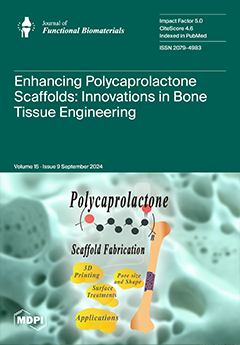
Cover Story: Polycaprolactone (PCL) scaffolds have emerged as a pivotal element in bone tissue engineering due to their favorable properties such as biocompatibility, biodegradability, and mechanical strength. This review comprehensively explores innovative fabrication techniques, including 3D printing and surface modifications, to enhance PCL scaffold performance. Emphasis is placed on the integration of biomaterials like hydroxyapatite and graphene oxide to improve cellular behavior and mechanical properties. The study provides valuable insights into optimizing scaffold structures for effective bone regeneration, offering promising directions for future clinical applications. View this paper
  • Issues are regarded as officially published after their release is announced to the table of contents alert mailing list .
  • You may sign up for email alerts to receive table of contents of newly released issues.
  • PDF is the official format for papers published in both, html and pdf forms. To view the papers in pdf format, click on the "PDF Full-text" link, and use the free Adobe Reader to open them.

Articles (37)

  • Article
  • Open Access
9 Citations
6,478 Views
23 Pages

In Vitro Wound-Healing Potential of Phenolic and Polysaccharide Extracts of Aloe vera Gel

  • Andreea Iosageanu,
  • Elena Mihai,
  • Ana-Maria Seciu-Grama,
  • Elena Utoiu,
  • Alexandra Gaspar-Pintiliescu,
  • Florentina Gatea,
  • Anisoara Cimpean and
  • Oana Craciunescu

13 September 2024

The present study aimed to conduct a comparative investigation of the biological properties of phenolic and polysaccharide extracts obtained using an ultrasound-assisted technique from Aloe vera gel and their effects on each stage of the wound healin...

  • Article
  • Open Access
3 Citations
2,929 Views
16 Pages

Exploring the Role of Fibrin Gels in Enhancing Cell Migration for Vasculature Formation

  • Joana A. Moura,
  • Hugh J. Barlow,
  • Shareen H. Doak,
  • Karl Hawkins,
  • Iris Muller and
  • Martin J. D. Clift

12 September 2024

A hallmark of angiogenesis is the sprouting of endothelial cells. To replicate this event in vitro, biomaterial approaches can play an essential role in promoting cell migration. To study the capacity of a scaffold of fibrin (fibrinogen:thrombin mix)...

  • Article
  • Open Access
5 Citations
1,636 Views
22 Pages

Comparison of Key Properties of Ag-TiO2 and Hydroxyapatite-Ag-TiO2 Coatings on NiTi SMA

  • Karolina Dudek,
  • Aleksandra Strach,
  • Daniel Wasilkowski,
  • Bożena Łosiewicz,
  • Julian Kubisztal,
  • Anna Mrozek-Wilczkiewicz,
  • Patryk Zioła and
  • Adrian Barylski

12 September 2024

To functionalize the NiTi alloy, multifunctional innovative nanocoatings of Ag-TiO2 and Ag-TiO2 doped with hydroxyapatite were engineered on its surface. The coatings were thoroughly characterized, focusing on surface topography and key functional pr...

  • Article
  • Open Access
1 Citations
2,040 Views
21 Pages

11 September 2024

Distant metastasis is the primary cause of unsuccessful treatment in nasopharyngeal carcinoma (NPC), suggesting the crucial need to comprehend this process. A tumor related to NPC does not have flat surfaces, but consists of confined microenvironment...

  • Article
  • Open Access
2 Citations
2,550 Views
23 Pages

Synthetic Extracellular Matrix of Polyvinyl Alcohol Nanofibers for Three-Dimensional Cell Culture

  • Thi Xuan Thuy Tran,
  • Gyu-Min Sun,
  • Hue Vy An Tran,
  • Young Hun Jeong,
  • Petr Slama,
  • Young-Chae Chang,
  • In-Jeong Lee and
  • Jong-Young Kwak

10 September 2024

An ideal extracellular matrix (ECM) replacement scaffold in a three-dimensional cell (3D) culture should induce in vivo-like interactions between the ECM and cultured cells. Highly hydrophilic polyvinyl alcohol (PVA) nanofibers disintegrate upon cont...

  • Article
  • Open Access
4 Citations
2,602 Views
17 Pages

10 September 2024

The mucosa height has always been of interest in modern implant dentistry to obtain biomimetic results. Papilla height, mucosa scalloping, and free mucosal margin level are crucial to achieve “pink aesthetics”. The aim of this study was t...

  • Article
  • Open Access
3 Citations
1,616 Views
23 Pages

9 September 2024

Clinical indications for the Ti-Zr alloy (Roxolid®) mini-implants (MDIs) in subjects with narrow ridges are still under review. The aim was to analyze peri-implant and posterior edentulous area strains dependent on the MDI number, splinting statu...

  • Article
  • Open Access
3,639 Views
15 Pages

Effect of Silica Nanoparticle Treatment on Adhesion between Tissue-like Substrates and In Vivo Skin Wound Sealing

  • Yeji Jeon,
  • Tae Ryeol Kim,
  • Eun Seo Park,
  • Jae Hyun Park,
  • Han Sung Youn,
  • Dae Youn Hwang and
  • Sungbaek Seo

9 September 2024

Silica nanoparticles are innovative solutions of surgical glue that can readily adhere to various tissue-like substrates without the need for time-consuming chemical reactions or ultraviolet irradiation. Herein, 10 nm-sized silica nanoparticle (SiNP1...

  • Review
  • Open Access
18 Citations
4,731 Views
30 Pages

Advances in Zinc-Containing Bioactive Glasses: A Comprehensive Review

  • Fariborz Sharifianjazi,
  • Mohammadjavad Sharifianjazi,
  • Maryam Irandoost,
  • Ketevan Tavamaishvili,
  • Mehdi Mohabatkhah and
  • Maziar Montazerian

8 September 2024

Bioactive glasses (BGs) have attracted significant attention in the biomaterials field due to their ability to promote soft and hard tissue regeneration and their potential for various clinical applications. BGs offer enriched features through the in...

  • Article
  • Open Access
3 Citations
3,018 Views
17 Pages

Healing Potential of the Marine Polysaccharides Carrageenan and Ulvan on Second-Degree Burns

  • Dimitra Statha,
  • Asimina Papaioannou,
  • Stefanos Kikionis,
  • Maria Kostaki,
  • Ioannis Sfiniadakis,
  • Andreas Vitsos,
  • Jane Anastassopoulou,
  • Efstathia Ioannou,
  • Vassilios Roussis and
  • Michail Christou Rallis

5 September 2024

The treatment of second-degree burn wounds presents a significant clinical challenge, often characterized by prolonged healing times and risk of complications. In this study, the wound healing potential of bioactive marine sulfated polysaccharides ul...

of 4

Get Alerted

Add your email address to receive forthcoming issues of this journal.

XFacebookLinkedIn
J. Funct. Biomater. - ISSN 2079-4983