


Abstract
The integration of eye-tracking into consumer-grade virtual reality (VR) headsets presents a transformative opportunity for assessing user mental states within simulated, immersive environments. However, the validity of this built-in technology must be established against gold-standard real-world eye-tracking systems. This study employs a novel paradigm using a physically moving object to evaluate the accuracy of dynamic smooth pursuit, a key oculomotor function in mental state assessment. We rigorously validated the performance of the HTC Vive Pro Eye’s integrated eye-tracker against the Tobii Pro Glasses 3 using a high-precision OptiTrack motion capture system as ground-truth for object position. Eight participants completed both 2D and 3D gaze-tracking tasks. In the 2D condition, they tracked a dot on a screen, while in the 3D condition, they tracked a physically moving object. The real-world object trajectories captured by OptiTrack were replicated within a VR environment. Gaze data from both the VR headset and the Tobii glasses were recorded simultaneously and compared to the OptiTrack baseline using Dynamic Time Warping (DTW) to quantify accuracy. Results revealed a task-dependent performance. In the 2D task, the Tobii glasses demonstrated significantly lower DTW distances, indicating superior accuracy. Conversely, in the 3D task, the VR headset significantly outperformed the glasses, showing a closer match to the real object trajectory. This suggests that while traditional eye-trackers excel in constrained 2D contexts, integrated VR eye-tracking is more accurate for naturalistic 3D gaze pursuit. We conclude that VR headset eye-tracking is not only a reliable but also a cost-effective tool for research, particularly offering enhanced performance for studies conducted within immersive 3D simulations.
1. Introduction
The adage that the “eyes are the window to the soul” finds a compelling scientific validation in cognitive and neurological science. Eye movements provide a rich and continuous stream of data that serves as a non-invasive proxy for the higher-order brain networks governing attention, cognition, and emotion [1,2]. With the advancement of wearable eye-tracking technology, metrics such as fixations, saccades, smooth pursuit, blinks, and pupil dynamics (dilation and constriction) have become readily quantifiable, offering objective and real-time access to mental states [3]. The link between eye metrics and mental states is well-established. For instance, pupil dilation is a direct indicator of autonomic arousal, which increases with emotionally evocative stimuli or heightened cognitive effort, as shown in numerous psychophysiological studies [4,5,6,7,8,9]. Similarly, saccadic velocity can decrease under high cognitive load, providing a real-time measure of mental effort during complex tasks [10,11]. The practical utility of this relationship extends into clinical diagnostics. Crucially, specific eye movement abnormalities are tied to distinct neural pathway dysfunctions, aiding diagnosis. In schizophrenia, patients show significant deficits in executing the anti-saccades task which requires prefrontal cortical inhibition to look away from a sudden visual stimulus, with error rates far exceeding control groups [12,13]. In Autism Spectrum Disorder (ASD), atypical social scan paths such as reduced attention to eyes in faces serve as an early behavioral marker [14]. For Alzheimer’s disease, impairments in smooth pursuit and increased latency of saccades correlate with progressive degeneration in associated cortical and brainstem areas [15,16].
Parallel to these developments, consumer-grade virtual reality (VR), delivered via head-mounted displays (HMDs), has emerged as a transformative tool that bridges controlled laboratory settings and real-world complexity. VR’s core strength lies in its capacity to immerse users in ecologically valid and replicable 3D environments while enabling precise behavioral measurement [17,18]. This allows for the assessment of naturalistic behaviors in standardized contexts. For instance, researchers can evaluate social anxiety by measuring gaze avoidance as a participant navigates a virtual crowd of avatars, a scenario difficult to standardize in real life [19,20]. Recognizing this synergy, manufacturers are increasingly integrating eye-tracking into commercial HMDs (e.g., HTC Vive Pro Eye (https://www.vive.com/sea/product/vive-pro-eye/overview/, accessed on 2 December 2025), Meta Quest (https://www.meta.com/quest/, accessed on 2 December 2025), Apple Vision Pro (https://www.apple.com/apple-vision-pro/, accessed on 2 December 2025)). The built-in eye-tracking in HMDs is driven by practical and experiential benefits. Foveated rendering [21] is a prime example: by rendering only the high-resolution area where the user is fixating, it drastically reduces the computational power needed, enabling more complex graphics on standalone devices. For interaction, gaze-based menu selection provides a hands-free, intuitive interface, crucial for applications in training or rehabilitation [22,23]. The fusion of eye-tracking and virtual reality technology promises a paradigm shift in mental health, allowing assessment and intervention within dynamic and lifelike contexts that boost translational validity [24,25,26].
However, the promise of VR-embedded eye tracking for rigorous scientific and clinical application is tempered by significant, often overlooked, methodological challenges. Data quality and validity are threatened by intrinsic limitations of the HMD environment. A fundamental issue is the vergence-accommodation conflict (VAC), where the eyes’ convergence point in 3D space conflicts with their fixed focal distance on the HMD screen, causing visual strain and potentially destabilizing vergence eye movements [27,28]. Furthermore, HMDs are susceptible to physical slippage on the user’s face, which can de-calibrate the eye-tracker during the experiment [29,30]. Compounding these issues, manufacturers apply proprietary filters to smooth raw gaze data, creating a “black box” where researchers cannot discern biological signals from algorithmic artifacts [31]. These factors collectively raise critical questions about the comparative validity of data from VR HMDs versus established research-grade eye-trackers [32,33]. Without the evidenced psychophysical validation, the use of these systems for sensitive applications like diagnostic inference remains scientifically limited [34].
Initial validations of the HTC Vive Pro Eye—a leading VR HMD with a manufacturer-reported eye-tracking accuracy of 0.5–1.1° within a 20-degree visual angle [35]—are promising, yet empirical data remains limited. Recent studies have substantiated the device’s core specifications, demonstrating its reliability for tracking gaze on a static 2D plane in VR, even for users wearing corrective lenses [36,37]. However, performance follows established eccentricity patterns: spatial accuracy is significantly higher in the central visual field than in the periphery [38]. A critical and unaddressed gap, however, concerns the dynamic accuracy of smooth pursuit tracking: the continuous eye movements used to follow a moving object. Smooth pursuit, governed by distinct neural pathways, is essential for naturalistic behavior [39]. Accurate measurement of smooth pursuit in VR is therefore critical for applications such as assessing a driver’s ability to track vehicles in simulation [40], diagnosing neurological disorders like traumatic brain injury [41], or enabling realistic social interactions with moving avatars [42]. Effective identification of impairments in dynamic smooth pursuit requires eye-tracking systems to operate with high precision. Research indicates that even minimal measurement error can significantly disrupt motion perception. For instance, a gaze displacement of just one pixel during tracking can correspond to a velocity error of approximately 9°/s [43]. This underscores the necessity for sub-pixel gaze accuracy, especially in clinical contexts where precise oculomotor assessment is vital, such as in schizophrenia or Parkinson’s disease [44,45] (Chen et al., 1999; Pinkhardt et al., 2009). However, existing validation studies have largely relied on static stimuli, leaving a significant gap in evaluating VR headset eye-trackers for dynamic smooth pursuit. Consequently, the suitability of this technology for real-world, dynamic tasks remains inadequately understood.
To address this specific gap, the present study introduces a novel validation framework employing a high-fidelity and motion-capture-derived “ground truth”. We mapped the precise 3D trajectory of a physically moving target onto a matched VR environment: a motion capture system (OptiTrack, https://optitrack.com/) can track a physical target with sub-millimeter spatial and temporal accuracy. Using the precisely tracked 3D coordinates of the target, a virtual moving target can be created in VR whose true position is known at every millisecond, against which gaze data can be compared. Participants visually tracked this target under two conditions: (1) in the real world using a standard wearable eye tracker (Tobii Glasses 3, https://www.tobii.com/products/eye-trackers/wearables/tobii-pro-glasses-3?creative=639482882345&keyword=tobii%20glasses%203&matchtype=p&network=g&device=c&utm_source=google&utm_medium=cpc%7bifdisplay:display%7d%7bifvideo:video%7d&utm_campaign=&utm_term=tobii%20glasses%203&utm_content=g&gad_source=1&gad_campaignid=19079851648&gbraid=0AAAAADcpHK_82myLfgjTfo_329KbHIUgB&gclid=CjwKCAiAjc7KBhBvEiwAE2BDOfu5muWdv40hTBPkAUwfUk-rWt-uMhL3500nyYncXmFRKV0Qbi0hsRoCgjYQAvD_BwE, accessed on 2 December 2025), and (2) within the VR environment using the embedded tracker of the HTC Vive Pro Eye HMD. By comparing the gaze trajectories from both systems against the MoCap-derived ground truth, this study conducted a direct and psychophysical comparison. This design isolates the error introduced by the VR environment and hardware, providing a rigorous assessment of the system’s capability for capturing dynamic smooth pursuit. The ultimate goal is to establish the reliability of the HTC Vive Pro Eye for studying naturalistic visual behavior, thereby informing its appropriate application in future research and clinical scenarios.
2. Materials and Methods
2.1. Participants
This study aims to evaluate the performance of the eye-tracker embedded in HTC Vive Pro Eye HMD in dynamic pursuit-tracking tasks to inform future experimental design. Following the precedent of prior validation studies that successfully utilized small-sample and repeated-measures designs [33,34,46], we recruited eight participants with normal vision (6 males and 2 females; mean age 28.6 ± 6.2 years). Each participant completed a series of matched 2D and 3D pursuit tasks in both real-world and VR conditions. Each pair of tasks involved the participant focusing their eyes on an object as it moved in the real world while wearing the Tobii Glasses 3 and then focusing on that object again as its motion is replayed in the virtual world while wearing the VR headset. One participant did not complete the 3D stimuli tasks, so the data analysis for the 3D stimuli tasks was based on the remaining seven participants.
2.2. Instruments
A Tobii Pro Glasses 3 (Tobii AB, Stockholm, Sweden) was used to capture the participant’s gaze points when the participant was asked to stare at a moving object in the real world. Gaze points were recovered by computationally mapping the pupil position data from the integrated eye-tracking cameras onto the high-definition scene video via a pre-recording calibration, creating a dynamic overlay of the participant’s point-of-observation. The system provides a typical gaze accuracy of approximately 0.5° of visual angle, meaning that under normal conditions, the estimated gaze point on the scene video is within half a degree of the true point of fixation, ensuring a reliable and precise record of visual attention.
The eye-tracking hardware built into the HTC Vive Pro Eye VR headset (HTC Corporation, New Taipei City, Taiwan) was used to handle eye-tracking when viewing stimuli presented in the virtual world. Gaze direction and pupil position were recovered through inward-facing infrared cameras that continuously tracked the eyes, with data mapped onto the virtual 3D coordinate system via an in-headset user calibration performed at the start of the session. The integrated system provides a spatial accuracy ranging from 0.5° to 1.1° of visual angle, meaning the calculated gaze ray in the virtual environment is accurate to within this angular range relative to the user’s true point of fixation. The headset’s display specifications, as reported by the manufacturer, consist of 1440 × 1600 pixels per eye with a refresh rate of 90 Hz, and a field of view of 110 degrees. As the built-in eye tracking runs at 120 Hz, independent of the display’s 90 Hz refresh rate, the Unity program (ver 2023.1.0a14) used coroutines with the SRanipal (https://docs.vrcft.io/docs/v4.0/hardware/VIVE/sranipal, accessed on 2 December 2025) and TobiiXR (https://developer.tobii.com/xr/, accessed on 2 December 2025) libraries to sample eye data asynchronously from the rendering framerate, ensuring complete and time-aligned data capture.
The OptiTrack PrimeX (NaturalPoint, Inc., Corvallis, OR, USA; https://optitrack.com/cameras/primex-22/buy, accessed on 2 December 2025) Motion Capture system was used to track the real-world positions of all objects of interest and served as the master coordinate system for aligning measurements from the VR headset and eye-tracking glasses. Object positions were recovered by triangulating the 2D centroids of reflective passive markers from a calibrated array of high-speed cameras, reconstructing their precise 3D trajectories in physical space. The system provides a sub-millimeter 3D positional accuracy (<0.2 mm) and operates with extremely low latency, establishing a gold-standard spatial reference for the experimental setup. The system was operated using Motive (v2.6), which streamed real-time position and rotation data to the Unity program.
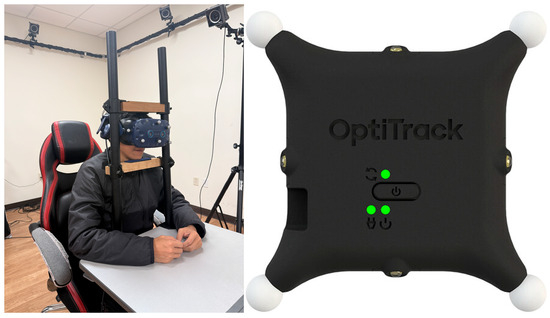
A custom chinrest maintained participant head position, and an active OptiTrack puck was used by an investigator to present a moving target in 3D space (see Figure 1). All motion data was recorded both within Motive and the Unity application for analysis.
Figure 1.
A custom-made Chinrest for the participant to wear during experiments and OptiTrack Puck used as a moving target in 3D space. The green dots in the figure were lights indicating the status of the puck: it was turned on and synched to the receiver attached to the system.
All devices and software were run concurrently on a single lab PC built to handle the large computational load of running the MoCap system, rendering the presented stimuli, running the eye-tracking software, and recording data all at the same time. The lab PC housed an i9-10900K CPU run at 3.7 GHz, an Nvidia Geforce RTX 3090 GPU, 64 GB of RAM, and ran Windows 10 Pro as the operating system for compatibility.
2.3. Procedure
While the OptiTrack system was active, participants wore either Tobii Pro Glasses 3 or an HTC Vive Pro Eye headset to visually track a moving object (virtual or real) in 2D and 3D patterns. In all conditions, participants were seated at a table with a chinrest to stabilize head position within the motion capture system’s volume.
For real-world trials, a monitor was placed approximately 70 cm away during 2D tasks, while the table remained clear for 3D tasks. The VR condition used an identical physical setup.
Prior to each trial block, the eye-tracking hardware was calibrated. For the Tobii Pro Glasses 3, calibration was automated by having the participant focus on a provided reference card (a white card with a black ring). For the HTC Vive Pro Eye, participants first adjusted the headset fit and inter-pupillary distance (IPD) for optimal alignment. They then completed the built-in SteamVR (https://partner.steamgames.com/doc/features/steamvr/info, accessed on 2 December 2025) calibration by following a moving dot with their eyes, with functionality confirmed in a subsequent validation step.
While we randomized task conditions to counterbalance order effects, real-world trials were always conducted first. This was necessary to record the object’s motion coordinates using the OptiTrack system, which were then used to programmatically recreate the movement patterns for the subsequent VR tracking tasks.
2.3.1. The 2D GRID Task
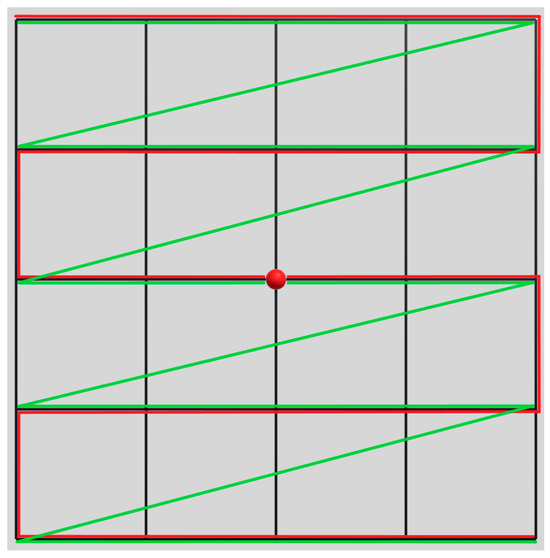
In the real-world condition, participants performed a visual pursuit task while wearing Tobii Pro Glasses 3 and maintaining head stabilization via a chinrest. Their task was to follow a dot moving along a grid pattern displayed on a monitor (Figure 2).
Figure 2.
The 5 × 5 Grid and Dot Movement Patterns, where the two-colored lines differentiate the travel pattern type. The Red path illustrated the dot moving in a “Snake” pattern. The Green path illustrated a “Reading” pattern.
The stimulus was a 1 cm diameter red dot animated in Unity to move smoothly along a grid. The grid consisted of 25 intersection points within squares measuring 7 cm per side, displayed on a 27-inch 1440 p monitor positioned approximately 70 cm from the participant. The dot moved between intersection points via linear interpolation, with each segment lasting 2 s. Two movement patterns were used: a ‘reading’ pattern (left-to-right along each row) and a ‘snake’ pattern (traversing each row end-to-end before proceeding to the next). Each pattern animation lasted 48 s.
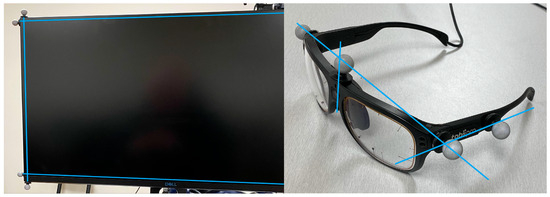
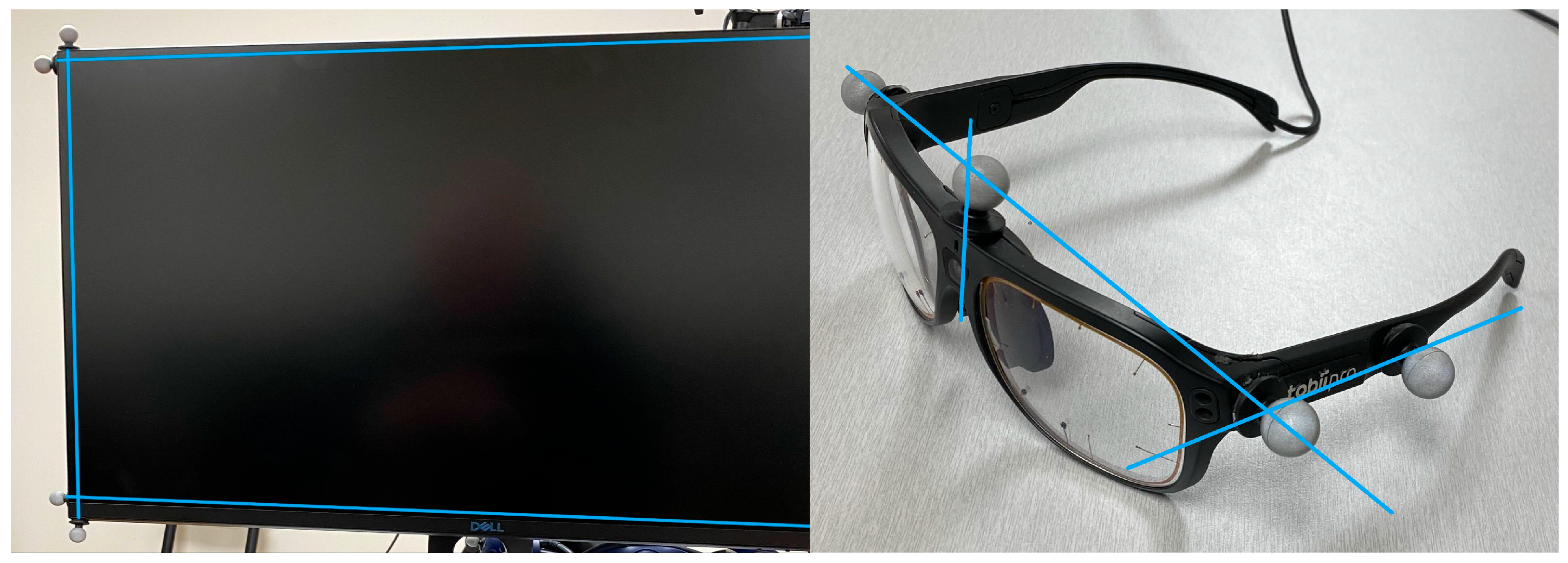
To spatially align the animation within the motion capture volume, retroreflective markers were placed at the eight corners of the monitor. This defined a “screen-space” reference frame within the OptiTrack coordinate system, allowing the 2D animation coordinates to be mapped to real-world 3D positions. Additional markers were attached to the glasses (temples, nose bridge, and one arm; Figure 3) to track their position and rotation, thereby aligning the head-based coordinate system with OptiTrack.
Figure 3.
The reflective markers placed on screen and Tobii Pro Glasses 3 for determination of coordinate system in the 2D GRID Task. The blue lines drawn on the screen and the glasses were the “screen-space” and head-based references for the mapped 2D animation coordinates.
Using the recorded real-world 3D positions of the screen and glasses, the moving dot animation was programmatically recreated in VR, preserving the exact spatial relationship between the participant’s head and the virtual screen. The participant then repeated the tracking task wearing the VR headset. Within the virtual environment, the stimulus was displayed on a screen matching the size, position, and animation parameters of the real-world monitor.
2.3.2. The 3D WAVE Task
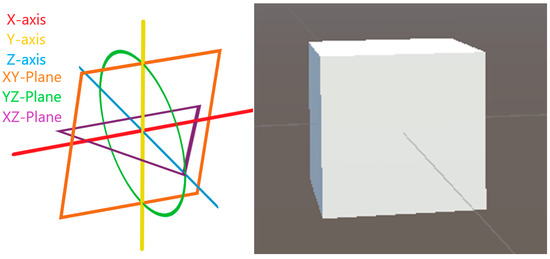
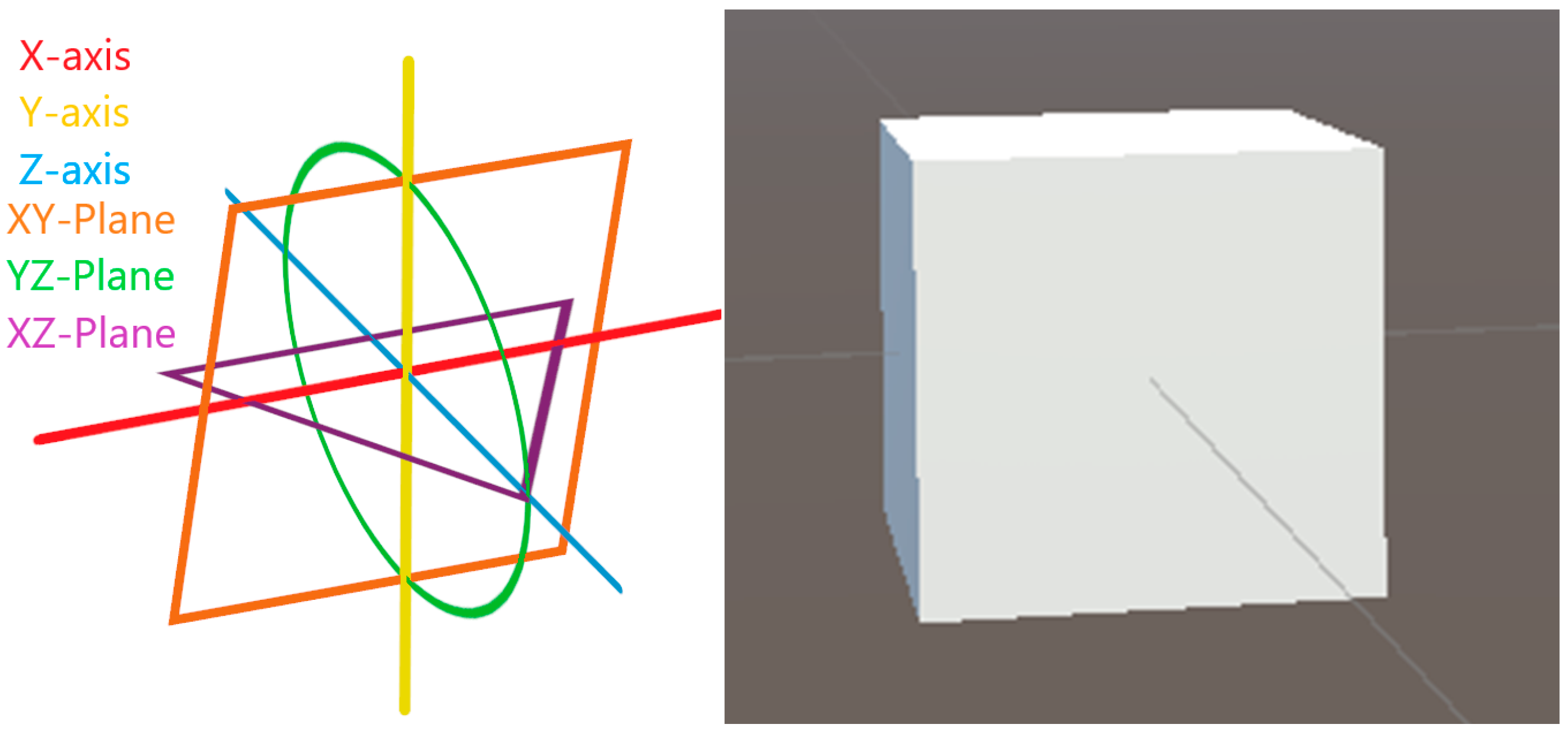
In the real-world condition, participants, wearing Tobii Pro Glasses 3 with their head stabilized on a chinrest, were instructed to visually track an active OptiTrack puck. An experimenter moved this puck through a predefined 3D trajectory designed to isolate motion along all three axes, forming a recognizable wave-like shape visible in all cardinal planes (Figure 4).
Figure 4.
The pre-determined 3D movement trajectories for both OptiTrack Puck and Virtual Cube. A circle in the ZY plane, a square in the XY plane, a triangle pointing toward the participant in the ZX plane, and then a line along each axis.
The puck’s position and rotation were recorded by the OptiTrack system at 120 Hz. These data were subsequently interpolated and down-sampled to 90 Hz to precisely match the refresh rate of the VR headset, ensuring an accurate replication of the motion.
This recorded trajectory was then used to animate a virtual cube (size-matched to physical puck) within the VR environment. Critically, the spatial relationship between the participant’s head and the moving focal object was preserved from the real-world capture to the virtual replay. Wearing the VR headset, participants tracked this moving cube.
2.3.3. Comparative Framework
Gaze data were captured concurrently by both the physical (Tobii Pro Glasses 3) and virtual (HTC Vive Pro Eye) eye-trackers. Custom Unity C# scripts synchronized these data streams by interfacing with the respective software SDKs (Tobii Pro Lab (ver 1.207), OptiTrack Motive (ver 2.3.0), SRanipal (ver 1.3.6.8), and Tobii XR (ver 3.0.1.179)), merging them into a unified dataset for analysis. This step enabled a direct comparison of tracking trajectories from three sources: the Tobii glasses (providing real-world 3D gaze coordinates), the Vive headset (providing VR-based 3D gaze vectors), and the OptiTrack system (serving as the high-precision 3D ground truth, mapped into VR). This comparison assesses the performance of the REAL and VIRTUAL eye-tracking systems against a common benchmark. The methodology establishes a framework for validating and cross-comparing otherwise incompatible tracking systems.
2.4. Data Analysis
To assess the spatial fidelity of dynamic gaze tracking, we used dynamic time warping (DTW) to compare the 3D trajectory data across systems. The recorded target position from the OptiTrack MoCap system served as the high-fidelity ground truth. This reference trajectory was compared against the corresponding gaze trajectories recorded concurrently by the Tobii Glasses 3 (real-world condition) and the HTC Vive Pro Eye (VR condition) during both the 2D (GRID) and 3D (WAVE) pursuit tasks.
DTW is an algorithm that measures similarity between two time series by non-linearly aligning them in time to minimize the cumulative geometric distance between matched points [47]. Unlike direct point-to-point metrics (e.g., Euclidean distance), it is robust to variations in timing, speed, or local lag between signals. This makes it ideal for comparing the inherently variable oculomotor response to a smoothly moving target, as it accommodates the natural dynamics of pursuit (including corrective saccades) without penalizing biological latency. The primary output, that is a minimized cumulative distance (DTW distance), serves as a direct metric of spatial accuracy, where a lower value indicates the gaze path is geometrically closer to the true target path. DTW is a well-established method for comparing temporal trajectories in movement and gaze analysis, allowing direct comparison with prior validation studies [48,49]. Thus, by effectively decoupling timing errors from spatial inaccuracy, DTW provides a robust measure of how well each eye-tracking system’s recorded gaze follows the shape of the target’s trajectory in space. It serves as an overall trajectory similarity index for comparing timeseries data rather than an instantaneous error measure. Specifically, given a pair of time series data of movement trajectories:
where are vectors in either 2D or 3D.
The DTW distance between the pair is defined as:
where d is the Euclidean distance and ω is the warping path to be calculated:
where K is the length of the warping path (the number of matched index pairs used to align the two timeseries).
To avoid bias towards trajectories of longer or shorter path, normalized DTW distance is used to report final results:
All reported DTW are normalized DTW. DTW has the same physical unit as the local distance used, which is reported as 1 m of the calibrated distance within the Unity VR environment.
Consequently, we calculated DTW distances for three pairs of trajectory matching (Optitrack vs. Tobii, Optitrack vs. VR, and Tobii vs. VR) and then used a Linear Mixed Model (LMM) to examine the fixed effects of Pair and Axis on the mean DTW differences in both 2D and 3D tasks. Given our small sample size design, we selected LMM over traditional repeated-measures ANOVA due to its superior handling of missing data and its robustness to violations of sphericity [50,51].
3. Results
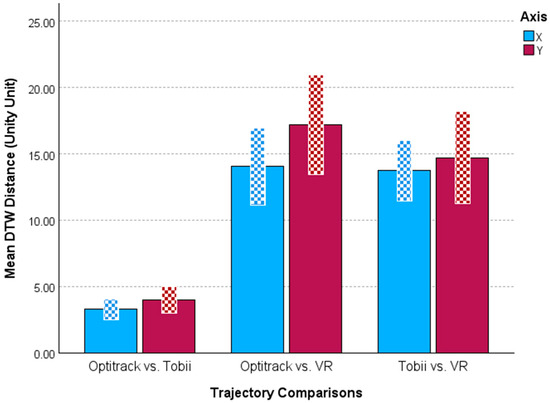
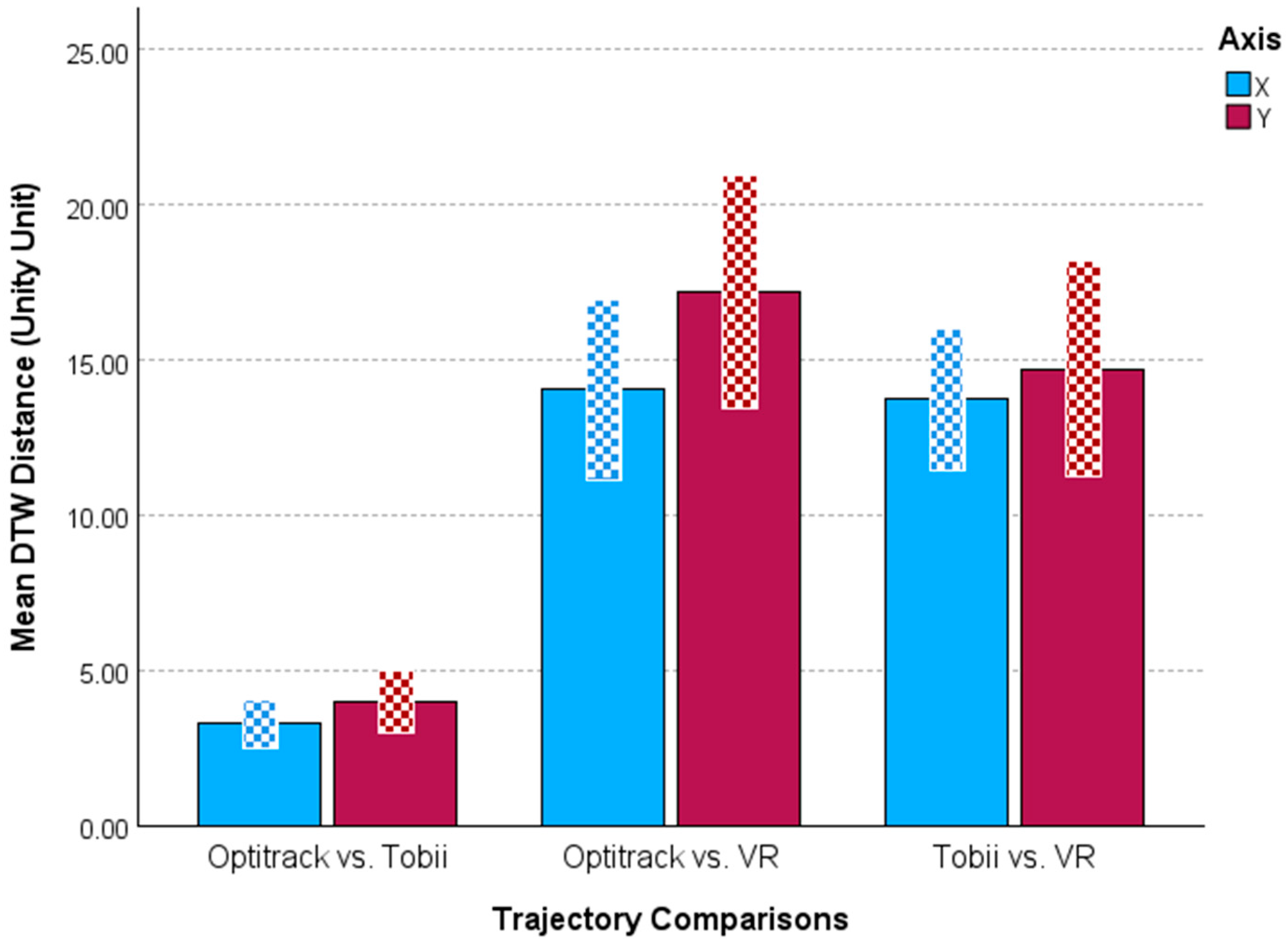
In the 2D GRID task, the mean DTW distances between Tobii-glasses and OptiTrack trajectories in both X and Y axes were significantly lower than those in another two pairs of trajectory matching (see Figure 5). The LMM analysis revealed a significant effect for pairs only (F2,25.7 = 88.4, p < 0.001), and the following pair-wise comparisons with Bonferroni adjustment showed that the trajectory matching between Tobii-glasses and OptiTrack yielded the smallest mean DTW distance in both X and Y axes (p < 0.001), as compared to another two pairs of trajectory matching with no difference detected between them.
Figure 5.
Mean DTW distance as a function of pair and axis in 2D GRID task. Checkered error denote the mean ± 2 standard errors.
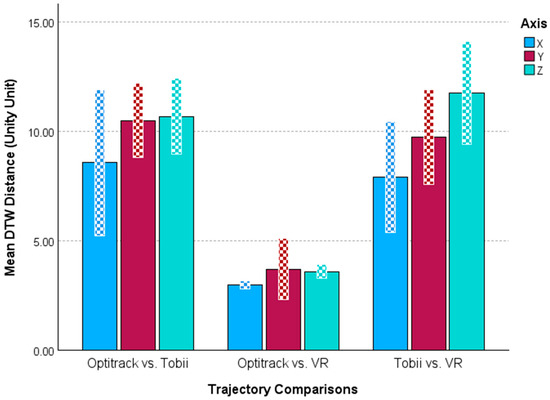
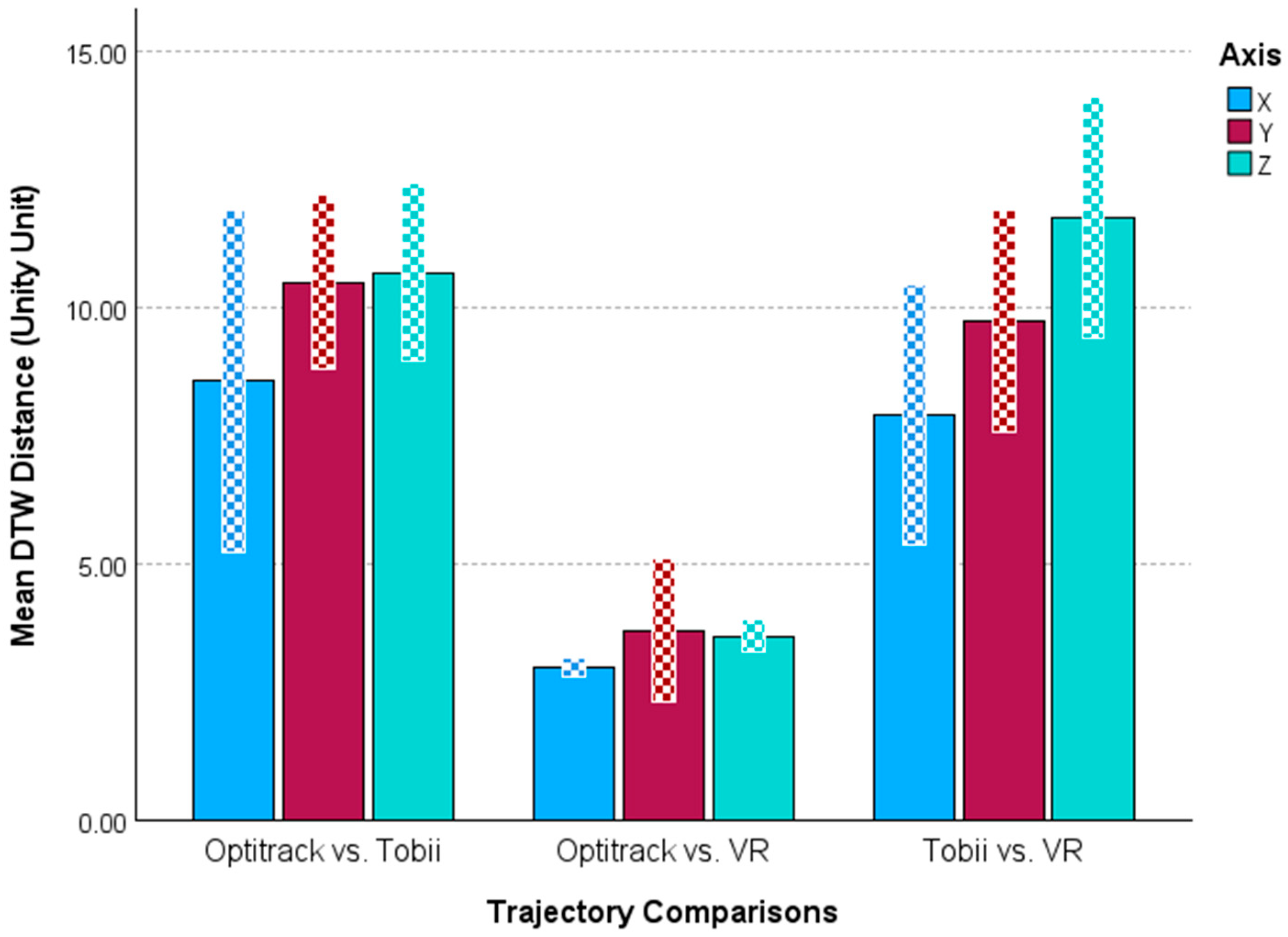
In the 3D WAVE task, the mean DTW distances between VR and OptiTrack trajectories in X, Y, and Z axes were significantly lower than those in another two pairs of trajectory matching (see Figure 6). The LMM analysis revealed a significant effect for pairs only (F2,26.8 = 70.5, p < 0.001), and the following pair-wise comparisons with Bonferroni adjustment showed that the trajectory matching between VR and OptiTrack yielded the smallest mean DTW distance in all axes (p < 0.001), as compared to another two pairs of trajectory matching with no difference detected between them.
Figure 6.
Mean DTW distance as a function of pair and axis in 3D WAVE task. Checkered error denote the mean ± 2 standard errors.
Since the OptiTrack trajectories represent the real trajectories of the moving object in the real world, Tobii-glasses showed better accuracy and performance in the 2D GRID task, while the VR headset demonstrated better accuracy and performance in the 3D WAVE task.
4. Discussion
The growing reliance on eye-tracking to assess user mental states in both real and virtual environments necessitates the validation of these devices across domains. This study cross-validated two widely used eye-trackers (Tobii Pro Glasses 3 in real world and the HTC Vive Pro Eye in virtual environment) using novel 2D and 3D object-tracking tasks. Participant gaze data from each device was compared against trajectories generated from a gold-standard OptiTrack motion capture system, where closer alignment indicated better performance. The results revealed a key differential: the Tobii Pro Glasses 3 performed better in the 2D task, whereas the HTC Vive Pro Eye demonstrated superior performance in the 3D task.
The Tobii Pro Glasses 3, as a mobile eye tracker, calculates gaze within a 2D coordinate system relative to its scene camera, providing excellent precision for locating points on a 2D video plane. However, it is inherently limited in measuring the absolute depth or distance to a point of observation in the real world. Deriving a 3D gaze point is only possible through indirect estimation via computer vision and 3D scene reconstruction [7]. This is reflected in Tobii’s own documentation, which frames “3D Gaze Mapping” as an advanced, non-standard feature that requires supplementary technologies like SLAM or depth-sensing cameras (e.g., Intel RealSense). This fundamental constraint clarifies the Tobii glasses’ strong performance in our 2D GRID task. With a fixed viewing distance and a dot moving along a grid with predefined 2D coordinates, the task created a stable and perfectly aligned 2D reference plane, fully leveraging the device’s core capabilities.
In contrast, the HTC Vive Pro Eye operates within a pre-defined, metric 3D coordinate system. Since the virtual environment is a precise 3D model, the coordinates of all objects are known, allowing the system to calculate a gaze vector from the eye and perform a precise ray-cast intersection with the scene geometry. This provides a direct and accurate measurement of the user’s 3D point of observation, including its depth. This inherent advantage is well-established. Clay et al. [8] highlighted that the precise 3D scene geometry in VR enabled accurate gaze depth calculation without error-prone estimation, a finding corroborated by Lamb et al. [5], who demonstrated the superior accuracy of VR-based tracking for depth-based fixations. This aligns perfectly with our results from the 3D WAVE task. Critically, in this task, both the HTC Vive Pro Eye’s gaze data and the object’s position (replicated from OptiTrack) existed within the same unified virtual 3D space, eliminating the complex sensor fusion required by the Tobii system. The Tobii glasses, conversely, had to correlate its gaze data (from a moving head) with separate, external 3D positional data from OptiTrack, where even minor temporal or calibration errors were amplified in the dynamic 3D environment. Consequently, the superior tracking performance of the HTC Vive Pro Eye in the 3D task was expected.
The findings of this study provide a critical, empirically validated framework for selecting eye-tracking technology based on usage, with direct implications for research design and practical application. The choice between a mobile device like the Tobii Pro Glasses 3 and a VR-integrated system like the HTC Vive Pro Eye should be guided by both the dimensionality of the task (2D vs. 3D) and the mobility of the user (stable vs. dynamic). For stable users interacting with 2D planes, such as in desktop-based usability testing, screen monitoring, or behavioral labs, the Tobii glasses provide exceptional accuracy and a naturalistic view of the user’s environment. However, for dynamically moving users in the real world, the Tobii system’s limitation in 3D depth perception becomes a significant factor that requires additional solutions. In contrast, the HTC Vive Pro Eye is inherently designed for dynamic interaction, but within a controlled virtual space. It is the superior tool for any task requiring precise 3D gaze metrics, whether the user is stationary or moving, such as VR game testing, architectural walkthroughs, or training simulations for surgery or equipment repair. Its integrated system ensures that head, body, and gaze movements are all captured within a single, unified coordinate system, eliminating the alignment errors common when correlating a mobile eye-tracker with external motion capture. Therefore, practitioners should opt for mobile eye-tracking for real-world studies of general attention patterns on 2D surfaces or for qualitative context, and invest in VR-based eye-tracking for any quantitative analysis of depth perception, spatial reasoning, or dynamic interaction within a 3D environment. Our research contribution addresses the gap of determining accuracy of gaze pursuit during the visual tracking of a moving target in 3D VR space or immersive environments utilizing a novel approach of mapping the 3D coordinates of a real-world target tracked by a motion-capture system onto a moving target in VR. We also offer the details of this approach for other researchers to utilize this method in other contexts.
However, this work has several intrinsic limitations. The validation used a highly controlled movement trajectory on one VR system, which may not represent the full spectrum of dynamic motion or the performance of other VR headsets. The relatively small and homogeneous participant sample further limits generalizability. Additionally, the use of a chinrest at a seated position precluded assessment of dynamic smooth pursuit with natural head and body movements. Future studies should expand on this work by evaluating a wider array of VR headset eye-trackers and more complex, ecologically valid motion paths, employing larger and more diverse participant samples, and assessing dynamic pursuit accuracy under conditions that allow for unrestricted head and torso movements.
5. Conclusions
Overall, the VR headset eye-tracking performed well enough relative to the Tobii glasses in both 2D and 3D contexts as to be suitable for research purposes. Compared to the Tobii glasses, the VR headset eye-tracking costs significantly less and performs better in the 3D context, suggesting that it can be a reliable and cheaper option for researchers who are interested in assessing the user’s mental state with simulated 3D VR tasks, or tasks completed in immersive environments. We have demonstrated a repeatable and cross-platform verification framework for comparing different eye-tracking hardware that was previously difficult to compare against each other. Thus, this study offers a methodological blueprint, providing robust evidence and a clear pathway for selecting eye-trackers to obtain high-fidelity 3D gaze data, thereby empowering a new wave of scientific discovery and technological advancement grounded in a deeper understanding of human behavior in complex, spatially rich environments.
Author Contributions
Conceptualization, R.N.T. and Q.Z.; methodology, R.N.T., A.C.B. and Q.Z.; software, R.N.T.; validation, R.N.T. and J.G.; formal analysis, J.G. and Q.Z.; investigation, R.N.T., A.C.B., J.G. and Q.Z.; resources, Q.Z.; data curation, R.N.T. and J.G.; writing—original draft preparation, R.N.T. and Q.Z.; writing—review and editing, R.N.T., A.C.B., J.G., and Q.Z.; visualization, R.N.T. and Q.Z.; supervision, Q.Z.; project administration, Q.Z. All authors have read and agreed to the published version of the manuscript.
Funding
This research received no external funding.
Institutional Review Board Statement
The study was conducted in accordance with the Declaration of Helsinki and approved by the Institutional Review Board (or Ethics Committee) of University of Wyoming (protocol code IRB-2024-377 and date of approval on 29 April 2025).
Informed Consent Statement
Informed consent was obtained from all subjects involved in the study.
Data Availability Statement
Data supporting reported results can be found here: https://figshare.com/s/fb1c2a6b972f4fa83e33 (accessed on 2 December 2025).
Acknowledgments
The authors were grateful to the University of Wyoming College of Health Sciences Research Equipment Grant awarded to Q.Z. for the acquisition of the Tobii Pro Glasses 3 and Tobii Pro Lab software required for the study.
Conflicts of Interest
The authors declare no conflicts of interest.
Abbreviations
The following abbreviations are used in this manuscript:
| MoCap | Motion Capture |
| VR | Virtual Reality |
| HMD | Head Mounted Device |
| DTW | Dynamic Time Warping |
| LMM | Linear Mixed Model |
References
- Liversedge, S.P.; Gilchrist, I.D.; Everling, S. (Eds.) The Oxford Handbook of Eye Movements; Oxford University Press: Oxford, UK, 2011. [Google Scholar]
- Leigh, R.J.; Zee, D.S. The Neurology of Eye Movements, 5th ed.; Oxford University Press: Oxford, UK, 2015. [Google Scholar]
- Duchowski, A.T. Eye Tracking Methodology: Theory and Practice, 3rd ed.; Springer: London, UK, 2017. [Google Scholar]
- Hess, E.H.; Polt, J.M. Pupil size as related to interest value of visual stimuli. Science 1960, 132, 349–350. [Google Scholar] [CrossRef] [Scilit]
- Bradley, M.M.; Miccoli, L.; Escrig, M.A.; Lang, P.J. The pupil as a measure of emotional arousal and autonomic activation. Psychophysiology 2008, 45, 602–607. [Google Scholar] [CrossRef] [Scilit]
- Siegle, G.J.; Steinhauer, S.R.; Thase, M.E. Pupillary assessment and computational modeling of the Stroop task in depression. Int. J. Psychophysiol. 2004, 52, 63–76. [Google Scholar] [CrossRef] [Scilit]
- Just, M.A.; Carpenter, P.A. Eye fixations and cognitive processes. Cognit. Psychol. 1976, 8, 441–480. [Google Scholar] [CrossRef] [Scilit]
- Rayner, K. Eye movements and attention in reading, scene perception, and visual search. Q. J. Exp. Psychol. 2009, 62, 1457–1506. [Google Scholar] [CrossRef] [Scilit] [PubMed]
- Beatty, J. Task-evoked pupillary responses, processing load, and the structure of processing resources. Psychol. Bull. 1982, 91, 276–292. [Google Scholar] [CrossRef] [PubMed]
- Van Orden, K.F.; Limbert, W.; Makeig, S.; Jung, T.P. Eye activity correlates of workload during a visuospatial memory task. Hum. Factors 2001, 43, 111–121. [Google Scholar] [CrossRef] [Scilit]
- Di Stasi, L.L.; Marchitto, M.; Antolí, A.; Cañas, J.J. Saccadic velocity as an arousal index in naturalistic tasks. Neurosci. Biobehav. Rev. 2013, 37, 968–975. [Google Scholar] [CrossRef] [Scilit]
- Benson, P.J.; Beedie, S.A.; Shephard, E.; Giegling, I.; Rujescu, D.; St. Clair, D. Simple viewing tests can detect eye movement abnormalities that distinguish schizophrenia cases from controls with exceptional accuracy. Biol. Psychiatry 2012, 72, 716–724. [Google Scholar] [CrossRef] [Scilit] [PubMed]
- Morita, K.; Miura, K.; Fujimoto, M.; Yamamori, H.; Yasuda, Y.; Kudo, N.; Azechi, H.; Okada, N.; Koshiyama, D.; Ikeda, M.; et al. Eye movement abnormalities and their association with cognitive impairments in schizophrenia. Schizophr. Res. 2019, 218, 255–262. [Google Scholar] [CrossRef] [Scilit]
- Falck-Ytter, T.; Bölte, S.; Gredebäck, G. Eye tracking in early autism research. J. Neurodev. Disord. 2013, 5, 28. [Google Scholar] [CrossRef] [Scilit]
- Molitor, R.J.; Ko, P.C.; Ally, B.A. Eye movements in Alzheimer’s disease. J. Alzheimers Dis. 2015, 44, 1–12. [Google Scholar] [CrossRef] [Scilit]
- Armstrong, R.A. Oculo-visual dysfunction in Parkinson’s disease. J. Parkinsons Dis. 2015, 5, 715–726. [Google Scholar] [CrossRef] [Scilit]
- Bohil, C.J.; Alicea, B.; Biocca, F.A. Virtual reality in neuroscience research and therapy. Nat. Rev. Neurosci. 2011, 12, 752–762. [Google Scholar] [CrossRef] [Scilit]
- Parsons, T.D. Virtual reality for enhanced ecological validity and experimental control in the clinical, affective, and social neurosciences. Front. Hum. Neurosci. 2015, 9, 660. [Google Scholar] [CrossRef] [Scilit] [PubMed]
- Rizzo, A.; Koenig, S.T. Is clinical virtual reality ready for primetime? Neuropsychology 2017, 31, 877–899. [Google Scholar] [CrossRef] [Scilit] [PubMed]
- Freeman, D.; Reeve, S.; Robinson, A.; Ehlers, A.; Clark, D.; Spanlang, B.; Slater, M. Virtual reality in the assessment, understanding, and treatment of mental health disorders. Psychol. Med. 2017, 47, 2393–2400. [Google Scholar] [CrossRef] [Scilit] [PubMed]
- Patney, A.; Salvi, M.; Kim, J.; Kaplanyan, A.; Wyman, C.; Benty, N.; Luebke, D. Towards foveated rendering for gaze-tracked virtual reality. ACM Trans. Graph. 2016, 35, 1–12. [Google Scholar] [CrossRef] [Scilit]
- Clay, V.; König, P.; König, S.U. Eye tracking in virtual reality. J. Eye Mov. Res. 2019, 12, 1–18. [Google Scholar] [CrossRef] [Scilit]
- Wang, D.; He, P.; Wang, Y.; Jian, Z.; Song, Z.; Hu, Q.; Fang, F.; Yang, C.; Wang, D.; Yu, H. Gaze and Go: Harnessing Visual Attention Valence in Upper-Limb Robotic Rehabilitation with Tailored Gamification and Eye Tracking for Neuroplasticity. Presented at the 2025 IEEE International Conference on Robotics and Automation (ICRA), Atlanta, GA, USA, 19–23 May 2025; pp. 9455–9461. [Google Scholar]
- Kasprowski, P.; Harezlak, K. The use of eye movements in biometrics. In Handbook of Human Motion; Springer: Cham, Switzerland, 2018; pp. 1–23. [Google Scholar]
- Adhanom, I.B.; MacNeilage, P.; Folmer, E. Eye tracking in virtual reality: A broad review of applications and challenges. Virtual Real. 2023, 27, 1481–1505. [Google Scholar] [CrossRef] [Scilit]
- Tabbaa, L.; Searle, R.; Bafti, S.M.; Hossain, M.M.; Intarasisrisawat, J.; Glancy, M.; Ang, C.S. Vreed: Virtual reality emotion recognition dataset using eye tracking & physiological measures. In Proceedings of the ACM on Interactive, Mobile, Wearable and Ubiquitous Technologies; Association for Computing Machinery: New York, NY, USA, 2021; Volume 5, pp. 1–20. [Google Scholar]
- Hoffman, D.M.; Girshick, A.R.; Akeley, K.; Banks, M.S. Vergence-accommodation conflicts hinder visual performance and cause visual fatigue. J. Vis. 2008, 8, 33. [Google Scholar] [CrossRef] [Scilit]
- Shibata, T.; Kim, J.; Hoffman, D.M.; Banks, M.S. The zone of comfort: Predicting visual discomfort with stereo displays. J. Vis. 2011, 11, 11. [Google Scholar] [CrossRef] [Scilit]
- Niehorster, D.C.; Santini, T.; Hessels, R.S.; Hooge, I.T.C.; Kasneci, E.; Nyström, M. The impact of slippage on the data quality of head-worn eye trackers. Behav. Res. Methods 2020, 52, 1140–1160. [Google Scholar] [CrossRef] [Scilit]
- Chugh, S. An Eye Tracking System for a Virtual Reality Headset. Master’s Thesis, University of Toronto, Toronto, ON, Canada, 2020. [Google Scholar]
- Manakhov, P.; Sidenmark, L.; Pfeuffer, K.; Gellersen, H. Filtering on the Go: Effect of Filters on Gaze Pointing Accuracy During Physical Locomotion in Extended Reality. IEEE Trans. Vis. Comput. Graph. 2024, 30, 7234–7244. [Google Scholar] [CrossRef] [Scilit]
- MacInnes, J.J.; Iqbal, S.; Pearson, J.; Johnson, E.N. Wearable Eye-tracking for Research: Automated dynamic gaze mapping and accuracy/precision comparisons across devices. bioRxiv 2018. [Google Scholar] [CrossRef] [Scilit]
- Ooms, K.; Lapon, L.; Dupont, L.; Popelka, S. Accuracy and precision of fixation locations recorded with the Tobii TX300 eye tracker in a stimulus presentation mode. J. Eye Mov. Res. 2015, 8, 1–20. [Google Scholar] [CrossRef] [Scilit]
- Sipatchin, A.; Wahl, S.; Rifai, K. Eye-tracking for clinical ophthalmology with virtual reality (VR): A case study of the HTC Vive Pro Eye’s usability. Healthcare 2021, 9, 180. [Google Scholar] [CrossRef] [Scilit]
- HTC VIVE. What’s the Trackable FOV? How About the Tracking Accuracy? VIVE Developer. Available online: https://developer.vive.com/us/support/sdk/category_howto/trackable-field-of-view.html (accessed on 30 December 2025).
- Sipatchin, A.; Wahl, S.; Rifai, K. Accuracy and precision of the HTC VIVE PRO eye tracking in head-restrained and head-free conditions [abstract]. Investig. Ophthalmol. Vis. Sci. 2020, 61, 5071. [Google Scholar]
- Hou, B.J.; Abdrabou, Y.; Weidner, F.; Gellersen, H. Unveiling variations: A comparative study of vr headsets regarding eye tracking volume, gaze accuracy, and precision. Presented at the 2024 IEEE Conference on Virtual Reality and 3D User Interfaces Abstracts and Workshops (VRW), Orlando, FL, USA, 16–21 March 2024; pp. 650–655. [Google Scholar]
- Schuetz, I.; Fiehler, K. Eye tracking in virtual reality: Vive pro eye spatial accuracy, precision, and calibration reliability. J. Eye Mov. Res. 2022, 15, 10. [Google Scholar] [CrossRef] [Scilit] [PubMed]
- Lencer, R.; Trillenberg, P. Neurophysiology and neuroanatomy of smooth pursuit in humans. Brain Cogn. 2008, 68, 219–228. [Google Scholar] [CrossRef] [Scilit]
- Sudkamp, J.; Bocian, M.; Souto, D. The role of eye movements in perceiving vehicle speed and time-to-arrival at the roadside. Sci. Rep. 2021, 11, 23312. [Google Scholar] [CrossRef] [Scilit]
- Murray, N.G.; Fenner, M.; Szekely, B.; Quigley, K.G.; Islas, A.; Cipriani, D.; Berryhill, M.E.; Buckley, T. Smooth pursuit velocity after a season of repetitive head impacts in American football players. JAMA Ophthalmol. 2025, 143, 866–873. [Google Scholar] [CrossRef] [Scilit] [PubMed]
- Pan, X.; Hamilton, A.F.D.C. Why and how to use virtual reality to study human social interaction: The challenges of exploring a new research landscape. Br. J. Psychol. 2018, 109, 395–417. [Google Scholar] [CrossRef] [Scilit]
- Dörr, M.; Martinetz, T.; Gegenfurtner, K.; Barth, E. Variability of eye movements when viewing dynamic natural scenes. J. Vis. 2010, 10, 28. [Google Scholar] [CrossRef] [Scilit] [PubMed]
- Chen, Y.; Nakayama, K.; Levy, D.; Matthysse, S.; Holzman, P. Psychophysical isolation of a motion-processing deficit in schizophrenics and their relatives and its association with impaired smooth pursuit. Proc. Natl. Acad. Sci. USA 1999, 96, 4724–4729. [Google Scholar] [CrossRef] [Scilit] [PubMed]
- Pinkhardt, E.; Kassubek, J.; Süßmuth, S.; Ludolph, A.; Becker, W.; Jürgens, R. Comparison of smooth pursuit eye movement deficits in multiple system atrophy and parkinson’s disease. J. Neurol. 2009, 256, 1438–1446. [Google Scholar] [CrossRef] [Scilit]
- Lamb, M.; Brundin, M.; Perez Luque, E.; Billing, E. Eye-tracking beyond peripersonal space in virtual reality: Validation and best practices. Front. Virtual Real. 2022, 3, 864653. [Google Scholar] [CrossRef] [Scilit]
- Senin, P. Dynamic Time Warping Algorithm Review; Information and Computer Science Department, University of Hawaii at Manoa: Honolulu, HI, USA, 2008; Volume 855, p. 40. [Google Scholar]
- Switonski, A.; Josinski, H.; Wojciechowski, K. Dynamic time warping in classification and selection of motion capture data. Multidimens. Syst. Signal Process. 2019, 30, 1437–1468. [Google Scholar] [CrossRef] [Scilit]
- Hiroe, M.; Kawaguchi, Y.; Takemura, K.; Zheng, Y.; Kowa, H.; Nagamatsu, T. Dynamic time warping analysis of smooth pursuit eye movements for dementia detection. Procedia Comput. Sci. 2025, 270, 4830–4837. [Google Scholar] [CrossRef] [Scilit]
- Gueorguieva, R.; Krystal, J.H. Move over ANOVA: Progress in analyzing repeated-measures data and its reflection in papers published in the Archives of General Psychiatry. Arch. Gen. Psychiatry 2004, 61, 310–317. [Google Scholar] [PubMed]
- West, B.T.; Welch, K.B.; Galecki, A.T. Linear Mixed Models: A Practical Guide Using Statistical Software, 2nd ed.; Chapman and Hall/CRC: Boca Raton, FL, USA, 2022. [Google Scholar]
Disclaimer/Publisher’s Note: The statements, opinions and data contained in all publications are solely those of the individual author(s) and contributor(s) and not of MDPI and/or the editor(s). MDPI and/or the editor(s) disclaim responsibility for any injury to people or property resulting from any ideas, methods, instructions or products referred to in the content. |
© 2026 by the authors. Licensee MDPI, Basel, Switzerland. This article is an open access article distributed under the terms and conditions of the Creative Commons Attribution (CC BY) license.