


Abstract
Traditional disease management, which is based on the application of synthetic chemical products, has negatively affected human health and the environment. A sustainable approach based on the application of natural compounds and microorganisms is potentially better for consumer health. Thus, the aim of this study was to evaluate the efficacy of plant-based and/or organic products against soilborne fungal pathogens of tomato. A preliminary in vitro experiment was performed to select potential putative inhibitory products (PIPs) and fungal pathogens that were then used in an in vivo experiment conducted inside a greenhouse that mimics real-world field conditions. For the greenhouse experiment, bergamot and pomegranate wastes and the commercial product EP5 were selected as the PIPs to control Agroathelia rolfsii, Fusarium oxysporum and Sclerotinia sclerotiorum growth. Each pot was artificially inoculated three days before the low-dose treatment, and one tomato seedling was transplanted into each pot four days after the treatment. Data regarding the phytosanitary status of the plants and roots, as well as their length and weight, were collected after 45 days, and the results obtained demonstrate that plant-derived products were able to mitigate fungal diseases, with pomegranate waste being the most effective. Also, the EP5 product, as a resistant inducer, was able to significantly improve the natural defense of tomato plants, resulting in it being the best PIP used. Mycological analyses were performed on the roots to assess the presence of inoculated fungal pathogens after natural product treatment. Overall, the results confirm that the PIPs are suitable for crop management, but the outcomes are variable. In general, pomegranate waste and EP5 significantly protected the roots against fungal attacks, while bergamot waste showed lower efficacy. This trend was not observed for plant length and weight, as the treated plants showed results similar to those of the untreated controls. In conclusion, natural products are a valid alternative to chemicals, as they demonstrate both efficacy and safety, but their potential should be further investigated in field trials.
1. Introduction
Tomato (Solanum lycopersicum L.) is one of the most widely grown and consumed agricultural food commodities, with notable benefit to human health [1]. In 2023, global tomato production reached the highest record, accounting for 192 million tonnes [2]. The largest producer is China, followed by India, the United States, Turkey, and European countries. Among European countries, Italy is the leading producer, accounting for 36% (approximately 6.0 million tonnes) of the total production in 2024, followed by Spain (27%) and Portugal (10%) [3]. Among Italian regions, Apulia remains the major contributor, accounting for 22.3% of the nation’s production, of which 19.4% comes from the Foggia province as the primary hub [4].
Given the global importance of tomato, its health status is also of global interest, as tomato yields are consistently threatened by microbial diseases, with fungi and oomycetes being the major causal agents [5]. Alternaria solani, Botrytis cinerea, and Phytophthora infestans represent the major aerial pathogens that attack the aerial parts of the tomato plant [6]. In particular, A. solani causes seedling blight, fruit rot, and severe leaf rust, leading to complete defoliation [7]. B. cinerea causes necrotic-enzyme-induced soft rot via cell wall degradation [8], while P. infestans is responsible for shoot and leaf necrosis, fruit rot, and rapid plant death [5]. Significant threats also are caused by several soilborne pathogens, among which Agroathelia rolfsii, Fusarium oxysporum f.sp. lycopersici, and Sclerotinia sclerotiorum are the most widespread in soils worldwide [9]. A. rolfsii mainly causes stem and collar rot, but it can also induce fruit rot when in contact with the soil [10]. F. oxysporum, as a vascular pathogen, causes root colonization, which leads to wilting and plant death [11]. S. sclerotiorum is particularly destructive and causes severe root rot and water-soaked lesions at the stem joints, potentially resulting in yield losses exceeding 50% [12,13]. Chemical control remains the primary and effective means for reducing the destructive potential of fungal pathogens in agriculture; however, in addition to the high costs and the risk of resistance development, their use is increasingly restricted due to their detrimental effects on human health and the environment [6]. Therefore, chemical pesticides are responsible for widespread negative impacts, as sprayed pesticides can enter the human bloodstream through inhalation or skin contact, causing acute symptoms such as dermatitis, respiratory irritation, nausea, and headaches [14]. Moreover, chronic exposure to pesticide residues in food is often associated with severe human diseases, including cancer, Alzheimer’s disease, and diabetes mellitus, which often occur due to DNA damage [14]. Chemical pesticides also negatively affect the environment, as toxic residues can persist in the soil, harm beneficial organisms (suppressive, antagonistic, etc.), and compromise soil fertility [15,16,17]. Chemical residues are frequently detected in various food and beverage products [18]. To address these concerns, the European Parliament has enforced stringent regulations by limiting maximum residue levels (MRLs) in food and banning the use of specific active fungicides in open fields since the 1980s [19,20]. These regulatory measures have stimulated scientific research to investigate the effectiveness of natural alternatives, including agricultural wastes (AWs) and biological control agents (BCAs). Several studies confirm that BCAs, such as Trichoderma [21,22,23,24,25] and Bacillus spp. [26,27,28], are effective for controlling fungal pathogens. Beyond microorganisms, plant products and their extracts can also offer a viable alternative to chemicals. Indeed, extracts from Azadirachta indica, Cannabis sativa, Cassia fistula, Cinnamomum verum, and Lantana camara display high inhibitory activity against multiple fungal pathogens [29,30,31]. Morea et al. [32] demonstrated that plant powders from numerous botanical species were able to inhibit the growth of more than 30 different fungal pathogens, and other studies have reported significant results regarding the pharmacological and antifungal activities of pomegranate and bergamot extracts, which are attributed to their rich metabolic profiles [33,34,35,36]. Carlucci et al. [37] and Morea et al. [32] assayed EP5 in their experiments to confirm its ability to protect grape berries against Botrytis cinerea infections in postharvest conditions and to compare its antifungal activity against more than 30 severe phytopathogens under in vitro conditions. Based on previous research on the efficacy of plant-derived products in controlling severe microbial diseases in plants, their potential contribution to the circular economy in agriculture, and their very low impact on humans and the environment, the aim of the present study is to assess the efficacy of putative plant-based wastes against soilborne fungal pathogens of tomato crops. These natural putative fungicides, as minimally processed products, are tested to ensure that they can be used in organic agriculture, without any expensive and non-eco-friendly chemical transformation. Therefore, the objectives of this study are to conduct (a) an in vitro assessment of plant products, including those from laurel, eucalyptus, pomegranate, sage, bergamot, and false pepper, and a commercial organic product against ten soilborne fungal pathogens; (b) a greenhouse-based evaluation of low doses of the selected products to assess their efficacy to protect tomato roots against fungal pathogens; and (c) an assessment of the agronomic quality indices of tomato plant growth after treatment with putative plant-based antifungal products.
2. Materials and Methods
2.1. Preparation of Putative Inhibitory Products
The putative inhibitory products (PIPs) were prepared according to the method described by Morea et al. [32]. Different plant products with potential antifungal activity were collected from two botanical species: pomegranate (Punica granatum L.; peel) (Pg) from open-field agricultural crops in Foggia province (Apulia region, Italy) and bergamot-derived (Citrus bergamia Risso & Poit.; peel) (Cb) from agro-industrial waste obtained after essential oil extraction in Gioia Tauro-origin (Calabria, Italy). After collection, the plant tissues were carefully washed, cut into small pieces, and left to dry at room temperature until the weight was reduced by approximately 50%. The semi-dehydrated plant tissues were placed on a stove at 30 °C (FN 500 Sterilizer, Nuve, Ankara, Turkey) until constant weight was achieved. The plant PIPs were ground as finely as possible using an electric mill equipped with a fine-mesh screen (Geomil-50P) at 600 nm to obtain plant powders, which were then stored in plastic jars in darkness. In addition, a commercial product (EP5-Protect) (EP5) that is used as resistance inducer in organic agriculture was tested, whose composition consists of minerals and silicates [bentonite (30%), citric acid (5%), iron (10%), zinc (6%), and manganese (6.5%) sulphate; Phenom Biotech srl, Milan Italy].
2.2. Soilborne Fungal Phytopathogens
To assess the ability of the PIPs to inhibit fungal growth, three fungal species considered as severe soilborne pathogens, namely Agroathelia rolfsii, Fusarium oxysporum, and Sclerotinia sclerotiorum, were used; these fungi were obtained from the fungal collection of the Laboratory of Plant Pathology and Diagnostic of the Department of Agricultural, Food, Natural Resources and Engineering Sciences (DAFNE) of the University of Foggia, Italy. The taxonomic identities of these fungi, which were determined via morphological and molecular tools, have been reported by Morea et al. [32] using the DNA extraction protocol described by Carlucci et al. [38].
2.3. Assessment of Putative Inhibitory Products (PIPs) Against Fungal Pathogens Under In Vitro Conditions
Each plant powder and EP5 were used at a concentration of 2% (w:v), and added to the PDA medium (39 g/L; Sigma-Aldrich, Milan, Italy). After adjusting the pH to 6.0, the latter was thermally treated at 115 °C for 15 min in an autoclave. Inhibitory activity was assessed on 90 mm Petri dishes containing the PDA medium. Fungal plugs of 4 mm in diameter, which were taken from the margins of 14-day-old colonies of each fungal pathogen, were placed at the center of 90 mm Petri dishes containing the PDA medium supplemented with PIPs and incubated in darkness at 21 ± 3 °C for up to 21 days, depending on the mycelial growth of each fungal species, while PDA plates without PIPs were used as controls, as performed by Morea et al. [32]. The experiment was replicated three times, and mycelial growth was recorded every 48 h by measuring two perpendicular diameters. According to Carlucci et al. [39] and Morea et al. [32], inhibitory activity (IA; %) was calculated as the percentage of mycelium growth inhibition compared to the control using the formula:
where D1 and D2 are the measured perpendicular diameters of the fungal colonies on PDA control plates and PDA plates amended with PIP powders, respectively.
Fungal growth was modeled according to Bevilacqua et al. [40], who used a logistic equation modified by Dantigny et al. [41], and it is determined using following formula:
where Dmax is the maximum diameter of the fungal colony (55 mm); k is the rate of fungal growth (mm hours−1); τ is the time to attain half of Dmax (hours); and t is the time (hours).
This Dantigny function utilizes three fitting parameters, i.e., the rate of fungal growth, the maximum extent of germination, and the time to attain half of the maximal density/probability of germination. Thus, the modified equation, which was based on Bevilacqua et al. [40], was used to model the radial increase in the diameter of fungal colonies on the plates. Moreover, the maximum extent of fungal growth was set to 55 mm (i.e., the diameter of the plates). The fitting procedure was intended to estimate the rate of fungal growth, reported as diameter increase per day, and the parameter τ, which refers to the time (hours) needed to attain a diameter of 27.5 mm on the plates. The Dantigny equation satisfactorily fitted all the data sets, with regression coefficients ranging from 0.909 to 0.999.
2.4. Evaluation of PIPs to Control Fungal Pathogens Under In Vivo Conditions
2.4.1. Artificial Fungal Inoculum Preparation
The artificial inoculum of each fungal pathogen was prepared by infecting 100 g of wheat kernels (RGT Voilur variety; Semetica, Bologna, Italy) preliminarily soaked in tap water in a 500 mL glass jar for 12 h. Then, the water was removed, and the kernels were sterilized three times at 121 °C for 20 min. The sterilized kernels were then inoculated with 5 mL of the fungal propagule suspension at a concentration of 1·105 cfu mL−1, which was obtained by scraping the surface of a 14-day-old fungal colony with a scalpel and collecting the propagules in a sterile solution (distilled H2O with 0.5% Tween 20). All inoculated jars were sealed with parafilm and incubated in the dark at 25 °C ± 3 °C for 21 days.
2.4.2. Setup of the Greenhouse Experiment
The experiment was conducted in a greenhouse that mimics real-world field conditions from May to July 2024 at the Department DAFNE of the University of Foggia. For this experiment, two layers of non-woven fabric were placed at the bottom of 1.5 L pots to prevent soil loss and covered with 5 cm of commercial Gaia soil (Agrochimica S.p.A., Bolzano, Italy). Twelve kernels artificially inoculated with each fungal pathogen were placed equidistantly from each other on the moistened soil surface and covered with approximately 1 cm of soil. The soil was then watered to promote fungal growth and covered with a plastic film. After 72 h, 3 g aliquots of powder from each PIP were placed on the soil surface, covered with another 1 cm of soil, and again covered with a plastic film. Finally, after an additional 72 h, one tomato seedling was placed at the center of the pot and covered with 1 cm of soil. The experiment consisted of 16 different trials with 24 replicates. Un-inoculated and un-treated pots were used as negative controls (Table 1).
Table 1.
PIP and fungal composition of each trial under different settings in the greenhouse experiment.
During the greenhouse experiment, the tomato plants received 150–200 mL of water, and no fertilization was carried out. After 45 days, to assess damage caused by the diseases, the tomato plants were subjected to phytosanitary status determination by observing the symptoms that occurred on the aerial plant parts using an empirical six-class pathometric scale (0 = healthy; 1 = slightly yellow; 2 = completely yellow; 3 = slightly necrotized; 4 = completely necrotized; and 5 = dead). The plants were then gently removed from the pots, and the roots were carefully washed and assessed with a seven-class empirical pathometric scale (0 = no symptoms observed; 1 = 1–15%; 2 = 16–35%; 3 = 36–50%; 4 = 51–70%; 5 = 71–85%; and 6 = 86–100%). However, to evaluate phytosanitary status based on the symptoms that occurred on the collar, a different six-class empirical pathometric scale (0 = healthy; 1 = hydropic tissues; 2 = brown; 3 = slightly rotten; 4 = rotten; and 5 = heavily rotten) was used. The phytosanitary status of the aerial plant part, root, and collar was expressed as disease incidence according to the McKinney index (MkI; %) [42], which was determined according to the following formula:
where Nn is the number of cases observed for each class, Cn is the reference class, Ntot is the total number of cases observed, and Cmax is the highest class of the scale.
Moreover, the plant length (including root) of young tomato plants that survived was monitored once a week, and at the end of each plant’s lifecycle, compactness (g cm−1) was assessed as a growth index according to Nam et al.’s study [43], as it is generally known that when plants undergo drought stress, stem length decreases and compactness increases [44]. Therefore, compactness (growth index) was determined using the following formula [43]:
2.5. Re-Isolation of Artificially Inoculated Fungal Pathogens
Then, the tomato roots were subjected to mycological analyses to determine the presence of the fungi inoculated (re-isolation frequency (RIF; %)), and RIF was calculated according to the following formula:
The roots from each plant were gently washed with distilled water to remove soil and cut into approximately 1.0 cm pieces, and the surface of the tissue pieces was superficially disinfected according to the method described by Fisher et al. [45]. For each trial, six root pieces were placed on the surface of PDA with 500 ppm of streptomycin (Sigma-Aldrich, Milan, Italy), and two plates were prepared for each trial. The fungal colonies grown after 21 days were subjected to morphological and microscopic observations to ascertain the identity of the fungi artificially inoculated.
2.6. Statistical Analyses
Statistical analyses were performed on the datasets collected for all the experiments (inhibition, bio-fumigation, and PIP activity persistence) using the JMP software package, version 16.2 (SAS Institute Inc., Cary, NC, USA). The percentage data of both PIP activities, namely inhibition of fungal growth on the PDA plate (IA) and control of fungal disease by artificial fungal inoculation (MkI), were arcsine root-square-transformed in Excel 2007 using the formula DEGREES(ASIN(SQRT(X))), where X is the percentage value.
To test if the in vitro and in vivo datasets followed normal distributions, the Shapiro–Wilk test (W test) was applied. Homogeneity of variance was assessed using the Levene test based on the number of fungal species (three in the in vitro experiment; three in the in vivo experiment) and the number of PIPs (three in the in vitro experiment; three in the in vivo experiment). A factorial ANOVA analysis was performed to determine the statistical significance of IA and the MkI by PIP against fungal growth under in vitro and in vivo conditions, as well as differences due to the sensitivity of each fungus assayed, and to detect any interaction between these factors (fungus × PIP). One-way ANOVA was performed to determine significant differences in inhibiting activity (IA) caused by each fungal species tested, as well as any difference due to the three PIPs used under in vitro conditions; disease incidence (MkI) by PIP and fungus under in vivo conditions was also analyzed. Tukey’s tests were used to compare treatment means at a significance level of p < 0.01. Plant length and dry matter were also statistically analyzed using one-way and factorial ANOVAs, considering fungal pathogens and PIPs, using JMP version 16.2 (SAS Institute Inc., Cary, NC, USA). Regarding the kinetics of fungal pathogens, curve fitting was performed through the software Statistica for Windows version 12.0; (Statsoft, Tulsa, OK, USA) using the least square approach. The experimental data were collected for 18 months from January 2024 to August 2025.
3. Results
3.1. Effectiveness of Putative Inhibitory Products (PIPs) Against Fungal Pathogens Under In Vitro Conditions
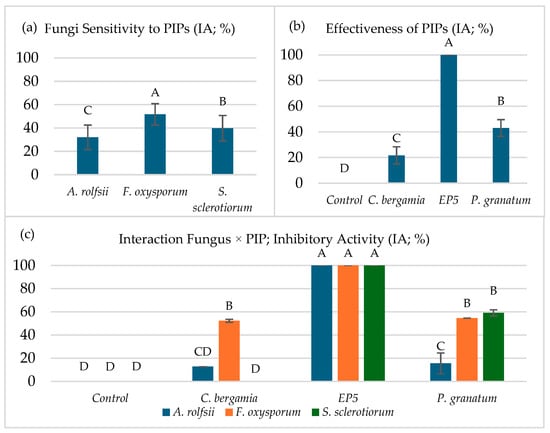
Figure 1 (as well as Tables S1–S3) presents the results of a comprehensive scientific analysis of the effectiveness of specific natural or mineral products (PIPs) in inhibiting fungal growth. This analysis was conducted under in vitro conditions to assess the preliminary inhibitory activity of natural products before testing them under in vivo conditions. In particular, panel (a) shows data related to the sensitivity of three fungal pathogens when exposed to the PIPs, highlighting that A. rolfsi was the least sensitive with an IA of 42.73%, while F. oxysporum was the most sensitive with an IA of 68.94%, and S. sclerotiorum was inhibited with an IA value of 53.03% (Table S1). Panel (b) compares the effectiveness of the PIPs against the selected fungi to determine their “relative antifungal potential”. The graph shows that, among the plant products, pomegranate (IA = 43.03%) was more effective than bergamot (IA = 21.67%), but EP5, as a mineral product, demonstrated the highest efficacy in controlling all fungal pathogens, with IA values of 100.00% (Table S2). The graph in panel (c) of Figure 2 displays the interaction between specific fungal pathogens and the PIPs (EP5, pomegranate, and bergamot), showing that EP5 was the most effective treatment that inhibited all fungi, with IA values of 100.00%. In contrast, bergamot had high efficacy and specificity against F. oxysporum (IA = 52.27%), no efficacy and specificity against S. sclerotiorum (IA = 0.00%), and very low efficacy against A. rolfsii (IA = 12.73%) (Table S3 and Figure 2).
Figure 1.
In vitro evaluation of fungal pathogen sensitivity and inhibition potential of putative inhibitory products (PIPs) after 21 days: (a) sensitivity of different fungal pathogens to PIPs, expressed as inhibition activity (IA; %); (b) comparative efficacy of PIPs against fungal pathogens, showing their relative antifungal potential; (c) interaction effects between fungal pathogens and PIPs (EP5, P. granatum, and C. bergamia), expressed as IA percentages. Data were analyzed using one-way and factorial ANOVAs and Tukey’s Test (p < 0.01). Means with the same capital letters indicate no significant differences.
Figure 2.
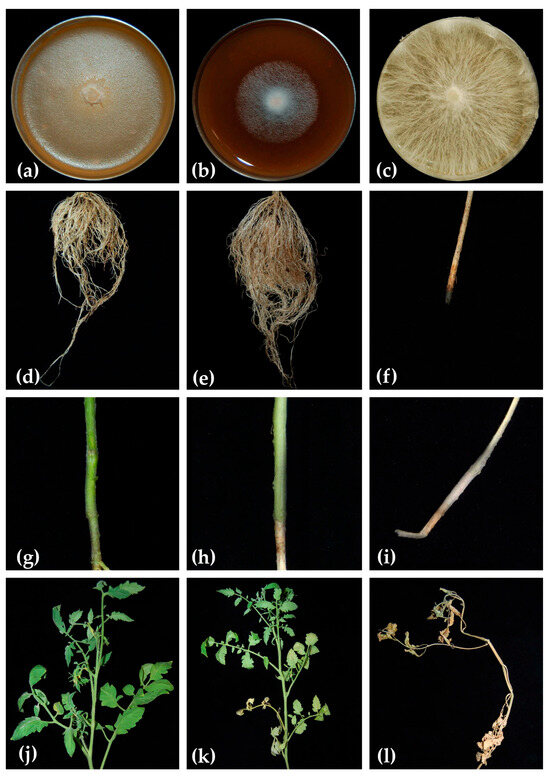
Inhibitory activity (IA) of putative inhibitory products (PIPs) under in vitro (after 21 days) and in vivo (after 45 days) conditions: (a) IA of EP5 against Fusarium oxysporum; (b) IA of Punica granatum against Sclerotinia sclerotiorum; (c) IA of Citrus bergamia against Agroathelia rolfsii; (d) healthy roots treated with EP5 against F. oxysporum; (e) unhealthy roots treated with P. granatum against S. sclerotiorum; (f) severely unhealthy roots treated with C. bergamia against A. rolfsii showing significant root destruction; (g) healthy collar treated with EP5 against F. oxysporum; (h) unhealthy collar treated with P. granatum against S. sclerotiorum showing collar discoloration; (i) severely unhealthy collar treated with C. bergamia against A. rolfsii showing significant root destruction; (j) healthy aerial parts treated with EP5 against F. oxysporum; (k) unhealthy aerial parts treated with P. granatum against S. sclerotiorum showing stunted leaves; (l) severely unhealthy aerial parts treated with C. bergamia against A. rolfsii showing wilt and necrosis of leaves.
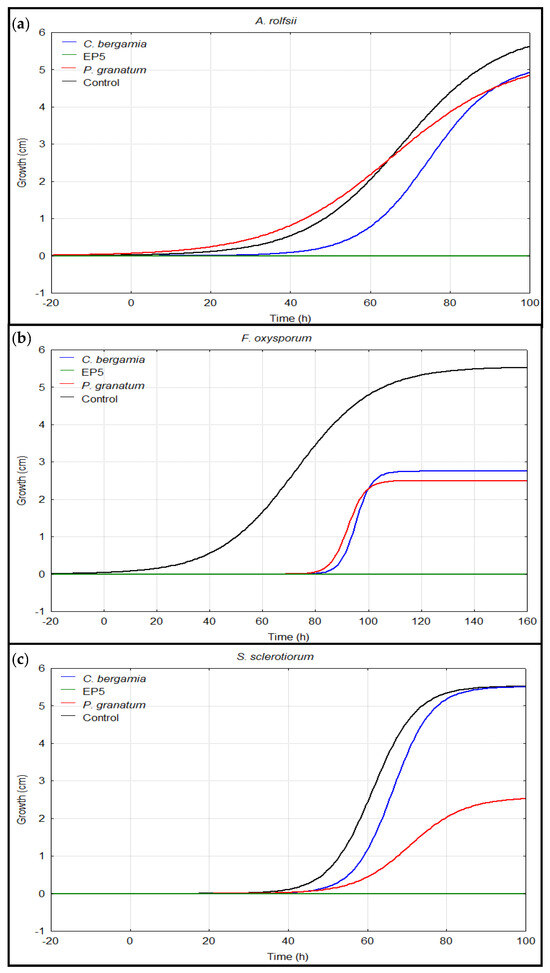
Figure 3 (Table S4) shows the growth trends of A. rolfsii, F. oxysporum, and S. sclerotiorum in the presence of bergamot, EP5, and pomegranate. Among the PIPs, only EP5’s effect was not influenced by the presence of fungal pathogens. Among the fungal pathogens, A. rolfsii growth was not slowed by the PIPs. In fact, except for EP5 (τ = 480.00 h), Bergamot (τ = 74.80 h) and pomegranate (τ = 65.50 h) showed τ values close to those of the control (τ = 68.12 h). F. oxysporum’s sensitivity to the PIPs was higher than that of A. rolfsii. In this case, the growth kinetics of the control (τ= 72.41 h) was lower than those observed with bergamot, EP5, and pomegranate, with τ values of 480.00, 95.24, and 92.19 h, respectively.
Figure 3.
Growth kinetics of fungal pathogens on culture media amended with different putative inhibitory products (PIPs): (a) Agroathelia rolfsii growth; (b) Fusarium oxysporum growth; and (c) Sclerotinia sclerotiorum growth. Fungal growth on a culture medium not amended with PIPs was used as the control. The colored lines represent the fungal kinetics best fitted to the data based on Dantigny’ model [41].
Moreover, the inhibitory effect of bergamot and pomegranate persisted until the end of the experiment, as the growth of fungal pathogens remained constant after 100 h. While the growth trends of A. rolfsii and F. oxysporum were similar in the presence of bergamot and pomegranate, S. sclerotiorum’s sensitivity was significantly different for these two PIPs. The τ values of bergamot (τ = 66.44 h), EP5 (τ = 480.00 h), and pomegranate (τ = 70.70 h) were higher than the control’s value (61.34 h), suggesting that all the PIPs slowed the growth of fungal pathogens. While the τ values of bergamot and pomegranate were very similar, the final growth values of the fungal pathogens exposed to them were different. S. sclorotiorum’s final growth after exposure to bergamot was equal to that of the control, while its final growth after exposure to pomegranate was lower. This suggests that bergamot lost its efficacy over time, while pomegranate did not (Figure 2).
3.2. Assessment of Effectiveness of PIPs Against Fungal Pathogens Under In Vivo Conditions
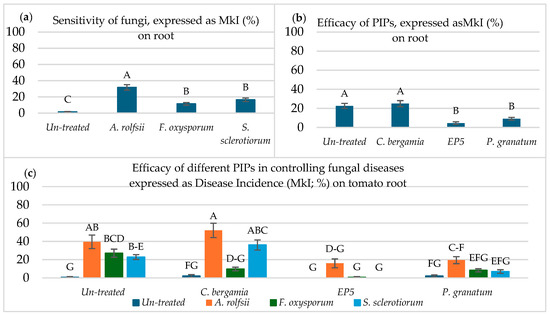
Figure 4 (as well as Tables S5–S7) presents the evaluation results of the efficacy of the PIPs as control methods against soilborne fungal pathogens that affect the roots of tomato plants grown in the greenhouse experiment. The graph in panel (a) describes the sensitivity or aggressiveness of the fungi used in the experiment when exposed to the PIPs. In particular, symptom manifestation on tomato roots, expressed as disease incidence (MkI), was overall better controlled when the PIPs were used against F. oxysporum (MkI = 11.46%) and S. sclerotiorum (MkI = 16.49), but it was less controlled against A. rolfsii (MkI = 32.76%) (Table S5). The graph in panel (b) highlights the overall performance of the different PIPs in controlling fungal pathogens, where EP5 and pomegranate were the most effective with MkI values, recorded from roots, of 4.51 and 9.20%, respectively. In contrast, bergamot was not effective because a high value of disease incidence was recorded (MkI = 25.00%) (Table S6).
Figure 4.
Efficacy of putative inhibitory product (PIP) treatments in controlling soilborne fungal pathogens in greenhouse-grown tomatoes, as determined by root phytosanitary status: (a) sensitivity of fungi exposed to PIPs, as assessed by disease incidence (MkI; %) on tomato roots; (b) effectiveness of PIPs in controlling fungal pathogens, expressed as disease incidence on tomato roots; and (c) interaction between PIP treatments and fungi, as assessed by disease incidence on tomato roots. Data were analyzed using one-way and factorial ANOVAs and Tukey’s test (p < 0.01). Means sharing the same capital letter do not differ significantly.
Panel (c) displays the interaction between specific treatments and fungi, where EP5 was the most effective against all three fungal species, with disease incidence ranging from 0.0 (S. sclerotiorum; un-treated trial) to 15.97% (A. rolfsii). A similar trend could be observed from the trial with pomegranate, though its MkI values were slightly higher overall (ranging from 6.95 to 19.45% against S. sclerotiourum and A. rolfsii, respectively) than those obtained with the EP5 treatment. In contrast, among the tested PIPs, bergamot showed variable effectiveness against different fungi: it was effective in controlling disease incidence caused by F. oxysporum (MkI = 9.72%) in roots but and not effective against A. rolfsii (MkI = 52.08%) and S. sclerotiorum (MkI = 36.11%). Moreover, the disease incidence values recorded when bergamot was used were higher than those recorded for plants not treated with any PIP but artificially inoculated with fungi (un-treated trial) (Table S7).
Figure S1 (as well as Tables S8–S10) reports the results specific to symptom manifestation on the collar of tomato plants, expressed as disease incidence (MkI; %). The results regarding the aggressiveness of the fungal pathogens (Table S8) in affecting the collar of tomato plants are similar to those presented in Figure 4 (Tables S5–S7). In particular, A. rolfsii was the most aggressive fungus, showing a mean disease incidence of 23.26%, while Fusarium oxysporum (MkI = 2.26%) and S. sclerotiorum (MkI = 1.39%) were the weaker fungal pathogens. Statistically, their damage levels were indistinguishable from the un-treated control (MkI = 0.00%) (Table S8). Table S9 displays the overall performance or efficacy of the PIPs across the three fungal pathogens. The bergamot treatment was statistically identical to the un-treated control, as the recorded disease incidences were 9.90 and 10.94%, respectively. In contrast, EP5 (MkI = 2.78%) and pomegranate (MkI = 3.30%) significantly reduced disease symptoms by roughly 70–75% compared with the averages obtained from the un-treated control and the bergamot treatment. Table S10 clearly reveals the successful and failed treatments, as determined by the specific interactions of the fungi and PIPs. In the presence of A. rolfsii, the un-treated tomato plants (MkI = 33.33%) and bergamot-treated plants (MkI = 36.11%) showed significantly high disease levels.
On the other hand, EP5 and pomegranate significantly reduced A. rolfsii-mediated disease incidence to 10.42 and 13.19%, respectively. Regarding F. oxysporum and S. sclerotiorum, disease incidence values remained significantly low (MkI ranged from 0.00 to 3.47%) across almost all treatments (EP5, pomegranate, and bergamot), making it difficult to detect which PIP treatment was more effective since the infection at baseline was negligible.
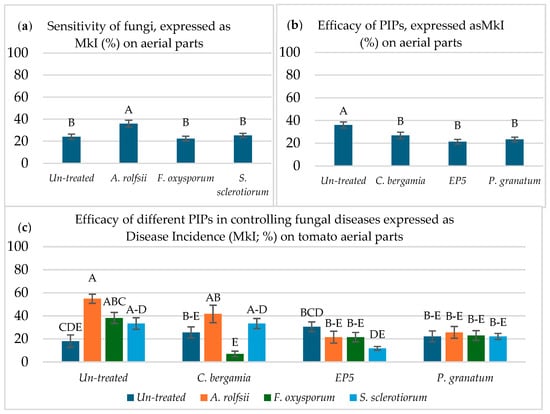
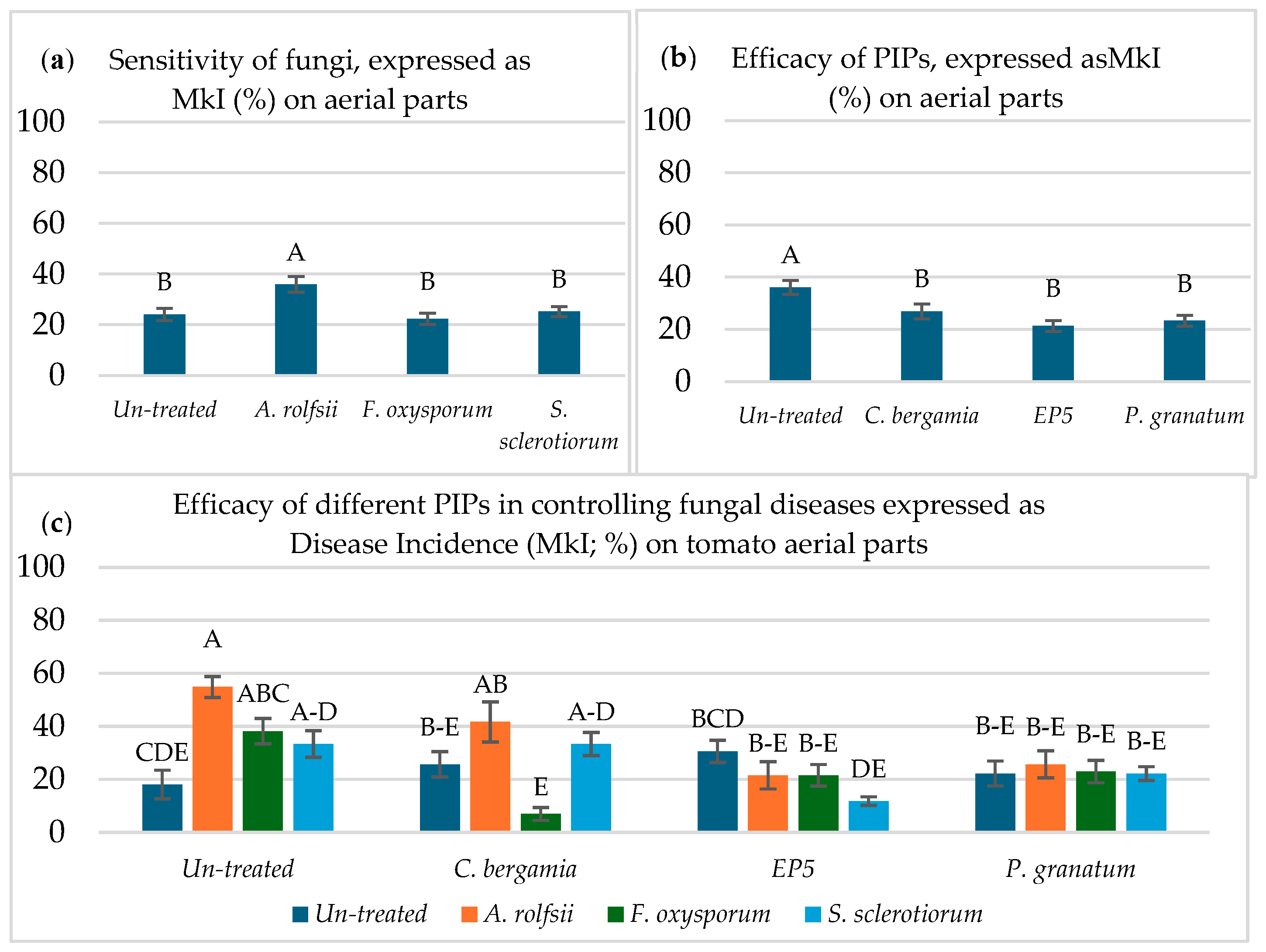
Figure 5, as well as Tables S11–S13, highlights the aerial phytosanitary status of tomato plants at the end of the growth cycle.
Figure 5.
Assessment of the efficacy of putative inhibitory product (PIP) treatments in controlling soilborne fungal pathogens in greenhouse-grown tomatoes, as determined by the phytosanitary status of aerial parts: (a) sensitivity of fungi exposed to PIPs, as assessed by disease incidence (MkI; %) on tomato aerial parts; (b) effectiveness of PIPs in controlling fungal pathogens, expressed as disease incidence on tomato aerial parts; (c) interaction between PIP treatments and fungi, as assessed by disease incidence on tomato aerial parts. Data were analyzed using one-way and factorial ANOVAs and Tukey’s test (p < 0.01). Means sharing the same capital letter do not differ significantly.
Graph (a) (Table S11) shows that disease incidence was significantly higher when A. rolfsii was used (MkI = 35.94%), while it was not significantly different from that of un-treated plants (MkI = 24.13%) when F. oxysporum (MkI = 22.40%) and S. sclerotiorum (MkI = 25.17%) were used. Graph (b) (Table S12) highlights that the PIPs did not produce phytotoxicity damage on the aerial plant part because their presence significantly protected tomato plants against fungal pathogens. In addition, the interaction between the PIPs and fungi shown in Graph (c) confirms the ability of the PIPs to protect the aerial plant part from damage caused by the presence of the fungi inoculated. In particular, the best PIP was EP5, with symptoms calculated as disease incidence ranging from 21.23 (A. rolfsii) to 11.81% (S. sclerotiorum). Also, pomegranate was effective, with disease incidence values ranging from 25.69 (S. rolfsii) to 22.22% (un-treated and S. sclerotiorum). In contrast, bergamot displayed selective protection activity; it was more effective against F. oxysporum (MkI = 6.94%) and less effective against A. rolfsi (MkI = 41.67%) and S. sclerotiorum (MkI = 33.33%) (Table S13).
Effects of PIPs and Fungal Pathogens on Plant Growth Length and Compactness
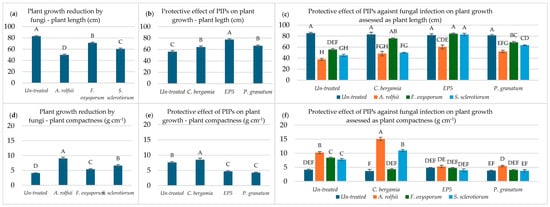
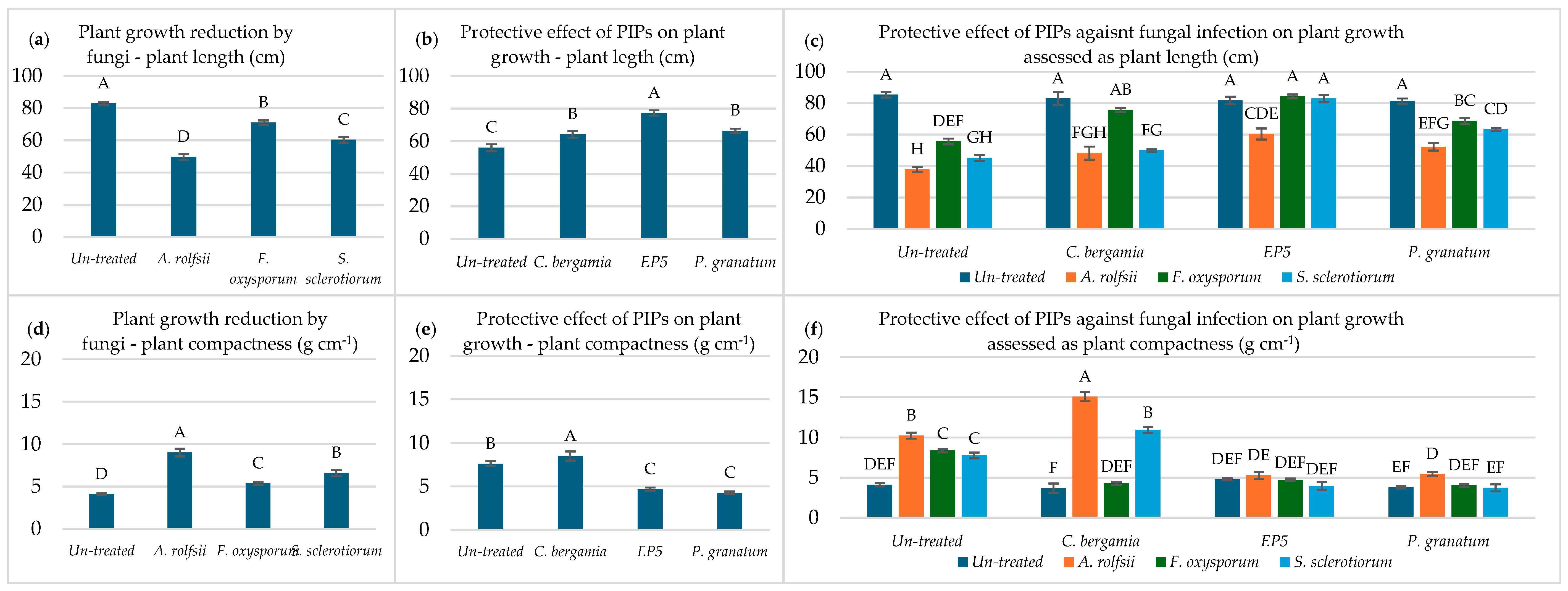
Figure 6 (as well as Tables S14–S19) presents the effects of PIPs and fungal pathogens on plant length, one of the growth indices evaluated in this experiment. The effects of fungal pathogens, PIPs, and their combinations did not follow a common trend. Specifically, the effects of fungal pathogens on final plant length revealed significant differences in the sensitivity of tomato plants to these pathogens. F. oxysporum, S. sclorotiorum and A. rolfsii reduced the growth of the plants compared with the control (82.79 cm), with F. oxysporum, S.sclerotiorum, and A. roflsii being slightly harmful (71.08 cm), moderately harmful (60.31 cm), and very harmful (49.67 cm), respectively, as observed in Graph (a) (Table S14). The effects of the PIPs were very variable, but there was a common trend toward growth promotion compared with un-treated plants (56.01 cm). Graph (b) (Table S15) shows that EP5 significantly promoted plant length, with a value of 77.32 cm, while growth promotion by pomegranate and bergamot was less significant, with values of 66.38 cm and 64.15 cm, respectively. Graph (c) (Table S16), in general, highlights the negative effects of fungal pathogens and the positive effects of PIP treatments. The presence of fungal pathogens, without any PIP treatment, significantly reduced plant growth, with values ranging from 37.83 (A. rolfsii) to 55.71 cm (F. oxysporum). The PIP treatments normalized the growth of the plants, thus limiting the negative effects of the presence of fungal pathogens. EP5 was the most effective PIP, with values ranging from 60.42 to 84.29 cm, while pomegranate and bergamot showed less pronounced effects, with values ranging from 52.19 to 81.33 cm and from 48.35 to 82.88 cm, respectively. Although the results depend on the different interactions between fungi and PIPs (indicating variability in fungus–PIP interactions), the un-treated plants and the plants treated with bergamot, pomegranate, and EP5 showed a similar negative trend with regard to A. rolfsii, with values of 37.83, 48.25, 59.19, and 60.42 cm, respectively. The results regarding tomato plant compactness followed a trend similar to that observed for final length. Graph (d) (Table S17) shows that A. rolfsii significantly increased compactness, suggesting a small growth of the plant (9.02 g cm−1). S. sclortiorum and F. oxysporum showed a similar effect on compactness, but this effect was less significant when compared to the control, with values of 6.61, 5.37, and 4.11 g cm−1, respectively.
Figure 6.
Effect of putative inhibitory product (PIP) treatments on tomato plant growth indices, as determined by plant length (cm) and compactness (g cm−1): (a) reduction in plant growth caused by fungal pathogens, expressed in terms of plant length; (b) PIP protection on plant growth, expressed in terms of plant length; (c) effect of the interaction between fungal pathogens and PIPs on plant growth, as assessed by plant length; (d) reduction in plant growth caused by fungal pathogens, expressed in terms of compactness; (e) protective effect of PIPs on plant growth, expressed in terms of compactness; (f) effect of the interaction between fungal pathogens and PIPs on plant growth, as assessed by plant compactness. One-way and factorial ANOVAs (interaction between fungi and PIPs) and Tukey’s test (p < 0.01) were performed; the means with the same capital letters indicate no significant differences.
Regarding the PIPs, plants treated with bergamot and un-treated plants showed a highest compactness, with values of 8.51 and 7.63 g cm−1, respectively. In contrast, Graph (e) (Table S18) shows that EP5 and pomegranate did not increase compactness, and their effects were not significantly different, with values of 4.70 and 4.27 g cm−1, respectively. Graph (f) (Table S19) clearly highlights the differences among the PIPs in relation to the fungal pathogens. While compactness in plants treated with EP5 and pomegranate remained relatively stable, with values ranging from 3.95 (EP5 vs. S. sclerotiorum) to 5.3 g cm−1 (EP5 vs. A. rolfsii) for EP5 and from 3.74 (pomegranate vs. S. sclerotiorum) to 5.46 g cm−1 (pomegranate vs. A. rolfsii) for pomegranate, the plants treated with bergamot showed a wide range of compactness depending on the fungal pathogen inoculated, ranging from 3.69 (bergamot without any fungal inoculation) to 15.08 g cm−1 (bergamot against A. rolfsii). In general, the EP5 and pomegranate treatments reduced compactness to values almost equal to that of the un-treated and un-inoculated plants (4.14 g cm−1). Moreover, the two PIPs reduced the compactness values observed in the un-treated and inoculated plants, which ranged from 7.78 (S. sclerotiorum) to 10.24 g cm−1 (A. rolfsii). Bergamot was the only PIP showing inconsistent effects, as it reduced the compactness of the plants treated with F. oxysporum (4.29 g cm−1) and increased it in the plants treated with S. scleortiorum (10.97 g cm−1) and A. rolfsii (15.08 g cm−1).
3.3. Survival of Inoculated Fungi Assessed by Re-Isolation Frequency
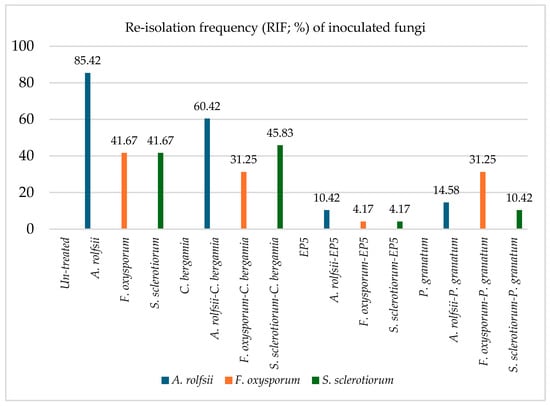
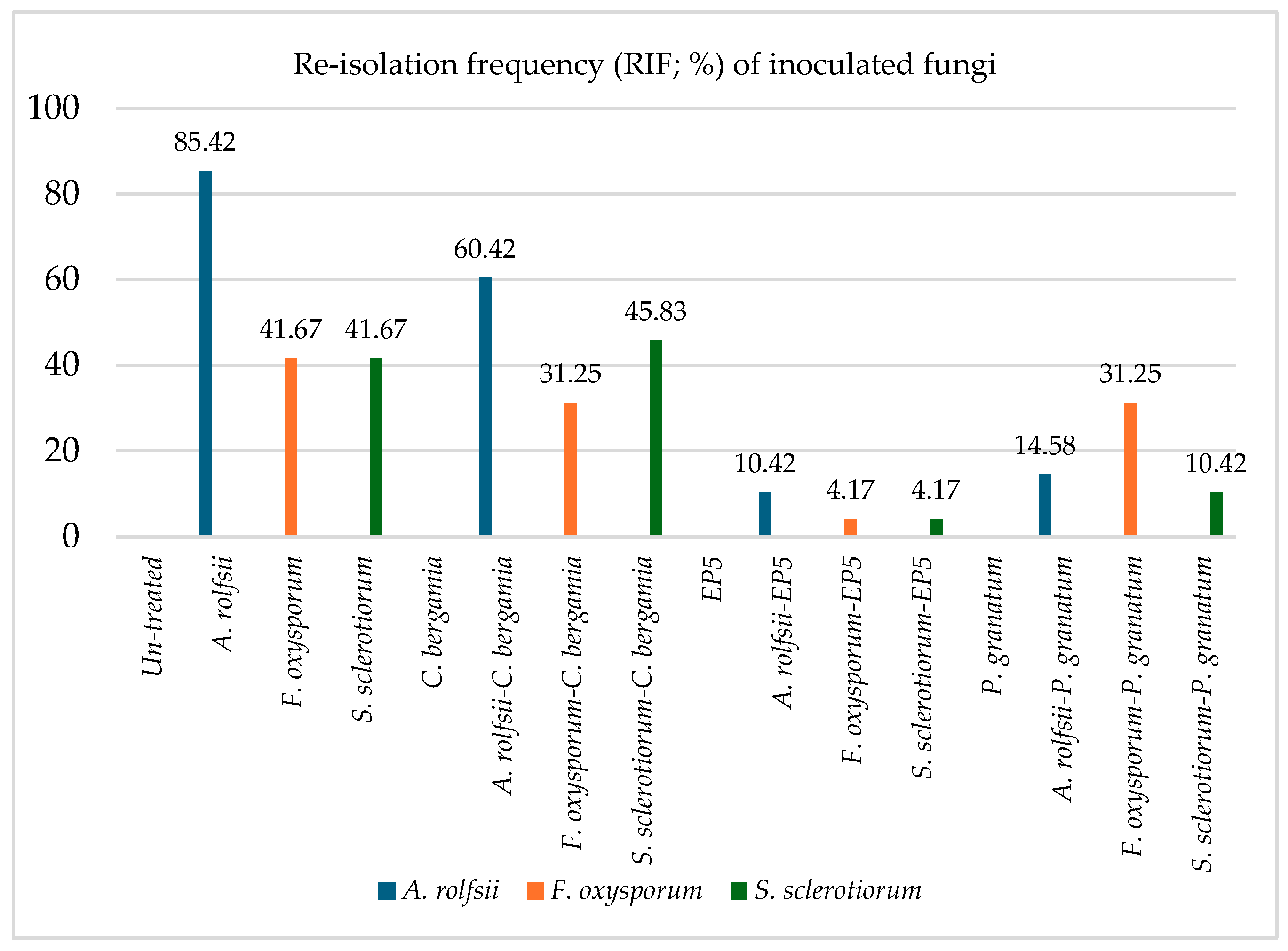
Figure 7 (along with Table S20) reports the re-isolation frequency percentage (RIF; %) of artificially inoculated fungi, which better explains the MkI observed on roots. In particular, the graph highlights the high efficacy of EP5 (from 4.17 to 10.42%).
Figure 7.
Percentage of inoculated fungal pathogens re-isolated from tomato roots.
The same panel shows that between the other two PIPs, pomegranate was more effective in inhibiting fungal growth (from 10.42 to 31.25%) than bergamot (from 31.25 to 60.42%). Additionally, the R-IF values of artificially inoculated fungi were lower in the trials with EP5 and pomegranate than that of the un-treated trial, ranging from 41.67 (in the presence of F. oxysporum and S. sclerotiorum) to 85.42% (in the presence of A. rolfsii). Although all the PIPs showed general efficacy, the bergamot vs. S. scelrotiorum trial (45.83%) was the only trial with an RIF value higher than that of the un-treated trial (41.67%).
4. Discussion
The experiment carried out in the present work highlights the effectiveness of potential plant products as sustainable control measures against several severe fungal pathogens under in vitro and in vivo conditions. Recent studies [29,30,32] have reported the potential use of natural fungicides that are environmentally friendly and safe for pollinating insects, livestock, and humans as alternatives suitable for organic and chemical-free agriculture, which is in agreement with the results obtained in greenhouse experiments on tomato seedlings. According to other studies, essential oils from thyme, oregano, and marjoram plants have shown strong antifungal activity against Penicillium olsonii [46,47]. Moreover, essential oils from oregano were reported to completely inhibit Botrytis cinerea growth under both in vitro and in vivo conditions, thus protecting tomato plants from disease-induced damage. More recently, Castello et al. [48] discussed results obtained from a greenhouse experiment where plant-based treatments were used to manage damping-off and root rot diseases caused by Rhizoctonia solani and A. rolfsii, respectively, on tomato plants. Therefore, the results of many investigations are consistent with those described in this work, which stated that, in the in vitro experiment, the most vulnerable fungal pathogen to PIP activity was F. oxysporum, characterized by the highest average sensitivity, while the most resistant pathogen was A. rolfsii. On the other hand, among the PIPs used, EP5, as a mineral product, was the most effective agent in controlling the fungi tested. Bergamot displayed specificity because it was quite effective against F. oxysporum but completely ineffective against S. sclerotiorum. Moreover, as similar results were obtained from the greenhouse experiment, it allowed us to infer that EP5 and pomegranate were the most effective natural products for inhibiting fungal growth and protecting roots and collars in live tomato plants, resulting in the lowest disease incidence values. In contrast, bergamot performed poorly under greenhouse conditions because its treatment resulted in higher disease incidence than un-treated plants, suggesting that it may harm the plants or aid the fungus. Additionally, the antifungal activity of pomegranate and bergamot products differed due to the metabolites present in their peels. Many studies report the chemical composition and metabolic profiles of pomegranate and bergamot and demonstrate their high antifungal and antioxidant values [49,50]. Accordingly, our results on EP5, which contains minerals and silicates, encountered strong support from recent studies reporting the powerful effects of mineral products such as zeolite and bentonite against root diseases caused by soilborne pathogens in tomato crops. These results indicated that zeolite and bentonite act as slow-release reservoirs for both water and defense-boosting ions by releasing silicon ions into the soil solution. Despite silicon not being an essential nutrient, it is absorbed by tomato roots and deposited beneath the cuticle and in cell walls, making root cells more resistant to fungal infections [51,52]. Therefore, EP5 is the best candidate for controlling soilborne fungi that affect plant roots, demonstrating consistent, broad-spectrum efficacy in both lab and greenhouse experiments. Pomegranate, as a plant PIP, is a viable alternative, while bergamot carries significant risk, as despite its effectiveness against specific fungi in the lab, it failed to protect roots and collars in live tomato plants and potentially worsened infections for certain pathogens. The efficacy of pomegranate against soilborne fungal pathogens of tomato plants has been positively reported by Leontopoulos et al. [53], who attributed its activity against R. solani and F. oxysporum f.sp. lycopersici to the high tannin content in its peel. Bergamot’s reduced effectiveness against the same fungi can be linked to its high content of residual essential oils (volatile compounds) and flavonoids in peel waste [54,55]. Moreover, the phytosanitary status of the aerial parts of tomato plants at the end of their growth cycle allowed us to assess the PIP’s potential to control soilborne fungal pathogens. The results are in line with those collected from roots and collars, confirming that A. rolfsii has been the most damaging pathogen, causing significantly higher disease incidence on root and collars, as well as on the aerial plant part, compared to the other fungi inoculated. Indeed, A. rolfsii, which affects the plant roots, also induces damage on the collar region, stem, and aerial parts, as confirmed by Aljabali et al. [56]. Moreover, the aerial symptoms caused by F. oxysporum and S. sclerotiorum were not significantly different from those observed in the un-treated control plants, suggesting that these pathogens primarily attack roots or cause low aerial stress. This study highlights that PIPs are phytotoxic to tomato plants and provide significant protection against fungal attacks. In particular, EP5 was the best PIP and most effective protectant across all agents evaluated because it was potent against fungi but gentle on plant tissue. This feature of EP5 makes it a highly valuable alternative for agricultural application. Otherwise, pomegranate can be used as an effective PIP as it provides good protection, and bergamot can be used selectively because of its high efficacy against F. oxysporum but inconsistent and poor performance against S. sclerotiorum and A. rolfsii. The results regarding the phytosanitary status of the tomato plants reflected the results on their growth, which was expressed as plant length (cm) and compactness (g cm−1). The two parameters are not directly related, as it has been discovered that stressed plants tend to promote more biomass accumulation compared to plants undergoing elongation [57]. EP5 and pomegranate had stronger efficacy against the fungal pathogens and resulted in higher and less compact plants, while plants treated with bergamot were more sensitive to the fungal pathogens, displaying more compact and shorter profiles. The influence of zeolite and pomegranate on plant growth has been reported in other investigations. Zeolite significantly increases the height of the flowering stem, the diameter of the flower, the leaf area, and the chlorophyll content of tuberose plants [58], while pomegranate peel is able to control Fusarium wilt, leading to an improvement in the growth variables of tomato plants [59]. Moreover, the data shows that the aggressiveness of A. rolfsii and S. sclerotiorum leads to negative growth indices. The damage caused by these pathogens not only affect the growth of tomato plants [60] but also impact a wide range of botanical species, like Mentha arvensis [61]. Through the re-isolation frequency (RIF), this study determined the “colonization rate” of the pathogens within the roots of tomato plants artificially inoculated with fungal pathogens at the end of their growth cycles. The RIF data collected were found to correlate strongly with the MkI data collected from tomato roots. The low RIFs indicate reduced symptom presence, confirming that the PIP treatments were able to prevent fungi from surviving or establishing themselves deep within roots. In particular, EP5 demonstrated high efficacy with very low fungal recovery. Pomegranate was also effective, significantly reducing fungal presence compared to controls; however, according to El Khetabi et al. [62] and Orak et al. [63], it allowed a few fungal species to grow. In contrast, this work reports that bergamot displays characteristics beyond being the least effective treatment; against S. sclerotiorum, it actually resulted in higher fungal presence than the controls, reinforcing the finding from previous research indicating that bergamot may promote certain fungal infections, as reported by Cebi et al. [50] and Whiley et al. [64].
5. Conclusions
The results discussed in this study are presented to evaluate plant-derived products as eco-friendly alternatives and mineral-derived products as suitable resistance inducers that elicit natural defenses inside tomato plants. Among the putative inhibitory products, EP5, which contains bentonite, emerged as the most effective treatment, likely due to the release of silicon to strengthen root cell walls. Pomegranate peel, due to its tannin content, also showed high efficacy, as demonstrated by its ability to effectively reduce the colonization of the fungal pathogens used in both experiments (in vitro and in vivo). In contrast, the effect of bergamot proved to be inconsistent and controversial because it targeted F. oxysporum in vitro but failed in vivo and could potentially worsen the infection. Agroatelia rolfsii was identified as the most aggressive pathogen, causing severe damage across all plant parts and making it difficult to limit its aggressiveness in both in vitro and in vivo experiments. Moreover, the successful treatments (EP5 and pomegranate) not only lowered disease incidence but also promoted better plant growth, thereby resulting in taller, healthier tomato plants, as demonstrated by their agronomic features. Overall, although EP5 and pomegranate represent safe, non-phytotoxic alternatives for sustainable, chemical-free agriculture, further experiments on the mechanisms governing host–pathogen interactions under natural conditions deserve attention. To conclude, scientific research in this area is required to provide policymakers with effective tools to guide farmers toward sustainable agriculture that is safe for consumers and the environment while remaining respectful of biodiversity.
Supplementary Materials
The following supporting information can be downloaded at https://www.mdpi.com/article/10.3390/agriculture16080861/s1, Table S1: Sensitivity of Fungal species subjected to inhibiting activity of putative inhibiting products (PIPs) on artificial medium in in vitro conditions; Table S2: Inhibiting activity (IA) of putative inhibiting products (PIPs) on artificial medium in in vitro condi-tions; Table S3: Inhibiting activity of putative inhibiting products (PIPs) on artificial medium against fungal pathogens in in vitro conditions; Table S4: Fungal growth (τ; time to attain a half of the maximum diameter expressed in hours) on the culture medium amended with putative inhibitory products (PIPs); Table S5: Disease Incidence determined based on root symptoms caused by inoc-ulated fungi; Table S6: Disease Incidence expressed as root symptoms based on efficacy of the pu-tative inhibitory products (PIPs) to control inoculated fungi; Table S7: Effect of the interaction between the inoculated fungal pathogens and the putative inhibitory products (PIPs) in affecting root health; Figure S1: Efficacy of putative inhibitory products (PIPs) treatments in controlling soilborne fungal pathogens in greenhouse tomatoes, determined by the collar phytosanitary status: (a) Sensitivity of fungi exposed to PIPs, assessed by disease incidence (MkI; %) on tomato collar; (b) Effectiveness of PIPs in controlling fungal pathogens, expressed as disease incidence on tomato collar; (c) Interaction between PIP treatments and fungi, assessed by disease incidence on tomato collar. One-way and Factorial Anova, Tukey’s Test (p < 0.01). Means sharing the same capital letter do not differ significantly; Table S8: Disease Incidence determined based on collar symptoms caused by inoculated fungi; Table S9: Disease Incidence expressed as collar symptoms based on efficacy of the putative inhibitory products (PIPs) to control inoculated fungi; Table S10: Effect of the interac-tion between the inoculated fungal pathogens and the putative inhibitory products (PIPs) in affecting collar health; Table S11: Disease Incidence determined based on aerial parts symptoms caused by inoculated fungi; Table S12: Disease Incidence expressed as aerial symptoms based on efficacy of the putative inhibitory products (PIPs) to control inoculated fungi; Table S13: Effect of the interaction between the inoculated fungal pathogens and the putative inhibitory products (PIPs) in affecting collar health; Table S14: Effect of the presence of the inoculated fungal pathogens on plant growth, assessed as plant length; Table S15: Protection promoted by the putative inhibitory products (PIPs) on plant growth, assessed as plant length; Table S16: Effect of the interaction between fungus and putative inhibitory products (PIPs) on plant growth, assessed as plant length; Table S17: Effect of the presence of the inoculated fungal pathogens on plant growth, assessed as plant compactness; Table S18: Protection promoted by the putative inhibitory products (PIPs) on plant growth, assessed as plant compactness; Table S19: Effect of the interaction between fungus and putative inhibitory products (PIPs) on plant growth, assessed as plant compactness; Table S20: Inoculated fungal pathogens re-isolated from the treated and un-treated root.
Author Contributions
Conceptualization, A.C.; methodology, T.C., M.G.M., G.R. and A.C.; software, T.C., M.G.M. and A.C.; validation, T.C., M.G.M. and A.C.; formal analysis, T.C.; investigation, T.C. and A.C.; resources, A.C.; data curation, T.C. and A.C.; writing—original draft preparation, T.C. and A.C.; writing—review and editing, T.C., A.L. and A.C.; visualization, T.C. and A.C.; supervision, A.C. and A.L.; project administration, A.C. All authors have read and agreed to the published version of the manuscript.
Funding
This research received no external funding.
Institutional Review Board Statement
Not applicable.
Data Availability Statement
The data presented in this study are available from the corresponding author upon request.
Acknowledgments
The authors warmly thank Emanuela Conte for her careful revision of the English language as she is an experienced English teacher.
Conflicts of Interest
The authors declare no conflicts of interest.
Correction Statement
This article has been republished with a minor change. The change does not affect the scientific content of the article and further details are available within the backmatter of the website version of this article.
Abbreviations
The following abbreviations are used in this manuscript:
| PIP | Putative inhibiting product |
| MkI | McKinney index |
| RIF | Re-isolation frequency |
References
- Li, N.; Wu, X.; Zhuang, W.; Xia, L.; Chen, Y.; Wu, C.; Rao, Z.; Du, L.; Zhao, R.; Yi, M.; et al. Tomato and lycopene and multiple health outcomes: Umbrella review. Food Chem. 2021, 343, 128396. [Google Scholar] [CrossRef] [Scilit]
- FAO. Agricultural Production Statistics 2010–2023; FAO: Rome, Italy, 2024; pp. 1–16. Available online: https://openknowledge.fao.org/handle/20.500.14283/cd3755en (accessed on 12 January 2026).
- Eurostat. Available online: https://ec.europa.eu/eurostat/web/products-eurostat-news/w/ddn-20250825-1# (accessed on 12 January 2026).
- Sipcam. Available online: https://www.sipcam.com/it/it/magazine/pomodoro-da-industria-foggia-la-regina-italiana (accessed on 12 January 2026).
- Foolad, M.R.; Merk, H.L.; Ashrafi, H. Genetics, Genomics and Breeding of Late Blight and Early Blight Resistance in Tomato. Crit. Rev. Plant Sci. 2008, 27, 75–107. [Google Scholar] [CrossRef] [Scilit]
- Vos, C.M.; Yang, Y.; De Coninck, B.; Cammue, B.P.A. Fungal (–like) biocontrol organisms in tomato disease control. Biol. Control 2014, 74, 65–81. [Google Scholar] [CrossRef] [Scilit]
- De La Noval, B.; Pérez, E.; Martínez, B.; León, O.; Martínez-Gallardo, N.; Délano-Frier, J. Exogenous systemin has a contrasting effect on disease resistance in mycorrhizal tomato (Solanum lycopersicum) plants infected with necrotrophic or hemibiotrophic pathogens. Mycorrhiza 2007, 17, 449–460. [Google Scholar] [CrossRef] [Scilit]
- Williamson, B.; Tudzynski, B.; Tudzynski, P.; Van Kan, J.A.L. Botrytis cinerea: The cause of grey mould disease. Mol. Plant Pathol. 2007, 8, 561–580. [Google Scholar] [CrossRef] [Scilit] [PubMed]
- Wani, A.H. An overview of the fungal rot of tomato. Mycopath 2011, 9, 33–38. [Google Scholar]
- Dafny Yelin, M.; Graph, S.; Rabinovitz, O.; Shakked, N.; Hill, A.; Lifshitz, O. Optimal treatment against Athelia rolfsii rot in processing tomatoes using pesticide and rootstock against key stages of the disease. Crop Prot. 2024, 176, 106480. [Google Scholar] [CrossRef] [Scilit]
- Fravel, D.; Olivain, C.; Alabouvette, C. Fusarium oxysporum and its biocontrol. New Phytol. 2003, 157, 493–502. [Google Scholar] [CrossRef] [Scilit] [PubMed]
- Gomaa, N.A.; Mahdy, A.M.M.; Fawzy, R.N.; Ahmed, G.A. Integrated management of tomato white mold disease caused by Sclerotinia sclerotiorum. Middle East J. Agric. 2016, 5, 479–486. [Google Scholar]
- Rodríguez, M.A.; Venedikian, N.; Bazzalo, M.E.; Godeas, A. Histopathology of Sclerotinia sclerotiorum attack on flower parts of Helianthus annuus. Mycopathologia 2004, 157, 291–302. [Google Scholar] [CrossRef] [Scilit]
- Mengistie, B.T.; Ray, R.L.; Iyanda, A. Environmental and Human Health Impacts of Agricultural Pesticides on BIPOC Communities in the United States: A Review from an Environmental Justice Perspective. Int. J. Environ. Res. Public Health 2025, 22, 1683. [Google Scholar] [CrossRef] [Scilit]
- Muñoz-Bautista, J.M.; Bernal-Mercado, A.T.; Martínez-Cruz, O.; Burgos-Hernández, A.; López-Zavala, A.A.; Ruiz-Cruz, S.; Ornelas-Paz, J.d.J.; Borboa-Flores, J.; Ramos-Enríquez, J.R.; Del-Toro-Sánchez, C.L. Environmental and Health Impacts of Pesticides and Nanotechnology as an Alternative in Agriculture. Agronomy 2025, 15, 1878. [Google Scholar] [CrossRef] [Scilit]
- Arya, S.; Kumar, R.; Prakash, O.; Rawat, A.; Pant, A.K. Impact of insecticides on soil and environment and their management strategies. In Agrochemicals in Soil and Environment: Impacts and Remediation; Naeem, M., Bremont, J.F.J., Ansari, A.A., Gill, S.S., Eds.; Springer Nature: Singapore, 2022; pp. 213–230. [Google Scholar] [CrossRef] [Scilit]
- Dhuldhaj, U.P.; Singh, R.; Singh, V.K. Pesticide contamination in agro-ecosystems: Toxicity, impacts, and bio-based management strategies. Environ. Sci. Pollut. Res. 2023, 30, 9243–9270. [Google Scholar] [CrossRef] [Scilit]
- Kaur, R.; Choudhary, D.; Bali, S.; Bandral, S.S.; Singh, V.; Ahmad, M.A.; Rani, N.; Singh, T.G.; Chandrasekaran, B. Pesticides: An alarming detrimental to health and environment. Sci. Total Environ. 2024, 915, 170113. [Google Scholar] [CrossRef] [Scilit]
- European Commission. Commission Implementing Regulation (EU) 2016/1056 of 29 June 2016 Amending Implementing Regulation (EU) No 540/2011 as Regards the Extension of the Approval Period of the Active Substance Glyphosate (Text with EEA Relevance). Available online: https://eur-lex.europa.eu/eli/reg_impl/2016/1056/oj/eng (accessed on 12 January 2026).
- EU Regulation. Pesticide Residues in Fruit and Vegetables: Maximum Levels. Available online: https://eur-lex.europa.eu/legal-content/EN/TXT/?uri=legissum%3Al13007c (accessed on 12 January 2026).
- Metz, N.; Hausladen, H. Trichoderma spp. as potential biological control agent against Alternaria solani in potato. Biol. Control 2022, 166, 104820. [Google Scholar] [CrossRef] [Scilit]
- Põldmets, M.; Koppel, M.; Puidet, B.; Abuley, I.K.; Belle, N.; Lynott, J.; Hansen, J.G.; Hausladen, H.; Hokka, M.; Lukkala, R.; et al. Use of biological control agents and plant resistance inducers for the control of potato late blight (Phytophthora infestans). Potato Res. 2025, 68, 3843–3863. [Google Scholar] [CrossRef] [Scilit]
- Sallam, N.M.A.; Eraky, A.M.I.; Sallam, A. Effect of Trichoderma spp. on fusarium wilt disease of tomato. Mol. Biol. Rep. 2019, 46, 4463–4470. [Google Scholar] [CrossRef] [Scilit]
- Patra, G.K.; Acharya, G.K.; Panigrahi, J.; Mukherjee, A.K.; Rout, G.R. The soil-borne fungal pathogen Athelia rolfsii: Past, present, and future concern in legumes. Folia Microbiol. 2023, 68, 677–690. [Google Scholar] [CrossRef] [Scilit]
- Khairy, A.; Elattaapy, A.M.; Yousef, S.A.; Hamada, M.S.; Amin, B.H.; Elsherbiny, E.A. Effective biocontrol of Botrytis cinerea by antifungal metabolites of Trichoderma reesei T1 for gray mold in postharvest tomato. Int. J. Food Microbiol. 2025, 436, 111203. [Google Scholar] [CrossRef] [Scilit]
- Bolivar-Anillo, H.J.; González-Rodríguez, V.E.; Cantoral, J.M.; García-Sánchez, D.; Collado, I.G.; Garrido, C. Endophytic bacteria Bacillus subtilis isolated from Zea mays as potential biocontrol agent against Botrytis cinerea. Biology 2021, 10, 492. [Google Scholar] [CrossRef] [Scilit]
- Zhang, J.X.; Xue, A.G. Biocontrol of sclerotinia stem rot (Sclerotinia sclerotiorum) of soybean using Bacillus subtilis strain SB24. Plant Pathol. 2010, 59, 382–391. [Google Scholar] [CrossRef] [Scilit]
- Kumari, P.; Bishnoi, S.K.; Chandra, S. Assessment of antibiosis potential of Bacillus sp. against Sclerotium rolfsii (Athelia rolfsii). Egypt. J. Biol. Pest Control 2021, 31, 17. [Google Scholar] [CrossRef] [Scilit]
- Anil Kumar, R.; Raj Kumar, H.G. In vitro antifungal activity of some plant extracts against Fusarium oxysporum f. sp. lycopersici. Asian J. Plant Sci. Res. 2015, 5, 22–27. [Google Scholar]
- Wavare, S.H.; Gade, R.M.; Vijay Shitole, A. Effect of plant extracts, bio agents and fungicides against Sclerotium rolfsii causing collar rot in chickpea. Indian J. Pharm. Sci. 2025, 79, 513–520. [Google Scholar] [CrossRef]
- Wahab, H.A.; Malek, A.; Ghobara, M. Effects of some plant extracts, bioagents and organic compounds on Botrytis and Sclerotinia molds. Acta Agrobot. 2020, 73, 7321. [Google Scholar] [CrossRef] [Scilit]
- Morea, M.G.; Conte, T.; Ricciardi, G.; Raimondo, M.L.; Carlucci, A. Preliminary study on the antifungal potential of selected plants as botanical fungicides against main fungal phytopathogens. Plants 2025, 14, 3634. [Google Scholar] [CrossRef] [Scilit] [PubMed]
- Noreen, S.; Hashmi, B.; Aja, P.M.; Atoki, A.V. Phytochemicals and pharmacology of pomegranate (Punica granatum L.): Nutraceutical benefits and industrial applications: A review. Front. Nutr. 2025, 12, 1528897. [Google Scholar] [CrossRef] [Scilit]
- Elshafie, H.S.; Caputo, L.; De Martino, L.; Sakr, S.H.; De Feo, V.; Camele, I. Study of Bio-Pharmaceutical and Antimicrobial Properties of Pomegranate (Punica granatum L.) Leathery Exocarp Extract. Plants 2021, 10, 153. [Google Scholar] [CrossRef] [Scilit] [PubMed]
- Shastrakar, P.; Kotkar, K.; Gagarani, M.; Agrawal, S. A Review of Botanical Aspects and Various Pharmacological Actions of Bergamot (Citrus bergamia) Essential Oil. Int. J. Pharm. Qual. Assur. 2023, 14, 1264–1271. [Google Scholar] [CrossRef] [Scilit]
- Calefi, G.G.; Silva, N.B.S.; Alhatlani, B.Y.; Abdallah, E.M.; Martins, C.H.G. Harnessing nature’s arsenal: Sustainable plant-based strategies for phytopathogen control. Front. Microbiol. 2025, 16, 1588462. [Google Scholar] [CrossRef] [Scilit]
- Carlucci, A.; Raimondo, M.L.; Ricciardi, G.; Macolino, S.; Sorbo, A.; Lops, F. Assessment of different control means to protect grape berries from biotic injuries in postharvest. Postharvest Biol. Technol. 2024, 213, 112912. [Google Scholar] [CrossRef] [Scilit]
- Carlucci, A.; Raimondo, M.L.; Cibelli, F.; Phillips, A.; Lops, F. Pleurostomophora richardsiae, Neofusicoccum parvum and Phaeoacremonium aleophilum associated with a decline of olives in southern Italy. Phytopathol. Mediterr. 2013, 52, 517–527. [Google Scholar] [CrossRef] [Scilit]
- Carlucci, A.; Raimondo, M.L.; Colucci, D.; Lops, F. Streptomyces albidoflavus strain CARA17 as a biocontrol agent against fungal soil-borne pathogens of fennel plants. Plants 2022, 11, 1420. [Google Scholar] [CrossRef] [Scilit]
- Bevilacqua, A.; Cibelli, F.; Raimondo, M.L.; Carlucci, A.; Lops, F.; Corbo, M.R. Fungal bioremediation of olive mill wastewater: Using a multi-step approach to model inhibition or stimulation. J. Sci. Food Agric. 2017, 97, 461–468. [Google Scholar] [CrossRef] [Scilit] [PubMed]
- Dantigny, P.; Nanguy, S.P.M.; Judet-Correia, D.; Bensoussan, M. A new model for germination of fungi. Int. J. Food Microbiol. 2011, 146, 176–181. [Google Scholar] [CrossRef] [Scilit]
- Mckinney, H.H. Influence of soil temperature and moisture on infection of Wheat seedlings by Helminthosporium sativum. J. Agric. Res. 1923, 26, 195–217. [Google Scholar]
- Nam, S.; Lee, D.-H.; Kim, J. Effect of Substrate Volumetric Water Content on Performance of Ardisia pusilla Grown in Indoor Conditions. Flower Res. J. 2018, 26, 124–131. [Google Scholar] [CrossRef] [Scilit]
- Eakes, D.J.; Wright, R.D.; Seiler, J.R. Moisture stress conditioning effects on Salvia splendens ‘Bonfire’. J. Am. Soc. Hortic. Sci. 1991, 116, 716–719. [Google Scholar] [CrossRef] [Scilit]
- Fisher, P.J.; Petrini, O.; Scott, H.M.L. The distribution of some fungal and bacterial endophytes in maize (Zea mays L.). New Phytol. 1992, 122, 299–305. [Google Scholar] [CrossRef] [Scilit]
- Mrvová, M.; Medo, J.; Lakatošová, J.; Barboráková, Z.; Golian, M.; Mašková, Z.; Tančinová, D. Vapor-Phase Essential Oils as Antifungal Agents against Penicillium olsonii Causing Postharvest Cherry Tomato Rot. Foods 2024, 13, 3202. [Google Scholar] [CrossRef] [Scilit]
- Soylu, E.M.; Kurt, Ş.; Soylu, S. In vitro and in vivo antifungal activities of the essential oils of various plants against tomato grey mould disease agent Botrytis cinerea. Int. J. Food Microbiol. 2010, 143, 183–189. [Google Scholar] [CrossRef] [Scilit]
- Castello, I.; Baglieri, A.; Montoneri, E.; Vitale, A. Utilization of Municipal Biowaste-Derived Compounds to Reduce Soilborne Fungal Diseases of Tomato: A Further Step Toward Circular Bioeconomy. GCB Bioenerg. 2025, 17, e70027. [Google Scholar] [CrossRef] [Scilit]
- Tehranifar, A.; Selahvarzi, Y.; Kharrazi, M.; Bakhsh, V. High potential of agro-industrial by-products of pomegranate (Punica granatum L.) as the powerful antifungal and antioxidant substances. Ind. Crops Prod. 2011, 34, 1523–1527. [Google Scholar] [CrossRef] [Scilit]
- Cebi, N.; Erarslan, A. Determination of the Antifungal, Antibacterial Activity and Volatile Compound Composition of Citrus bergamia Peel Essential Oil. Foods 2023, 12, 203. [Google Scholar] [CrossRef] [Scilit]
- Huang, C.-H.; Roberts, P.D.; Datnoff, L.E. Silicon Suppresses Fusarium Crown and Root Rot of Tomato. J. Phytopathol. 2011, 159, 546–554. [Google Scholar] [CrossRef] [Scilit]
- Cataldo, E.; Salvi, L.; Paoli, F.; Fucile, M.; Masciandaro, G.; Manzi, D.; Masini, C.M.; Mattii, G.B. Application of Zeolites in Agriculture and Other Potential Uses: A Review. Agronomy 2021, 11, 1547. [Google Scholar] [CrossRef] [Scilit]
- Leontopoulos, S.; Skenderidis, P.; Petrotos, K.; Mitsagga, C.; Giavasis, I. Preliminary Studies on Suppression of Important Plant Pathogens by Using Pomegranate and Avocado Residual Peel and Seed Extracts. Horticulturae 2022, 8, 283. [Google Scholar] [CrossRef] [Scilit]
- Ranieri, E.; Schwan-Estrada, K.R.F.; Oliveira, J.S.B.; Mesquini, R.M.; Clemente, E.; Cruz, M.E.S. Utilização de compostos bioativos de plantas medicinais na pós-colheita de tomate. Rev. Sci. Agrar. Parana. 2015, 14, 160–165. [Google Scholar] [CrossRef] [Scilit]
- Hendges, C.; Stangarlin, J.R.; de Holanda Nozaki, M.; Lorenzetti, E.; Kuhn, O.J. Antifungal activity against Alternaria solani and control of early blight in tomato by essential oil of bergamot orange. Sem. Ciênc. Agrár. 2020, 41, 1861–1874. [Google Scholar] [CrossRef] [Scilit]
- Aljabali, M.A.R.A.; Basavaraj, V.; Sampathkumar, M.R.; Sharada, M.S. Biological Control of Southern Blight in Tomato Caused by Sclerotium rolfsii Using Trichoderma spp. Under In-Vitro and In-Vivo Conditions. Asian J. Soil Sci. Plant Nutr. 2025, 11, 278–288. [Google Scholar] [CrossRef] [Scilit]
- Nagashima, H.; Hikosaka, K. Plants in a crowded stand regulate their height growth so as to maintain similar heights to neighbours even when they have potential advantages in height growth. Ann. Bot. 2011, 108, 207–214. [Google Scholar] [CrossRef] [Scilit]
- Bahadoran, M.; Salehi, H.; Eshghi, S. Growth and flowering of tuberose as affected by adding natural zeolite to the culture medium. J. Plant Nutr. 2012, 35, 1491–1496. [Google Scholar] [CrossRef] [Scilit]
- Rongai, D.; Pulcini, P.; Pesce, B.; Milano, F. Antifungal activity of pomegranate peel extract against fusarium wilt of tomato. Eur. J. Plant Pathol. 2017, 147, 229–238. [Google Scholar] [CrossRef] [Scilit]
- Mandal, D.; Pal, R.; Mohapatra, S.; Seni, A.; Bansure, S.K.; Seth, P.; Barla, S.; Sahu, J. Use of organic amendments for sustainable management of root rot disease of tomato (Solanum lycopersicum L.) caused by Sclerotium rolfsii. Sci. Rep. 2025, 15, 35772. [Google Scholar] [CrossRef] [Scilit]
- Perveen, K.; Haseeb, A.; Shukla, P.K. Effect of Sclerotinia sclerotiorum on the disease development, growth, oil yield and biochemical changes in plants of Mentha arvensis. Saudi J. Biol. Sci. 2010, 17, 291–294. [Google Scholar] [CrossRef] [Scilit]
- El Khetabi, A.; Lahlali, R.; Askarne, L.; Ezrari, S.; El Ghadaroui, L.; Tahiri, A.; Hrustić, J.; Amiri, S. Efficacy assessment of pomegranate peel aqueous extract for brown rot (Monilinia spp.) disease control. Physiol. Mol. Plant Pathol. 2020, 110, 101482. [Google Scholar] [CrossRef] [Scilit]
- Orak, H.H.; Demirci, A.; Gümüş, T. Antibacterial and antifungal activity of pomegranate (Punica granatum L.cv.) peel. Electron. J. Environ. Agric. Food Chem. 2011, 10, 1958–1969. [Google Scholar]
- Whiley, H.; Gaskin, S.; Schroder, T.; Ross, K. Antifungal properties of essential oils for improvement of indoor air quality: A review. Environ. Health Rev. 2018, 33, 63–76. [Google Scholar] [CrossRef] [Scilit] [PubMed]

Disclaimer/Publisher’s Note: The statements, opinions and data contained in all publications are solely those of the individual author(s) and contributor(s) and not of MDPI and/or the editor(s). MDPI and/or the editor(s) disclaim responsibility for any injury to people or property resulting from any ideas, methods, instructions or products referred to in the content. |
© 2026 by the authors. Licensee MDPI, Basel, Switzerland. This article is an open access article distributed under the terms and conditions of the Creative Commons Attribution (CC BY) license.