

Previous Issue
Volume 16, April-1


Agriculture, Volume 16, Issue 8 (April-2 2026) – 10 articles

  • Issues are regarded as officially published after their release is announced to the table of contents alert mailing list.
  • You may sign up for e-mail alerts to receive table of contents of newly released issues.
  • PDF is the official format for papers published in both, html and pdf forms. To view the papers in pdf format, click on the "PDF Full-text" link, and use the free Adobe Reader to open them.
Order results
Result details
Section
Select all
Export citation of selected articles as:
25 pages, 2224 KB  
Article
Spectral Modulation of Morphophysiological Responses and Plant Quality in Korean White Dandelion (Taraxacum coreanum Nakai) Under Controlled Environmental Conditions
by Kyoung Ou Ryu, Eun Ji Shin, Samuel Lee, Jeong Geun Lee, Eun Bin Cha, Yeong Sunwoo, Jinuk Hong, Ji Eun Yoon, Jae Hwan Lee and Sang Yong Nam
Agriculture 2026, 16(8), 830; https://doi.org/10.3390/agriculture16080830 (registering DOI) - 8 Apr 2026
Abstract
This study evaluated the effects of seven light-emitting diode (LED) spectra on the morphophysiological and plant-quality responses of Korean white dandelion (Taraxacum coreanum Nakai) grown for 30 days under controlled environmental conditions. The treatments included monochromatic red, green, and blue LEDs; a [...] Read more.
This study evaluated the effects of seven light-emitting diode (LED) spectra on the morphophysiological and plant-quality responses of Korean white dandelion (Taraxacum coreanum Nakai) grown for 30 days under controlled environmental conditions. The treatments included monochromatic red, green, and blue LEDs; a purple-phyto LED containing red, blue, and far-red wavelengths; and three white LEDs (warm white, natural white, and cool white). Morphophysiological responses were assessed together with principal component analysis, correlation analysis, and hierarchical clustering. Green light promoted elongation, increasing shoot height and leaf length, but reduced stem diameter, root length, leaf thickness, biomass accumulation, photochemical performance, and plant quality indices. Red light also resulted in relatively low biomass, SPAD units, Fv/Fm, PIABS, normalized difference vegetation index (NDVI), Dickson quality index (DQI), and integrated morphophysiological index (IMI), indicating an imbalanced growth response. In contrast, natural white and cool white LEDs were generally associated with greater stem thickening, root development, leaf thickening, shoot and root dry weight accumulation, and higher Fv/Fm, PIABS, NDVI, DQI, and IMI. Warm white showed favorable trends in shoot and root fresh weights and relative moisture content. Multivariate analyses separated the red and green treatments from the white-light treatments. Overall, white LEDs, especially natural and cool white, appeared more effective than monochromatic LEDs in supporting balanced early growth and plant quality in T. coreanum. Full article
(This article belongs to the Special Issue The Effects of LED Lighting on Crop Growth, Quality, and Yield)
22 pages, 1888 KB  
Article
Predictive Fuzzy Proportional–Integral–Derivative Control for Edge-Based Greenhouse Environmental Regulation
by Wenfeng Li, Jianghua Zhao, Yang Liu, Xi Liu, Shu Lou, Hongyao Xu, Chaoyang Wang, Xuankai Zhang and Zhaobo Huang
Agriculture 2026, 16(8), 829; https://doi.org/10.3390/agriculture16080829 (registering DOI) - 8 Apr 2026
Abstract
To address the strong nonlinearity, coupling, and time-delay characteristics in greenhouse environmental regulation, as well as the large overshoot and limited robustness of conventional proportional–integral–derivative (PID) control, while considering the practical constraint that complex intelligent control methods are difficult to deploy directly on [...] Read more.
To address the strong nonlinearity, coupling, and time-delay characteristics in greenhouse environmental regulation, as well as the large overshoot and limited robustness of conventional proportional–integral–derivative (PID) control, while considering the practical constraint that complex intelligent control methods are difficult to deploy directly on low-cost industrial controllers, this study proposes a predictive fuzzy PID control method for greenhouse environments under programmable logic controller (PLC)-based edge deployment. An integrated remote monitoring and control system with a “PLC–human–machine interface (HMI)–cloud–mobile” architecture was also developed. Based on the intelligent greenhouse experimental platform of Yunnan Agricultural University, the proposed method was validated for greenhouse temperature and air humidity regulation through MATLAB simulations, PLC deployment, and on-site operation tests. The results showed that all four control strategies were able to effectively track the setpoints of greenhouse temperature and humidity, while predictive PID and predictive fuzzy PID achieved better overall performance than conventional PID and fuzzy PID. Predictive fuzzy PID performed best in the humidity channel, whereas its performance in the temperature channel was close to that of predictive PID but with more stable disturbance recovery and better overall balance. On-site operation results further showed that, under typical operating conditions, the tracking error of the actual greenhouse temperature relative to the target temperature could be maintained within approximately ±1 °C, while the error of the actual air humidity relative to the target humidity remained within approximately −2% to 3% RH. These results verify the engineering feasibility of the proposed method on resource-constrained industrial PLC platforms. The proposed method can provide a useful reference for the lightweight and intelligent upgrading of small- and medium-sized greenhouse environmental control systems. Full article
31 pages, 10425 KB  
Article
AVGS-YOLO: A Quad-Synergistic Lightweight Enhanced YOLOv11 Model for Accurate Cotton Weed Detection in Complex Field Environments
by Suqi Wang and Linjing Wei
Agriculture 2026, 16(8), 828; https://doi.org/10.3390/agriculture16080828 (registering DOI) - 8 Apr 2026
Abstract
Cotton represents one of the world’s most significant agricultural commodities. However, severe weed proliferation in cotton fields seriously hampers the development of the cotton industry, making precise weed control essential for ensuring healthy cotton growth. Traditional object detection methods often suffer from computational [...] Read more.
Cotton represents one of the world’s most significant agricultural commodities. However, severe weed proliferation in cotton fields seriously hampers the development of the cotton industry, making precise weed control essential for ensuring healthy cotton growth. Traditional object detection methods often suffer from computational complexity, rendering them difficult to deploy on resource-constrained edge devices. To address this challenge, this paper proposes AVGS-YOLO, a lightweight and enhanced model employing a Quadruple Synergistic Lightweight Perception Mechanism (QSLPM) for precise weed detection in complex cotton field environments. The QSLPM emphasizes synergistic interactions between modules. It integrates lightweight neck architecture (Slimneck) to optimize feature extraction pathways for cotton weeds; the ADown module (Adaptive Downsampling) replaces Conv modules to address model parameter redundancy; the small object attention modulation module (SEAM) enhances the recognition of small-scale cotton weed features; and angle-sensitive geometric regression (SIoU) improves bounding box localization accuracy. Experimental results demonstrate that the AVGS-YOLO model achieves 95.9% precision, 94.2% recall, 98.2% mAP50, and 93.3% mAP50-95. While maintaining high detection accuracy, the model achieves a lightweight design with reductions of 17.4% in parameters, 27% in GFLOPs, and 14.5% in model size. Demonstrating strong performance in identifying cotton weeds within complex cotton field environments, this model provides technical support for deployment on resource-constrained edge devices, thereby advancing intelligent agricultural development and safeguarding the healthy growth of cotton crops. Full article
(This article belongs to the Section Artificial Intelligence and Digital Agriculture)
29 pages, 6506 KB  
Article
A Hybrid VMD–Informer Framework for Forecasting Volatile Pork Prices
by Xudong Lin, Guobao Liu, Zhiguo Du, Bin Wen, Zhihui Wu, Xianzhi Tu and Yongjie Zhang
Agriculture 2026, 16(8), 827; https://doi.org/10.3390/agriculture16080827 - 8 Apr 2026
Abstract
Accurate forecasting of pork prices is important yet challenging because pork price series are highly volatile and non-stationary. Existing hybrid forecasting models often rely on fixed-weight integration, which may limit their ability to adapt to multi-scale temporal variation and complex temporal dependencies. To [...] Read more.
Accurate forecasting of pork prices is important yet challenging because pork price series are highly volatile and non-stationary. Existing hybrid forecasting models often rely on fixed-weight integration, which may limit their ability to adapt to multi-scale temporal variation and complex temporal dependencies. To address these issues, this study proposes VMD–EMSA–HCTM–Informer, a hybrid forecasting framework that combines signal decomposition with an enhanced encoder–decoder architecture. Variational Mode Decomposition (VMD) is first used to reduce signal non-stationarity by extracting intrinsic mode functions. Within the Informer backbone, an Enhanced Multi-Scale Attention (EMSA) encoder is introduced to capture local fluctuations at different temporal scales, while a Hybrid Convolutional–Temporal Module (HCTM) decoder is used to strengthen temporal feature extraction and channel interaction modeling. Empirical evaluation was conducted on daily pork price data from the China Pig Industry Network and a large-scale intensive breeding enterprise in southern China over the period 2013–2025. Under the current experimental setting, the proposed framework achieved the lowest average errors among the compared baselines across five independent runs, with an average MAE of 0.4875 and an average MAPE of 3.0540%. These results suggest that the proposed framework provides a useful and relatively stable univariate forecasting approach for volatile pork prices. However, the findings should be interpreted within the scope of the present dataset and experimental design, and future work will extend the framework to multivariate forecasting with exogenous drivers and uncertainty quantification. Full article
(This article belongs to the Section Agricultural Economics, Policies and Rural Management)
Show Figures

Figure 1

25 pages, 3968 KB  
Article
Explainable Data-Driven Approach for Smart Crop Yield Prediction in Sub-Saharan Africa: Performance and Interpretability Analysis
by Damilola D. Olatinwo, Herman C. Myburgh, Allan De Freitas and Adnan Abu-Mahfouz
Agriculture 2026, 16(8), 826; https://doi.org/10.3390/agriculture16080826 - 8 Apr 2026
Abstract
The increasing demand for innovative strategies in sustainable food production—driven by rapid global population growth, particularly in sub-Saharan Africa (SSA)—necessitates urgent attention to agricultural resilience. Recent technological advancements have enhanced crop productivity, post-harvest preservation, and environmentally sustainable farming practices. However, three critical bottlenecks [...] Read more.
The increasing demand for innovative strategies in sustainable food production—driven by rapid global population growth, particularly in sub-Saharan Africa (SSA)—necessitates urgent attention to agricultural resilience. Recent technological advancements have enhanced crop productivity, post-harvest preservation, and environmentally sustainable farming practices. However, three critical bottlenecks remain: (i) the lack of accurate, maize-specific yield prediction methods tailored to SSA; (ii) limited multimodal modeling approaches capable of capturing complex, nonlinear interactions among heterogeneous data sources; and (iii) a lack of explainability mechanisms, which render high-performing models “black boxes” and hinder stakeholder trust. To address these gaps, this study presents an explainable machine learning framework for smart maize yield prediction. We integrate multimodal SSA-specific soil, crop, and weather data to capture the multi-dimensional drivers of maize productivity. Six diverse algorithms—including extreme gradient boosting (XGBoost), light gradient boosting machine (LGBM), categorical boosting (CatBoost), support vector machine (SVM), random forest (RF), and an artificial neural network (ANN) combined with a k-nearest neighbors (kNN)—were benchmarked to evaluate predictive performance. To ensure robustness against spatial heterogeneity, we employed a Leave-One-Plot-Out (LOPO) cross-validation strategy. Empirical results on unseen test data identify CatBoost as the best-performing model, achieving a coefficient of determination of (R2 =~76%), demonstrating its ability to capture complex, nonlinear relationships in agricultural data. To enhance transparency and stakeholder trust, we integrated Local Interpretable Model-agnostic Explanations (LIME), providing plot-level insights into the physiological and environmental drivers of maize yield. Together, these contributions establish a scalable and interpretable modeling framework capable of supporting data-driven agricultural decision-making in SSA. Full article
(This article belongs to the Section Artificial Intelligence and Digital Agriculture)
Show Figures

Figure 1

33 pages, 1753 KB  
Article
The Impact of Extreme Climate on Agricultural Production Resilience in China: Evidence from a Dynamic Panel Threshold Model
by Huanpeng Liu, Zhe Chen and Lin Zhuang
Agriculture 2026, 16(8), 825; https://doi.org/10.3390/agriculture16080825 - 8 Apr 2026
Abstract
Against the backdrop of accelerating climate change, extreme weather events have increasingly caused yield losses in agricultural crops. Meanwhile, they undermine the stability of production systems, posing an increasingly severe threat to agriculture. This study draws on the “diversity–stability” hypothesis to construct a [...] Read more.
Against the backdrop of accelerating climate change, extreme weather events have increasingly caused yield losses in agricultural crops. Meanwhile, they undermine the stability of production systems, posing an increasingly severe threat to agriculture. This study draws on the “diversity–stability” hypothesis to construct a country-level measure of agricultural production resilience in China (ARES). Using output time series for multiple agricultural products, we capture the co-movements of shocks and system resilience through output stability and volatility. By combining ARES with climate exposure measures, we assemble a panel dataset covering 1343 counties over the period 2000–2023 and employ a dynamic panel threshold model to jointly account for persistence in ARES and state-dependent nonlinearities in climate impacts. The results reveal significant path dependence in ARES and pronounced threshold effects across climate dimensions. In the full sample, extreme high-temperature days become significantly detrimental after crossing the threshold, whereas extreme low-temperature days become significantly beneficial in the high-exposure regime. Extreme rainfall days and extreme drought days generally exhibit positive effects that weaken markedly beyond their respective thresholds, indicating diminishing marginal gains in ARES under severe exposure. The comprehensive climate physical risk index significantly suppresses ARES when it is below the threshold value; however, after surpassing the threshold, its marginal effect becomes significantly weaker. Heterogeneity analyses across hilly, plain, and mountainous areas, as well as nationally designated key counties for poverty alleviation and development, further show that threshold locations and regime-specific effects differ substantially by terrain and development conditions. These findings highlight the need for “threshold-based” climate adaptation governance, emphasizing targeted investments and risk-financing instruments to prevent ARES collapse under tail-risk regimes. Full article
(This article belongs to the Section Agricultural Economics, Policies and Rural Management)
Show Figures

Figure 1

26 pages, 1776 KB  
Article
Regression Meta-Model for Predicting Temperature-Humidity Index in Mechanically Ventilated Broiler Houses Using Building Energy Simulation in South Korea
by Taehwan Ha, Kyeongseok Kwon, Se-Woon Hong and Uk-Hyeon Yeo
Agriculture 2026, 16(8), 824; https://doi.org/10.3390/agriculture16080824 - 8 Apr 2026
Abstract
Heat stress is a major challenge for broiler production worldwide and is expected to intensify with more frequent heatwaves. This study focuses on mechanically ventilated broiler houses in South Korea, where heatwaves have become increasingly frequent. Three regression meta-models were developed to predict [...] Read more.
Heat stress is a major challenge for broiler production worldwide and is expected to intensify with more frequent heatwaves. This study focuses on mechanically ventilated broiler houses in South Korea, where heatwaves have become increasingly frequent. Three regression meta-models were developed to predict the indoor temperature–humidity index (THI) directly from weather forecast data, using simulated results from a validated building energy simulation (BES) model. A TRNSYS-based BES model was validated against field measurements from four rearing cycles in a commercial broiler house (RMSE 1.31–2.16; MAPE < 2.00%). Using 3072 simulation cases that combined multiple sites, thermal-transmittance levels, cooling conditions, building sizes, and broiler body weights, three regression meta-model approaches were evaluated: a condition-specific regression meta-model for each condition set, a unified regression meta-model with categorical predictors, and a single variable meta-model using only external THI as a predictor. All three showed strong predictive performance, and the unified regression meta-model achieved R2 = 0.978, RMSE = 0.817, and MAPE = 0.829, providing the best balance between accuracy and simplicity. This unified model offers a practical tool to link weather forecasts with broiler-house design and environmental-control decisions for heat-stress risk management. Full article
Show Figures

Graphical abstract

13 pages, 871 KB  
Article
Host Specificity and Fitness Cost of Pasteuria penetrans Spore Attachment to Second-Stage Juveniles of Meloidogyne javanica, Meloidogyne luci and Meloidogyne arenaria
by Emmanuel A. Tzortzakakis, Carolina Cantalapiedra-Navarrete, Ana García-Velázquez, Rosana Salazar-García, Eleni Nasiou, Juan E. Palomares-Rius, Pablo Castillo and Antonio Archidona-Yuste
Agriculture 2026, 16(8), 823; https://doi.org/10.3390/agriculture16080823 - 8 Apr 2026
Abstract
Pasteuria penetrans (Pp) is a mycelial and endospore-forming bacterium that parasitizes Meloidogyne spp. A single Pp population may contain multiple genotypes that differ in their spore-attachment specificity. Consequently, a subpopulation within a Pp isolate, which can attach to one Meloidogyne species, [...] Read more.
Pasteuria penetrans (Pp) is a mycelial and endospore-forming bacterium that parasitizes Meloidogyne spp. A single Pp population may contain multiple genotypes that differ in their spore-attachment specificity. Consequently, a subpopulation within a Pp isolate, which can attach to one Meloidogyne species, may fail to attach to another. Repeated culturing of that Pp isolate, on different Meloidogyne species, may therefore lead to shifts in host specificity. We tested this hypothesis using M. luci and M. arenaria, both of which are quite poor hosts of the Pp3 isolate maintained on M. javanica. Using relatively high spore concentrations (106 spores/mL), low levels of attachment and infection were obtained, and after three successive selection cycles, Pp3 sub-isolates adapted to M. luci and M. arenaria were generated. This selection process was associated with a fitness cost, expressed as reduced spore attachment on M. javanica. The shift in host specificity proved reversible. When the adapted Pp3 M. arenaria and Pp3 M. luci sub- isolates were subsequently selected on M. javanica, for two generations, they regained the ability to attach on M. javanica but with a corresponding fitness cost, of spore attachment on M. arenaria and M. luci. These results demonstrate that Pp host specificity is plastic and capable of rapid selection-driven changes in attachment patterns, although such shifts are accompanied by fitness trade-offs. Full article
(This article belongs to the Section Crop Protection, Diseases, Pests and Weeds)
Show Figures

Figure 1

33 pages, 1117 KB  
Review
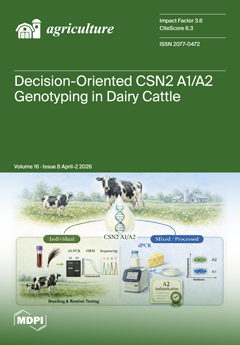
CSN2 A1/A2 Genotyping in Dairy Cattle: A Decision-Oriented Review of Molecular Methods and Practical Applications
by Lilla Sándorová, Ferenc Pajor, István Egerszegi, Ákos Bodnár, Szilárd Bodó and Viktor Stéger
Agriculture 2026, 16(8), 822; https://doi.org/10.3390/agriculture16080822 - 8 Apr 2026
Abstract
This study presents a structured narrative review integrating methodological and decision-oriented perspectives. Milk proteins, particularly β-casein, have attracted increasing scientific and commercial attention due to their genetic variability and role in dairy production and product differentiation. Among β-casein variants, the A1 and A2 [...] Read more.
This study presents a structured narrative review integrating methodological and decision-oriented perspectives. Milk proteins, particularly β-casein, have attracted increasing scientific and commercial attention due to their genetic variability and role in dairy production and product differentiation. Among β-casein variants, the A1 and A2 alleles of the CSN2 gene are of particular relevance, as their single-nucleotide difference has influenced breeding strategies and the expansion of A2-oriented dairy markets. Although multiple validated molecular genotyping approaches are available for CSN2 A1/A2 discrimination, guidance on their context-appropriate deployment in agricultural systems remains largely technique-centric. The present framework integrates analytical performance, sample complexity, and operational constraints to support the selection of fit-for-purpose methods across breeding, diagnostic, and dairy authentication contexts. Classical and advanced approaches, including polymerase chain reaction–restriction fragment length polymorphism (PCR-RFLP), allele-specific polymerase chain reaction (AS-PCR) and amplification refractory mutation system PCR (ARMS-PCR), high-resolution melting (HRM) analysis, sequencing-based methods, single nucleotide polymorphism (SNP) arrays, and digital polymerase chain reaction (dPCR), are comparatively evaluated not only in terms of sensitivity and throughput but also with respect to scalability, reproducibility, and decision risk. This framework provides a practical decision-support tool for aligning genotyping strategies with application-specific risk profiles, thereby improving reliability, transparency, and regulatory compliance in modern dairy systems. Full article
(This article belongs to the Section Farm Animal Production)
Show Figures

Figure 1

17 pages, 4100 KB  
Article
Transformation Characteristics of Organic Carbon at Different Molecular Weight Fractions During Food Waste Composting
by Lishi Tang, Shuang Tang, Mingxiao Li, Chengze Yu, Jiaqi Hou and Chunming Hu
Agriculture 2026, 16(8), 821; https://doi.org/10.3390/agriculture16080821 - 8 Apr 2026
Abstract
Food waste is commonly valorized through aerobic composting, yet the responses of water-soluble organic carbon (WSOC) across molecular-weight (MW) fractions remain insufficiently resolved. This study aimed to quantify how distinct composting strategies regulate WSOC MW distribution and compositional evolution and identify the key [...] Read more.
Food waste is commonly valorized through aerobic composting, yet the responses of water-soluble organic carbon (WSOC) across molecular-weight (MW) fractions remain insufficiently resolved. This study aimed to quantify how distinct composting strategies regulate WSOC MW distribution and compositional evolution and identify the key physicochemical drivers. Food waste was treated by 30-day conventional composting (CK), 15-day phased inoculation (JJ; 2% (w/w) antioxidative consortium dominated by Bacillus/Pseudomonas followed by 2% (w/w) thermophilic cellulolytic consortium enriched in Geobacillus/Paenibacillus when the temperature reached 50 °C), and 24-h rapid thermophilic composting (RC; 2% (w/w) inoculation with a 24-h moist-heat pretreatment). RC yielded a small molecular weight organic carbon (SMOC)-rich product with low aromaticity, with MW < 5 kDa accounting for 68.21% (MW < 500 Da: 28.50%). JJ preferentially enriched more oxidized, fulvic-like/carboxyl-rich organics, increasing the fulvic-like contribution from 15.97% to 35.40% and raising the HMOC/SMOC to 2.72:1. CK showed the strongest humification, with MW > 5 kDa reaching 65.56% and humic-like Region V increasing from 26.25% to 66.36%. pH was the primary predictor of MW (day 6: CK 3.9; JJ 4.9; final ~8.8), while temperature jointly governed humic-like formation in RC. Full article
(This article belongs to the Section Agricultural Soils)
Show Figures

Figure 1

Previous Issue
Back to TopTop