


Abstract
Seed viability fundamentally determines crop establishment, stress resilience, and yield stability in pepper (Capsicum annuum L.), yet conventional assessment remains destructive, labor-intensive, and poorly scalable, while existing spectral learning approaches largely lack physiological interpretability, limiting their reliability for industrial seed quality management. Here, we present ViaNet, a lightweight, interpretable deep hyperspectral classification framework for 1038 naturally aged pepper seeds labeled via standardized 14-day germination tests. ROI-averaged hyperspectral reflectance vectors are modeled as a binary classification task, and ViaNet integrates Successive Projections Algorithm (SPA)-based wavelength sparsification with Efficient Channel Attention (ECA)-driven spectral weighting within a compact 1D-CNN architecture, enabling physiologically grounded feature learning under strict computational constraints. The model achieves recall for germinable seeds (79.75%) and outperforms classical machine learning methods. In addition, ViaNet consistently highlights reproducible spectral bands associated with natural-aging-related biochemical changes as reported in the literature (e.g., carotenoid-related absorption features in the near-UV region). By coupling spectral feature selection with attention-guided wavelength focusing, ViaNet establishes a closed analytical chain from spectral compression to physiologically interpretable inference. This framework balances predictive accuracy, interpretability, and deployability and provides a scalable, non-destructive, and biologically informed paradigm for hyperspectral seed viability assessment.
1. Introduction
Chili pepper (Capsicum annuum L.) is a globally important vegetable and cash crop, and the physiological quality of its seeds plays a decisive role in seedling uniformity, stress resilience, and long-term yield stability [1]. High-vigor seeds not only ensure rapid and robust emergence but also underpin the modernization of the seed industry, where reliable, high-throughput quality assessment has become indispensable [2,3]. Despite this central importance, accurate evaluation of pepper seed viability remains challenging. The minute size of seeds and their highly homogeneous external morphology render conventional, experience-dependent inspection inherently subjective, inefficient, and poorly scalable, falling short of the growing demand for standardized and non-destructive evaluation in industrial seed systems [4]. Collectively, these constraints expose a fundamental mismatch between the biological significance of seed vigor and the methodological capacity of existing assessment paradigms, motivating the development of rapid, objective, and scalable viability-detection technologies.
Against this backdrop, optical imaging and spectral sensing technologies have emerged as powerful alternatives for non-destructive seed quality assessment. Among them, hyperspectral imaging (HSI) has demonstrated particular promise in capturing subtle physicochemical signatures associated with seed vigor [5,6]. A wide range of chemometric, machine learning, and ensemble-learning approaches have achieved encouraging results across multiple crops—including soybean, peanut, corn, and pepper—often reporting classification accuracies exceeding 90% [3,7,8]. Complementary modalities such as Fourier near-infrared (NIR) spectroscopy, Raman spectroscopy, multispectral imaging, and X-ray analysis further illustrate the potential of multi-modal sensing for seed viability evaluation [1,9,10].
Recent advances in deep learning [11,12], spanning uni-modal [13,14,15,16] and multi-modal learning paradigms [17,18,19,20,21,22], have shown remarkable capacity for modeling complex, high-dimensional, and heterogeneous data [23,24,25,26,27,28]. These developments provide a strong methodological foundation for hyperspectral seed analysis [29]. However, existing methods face a series of critical limitations when applied to the detection of chili seed viability. First, at the model design level, there is a prevalent decoupling between feature selection and attention-based deep learning. Traditional chemometric methods (e.g., PLS-DA and SVM) heavily rely on manual feature engineering and struggle to capture the nonlinear structure of hyperspectral signals [1,30,31,32]. Although deep learning models, particularly convolutional neural networks (CNNs), can automatically extract features [33,34] and have achieved impressive accuracies in seed classification [35,36], they often lack intrinsic interpretability and treat feature selection as external to learning. Critically, most approaches treat band selection (e.g., using CARS and SPA) as a static preprocessing step [32] or rely on post hoc explanation tools (e.g., SHAP and Grad-CAM) [37,38]. This fails to achieve a synergistic, end-to-end optimization where wavelength selection dynamically informs and is refined by the attention mechanism during model training, preventing the model from consistently focusing on the most physiologically informative spectral regions.
Second, at the architectural efficiency level, lightweight attention modules (e.g., ECA-Net) operate on full spectra without inherent wavelength selection, making them susceptible to spectral redundancy [39]. In contrast, sophisticated spectral modeling frameworks (e.g., SpectralFormer) achieve selectivity through complexity, incurring costs often prohibitive for deployment on portable, field-ready devices [40]. Third, and most critically, many studies prioritize predictive accuracy, but neglect to rigorously link learned spectral features to underlying biological processes such as seed aging metabolism, limiting biological reliability [1,3,4,41]. Furthermore, the widespread use of artificially accelerated aging protocols for the construction of datasets [36,42] introduces physiological artifacts that differ from natural aging trajectories [43,44], jeopardizing the generalizability of the model to real-world agricultural scenarios.
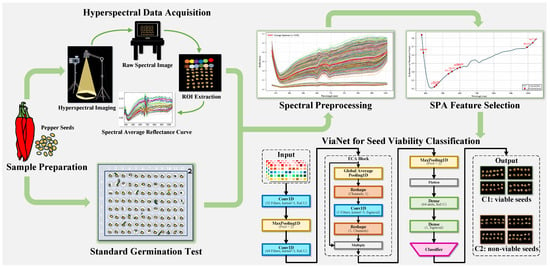
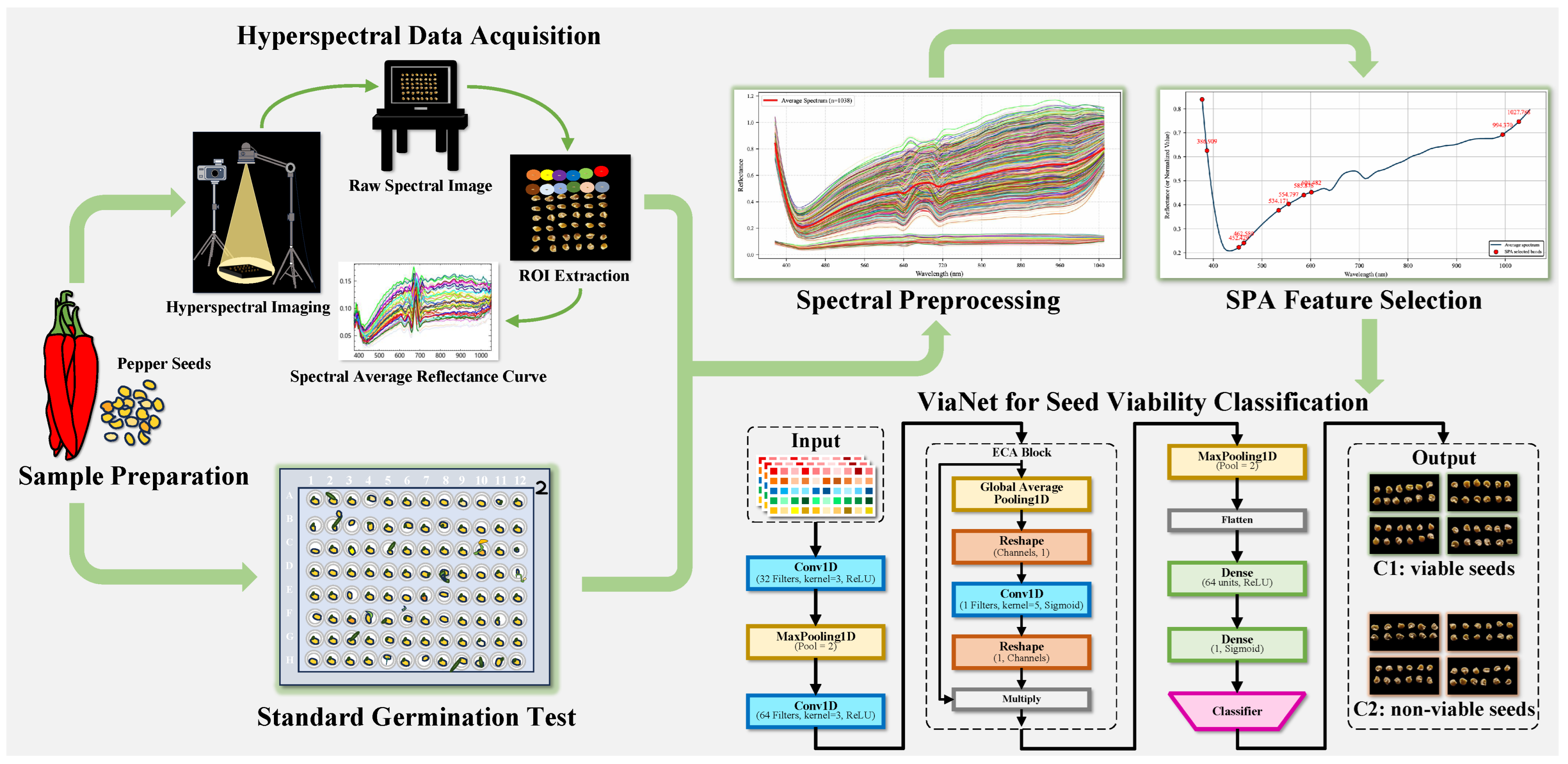
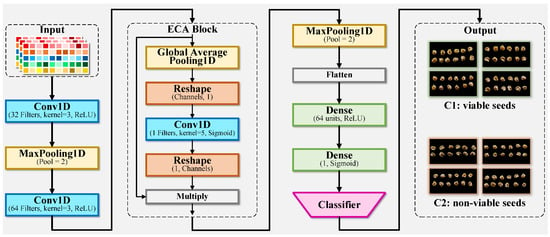
To simultaneously address these intertwined challenges of model design inefficiency, architectural bulk, and poor interpretability grounded in real-world physiology, this study proposes a novel deep learning framework named ViaNet. We aim to design a lightweight and interpretable framework for a rapid assessment of chili seed viability based on hyperspectral signatures. Viability prediction is formulated as a binary classification task distinguishing viable from non-viable seeds. To ensure biological fidelity, we construct a benchmark dataset comprising hyperspectral images of naturally aged chili seeds, with viability labels determined through standardized germination tests. The core innovation of ViaNet is a compact 1D-CNN architecture that features the principled coupling of the Successive Projections Algorithm (SPA) [45] for characteristic wavelength selection with an Efficient Channel Attention (ECA) module [39]. This SPA-ECA synergy enables the model to start with a physiologically informed, sparse spectral input and then dynamically amplify the importance of relevant spectral channels during training. The result is a computationally efficient model whose attention is explicitly guided towards spectral regions associated with biochemical degradation, thereby enhancing both performance and interpretability. The overall workflow is illustrated in Figure 1.
Figure 1.
Schematic diagram of our workflow. Colored curves represent average spectral reflectance of individual seed samples. Colored dots indicate representative ROI regions of individual seeds. Green arrows indicate data flow direction. Dashed boxes enclose key functional modules of ViaNet. Blue: Conv1D layers; Yellow: MaxPooling1D layers; Orange: Reshape operations; Green: Dense layers; Pink: classifier. Gray boxes indicate element-wise operations (Multiply, Flatten). C1: viable seeds; C2: non-viable seeds.
The main contributions of this work are threefold:
- An Ultra-Lightweight ViaNet for Field Deployment. Designed for SPA-refined spectral input, ViaNet achieves a recall of 79.75% on 1038 naturally aged pepper seed samples while maintaining an ultra-compact model footprint, enabling deployment on portable low-power devices for on-site seed viability screening.
- Physiologically Grounded Spectral Indicators. ViaNet identifies reproducible wavelength regions via the SPA–ECA mechanism that align with spectral ranges previously reported to be sensitive to seed aging processes. These findings enhance model interpretability by narrowing attention to physiologically relevant spectral domains while avoiding direct biochemical quantification.
- Robust Viability Assessment Under Natural Aging. Trained exclusively on naturally aged seeds, ViaNet better reflects real-world storage dynamics, enhancing ecological validity and agricultural applicability.
The paper is organized as follows: the experimental materials, data preprocessing procedures, and proposed method are described in Section 2. The experimental results are presented in Section 3. Section 4 discusses the main findings, limitations, and future directions. The conclusions are drawn in Section 5.
2. Materials and Methods
2.1. Experimental Materials
Naturally aged seeds of the pepper cultivar 21HL11 (research-grade; harvested during the 2022 growing season) were used as the experimental material (n = 1038). Seeds were stored in darkness in brown paper bags for 24 months (May 2022–May 2024) under controlled ambient conditions (25 ± 2 °C; 40–50% relative humidity). Before data collection, seeds exhibiting physical damage or mold contamination were removed. To equilibrate moisture content, seeds were dried at 37 °C for 24 h—an established pre-treatment temperature that avoids thermal damage to seed tissues [46].
2.1.1. Hyperspectral Data Acquisition
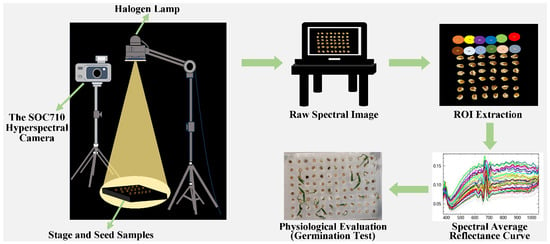
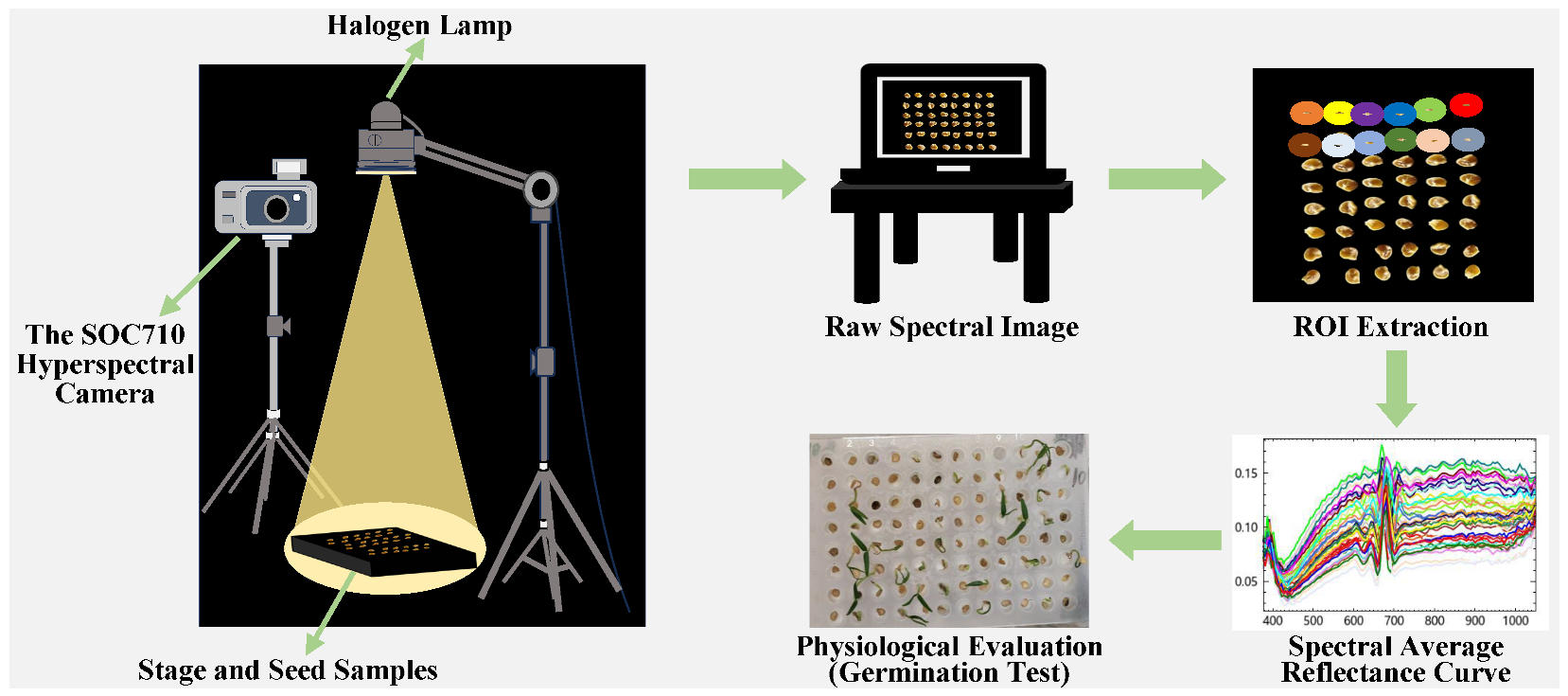
As shown in Figure 2, hyperspectral reflectance data were acquired using an SOC710-VP system (Surface Optics Corporation, San Diego, CA, USA), comprising a hyperspectral camera equipped with a variable-focal-length C-mount lens, a 150 W tungsten–halogen light source, a motorized translation stage, and a dedicated analysis workstation. The system captured 128 spectral bands spanning 376.9–1050.16 nm with a spectral resolution of 4.7 nm.
Figure 2.
Schematic diagram of the hyperspectral data acquisition of pepper seeds. Visual format same as Figure 1.
Data acquisition was performed in a fully light-shielded environment to eliminate ambient illumination. The halogen lamp was mounted vertically 30 cm above the sample surface to ensure uniform irradiance. For each scan, 48 seeds were evenly distributed on the stage with sufficient spacing to reduce cross-reflected light. The raw hyperspectral cube was processed using the system’s proprietary software, which applied dark-current subtraction and gray reference correction. Reflectance was computed as:
where denotes the uncorrected spectral signal, the dark current, and the signal from a calibrated gray reference panel. For each individual seed, a region of interest (ROI) corresponding to the entire seed area was manually delineated to exclude background pixels. The spectral reflectance values of all pixels within the ROI were averaged at each wavelength, yielding a representative one-dimensional reflectance spectrum for each seed.
To ensure strict one-to-one correspondence between spectral measurements and germination outcomes, all seeds were positioned and indexed using a 96-well plate during the viability test. This procedure enabled precise alignment between hyperspectral data and physiological labels. The resulting dataset was organized as a sample-by-band matrix, with wavelengths in the first row, sample identifiers in the first column, and binary viability labels appended for subsequent modeling.
2.1.2. Physiological Evaluation and Data Annotation
To translate raw spectral measurements into biologically meaningful labels, we anchored our annotation process in the internationally standardized germination assay prescribed by ISTA for pepper seeds [47]. After hyperspectral acquisition, every seed entered a 14-day physiological evaluation—a standardized germination test—conducted on moistened paper under tightly controlled conditions (30 °C, 50 ± 5% relative humidity). During this period, seed viability was physiologically determined based on radicle emergence: seeds with radicle extension ≥ were classified as viable, while seeds exhibiting delayed or borderline germination (e.g., radicle length < or visible initiation without reaching the threshold) were consistently categorized as non-viable to ensure a clear binary label set. In total, 539 seeds were physiologically validated as viable, while 499 were not, yielding a carefully curated spectral-viability dataset that grounds our modeling efforts in direct biological evidence.
2.2. Spectral Preprocessing and Feature Selection
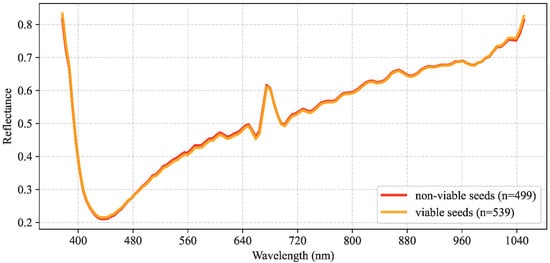
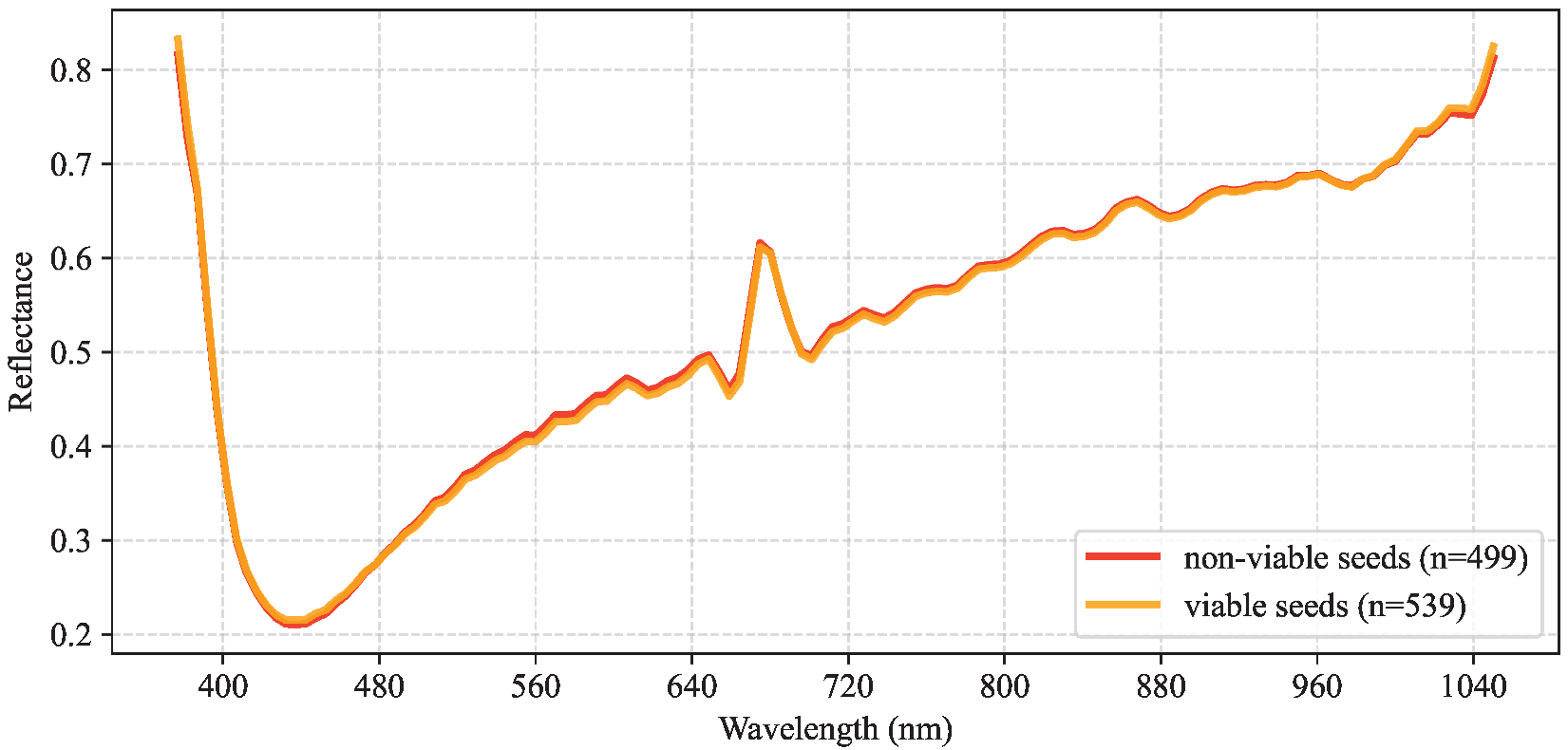
The raw spectral reflectance curves of pepper seeds are shown in Figure 3. Distinct differences between viable and non-viable seeds can be observed across multiple bands, primarily within 400–460 nm, 530–680 nm, and 740–1000 nm. These bands are commonly associated with pigment absorption characteristics and variations in seed physiological status. However, hyperspectral measurements are susceptible to non-target interferences, including instrumental noise, sample scattering effects, and baseline drift [2], which can amplify spectral fluctuations, obscure subtle absorption features, and increase data redundancy, thereby hindering subsequent feature extraction and classification modeling.
Figure 3.
Average spectral curves of viable and non-viable pepper seeds.
To suppress noise while preserving informative spectral features, a two-stage analytical workflow consisting of “spectral preprocessing → feature selection” was adopted. Savitzky–Golay (SG) smoothing [48] was first applied to the raw spectra. Local least-squares polynomial fitting within a sliding window effectively attenuated high-frequency noise while maintaining the intrinsic morphological characteristics of spectral signals, including peak positions, intensities, and widths.
Subsequently, the SPA was employed for spectral feature selection to reduce multicollinearity among wavelength variables. SPA is a forward variable selection method that progressively constructs a wavelength subset based on a geometric projection criterion. At each iteration, candidate wavelength variables are projected onto the orthogonal subspace spanned by previously selected variables, and the wavelength with the maximum projection amplitude is preferentially chosen, effectively reducing inter-band multicollinearity [45].
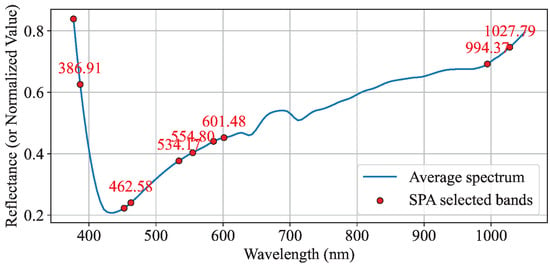
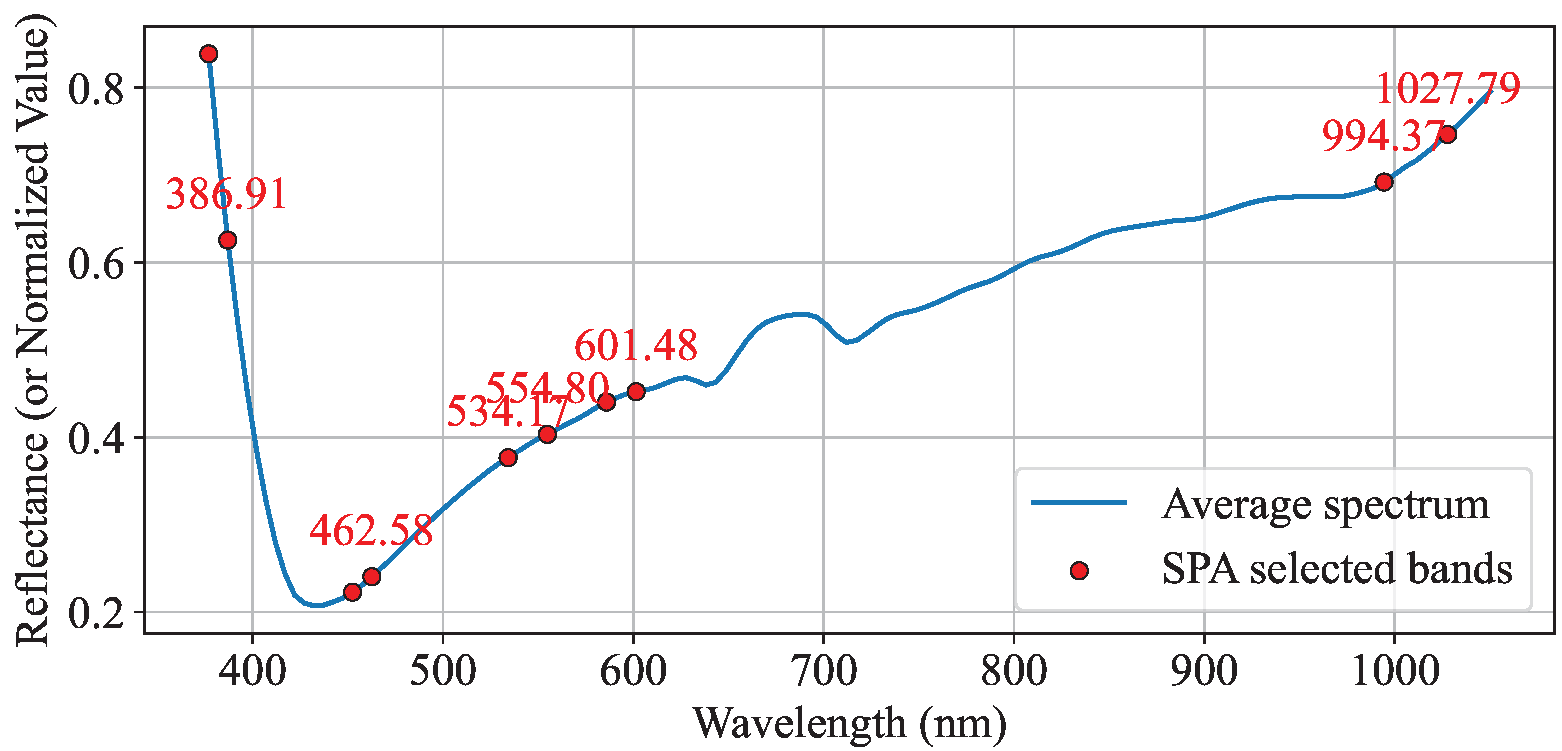
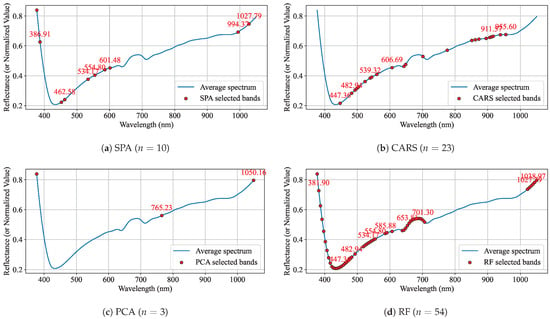
To objectively determine the optimal number of bands, the root mean square error of cross-validation (RMSECV) derived from a Partial Least Squares (PLS) [49] regression model was used as the evaluation criterion. Here, PLS served solely as an error-evaluation tool to guide feature selection rather than as a classification model. The selection process was terminated when the addition bands no longer significantly reduced RMSECV, producing a compact and stable subset of 10 representative bands from the original 128 variables (Figure 4).
Figure 4.
SPA-selected spectral bands. All selected wavelengths are fully retained on the spectral curve, while numerical labels are provided only for representative bands associated with seed physiological activity. In regions where wavelength distribution is dense or highly redundant, numerical annotations are intentionally omitted to enhance overall image clarity without compromising the integrity of the feature selection results.
To prevent information leakage and ensure fair evaluation, all feature selection methods were applied exclusively to the training set after data partitioning. The selected bands were subsequently fixed and applied to the validation and test sets without further optimization. Internal cross-validation within the training set was used only for feature subset evaluation, and no information from the validation or test sets was involved in the feature selection process. These selected bands were distributed across several physiologically relevant spectral regions, including the blue-violet, green, yellow-orange, and NIR regions, which are closely associated with deterioration of viability mechanisms such as pigment degradation, structural weakening of seed tissues, and metabolic changes [3,50].
2.3. The Proposed Classification Model: ViaNet
2.3.1. Overview
To achieve rapid, resource-efficient, and biologically robust viability classification, we developed ViaNet, a lightweight 1D convolutional neural architecture tailored to the spectral characteristics of pepper seeds. Prior work has demonstrated that 1D-CNNs effectively capture local spectral motifs associated with seed composition and physiological status. Building on this foundation, ViaNet integrates efficient spectral encoding with selective channel attention to maximize informative signal utilization while constraining computational burden.
The original hyperspectral cube (128 bands) was reduced using SPA, which yielded a 10-dimensional set of minimally collinear wavelengths spanning 381.9–1044.6 nm. Each sample was therefore represented as a feature vector. This representation preserved the dominant spectral variation while facilitating memory- and computation-efficient processing. As shown in the Results section, ViaNet maintained high predictive stability under this compact representation, underscoring the adequacy of the extracted features.
2.3.2. Network Architecture
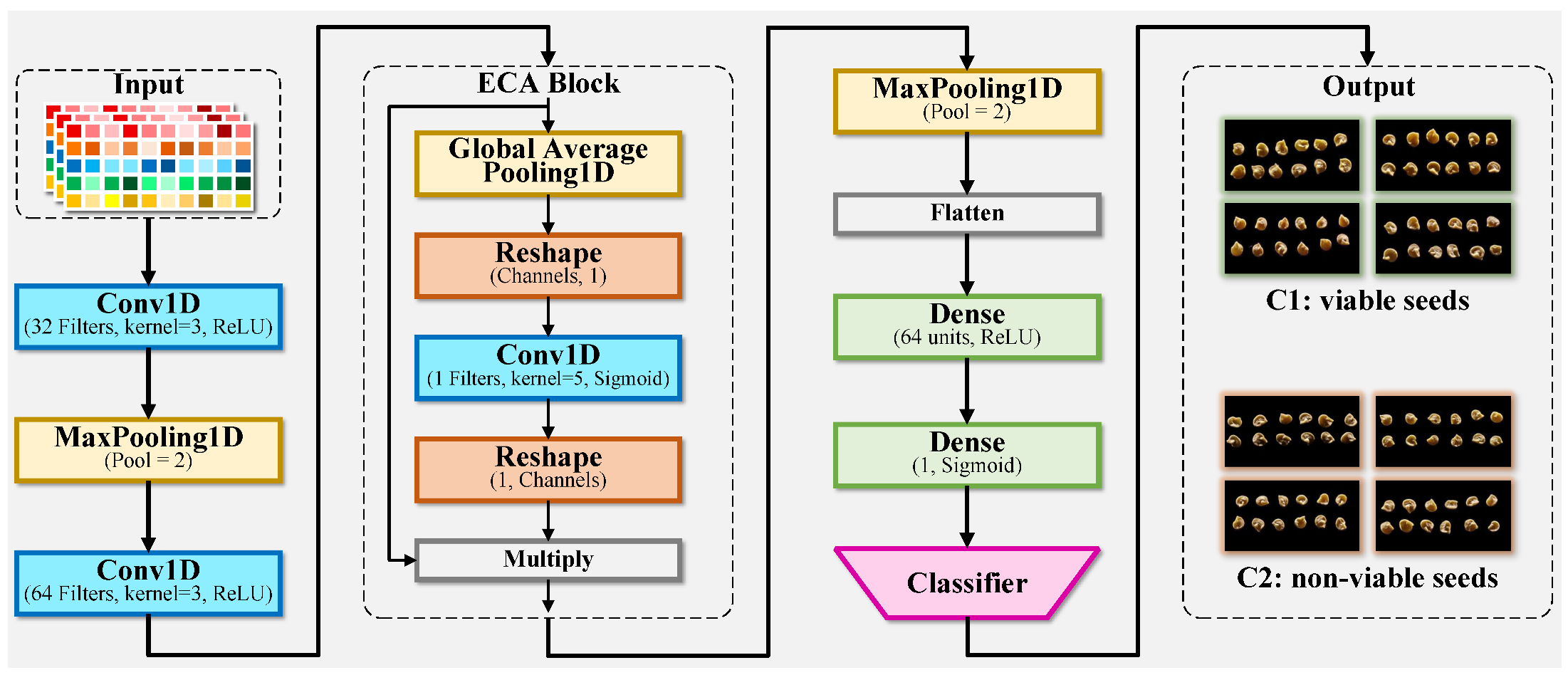
The architecture of ViaNet is shown in Figure 5. The model operates directly on the spectral sequence, which is first processed by two convolution-pooling blocks designed to extract multi-scale spectral patterns and suppress redundant variation. The first convolutional layer employs 32 kernels of size , followed by 64 kernels of the same size in the second layer. Both stages use ReLU activations and L2 kernel regularization to enforce parameter smoothness and mitigate overfitting. Max-pooling () further condenses the spectral structure into compact feature maps.
Figure 5.
The architecture of the proposed ViaNet. Visual format same as Figure 1.
To refine feature weighting based on global spectral context, an ECA module is inserted after the second convolutional block. Following global average pooling, each channel is summarized into a scalar descriptor:
where denotes the activation at spectral position i and channel c. A 1D convolution with kernel size is applied to g to capture local inter-channel interactions:
The resulting attention vector modulates the convolutional output via element-wise multiplication:
thereby increasing the influence of channels that carry strong viability signatures while suppressing spectrally uninformative responses. The lightweight configuration of ECA maintains computational efficiency while providing measurable gains in model stability.
The attention-enhanced feature representation is subsequently max-pooled, flattened, and passed through a fully connected layer with 64 ReLU-activated units and a dropout rate of 0.15. Finally, a sigmoid neuron outputs the probability of seed viability. This compact architecture enables fast inference and mitigates overfitting, making it suitable for real-time, resource-constrained seed quality assessment.
3. Experimental Results and Analysis
3.1. Evaluation Metrics
To comprehensively evaluate model performance, four complementary metrics were adopted: accuracy, recall, F1-score, and Cohen’s Kappa. Specifically, accuracy quantifies the overall proportion of correctly classified samples; recall emphasizes the model’s ability to correctly identify viable seeds, which is critical for practical seed quality assessment; the F1-score balances precision and recall to offer a holistic measure of classification reliability; and Cohen’s Kappa further accounts for random agreement, providing a conservative estimate of model consistency beyond chance-level performance. The metrics are defined as follws:
where and are the observed and expected agreements under random classification.
All evaluations were independently repeated for 10 runs using different random seeds, and results are reported as mean ± standard deviation (mean ± std for short). Identical evaluation protocols were applied across all experiments to ensure statistical consistency and fair comparison.
3.2. Experimental Setup and Model Training
To ensure a rigorous and reproducible evaluation under the aforementioned metrics, all experiments were conducted under a unified and controlled experimental protocol. The dataset was partitioned into training, validation, and test sets using stratified sampling with a ratio of 0.7:0.15:0.15, thereby preserving class distributions across splits. Three input configurations were designed to support different experimental objectives:
- Full-band baseline experiments employed the complete spectral range without feature selection to establish a performance reference.
- Feature selection comparison experiments applied SG smoothing, followed by input restriction to characteristic wavelengths selected by each feature selection method.
- Full ViaNet evaluation and ablation analysis adopted a unified protocol in which models without SPA-based selection used full-band spectra, whereas SPA-related variants operated on the reduced set of characteristic wavelengths identified by SPA.
This design enables a controlled assessment of how spectral compression influences model behavior and performance.
Model training utilized the Adam optimizer with binary cross-entropy loss. The batch size was fixed at 16, and training proceeded for up to 300 epochs with an early stopping strategy (patience = 30) based on validation loss. Through grid search over validation performance, the optimal combination of key hyperparameters was determined: learning rate , dropout rate , and L2 regularization coefficient . This parameter set was applied to all final reported experimental results to ensure a fair comparison.
3.3. Performance Comparison with Baseline Methods
We compared ViaNet with three categories of representative approaches: traditional spectroscopy-based models (PLS-DA, SVM, RF, KNN, XGBoost), general deep learning architectures (1D-CNN, ResNet18, CNN-LSTM, Transformer), and the proposed lightweight ViaNet. Traditional methods have been widely applied in seed viability assessment [33,37,51,52,53,54], yet often exhibit limited capacity to model complex spectral dependencies. In contrast, general deep learning models offer enhanced representational power, but may encounter adaptation challenges when applied to one-dimensional hyperspectral signals. To ensure a fair comparison, all models were evaluated using identical SPA-selected wavelengths and the same data partitions. The results are presented in Table 1. It should be noted that the overall accuracy levels reported in Table 1 reflect a deliberately challenging classification setting based on naturally aged seeds, where performance evaluation emphasizes recall and physiological interpretability in addition to general accuracy.
Table 1.
Performance comparison with baseline methods. Gray shading and italics distinguish model categories (traditional machine learning vs. deep learning). Bold values in all tables indicate the best performance and are retained.
Among traditional machine learning methods, PLS-DA achieved the most balanced performance, with an accuracy of 61.41 ± 2.02% and recall of 60.94 ± 1.96%, indicating that linear discriminant analysis can effectively capture dominant spectral variations when informative wavelengths are provided. SVM achieved a relatively high recall (77.84 ± 1.56%), suggesting a strong sensitivity to viable seeds; however, its limited variation between runs may indicate a reduced flexibility in adapting to data heterogeneity. The ensemble methods, including RF and XGBoost, yielded moderate performance and did not outperform PLS-DA or SVM, implying that nonlinear feature interactions alone offer limited advantage under the current experimental conditions. KNN exhibited the lowest overall performance and higher variability, likely due to its sensitivity to noise and local feature distribution shifts.
To further evaluate model performance from the perspective of screening applications—where both false positives and false negatives have practical implications—we additionally calculated precision and ROC-AUC for these models (Table 2). ViaNet achieved a mean ROC-AUC of 68.32% (±0.58%) (outperforming all comparison models) and a precision of 63.32% (±0.93%), confirming its discriminative ability across classification thresholds and its practical utility in balancing sensitivity and precision for real-world screening deployment.
Table 2.
Precision and ROC-AUC comparison of all models for screening performance evaluation. Visual format same as Table 1.
General deep learning models demonstrated mixed performance trends. ResNet18, originally designed for two-dimensional visual data, showed limited suitability for one-dimensional spectral input. CNN-LSTM and Transformer architectures were able to capture longer-range spectral dependencies but exhibited substantial variability across runs, reflecting challenges in achieving stable optimization under small-sample conditions. By contrast, 1D-CNN achieved relatively balanced performance, benefiting from localized convolutional operations that aligned well with contiguous spectral structures.
Building upon these observations, ViaNet integrates SPA-based wavelength selection with lightweight channel-wise attention to enhance representational efficiency while preserving model stability. This integration enables ViaNet to achieve competitive accuracy (65.45 ± 1.67%) and minimal variance among deep learning models. Although SVM attained comparable accuracy (61.60 ± 1.23%) with higher recall, and PLS-DA demonstrated stable linear discrimination, ViaNet provided a more balanced trade-off between sensitivity (recall: 79.75 ± 8.32%) and robustness. ), which is not available in conventional machine learning baselines.
3.4. Performance Comparison of Spectral Preprocessing Methods
To identify an optimal spectral preprocessing strategy for pepper seed viability recognition, we systematically evaluated a range of commonly used preprocessing techniques within a unified experimental framework. To ensure methodological consistency and isolate the effect of preprocessing, PLS-DA was adopted as a baseline classifier exclusively for this stage and was not involved in subsequent model comparisons.
Specifically, representative preprocessing approaches encompassing SG smoothing, scatter correction (MSC [55] and its variants), derivative enhancement (First Derivative and composite forms), and scale normalization (SNV and Z-score standardization (Z-score)) were examined. Their classification performance under both 5- and 10-fold cross-validation is reported in Table 3, enabling a robust assessment of stability and generalization across validation schemes.
Table 3.
Performance comparison of preprocessing methods under 5-fold and 10-fold cross-validation.
Across all evaluated metrics, SG smoothing consistently outperformed alternative preprocessing strategies. In both cross-validation settings, SG achieved the highest accuracy, recall, F1-score, and Kappa, while also exhibiting comparatively low performance variance. In contrast, composite or derivative-based transformations (e.g., SG + First Derivative, SNV + First Derivative) did not yield additional gains and in some cases introduced greater variability. Similarly, single-step normalization or scatter correction methods (e.g., MSC, SNV, and Z-score) generally underperformed relative to SG, suggesting limited effectiveness in isolating discriminative spectral information for this task.
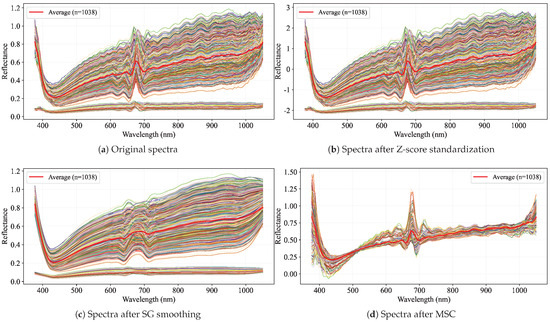
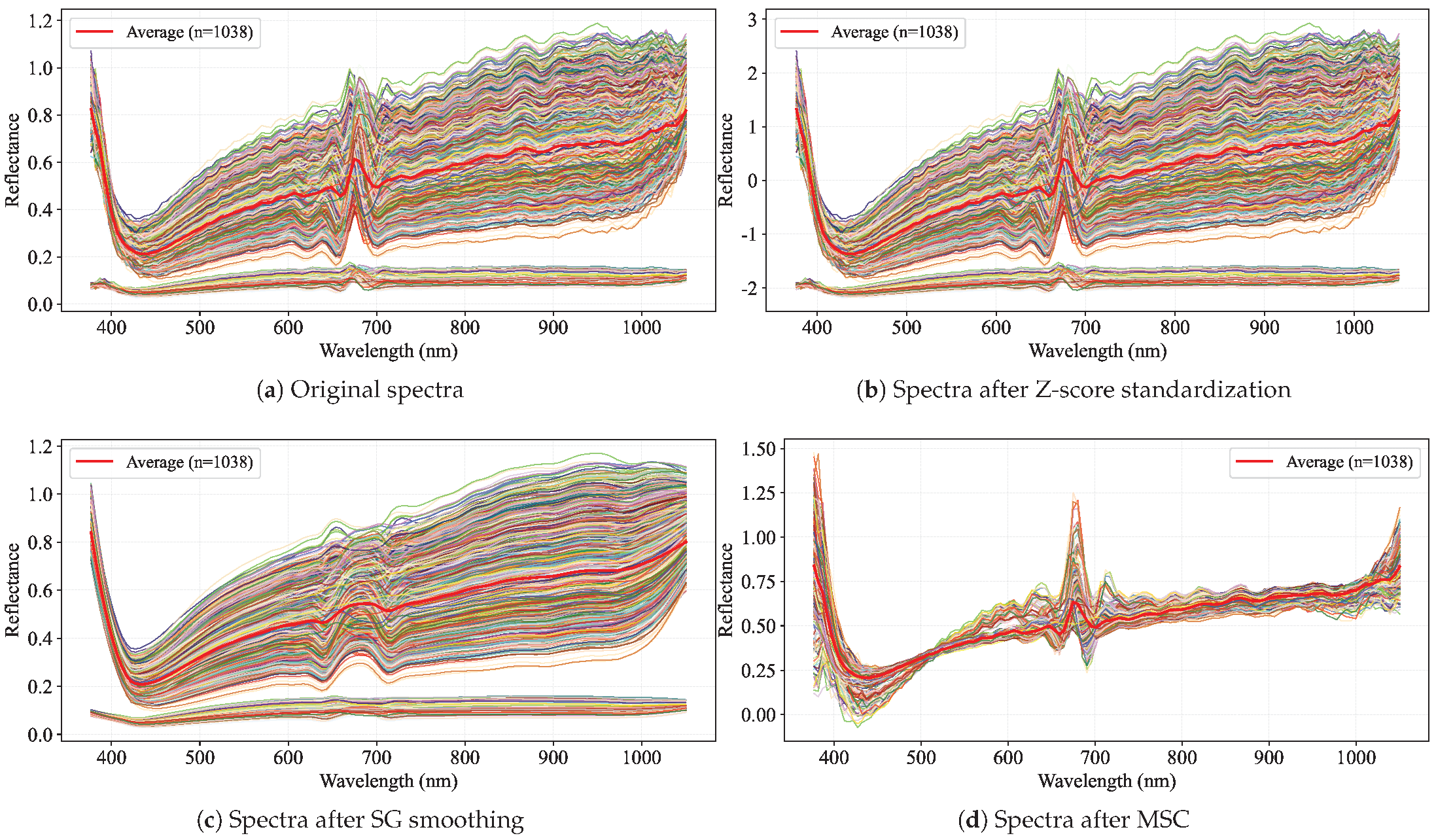
The observed superiority of SG smoothing can be attributed to its ability to suppress high-frequency noise while preserving essential spectral morphology. As illustrated in Figure 6, SG-processed spectra maintain smooth but structurally consistent absorption patterns, effectively reducing random fluctuations without distorting characteristic peaks associated with biochemical constituents. This balance enhances inter-sample consistency and facilitates more stable downstream discrimination, particularly under linear modeling assumptions such as those employed by PLS-DA.
Figure 6.
Effects of spectral preprocessing on curve morphology.
Importantly, these empirical findings support—rather than determine—our methodological choice. SG smoothing is adopted a priori based on established spectroscopic knowledge and its capacity to preserve physically meaningful signal characteristics. The comparative analysis therefore serves to validate the robustness and rationality of this design choice, rather than to retrospectively select an optimal preprocessing strategy. Such stability is especially critical for the selection of the downstream feature- and attention-based modeling, where physiologically interpretable wavelength responses must be consistently maintained. By providing a robust and biologically coherent spectral foundation, SG smoothing enables reliable representation learning and supports the interpretability of subsequent analyses.
3.5. Evaluation of Feature Selection Method
To quantify the contribution of spectral feature selection to pepper seed viability classification, we systematically evaluated the adopted SPA against three widely used alternatives: competitive adaptive reweighted sampling (CARS) [56], random forest-based selection (RF) [57], and principal component analysis (PCA) [58]. All methods were assessed under identical experimental settings, and performance statistics were aggregated over ten independent runs to ensure robustness (Table 4). As summarized in Table 4, SPA consistently achieved the highest accuracy, recall, and F1-score despite retaining only ten spectral bands, indicating that effective hyperspectral feature selection depends more on physiological relevance and feature independence than on feature quantity alone.
Table 4.
Comparison of different feature selection methods.
A joint analysis of classification performance and wavelength distributions (Figure 7) reveals clear distinctions among the evaluated methods. CARS selects 23 wavelengths, some overlapping with the chlorophyll a absorption region (640–680 nm), yet these bands are largely clustered within narrow spectral intervals—particularly 500–600 nm—resulting in limited robustness and increased performance variability. PCA, while achieving strong dimensionality reduction by retaining only three components, discards explicit wavelength correspondence (Figure 7c), leading to the weakest classification performance. RF selects a larger number of wavelengths across the blue (400–500 nm) and green (500–600 nm) regions (Figure 7d), but fails to consistently preserve representative bands associated with key physiological processes.
Figure 7.
Bands selected by SPA and three commonly used feature selection methods. All selected wavelengths are fully retained on the spectral curves, while numerical labels are provided only for representative bands associated with seed physiological activity. In regions where wavelength distribution is dense or highly redundant, numerical annotations are intentionally omitted to enhance overall image clarity without compromising the integrity of the feature selection results.
In contrast, SPA yields a compact yet physiologically grounded spectral representation. As illustrated in Figure 7a, the selected wavelengths are sparsely and systematically distributed across biologically meaningful regions, including carotenoid-related bands (430–470 nm), chlorophyll b absorption (540–570 nm), chlorophyll a absorption (640–680 nm), the red-edge region associated with chlorophyll fluorescence (700–780 nm), and NIR bands linked to water and protein absorption (970–1050 nm) [1,3,50,59]. By retaining only one to two representative wavelengths per functional interval, SPA effectively suppresses multicollinearity while preserving physiologically interpretable spectral information. This structured and biologically coherent selection strategy provides a stable foundation for subsequent ECA-based channel attention modeling, enabling robust representation learning and reducing performance variance across experimental runs.
3.6. Ablation Study
To systematically quantify the contribution of each architectural component in ViaNet, we conducted a comprehensive ablation analysis under the unified experimental protocol described in Section 3.2. The ablation study was organized into two complementary parts:
- Component-level ablation, aimed at disentangling the individual and joint effects of spectral feature compression and channel-wise attention.
- Mechanism-level ablation, designed to examine whether the adopted ECA module was better suited to hyperspectral inputs than alternative attention mechanisms.
This two-stage design enabled a principled assessment of both what components were necessary and why specific architectural choices were effective.
3.6.1. Ablation Study of Architectural Components
The comparative results are summarized in Table 5. The baseline model, which incorporates neither attention mechanisms nor spectral feature compression, achieved a recall of 75.06%. Introducing the ECA module alone (Baseline + ECA) led to only a marginal improvement in recall to 75.19%, corresponding to an absolute gain of 0.13%. This limited improvement indicates that channel-wise attention, when directly applied to full-band hyperspectral input, provides only modest feature recalibration.
Table 5.
Performance comparison of architectural variants in the ablation study.
In contrast, incorporating SPA-based spectral selection (Baseline+SPA) resulted in a substantially larger performance gain, with recall increasing to 78.27% (+3.21%). This improvement highlights the effectiveness of SPA in suppressing spectral redundancy and isolating physiologically informative wavelengths. When both SPA and ECA were jointly integrated (Baseline + ECA + SPA), recall further increased to 79.75%, yielding the highest performance among all architectural variants.
Taken together, these results indicate that SPA generates a sparse, physiologically anchored spectral representation. By reducing input redundancy and emphasizing informative bands, SPA reshapes the feature space in a way that enhances the operation of the subsequent attention module. This combined SPA–attention pipeline forms the core architecture of ViaNet.
3.6.2. Ablation Study of Attention Mechanisms
To further examine the effectiveness of the ECA module within ViaNet, we conducted a comparative ablation study by replacing ECA with two widely used attention mechanisms: Squeeze-and-Excitation (SE) [60] and Convolutional Block Attention Module (CBAM) [61]. All other architectural components, training strategies, and hyperparameter settings were held constant to ensure a fair comparison.
As reported in Table 6, the ECA-based ViaNet achieved the best overall performance across all evaluation metrics. Compared with SE and CBAM, ECA yielded a higher recall and F1-score while exhibiting lower performance variance. This suggests that lightweight channel-wise attention is better aligned with low-dimensional spectral representations, where overly complex attention structures may introduce unnecessary inductive bias and optimization instability.
Table 6.
Comparison of different attention mechanisms in ViaNet.
Although ECA alone provides limited gain compared with SPA (+0.13% vs. +3.21% recall; Table 5), it complements SPA by adaptively reweighting the selected spectral features, further improving recall and robustness under complex spectral variations. These findings confirm that the ECA module strikes an effective balance between representational capacity and architectural simplicity. In the context of SPA-selected features, ECA provides sufficient adaptive reweighting without compromising training stability, making it particularly well suited for hyperspectral learning in resource-constrained or small-sample regimes.
These findings further confirm that the ECA module strikes an effective balance between representational capacity and architectural simplicity. In the context of SPA-selected spectral features, ECA provides sufficient adaptive reweighting without compromising training stability, making it particularly well suited for hyperspectral learning in resource-constrained or small-sample regimes.
3.7. Interpretability of ViaNet
To elucidate whether ViaNet’s channel attention mechanism captures physiologically relevant spectral cues—rather than merely reflecting data-driven correlations—we designed a three-stage interpretability analysis focusing on: (i) attention distribution and physiological alignment; (ii) stability across independent runs; and (iii) feature necessity via single-band exclusion experiments.
Through this complementary analysis, we jointly assess where ViaNet attends spectrally and how consistently such attention patterns are formed under both full-band hyperspectral inputs and sparsity-inducing SPA-selected inputs, thereby providing a principled evaluation of whether the learned attention reflects stable, physiologically grounded spectral representations rather than stochastic or dataset-specific artifacts.
3.7.1. Attention Distribution and Physiological Grounding
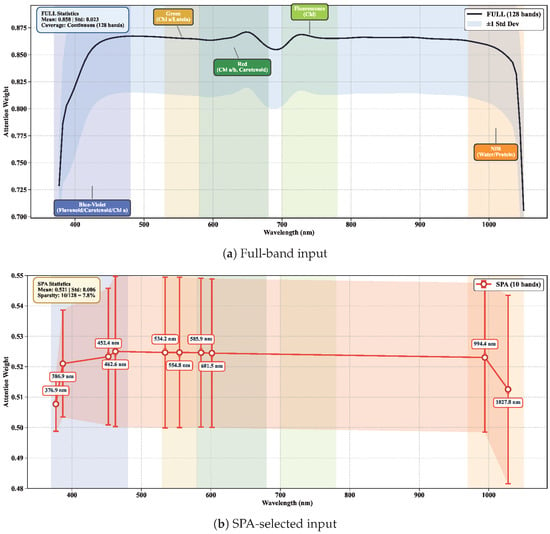
Figure 8 compares the channel attention distributions learned by ViaNet under (a) full-band hyperspectral input and (b) SPA-selected spectral input. Under the full-band condition (Figure 8a), attention is diffuse (mean: 0.858; std: 0.023) with limited contrast between informative and redundant wavelengths. After SPA reduction, attention becomes concentrated in the 380–600 nm visible region, with the highest weights at 462.58 nm (carotenoid absorption, 0.525) and 554.80 nm (chlorophyll reflectance, 0.525). The UV–blue band at 386.91 nm (phenolic/protein absorption) and yellow band at 585.88 nm (carotenoid reflectance) receive moderate but stable attention, while NIR bands (994.37 nm, 1027.79 nm) show lower but consistent weights.
Figure 8.
Attention distribution of ViaNet under (a) full-band input and (b) SPA-selected input. Colored background regions indicate spectral bands and their associated biochemical components: blue-violet (370–480 nm: flavonoid/carotenoid/chlorophyll a), green (530–580 nm: chlorophyll a/lutein), red (580–680 nm: chlorophyll a/b, carotenoid), yellow-green (700–780 nm: fluorescence/chlorophyll), orange (970–1050 nm: NIR/water/protein). In (b), attention is concentrated in the blue–green region (450–600 nm), with the highest weights at 462.58 nm and 554.80 nm.
3.7.2. Stability of Attention Across Independent Runs
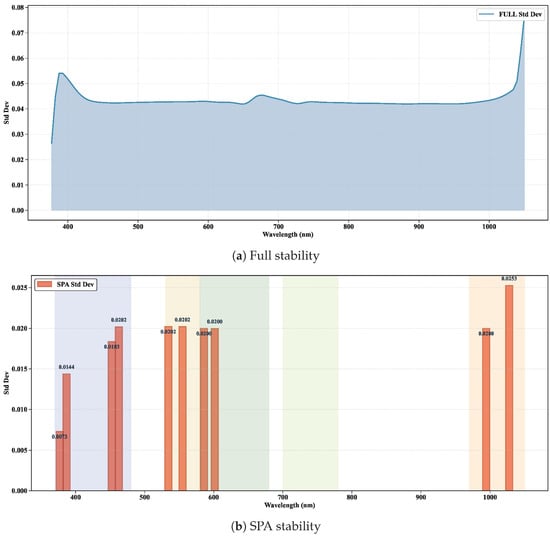
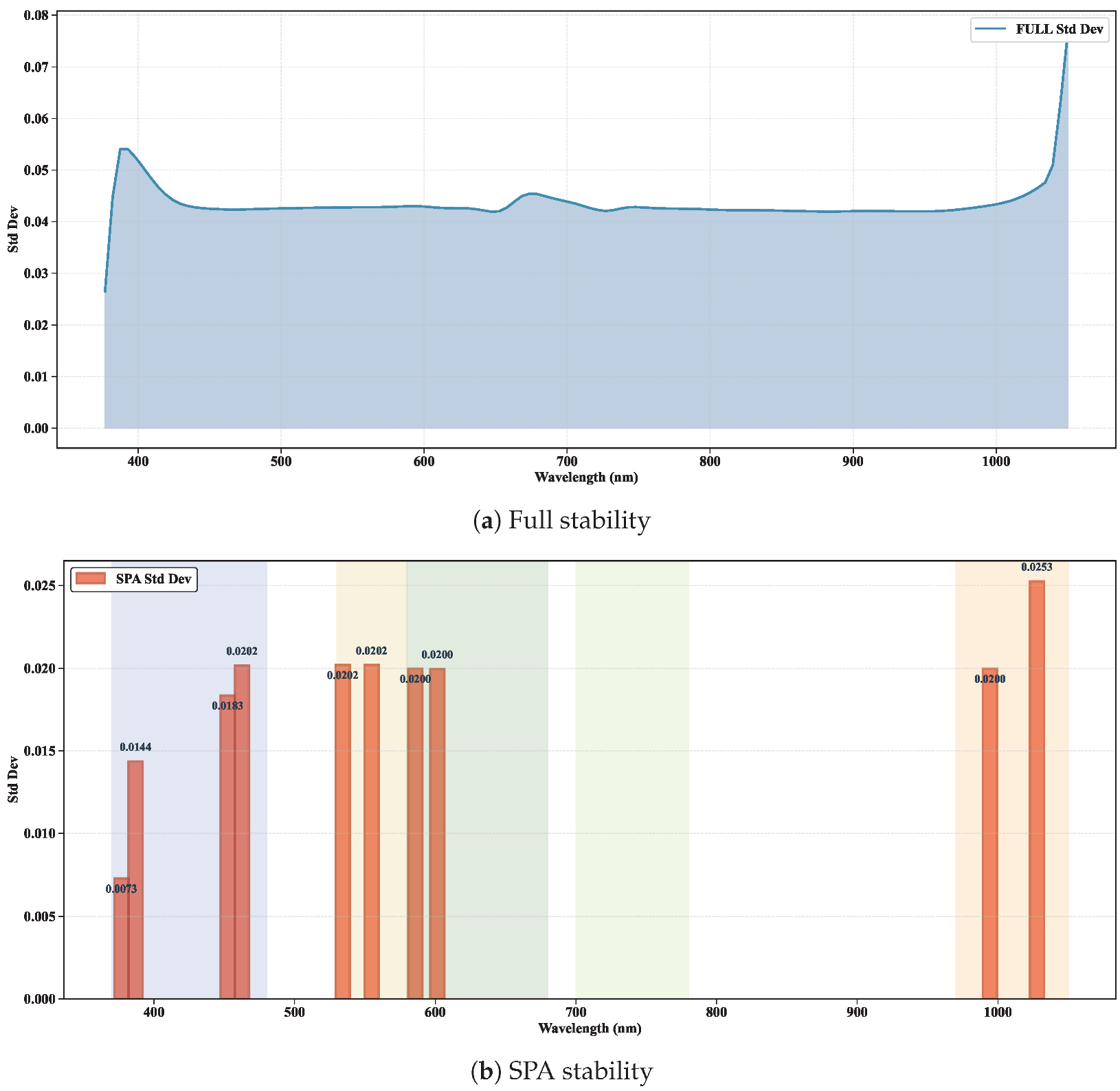
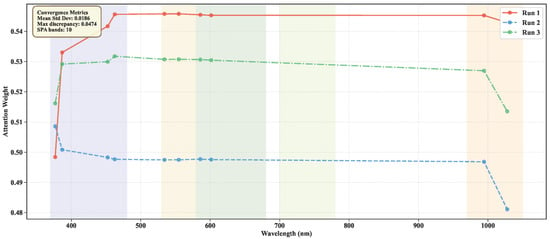
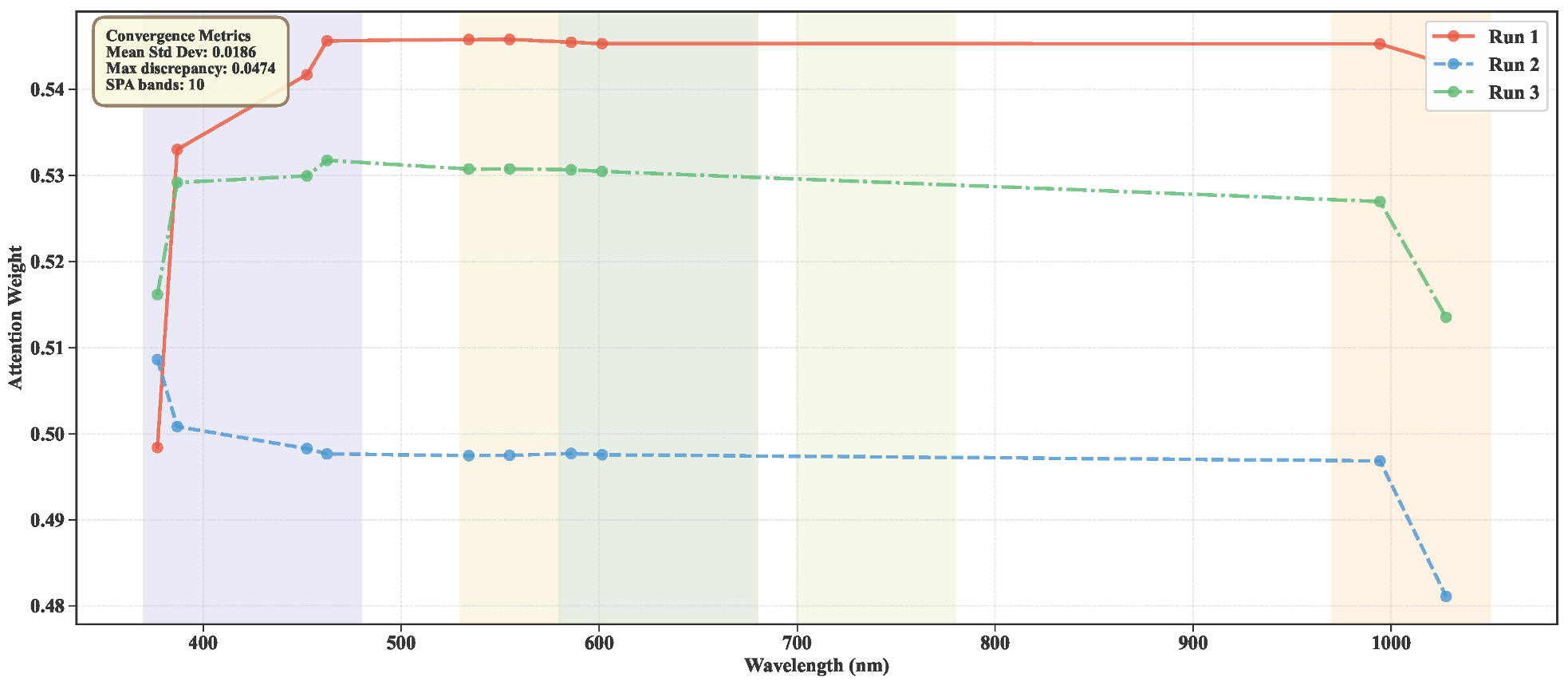
Figure 9 demonstrates that SPA filtering reduces the cross-run standard deviation (mean: 0.006 vs. 0.023 for full-band), particularly in the blue–green region. Convergence metrics across three runs (Figure 10) confirm reliable attention learning (mean std: 0.0186; maximum discrepancy: 0.0474). Table 7 quantifies the top-five wavelengths, with 462.58 nm and 386.91 nm achieving perfect recurrence (3/3). This reproducibility suggests its potential as a stable and discriminative spectral marker for seed viability.
Figure 9.
Attention stability comparison of ViaNet under full-band and SPA-selected spectral inputs.
Figure 10.
Attention stability analysis of ViaNet under SPA-selected spectral input.
Table 7.
Attention statistics of top-five wavelengths among SPA-selected features.
3.7.3. Post Hoc Feature Necessity Analysis via Single-Band Exclusion
While the preceding analyses demonstrate that ViaNet consistently attends to physiologically relevant spectral regions, attention magnitude alone does not necessarily imply the strict indispensability of an individual wavelength, particularly under conditions of strong inter-band collinearity. To further examine whether the SPA-selected features constitute a necessary subset for classification, a post hoc single-band exclusion analysis was conducted.
Specifically, each of the ten SPA-selected wavelengths were individually excluded and ViaNet was retrained under identical experimental settings. The resulting performance variations are summarized in Table 8. Rather than uniformly degrading classification performance, the exclusion results reveal a structured hierarchy of feature necessity.
Table 8.
Performance impact of post hoc single-band exclusion within the SPA-selected feature set.
The exclusion of 452.43 nm caused the most pronounced performance deterioration (accuracy: ; recall: ), demonstrating that this carotenoid-associated wavelength is indispensable for reliable viability discrimination and cannot be compensated for by neighboring bands. This behavior confirms that SPA preserves truly critical spectral information.
In contrast, several wavelengths located in the green and yellow regions (534.17, 554.80, 585.87 and 601.48 nm) exhibited moderate but consistent performance degradation upon exclusion, indicating that these chlorophyll- and carotenoid-related bands function as core stabilizing features. Their partial redundancy suggests shared biochemical sensitivity, yet their collective presence contributes to robust decision boundaries.
Interestingly, the exclusion of multiple bands that received high attention weights— particularly within the UV–blue region (376.90 and 386.91 nm) and at the NIR margin (994.37 nm)—led to marginal improvements in accuracy or recall. This phenomenon reflects inter-band collinearity, whereby attention emphasizes the informativeness of a spectral region rather than the strict indispensability of an individual wavelength. Under such conditions, removal of a correlated feature may reduce redundancy without impairing, and in some cases slightly enhancing, classifier performance.
Importantly, while these attention-derived features provide stable spectral indicators associated with viability, they represent correlational importance within the model’s decision process rather than causal biological evidence. As such, they should be regarded as hypothesis-generating markers for future targeted biochemical validation.
Overall, this post hoc necessity analysis clarifies the complementary roles of SPA and attention within ViaNet. SPA provides a conservative reduction that ensures that no critical information is discarded, while the attention mechanism consistently focuses on physiologically relevant spectral regions. The subsequent exclusion analysis refines this representation into a minimal, classifier-specific sufficient subset, thereby completing an interpretable pipeline from spectral compression to necessity-aware feature validation.
3.8. Model Efficiency and TinyML Deployability
Based on Table 9, we further compare the parameter efficiency and deployment feasibility of representative lightweight convolutional neural network models under stringent TinyML constraints. When operating on SPA-refined spectral input, all evaluated models meet the 250 KB memory limit required for TinyML deployment, underscoring the critical role of spectral feature selection in reducing model footprint and enabling embedded implementation.
Table 9.
Comparison of TinyML compliance and model efficiency.
Under comparable parameter scales, ViaNet demonstrates markedly higher parameter utilization efficiency. Specifically, compared to the 1D-CNN baseline, ViaNet achieves an almost identical model size (41.02 KB vs. 41.25 KB) while improving the efficiency per thousand parameters by nearly two orders of magnitude. This gain indicates that the proposed architectural design enables a denser encoding of discriminative spectral information within a fixed resource budget, rather than merely increasing representational capacity through additional parameters.
Relative to SE-CNN and CBAM-based models that incorporate channel-wise or joint attention mechanisms, ViaNet attains higher parameter efficiency while maintaining a smaller parameter count and reduced model footprint, without introducing the additional training overhead associated with more complex attention modules. Although ViaNet requires a slightly longer training time than the simplest 1D-CNN structure, it remains substantially faster than CBAM-based counterparts, reflecting a favorable trade-off between computational cost and model effectiveness.
In general, under stringent TinyML resource constraints, ViaNet achieves a coordinated optimization of parameter efficiency, model size, and training cost. This balance is particularly important for deploying physiologically interpretable spectral models on resource-limited edge devices, providing a lightweight but expressive foundation for subsequent attention-based spectral analysis and enabling practical on-site seed quality screening in agricultural settings.
Detailed experimental results and statistical analysis are provided in the Supplementary Materials (Tables S1–S8).
4. Discussion
4.1. Spectral Preprocessing and Discriminative Information Retention
Spectral preprocessing plays a critical role in determining whether genuine physiological differences are preserved or inadvertently suppressed. In this study, SG smoothing consistently outperforms MSC [55], despite the latter producing visually more compact spectra. This difference can be attributed to their fundamentally distinct operating principles. SG smoothing preserves the magnitude of the overall reflectance while attenuating high-frequency noise [48], thus retaining subtle but meaningful spectral variations associated with seed aging, such as carotenoid degradation and protein oxidation.
In contrast, MSC enforces spectral alignment by normalizing scattering effects across samples, which can inadvertently remove amplitude-related discriminative cues. As a result, physiologically relevant differences are attenuated, which is why MSC is less able to distinguish despite its apparent improvement in spectral uniformity. These findings underscore that visually smoother or more compact spectra do not necessarily translate into higher discriminative power. Consequently, SG smoothing is adopted in this study to preserve physiologically relevant spectral information for subsequent SPA-ECA analysis.
4.2. SPA-ECA Synergistic Mechanism and Interpretability
The SPA–ECA framework addresses a key limitation of applying channel attention mechanisms directly to full-spectrum hyperspectral data, namely unstable and diffuse attention responses caused by strong spectral redundancy. By reducing the input dimensionality to a compact yet representative set of wavelengths, SPA constrains the spectral search space and enables the ECA module to learn more stable and reproducible attention patterns, as evidenced by the reduced cross-run variability of attention weights after SPA filtering (Figure 9).
The resulting attention distributions exhibit clear physiological coherence at the regional level. Under SPA-selected inputs, ViaNet consistently concentrates attention within the visible blue–green range (approximately 380–600 nm), which is closely associated with pigment-related biochemical processes that govern seed viability. Several wavelengths within this region, such as 462.58 nm and 554.80 nm, show high recurrence in independent runs (Table 7), while additional UV–blue and near-infrared bands provide complementary information related to phenolic compounds and water–protein dynamics [3,9].
Importantly, attention magnitude reflects the relative informativeness of a spectral region rather than the strict indispensability of an individual wavelength. This distinction is clarified by the post hoc single-band exclusion analysis, which shows that some highly attended wavelengths may be optimized under classifier-specific redundancy without undermining the overall physiological focus of the model. The exclusion results further confirm that SPA preserves truly essential information while allowing redundant features to be refined at the model level. It should be noted, however, that attention weights indicate correlational importance within the model’s decision process rather than causal biological evidence. Therefore, the consistently highlighted bands should be regarded as hypothesis-generating spectral markers—pinpointing regions for targeted biochemical validation—rather than definitive physiological proof.
Overall, interpretability in ViaNet emerges from the synergistic interaction between SPA-driven spectral compression and ECA-based attention focusing. SPA provides a conservative, physiologically informed reduction that prevents the loss of critical spectral cues, whereas ECA learns stable attention patterns over the reduced feature space. The subsequent necessity analysis refines this representation into a minimal sufficient subset, forming a coherent and principled interpretability framework.
4.3. Balance Between Performance and Interpretability
As shown in Table 1, ViaNet achieves competitive classification performance among both traditional machine learning and deep learning approaches. In terms of accuracy (65.45%), F1-score (70.38%), and Kappa coefficient (30.08%), ViaNet slightly outperforms classical models such as PLS-DA and SVM, while exhibiting performance comparable to lightweight deep learning architectures, including 1D-CNN and Transformer-based models. These results demonstrate that reliable predictive performance can be attained without resorting to overly complex network designs.
Beyond general metrics, the primary advantage of ViaNet lies in its ability to extract stable and interpretable spectral features. The incorporation of SPA substantially enhances attention robustness, reducing the cross-run standard deviation of ECA weights from approximately 0.010 under full-spectrum input to below 0.008, representing an improvement of about 20% (Figure 9). Furthermore, wavelength-level analysis (Table 7) reveals that only the ultraviolet–blue band at 376.90 nm is consistently highlighted across all three runs, with the NIR band at 1050.16 nm showing recurrent activation in two runs.
In contrast, although traditional models such as PLS-DA and SVM can achieve comparable overall accuracy or recall, they lack mechanisms to assess wavelength-level stability across repeated experiments, limiting their capacity to identify reproducible physiological indicators. Rather than maximizing predictive performance alone, ViaNet emphasizes the extraction of spectrally stable and physiologically interpretable features, aligning model behavior with underlying biological processes. To our knowledge, this study represents one of the early attempts to integrate SPA-based spectral reduction with attention-guided feature stabilization, forming a complete chain from spectral selection to physiological interpretation for hyperspectral seed viability assessment.
Although HSI intrinsically provides both spatial and spectral information, this study deliberately focuses on ROI-averaged spectral features. This design choice prioritizes physiologically relevant signals, enhances robustness across samples, and facilitates lightweight deployment under resource-constrained settings. By constraining the model to operate on compact yet informative spectral representations, the proposed framework aligns practical deployability with interpretability, which is critical for real-world seed viability screening applications. Nevertheless, we acknowledge that this choice inevitably discards spatial cues, and extending ViaNet toward spatial–spectral modeling remains a promising direction for future studies.
The 65% accuracy reflects the exceptionally challenging nature of natural aging discrimination. Unlike artificial aging protocols that generate clearly separable patterns, natural aging produces highly overlapping spectral signatures, rendering this a difficult fine-grained classification problem. Within this context, ViaNet is designed to prioritize high recall for viable seeds (79.75%). For a commercial seed lot with 90% baseline viability, this recall translates to retaining 72% of all viable seeds (0.9 × 0.7975) while reducing the germination testing workload by approximately 35%—transforming an infeasible 100% manual test into a feasible two-stage screening process. Therefore, although absolute accuracy is moderate, ViaNet provides meaningful practical utility as a rapid pre-screening tool rather than a replacement for germination tests.
4.4. Limitations and Future Perspectives
Although this study establishes a robust and interpretable framework for hyperspectral assessment of pepper seed viability, several directions merit further investigation to extend its generality and biological scope.
First, the current analysis focuses on a single pepper cultivar (“21HL11”), which enables controlled evaluation but may partially constrain cross-genotype generalization. The SPA-selected wavelength subset (Figure 8) likely reflects cultivar-specific biochemical characteristics, such as flavonoid composition and seed coat properties. Extending validation to multiple Capsicum genotypes and developmental stages will be essential to assess the stability of the identified spectral signatures and establish their broader applicability across genetic backgrounds.
Second, although identified spectral regions can be associated with physiological processes reported in previous studies, such as carotenoid-related changes and protein-associated absorption, the present study relies on spectral inference rather than direct biochemical quantification [1,3,50,59]. Integrating complementary assays (e.g., HPLC-based pigment profiling or Kjeldahl nitrogen analysis) into future work would enable a more explicit coupling between attention-derived features and underlying physiological states, thus strengthening the mechanistic interpretability of the proposed framework. Consequently, the present findings should be interpreted as hypothesis-generating observations rather than definitive physiological evidence.
Finally, while repeated cross-validation ensures robust performance estimation in the current experimental setting, the relatively limited sample scale restricts statistical power for rare or borderline-viability phenotypes. Expanding the dataset over multiple growing seasons and environmental conditions will be critical to evaluating the stability and generalization of ViaNet under realistic agricultural variability. In addition, the current experiments were conducted under controlled laboratory conditions, and no field-level deployment or portable hardware validation was performed. Although ViaNet is designed to be computationally lightweight and deployment-oriented, its robustness under realistic agricultural environments, including illumination variability and environmental fluctuations, remains to be evaluated; future studies incorporating field trials and embedded-system benchmarking will be necessary to fully assess its practical deployment potential.
Regarding the potential of threshold tuning for performance improvement, it should be noted that the classification threshold was fixed at 0.5 in this study to ensure the comparability of all models. In practical pepper seed viability identification, appropriately lowering the classification threshold (e.g., to 0.3–0.4) could further improve the recall of viable seeds by reducing missed detections. However, this tuning strategy needs to balance the trade-off between recall and precision: an overly low threshold would lead to an unacceptable increase in false positives, which would still cause practical production losses due to misjudgment of non-viable seeds as viable ones. Therefore, the optimal classification threshold in actual application should be determined based on the specific production demand for recall–precision balance.
Together, these directions do not diminish the present findings but instead delineate a clear path toward extending SPA-ECA into a biologically grounded and scalable framework for hyperspectral phenotyping. By bridging data-driven learning with physiological interpretability, the proposed approach provides a foundation for future advances in non-destructive seed quality assessment and broader agricultural sensing applications.
5. Conclusions
This study proposes ViaNet, a lightweight and interpretable deep hyperspectral learning framework for non-destructive assessment of pepper seed viability, and demonstrates its ability to learn stable and physiologically interpretable spectral representations that are consistent with reported seed aging phenomena under natural aging conditions. Based on ROI-averaged reflectance spectra, ViaNet embeds SPA-based wavelength sparsification and ECA-driven spectral weighting within a compact 1D convolutional neural network (1D-CNN) architecture, enabling physiologically constrained feature learning under strict computational limitations. By combining SG smoothing spectral preprocessing with SPA-based wavelength selection, the model consistently focuses on a compact subset of ten informative spectral bands, which are closely associated with key physiological processes related to seed natural aging, including pigment composition, cellular structure, and water–protein status. Within this subset, wavelengths located in the UV–blue and blue–green regions (e.g., around 376.90 nm and 450–500 nm), which are linked to carotenoid- and phenolic-related biochemical changes, repeatedly emerge as physiologically relevant indicators of seed aging.
In an independent test set, ViaNet achieved a recall of 79.75% for germinable seed identification, with performance advantages most pronounced against classical machine learning methods, while maintaining high sensitivity to viable seeds. Cross-run analysis of attention distributions further indicates that the model exhibits consistent and reproducible responses to key spectral regions rather than isolated wavelengths, supporting the physiological plausibility and stability of the learned spectral representations. By jointly considering spectral feature compression, attention-guided wavelength focusing, and post hoc feature necessity analysis, ViaNet establishes a closed analytical pathway from high-dimensional spectral data to mechanistic understanding, achieving a balanced trade-off between predictive performance, interpretability, and deployability. This framework therefore provides a scalable, non-destructive, and biologically faithful paradigm for hyperspectral-based seed viability assessment.
Supplementary Materials
The following supporting information can be downloaded at https://www.mdpi.com/article/10.3390/agriculture16040486/s1, Table S1: Performance comparison with baseline methods; Table S2: Comprehensive performance metrics of architectural variants in the ablation study; Table S3: Raw results of ViaNet (10 independent runs); Table S4: Raw results of 1D-CNN (10 independent runs); Table S5: Raw results of SVM (10 independent runs); Table S6: Statistical comparison between ViaNet and 1D-CNN; Table S7: Statistical comparison between ViaNet and SVM; Table S8: Comparison of 1D-CNN, 1D-CNN ChannelWeight, and ViaNet on SPA-selected features.
Author Contributions
L.Z. (Lei Zhu): Conceptualization, methodology, formal analysis, validation, writing—original draft, writing—review and editing, funding acquisition; Y.Z. (Yeminzi Zhou): methodology, software, validation, formal analysis, investigation, data curation, writing—original draft, visualization; Y.Z. (Yueming Zhu): visualization, data curation; L.Z. (Ling Zou): data curation, funding acquisition; B.L.: resources, validation; S.T.: resources, supervision, project administration, funding acquisition; F.L.: resources, supervision, validation, funding acquisition; F.C.: conceptualization, supervision, validation, writing—review and editing. All authors have read and agreed to the published version of the manuscript.
Funding
This research was supported in part by the National Natural Science Foundation of China under grants 62202163, 62472161, and 62372150; the Yuelu Mountain Laboratory Seed Industry Special Project Grant YLS-2025-ZY04016; the Hunan Provincial Key Research and Development Program under grant 2025QK3002; the Natural Science Foundation of Hunan Province under grant 2022JJ30231; the Scientific Research Project of Hunan Provincial Department of Education under grants 22A0145 and 22B0559; and the China Agriculture Research System of MOF and MARA (CARS-24-A-15).
Institutional Review Board Statement
Not applicable.
Data Availability Statement
The data presented in this study are available on request from the corresponding author due to the proprietary nature of the dataset. The code is available at: https://github.com/NM00120/Vianet.git (accessed on 22 January 2026).
Conflicts of Interest
The authors declare that they have no known competing financial interests or personal relationships that could have appeared to influence the work reported in this paper.
References
- Li, C.; Wang, X.; Meng, Z.; Fan, P.; Cai, J. Pepper Seed Variety Identification Based on Visible/Near Infrared Spectral Technology. Proc. SPIE 2016, 10030, 100302N. [Google Scholar]
- Mondo, V.H.V.; Dias, M.A.N.; Cicero, S.M. Recent Approaches for Bell Pepper Seed Vigor Testing. Acta Scientiarum. Agron. 2014, 36, 483–487. [Google Scholar]
- Mo, C.; Kim, G.; Lee, K.; Kim, M.S.; Cho, B.K.; Lim, J.; Kang, S. Non-Destructive Quality Evaluation of Pepper (Capsicum annuum L.) Seeds Using LED-Induced Hyperspectral Reflectance Imaging. Sensors 2014, 14, 7489–7504. [Google Scholar] [CrossRef] [Scilit]
- Sabanci, K.; Unlersen, M.F.; Akin, A. A Deep Convolutional Neural Network for Pepper Seed Varieties Classification. J. Food Process Eng. 2022, 45, e13960. [Google Scholar] [CrossRef] [Scilit]
- Xia, C.; Yang, S.; Huang, M.; Zhu, Q.; Guo, Y.; Qin, J. Maize Seed Classification Using Hyperspectral Imaging Coupled with Multi-Linear Discriminant Analysis. Infrared Phys. Technol. 2019, 103, 103077. [Google Scholar] [CrossRef] [Scilit]
- Xu, P.; Zhang, Y.; Tan, Q.; Xu, K.; Sun, W.; Xing, J.; Yang, R. Vigor Identification of Maize Seeds by Using Hyperspectral Imaging Combined with Multivariate Data Analysis. Infrared Phys. Technol. 2022, 126, 104361. [Google Scholar] [CrossRef] [Scilit]
- Wang, R.T.; Tan, K.Z.; Li, M.Y.; Gong, Z. Discriminating Soybean Seed Varieties Using Hyperspectral Imaging and Machine Learning. J. Comput. Methods Sci. Eng. 2019, 19, 1001–1015. [Google Scholar] [CrossRef] [Scilit]
- Zou, Z.Y.; Chen, J.; Wu, W.J.; Luo, J.; Long, T.; Wu, Q.; Wang, Q.; Zhen, J.; Zhao, Y.; Wang, Y.; et al. Detection of Peanut Seed Vigor Based on Hyperspectral Imaging and Chemometrics. Front. Plant Sci. 2023, 14, 1127108. [Google Scholar] [CrossRef] [Scilit]
- Seo, Y.W.; Ahn, C.K.; Lee, H.; Park, E.; Mo, C.; Cho, B.K. Non-Destructive Sorting Techniques for Viable Pepper (Capsicum annuum L.) Seeds Using Fourier Transform Near-Infrared and Raman Spectroscopy. J. Biosyst. Eng. 2016, 41, 51–59. [Google Scholar] [CrossRef] [Scilit]
- Rahman, A.; Cho, B.-K. Assessment of seed quality using non-destructive measurement techniques: A review. Seed Sci. Res. 2016, 26, 285–305. [Google Scholar] [CrossRef] [Scilit]
- Kamilaris, A.; Prenafeta-Boldú, F.X. Deep Learning in Agriculture: A Survey. Comput. Electron. Agric. 2018, 147, 70–90. [Google Scholar] [CrossRef] [Scilit]
- LeCun, Y.; Bengio, Y.; Hinton, G. Deep Learning. Nature 2015, 521, 436–444. [Google Scholar] [CrossRef] [Scilit] [PubMed]
- Zhu, L.; Yu, W.; Zhu, X.; Zhang, C.; Li, Y.; Zhang, S. MvHAAN: Multi-View Hierarchical Attention Adversarial Network for Person Re-Identification. World Wide Web 2024, 27, 59. [Google Scholar] [CrossRef] [Scilit]
- Sun, H.; Tan, S.; Luo, Z.; Yin, Y.; Cao, C.; Zhou, K.; Zhu, L. Development of a Lightweight Model for Rice Plant Counting and Localization Using UAV-Captured RGB Imagery. Agriculture 2025, 15, 122. [Google Scholar] [CrossRef] [Scilit]
- He, C.; Peng, Z.; Peng, L.; Liu, Y.; Zhang, C.; Zhu, L.; Zou, L. Chilo Suppressalis Population Dynamics Forecasting by Exponential Smoothing Decomposition and Multi-Stream Network. Agriculture 2025, 15, 2474. [Google Scholar] [CrossRef] [Scilit]
- Yuan, Y.; Chen, L.; Wu, H.; Li, L. Advanced Agricultural Disease Image Recognition Technologies: A Review. Inf. Process. Agric. 2022, 9, 48–59. [Google Scholar] [CrossRef] [Scilit]
- Zhu, L.; Wu, R.; Zhu, X.; Zhang, C.; Wu, L.; Zhang, S.; Li, X. Bi-Direction Label-Guided Semantic Enhancement for Cross-Modal Hashing. IEEE Trans. Circuits Syst. Video Technol. 2025, 35, 3983–3999. [Google Scholar] [CrossRef] [Scilit]
- Shen, Y.; Wang, L.; Jin, Y. AAFormer: A Multi-Modal Transformer Network for Aerial Agricultural Images. In Proceedings of the IEEE/CVF Conference on Computer Vision and Pattern Recognition, New Orleans, LA, USA, 18–24 June 2022; pp. 1705–1711. [Google Scholar]
- Sapkota, R.; Qureshi, R.; Hadi, M.U.; Hassan, S.Z.; Sadak, F.; Shoman, M.; Karkee, M. Multi-Modal LLMs in Agriculture: A Comprehensive Review. In IEEE Transactions on Automation Science and Engineering; IEEE: Piscataway, NJ, USA, 2025. [Google Scholar]
- Zhu, L.; Wu, R.; Liu, D.; Zhang, C.; Wu, L.; Zhang, Y.; Zhang, S. Textual Semantics Enhancement Adversarial Hashing for Cross-Modal Retrieval. Knowl.-Based Syst. 2025, 317, 113303. [Google Scholar] [CrossRef] [Scilit]
- Zhu, L.; Cai, L.; Song, J.; Zhu, X.; Zhang, C.; Zhang, S. MSSPQ: Multiple Semantic Structure-Preserving Quantization for Cross-Modal Retrieval. In Proceedings of the 2022 International Conference on Multimedia Retrieval, Newark, NJ, USA, 27–30 June 2022; pp. 631–638. [Google Scholar]
- Yang, R.; Yan, Y.; Wei, Z.; Wang, F.; Yang, G. Pesti-DGI-Net: A Multi-Modal Deep Learning Architecture Based on Dual Interpretability for Pesticide-Likeness Prediction. Comput. Electron. Agric. 2024, 217, 108660. [Google Scholar] [CrossRef] [Scilit]
- Huang, Y.; Lyu, B.; Gao, T.; Wu, X.; Duan, Y. CornMFN: A Multimodal Fusion Network for Corn Phenology Stage Identification. Smart Agric. Technol. 2025, 12, 101202. [Google Scholar] [CrossRef] [Scilit]
- Zhu, L.; Yuan, Z.; Yi, Z.; Zhang, C.; Wu, L.; Zhang, Y.; Boussaid, F.; Bennamoun, M.; Zhang, S. Information Bottleneck-Guided KNN Contrastive Hashing for Unsupervised Cross-Modal Retrieval. Knowl.-Based Syst. 2025, 329, 114347. [Google Scholar] [CrossRef] [Scilit]
- Lu, J.; Li, J.; Fu, H.; Tang, X.; Liu, Z.; Chen, H.; Ning, X. Deep Learning for Multi-Source Data-Driven Crop Yield Prediction in Northeast China. Agriculture 2024, 14, 794. [Google Scholar] [CrossRef] [Scilit]
- Guo, L.; Gao, Q.; Zhang, M.; Cheng, P.; He, P.; Li, L.; Qi, J. Soil Organic Matter Content Prediction Using Multi-Input Convolutional Neural Network Based on Multi-Source Information Fusion. Agriculture 2025, 15, 1313. [Google Scholar] [CrossRef] [Scilit]
- Xie, F.; Sun, E.; Wang, L.; Wang, G.; Xiao, Q. Rolling Bearing Fault Diagnosis in Agricultural Machinery Based on Multi-Source Locally Adaptive Graph Convolution. Agriculture 2024, 14, 1333. [Google Scholar] [CrossRef] [Scilit]
- Zhu, L.; Zhang, C.; Song, J.; Zhang, S.; Tian, C.; Zhu, X. Deep Multigraph Hierarchical Enhanced Semantic Representation for Cross-Modal Retrieval. IEEE Multimed. 2022, 29, 17–26. [Google Scholar] [CrossRef] [Scilit]
- Feng, L.; Zhu, S.; Liu, F.; He, Y.; Bao, Y.; Zhang, C. Hyperspectral Imaging for Seed Quality and Safety Inspection: A Review. Plant Methods 2019, 15, 91. [Google Scholar] [CrossRef] [Scilit]
- Noble, W.S. What is a support vector machine. Nat. Biotechnol. 2006, 24, 1565–1567. [Google Scholar] [CrossRef] [Scilit] [PubMed]
- Hearst, M.A.; Dumais, S.T.; Osuna, E.; Platt, J.; Scholkopf, B. Support Vector Machines. IEEE Intell. Syst. 1998, 13, 18–28. [Google Scholar] [CrossRef] [Scilit]
- Liu, W.; Luo, B.; Kang, K.; Xia, Y.; Zhang, H. Non-Destructive Detection of Single Corn Seed Vigor Based on Visible/Near-Infrared Spatially Resolved Spectroscopy Combined with Chemometrics. Spectrochim. Acta Part A Mol. Biomol. Spectrosc. 2024, 312, 124089. [Google Scholar] [CrossRef] [Scilit] [PubMed]
- He, K.; Zhang, X.; Ren, S.; Sun, J. Deep Residual Learning for Image Recognition. In Proceedings of the IEEE Conference on Computer Vision and Pattern Recognition, Las Vegas, NV, USA, 27–30 June 2016; pp. 770–778. [Google Scholar]
- Krizhevsky, A.; Sutskever, I.; Hinton, G.E. ImageNet Classification with Deep Convolutional Neural Networks. In Advances in Neural Information Processing Systems; Curran Associates, Inc.: Red Hook, NY, USA, 2012; Volume 25. [Google Scholar]
- Wongchaisuwat, P.; Chakranon, P.; Yinpin, A.; Onwimol, D.; Wonggasem, K. Rapid Maize Seed Vigor Classification Using Deep Learning and Hyperspectral Imaging Techniques. Smart Agric. Technol. 2025, 10, 100820. [Google Scholar] [CrossRef] [Scilit]
- Ding, Z.Y.; Yue, X.J.; Zeng, F.G.; Shi, H.W.; Peng, W.; Xiao, J.Y. Spectral Detection of Maize Seed Vigor Based on Machine Learning and Deep Learning. J. Huazhong Agric. Univ. 2023, 42, 230–240. [Google Scholar]
- Hong, Z.; Zhang, C.; Song, W.; Nie, X.; Ye, H.; He, Y. Application of Hyperspectral Imaging for Identification of Melon Seed Variety Using Deep Learning. Agriculture 2025, 15, 1139. [Google Scholar] [CrossRef] [Scilit]
- Ahmed, M.T.; Villordon, A.; Kamruzzaman, M. Hyperspectral imaging and explainable deep-learning for non-destructive quality prediction of sweetpotato. Postharvest Biol. Technol. 2025, 222, 113379. [Google Scholar] [CrossRef] [Scilit]
- Wang, Q.; Wu, B.; Zhu, P.; Li, P.; Zuo, W.; Hu, Q. ECA-Net: Efficient Channel Attention for Deep Convolutional Neural Networks. In Proceedings of the IEEE/CVF Conference on Computer Vision and Pattern Recognition (CVPR), Seattle, WA, USA, 13–19 June 2020; pp. 11531–11539. [Google Scholar]
- Hong, D.; Han, Z.; Gao, L.; Yao, J.; Gao, B.; Zhang, B.; Chanussot, J. SpectralFormer: Rethinking Hyperspectral Image Classification with Transformers. IEEE Trans. Geosci. Remote Sens. 2022, 60, 1–16. [Google Scholar] [CrossRef] [Scilit]
- Zhu, J.; Li, J.; Plaza, A.; Bioucas-Dias, J.M. Interpretable Hyperspectral Artificial Intelligence: When Non-Convex Modeling Meets Hyperspectral Remote Sensing. IEEE J. Sel. Top. Appl. Earth Observ. Remote Sens. 2023, 16, 1059–1075. [Google Scholar]
- Wang, X.M.; He, X.; Zhang, H.; Song, R.; Mao, P.; Jia, S. Rapid and Non-Destructive Detection of Artificially Aged Alfalfa Seeds Based on Multispectral Imaging Technology. Acta Prataculturae Sin. 2022, 31, 197–208. [Google Scholar]
- Zhang, S.; Zeng, H.; Ji, W.; Yi, K.; Yang, S.; Mao, P.; Wang, Z.; Yu, H.; Li, M. Non-Destructive Testing of Alfalfa Seed Vigor Based on Multispectral Imaging Technology. Sensors 2022, 22, 2760. [Google Scholar] [CrossRef] [Scilit]
- Peng, Y.N.; Zhou, Y.X.; Huang, X.L.; Xian, B.; Chen, C.; Dong, S.; Chen, C.P.; Ren, C.X.; Pei, J.; Chen, J. Detection of Safflower Seed Vigor with Different Natural Aging Times Based on Multispectral Imaging Technology. Seed 2023, 42, 31–37. [Google Scholar]
- Araujo, M.C.U.; Saldanha, T.C.B.; Galvão, R.K.H.; Yoneyama, T.; Chame, H.C.; Visani, V. The Successive Projections Algorithm for Variable Selection in Spectroscopic Multicomponent Analysis. J. Chemom. 2001, 15, 488–496. [Google Scholar] [CrossRef] [Scilit]
- Han, X. Effect of Drying Temperature on the Germination of Line Pepper Seeds. Agric. Eng. Technol. 2016, 36, 17–18. [Google Scholar]
- International Seed Testing Association (ISTA). International Rules for Seed Testing; ISTA: Wallisellen, Switzerland, 2022. [Google Scholar]
- Schulz, H.; Baranska, M. Study on Variable Selection and Calibration Modeling for Analyzing Periclinal Pantanos by FT-IR Spectroscopy. Appl. Spectrosc. 1999, 53, 830–837. [Google Scholar]
- Barker, M.; Rayens, W. Partial least squares for discrimination. J. Chemom. J. Chemom. Soc. 2003, 17, 166–173. [Google Scholar] [CrossRef] [Scilit]
- Amanah, H.Z.; Rahmannisa, Y.F.; Hernanda, R.A.P.; Lee, H.; Nisa, N.H.; Maftukhah, R.; Masithoh, R.E. Support Vector Machine Coupled with Modular Visible-Near Infrared Spectroscopy for Chili (Capsicum annuum) Seed Viability Discrimination. Trends Sci. 2025, 22, 9546. [Google Scholar] [CrossRef] [Scilit]
- Zhao, Y. A Detection Method of Saposhnikovia Divaricata Seed Vigor Based on Near-Infrared Spectral Features. Master’s Thesis, Heilongjiang Bayi Agricultural University, Daqing, China, 2025. [Google Scholar]
- Shi, R.; Zhang, H.; Wang, C.; Kang, K.; Luo, B. Detection of Wheat Single Seed Vigor Using Hyperspectral Imaging and Spectrum Fusion Strategy. Spectrosc. Spectr. Anal. 2024, 44, 3206–3212. [Google Scholar]
- Shi, W.; Zhu, H.; Lu, M.; Li, J.; Han, Z. Detection of pumpkin seed vigor based on deep spectral features. Comput. Electron. Agric. 2025, 236, 110457. [Google Scholar] [CrossRef] [Scilit]
- Bai, R.; Zhou, J.; Wang, S.; Zhang, Y.; Nan, T.; Yang, B.; Zhang, C.; Yang, J. Identification and Classification of Coix seed Storage Years Based on Hyperspectral Imaging Technology Combined with Deep Learning. Foods 2024, 13, 498. [Google Scholar] [CrossRef] [Scilit]
- Geladi, P.; MacDougall, D.; Martens, H. Linearization and scatter-correction for near-infrared reflectance spectra of meat. Appl. Spectrosc. 1985, 39, 491–500. [Google Scholar] [CrossRef] [Scilit]
- Li, H.; Liang, Y.; Xu, Q.; Cao, D. Key Wavelengths Screening Using Competitive Adaptive Reweighted Sampling Method for Multivariate Calibration. Anal. Chim. Acta 2009, 648, 77–84. [Google Scholar] [CrossRef] [Scilit]
- Breiman, L. Random Forests. Mach. Learn. 2001, 45, 5–32. [Google Scholar] [CrossRef] [Scilit]
- Wold, S.; Esbensen, K.; Geladi, P. Principal Component Analysis. Chemom. Intell. Lab. Syst. 1987, 2, 37–52. [Google Scholar] [CrossRef] [Scilit]
- Li, C.; Jiang, K.; Ma, W.; Wang, X. Pepper Seed Cultivar Identification Based on Fluorescence Spectra. Vegetables 2020, 9, 9–13. [Google Scholar]
- Hu, J.; Shen, L.; Sun, G. Squeeze-and-Excitation Networks. In Proceedings of the IEEE Conference on Computer Vision and Pattern Recognition (CVPR), Salt Lake City, UT, USA, 18–22 June 2018; pp. 7132–7141. [Google Scholar]
- Woo, S.; Park, J.; Lee, J.; Kweon, I.S. CBAM: Convolutional Block Attention Module. In Proceedings of the European Conference on Computer Vision (ECCV), Munich, Germany, 8–14 September 2018; pp. 3–19. [Google Scholar]

Disclaimer/Publisher’s Note: The statements, opinions and data contained in all publications are solely those of the individual author(s) and contributor(s) and not of MDPI and/or the editor(s). MDPI and/or the editor(s) disclaim responsibility for any injury to people or property resulting from any ideas, methods, instructions or products referred to in the content. |
© 2026 by the authors. Licensee MDPI, Basel, Switzerland. This article is an open access article distributed under the terms and conditions of the Creative Commons Attribution (CC BY) license.