


Abstract
Honey bees (Apis mellifera), depend on the availability and diversity of floral resources within the landscape for their survival and productivity. This study characterized the floristic composition, richness and diversity of vegetation in a beekeeping area of the Peruvian Amazon in order to evaluate its potential to provide forage resources for honey bees. Vegetation was surveyed within a circular area of 28.3 km2 centered on an apiary, where 24 quadrats were distributed along four transects. Species composition analyses were conducted for the general floristic composition and for species with bee foraging potential, followed by PERMANOVA and non-metric multidimensional scaling (NMDS) analyses. A total of 124 plant species belonging to 103 genera were recorded. Among them, 90 species belonging to 75 genera were identified as bee forage species, of which 23% were classified as pollen sources, whereas 77% provided both nectar and pollen. Both the general floristic composition and the bee forage species assemblage were dominated by the low vegetation stratum (≥86%), indicating a high prevalence of herbaceous species. Shannon, Simpson, evenness, and Berger–Parker dominance indices for the general floristic composition were 2.05 (0.38), 0.81 (0.08), 0.79 (0.09), and 0.32 (0.11), respectively, with no significant differences among land-cover types, transect orientations, or distances from the apiary, except for the Berger–Parker dominance index, for which distance had a significant effect. PERMANOVA revealed significant differences in species composition among land-cover types and transects (p < 0.05) for both the general floristic composition and bee forage species, which was further supported by NMDS analysis (stress = 0.16). The high proportion of plant species with documented floral resources and the heterogeneous landscape indicate substantial potential floral resource availability. These findings provide a baseline for understanding the floral resources supporting beekeeping in the study area and highlight the need for future validation through honey bee visitation, palynological, phenological, and resin-resource studies.
Keywords:
bees; beekeeping; bee forage species; cropland; forest; floristic composition; diversity indices 1. Introduction
The honey bee (Apis mellifera) is one of the most important species due to its ecological and economic significance, as it contributes substantially to the pollination of both wild plants and agricultural crops [1,2]. The availability of floral resources, such as nectar, pollen and resins, is essential for the survival, development, and productivity of bee colonies. Nectar provides carbohydrates that serve as an energy source for adult bees, whereas pollen constitutes the primary source of proteins and other nutrients required for larval development and colony growth [3]. Therefore, the diversity and abundance of flowering plants within a landscape strongly influence honey bee foraging behavior and overall colony performance [4].
In recent years, studies have highlighted the importance of landscape composition and vegetation diversity in shaping the availability of floral resources for honey bees [5]. Agricultural landscapes, depending on their management practices and degree of heterogeneity, may either limit or enhance the availability plant resources. Landscapes composed of a mosaic of crops, forest, and semi-natural habitats can provide a continuous supply of floral resources throughout the year, thereby supporting pollinator communities [6]. In contrast, landscapes dominated by monocultures or characterized by low plant diversity may lead to temporary shortages of floral resources, negatively affecting pollinator populations [7]. Recent studies have further demonstrated that floral diversity and landscape composition play a key role in honey bee nutrition, foraging behavior, and colony health, reinforcing the importance of conserving diverse plant communities in agricultural landscapes [8].
The identification of plant species that may provide floral resources for honey bees is essential for understanding foraging patterns and the productive potential of beekeeping systems [9]. Floristic surveys conducted in tropical and subtropical regions have demonstrated that plant diversity strongly influences the quantity and quality of floral resources available to honey bees, ultimately affecting colony development and honey production [10]. However, previous studies have largely focused either on inventories of bee forage species or on the effects of landscape composition on honey bees [11], whereas fewer studies have integrated the general floristic composition of the landscape with the spatial distribution of potential bee forage species within the foraging range of A. mellifera. This gap is particularly relevant in the Andean–Amazonian landscapes of northern Peru, where information on vegetation resources that may support local beekeeping systems remains scarce [12]. Characterizing both the general floristic composition and the spatial availability of potential floral resources can therefore provide a baseline for understanding the ecological resources surrounding apiaries and for guiding future studies on actual honey bee resource use.
In this context, the present study aimed to characterize the general floristic composition, richness, and diversity of the vegetation surrounding an apiary in the Peruvian Amazon and to identify plant species with documented value as floral resources for Apis mellifera. By integrating floristic and spatial analyses, this study provides a landscape-scale assessment of the potential availability of nectar and pollen resources within the honey bee foraging range, establishing a baseline for future studies based on direct observations of honey bee visitation or palynological analyses to validate resource use under local conditions.
2. Materials and Methods
2.1. Study Area
The study was conducted in an apiary located in the district of Levanto (6°17′51.66″ S, 77°52′54.46″ W), Chachapoyas Province, Amazonas Region, Peru. The area is characterized by a humid tropical climate, with high rainfall (2.3 ± 4.3 mm day−1) and temperatures ranging from 11.5 ± 1.1 °C (minimum) to 21.4 ± 2.0 °C (maximum) during the sampling months (April and May 2025), according to records from the National Service of Meteorology and Hydrology of Peru [13]. The surrounding landscape consisted of a mosaic of agricultural fields and forest patches, forming a heterogeneous environment with potential for honey bee foraging. The apiary was selected because of its location within this heterogeneous Andean–Amazonian landscape and the suitable conditions it provided for systematic vegetation surveys within the potential foraging range of Apis mellifera. Permission to conduct the research was granted by the apiary owner.
2.2. Experimental Design and Vegetation Sampling
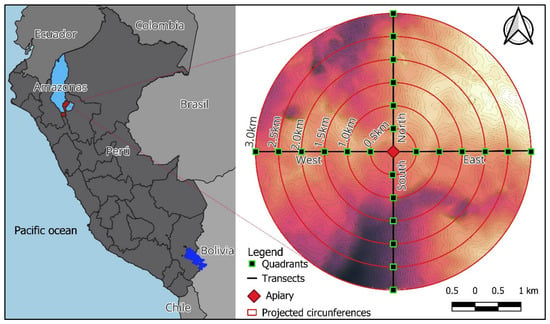
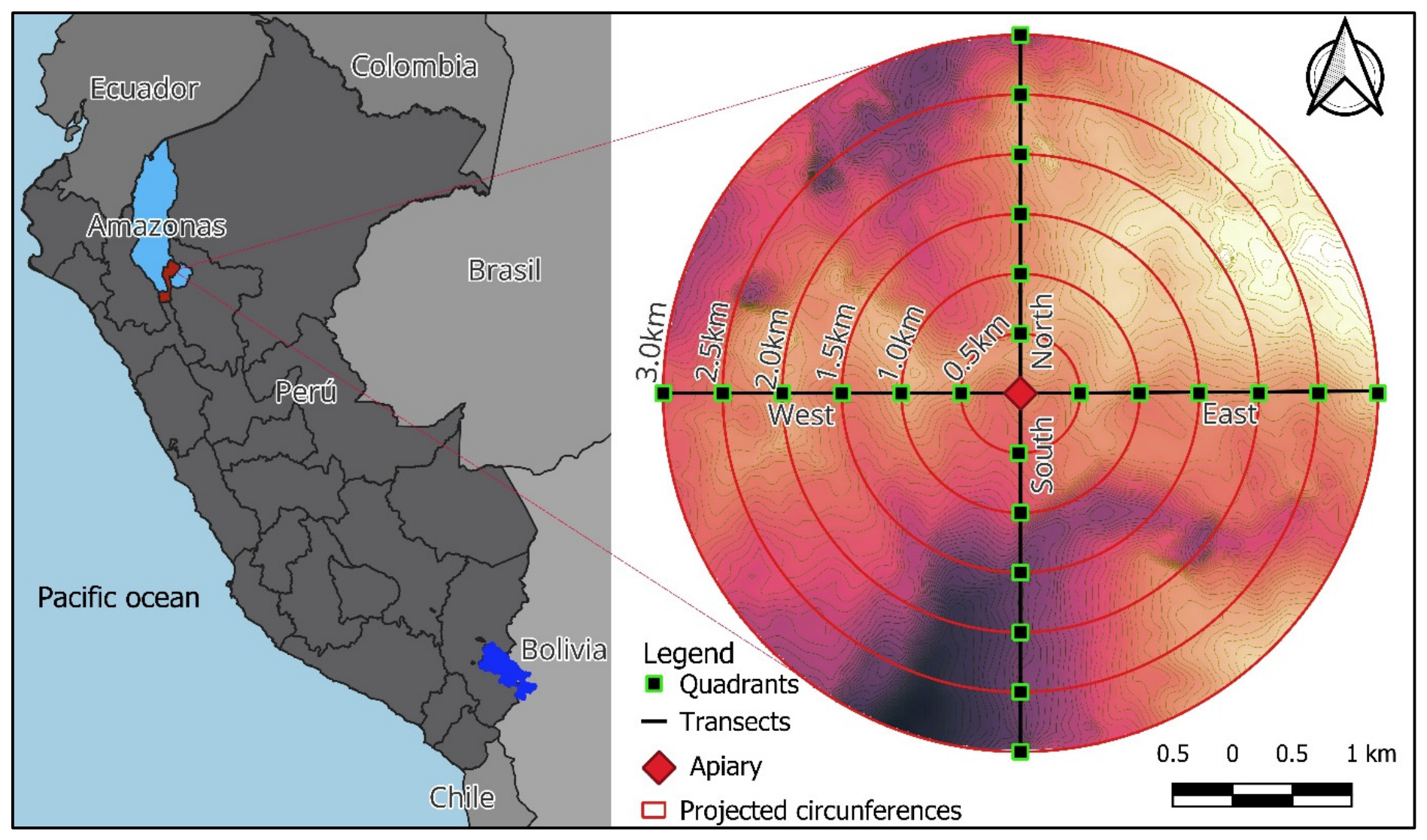
Vegetation sampling was conducted within a circular area with a radius of 3 km centered on the apiary, considering this distance to be representative of the foraging range of A. mellifera. A total of 24 sampling units (25 m2) were established using a Garmin GPS Montana 700 (Garmin Ltd., Olathe, KS, USA) along four transects oriented according to the cardinal directions (north, south, east, and west), using the apiary as the reference point. Along each transect, six quadrats were positioned at distances of 0.5, 1.0, 1.5, 2.0, 2.5, and 3.0 km from the apiary to assess potential spatial variations in floristic composition. The spatial arrangement of the sampling units is illustrated in Figure 1.
Figure 1.
Spatial arrangement of transects and sampling quadrats within the study area. Red lines represent concentric sampling distances established at 500 m intervals from the apiary.
Within each quadrat, all plant species present at the time of sampling were recorded, regardless of their pollination syndrome, floral reward, or documented visitation by A. mellifera. When necessary, botanical specimens were collected following the procedures described by [14] for subsequent identification using specialized literature and taxonomic databases. Specimens lacking flowers or fruits that could not be reliably identified to species level were assigned to the genus level and recorded as Genus sp. For each species, the number of individuals was recorded to estimate abundance and density. For each species, the number of individuals was recorded to estimate its abundance and density.
Plant species were classified according to vegetation stratum as low (<1.5 m), medium (1.5–5 m), or high (>5 m), following habitat structural stratification criteria that may influence resource accessibility and utilization by honey bees [15,16]. Based on published studies on A. mellifera, other bee species, and regional botanical databases, floral resources were classified as pollen (P), nectar (N), or both (N-P). Regional sources were considered when species-specific information for A. mellifera was unavailable [17,18]. Resin- and oil-producing plants were not included in this classification. No direct observations of A. mellifera visitation, corbicular pollen collection, or systematic phenological monitoring were conducted. Accordingly, the term “potential bee forage species” refers to plant species reported in the literature as providing floral resources and does not imply locally confirmed use or preference by honey bees.
2.3. Data Processing and Ecological Indices
A comprehensive species inventory was compiled and classified according to land-cover type (forest or cropland), transect orientation, and distance from the apiary. Additionally, species were grouped based on their potential value as foraging resources for honey bees.
Species richness was estimated as the total number of species recorded per quadrat. Diversity was assessed using the Shannon & Weaver [19] and Simpson [20] indices, whereas evenness and dominance were calculated using the Pielou [21] and Berger–Parker [22] indices, respectively. These metrics were used to characterize the structure of the general floristic composition and the availability of floral resources for honey bees. Species accumulation curves were generated using randomization and rarefaction methods to evaluate the adequacy and representativeness of the sampling effort.
2.4. Statistical Analysis
All statistical analyses were performed in RMarkdown (RStudio, version 2025.05.1 + 513, Boston, MA, USA) [23]. The vegan package [24] was used for the calculation of diversity indices and multivariate analyses. Prior to inferential analyses, the assumptions of normality and homogeneity of variances were evaluated using the Shapiro–Wilk and Levene tests, respectively. Because the data met these assumptions, analyses of variance (ANOVA) were performed for species richness, diversity, evenness, and dominance indices using a linear model that included land-cover type (forest vs. cropland), distance from the apiary (0.5, 1.0, 1.5, 2.0, 2.5, and 3.0 km), and transect orientation (north, south, east, and west) as factors. When significant differences were detected, means were compared using Tukey’s honestly significant difference (HSD) test. Statistical significance was assessed at α = 0.05.
Differences in species composition were evaluated using permutational multivariate analysis of variance (PERMANOVA), considering land-cover type, distance from the apiary, and transect orientation as factors. Analyses were based on Bray–Curtis dissimilarity matrices [25] with 10,000 permutations. When significant effects were detected, pairwise comparisons were conducted using the Benjamini–Hochberg adjustment method. Finally, non-metric multidimensional scaling (NMDS) was used to visualize patterns of similarity in species composition among land-cover types, transects, and distances from the apiary. The ordination was based on Bray–Curtis dissimilarities and 10,000 permutations, and model goodness-of-fit was assessed using stress values.
3. Results
3.1. General Floristic Composition
All plant species identified in the sampling area, irrespective of their vegetation stratum or their potential value as forage resources for A. mellifera, were included in the general floristic composition. A total of 124 species belonging to 103 genera were recorded. Of these, 50 species were shared between both land-cover types (forest and cropland), whereas 37 species were exclusively found in forest and another 37 were restricted to cropland (Table 1).
Table 1.
Plant species recorded in the study area, their taxonomic classification, vegetation stratum, and bee foraging potential.
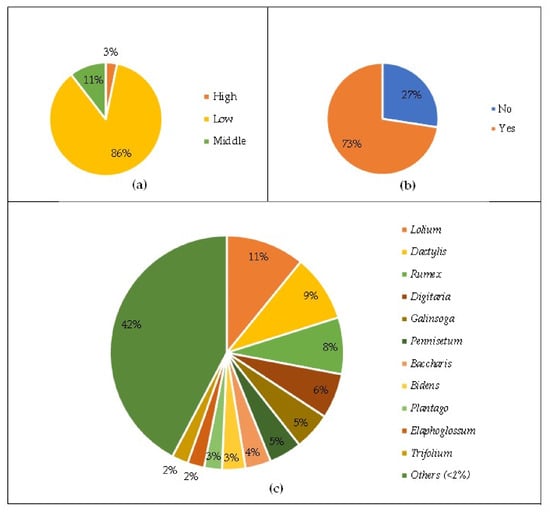
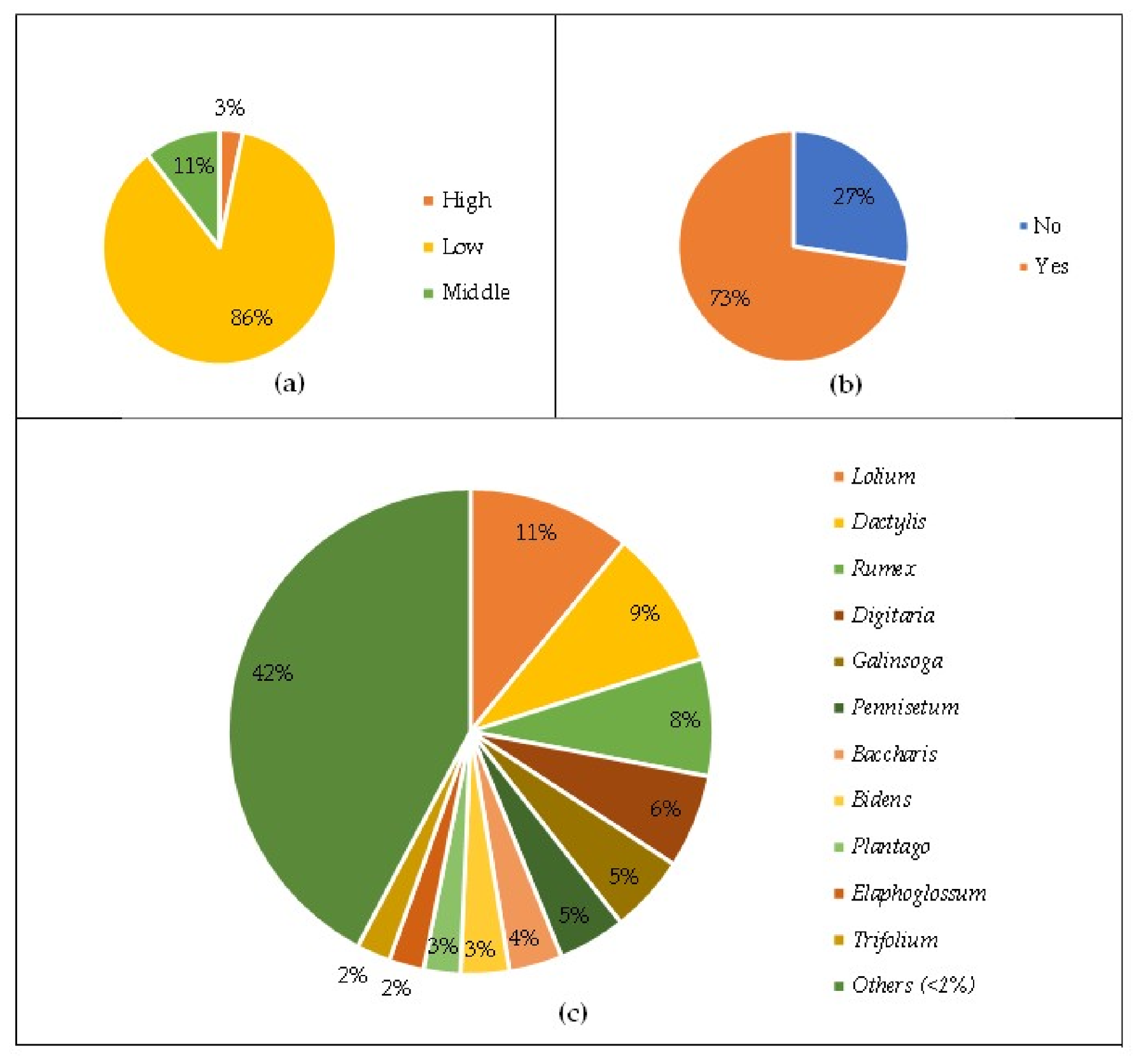
A total of 86% of the recorded species (107 species) belonged to the low vegetation stratum, whereas 11% (13 species) and 3% (4 species) were classified within the medium and high strata, respectively, indicating a predominance of herbaceous and low-growing vegetation (Figure 2a). Regarding bee foraging potential, 73% of the recorded species (90 species) were identified as potential forage resources for honey bees, whereas 27% (34 species) did not provide significant floral resources (Figure 2b).
Figure 2.
Distribution of recorded plant species according to vegetation stratum (a), bee foraging potential (b), and generic composition (c).
The most representative genera were Lolium (11%), Dactylis (9%), Rumex (8%), Digitaria (6%), Galinsoga (5%), Pennisetum (5%), Baccharis (4%), Bidens (3%), and Plantago (3%), whereas Elaphoglossum (2%) and Trifolium (2%) were less represented. The remaining 42% comprised genera with relative frequencies below 2% (Figure 2c).
3.2. Bee Forage Species
A total of 90 species with bee foraging potential, belonging to 75 genera, were recorded. Of these, 74 species (82%) were present in four or fewer quadrats, whereas 16 species (18%) occurred in five or more quadrats. In terms of abundance, the most numerous bee forage species were Lolium multiflorum (603 individuals), Dactylis glomerata (513 individuals), Rumex obtusifolius (433 individuals), Digitaria sanguinalis (293 individuals), and Pennisetum clandestinum (249 individuals).
The species exhibiting the highest densities were Lolium multiflorum, Dactylis glomerata, Helianthus sp., Rumex obtusifolius, Salvia rosmarinus, Tessaria absinthioides, and Plantago major, all with densities exceeding 45 individuals per 25 m2 (Table 2). The species recorded in the greatest number of quadrats were Digitaria sanguinalis, Trifolium repens, and Rubus urticifolius (11 quadrats each), followed by Dactylis glomerata (10 quadrats), Lolium multiflorum and Rumex obtusifolius (9 quadrats each), Pennisetum clandestinum (8 quadrats), Bidens pilosa, Baccharis salicifolia, Baccharis latifolia, and Philoglossa mimuloides (7 quadrats each), and Ranunculus repens (6 quadrats). All remaining species occurred in five or fewer quadrats.
Table 2.
Bee forage species recorded in the study area, including vegetation stratum, floral reward type, abundance, and density.
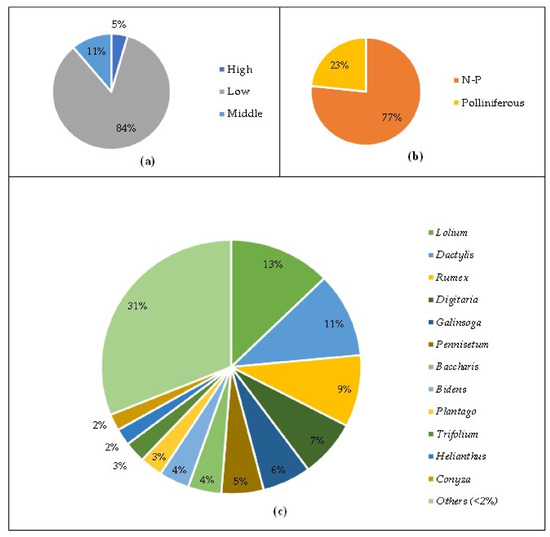
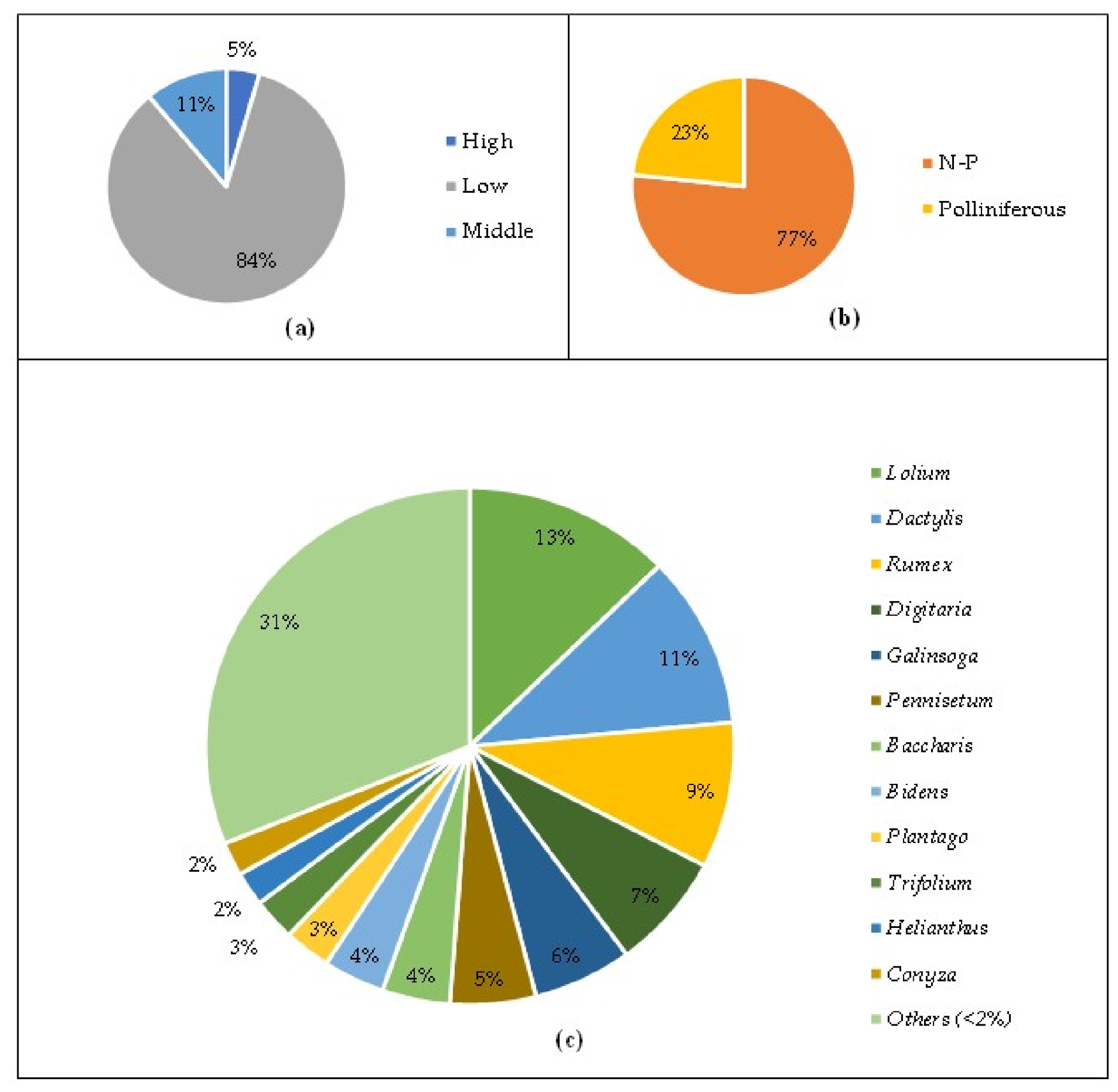
Regarding the vegetation strata of bee forage species, most species (76 species; 84%) belonged to the low stratum, whereas the medium stratum (10 species) accounted for approximately 11% and the high stratum (4 species) represented only 5% of the total (Figure 3a). Concerning floral resource type, 77% of the species (69 species) provided both nectar and pollen, whereas 23% (21 species) were classified as species classified as pollen sources for honey bees (Figure 3b).
Figure 3.
Distribution of bee forage species according to vegetation stratum (a), floral resource type (b), and generic composition (c).
Regarding the bee forage species, the most representative genera were Lolium (13%), Dactylis (11%), Rumex (9%), Digitaria (7%), Galinsoga (6%), Pennisetum (5%), Baccharis (4%), Bidens (4%), Plantago (3%), and Trifolium (3%). In contrast, Helianthus and Conyza each accounted for only 2% of the recorded species. The remaining genera collectively represented 40% of the total, with each individual genus contributing less than 2% (Figure 3c).
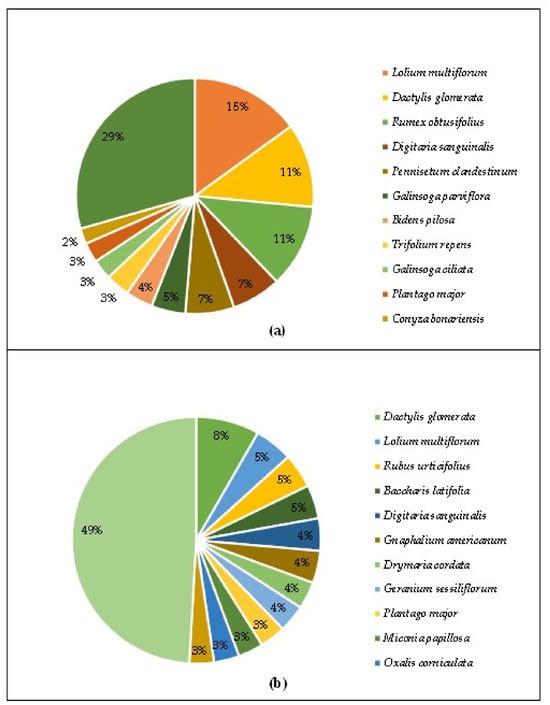
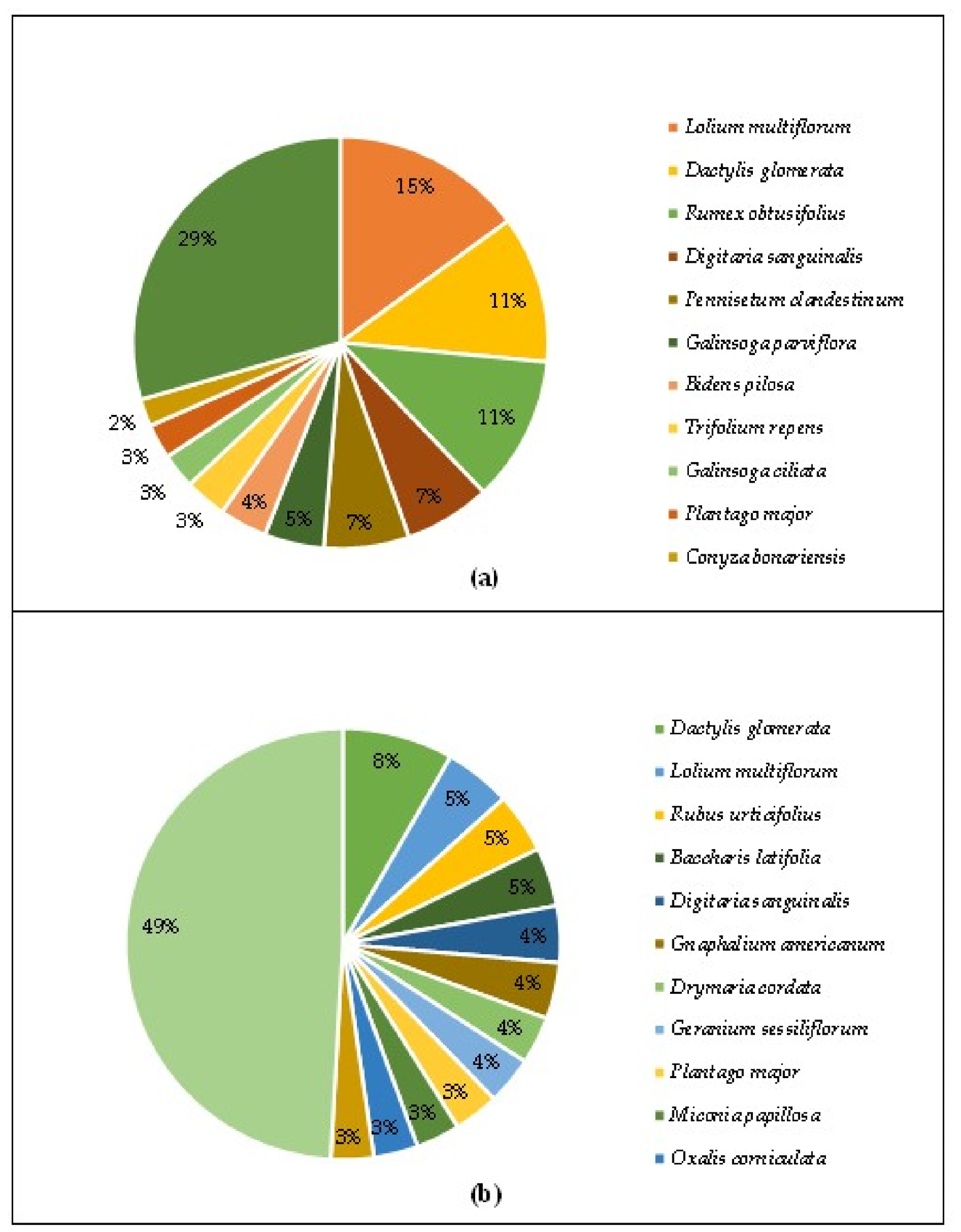
Among the bee forage species recorded in cropland, the most representative were Lolium multiflorum (15%), Dactylis glomerata (11%), Rumex obtusifolius (11%), Digitaria sanguinalis (7%), and Pennisetum clandestinum (7%). Other relevant species included Galinsoga parviflora (5%), Bidens pilosa (4%), Trifolium repens (3%), Galinsoga ciliata (3%), Plantago major (3%), and Conyza bonariensis (2%). Species with lower frequencies (<2% each) collectively accounted for 29% of the bee forage species recorded in cropland (Figure 4a).
Figure 4.
Relative distribution of the main bee forage species recorded in cropland (a) and forest areas (b).
In contrast, species with low representation (<3% each) collectively accounted for 49% of the bee forage species recorded in forest areas. The most representative species were Dactylis glomerata (8%), whereas Lolium multiflorum, Rubus urticifolius, and Baccharis latifolia each accounted for 5% of the records. Digitaria sanguinalis, Gnaphalium americanum, Drymaria cordata, and Geranium sessiliflorum each represented 4%, while Plantago major, Miconia papillosa, Oxalis corniculata, and Ageratum conyzoides each accounted for 3% of the recorded species (Figure 4b).
3.3. Species Accumulation Curves
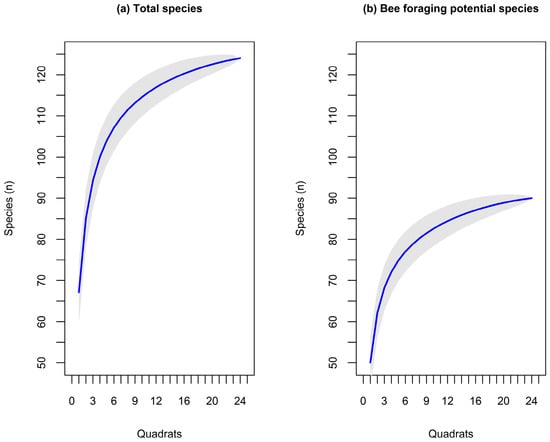
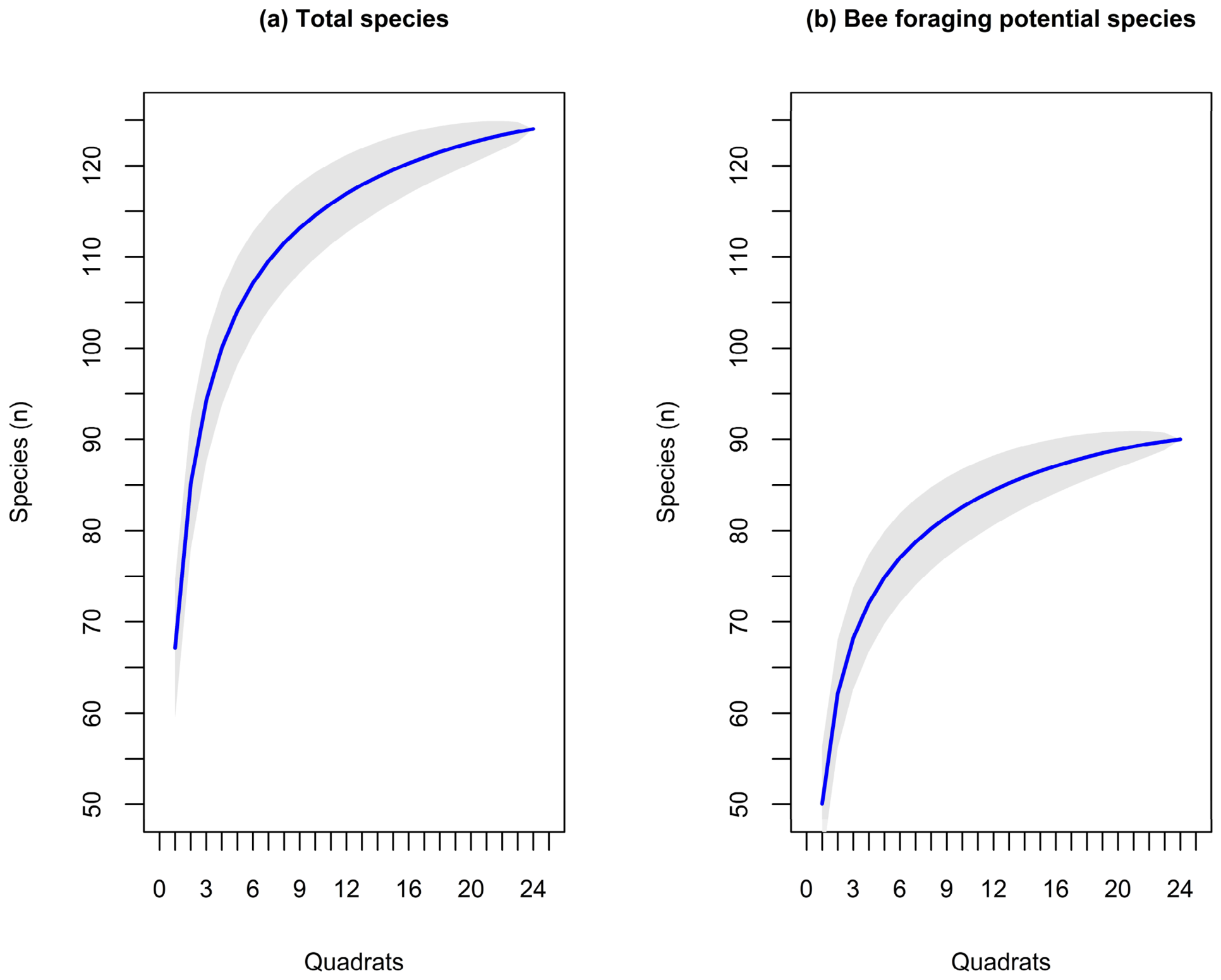
The species accumulation curve for the entire general floristic composition showed that more than 110 species were recorded within the first 10 quadrats. Thereafter, the rate of species accumulation decreased substantially, with only 14 additional species being recorded in the remaining quadrats, resulting in a total of 124 species across the 24 sampled quadrats (Figure 5a). According to the Bootstrap richness estimator, the expected total species richness was 147 species. Therefore, the sampling effort captured approximately 84.4% of the estimated total species richness in the study area (124/147 × 100).
Figure 5.
Rarefaction-based species accumulation curves for total plant species (a) and bee forage species (b). Shaded areas indicate the 95% confidence intervals.
Regarding bee forage species, more than 75 species were recorded within the first 10 quadrats. Similar to the pattern observed for the general floristic composition, the rate of species accumulation decreased thereafter, with only 15 additional species being recorded in the remaining quadrats, resulting in a total of 90 species across the 24 sampled quadrats (Figure 5b). According to the Bootstrap richness estimator, the expected richness of bee forage species was 106 species. Therefore, the sampling effort captured approximately 84.9% of the estimated bee forage species richness in the study area (90/106 × 100).
3.4. Richness, Diversity, Evenness, and Dominance
No significant differences (p > 0.05) were observed in species richness or in the diversity, evenness, and dominance indices between land-cover types (forest and cropland), distances from the apiary, or transect orientations. The only exception was the Berger–Parker dominance index, which differed significantly among distances (p < 0.05). Dominance was highest in areas closest to the apiary (0.5 km), with a value of 0.46, whereas at greater distances (2–3 km) dominance values ranged from 0.23 to 0.25 (Table 3).
Table 3.
Mean (±SD) values of species richness, diversity, evenness, and dominance indices according to land-cover type, distance from the apiary, and transect orientation.
Species richness, diversity, evenness, and dominance indices of bee forage species were not significantly affected (p > 0.05) by land-cover type (cropland versus forest), distance from the apiary, or transect orientation (Table 4).
Table 4.
Mean (± SD) values of species richness, diversity, evenness, and dominance indices of bee forage species according to land-cover type, distance from the apiary, and transect orientation.
3.5. Species Composition Patterns Revealed by PERMANOVA and NMDS
PERMANOVA revealed that land-cover type and transect orientation significantly influenced the composition of both the general floristic composition and the bee forage species assemblage (p < 0.05). In contrast, distance from the apiary did not have a significant effect on species composition (p > 0.05) (Table 5).
Table 5.
PERMANOVA results for the general floristic composition and bee forage species, including F-statistics, coefficients of determination (R2), and p-values.
Post hoc pairwise PERMANOVA comparisons revealed that species composition differed significantly between cropland and forest for both the general floristic composition and the bee forage species assemblage (p < 0.05; Table 6).
Table 6.
Results of post hoc pairwise PERMANOVA comparisons between land-cover types for the general floristic composition and bee forage species.
Post hoc pairwise comparisons revealed significant differences in species composition among transects for both the general floristic composition and the bee forage species assemblage (p < 0.05). The only exception was the comparison between the south and east transects, which showed no significant differences for either dataset (p > 0.05) (Table 7).
Table 7.
Results of post hoc pairwise PERMANOVA comparisons of species composition among transects for the general floristic composition and bee forage species.
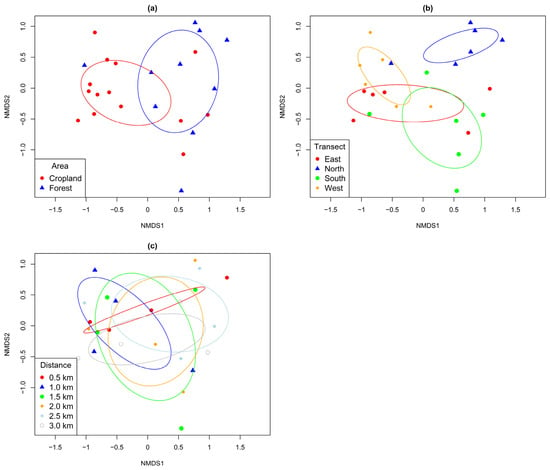
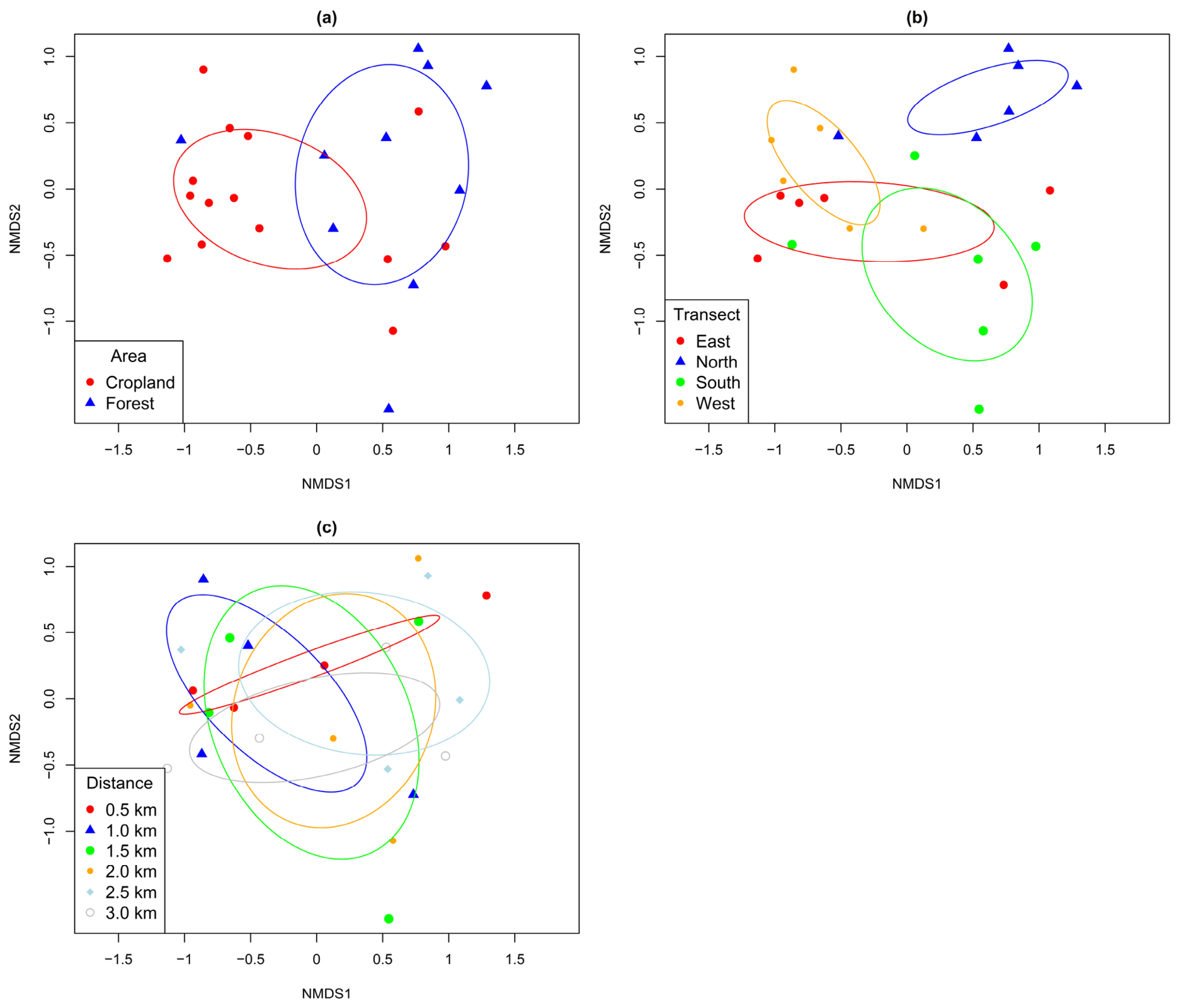
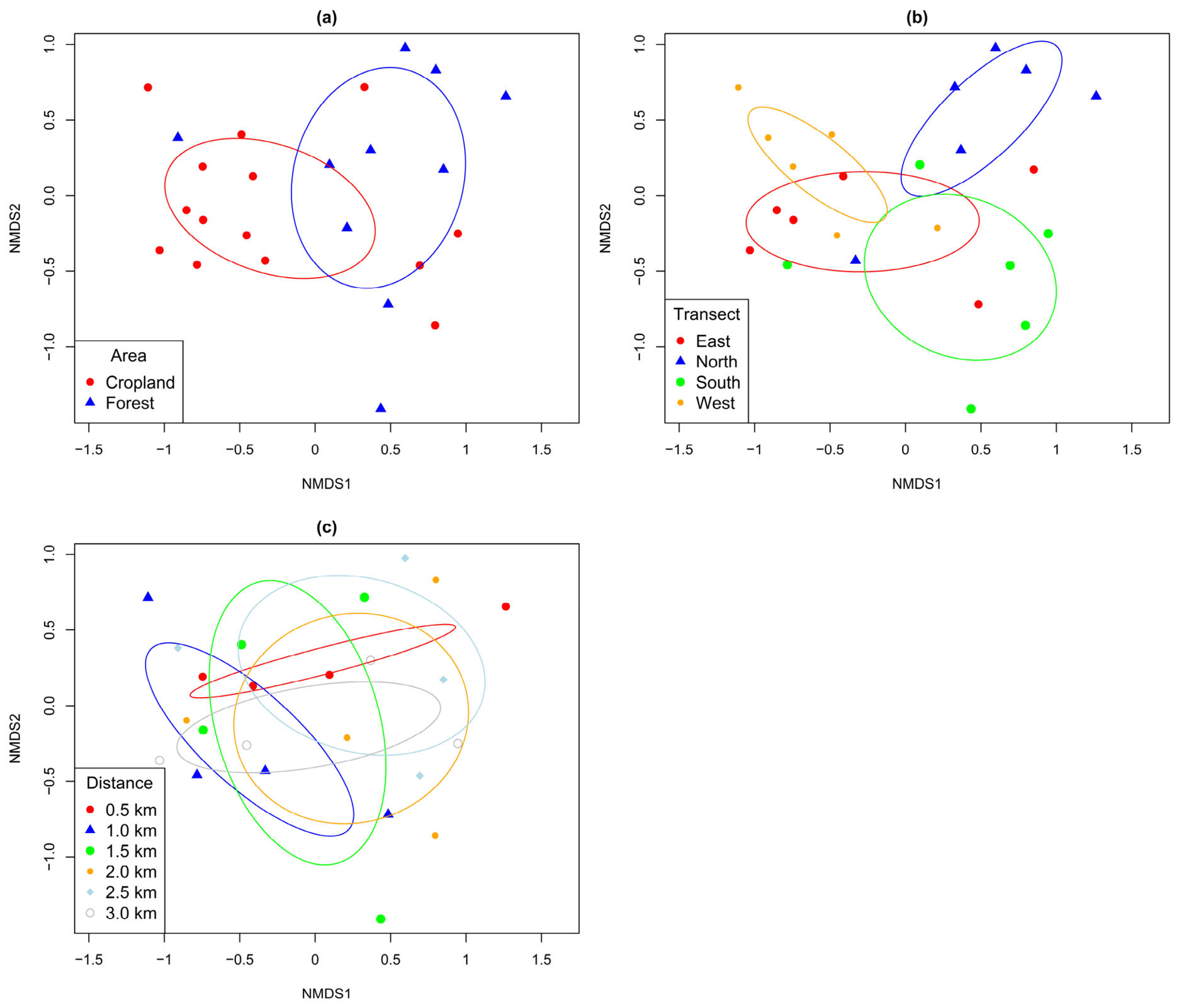
The NMDS ordination for the general floristic composition showed an acceptable goodness-of-fit, with a stress value of 0.1533, indicating a reasonable representation of multidimensional relationships in the two-dimensional configuration. Clear differences in species composition were observed between cropland and forest, although substantial within-group variability was also evident (Figure 6a). The north transect exhibited the most distinct species composition compared with the other transects. In contrast, the south and west transects showed partial separation, whereas the east transect was more similar to the south and west transects (Figure 6b). No clear differences in species composition were observed among distances from the apiary (Figure 6c).
Figure 6.
Non-metric multidimensional scaling (NMDS) ordination plots of the general floristic composition according to land-cover type (a), transect orientation (b), and distance from the apiary (c).
The NMDS ordination for bee forage species showed an acceptable goodness-of-fit, with a stress value of 0.1584, indicating a reasonable representation of multidimensional relationships in the two-dimensional configuration. Clear differences in species composition were observed between cropland and forest, although substantial within-group variability was evident (Figure 7a). The north transect exhibited a distinct species composition compared with the other transects. The west and south transects showed slight separation from one another, whereas the east transect was more similar to both the west and south transects (Figure 7b). No clear separation in species composition was observed among distances from the apiary (Figure 7c).
Figure 7.
Non-metric multidimensional scaling (NMDS) ordination plots of bee forage species according to land-cover type (a), transect orientation (b), and distance from the apiary (c).
4. Discussion
4.1. General Floristic Composition
The results revealed an interesting floristic richness in the study area (124 species), reflecting the structural complexity and heterogeneity of the landscape. This pattern is particularly relevant from a beekeeping perspective due to the high proportion of species identified as potential bee forage resources (approximately 73%) [119,120]. These findings indicate that the landscape is not only diverse but also functionally important for providing floral resources to honey bees.
The predominance of the low vegetation stratum, which accounted for approximately 86% of the recorded species, indicates that herbaceous plants represent a major component of the vegetation with potential relevance as bee forage resources in the study area. However, the contribution of these resources to the seasonal availability of forage cannot be determined from the present study, as flowering phenology was not monitored throughout the year [121]. Such vegetation is often associated with disturbed or managed landscapes and can enhance the temporal availability of floral resources for foraging honey bees [122].
From both ecological and productive perspectives, flowering plant diversity is closely associated with the availability of nectar and pollen, which are essential resources for the maintenance and development of A. mellifera colonies [123]. Landscapes with high floristic diversity generally support greater abundance and stability of pollinator communities [5]. Furthermore, the occurrence of numerous species in both cropland and forest indicates a certain degree of floristic connectivity within the landscape. Such connectivity may facilitate pollinator movement among habitat types and promote more efficient use of available floral resources, thereby contributing to the ecological stability of pollinator-dependent systems under changing environmental conditions [124].
4.2. Bee Forage Species
The identification of 90 plant species with literature-supported bee forage potential indicates that the study area contains a diverse pool of potentially available floral resources. However, their local use and relative importance to A. mellifera were not directly evaluated.
The high proportion of species providing both nectar and pollen (approximately 77%) represents an important functional advantage, as these species may contribute to a mzore balanced diet for honey bee colonies. The simultaneous availability of nectar and pollen supports larval development [125], colony energy requirements [126], and may help mitigate the effects of environmental stressors on colony performance [127]. These findings should be interpreted within the scope of the adopted classification, which considered nectar and pollen as the main floral rewards relevant to A. mellifera. Consequently, plant species providing other resources, particularly resins used for propolis production, were not included in this classification.
The high abundance and spatial occurrence of species such as Lolium multiflorum, Dactylis glomerata, Rumex obtusifolius, and Digitaria sanguinalis identify them as potentially important components of the local forage landscape. Given their abundance and frequency, these species may contribute substantially to the local availability of floral resources, particularly because several of them are documented pollen sources [128]. However, their actual contribution to honey bee nutrition and their relative use by A. mellifera were not directly assessed. Therefore, abundance within vegetation quadrats should not be interpreted as evidence of honey bee preference or as a proxy for the proportion of pollen collected from each species.
However, an excessive reliance on a limited number of dominant species may reduce the nutritional diversity available to honeybees [129]. In this context, the coexistence of less abundant yet functionally complementary species is essential to ensure a diverse and balanced diet [130]. Therefore, the conservation of nectar-producing species within the genus Baccharis is of particular importance, as they diversify the availability of floral resources and enhance the nutritional resilience of honey bee colonies.
Differences in species composition between cropland and forest indicate that both land-cover types contribute complementary floral resources to the landscape. Cropland tended to be characterized by a higher abundance of a few dominant species, whereas forest contributed additional bee forage species that increased landscape-level heterogeneity [131,132]. This pattern highlights the importance of maintaining both components of the landscape to sustain the diversity and temporal stability of floral resources available to honey bees. Consequently, identifying key bee forage species provides a useful basis for ecological restoration programs, the design of pollinator-friendly productive landscapes, and beekeeping planning strategies [133].
4.3. Species Accumulation Curves
The species accumulation curves indicate that the sampling effort was sufficient to capture most of the floristic richness present in the study area. The tendency of both the total plant species and bee forage species curves to approach an asymptote suggests that additional sampling would likely yield only a limited number of new species [134]. The pattern of rapid initial species accumulation followed by a gradual stabilization is characteristic of well-sampled communities and has been widely reported in biodiversity studies [135,136,137]. In the present study, the similarity between the total plant species and bee forage species accumulation curves further suggests that a large proportion of the local flora contributes to the floral resources available to honey bees.
These results confirm the representativeness of the sampling effort and provide a robust basis for interpreting patterns of species richness, diversity, and composition observed in the study area. Furthermore, the similarity between the total plant species and bee forage species curves indicates that a substantial proportion of the flora is associated with resources used by honey bees [138,139]. In this context, the ecosystem appears to function not only as a reservoir of plant biodiversity but also as an important provider of floral resources that support pollinator communities and beekeeping activities [140].
4.4. Richness and Diversity
The absence of significant differences in species richness and diversity between cropland and forest indicates that both land-cover types contribute similarly to the maintenance of floral resources within the landscape. From a beekeeping perspective, this finding suggests that agricultural systems, when characterized by a certain degree of heterogeneity, may provide floral resource diversity comparable to that of forest [141,142].
The relatively homogeneous distribution of species diversity throughout the 3 km foraging radius represents another important finding, as it suggests that honey bee colonies have access to similar levels of floral diversity across the landscape [143]. Such spatial consistency in floral resources may contribute to more stable foraging opportunities and reduce the likelihood of localized resource shortages [144].
The higher Berger–Parker dominance values observed near the apiary may indicate areas where floral resources are concentrated in a few highly abundant species, potentially influencing honey bee foraging patterns [145]. This information may be useful for optimizing apiary placement and improving landscape management strategies based on the spatial distribution of bee forage species. Overall, these findings suggest that both species diversity and the spatial arrangement of dominant bee forage species are important components of landscape functionality for beekeeping systems [146,147].
4.5. Species Composition Based on PERMANOVA and NMDS
The multivariate analyses revealed significant differences in species composition among land-cover types and transect orientations. Although species richness and diversity were similar across the landscape, the identity of species varied spatially. From a beekeeping perspective, this spatial variation may be advantageous because it increases the functional diversity of floral resources available to honey bees [148].
The floristic differentiation observed between cropland and forest suggests that each land-cover type contributes a distinct set of species to the landscape, thereby increasing resource complementarity. Such compositional diversity may promote a broader range of floral resources for honey bees and other pollinators and has been associated with greater ecological stability and resilience of pollinator communities under environmental stress [149].
The absence of a significant effect of distance from the apiary further supports the idea that floral resources are widely distributed throughout the landscape. This pattern suggests that potential bee forage species occur across the entire 3 km study radius rather than being concentrated in specific zones [150]. In contrast, the significant differences among transects indicate that local environmental conditions and landscape characteristics influence the spatial distribution of plant communities.
The conservation of heterogeneous landscapes that integrate both productive areas and forest is therefore of considerable importance [151]. Such landscape configurations can enhance plant biodiversity and increase the diversity of floral resources available to honey bees [152]. Consequently, detailed characterization of floristic composition provides valuable information for identifying key species and spatial patterns, representing an important tool for the development of management and conservation strategies aimed at promoting sustainable beekeeping systems [153].
4.6. Study Limitations and Future Research
Despite these findings, some limitations should be considered when interpreting the results. This study provides a floristic and spatial characterization of plant species that represent potential floral resources for A. mellifera within the landscape surrounding a managed apiary. The classification of species as potential pollen, nectar, or mixed resources was based on published literature rather than on direct validation through field observations of honey bee visitation or analyses of corbicular pollen, bee bread, or honey pollen. Therefore, plant abundance and spatial distribution should be interpreted as indicators of the potential availability of floral resources rather than as evidence of honey bee preference or actual resource use by local colonies.
In addition, vegetation was surveyed only during April and May 2025, precluding the assessment of flowering phenology, seasonal variation in resource availability, and potential forage gaps throughout the year. Likewise, resin-producing plant species were not assessed, which may have resulted in an underestimation of the diversity of resources potentially available to honey bee colonies. Furthermore, the study was conducted within the landscape surrounding a single apiary in Levanto, Chachapoyas. Although vegetation sampling was systematic and covered different distances and land-cover types, the results are specific to the study landscape and should not be extrapolated beyond the area evaluated.
Future studies should include multiple apiaries, year-round phenological monitoring, direct observations of honey bee foraging, and palynological or molecular approaches to validate plant use under local conditions. These approaches would help determine which plant species are actually visited and exploited by A. mellifera, characterize seasonal patterns of resource availability, and provide a more comprehensive assessment of the floral and resin resources available to honey bee colonies within the studied landscape.
5. Conclusions
The study area exhibited high floristic richness and a diverse assemblage of plant species reported in the literature as potential floral resources for Apis mellifera. Although species richness, diversity, evenness, and dominance did not differ significantly among land-cover types, distances, or transect orientations, PERMANOVA and NMDS analyses revealed significant spatial variation in species composition between cropland and forest and among transects. These findings indicate that the heterogeneous landscape provides a spatially diverse pool of potential floral resources for honey bees. Because this study was based on vegetation surveys, the results represent the potential availability of floral resources rather than direct evidence of plant use by Apis mellifera. Nevertheless, this work provides a valuable baseline for understanding the floristic composition surrounding managed apiaries in the Peruvian Amazon. Future studies incorporating direct observations of honey bee visitation, pollen-load or melissopalynological analyses, year-round phenological monitoring, and the assessment of resin-producing plants will be essential to validate local resource use and support evidence-based beekeeping management.
Author Contributions
Conceptualization, methodology, writing—review and editing, supervision, Y.M.B.-M. and A.E.-C.; data collection, methodology, investigation, K.G.-H. and L.T.-G.; formal analysis, validation, review J.A.S.-U.; J.L.M.-Q. and L.M.M.-C.; data curation, statistics, Y.P.; conceptualization, writing—review and editing, supervision, I.S.C.-C. All authors have read and agreed to the published version of the manuscript.
Funding
The APC was funded by the Vicerrectorado de Investigación—Universidad Nacional Toribio Rodríguez de Mendoza de Amazonas.
Institutional Review Board Statement
Not applicable.
Data Availability Statement
The original contributions presented in this study are included in the article. Further inquiries can be directed to the corresponding author.
Acknowledgments
The authors like to thank the Doctoral Program in Sciences for Sustainable Development of the Universidad Nacional Toribio Rodríguez de Mendoza de Amazonas. Also to the Consejo Nacional de Ciencia, Tecnología e Innovación Tecnológica (CONCYTEC) and the Programa Nacional de Investigación Científica y Estudios Avanzados (PROCIENCIA) within the framework of the call E033-2023-01-BM “Interinstitutional Alliances for Doctoral Programs”, under grant number (PE501084305-2023).
Conflicts of Interest
The authors declare no conflicts of interest.
References
- Ejaz, K.; Ali, M.; Khan, F.Z.A.; Mozūratis, R. Enhancing Alfalfa (Medicago sativa) Seed Yield: The Effect of Honey Bee (Apis mellifera) Supplementation and Efficiency of Other Pollinators. Biology 2025, 14, 599. [Google Scholar] [CrossRef] [Scilit]
- Mramba, R.P. The role of plant diversity and density in the availability of floral resources for effective pollination and honey production by the honey bee (Apis mellifera) in arid areas. Discov. Plants 2025, 2, 65. [Google Scholar] [CrossRef] [Scilit]
- Corona-López, X.; Hernández-Martínez, D.; Ruíz-Juárez, D.; González-Félix, M.L.; Pérez-Velázquez, M.; González-Gutiérrez, F.H.; Valencia-Dávila, M.; Cornejo-Ramírez, Y.I.; López-Corona, B.E. Nutritional and Physical Characterization of Bee Bread of Honeybee (Apis mellifera) and Artificial Food as Diet for Bees. ACS Food Sci. Technol. 2026, 6, 669–678. [Google Scholar] [CrossRef] [Scilit]
- Ayers, A.C.; Rehan, S.M. Supporting Bees in Cities: How Bees Are Influenced by Local and Landscape Features. Insects 2021, 12, 128. [Google Scholar] [CrossRef] [Scilit]
- Wang, H.; Ran, N.; Jiang, H.-Q.; Wang, Q.-Q.; Ye, M.; Bowler, P.A.; Jin, X.-F.; Ye, Z.-M. Complex floral traits shape pollinator attraction to flowering plants in urban greenspaces. Urban For. Urban Green. 2024, 91, 128165. [Google Scholar] [CrossRef] [Scilit]
- Papa, G.; Maier, R.; Durazzo, A.; Lucarini, M.; Karabagias, I.K.; Plutino, M.; Bianchetto, E.; Aromolo, R.; Pignatti, G.; Ambrogio, A.; et al. The Honey Bee Apis mellifera: An Insect at the Interface between Human and Ecosystem Health. Biology 2022, 11, 233. [Google Scholar] [CrossRef] [Scilit]
- Monmany-Garzia, A.C.; Chacoff, N.; Aragón, R.; Sosa, A.; Aparicio, V.C.; Ayup, M.M.; Galindo-Cardona, A. Effects of soybean fields on the health of Apis mellifera (Hymenoptera: Apidae) in the Chaco ecoregion. J. Econ. Entomol. 2025, 118, 473–485. [Google Scholar] [CrossRef] [Scilit]
- Vujanović, D.; Losapio, G.; Mészáros, M.; Popov, S.; Ristić, Z.M.; Stojnić, S.M.; Jović, J.; Vujić, A. Forest and grassland habitats support pollinator diversity more than wildflowers and sunflower monoculture. Ecol. Entomol. 2023, 48, 421–432. [Google Scholar] [CrossRef] [Scilit]
- Dupont, Y.L.; Balsby, T.J.S.; Greve, M.B.; Marcussen, L.K.; Kryger, P. Spatio-temporal variation in pollen collected by honey bees (Apis mellifera) in rural-urban mosaic landscapes in Northern Europe. PLoS ONE 2025, 20, e0309190. [Google Scholar] [CrossRef] [Scilit]
- Briceño-Mendoza, Y.M.; Saucedo-Uriarte, J.A.; Huatangari, L.Q.; Gaslac-Gomez, J.B.; Quispe-Ccasa, H.A.; Cayo-Colca, I.S. Predictive Modeling of Honey Yield in Rural Apiaries: Insight from Chachapoyas, Amazonas, Peru. Agriculture 2025, 15, 2377. [Google Scholar] [CrossRef] [Scilit]
- Balvino-Olvera, F.J.; Quesada, M.; Hernández-Valencia, Y.S.; Ruiz-Guzmán, G.; Sánchez-Gómez, K.F.; Aguilar-Aguilar, M.J.; Patiño-Conde, V.; Herrerías-Diego, Y.; Reyes-González, A.; Cristóbal-Pérez, E.J.; et al. Nutritional landscape of managed honey bee colonies in Mexico. Apidologie 2025, 56, 50. [Google Scholar] [CrossRef] [Scilit]
- Salcedo, R.P.; Huamán, D.M.; Mesía, L.H. Botanical origin of stingless bee honey from the Peruvian Amazon. Palynology 2025, 49, 2497926. [Google Scholar] [CrossRef] [Scilit]
- SENAMHI. Datos Hidrometereológicos a Nivel Nacional. Available online: https://www.senamhi.gob.pe/?p=estaciones (accessed on 9 December 2025).
- Matteucci, S.D.; Colma, A. Metodología Para el Estudio de La Vegetación; Buenos Aires; The General Secretariat of the Organization of American States: Washington, DC, USA, 1982; Available online: https://www.researchgate.net/publication/44553298 (accessed on 5 March 2025).
- Roubik, D.W. Ecology and Natural History of Tropical Bees; Cambridge University Press: Cambridge, UK, 1992; p. 514. Available online: https://books.google.com/books/about/Ecology_and_Natural_History_of_Tropical.html?hl=es&id=ljlaYMeI6noC (accessed on 2 July 2026).
- Klein, A.-M.; Vaissière, B.E.; Cane, J.H.; Steffan-Dewenter, I.; Cunningham, S.A.; Kremen, C.; Tscharntke, T. Importance of pollinators in changing landscapes for world crops. Proc. R. Soc. B 2007, 274, 303–313. [Google Scholar] [CrossRef] [Scilit]
- Seeley, T.D. The Wisdom of the Hive: The Social Physiology of Honey Bee Colonies; Harvard University Press: Cambridge, MA, USA; London, UK, 1995; Available online: https://www.academia.edu/23803928/The_Wisdom_of_the_Hive_The_Social_Physiology_of_Honey_Bee_Colonies (accessed on 2 July 2026).
- Vaissière, B.E.; Freitas, B.M.; Gemmill-Herren, B. Protocol to Detect and Assess Pollination Deficits in Crops: A Handbook for Its Use; FAO: Rome, Italy, 2018. [Google Scholar] [CrossRef] [Scilit]
- Shannon, C.E.; Weaver, W. The Mathematical Theory of Communication. Bell Syst. Tech. J. 1949, 27, 379–423. [Google Scholar] [CrossRef] [Scilit]
- Simpson, E.H. Measurement of diversity. Nature 1949, 163, 668. [Google Scholar] [CrossRef] [Scilit]
- Pielou, E.C. Species-diversity and pattern-diversity in the study of ecological succession. J. Theor. Biol. 1966, 10, 370–383. [Google Scholar] [CrossRef] [Scilit]
- Berger, W.H.; Parker, F.L. Diversity of Planktonic Foraminifera in Deep-Sea Sediments. Science 1970, 168, 1345–1347. [Google Scholar] [CrossRef] [Scilit]
- R Core Team. R A Language and Environment for Statistical Computing; R Foundation for Statistical Computing.-References-Scientific Research Publishing: Vienna, Austria, 2025; Available online: https://www.scirp.org/reference/referencespapers?referenceid=3967248 (accessed on 2 July 2026).
- Oksanen, J.; Simpson, G.L.; Blanchet, F.G.; Kindt, R.; Legendre, P.; Minchin, P.R.; O’Hara, R.B.; Solymos, P.; Stevens, M.H.H.; Szoecs, E.; et al. Community Ecology Package [R package vegan version 2.7-5]. CRAN: Contributed Packages, May 2026. Available online: https://cran.r-project.org/web/packages/vegan/index.html (accessed on 6 March 2026).
- Bray, J.R.; Curtis, J.T. An Ordination of the Upland Forest Communities of Southern Wisconsin. Ecol. Monogr. 1957, 27, 325–349. [Google Scholar] [CrossRef] [Scilit]
- Öztürk, F. Bee Plants of Çatak Valley and Determination of Nectar, Polen and Secretion Groups (Van/Turkey). ISPEC J. Agric. Sci. 2021, 5, 81–99. [Google Scholar] [CrossRef] [Scilit]
- Amithasekaral, D.G.S.M.; Sirisenal, U.G.A.I.; Geekiyanagel, N.; Thakshila, S.A.D.; Prabashwara, V.A.T.; Nanayakkara, S. Floral Resources and Foraging Ecology of Wild Bees in Queensberry Estate of Nawalapitiya, Sri Lanka. 2021. Available online: http://repository.rjt.ac.lk/handle/123456789/6218 (accessed on 18 August 2026).
- Pajarillo, R.M.; Masiong, P.; De Castro, D.; Soliba, M.; Panas, J.; Acosta, M.D. Profiling of the Beekeeping Industry: Status of Beekeeping in Region 1 and Cordillera Administrative Region. DMMMSU Res. Ext. J. 2022, 6, 70–93. [Google Scholar] [CrossRef] [Scilit]
- London-Shafir, I.; Shafir, S.; Eisikowitch, D. Amygdalin in almond nectar and pollen–facts and possible roles. Plant Syst. Evol. 2003, 238, 87–95. [Google Scholar] [CrossRef] [Scilit]
- Guallpa-Calva, M.A.; Guilcapi-Pacheco, E.D.; Espinoza-Espinoza, A.E. Estimation of the honey flora for the beekeeping productivity of the tunshi experimental station in the licto sector, Riobamba. Dominio Las Cienc. 2020, 6, 181–202. Available online: https://dialnet.unirioja.es/servlet/articulo?codigo=7398451 (accessed on 18 August 2026).
- Wolff, D.; Liedeschumann, S. Evolution of flower morphology, pollen dimorphism, and nectar composition in Arcytophyllum, a distylous genus of Rubiaceae. Org. Divers. Evol. 2007, 7, 106–123. [Google Scholar] [CrossRef] [Scilit]
- Wyatt, R. Ecology and Evolution of Self-Pollination in Arenaria Uniflora (Caryophyllaceae). J. Ecol. 1986, 74, 403–418. [Google Scholar] [CrossRef] [Scilit]
- Fishman, L.; Wyatt, R. Pollinator-Mediated Competition, Reproductive Character Displacement, and The Evolution of Selfing in Arenaria Uniflora (Caryophyllaceae). Evolution 1999, 53, 1723–1733. [Google Scholar] [CrossRef] [Scilit]
- Orozco-Orozco, L.F.; López-Hoyos, J.H.; Espitia-Negrete, L.B.; Velásquez-Arroyo, C.E.; Rodríguez-Rodríguez, O.J.; Garnica-Montaña, J.P. Biología floral de accesiones de Arracacia xanthorrhiza Bancr. del banco de germoplasma de Colombia. Agron. Mesoam. 2022, 33, 49469. [Google Scholar] [CrossRef] [Scilit]
- Rodrigues, D.M.; De Souza, M.C.; Arruda, C.; Pereira, R.A.S.; Bastos, J.K. The Role of Baccharis dracunculifolia and its Chemical Profile on Green Propolis Production by Apis mellifera. J. Chem. Ecol. 2019, 46, 150–162. [Google Scholar] [CrossRef] [Scilit]
- Abad, M.J.; Bermejo, P. Baccharis (Compositae): A review update. Arkivoc 2007, 7, 76–96. [Google Scholar] [CrossRef] [Scilit]
- Flores, F.F.; Hilgert, N.I.; Zamudio, F.; Fabbio, F.; Lupo, L.C. Pollen analysis of honeys from Apis mellifera and Tetragonisca fiebrigi (Hymenoptera: Apidae) in the Upper Paraná Atlantic Forest, Argentina. Rodriguésia 2021, 72, e00902020. [Google Scholar] [CrossRef] [Scilit]
- Boldt, P.E.; Robbins, T.O. Phytophagous and Flower-Visiting Insect Fauna of Baccharis salicifolia (Asteraceae) in the Southwestern United States and Northern Mexico. Environ. Entomol. 1990, 19, 515–523. [Google Scholar] [CrossRef] [Scilit]
- Díaz, R.Y.; Niell, S.; Cesio, M.V.; Heinzen, H. Floral food resources for Apis mellifera (Hymenoptera: Apidae) in a mountain forest area in Uruguay. Agrociencia Urug. 2021, 25, e426. [Google Scholar] [CrossRef] [Scilit]
- Ruiz-Valencia, J.A.; Vázquez, M.; Burgos-Hernández, M.; Gutiérrez, J.; Terrazas, T. Anatomía de la madera de especies de Forestiera (Oleaceae) en México. Acta Bot. Mex. 2021, 128, 1–17. [Google Scholar] [CrossRef] [Scilit]
- Calva, M.Á.G.; Pacheco, E.D.G.; Espinoza, A.E.E. Flora apícola de la zona estepa espinosa Montano Bajo, en la Estación Experimental Tunshi, Riobamba, Ecuador. Dominio Cienc. 2019, 5, 71–93. [Google Scholar] [CrossRef] [Scilit][Green Version]
- Insuasty-Santacruz, E.G.; Gamez, H.A.J.; Lasso, A.F.A. Floral offer, honey and wax quality from hybrid and European bees in Nariño-Colombia. Rev. Cienc. Agric. 2025, 42, e1247. [Google Scholar] [CrossRef] [Scilit]
- Pfeiffer, P.M.M.; Bonilla, D.L.; Parra, G.N. Catálogo de polen en mieles de Apis mellifera provenientes de zonas cafeteras en la Sierra Nevada de Santa Marta, Magdalena, Colombia. Rev. Acad. Colomb. Cienc. Exactas Físicas Nat. 2014, 38, 364–384. [Google Scholar] [CrossRef] [Scilit]
- Denisow, B. Pollen Production of Selected Ruderal Plant Species in the Lublin Area; WUP Wydawnictwo Uniwersytetu Przyrodniczego: Lublin, Poland, 2011. [Google Scholar]
- Moskalyk, I.; Fylypchuk, T.; Zhuk, A.; Moskalyk, H.; Sytnikova, I.; Zarochentseva, O.; Fedoriak, M. Phytodiversity of Herbaceous Wild Vegetation Strips as a Determinant of Wild Pollinator Conservation. Int. J. Ecosyst. Ecol. Sci. 2025, 15, 161–170. [Google Scholar] [CrossRef] [Scilit]
- Prđun, S.; Vrhovnik, I.; Bubalo, D.; Svečnjak, L. Botanical Origin and Quantity of Pollen Load on Satsuma Mandarin (Citrus unshiu Marc.) Honey Bee Forage. Agric. Conspec. Sci. 2018, 83, 345–349. [Google Scholar]
- Diaz-Losada, E.; Ricciardelli-D’ALbore, G.; Saa-Otero, M.P. The possible use of honeybee pollen loads in characterising vegetation. Grana 1998, 37, 155–163. [Google Scholar] [CrossRef] [Scilit]
- Faye, P.F.; Planchuelo, A.M.; Molinelli, M.L. Relevamiento de la flora apícola e identificación de cargas de polen en el sureste de la provincia de Córdoba, Argentina. AgriScientia 2002, 19, 19–30. [Google Scholar] [CrossRef] [Scilit]
- Layek, U.; Das, A.; Das, U. Floral biology, floral volatile organic compounds and floral visitors of Chromolaena odorata, an invasive alien species in West Bengal, India. Biodivers. J. Biol. Divers. 2022, 23, 2118–2129. [Google Scholar] [CrossRef] [Scilit]
- Rathnayake, D.G.R.M.M.K.; Wijetunga, W.M.G.A.S.T.B. Species Composition and Visiting Frequencies of Flower Visitors of Chromolaena odorata in a Dry Zone Forest Patch of Sri Lanka. Psyche A J. Entomol. 2016, 2016, 8746251. [Google Scholar] [CrossRef] [Scilit]
- Underwood, D.; Fisher, A.E.; Brusslan, J.A.; Cruz, B.B.G. San Miguel Savory (Clinopodium Chandleri) Pollination: Honey Bees Versus Native Visitors; California State University: Long Beach, UK, 2021. [Google Scholar]
- Huamán, F.T.G.; Trauco, M.A. Identificación de flora apícola en el fundo Vitaliano, Amazonas, Perú. Rev. Científica UNTRM Cienc. Soc. Y Humanid. 2021, 2, 09–17. [Google Scholar] [CrossRef] [Scilit]
- Arriaga, E.R.; Martínez-Bernal, A.; Ramírez-Maldonado, N.; Martínez-Hernández, E. Análisis palinológico de mieles y cargas de polen de Apis mellifera (Apidae) de la región Centro y Norte del estado de Guerrero, México. Bot. Sci. 2016, 94, 141–156. [Google Scholar] [CrossRef] [Scilit]
- Kumar, M.; Jaiswal, B.K. Effect of honeybee (Apis mellifera L.) pollination on yield and quality in coriander. Indian J. Entomol. 2012, 74, 281–284. [Google Scholar]
- Tesfaye, B.; Gelgelu, T.; Lelisa, W. The Role of Honeybee (Apis mellifera) Pollination in Enhancing Seed Yield and Yield Related Parameters of Coriandrum sativum L. J. Energy Nat. Resour. 2020, 9, 120. [Google Scholar] [CrossRef] [Scilit]
- Khan, K.; Malik, K.; Ahmad, M.; Raja, M.N.I.; Nazish, M.; Kamal, A.; Albasher, G.; Ahmad, S.; Naseem, M.T. Exploring the nutritional composition and quality parameters of natural honey from diverse melliferous flora. Sci. Rep. 2024, 14, 31626. [Google Scholar] [CrossRef] [Scilit]
- Kumari, I.; Kumar, R. Parthenium hysterophorus and Cyperus rotundus: Alternative sources of food for Honeybees during dearth period. Biosci. Biotechnol. Res. Asia 2017, 14, 1177–1180. [Google Scholar] [CrossRef] [Scilit]
- Kirilov, A.; Nikolova, I.; Georgieva, N.; Mladenova, R. Flowering legumes as pollen and nectar-rich habitats for bees: Preference of bee pollinators to different forage species. Option Méditerranéennes Ser. A Mediterr. Semin. 2016, 114, 241–244. [Google Scholar]
- Severova, E.; Kopylov-Guskov, Y.; Selezneva, Y.; Karaseva, V.; Yadav, S.R.; Sokoloff, D. Pollen Production of Selected Grass Species in Russia and India at the Levels of Anther, Flower and Inflorescence. Plants 2022, 11, 285. [Google Scholar] [CrossRef] [Scilit]
- Bacab-Pérez, A.I.; Ramírez-Arriaga, E.; Canto, A. Melissopalynology of pot-pollen and pot-honey of the Mayan stingless bee Melipona beecheii Bennett, 1831 (Apidae, Meliponini) in Yucatan, Mexico. Apidologie 2024, 55, 22. [Google Scholar] [CrossRef] [Scilit]
- de Céspedes, I.-S.S.; Aguirre, J.A.C.; Males, M.A.M.; León-Espinoza, M.E.; Chalampuente-Flores, D.; Prado, J.K.; de Azcárate, J.G.; Carrillo, C.C. Weed Diversity and Associated Entomofauna in High-Andean Organic Pastures. Sustainability 2026, 18, 1828. [Google Scholar] [CrossRef] [Scilit]
- Araujo-Mondragón, F.; Redonda-Martínez, R. Flora melífera de la región centro-este del municipio de Pátzcuaro, Michoacán, México. Acta Bot. Mex. 2019, 126, 1–20. [Google Scholar] [CrossRef] [Scilit]
- de Jesus Silva, L.; de Oliveira, J.P.M.; de Almeida Scabbia, R.J. Levantamento de flora de interesse apícola em apiários de três municípios da região do Alto Tietê/SP. FLOVET 2025, 3, 1806–8863. [Google Scholar] [CrossRef] [Scilit]
- Jiménez, M.M.; Kuethe, J.R.; Garzón-Suárez, H.X.; Lapo-González, N.; Vélez-Abarca, L.; Iturralde, G. A new white-flowered Elleanthus (Orchidaceae: Sobralieae) from the Andes of southern Ecuador and notes on hummingbird pollination of Elleanthus scopula. Phytotaxa 2024, 662, 209–223. [Google Scholar] [CrossRef] [Scilit]
- Adhikari, R.D.; Miyanaga, R.; Adhikari, R.D.; Miyanaga, R. Utilization of Hairy Footed Flower Bee Anthophora plumipes (Hymenoptera: Apidae) for Pollination of Greenhouse Strawberry. Adv. Entomol. 2016, 4, 25–31. [Google Scholar] [CrossRef]
- Janečková, P.; Janeček, Š.; Bartoš, M.; Hrázský, Z. Reproductive system of the critically endangered taxon Gentianella praecox subsp. bohemica. Preslia 2019, 91, 77–92. [Google Scholar] [CrossRef] [Scilit]
- Masierowska, M.; Stawiarz, E.; Rozwałka, R. Perennial ground cover plants as floral resources for urban pollinators: A case of Geranium species. Urban For. Urban Green. 2018, 32, 185–194. [Google Scholar] [CrossRef] [Scilit]
- Soininen, J.; Paukkunen, J.; Kytöviita, M.-M. Managed honeybees affect the foraging behaviour of bumblebees in Geranium sylvaticum. J. Pollinat. Ecol. 2025, 39, 316–329. [Google Scholar] [CrossRef] [Scilit]
- Lefebvre, V.; Daugeron, C.; Villemant, C.; Fontaine, C. Empidine dance flies pollinate the woodland geranium as effectively as bees. Biol. Lett. 2019, 15, 20190230. [Google Scholar] [CrossRef] [Scilit]
- Méndez, M.V.; Sánchez, A.C.; Flores, F.F.; Lupo, L.C. Recurso polinífero utilizado por Apis mellifera (Himenoptera: Apidae) en un área de bosque subtropical del noroeste de Argentina. Rev. Biol. Trop. 2018, 66, 1182–1196. [Google Scholar] [CrossRef] [Scilit]
- Coronel-Castro, E.; Pantigoso, I.R.; Pariente-Mondragón, E.; Torres-Guzmán, C.; Mori, G.M.; Oliva-Cruz, S.M. Género Gynoxys Cass (Asteraceae) en el Departamento de Amazonas, Perú: Distribución Y Nuevos Registros. Folia Amaz. 2023, 32, e32724. [Google Scholar] [CrossRef] [Scilit]
- Mercado, J.; Solano, C.; Wolfgang, H. Recursos florales usados por dos especies de Bombus en un fragmento de bosque subandino (Pamplonita-Colombia). Rev. Colomb. Cienc. Anim. Recia 2017, 9, 31–37. [Google Scholar] [CrossRef] [Scilit]
- Leal, D.A.A.; Gomez, A.P.; Bautista, G.V.; Barbosa, D.C.D. Food Supply for Apis Mellifera Bees in Coffee in Pasuncha (Cundinamarca). Corporación Universitaria Minuto de Dios- UNIMINUTO. 2019. Available online: https://revistas.uniminuto.edu/index.php/Pers/article/view/1805/1705 (accessed on 3 June 2026).
- Doria, M.G.; Pabón-Mora, N.; González, F. Reassessing Inflorescence and Floral Morphology and Development in Hedyosmum(Chloranthaceae). Int. J. Plant Sci. 2012, 173, 735–750. [Google Scholar] [CrossRef] [Scilit]
- Gaur, R.D.; Tiwari, P.; Tiwari, J.K.; Rawat, S.; Ballabha, R. Addendum Bee Forage Potential of Garhwal Himalaya, India. Indian J. Fundam. Appl. Life Sci. 2014, 4, 196–204. [Google Scholar]
- Chamorro-García, F.J.; León-Bonilla, D.; Nates-Parra, G. El Polen Apícola Como Producto Forestal No Maderable en la Cordillera Oriental de Colombia Bee pollen as non-wood forest product in the eastern Andean highlands of Colombia. Colomb. For. 2013, 16, 53–66. [Google Scholar]
- Amakpe, F.; Kenali, H.I.; Sinsin, B. A Melissopalynologic dynamics appraisal revealed the strategic foraging adaptation of the honeybees (Apis mellifera Linnaeus 1758) to the anthropogenic impacts in the Republic of Benin. Heliyon 2024, 10, e33753. [Google Scholar] [CrossRef] [Scilit]
- Inoka, W.A.; Karunaratne, P.; Edirisinghe, J.P.; Gunatilleke, C.V.S. Floral Relatioships of Bees in Selected Areas of Sri lanka. Ceylon J. Sci. 2005, 34, 27–45. [Google Scholar]
- Abrahams, E.; Abrahams, E. Structural Responses to Land Use in Pollination Networks: Effects of Biodiversity and Alien Plants in the Ecuadorian Chocó. Independent Study Project (ISP) Collection. 2024. Available online: https://digitalcollections.sit.edu/isp_collection/3806 (accessed on 3 June 2026).
- Meneguzzo, M.K. Fontes de alimentos usadas por abelhas (Hymenoptera, Apoidea) em áreas campestres da Floresta Densa Montana, no sul de Santa Catarina. Universidade do Extremo Sul Catarinense, 2013. Available online: https://repositorio.unesc.net/items/ca9a6179-f912-411a-8212-c332fa6540f0 (accessed on 16 May 2026).
- Hernández, E.; Montalvo, J.M.; Calpeño, M.J.A.; Torres, F.O. Flora nativa de Atlixco, puebla, México, con potencial para el uso en la creación de jardines atrayentes de polinizadores. Rev. Científica Ecocienc. 2025, 12, 43–60. [Google Scholar] [CrossRef] [Scilit]
- Gallardo, O.M.; López, G.; Yaguana, D.V.; Ortiz, A.Y. Polinizadores del cultivo de chocho (Lupinus mutabilis Sweet) en sistemas de producción orgánica y convencional. Alfa Rev. Investig. Cienc. Agronómicas Vet. 2023, 7, 309–324. [Google Scholar] [CrossRef] [Scilit]
- Grant, J. Systematics, Biogeography, and Natural History of the Neotropical Moon-Gentians (Macrocarpaea: Gentianaceae). Ph.D. Thesis, Université de Neuchâtel, Neuchâtel, Switzerland, 2003. [Google Scholar] [CrossRef] [Scilit]
- Davies, K.L.; Pansarin, E.R.; Stpiczyńska, M. Labellar Structure of the Maxillaria splendens Alliance (Orchidaceae: Maxillariinae) Indicates Floral Polyphenols as a Reward for Stingless Bees. Plants 2023, 12, 921. [Google Scholar] [CrossRef] [Scilit]
- Flach, A.; Dondon, R.C.; Singer, R.B.; Koehler, S.; Amaral, M.D.C.E.; Marsaioli, A.J. The Chemistry of Pollination in Selected Brazilian Maxillariinae Orchids: Floral Rewards and Fragrance. J. Chem. Ecol. 2004, 30, 1045–1056. [Google Scholar] [CrossRef] [Scilit]
- Glinos, E.; Condat, E.; Mulieri, P.; Ashworth, L. Essential dependence on wild pollination service: A medicinal plant under threat Minthostachys verticillata (Lamiaceae). Arthropod-Plant Interact. 2019, 13, 865–874. [Google Scholar] [CrossRef] [Scilit]
- Robinson, H.E. A generic review of the tribe Liabeae (Asteraceae). Smithson. Contrib. Bot. 1983, 54, 1–69. [Google Scholar] [CrossRef] [Scilit]
- Montagna, T.; Silva, J.Z.; Pikart, T.G.; Reis, M.S.; Pickart, T.G. Reproductive ecology of Ocotea catharinensis, an endangered tree species. Plant Biol. 2018, 20, 926–935. [Google Scholar] [CrossRef] [Scilit]
- Wolin, C.L.; Galen, C.; Watkins, L. The Breeding System and Aspects of Pollination Effectiveness in Oenothera speciosa (Onagraceae). Southwest. Nat. 1984, 29, 15–20. [Google Scholar] [CrossRef] [Scilit]
- Xie, Z.; Shebl, M.A.; Pan, D.; Wang, J. Synergistically positive effects of brick walls and farmlands on Anthophora waltoni populations. Agric. For. Entomol. 2020, 22, 328–337. [Google Scholar] [CrossRef] [Scilit]
- Jiang, W.; Battesti, M.-J.; Yang, Y.; Jean-Marie, É.; Costa, J.; Béreau, D.; Paolini, J.; Robinson, J.-C. Melissopalynological Analysis of Honey from French Guiana. Foods 2024, 13, 1073. [Google Scholar] [CrossRef] [Scilit]
- Webster, B.D.; Ross, R.M.; Evans, T. Nectar and the Nectary of Phaseolus vulgaris L.1. J. Am. Soc. Hortic. Sci. 1982, 107, 497–503. [Google Scholar] [CrossRef] [Scilit]
- Webster, B.D.; Tucker, C.L.; Lynch, S.P. A Morphological Study of the Development of Reproductive Structures of Phaseolus vulgaris L.1. J. Am. Soc. Hortic. Sci. 1977, 102, 640–643. [Google Scholar] [CrossRef] [Scilit]
- Fisher, A.; Umeda, C.; Brusslan, J.; Dillon, J.; By, Y.; Wang, B.S. Evolution of Corolla and Pollen Forms in The Justicia ‘Sessile-Axillary Inflorescence’ Clade; California State University: Long Beach, CA, USA, 2023. [Google Scholar]
- Hansson, C. Competition Between Wild Bees and Manged Honeybees—A Review of Floral Preferences. 2020. Available online: https://stud.epsilon.slu.se/16169/3/hansson_c_201013.pdf (accessed on 17 May 2026).
- Addi, A.; Lamessa, D. Bee Plant Inventory and The Pollen Potentiality of Menagesha Suba State Forest for Beekeeping Utilization. J. Biol. Sci. 2009, 8, 85–97. [Google Scholar]
- Rust, R.W. Collecting of Pinus (Pinaceae) Pollen by Osmia Bees (Hymenoptera: Megachilidae). Environ. Entomol. 1987, 16, 668–671. [Google Scholar] [CrossRef] [Scilit]
- Martins, A.C.; Proença, C.E.B.; Vasconcelos, T.N.C.; Aguiar, A.J.C.; Farinasso, H.C.; de Lima, A.T.F.; Faria, J.E.Q.; Norrana, K.; Costa, M.B.R.; Carvalho, M.M.; et al. Contrasting patterns of foraging behavior in neotropical stingless bees using pollen and honey metabarcoding. Sci. Rep. 2023, 13, 14474. [Google Scholar] [CrossRef] [Scilit]
- Sabugosa-Madeira, B.; Ribeiro, H.; Cunha, M.; Abreu, I. The importance of plantain (Plantago spp.) as a supplementary pollen source in the diet of honey bees. J. Apic. Res. 2008, 47, 77–81. [Google Scholar] [CrossRef] [Scilit]
- Flores, F.F.; Lupo, L.C.; Hilgert, N.I. Outstanding botanical resources for Plebeia mansita (Apidae, Meliponini) in the Northern Argentine Yungas: Botanical characterization of its honey and main nesting substrates. Palynology 2024, 48, 2266487. [Google Scholar] [CrossRef] [Scilit]
- Käpylä, M.; Niemelä, P. Flowers visited by honey bee in southern Finland. Agric. Food Sci. 1979, 51, 17–24. [Google Scholar] [CrossRef] [Scilit]
- Antonie, I. The Melliferous Potential of The Flora in The Gușterița Locality, Sibiu County, Romania. Sci. Pap. Ser. Manag. Econ. Eng. Agric. Rural Dev. 2019, 19, 61–66. [Google Scholar]
- Cavers, P.B.; Harper, J.L. Rumex Obtusifolius L. and R. Crispus L. J. Ecol. 1964, 52, 737–766. [Google Scholar] [CrossRef] [Scilit]
- Benarfa, N.; Louadi, K.; Chenchouni, H. Species assemblage of wild bees (Hymenoptera: Apoidea) associated with rosemary (Salvia rosmarinus Spenn.). J. Asia-Pac. Biodivers. 2026, 19, 355–377. [Google Scholar] [CrossRef] [Scilit]
- Sawyer, N.W.; Anderson, G.J. Reproductive Biology of The Carrion-Flower, Smilax Herbacea (Smilacaceae). Source 1998, 100, 1–24. [Google Scholar]
- Stubbs, C.S.; Jacobson, H.A.; Osgood, E.A.; Drummond, F.A.; Stuvvs, C.S. Alternative Forage Plants for Native (Wild) Bees Associated with Lowbush Blueberry, Vaccinium spp., In Maine Recommended Citation. 1992. Available online: https://digitalcommons.library.umaine.edu/aes_techbulletin (accessed on 20 May 2026).
- Torres-García, I.; Delgado-Lemus, A.M.; Casas, A. Solanum americanum Mill. Solanum cardiophyllum Lindl. Solanum demissum Lindl. Solanum douglasii Dunal Solanum elae agnifolium Cav. Solanum ehrenbergii (Bitter) Rydb. Solanum houstonii Martyn Solanum lycopersicum L. Solanum nigrescens M. Martens & Galeotti Solanum pubigerum Dunal Solanum rostratum Dunal Solanum rudepannum Dunal Solanum stoloniferum Schltdl. Solanum umbellatum Mill. Solanum verrucosum Schltdl. Solanaceae. In Ethnobotany of the Mountain Regions of Mexico; Springer International Publishing: Cham, Switzerland, 2023; pp. 1461–1481. [Google Scholar] [CrossRef] [Scilit]
- Cınbırtoğlu, Ş.; Sıralı, R. The Importance of Plants Belonging to Asteraceae Family as a Pollen Source in Beekeeping. Bee Stud. Apic. Res. Inst. 2023, 15, 21–24. [Google Scholar] [CrossRef] [Scilit]
- Morrison, J.; Izquierdo, J.; Plaza, E.H.; González-Andújar, J.L. The Attractiveness of Five Common Mediterranean Weeds to Pollinators. Agronomy 2021, 11, 1314. [Google Scholar] [CrossRef] [Scilit]
- Cerceau-Larrival, M.-T. Palynologie et répartition des ombellifères australes actuelles. Relations avec les géoflores tertiaires. Sci. Géolog. Bull. 1974, 27, 117–134. [Google Scholar] [CrossRef] [Scilit]
- Esteban, K.W.; Rehan, S.M. La composición de macronutrientes en el polen afecta el desarrollo y la supervivencia de las abejas silvestres. Physiol. Entomol. 2026, 51, 350–362. [Google Scholar] [CrossRef] [Scilit]
- Forcone, A.; Calderón, A.; Kutschker, A. Apicultural pollen from the Andean region of Chubut (Argentinean Patagonia). Grana 2013, 52, 49–58. [Google Scholar] [CrossRef] [Scilit]
- Paniagua-Zambrana, N.Y.; Bussmann, R.W.; Echeverría, J.; Romero, C. Tessaria absinthioides (Hook. & Arn.) DC. Tessaria integrifolia Ruiz & Pav. Asteraceae. In Ethnobotany of the Andes; Springer International Publishing: Cham, Switzerland, 2020; pp. 1–5. [Google Scholar] [CrossRef] [Scilit]
- Jing, S.; Kryger, P.; Boelt, B. Review of seed yield components and pollination conditions in red clover (Trifolium pratense L.) seed production. Euphytica 2021, 217, 69. [Google Scholar] [CrossRef] [Scilit]
- Zolotarev, V. Study of the efficiency of creeping clover pollination (Trifolium repens L.) by honey bees (Apis mellifera L.). In E3S Web of Conferences; EDP Sciences: Les Ulis Cedex A, France, 2021. [Google Scholar] [CrossRef] [Scilit]
- Marzinzig, B.; Brünjes, L.; Biagioni, S.; Behling, H.; Link, W.; Westphal, C. Bee pollinators of faba bean (Vicia faba L.) differ in their foraging behaviour and pollination efficiency. Agric. Ecosyst. Environ. 2018, 264, 24–33. [Google Scholar] [CrossRef] [Scilit]
- Somerville, D.C. Honeybees (Apis mellifera L.) increase yields of faba beans (Vicia faba L.) in New South Wales while maintaining adequate protein requirements from faba bean pollen. Aust. J. Exp. Agric. 1999, 39, 1001–1005. [Google Scholar] [CrossRef] [Scilit]
- Campos, M.G.; Almaraz-Abarca, N.; Matos, M.P.; Gomes, N.M.; Arruda, V.A.; Barth, O.M.; Freitas, A.S.; Amâncio, D.C.; Almeida-Muradian, L.B. Zea mays L. Pollen: An Approach to Its Quality Control. J. Agric. Sci. Technol. B 2015, 5, 513–522. [Google Scholar] [CrossRef] [Scilit]
- Karki, P.R.; Rahman, M.; Subedi, S.; Biswas, A.P.; Mallick, D.; Islam, N. Exploring the floral diversity in honey from various regions of Bangladesh using Melissopalynology. Food Humanit. 2025, 4, 100488. [Google Scholar] [CrossRef] [Scilit]
- Langlois, A.; Michelot-Antalik, A.; Marchant, A.; Griat, T.; Soderberg, E.; Swiderski, C.; Baude, M. From species to landscape: Quantification of nectar and pollen reveals seasonal gaps for pollinators in intensive arable systems. Agric. Ecosyst. Environ. 2025, 407, 110445. [Google Scholar] [CrossRef] [Scilit]
- Soley, N.; Wilsey, B. Factors that extend flowering phenology for pollinators in prairie restorations. Perspect. Plant Ecol. Evol. Syst. 2025, 66, 125848. [Google Scholar] [CrossRef] [Scilit]
- Szigeti, N.; Berki, I.; Vityi, A.; Winkler, D. Soil mesofauna and herbaceous vegetation patterns in an agroforestry landscape. Agrofor. Syst. 2022, 96, 773–786. [Google Scholar] [CrossRef] [Scilit]
- Berenbaum, M.R.; Calla, B. Honey as a Functional Food for Apis mellifera. Annu. Rev. Entomol. 2021, 66, 185–208. [Google Scholar] [CrossRef] [Scilit]
- Zapata-Hernández, G.; Gajardo-Rojas, M.; Calderón-Seguel, M.; Muñoz, A.A.; Yáñez, K.P.; Requier, F.; Fontúrbel, F.E.; Ormeño-Arriagada, P.I.; Arrieta, H. Advances and knowledge gaps on climate change impacts on honey bees and beekeeping: A systematic review. Glob. Change Biol. 2024, 30, e17219. [Google Scholar] [CrossRef] [Scilit]
- Pang, C.; Dong, K.; Guo, Y.; Ding, G.; Lu, Y.; Guo, Z.; Wu, J.; Huang, J. Effects of Three Types of Pollen on the Growth and Development of Honey Bee Larvae (Hymenoptera, Apidae). Front. Ecol. Evol. 2022, 10, 870081. [Google Scholar] [CrossRef] [Scilit]
- Li, X.-M.; Wang, Y.; Lei, L.; Zhang, G.; Xu, B.-H. Effects of Three Different Bee Pollen on Digestion, Immunity, Antioxidant Capacity, and Gut Microbes in Apis mellifera. Insects 2025, 16, 505. [Google Scholar] [CrossRef] [Scilit]
- Gajger, I.T.; Cvetkovikj, A. Antioxidant Potential of Pollen Polyphenols in Mitigating Environmental Stress in Honeybees (Apis mellifera). Antioxidants 2025, 14, 1086. [Google Scholar] [CrossRef] [Scilit]
- Lisboa, S.N.; Domingos, F.; Vallius, E.; Lensu, A.; Macamo, E.; Sitoe, A. Assessing the Impact of Road and Land Use on Species Diversity of Trees, Shrubs, Herbs and Grasses in the Mountain Landscape in Southern Africa. Front. Conserv. Sci. 2022, 3, 829690. [Google Scholar] [CrossRef] [Scilit]
- Ammann, L.; Bosem-Baillod, A.; Herzog, F.; Frey, D.; Entling, M.H.; Albrecht, M. Spatio-temporal complementarity of floral resources sustains wild bee pollinators in agricultural landscapes. Agric. Ecosyst. Environ. 2024, 359, 108754. [Google Scholar] [CrossRef] [Scilit]
- Kuppler, J.; Neumüller, U.; Mayr, A.V.; Hopfenmüller, S.; Weiss, K.; Prosi, R.; Schanowski, A.; Schwenninger, H.-R.; Ayasse, M.; Burger, H. Favourite plants of wild bees. Agric. Ecosyst. Environ. 2023, 342, 108266. [Google Scholar] [CrossRef] [Scilit]
- Satta, A.; Lezzeri, M.; Brundu, G.; Floris, I.; Palmieri, N.; Pantaleoni, R.A.; Theodorou, P.; Pusceddu, M. How seasonality, semi-natural habitat cover and compositional landscape heterogeneity affect pollen collection and development of Apis mellifera colonies in Mediterranean agro-sylvo-pastoral systems. Landsc. Ecol. 2024, 39, 26. [Google Scholar] [CrossRef] [Scilit]
- Clair, A.L.S.; Zhang, G.; Dolezal, A.G.; O’nEal, M.E.; Toth, A.L. Agroecosystem landscape diversity shapes wild bee communities independent of managed honey bee presence. Agric. Ecosyst. Environ. 2022, 327, 107826. [Google Scholar] [CrossRef] [Scilit]
- Rahimi, E.; Barghjelveh, S.; Dong, P. A review of diversity of bees, the attractiveness of host plants and the effects of landscape variables on bees in urban gardens. Agric. Food Secur. 2022, 11, 6. [Google Scholar] [CrossRef] [Scilit]
- Chazdon, R.L.; Colwell, R.K.; Denslow, J.S.; Guariguata, M.R. Statistical Methods for Estimating Species Richness of Woody Regeneration in Primary and Secondary Rain Forests of Northeastern Costa Rica. For. Biodivers. Res. Monit. Model. Concept. Backgr. Old World Case Stud. 2026, 20, 285–310. [Google Scholar] [CrossRef] [Scilit]
- Aqmal-Naser, M.; Sahari, M.S.; Fahmi-Ahmad, M.; Ahmad, A. Fish Species Richness, Their Importance and Conservation Status in Tropical Oil Palm Agroecosystem of Terengganu, Peninsular malaysia. J. Oil Palm Res. 2024, 36, 51–62. [Google Scholar] [CrossRef] [Scilit]
- Thompson, G.G.; Thompson, S.A. Using species accumulation curves to estimate trapping effort in fauna surveys and species richness. Austral Ecol. 2007, 32, 564–569. [Google Scholar] [CrossRef] [Scilit]
- Ugland, K.I.; Gray, J.S.; Ellingsen, K.E. The species–accumulation curve and estimation of species richness. J. Anim. Ecol. 2003, 72, 888–897. [Google Scholar] [CrossRef] [Scilit]
- Chuttong, B.; Panyaraksa, L.; Tiyayon, C.; Kumpoun, W.; Chantrasri, P.; Lertlakkanawat, P.; Jung, C.; Burgett, M. Foraging behavior and pollination efficiency of honey bees (Apis mellifera L.) and stingless bees (Tetragonula laeviceps species complex) on mango (Mangifera indica L., cv. Nam Dokmai) in Northern Thailand. J. Ecol. Environ. 2022, 46, 1–7. [Google Scholar] [CrossRef] [Scilit]
- Raderschall, C.A.; Lundin, O.; Lindström, S.A.; Bommarco, R. Annual flower strips and honeybee hive supplementation differently affect arthropod guilds and ecosystem services in a mass-flowering crop. Agric. Ecosyst. Environ. 2022, 326, 107754. [Google Scholar] [CrossRef] [Scilit]
- Ferenczi, A.F.; Szűcs, I.; Gáthy, A.B. Evaluation of the Pollination Ecosystem Service of the Honey Bee (Apis mellifera) Based on a Beekeeping Model in Hungary. Sustainability 2023, 15, 9906. [Google Scholar] [CrossRef] [Scilit]
- Ochungo, P.; Veldtman, R.; Abdel-Rahman, E.M.; Muli, E.; Ng’ang’a, J.; Tonnang, H.E.Z.; Landmann, T. Fragmented landscapes affect honey bee colony strength at diverse spatial scales in agroecological landscapes in Kenya. Ecol. Appl. 2022, 32, e02483. [Google Scholar] [CrossRef] [Scilit]
- Sorribas, J.; Escriche, I.; Vercher, R. Enhancing plants and potential pollinator diversity: A case study of Mediterranean fruit orchards in agroecological transition. Environ. Sustain. Indic. 2025, 28, 100924. [Google Scholar] [CrossRef] [Scilit]
- Verma, R.D.; Giri, G.S.; Kumar, N.; Thakur, M.V.; Tudu, L. Spatial and temporal distribution of domestic and wild bee species in mustard with special concern of competitive displacement. J. Entomol. Res. 2024, 48, 77–81. [Google Scholar] [CrossRef] [Scilit]
- Laboisse, S.; Vaillant, M.; Cazenave, C.; Kelečević, B.; Chevalier, I.; Andres, L. Space and Time Dynamics of Honeybee (Apis mellifera L.)-Melliferous Resource Interactions Within a Foraging Area: A Case Study in the Banja Luka Region (Bosnia & Herzegovina). Biology 2025, 14, 422. [Google Scholar] [CrossRef] [Scilit]
- Cavigliasso, P.; Phifer, C.C.; Knowlton, J.L.; Licata, J.A.; Flaspohler, D.J.; Webster, C.R.; Chacoff, N.P. Influence of landscape composition on wild bee communities: Effects of functional landscape heterogeneity. Agric. Ecosyst. Environ. 2022, 340, 108150. [Google Scholar] [CrossRef] [Scilit]
- Robinson, S.V.J.; EHoover, S.; Pernal, S.F.; Cartar, R.V. Optimal distributions of central-place foragers: Honey bee foraging in a mass flowering crop. Behav. Ecol. 2022, 33, 386–397. [Google Scholar] [CrossRef] [Scilit]
- Rutschmann, B.; Kohl, P.L.; Steffan-Dewenter, I. Foraging distances, habitat preferences and seasonal colony performance of honeybees in Central European forest landscapes. J. Appl. Ecol. 2023, 60, 1056–1066. [Google Scholar] [CrossRef] [Scilit]
- Cannizzaro, C.; Keller, A.; Wilson, R.S.; Elliott, B.; Newis, R.; Ovah, R.; Inae, K.; Kerlin, D.H.; Bar, I.; Kämper, W.; et al. Forest landscapes increase diversity of honeybee diets in the tropics. For. Ecol. Manag. 2022, 504, 119869. [Google Scholar] [CrossRef] [Scilit]
- Ellis, J.T.; Rangel, J. Stress drives premature hive exiting behavior that leads to death in young honey bee (Apis mellifera) workers. Biol. Res. 2024, 57, 92. [Google Scholar] [CrossRef] [Scilit]
- Chege, M.; Wambua, M.B.; Kilonzo, W.J.; Subramanian, S.; Nganso, B.T. Seasonal and Landscape-Driven Variations in Forage Resources of Apis mellifera scutellata: Implications for Pollination Sustainability and Colony Health in Taita Taveta County, Kenya. Ecol. Evol. 2025, 15, e71613. [Google Scholar] [CrossRef] [Scilit]
- Forster, C.Y.; Middleton, E.J.T.; Gloag, R.; Hochuli, D.F.; White, T.E.; Latty, T. Impact of empty flowers on foraging choice and movement within floral patches by the honey bee, Apis mellifera. Insectes Sociaux 2023, 70, 413–422. [Google Scholar] [CrossRef] [Scilit]
- Shackleton, K.; Balfour, N.J.; Al Toufailia, H.; James, E.; Ratnieks, F.L. Honey bee waggle dances facilitate shorter foraging distances and increased foraging aggregation. Anim. Behav. 2023, 198, 11–19. [Google Scholar] [CrossRef] [Scilit]
- Vicencio-Olivares, F.; López-Aliste, M.; Díaz-Siefer, P.; Gomes, I.N.; Jofré-Pérez, C.; Flores-Prado, L.; Celis-Diez, J.L.; Fontúrbel, F.E. Exploring the role of natural vegetation in shaping bee diversity, functional space, and species turnover across agricultural landscapes. Glob. Ecol. Conserv. 2025, 62, e03749. [Google Scholar] [CrossRef] [Scilit]

Disclaimer/Publisher’s Note: The statements, opinions and data contained in all publications are solely those of the individual author(s) and contributor(s) and not of MDPI and/or the editor(s). MDPI and/or the editor(s) disclaim responsibility for any injury to people or property resulting from any ideas, methods, instructions or products referred to in the content. |
© 2026 by the authors. Licensee MDPI, Basel, Switzerland. This article is an open access article distributed under the terms and conditions of the Creative Commons Attribution (CC BY) license.