


Abstract
Wheat pests and diseases threaten food security, but field management still lacks intelligent systems that can connect visual diagnosis with executable treatment recommendations. This study proposes WDPG, a knowledge-enhanced multi-agent framework that integrates a three-layer heterogeneous knowledge graph with a source-traceable prescription knowledge base, and combines DSPy-based diagnostic prompt optimization, DeepResearch-based evidence completion, and agentic prescription verification. The system takes wheat images or symptom descriptions as input and coordinates Diagnostic, Prescription, and Critic agents to generate structured prescriptions with traceable evidence, dosage, application method, and pre-harvest interval. On a 601-sample held-out test set, the integrated WDPG system achieved an end-to-end full-prescription accuracy of 0.9218 and demonstrated better overall performance than GPT-5.5 and GLM-4.6V for wheat pest and disease diagnosis and prescription generation. These results support the effectiveness of the integrated WDPG framework for structured and source-grounded wheat pest and disease diagnosis and prescription generation.
1. Introduction
In modern agricultural production, early identification and scientific control of crop pests and diseases are of great importance for ensuring crop yield, quality, and production stability. As a major global food crop, wheat is often affected by multiple pests and diseases during its growth, and their occurrence and spread can substantially influence yield formation, grain quality, and field productivity [1]. As global climate change continues to intensify, transmission environments become increasingly complex, and agricultural production places higher demands on fine-grained management, the development of intelligent diagnosis and treatment systems for wheat pests and diseases in real agricultural scenarios has become an important direction in smart agriculture research [2]. The advancement of such technologies helps reduce economic losses caused by pests and diseases, improve the scientific basis of pesticide application, promote the safety of agricultural products, and support the long-term stability of food security goals [3].
Existing studies have already made substantial progress in visual recognition for pests and diseases. After a systematic review of 160 related studies published during 2020–2024, Pacal et al. [4] pointed out that deep learning has developed relatively mature technical paradigms for disease classification, detection and segmentation tasks. In the wheat domain, Zhang and Liu [5] realized 94.1% precision, 95.7% recall, and 98.3% mAP on a dataset covering 12 categories of wheat leaf pests and diseases. Dong et al. [6] validated the SC-ConvNeXt model on 2028 wheat images collected under natural field backgrounds, where the average test accuracy reached 88.05%. These studies showed that visual models already provided a relatively reliable entry point for intelligent diagnosis and treatment of wheat pests and diseases. However, disease and pest classification alone does not directly yield executable prescriptions.
Agricultural practice further requires treatment recommendations that are evidence-grounded, field-complete, and compliant with domain standards. To convert diagnosis into actionable recommendations, recent work has incorporated structured agricultural knowledge and generative models. Liu and Cui [7] built a domain ontology and a knowledge extraction framework for wheat sharp eyespot control, improving the F1 score of knowledge extraction to 91.26%. This result showed that relationships among diseases, control measures, and applicable targets can be converted from dispersed literature and technical documents into computable resources. Jiang et al. [8] proposed a knowledge-graph-guided agricultural Large Language Model (LLM) that reduced factual errors and information gaps in agricultural question answering through precise knowledge retrieval and collaborative generation. Compared with GPT-4o, the method improves Mean BLEU by 2.5923, ROUGE by 2.8151, and BERTScore by 9.84%. Wang et al. [9] constructed a knowledge graph for tomato pests and diseases from agricultural standards, knowledge websites, and related literature, achieved an entity-recognition recall of 95.03%, and further developed a digital diagnosis system. These studies showed that knowledge enhancement improves the consistency between generated content and external evidence. Prescription generation, however, requires stronger guarantees of field completeness and standardization. The task is not only to produce a semantically plausible answer, but also to ensure that constrained fields such as pesticide name, pre-harvest interval (PHI), and target object are supported by explicit evidence [10].
One-shot retrieval is usually insufficient for standardized prescription generation. Ammann et al. [11] show that the facts required for multi-hop questions are often distributed across multiple documents, which makes it difficult for standard retrieval-augmented generation (RAG) to assemble complete evidence in a single round. Their question decomposition strategy improves MRR@10 by 36.7% and answer F1 by 11.6% on MultiHop-RAG and HotpotQA. Sun et al. [12] propose KERAG, which compresses broad knowledge subgraphs into reasoning-oriented evidence through retrieval, filtering, and summarization, improving complex question answering by about 7%. The Tongyi DeepResearch Team [13] further showed that Deep Research is effective for autonomous multi-step reasoning and information retrieval over long-horizon tasks, with strong performance on BrowseComp, BrowseComp-ZH, WebWalkerQA, GAIA, and xbench-DeepSearch. In agriculture, Bai et al. [14] proposed Sem-RAG, which combined local text chunks with topic-level semantic summaries through dual-store retrieval and improved Answer-C, Answer-R, and CR on CornData by 2.6%, 1.7%, and 1.6% over NaiveRAG. These results suggest that fixed-corpus retrieval cannot fully satisfy decision requirements when evidence is scattered across heterogeneous sources. In prescription generation for wheat pests and diseases, dosage, PHI, and registration targets often come from standards, pesticide labels, web pages, and literature. A reliable prescription therefore requires targeted evidence supplementation and cross-source comparison [13].
Assigning visual diagnosis, knowledge retrieval, evidence supplementation, prescription generation, and result review to a single model or a rigid pipeline creates unclear responsibility boundaries. It also makes errors harder to localize and weakens output verification. Li et al. [15] showed that multi-agent systems are well suited to complex tasks that require perception, action, interaction, and collaborative decision-making. This observation is consistent with wheat diagnosis and treatment, where diagnosis, retrieval, generation, and review are strongly interdependent.
Recent studies have moved language model prompting toward a more structured optimization paradigm. Khattab et al. [16] proposed DSPy, which formulates LM tasks with structured signatures and optimizes prompting behavior under explicit evaluation metrics, thereby improving the robustness and transferability of prompt-based pipelines. This direction has also shown value in visual diagnosis. Singhvi et al. [17] applied structured prompt optimization to medical imaging benchmarks and reported clear gains in vision–language diagnostic performance across multiple tasks. These findings indicate that prompt optimization has evolved from heuristic prompt writing to a reproducible program design strategy, offering a useful foundation for domain-specific diagnostic systems that require precise category boundaries and stable evidence-guided reasoning.
In this setting, a multi-agent framework is a functional design choice. It matches the division of labor required by the diagnosis and treatment workflow. Prior work provides important foundations in visual recognition, knowledge-enhanced question answering, multi-step retrieval, and multi-agent collaboration, but a unified framework for standardized prescription generation in wheat pest and disease management is still lacking. Visual recognition provides an entry point for diagnosis but does not yield compliant prescriptions. Knowledge support improves factual consistency, but highly constrained prescription fields still require structured organization and verification. Multi-step evidence aggregation can supplement scattered information, but it needs to be transformed into stable and reusable prescription knowledge before deployment. Multi-agent methods support task division and coordinated scheduling, but their use in standardized wheat prescription generation still requires careful design and empirical validation [18,19,20,21,22].
To address these limitations, this study proposes WDPG, a task-specific framework for transforming wheat pest and disease diagnoses into structured, constraint-aware, and traceable management prescriptions. First, a DSPy-enhanced diagnostic module is developed for the six-class wheat visual diagnosis task to improve the stability and task specificity of front-end recognition under field-oriented image conditions, while producing structured diagnostic information required by downstream prescription generation. Second, curated agronomic knowledge from authoritative and traceable sources is organized through a three-layer heterogeneous knowledge graph and a DeepResearch-enhanced evidence completion process, from which a source-traceable prescription knowledge base is derived. This knowledge foundation supports retrieval, field normalization, dosage and PHI constraints, and source provenance. Third, a knowledge-enhanced multi-agent framework connects diagnosis, prescription selection, and constraint-based review through structured intermediate outputs, enabling the system to generate consistent, traceable, and operationally complete treatment recommendations for field-oriented diagnostic scenarios.
2. Materials and Methods
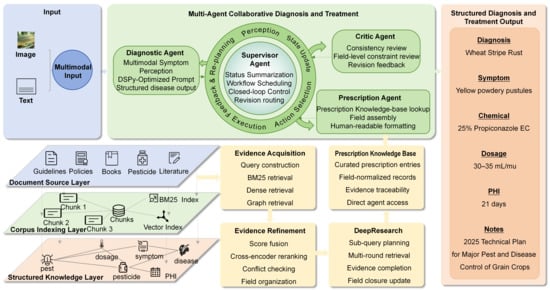
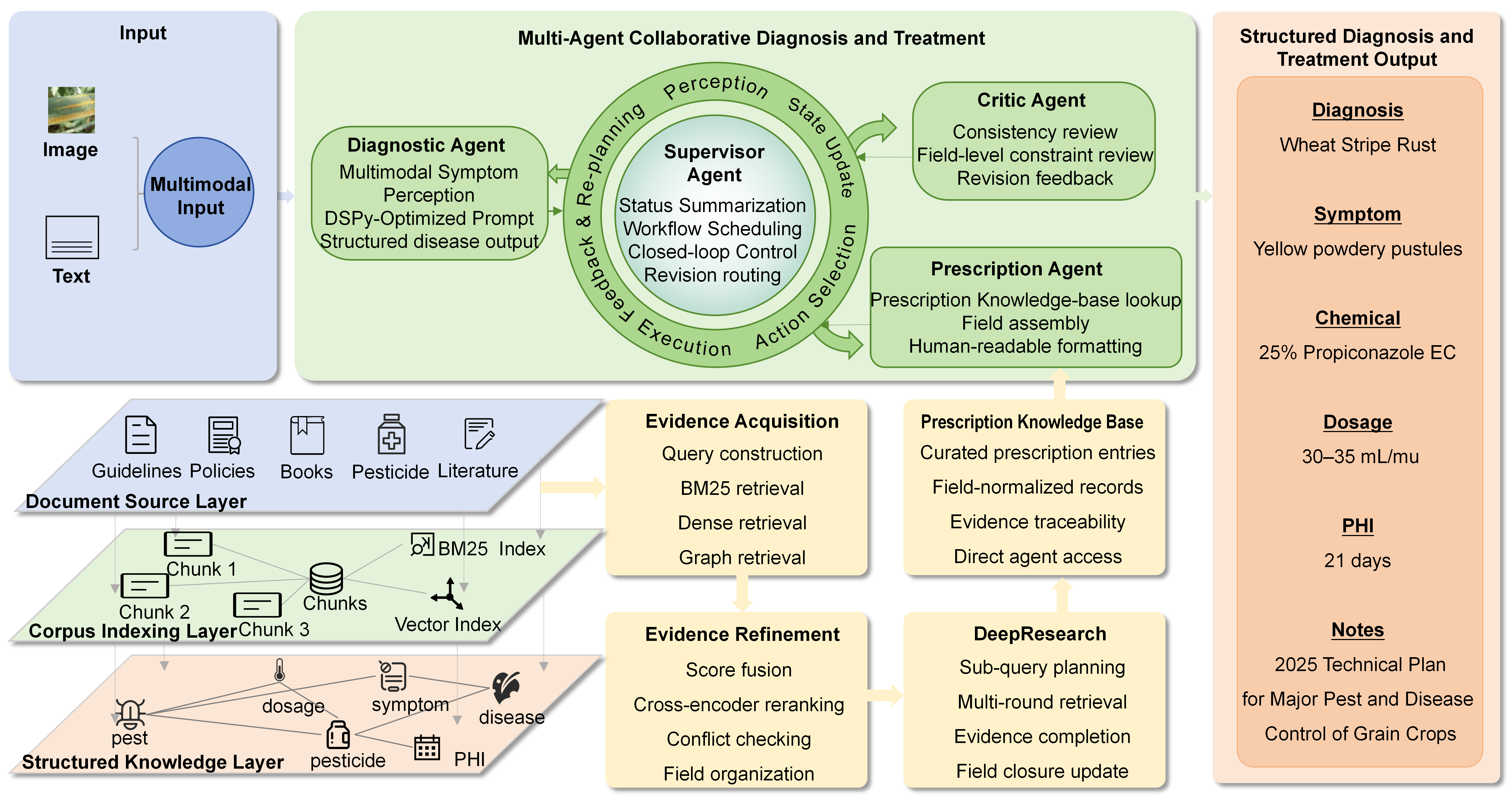
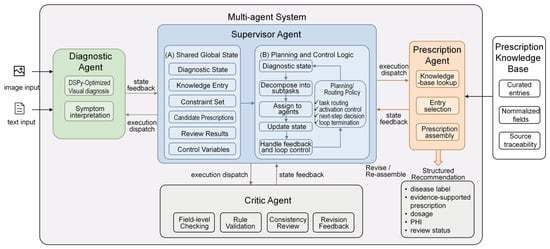
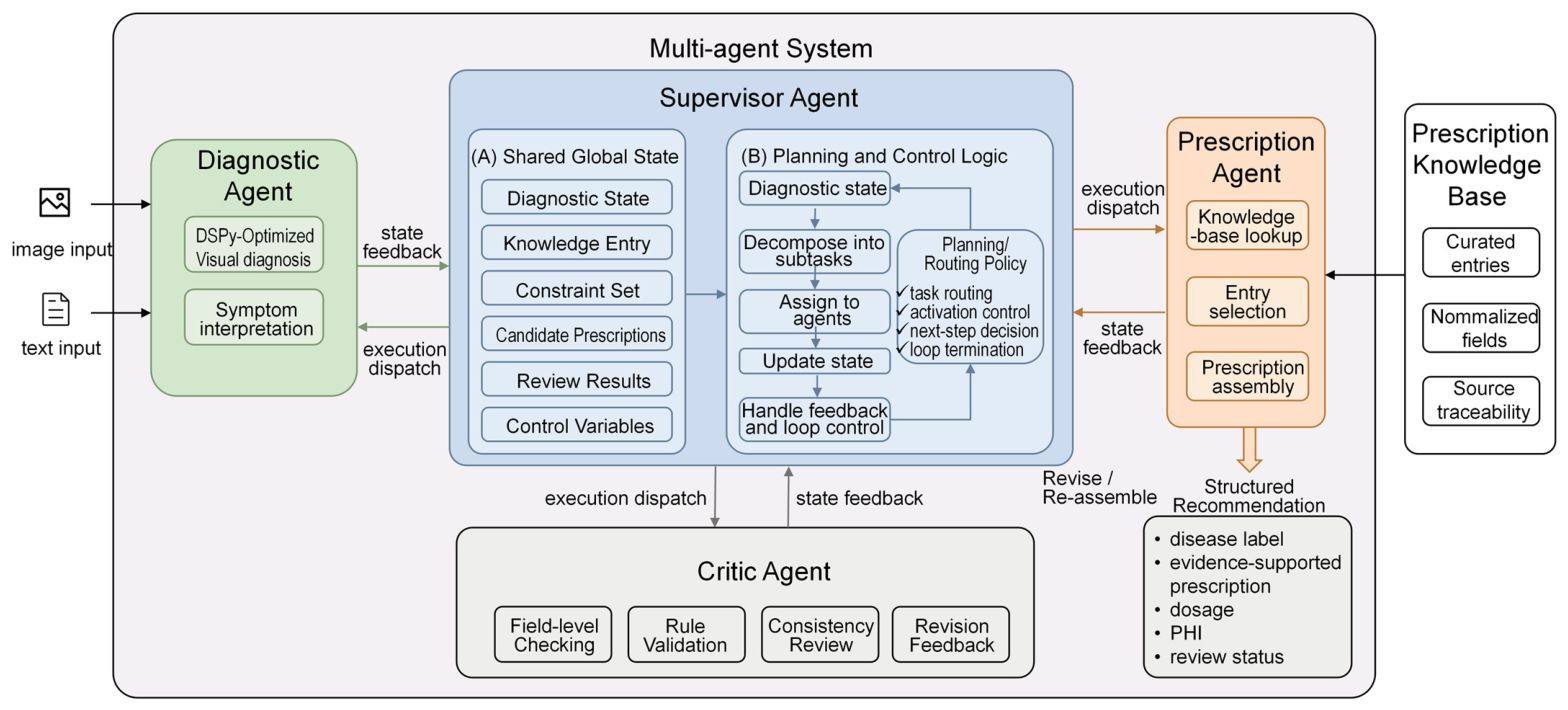
In this study, WDPG was designed as a knowledge-enhanced multi-agent framework with two linked phases. During offline knowledge-base construction, agronomic evidence is organized through the three-layer heterogeneous knowledge graph, hybrid retrieval, reranking, and DeepResearch-based evidence completion to produce a source-traceable prescription knowledge base. During inference, a wheat image with an optional symptom description is processed by the Diagnostic agent; the Prescription agent directly selects diagnosis-matched entries from the preconstructed prescription knowledge base; and the Critic agent reviews the candidate prescription. The Supervisor coordinates the inference workflow and manages the shared task state. The overall architecture of the proposed method is shown in Figure 1.
Figure 1.
Overall architecture of the multi-agent collaborative framework for wheat pest and disease diagnosis and treatment.
2.1. Materials
The experiment focused on four representative wheat threats: wheat powdery mildew, wheat stripe rust, wheat Fusarium head blight, and wheat aphid. These pests and diseases are among the most typical constraints on wheat production, substantially reducing both yield and grain quality and therefore presenting a clear need for intelligent diagnosis and treatment. At the same time, they span foliar diseases, spike diseases, and insect pests, and differ markedly in symptom manifestation, infection site, and control strategy. This diversity enables a comprehensive evaluation of the proposed system in terms of visual discrimination, knowledge-base retrieval, and standardized prescription generation [23].
In addition, the experiment included both healthy samples and an “other” category. Healthy samples were introduced to reduce the risk of misdiagnosing healthy plants, whereas the “other” category comprised non-target pests and diseases as well as diagnostically challenging cases with atypical symptoms. This design better reflects real-world field conditions and allows for a more thorough assessment of the system’s diagnostic robustness, error control, and the safety of downstream prescription generation [9].
A total of 5263 textual resources were collected from authoritative sources on wheat pest and disease management, including official plant-protection guidelines, pesticide registration and label information, technical extension documents, industry standards, professional monographs, and peer-reviewed literature published or released between January 2016 and May 2026. These resources were curated to establish a task-specific evidence base for wheat pest and disease management under China’s agricultural regulatory framework and production practices. The collected resources primarily represent nationwide Chinese agricultural contexts, covering general wheat production, pest and disease management recommendations, pesticide usage requirements, and safety regulations applicable across China. The resulting knowledge base covers five key dimensions: regulatory requirements, food production safety, application constraints, established domain knowledge, and recent research evidence.
The experimental dataset used in this study was derived from the publicly available Wheat Plant Diseases dataset released on Kaggle by Kushagra Agarwal [24]. The dataset was used as the image source for wheat pest and disease diagnosis evaluation. The original dataset contains diverse wheat disease and pest images collected for image classification research. In this study, the dataset was reorganized according to the task requirements and manually reviewed class by class before dataset partitioning. Images were retained only when the wheat target category could be verified, the corresponding symptom or pest was clearly visible, and the image quality was sufficient for diagnosis. During this process, duplicate images with identical visual content and near-duplicate images depicting the same leaf or scene with only minor differences in cropping, resizing, or image quality were identified, and only one representative image from each group was retained. Images with ambiguous labels, severe blur, heavy occlusion, unrelated crops, obvious artifacts, or samples that could not be reliably assigned to one of the predefined categories were excluded.
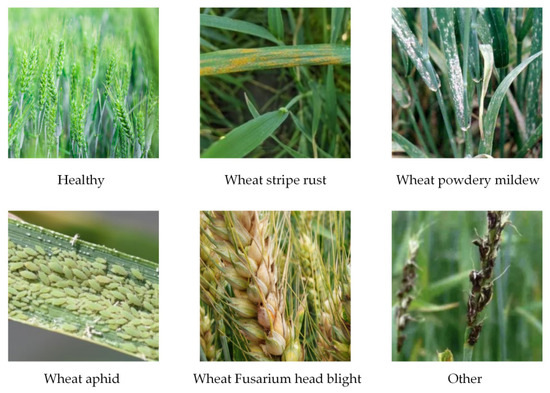
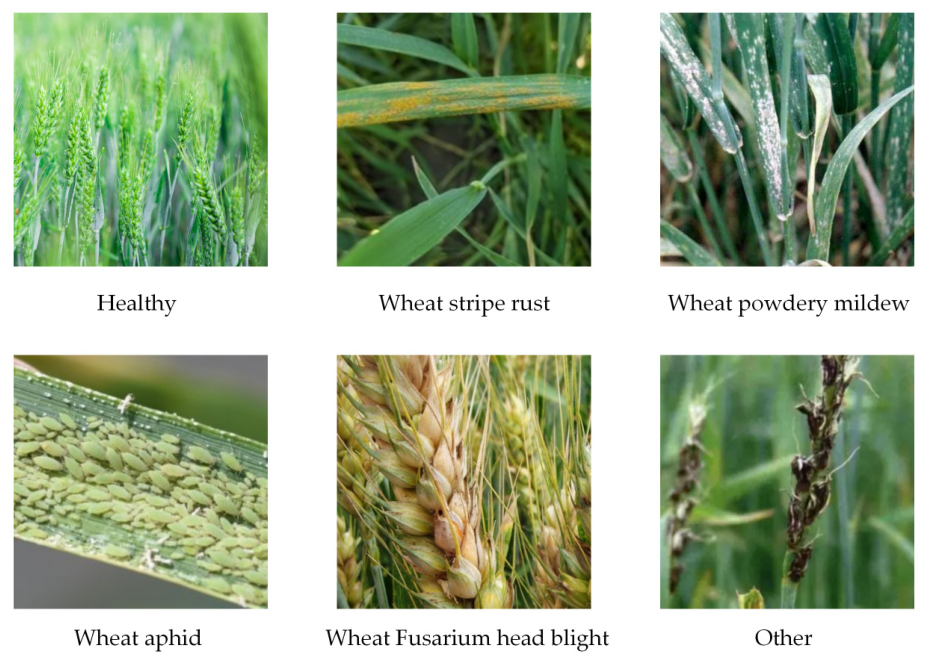
After quality screening and task-specific selection, a total of 1489 images were retained and organized into six categories: healthy, wheat stripe rust, wheat powdery mildew, wheat aphid, wheat Fusarium head blight, and other. The detailed class distribution and dataset split are presented in Table 1, and representative samples from the six categories are illustrated in Figure 2. Because this study focused on prompt optimization and end-to-end system evaluation rather than training a visual model from scratch, the dataset was divided into training, validation, and held-out test sets at a ratio of 3:3:4, resulting in 444 training images, 444 validation images, and 601 test images. The resulting subsets were subsequently rechecked to ensure that no visually identified duplicate or near-duplicate images were shared across the training, validation, and test sets. Because the public dataset did not provide reliable source-level metadata, a source-aware split based on common image sources or acquisition origins could not be performed. The pre-partition manual screening and post-partition cross-subset check were therefore used to reduce the potential risk of image leakage. The training and validation sets were used for prompt optimization and candidate selection, whereas the held-out test set was reserved exclusively for held-out test evaluation and was not involved in prompt optimization, retrieval parameter selection, prescription-set construction, or system debugging. This partition strategy ensures a strict separation between system development and final evaluation.
Table 1.
Class distribution and data split of the experimental dataset.
Figure 2.
Representative images of the six classes in the wheat pest and disease dataset.
To further evaluate robustness under common image-quality degradation, the 601 held-out test images were transformed into four deterministic perturbation variants, including reduced brightness (factor = 0.7), increased brightness (factor = 1.3), Gaussian blur (radius = 1.0), and JPEG compression (quality factor = 60). Together with the original test images, these five variants formed a perturbation-based robustness evaluation set containing 3005 images. The held-out test set was used for standard held-out evaluation, whereas the perturbation-based robustness evaluation set was used to assess model stability under degraded visual conditions.
2.2. Construction of Three-Layer Heterogeneous Knowledge Graph
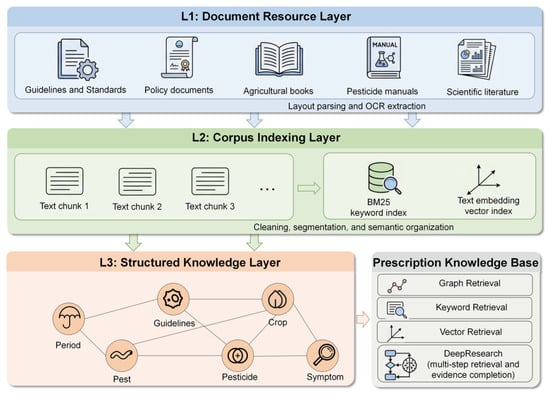
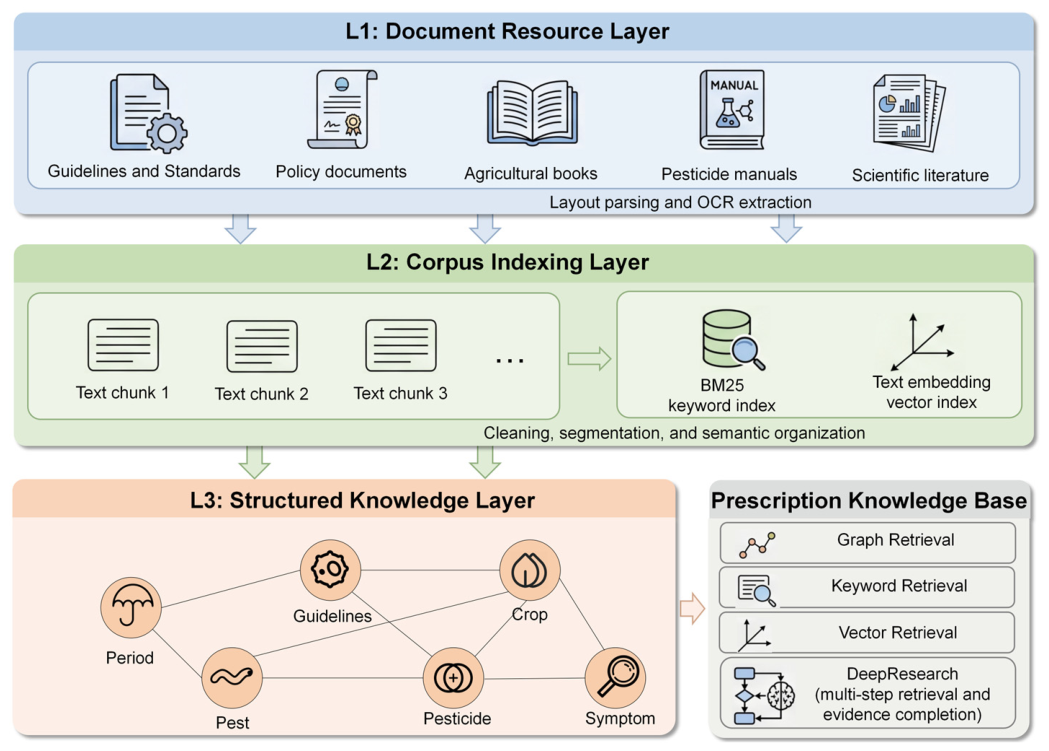
A three-layer heterogeneous knowledge graph was constructed, consisting of a document resource layer, a corpus indexing layer, and a structured knowledge layer, as shown in Figure 3.
Figure 3.
Workflow of the three-layer heterogeneous knowledge graph construction.
Wheat pest and disease prescription generation must satisfy three requirements at the same time: traceable knowledge sources, retrievable evidence content, and computable diagnostic and treatment rules. To meet these requirements, the proposed framework organizes knowledge across these three layers. The document resource layer stores authoritative agricultural materials together with their source information. The corpus indexing layer converts raw materials into retrievable evidence units. The structured knowledge layer encodes diseases, pests, pesticides, and related constraints as a relational structure that supports query and reasoning. Together, these layers provide a unified knowledge foundation for subsequent retrieval, reasoning, and prescription generation.
The document resource layer mainly preserves the document metadata required for source tracing and result auditing. For each agricultural document, it records identifiers such as doc_id, title, and source type.
The corpus indexing layer performs text normalization, corpus segmentation, and retrieval index construction over the document content. This layer calls the MinerU hybrid parsing service to convert PDF files into an intermediate Markdown representation that preserves the structure of titles and paragraphs. It then segments the content with a sliding window of 1500 characters and keeps an overlap of 150 characters between adjacent chunks to reduce information breaks across segments. Each chunk is associated with backtracking fields such as chunk_id and doc_id, which allow every evidence unit to be linked back to its original source in the document resource layer.
After segmentation, the corpus indexing layer further builds both sparse and dense indexes. Sparse retrieval uses BM25Retriever based on rank_bm25 to build a term-based retriever over the chunk-level text collection. The retrieved content mainly covers pest and disease names, pesticide names, aliases, symptom terms, and related keywords, which supports exact term matching and short-field recall. Dense retrieval uses an OpenAI-compatible embeddings interface and applies qwen3-vl-embedding-2B to generate a semantic vector for each chunk. It then writes the id, title, tags, content, and embedding into a Milvus collection. Milvus builds a Hierarchical Navigable Small World (HNSW) vector index on the embedding field and uses cosine similarity as the distance metric for nearest-neighbor retrieval. In this way, the document resource layer is responsible for preserving trustworthy sources, while the corpus indexing layer is responsible for retrieval-oriented representation. Together, the two layers complete the transformation from raw agricultural materials to callable evidence units.
Built on the normalized corpus, the structured knowledge layer constructs the knowledge graph through a two-stage process that first extracts structured facts and then maps them into graph nodes and relations. This process calls Qwen3-VL-32B-Instruct-FP8, a vision–language model (VLM), and, under a predefined JSON schema, extracts knowledge units that can directly support diagnostic and treatment decisions from each text chunk. These units include pest and disease entities, pesticide plans, active ingredients, dosage and PHI constraints, applicable crops and growth stages, and the corresponding evidence fragments. On this basis, the extracted results undergo Pydantic validation and field normalization, including required-field checking, name standardization, alias alignment, dosage-unit normalization, PHI conversion, provenance checking, and duplicate removal. The standardized pests and diseases, pesticides, symptoms, environmental factors, crops, and growth stages are then mapped into graph nodes. Relations such as pest or disease to symptom, pesticide to target organism, pesticide to dosage, and pesticide to PHI are then generated from the semantic roles of fields within each structured fact and written into Neo4j through the MERGE mechanism to reduce duplicate nodes and relations.
Through this process, heterogeneous authoritative agronomic knowledge was transformed into a structured and traceable representation that supports retrieval and downstream prescription generation and review. For prescription-related entities and relationships, supporting sources were retained during knowledge construction to enable traceability of key agricultural recommendations.
2.3. Construction of the Source-Traceable Prescription Knowledge Base
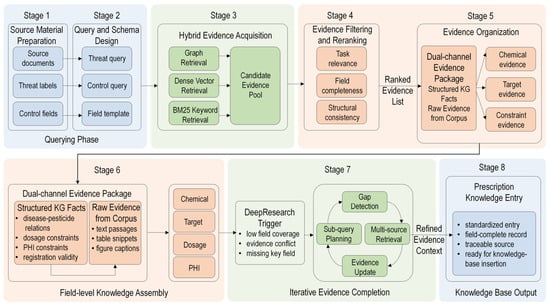
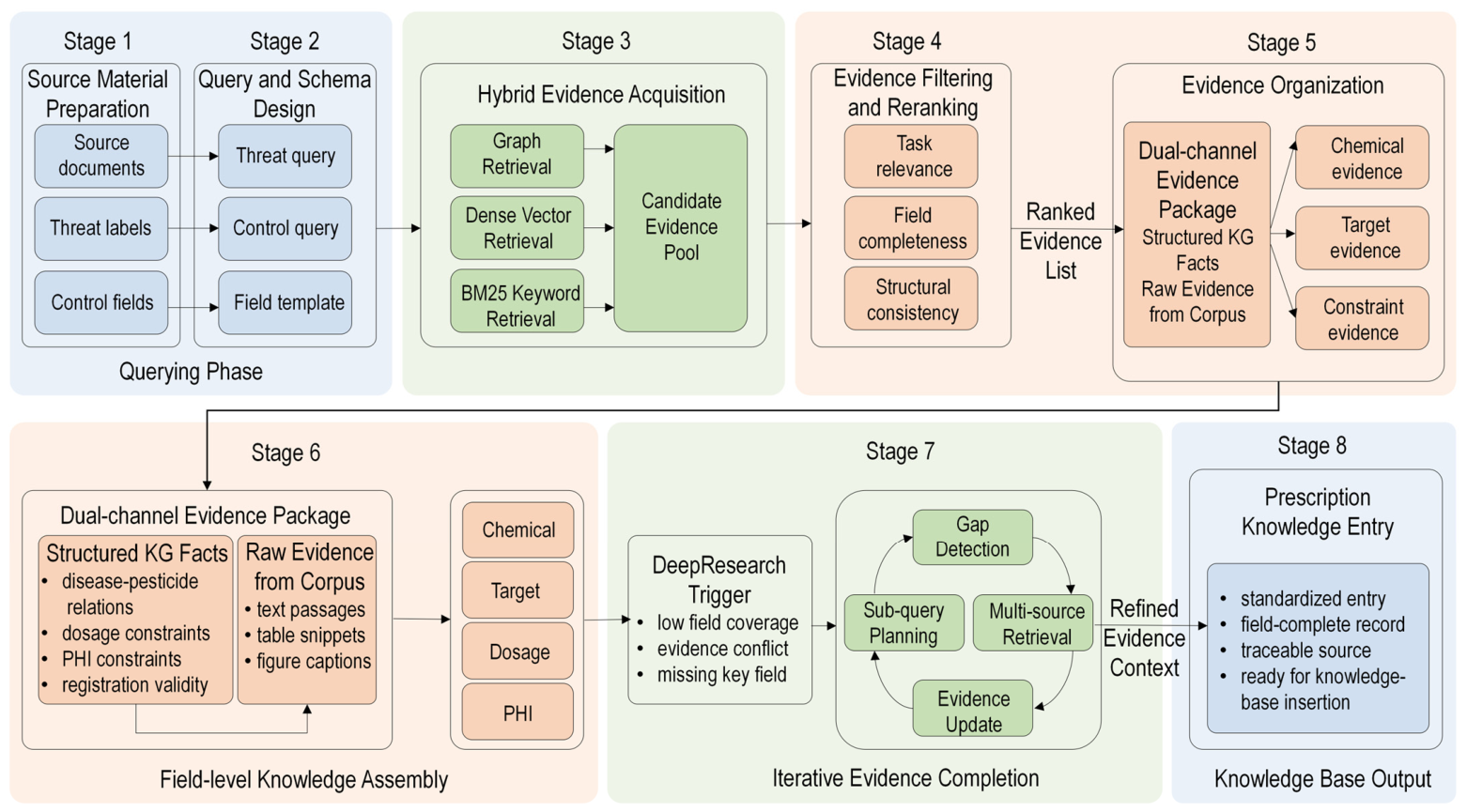
The construction of the wheat pest and disease prescription knowledge base followed a closed-loop process, mainly including evidence query construction, hybrid evidence retrieval, candidate evidence reranking, key information organization, deep evidence supplementation, and structured knowledge entry generation. During the construction process, the prescription knowledge base construction module formed retrieval queries based on standardized pest or disease labels, in order to obtain candidate evidence related to the current pest or disease from the three-layer heterogeneous knowledge graph. Under this process, standards, policy-guidance materials, and pesticide labels were given higher priority for prescription constraints, while professional references and academic literature were used to supplement applicability and updated treatment evidence. The overall construction workflow is illustrated in Figure 4.
Figure 4.
Workflow of the construction of the wheat pest and disease prescription knowledge base.
As a prerequisite step for knowledge entry generation, the retrieval module invoked in parallel the keyword retrieval channel and dense retrieval channel in the corpus indexing layer, together with the graph retrieval channel in the structured knowledge layer, and then traced the matched results back to the original sources in the document resource layer through reverse pointers such as doc_id and chunk_id. In the retrieval stage, keyword retrieval used a BM25 retriever based on rank_bm25 for exact keyword matching, dense retrieval used qwen3-vl-embedding-2B to encode both the query and text chunks into embeddings and performed semantic nearest-neighbor search in Milvus with an HNSW index, and graph retrieval queried Neo4j around the target pest or disease entity to retrieve structured relations. The outputs of the three retrieval channels were retrieved in parallel and then fused and ranked to form the candidate evidence set for downstream prescription generation and result review.
Their outputs are fused into a unified retrieval score:
where ej denotes the j-th candidate evidence item, Q denotes the retrieval query, sdense denotes semantic similarity, sBM25 denotes term and alias matching, and sgraph denotes graph relevance. wd, wt and wg are set to 0.35, 0.45, and 0.20, assigning slightly greater emphasis to lexical matching than to dense and graph signals [25,26,27].
To further improve fine-grained matching between candidate evidence and the current task, a cross-encoder reranker was adopted to refine the candidate order. The top-ranked results were then organized into two complementary channels, namely structured graph facts and raw textual evidence, which together supported downstream prescription generation and result review.
When candidate evidence could not complete the required prescription fields, the DeepResearch module was activated for field-level evidence supplementation and cross-source corroboration. The decision was made according to evidence coverage over critical fields and evidence conflict across candidate values. The trigger rule was defined as
where cov denotes evidence coverage over critical prescription fields, and conf denotes whether conflicting candidate values are detected. τcov and τconf are set to 0.75 and 0, respectively. Therefore, DeepResearch is triggered when evidence coverage is insufficient or when any evidence conflict is detected. In practice, insufficient coverage mainly referred to missing or incomplete dosage, PHI, application method, or source provenance information [28,29,30].
Once DeepResearch was triggered, sub-queries were automatically generated for missing or conflicting fields, and the system iterated over retrieval, reranking, and evidence updating within the local graph and corpus until the evidence requirement was met or the maximum number of iterations was reached. Finally, the consolidated multi-source evidence was organized into structured wheat pest and disease prescription entries. Each retained entry contained the pest or disease name, recommended pesticide, application dosage, PHI, and corresponding supporting source information, allowing critical prescription information to be traced to the original authoritative evidence.
2.4. DSPy-Based Diagnostic Prompt Optimization
The diagnosis task was defined as a structured wheat pest-and-disease diagnosis task with a DSPy Signature. The program takes a wheat image as input and produces three structured outputs: a diagnosis label, a confidence score, and a diagnosis rationale. The task signature, together with the predefined input and output fields, forms a unified interface for diagnosis and provides a consistent basis for subsequent prompt optimization.
Built upon the baseline diagnosis program, the candidate generation stage performs constraint-augmented prompt rewriting to construct multiple candidate prompt programs. Prompt revision is guided by class-specific visual features of the six classes, frequent confusion patterns observed in the training set, and expert rules from agricultural pathology. Three optimization directions are emphasized: organ-first inspection, confusion-aware prompt design, and error-guided prompt refinement. Through this process, the baseline prompt is expanded into multiple candidate diagnosis programs.
After candidate generation, the validation-set selection stage evaluates and ranks all candidate diagnosis programs. Ranking is conducted by diagnosis accuracy under the core target-class recognition setting. The best-performing candidate is then saved as a compiled prompt program.
During deployment, the compiled prompt program is loaded directly into the Diagnostic agent as the final inference prompt. In this way, DSPy supports a complete pipeline for diagnostic prompt optimization, covering structured task definition, prompt candidate generation, validation-set-based prompt selection, and final prompt deployment.
2.5. Knowledge-Aware Multi-Agent Collaborative Framework
A knowledge-aware multi-agent collaborative system was developed, comprising the Supervisor, Diagnostic, Prescription, and Critic agents. The Supervisor agent undertakes global scheduling and system state management. The overall structure of the proposed multi-agent collaborative framework is illustrated in Figure 5.
Figure 5.
Illustration of the multi-agent collaborative framework.
The Supervisor agent is responsible for global workflow scheduling and shared-state management. The system maintains the input image of the current sample, the user’s supplementary text, the diagnosis result, selected prescription knowledge entries, candidate prescription, review feedback, and the collaboration round index in a unified shared task state. After each stage is completed, the Supervisor reads these state fields and routes the workflow to the next node based on the LangGraph state graph.
The Diagnostic agent is responsible for diagnosis, and it takes the image provided by the user as the primary input and can jointly incorporate user-provided symptom descriptions to perform diagnostic inference. It invokes a DSPy-compiled and optimized diagnostic prompt program, formulates visual diagnosis as a closed-set structured prediction task, and drives the vision–language model to make judgments. The output is written into the shared state in structured form, including the pest-or-disease category, confidence score, and key visual features.
The Prescription agent is responsible for prescription assembly and standardized prescription generation. Based on the standardized pest and disease diagnosis results produced during the diagnostic phase, the agent directly accesses the preconstructed prescription knowledge base and selects the corresponding knowledge entries for the identified target. The prescription knowledge base contains structured and source-traceable treatment information, including the control target, recommended pesticide, active ingredient, dosage and application method, PHI, and precautions. The Prescription agent then organizes these entries into a standardized candidate prescription that is readable and actionable for end users.
The Critic agent is responsible for result review and revision feedback. This agent reads the diagnosis result, the prescription knowledge entries used by the Prescription agent, and the candidate prescription from the shared state, and performs field-level verification through both agricultural rule-based constraint checking and structured language-model-based review. The review focuses on the compatibility between the pesticide and the diagnosed pest or disease category, the completeness of dosage and PHI fields, and the consistency between the generated prescription and the supporting prescription knowledge entries. The review result is written back into the shared state in structured form, including the pass/fail decision, the issue list, and the rerouting target. When the current prescription satisfies the release criteria, the system preserves the final diagnosis-and-treatment result. When key fields are still missing, constraints remain inconsistent, or the generated prescription is not adequately supported by the referenced prescription knowledge entries, the Critic provides explicit revision instructions and triggers the Supervisor to route the task back to the Prescription stage for prescription revision and correction.
2.6. Hardware and Software Environment
All experiments were conducted on a server running Ubuntu 24.04.3 LTS and equipped with four NVIDIA GeForce RTX 4090 GPUs (NVIDIA Corporation, Santa Clara, CA, USA). The system was implemented in Python 3.12.3 with PyTorch 2.11.0+cu130, CUDA 13.0, LangGraph 1.0.7, Neo4j 4.4.39 Enterprise, Neo4j Python driver 6.1.0, Milvus 2.6.6, PyMilvus 2.6.10, DSPy 3.2.1, Pydantic 2.13.4, rank_bm25 0.2.2, and MinerU 2.7.1. The core vision–language model was Qwen3-VL-32B-Instruct-FP8 and was served through an OpenAI-compatible endpoint using the LMCache v0.3.10 container image. The dense retriever used qwen3-vl-embedding-2B, and candidate evidence was reranked by bge-reranker-v2-m3; both models were served using vLLM 0.11.2.
For retrieval, keyword retrieval used BM25 based on rank_bm25 with top-k = 4; dense retrieval used Milvus HNSW indexing and cosine similarity with top-k = 4; and graph retrieval queried Neo4j around the target pest or disease entity with top-k = 6. The three retrieval channels were combined by weighted rank fusion after deduplication, with weights of 0.45, 0.35, and 0.20 for BM25, dense retrieval, and graph retrieval, respectively. The fused candidates were reranked, and the top 8 evidence items were retained for downstream prescription generation and review. DeepResearch used per-route top-k = 8, graph top-k capped at 6, and a maximum of 2 rounds.
For inference, the temperature was set to 0.0 for all agents, with max_tokens set to 900, 600, 1200, and 1400 for the Diagnostic, Supervisor, Prescription, and Critic agents, respectively.
2.7. Evaluation Metrics
For a set of N samples indexed by i, diagnostic accuracy is defined as
where 𝕀(·) is the indicator function, which equals 1 when the predicted label matches the ground-truth label and 0 otherwise. denotes the predicted label and yi denotes the ground-truth label.
For class c, precision Pc, recall Rc, and F1 score F1c are defined as
where TPc, FPc, and FNc denote the numbers of true positives, false positives, and false negatives for class c, respectively.
The macro-averaged metrics are further defined as the arithmetic mean over all classes:
where C denotes the total number of diagnostic classes.
The quality of prescription generation was evaluated using diagnosis-gated end-to-end metrics. For sample i, yi and denote the ground-truth and predicted diagnostic labels, respectively. Diagnosis correctness is defined as
where ci = 1 indicates a correct diagnosis and ci = 0 otherwise.
The blinded expert assessment produced four binary acceptability indicators:
where indicates whether the recommended pesticide or active ingredient is applicable to the reference target pest or disease; indicates whether the dosage is explicitly provided and is agronomically reasonable and safety-compliant for the recommended pesticide and target; indicates whether the PHI is explicitly provided and consistent with the applicable safety requirements; and indicates whether the overall prescription contains no obvious safety risk. These indicators represent expert-adjudicated agronomic and safety acceptability and do not require exact equality with a single predefined prescription.
Pesticide accuracy is defined as
Dosage accuracy and PHI accuracy are respectively defined as
Full-prescription accuracy is defined as
To distinguish downstream prescription quality from upstream diagnostic performance, prescription performance conditional on correct diagnosis was additionally calculated using the number of samples with ci = 1 as the denominator.
Accordingly, an incorrect diagnosis was scored as incorrect for all downstream prescription-related metrics, even when one or more generated prescription fields happened to overlap with an acceptable treatment option for the ground-truth target. For healthy and other cases, the prescription-related criteria were considered satisfied only when the corresponding category was correctly diagnosed and no pesticide prescription was generated.
To establish the acceptability labels, all system outputs were anonymized and randomly shuffled before expert assessment. Two wheat plant-protection experts independently evaluated each output without knowing the system identity or the other expert’s judgment.
Pesticide correctness was determined according to whether the recommended pesticide or active ingredient was applicable to the reference target pest or disease and consistent with the applicable pesticide registration information, product label, or official technical guidance. Dosage correctness required the dosage to be explicitly provided, agronomically reasonable for the stated pesticide or formulation, and consistent with the applicable labeled or officially recommended use requirements. PHI correctness required the pre-harvest interval to be explicitly provided and consistent with the applicable product-label or regulatory safety-interval requirements. A full prescription was considered correct only when the pesticide, dosage, and PHI were all acceptable and the overall recommendation contained no obvious safety risk or conflict with the applicable use restrictions.
The evaluation did not require exact matching to a single predefined prescription entry. Multiple pesticides, dosage values or ranges, and PHI values could be considered acceptable when they were judged to be agronomically appropriate and safety-compliant for the reference target. When the two experts disagreed, a third expert conducted arbitration, and the adjudicated judgment was used as the final evaluation label.
3. Results
3.1. Knowledge Graph and Prescription Knowledge Base
This section presents the knowledge foundation of the proposed framework, including the three-layer wheat pest and disease knowledge graph and the prescription knowledge base constructed on top of it. The knowledge graph organizes heterogeneous agricultural knowledge from structured relations, indexed corpus evidence, and source documents into a unified and traceable representation, providing the basis for evidence retrieval and knowledge integration. Building on this foundation, the prescription knowledge base further consolidates standardized and source-traceable treatment-related knowledge into structured prescription entries that can be directly used in downstream decision support.
3.1.1. Three-Layer Wheat Pest and Disease Knowledge Graph
The constructed knowledge graph provided a unified structured knowledge foundation for intelligent diagnosis and treatment of wheat pests and diseases. It integrates source documents, corpus fragments, standardized entities, diagnostic relations and pesticide-use constraints into a coherent knowledge chain. Based on the mapped standard entities, the system further associates candidate entities with their symptom manifestations, triggering environments, control pesticides, dosage constraints, and PHI requirements, thereby providing entity-level knowledge support for subsequent diagnosis confirmation, prescription generation, and result review. For retrieval and rule representation, the graph traces diagnostic evidence back to the original documents and retrieves relevant knowledge through sparse and dense retrieval channels, while representing pesticide application rules in a computable form. Overall, the graph provides a traceable, retrievable, and rule-aware knowledge foundation for evidence completion, multi-agent reasoning, prescription generation and result review. The structural scale of the three-layer heterogeneous knowledge graph across source documents, indexed evidence fragments, standardized entities, and treatment relations is summarized in Table 2.
Table 2.
Scale of the three-layer heterogeneous knowledge graph.
3.1.2. Construction Outcomes and Quality Control of the Prescription Knowledge Base
The prescription knowledge base covers the four actionable wheat pest and disease categories considered in this study and organizes treatment knowledge from standards, official guidance documents, pesticide labels, professional references, and academic literature into standardized entries for use by the Prescription agent. Each entry is centered on the control target and preserves the key fields required for prescription generation and review, including the recommended pesticide, dosage, and PHI. The prescription knowledge base was intended to provide source-supported and commonly recommended treatment options for generating safe and executable prescriptions within a defined set of recommendations, rather than to enumerate all pesticide products registered for wheat pests and diseases.
Under the current architecture, the quality of the prescription knowledge base mainly depends on whether candidate entries can be completed into directly usable prescriptions. Therefore, we compared the BASE setting with the DEEP setting to evaluate whether DeepResearch improves the completeness of key prescription fields. The results are shown in Table 3.
Table 3.
Field-completeness comparison of prescription entries under the BASE and DEEP settings.
Basic retrieval identified 35 candidate entries with sufficient supporting evidence for the pesticide field. Under the BASE setting, 28 entries also had sufficient dosage support and 24 had sufficient PHI support. Consequently, 24 entries satisfied the retention criteria requiring source-supported pesticide, dosage, and PHI fields. The remaining 11 entries did not satisfy the retention criteria under BASE because the dosage, PHI, or both lacked sufficient supporting evidence and were therefore not included in the retained BASE set. Under the DEEP setting, targeted evidence completion supplied the missing field-level evidence, enabling all 35 entries to satisfy the retention criteria. The resulting DEEP prescription knowledge base therefore contained 35 valid entries, and no entry was excluded after evidence completion. Each retained entry preserved supporting source information, allowing the corresponding treatment information to be traced back to the original evidence.
Within WDPG, the prescription knowledge base provides source-supported treatment information for the Prescription agent and supports constraint checking by the Critic agent.
3.2. Visual Diagnosis Performance
To examine the effect of DSPy-based prompt optimization on front-end diagnosis, the 601-sample clean held-out test set was used, covering four actionable wheat pest and disease categories together with the healthy and other classes. This evaluation assessed whether the front-end diagnosis module could distinguish treatable cases from non-actionable cases under diverse public-image conditions. The direct vision–language model (VLM), the DSPy-structured diagnostic program with the non-optimized baseline prompt (BASE), and WDPG using the optimized diagnostic prompt were compared. The results are summarized in Table 4.
Table 4.
Visual diagnosis performance of VLM, BASE, and WDPG on the 601-sample clean held-out test set.
The VLM achieved 0.6889 in classification accuracy and 0.6246 in macro F1, indicating that direct diagnosis by the base vision–language model captured part of the disease and pest cues but remained unstable across visually similar categories. After introducing the DSPy-structured diagnostic program with the non-optimized baseline prompt, the BASE setting increased accuracy to 0.7854 and macro F1 to 0.7613. This improvement suggests that a clearer task boundary and fixed output schema can reduce errors caused by unconstrained free-form generation.
WDPG further improved diagnostic performance, achieving 0.9218 accuracy, 0.9242 macro precision, 0.9204 macro recall, and 0.9212 macro F1. This gain did not come from changing the underlying vision–language model, but from optimizing the diagnostic prompt within the same structured DSPy program. The optimized diagnostic prompt incorporated task-specific constraints for organ-focused inspection, confusion-aware category discrimination, and correction of recurring misclassifications observed during prompt selection. As a result, the model was more likely to attend to discriminative visual evidence such as lesion texture, color variation, symptom location, and insect distribution.
From the perspective of a multi-stage diagnosis-to-prescription workflow, front-end diagnostic stability sets the practical upper bound for downstream prescription generation. Prescription generation for wheat pest and disease management follows a fixed order from diagnosis to knowledge-base lookup, prescription assembly, and constraint-based review. Therefore, a more accurate diagnosis provides a more reliable class entry for selecting the appropriate prescription knowledge.
3.3. Comparison with Frontier Multimodal Models
To assess whether the proposed framework improves upon the original VLM and remains competitive against frontier general-purpose models, we compare four system configurations: direct inference with VLM, GLM-4.6V, and GPT-5.5, and the proposed WDPG framework on the same 601-image held-out test set. The comparison was conducted at the system level. General-purpose multimodal models generated outputs directly from task instructions, whereas WDPG integrated task-specific agricultural knowledge representation, a preconstructed source-traceable prescription knowledge base, and Critic-based verification as components of the complete decision framework. All methods used the same input images, category definitions, output schema, diagnostic labels, and scoring rules, with the blinded expert-adjudicated labels serving as the reference for prescription-related metrics. GPT-5.5 and GLM-4.6V were provided with the same task instruction, disease and pest category scope, prescription output requirements, and evaluation-oriented prompt constraints. The diagnosis layer reports accuracy, precision, recall, and F1, while the prescription layer reports pesticide, dosage, PHI, and full-prescription accuracy. For correctly diagnosed healthy and other cases, withholding a pesticide prescription is treated as correct in the end-to-end evaluation. The results are shown in Table 5, where point estimates with 95% bootstrap confidence intervals are reported.
Table 5.
Performance comparison of different multimodal models on the 601-image held-out test set. Values are reported as point estimates with 95% bootstrap confidence intervals in brackets.
To separate downstream prescription quality from upstream diagnostic performance, prescription performance was also examined among correctly diagnosed samples. Conditional full-prescription accuracy was 0.2367 (98/414) for VLM, 0.2520 (96/381) for GLM-4.6V, 0.4656 (210/451) for GPT-5.5, and 1.0000 (554/554) for WDPG. For WDPG, conditional pesticide, dosage, and PHI accuracies were also 1.0000.
Among the 190 ground-truth healthy and other samples, WDPG correctly withheld pesticide recommendations for 172 samples, corresponding to a correct withholding rate of 90.5%.
To further examine the practical advantage of WDPG in agricultural diagnosis and treatment, we compare VLM, GLM-4.6V, GPT-5.5, and WDPG. This comparison is meaningful in practice because general-purpose multimodal models are among the strongest AI tools that ordinary users can directly access without building a specialized agricultural system. In this setting, GPT-5.5 and GLM-4.6V generated diagnosis and prescription outputs directly from the task input and prompt, whereas WDPG used its task-specific knowledge graph, source-traceable prescription knowledge base and Critic agent review process as components of the proposed framework. WDPG is built upon an underlying multimodal model and integrates task-oriented knowledge organization, evidence supplementation, and closed-loop agent collaboration. Therefore, the reported gains reflect the value of the integrated WDPG framework for this task.
In the visual diagnosis stage, WDPG achieves higher accuracy and macro F1 than both GPT-5.5 and GLM-4.6V. This result suggests that structured task optimization can substantially improve front-end diagnostic stability on field-scene images with complex natural backgrounds.
The difference becomes larger in prescription generation. GPT-5.5 and GLM-4.6V remain partly usable for basic pesticide recommendation, but their performance drops sharply once the task requires joint validation over dosage, PHI, and other constrained fields. The full-prescription accuracies of GPT-5.5 and GLM-4.6V were 0.3494 and 0.1597, respectively. By contrast, WDPG achieved 0.9218 on the same metric. This gap indicates that the evaluated general-purpose multimodal systems did not consistently satisfy all prescription-field constraints in this task. These models are strong at generating answers from semantic knowledge, but a single forward pass is often not enough when the output must remain aligned with external facts such as registration rules, label-compliant dosage, and PHI.
The strength of WDPG lies in its process design. The visual module first provides a more reliable diagnosis. During offline knowledge-base construction, the knowledge graph supports hybrid evidence retrieval, DeepResearch supplements missing or conflicting prescription fields, and the resulting entries are stored in a source-traceable prescription knowledge base. During inference, the Prescription agent selects diagnosis-matched entries from the preconstructed knowledge base, and the Critic agent reviews the candidate prescription. Through this process, diagnosis, retrieval, evidence supplementation, verification, and prescription output are organized into a closed decision chain, and these components jointly form a task-specialized system for wheat pest and disease diagnosis and prescription generation, enabling the system to produce more reliable and executable prescriptions under agricultural safety constraints. Beyond predictive performance, response efficiency and practical feasibility are also important for agricultural diagnosis and treatment systems. Based on the saved prediction logs, WDPG required an average end-to-end latency of 5.43 s per sample, slightly longer than direct VLM inference (4.26 s) but shorter than GPT-5.5 (13.50 s) and GLM-4.6V (13.95 s) because it includes structured diagnosis, knowledge-base lookup, prescription selection, and constraint-based review. This additional latency was accompanied by a substantial improvement in prescription quality, with full-prescription accuracy reaching 0.9218. These results suggest that WDPG is more suitable for offline or semi-online prescription decision support, where dosage, PHI, and pesticide safety constraints are more important than millisecond-level response [31,32].
To further evaluate whether the observed improvements were statistically significant, bootstrap confidence intervals and paired statistical tests were conducted on the same held-out test samples. Bootstrap resampling with 2000 iterations was used to estimate 95% confidence intervals. McNemar tests were applied to compare diagnosis correctness, and paired bootstrap tests were used to compare full-prescription accuracy differences. The results of pairwise comparisons are summarized in Table 6.
Table 6.
Pairwise statistical comparisons between multimodal models on the 601-image held-out test set.
As shown in Table 6, comparisons involving WDPG demonstrated statistically significant improvements over all baseline models in both diagnosis correctness and full-prescription accuracy (p < 0.001).
3.4. Robustness Evaluation
To evaluate the stability of different multimodal models under degraded visual conditions, we further tested all models on the perturbation-based robustness evaluation set. The overall performance results are summarized in Table 7.
Table 7.
Overall performance comparison on the 3005-image perturbation-based robustness evaluation set.
As shown in Table 7, WDPG maintained the highest performance across both diagnosis and prescription-related tasks under the robustness evaluation setting. It achieved a diagnosis accuracy of 0.9005 and an F1 score of 0.9004, substantially outperforming VLM, GLM-4.6V, and GPT-5.5. Meanwhile, WDPG achieved 0.9005 accuracy for full prescription generation, indicating that the proposed framework remained effective when visual inputs were affected by common quality degradation.
Under the tested perturbations, WDPG’s diagnostic stability primarily reflects the DSPy-optimized structured diagnostic program. Once a diagnosis passes the prescription-eligibility rule, the source-traceable prescription knowledge base and constraint-based review help maintain the consistency of downstream prescription fields. These results characterize the integrated workflow under the specified image-quality degradations.
These results demonstrate that WDPG maintained stronger performance than the evaluated baseline systems under the tested image perturbations.
3.5. Wheat Diagnosis and Treatment Platform Development
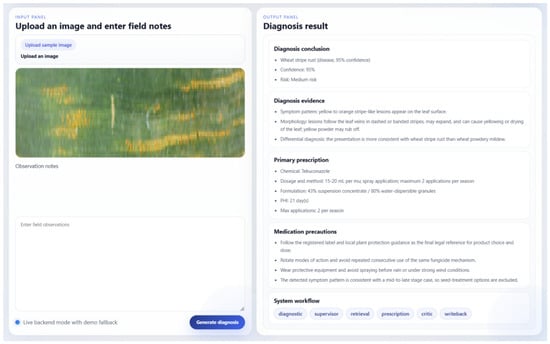
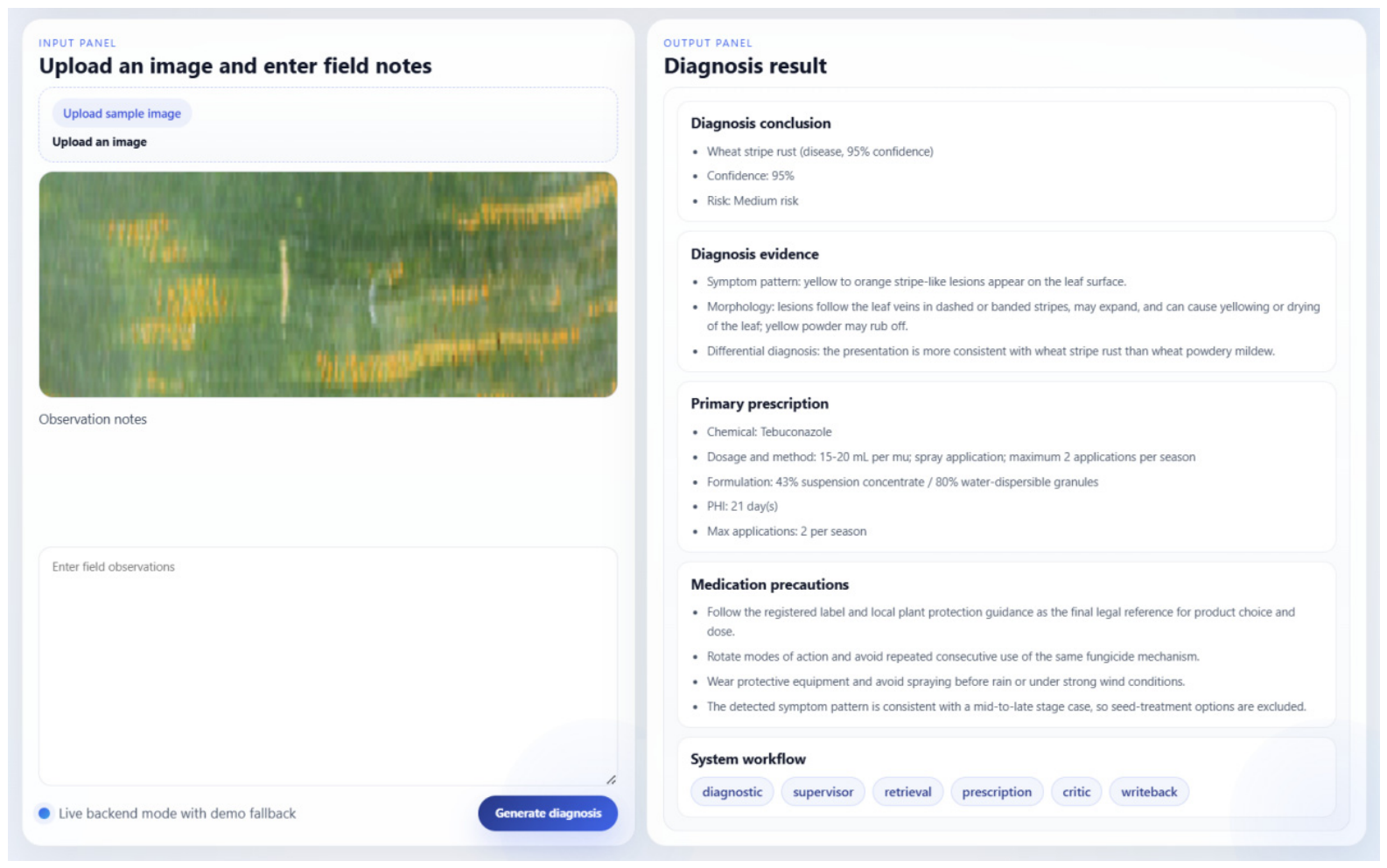
The wheat pest and disease diagnosis and prescription recommendation platform adopts a decoupled front-end/back-end architecture. The front end handles user interaction and result presentation, including image upload, sample preview, symptom-text input, and diagnosis-result visualization. The back end handles multi-agent scheduling and workflow orchestration. After receiving the input, it sequentially executes the diagnosis, knowledge-base lookup, prescription generation, and review stages to complete the closed loop from symptom perception to prescription output. This design keeps diagnosis results grounded in knowledge and helps prescription recommendations satisfy compliance and safety requirements. The interface follows a dual-column layout with input on the left and output on the right. The input panel supports image upload, sample preview, and text entry. The output panel presents the diagnosis name, confidence, reasoning mode, diagnosis rationale, prescription recommendation, and supplementary notes. This layout exposes the collaborative structure of the multi-agent workflow and allows users to trace the evidence behind both the diagnosis and the prescription recommendation. The deployed platform interface is shown in Figure 6.
Figure 6.
Interactive platform for wheat pest and disease diagnosis and prescription recommendation based on multi-agent collaboration.
4. Discussion and Limitations
Previous studies have addressed crop disease recognition [4,5,6,18], agricultural knowledge organization and decision support [7,9,19], and retrieval-enhanced or multi-agent reasoning [11,12,13,14,15,21] from different perspectives. WDPG connects these research directions within a prescription-oriented diagnosis-to-treatment process. Visual diagnosis provides the structured entry point, while heterogeneous agronomic evidence is reorganized around prescription-relevant fields, including pesticide, dosage, PHI, and provenance. During prescription knowledge-base construction, incomplete or insufficiently supported fields trigger targeted evidence completion before the entries are finalized. During inference, structured intermediate outputs connect diagnosis, prescription selection, and constraint review under explicit prescription-field requirements. The contribution of WDPG is therefore reflected in its end-to-end task formulation, prescription-oriented knowledge operationalization, and controlled transformation of diagnostic evidence into source-traceable treatment recommendations.
To clarify the remaining diagnostic boundary of WDPG, we inspected the final diagnostic prediction logs. In the 601-sample test set, the Diagnostic agent achieved an accuracy of 0.9218, and the remaining errors were concentrated in visually ambiguous cases. The main error patterns included wheat Fusarium head blight being predicted as healthy, wheat stripe rust being predicted as healthy or other, and wheat powdery mildew being predicted as wheat stripe rust. These errors mainly occurred when symptoms were weak, lesion areas were not sufficiently visible, or the image contained non-target abnormalities with visual appearances similar to the target categories. Future work will develop and quantitatively evaluate an interactive clarification mechanism that requests additional images or symptom information before reconsidering withheld cases.
The comparison with GPT-5.5 and GLM-4.6V should be interpreted as an application-level system comparison rather than a model-only comparison under identical knowledge access. The baselines used the same test set, input format, output schema, and scoring protocol, but did not use WDPG’s preconstructed source-traceable prescription knowledge base or Critic agent review process. The observed gains therefore reflect the combined effect of diagnostic prompt optimization, structured prescription knowledge, evidence supplementation, and constraint-based review.
Several limitations remain. First, the current knowledge base is designed for nationwide wheat pest and disease management scenarios in China and should be interpreted within the scope of the included Chinese regulatory and agronomic contexts. Although the prescription knowledge base provides treatment options for the four actionable wheat pest and disease categories considered in this study, it does not yet fully cover all wheat pests and diseases, province-specific pesticide-use regulations, registered products, growth-stage-specific prescriptions, or environment-dependent application conditions. Therefore, WDPG should be regarded as a decision-support framework rather than an autonomous pesticide-application system. The generated recommendations are intended to support, rather than replace, decisions by qualified plant-protection personnel and should not substitute local pesticide regulations, registered product labels, or field-specific safety assessments. Future work will further improve the geographical adaptability of the knowledge base by incorporating regional pesticide registration information, local crop management practices, pest occurrence patterns, and location-specific expert knowledge. Such extensions may enable the transition from nationwide recommendations to region-specific decision support for different wheat production environments.
Second, although the image dataset was derived from a publicly available Kaggle dataset, it remains limited in scale and does not constitute external validation across independent regions, seasons, farms, or research groups. The test set was kept separate from system development; however, because some images were obtained from public online sources, potential overlap with the pretraining data of the vision–language models cannot be ruled out. Future studies should validate the system on larger, newly collected field datasets spanning multiple locations and seasons, and further divide the “other” category into more specific subcategories such as non-target disease, non-target pest, atypical symptom, and low-confidence or uncertain cases.
Finally, the current experiments quantify the effects of DSPy-based diagnostic optimization and DeepResearch-based evidence completion at their respective stages, while the end-to-end comparison evaluates the complete WDPG workflow. The independent contributions of hybrid retrieval, reranking, Critic-based verification, and multi-agent coordination remain to be examined in future work. Within the current study, the knowledge graph was examined through its use in the integrated WDPG workflow, while Table 2 reports its structural scale. This structural characterization is distinct from an independent validation of the accuracy and completeness of the knowledge graph. A dedicated component-level evaluation of entity and relation extraction accuracy, retrieval accuracy, graph coverage, and provenance correctness remains for future work. Future work should further include repeated runs, confidence calibration, and safety-focused uncertainty analysis. Following Nansen et al. [33], further controlled perturbation tests such as cropping and occlusion should be added to quantify robustness under more complex image degradation scenarios.
5. Conclusions
This study proposed WDPG, a knowledge-aware optimization framework for standardized prescription generation in wheat pest and disease management. The framework organizes curated agronomic knowledge from authoritative and traceable sources into a three-layer heterogeneous knowledge graph and further derives a source-supported prescription knowledge base, thereby providing a retrievable, constraint-aware, and traceable knowledge foundation. On this basis, DSPy-based diagnosis optimization, DeepResearch-based evidence supplementation, and multi-agent closed-loop generation and review are integrated into a continuous process from field-scene image diagnosis to operationally complete treatment output. Experiments on a 601-sample held-out test set show that the integrated WDPG system achieves an end-to-end full-prescription accuracy of 0.9218 and demonstrates better overall performance than GPT-5.5 and GLM-4.6V for wheat pest and disease diagnosis and prescription generation. These results support the contribution of explicit prescription constraints, evidence completion, and prescription-field verification to structured and source-grounded agricultural prescription generation. The proposed method provides a reusable framework for knowledge-grounded wheat diagnosis and standardized prescription decision support.
Author Contributions
Conceptualization, J.C., Q.Z., H.Q. and B.F.; methodology, J.C.; software, J.C.; validation, B.F. and C.Y.; formal analysis, J.C.; investigation, C.Y.; resources, X.L.; data curation, J.C.; writing—original draft preparation, J.C.; writing—review and editing, H.Q. and X.L.; visualization, C.Y.; supervision, Q.Z. and H.Q.; project administration, X.L.; funding acquisition, Q.Z. All authors have read and agreed to the published version of the manuscript.
Funding
This research was funded by the National Key Research and Development Program of China, grant number 2023YFD2000102.
Data Availability Statement
Publicly available image data were analyzed in this study. The original wheat image data are available from the Kaggle dataset Wheat Plant Diseases at https://www.kaggle.com/datasets/kushagra3204/wheat-plant-diseases (accessed on 14 August 2026). The implementation code used in this study is openly available in the WDPG GitHub repository at https://github.com/cuaqian/WDPG (accessed on 14 August 2026).
Conflicts of Interest
The authors declare no conflicts of interest.
References
- Joshi, P.; Sandhu, K.S.; Singh Dhillon, G.; Chen, J.; Bohara, K. Detection and Monitoring Wheat Diseases Using Unmanned Aerial Vehicles (UAVs). Comput. Electron. Agric. 2024, 224, 109158. [Google Scholar] [CrossRef] [Scilit]
- Li, H.; Wu, H.; Li, Q.; Zhao, C. A Review on Enhancing Agricultural Intelligence with Large Language Models. Artif. Intell. Agric. 2025, 15, 671–685. [Google Scholar] [CrossRef] [Scilit]
- Chakrabarty, S.; Deb, C.K.; Marwaha, S.; Haque, M.A.; Kamil, D.; Bheemanahalli, R.; Shashank, P.R. Application of Artificial Intelligence in Insect Pest Identification—A Review. Artif. Intell. Agric. 2026, 16, 44–61. [Google Scholar] [CrossRef] [Scilit]
- Pacal, I.; Kunduracioglu, I.; Alma, M.H.; Deveci, M.; Kadry, S.; Nedoma, J.; Slany, V.; Martinek, R. A Systematic Review of Deep Learning Techniques for Plant Diseases. Artif. Intell. Rev. 2024, 57, 304. [Google Scholar] [CrossRef] [Scilit]
- Zhang, Y.; Liu, D. Rethinking Feature Representation and Attention Mechanisms in Intelligent Recognition of Leaf Pests and Diseases in Wheat. Sci. Rep. 2025, 15, 15624. [Google Scholar] [CrossRef] [Scilit] [PubMed]
- Dong, T.; Ma, X.; Huang, B.; Zhong, W.; Han, Q.; Wu, Q.; Tang, Y. Wheat Disease Recognition Method Based on the SC-ConvNeXt Network Model. Sci. Rep. 2024, 14, 32040. [Google Scholar] [CrossRef] [Scilit] [PubMed]
- Liu, K.; Cui, Y. Automated Knowledge Extraction in the Field of Wheat Sharp Eyespot Control. Information 2024, 15, 367. [Google Scholar] [CrossRef] [Scilit]
- Jiang, J.; Yan, L.; Liu, J. Agricultural Large Language Model Based on Precise Knowledge Retrieval and Knowledge Collaborative Generation. Smart Agric. 2025, 7, 20–32. [Google Scholar] [CrossRef]
- Wang, K.; Miao, Y.; Wang, X.; Li, Y.; Li, F.; Song, H. Research on the Construction of a Knowledge Graph for Tomato Leaf Pests and Diseases Based on the Named Entity Recognition Model. Front. Plant Sci. 2024, 15, 1482275. [Google Scholar] [CrossRef] [Scilit] [PubMed]
- Wang, J.; Fu, J.; Wang, R.; Song, L.; Bian, J. PIKE-RAG: sPecIalized KnowledgE and Rationale Augmented Generation. arXiv 2025, arXiv:2501.11551. [Google Scholar]
- Ammann, P.J.L.; Golde, J.; Akbik, A. Question Decomposition for Retrieval-Augmented Generation. In Proceedings of the 63rd Annual Meeting of the Association for Computational Linguistics (Volume 4: Student Research Workshop), Vienna, Austria, 27 July–1 August 2025; pp. 497–507. [Google Scholar] [CrossRef] [Scilit]
- Sun, Y.; Sun, K.; Xu, Y.E.; Yang, X.; Dong, X.L.; Tang, N.; Chen, L. KERAG: Knowledge-Enhanced Retrieval-Augmented Generation for Advanced Question Answering. In Proceedings of the Findings of the Association for Computational Linguistics: EMNLP 2025, Suzhou, China, 4–9 November 2025; pp. 6194–6216. [Google Scholar] [CrossRef] [Scilit]
- Tongyi DeepResearch Team; Li, B.; Zhang, B.; Zhang, D.; Huang, F.; Li, G.; Chen, G.; Yin, H.; Wu, J.; Zhou, J.; et al. Tongyi DeepResearch Technical Report. arXiv 2025, arXiv:2510.24701. [Google Scholar]
- Bai, B.; Meng, X.; Zhao, C. Research on Sem-RAG: A Corn Planting Knowledge Question-Answering Algorithm Based on Fine-Grained Semantic Information Retrieval Enhancement. Appl. Sci. 2025, 15, 10850. [Google Scholar] [CrossRef] [Scilit]
- Li, X.; Wang, S.; Zeng, S.; Wu, Y.; Yang, Y. A Survey on LLM-Based Multi-Agent Systems: Workflow, Infrastructure, and Challenges. Vicinagearth 2024, 1, 9–51. [Google Scholar] [CrossRef] [Scilit]
- Khattab, O.; Singhvi, A.; Maheshwari, P.; Zhang, Z.; Santhanam, K.; Vardhamanan, S.; Haq, S.; Sharma, A.; Joshi, T.T.; Moazam, H.; et al. DSPy: Compiling Declarative Language Model Calls into Self-Improving Pipelines. In Proceedings of the Twelfth International Conference on Learning Representations (ICLR 2024), Vienna, Austria, 7–11 May 2024. [Google Scholar]
- Singhvi, A.; Bikia, V.; Aali, A.; Chaudhari, A.; Daneshjou, R. Prompt Triage: Structured Optimization Enhances Vision-Language Model Performance on Medical Imaging Benchmarks. arXiv 2025, arXiv:2511.11898. [Google Scholar]
- Wen, X.; Maimaiti, M.; Liu, Q.; Yu, F.; Gao, H.; Li, G.; Chen, J. MnasNet-SimAM: An Improved Deep Learning Model for the Identification of Common Wheat Diseases in Complex Real-Field Environments. Plants 2024, 13, 2334. [Google Scholar] [CrossRef] [Scilit] [PubMed]
- Alharbi, A.F.; Aslam, M.A.; Asiry, K.A.; Aljohani, N.R.; Glikman, Y. An Ontology-Based Agriculture Decision-Support System with an Evidence-Based Explanation Model. Smart Agric. Technol. 2024, 9, 100659. [Google Scholar] [CrossRef] [Scilit]
- Shi, Z.; Zhang, S.; Sun, W.; Gao, S.; Ren, P.; Chen, Z.; Ren, Z. Generate-then-Ground in Retrieval-Augmented Generation for Multi-Hop Question Answering. In Proceedings of the 62nd Annual Meeting of the Association for Computational Linguistics (Volume 1: Long Papers), Bangkok, Thailand, 11–16 August 2024; pp. 7339–7353. [Google Scholar] [CrossRef] [Scilit]
- Chen, P.; Zhang, S.; Han, B. CoMM: Collaborative Multi-Agent, Multi-Reasoning-Path Prompting for Complex Problem Solving. In Proceedings of the Findings of the Association for Computational Linguistics: NAACL 2024, Mexico City, Mexico, 16–21 June 2024; pp. 1720–1738. [Google Scholar] [CrossRef] [Scilit]
- Wang, Y.; Wang, F.; Chen, W.; Lv, B.; Liu, M.; Kong, X.; Zhao, C.; Pan, Z. A Large Language Model for Multimodal Identification of Crop Diseases and Pests. Sci. Rep. 2025, 15, 21959. [Google Scholar] [CrossRef] [Scilit] [PubMed]
- Singh, J.; Chhabra, B.; Raza, A.; Yang, S.H.; Sandhu, K.S. Important Wheat Diseases in the US and Their Management in the 21st Century. Front. Plant Sci. 2023, 13, 1010191. [Google Scholar] [CrossRef] [Scilit] [PubMed]
- Agarwal, K.; Yadav, V.; Suthar, T. Wheat Plant Diseases Dataset. Available online: https://www.kaggle.com/datasets/kushagra3204/wheat-plant-diseases (accessed on 14 August 2026).
- Arivazhagan, M.G.; Liu, L.; Qi, P.; Chen, X.; Wang, W.Y.; Huang, Z. Hybrid Hierarchical Retrieval for Open-Domain Question Answering. In Proceedings of the Findings of the Association for Computational Linguistics: ACL 2023, Toronto, ON, Canada, 9–14 July 2023; pp. 10680–10689. [Google Scholar] [CrossRef] [Scilit]
- Lee, D.; Hwang, S.-W.; Lee, K.; Choi, S.; Park, S. On Complementarity Objectives for Hybrid Retrieval. In Proceedings of the 61st Annual Meeting of the Association for Computational Linguistics (Volume 1: Long Papers), Toronto, ON, Canada, 9–14 July 2023; pp. 13357–13368. [Google Scholar] [CrossRef] [Scilit]
- Zheng, Z.; Wang, S.; Chen, Z.; Zhu, Y.; He, Y.; Hong, L.; Guo, Q.; Li, J. CoRAG: Enhancing Hybrid Retrieval-Augmented Generation through a Cooperative Retriever Architecture. In Proceedings of the Findings of the Association for Computational Linguistics: EMNLP 2025, Suzhou, China, 4–9 November 2025; pp. 16088–16101. [Google Scholar] [CrossRef] [Scilit]
- Yao, Z.; Qi, W.; Pan, L.; Cao, S.; Hu, L.; Liu, W.; Hou, L.; Li, J. SeaKR: Self-Aware Knowledge Retrieval for Adaptive Retrieval Augmented Generation. In Proceedings of the 63rd Annual Meeting of the Association for Computational Linguistics (Volume 1: Long Papers), Vienna, Austria, 27 July–1 August 2025; pp. 27022–27043. [Google Scholar] [CrossRef] [Scilit]
- Kim, T.; Lee, K.; Jang, Y.R.; Cho, J.Y.; Kim, G.; Cho, M.; Lee, M. Learning to Explore and Select for Coverage-Conditioned Retrieval-Augmented Generation. In Proceedings of the Findings of the Association for Computational Linguistics: NAACL 2025, Albuquerque, NM, USA, 29 April–4 May 2025; pp. 1460–1480. [Google Scholar] [CrossRef] [Scilit]
- Choi, E.; Park, J.; Lee, H.; Lee, J. Conflict-Aware Soft Prompting for Retrieval-Augmented Generation. In Proceedings of the 2025 Conference on Empirical Methods in Natural Language Processing, Suzhou, China, 4–9 November 2025; pp. 26981–26995. [Google Scholar] [CrossRef] [Scilit]
- Yao, S.; Yu, D.; Zhao, J.; Shafran, I.; Griffiths, T.L.; Cao, Y.; Narasimhan, K. Tree of Thoughts: Deliberate Problem Solving with Large Language Models. Adv. Neural Inf. Process. Syst. 2023, 36, 11809–11822. [Google Scholar] [CrossRef] [Scilit]
- Thirunavukarasu, A.J.; Ting, D.S.J.; Elangovan, K.; Gutierrez, L.; Tan, T.F.; Ting, D.S.W. Large Language Models in Medicine. Nat. Med. 2023, 29, 1930–1940. [Google Scholar] [CrossRef] [Scilit] [PubMed]
- Nansen, C.; Imtiaz, M.S.; Mesgaran, M.B.; Lee, H. Experimental Data Manipulations to Assess Performance of Hyperspectral Classification Models of Crop Seeds and Other Objects. Plant Methods 2022, 18, 74. [Google Scholar] [CrossRef] [Scilit] [PubMed]

Disclaimer/Publisher’s Note: The statements, opinions and data contained in all publications are solely those of the individual author(s) and contributor(s) and not of MDPI and/or the editor(s). MDPI and/or the editor(s) disclaim responsibility for any injury to people or property resulting from any ideas, methods, instructions or products referred to in the content. |
© 2026 by the authors. Licensee MDPI, Basel, Switzerland. This article is an open access article distributed under the terms and conditions of the Creative Commons Attribution (CC BY) license.