1. Introduction
The global snack food industry has experienced significant growth in recent years, driven by changing consumer lifestyles, increasing demand for convenient and portable food options, and a rising focus on health and nutrition [
1,
2]. Among various snack categories, cheese-based snacks have gained prominence due to their rich sensory attributes, such as crispiness, flavor, and texture, combined with their nutritional profile, including high protein content and essential minerals like calcium [
3,
4,
5]. Traditional cheese snacks are typically produced through methods like extrusion, baking, freeze-drying (lyophilization), vacuum microwave drying, or explosion puffing drying (EPD), which aim to enhance shelf life, reduce moisture, and create desirable textural properties such as porosity and crunchiness [
6,
7,
8,
9]. For instance, extruded ready-to-eat (RTE) snacks incorporating cheese powder have been developed to improve protein content and sensory acceptability, while baked or dried cheese snacks, such as those from Cheddar or traditional artisan cheeses, have been optimized for physical-chemical characteristics and storage stability [
7,
8,
9]. However, challenges in cheese snack production include variability in raw material quality, high production costs due to fresh cheese usage, and the need for reduced-fat or healthier formulations to meet consumer preferences for functional foods [
4,
8]. Despite these advancements, the sector continues to evolve toward incorporating diverse dairy sources and bioactive additives to enhance nutritional value and appeal to health-conscious consumers. Despite the wide variety of commercial products, there is still a need for nutritionally improved cheese snacks that combine high protein content with added bioactive compounds and reduced health risks compared with conventional high-fat, high-salt snacks [
9].
Goat and camel milks stand out as promising alternatives or complements to cow milk in dairy product development, owing to their unique nutritional and functional properties. Goat milk is renowned for its high digestibility, attributed to smaller fat globules and a higher proportion of short- and medium-chain fatty acids, which facilitate easier absorption compared to cow milk [
10,
11]. It is also richer in essential amino acids, oligosaccharides, and bioactive peptides that exhibit antioxidant, antimicrobial, and anti-inflammatory effects, making it suitable for individuals with lactose intolerance or cow milk allergies [
10]. Furthermore, goat milk’s superior coagulation properties and cheese yield traits contribute to efficient cheesemaking, with studies showing enhanced nutrient recovery in curds and higher protein retention during processing [
10,
12]. Camel milk, on the other hand, offers exceptional health benefits, including a high content of unsaturated fatty acids, vitamins (particularly vitamin C), minerals, and immunoglobulins, which confer antidiabetic, hypoallergenic, and antimicrobial properties [
13,
14,
15]. Its protein profile, dominated by caseins and whey proteins with low β-lactoglobulin content, reduces allergenicity, while its fatty acid composition (rich in PUFAs like C18:3n3 and C18:3n6) supports cardiovascular health and gut microbiota modulation [
14,
15]. Camel milk has been shown to improve antioxidant capacity in vivo, alleviating oxidative stress through enhanced total antioxidant activity and reduced malondialdehyde levels [
15]. Blending these milks with cow milk, which provides a balanced fat-protein ratio and cost-effective base, can synergistically enhance the nutritional profile, cheesemaking efficiency, and sensory qualities of dairy products, as evidenced by improved cheese yield and nutrient recovery in mixed-milk formulations [
11]. However, tri-milk formulations combining camel, goat and cow milks have been only scarcely explored, particularly in the context of shelf-stable cheese snacks.
The development of functional cheese snacks is increasingly relevant in the context of modern dietary trends, where consumers seek products that not only satisfy snacking needs but also deliver health benefits, such as antioxidant support and improved gut health [
1,
4]. With rising incidences of lifestyle-related diseases, including oxidative stress and metabolic disorders, there is a pressing need for innovative dairy snacks fortified with natural bioactive compounds [
15]. This study addresses this gap by incorporating black chokeberry (
Aronia melanocarpa) powder as a functional additive, which is rich in polyphenols, anthocyanins, and antioxidants, known to enhance oxidative stability, antimicrobial activity, and sensory appeal in food products [
16].
Black chokeberry (
Aronia melanocarpa) is regarded as one of the richest natural sources of polyphenols, predominantly proanthocyanidins, anthocyanins (cyanidin 3-galactoside, cyanidin 3-arabinoside, cyanidin 3-xyloside, cyanidin 3-glucoside), hydroxycinnamic acids (chlorogenic and neochlorogenic acids) and quercetin derivatives. These compounds confer a remarkably high antioxidant capacity and have been associated with anti-inflammatory, cardioprotective, antimicrobial and other health-promoting effects [
15,
16,
17].
Black chokeberry powder has been successfully used to enrich dairy items like yogurt and cheese, improving their phenolic content, radical scavenging ability, and shelf life without compromising texture or flavor [
15,
16]. By blending camel, goat, and cow milks and enriching the resulting cheese snacks with black chokeberry powder, this approach aligns with sustainable food production goals, utilizing underutilized milk sources and plant-based enhancers to create value-added products.
The novelty of this research lies in the development of functional cheese snacks produced from a ternary blend of camel, goat and cow milks, a combination that has not been systematically studied for shelf-stable snack applications. While individual or binary milk blends have been investigated for cheese production (e.g., camel–buffalo or goat–cow mixtures), tri-milk formulations remain largely unexplored, especially when combined with polyphenol-rich plant ingredients. In particular, the use of black chokeberry powder as a functional additive in such snacks has not been documented, despite its exceptionally high content of proanthocyanidins, anthocyanins and other polyphenols with antioxidant and potential health-promoting effects.
This preliminary study was based on the following working hypotheses:
- -
incorporation of black chokeberry powder into cheese snacks produced from a camel–goat–cow milk blend would lead to measurable changes in colour and sensory properties without adversely affecting the basic physicochemical composition (protein and fat contents);
- -
moderate levels of black chokeberry powder (0.1–0.3%) would be better accepted in terms of appearance, texture and overall liking than higher levels;
- -
the applied baro-vacuum drying process would result in low-water-activity cheese snacks suitable for short-term storage at ambient temperature.
This preliminary study therefore focuses on the formulation and characterization of cheese snacks based on a camel–goat–cow milk blend enriched with black chokeberry powder, aiming to describe their physicochemical, textural and sensory properties and to provide an initial indication of short-term storage stability, thereby defining a basis for future process optimization and commercial-scale development.
2. Materials and Methods
2.1. Sample Preparation
Cheese snacks were made on the basis of soft cheese obtained from a combined composition of cow, goat and camel milk in a ratio of 60:20:20, respectively. All types of raw milk were got from small farms. After blending they were pasteurized at temperature 73 ± 2 °C 15–20 s. Pasteurization was chosen as a compromise between microbial safety and preservation of nutrients: short-time heating at 73 °C for 15–20 s [
18,
19] may slightly affect calcium partitioning between micellar and serum phases and thus coagulation capacity; however, in our trials the applied pasteurization regime in combination with the selected rennet preparation and coagulation temperature of 40 °C provided satisfactory curd formation without the need for additional calcium fortification.
After pasteurization, the milk blend was cooled to 40 °C and inoculated with a mesophilic starter culture containing Lactococcus lactis, L. lactis subsp. lactis and L. lactis subsp. cremoris MicroMilk S.r.l. (Cremosano, CR, Italy), which acidified the milk to a pH suitable for coagulation (approximately pH 6.4–6.5). Coagulation was carried out using a commercial calf rennet preparation “Meito” Meito Sangyo Co., Ltd. (Nagoya, Aichi, Japan) based on chymosin/pepsin enzymes recommended for the manufacture of soft cheeses, for 40 min until pH < 6.0. The curd was cut into 1.5–2.0 cm cubes, gently stirred for about 5 min, then subjected to heat treatment of the curd at 80 °C for 5 min to improve syneresis, followed by self-pressing and subsequent pressing at 18 ± 2 °C for 12 h.
Fresh black chokeberries (Aronia melanocarpa) harvested at full technological ripeness in northern Kazakhstan (end of August–beginning of September) were manually sorted, washed, blanched, and dried in a convective dryer at 32 °C for 72 h. The dried berries were then milled in a knife mill Pulverisette 11 knife mill (Fritsch GmbH, Idar-Oberstein, Germany) until a fine homogeneous powder was obtained, followed by sieving through a 0.25 mm screen to standardize particle size. The resulting powder was immediately packed in dark-glass jars and stored in a refrigerator at 4 ± 2 °C until use.
Black chokeberry powder (
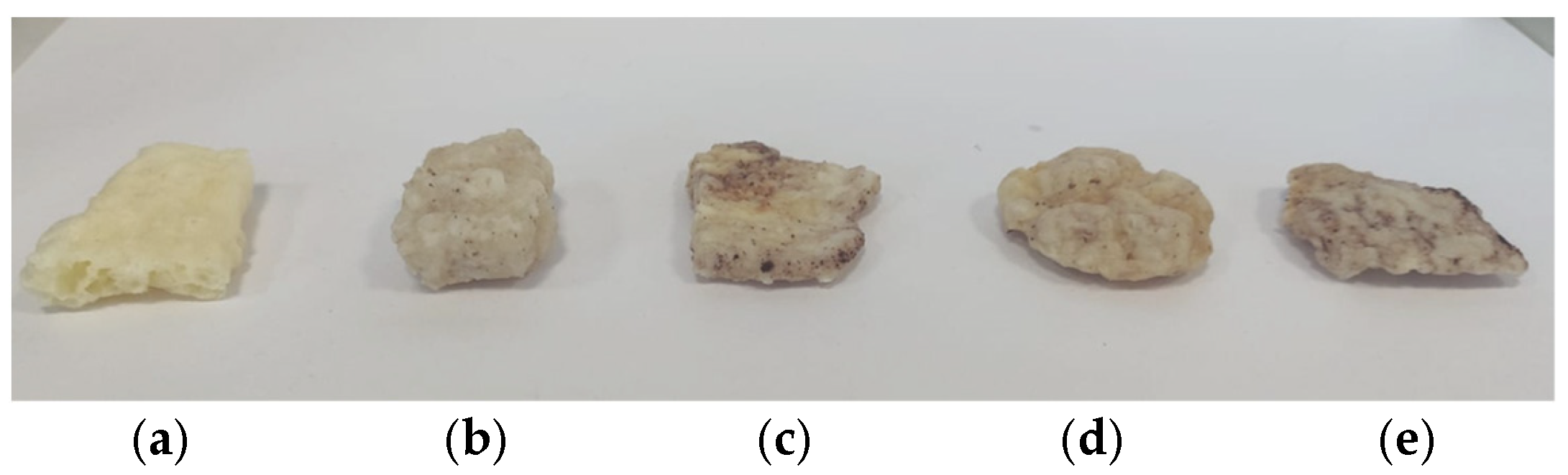
Aronia melanocarpa) was added to soft cheese before the drying process at the stage of cheese mass formation after the completion of milk fermentation and coagulation processes in the form of dry powders in four concentrations: 0.1%, 0.2%, 0.3% and 0.4% by weight (
Figure 1).
Salting was performed by immersing the pressed cheese in 10% NaCl brine for 20 min, after which the cheese was ripened at 4 ± 2 °C and 80% relative humidity for 3 days and then formed into snacks (discs of 2 cm diameter and 2–3 mm thickness).
The snacks were dried in a microwave vacuum dryer ALTA LM-2 (OOO Mir Online (Krasnodar, Russia) at an absolute pressure near of 50 mmHg and a product temperature of 13 °C. The final products were packaged and stored at 24 ± 2 °C until analysis.
Samples were stored at 4 °C prior to analysis to minimize environmental influences on color. For measurement, each sample was cut into uniform slices or sections to expose a flat, homogeneous surface, ensuring consistency and avoiding surface irregularities that could affect readings. All samples were allowed to equilibrate to room temperature (approximately 20–25 °C) for 30 min before measurement to stabilize color attributes.
2.2. Determination of Chemical Profile
Protein, fat, ash, moisture and lactose contents were determined by FT-IR using Bruker Tango with the MilkPowder calibration models (Bruker Optics GmbH & Co. KG, Ettlingen, Germany). Each sample was analyzed in quadruplicate (n = 4).
Total energy was recalculated according to the Atwater general factors using the equation: energy (kcal/100 g dry weight) = 4 × (g protein + g carbohydrates) + 9 × (g fat), as recommended by FAO/WHO for food composition and food-energy conversion [
20]. Energy values per 100 g product were calculated from mean composition data and are therefore presented without standard deviations.
2.3. Color Measurement
Colour parameters were determined using a portable tristimulus chroma meter CR-400 (Konica Minolta Sensing Inc., Tokyo, Japan) equipped with an 8 mm measuring aperture and an optical glass target mask, suitable for solid food samples such as cheese. Before measurements, the instrument was calibrated with the manufacturer’s white calibration tile (CR-A43) under standard illuminant D65. Measurements were conducted at room temperature (approximately 26 °C) and relative humidity ≤ 85% in a controlled laboratory environment, avoiding direct sunlight, dust and strong magnetic fields. For each snack type, four independent samples (n = 4) were prepared. On each sample, colour was measured at 3–4 different surface positions, and the mean of these within-sample readings was used as a single observation in the statistical analysis; the mean of these readings was used in the statistical analysis.
Colour was recorded in the CIE
L*a*b* system, where
L* represents lightness (0–100),
a* the green–red axis and
b* the blue–yellow axis; the total colour difference was calculated as
where
ΔL*,
Δa* and
Δb* are the differences between the sample and the reference colour [
21].
In addition, Munsell hue (H), value (V) and chroma (C) were obtained to provide an intuitive description of the yellow–orange shades of the samples [
22].
2.4. Texture Profile Analysis (TPA)
Texture Profile Analysis (TPA) was conducted to evaluate the mechanical properties of the cheese chips, simulating the mastication process. A texture analyzer (TX-700 (LAMY RHEOLOGY, Champlan, France) equipped with a 50 N load cell and a flat cylindrical probe (20 mm diameter) was used. Cylindrical samples of cheese chips (approximately 20 mm diameter and 8–10 mm height) were punched out from the dried cheese snacks prepared as described in
Section 2.1. They were prepared and equilibrated at room temperature (20 ± 2 °C) for 1 h prior to testing.
The TPA procedure involved a double compression cycle: the sample was compressed to 50% of its original height at a pre-test speed of 2 mm/s, test speed of 1 mm/s, and post-test speed of 2 mm/s, with a 5-s holding time between the two compression cycles. The trigger force was set at 0.05 N to ensure consistent contact detection. Each sample was tested in triplicate, and the following textural parameters were derived from the force-deformation curves using the instrument’s software RheoTex software, version 5.0 (LAMY RHEOLOGY, Champlan, France): hardness (peak force during the first compression, N), adhesiveness (negative area under the curve during probe withdrawal after the first compression, N·s), springiness (ratio of the time from the start of the second compression to the peak force to that of the first compression), cohesiveness (ratio of the positive force area during the second compression to that of the first), gumminess (hardness × cohesiveness, N), chewiness (gumminess × springiness, N), and resilience (ratio of the area during probe withdrawal to the area during compression in the first cycle).
This method was adapted from standard TPA protocols for solid food products and is similar to the approach described in a study on homogenized meat and plant-based patties, where TPA was used to measure eight parameters including hardness and chewiness using a comparable double compression setup.
2.5. Water Activity
Water activity (a
w) of cheese snacks with black chokeberry powder were measured by using Aqualab 4TE (Meter Group, Inc., Pullman, DC, USA). Measurements were conducted in triplicate at 25 °C, following the manufacturer’s guidelines. Samples were equilibrated for 15 min prior to analysis to ensure accurate readings. The a
w values were recorded directly from the instrument display. This parameter was assessed to evaluate the product’s microbial stability and shelf-life potential, as lower a
w levels are associated with reduced risk of spoilage in extruded snack foods enriched with bioactive ingredients like black chokeberry powder [
23].
2.6. Sensory Evaluation
Sensory evaluation was conducted as a preliminary consumer test with a small panel of fifteen untrained judges (e.g., students/staff, aged 20–40, balanced gender), who evaluated coded samples in a controlled environment (room temperature, neutral lighting), providing only an initial indication of product acceptability. Before the test, the panel received a brief instruction session following the general guidance of ISO 22935-1:2023 [
24], including explanations of the attributes (appearance, consistency, taste, smell) and the use of the 5-point hedonic scale. Samples were presented randomly, with water rinses between tastings. Data were collected via questionnaires and analyzed for means ± standard deviation. One-way ANOVA and Tukey’s HSD test (α = 0.05) were applied using Prism 10 to identify significant differences.
2.7. Statistical Analysis
Data analysis was performed using Python (version 3.12.3) with libraries including NumPy, SciPy, Pandas, and Statsmodels for descriptive statistics and hypothesis testing. Descriptive statistics (mean, standard deviation, minimum, maximum) were calculated for each treatment level. One-way ANOVA followed by appropriate post hoc tests was used to compare the effects of black chokeberry concentration (0%, 0.1%, 0.2%, 0.3%, 0.4%) on colour and texture parameters, with significance set at p < 0.05.
Descriptive statistics (mean, standard deviation, minimum, maximum) were calculated for each sample across all Δ parameters. Pearson correlation coefficients were computed to identify relationships between key variables (e.g., ΔL*, Δa*, Δb*, ΔE*). Linear regression modeled ΔE* as a function of assumed concentration levels (Control = 0.0, Cheese 0.1 = 0.1, etc.), with R2 and p-values reported.
A two-sample independent t-test (assuming equal variances) compared means between groups for selected parameters (ΔL*, ΔE*, Δa*, Δb*), using SciPy’s t-test and function. Significance was set at p < 0.05. Given the limited number of replicates (n = 4 per sample), these findings should be considered preliminary; future studies should include more measurements to increase statistical power.
3. Results
3.1. Chemical Profile of Cheese Snacks
The results of the chemical profile are presented in
Table 1, which summarizes the nutritional composition of the control sample and the four experimental cheese variants (Cheese 0.1, 0.2, 0.3, and 0.4) on a dry weight basis.
Protein content remained relatively consistent across all samples, averaging approximately 46–48%, with the control exhibiting the highest value at 48.8 ± 0.98% and minor variations in the cheese groups (ranging from 46.06 ± 0.9% in Cheese 0.2 to 46.13 ± 1.12% in Cheese 0.4). Fat content ranged from about 33 to 36% DW and was lowest in Cheese 0.3, while Cheese 0.4 had the highest fat level, as indicated by different superscript letters. Ash (≈9.6–10.8% DW) and moisture (≈3.6–4.0% DW) did not differ significantly among samples. The calculated carbohydrate content increased with the addition of black chokeberry powder, reaching the highest values in Cheese 0.2 and 0.3, whereas the control contained only about 2.3% DW. The calculated energy value varied between approximately 509 and 522 kcal/100 g DW, with Cheese 0.3 showing the lowest and Cheese 0.2–0.4 the highest values, reflecting the combined effects of fat and lactose contents.
3.2. Color Measurement
In this study, colour differences of the cheese snacks were expressed as deviations (Δ values) from a reference colour in the CIE L*a*b* space and, additionally, by Munsell hue–value–chroma notation. Measurements under illuminant D65 focused on lightness (L*), chroma and hue, and on the overall colour difference (ΔE*). The Munsell H, V and C values and the corresponding CIE L*, a*, b* and ΔE* data for the control and black chokeberry-enriched snacks (0.1–0.4%) are presented in
Table 2.
All samples exhibited yellow-to-orange hues (Y = yellow, YR = yellow-red/orange). The Light Group showed hues closer to yellow with higher lightness (V > 7.0), indicating paler tones. The Dark Group shifted toward orange with lower lightness (V < 6.5) and variable chroma, peaking at 4.2 in Cheese 0.3, suggesting increased saturation possibly due to oxidation or maturation.
The Deviations in CIE Lab* Color Space (with Directional Labels) mimics human perception, with labels indicating shifts (L = lighter, D = darker; −G = less green/redder; −Y = less yellow/bluer; +Y = more yellow). All samples were redder than the target (positive Δa*). The Light Group was generally lighter and less yellow, with ΔE* values from 4.63 to 12.09 (noticeable to significant differences). The Dark Group was darker and showed the highest ΔE* (17.69–19.0), indicating substantial visual deviations, with Cheese 0.3 uniquely more yellow.
Two-Sample
t-Test (Light Group vs. Dark Group) shown in
Table 3.
Overall, the results demonstrate progressive color changes with increasing black chokeberry powder concentration, shifting from pale yellow to darker orange tones, with implications for quality control in cheese production.
3.3. Texture Profile Analysis (TPA)
Results of textural profile analysis (TPA) of cheese snacks with various concentrations of additives (0%, 0.1%, 0.2%, 0.3%, 0.4%). The data are presented in
Table 4. The data were obtained based on several repeated measurements for each concentration (
n = 4). The parameters include fracture strength, maximum strength of the second peak (F.Max2), cohesiveness, springiness, chewiness, resistance, as well as auxiliary indicators (duration and F mini). The values are given as mean ± standard deviation (SD). The duration and F mini parameters remain almost constant and close to zero, which indicates the stability of the measurement process.
The addition of the additive significantly affected the fracturability of cheese snacks according to one-way ANOVA (p < 0.05). A marked decrease in fracturability was observed at a concentration of 0.1% compared to the control, indicating a softer texture. With a further increase in the additive concentration to 0.4%, fracturability increased and approached the control values, although no significant difference was observed between these two samples.
For the remaining textural parameters, including force maximum 2, cohesiveness, springiness, gumminess, chewiness, and resistance, no statistically significant differences were detected among samples (p > 0.05). Despite some variations in mean values with increasing additive concentration, these changes were accompanied by high variability and did not indicate a consistent or statistically confirmed trend.
3.4. Water Activity
The water activity (a
w) results for the cheese snacks enriched with varying levels of black chokeberry powder are summarized in
Table 5 One-way ANOVA indicated a significant effect of black chokeberry powder concentration on a
w (F = 6.39, df = 4.10,
p = 0.008). Post-hoc analysis using Tukey’s HSD test (α = 0.05) revealed that the sample with 0.2% black chokeberry powder had significantly lower a
w compared to the 0.3% and 0.4% samples, with overlapping similarities among the control, 0.1%, and other groups as indicated.
The measurement temperature (T, °C) also showed a marginal overall effect by ANOVA (F = 3.60, df = 4.10, p = 0.046), but Tukey’s HSD test indicated no significant pairwise differences among the samples.
3.5. Sensory Properties
The data directly assess the impact of black chokeberry powder concentration on key sensory attributes (appearance, consistency, taste, smell, and overall score), complementing the existing chemical, color, texture, and water activity results. The getting data shown in
Table 6.
4. Discussion
4.1. Composition and Nutritional Aspects
The incorporation of black chokeberry powder into cheese snacks produced from a camel–goat–cow milk blend did not substantially alter the protein content, which remained in a relatively narrow range across all samples (approximately 46–49% DW), with only small differences between the control and black chokeberry-enriched variants (
Table 1). This indicates that the moderate inclusion levels of black chokeberry powder (0.1–0.4%) did not dilute the high-protein matrix of the dried cheese and supports the use of such snacks as concentrated protein carriers rather than carbohydrate-based snacks [
1,
2,
3]. Similar stability of protein content has been reported in other dairy systems enriched with fruit powders or plant extracts, where low-level additions primarily affect colour and flavour rather than the core protein fraction [
4,
6,
7,
25].
Fat content (approximately 33–36% DW) showed some variability, with the lowest values observed in Cheese 0.3 and slightly higher values in the control and Cheese 0.4, as reflected by the different superscript letters in
Table 1. However, this pattern did not follow a clear dose-dependent trend with increasing black chokeberry concentration, suggesting that the observed differences are more likely related to intrinsic batch and processing variability than to a systematic effect of the additive. Ash and moisture contents (around 9.6–10.8% and 3.6–4.0% DW, respectively) did not differ significantly among samples, indicating that mineral content and residual water were largely governed by the cheesemaking and drying conditions rather than by the small amount of berry powder. Lactose (carbohydrate) content was higher in black chokeberry-containing samples than in the control, with the greatest values in Cheese 0.2 and 0.3 (about 6–7% DW), which is consistent with the contribution of additional solids from the powder, but the variability and relatively small absolute changes mean that these differences should be interpreted cautiously. Overall, the calculated energy values (approximately 509–522 kcal/100 g DW) fell within a narrow range, indicating that adding 0.1–0.4% black chokeberry does not substantially modify the energy density or core macronutrient profile of the snacks.
The use of a ternary camel–goat–cow milk blend as the base for these snacks was motivated by the complementary nutritional and functional properties of the individual milks, including the high digestibility of goat milk, the bioactive components of camel milk and the structural robustness of cow milk [
10,
11,
12,
13,
14,
15]. However, parameters such as vitamin content, detailed fatty acid profile or specific bioactive peptides were not quantified in the present work, so any potential nutritional advantages of the blend over single-milk snacks remain hypothetical and based on the literature [
12,
13,
14,
15]. From a compositional standpoint, the main demonstrated effect of the formulation is the maintenance of a high protein content and typical fat and ash levels in all variants [
6,
7,
8].
4.2. Colour Modification by Black Chokeberry Powder
Colour measurements clearly showed that the addition of black chokeberry powder produced concentration-dependent changes in both Munsell and CIELab parameters (
Table 2). In the Munsell system, hues shifted within the yellow to yellow–red/orange range (Y to YR), while the value (V) decreased from about 7.4 in the control to approximately 5.8–6.0 in the more enriched samples, indicating darker tones. These trends were confirmed in the CIELab space, where ΔL* became increasingly negative in Cheese 0.3 and 0.4 (around −15 and −13), reflecting a substantial reduction in lightness compared with the reference. Δa* values increased markedly with black chokeberry addition, particularly at 0.3 and 0.4%, demonstrating that the enriched snacks were redder, while Δb* values showed a complex behaviour, with both more yellow and less yellow shifts depending on the concentration. The total colour difference ΔE* rose from about 4.8 in the control to roughly 16–20 in the higher- black chokeberry samples, which corresponds to visually obvious differences for consumers [
26].
These results are consistent with the known pigment profile of black chokeberry, which is rich in anthocyanins and other phenolics capable of imparting intense red–violet to orange hues and of interacting with the protein and fat matrix of dairy products [
17,
18,
27]. In other studies, addition of berry powders or juices to yogurt and cheese has similarly led to decreased lightness, increased redness and higher ΔE* values compared with controls, often improving perceived visual appeal at intermediate inclusion levels [
22,
28,
29]. In the present work, the 0.3% formulation produced the largest shift toward orange and the highest ΔE*, while 0.1–0.2% yielded more moderate but still noticeable colour changes. This suggests that black chokeberry powder can be used to generate a range of colour intensities, from slightly tinted to strongly coloured snacks, which may be advantageous for product differentiation [
22,
27,
30,
31,
32].
4.3. Texture Profile
Texture profile analysis revealed non-linear responses of the mechanical properties to black chokeberry concentration. Among the measured parameters, fracturability exhibited the most pronounced and statistically significant changes. The control snacks showed the highest fracturability, indicating a relatively hard and brittle structure. With black chokeberry addition, fracturability decreased substantially, reaching the lowest values around 0.3% powder, and then partially increased again at 0.4%. This pattern suggests that moderate levels of black chokeberry powder may disrupt or plasticize the protein–fat network, reducing the force required to fracture the snacks, whereas higher levels might restore or reorganize the structure [
25,
33].
Other TPA parameters, including cohesiveness, springiness, gumminess and chewiness, showed peaks at specific concentrations (for example, increased cohesiveness and springiness at 0.1% and higher chewiness at 0.2%), but these differences were not statistically significant overall due to variability and the limited number of replicates. Similar behaviour has been observed in other cheese-based snacks and low-moisture dairy systems supplemented with plant ingredients, where small additions of fibre or phenolics can alter microstructure and water distribution [
2,
4,
6,
7,
8,
34], but clear trends require larger sample sizes to confirm. In the present study, the texture data therefore provide an initial indication that black chokeberry powder levels around 0.1–0.3% may yield less brittle, more consumer-friendly snacks, but more extensive testing would be needed to define optimal textural targets.
4.4. Water Activity and Stability
Water activity values of the dried snacks were very low (approximately 0.15–0.16), with some statistically detectable differences among samples but all remaining well below the thresholds associated with microbial growth and most chemical spoilage reactions. Such low a
w is consistent with the intense microwave vacuum drying regime applied, which is designed to produce shelf-stable cheese snacks closer to dried or grated cheese products than to conventional semi-hard cheeses. In comparable low-moisture foods, a
w values below about 0.60 are typically associated with good microbiological safety and extended shelf life, provided that packaging prevents moisture uptake [
4,
7,
22].
At the same time, the extremely low aw values, particularly those around 0.15, should be interpreted with some caution, as they depend on instrument calibration, equilibration conditions and sample handling. The present measurements nevertheless indicate that all formulations can be classified as low-water-activity snacks suitable for short-term ambient storage.
4.5. Sensory Properties
The sensory evaluation, conducted as a preliminary consumer-oriented test with fifteen untrained assessors, provided an initial indication of the acceptability of the black chokeberry-enriched snacks. Mean scores for appearance, consistency, taste and smell remained above 3.5 on a 5-point hedonic scale for all samples (
Table 6), with the 0.3% formulation generally receiving the highest ratings across attributes and the highest overall liking. This aligns with the instrumental colour data, which showed that 0.3% black chokeberry produced vivid but not excessively dark orange tones, and with the fracturability results, which indicated reduced brittleness at this concentration.
However, the differences in sensory scores were not always statistically significant, and the small number of untrained judges limits the strength of the conclusions. The present sensory findings should therefore be regarded as exploratory, suggesting that moderate black chokeberry inclusion (around 0.3%) is promising from a consumer acceptance standpoint, but requiring confirmation in future studies using larger consumer panels and trained descriptive analysis. Importantly, no formulation was rejected by the panel, indicating that even at 0.4% black chokeberry the snacks remained broadly acceptable in terms of flavour and odour.
4.6. Functional Potential and Mechanistic Considerations
The addition of black chokeberry powder introduces a source of polyphenols, anthocyanins and other bioactive compounds known to exhibit antioxidant, anti-inflammatory and antimicrobial properties in various food matrices. Although the powder was incorporated only after fermentation and coagulation had been completed, these compounds can still interact with the proteins and lipids present in the dried cheese matrix during mixing and subsequent storage.
These effects can be understood in terms of fundamental food chemistry principles: non-covalent protein–phenolic complexation, the pH- and matrix-dependent stability of anthocyanins, and the reduced molecular mobility in glassy, low-moisture systems, which together modulate colour, texture and oxidative stability [
35]. Although the present study did not quantify total phenolic content, anthocyanins or tannins in the snacks, the colour changes and the literature-based composition of black chokeberry suggest that polyphenols were indeed incorporated into the product. In dairy systems, berry polyphenols can interact with casein and whey proteins through hydrogen bonding and hydrophobic interactions, as well as associate with milk fat globule membranes, potentially influencing both texture and oxidative stability [
34,
35,
36,
37]. The observed decrease in fracturability at moderate black chokeberry levels may reflect such interactions, which could weaken certain protein–protein linkages or modify the local glass transition behaviour in this low-moisture matrix.
In a ternary camel–goat–cow milk system, differences in casein micelle structure and milk fat globule membrane composition between species may further modulate these interactions, as goat and camel milks typically contain higher proportions of short- and medium-chain fatty acids and distinct phospholipid profiles, which can influence how phenolics partition at the fat–water interface [
10,
11,
12,
37].
From a food chemistry perspective, the high degree of drying and very low water activity imply that most of the matrix is in a glassy or semi-glassy state, where mobility of reactants is limited and both Maillard reactions and lipid oxidation are slowed, although not completely halted. The presence of black chokeberry phenolics could further contribute to oxidative stability through radical scavenging and metal chelation, especially at the surface where oxygen exposure is greatest [
27,
31,
32]. These mechanistic hypotheses are consistent with studies on other polyphenol-enriched snacks but need to be tested directly in future work by measuring antioxidant capacity, monitoring lipid oxidation markers and examining microstructural changes. A dedicated follow-up study is currently underway to quantify the antioxidant activity of these cheese snacks, and the results will be presented in a subsequent manuscript.
4.7. Limitations and Future Directions
Several limitations of the present study should be acknowledged. First, the number of independent replicates for composition, colour, texture and water activity measurements was limited, which reduces statistical power and contributes to variability in some parameters, particularly texture. For gumminess and chewiness, the standard deviations were relatively large, reflecting considerable sample-to-sample variability within each treatment in combination with the limited number of replicates (n = 4); therefore, the differences among formulations should be interpreted with caution.
Second, the sensory evaluation involved only fifteen untrained assessors and was not designed as a full-scale consumer study; the sensory results therefore provide only preliminary insight into acceptance. Third, the study did not include direct measurements of polyphenol content, anthocyanins, tannins, vitamins or detailed fatty acid profiles in the snacks, so functional and nutritional aspects are mainly inferred from the formulation and from the literature rather than being analytically demonstrated. Finally, the storage period considered was relatively short, and no microbiological or oxidative stability tests were performed.
Future research should increase replication, perform full compositional and antioxidant profiling, and include extended shelf-life and larger sensory studies. Despite these limitations, this preliminary work shows that small additions of black chokeberry powder can yield visually attractive, high-protein, low-water-activity snacks with promising textural and sensory properties.





 ,
,