


Abstract
There are numerous operating parameters that affect the thermodynamic and thermoeconomic performance of gas turbine cycles, and many studies based on energy, exergy, and economic analyses have been conducted in the literature by considering these parameters. However, the order of importance and contribution ratios of key operating parameters such as ambient temperature, compressor pressure ratio, combustion efficiency, regenerator effectiveness, and compressor and turbine isentropic efficiencies with respect to thermal efficiency, exergy efficiency, and the levelized cost of electricity (LCOE) have not been sufficiently investigated using statistical methods. Accordingly, a thermodynamic model of a gas turbine cycle improved with intercooling, reheating, and regeneration processes was developed in the study, and thermal efficiency, exergy efficiency, and LCOE values were calculated under different parameter levels. Taguchi analysis was carried out by using the L27 orthogonal array, in which six operating parameters were evaluated at three levels, and optimum parameter levels were determined for each performance indicator. Next, the contribution ratios of the parameters to the objective functions were calculated using the ANOVA method. The results showed that turbine isentropic efficiency was the most influential parameter in terms of thermal and exergy efficiencies, while compressor pressure ratio played the dominant role in terms of LCOE. Additionally, to simultaneously achieve the goals of maximizing thermal and exergy efficiencies and minimizing the LCOE value, the grey relational analysis (GRA) method was applied as a multi-objective optimization approach, and the optimum operating conditions were determined based on a single performance indicator. According to the GRA results, under the optimum conditions, the thermal efficiency was calculated as 0.5533, its exergy efficiency was 0.5772, and the LCOE value was 0.01751 USD/kWh.
1. Introduction
Gas turbines are high-temperature continuous-flow energy conversion systems that operate based on the Brayton cycle principle and convert chemical energy into mechanical and/or electrical energy. Owing to their high power densities, compact structures, rapid start-up capability, and flexibility to operate with different fuel types, gas turbine cycles are widely used in modern energy systems both for stand-alone electricity generation and in integrated applications such as combined cycles, cogeneration, and trigeneration. However, in conventional gas turbine cycles, a significant portion of the fuel’s energy is discharged from the system through high-temperature exhaust gases, which remains a major limitation, reducing cycle efficiency and resource utilization effectiveness.
The high-temperature exhaust gases generated in gas turbine cycles offer significant potential for waste heat recovery. Numerous approaches have been proposed to recover this waste heat by integrating bottoming cycles, thereby improving cycle efficiency and overall energy utilization. Ghazikhani et al. [1] integrated a conventional gas turbine cycle with an air bottoming cycle (ABC) and examined the recovery potential of exhaust heat. In their study, it was determined that, with ABC integration, exhaust exergy could be recovered in the range of 8.6–14.1%, and exergy destruction caused by additional equipment remained limited. The ABC-supported gas turbine cycle also increased specific work while reducing specific fuel consumption.
Khaljani et al. [2] examined the energy, exergy, and exergoeconomic performance of a cogeneration system that aimed to recover exhaust heat by integrating a gas turbine cycle with an organic Rankine cycle. In their study, exergy destruction was analyzed on a component basis, and it was determined that the highest exergy destruction occurred in the combustion chamber. It was also found that increases in operating parameters such as pressure ratio and isentropic efficiency improved the thermodynamic performance of the system, but these increases adversely affected the total cost rate after a certain point. Sadeghi et al. [3] investigated the impacts of thermophysical and thermochemical regeneration on the performance of an integrated GT/ORC power generation system that combined a gas turbine and an organic Rankine cycle. In their study, a simple GT/ORC configuration, GT/ORC systems with a thermophysical regenerator, and those with a thermophysical–thermochemical regenerator were compared, and optimization was carried out by using a multi-objective genetic algorithm. According to their results, exergy efficiency increased by 22.86% in the thermophysical regeneration system compared to the simple GT/ORC system, and product cost was found to be lower in the thermochemical regeneration system.
Ahmadi et al. [4] carried out a multi-objective optimization study on a conventional gas turbine power plant and assessed its thermodynamic, exergoeconomic, and environmental performance. In their work, the NSGA-II algorithm was implemented to maximize exergy efficiency while minimizing the total production cost, including environmental cost terms. Under the optimum operating conditions obtained, the environmental impact was reported to decrease by 50.50%, whereas the system exergy efficiency increased to 42.78%. Sun et al. [5] analyzed two different supercritical carbon dioxide (S-CO2) Brayton cycle configurations proposed for recovering gas turbine exhaust heat and evaluated their energy, exergy, and exergoeconomic performances. In this work, the influence of working parameters on system performance was evaluated parametrically.
Multi-generation systems that utilize waste heat from gas turbine cycles to produce useful products such as heating, cooling, hydrogen, and fresh water have attracted significant attention in the literature. The primary objective of such systems is to enhance overall energy utilization by generating multiple outputs in addition to electricity. Altun [6] evaluated the thermodynamic and economic performance of a novel trigeneration configuration, integrating an intercooling gas turbine power cycle with an ammonia–water absorption cooling unit and hot water production. The results showed that the energy utilization factor of the system could reach 83%, while carbon emissions were reduced by 49% compared to separate production. In addition, the LCOE of the proposed system was reported to be lower than that of grid electricity. Alrobaian [7] evaluated a solar-assisted multi-generation configuration combining Brayton, Kalina, and absorption cooling cycles, and reported its energy, exergy, economic, and environmental performance. For a model developed to satisfy the energy demand of a commercial building in Saudi Arabia, the exergy efficiency was found to be 42.11%. Moreover, it was reported that 93% of the total exergy destruction occurred in the Brayton cycle, and the life-cycle cost of the system was calculated as 2.02 M$.
A trigeneration configuration combining a Brayton cycle and a Kalina cycle with a multi-effect desalination unit connected to a biomass digester was investigated by Liu et al. [8]. In their work, thermodynamic, environmental, and economic evaluations were performed, and the system was optimized via the multi-objective particle swarm optimization (MOPSO) algorithm. The optimum results showed an exergy efficiency of 45.69% and a payback period of 5.05 years. Wang et al. [9] developed a trigeneration system for recovering gas turbine exhaust waste heat by integrating a supercritical CO2 Brayton cycle with an organic Rankine cycle and an absorption cooling cycle. Their study included energy, exergy, and exergoeconomic evaluations together with a multi-objective optimization procedure. The system was found to provide combined power, cooling, and heating outputs with an overall exergoeconomic factor of 20.17% under optimum conditions.
Pirmohamadi et al. [10] proposed a multi-generation system that integrated a Brayton cycle fueled by ammonia–methane with a Kalina cycle, hydrogen production, and fuel synthesis units. The thermodynamic behavior of the system was modeled in detail, and performance indicators were calculated. According to the thermodynamic analysis results, the proposed system reached 56.5% thermal efficiency, and the amount of carbon emission was 0.058 kg/kWh. Zoghi et al. [11] developed a model of an integrated system combining a conventional gas turbine cycle with an inverse Brayton cycle (IBC), which allows the simultaneous production of electricity, hydrogen, and fresh water. The simple combined Brayton–IBC configuration and the advanced system, including a thermoelectric generator, absorption cooling, and water purification units, were compared in terms of energy, exergy, exergoeconomic, and environmental aspects. Under the best operating conditions, exergy efficiency for the advanced system was calculated as 40.77%, and the unit product cost was 63.19 $/GJ.
In addition to multi-generation applications, several studies have focused on hybrid configurations in which gas turbine cycles are coupled with advanced energy conversion technologies, particularly fuel cells, and their performance is assessed using thermodynamic and economic criteria. Shirazi et al. [12] evaluated an internal reforming SOFC–GT hybrid system considering energy, exergy, economic, and environmental aspects. Their optimum design yielded an exergy efficiency of 65.60% and a payback period of 6.14 years. Chen et al. [13] presented a power generation concept in which an SOFC-GT hybrid system was coupled with a supercritical CO2 Brayton cycle. A multi-objective optimization study was performed to improve exergy efficiency and reduce electricity generation costs while examining the role of key design parameters. Under optimum conditions, an exergy efficiency of 68.14% was achieved, and the SOFC operating temperature was reported as the most influential parameter.
Alongside these studies on hybrid systems, the literature also includes research examining the effects of fuel type and fuel composition on system performance in gas turbine cycles. The use of hydrogen-enriched fuels has become an important research topic, particularly in terms of emission behavior, as well as thermodynamic performance. Skabelund et al. [14] examined the thermodynamic performance and emission behavior of a gas turbine cycle operating with a hydrogen–methane mixture at the system level. In their study, the hydrogen volume ratio was varied in the range of 0–100%, and cycle performance was analyzed under different equivalence ratios. According to the results, turbine and compressor isentropic efficiencies were the most influential parameters on system efficiency, and it was determined that optimum operating conditions changed as the hydrogen ratio increased. Hai et al. [15] evaluated the thermoeconomic and environmental performance of a gas turbine-based energy system fueled with hydrogen-enriched natural gas and integrated with heat recovery. A model was developed, and a genetic algorithm was employed for multi-objective optimization. The optimized case improved the exergy efficiency from 41.01% to 49.46%, reduced the total cost rate by 8.16%, and lowered CO2 emissions by 1.15%.
Although numerous studies in the literature have investigated the thermodynamic and thermoeconomic performance of gas turbine cycles, the systematic evaluation of the importance order and quantitative contribution ratios of operating parameters using statistical approaches remains limited. Furthermore, integrated analyses that simultaneously assess thermal efficiency, exergy efficiency, and economic indicators such as LCOE are comparatively scarce.
To address this gap, the present study investigates the effects of key operating parameters (namely, ambient temperature, compressor pressure ratio, combustion efficiency, regenerator effectiveness, and compressor and turbine isentropic efficiencies) on the thermal efficiency, exergy efficiency, and LCOE of a gas turbine cycle with intercooling, reheating, and regeneration by employing an integrated Taguchi–ANOVA–GRA framework. Within this unified framework, (i) the relative importance of the parameters is determined using the Taguchi method, (ii) their quantitative contribution ratios are statistically validated through ANOVA, and (iii) optimum operating conditions are identified via multi-objective evaluation using the GRA method.
In this way, the study not only provides a systematic statistical evaluation of the key operating parameters but also enables the simultaneous optimization of thermodynamic and economic performance indicators. Therefore, the proposed framework contributes to the literature by offering a structured methodology for identifying dominant design parameters and improving the performance of advanced gas turbine cycles.
2. Mathematical Model
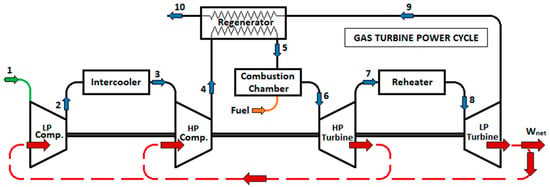
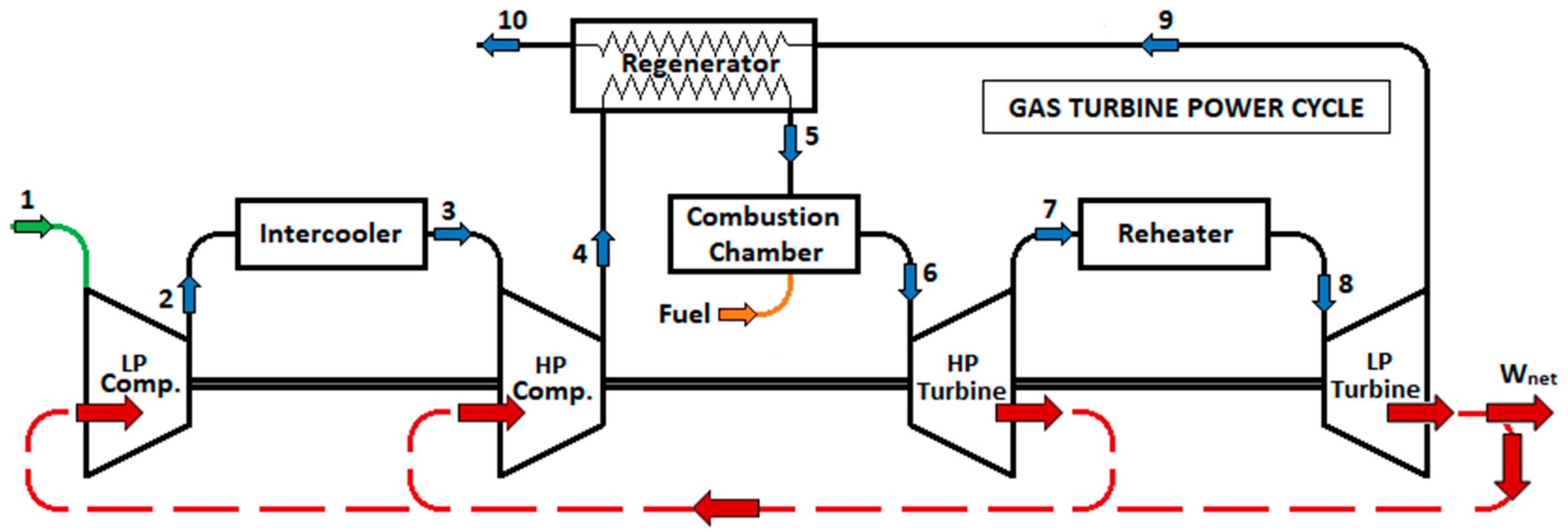
The schematic diagram of the gas turbine cycle with intercooling, reheating, and regeneration processes modeled in this study is shown in Figure 1.
Figure 1.
The schematic diagram of the gas turbine cycle. The arrows indicate the direction of the working fluid flow and the work interactions within the system, while the numbers denote the state points of the cycle.
Air at ambient conditions enters the system and is first compressed in the low-pressure compressor, then cooled in the intercooler and compressed again in the high-pressure compressor. At this stage, air reaches the highest pressure level targeted in the cycle. Compressed air is subjected to preheating in the regenerator to utilize the waste heat of turbine exhaust gases and is then directed to the combustion chamber. As a result of the combustion process that occurs with the addition of fuel in the combustion chamber, the fluid turns into combustion products with high temperature and pressure. These combustion gases first expand in the high-pressure turbine, then are reheated in the reheater, and expand a second time in the low-pressure turbine. At the turbine outlet, hot combustion gases are directed to the regenerator and used to heat the air sent to the combustion chamber; thus, heat recovery is achieved in the system, and the thermal efficiency of the cycle is improved.
2.1. Energy and Exergy Equations
For steady-flow open systems, the principle of energy conservation is expressed as follows:
Here, denotes heat transfer rate, denotes work, denotes the mass flow rate of the fluid, h is specific enthalpy, g is gravitational acceleration, V is fluid velocity, and z is elevation. Neglecting the kinetic and potential energy variations within the control volume, the steady-flow energy balance for open systems can be written as follows [16]:
Exergy is defined as the maximum useful work potential that a system can provide until it reaches equilibrium with the environmental conditions from its current state. The total specific exergy () and total exergy flow () are calculated using the following relations:
Here, and denote physical and chemical exergy, respectively. Physical exergy represents the maximum useful work potential that may arise when the system temperature and pressure are adjusted to reach equilibrium with the environmental conditions and is calculated using the following relation [17]:
Here, and denote the specific entropy at the state and the reference (dead-state) conditions, respectively, and is the environmental reference temperature.
Chemical exergy is defined as the maximum useful work that a system can provide through heat and mass exchange during the process of reaching chemical equilibrium with its environment. For pure substances, chemical exergy is expressed as follows by considering standard chemical exergy [18]:
Here, is the standard chemical exergy of the substance, and is the molar mass of the substance. The standard chemical exergies and molar masses of some substances used in this study are presented in Table 1.
Table 1.
Standard chemical exergies and molar masses of substances used in the study [19,20].
The chemical exergy of gas mixtures is given by the following relation [18]:
Here, denotes the standard chemical exergy of the kth gas, denotes the molar fraction of the kth gas in the total gas, and denotes the universal gas constant.
The exergy balance for each component of the system is given below:
Here, and denote the exergy input and output, respectively, and denotes exergy destruction.
2.2. Thermodynamic Analysis of the Gas Turbine Cycle
To perform the thermodynamic analysis of the gas turbine cycle, energy and exergy balance equations were established for all components of the cycle, and these equations are presented in detail in Table 2. Using these equations, the energy and exergy performance of each component was evaluated.
For each compressor stage in the gas turbine cycle, the isentropic temperature–pressure relations between inlet and outlet states are expressed as follows [21]:
Here, is the specific heat ratio (ratio of specific heats at constant pressure and constant volume), and the subscript “s” denotes the isentropic state. In this study, the value of k for air was taken as 1.4 [20,22].
The overall compressor pressure ratio () is obtained by dividing the outlet pressure of the high-pressure compressor by the inlet pressure of the low-pressure compressor, given as follows:
Methane (CH4) was used as fuel in the combustion chamber, and the stoichiometric combustion reaction of methane with air is given as follows [23,24]:
Stoichiometric combustion represents the ideal combustion condition in which the fuel reacts completely with the theoretically required amount of oxygen and produces only CO2 and H2O products. However, in practical applications, more air than the stoichiometric value is generally used to prevent incomplete combustion and CO formation, increase combustion efficiency, and ensure the material safety of components exposed to high temperatures. This situation is defined by the excess air coefficient (λ), and λ > 1 indicates excess air relative to stoichiometric conditions.
In this study, the excess air coefficient in the combustion chamber was taken as λ = 4, and the combustion reaction occurring under this condition is given as follows:
For each turbine stage, the isentropic relation between inlet and outlet pressures and temperatures is expressed using the following relations:
The net work () obtained from the gas turbine cycle is calculated as the difference between the total turbine work output and the total compressor work input, and is expressed as follows [25]:
For the gas turbine cycle, the thermal efficiency () can be expressed as follows:
The exergy efficiency of the gas turbine cycle () is expressed as follows:
Table 2.
Energy and exergy equations of the gas turbine cycle components [26,27,28].
2.3. Thermoeconomic Analysis of the Gas Turbine Cycle
Thermoeconomic analysis enables the simultaneous evaluation of the technical and economic performance of a system by relating the energy conversions in the system to component costs. Accordingly, the total investment cost of each component that constitutes the system must be determined. For each component, the total investment cost is defined as the sum of the initial investment cost and the maintenance, repair, and operating expenses and is expressed as follows [29]:
Here, is the total investment cost of the component, is the initial investment cost, and is the maintenance, repair, and operating cost. For each component, the initial investment cost is determined using the following expression:
Here, is the purchase cost of the component, is the annual operating time, and is the capital recovery factor. The annual operating time of the system was assumed as 8000 h in this study [29,30].
The capital recovery factor (CRF) is a coefficient that enables an investment to be repaid in fixed annual installments throughout its economic lifetime. The CRF value is calculated as follows:
Here, is the compound interest rate, and is the system lifetime. A compound interest rate of 15% and a system lifetime of 20 years were assumed in this study [31,32,33].
The maintenance, repair, and operating cost of each component in the system is expressed as follows:
Here, is the maintenance, repair, and operating cost factor and was taken as 0.06 in this study [30,32].
After determining the investment costs of the components, the hourly fuel consumption cost of the system is calculated as follows:
Here, is the hourly fuel consumption cost of the system, is the hourly fuel mass flow rate, and is the unit fuel price. The unit fuel price of methane (CH4), which was used as fuel, was taken as 0.004 USD/MJ in this study [5,9,34].
The system investment cost () is defined as the sum of the investment cost of the components and the fuel cost and is expressed as follows:
The levelized cost of electricity (LCOE) is one of the fundamental economic parameters that evaluates the economic effectiveness of an energy generation system along with technical performance indicators. Accordingly, LCOE is determined as the total cost over the system’s economic lifetime divided by the net electrical energy generated during the same period, and it is obtained using the relation provided below [35]:
The purchase cost equations for the components constituting the gas turbine cycle are given in Table 3. To adapt the component purchase costs to current economic conditions, the Chemical Engineering Plant Cost Index (CEPCI) value corresponding to the reference year of each equation was taken as the basis, and all costs were recalculated using the 2024 CEPCI value of 798.8 [36,37] via the following proportional conversion:
Table 3.
The purchase cost equations for each component of the gas turbine cycle [26,30,38,39].
Here, denotes the updated purchase cost according to the 2024 price level, denotes the original purchase cost calculated for the reference year, denotes the CEPCI value for 2024, and denotes the CEPCI value of the reference year.
In some of the purchase cost equations presented in Table 3, the heat transfer area is defined as an input parameter for certain components. Accordingly, the heat transfer areas of the relevant components are determined using the following relation:
Here, is the average overall heat transfer coefficient for the relevant component. In the analyses, the value was taken as 2000 W/m2K for the intercooler, 1600 W/m2K for the reheater, and 3000 W/m2K for the regenerator [30]. denotes the effective heat transfer area, and is the logarithmic mean temperature difference between the two fluids. The value of is calculated as follows:
Here, and correspond to the hot-fluid inlet and outlet temperatures, respectively, while and correspond to the cold-fluid inlet and outlet temperatures.
2.4. Taguchi Method and Analysis of Variance (ANOVA)
The Taguchi method is a statistical optimization approach that enables the investigation of the impacts of numerous design and operating parameters on system performance with a limited number of experiments or analyses. Because it requires fewer runs than a full factorial design, the Taguchi method offers significant advantages in terms of time and cost, and it is widely applied not only in experimental studies but also in numerical and theoretical analyses [40,41,42].
In the Taguchi approach, the basis of the analysis process is formed by the signal-to-noise (S/N) ratio and orthogonal arrays. Through the use of these methods, system performance is optimized with far fewer trials, and the order of importance of the parameters is determined. Ambient temperature, compressor pressure ratio, combustion efficiency, regenerator effectiveness, compressor isentropic efficiency, and turbine isentropic efficiency were considered as the operating parameters in this study. The ranges of these parameters were determined based on commonly reported operating conditions and design limits in the literature for gas turbine cycles with intercooling, reheating, and regeneration [1,2,12,13,15,16]. Their selected levels are provided in Table 4.
Table 4.
Parameters and their levels used in the analysis [1,2,12,13,15,16].
The selection of a suitable orthogonal array requires the calculation of the total degree of freedom (DOF). In the Taguchi framework, the DOF of each parameter is obtained as the number of levels minus one. Therefore, considering six parameters at three levels in this study, the overall DOF was determined as 12. In the Taguchi approach, the number of experiments in the selected orthogonal array should be at least one greater than the total DOF value. In this regard, the L27 orthogonal array, which satisfies the total DOF requirement and enables a more reliable evaluation of parameter effects, was selected, and the analyses were carried out over a total of 27 cases.
In this study, the Taguchi method was used in the optimization of three different objective functions aiming to maximize the thermal and exergy efficiencies and minimize the LCOE value. The performance results obtained from the thermodynamic model were converted into S/N ratios. In the Taguchi method, three different performance characteristics are used to calculate S/N ratios: “larger is better”, “nominal is best”, and “smaller is better” [43]. In this study, since maximizing thermal and exergy efficiencies was the aim, the “larger is better” performance characteristic was used, and, since minimizing the LCOE value was targeted, the “smaller is better” characteristic was used. For the “larger is better” and “smaller is better” cases, the S/N ratios were obtained using Equations (29) and (30), respectively.
Here, is the number of experiments, and is the response value corresponding to the ith experiment.
While the Taguchi method reveals the order of importance of operating parameters on performance indicators, analysis of variance (ANOVA) is applied to quantitatively validate this order and determine the contribution ratios of the parameters [44,45]. ANOVA enables the statistical examination of intragroup and intergroup differences by determining which factors cause the total variation [46,47]. In this study, by using ANOVA, the contribution ratios of each parameter on thermal efficiency, exergy efficiency, and LCOE were calculated and statistically analyzed.
In ANOVA, the significance level of the statistical analyses was taken as 0.05, corresponding to a 95% confidence interval [40,48]. The F-test was applied to examine the statistical reliability of the results. In the ANOVA procedure, the necessary statistical terms are determined using the relations provided below [49]:
Here, is defined as the F-test value employed to assess the statistical significance of a factor. and are the factor and error variances, respectively. denotes the degrees of freedom, and is the sum of squares for the factor [50]. is the sum of the S/N ratios at the ith level of the factor. For each factor, the mean square (MS) is computed by dividing the sum of squares (SS) by the corresponding DOF.
2.5. Grey Relational Analysis (GRA)
While the Taguchi and ANOVA methods are widely used statistical tools to analyze the effects of parameters with a single objective function, they have limitations in terms of simultaneously optimizing multiple, often conflicting objective functions. For this reason, within the scope of this study, the grey relational analysis (GRA) method was used to simultaneously maximize the thermal and exergy efficiencies of the gas turbine cycle and minimize the LCOE value. The GRA method transforms a multi-objective optimization problem characterized by multiple performance characteristics into a comparable single-objective optimization formulation, which enables a holistic evaluation of the effects of system parameters on multiple performance characteristics [51,52,53].
In the GRA method, the first step is to normalize the obtained results within the range of 0 to 1. For the normalization process, three different characteristics are defined: “larger is better”, “smaller is better”, and “nominal is best” [54]. In this study, since the target was to maximize thermal and exergy efficiencies, the “larger is better” normalization criterion given in Equation (35) was used for both objective functions. In contrast, since minimizing the LCOE value was the aim, the “smaller is better” approach given in Equation (36) was preferred for LCOE [55].
Here, denotes the normalized grey relational value calculated for each performance characteristic. and denote the maximum and minimum values of , respectively.
After the normalization process, the grey relational coefficient () is calculated to quantitatively determine the closeness between the ideal condition and the actual condition for each response. The grey relational coefficient expresses the degree of difference between the normalized reference sequence and the comparison sequence and reveals the extent to which system performance approaches the ideal condition. This coefficient is calculated using Equations (37)–(40) [54,55].
Here, is the reference sequence representing the ideal condition, and is the comparison sequence obtained for the related response, while denotes the absolute difference between these two sequences. When all experimental conditions and performance characteristics are considered, and are the maximum and minimum values taken by , respectively.
The parameter in these equations is expressed as the distinguishing coefficient in GRA and takes a value in the range of . In the literature, the distinguishing coefficient is usually selected as 0.5, and the same value was used in this study [51,54,56]. In the GRA method, selecting any value between 0 and 1 for the distinguishing coefficient does not significantly change the importance order. The selection of this coefficient affects the distribution of grey relational coefficients and the sensitivity of closeness to the ideal condition, and, by determining the extent to which small deviations are considered distinctive, it enables the control of distinguishability among performance characteristics.
Following the calculation of the grey relational coefficients, the grey relational grade () is defined to enable the simultaneous evaluation of multiple performance characteristics. The grey relational grade () is an assessment index obtained from the grey relational coefficients () corresponding to each performance characteristic together with the related weighting factors. In this study, the case with the highest grey relational grade is considered as the most appropriate operating condition, where thermal and exergy efficiencies reach their maximum values and the LCOE becomes minimum. Accordingly, the grey relational grade () is determined using the relation given below by considering different weighting factors [52,55]:
Here, denotes the overall grey relational grade, is the weighting factor of the kth performance characteristic, and m is the number of responses.
In many studies in the literature, equal weights have been used in calculating the grey relational grade. However, since this approach cannot sufficiently reflect the influence of multiple performance characteristics, it may limit the reliability of the obtained results. For this reason, in this study, a weighting procedure that considered the impact of parameter variations on thermal efficiency, exergy efficiency, and LCOE was followed. Accordingly, first, the average S/N ratio ranges of the parameters, that is, the Delta values, were calculated for each response. Then, the Delta values obtained for each response were summed, and, finally, the weighting factors were calculated by dividing these sums by the total Delta value of all responses using Equation (42) [49,51].
Here, is the number of parameters, and Delta is the range of S/N ratios.
The normalized values obtained for each performance indicator, the corresponding grey relational coefficients (GRCs), the grey relational grades (GRGs), and the ranking of all examined cases, are presented as part of the GRA results in this study. This table summarizes the results of the GRA procedure and clearly presents the normalization and evaluation process for all operating conditions.
2.6. Validation
In this study, in order to ensure the accuracy of the thermodynamic model established for the gas turbine cycle and the reliability of the obtained results, the model was compared with studies reported in the literature. Within this scope, thermodynamic analyses were performed using the operating parameters reported in the literature, and the obtained thermal and exergy efficiency values were compared with the results available in the literature. The comparative results are presented in Table 5. When the table is examined, it is seen that the results obtained in the present study are consistent with the values reported in the literature. This indicates that the thermodynamic model used in the present study is valid and that the obtained results are reliable.
Table 5.
Comparison of the present model results with literature data for validation.
3. Results and Discussion
To evaluate the impacts of the examined operating parameters on the thermal efficiency, exergy efficiency, and LCOE of the gas turbine cycle separately, Taguchi analysis was first carried out. Within the scope of the Taguchi analysis, a total of 27 different cases were created by considering the different parameter levels given in Table 4. For these cases, the thermal efficiency, exergy efficiency, and LCOE value of the cycle were calculated using the thermodynamic model, and, as shown in Table 6, the S/N ratios were determined for each case. For example, for Case 1, the parameter levels were selected as = 15 °C, = 10, = 0.92, = 0.82, = 0.75, and = 0.80. Under these conditions, the thermal and exergy efficiencies of the gas turbine cycle were calculated as 0.4530 and 0.4475, respectively, and the LCOE value was determined as 0.02266. Then, these performance values were converted into S/N ratios. All results obtained for the 27 different cases are presented in Table 6.
Table 6.
Thermal efficiency, exergy efficiency, and LCOE variations with their S/N ratios for the L27 orthogonal array.
In this section, the influence of operating parameters on the thermal efficiency of the gas turbine cycle was examined using the Taguchi method through average S/N ratio values, and the importance order of the parameters was identified. The results are summarized in Table 7. In this table, Delta is obtained from the difference between the highest and lowest S/N ratios for each parameter. The Rank values indicate the relative influence of the parameters on thermal efficiency, as reflected by the Delta results. ∑Delta represents the sum of the S/N ratio variation ranges (Delta) obtained for each parameter and is used as a reference value in calculating the relative weights of the parameters. Weight here proportionally expresses the relative contribution of each performance indicator to the overall assessment process in the simultaneous optimization of thermal efficiency, exergy efficiency, and LCOE within the scope of GRA.
Table 7.
Average S/N ratios and weight factor for the thermal efficiency of the gas turbine cycle.
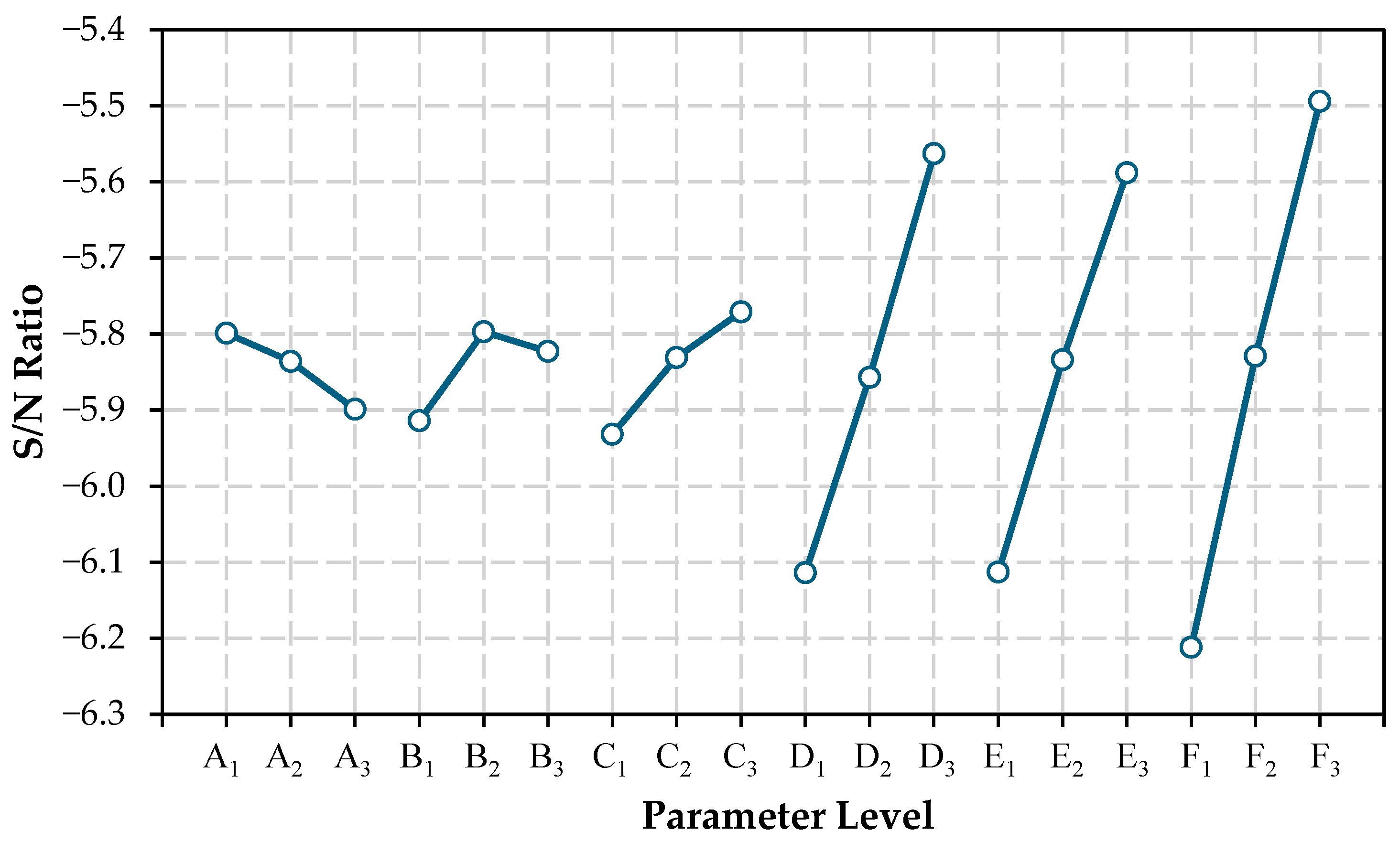
Considering the average S/N ratios presented in Table 7, it is seen that the most influential parameter on the thermal efficiency of the gas turbine cycle was F (turbine isentropic efficiency), followed by D (regenerator effectiveness). In contrast, the parameters with more limited effects on thermal efficiency compared to the others were determined as A (ambient temperature) and B (compressor pressure ratio). The importance order of all examined parameters on thermal efficiency was obtained as > > > > > .
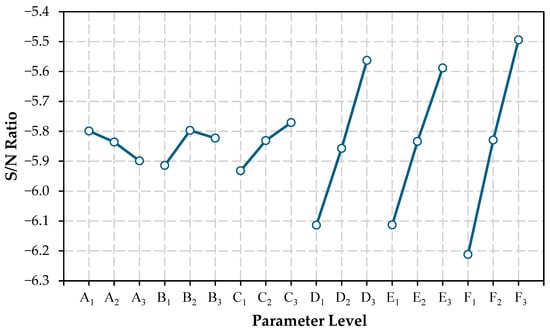
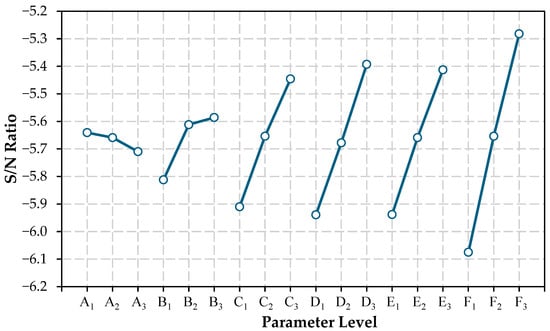
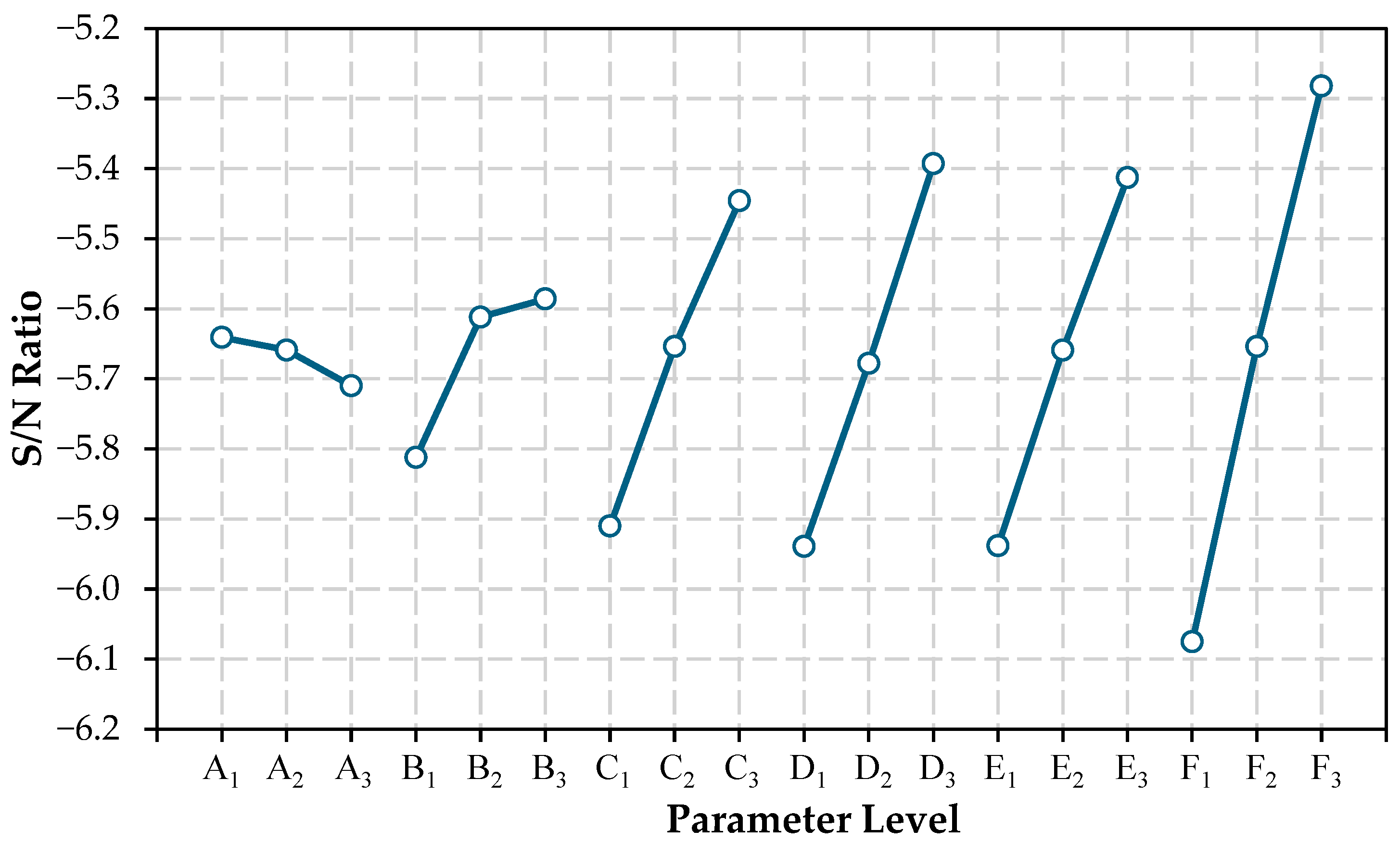
The impact of each parameter on the thermal efficiency of the gas turbine cycle is shown in Figure 2. According to the Taguchi analysis results, the impact of each design parameter on the objective function is expressed by the change in the S/N ratio of the related parameter. A larger difference between the maximum and minimum S/N ratio values implies that the corresponding parameter has a stronger influence on the objective function. The optimum levels of the design parameters are obtained at the operating conditions yielding the highest S/N ratio. In this regard, the optimum design parameters for maximum thermal efficiency were determined as = 15 °C, = 15, = 0.98, = 0.88, = 0.85, and = 0.90. At the optimum parameter combination A1B2C3D3E3F3, the gas turbine cycle achieved a thermal efficiency of 0.5723.
Figure 2.
Impact of each parameter on thermal efficiency of the gas turbine cycle.
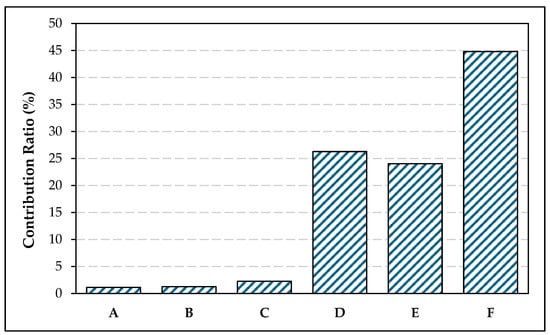
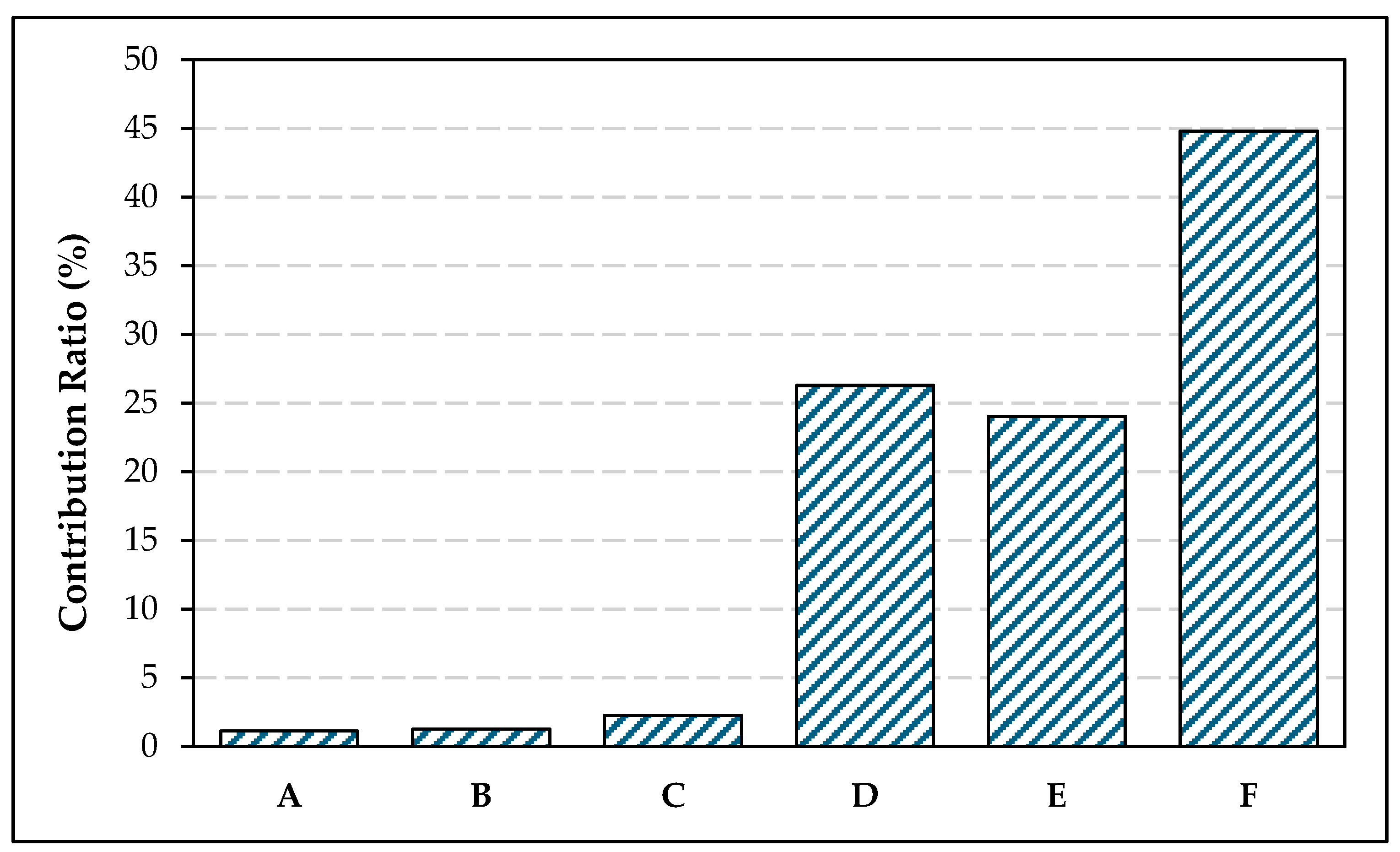
ANOVA was conducted in conjunction with the Taguchi analysis to quantify parameter contribution ratios and statistically validate the importance order obtained from the Taguchi results. Table 8 and Figure 3 summarize the ANOVA contribution ratios for the parameters affecting cycle thermal efficiency. According to these results, turbine isentropic efficiency, regenerator effectiveness, and compressor isentropic efficiency emerged as the three dominant parameters influencing the thermal efficiency of the gas turbine cycle, with contribution ratios of 44.80%, 26.28%, and 24.02%, respectively. In contrast, ambient temperature, compressor pressure ratio, and combustion efficiency constituted only 4.67% of the total effect, and their influence on thermal efficiency was negligible. As indicated by the ANOVA findings summarized in Table 8, the importance order of the operating parameters on thermal efficiency was determined as > > > > > . These findings indicate that both the Taguchi and ANOVA methods yielded the same importance order for the parameters influencing the thermal efficiency of the gas turbine cycle, demonstrating consistency between the two analyses.
Table 8.
ANOVA results and contribution ratios on the thermal efficiency of the gas turbine cycle.
Figure 3.
Contribution ratio of each parameter to the thermal efficiency.
After determining the parameters that affected the thermal efficiency of the gas turbine cycle and their contribution ratios, the same analysis procedure was applied for the exergy efficiency of the cycle. Accordingly, the order of importance of the parameters affecting exergy efficiency was determined by the Taguchi analysis, and the contribution ratios of these parameters were calculated using the ANOVA method.
The importance order of the examined parameters on the exergy efficiency of the gas turbine cycle and the average S/N ratios are presented in Table 9. Considering the average S/N ratios, the most influential parameter on exergy efficiency was determined as F (turbine isentropic efficiency), followed by D (regenerator effectiveness) and E (compressor isentropic efficiency). In contrast, the parameters with the least effect on exergy efficiency were determined as A (ambient temperature) and B (compressor pressure ratio), respectively. Furthermore, the order of importance of the parameters on the exergy efficiency of the cycle was obtained as > > > > > .
Table 9.
Average S/N ratios and weight factor for the exergy efficiency of the gas turbine cycle.
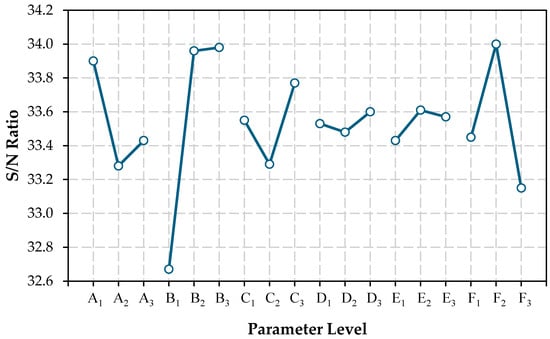
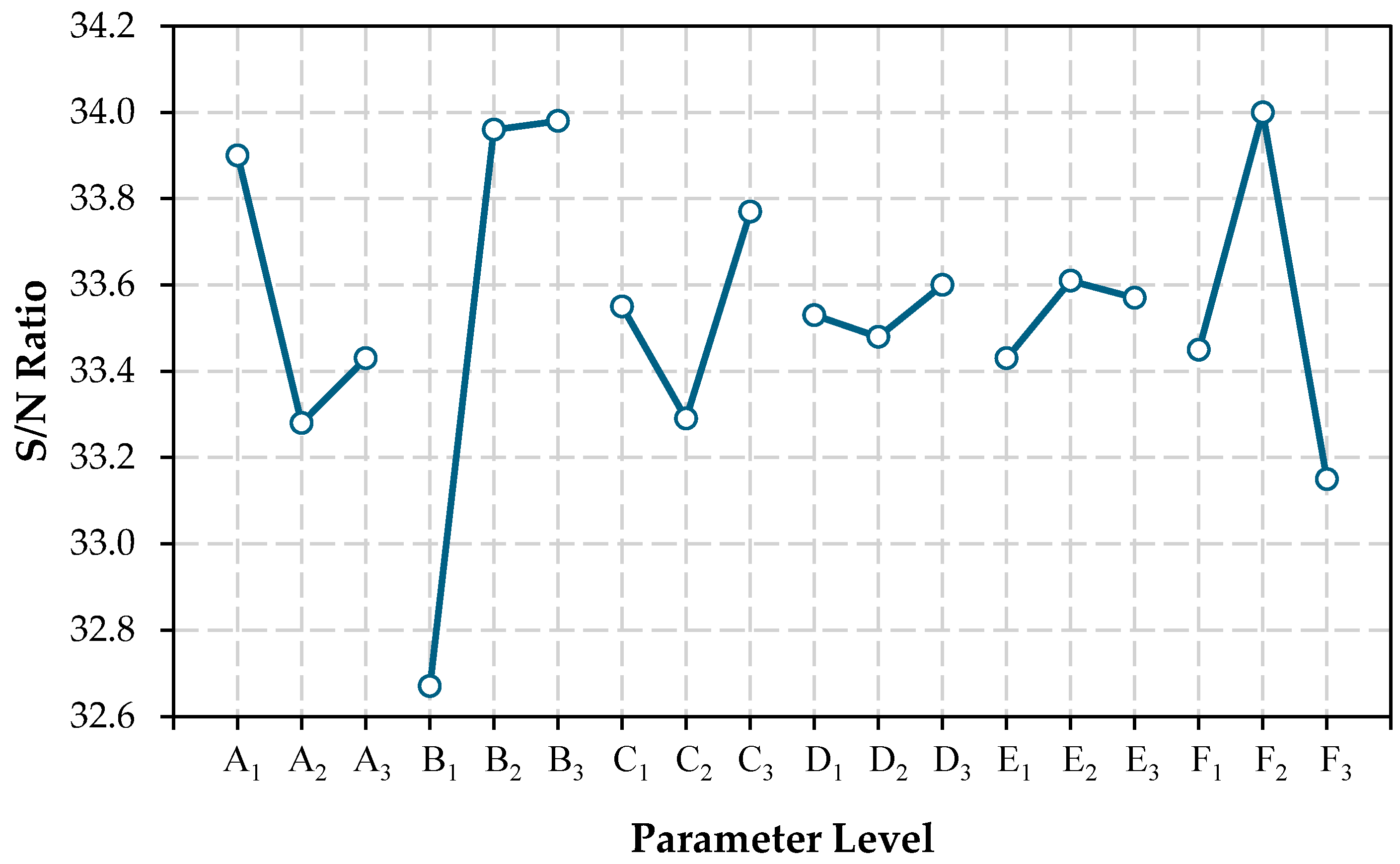
The impact of each parameter on the exergy efficiency of the gas turbine cycle is given in Figure 4. The optimum values providing maximum exergy efficiency were determined as 15 °C for ambient temperature, 20 for compressor pressure ratio, 0.98 for combustion efficiency, 0.88 for regenerator effectiveness, 0.85 for compressor isentropic efficiency, and 0.90 for turbine isentropic efficiency. For these optimum design parameters (A1B3C3D3E3F3), the exergy efficiency was calculated as 0.5992.
Figure 4.
Impact of each parameter on the exergy efficiency of the gas turbine cycle.
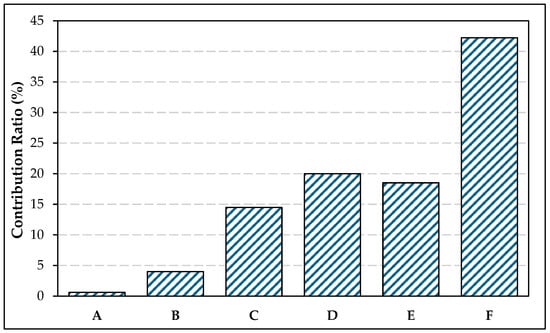
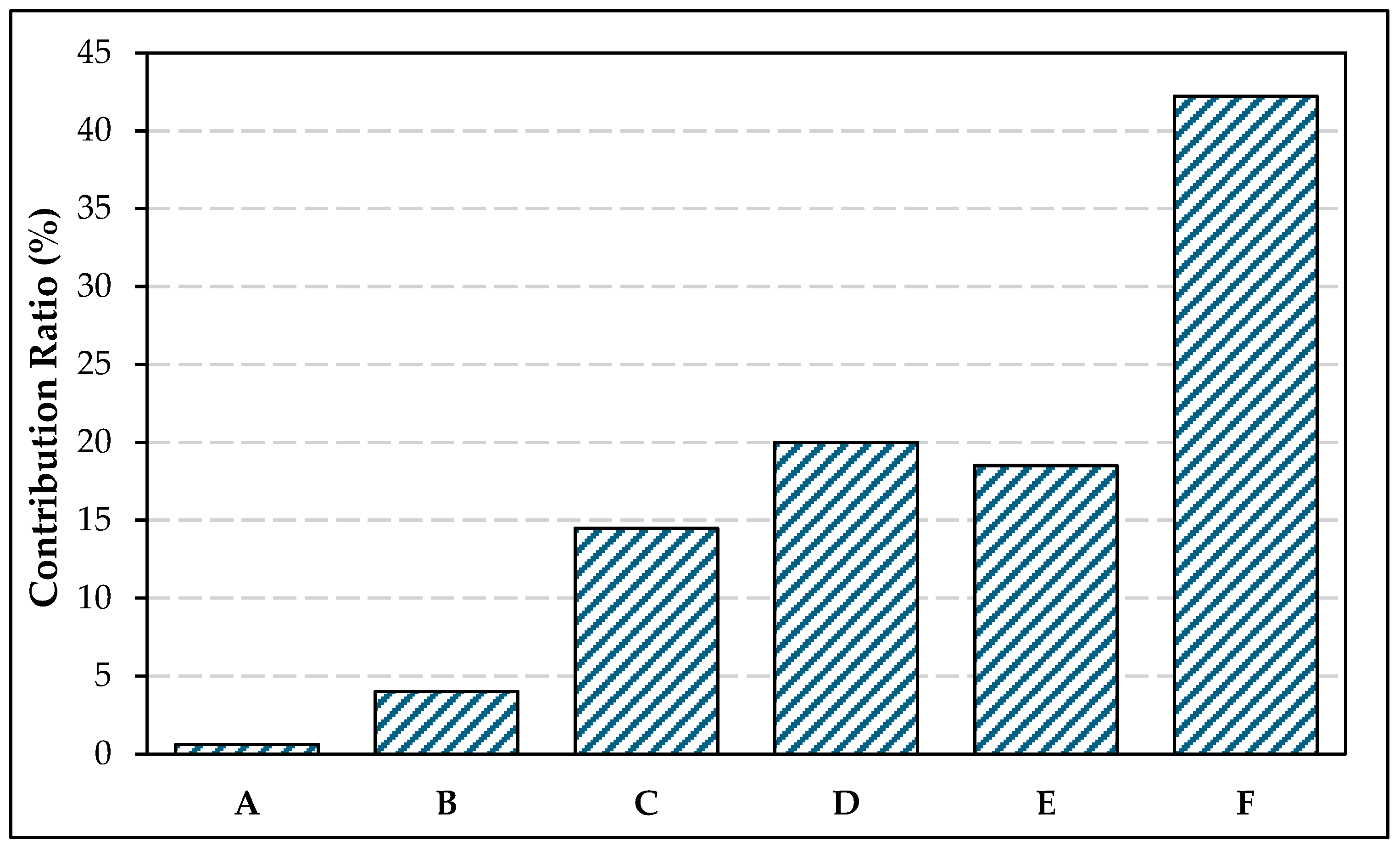
The contribution ratios of the parameters examined for the exergy efficiency of the gas turbine cycle, as derived from the ANOVA results, are summarized in Table 10 and Figure 5. The ANOVA results indicate that turbine isentropic efficiency, regenerator effectiveness, compressor isentropic efficiency, and combustion efficiency were the four most influential parameters on exergy efficiency, with contribution ratios of 42.22%, 19.99%, 18.51%, and 14.48%, respectively. In contrast, ambient temperature and compressor pressure ratio constituted only 4.61% of the total effect, and their influence on exergy efficiency was negligible. Moreover, considering the contribution ratios of the examined parameters, it is seen that the ANOVA and Taguchi results were consistent with each other.
Table 10.
ANOVA results and contribution ratios on the exergy efficiency of the gas turbine cycle.
Figure 5.
Contribution ratio of each parameter to the exergy efficiency.
Following the evaluation of parameter impacts on the thermal and exergy efficiencies of the gas turbine cycle, the same analytical framework was extended to the LCOE in order to assess the economic performance of the system. In this context, the importance order of the operating parameters with respect to LCOE was obtained through Taguchi analysis, while their contribution ratios were calculated using the ANOVA method.
The average S/N ratios and the order of importance of the parameters on the LCOE value of the gas turbine cycle are given in Table 11. Based on these findings, the most influential parameter on the LCOE value was determined as B (compressor pressure ratio). This parameter was followed by F (turbine isentropic efficiency) and A (ambient temperature). In contrast, the parameters with more limited effects on LCOE compared to the others were determined as D (regenerator effectiveness) and E (compressor isentropic efficiency). The importance order of all examined parameters on the LCOE value of the gas turbine cycle was obtained as > > > > > .
Table 11.
Average S/N ratios and weight factor for the LCOE of the gas turbine cycle.
The impact of each parameter on the LCOE value of the gas turbine cycle is presented in Figure 6. The optimum operating parameters for minimizing the LCOE value were determined as 15 °C for ambient temperature, 20 for compressor pressure ratio, 0.98 for combustion efficiency, 0.88 for regenerator effectiveness, 0.80 for compressor isentropic efficiency, and 0.85 for turbine isentropic efficiency. For these optimum design parameters (A1B3C3D3E2F2), the LCOE value of the cycle was calculated as 0.0174 USD/kWh.
Figure 6.
Impact of each parameter on LCOE of the gas turbine cycle.
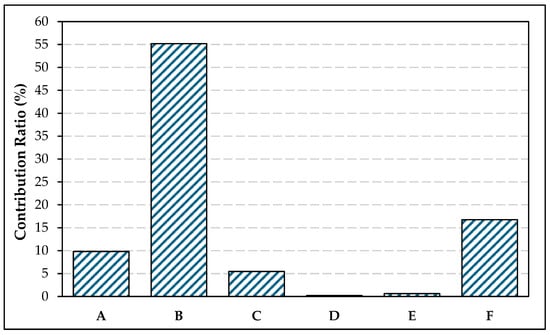
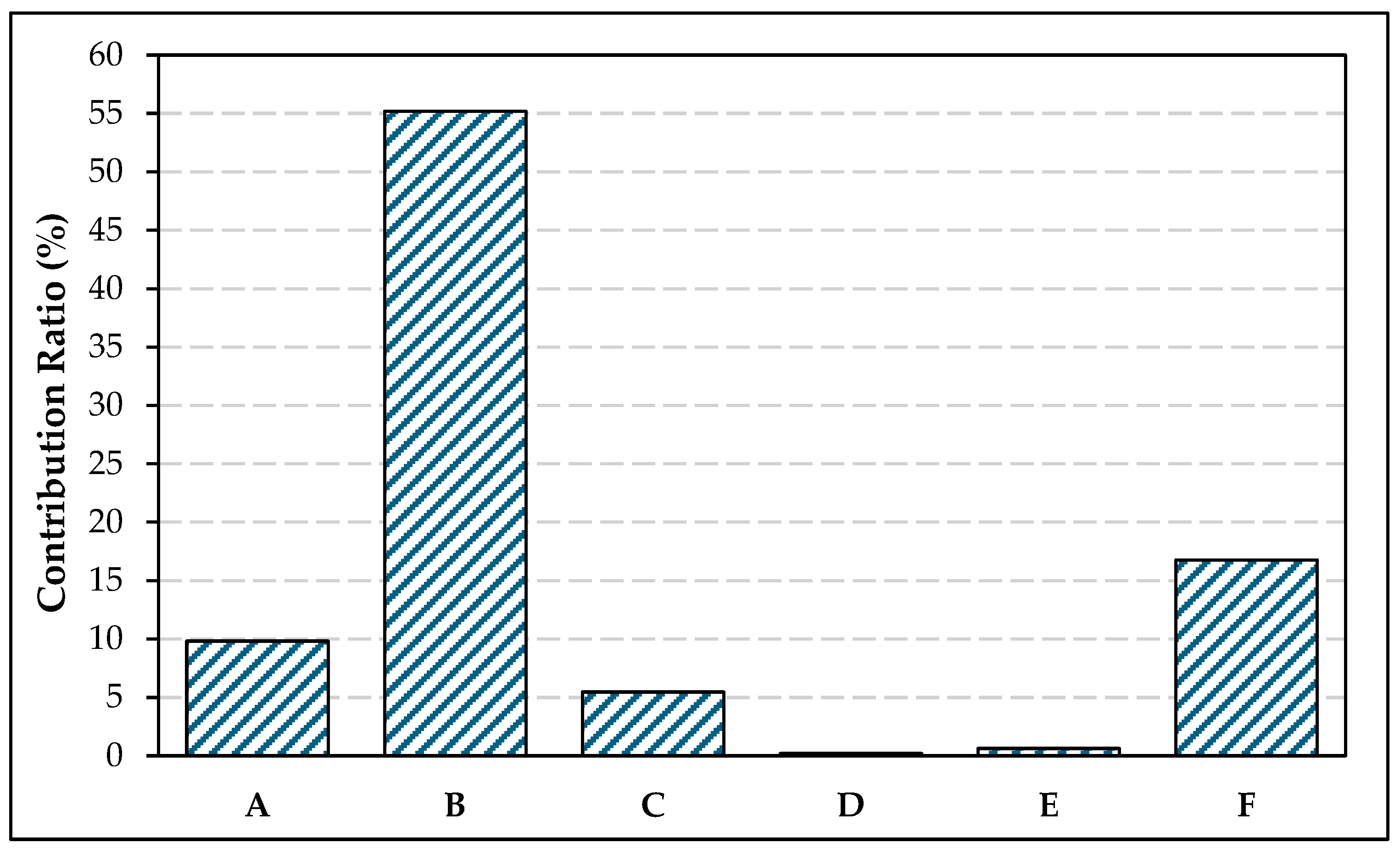
Table 12 and Figure 7 summarize the ANOVA-based contribution ratios of the investigated parameters for the LCOE of the gas turbine cycle. Among all parameters, the compressor pressure ratio exhibited the highest contribution to LCOE, accounting for 55.19%. This parameter was followed by turbine isentropic efficiency and ambient temperature with contribution ratios of 16.76% and 9.83%, respectively. In contrast, regenerator effectiveness and compressor isentropic efficiency constituted only 0.81% of the total effect, and their influence on LCOE was negligible. As shown in Figure 7, the ANOVA results obtained for the LCOE value of the gas turbine cycle were consistent with the Taguchi analysis results.
Table 12.
ANOVA results and contribution ratios on the LCOE of the gas turbine cycle.
Figure 7.
Contribution ratio of each parameter to the LCOE.
The results reveal that the optimum operating conditions obtained for thermal efficiency, exergy efficiency, and LCOE do not coincide exactly, which clearly indicates the presence of inherent trade-offs among the objective functions. In particular, increasing thermodynamic efficiencies generally requires higher component performance levels and, in some cases, higher pressure ratios, which may increase capital and operational costs. Conversely, operating conditions that minimize LCOE do not always correspond to the maximum achievable thermal or exergy efficiencies. While the Taguchi and ANOVA analyses provide valuable insight into the individual influence of operating parameters on each objective, a multi-objective optimization framework is required to simultaneously evaluate their combined effects. In this context, the grey relational analysis (GRA) method was employed to reduce the three objective functions to a single performance indicator and to determine the optimum multi-objective operating condition.
Accordingly, the multiple performance characteristic was targeted to be maximized within the GRA framework to achieve high thermal and exergy efficiencies and a low LCOE. The procedure followed for the implementation of the GRA method is described in detail in the mathematical model section. In this section, the normalized results, grey relational coefficients (GRCs), grey relational grades (GRGs), and rankings are calculated, and the corresponding values are provided in Table 13.
Table 13.
Results of grey relational analysis.
To obtain reliable and consistent results in the GRA method, the weighting factors expressing the contributions of each objective function to the multiple performance characteristic must be determined appropriately. For this reason, the weighting factors for thermal efficiency, exergy efficiency, and LCOE were calculated using Equation (42) as 26%, 31.45%, and 42.55%, respectively, and these are presented in Table 7, Table 9 and Table 11. Considering the weighting factors of each objective function, the grey relational grade equation was obtained as follows:
Here, , , and denote the GRC values calculated for thermal efficiency, exergy efficiency, and LCOE, respectively.
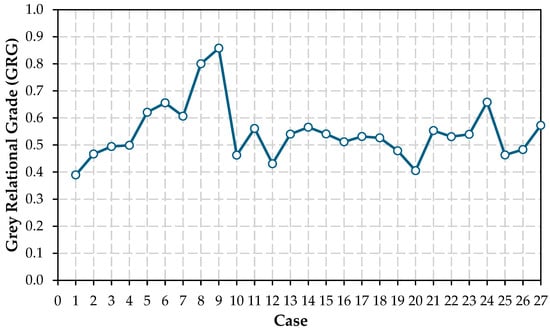
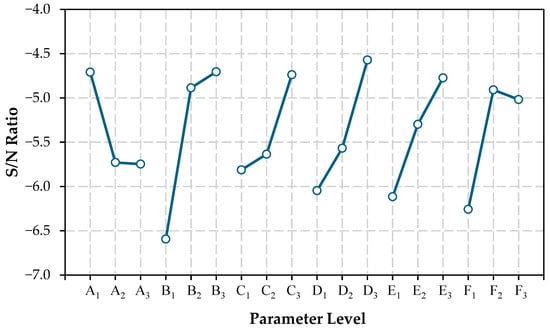
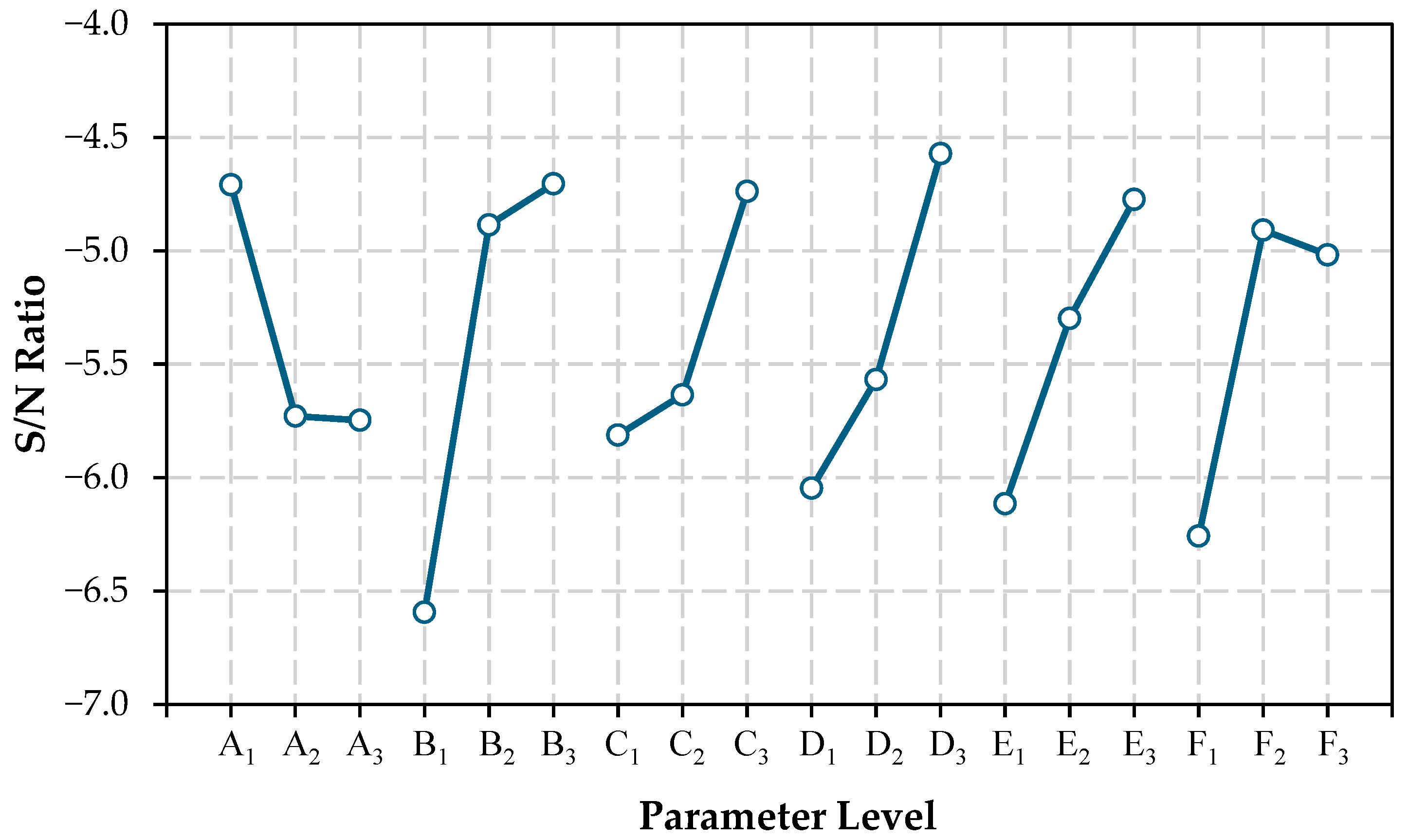
The variation of the GRG values depending on the operating conditions is presented in Figure 8. Among all examined conditions, the condition with the highest GRG represents the maximum multiple performance characteristic. Among the 27 different cases in Figure 8, it is seen that Case 9 (A1B3C3D3E3F3) had the highest GRG, while Case 1 (A1B1C1D1E1F1) had the lowest GRG. However, when all possible combinations were evaluated, the optimum operating parameters providing the maximum multiple performance characteristic were determined as = 15 °C, = 20, = 0.98, = 0.88, = 0.85, and = 0.85, as shown in Figure 9. For these operating conditions (A1B3C3D3E3F2), the thermal and exergy efficiencies of the gas turbine cycle were calculated as 0.5533 and 0.5772, respectively, and the LCOE value was obtained as 0.01751 USD/kWh.
Figure 8.
Grey relational grade for the maximum performance characteristic.
Figure 9.
Impact of each parameter on multiple performance characteristic.
Furthermore, the operating parameters at which the thermodynamic and economic performance of the cycle was lowest, obtained by minimizing thermal and exergy efficiencies while maximizing the LCOE value, were determined as = 25 °C, = 10, = 0.92, = 0.82, = 0.75, and = 0.80. For these conditions (A3B1C1D1E1F1), the thermal and exergy efficiencies of the cycle were obtained as 0.4453 and 0.4408, respectively, and the LCOE value was calculated as 0.02304.
To determine the importance order of the parameters on the multiple performance characteristic examined within the scope of the study, the response table created based on the GRG values is presented in Table 14. According to the obtained results, the importance order of the parameters in terms of the multiple performance characteristic was determined as > > > > > . The impact of each examined parameter on the multiple performance characteristic is shown in Figure 9.
Table 14.
Response table for grey relational grade.
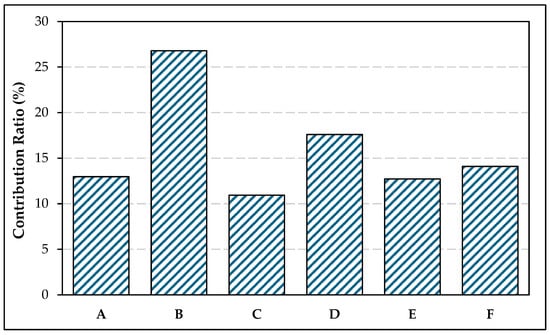
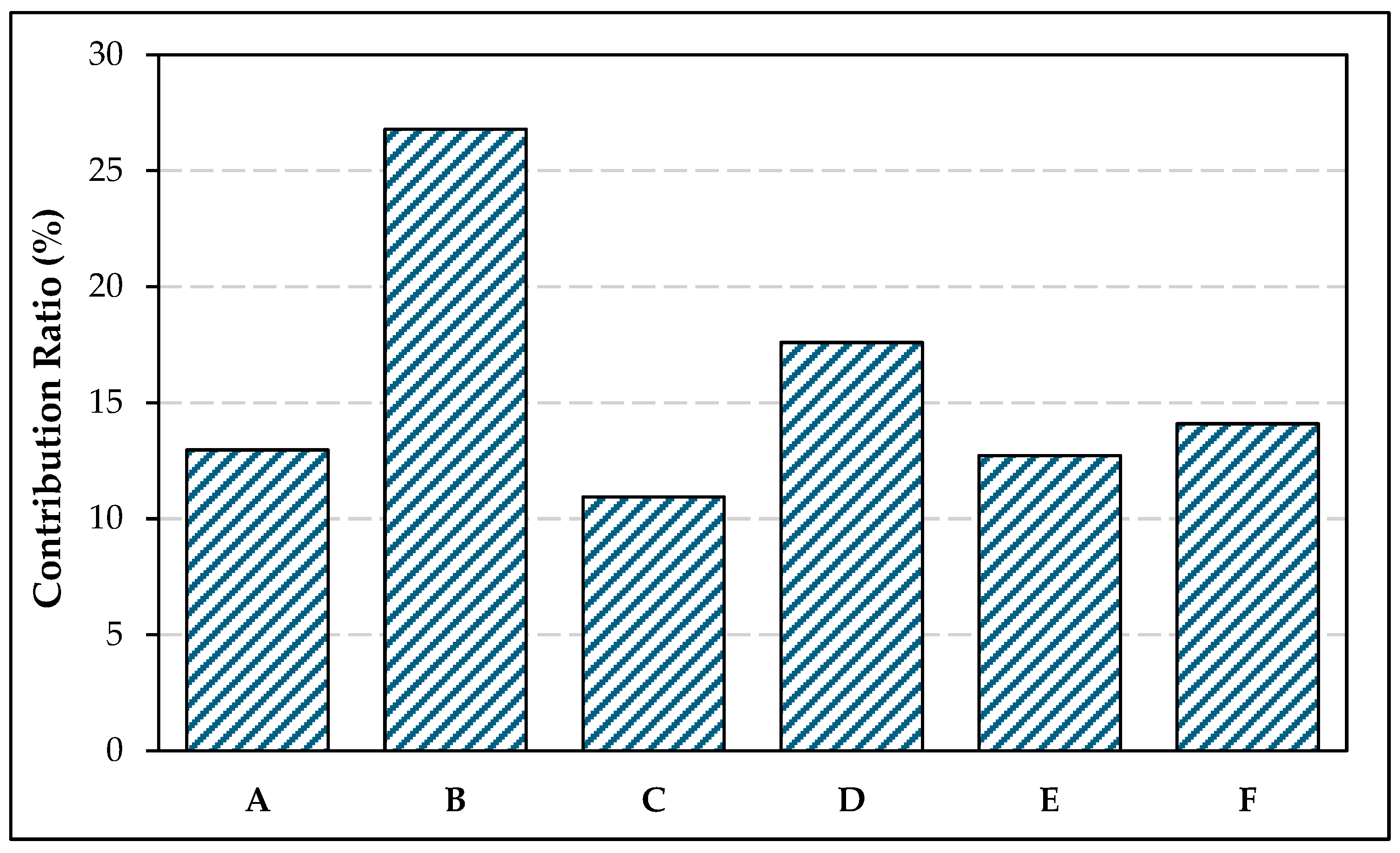
The GRG results were analyzed through ANOVA, and the contribution ratios of each parameter are presented in Table 15 and Figure 10. The compressor pressure ratio was identified as the most influential parameter affecting the multiple performance characteristic, with a contribution ratio of 26.79%. This was followed by regenerator effectiveness and turbine isentropic efficiency, with contribution ratios of 17.6% and 14.09%, respectively. Ambient temperature, compressor isentropic efficiency, and combustion efficiency were determined to have very similar levels of influence on the multiple performance characteristic, with contribution ratios of 12.97%, 12.72%, and 10.94%, respectively.
Table 15.
ANOVA results and contribution ratios for grey relational grade.
Figure 10.
Contribution ratio of each parameter to multiple performance characteristic.
Although the Taguchi analysis based on the GRG and ANOVA results were generally consistent, partial differences were observed in the order of importance for some parameters with low contribution ratios. However, the fact that the contribution ratios of these parameters were close to each other indicates that the differences in the order of importance had a limited impact on the results. These differences probably arose from the Taguchi method being founded on level-based average variations, while the ANOVA method is based on total variance contributions, and this shows that the obtained results were complementary in nature.
The obtained optimum parameter combination represents a balanced operating condition in which thermodynamic and economic performances are simultaneously optimized. In particular, the relatively high turbine and compressor isentropic efficiencies reduce irreversibilities during the expansion and compression processes, thereby improving both the thermal and exergy efficiencies of the cycle. Similarly, the high regenerator effectiveness enhances heat recovery from turbine exhaust gases, which increases the overall cycle efficiency and reduces the fuel consumption required for the desired power output. In addition, the selected compressor pressure ratio provides an appropriate compromise between thermodynamic and economic performance, which directly affects the LCOE value. The relatively low ambient temperature leads to a lower compressor inlet temperature, which reduces the compressor work and contributes positively to the thermodynamic performance of the cycle. Furthermore, higher combustion efficiency improves the effective utilization of fuel chemical energy in the combustion chamber, thereby supporting improvements in both thermal and exergy efficiencies. These results demonstrate that the GRA-based multi-objective optimization successfully identifies operating conditions that balance the conflicting objectives of maximizing thermal and exergy efficiencies while minimizing the LCOE value.
4. Conclusions
In this study, the fundamental operating parameters affecting the thermodynamic and economic performance of a gas turbine cycle with intercooling, reheating, and regeneration were comprehensively evaluated using the Taguchi, ANOVA, and GRA methods. Ambient temperature, compressor pressure ratio, combustion efficiency, regenerator effectiveness, compressor isentropic efficiency, and turbine isentropic efficiency were considered as the fundamental operating parameters. Within the scope of the study, the thermodynamic model of the gas turbine cycle was first established, and the thermal efficiency, exergy efficiency, and LCOE values of the system were calculated for different operating parameters. Then, the parameters were ranked in terms of their influence on the related performance indicators by applying the Taguchi method, and the contribution ratios of the parameters were calculated using the ANOVA method. Furthermore, since the optimum operating conditions obtained for different objective functions differed from each other, a multi-objective optimization approach capable of evaluating these three performance characteristics simultaneously was adopted, and the multiple performance characteristic was defined using the GRA method. The obtained results enabled a more comprehensive evaluation of the system’s behavior in terms of both individual performance indicators and the multiple performance characteristic.
According to the Taguchi analysis results, the importance order of the operating parameters affecting the thermal efficiency of the gas turbine cycle was determined as > > > > > . According to the ANOVA results, turbine isentropic efficiency, regenerator effectiveness, and compressor isentropic efficiency emerged as the three most influential parameters on thermal efficiency, with contribution ratios of 44.80%, 26.28%, and 24.02%, respectively. Furthermore, the maximum thermal efficiency was calculated as 0.5723 for the optimum operating conditions A1B2C3D3E3F3.
In the evaluations made for the exergy efficiency of the cycle, the order of importance of the operating parameters was again seen to be > > > > > . According to the ANOVA results, turbine isentropic efficiency, regenerator effectiveness, compressor isentropic efficiency, and combustion efficiency were the determining parameters on exergy efficiency, with contribution ratios of 42.22%, 19.99%, 18.51%, and 14.48%, respectively. Under the optimum operating conditions A1B3C3D3E3F3, the exergy efficiency was maximum and calculated as 0.5992.
The importance order of the operating parameters on the LCOE value of the gas turbine cycle was determined as > > > > > . According to the analysis results, the compressor pressure ratio emerged as the most influential parameter on LCOE, with a contribution ratio of 55.19%. In contrast, regenerator effectiveness and compressor isentropic efficiency constituted only 0.81% of the total effect, and their influence on LCOE was negligible. For the optimum operating conditions A1B3C3D3E2F2, the LCOE value was minimum and obtained as 0.0174 USD/kWh.
After the Taguchi analysis and ANOVA, the GRA method was used for a multi-objective optimization=, aiming to maximize the thermal and exergy efficiencies while minimizing the LCOE value. According to the GRA results, compressor pressure ratio, regenerator effectiveness, and turbine isentropic efficiency were determined as the most influential parameters on the multiple performance characteristic, and the contribution ratios of these parameters were calculated as 26.79%, 17.6%, and 14.09%, respectively. Considering the multiple performance characteristic, the most suitable operating conditions for the gas turbine cycle were determined as A1B3C3D3E3F2. These operating conditions represent the state in which thermal and exergy efficiencies simultaneously reached their maximum and the LCOE value was minimum. Under these conditions, the thermal efficiency of the gas turbine cycle was calculated as 0.5533, while its exergy efficiency was 0.5772 and its LCOE value was 0.01751 USD/kWh.
This study statistically revealed the relative impacts of the operating parameters on the thermodynamic and economic performance of a gas turbine cycle and determined the optimum operating conditions in terms of both individual and multi-objective optimization results. In this respect, the study contributes to the design of gas turbine cycles in a more efficient and cost-effective manner, and the obtained results are considered to be instructive for similar energy systems.
From an engineering design perspective, the results of this study provide important insights into which operating parameters should be prioritized to improve the performance of gas turbine cycles incorporating intercooling, reheating, and regeneration. The findings may contribute to more informed and systematic decision-making in the design and performance optimization of gas turbine systems. Future studies may further extend the present approach by incorporating additional performance indicators, such as environmental metrics, in order to provide a more comprehensive evaluation of gas turbine system performance.
Funding
This research received no external funding.
Institutional Review Board Statement
Not applicable.
Informed Consent Statement
Not applicable.
Data Availability Statement
The original contributions presented in this study are included in the article. Further inquiries can be directed to the corresponding author.
Conflicts of Interest
The author declares no conflict of interest.
References
- Ghazikhani, M.; Khazaee, I.; Abdekhodaie, E. Exergy analysis of gas turbine with air bottoming cycle. Energy 2014, 72, 599–607. [Google Scholar] [CrossRef] [Scilit]
- Khaljani, M.; Saray, R.K.; Bahlouli, K. Comprehensive analysis of energy, exergy and exergo-economic of cogeneration of heat and power in a combined gas turbine and organic Rankine cycle. Energy Convers. Manag. 2015, 97, 154–165. [Google Scholar] [CrossRef] [Scilit]
- Sadeghi, M.; Chitsaz, A.; Marivani, P.; Yari, M.; Mahmoudi, S.M.S. Effects of thermophysical and thermochemical recuperation on the performance of combined gas turbine and organic rankine cycle power generation system: Thermoeconomic comparison and multi-objective optimization. Energy 2020, 210, 118551. [Google Scholar] [CrossRef] [Scilit]
- Ahmadi, P.; Dincer, I. Thermodynamic and exergoenvironmental analyses, and multi-objective optimization of a gas turbine power plant. Appl. Therm. Eng. 2011, 31, 2529–2540. [Google Scholar] [CrossRef] [Scilit]
- Sun, L.; Wang, D.; Xie, Y. Energy, exergy and exergoeconomic analysis of two supercritical CO2 cycles for waste heat recovery of gas turbine. Appl. Therm. Eng. 2021, 196, 117337. [Google Scholar] [CrossRef] [Scilit]
- Altun, A.F. A conceptual design and analysis of a novel trigeneration system consisting of a gas turbine power cycle with intercooling, ammonia–water absorption refrigeration, and hot water production. Sustainability 2022, 14, 11820. [Google Scholar] [CrossRef] [Scilit]
- Alrobaian, A.A. Energy, exergy, economy, and environmental (4E) analysis of a multi-generation system composed of solar-assisted Brayton cycle, Kalina cycle, and absorption chiller. Appl. Therm. Eng. 2022, 204, 117988. [Google Scholar] [CrossRef] [Scilit]
- Liu, X.; Hu, G.; Zeng, Z. Potential of biomass processing using digester in arrangement with a Brayton cycle, a Kalina cycle, and a multi-effect desalination; thermodynamic/environmental/financial study and MOPSO-based optimization. Energy 2022, 261, 125222. [Google Scholar] [CrossRef] [Scilit]
- Wang, S.; Liu, C.; Li, J.; Sun, Z.; Chen, X.; Wang, X. Exergoeconomic analysis of a novel trigeneration system containing supercritical CO2 Brayton cycle, organic Rankine cycle and absorption refrigeration cycle for gas turbine waste heat recovery. Energy Convers. Manag. 2020, 221, 113064. [Google Scholar] [CrossRef] [Scilit]
- Pirmohamadi, A.; Ziapour, B.M. Investigation of a novel multigeneration system driven by an ammonia-methane Brayton cycle with partial production and utilization of ammonia, methane, and hydrogen: Energy and carbon footprint assessments. Heliyon 2024, 10, e38769. [Google Scholar] [CrossRef] [Scilit]
- Zoghi, M.; Hosseinzadeh, N.; Gharaie, S.; Zare, A. Waste heat recovery of a combined Brayton and inverse Brayton cycle for gas turbine based multi-generation hydrogen and freshwater purposes: 4E comparison with a simple coupled Brayton and inverse Brayton cycle. Therm. Sci. Eng. Prog. 2024, 53, 102718. [Google Scholar] [CrossRef] [Scilit]
- Shirazi, A.; Aminyavari, M.; Najafi, B.; Rinaldi, F.; Razaghi, M. Thermal-economic-environmental analysis and multi-objective optimization of an internal-reforming solid oxide fuel cell-gas turbine hybrid system. Int. J. Hydrogen Energy 2012, 37, 19111–19124. [Google Scholar] [CrossRef] [Scilit]
- Chen, Y.; Wang, M.; Liso, V.; Samsatli, S.; Samsatli, N.J.; Jing, R.; Chen, J.; Li, N.; Zhao, Y. Parametric analysis and optimization for exergoeconomic performance of a combined system based on solid oxide fuel cell-gas turbine and supercritical carbon dioxide Brayton cycle. Energy Convers. Manag. 2019, 186, 66–81. [Google Scholar] [CrossRef] [Scilit]
- Skabelund, B.B.; Jenkins, C.D.; Stechel, E.B.; Milcarek, R.J. Thermodynamic and emission analysis of a hydrogen/methane fueled gas turbine. Energy Convers. Manag. X 2023, 19, 100394. [Google Scholar] [CrossRef] [Scilit]
- Hai, T.; El-Shafay, A.S.; Chaturvedi, R.; Marjan, R.K.; Almujibah, H.; Rajab, H.; Almojil, S.F.; Almohana, A.I. Quantitative assessment of hydrogen blending in a gas turbine-based plant for supplying residential electricity, water, and cooling load: A techno-economic-environmental optimization. Process Saf. Environ. Prot. 2024, 184, 428–444. [Google Scholar] [CrossRef] [Scilit]
- Ozen, D.N.; Guleryuz, E.H.; Acilar, A.M. Advanced exergo-economic analysis of an advanced adiabatic compressed air energy storage system with the modified productive structure analysis method and multi-objective optimization study. J. Energy Storage 2024, 81, 110380. [Google Scholar] [CrossRef] [Scilit]
- Nazari, N.; Mousavi, S.; Mirjalili, S. Exergo-economic analysis and multi-objective multi-verse optimization of a solar/biomass-based trigeneration system using externally-fired gas turbine, organic Rankine cycle and absorption refrigeration cycle. Appl. Therm. Eng. 2021, 191, 116889. [Google Scholar] [CrossRef] [Scilit]
- Bademlioglu, A.H.; Canbolat, A.S.; Kaynakli, O. Sustainable liquid hydrogen production: Comprehensive modeling and thermodynamic analysis of a geothermal-powered multifunctional system. Sustain. Energy Technol. Assess. 2025, 76, 104279. [Google Scholar] [CrossRef] [Scilit]
- Bejan, A.; Tsatsaronis, G.; Moran, M.J. Thermal Design and Optimization, 1st ed.; John Wiley & Sons: Hoboken, NJ, USA, 1995. [Google Scholar]
- Cengel, Y.A.; Boles, M.A. Thermodynamics: An Engineering Approach, 8th ed.; McGraw-Hill: New York, NY, USA, 2015. [Google Scholar]
- Peng, W.; Gonzalez-Ayala, J.; Guo, J.; Chen, J.; Hernandez, A.C. An alkali metal thermoelectric converter hybridized with a Brayton heat engine: Parametric design strategies and energetic optimization. J. Clean. Prod. 2020, 260, 120953. [Google Scholar] [CrossRef] [Scilit]
- Wang, R.; Ge, Y.; Chen, L.; Feng, H.; Wu, Z. Power and thermal efficiency optimization of an irreversible steady-flow Lenoir cycle. Entropy 2021, 23, 425. [Google Scholar] [CrossRef] [Scilit]
- Moran, M.J.; Shapiro, H.N.; Boettner, D.D.; Bailey, M.B. Fundamentals of Engineering Thermodynamics, 8th ed.; John Wiley & Sons: Hoboken, NJ, USA, 2014. [Google Scholar]
- Nazari, N.; Porkhial, S. Multi-objective optimization and exergo-economic assessment of a solar-biomass multi-generation system based on externally-fired gas turbine, steam and organic Rankine cycle, absorption chiller and multi-effect desalination. Appl. Therm. Eng. 2020, 179, 115521. [Google Scholar] [CrossRef] [Scilit]
- Miao, X.; Zhang, H.; Zhao, S.; Zhang, Q.; Xia, Y. An innovative S–CO2 recompression Brayton system and its thermodynamic, exergoeconomic and multi-objective analyses for a nuclear spacecraft. Case Stud. Therm. Eng. 2024, 53, 103805. [Google Scholar] [CrossRef] [Scilit]
- Chen, F.; Zhang, W.; Cai, J.; Wang, X.; Guo, J.; Li, W. Design and optimization of a multi-level wasted heat recovery system for a natural gas-based gas turbine cycle; comprehensive exergy and economic analyses. Appl. Therm. Eng. 2024, 236, 121662. [Google Scholar] [CrossRef] [Scilit]
- Enayatizadeh, H.; Arjomand, A.; Tynjälä, T.; Inkeri, E. Cryogenic carbon capture design through CO2 anti-sublimation for a gas turbine exhaust: Environmental, economic, energy, and exergy analysis. Energy 2024, 304, 132244. [Google Scholar] [CrossRef] [Scilit]
- Baghernejad, A.; Anvari-Moghaddam, A. Exergoeconomic and environmental analysis and multi-objective optimization of a new regenerative gas turbine combined cycle. Appl. Sci. 2021, 11, 11554. [Google Scholar] [CrossRef] [Scilit]
- Wang, X.; Yang, Y.; Zheng, Y.; Dai, Y. Exergy and exergoeconomic analyses of a supercritical CO2 cycle for a cogeneration application. Energy 2017, 119, 971–982. [Google Scholar] [CrossRef] [Scilit]
- Wu, C.; Xu, X.; Li, Q.; Li, J.; Wang, S.; Liu, C. Proposal and assessment of a combined cooling and power system based on the regenerative supercritical carbon dioxide Brayton cycle integrated with an absorption refrigeration cycle for engine waste heat recovery. Energy Convers. Manag. 2020, 207, 112527. [Google Scholar] [CrossRef] [Scilit]
- Khalili, B.; Kargarsharifabad, H.; Rahbar, N.; Esfahlani, A.A.; Jamshidi, E. Performance evaluation of a CGS gas heater-powered HDH desalination system using thermosyphon heat pipes: An experimental study with economic and environmental assessment. Int. Commun. Heat Mass Transf. 2024, 152, 107300. [Google Scholar] [CrossRef] [Scilit]
- Singmai, W.; Janpla, P.; Sutthivirode, K.; Thongtip, T.; Ruangtrakoon, N. Thermo-economic assessment of the organic Rankine cycle combined with an ejector cooling cycle driven by low-grade waste heat. Energies 2025, 18, 6408. [Google Scholar] [CrossRef] [Scilit]
- Belman-Flores, J.M.; Rangel-Hernández, V.H.; Pérez-García, V.; Zaleta-Aguilar, A.; Fang, Q.; Méndez-Méndez, D. An advanced exergoeconomic comparison of CO2-based transcritical refrigeration cycles. Energies 2020, 13, 6454. [Google Scholar] [CrossRef] [Scilit]
- Hou, S.; Zhou, Y.; Yu, L.; Zhang, F.; Cao, S. Optimization of the combined supercritical CO2 cycle and organic Rankine cycle using zeotropic mixtures for gas turbine waste heat recovery. Energy Convers. Manag. 2018, 160, 313–325. [Google Scholar] [CrossRef] [Scilit]
- Hu, Y.; Badrawi, S.I.; Kumar, J.; Sabeh, H.N.; Alsenani, T.R.; Riaz, F.; Alkhalifah, T.; Alkhalaf, S.; Alturise, F. Gas turbine-based system taking advantage of LNG regasification process for multigeneration purposes; Techno-economic-environmental analysis and machine learning optimization. Process Saf. Environ. Prot. 2023, 179, 10–26. [Google Scholar] [CrossRef] [Scilit]
- Pelaez, R.; Marin, P.; Ordonez, S. Hydrogen production through the integration of biomass gasification and residual steelmaking streams. Int. J. Hydrogen Energy 2025, 176, 151420. [Google Scholar] [CrossRef] [Scilit]
- Lu, H.; Fan, C.; Li, D.; Chen, Y.; Yao, F. Economic and exergy assessments for ocean thermal energy conversion using environment-friendly fluids. Processes 2025, 13, 2780. [Google Scholar] [CrossRef] [Scilit]
- Yousef, M.S.; Hawwash, A.A.; Santana, D. Assessment of a sustainable multigeneration system integrating supercritical CO2 Brayton cycle and LNG regasification: Thermodynamic and exergoeconomic evaluation. Case Stud. Therm. Eng. 2024, 56, 104205. [Google Scholar] [CrossRef] [Scilit]
- Zhou, J.; Ali, M.A.; Zeki, F.M.; Dhahad, H.A. Thermoeconomic investigation and multi-objective optimization of a novel efficient solar tower power plant based on supercritical Brayton cycle with inlet cooling. Therm. Sci. Eng. Prog. 2023, 39, 101679. [Google Scholar] [CrossRef] [Scilit]
- Bademlioglu, A.H.; Karatas, O.B.; Sokmen, K.F.; Yuruklu, E. Thermal management and fin characteristic optimization of an electronic power supply utilizing Taguchi and ANOVA methods. Appl. Therm. Eng. 2024, 252, 123671. [Google Scholar] [CrossRef] [Scilit]
- Kesercioglu, M.A.; San, F.G.B.; Sozbir, N.; Cay, Y. Performance optimization of PEM electrolyzers: An experimental and Taguchi-based approach. Int. J. Hydrogen Energy 2025, 152, 150214. [Google Scholar] [CrossRef] [Scilit]
- Jansasithorn, A.; Ma, L.; Ingham, D.; Pourkashanian, M. Bulding a robust CFD model using the Taguchi method for the simulation of dynamic passive self-starting of vertical axis wind turbines. Energy 2025, 335, 137965. [Google Scholar] [CrossRef] [Scilit]
- Pandey, A.; Mishra, M.K. Optimizing the rate of heat transfer through nanofluid impinging upon a continuously deforming Riga plate using Taguchi method. Case Stud. Therm. Eng. 2024, 55, 104115. [Google Scholar] [CrossRef] [Scilit]
- Kumar, P.; Almeida, F.; Muhammed, T.; Alghamdi, M. Surface drag optimization using ANOVA-Taguchi method for the unsteady radiative flow of dusty-trihybrid nanofluid in a microchannel emphasizing shape factor. J. Radiat. Res. Appl. Sci. 2025, 18, 101806. [Google Scholar] [CrossRef] [Scilit]
- Kale, M.F.; Yilmaz, N.; Bademlioglu, A.H.; Sokmen, K.F.; Shi, W. Design and optimization of the hydrokinetic turbine blades using statistical Approaches. Renew. Energy 2026, 256, 123909. [Google Scholar] [CrossRef] [Scilit]
- Ma, X.; Joybari, M.M.; Luo, J.; Liu, J.; Lai, K. Conducting a parametric study on microgrid energy and economic performance with system optimization using Taguchi-ANOVA approach. J. Energy Storage 2024, 97, 112960. [Google Scholar] [CrossRef] [Scilit]
- Ustaoglu, A.; Kursuncu, B.; Alptekin, M.; Gok, M.S. Performance optimization and parametric evaluation of the cascade vapor compression refrigeration cycle using Taguchi and ANOVA methods. Appl. Therm. Eng. 2020, 180, 115816. [Google Scholar] [CrossRef] [Scilit]
- Mirzabaghi, F.; Saidi, M.H.; Aghanajafi, C. Cooling optimization of developing, pulsating, incompressible airflow through a 4-rifled aluminum microtube using statistical approach based on analysis of variance (ANOVA). Results Eng. 2025, 27, 105566. [Google Scholar] [CrossRef] [Scilit]
- Canbolat, A.S.; Bademlioglu, A.H.; Arslanoglu, N.; Kaynakli, O. Performance optimization of absorption refrigeration systems using Taguchi, ANOVA and Grey Relational Analysis methods. J. Clean. Prod. 2019, 229, 874–885. [Google Scholar] [CrossRef] [Scilit]
- Megdouli, K.; Gholizadeh, T.; Tashtoush, B.; Cinnella, P.; Skorek-Osikowska, A. Optimization of carbon dioxide ejector expansion transcritical refrigeration system with ANOVA and NSGA-II. Int. J. Refrig. 2024, 158, 173–189. [Google Scholar] [CrossRef] [Scilit]
- Bademlioglu, A.H.; Canbolat, A.S.; Kaynakli, O. Multi-objective optimization of parameters affecting Organic Rankine Cycle performance characteristics with Taguchi-Grey Relational Analysis. Renew. Sustain. Energy Rev. 2020, 117, 109483. [Google Scholar] [CrossRef] [Scilit]
- Sun, G.; Zhang, H.; Fang, J.; Li, G.; Li, Q. A new multi-objective discrete robust optimization algorithm for engineering design. Appl. Math. Model. 2018, 53, 602–621. [Google Scholar] [CrossRef] [Scilit]
- Saeheaw, T. Application of integrated CRITIC and GRA-based Taguchi method for multiple quality characteristics optimization in laser-welded blanks. Heliyon 2022, 8, e11349. [Google Scholar] [CrossRef] [Scilit]
- Acir, A.; Canli, M.E.; Ata, I.; Cakiroglu, R. Parametric optimization of energy and exergy analyses of a novel solar air heater with grey relational analysis. Appl. Therm. Eng. 2017, 122, 330–338. [Google Scholar] [CrossRef] [Scilit]
- Sazon, T.A.; Zhang, Q.; Nikpey, H. Comparison of different configurations of a solar-assisted ground-source CO2 heat pump system for space and water heating using Taguchi-Grey Relational analysis. Energy Convers. Manag. 2024, 300, 117881. [Google Scholar] [CrossRef] [Scilit]
- Naqiuddin, N.H.; Saw, L.H.; Yew, M.C.; Yusof, F.; Poon, H.M.; Cai, Z.; Thiam, H.S. Numerical investigation for optimizing segmented micro-channel heat sink by Taguchi-Grey method. Appl. Energy 2018, 222, 437–450. [Google Scholar] [CrossRef] [Scilit]
- Memon, A.G.; Memon, R.A.; Harijan, K.; Uqaili, M.A. Thermo-environmental analysis of an open cycle gas turbine power plant with regression modeling and optimization. J. Energy Inst. 2014, 87, 81–88. [Google Scholar] [CrossRef] [Scilit]
- Koosha, N.; Njafi, M.; Nazari, M.R.S.; Salehi, G.R. Energy, exergy, economic, and environmental (4E) analysis of gas turbine performance enhancement through inlet fogging across different climate zones. Appl. Therm. Eng. 2025, 274, 126828. [Google Scholar] [CrossRef] [Scilit]
- He, D.; Yu, W. Thermodynamic optimization of a gas turbine power plant combined with/without a solid oxide fuel cell. Case Stud. Therm. Eng. 2026, 79, 107829. [Google Scholar] [CrossRef] [Scilit]

Disclaimer/Publisher’s Note: The statements, opinions and data contained in all publications are solely those of the individual author(s) and contributor(s) and not of MDPI and/or the editor(s). MDPI and/or the editor(s) disclaim responsibility for any injury to people or property resulting from any ideas, methods, instructions or products referred to in the content. |
© 2026 by the author. Licensee MDPI, Basel, Switzerland. This article is an open access article distributed under the terms and conditions of the Creative Commons Attribution (CC BY) license.