Article

Chemical, Nutritional, and Sensory Traits in Yogurt from Murciano-Granadina Goats Fed with Recycled Black Grape Pomace


1
Department of Animal Medicine, Production and Health, Padova University, Viale dell’Università, 16, 35020 Legnaro, Italy
2
Institute of Animal Science and Technology, Universitat Politècnica de València, Camino de Vera s/n, 46022 València, Spain
3
Research and Innovation Centre for Agri-Food and Agro-Environmental Technologies (CIAGRO), Miguel Hernández University of Elche, 03312 Orihuela, Spain
*
Author to whom correspondence should be addressed.
Appl. Sci. 2026, 16(4), 1913; https://doi.org/10.3390/app16041913
Submission received: 15 January 2026 / Revised: 6 February 2026 / Accepted: 11 February 2026 / Published: 14 February 2026

Abstract

Recycling winery by-products into small ruminant diets is an effective strategy to increase the dairy supply chain’s sustainability. The study aimed to assess the effects of a 12% replacement of alfalfa hay with ensiled black grape pomace (BGP) in a Murciano-Granadina goat diet on yogurt’s technological, nutritional and sensory properties. The yogurt was manufactured across three milk samplings in a pilot plant and stored for 1, 14, and 28 days. Data were submitted to ANOVA testing diet and storage factors and their interaction. Compared to the control diet, both in milk and yogurt, BGP significantly increased fat content and reduced yellowness (b*). The winery by-product also affected the yogurt’s fatty acid profile given the increase in C18:1 trans11 and total CLA isomers, and a decrease in PUFA n-3. A moderate influence on sensory traits was observed, including a higher overall acceptance. The yogurt’s storage time did not affect any of the investigated quality traits. The outcomes suggested that the recycling of the winery by-product into the goat diet could enhance the overall quality of the obtained yogurt, as well as the sustainability and circular economy contributing to achieve a zero-waste strategy in the involved dairy goat supply chain.

1. Introduction

The Mediterranean basin is one of the most suitable areas for Vitis vinifera cultivation due to the combination of landscape and climatic conditions that support grapevine growth over large territories [1]. However, the winemaking process generates substantial amounts of by-products, particularly grape pomace (GP), whose management represent an environmental and economic challenge, which could be overcame by its processing to obtain extracted ingredients and additives useful for food manufacturing [2]. However, a more efficient recycling strategy could be their inclusion in feeding lactating animals and other livestock productions [3,4]. In this framework, the valorisation of such winery by-products as feed resources for small ruminants has gained increasing attention, especially in dairy systems [5], where their recycling could be alternatively used to deal with summer forage scarcity caused by prolonged drought and high temperatures. This cost-effective and sustainable feeding strategy would reduce the dependence on high-market-value forages, limiting the disposal of this winery biomass and therefore reducing the environmental impact, promoting a circular economy approach [3,6]. Indeed, the use of alternative forage recovered from local by-products contributes to enhancing the sustainability of the agri-food system because, in fact, it allows a reduction in land and fossil-energy-based supplies to produce livestock feed. A synergic productive model integrating fruit (e.g., wine) and dairy (e.g., milk and derivates) supply chains contributes both to achieving massive recycling and to a better ratio between inputs (energy and nutrients from forages) and outputs (energy and nutrients from milk), as effective parameters to estimate the sustainability, as well to achieving the goal of zero waste recommend by the European Union policy in the agri-food systems [7]. The use of a novel biomanufacturing process in fruit and vegetable waste to produce food, feed, fertilizers, biofuel, and pharmaceutical products based on engineered metabolic pathways is still a challenge in modern industry, and a crucial point in this high-technological alternative disposal is the further recycling of the residual waste biomass [8]. Based on previous research, ref. [9,10], feeding dairy goats with GP by-products might positively impact animal health; meanwhile, it did not seem to affect milk yield [5], and it appeared to have an incidence on milk gross composition and other nutritional traits [11]. Furthermore, the diet inclusion of winery by-products has been reported to modulate the abundance of some beneficial fatty acids (FA) [12], which are associated with relevant health-promoting properties for humans [13], even though these positive effects depend on the chemical composition of GP that is affected by grape variety, climatic and soil conditions, and winemaking process as well as the preprocessing treatments before feeding use [14].
Goat milk is characterised by relatively high content of total solids and a well-balanced nutrient profile and is widely recognised for its a high nutritional value, favourable fat digestibility, and reduced allergenic potential [15,16]. Therefore, goat milk and its fermented products (i.e., yogurt and kefir) are claimed as a functional foods associated with health-promoting properties, which has contributed to a steady growth in consumer demand [17]. In addition, goat yogurt is also a nutrition-dense and an excellent probiotic carrier [18], in which a de novo synthesis of bioactive and aromatic compounds occurs through lactic acid bacteria (LAB) metabolism [19], enhancing its potential antioxidant capacity, flavour, texture, and overall sensory quality [20,21].
Despite the growing body of literature evaluating the advantage of utilizing the GP as an agro-industrial by-product into goat diets in terms of its effects on milk yield and chemical composition, little research seems to exist on the use of such winery biomass when milk is fermented into yogurt. Therefore, to fill this gap, the aim of this study was to investigate the effect of a 12% (on DM) replacement of alfalfa with ensiled black grape pomace (BGP) in the diet of lactating Murciano-Granadina goats on milk and, above all, derived yogurt chemical, nutritional, and sensory traits. In addition, the effect of refrigerated storage over a 28-day period on the physicochemical quality parameters of yogurt was evaluated.

2. Materials and Methods

2.1. Experimental Design and Milk Collection

The feeding trial was performed at the experimental farm of the Miguel Hernández University (UMH). The experimental design and the related procedures were approved by the Ethics Committee of the UMH (code UMH.DTA.JDS.03.21) on 9 September 2022.
Forty multiparous Murciano-Granadina goats were randomly assigned to two homogeneous groups with a similar number of previous births, live weight and daily milk yield; the goats were in mid-lactation (second to third month of lactation). They were administered two nutritional balanced feeding treatments: control (CTR) group receiving a diet based on concentrate and alfalfa hay vs. black grape pomace (BGP) group where 12% of the alfalfa hay was replaced with the ensiled BGP. The diets comprised a concentrate feed, alfalfa hay, and cereal straw, and the BGP silage was manufactured as reported by Romero et al. (2025) [22]. The details of ingredients and proximate composition of the experimental diets, as well as the outcomes to support the choice of the actual tested percentage of BGP replacement, are available in a preliminary study [23]. The experimental feeding with silage began one month after parturition of the goats and lasted until the end of lactation. The goats were milked once a day in the morning, and six bulk milk samples—three for each experimental group—were collected weekly over three consecutive weeks (in June) for yogurt manufacturing.

2.2. Yogurt Fermentative Process

The six raw milk bulk samples were delivered under refrigerated conditions to the pilot plant of the Institute of Animal Science and Technology of Universitat Politècnica de València (UPV) and immediately processed to obtain yogurt [24]. The yogurt was manufacturing in 4 L volume vats, where this whole raw milk was first mixed and then pasteurized at 90 °C for 5 min using a Thermomix TM6 (Vorwerk, Wuppertal, Germany). After pasteurization, the milk was cooled down to 45 °C and then inoculated, at the dose of ≈0.3 g/L of pasteurized milk, with the YO-MIX 300 LYO 10 DCU starter culture (Danisco, Dangé-Saint-Romain, France) containing Lactobacillus delbrueckii subsp. bulgaricus and Streptococcus thermophilus according to the instructions provided by the manufacturer. The fermentative process was carried out at 42 ± 1 °C until a pH of 4.60 ± 0.05 was achieved. Time of fermentation process and pH pattern were automatically recorded every 15 min using a HI522 pH meter equipped with two combined electrodes (Hanna Instruments, Eibar, Spain). The derived yogurt samples were immediately refrigerated at 4 ± 1 °C and then stored for 1, 14, and 28 days in a cold chamber.

2.3. Physico-Chemical Analysis

The dataset submitted to the chemical and microbiological analyses was as follows: 2 diets (CTR vs. BGP) per 3 bulk milk samplings (i.e., 3 fermentative manufacturing sessions) per 3 storage times of yogurt (1, 14, and 28 days). pH was determined by a Sension+ pH1 instrument (Hach, IA, USA), the titratable acidity (TA) was measured using a 0.11 N NaOH solution and phenolphthalein as indicator (Panreac, Barcelona, Spain), and results were expressed by Dornic degree (D°). Two replicates were run for pH and TA. The milk and yogurt gross composition (fat, protein, lactose, and total solids) was analysed at the Interprofessional Dairy Laboratory of the Valencian Community (LICOVAL, València, Spain) using a MilkoScan FT6000 (Foss, Hillerød, Denmark). To reduce the yogurt viscosity before the analysis, this was diluted 1:1 (w/w) with distilled water. Milk somatic cell count (SCC) was determined by the fluoro-opto-electronic method using a Fossomatic 5000 (Foss Iberia, Barcelona, Spain). Total bacterial count (TBC) was determined using a BactoScanTM 5 (Foss, Hillerød, Denmark), and an Eclipse 100 test (Zeulab, Zaragoza, Spain) inhibitor detection. Samples of milk and yogurt were poured into 9 cm−Ø circular glass dishes, and the liquid surface CIE-L*a*b* (L*, lightness; a*, redness; b*, yellowness) colour coordinates were determined using a tristimulus colorimeter (CR-400, Konica Minolta, Chiyoda, Japan) with a D65 illuminant and a 10° observer angle; six replicates were recorded for each sample. The a* and b* coordinates were used to derive C* (chroma or vividness of h*) and h* (hue angle or the degree to which a colour stimulus can be described) [25,26].

2.4. Antioxidant Activity

To evaluate the antioxidant activity of natural yogurt, ABTS [2,2′-azino-bis-(3-ethylbenzothiazoline-6-sulfonic acid)] and FRAP (ferric reducing antioxidant power) assays were performed. For both methods, antioxidant activity was calculated from absorbance values using a Trolox calibration curve, and the same extraction procedure was applied, consisting of mixing 2 mL of sample with 8 mL of extractant solution (80% MeOH). The mixture was centrifuged (9050× g at 4 °C for 10 min) and the supernatant was collected. For the ABTS assay, the procedure described by Re et al. (1999) [27] was used, measurements were performed at a wavelength of 734 nm by a Helios Gamma UV-Vis (Thermo Fisher Scientific, Madrid, Spain), and the standard curve was prepared from a 10 mM Trolox stock solution in methanol. Dilutions at different concentrations within the range of 0.05–2.00 mM were prepared. The FRAP analysis was carried out according to the procedure described by Oyaizu (1986) [28], and the standard curve was prepared from a 1 mM Trolox stock solution, obtaining different concentrations within the range of 0.05–1.00 mM, and measurements were performed at a wavelength of 700 nm by using the same UV-Vis spectrophotometer. The results were calculated using the Trolox standard curve and expressed as mM Trolox equivalent (TE) per mL of yogurt.

2.5. Microbiological Analysis

The microbiological analyses in yogurt samples were performed using plate count methods following the ISO 4833-2:2014/A1:2022 standard procedure [29]; 10 g of yogurt were diluted 1:10 in 90 mL of sterile buffered peptone water (Scharlau, Barcelona, Spain) and then mixed accurately for 3 min using a 400 P stomacher apparatus (Interscience BugMixer, Saint Nom, France). Serial decimal dilutions were performed, and 0.1 mL of each dilution was plated in duplicate on the following solid media: MRS agar (Scharlau, Barcelona, Spain) for Lactobacillus bulgaricus subsp. and M17 agar (Scharlau, Barcelona, Spain) for Streptococcus thermophilus. Plates for Lactobacillus and Streptococcus counts were incubated at 37 °C for 72 h in an anaerobic chamber with AnaeroGen sachets (ThermoScientific, Waltham, MA, USA). Colony counts were performed using a digital colony counter (Selecta, Zaragoza, Spain) and results were expressed as log10 CFU/g.

2.6. Fatty Acids (FA) Profile

Based on published methods, the FA profile was determined after yogurt fat extraction using a dichloromethane–methanol solution (2:1, v/v) [30], and then FA methyl esters (FAME) were obtained with a base-catalysed trans-esterification [31]. FAME were separated using an 8860 GC System (Agilent Technologies Inc, Santa Clara, CA, USA) equipped with a split/spitless injector and a flame ionization detector and operated with a split ratio of 1:40; a CP-Sil 88 capillary (100 m × 0.25 mm i.d., 0.20 μm film thickness) column (Agilent Technologies, Santa Clara, CA, USA) was used. The carrier gas was helium at a constant flow of 1.1 mL/min. Initial oven temperature was held at 45 °C for 4 min, then increased to 175 °C at 13 °C/min and maintained for 27 min. Finally, oven temperature increased to 215 °C at 4 °C/min and held for 35 min. Detector and injector temperatures were set at 250 °C and 270 °C, respectively. The program used to determine the area of FAME was the OpenLAB CDS GC software (module version 2.5.0.0.) data system (Agilent Technologies, Santa Clara, CA, USA), and FA data were expressed as weight percentage of total detected FAME. As suggested by Nudda et al., 2013 [32], the nutritional fat indices used as predictors of the atherogenic (AI) and thrombogenic (TI) potential were calculated using Equations (1) and (2):
AI = [(C12:0 + 4 × C14:0 + C16:0)]/[(∑PUFA) + (∑MUFA)]
TI = [(C14:0 + C16:0)]/[(0.5 × ∑MUFA) + (0.5 × ∑n-6) + (3 × ∑n-3) + (∑n-3/∑n-6)]
The C18:0 once included in the original Ulbricht and Southgate’s formula, for TI calculation, was not included because it does not influence human serum cholesterol [33].

2.7. Sensory Analysis

The sensory analysis was carried out under controlled temperature and lighting conditions in a dedicate sensory room at UPV according to the ISO 4121:2003—Sensory analysis methodology [34]. A panel of 12 semi-trained assessors performed the sensory test on yogurt stored for 14 days using a comparative method, in which the BGP samples were assessed against the CTR ones. The order of the attributes included in the evaluation was: odour, whiteness, visual and mouthfeel consistencies, creaminess, taste, acidity, goaty flavour, and overall acceptance. Panellists rated each attribute on a 10 cm unstructured line scale where the CTR was assumed to be in the middle (5 cm): they were requested to indicate whether the BGP samples showed greater (positive increment) or lesser (negative increment) perceived judgment values.

2.8. Statistical Analyses

All the analyses were carried out using the SAS 9.4 software (SAS Institute Inc., Cary, NC, USA). The normality of data distribution was assessed by the Shapiro–Wilk test (PROC UNIVARIATE). Milk data were submitted to a One-way ANOVA to test the fixed effect of the diet (CTR vs. BGP). Data on chemical, colour, microbial traits, and FA profile of the yogurt were analysed using a linear model as in Equation (3):
Yijk = μ + Di + Sj + (Di × Sj) + εijk
where yijk, measured parameter; μ, overall mean; Di, fixed effect of the diet (CTR vs. BGP); Sj, fixed effect of the jth yogurt storage time (j = 1, 14, 28 days); Di × Sj, interaction between D and S; and εijk, residual random error term ~N (0, σ2). A Bonferroni-adjusted significance test for pairwise comparisons among LSMeans of yogurt storage levels was performed. The sensory data from 14 d yogurt samples were expressed as the difference between BGP and CTR and then tested using a student t-test.

3. Results

3.1. Milk Physico-Chemical Characteristics

The effects of diet (CTR vs. BGP) on the physico-chemical and colorimetric properties of milk are reported in Table 1. Compared to the CTR, the experimental BGP feeding treatment led to a slight but significant (p < 0.05) increase in the fat content, while yellowness (b*) decreased (Table 1).

3.2. Yogurt Fermentative Process, Chemical, Colour and Microbiological Characteristics

The results coming from yogurt analyses were tabulated according to the main effect of the diet (CTR vs. BGP), while the LSMeans of the yogurt storage time were reported in the text only if significant (p < 0.05). The goat yogurt fermentation showed a similar acidification kinetics between the two experimental dietary groups, highlighting a similar (p > 0.05) incubation time (4.7 ± 0.4 h on average ± s.d.) between the CTR and BGP samples.
The effects of dietary treatment on the physicochemical, antioxidant, and microbiological properties of yogurt are reported in Table 2. In line with the results observed in milk, feeding Murciano-Granadina goats with the BGP winery by-products caused a significant (p < 0.05) increase in fat content also in the yogurt, while the b* values remained significantly lower. The pH, microbial data, and antioxidant activity measured via ABTS and FRAP assays were not affected by the diet treatment.
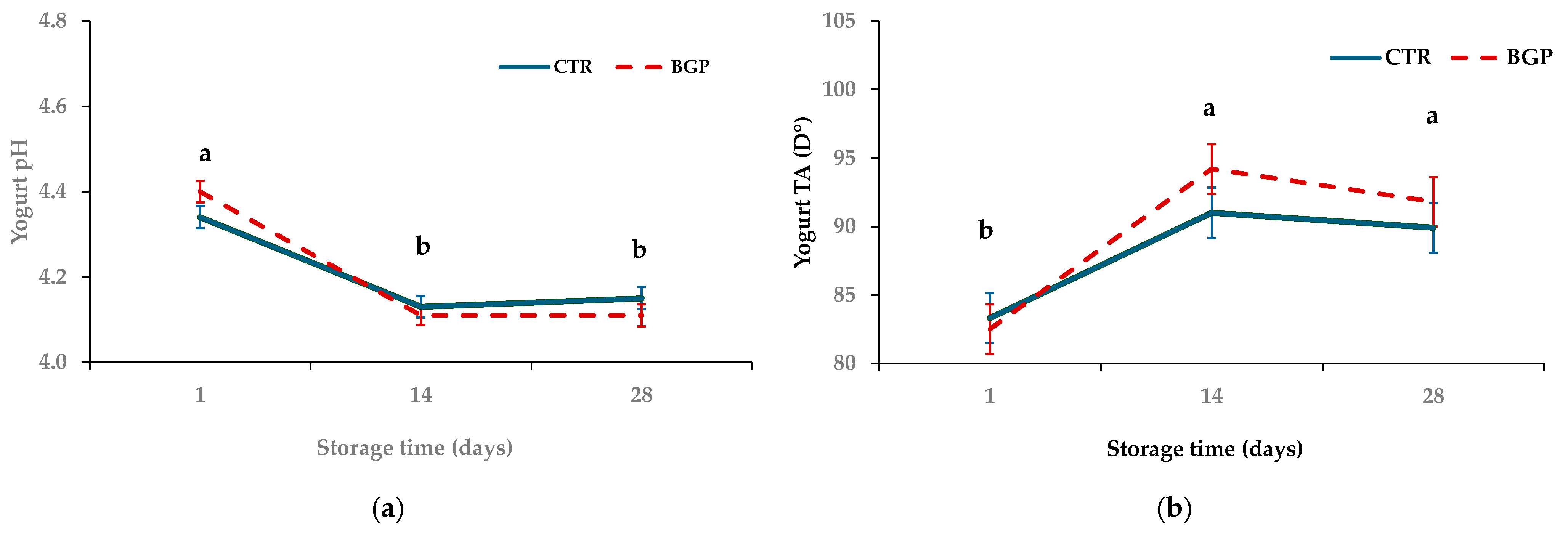
Regarding storage time, the chemical, instrumental colour and microbial yogurt data did not change across the cold storage period, except for pH and acidity. The storage time had a significant (p < 0.05) effect on pH: after a 14 d storage period the pH significantly decreased in both CTR and BGP samples (Figure 1a), meanwhile the titratable acidity (TA) increased in both the experimental groups (Figure 1b). No variations were detected in the comparison between 14 and 28 days in terms of both pH and TA. For all the investigated variables the interaction diet per storage time (D × S) was never significant.

3.3. Yogurt FA Profile

The influence of the experimental BGP diet treatment on FA profile is given in Table 3. The use of the BGP winery by-products led to a significant (p < 0.05) reduction in C12:0 and C14:0, while C18:0 increased; therefore, SFA were unaffected. Moreover, in the BGP-yogurt samples, there was an increase in both C18:1 trans11 and CLA cis9 trans11, which promote also a higher amount of total CLA isomers. Instead, the incidence of PUFA n-3 was significantly (p < 0.05) lower in BGP samples, mainly due to a reduction in C18:3 n-3. With regard to the FA groups, there was also an increase in LCFA in the BGP-yogurt samples, which implies a decrease in MCFA, while SCFA were unaffected (Table 3). The FA profile of the yogurt coming from both the diet groups did not change either across the storage period nor for the interaction diet per storage time.

3.4. Yogurt Sensory Analysis

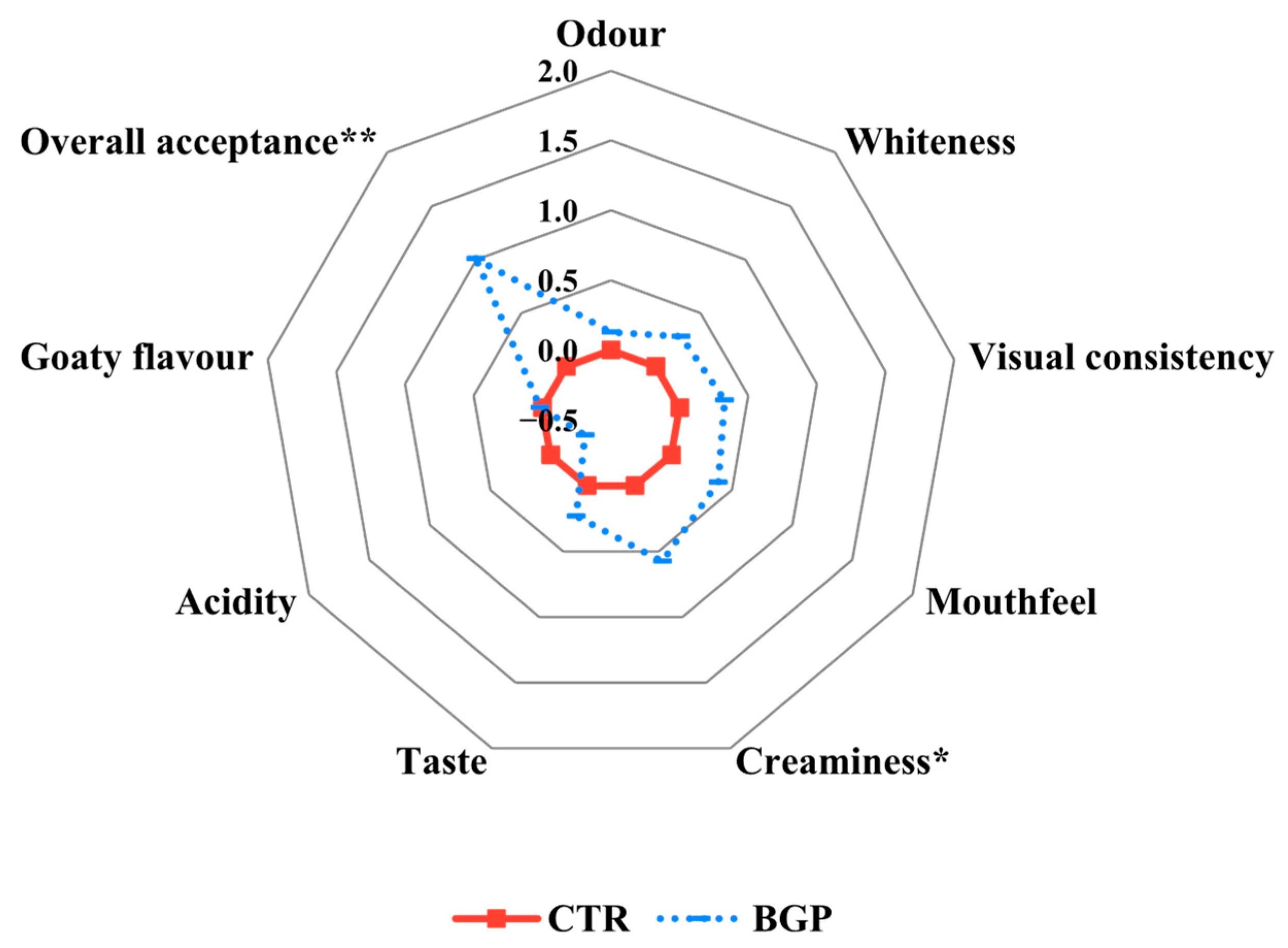
The impact of BGP on the yogurt sensory attributes was mild since only creaminess and the overall acceptance were significantly higher compared to the CTR yogurt (Figure 2). Notably, the odour and taste values did not show any difference compared to the CTR yogurt, suggesting that no off-flavours transfer occurred from the BGP winery by-product.

4. Discussion

The objective of this study was to assess the potential influence of replacing alfalfa hay in a dairy goat diet with black grape pomace (BGP), as an ensiled winery by-product, on the chemical, nutritional, and sensory traits of the yogurt. Moreover, the effect of a 28 days of refrigeration storage on such quality traits was investigated. The main chemical and nutritional effects related to the diet treatment were considered also in milk to verify whether the fermentation process could interfere with the experimental implications of the BGP recycling in the diet on the final yogurt quality traits. Notably, milk FA profile (Supplementary Materials, Table S1) was very similar to those detected in the yogurt (Table 3), highlighting the absence of marked changes, especially for some specific functional groups as total CLA isomers and PUFA n-3.
As stated in the results, the main finding about the proximate composition of the investigated dairy products was a positive effect of the BGP diet on both milk and, as a consequence, yogurt fat content. According to the literature [5,11], the use of winery by-products in the ration of dairy goats has been resulting in diverse milk gross composition outcomes depending on both the variability of the winery biomass (e.g., nutritional value, preprocessing factors, and replacement rate in the diet) and the management conditions of the goat feeding strategy, even though its feeding replacement was mainly related to an increase in the milk fat content [5], as observed in our trial.
Milk and yogurt colours are mainly related to the physical structure of milk and to the concentration of natural pigments, the first being more correlated with the L* coordinate and the second influencing a* and b*. Therefore, the decrease in yellowness (b*) detected in yogurt BGP samples suggests that the replacement of alfalfa hay with the winery by-product could result in a mildly lower pigmentation, even though the human eye can hardly perceive such measured instrumental difference (<than 1 unit). This is confirmed by the fact that the panellists involved in the sensory analysis did not highlight any difference between control (CTR) and BGP yogurt samples in terms of whiteness (Figure 2), thus making this colour change irrelevant for consumers from a visual perception point of view.
The antioxidant capacity tested in the yogurt samples via ABTS and FRAP assays did not show any significant difference between the diet groups and among the three investigated storage times, in line with a similar study that analysed milk from ewe receiving a grape marc by-product [35]. Conversely, in a previous similar study [12], a slight increase in both ABTS and FRAP values was observed in milk from goats fed a diet with 15% of ensiled white grape pomace as the main substitution for alfalfa hay. Fermented dairy goat products, including yogurt, have been reported to naturally contain various antioxidant compounds like proteins (mainly casein), peptides, and antioxidant enzymes [36], limiting the further antioxidant contribute possibly coming from dietary compounds (i.e., polyphenols, tannins), which explains the lack of significant difference between CTR and BGP samples in our study and in that by [37]. However, the positive role of supplemented BGP in improving the antioxidant capacity of dairy products depends on the BGP native characteristics, the preprocessing treatment, and the management of the feeding conditions [5].
In the dairy industry, maintaining the survival of starter microorganisms during processing and storage is essential for the quality of fermented products; in the present study, neither the BGP diet nor storage time significantly affected the viability of the selected microorganism used to produce yogurt. The combined population of Lactobacillus spp. and Streptococcus spp. remained stable throughout 28 days of refrigerated storage, showing counts values comparable to those reported in previous studies on fermented goat milk [36].
The results related to the FA profile confirmed that feeding lactating small ruminants with winery by-products containing unsaturated FA (i.e., C18:2 n-6, C18:3 n-3) can highly impact rumen function, potentially leading to several advantages in the FA profile, mainly due to an increase in unsaturated FA in milk and its derivates [38]. Notably, in the BGP samples produced in this study, a significant increase in CLA cis9 trans11 (C18:2 cis9 trans11), as well as total CLA isomers, and its precursor C18:1 trans11, was observed, consistent with previous studies involving lactating ewes [39] and goats [12]. This rise in total CLA isomers is likely due to the typically high content of C18:2 n-6 and C18:3 n-3 in these winery derived by-products, which was indicated to undergo incomplete ruminal hydrogenation, thus generating the intermediate C18:1 trans11 rather than C18:0 [40,41]. Indeed, in the literature [39] there is evidence of the ability of grape pomace by-products to slow down the last steps of biohydrogenation, thus favouring the accumulation of C18:1 trans11 that, as stated above, is a main precursor of various CLA isomers, which are associated with a high bioactive potential and healthy values [42]. The slight reduction in C18:3 n-3 detected in the BGP yogurt samples could be the result of the series of chemical and biohydrogenation steps occurring in the ruminal processes [35], in which tannins and polyphenols may play many roles resulting in similar [43] or even in lower content of FA n-3 in milk [5]. The absence of a difference in short-chain FA (SCFA) between CTR- and BGP-samples, which are almost exclusively de novo synthesised, seemed to confirm the hypothesis that the BGP winery by-product did not negatively impact the rumen fermentation of carbohydrates [11].
As stated in similar studies, the use of by-products from fruit and vegetable crops seemed to promote the production of yogurt with a better nutritional value and sensory quality traits than ordinary counterparts. Hachana et al. 2023 [20] stated that the use of seagrass biomass in goat diet resulted in an improved texture and overall sensory quality as well as in an increased antioxidant activity. Also, Muelas et al. 2022 [37] pointed out that the recycling of broccoli and artichoke plant by-products enhance the goat milk’s antioxidant activity, while the fat health quality index of yogurt varied according to the tested levels of inclusion, suggesting that the optimal feeding strategy should be further investigated. Moreover, a goat feeding trial assessing the effects of the dietary enrichment with olive leaves (350 g of daily dose) on yogurt’s nutritional and healthy value resulted in a positive effect on both CLA and vaccenic acid percentage, as well as an increase in total UFA, and led to a higher antioxidant potential, which induced a greater resistance to lipid peroxidation [44]. Therefore, these studies contribute to the claim that in lactating small ruminants a moderate diet replacement of the conventional forages with these natural biomasses could be valorised to produce yogurt or other dairy products (i.e., kefir, cheese, fermented beverages) naturally enriched in bioactive compounds and specific beneficial FA or other nutrients without compromising the sensory perceived quality. This is an additional positive key-point when promoting their massive recycling within a zero-waste-strategy agri-food system.
To the best of our knowledge, only a few studies have investigated the changes in the FA profile of yogurt across a typical 4-week storage time. A limited change in the main chemical FA groups was observed in the goat yogurt stored for 21 days at 8 °C, and such changes were also milder if compared to those occurring in cow yogurt [45]. Instead, a study on Murciano-Granadina goats reported no differences in the FA profile of yogurt stored for 2 vs. 30 days [37]. Perhaps, different outcomes on FA profile across the storage time could be related to the degree of lipolysis and secondary oxidative reactions, which depends on the conditions occurring during technological processing such as milk heat treatment and storage conditions [46,47].
Overall, the yogurt sensory assessment showed that the BGP winery by-product had a significant influence on the product creaminess likely correlated to the high fat content. Moreover, it led to a higher overall acceptability that might be due to the slightly higher but not significant judgment values attributed to many other traits, whose combination could explain the more favourable sensory appeal given to the BGP yogurt by the semi-trained panellists. In this context, it is still debated whether feeding by-products rich in bioactive compounds to small ruminants could promote the development of volatile compounds in fermented dairy products and, therefore, improve their aroma and taste [20]. From a market point of view, a moderate improvement in the overall sensory acceptability of yogurt can be claimed, thus enhancing acceptance by consumers.

5. Conclusions

The results of this study demonstrated that the recycling of an ensiled winery by-product like black grape pomace (BGP) into a dairy goat feeding regime did not change the milk and yogurt gross composition substantially, but it tended to increase both milk and yogurt fat content and to enhance the percentage of some beneficial FA, such as C18:1 trans11 and total CLA isomers, even though a slight decrease in FA n-3 was recorded. Overall, these changes in the FA profile seemed to promote a better healthy fat value. Furthermore, the partial alfalfa hay replacement with the ensiled BGP did not modify the antioxidant capacity. However, BGP yogurts seemed to be associated with an increased overall acceptability. The storage time did not have any influence on either the chemical traits or FA profile of yogurt.
Moreover, given these outcomes, BGP yogurt could be considered a more environmentally friendly food since it allows a better re-allocation of agri-food resources, especially within semi-intensive farming systems, paving the way for a more circular economy in the agricultural sector. Indeed, the integration of BGP in goat diet represents an effective strategy that promotes sustainability of the dairy food supply chain thanks to the replacement of expensive feeds with recycled local by-products. This would also allow labelling the derived dairy products as more environmental-friendly. Future studies should explore the metabolomic fingerprinting of goat milk and its fermented products obtained from diets supplemented with winery by-products to characterise the diet-derived biochemical markers transferred along the dairy production chain.

Supplementary Materials

The following supporting information can be downloaded at https://www.mdpi.com/article/10.3390/app16041913/s1, Table S1: Effect of the diet treatment on goat milk fatty acid (FA) profile and FA groups (g/100 g FAME).

Author Contributions

Conceptualization, J.R.D. and M.P.M.; methodology, S.K., J.R.D. and M.P.M.; software, S.K., T.R. and S.S.; validation, J.R.D., S.S. and M.P.M.; formal analysis, S.K., T.R., S.S. and M.P.M.; investigation, S.K., J.R.D. and M.P.M.; resources, J.R.D. and M.P.M.; data curation, S.K., T.R., S.S. and M.P.M.; writing—original draft preparation, S.K., S.S. and M.P.M.; writing—review and editing, S.K., S.S. and M.P.M.; visualization, T.R., S.S. and M.P.M.; supervision, M.P.M.; project administration, J.R.D. and M.P.M.; funding acquisition, J.R.D. and M.P.M. All authors have read and agreed to the published version of the manuscript.

Funding

This research was funded by the Ministry of Science and Innovation of Spain and FEDER/EU (grant number PID2021-122962OB-C31, MCIN/AEI/10.13039/501100011033/FEDER, EU). Sara Khazzar received a grant by “iNEST- Interconnected Nord-Est Innovation ECS00000043” from the Next Generation EU (under the National Recovery and Resilience Plan, NRRP—Mission 4 Component 2, Investment 1.5).

Institutional Review Board Statement

The study was conducted according to the guidelines of the Declaration of Helsinki and approved by the Ethics Committee of Universidad Miguel Hernández de Elche (UMH.DTA.JDS.03.21) on 9 September 2022.

Informed Consent Statement

Not applicable.

Data Availability Statement

The data presented in this study are available in the article.

Acknowledgments

The authors would like to thank technical personnel from Granja Caprina at Miguel Hernández University (Amparo Roca, Alfonso Navarro and Elena Pérez) for their implication in the welfare and management of the animals.

Conflicts of Interest

The authors declare no conflicts of interest.

Abbreviations

The following abbreviations are used in this manuscript:
ABTS2,2′-azino-bis (3-ethylbenzothiazoline-6-sulphonic acid)
AIAtherogenic index
ANOVAAnalysis of variance
BGP Black grape pomace
CFUClony forming units
CLA Conjugated linoleic acid
CTRControl
DDiet
FAFatty acids
FAMEFatty acid methyl esters
FRAPFerric reducing antioxidant power
GCGas chromatography
GPGrape pomace
LABLactic acid bacteria
LCFALong-chain fatty acids
LSMeansLeast squares means
MCFAMedium-chain fatty acids
MUFAMonounsaturated fatty acids
PUFAPolyunsaturated fatty acids
SStorage time
SCCSomati cell count
SCFAShort-chain fatty acids
SEMStandard error of the mean
SFASaturated fatty acids
TATitratable acidity
TBCTotal bacterial count
TETrolox equivalent
TIThrombogenic index
UMHUniversidad Miguel Hernández
UPVUniversitat Politècnica de València

References

  1. Baltazar, M.; Castro, I.; Gonçalves, B. Adaptation to climate change in viticulture: The role of varietal selection—A Review. Plants 2025, 14, 104. [Google Scholar] [CrossRef]
  2. da Rocha Zanetti, M.B.; da Silva Haas, I.C.; Pereira-Coelho, M.; Marchesan Maran, B.; Machado Canella, M.H.; dos Santos Madureira, L.A.; Schwinden Prudêncio, E.; de Mello Castanho Amboni, R.D.; da Silva Kazama, D.C.; Camino Feltes, M.M. Valorization of biowastes from sustainable viticulture with bioactive potential: Application in functional yogurt. J. Food Sci. Technol. 2022, 59, 4673–4684. [Google Scholar] [CrossRef]
  3. Blasi, F.; Trovarelli, V.; Mangiapelo, L.; Ianni, F.; Cossignani, L. Grape pomace for feed enrichment to improve the quality of animal-based foods. Foods 2024, 13, 3541. [Google Scholar] [CrossRef]
  4. Kurćubić, V.S.; Stanišić, N.; Stajić, S.B.; Dmitrić, M.; Živković, S.; Kurćubić, L.V.; Živković, V.; Jakovljević, V.; Mašković, P.Z.; Mašković, J. Valorizing grape pomace: A review of applications, nutritional benefits, and potential in functional food development. Foods 2024, 13, 4169. [Google Scholar] [CrossRef] [PubMed]
  5. Correddu, F.; Caratzu, M.F.; Lunesu, M.F.; Carta, S.; Pulina, G.; Nuda, A. Grape, pomegranate, olive, and tomato by-products fed to dairy ruminants improve milk fatty acid profile without depressing milk production. Foods 2023, 12, 865. [Google Scholar] [CrossRef] [PubMed]
  6. Neves Almeida, S.; Antonio Cardoso, M. Drivers and barriers in the transition from a linear economy to a circular economy. J. Clean. Prod. 2022, 341, 130865. [Google Scholar] [CrossRef]
  7. European Commission. A New Circular Economy Action Plan. For a Cleaner and More Competitive Europe (COM 2020—98 Final). 2020. Available online: https://eur-lex.europa.eu/resource.html?uri=cellar:9903b325-6388-11ea-b735-01aa75ed71a1.0017.02/DOC_1&format=PDF (accessed on 30 January 2026).
  8. Fan, Z.; Gao, Z.; Fu, Y.; Liao, Y.; Xiao, W.; Ding, Y.; Yang, C.; Li, X.; Li, G.; Su, D.; et al. Unlocking the potential of fruit and vegetable waste: Sustainable biomanufacturing strategies for synergistic nutrient recovery and high-value bioproduct synthesis. Trends Food Sci. Technol. 2025, 165, 105288. [Google Scholar] [CrossRef]
  9. Correddu, F.; Lunesu, M.F.; Buffa, G.; Atzori, A.S.; Nudda, A.; Battacone, G.; Pulina, G. Can agro-industrial by-products rich in polyphenols be advantageously used in the feeding and nutrition of dairy small ruminants? Animals 2020, 10, 131. [Google Scholar] [CrossRef]
  10. Echave, J.; Pereira, A.G.; Jorge, A.O.S.; Barciela, P.; Nogueira-Marques, R.; Yuksek, E.N.; Oliveira, M.B.P.P.; Barros, L.; Prieto, M.A. Grape winemaking by-products: Current valorization strategies and their value as source of tannins with applications in food and feed. Molecules 2025, 30, 2726. [Google Scholar] [CrossRef]
  11. Renna, M.; Marín, A.L.M.; Lussiana, C.; Colonna, L.; Mimosi, A.; Cornale, P. Caprine milk fatty acid responses to dietary dried grape pomace. Ital. J. Anim. Sci. 2023, 22, 1186–1194. [Google Scholar] [CrossRef]
  12. Galvez-Lopez, M.; Viuda-Martos, M.; Saldo, J.; Sendra, E.; Romero, G.; Díaz, J.R. Dietary white grape pomace silage for goats: Assessing the impact of inclusion level on milk processing attributes. Appl. Sci. 2025, 15, 12791. [Google Scholar] [CrossRef]
  13. Tunick, M.H.; Van Hekken, D.L. Dairy products and health: Recent insights. J. Agric. Food Chem. 2015, 63, 9381–9388. [Google Scholar] [CrossRef] [PubMed]
  14. Kandylis, P.; Dimitrellou, D.; Moschakis, T. Recent applications of grapes and their derivatives in dairy products. Trends Food Sci. Technol. 2021, 114, 696–711. [Google Scholar] [CrossRef]
  15. Park, Y.W.; Juárez, M.; Ramos, M.; Haenlein, G.F.W. Physico-chemical characteristics of goat and sheep milk. Small Rumin. Res. 2007, 68, 88–113. [Google Scholar] [CrossRef]
  16. Slačanac, V.; Božanić, R.; Hardi, J.; Rezessyné Szabó, J.; Lučan, M.; Krstanović, V. Nutritional and therapeutic value of fermented caprine milk. Int. J. Dairy Technol. 2010, 63, 171–189. [Google Scholar] [CrossRef]
  17. Verruck, S.; Dantas, A.; Prudencio, E.S. Functionality of the components from goat’s milk, recent advances for functional dairy products development and its implications on human health. J. Funct. Foods 2019, 52, 243–257. [Google Scholar] [CrossRef]
  18. Mishra, S.; Kannaujia, S.; Dipt, A.; Singh, S.; Meena, S.; Duary, K.R.; Meena, K.K. Exploring the multifaceted potential of goat milk: Nutritional, processing, and commercial applications. Int. Dairy J. 2026, 172, 106447. [Google Scholar] [CrossRef]
  19. Liu, W.; Yu, J.; Sun, Z.; Song, Y.; Wang, X.; Wang, H.; Wuren, T.; Zha, M.; Menghe, B.; Heping, Z. Relationships between functional genes in Lactobacillus delbrueckii spp. bulgaricus isolates and phenotypic characteristics associated with fermentation time and flavor production in yogurt elucidated using multilocus sequence typing. J. Dairy Sci. 2016, 99, 89–103. [Google Scholar] [CrossRef]
  20. Hachana, Y.; Jabbari, A.; Yousfi, W.; Fortina, R. Bioactive compounds in yogurt obtained from Alpine goats fed with seagrass debris. Small Rumin. Res. 2023, 225, 107015. [Google Scholar] [CrossRef]
  21. Yang, Y.; Zhang, R.; Zhang, F.; Wang, B.; Liu, Y. Storage stability of texture, organoleptic, and biological properties of goat milk yogurt fermented with probiotic bacteria. Front. Microbiol. 2023, 9, 1093654. [Google Scholar] [CrossRef]
  22. Romero, G.; Nieddu, L.; Mouhssine, A.; Nowicka, P.; Bueso-Ródenas, J.; Fernández, N.; Díaz, J.R. Bale ensiling preserves nutritional composition and phenolic compounds of red grape pomace. AgriEngineering 2025, 7, 172. [Google Scholar] [CrossRef]
  23. Fernandez, N.; Andrade, C.; Palomares, J.L.; Marti-de Olives, A.; Diaz, J.R.; Peris, C.; Rodriguez, M. Productive, environmental and economic effects of black grape pomace silage in the diet of Murciano-Granadina dairy goat. J. Anim. Sci. Technol. 2026; in press. [Google Scholar] [CrossRef]
  24. González-Navarro, E.J.; Beltrán, M.C.; Molina, M.P.; Pérez-Barbería, F.J.; Molina, A.; Berruga, M.I. Suitability of goat colostrum to produce a fermented yogurt-type product. Animals 2022, 12, 3025. [Google Scholar] [CrossRef] [PubMed]
  25. Vargas, M.; Cháfer, M.; Albors, A.; Chiralt, A.; González-Martínez, C. Physicochemical and sensory characteristics of yoghurt produced from mixtures of cows’ and goats’ milk. Int. Dairy J. 2008, 18, 1146–1152. [Google Scholar] [CrossRef]
  26. Khazzar, S.; Balzan, S.; Peker, A.; Da Dalt, L.; Fontana, F.; Garbin, E.; Tonolo, F.; Rilievo, G.; Novelli, E.; Segato, S. An Integrated Approach in Assessing the Food-Related Properties of Microparticulated and Fermented Whey. Foods 2025, 14, 3421. [Google Scholar] [CrossRef]
  27. Re, R.; Pellegrini, N.; Proteggente, A.; Pannala, A.; Yang, M.; Rice-Evans, C. Antioxidant activity applying an improved ABTS radical cation decolorization assay. Free Radic. Biol. Med. 1999, 26, 1231–1237. [Google Scholar] [CrossRef] [PubMed]
  28. Oyaizu, M. Studies on products of browning reaction. Antioxidative activities of products of browning reaction prepared from glucosamine. Jpn. J. Nutr. Diet. 1986, 44, 307–315. [Google Scholar] [CrossRef]
  29. ISO 4833-2:2014/A1:2022; Microbiology of the Food Chain-Horizontal Method for the Enumeration of Microorganisms. AENOR-UNE, Spanish Association for Standardization and Certification: Madrid, Spain, 2022.
  30. Romeu-Nadal, M.; Morera-Pons, S.; Castellote, A.I.; López-Sabater, M.C. Comparison of two methods for the extraction of fat from human milk. Anal. Chim. Acta 2004, 513, 457–461. [Google Scholar] [CrossRef]
  31. Nudda, A.; McGuire, M.A.; Battacone, G.; Pulina, G. Seasonal variation in conjugated linoleic acid and vaccenic acid in milk fat of sheep and its transfer to cheese and ricotta. J. Dairy Sci. 2005, 88, 1311–1319. [Google Scholar] [CrossRef]
  32. Nudda, A.; Battacone, G.; Atzori, A.S.; Dimauro, C.; Rassu, S.P.G.; Nicolussi, P.; Bonelli, P.; Pulina, G. Effect of extruded linseed supplementation on blood metabolic profile and milk performance of Saanen goats. Animal 2013, 7, 1464–1471. [Google Scholar] [CrossRef]
  33. Kelly, F.D.; Sinclair, A.J.; Mann, N.J.; Turner, A.H.; Abedin, L.; Li, D. A stearic acid-rich diet improves thrombogenic and atherogenic risk factor profiles in healthy males. Eur. J. Clin. Nutr. 2001, 55, 88–96. [Google Scholar] [CrossRef]
  34. ISO 4121:2003; Sensory Analysis—Guidelines for the Use of Quantitative Response Scales. ISO Copyright Office: Geneva, Switzerland, 2003.
  35. Buffa, G.; Tsiplakou, E.; Mitsiopoulou, C.; Pulina, G.; Nudda, A. Supplementation of by-products from grape, tomato and myrtle affects antioxidant status of dairy ewes and milk fatty acid profile. J. Anim. Physiol. Anim. Nutr. 2020, 104, 493–506. [Google Scholar] [CrossRef]
  36. Uzkuç, H.; Sarıtaş, S.; Çelebi Uzkuç, N.M.; Karagül Yüceer, Y.; Esatbeyoglu, T. Comparison of in vitro antioxidant activities of kefir, yogurt, and cheese produced from goat milk. Food Chem. X 2026, 33, 103394. [Google Scholar] [CrossRef]
  37. Muelas, R.; Romero, G.; Diaz, J.R.; Monllor, P.; Fernandez-Lopez, J.; Viuda-Martos, M.; Cano-Lamadrid, M.; Sendra, E. Quality and functional parameters of fermented milk obtained from goat milk fed with broccoli and artichoke plant by-products. Foods 2022, 11, 2601. [Google Scholar] [CrossRef]
  38. Harun, N.L.A.; Yusof, H.M.; Samsudin, A.A.; Sazili, A.Q.; Goh, Y.-M. Effect of polyphenol supplementation on milk composition and fatty scid of dairy animal: A systematic review. Ruminants 2025, 5, 15. [Google Scholar] [CrossRef]
  39. Carta, S.; Correddu, F.; Steri, R.; Zilio, D.M.; Cesarani, A.; Pulina, G.; Nudda, A. Effect of grape pomace supplementation in mid-lactation dairy ewes on production and quality of milk and methane emissions. J. Anim. Sci. 2025, 103, skaf237. [Google Scholar] [CrossRef] [PubMed]
  40. Riuzzi, G.; Davis, H.; Lanza, I.; Butler, G.; Contiero, B.; Gottardo, F.; Segato, S. Multivariate modelling of milk fatty acid profile to discriminate the forages in dairy cows’ ration. Sci. Rep. 2021, 11, 23201. [Google Scholar] [CrossRef]
  41. Lanza, I.; Lolli, V.; Segato, S.; Caligiani, A.; Contiero, B.; Lotto, A.; Galaverna, G.; Magrin, L.; Cozzi, G. Use of GC-MS and 1H NMR low-level data fusion as an advanced and comprehensive metabolomic approach to discriminate milk from dairy chains based on different types of forage. Int. Dairy J. 2021, 123, 105174. [Google Scholar] [CrossRef]
  42. Derakhshandeh-Rishehri, S.M.; Rajabzadeh-Dehkordi, M.; Ghobadi, S.; Faghih, S. The effects of conjugated linoleic acid supplements on biomarkers of oxidative stress in human studies: A Systematic Review and Meta-Analysis. J. Nutr. Food Secur. 2024, 9, 173–188. [Google Scholar] [CrossRef]
  43. Bennato, F.; Ianni, A.; Florio, M.; Grotta, L.; Pomilio, F.; Saletti, M.A.; Martino, G. Nutritional properties of milk from dairy ewes fed with a diet containing grape pomace. Foods 2022, 11, 1878. [Google Scholar] [CrossRef]
  44. Bennato, F.; Innosa, D.; Ianni, A.; Martino, C.; Grotta, L.; Martino, G. Volatile profile in yogurt obtained from Saanen goats fed with olive leaves. Molecules 2020, 25, 2311. [Google Scholar] [CrossRef] [PubMed]
  45. Paszczyk, B.; Łuczyńska, J.; Polak-Śliwińska, M. The effect of storage on the yogurt fatty acid profile. Mljekarstvo 2020, 70, 59–70. [Google Scholar] [CrossRef]
  46. Sharma, H.; Ramanathan, R. Gas chromatography-mass spectrometry based metabolomic approach to investigate the changes in goat milk yoghurt during storage. Food Res. Int. 2021, 140, 110072. [Google Scholar] [CrossRef] [PubMed]
  47. Serafeimidou, A.; Zlatanos, S.; Kritikos, G.; Tourianis, A. Change of fatty acid profile, including conjugated linoleic acid (CLA) content, during refrigerated storage of yogurt made of cow and sheep milk. J. Food Compos. Anal. 2013, 31, 24–30. [Google Scholar] [CrossRef]
Figure 1. Yogurt acidification during the storage time. (a) displays the pH while (b) the titratable acidity (TA). a,b LSMeans (±standard error) with different letters differ at p < 0.05.
Applsci 16 01913 g001
Figure 2. Radar plot of yogurt sensory assessment. For each attribute, as CTR (continuous red line) was the standard reference, it had a null difference. Meanwhile, BGP (dotted blue line) had a negative or positive difference. *, **: p < 0.05, p < 0.01, respectively.
Applsci 16 01913 g002
Table 1. Effect of the diet on goat milk (as fresh matter) acidity, composition, somatic cell (SCC) and microbial (TBC) counts, and instrumental colour.
CTRBGPSEMp-Value
Acidity
pH6.776.740.020.263
Titratable acidity (D°)14.313.80.50.178
Composition (g/100 g)
Fat4.474.750.070.011
Protein3.503.480.050.805
Lactose4.664.670.040.921
Total solids13.2513.610.120.076
Hygienic quality
Log10 SCC (cells/mL)6.126.130.110.916
Log10 TBC (CFU/mL)4.694.880.130.333
Instrumental colour
L*80.180.00.40.950
a*−2.31−2.290.030.369
b*5.054.780.050.005
C*5.495.330.050.005
h*114.9115.40.30.118
CTR, control; BGP, black grape pomace; SEM, standard error of the mean. For the colour coordinates see Section 2.3 for more details.
Table 2. Effect of diet (D), storage time (S), and their interaction (D × S) on goat yogurt (as fresh matter) physico-chemical, instrumental colour, and microbial traits.
DietSEMp-Value
CTRBGP DSD × S
Acidity
pH4.204.210.020.8250.0010.175
TA (D°)88.189.51.80.4450.0040.393
Composition (g/100 g)
Fat4.564.850.110.0310.5440.431
Protein3.653.620.070.7680.4640.123
Lactose3.323.340.060.9820.4990.150
Total solids12.2312.550.150.2290.4120.234
Instrumental colour
L*82.882.70.30.9090.5670.450
a*−2.77−2.730.020.1360.1470.185
b*5.064.760.050.0020.2760.463
C*5.775.490.050.0030.2920.633
h*1191200.250.1820.1560.345
Antioxidant activity (mM TE/mL)
ABTS0.830.760.030.1100.9250.214
FRAP0.720.670.090.6850.7730.902
Microbial count (log10 CFU/g)
Lactobacillus spp.6.916.670.330.8130.5980.706
Streptococcus spp.9.049.180.100.7810.6940.693
CTR, control; BGP, black grape pomace; SEM, standard error of the mean.
Table 3. Effect of the diet (D), storage time (S), and their interaction (D × S) on goat yogurt FA (g/100 g of total FAME) profile and FA groups 1.
FA/Groups of FADiet SEMp-Value
CTRBGP DSD × S
C4:01.291.330.060.6790.9830.727
C6:01.982.020.070.6960.8650.453
C8:02.712.670.090.7540.8510.775
C10:09.538.990.240.1370.8970.967
C11:00.300.250.010.0070.9180.923
C12:04.373.820.120.0080.9540.988
C14:08.538.170.090.0160.9940.758
C14:1 cis90.200.150.010.0010.7480.729
iso C15:00.180.150.010.0010.5410.709
anteiso C15:00.290.250.010.0010.3770.712
C15:00.840.720.010.0010.9620.875
iso C16:00.290.250.010.0010.7330.358
C16:024.423.00.770.2220.6470.767
C16:1 cis70.260.250.010.5790.9580.223
C16:1 cis90.960.730.020.0010.5140.815
iso C17:00.270.350.030.0600.4190.373
anteiso C17:00.350.300.010.0010.6450.861
C17:00.680.570.020.0010.7540.788
C18:05.677.310.320.0040.7440.820
C18:1 trans6–80.450.560.020.0010.9810.992
C18:1 trans90.360.440.020.0050.6940.391
C18:1 trans102.072.150.180.8510.8620.831
C18:1 trans112.513.440.150.0010.8060.340
C18:1 trans120.500.650.010.0010.8290.583
C18:1 trans13–140.410.520.040.0570.9280.487
C18:1 cis919.319.90.480.4310.7820.810
C18:1 cis110.860.790.010.0030.2200.228
C18:1 cis120.390.490.020.0010.6130.749
C18:1 cis14 + trans160.140.170.010.0010.2520.431
C18:2 n-6 4.384.220.100.3170.6860.727
CLA cis9 trans111.331.670.040.0010.7740.831
∑ CLA isomers1.521.840.040.0010.8700.803
C18:3 n-60.040.040.010.5230.7840.369
C18:3 n-30.400.280.020.0010.9490.847
C20:2 n-60.060.050.010.0130.8080.143
C20:4 n-60.250.230.010.1170.6460.841
SFA62.360.70.820.1790.6660.759
MUFA29.931.50.650.0920.6650.780
PUFA7.807.780.190.9540.6960.707
PUFA n-65.044.880.120.3710.6840.727
PUFA n-30.430.300.020.0010.9540.766
n-6/n-311.916.50.550.0010.9070.834
SCFA15.715.20.440.3660.8760.806
MCFA43.140.00.680.0080.6680.676
LCFA41.144.80.590.0010.8040.865
AI1.681.520.060.0850.6420.632
TI1.771.630.050.0670.5340.761
1 Since the fixed effect of storage time was never significant, the related LSmeans are not tabulated. CTR, control; BGP, black grape pomace; SEM, standard error of the mean. For specific FA and FA groups see the list of abbreviations. Short-chain FA (SCFA), from C4 to C10; medium-chain FA (MCFA), from C11 to C17; long-chain FA (LCFA), higher than C17.
Disclaimer/Publisher’s Note: The statements, opinions and data contained in all publications are solely those of the individual author(s) and contributor(s) and not of MDPI and/or the editor(s). MDPI and/or the editor(s) disclaim responsibility for any injury to people or property resulting from any ideas, methods, instructions or products referred to in the content.