


Abstract
There are many studies showing fitness and/or sporting skill is associated with better cognitive performance. One mechanism proposed to explain these effects is increased neural plasticity, meaning better cognitive performance could be the result of a more trainable brain. This theory was tested by looking at the initial performance and the performance following training on a visual search task for individuals engaged in sports and for control individuals. Analysis of variance for speed of task performance with factors of group, gender and sport for both speed of responses on the task and improvement in response times with practice showed no significant effects (analysis of variance F < 1.9, p > 0.175 for all group effects). The only significant difference was a reduced difference between specific and non-specific learning on the task, likely indicative of reduced non-specific learning in some of the sports groups (runners/controls, ANOVA F(1, 43) = 5.484, p = 0.024, ηp2 = 0.113 a medium effect size; and male baseball, runners and controls F(2, 33) = 3.427, p = 0.044, ηp2 = 0.172 a large effect size), possibly due to previous improvement because of fitness or sporting skill. These findings suggest a need for specificity in terms of selecting sport training when trying to produce cognitive benefits and a need for better assessment of sport-specific and sport/fitness-general effects on cognitive performance.
1. Introduction
Background
It is of no doubt that engaging in physical activity is associated with a range of health benefits, and while this is of particular interest for populations of older individuals [1], there are now many studies showing benefits for those who are fitter/engage in sports compared to those who do not for younger individuals [2], with the most significant effects relating to executive function/attentional control [3]. Consideration of effects in younger individuals is important because it allows investigation of whether beneficial effects reported in the elderly are primarily due to neuroprotection, meaning benefits in younger individuals would be less likely, or whether they are due to actual cognitive benefits, in which case younger people would benefit too. An example related to this is a review conducted by Donnelly and colleagues [4], who covered studies looking at exercise and cognitive function in younger individuals (aged 5–13). This specifically mentioned the reliability of cross-sectional work showing fitter children had better cognitive measures but also, importantly, that there were studies exploring the longitudinal effects of fitness on cognition. Another study of younger individuals by Fernández-Sánchez and colleagues [5] reported that children of 9–11 years of age showed the beneficial associations between fitness and motor skills and academic performance. This study is also interesting because it illustrates some of the difficulties in understanding the causes of any benefits on cognition associated with factors such as fitness. These can be most readily summarized as there being a link between fitness and cognitive performance, but why there is such a link is unclear. When a sport places particular demands on a cognitive process, this might account for the differences that are seen in the sport’s participants compared to individuals who do not take part in the sport (e.g., differences in temporal preparation in tennis players [6]); but when there is no obvious cognitive demand in a fitness-based activity (such as running) then the reasons for cognitive differences are harder to explain. This is particularly interesting given that endurance exercise seems to be more beneficial for cognition than, for example, mixed exercise programs [7] despite it being suggested that the cognitive benefits of exercise may often depend on skills related to the exercise undertaken [8]. Ludyga and colleagues specifically stated that “it remains unclear whether exercise has a general or cognitive domain-specific effect” [8], with their analysis going on to claim that there is a general effect of exercise on cognition. Again, like many studies, they were looking at the effects of exercise on cognition rather than investigating why such effects occur.
It is important to consider the underlying causal factors of the reported beneficial effects of sport on cognition, particularly for general rather than selective effects. For example, for people voluntarily engaging in sport/exercise, it is possible that people with faster response times are more likely to persist in a sport where quicker responding helps with performance. In these cases, it would be beneficial cognition that relates to the sport, rather than sport causing a benefit. This is in line with previous investigation of factors that relate to younger individuals persisting with a sport. While there remain “knowledge gaps” about why individuals show such sport-engagement persistence [9], several contributing factors have been reported for young people [10], including support from coaches and parents, peer support and, of relevance here, sports competence. Similarly, a relationship between hand control and coordination has been linked to a tendency to be inactive, which is described as has having a “low sports aptitude” [11]. While these factors are not directly linked to fundamental measures of cognitive performance, the patterns are in line with the theory that differences in sporting engagement are due to initial differences in factors that affect sporting performance. However, and importantly, while this might contribute to some of the differences seen in individuals who choose to engage in sport/fitness training and those who do not, it cannot account for any effects seen as the result of interventions aiming to improve cognition. For example, more than twenty years ago Colcombe and Kramer conducted a meta-analysis of studies to look at what cognitive processes, if any, were affected by aerobic fitness [3], and it was clear in reporting that aerobic training had beneficial effects on cognition in older individuals, with the largest benefit being seen for processes involving executive control. Importantly, they said “it is unclear precisely what role cardiovascular fitness might play in instigating these changes”.
This means there is consistently a question of what is causing the beneficial effects of exercise, better understanding of which could help improve the efficiency of any intervention where a benefit is desired. It could also help us to have a clearer idea of when such an intervention might be useful and when it might not, with the latter meaning alternative approaches should be considered instead. This is also important for clarifying the degree of generality of any training benefits, given that it has been suggested that these can arise from long-term exercise [8].
The primary aim of the study here was to better understand the effects of sport and fitness engagement on cognition, with the goal of gaining insight into the underlying reasons for such effects. For this investigation, an individual was initially considered as engaged in sport based on “dedication”, one of the characteristics previously described for athletes [12]. This can be readily observed and is based on the time and energy given to the pursuit of sport or fitness training. Its validity can also be, at least partly, tested by assessment of the fitness of the groups obtained in such a way in comparison to control (non-active) individuals, whose level of fitness is obtained by, for example, estimates of measures such as the VO2max, an indicator of cardiovascular fitness and endurance [13], so this was used to supplement classification.
To investigate the nature of cognitive changes linked with sport/fitness, the proposed mechanisms underlying these should be considered. Stimpson and colleagues [14] proposed that there is promotion of angiogenesis and cerebral circulation due to improved cardiovascular fitness. They suggest that exercise, mostly of an aerobic nature, promotes cerebral angiogenesis [15,16], likely relating to observed increases in cerebral circulation [17] and increase oxygenation in the brain [18]. This is thought to result in greater brain plasticity during or following exercise. This could underlie many of the effects on cognition that have been reported [2,3]. Previously, this possibility was investigated for motor learning in relation to sport/fitness [19]. Sporting individuals were found to initially perform the motor task better than control participants but did not differ in terms of learning rates. Such learning does not, of course, involve executive function, which has been shown to be one of the primary beneficiaries of increased fitness [20,21]. Therefore, here, a visual search task was presented to individuals engaged in sport/fitness training to investigate whether (1) they showed any differences in initial task performance and (2) whether they showed any differences in the improvement of task performance following training. This used a variant of the visual search task described by Kunar and colleagues [22] in which improvement related to repetition of the arrangement of elements in a visual search array and non-specific improvement can be measured. Repetition of the arrangement of non-target elements in visual search arrays causes contextual cueing, an effect that has been reliably seen in several studies [23,24,25]. Use of this task is relevant because it is thought to require executive control for performance, a process that, as mentioned above, is thought to benefit from fitness [3]. More specifically, a study by Peterson and colleagues [26] reported patterns of disruption to visual search performance that indicated the necessity of executive control for effective performance of the task. Because it has been suggested exercise results in a more trainable brain, this means fitter individuals should learn better on a task, showing more improvement in task performance with training than control participants. Should this be the case for this visual search task, then it could be judged as being consistent with there being an effect of sport/fitness on executive aspects of task performance, whereas an absence of such an effect would suggest that such a general effect does not occur.
The study here, therefore, tested the hypothesis that cognitive benefits reported in individuals who take part in sport or fitness training occur because such training results in a more trainable brain. Because many of the reported benefits are related to executive function, it was hypothesized that this would mean greater improvements would be seen in a version of a visual search task previously reported to involve executive control. In other words, improvement in performance of a visual search task, such as that used by Kunar and colleagues [22], was expected to be greater in fit/sporting individuals than in control participants.
2. Materials and Methods
2.1. Participants
A total of 60 participants took part in the study, with participation being entirely voluntary. All were recruited from National Central University, Taiwan. A total of 36 of these participants engaged in sport/fitness training and 24 were control participants who did not engage in any sport or fitness activity. The sporting individuals were runners (23 in total, 11 males and 12 females, ±standard deviation: 21.5 ± 2.52 years) or baseball players (13 males, mean age ± standard deviation: 20.3 ± 2.81 years). All sporting individuals were recruited from the associated university teams (i.e., the university running team and the university baseball team). This was thought to be a reasonable indicator of a high level of engagement with the sport/training, fitting with the “dedication” indicator of engagement (see [12]). The control participants took part in no sport or exercise activities and 12 were male and 12 were female (mean age ± standard deviation: 21.4 ± 3.89 years). Measurements indicative of fitness/activity levels of participants were collected to test the validity of the group selections, with the expectation that the running and baseball individuals would have higher levels of activity and higher estimated fitness levels (see Section 2.3.1 Questionnaires, below). Thus, a more definitive criterion for inclusion for the sporting individuals was (1) they were members of university-level sport teams and (2) they showed significantly higher scores on measures indicative of physical fitness (i.e., VO2max estimates). All participants in the study were right-handed, and all had either normal or corrected-to-normal vision, and none had taken part in the previous study [11]. These participant numbers were in line with those suggested by power analysis based on previously reported performance on this type of task [22]. Power analysis conducted using G*Power [27] indicated 10 participants would be required to detect a significant learning effect (p < 0.05) with a two-tailed analysis and a power of 0.8. In terms of response time differences in cognitive task performance seen when comparing sporting/fit individuals with control individuals, a difference of 10% would be a reasonable but conservative effect size [19].
2.2. Ethical Approval and Consent
All tasks and procedures were explained to participants before they agreed to take part in the experiment, and it was made clear that they would also be free to withdraw at any point during the study for any reason. Each participant who took part in the study gave written informed consent prior to participation. The study was carried out in accordance with the Declaration of Helsinki [28] and had been approved by the Ethics Review Committee of National Taiwan University (approval number: 202105EM017, June 2021).
2.3. Study Design
The visual-cognitive task (see Section 2.3.2) was designed such that performance could be compared between groups but, importantly, so changes in performance following training (i.e., learning) could be measured for individuals, thus allowing analysis both within and between groups. Task improvement could also be looked at in terms of stimulus specific learning and general learning on the task (see below for details of this). This meant the study was of a mixed design, being of a between-groups design when analyzing the degree of learning effects seen for each group and within-groups when analyzing whether there were significant changes in terms of performance of the task.
2.3.1. Questionnaires
In addition to the group characteristics (i.e., sport/physical activity engagement), further measures were collected from all participants who took part in the study. Several of these were to assist with the classification of participants, with baseball players and runners expected to show higher scores for activity-related measures and for the estimated VO2max scores. The remainder (e.g., sleep-related measures and competitiveness) were supplementary measures collected to see whether these might be of further interest for future investigation should differences between groups be seen in this study. These were Perceived Functional Ability (PFA) and Physical Activity Rating (PA-R) [29], with higher scores representing higher ability or activity; the Revised Competitiveness Index (CI-R) [30], with higher scores indicating an individual was more competitive; the Stanford Sleepiness Scale [31,32], higher scores being sleepier; the Pittsburgh Sleep Quality Index; the Revised Competitiveness Index (CI-R) [30]; and the International Physical Activity Questionnaires (IPAQ) [33], with higher scores indicating higher levels of each of these measures. Each of these involved presenting the written questions for each questionnaire separately, with clear instructions on how they should be completed. For example, the Stanford Sleepiness scale requires responses on a 7-point scale relating to their current sleepiness (with 1 being “Feeling active and vital; alert; wide awake” and 7 being “Almost in reverie; sleep onset soon; lost struggle to remain awake”).
The physical activity questionnaire scores also allowed estimation of each individual’s VO2max score, an indicator of the maximum rate of oxygen consumption and taken as an indicator of fitness levels. This used the equation:
the validity of which was reported by George and colleagues [29]. These were all collected to provide better characterization of the participants in the study.
VO2max (in mL·kg−1·min−1) = 48.073 + (6.178 × gender) − (0.246 × age) − (0.619 × BMI) − (0.712 × PFA) + (0.671 × PA-R)
2.3.2. Visual Search Learning Task
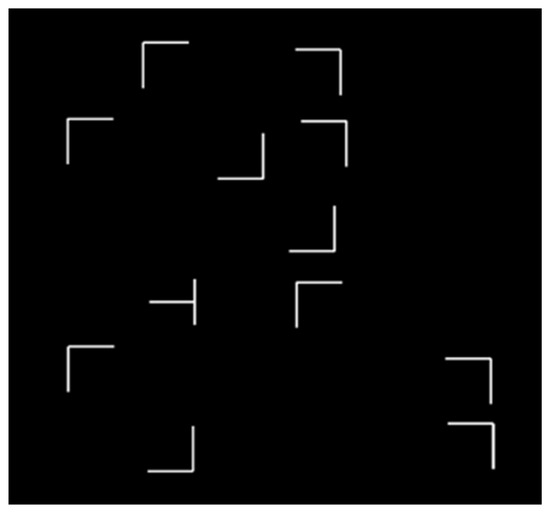
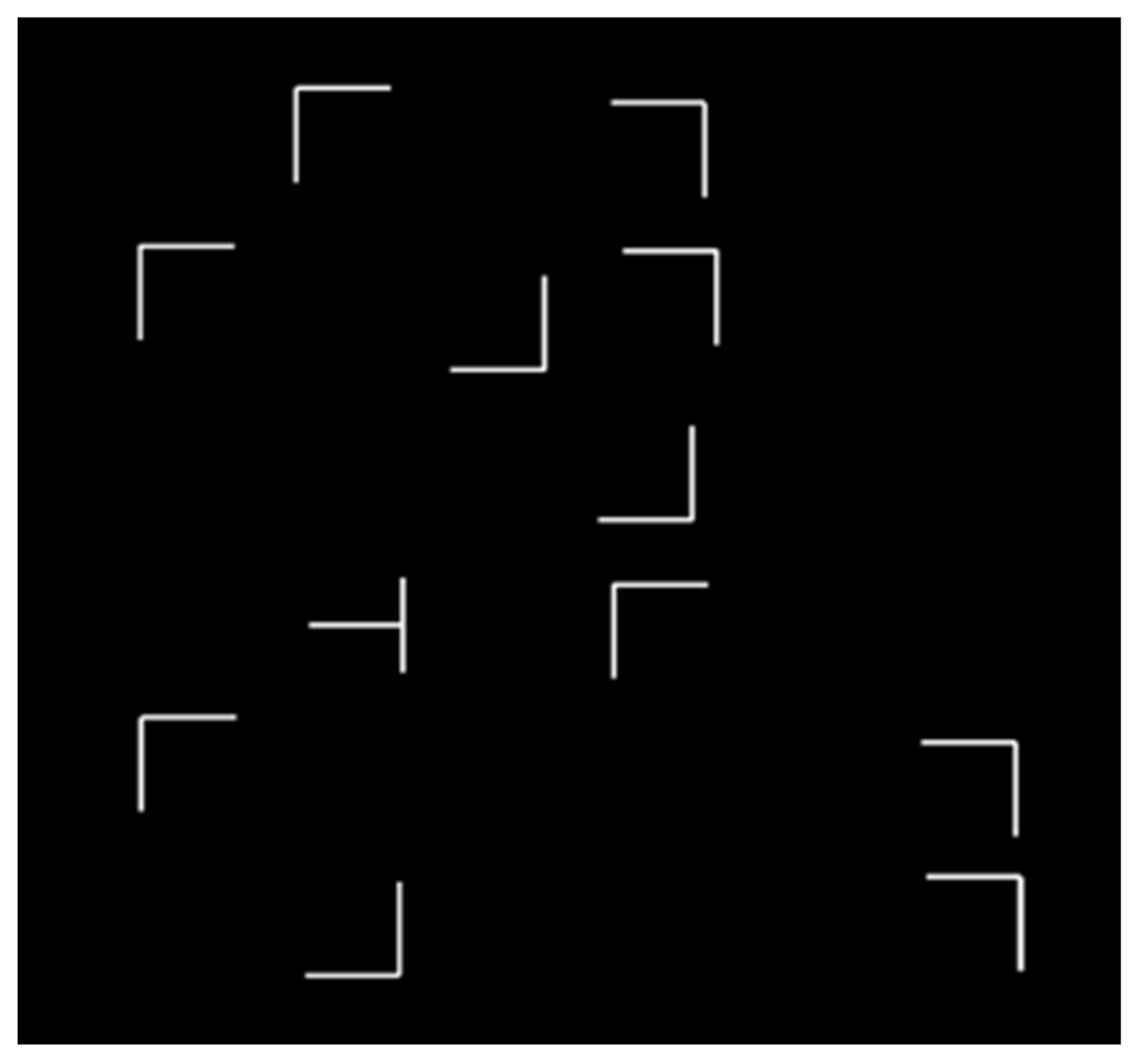
The task used was based on that described by Kunar and colleagues [22] and was presented 57 cm from the participants on a 54.4 cm width computer visual display unit (VDU) and programmed using PsychoPy [34]. Stimuli were constructed of a target, which was a letter T oriented either 90 degrees to the left or 90 degrees to the right, with each orientation present on an equal number of occasions, and with eleven distractors, which involved the letter L rotated by 90, 180 or 270 degrees (such that there were three or four of each rotation). Stimulus arrays were constructed with elements (target/distractors) positioned within squares within a 6 × 6 grid array (not shown to the participants) such that there was no overlap for any elements, with 1.7 × 1.7-degree element size and offsets of each of up to 0.3 degrees of visual angle. All stimulus elements were white and were presented on a black background. Each trial started with presentation of a fixation “+” in the center of the screen, followed by the presentation of the search array. This remained on the screen until a response was made. No feedback was given about the accuracy of a response on a trial and a new trial followed immediately. Blocks of the task consisted of 32 trials, each lasting approximately 1.5 to 2 min, and seven such blocks were presented to make up the training on the task. In these blocks there were four target locations, each associated with a specific arrangement of distractor stimuli, meaning participants were trained with 56 trials for each arrangement. For each participant, these were randomly generated during the first four trials of the task and then the arrangements were used for the remaining training trials. The final block was made up of 192 trials. A total of 96 of these were the same as the training trials and the other 96 had targets in the same locations as during training but different configurations of the distractor arrangements.
Participants were instructed that they had to report the orientation of the single letter T that was presented in each trail of the task (see Figure 1 for an example trial). As mentioned above, this was always rotated 90 degrees to the left or to the right (with the latter being the case in Figure 1) and they had to indicate this rotation by means of a keypress, using the “z” key for a leftward rotation and the “m” key for a rightward rotation. Responses had to be made with the first finger of the left hand for “z” and the first finger of the right hand for “m”. Participants were instructed to make their responses as quickly and accurately as possible. Following a response, the screen went blank before the next trial was presented.
Figure 1.
An example of a search array for a trial from the task presented to participants. The target was a horizontally oriented letter “T” rotated 90 degrees to the left or right of upright (with the target in the example being a right-rotated “T”). Distractors were the letter “L” oriented 90, 180 or 270 degrees clockwise from the normal orientation of the letter.
2.4. Statistical Analysis
Performance analysis was carried out for response times and accuracy on the task. Only the outcomes of the response time analysis are reported because no significant effects were seen for any of the accuracy analyses, likely due to the generally high levels of performance, with few (or no) errors being made by participants in blocks of trials.
For response time analysis, no participants showed values above the exclusion criterion of being more than three standard deviations from the mean of the values from all of the participants and only correct response times were analyzed.
IBM SPSS Statistics (version 25) was used for analysis, which employed mixed analysis of variance (ANOVA) with factors of group (control, runners or baseball players) and gender (male or female), two-way ANOVA for group (control or runners) × gender (male or female) analysis or one-way ANOVA for male groups (control, runners or baseball players). Where the assumption of homogeneity of variance was violated, this is indicated.
Partial eta squared values indicate effect sizes, with 0.01 indicating a small effect, 0.06 a moderate effect and 0.14 a large effect [35].
Post hoc comparisons, where needed, were independent sample t tests for 2-way ANOVA significances. For these, the statistical values listed are where the test used the assumption of equal variances (but for all cases where there was a significant difference this was also the case if equal variances were not assumed).
Post hoc tests for comparisons involving male controls, runners and baseball players used the Dunnett t-test, with the controls selected as the control group. The different post hoc test was used in this case because of the simplicity of the required comparisons, with just the three groups and the need to test whether the runners and/or baseball players differed from the control group.
Throughout, a p value of less than 0.05 was considered significant.
3. Results
3.1. Participants
The characteristics and measures collected from the participants are illustrated in Table 1. These are intended to give a more detailed characterization of the participants in the study than is often the case when carrying out such studies as well as allowing estimates of fitness levels, which were expected to be better for sporting individuals (indicated by, for example, VO2max measures), to be tested.
Table 1.
Characteristics of the participants in the experiment. Symbols: * indicates this was significantly higher for males; ** indicates this was significantly higher for runners than controls; # indicates this was significantly higher for baseball players than controls; and $ indicates this was significantly higher for control participants than runners.
Analysis of Participant Characteristics
This is described in more detail in Supplementary Materials, with significant findings indicated in Table 1. Of relevance here is the fact that there were no significant age differences but there were higher scores for the derived VO2max scores for the runners and the baseball players, as well as higher vigorous MET scores for runners and higher total MET scores for runners and baseball players.
3.2. Task Performance
Task performance accuracy was generally high (typically of 95% accuracy or higher, with blocks of trials frequently containing no errors). There were no significant differences between groups for baseline accuracy, nor any differences between baseline accuracy and accuracy following learning (all p-values > 0.05). This analysis is described in Supplementary Materials. All of the analysis described below was carried out on response time data.
3.2.1. Baseline Task Performance
Performance of the task was compared for the first block of trials for each group. This is the sort of analysis carried out in many studies looking at the effects of sport on cognition. No significant differences between groups were seen (see Supplementary Materials and Supplementary Figure S1 for details).
3.2.2. Task Learning
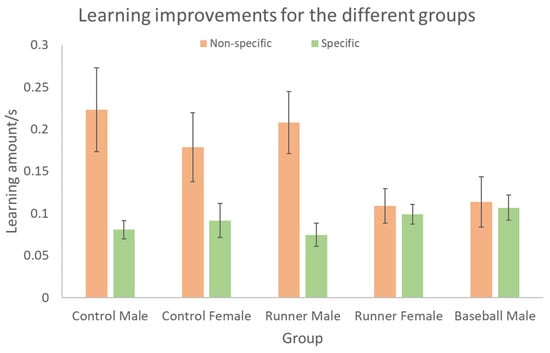
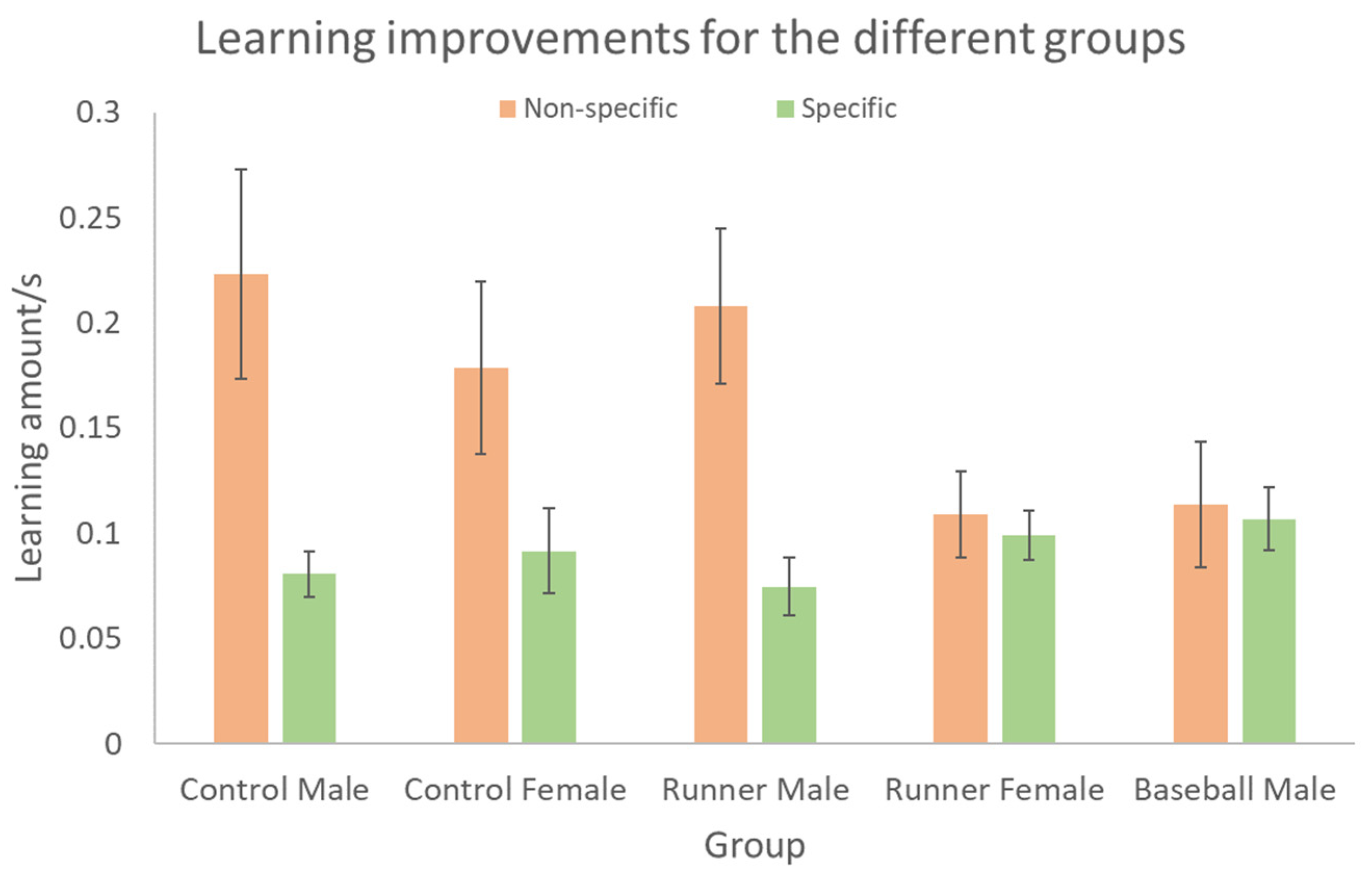
This analysis was conducted to look at the degree of improvement in performance of the task. This was again conducted using analysis of variance and looked at (1) whether significant learning was seen, (2) whether the learning was specific (i.e., for the repeated stimulus arrangements), general (i.e., for novel stimulus arrangements) or both and, importantly, (3) whether there were any differences in the learning for the different groups, the difference of primary relevance to the hypothesis of the study. Learning measures for the groups are shown in Figure 2.
Figure 2.
Amount of learning either specific to the stimulus arrangements (indicated as “specific” in the diagram) or non-specific learning, indicative of improvement in performance not linked to specific stimulus arrangements. These were calculated as the response times on the first block of the task minus the response times for the repeated trials in the final block (specific) and the new arrangements in the final block (non-specific) in seconds.
Overall Analysis of Learning
ANOVA was carried out for response times with factors of group (runners, controls or baseball players), gender (male or female) and stage (first block (baseline performance, referred to as baseRTs below)); final block trials with repeats of the learned trials (indicated as rptRTs below); and final block new trials (to see whether there was improvement not related to the specifically learned trials and indicated as newRTs below). Only the stage factor showed a significant effect, with this having a large effect size (F(1, 55) = 87.025, p < 0.001, ηp2 = 0.826).
Learning in Runners Compared to Controls
Runners were compared to controls with factors of group (runners or controls), gender (male or female) and stage (baseRTs, rptRTs or newRTs). Details of this are described in Supplementary Materials and Supplementary Table S1 and can be summarized as being consistent with the aforementioned overall analysis, with the only significant effect being for stage, again with a large effect size (F(2, 86) = 120.789, p < 0.001, ηp2 = 0.737). Post hoc comparisons showed baseRTs differed significantly from both rptRTs (t(46) = 12.079, p < 0.001, 95% confidence intervals (C.I.) 0.221–0.310) and newRTs (t(46) = 9.051, p < 0.001, 95% C.I. 0.139–0.219). RptRTs and newRTs also differed significantly (t(46) = 12.044, p < 0.001, 95% C.I. 0.072–0.101). The Cohen’s D value for all of these comparisons was 0.9 or higher, indicative of large effects.
Learning in the Groups for Males
Details of this analysis are described in Supplementary Materials and shown in Supplementary Table S2. This analysis used a repeated measures ANOVA with a within-subjects factor of stage (baseRTs, rptRTs, newRTs) and a between-subject factor of group (control, running or baseball). The pattern of results was consistent with that described above, with a large significant effect of stage and with baseRTs significantly higher than newRTs which were significantly higher than rptRTs.
Generalized Estimating Equation Analysis of Learning
Details of this analysis are also described in Supplementary Materials. Results were consistent with ANOVA outcomes, with performance differing significantly at the three time-points, but not for gender or as a result of being active.
3.2.3. Analysis of Learning Amounts: Non-Specific and Specific Learning
First, this was calculated for non-specific learning—improvement in performance not linked to specific stimuli arrangements. This was indexed by the difference between the response times in the first block (baseRTs) and the response times for the new trials in the final block (newRTs) (i.e, baseRTs − newRTs).
Second, specific learning was calculated for each participant, with this representing improved performance related specifically to the repeated stimulus presentations. This was the responses times on the final block for the new trials (newRTs) minus the repeated trials (rptRTs). This data is shown in Figure 2.
Effects of Sport and Gender on Specific and Non-Specific Learning
ANOVA was used to analyze non-specific and specific learning amounts with factors of group (control and runners) and gender (male and female). No significant effects were seen (see Table 2).
Table 2.
Outcomes of the analysis of variance for specific and non-specific learning with factors of stage (baseline RTs, repeat RTs and new RTs), group (runners and controls) and gender (male and female). The ηp2 value for the gender effect approaching significance was of medium size.
Effects of Sport on Specific and Non-Specific Learning in Males
No significant effects were seen in ANOVA carried out with a factor of group (control, running or baseball) for non-specific and specific learning for male participants (see Supplementary Materials for values).
Effects of Activity on Specific and Non-Specific Learning Analyzed with Generalized Estimating Equations
Details of this analysis are shown in Supplementary Materials. Effects were generally consistent with the results from the ANOVA above but were also suggestive of differences between patterns of learning for female runners and for baseball players (both compared to controls).
3.2.4. Analysis of Patterns of Learning: Differences Between Non-Specific and Specific Learning
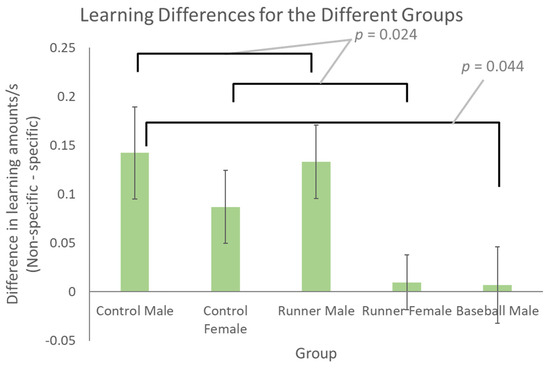
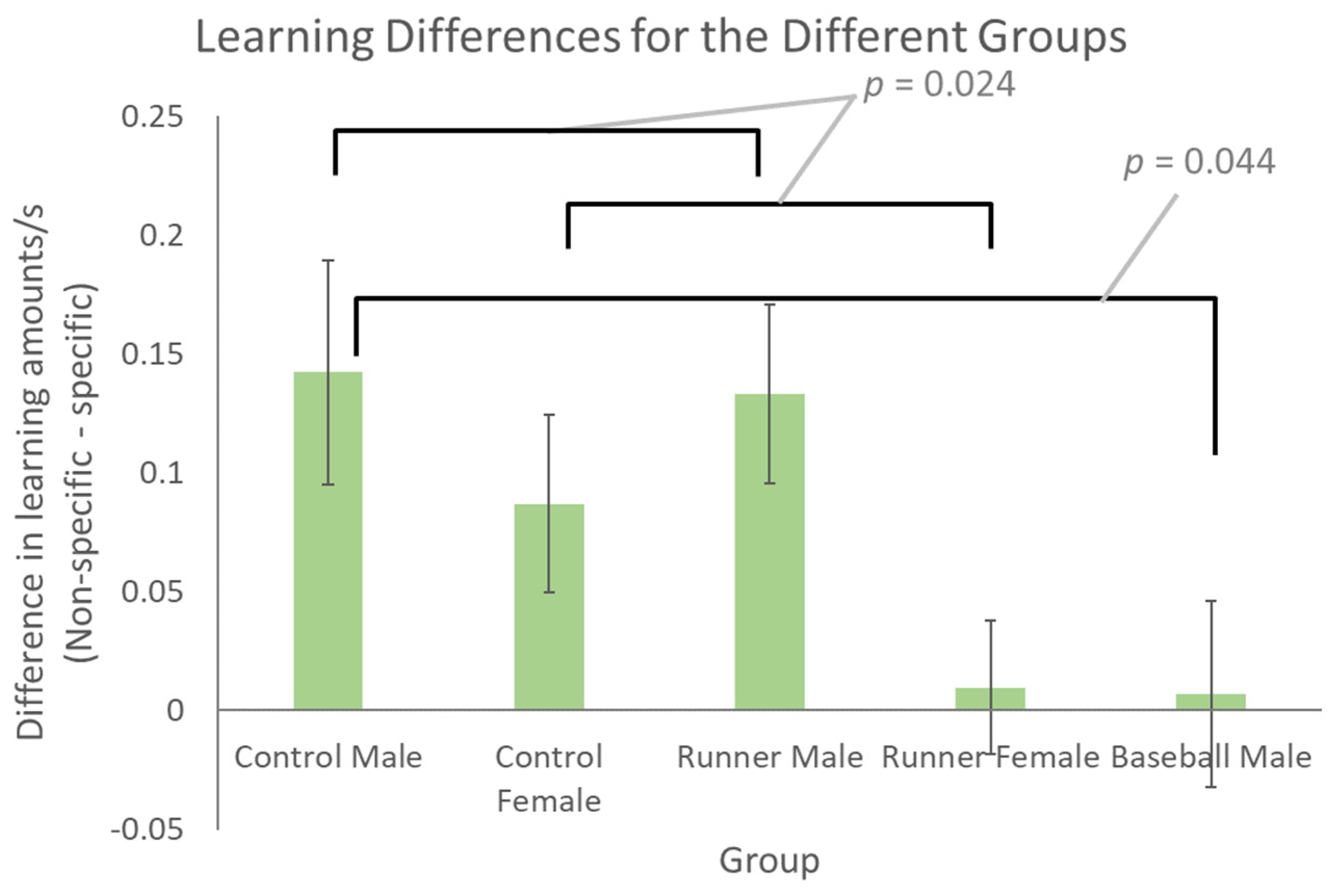
For the final analysis, the pattern of non-specific learning and specific learning was examined by looking at the differences between these for the different groups. This measure is also shown in Figure 3.
Figure 3.
Differences between non-specific and specific learning for each of the groups. These patterns are a consequence of lower amounts of non-specific learning in the female runners and the baseball players. These were calculated as response times for the trials with new arrangements in the final block (the trials for non-specific learning) minus the response times for the repeated trials in the final block (the trials for specific learning), with values in seconds.
Effects of Sport and Gender on Specific and Non-Specific Learning Differences
Analysis was carried out on the difference between non-specific learning RT values and specific learning RT values (i.e., non-specific learning RT − specific learning RT) using ANOVA with factors of group (running or control) and gender (male or female) (see Figure 3). Outcomes are shown in Table 3.
Table 3.
Outcomes of the analysis of variance for specific and non-specific learning differences with factors of stage (baseline RTs, repeat RTs and new RTs), group (runners and controls) and gender (male and female). The ηp2 effect size for gender was a medium size effect.
For the significant effect of gender, post hoc comparison t-tests showed that, for the control participants, there was no significant difference between genders (t(22) = 0.923, p = 0.366) whereas there was a significant difference for runners (t(21) = 2.664, p = 0.015). This reflected a lower value in female runners, indicative, given the outcomes of the previous analyses, of a reduced difference between the two types of learning.
Effects of Sport on the Difference Between Learning Amounts for Male Participants
The difference between non-specific learning and specific learning with a factor of group (running, baseball or control) was analyzed for males.
A significant effect of sport was seen (F(2, 33) = 3.427, p = 0.044, partial eta squared = 0.172 (large effect)). Post hoc comparison using Dunnett’s test with the control group used as the control condition showed no significant difference for runners compared to controls (p = 0.983) and a significant difference for baseball players compared to controls (p = 0.047, 95% C.I. 0.002–0.269).
A similar post hoc analysis as that used in the previous analysis of specific and non-specific learning showed that the difference approached significance for baseball players compared to controls (p = 0.096) for non-specific learning but was not significant for specific learning (p = 0.287).
Summary of the Patterns of Differences
Significant effects were seen here for female runners and male baseball players, with, in both cases, there being a reduction in the differences between non-specific and specific learning on the visual search task. The patterns of data, statistics and visual inspection of the data (see Figure 2 and Figure 3) are all consistent with this being due to lower levels of non-specific learning in these individuals.
4. Discussion
4.1. Overview of Findings
The hypothesis that sporting engagement/fitness improves cognitive performance by increasing the ability to learn a task was tested by presenting blocks of a visual search task (thought to have an executive function component [26]) to runners and baseball players (who made up the sporting group), and control participants who did not engage in sport or fitness training.
The sporting participants here were all university-level baseball players or runners, consistent with a high level of sporting/fitness training engagement and these groups had significantly higher levels of fitness than the control group. Participants were compared for initial visual search task performance and for the amount of learning with repeated presentation of the task. A final block of trials allowed learning to be divided into that specific to arrangements of the stimuli and non-specific task-related improvement by using trials using the stimulus arrangements used during training and trials with novel stimulus arrangements. There were no significant differences between groups for baseline performance on the task, but, as was expected, significant improvements were seen following training on the task, as indicated by significantly reduced response times (with a large effect size) and with consistently high accuracy throughout. This was the case for participants as a whole, for sporting individuals as a whole and also for each individual group. Additionally, improvements were significant for both training measures, i.e., for the training benefits of repetition of search elements (specific training) and the non-specific benefits on task performance, with the latter indicated by improved performance for novel search arrays.
4.2. Absence of Improved Learning for the Sports Group
Interestingly, and relating to the main point of investigation in this study, there were no differences indicative of better learning of the visual search task for the group consisting of runners and baseball players. This was the case for both specific and non-specific learning. There was also no trend for differences in a direction suggestive of an improved level of learning, with, if anything, lower learning in the sports groups. The only significant difference seen was a reduction in the difference between non-specific and specific learning for female runners and male baseball players, which could be speculated to represent less non-specific learning in these two groups. Again, the hypothesis, based on the idea that sport/exercise results in changes in the neurochemical systems in the brain, enabling individuals to perform better on cognitive tasks with practice (i.e., learn more), was that the sports groups should show improved performance more on a task with practice. This was not seen, and the only significant differences were for lower levels of improvement.
4.3. Potential Explanations for the Significant Patterns of Performance
The data found here leads to two questions. First, what might the significant effects that were seen for two of the sports groups mean and, second, what might be the reason for it being seen in two groups but not the third (male runners)? It must be remembered, however, that such explanations should be tempered by the fact that these groups were smaller than those for the main analysis in the experiment.
In the case of the first question, the overall results suggest there is no general benefit in terms of either initial performance or rate of improvement of performance on a new task for the sports group. The significant effects seen were for reduced non-specific learning, and this might be informative. This could be due to transferrable benefits from trained sport/fitness skill that generalizes to aspects of other tasks or that there were other, more general trainability-related changes. In other words, there was a non-specific improvement due to sport/fitness, but this was at some time following sport/fitness training starting but prior to the testing here. However, if this was the case there is a question of why there was no initial difference in task performance for the sporting groups compared to the control participants. This should, therefore, certainly be viewed as a speculative interpretation, with more specific work required before anything more definitive could be validly concluded. This interpretation also seemingly contrasts with the previous study by Guchait and Muggleton [19], in which better performance on a motor-learning task was associated with sport/fitness, but no learning differences were seen. Again, it could be speculated that this might be due to the weighting being more on non-specific skills in the motor task and this was enough to result in performance differences but the parts that were improved during practice were different and did not differ between groups, but this would also require future investigation.
There is, of course, also the possibility that the study here was of insufficient power to be able to detect any significant difference. While both consideration of previously reported effect sizes for this task and typical group sizes showing differences when investigating sport and cognition suggest this should not be the case, it cannot be ruled out.
More broadly, there is the question of what the current findings, along with the previous motor learning investigation [19], means for (1) understanding of the nature of the effects of sport/fitness on cognition and (2) consideration of using sport/fitness as a beneficial cognitive intervention. A reasonable summary could be:
- The sports group did not show better learning on a cognitive task involving executive function, indicating that executive-function-related learning is not generally improved in such individuals.
- When aiming to use sport or fitness training to aid with cognition there is a need for more consideration of the processes in which benefits are sought along with better characterization of the processes that are affected by the specific activities that can be engaged in. In other words, broader characterization of changes associated with specific activities would be useful.
4.4. Potential Future Investigations
Further investigation of the above-mentioned points would be of interest when considering using sport or fitness with the specific aim of improving cognition. Better quantification of what it is about sport or fitness training that leads to more general transferrable benefits would also be useful in conjunction with looking at the characteristics of individuals who show more benefits from training. This latter point fits with the increasing acknowledgment of the importance of more consideration of participant characteristics in psychology studies in general. In other words, while effects might be seen at a group level, they will differ for different individuals and whether there are factors that can predict this would be important information.
4.5. Study Limitations
As always, it is important to mention the limitations of this study. While power analysis indicated that the number of participants tested should have been sufficient to detect learning-related changes in performance (and these were seen with high effect sizes), it is possible that other effects could have been missed, meaning that the lack of increased task learning could reflect an under-powered experiment. This is offset somewhat by learning differences that were significant being in the direction opposite to those predicted by the hypothesis (i.e., that there would be more, not less, learning for the sporting participants). Additionally, while the participants were grouped by classification (i.e., runners, baseball players and controls), their fitness (indicated by a VO2max estimate) was measured indirectly and this, although it has been found to be a reliable measure, limits its utility. It is also the case that factors such as sleep quality or competitiveness were not factored into analysis of behavioral performance. Indeed, exercise is known to interact with sleep quality and competitiveness is generally higher in those engaging in sports. Future analysis could beneficially examine whether factors such as these interact with behavioral differences in a way that could be dissociated from whether an individual is fit/engages in competitive sport. It should also be emphasized that subgroup analysis here was subject to smaller sample sizes, meaning caution should be engaged into inferring too much from these findings, with future work more specifically addressing the associated implications being preferable.
5. Conclusions
No significant differences were seen in performance of a visual search task for individuals who engaged in sport, nor was there any indication of improved learning rates for these individuals. This is particularly important given that this is a task involving cognitive processes that have been suggested to benefit from improving fitness or taking part in sports [3,26]. It should be cautioned that this by no means guarantees this is the case for other tasks that involve such processes. Such a finding is important when trying to choose exercise to improve cognitive processes, suggesting that it might be better to choose specific sports that have been suggested to have the desired effect. For example, tennis players show better temporal preparation [6], meaning tennis training might be beneficial if the aim is to improve this process. Maybe more importantly, broader investigation of processes affected by different sports would help us to better know which exercises are most important to achieve benefits in specific processes.
Supplementary Materials
The following supporting information can be downloaded at: https://www.mdpi.com/article/10.3390/app16021076/s1, Figure S1: Performance of the participants on the visual search task illustrated as mean response times for correct trials for each group in seconds. Error bars indicate standard errors of the mean; Table S1: Outcomes of the analysis of variance for response times with factors of stage (baseline RTs, repeat RTs and new RTs), group (runners, controls) and gender (male, female). Power for significant effects is shown as partial eta squared (ηp2) and this was a large effect size for Stage; Table S2: Outcomes of the analysis of variance for response times for male participants with factors of stage (baseline RTs, repeat RTs and new RTs), group (runners, controls, baseball players). The ηp2 effect size for stage was a large size effect.
Author Contributions
Conceptualization, A.G. and N.G.M.; methodology, A.G., Y.-H.Z. and N.G.M.; software, N.G.M.; validation, A.G., C.-Y.C., Y.-H.Z. and N.G.M.; formal analysis, A.G. and N.G.M.; investigation, A.G. and Y.-H.Z.; resources, N.G.M.; data curation, A.G. and Y.-H.Z.; writing—original draft preparation, N.G.M.; writing—review and editing, C.-Y.C. and A.G.; visualization, N.G.M.; supervision, C.-Y.C. and N.G.M.; project administration, N.G.M.; and funding acquisition, C.-Y.C. and N.G.M. All authors have read and agreed to the published version of the manuscript.
Funding
This study was funded by the National Science and Technology Council (NSTC), Taiwan (grant numbers: 113-2410-H-194-086, 114-2410-H-194-088 to CYC, 110-2410-H-008-040-MY3 and 114-2410-H-008-063-MY2 to NGM).
Institutional Review Board Statement
The study was conducted in accordance with the Declaration of Helsinki and approved by the Institutional Review Board (or Ethics Committee) of the National Taiwan University (protocol code 202105EM017, date of approval June 2021).
Informed Consent Statement
Informed consent was obtained from all subjects involved in the study.
Data Availability Statement
Data will be made available on request.
Conflicts of Interest
The authors declare no conflicts of interest. The funders had no role in the design of the study; in the collection, analyses or interpretation of data; in the writing of the manuscript; or in the decision to publish the results.
References
- Galloza, J.; Castillo, B.; Micheo, W. Benefits of Exercise in the Older Population. Phys. Med. Rehabil. Clin. N. Am. 2017, 28, 659–669. [Google Scholar] [CrossRef] [Scilit]
- Looser, V.N.; Gerber, M.; Ludyga, S. Cardiorespiratory Fitness and Neurophysiological Indices of Working Memory Maintenance in Young Adults. Psychophysiology 2025, 62, e70012. [Google Scholar] [CrossRef] [Scilit] [PubMed]
- Colcombe, S.; Kramer, A.F. Fitness effects on the cognitive function of older adults: A meta-analytic study. Psychol. Sci. 2003, 14, 125–130. [Google Scholar] [CrossRef] [Scilit]
- Donnelly, J.E.; Hillman, C.H.; Castelli, D.; Etnier, J.L.; Lee, S.; Tomporowski, P.; Lambourne, K.; Szabo-Reed, A.N. Physical Activity, Fitness, Cognitive Function, and Academic Achievement in Children: A Systematic Review. Med. Sci. Sports Exerc. 2016, 48, 1197–1222. [Google Scholar] [CrossRef] [Scilit]
- Fernández-Sánchez, A.; Ruiz-Hermosa, A.; Redondo-Tébar, A.; Díez-Fernández, A.; Martínez-Vizcaíno, V.; Visier-Alfonso, M.E.; Sánchez-López, M. Relation between motor competence and academic achievement: The mediating role of fitness and cognition in boys and girls. PLoS ONE 2025, 20, e0314948. [Google Scholar] [CrossRef] [Scilit]
- Wang, C.H.; Chang, C.C.; Liang, Y.M.; Shih, C.M.; Muggleton, N.G.; Juan, C.H. Temporal preparation in athletes: A comparison of tennis players and swimmers with sedentary controls. J. Mot. Behav. 2013, 45, 55–63. [Google Scholar] [CrossRef] [Scilit] [PubMed]
- Antunes, H.K.; Santos-Galduroz, R.F.; De Aquino Lemos, V.; Bueno, O.F.; Rzezak, P.; de Santana, M.G.; De Mello, M.T. The influence of physical exercise and leisure activity on neuropsychological functioning in older adults. Age 2015, 37, 9815. [Google Scholar] [CrossRef] [Scilit]
- Ludyga, S.; Gerber, M.; Pühse, U.; Looser, V.N.; Kamijo, K. Systematic review and meta-analysis investigating moderators of long-term effects of exercise on cognition in healthy individuals. Nat. Hum. Behav. 2020, 4, 603–612. [Google Scholar] [CrossRef] [Scilit]
- Kovács, K.E.; Szakál, Z. Factors influencing sport persistence still represent a knowledge gap—The experience of a systematic review. BMC Psychol. 2024, 12, 584. [Google Scholar] [CrossRef] [Scilit] [PubMed]
- Zhang, M.; Wang, X.C.; Shao, B. Predictors of Persistent Participation in Youth Sport: A Systematic Review and Meta-Analysis. Front. Psychol. 2022, 13, 871936. [Google Scholar] [CrossRef] [Scilit]
- Pinto Pereira, S.M.; Li, L.; Power, C. Early Life Factors and Adult Leisure Time Physical Inactivity Stability and Change. Med. Sci. Sports Exerc. 2015, 47, 1841–1848. [Google Scholar] [CrossRef] [Scilit]
- Schellenberg, B.J.I.; Lötscher, J. Passion and engagement in sport: A look at athletes and coaches using a quadripartite approach. Psychol. Sport Exerc. 2024, 75, 102703. [Google Scholar] [CrossRef] [Scilit]
- Stimpson, N.J.; Davison, G.; Javadi, A.-H. Joggin’ the noggin: Towards a physiological understanding of exercise-induced cognitive benefits. Neurosci. Biobehav. Rev. 2018, 88, 177–186. [Google Scholar] [CrossRef] [Scilit]
- Seeherman, H.J.; Taylor, C.R.; Maloiy, G.M.; Armstrong, R.B. Design of the mammalian respiratory system. II. Measuring maximum aerobic capacity. Respir. Physiol. 1981, 44, 11–23. [Google Scholar] [CrossRef] [Scilit] [PubMed]
- Kleim, J.A.; Cooper, N.R.; VandenBerg, P.M. Exercise induces angiogenesis but does not alter movement representations within rat motor cortex. Brain Res. 2003, 934, 1–6. [Google Scholar] [CrossRef] [Scilit] [PubMed]
- Swain, R.A.; Harris, A.B.; Wiener, E.C.; Dutka, M.V.; Morris, H.D.; Theien, B.E.; Konda, S.; Engberg, K.; Lauterbur, P.; Greenough, W. Prolonged exercise induces angiogenesis and increases cerebral blood volume in primary motor cortex of the rat. Neuroscience 2003, 117, 1037–1046. [Google Scholar] [CrossRef] [Scilit]
- Pereira, A.C.; Huddleston, D.E.; Brickman, A.M.; Sosunov, A.A.; Hen, R.; McKhann, G.M.; Sloan, R.; Gage, F.H.; Brown, T.R.; Small, S.A. An in vivo correlate of exercise-induced neurogenesis in the adult dentate gyrus. Proc. Natl. Acad. Sci. USA 2007, 104, 5638–5643. [Google Scholar] [CrossRef] [Scilit]
- Dupuy, O.; Gauthier, C.J.; Fraser, S.A.; Desjardins-Crèpeau, L.; Desjardins, M.; Mekary, S.; Lesage, F.; Hoge, R.D.; Pouliot, P.; Bherer, L. Higher levels of cardiovascular fitness are associated with better executive function and prefrontal oxygenation in younger and older women. Front. Hum. Neurosci. 2015, 9, 66. [Google Scholar] [CrossRef] [Scilit] [PubMed]
- Guchait, A.; Muggleton, N.G. Investigating mechanisms of sport-related cognitive improvement using measures of motor learning. Prog. Brain Res. 2024, 283, 305–325. [Google Scholar] [CrossRef] [Scilit]
- Sanders, L.M.J.; Hortobágyi, T.; la Bastide-van Gemert, S.; van der Zee, E.A.; van Heuvelen, M.J.G. Dose-response relationship between exercise and cognitive function in older adults with and without cognitive impairment: A systematic review and meta-analysis. PLoS ONE 2019, 14, e0210036. [Google Scholar] [CrossRef] [Scilit]
- Xue, Y.; Yang, Y.; Huang, T. Effects of chronic exercise interventions on executive function among children and adolescents: A systematic review with meta-analysis. Br. J. Sports Med. 2019, 53, 1397–1404. [Google Scholar] [CrossRef] [Scilit]
- Kunar, M.A.; John, R.; Sweetman, H. A configural dominant account of contextual cueing: Configural cues are stronger than colour cues. Q. J. Exp. Psychol. 2014, 67, 1366–1382. [Google Scholar] [CrossRef] [Scilit]
- Chun, M.M. Contextual cueing of visual attention. Trends Cogn. Sci. 2000, 4, 170–178. [Google Scholar] [CrossRef] [Scilit] [PubMed]
- Jiang, Y.; Leung, A.W. Implicit learning of ignored visual context. Psychon. Bull. Rev. 2005, 12, 100–106. [Google Scholar] [CrossRef] [Scilit] [PubMed]
- Kunar, M.A.; Flusberg, S.J.; Horowitz, T.S.; Wolfe, J.M. Does contextual cueing guide the deployment of attention? J. Exp. Psychol. Human. Percept. Perform. 2007, 33, 816–828. [Google Scholar] [CrossRef] [Scilit]
- Peterson, M.S.; Beck, M.R.; Wong, J.H. Effects of executive functioning on visual search. J. Vis. 2006, 6, 1106. [Google Scholar] [CrossRef] [Scilit]
- Faul, F.; Erdfelder, E.; Lang, A.-G.; Buchner, A. G*Power 3: A flexible statistical power analysis program for the social, behavioral, and biomedical sciences. Behav. Res. Methods 2007, 39, 175–191. [Google Scholar] [CrossRef] [Scilit] [PubMed]
- World Medical Association. Declaration of Helsinki. Recommendations Guiding Medical Doctors in Biomedical Research Involving Human Subjects. Med. J. Aust. 1976, 1, 206–220. [Google Scholar]
- George, J.D.; Stone, W.J.; Burkett, L.N. Non-exercise VO2max estimation for physically active college students. Med. Sci. Sports Exerc. 1997, 29, 415–423. [Google Scholar] [CrossRef] [Scilit]
- Smither, R.D.; Houston, J.M. The nature of competitiveness: The development and validation of the competitiveness index. Educ. Psychol. Meas. 1992, 52, 407–418. [Google Scholar] [CrossRef] [Scilit]
- MacLean, A.W.; Fekken, G.C.; Saskin, P.; Knowles, J.B. Psychometric evaluation of the Stanford Sleepiness Scale. J. Sleep. Res. 1992, 1, 35–39. [Google Scholar] [CrossRef] [Scilit] [PubMed]
- Shahid, A.; Wilkinson, K.; Marcu, S.; Shapiro, C.M. Stanford sleepiness scale (SSS). In STOP, THAT and One Hundred Other Sleep Scales; Shahid, A., Wilkinson, K., Marcu, S., Shapiro, C., Eds.; Springer: New York, NY, USA, 2011. [Google Scholar] [CrossRef] [Scilit]
- Craig, C.L.; Marshall, A.L.; Sjöström, M.; Bauman, A.E.; Booth, M.L.; Ainsworth, B.E.; Pratt, M.; Ekelund, U.; Yngve, A.; Sallis, J.F.; et al. International physical activity questionnaire: 12-country reliability and validity. Med. Sci. Sports Exerc. 2003, 35, 1381–1395. [Google Scholar] [CrossRef] [Scilit] [PubMed]
- Peirce, J.W.; Gray, J.R.; Simpson, S.; MacAskill, M.R.; Höchenberger, R.; Sogo, H.; Kastman, E.; Lindeløv, J. PsychoPy2: Experiments in behavior made easy. Behav. Res. Methods 2019, 51, 195–203. [Google Scholar] [CrossRef] [Scilit]
- Cohen, J. A Power Primer. Psychol. Bull. 1992, 112, 155–159. [Google Scholar] [CrossRef] [PubMed]

Disclaimer/Publisher’s Note: The statements, opinions and data contained in all publications are solely those of the individual author(s) and contributor(s) and not of MDPI and/or the editor(s). MDPI and/or the editor(s) disclaim responsibility for any injury to people or property resulting from any ideas, methods, instructions or products referred to in the content. |
© 2026 by the authors. Licensee MDPI, Basel, Switzerland. This article is an open access article distributed under the terms and conditions of the Creative Commons Attribution (CC BY) license.