


Abstract
The growing demand for protein-enriched foods has increased interest in incorporating plant proteins into fermented dairy products. This study investigated the effects of sunflower, pumpkin, and hemp seed protein preparations, added in amounts adjusted according to their protein content to provide an additional 5% or 10% protein (w/v), on the physicochemical, nutritional, and microbiological properties of yogurts. The obtained products exhibited improved nutritional properties, with protein and dry matter contents reaching up to (16.14 ± 1.03) and (24.01 ± 1.24) g/100 g, respectively. Protein enrichment resulted in higher pH values, whereas total lactic acid production remained comparable to the control. More than 96% of the lactic acid produced was present as the L-(+) isomer, indicating proper starter culture activity and efficient fermentation. Microbial viability was influenced by both ingredient type and supplementation level. A 5% addition improved the viability of Streptococcus thermophilus and Lactobacillus spp. during refrigerated storage, whereas increasing it to 10% decreased total bacterial counts. Although freshly prepared enriched yogurts exhibited higher syneresis, whey separation stabilized or slightly decreased during storage. Protein preparations were also associated with larger growth inhibition zones against selected food-relevant strains. These findings indicate that oilseed-derived protein preparations are promising functional components for developing hybrid dairy–plant yogurts. However, their effects on acidification and bacterial viability should be considered when optimizing product formulations.
1. Introduction
Yogurt is among the most widely consumed fermented dairy products globally and is recognized for its high nutritional value and numerous beneficial effects, particularly on the gastrointestinal tract. Traditionally, it is produced by fermenting bovine, caprine, or ovine milk with Streptococcus thermophilus and Lactobacillus delbrueckii subsp. bulgaricus. In recent years, however, yogurt production has undergone substantial innovations, driven by the use of diverse milk sources (including both animal-derived and plant-based alternatives), the incorporation of novel functional ingredients, and the application of additional probiotic and functional strains. These changes reflect the growing consumer demand for nutritionally enhanced, functional, and environmentally sustainable dairy products [1,2].
High protein yogurts represent a category of functional foods primarily intended for individuals seeking to support muscle mass development, regulate appetite, or prevent muscle atrophy [3]. In the European Union, a product may be labelled as “high protein” only if at least 20% of its energy value is provided by protein [4]. This is achieved through the incorporation of proteins from various sources into yogurt formulations. Currently, caseinates, concentrates, and whey protein isolates remain the most commonly used ingredients to increase the protein content of dairy products [5]. However, plant-based, single-cell (SCP), and recombinant proteins are being explored as complete or partial alternatives to dairy proteins [6]. Nevertheless, studies have shown that their application requires careful consideration due to potential adverse effects on the technological properties, texture, and sensory characteristics of the final products [7].
Although plant protein preparations offer valuable nutraceutical and bioactive compounds, including dietary fiber, minerals, vitamins, and antioxidants, technological limitations, such as poor water solubility and pronounced off-flavors, mainly restrict their broader utilization as food ingredients [6,8]. Moreover, plant proteins often contain an unbalanced essential amino acid profile, with low levels of lysine, methionine, and cysteine, thereby affecting their nutritional value and digestibility [9,10]. Therefore, several studies have focused on developing dairy products based on milk proteins supplemented or partially substituted with plant proteins [11,12]. This approach may improve the techno-functional properties of plant proteins and expand their use in food systems while maintaining desirable product quality.
Soy proteins are the most extensively studied for this purpose, whereas other oilseed-derived proteins, such as sunflower, pumpkin, and hemp proteins, remain relatively underexplored in fermented dairy systems, highlighting the need for further research into their potential applications [6]. These proteins differ in their amino acid composition and functional properties. Sunflower protein is recognized for its favorable emulsifying properties, whereas pumpkin protein is valued for its high arginine and mineral content [13,14]. Hemp protein, in turn, exhibits a well-balanced amino acid profile and contains highly digestible storage proteins, mainly edestin and albumin [15].
In this study, sunflower (SUN), pumpkin (PUM), and hemp (HEM) seed protein preparations were evaluated as potential functional ingredients for the development of protein-enriched dairy products by assessing their effects on the physicochemical, nutritional, and microbiological properties of yogurts.
2. Materials and Methods
2.1. Materials
Pasteurized and microfiltered bovine milk (2.0% w/v fat and 3.2% w/v protein; Okręgowa Spółdzielnia Mleczarska, Piątnica, Poland) was purchased from a supermarket in Łódź, Poland. Protein preparations derived from sunflower, pumpkin, and hemp seeds (Organic Sunflower, Pumpkin, and Hemp Protein) with protein contents of 53%, 65%, and 51% (w/w), respectively, were obtained from DIET-FOOD (Opatówek, Poland). The yogurt starter culture VIVO (GAMA-TECH, Warsaw, Poland), containing Streptococcus thermophilus, Lactobacillus delbrueckii subsp. bulgaricus (L. bulgaricus), Lactobacillus acidophilus, and Bifidobacterium animalis subsp. lactis (B. lactis), was also purchased locally.
2.2. Preparation of Yogurt
Milk was heated to (43 ± 2) °C, and a commercial starter culture was incorporated at a concentration of 0.5 g/L according to the manufacturer’s instructions. The inoculated milk was dispensed into 50 mL portions in glass jars, and plant protein preparations (PRP) were added to provide an additional 5% or 10% protein (w/v), as specified in Table 1. The amounts of PRP were adjusted to account for differences in their protein content. All formulations were incubated at 40 °C in a Yogurella 617 yogurt maker (Ariete, Florence, Italy) for a predetermined period of approximately 6 h, regardless of the pH reached. Following fermentation, the yogurts were cooled to 4 °C and allowed to mature overnight. The final products were stored under refrigerated conditions (4 °C) for 14 days to monitor changes in yogurt quality over time.
Table 1.
Plant protein preparations and their nutrient contribution to the yogurt formulations.
2.3. Physicochemical and Biochemical Characterization
Yogurt protein content was determined by the Kjeldahl method using a nitrogen-to-protein conversion factor of 6.25, as recommended by the AOAC [16]. Dry matter was obtained by drying a 1.5 g sample at 105 °C in an MA 50.X2.A.WH moisture analyzer (RADWAG, Radom, Poland) until constant weight was achieved. pH was measured with a CP-411 pH meter (ELMETRON, Zabrze, Poland). D- and L-lactic acid contents were quantified employing a K-DLATE enzymatic assay kit (Megazyme, Bray, Ireland) according to the manufacturer’s instructions, while absorbance was recorded at 340 nm using a UV-2601 spectrophotometer (Rayleigh, Beijing, China).
2.4. Determination of Syneresis
Yogurt syneresis was determined according to the method described by Ghaderi-Ghahfarokhi et al. [17] with minor modifications. Samples (15 g) were centrifuged at 5000 rpm (Centrifuge MPW–350R, MPW Med. Instruments, Warsaw, Poland) for 10 min at 4 °C. The separated whey was collected and weighed. Syneresis was calculated as the percentage of whey released relative to the initial sample mass.
2.5. Bacterial Count
The viable counts of Streptococcus thermophilus, lactobacilli (Lactobacillus bulgaricus and Lactobacillus acidophilus), and Bifidobacterium lactis in yogurt treatments after 0, 7, and 14 days of refrigerated storage at 4 °C were determined using the drop plate method described by Munsch-Alatossava et al. [18]. Five 10 µL drops of serial saline dilutions were plated onto selective culture media. S. thermophilus was enumerated on M17 agar (Merck, Darmstadt, Germany) after aerobic incubation for 48 h at 45 °C, whereas lactobacilli and bifidobacteria were enumerated under anaerobic conditions at 37 °C for 72 h on MRS agar and TOS-MUP agar (Merck, Darmstadt, Germany), respectively.
2.6. Assessment of Antibacterial Activity
The antimicrobial activity of yogurt samples was evaluated against the reference bacterial strains Bacillus cereus ATCC 11778, Enterococcus faecalis ATCC 29212, E. faecalis ATCC 51299, Listeria monocytogenes ATCC 19112, L. monocytogenes ATCC 19115, Staphylococcus aureus ATCC 25923, S. aureus ATCC 27734, Escherichia coli ATCC 11303, E. coli ATCC 35218, Pseudomonas paraeruginosa ATCC 9027, Salmonella Choleraesuis ATCC 7001, Salmonella Enteritidis ATCC 13076, and Salmonella Typhimurium ATCC 14028 using the disk diffusion method according to the EUCAST guidelines [19]. All strains were obtained from MediMark® Europe (Grenoble, France).
Mueller–Hinton agar (Merck, Darmstadt, Germany), or Mueller–Hinton agar supplemented with 5% defibrinated horse blood and 20 mg/L β-NAD for L. monocytogenes, was inoculated with a (0.5 ± 0.1) McFarland suspension of each test organism by evenly swabbing the agar surface. Sterile paper discs (6 mm in diameter) were placed onto the inoculated agar, and 20 µL of each yogurt sample was applied to the discs. Distilled water served as the negative control, whereas ciprofloxacin (5 µg) and gentamicin (10, 30, and 120 µg) were used as positive controls. Plates were incubated at 37 °C for (18 ± 2) h. Inhibition zones were measured to the nearest 1 mm, and diameters ≥ 7 mm were considered indicative of antibacterial activity.
2.7. Statistical Analysis
Experiments were performed in triplicate, with three independent fermentations conducted for each yogurt variant. Results were analyzed using one-way ANOVA (to assess differences among yogurt formulations) and repeated-measures ANOVA (to assess the effects of formulation and refrigerated storage time, where applicable), followed by Tukey’s post hoc test. Statistical significance was set at p < 0.05. All data are presented as mean ± standard deviation. Statistical analyses were conducted using XLSTAT 2025.2.0 (Addinsoft, New York, NY, USA).
3. Results
3.1. Physicochemical and Biochemical Characterization
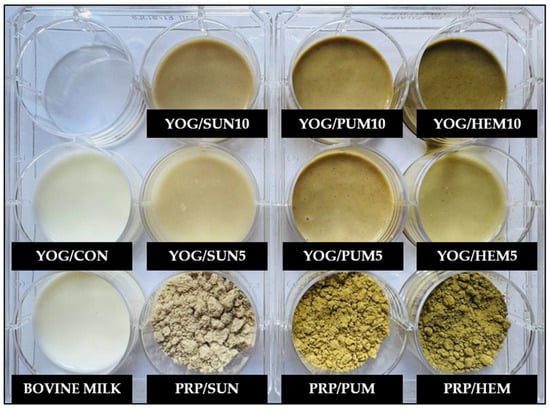
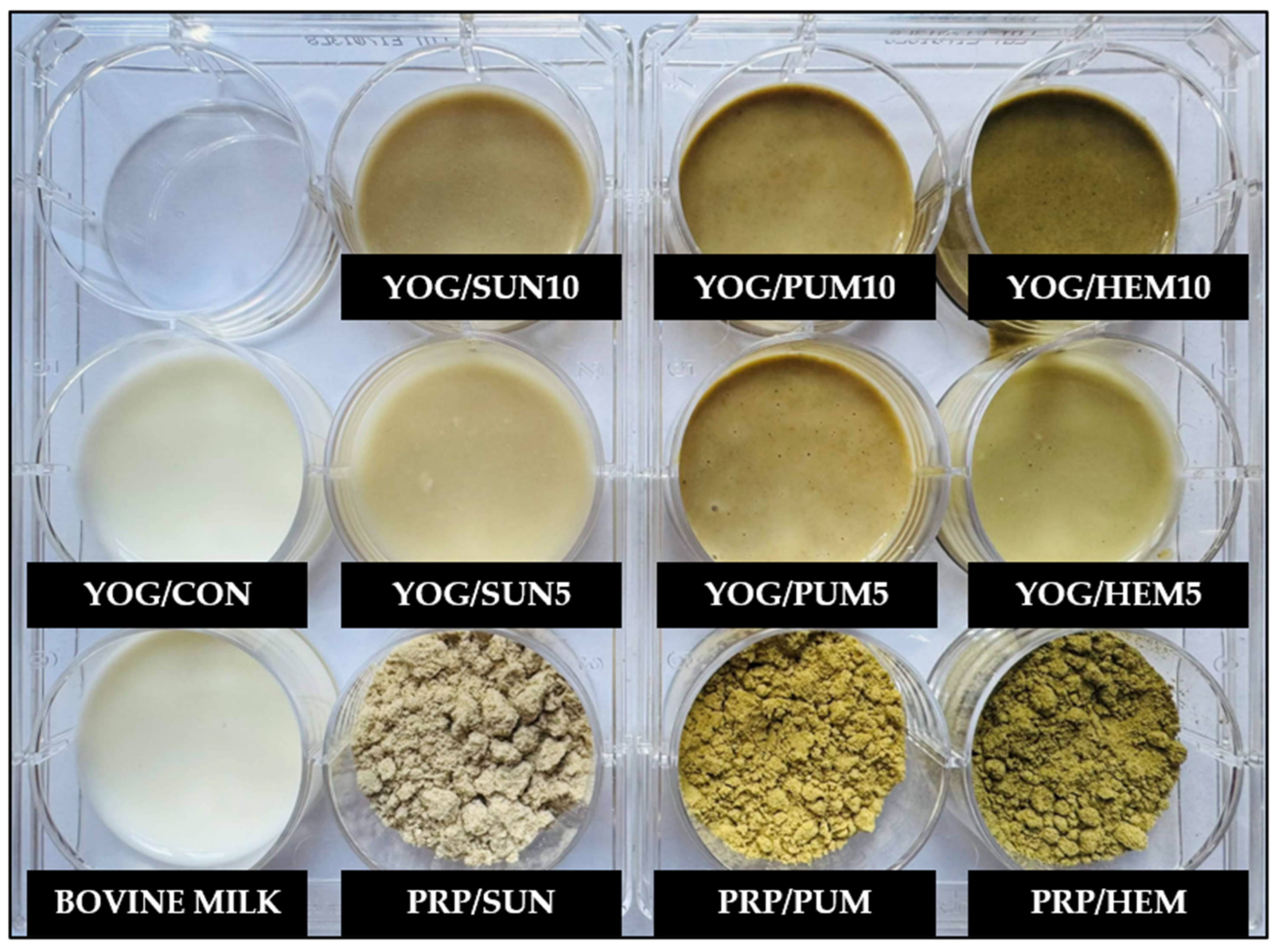
The macroscopic characteristics of the dry plant protein preparations and the corresponding yogurts are presented in Figure 1. The color of the yogurts reflected the original appearance of the protein preparations and intensified with increasing concentration.
Figure 1.
Prepared yogurts (YOG) enriched with sunflower (SUN), pumpkin (PUM), and hemp (HEM) protein preparations. Protein addition of 5% and 10% (w/v) was applied. Plain yogurt served as the control (CON). The plant protein preparations (PRP) used in the study are also shown.
Table 2 summarizes the physicochemical and biochemical parameters of yogurts supplemented with sunflower (SUN), pumpkin (PUM), and hemp (HEM) proteins. Plain yogurt without protein supplementation was used as the control (CON). The pH values of the protein-enriched yogurts ranged from 4.8 to 4.9, except for the YOG/PUM10 variant, which exhibited a pH of approximately 5.0. In comparison, the control showed a significantly lower pH value (4.4).
Table 2.
Physicochemical and biochemical characteristics of plant protein-enriched yogurt.
The lactic acid concentration in the control was (6.58 ± 2.41) g/L, whereas in the protein-enriched yogurts it ranged from (7.03 ± 0.82) to (10.23 ± 2.35) g/L; however, these differences were not statistically significant. The produced yogurts contained predominantly the L-lactic acid enantiomer, accounting for 96–99% of the total lactic acid content, indicating that PRP supplementation did not substantially affect the stereoisomeric profile, although differences in final pH suggest an effect on the acidification process.
As expected, fortified yogurts contained significantly higher protein levels than the control, whose protein ((3.97 ± 0.08) g/100 g) was derived exclusively from bovine milk. Yogurts enriched with 5% and 10% protein exhibited values ranging from (8.89 ± 1.82) to (12.02 ± 1.39) and (10.97 ± 0.90) to (16.14 ± 1.03) g/100 g, respectively. Interestingly, the differences between the two supplementation levels were not statistically significant. This may be related to the composition of the plant-based preparations, which contained approximately 40–50% non-protein components. Therefore, increasing the amount of added preparation resulted not only in higher protein content but also in increased dry matter, with differences observed between the control yogurt and protein-enriched variants, as well as between the 5% and 10% supplementation levels.
3.2. Syneresis
In dairy technology, syneresis is defined as the spontaneous separation of the dispersed phase (whey) from the protein gel matrix. This phenomenon results from the physicochemical instability of the colloidal system caused by pH changes occurring during fermentation. From a structural perspective, syneresis involves the contraction of the three-dimensional casein network, which reduces the water-holding capacity of proteins and consequently leads to the expulsion of entrapped serum to the product surface [20].
Table 3 presents the syneresis results, expressed as the percentage of whey separation from the yogurt gel matrix. Repeated-measures ANOVA revealed that both plant protein supplementation and refrigerated storage duration significantly affected this parameter. The lowest value was observed in the plain yogurt (YOG/CON), reaching (27.98 ± 2.27)% on day 0. After 7 and 14 days of refrigerated storage, these values increased to (34.27 ± 1.63)% and (35.78 ± 2.32)%, respectively.
Table 3.
Syneresis of yogurt with added plant protein preparations during refrigerated storage.
Initially (day 0), the highest syneresis values were recorded for YOG/PUM5 and YOG/HEM5, whereas the control exhibited the lowest whey separation. Following 7 days of refrigerated storage, the greatest extent of syneresis was observed in YOG/SUN5, YOG/PUM5, and YOG/HEM5, while variants containing 10% additional plant protein and the control exhibited lower values. By day 14, YOG/PUM5 and YOG/HEM5 continued to exhibit the highest syneresis values, whereas the lowest values were noted for YOG/CON and YOG/SUN10.
3.3. Microbial Viability During Refrigerated Storage
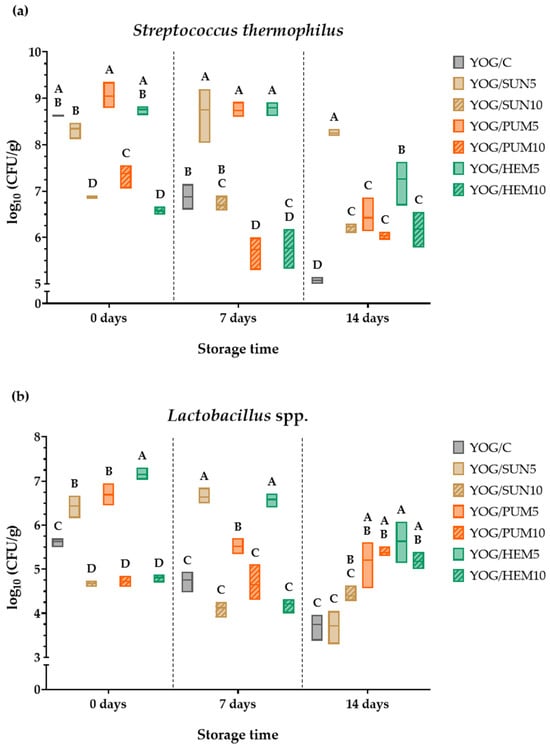
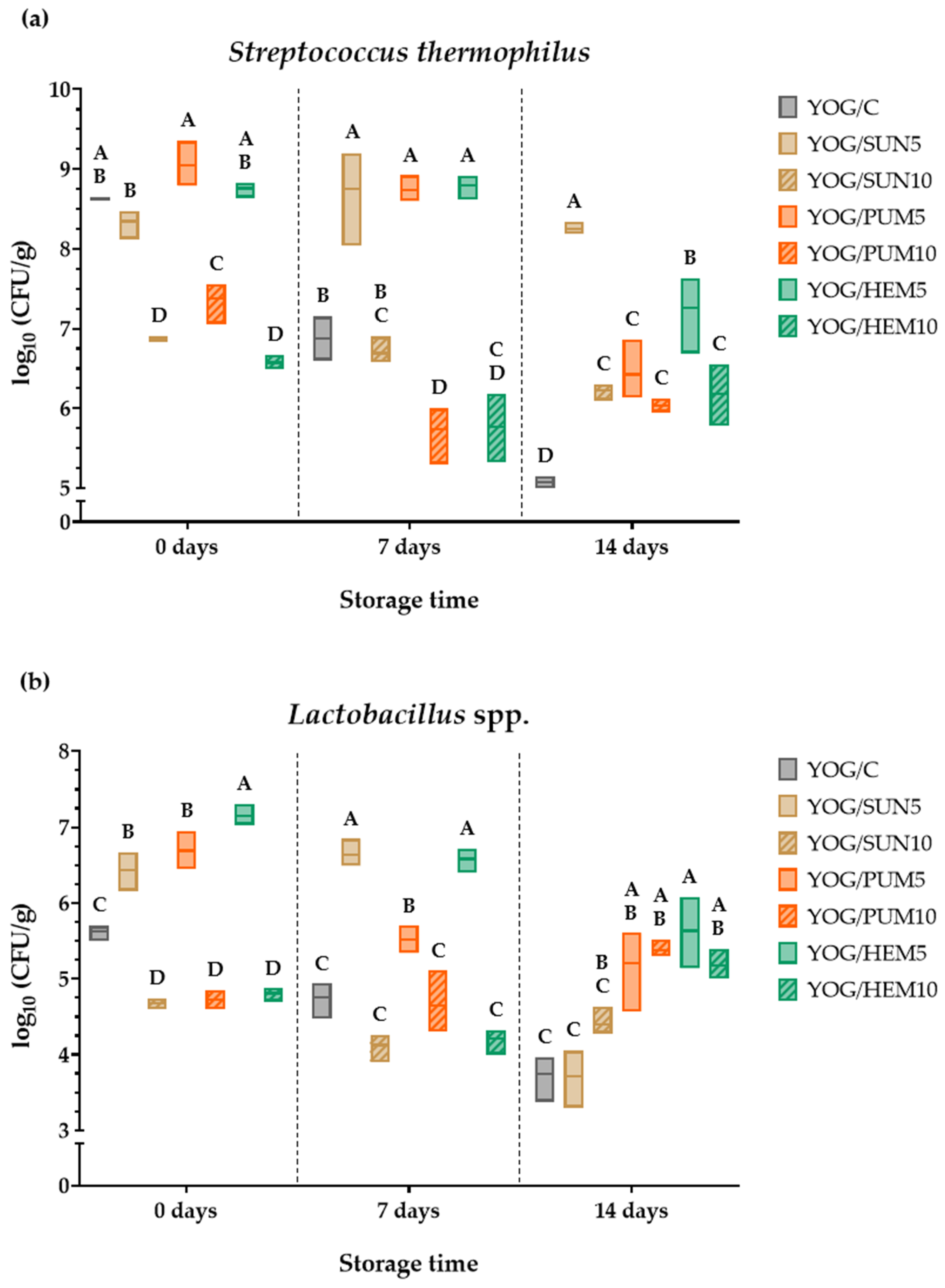
The viability of Streptococcus thermophilus, Lactobacillus spp. (including L. bulgaricus and L. acidophilus), and Bifidobacterium lactis was assessed in yogurts at day 0 (after fermentation and overnight storage at 4 °C) and after 7 and 14 days of refrigerated storage, as their presence was declared by the inoculum manufacturer. Figure 2 presents the counts of S. thermophilus (a) and Lactobacillus spp. (b) over the 14-day storage period. B. lactis counts were not included in the figure, as this bacterium was detected only in the control yogurt on day 0, reaching (4.83 ± 0.35) log10 CFU/g, and was no longer detectable after subsequent storage.
Figure 2.
Viable counts of (a) Streptococcus thermophilus and (b) Lactobacillus spp. (L. delbrueckii subsp. bulgaricus and L. acidophilus) in yogurts (YOG) enriched with 5% or 10% (w/v) sunflower, pumpkin, or hemp protein during 0, 7, and 14 days of storage at 4 °C. Plain yogurt without added protein was the control (CON). Capital letters (A–D) indicate statistically significant differences among formulations at each storage time (p < 0.05; repeated-measures ANOVA followed by Tukey’s post hoc test).
At day 0, the 5% protein formulations did not differ significantly from the control in terms of S. thermophilus counts, which reached (8.62 ± 0.21) log10 CFU/g. In contrast, increasing the protein supplementation level to 10% resulted in lower initial S. thermophilus counts, reaching (6.88 ± 0.04), (7.45 ± 0.28), and (6.59 ± 0.31) log10 CFU/g in YOG/SUN10, YOG/PUM10, and YOG/HEM10, respectively. During refrigerated storage, a statistically significant reduction in S. thermophilus counts was observed in YOG/CON, reaching (6.12 ± 0.89) and (5.08 ± 0.07) log10 CFU/g after 7 and 14 days, respectively. In contrast, YOG/SUN5, YOG/PUM5, and YOG/HEM5 maintained S. thermophilus counts above 6.4 log10 CFU/g throughout the 14-day storage period. Notably, despite their generally lower initial S. thermophilus counts, yogurts fortified with 10% plant protein exhibited better retention of viable S. thermophilus cells during refrigerated storage, resulting in higher counts after 14 days than those observed in the plain yogurt.
For Lactobacillus spp., the highest counts at day 0 were recorded in YOG/SUN5 ((6.44 ± 0.24) log10 CFU/g), YOG/PUM5 ((6.66 ± 0.34) log10 CFU/g), and YOG/HEM5 ((7.12 ± 0.36) log10 CFU/g). During refrigerated storage, Lactobacillus spp. counts gradually decreased in all yogurt samples, with the magnitude of the decline varying among formulations.
Interestingly, despite the general decrease in viable counts over 14 days of storage, fortification with plant protein appeared to slow this decline compared with the control. The effect was more pronounced at the lower supplementation level, with YOG/SUN5 and YOG/HEM5 showing the greatest ability to support the survival of lactic acid bacteria.
3.4. Antimicrobial Activity Against Food-Related Bacterial Strains
The antibacterial activity of the obtained yogurts is presented in Table 4. Gram-positive and -negative reference strains relevant for food safety assessment were used for the evaluation. Zones of <7 mm, 7–9 mm, 10–14 mm, and >14 mm were classified as indicating no relevant, low, moderate, and high growth inhibition, respectively [21].
Table 4.
Inhibition zones of plant protein-enriched yogurt against selected bacterial strains.
Yogurts enriched with plant-based preparations exhibited broader growth-inhibitory effects compared with the control. The plain yogurt showed only weak inhibitory activity, limited to the Gram-positive E. faecalis strains (ATCC 29212 and ATCC 51299), two L. monocytogenes strains (ATCC 19112 and ATCC 19115), and the Gram-negative E. coli ATCC 11303 and P. paraeruginosa ATCC 9027. In contrast, YOG/SUN5, YOG/SUN10, YOG/PUM5, YOG/PUM10, YOG/HEM5, and YOG/HEM10 exhibited low to moderate inhibitory effects against the majority of the tested strains. These screening findings might indicate a potential antibacterial effect associated with the addition of plant protein preparations. However, as diffusion-related physicochemical properties were not controlled, the results should be interpreted in terms of inhibition-zone diameter rather than as direct evidence of enhanced antibacterial activity.
4. Discussion
The expansion of the functional food market and growing interest in protein-rich diets have contributed to the rising popularity of protein-enriched yogurts. These products provide enhanced nutritional value, alongside potential benefits related to satiety, muscle mass maintenance, and metabolic health [22]. Traditionally, increasing the protein content of yogurts has been achieved through the use of milk protein concentrates or isolates. However, in recent years, plant-based proteins have emerged as promising alternatives, driven by the need to diversify protein sources and address the demand for more sustainable food systems [23,24].
Plant protein preparations may influence not only the nutritional value of the final product but also fermentation performance, starter culture activity, acidification kinetics, and the textural and rheological characteristics of yogurt. Previous studies have shown that the enrichment of fermented dairy products with plant-derived ingredients can increase dry matter, improve water-holding capacity, and modify gel structure while maintaining appropriate lactic acid bacteria activity [25,26]. Therefore, evaluating the impact of novel protein sources on yogurt quality and functionality is essential. This study investigated the effects of these preparations on the chemical composition and selected quality parameters of milk–plant protein yogurts.
Yogurts enriched with sunflower, pumpkin, and hemp seed preparations contained (8.89 ± 1.82) to (12.02 ± 1.39) and (10.97 ± 0.90) to (16.14 ± 1.03) g/100 g of protein following 5% and 10% supplementation, respectively. Bovine milk protein contribution was not specifically quantified. However, the plain-milk control contained 3.97 ± 0.08 g/100 g protein. Among formulations, pumpkin-based preparation showed the highest protein-enhancing capacity. Fortification significantly increased dry matter content, reaching (17.41 ± 0.40) and (24.01 ± 1.24) g/100 g with progressive protein supplementation, approximately 1.5–3.0 times higher than in plain yogurt. This was also linked to the presence of non-protein fractions in the preparations, accounting for 40–59% of their composition. These findings highlight the potential of plant-based protein preparations as effective ingredients for improving the nutritional value of fermented dairy products, consistent with previous studies, including those of Sethi et al. [8].
The addition of oilseed preparations markedly affected the physicochemical characteristics of the yogurts. The pH increased in a concentration-dependent manner, with YOG/PUM10 exhibiting the highest value (pH 5.04 ± 0.10), whereas the control yogurt remained at pH 4.42 ± 0.06. The observed differences in final pH after 6 h of fermentation suggest that the plant protein preparations could have affected the acidification process of the starter cultures. As the incubation period was fixed, the final pH values reflect the effect of supplementation under the applied conditions rather than differences arising from reaching a common pH endpoint. However, the lactic acid content, predominantly occurring as the L-(+)-enantiomer (>96%), remained comparable among all variants, indicating that the differences in pH were not accompanied by substantial differences in lactic acid production. Nasrabadi et al. [27] demonstrated that plant proteins can reduce the extent of pH decline during fermentation by increasing the buffering capacity of the system, which may explain the pattern observed in the present study.
Lactic acid contributes to the desirable flavor and appropriate acidity of yogurt, which consequently supports microbiological safety and extends shelf life. The high proportion of the L-(+)-enantiomer in yogurt is advantageous from both technological and nutritional perspectives, as this form of lactic acid is naturally utilized by the human body in energy metabolism. In contrast, the D-(−)-enantiomer may accumulate under specific conditions and pose a risk of D-lactic acidosis, especially in infants and individuals with gastrointestinal disorders [28]. Typical yogurt starter cultures composed of S. thermophilus and L. delbrueckii subsp. bulgaricus strains preferentially produce the L-(+)-form, making its high proportion a useful indicator of proper fermentation performance [29]. The incorporation of plant proteins did not substantially affect lactic acid production or its stereoisomeric profile, although differences in final pH and bacterial viability suggested some variation in acidification and selected aspects of fermentation performance.
Syneresis, defined as the separation of the aqueous phase from the protein gel network, is an important quality attribute of fermented milk products. This phenomenon is influenced by pH changes occurring during fermentation but is primarily determined by the composition and structure of the food matrix. For example, Santillán-Urquiza et al. [30] and Sah et al. [31] indicated that increasing dry matter content enhances viscosity and gel stability, leading to reduced syneresis in yogurt.
For conventional whole milk yogurt, syneresis values of approximately 26% have been reported [32]. In the present study, the fresh control yogurt formulated from bovine milk (declared 2.0% w/v fat and 3.2% w/v protein) showed whey separation of (28.0 ± 2.3)%. Although fortification of the milk matrix initially increased syneresis, these variants exhibited greater stability during refrigerated storage than the control. This behavior might be associated with the diverse functional properties of plant-based preparations, including their hydration capacity, solubility, and interactions with milk proteins. Preparations containing protein fractions with high water-binding capacity enhance water retention and promote the formation of a denser gel network, thereby limiting whey release during storage. In contrast, poorly soluble components or those with restricted compatibility with the casein matrix can promote syneresis by increasing gel porosity. These differences in functional properties could explain the variability observed among the tested formulations. Similar findings were reported by Shin et al. [33], who demonstrated that pea protein increased viscosity and clot strength while reducing syneresis in soy yogurt.
The viability of yogurt bacteria depended on both the type of plant-based preparation and the degree of protein fortification. The 5% protein enrichment favored bacterial viability, whereas higher addition levels reduced lactic acid bacteria count. Previous studies have also indicated that moderate amounts of plant-derived ingredients support LAB growth, while excessive levels may inhibit it due to nutrient limitations or antimicrobial compounds [34]. In our study, YOG/HEM5 exhibited the highest initial Lactobacillus spp. counts (6.8–7.5 log10 CFU/g). Similar effects were reported by Montemurro et al. [35], who attributed the positive effect of hemp seed supplementation on LAB viability throughout shelf life to its high protein, dietary fiber, and mineral content. Additionally, Cižeikienė et al. [36] found that hemp seeds can serve as a suitable substrate for LAB proliferation, resulting in counts exceeding 9 log10 CFU/g.
The beneficial effect of 5% HEM incorporation on starter culture viability could stem from easily digestible peptides, fermentation-derived amino acids, and polyunsaturated fatty acids, which create favorable conditions for microbial growth. However, increasing the HEM level to 10% significantly reduced LAB counts, potentially due to elevated phenolic compound levels and alterations in curd structure affecting bacterial metabolism. Inhibitory effects of plant-derived additives at high concentrations have also been described in fermented products by Montemurro et al. [35].
For S. thermophilus, YOG/PUM5 and YOG/HEM5 showed the most favorable performance, with ST counts remaining at 8.6–9.0 log10 CFU/g throughout the 7-day storage period, whereas the control declined from 8.4–8.8 to 6.6–7.1 log10 CFU/g. This trend may suggest the presence of compounds supporting streptococcal activity. In the case of pumpkin-based formulations, recent studies have linked pumpkin seed proteins and polysaccharides with improved microbial viability and structural stability, as LAB counts exceeding 7 log10 CFU/g were maintained in fermented pumpkin-derived products [37]. Effects of hemp seed supplementation were discussed above.
YOG/SUN5 also retained high ST counts during storage, with levels of 7.8–8.7 log10 CFU/g after 14 days, significantly exceeding the control (5.0–5.2 log10 CFU/g). This could be related to sunflower components, particularly proteins and cell wall polysaccharides, which may contribute to a more stable fermentation environment and improve bacterial tolerance to cold stress, as suggested by Raak et al. [38]. In another study, Mendo et al. [39] reported high LAB counts (~9 log10 CFU/g) during fermentation of sunflower seed cake-based products, confirming their suitability for LAB growth.
Notably, Bifidobacterium spp. were not detectable in any fortified yogurts, while their counts in the plain yogurt decreased below 1 log10 CFU/g after 7 days of storage. Maintaining viable bifidobacteria populations in dairy products is more challenging than LAB due to their higher sensitivity to oxygen, low pH, and phenolic compounds from plant-derived additives. Nevertheless, successful preservation of Bifidobacterium spp. viability has been reported in pumpkin seed-based products, suggesting that formulation composition and starter culture selection might play key roles in their survival [37]. Increased oxygen exposure may have been a major contributor to the loss of bifidobacterial viability in our study, particularly through aeration during incorporation of plant preparations, sample mixing, and collection under non-anaerobic conditions. Their reduced growth and survival could have also been associated with changes in the physicochemical properties of the yogurt matrix.
The decline in viable bacterial counts during storage is typical for fermented products, as decreasing pH, lactic acid accumulation, and nutrient depletion gradually limit microbial metabolic activity. However, the optimal incorporation of plant-based protein preparations could mitigate the reduction in LAB viability, likely by providing additional nutrients, buffering capacity, and protective effects for bacterial cells. Importantly, this effect appears to be concentration-dependent, as higher doses of protein preparations may result in lower total bacterial counts, which should be considered when designing further studies. Comparable findings were reported by Aziz and Hekmat [34], who demonstrated that the addition of flax, hemp, and chia seeds at 2% (w/v) best supported the viability of L. rhamnosus GR-1 in probiotic yogurt. The authors suggested that seed-derived dietary fiber and polysaccharides contribute to the formation of a protective matrix around bacterial cells, thereby supporting their stability during storage.
Protein-enriched yogurts exhibited larger inhibition zones against several food safety-relevant strains than the plain yogurt. However, as the antimicrobial activity was assessed using whole yogurt samples in an agar diffusion assay, the observed differences might have been influenced not only by the presence of antimicrobial compounds but also by physicochemical properties affecting their diffusion through the agar, including pH, viscosity, and total solids content. Therefore, these findings indicate an association between protein enrichment and the observed antimicrobial activity but do not establish a direct enhancing effect of the plant protein preparations themselves.
Among the tested formulations, yogurts enriched with sunflower and hemp protein preparations exhibited inhibition zones against all tested microorganisms, whereas the plain yogurt showed inhibitory activity only against Enterococcus faecalis (ATCC 29212 and ATCC 51299), Listeria monocytogenes (ATCC 19112 and ATCC 19115), Escherichia coli ATCC 11303, and Pseudomonas paraeruginosa ATCC 9027. Nevertheless, the overall antimicrobial activity remained within the low-to-moderate range according to the classification proposed by Canlı et al. [21].
Lactic acid bacteria are known to produce various antimicrobial metabolites, including organic acids (lactic and acetic acids), aldehydes, bacteriocins, hydrogen peroxide, and other inhibitory compounds, which can limit the growth of foodborne pathogens and spoilage microorganisms. Tufail et al. [40] and Yerlikaya et al. [41] demonstrated that S. thermophilus and L. bulgaricus, exhibit strain-dependent antagonistic activity against a broad range of microorganisms, including Bacillus cereus, B. subtilis, Campylobacter jejuni, Candida albicans, Enterobacter aerogenes, Escherichia coli, L. monocytogenes, Pseudomonas aeruginosa, Salmonella Typhimurium, and Staphylococcus aureus. Many of these microorganisms were also included in the present study panel.
Plant-based preparations might also contribute to this effect through multiple potential mechanisms, including the presence of compounds with antimicrobial potential, such as plant secondary metabolites (e.g., polyphenols), as well as proteins and other substrates that could contribute to the production of bioactive metabolites by yogurt-associated bacteria. However, the contribution of these components cannot be confirmed based on the present results.
Corrêa et al. [42] reported that bioactive peptides with broad-spectrum antimicrobial properties could be released from food proteins during enzymatic hydrolysis or fermentation. Although this mechanism may be particularly relevant to products fortified with proteins prior to fermentation, it was not directly investigated in the present study and therefore remains speculative.
An additional limitation of this study was the absence of unfermented control formulations and neutralized cell-free supernatants, which would have helped distinguish the contributions of fermentation-derived metabolites, acidity, and the plant protein preparations to the observed antimicrobial activity. Future studies incorporating these controls would help clarify the relative contribution of these factors and provide further insight into the mechanisms underlying the antimicrobial activity of protein-enriched yogurts.
Overall, sunflower, pumpkin seed, and hemp seed protein preparations improved the nutritional profile of yogurts by increasing protein and dry matter content without negatively affecting fermentation performance. The beneficial effects observed at lower supplementation levels highlight their potential as functional ingredients for developing innovative fermented dairy products with improved nutritional properties.
5. Conclusions
The study demonstrated that sunflower, pumpkin, and hemp seed protein preparations have the potential to produce protein-enriched yogurts. Their incorporation did not adversely affect lactic acid fermentation, as indicated by similar lactic acid content and a high proportion of the L-(+)-lactic acid enantiomer (>96%) across all formulations, with values comparable to the control.
However, the overall yogurt quality depended on both the type and concentration of protein preparation. Yogurts containing an additional 5% protein showed better maintenance of lactic acid bacteria counts during storage, whereas the addition of 10% protein resulted in lower microbial counts despite the higher nutritional value. Among the tested ingredients, sunflower preparation was associated with the lowest whey separation, pumpkin preparation resulted in the highest protein content in the final product, and hemp preparation was linked to improved microbial stability during storage.
Protein-enriched yogurts exhibited low to moderate growth inhibition against food-related reference bacterial strains, with a broader inhibitory profile than the control. These effects were strain-dependent and varied according to the protein preparation used.
Overall, oilseed-derived protein preparations represent promising functional ingredients for the development of innovative dairy–plant hybrid yogurts, although their effects on product quality should be carefully considered when designing formulations.
Author Contributions
P.K.: methodology, formal analysis, and investigation. A.P.: methodology, formal analysis, investigation, and writing—original draft preparation. P.A.K.: conceptualization, methodology, formal analysis, investigation, data curation, writing—original draft preparation, writing—review and editing, and visualization. E.K.: conceptualization, methodology, formal analysis, investigation, resources, data curation, writing—original draft preparation, writing—review and editing, project administration and supervision. All authors have read and agreed to the published version of the manuscript.
Funding
This work was supported by statutory funds from the Institute of Fermentation Technology and Microbiology, Faculty of Biotechnology and Food Sciences, Lodz University of Technology, Poland.
Institutional Review Board Statement
Not applicable.
Informed Consent Statement
Not applicable.
Data Availability Statement
The data presented in this study are available from the corresponding authors upon reasonable request. Due to the size and partial nature of the dataset, the data are not publicly available.
Acknowledgments
This work has been completed while the third author was a Doctoral Candidate in the Interdisciplinary Doctoral School at the Lodz University of Technology, Poland.
Conflicts of Interest
The authors declare no conflicts of interest.
Abbreviations
The following abbreviations are used in this manuscript:
| CFU | Colony-forming units |
| CON | Control |
| HEM | Hemp seed protein preparation (51% w/w protein) |
| LAB | Lactic acid bacteria |
| PRP | Plant protein preparation |
| PUM | Pumpkin seed protein preparation (65% w/w protein) |
| ST | Streptococcus thermophilus |
| SUN | Sunflower seed protein preparation (53% w/w protein) |
| YOG | Yogurt |
References
- Wang, X.; Wang, L.; Wei, X.; Xu, C.; Cavender, G.; Lin, W.; Sun, S. Invited Review: Advances in Yogurt Development—Microbiological Safety, Quality, Functionality, Sensory Evaluation, and Consumer Perceptions across Different Dairy and Plant-Based Alternative Sources. J. Dairy Sci. 2025, 108, 33–58. [Google Scholar] [CrossRef] [Scilit]
- Sarıtaş, S.; Mondragon Portocarrero, A.d.C.; Miranda, J.M.; Witkowska, A.M.; Karav, S. Functional Yogurt: Types and Health Benefits. Appl. Sci. 2024, 14, 11798. [Google Scholar] [CrossRef] [Scilit]
- Douglas, S.M.; Ortinau, L.C.; Hoertel, H.A.; Leidy, H.J. Low, Moderate, or High Protein Yogurt Snacks on Appetite Control and Subsequent Eating in Healthy Women. Appetite 2013, 60, 117–122. [Google Scholar] [CrossRef] [Scilit]
- European Parliament; Council of the European Union. Regulation (EC) No 1924/2006 on Nutrition and Health Claims Made on Foods. Off. J. Eur. Union 2006, L404, 9–25. Available online: https://eur-lex.europa.eu/eli/reg/2006/1924/oj (accessed on 20 July 2026).
- Giacometti Cavalheiro, F.; Parra Baptista, D.; Domingues Galli, B.; Negrão, F.; Nogueira Eberlin, M.; Lúcia Gigante, M. High Protein Yogurt with Addition of Lactobacillus helveticus: Peptide Profile and Angiotensin-Converting Enzyme (ACE)-Inhibitory Activity. Food Chem. 2020, 333, 127482. [Google Scholar] [CrossRef] [Scilit]
- Diaz-Bustamante, M.L.; Keppler, J.K.; Reyes, L.H.; Alvarez Solano, O.A. Trends and Prospects in Dairy Protein Replacement in Yogurt and Cheese. Heliyon 2023, 9, e16974. [Google Scholar] [CrossRef] [Scilit]
- Alves, A.C.; Tavares, G.M. Mixing Animal and Plant Proteins: Is This a Way to Improve Protein Techno-Functionalities? Food Hydrocoll. 2019, 97, 105171. [Google Scholar] [CrossRef] [Scilit]
- Sethi, S.; Tyagi, S.K.; Anurag, R.K. Plant-Based Milk Alternatives: An Emerging Segment of Functional Beverages—A Review. J. Food Sci. Technol. 2016, 53, 3408–3423. [Google Scholar] [CrossRef] [Scilit]
- Jeewanthi, R.K.C.; Paik, H.-D. Modifications of Nutritional, Structural, and Sensory Characteristics of Non-Dairy Soy Cheese Analogs to Improve Their Quality Attributes. J. Food Sci. Technol. 2018, 55, 4384–4394. [Google Scholar] [CrossRef] [Scilit]
- Pachekrepapol, U.; Kokhuenkhan, Y.; Ongsawat, J. Formulation of Yogurt-Like Product from Coconut Milk and Evaluation of Physicochemical, Rheological, and Sensory Properties. Int. J. Gastron. Food Sci. 2021, 25, 100393. [Google Scholar] [CrossRef] [Scilit]
- Kim, W.; Wang, Y.; Selomulya, C. Dairy and Plant Proteins as Natural Food Emulsifiers. Trends Food Sci. Technol. 2020, 105, 261–272. [Google Scholar] [CrossRef] [Scilit]
- Hinderink, E.B.A.; Boire, A.; Renard, D.; Riaublanc, A.; Sagis, L.M.C.; Schroën, K.; Bouhallab, S.; Famelart, M.-H.; Gagnaire, V.; Guyomarc’h, F.; et al. Combining Plant and Dairy Proteins in Food Colloid Design. Curr. Opin. Colloid Interface Sci. 2021, 56, 101507. [Google Scholar] [CrossRef] [Scilit]
- González-Pérez, S.; Vereijken, J.M. Sunflower proteins: Overview of their physicochemical, structural and functional properties. J. Sci. Food Agric. 2007, 87, 2173–2191. [Google Scholar] [CrossRef] [Scilit]
- Yüncü-Boyacı, Ö.; Serdaroğlu, M. Sustainable plant-based proteins: Physicochemical, techno-functional, and antioxidant properties of flaxseed and pumpkin seed protein isolates. Eur. Food Res. Technol. 2026, 252, 12. [Google Scholar] [CrossRef] [Scilit]
- Tang, C.-H.; Ten, Z.; Wang, X.-S.; Yang, X.-Q. Physicochemical and functional properties of hemp (Cannabis sativa L.) protein isolate. J. Agric. Food Chem. 2006, 54, 8945–8950. [Google Scholar] [CrossRef] [Scilit]
- AOAC. Official Methods of Analysis of AOAC International, 18th ed.; Revision 4; AOAC International: Gaithersburg, MD, USA, 2011. [Google Scholar]
- Ghaderi-Ghahfarokhi, M.; Anvari, S.E.; Tabarsa, M.; Karimi, A.; Arab, M.S. Enzymatically Modified Corn Fiber Gum as a Potential Prebiotic and Fat Replacer in Low-Fat Yogurt: Effects on Probiotic Viability and Quality Attributes. LWT 2026, 239, 118957. [Google Scholar] [CrossRef] [Scilit]
- Munsch-Alatossava, P.; Rita, H.; Alatossava, T. A Faster and More Economical Alternative to the Standard Plate Count (SPC) Method for Microbiological Analyses of Raw Milks. In Communicating Current Research and Educational Topics and Trends in Applied Microbiology; Mendez-Vilas, A., Ed.; Formatex: Badajoz, Spain, 2007; Volume 1, pp. 495–499. [Google Scholar]
- European Committee on Antimicrobial Susceptibility Testing (EUCAST). EUCAST Disk Diffusion Method for Antimicrobial Susceptibility Testing; Version 13.0; EUCAST: Växjö, Sweden, 2025; Available online: https://www.eucast.org (accessed on 1 June 2026).
- Lucey, J.A. Formation and Physical Properties of Milk Protein Gels. J. Dairy Sci. 2002, 85, 281–294. [Google Scholar] [CrossRef] [Scilit]
- Canlı, K.; Yetgin, A.; Benek, A.; Bozyel, M.E.; Murat Altuner, E. In Vitro Antimicrobial Activity Screening of Ethanol Extract of Lavandula stoechas and Investigation of Its Biochemical Composition. Adv. Pharmacol. Pharm. Sci. 2019, 2019, 3201458. [Google Scholar] [CrossRef] [Scilit]
- Aryana, K.J.; Olson, D.W. A 100-Year Review: Yogurt and Other Cultured Dairy Products. J. Dairy Sci. 2017, 100, 9987–10013. [Google Scholar] [CrossRef] [Scilit]
- Aydar, E.F.; Tutuncu, S.; Ozcelik, B. Plant-Based Milk Substitutes: Bioactive Compounds, Conventional and Novel Processes, Bioavailability Studies, and Health Effects. J. Funct. Foods 2020, 70, 103975. [Google Scholar] [CrossRef] [Scilit]
- McClements, D.J.; Grossmann, L. The Science of Plant-Based Foods: Constructing Next-Generation Meat, Fish, Milk, and Egg Analogs. Compr. Rev. Food Sci. Food Saf. 2021, 20, 4049–4100. [Google Scholar] [CrossRef] [Scilit]
- Deshwal, G.K.; Tiwari, S.; Kumar, A.; Raman, R.K.; Kadyan, S. Review on Factors Affecting and Control of Post-Acidification in Yoghurt and Related Products. Trends Food Sci. Technol. 2021, 109, 499–512. [Google Scholar] [CrossRef] [Scilit]
- Żulewska, J.; Baranowska, M.; Bielecka, M.M.; Dąbrowska, A.Z.; Tarapata, J.; Kiełczewska, K.; Łobacz, A. Effect of Fortification with High-Milk-Protein Preparations on Yogurt Quality. Foods 2025, 14, 80. [Google Scholar] [CrossRef] [Scilit]
- Nasrabadi, M.N.; Doost, A.S.; Mezzenga, R. Modification Approaches of Plant-Based Proteins to Improve Their Techno-Functionality and Use in Food Products. Food Hydrocoll. 2021, 118, 106789. [Google Scholar] [CrossRef] [Scilit]
- Ho, V.T.T.; Fleet, G.H.; Zhao, J. Unravelling the Contribution of Lactic Acid Bacteria and Acetic Acid Bacteria to Cocoa Fermentation Using Inoculated Organisms. Int. J. Food Microbiol. 2018, 279, 43–56. [Google Scholar] [CrossRef] [Scilit]
- Ghailan, A.Z.; Niamah, A.K. Streptococcus thermophilus: Metabolic Properties, Functional Features, and Useful Applications. Appl. Microbiol. 2025, 5, 101. [Google Scholar] [CrossRef] [Scilit]
- Santillán Urquiza, E.; Méndez Rojas, M.Á.; Vélez Ruiz, J.F. Fortification of Yogurt with Nano and Micro Sized Calcium, Iron and Zinc: Effect on the Physicochemical and Rheological Properties. LWT 2017, 80, 462–469. [Google Scholar] [CrossRef] [Scilit]
- Sah, B.N.P.; Vasiljevic, T.; McKechnie, S.; Donkor, O.N. Physicochemical, Textural and Rheological Properties of Probiotic Yogurt Fortified with Fibre-Rich Pineapple Peel Powder during Refrigerated Storage. LWT 2016, 65, 978–986. [Google Scholar] [CrossRef] [Scilit]
- Verma, D.; Yashisht, P.; Pahariya, P.; Poku, F.A.; Kohli, P.; Sharma, A.; Tapia, M.A.; Choudhary, R. Compatibility of Pulse Protein in the Formulation of Plant-Based Yogurt: A Review of Nutrifunctional Properties and Processing Impact. Crit. Rev. Food Sci. Nutr. 2025, 65, 3817–3833. [Google Scholar] [CrossRef] [Scilit]
- Shin, J.S.; Kim, B.H.; Baik, M.Y. Applicable Plant Proteins and Dietary Fibers for Simulated Plant-Based Yogurts. Foods 2021, 10, 2305. [Google Scholar] [CrossRef] [Scilit]
- Aziz, H.G.; Hekmat, S. Microbial Quality and Sensory Evaluation of Probiotic Yogurt Fortified with Functional Seeds. Explor. Foods Foodomics 2025, 3, 1010101. [Google Scholar] [CrossRef] [Scilit]
- Montemurro, M.; Verni, M.; Rizzello, C.G.; Pontonio, E. Design of a Plant-Based Yogurt-Like Product Fortified with Hemp Flour: Formulation and Characterization. Foods 2023, 12, 485. [Google Scholar] [CrossRef] [Scilit]
- Cižeikiene, D.; Gaide, I.; Žadeike, D.; Bašinskiene, L. Effects of Lactic Acid Bacterial Fermentation on the Biochemical Properties and Antimicrobial Activity of Hemp Seeds. Appl. Sci. 2024, 14, 11469. [Google Scholar] [CrossRef] [Scilit]
- Wadeesirisak, K.; Musigamart, N.; Pantoa, T.; Saithong, P.; Chitisancul, W.T. Biochemical Composition and Functional Properties of Pumpkin (Cucurbita sp.) Seed Yogurt: A Functional Plant-Based Product. Appl. Food Res. 2025, 5, 101388. [Google Scholar] [CrossRef] [Scilit]
- Raak, N.; Mangieri, N.; Foschino, R.; Corredig, M. Shaping Future Foods through Fermentation of Side Streams: Microbial, Chemical, and Physical Characteristics of Fermented Blends from Sunflower Seed Press Cake and Cheese Whey. Foods 2023, 12, 4099. [Google Scholar] [CrossRef] [Scilit]
- Mendo, S.; Zignego, B.; Bonazza, F.; Masotti, F.; Casati, S.; Vanerio, S.; Foschino, R.; Battistini, A.; De Noni, I. Development and Characterization of a Sunflower-Seed Press-Cake-Based Fermented Food Prototype. Fermentation 2026, 12, 204. [Google Scholar] [CrossRef] [Scilit]
- Tufail, M.; Hussain, S.; Malik, F.; Mirza, T.; Parveen, G.; Shafaat, S.; Wajid, A.; Mahmood, R.; Channa, R.A.; Sadiq, A. Isolation and Evaluation of Antibacterial Activity of Bacteriocin Produced by Lactobacillus bulgaricus from Yogurt. Afr. J. Microbiol. Res. 2011, 5, 3842–3847. [Google Scholar] [CrossRef] [Scilit]
- Yerlikaya, O.; Saygili, D.; Akpinar, A. Evaluation of Antimicrobial Activity and Antibiotic Susceptibility Profiles of Lactobacillus delbrueckii subsp. bulgaricus and Streptococcus thermophilus Strains Isolated from Commercial Yoghurt Starter Cultures. Food Sci. Technol. 2021, 41, 418–425. [Google Scholar] [CrossRef] [Scilit]
- Corrêa, J.A.F.; de Melo Nazareth, T.; Rocha, G.F.D.; Luciano, F.B. Bioactive Antimicrobial Peptides from Food Proteins: Perspectives and Challenges for Controlling Foodborne Pathogens. Pathogens 2023, 12, 477. [Google Scholar] [CrossRef] [Scilit]

Disclaimer/Publisher’s Note: The statements, opinions and data contained in all publications are solely those of the individual author(s) and contributor(s) and not of MDPI and/or the editor(s). MDPI and/or the editor(s) disclaim responsibility for any injury to people or property resulting from any ideas, methods, instructions or products referred to in the content. |
© 2026 by the authors. Licensee MDPI, Basel, Switzerland. This article is an open access article distributed under the terms and conditions of the Creative Commons Attribution (CC BY) license.