


Abstract
Background: Childhood caries has been considered a public health problem due to its high worldwide prevalence and multifactorial etiology, particularly the exacerbated presence of cariogenic microflora, especially Streptococcus mutans (S. mutans). Structurally, it contains high levels of adhesins, which favor its adhesion to the tooth surface. Therefore, the objective of this study is to analyze the antimicrobial effect of ozone on cavitated lesions in the pediatric population by evaluating the presence of S. mutans using Mitis-Salivarius agar. Methods: This was a pre-experimental study conducted in 23 participants with ICDAS 5 cavitated carious lesions diagnosed with reversible pulpitis or involving asymptomatic teeth. Ozonated water was prepared at a concentration of 20 ppm and applied to the cavitated lesions for 120 s; bacterial samples were taken before and after the application of the ozonated water and subsequently cultured on Mitis-Salivarius agar at 37 °C in a 5% CO2 atmosphere for 24 h. Results: Wilcoxon signed-rank test revealed a statistically significant reduction in cultivable oral streptococci counts following application of the ozonated water treatment (Z = −3.00, p = 0.003). Of the 23 samples analyzed, 17 (73.9%) showed a decrease in CFU counts. Conclusions: The results suggest that ozonated water may be a promising alternative for bacterial control in cavitated carious lesions in children; however, evidence is still limited, and there is high variability in the protocols to support its widespread clinical use.
1. Introduction
Childhood caries has been considered a public health problem due to its high prevalence worldwide. It has been estimated that there are around 532 million untreated cases, with the highest prevalence occurring at six years of age [1]. In Latin America, the prevalence of caries in primary dentition is 56% [2]. In Mexico, according to the 2023 national statistics from the Epidemiological Surveillance System of Oral Pathologies (SIVEPAB), caries experience measured through the Deca, missing, filled index (DMFT) in children under 15 years old showed an average of 2.48 ± 3.69 affected teeth. The highest prevalence was observed among children between 5 and 7 years of age, with an average of 5.37 affected teeth [3].
The etiology of carious lesions is multifactorial, particularly involving the increased presence of cariogenic microflora, as well as structural defects in teeth caused by morphological alterations or hypomineralization defects [4]. However, the presence of cariogenic microflora is a key element for the demineralization of tooth tissues to occur, particularly Streptococcus mutans (S. mutans), a facultative anaerobic, Gram-positive microorganism that contains high levels of adhesins, favoring its adhesion to the tooth surface [5].
Among the strategies proposed to control the presence of cariogenic bacterial flora is ozone, a naturally occurring element that has been widely used due to its antibacterial, hypoxic, bioenergetic, and detoxifying properties [6]. This naturally occurring molecule, composed of three oxygen atoms, exhibits important antibacterial properties. These properties are attributed to its ability to disrupt the bacterial cell wall and plasma membrane, increasing the permeability of ozone molecules into the cell. This process causes damage to glycoproteins, glycolipids, and nucleic acids, ultimately leading to cell death. In addition to these properties, ozone also exhibits a buffering effect. It reacts with the unsaturated fatty acids of the cell membrane, and upon reaching the genetic material, it induces the degradation of nucleic acids, resulting in the release of large amounts of phosphate ions [7,8].
Due to these properties, ozone has been widely used in dentistry; the effects observed in tissues include lesion remission, enhanced healing, and an increased rate of cellular renewal. It has also been shown to have high value in the healing process, as it facilitates the release of oxygen, causing vasodilation and increasing blood supply in ischemic areas. Furthermore, its ability to control bacterial load in several clinical contexts has been demonstrated, both in carious lesions and in the prevention of their development. It has also been used as a prophylactic agent prior to the cementation of restorations and as a method to curb bacterial growth within root canals; additionally, it contributes to periodontal disease control [9].
Childhood dental caries is a major public health concern, making its prevention and treatment a priority for dental professionals. Ozone has emerged as a potential strategy for bacterial control in various medical and dental applications; however, evidence regarding its application under clinical conditions in cavitated carious lesions in pediatric patients remains limited, particularly regarding changes in cultivable bacterial counts immediately before and after application. Therefore, the objective of this study was to evaluate the antimicrobial effect of ozonated water on cavitated carious lesions in pediatric patients by assessing bacterial growth on Mitis–Salivarius agar. The study hypothesis was that the application of ozonated water would reduce the number of cultivable bacteria within dental cavities.
2. Materials and Methods
This is a pre-experimental study in which patients were recruited from the postgraduate dentistry clinics at the Universidad Autónoma de Ciudad Juárez, from November 2025 to February 2026, with prior approval of the ethics committee, CEI023-1-75; informed consent and/or assent were obtained from parents and/or legal guardians. A non-probability convenience sample was used. Children admitted to the postgraduate pediatric dentistry clinic were eligible for inclusion if they had at least one tooth with an ICDAS 5 cavitated carious lesion, either diagnosed with reversible pulpitis or without pulpal symptoms. Only teeth that had not been previously restored were included in the study.
Ozonated distilled water was prepared using an Odontozono MEDIC-03 ozone generator (Carbar’s), yielding a final ozone concentration of 20 ppm. To evaluate the effect of ozonated water, samples were collected before and after its application: Before ozonated water application, the tooth was isolated using a latex rubber dam and an atraumatic clamp. The surface of the tooth was then dried with a light air stream to remove any excess saliva that might be present inside the cavity. Subsequently, the first sample was collected using a previously sterilized microbrush. The entire carious surface was mechanically swabbed, and the microbrush was then placed into an Eppendorf tube containing 1 mL of sterile distilled water. In the second stage, ozonated water (20 ppm) was applied to the carious lesion for 120 s, after which the surface was dried using sterile cotton pellets. Afterward, the second sample was collected using a sterile microbrush by mechanically swabbing the entire carious surface. The microbrush was then placed into an Eppendorf tube containing 1 mL of sterile distilled water. All samples were inoculated on the same day they were collected. For bacterial culture, Mitis-Salivarius agar (Millipore, Cat. No. 01337) was used. Aliquots of 100 µL from a 2:10 dilution of each sample were inoculated onto the culture plates and incubated at 37 °C in a 5% CO2 atmosphere for 24 h. All samples were plated in triplicate. Bacterial growth was quantified by counting colony-forming units (CFUs), and statistical analyses were performed using SPSS Statistics, version 22 (IBM Corp., Armonk, NY, USA).
Bacterial counts were performed independently by two previously trained researchers who were blinded to the origin of the samples. To ensure blinding, the samples were identified using codes that prevented the researchers from determining whether they corresponded to pre- or post-ozonated water application. Each researcher performed the bacterial counts independently and had no access to the results obtained by the other evaluator.
3. Results
The study included 23 children with a mean age of 5 years (range: 3–9 years). Most participants (47.82%) reported performing oral hygiene twice daily, and 56.53% had no previous dental restorations (Table 1). Analysis of the association between the study variables revealed a significant association between the frequency of oral hygiene and the presence of previous restorations (χ2 = 8.696, p = 0.034) (Table 2).
Table 1.
Demographic and clinical characteristics of the study participants.
Table 2.
Association between study variables using the exact test. ** Indicates statistical significance (p < 0.05).
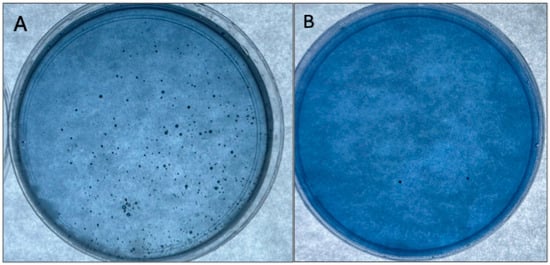
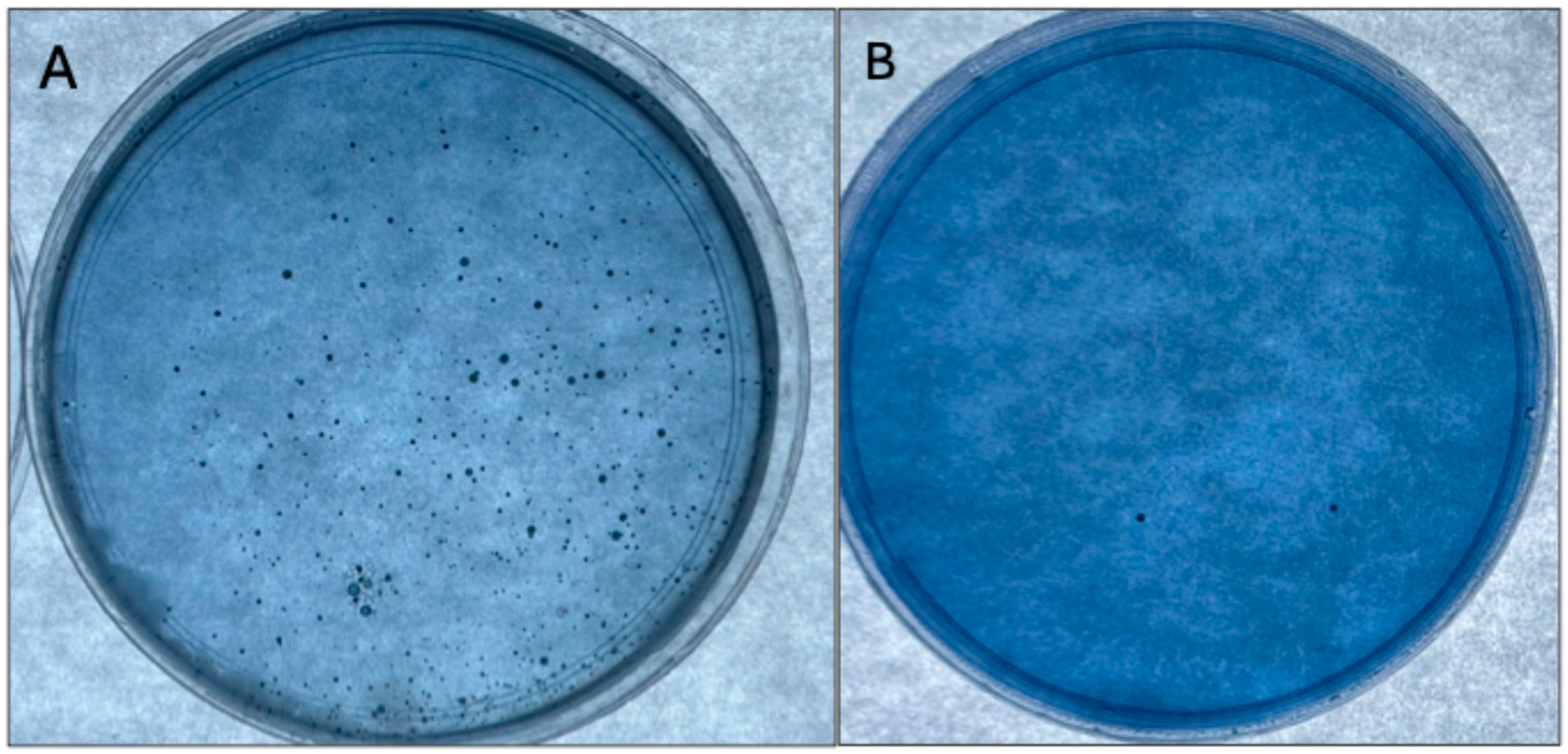
The Wilcoxon signed-rank test showed a statistically significant reduction in bacterial counts after ozonated water application compared with baseline (Z = −3.00, p = 0.003). Of the 23 samples analyzed, 17 (73.9%) showed a decrease in CFU counts, 2 (8.7%) showed an increase, and 4 (17.4%) showed no change. Figure 1 illustrates the difference in bacterial growth before and after the application of ozonated water.
Figure 1.
Representative bacterial cultures obtained from the study samples, all standardized to a 2:10 dilution before inoculation. (A) Bacterial culture before the application of ozonated water. (B) Bacterial culture after the application of ozonated water.
4. Discussion
As previously demonstrated, ozone has been widely used in dentistry, particularly for the control of cariogenic bacteria. Santos et al. evaluated the antimicrobial effectiveness of ozone gas (40 µg/mL) and ozonated water using extracted teeth. Ozonated water was applied at a concentration of 80 µg/mL for 80 s, and both treatments resulted in a reduction in bacterial counts. However, the authors also reported a decrease in adhesive bond strength following ozone application [10]. Furthermore, Adhami ZE et al. evaluated the effectiveness of ozone gel against Streptococcus mutans in dental plaque. The gel was applied twice daily for three weeks at a concentration of 20 ppm, resulting in a significant reduction in both S. mutans counts and dental plaque accumulation [11]. These findings are consistent with the results of the present study, in which the antimicrobial effect of ozonated water against cultivable oral streptococci—including Streptococcus mutans, one of the primary pathogens associated with dental demineralization—was demonstrated.
In a study by Nisar SS et al., the effects of various antimicrobial agents on the bond strength of composite restorations were evaluated. The authors reported that teeth treated with an Er laser (2940 nm, 18.9 J/cm2 for 150 s) or ozonated water (40 ppm for 30 s) exhibited higher bond strength than teeth treated with other disinfectants, including a potassium titanyl phosphate (KTP) laser, chlorhexidine, and a Rose Bengal photosensitizer [12]. These findings contrast with those reported by Santos et al. Although the present study did not evaluate the bond strength of restorative materials, it is important to consider that the conflicting findings reported in the literature may be largely attributed to the considerable heterogeneity in ozone concentrations and application protocols. As highlighted by Santos GM et al. in their systematic review, the ozone concentrations used across studies ranged from 525 to 2100 ppm, with application times varying from 30 to 120 s [13].
The development of novel strategies to enhance the adhesion of restorative materials is essential for the advancement of minimally invasive dentistry. However, understanding the effects of dental caries on the structure of both enamel and dentin is essential. In cavitated carious lesions, the outermost layer of dentin undergoes progressive degradation as bacterial invasion activates matrix metalloproteinases (MMPs), leading to the breakdown of type I collagen cross-links and the subsequent degeneration of the collagen matrix [14,15]. The interaction of ozone with dental tissues, particularly dentin, may occur through both direct and indirect mechanisms. Directly, ozone neutralizes acidic compounds produced by cariogenic bacteria through reactions with molecules containing double bonds, amine groups, or other reactive organic compounds. Indirectly, the reactive oxygen species generated during ozone decomposition contribute to the degradation of demineralized organic tissue. In the presence of remineralizing ions, this process may facilitate the occlusion of dentinal tubules and promote tissue remineralization [16,17]. Collectively, these findings support the potential use of ozone as an adjunctive strategy for bacterial control in the management of dental caries.
Another noteworthy finding of the present study was that most participants reported brushing their teeth twice daily, while a considerable proportion (43.4%) had already received at least one dental restoration. These findings suggest two important issues: suboptimal oral hygiene practices among the children and a high prevalence of previous caries experience.
These observations are consistent with previous reports in the Mexican pediatric population. In a study including 151 children, 84.1% presented with at least one carious lesion, and 43.7% exhibited at least one severe active caries lesion. Furthermore, the authors identified a significant association between parental educational level and children’s toothbrushing frequency, highlighting the importance of promoting oral health education from an early age [16]. Similarly, Liu et al. reported that inadequate oral hygiene practices among pediatric patients are closely associated with parents’ awareness and knowledge regarding oral health, reinforcing the critical role of caregivers in establishing healthy oral hygiene habits during childhood [17]. These findings emphasize that the prevention and management of dental caries in the pediatric population depend not only on advances in restorative and remineralizing materials but also on the oral health education provided by parents or caregivers. Although new materials and therapeutic approaches continue to emerge with the aim of improving treatment outcomes and enhancing tooth remineralization, their effectiveness may be substantially compromised in the absence of adequate oral hygiene practices and consistent parental involvement in daily oral care.
This study has several limitations. First, the pre-experimental design and the absence of a control group limit the ability to attribute the observed reduction in bacterial counts specifically to the use of ozonated water, as other procedural factors, such as mechanical action with the microbrush, may have contributed to the observed changes. In addition, no advanced bacterial identification methods, such as multiplex PCR or species-specific culture, were used, limiting the ability to identify the bacterial species present in the carious lesions. Finally, the absence of patient follow-up prevented the assessment of the long-term clinical progression of the carious lesions and whether the observed changes in bacterial counts were sustained over time.
5. Conclusions
The findings of the present study showed a reduction in bacterial counts after the application of ozonated water in cavitated carious lesions in children. However, given the study design and the absence of an independent control group, these findings cannot be attributed specifically to the ozonated water intervention. Further controlled studies are needed to determine the potential role of ozonated water in bacterial control. The absence of standardized treatment protocols, together with the considerable variability in ozone concentrations, application times, and delivery methods reported in the literature, limits the reproducibility and comparability of findings and hinders a definitive assessment of its clinical effectiveness. Further well-designed clinical trials with standardized protocols and long-term follow-up are needed to establish the efficacy and clinical applicability of ozonated water in minimally invasive caries management.
Author Contributions
Conceptualization, J.A.P.L.; writing—original draft, M.V.C.G.; methodology, J.C.C.G. and A.G.G.C.; validation, L.F.E.C. and K.L.T.C.; formal analysis, C.D.l.P.L.; investigation, R.P.E.; writing—review and editing, R.A.B.S. All authors have read and agreed to the published version of the manuscript.
Funding
This research received no external funding.
Institutional Review Board Statement
The study was conducted in accordance with the Declaration of Helsinki and approved by the Ethics Committee of the Institute of Biomedical Sciences of the Universidad Autónoma de Ciudad Juárez (approval code CEI023-1-75; approved on 17 May 2025).
Informed Consent Statement
Informed consent was obtained from all subjects involved in the study.
Data Availability Statement
The original contributions presented in this study are included in the article. Further inquiries can be directed to the corresponding author.
Conflicts of Interest
The authors declare no conflicts of interest.
Abbreviations
The following abbreviations are used in this manuscript:
| ICDAS | International Caries Detection and Assessment System |
| CFU | Colony Forming Unit |
| DMFT | Decayed, Missing, and Filled Teeth |
| SIVEPAB | Epidemiological Surveillance System of Oral Pathologies |
References
- Oliveira, L.B.; de Freitas Mattos, F.; Paiva, S.M.; Bönecker, M. Why do my patients still have early childhood caries? A critical appraisal. Braz. Oral Res. 2025, 39, e065. [Google Scholar] [CrossRef] [Scilit]
- Vera-Virrueta, C.G.; Sansores-Ambrosio, F.; Casanova-Rosado, J.F.; Minaya-Sánchez, M.I.; Casanova-Rosado, A.J.; Casanova-Sarmiento, J.A.; Guadarrama-Reyes, S.C.; de la Rosa-Santillana, R.; Medina-Solís, C.E.; Maupomé, G. Experience, prevalence, and severity of dental caries in Mexican preschool and school-aged children. Cureus 2023, 15, e51079. [Google Scholar] [CrossRef] [Scilit]
- Secretaría de Salud, Dirección General de Epidemiología. Resultados del Sistema de Vigilancia Epidemiológica de Patologías Bucales SIVEPAB 2023; Dirección General de Epidemiología: Mexico City, Mexico, 2025. [Google Scholar]
- Zou, J.; Du, Q.; Ge, L.; Wang, J.; Wang, X.; Li, Y.; Song, G.; Zhao, W.; Chen, X.; Jiang, B.; et al. Expert consensus on early childhood caries management. Int. J. Oral Sci. 2022, 14, 35. [Google Scholar] [CrossRef] [Scilit]
- Fang, Y.; Chen, X.; Chu, C.H.; Yu, O.Y.; He, J.; Li, M. Roles of Streptococcus mutans in human health: Beyond dental caries. Front. Microbiol. 2024, 15, 1503657. [Google Scholar] [CrossRef] [Scilit]
- El Meligy, O.A.; Elemam, N.M.; Talaat, I.M. Ozone therapy in medicine and dentistry: A review of the literature. Dent. J. 2023, 11, 187. [Google Scholar] [CrossRef] [Scilit]
- Rezaeianjam, M.; Khabazian, A.; Khabazian, T.; Ghorbani, F.; Abbasi, T.; Asghari, S.; Heidari, F.; Shiri, A.; Naderi, M. Efficacy of ozone therapy in dentistry with approach of healing, pain management, and therapeutic outcomes: A systematic review of clinical trials. BMC Oral Health 2025, 25, 433. [Google Scholar] [CrossRef] [Scilit]
- Veneri, F.; Filippini, T.; Consolo, U.; Vinceti, M.; Generali, L. Ozone therapy in dentistry: An overview of the biological mechanisms involved (Review). Biomed. Rep. 2024, 21, 115. [Google Scholar] [CrossRef] [Scilit]
- Tiwari, S.; Avinash, A.; Katiyar, S.; Iyer, A.A.; Jain, S. Dental applications of ozone therapy: A review of literature. Saudi J. Dent. Res. 2017, 8, 105–111. [Google Scholar] [CrossRef] [Scilit]
- Santos, M.; Leandro, F.; Barroso, H.; Delgado, A.H.S.; Proença, L.; Polido, M.; Cruz, J.V.E. Antibacterial effect of ozone on cariogenic bacteria and its potential prejudicial effect on dentin bond strength—An in vitro study. Pharmaceutics 2024, 16, 614. [Google Scholar] [CrossRef] [Scilit]
- Adhami, Z.E.; Erfanparast, L.; Molaei, Z.; Sadeghi, J.; Yazdanparas, A. Effect of 20-ppm ozone and 1% chlorhexidine gels on plaque index and Streptococcus mutans counts in the dental plaque in 6–12-year-old children: A randomized, double-blind clinical trial. J. Dent. Res. Dent. Clin. Dent. Prospects 2023, 17, 177–181. [Google Scholar] [CrossRef] [Scilit]
- Nisar, S.S.; Irfan, F.; Hammad, H.; Abdulla, A.M.; Kamran, M.A.; Barakat, A.; Niazi, F.; Baig, E.A.; Qureshi, A. Disinfection of caries-affected dentin using potassium titanyl phosphate laser, Rose Bengal and ozonated water on shear bond strength of deciduous teeth. Photodiagnosis Photodyn. Ther. 2022, 40, 103044. [Google Scholar] [CrossRef] [Scilit]
- Santos, G.M.; Pacheco, R.L.; Bussadori, S.K.; Santos, E.M.; Riera, R.; de Oliveira Cruz Latorraca, C.; Mota, P.; Bellotto, E.F.B.C.; Martimbianco, A.L.C. Effectiveness and safety of ozone therapy in dental caries treatment: Systematic review and meta-analysis. J. Evid. Based Dent. Pract. 2020, 20, 101472. [Google Scholar] [CrossRef] [Scilit]
- Pinna, R.; Maioli, M.; Eramo, S.; Mura, I.; Milia, E. Carious affected dentine: Its behaviour in adhesive bonding. Aust. Dent. J. 2015, 60, 276–293. [Google Scholar] [CrossRef] [Scilit]
- AlMogbel, A.A.; Albarrak, M.I.; AlNumair, S.F. Ozone therapy in the management and prevention of caries. Cureus 2023, 15, e37510. [Google Scholar] [CrossRef] [Scilit]
- Pérez-Reyes, Á.; Becerra-Ruiz, J.S.; Guzmán-Flores, J.M. Influence of behavioral and sociodemographic factors on dental caries in Mexican children. Pediatr. Rep. 2025, 17, 40. [Google Scholar] [CrossRef] [Scilit]
- Liu, X.; Wang, Z.; Tan, N.; Zhao, J. Impact of oral health education on the hygiene awareness of preschool children and their parents. Oral Health Prev. Dent. 2025, 23, 543–549. [Google Scholar] [CrossRef] [Scilit]

Disclaimer/Publisher’s Note: The statements, opinions and data contained in all publications are solely those of the individual author(s) and contributor(s) and not of MDPI and/or the editor(s). MDPI and/or the editor(s) disclaim responsibility for any injury to people or property resulting from any ideas, methods, instructions or products referred to in the content. |
© 2026 by the authors. Licensee MDPI, Basel, Switzerland. This article is an open access article distributed under the terms and conditions of the Creative Commons Attribution (CC BY) license.