


Abstract
Fragrance allergens are widely used in cosmetics and personal care products to make them more attractive to consumers. However, their presence has raised increasing concerns due to their potential to induce allergic contact dermatitis and other adverse health effects. As a result, regulatory authorities have progressively strengthened labelling requirements and restrictions for fragrance allergens in cosmetics, creating new analytical and compliance challenges for both industry and regulatory laboratories. In this context, the development of sensitive, selective, and reliable analytical methodologies has become essential for the identification and quantification of these compounds in complex cosmetic matrices. This review provides a comprehensive overview of analytical methodologies reported between 2015 and 2025 for the determination of fragrance allergens in cosmetic matrices, with a focus on sample preparation. Conventional extraction methodologies are critically discussed together with advanced, miniaturized and microextraction approaches. The advantages, limitations, and applicability for routine quality control and regulatory compliance are critically discussed. Chromatographic developments, including the use of multidimensional approaches, are assessed. Recent regulatory updates are examined, and the challenges related to allergen labelling, low-level detection, matrix complexity, standardization, and harmonization of analytical protocols are also addressed. Finally, future perspectives on innovative analytical tools, and green analytical chemistry approaches are highlighted.
1. Introduction
Over the past decade, the use of cosmetics and personal care products has increased worldwide, with the European market (EU-27, Norway, Switzerland and the United Kingdom) standing out as one of the most significant, reaching retail sales of approximately € 104 billion in 2024 [1].
The increasing use of these daily-use products has raised growing concerns regarding consumer safety, particularly in relation to allergenic substances present in fragrances. Fragrances can be of natural or synthetic origin and belong to different chemical classes, mainly aldehydes, ketones, alcohols, esters, and hydrocarbons [2]. In addition, the use of essential oils and additives of natural origin in cosmetic and dermocosmetic applications has increased continuously over the last decade, reflecting the growing demand for bioactive, natural, and sustainable ingredients in the industry. Botanical ingredients may contain bioactive compounds with both beneficial and toxic effects, requiring safety evaluation [3].
Fragrances are widely incorporated into cosmetics to enhance sensory properties by providing a pleasant scent, improving consumer acceptance, and masking any undesirable odours from other formulation ingredients. However, several of their chemicals have been identified as potential allergens capable of causing adverse health effects. Allergic contact dermatitis (ACD) is described as the primary immunologically mediated reaction associated with fragrance allergens. In addition, exposure to these compounds may aggravate eczema in susceptible individuals and respiratory symptoms such as asthma [4]. In Europe, Regulation (EC) No 1223/2009 [5] establishes a clear legal definition of cosmetic product and sets out the requirements that any product placed on the European market must follow to harmonize them among the Member States, aiming to ensure both the proper functioning of the internal market, as well as product and consumer safety. Within the framework of this regulation, the analytical developments are essential to ensure regulatory compliance through accurate results.
The analysis of allergenic fragrances in cosmetics and personal care products requires not only sensitive instrumental techniques but also efficient extraction and sample preparation strategies to isolate target analytes from highly complex matrices. Therefore, sample preparation represents a critical step in the development of reliable analytical methodologies.
Regarding the reported sample preparation strategies for fragrance allergen analysis, traditional liquid–liquid extraction (LLE) and direct dilution are still used for liquid samples and perfumes [6]. However, these approaches are not suitable for complex formulations, such as most of those currently marketed, and also require large volumes of organic solvents and extensive sample handling. In recent years, there has been growing interest in the development of more sustainable and efficient extraction strategies [7]. In this way, ultrasound-assisted extraction (UAE); matrix solid-phase dispersion (MSPD); pressurized liquid extraction (PLE); Quick, Easy, Cheap, Effective, Rugged, and Safe (QuEChERS); and solid-phase extraction (SPE) are suitable options, offering advantages such as reduced solvent consumption, shorter extraction times, and improved selectivity. The development of miniaturized and microextraction approaches, such as dispersive liquid–liquid microextraction (DLLME), ultrasound-assisted emulsification microextraction (USAEME) and solid-phase microextraction (SPME), using renewable sorbents and low-cost materials, has become particularly relevant in recent years [8].
The separation of fragrance allergens is mainly performed by gas chromatography (GC) due to the volatile, semi-volatile and thermally stable nature of these analytes. Comprehensive two-dimensional chromatography (GC × GC) has emerged as a powerful technique to enhance separation for structurally similar analytes in complex samples, although expensive instrumentation is required [9]. Identification and quantification are commonly carried out using mass spectrometry (MS) or tandem mass spectrometry (MS/MS), which provide higher analytical selectivity and sensitivity than other detectors, such as flame ionization (FID) and diode array (DAD) [10]. Therefore, the combination of GC and MS provides a highly efficient separation, reliable identification, and accurate quantification of target analytes, even at trace concentration levels in complex cosmetic formulations.
There are some standardized methods used to determine allergens in cosmetics, although they are limited to ready-to-inject samples. The most widely recognized is European Standard NF EN 16274, which relies on GC–MS for the identification and quantification of volatile fragrance allergens. The original 2012 version focused on the determination of 24 regulated fragrance allergens in ready-to-inject cosmetic samples and fragrance raw materials compatible with GC analysis [11]. However, the described methodology requires the use of two columns (non-polar/polar phases), implying highly time-consuming processes. The revised version of EN 16274:2021 expanded the target list from 24 to 57 suspected fragrance allergens [12,13], reflecting the growing regulatory and analytical concerns regarding these sensitizing compounds in cosmetic products, although it does not introduce substantial changes in sample preparation or instrumental methodology, leaving many of the analytical challenges associated with complex cosmetic matrices unresolved.
Most review articles concerning fragrance allergens in cosmetics mainly focus on market surveys, consumer exposure, prevalence studies or regulatory aspects [14,15]. These studies are generally devoted to assessing the occurrence of allergenic compounds in commercial formulations, as well as their compliance with labelling requirements established by the current regulation. In contrast, comparatively less attention has been paid to providing a comprehensive overview of advances in sample preparation, chromatographic separation, sensitivity improvement, and adaptation to the continuous amendments of Regulation (EC) No 1223/2009 [5,16]. Most reviews from the past decade on extraction techniques in cosmetics do not focus exclusively on allergenic fragrances, instead also including other families of compounds such as musks, preservatives, UV filters, phthalates, colourants, heavy metals, etc. [6,8,17,18,19]. Furthermore, all of them were published before the implementation of Regulation (EC) No 1223/2009 amendments [16] and therefore do not fully address the current analytical challenges associated with the expanded list of regulated fragrance allergens.
To fill these gaps, this review aims to provide a comprehensive and up-to-date overview specifically devoted to the analytical determination of fragrance allergens in cosmetics and personal care products (final products), covering the entire analytical workflow from sample preparation to instrumental detection. It systematically compares the performance, advantages, and limitations of the analytical methodologies developed during the last decade (2015–2025), identifying the key factors governing sensitivity, selectivity, robustness, and applicability to increasingly complex cosmetic matrices. Unlike previous reviews, it evaluates recent analytical developments, discussing their capability to address the expanded list of regulated fragrance allergens and the associated compliance requirements. Particular emphasis is given to green, miniaturized and high-throughput approaches to meet current regulatory and analytical requirements for the determination of fragrance allergens.
2. Regulation
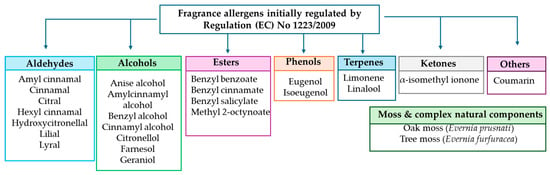
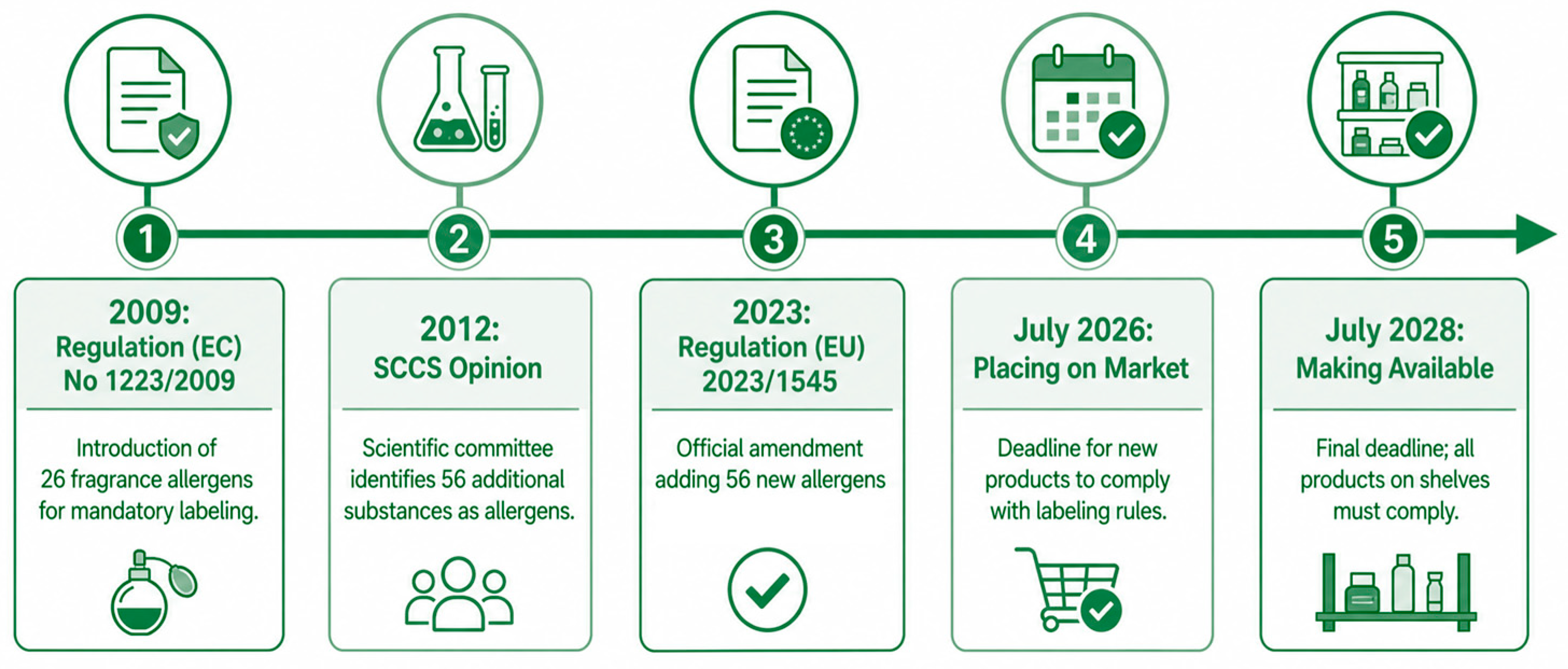
It is estimated that more than 3000 chemical substances are used in fragrances. Among them, in 1999, the Scientific Committee on Cosmetic Products and Non-Food Products intended for Consumers (SCCNFP) identified 26 substances as established contact allergens in humans. They are shown in Figure 1.
Figure 1.
Twenty-six fragrance allergens initially included in Regulation (EC) No 1223/2009.
The regulation of fragrance allergens in Europe has evolved significantly over the past two decades in response to increasing scientific evidence linking certain fragrance substances to ACD. Under early Regulation (EC) No 1223/2009, these 26 substances had to be individually declared in the list of ingredients when their concentration exceeded 0.001% (10 ppm) in leave-on products and 0.01% (100 ppm) in rinse-off products [5]. The objective was to allow consumers to identify and avoid products containing substances capable of triggering allergic contact dermatitis. Below these thresholds, the allergens could remain included under the generic term “parfum” or “aroma” without individual declaration. It is worth mentioning that two of these compounds, lyral and lilial, were later included in Annex II of the EC Regulation 1223/2009—list of substances prohibited in cosmetic products—through different amendments: Regulation (EU) 2017/1410 and Regulation (EU) 2021/1902, respectively [20,21].
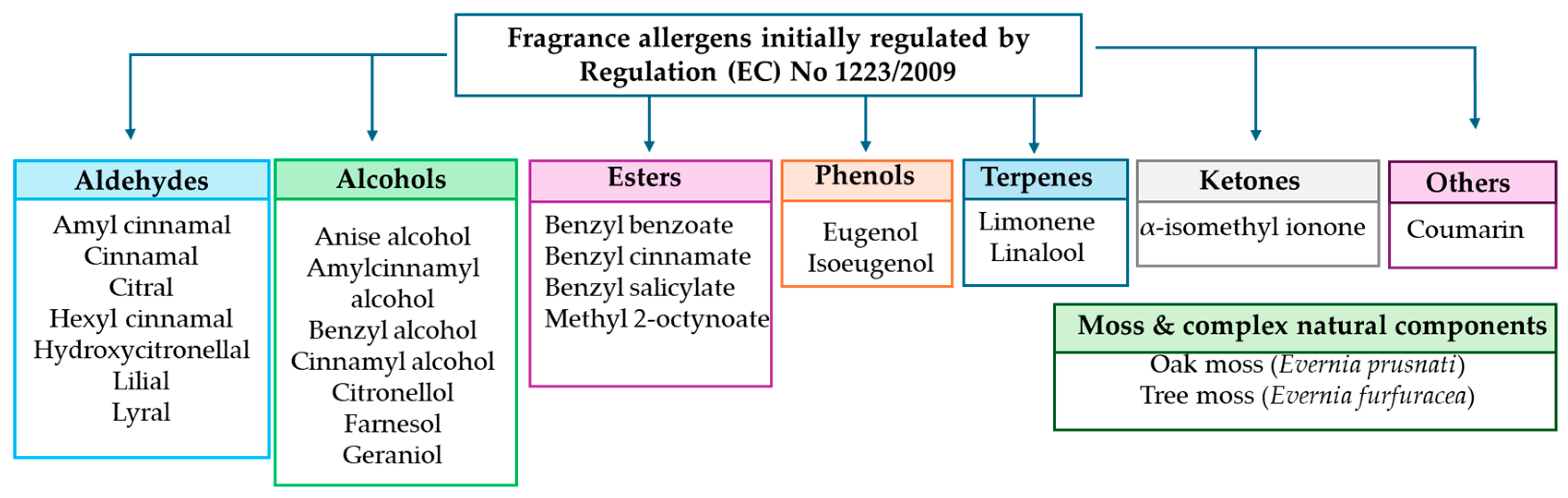
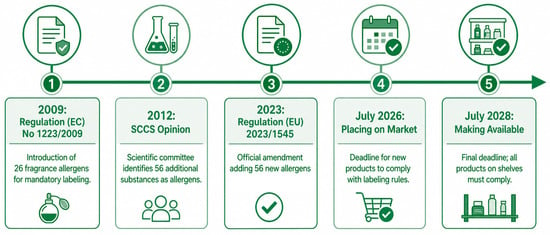
Further advances in toxicological and dermatological research, together with opinions issued by the Scientific Committee on Consumer Safety (SCCS), demonstrated that many additional fragrance compounds could also act as relevant sensitizers. As a result, the EU adopted Regulation (EU) 2023/1545, which considerably expanded the list of regulated fragrance allergens from the original 26 substances to 82 compounds (54 single chemicals and 28 natural extracts) requiring individual labelling when concentrations exceeded 0.001% (10 ppm) and 0.01% (100 ppm) in leave-on and rinse-off products, respectively [16]. This update reflects a more precautionary and consumer-oriented approach, strengthening transparency in cosmetic ingredient disclosure and improving protection for individuals affected by fragrance allergies. Regulation (EU) 2023/1545 established transitional periods to allow cosmetic manufacturers and the market sufficient time to adapt to the new fragrance allergen labelling requirements. Although the regulation entered into force on 16 August 2023, companies may continue placing non-compliant cosmetic products on the European market until 31 July 2026, and products already placed on the market before that date may continue to be available until 31 July 2028 [16]. These transitional periods are depicted in Figure 2.
Figure 2.
Timeline of EU regulations on fragrance allergens in cosmetics from 2009 to the present.
The expanded list of fragrance allergens requiring labelling declaration represents a major analytical challenge for regulatory, research, and industrial laboratories. The increased number of target analytes, together with their diverse chemical structures and physicochemical properties, demands more comprehensive analytical methodologies capable of providing accurate identification and quantification across a wider concentration range.
The EU currently represents the strictest and analytically demanding regulatory framework for fragrance allergens worldwide, often serving as a reference for safety assessments and regulatory developments in other regions. In contrast, the United States Food and Drug Administration (US-FDA) does not require the labelling of individual fragrance allergens, allowing most fragrance ingredients to be collectively listed as “fragrance”. Similarly, although China has strengthened cosmetic safety requirements under the Cosmetic Supervision and Administration Regulation (CSAR), it does not currently require the specific labelling of fragrance allergens comparable to that of the EU. These regulatory differences create challenges for manufacturers operating in global markets and underscore the need for greater international harmonization of fragrance allergen regulations and analytical methodologies.
3. Search Strategy
A systematic literature search was performed in scientific databases, including Scopus and Google Scholar, to identify studies related to the determination of fragrance allergens in cosmetic products. The search strategy included combinations of keywords such as “fragrances”, “cosmetics”, “volatile compounds”, “aroma compounds”, “analytical methods”, “extraction”, and “sample preparation” using Boolean operators (and, or) to optimize the sensitivity and specificity of the search. Peer-reviewed original research articles and review papers published in English between 2015 and 2025 were considered. Studies were selected based on their relevance to analytical approaches for the identification, quantification, or characterization of fragrance compounds in cosmetic matrices. Studies were excluded if they (i) focused exclusively on toxicological, dermatological, exposure, consumer perception, or regulatory aspects without addressing analytical methodologies; (ii) analysed fragrance allergens in matrices other than cosmetic products; (iii) lacked sufficient methodological detail regarding sample preparation, extraction, separation, or detection procedures; (iv) were conference abstracts, patents, technical reports, or other non-peer-reviewed publications.
4. Analytical Strategies to Determine Fragrance Allergens in Cosmetics
As was noted, cosmetics and personal care products are very complex matrices due to their heterogeneous composition and the wide variety of ingredients used in formulations and formats (liquid, viscous, cream, oil, emulsion, etc.). In addition, fragrance allergens may co-elute with structurally similar compounds and isomers or other matrix components, making their analysis a challenge.
Direct injection (ready-to-inject) and traditional sample preparation techniques such as solid– and liquid–liquid extraction (SLE and LLE) are still employed for the determination of fragrance allergens in simple or liquid formulations such as perfumes. However, they require significant solvent consumption and involve several steps. Moreover, they do not offer effective clean-up or selective analytes isolation, making them inadequate for complex matrices where a high number of compounds at different concentrations coexist.
On the other hand, advanced sample extraction techniques are moving towards faster sample processing, easier automation, higher throughput and a reduction in solvent volumes. These improvements are largely driven by the growing demand for more efficient, sustainable, and easy-to-implement analytical methodologies in routine laboratories. In this way, solid-phase extraction (SPE), pressurized liquid extraction (PLE) and matrix solid-phase dispersion (MSPD) are widely recognized as environmentally friendly alternatives due to their ability to minimize solvent use while maintaining or even improving extraction efficiency and selectivity. In parallel, considerable efforts have been made in the development of miniaturized and microextraction approaches, allowing for a reduction in sample sizes and solvent volume to align analytical practices with GAC [22] and GSP [23] principles.
4.1. Classical Methodologies: Ready-to-Inject and Liquid–Liquid Extraction (LLE)
The classical approaches—based on ready-to-inject, sample dilution and LLE, reported from 2015 to 2025—used to extract fragrance allergens from cosmetics and personal care products are summarized in Table 1 and commented on below.
Table 1.
Classical analytical methodologies to determine fragrance allergens in cosmetics.
A ready-to-inject-GC × GC–FID-MS strategy was used to determine 56 fragrance allergens and 69 analytes, including isomers, in perfumes [24]. The first-dimension separation was carried out on a VF1-MS capillary column and the second one on an LTM DB17-MS. The use of this two-dimensional approach allowed for reliable performance around the regulatory limit of 10 µg g−1, with acceptable results obtained for 88–100% of the target fragrance allergens, although matrix effects and coelutions limited the identification of certain analytes. The total analysis time was quite high (approximately 2 h), as it included two analytical runs (51 min each) and up to 10 min for data processing. The use of a flow-modulation (FM) comprehensive GC × GC-qMS methodology was developed for the determination of 54 fragrance allergens in perfumes [25]. In this case, SLB-5 ms and SLB-35 columns were employed in the first and second dimensions, respectively. LODs were lower than 0.30 µg mL−1. This FM configuration was proposed as a low-cost and effective alternative to cryogenic modulation.
An analytical approach based on EN 16274:2021 using two independent methods for the determination of cosmetic allergens was followed to determine 24 fragrance allergens in different liquid samples, including perfumes, eau de toilette, cologne and natural sprays [26]. Matrix co-elution was observed, leading to up to 30-fold overestimation of some analyte results. This demonstrates that a column/method evaluation using only solvent standards is not sufficient, as they do not reflect the chemical complexity of real perfume samples. The author also highlights that the most critical aspect of the measurements applying this methodology undoubtedly lies in the data evaluation (i.e., ion ratio check and comparing results).
Typically, between 1:10 and 1:4000 (v,v) sample dilutions in organic solvents were applied before the analysis to reduce matrix effects and avoid detector saturation. The choice of solvents strongly depends on both the physicochemical properties of the target analytes and the analytical detection technique employed. For instance, 100-fold dilution with acetone followed by GC combined with multiphoton ionization (MPI)-MS was proposed to determine 26 fragrance allergens in perfumes [27]. A femtosecond laser was used as an ionization source, and the effects of different wavelengths (200 and 267 nm) and pulse energies (16 and 130 μJ) on ionization efficiency were investigated using spectral data obtained by quantum chemical calculations. The lowest LODs (<0.1 µg mL−1) were achieved at 267 nm and 130 μJ using the third-harmonic emission of a Ti:sapphire laser for all 26 allergenic compounds.
GC-MS is the preferred technique to determine fragrance allergens in cosmetics due to their volatile, semi-volatile and thermally stable nature. However, alternative separation platforms, such as capillary electrophoresis, can offer complementary capabilities, particularly for complex natural-product-derived ingredients [32]. Although HPLC-UV exhibits lower sensitivity and selectivity than MS-based techniques, it is still used, as several of these compounds contain chromophore groups, such as aromatic and conjugated systems, exhibiting adequate UV absorbance. In this case, 107 perfumes were analysed to detect 25 fragrance allergens. Samples were diluted in acetonitrile, and HPLC-UV analysis was carried out [28]. The methodology showed quantitative recoveries (97–104%) but high LODs, up to 11 µg mL−1. In addition, an exposure-based quantitative risk assessment (QRA) was performed to determine safe levels of fragrance ingredients in a high number of commercial perfumes. The results revealed that the health risk was considerable for lilial, lyral, citral, isoeugenol and methyl-2-octynoate. It is important to note that lyral and lilial were recently included in Annex II of EC Regulation 1223/2009—a list of substances prohibited in cosmetic products—through different amendments: Regulation (EU) 2017/1410 and Regulation (EU) 2021/1902, respectively [20,21].
The determination of fragrance allergens in aqueous-based products (perfumes) was proposed. Samples were diluted in ethanol/water, and GC-MS analysis was performed [29]. In this case, two water-compatible ionic liquid (IL) GC stationary phases, based on phosphonium and imidazolium derivative cations combined with CF3SO3− (Watercol™), were developed. Narrow-bore columns of different lengths were optimized to minimize the amount of water reaching the MS detector. The results demonstrated that both columns are suitable, and the chromatographic performance remained stable after approximately 700 direct injections. Although this innovation offers several advantages for routine quality control, such as reducing analysis time, a key limitation is the lower sensitivity compared to other preconcentration techniques. Consequently, the LODs (up to 2.3 µg mL−1) may hinder the determination of target analytes at trace concentrations, although the method remains useful as a preliminary screening tool to identify samples requiring more sensitive analytical procedures.
The use of LLE-GC-MS was proposed to determine 27 restricted and banned fragrance allergens in leave-on and rinse-off cosmetics, including lotions, creams, perfumes, deodorants, shampoos, and shower gels [30]. Methyl-tertbutyl ether was used as extraction solvent. Although several samples can be simultaneously processed, the fact that the procedure involves several steps, including the application of ultrasound energy (30 min) and centrifugation (30 min), makes the whole sample preparation procedure time-consuming. Good recoveries (80–122%) were obtained, and very high limits of quantification (LOQs), up to 20 mg g−1, were achieved.
A simple liquid extraction using hexane combined with headspace (HS)-GC–MS analysis was developed for the determination of 24 fragrance allergens in complex hydrophilic and lipophilic cosmetic matrices [31]. The HS vial incubation temperature, one of the most critical experimental parameters, was optimized. Different incubation temperatures between 80 and 145 °C were tested, and finally, 135 °C was selected as necessary to transfer the fragrances with a high boiling point from the HS vial onto the column. The method validation was limited to a range of 8–15 µg g−1 to obtain a high degree of certainty at the labelling limit of 10 µg g−1. The results showed trueness deviations below 8% and expectation tolerance limits within the accepted ± 20% range at the labelling threshold.
4.2. Advanced Sample Preparation Techniques
The methodologies reported in the last decade—based on advanced extraction techniques, including UAE, MSPD, PLE, QuEChERS, and SPE—used to determine fragrance allergens in cosmetics are summarized in Table 2 and commented on below.
Table 2.
Advanced methodologies to determine fragrance allergens in cosmetics.
4.2.1. Ultrasound-Assisted Extraction (UAE)
UAE is based on the application of high-frequency sound waves to the sample and an extraction solvent. The propagation of ultrasound generates cavitation phenomena, which imply the formation, growth, and collapse of microscopic bubbles. This process enhances solvent penetration into the sample matrix. As a result, the mass transfer of target analytes from the sample matrix to the solvent is significantly improved, leading to faster, more efficient, and more environmentally friendly technology compared to conventional techniques [41].
A methodology based on UAE-GC-MS was developed to determine 28 fragrance allergens in a broad range of cosmetic products, including shampoos, creams, lotions, lipsticks and solid deodorants, among others [33]. Methanol was used as a solvent, and the extraction temperature was the most critical parameter. While extraction at room temperature yielded good results for most matrices, for lipstick products a higher extraction temperature (45 °C) was required. Matrix effects were assessed, and the results revealed that by using this easy-to-apply methodology, the matrix effect of cinnamic alcohol was substantially reduced from 162.5% [30] to 7%. Good recoveries (90–98%) and low relative standard deviation (RSD) values (5%) and LODs (0.04–0.10 µg g−1) were achieved.
UAE-GC-MS was successfully proposed for the multianalyte determination of 26 fragrance allergens, plasticizers and preservatives, making a total of 70 compounds in baby wipes, masks, and extreme cosmetics and borderline products [34]. In addition, for temporary tattoos, a UAE-modified version, Sup-UAE, was proposed. In this approach, a small piece (3 × 2.4 cm2) of filter paper sheet was “tattooed” with the sample; it was introduced in a vial, 5 mL of ethyl acetate was added, and UAE was carried out (10 min, 25 °C). This UAE modification was also employed to analyse products containing applicators and to assess a possible transfer of chemicals, mainly plasticizers, from the plastic applicators to the cosmetics matrices and, thereby, to consumers. Sup-UAE performance was compared with classical UAE and other validated methodologies, such as µ-MSPD, obtaining similar results in terms of recovery and precision, demonstrating its suitability and giving additional information about plasticizers’ migration from cosmetic applicators.
4.2.2. Matrix Solid-Phase Dispersion (MSPD)
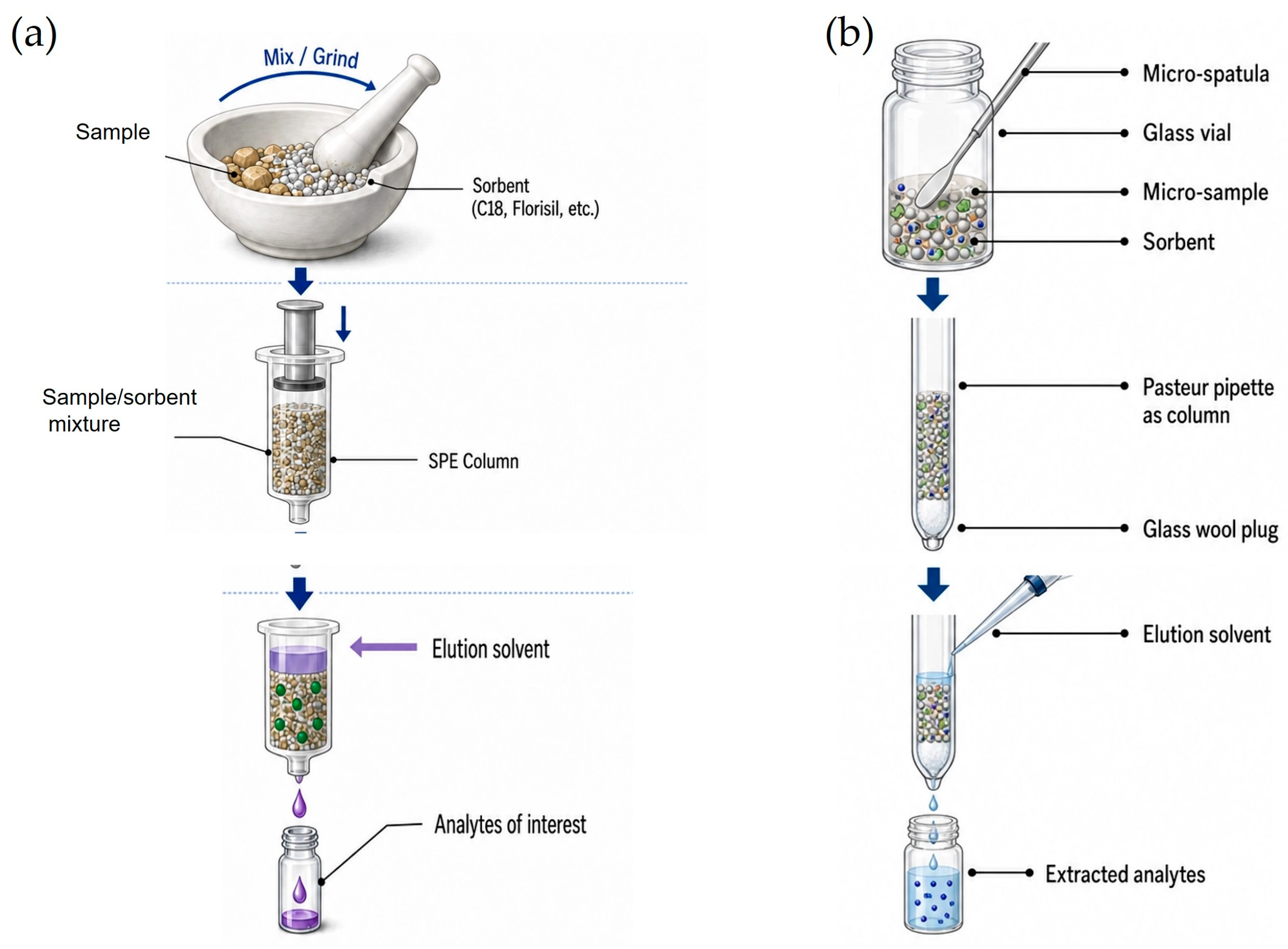
MSPD was introduced by Barker et al. [42] in 2000 as a simple sample preparation for complex matrices. It fundamentally relies on blending the sample (solid or semi-solid) with a solid sorbent material through dispersion. This mechanical grinding effectively disrupts the matrix. The target analytes are later selectively eluted with the appropriate solvent. MSPD combines sample homogenization, extraction, and clean-up into a single step, simplifying sample preparation and obtaining ready-to-inject extracts. It has been applied to the analysis of different cosmetic ingredients, including dyes, preservatives, musks, glycols, etc. [8]. MSPD is also a versatile and easy-to-miniaturize technology, making it an efficient and environmentally friendly alternative to conventional extraction methods.
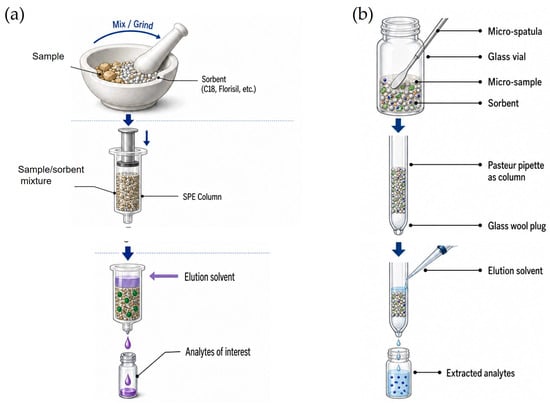
A miniaturized version of classical MSPD, µ-MSPD, was proposed to determine 25 fragrance allergens together with other cosmetics ingredients, including UV filters, preservatives, plasticizers and synthetic musks, making a total of 78 compounds [35]. MSPD and µ-MSPD procedures are represented in Figure 3. The influence of the main experimental parameters affecting extraction, dispersant, solvent type and volume was evaluated by design of experiments (DoE) to obtain the highest extraction efficiency. Under the optimal conditions—which implied the use of 0.1 g of the sample, Florisil, as a dispersing agent, and only 1 mL of acetonitrile as the elution solvent—the µ-MSPD-GC-MS methodology was successfully validated in terms of linearity, accuracy and precision and applied to a broad range of commercially available cosmetic samples. This miniaturized approach demonstrated its suitability as a low-cost reusable tool; daily-use materials are employed, and fast extraction is performed in a few minutes to simultaneously determine 78 compounds with very different physicochemical properties in a single extraction and chromatographic run.
Figure 3.
Experimental procedures of (a) MSPD and (b) µ-MSPD.
µ-MSPD was also applied to extract lyral (from 2021, the commercialization and sale of products containing this fragrance allergen are banned [20]), together with impurities and other forbidden compounds (polycyclic aromatic hydrocarbons (PAHs), pesticides, plasticizers, nitrosamines, alkylphenols and alkylphenol ethoxylates (APEOs)) from leave-on and rinse-off cosmetics [36]. In this case, GC-MS and LC-MS/MS were selected as determination techniques, depending on the analytes. For lyral, the µ-MSPD-GC-MS methodology provided quantitative recovery (97%) and low LOD (0.020 µg g−1), demonstrating that the combination of this miniaturization with GC-MS appears to be a very suitable tool for cosmetic control; it is easy to implement in control laboratories, and manufacturers can determine trace levels of banned analytes in final products to ensure quality and legal compliance.
4.2.3. Pressurized Liquid Extraction (PLE)
PLE was developed in the mid-1990s by Ritcher et al. [43] with the aim of reducing extraction time and solvent consumption compared with conventional SLE and LLE. It is based on the use of solvents at high temperature and pressure, but below their critical point, to extract the target analytes. Under these conditions, the solubility and mass transfer rates of the compounds are significantly enhanced, leading to higher extraction efficiencies, shorter processing times, and improved reproducibility. However, its main drawback is the high cost associated with the commercial instrumentation required to maintain the pressure and temperature conditions, as well as the energy consumption. PLE application to fragrance allergens in cosmetics remains relatively limited. In the last decade, only one work has been reported, and only in a specific cosmetic matrix, namely, baby wipes [37]. In this work, up to 65 cosmetics ingredients, including 26 fragrance allergens, preservatives, plasticizers and synthetic musks, were simultaneously determined in wipes and wet toilet paper intended for babies and children. The solvent, extraction temperature and time were optimized through advanced statistical tools, using real samples. The optimal conditions involved PLE at 110 °C for 5 min using methanol as the extraction solvent. Method quality parameters for the whole PLE-GC-MS methodology showed recoveries between 80 and 112%, even for the most volatile fragrance allergens, pinene and limonene. LODs lower than 0.02 µg g−1 were obtained for all the fragrance allergens, excluding farnesol (0.36 µg g−1).
4.2.4. Quick, Easy, Cheap, Effective, Rugged, and Safe (QuEChERS)
QuEChERS was initially developed for the extraction of pesticide residues from fruits and vegetables [44], although its application has been widely extended to other complex matrices. It is based on an SLE using an organic solvent (mainly acetonitrile), followed by a salting-out partitioning step that promotes the separation between the aqueous and organic phases. Typically, salts such as magnesium sulphate and sodium chloride are added to improve analyte transfer into the organic phase while reducing the presence of water. Then, a clean-up step using dispersive solid-phase extraction (d-SPE) is commonly carried out to remove interferences. Due to its simplicity, low solvent consumption, reduced sample handling, and high extraction efficiency, QuEChERS has become one of the most widely used sample preparation methods in analytical chemistry. QuEChERS was applied to determine fragrances in different leave-on and rinse-off cosmetics [38,39]. The sample preparation step was then optimized, with acetonitrile [38] and methanol [39] as the selected extraction solvents. Satisfactory recoveries (71–120%) and RSD values (<15%) were achieved. However, LODs differed significantly between the two methodologies, with values ranging from 0.1 to 1.2 µg g−1 [38] and 0.002 to 0.02 µg g−1 [39]. The lowest were achieved using PSA as a cleaning sorbent and GC-MS/MS analysis, which probably reduced matrix interference through higher selectivity.
4.2.5. Solid-Phase Extraction (SPE)
SPE is an advanced sample preparation technique that relies on the selective interaction between analytes and a solid sorbent to achieve efficient extraction, preconcentration and purification, providing enhanced sensitivity and reducing matrix effects [45]. Recent trends in SPE focus on the development of environmentally sustainable methodologies through the miniaturization and design of novel sorbent materials [46]. These innovations aim to reduce solvent volume, sample amounts, and time consumption without decreasing method performance. In this way, the use of molecular imprinted polymers (MIPs) was proposed in two SPE approaches—pipette-tip SPE and magnetic molecularly imprinted SPE (MISPE)—to determine coumarins in cosmetics [40]. In both cases, analyses were performed by HPLC-DAD-FL.
Pipette-tip SPE was used for low-viscosity samples such as deodorants, using 5 times less adsorbent and 3–4 times less solvent compared to conventional SPE (100 mg). Fe3O4/MISPE was employed for higher-viscosity samples such as shampoo. Several parameters affecting extraction, including adsorbent amount, washing solvent, elution solvent volume, and extraction time for magnetic extraction, were optimized. Satisfactory method performance with recoveries between 70 and 102% and RSD values lower than 6% was obtained. LODs at low µg mL−1 were achieved, showing that both sample preparation methods are suitable and can be mutually complementary, although Fe3O4/MISPE requires a high extraction time (90 min). Greenness was assessed in both cases through the Analytical Eco-Scale—to evaluate the environmental impact of an analytical method by assigning penalty points to different aspects of the procedure [47]—and the Green Analytical Procedure Index (GAPI)—to assess the environmental impact of fifteen analytical parameters grouped into five categories [48]. Eco-Scale scores of 78 and 77 were obtained for the pipette-tip-SPE–HPLC-DAD-FL and Fe3O4/MISPE–HPLC-DAD-FL methods, respectively, classifying both procedures as exhibiting excellent greenness (scores higher than 75). GAPI results showed that the pipette-tip-based methodology has a slightly better environmental profile, primarily because it required lower solvent volumes during the extraction step.
4.3. Microextraction Sample Preparation Techniques
The methodologies reported in the last decade—based on microextraction techniques, including DLLME, USAEME, SPME, GDME and SBSDME—used to determine fragrance allergens in cosmetics are summarized in Table 3 and commented on below.
Table 3.
Microextraction-based methodologies to determine fragrance allergens in cosmetics.
4.3.1. Dispersive Liquid–Liquid Microextraction (DLLME)
DLLME is a miniaturized sample preparation technique based on the rapid dispersion of an extraction solvent into an aqueous sample using a disperser solvent. This dispersion forms a fine emulsion that greatly increases the contact surface area between phases, promoting efficient transfer of analytes into the extraction solvent. After extraction, the enriched phase is typically separated by centrifugation and analysed using chromatographic or spectrometric techniques. DLLME is characterized by high extraction efficiency, rapid operation, low cost, and minimal solvent consumption, making it consistent with green chemistry principles [58]. It is widely used for the determination of trace organic compounds and contaminants in environmental, biological, and food samples.
DLLME was employed in combination with a new class of hydrophobic eutectic solvents (HES) to determine five fragrance allergens in water-based fragrances [49]. HES consist of phenolic compounds or natural terpenoids that can be used as hydrogen-bond donors (HBD) and acceptors (HBA). The most critical point was the HES composition, as HBA and HBD should not be present in the sample to avoid interferences. In this case, a natural HES formed by thymol–eugenol was prepared. The optimized DLLME-GC-FID methodology required only 50 µL of HES, which was easily dispersed in 2 mL of the sample. After optimizing the experimental parameters, the results showed good extraction performance with more than 3-fold enrichment and low LODs (0.2 µg mL−1) compared to direct injection (1 µg mL−1). The greenness of the proposed methodology was evaluated using the AGREEprep metric [59], yielding an overall score of 0.75 out of 1, which indicates a highly environmentally friendly sample preparation approach. Among the evaluated criteria, the degree of automation received the lowest score, representing the main factor limiting the overall sustainability assessment.
4.3.2. Ultrasound-Assisted Emulsification Microextraction (USAEME)
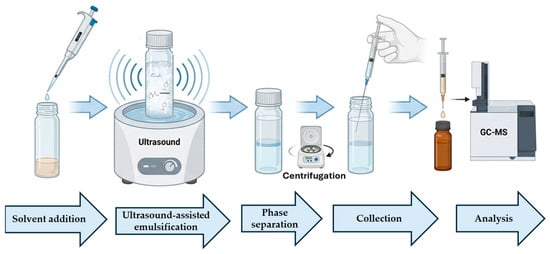
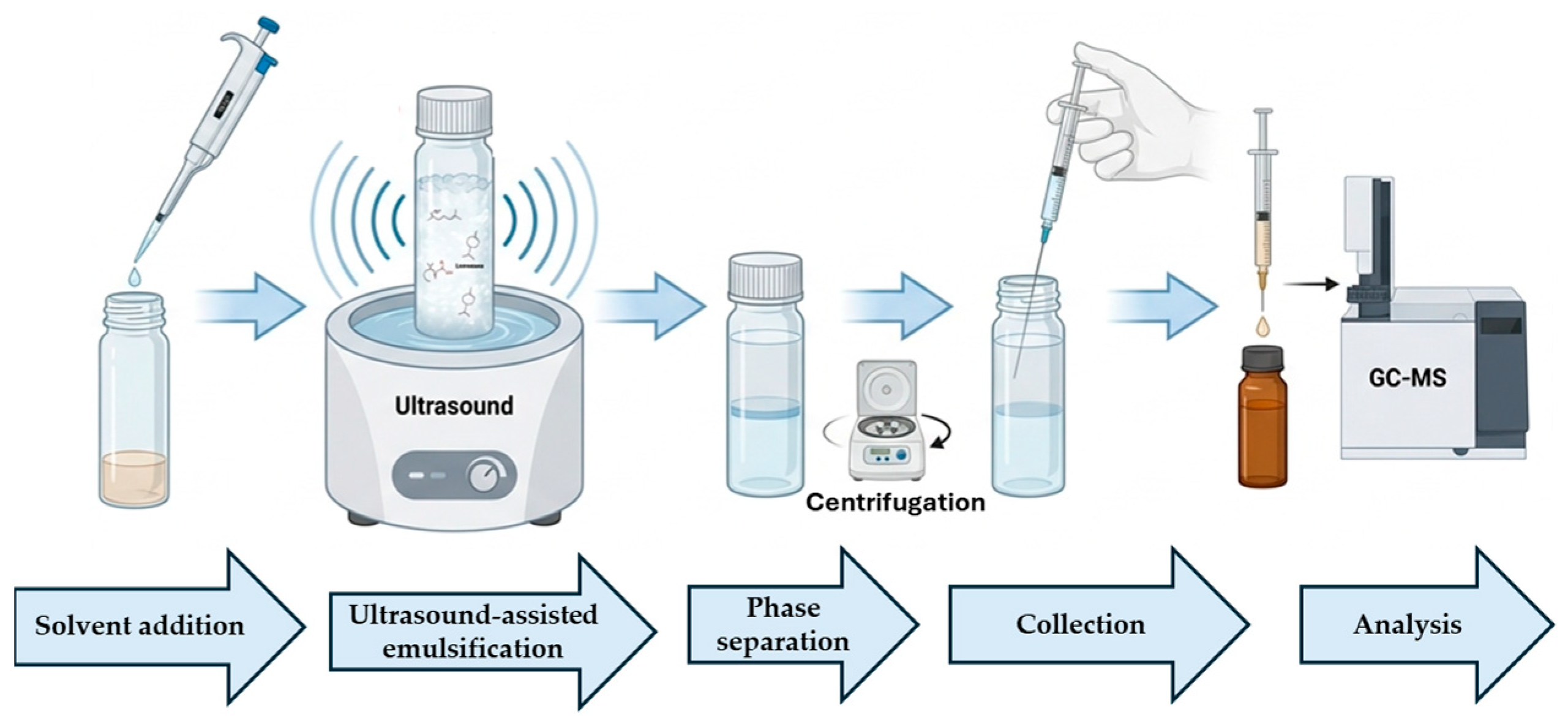
USAEME is a miniaturized LLE microextraction technique that emerged to solve the need to add a disperser solvent required in DLLME [60]. This problem was solved by using ultrasound energy to generate the emulsion, accelerating the formation of a fine emulsion between the aqueous sample and a water-immiscible extraction solvent. This allows for a mass transfer enhancement of target analytes into the organic phase and enables efficient, fast, and low-solvent extraction suitable for trace analysis. A schematic representation of the USAEME workflow is depicted in Figure 4.
Figure 4.
USAEME procedure.
USAEME followed by solidification of floating organic drop (SFOD) and HPLC-DAD was developed for the simultaneous determination of 18 fragrance allergens in cosmetics [50]. Several parameters affecting the microextraction process were investigated in detail. Optimized conditions involved the use of only 50 μL of 2-dodecanol as an extraction solvent. Good performance in terms of recovery (90–137%), precision (RSD values lower than 14%) and LODs (below 15 µg mL−1) were obtained. However, the main drawback of this methodology was the limited capability to quantify only 18 out of the 24 fragrance allergens, that is, those corresponding to well-defined chromatographic peaks. Quantification can be relatively easily achieved by univariate regression when non-overlapping and well-resolved peaks are obtained, but due to the complexity of cosmetics matrices, it is quite common to have overlapped peaks. To solve this, PARAllel FACtor Analysis (PARAFAC), a decomposition method where data arrays are decomposed as a sum of triple products of vectors, was applied for the extension of the proposed USAEME-SFOD-HPLC-DAD methodology to those fragrance allergens—hydroxycitronellal, coumarin, lyral, eugenol, citronellol and farnesol—that could not be adequately determined previously [51]. Validation of the PARAFAC model was carried out with standards and real spiked samples. In both cases, satisfactory results have been obtained, allowing for the analysis of all the target fragrance allergens despite co-elution and matrix interfering compounds.
4.3.3. Solid-Phase Microextraction (SPME)
SPME is a versatile, green and solvent-free sample preparation technique widely used due to its simplicity, sensitivity, and ability to integrate sampling, extraction, and preconcentration into a single step. SPME is a particularly valuable tool for the analysis of volatile and semi-volatile compounds, such as fragrance allergens, as it minimizes sample handling and, therefore, analyte loss [61]. Fibre coating is one of the most critical parameters affecting SPME. Commercially available coatings are usually used to extract fragrance allergens from cosmetics and personal care products due to their proven robustness [53,54], although in recent years the development of new sorbents is gaining interest.
Methodologies based on SPME-GC-FID and SPME-GC-MS/MS were developed to determine 24 fragrance allergens in rinse-off and leave-on cosmetics [54] and up to 60 cosmetic ingredients, including 23 fragrance allergens, preservatives, musks and plasticizers in hydroalcoholic gels [53], respectively. The most critical parameters affecting SPME (fibre coating, extraction mode and temperature) were optimized to obtain the highest extraction efficiency. The optimal conditions involved, in both cases, performing extraction in headspace (HS) mode for 20 min, although the best fibre coatings and temperatures were different: the commercially available divinylbenzene/carboxen/polydimethylsiloxane (DVB/CAR/PDMS) at 100 °C [53] and the use of polydimethylsiloxane/divinylbenzene (PDMS/DVB) at 40 °C [54]. LODs were between 7 and 90 times lower using the GC-MS/MS determination compared to GC-FID. The SPME-GC-MS/MS-validated and green (AGREEprep score of 0.8) methodology [53] was applied to a survey of more than 65 hand sanitizers [52], demonstrating that most of them were not correctly labelled according to Regulation (EC) No 1223/2009, and none of them followed the World Health Organization (WHO) recommendation for hand sanitizer formulation. In the context of the COVID-19 pandemic, a protocol was published to homogenize hydroalcoholic gel formulation and fabrication, ensuring their antimicrobial properties. This protocol strongly recommends that no ingredients other than ethanol/isopropyl alcohol, hydrogen peroxide and glycerol be added, especially to fragrances, because of the risk of allergic reactions.
The development of novel sorbent materials for SPME has significantly expanded its applicability, sensitivity, and selectivity. Recent advances focus on the design of highly porous, chemically stable, and tunable materials to enhance extraction efficiency. Although these new materials have been applied to a wide range of cosmetic-related compounds, such as UV filters, parabens, antioxidants, antimicrobials, etc. [62], their application to fragrance allergens is still limited.
Several home-made aminopropyltriethoxysilane (APTES), β-cyclodextrin (β-CD), graphene oxide (GO) and β-CD/GO-coated SPME fibres were prepared and tested to extract six fragrance allergens from cosmetics [55]. APTES-coated fibre showed the lowest extraction capacity, whereas the β-CD/GO showed the highest chromatographic (GC-FID) responses. This coating combines the advantages of β-CD, with an interior hydrophobic cavity and a hydrophilic exterior area, and GO, which presents a large surface area. Under optimal extraction conditions—30% NaCl addition, 70 °C and 40 min of extraction in HS mode—satisfactory recovery (70–94%) and precision, with RSD values below 10%, were achieved. Very low LODs (0.05–0.150 µg L−1) were obtained, up to several orders of magnitude lower than those obtained by using classical DVB/CAR/PDMS and PDMS/DVB fibres [53,54].
4.3.4. Gas-Diffusion Microextraction (GDME)
GDME was proposed for the first time in 2010 [63]. It is fundamentally based on the elution of analytes from the sample through a microporous gas-permeable membrane (diffusion) into a small volume of an acceptor solution, being a suitable option for volatile and semi-volatile analytes. The combination of membrane-assisted gas diffusion and microextraction offers a simple, fast, and low-cost extraction. GDME in combination with GC-MS/MS was recently developed and validated to determine 15 fragrance allergens in liquid and solid cosmetic formulations [56]. The key factors affecting GDME were optimized through DoE, resulting in 300 μL of ethyl acetate/acetonitrile 50/50 (v/v) as an acceptor solution and 15 min at 50 °C as the extraction time and temperature, respectively. Recovery studies were performed on both simulated and real cosmetic samples, achieving quantitative recoveries for all target fragrance allergens. Greenness assessment using the AGREEprep metric resulted in a score of 0.61, indicating a favourable environmental profile. Furthermore, the practical applicability of the methodology was evaluated through the Blue Applicability Grade Index (BAGI) [64], which assigned a score of 80 out of 100, highlighting the method’s strong potential for routine implementation. LODs (0.0001–0.07 µg mL−1) were similar to those obtained by SPME-GC-MS/MS [53].
4.3.5. Stir Bar Sorptive Dispersive Microextraction (SBSDME)
SBSDME combines the principles of stir bar sorptive extraction (SBSE) and dispersive solid-phase extraction (DSPE). It was introduced in 2014 by Benedé et al. [65], and it is based on the use of a magnetic stir bar coated with a sorbent material supporting the device (as in SBSE), while at higher speeds, it disperses throughout the sample, increasing contact with the target analytes (as in DSPE). When stirring stops, the material is recollected onto the magnetic bar, allowing the analytes to be extracted. This method was initially applied to the determination of organic compounds in environmental aqueous matrices and later extended to biological fluids. It was applied to determine three fragrance allergens, including the banned lilial and lyral, in cosmetics [57]. A hydrophilic–lipophilic balanced magnetic composite formed by CoFe2O4 magnetic nanoparticles (MNPs) entrapped in a divinylbenzene-co-vinylpyrrolidone copolymer (CoFe2O4@p(DVB-co-NVP)) was synthesized, characterised, and used as a sorbent. The critical parameters affecting extraction (sorbent amount, extraction and desorption times, and ionic strength) were optimized, and the analytical performance in terms of LODs was comparable with other methodologies, such as PLE-GC-MS [37]. The greenness of the method was evaluated using the AGREEprep metric, yielding a score of 0.63, which was slightly lower than the value reported for the determination of 26 fragrance allergens using SPME–GC–MS/MS (0.80) [52].
5. Future Trends and Perspectives
The expanded fragrance allergen list represents a major analytical challenge, demanding more comprehensive analytical methodologies capable of providing accurate identification and quantification. As a result, there is growing interest in multianalyte approaches, as cosmetic formulations contain a high number of chemicals at very different concentration levels. Furthermore, regulatory expansion is expected to stimulate the development of greener and more efficient analytical workflows. In this context, sample preparation strategies will continue evolving into miniaturized, automated, and low-solvent approaches aligned with the GAC and GSP Principles. The use of solvent-free or low-solvent consumption microextraction and miniaturized techniques, such as SPME, DLLME, USAEME, GDME, SBDSME, or µ-MSPD, together with the development of novel and reusable nano-sorbents and green solvents, is expected to gain further relevance. The integration of these greener extraction technologies with automated and high-throughput analytical platforms is likely to play a key role, supporting both regulatory compliance and the growing demand for environmentally responsible laboratory practices. Fully automated workflows combining extraction, clean-up, and injection steps could significantly improve reproducibility, minimizing potential contamination or analyte losses.
Regarding instrumental analysis, MS will remain the dominant detection technique due to its high selectivity and sensitivity. However, future developments are expected to extend the use of high-resolution mass spectrometry (HRMS), enabling accurate mass measurements and non-targeted approaches. These capabilities are especially relevant, considering the continuous expansion of allergen regulation lists, in identifying emerging sensitizers before their inclusion in regulatory frameworks. Multidimensional chromatographic techniques, such as GC × GC coupled to MS, are also expected to become more important for the separation of coeluting compounds, which remain a major challenge in fragrance allergen analysis. The application of chemometric tools, machine learning algorithms, and artificial intelligence for data treatment could facilitate the interpretation of large analytical datasets generated by multidimensional chromatography while also improving method optimization. However, their broader implementation in routine laboratories can be complex due to their high instrumental and maintenance costs, data complexity, and the lack of standardized protocols for inter-laboratory validation.
The limited availability of certified reference materials (CRMs) also remains an important challenge. Most analytical methods are validated using fragrance standard solutions or fortified samples rather than certified materials, which may not fully account for matrix effects and analyte–matrix interactions. The development of matrix-matched certified reference materials for representative cosmetic products would greatly facilitate method validation, results comparison, and regulatory compliance.
An important aspect involves the fact that during the development of analytical methodologies, it is necessary not only to assess performance parameters but also to take sustainability criteria into account. In recent years, several metrics based on the GAC and GSP principles have been developed to quantify greenness. However, the lack of harmonization between them can also be an obstacle when evaluating complex methodologies, such as those employed for the analysis of fragrance allergens in cosmetics.
From a regulatory perspective, future analytical methods for fragrance allergens in cosmetics will need to achieve lower LODs and harmonized validation protocols to comply with changing international regulations. The standardization of analytical procedures and the development of certified reference materials will play a crucial role in ensuring comparability and reliability between laboratories. Therefore, the long-term success of emerging analytical methodologies will depend not only on incremental improvements in analytical performance but also on their ability to deliver reliable results and throughput compatible with routine, quality control and industrial practice.
6. Conclusions
The selection of an appropriate methodology for the determination of fragrance allergens in cosmetics depends on the physicochemical properties of the target analytes and the complexity of the cosmetic matrix. Although microextraction techniques such as SPME, SBSE, and DLLME have gained considerable attention due to their high sensitivity, selectivity, and reduced solvent consumption, conventional approaches continue to dominate routine regulatory and industrial workflows. Their widespread use is mainly attributed to their established validation status, compatibility with existing instrumentation, and suitability for high-throughput analysis. Despite the promising performance reported in this review for innovative approaches, such as the use of novel nano-sorbents or green solvents, their applicability is often supported by studies involving only spiked samples and a limited number of cosmetic matrices, while interlaboratory validation remains scarce.
From an instrumental perspective, GC–MS and especially GC–MS/MS remain the most suitable techniques for fragrance allergen determination, providing an excellent balance between sensitivity, selectivity, cost-effectiveness, and regulatory acceptance. In contrast, GC × GC–MS and HRMS approaches offer high-resolution power, although their implementation in routine laboratories is currently limited by higher costs and methodological complexity. Consequently, these techniques are nowadays more relevant for research, method development, and confirmatory analysis than for large-scale routine monitoring.
Sustainability has become an increasingly important consideration in analytical method development, although comparing the greenness of different methodologies remains challenging due to the diversity of available assessment tools and evaluation criteria. In view of the discussion above, the expansion of the list of regulated fragrance allergens and the growing demand for greener analytical practices are expected to drive the development of more automated, miniaturized, and environmentally friendly workflows. Nevertheless, the most suitable methodology is not necessarily the most sophisticated one; currently, GC–MS/MS coupled with an appropriate extraction procedure—depending on the target analytes or matrices—offers the most practical compromise between analytical performance, sustainability, economic viability, and industrial scalability for fragrance allergen analysis in cosmetic products.
Funding
This research received no external funding.
Institutional Review Board Statement
Not applicable.
Informed Consent Statement
Not applicable.
Data Availability Statement
The original contributions presented in this study are included in the article. Further inquiries can be directed to the corresponding author.
Acknowledgments
This study is based upon work from the Sample Preparation Study Group and Network, supported by the Division of Analytical Chemistry of the European Chemical Society.
Conflicts of Interest
The author declares no conflicts of interest.
References
- Cosmetics Europe. Our Industry. 2024. Available online: https://cosmeticseurope.eu/our-industry/ (accessed on 19 April 2026).
- Rubio, L.; Pita, A.; Garcia-Jares, C.; Lores, M. Natural extracts and essential oils as ingredients in cosmetics: Search for potential phytomarkers and allergen survey. Cosmetics 2024, 11, 84. [Google Scholar] [CrossRef] [Scilit]
- Luo, P.; Feng, X.; Liu, S.; Jiang, Y. Traditional uses, phytochemistry, pharmacology and toxicology of Ruta graveolens L.: A critical review and future perspectives. Drug Des. Devel. Ther. 2024, 18, 6459–6485. [Google Scholar] [CrossRef] [Scilit] [PubMed]
- Sukakul, T.; Svedman, C. What is New in Contact Allergy To Cosmetics for Physicians, Cosmetologists, and Cosmetic Users? Curr. Aller. Asthma Rep. 2025, 25, 48. [Google Scholar] [CrossRef] [Scilit]
- European Commission. Regulation (EC) No 1223/2009 of the European Parliament and of the Council of 30 November 2009 on cosmetic products. Off. J. 2009, 342, 59. [Google Scholar]
- Abedi, G.; Talebpour, Z.; Jamechenarboo, F. The survey of analytical methods for sample preparation and analysis of fragrances in cosmetics and personal care products. TrAC Trends Anal. Chem. 2018, 102, 41–59. [Google Scholar] [CrossRef] [Scilit]
- Psillakis, E. Towards sustainable analytical chemistry. TrAC Trends Anal. Chem. 2025, 191, 118371. [Google Scholar] [CrossRef] [Scilit]
- Celeiro, M.; Garcia-Jares, C.; Llompart, M.; Lores, M. Recent advances in sample preparation for cosmetics and personal care products analysis. Molecules 2021, 26, 4900. [Google Scholar] [CrossRef] [Scilit] [PubMed]
- Tranchida, P.Q.; Franchina, F.A.; Mondello, L. Analysis of essential oils through comprehensive two-dimensional gas chromatography: General utility. Flav. Fragr. J. 2017, 32, 218–227. [Google Scholar] [CrossRef] [Scilit]
- Serb, A.F.; Georgescu, M.; Onulov, R.; Novaconi, C.R.; Sisu, E.; Bolocan, A.; Sandu, R.E. Mass-spectrometry-based research of cosmetic ingredients. Molecules 2024, 29, 1336. [Google Scholar] [CrossRef] [Scilit] [PubMed]
- NF EN 16274:2012; Methods for Analysis of Allergens—Quantification of Suspected Fragrance Allergens in Consumer Products—Step 1: GC Analysis of Ready-to-Inject Sample. AFNOR: Paris, France, 2012.
- EN 16274:2021; Method for Analysis of Allergens—Quantification of an Extended List of 57 Suspected Allergens in Ready to Inject Fragrance Materials by a Gas Chromatography Mass Spectrometry. Committee for Standardization (CEN): Brussels, Belgium, 2021.
- Pérès, C.; Corbi, E.; David, N.; Masson, J.; Cicchetti, E.; Kupfermann, N.; Kuropka, G.; Tacnet, N.; Roach, N.; Delacote, A.M.; et al. Collaborative validation of the quantification method for 57 allergens in ready to inject fragrance samples. Flav. Fragr. J. 2023, 38, 464–475. [Google Scholar] [CrossRef] [Scilit]
- Kalinowska-Lis, U. Overview of active ingredients used in deodorants and antiperspirants available on EU market. Appl. Sci. 2025, 15, 5068. [Google Scholar] [CrossRef] [Scilit]
- Rana, P.; Pathania, D.; Gaur, P.; Patel, S.K.; Bajpai, M.; Singh, N.T.; Pandey, R.; Shukla, S.V.; Pant, A.B.; Ray, R.S.; et al. Regulatory frameworks for fragrance safety in cosmetics: A global overview. Toxicol. Res. 2025, 41, 199–220. [Google Scholar] [CrossRef] [Scilit] [PubMed]
- European Commission. Regulation (EU) 2023/1545 of 26 July 2023 amends Regulation (EC) No 1223/2009 of the European Parliament and of the Council as regards the labelling of fragrance allergens in cosmetic products. Off. J. 2023, 188, 1. [Google Scholar]
- Zhong, Z.; Li, G. Current trends in sample preparation for cosmetic analysis. J. Sep. Sci. 2017, 40, 152–169. [Google Scholar] [PubMed]
- Papadopoulos, A.; Assimomytis, N.; Varvaresou, A. Sample preparation of cosmetic products for the determination of heavy metals. Cosmetics 2022, 9, 21. [Google Scholar] [CrossRef] [Scilit]
- Lores, M.; Llompart, M.; Alvarez-Rivera, G.; Guerra, E.; Vila, M.; Celeiro, M.; Lamas, J.P.; Garcia-Jares, C. Positive lists of cosmetic ingredients: Analytical methodology for regulatory and safety controls–a review. Anal. Chim. Acta 2016, 915, 1–26. [Google Scholar] [CrossRef] [Scilit] [PubMed]
- European Commission. Regulation (EU) 2017/1410 of 2 August 2017 amending Annexes II and III to Regulation (EC) No 1223/2009 of the European Parliament and of the Council on cosmetic products. Off. J. 2017, 3, 1. [Google Scholar] [CrossRef] [Scilit]
- European Commission. Commission Regulation (EU) 2021/1902 of 29 October 2021 amends Annexes II, III, and V to Regulation (EC) No 1223/2009 regarding the use of specific carcinogenic, mutagenic, or toxic for reproduction (CMR) substances in cosmetic. Off. J. 2021, 387, 120. [Google Scholar]
- Armenta, S.; Garrigues, S.; de la Guardia, M. Green analytical chemistry. TrAC Trends Anal. Chem. 2008, 27, 497–511. [Google Scholar] [CrossRef] [Scilit]
- Lopez-Lorente, A.I.; Pena-Pereira, F.; Pedersen-Bjergaard, S.; Zuin, V.G.; Ozkan, S.A.; Psillakis, E. The ten principles of greensample preparation. TrAC Trends Anal. Chem. 2022, 148, 116530. [Google Scholar] [CrossRef] [Scilit]
- Rey, A.; Corbi, E.; Pérès, C.; David, N. Determination of suspected fragrance allergens extended list by two-dimensional gas chromatography–mass spectrometry in ready-to-inject samples. J. Chromatogr. A 2015, 1404, 95–103. [Google Scholar] [CrossRef] [Scilit] [PubMed]
- Tranchida, P.Q.; Maimone, M.; Franchina, F.A.; Bjerk, T.R.; Zini, C.A.; Purcaro, G.; Mondello, L. Four-stage (low-) flow modulation comprehensive gas chromatography-quadrupole mass spectrometry for the determination of recently-highlighted cosmetic allergens. J. Chromatogr. A 2016, 1439, 144–151. [Google Scholar] [CrossRef] [Scilit] [PubMed]
- Ševčík, V.; Andraščíková, M.; Vavrouš, A.; Moulisova, A.; Vrbik, K.; Bendova, H.; Jirova, D.; Kejlova, K.; Hložek, T. Market surveillance: Analysis of perfuming products for presence of allergens and prohibited substances. Chem. Pap. 2022, 76, 4989–5000. [Google Scholar] [CrossRef] [Scilit]
- Shibuta, S.; Imasaka, T. Determination of fragrance allergens by ultraviolet femtosecond laser ionization mass spectrometry. Anal. Chem. 2016, 88, 10693–10700. [Google Scholar] [CrossRef] [Scilit] [PubMed]
- Soo Lim, D.; Min Choi, S.; Kim, K.B.; Yoon, K.; Kacew, S.; Sik Kim, H.; Lee, B.M. Determination of fragrance allergens and theirdermal sensitization quantitative risk assessment (QRA) in 107 spray perfumes. J. Toxicol. Environ. Health 2018, 81, 1173–1185. [Google Scholar] [CrossRef] [Scilit]
- Mazzucotelli, M.; Minteguiaga, M.A.; Sgorbini, B.; Sidisky, L.; Marengo, A.; Rubiolo, P.; Bicchi, C.; Cagliero, C. Ionic liquids as water-compatible GC stationary phases for the analysis of fragrances and essential oils. Anal. Bioanal. Chem. 2018, 410, 4668. [Google Scholar] [CrossRef] [Scilit]
- Lu, C.H.; Fang, M.C.; Chen, Y.Z.; Huang, S.C.; Wang, D.Y. Quantitative analysis of fragrance allergens in various matrixes of cosmetics by liquid-liquid extraction and GC-MS. J. Food Drug Anal. 2021, 29, 700. [Google Scholar] [CrossRef] [Scilit] [PubMed]
- Desmedt, B.; Canfyn, M.; Pype, M.; Baudewyns, S.; Hanot, V.; Courselle, P.; De Beer, J.O.; Rogiers, V.; De Paepe, K.; Deconinck, E. HS-GC-MS method for the analysis of fragrance allergens in complex cosmetic matrices. Talanta 2025, 131, 444–451. [Google Scholar]
- Xu, M.; Zhang, H.; Tang, T.; Zhou, J.; Zhou, W.; Tan, S.; He, B. Potential and applications of capillary electrophoresis for analyzing traditional Chinese medicine: A critical review. Analyst 2021, 146, 4724–4736. [Google Scholar] [CrossRef] [Scilit] [PubMed]
- Al-Mussallam, A.S.; Bawazir, A.T.; Alshathri, R.S.; Alharthi, O.; Aldawsari, F.S. Optimization of a gas chromatography-mass spectrometry (GC-MS) method for detecting 28 allergens in various personal care product. Cosmetics 2023, 10, 91. [Google Scholar] [CrossRef] [Scilit]
- Lores, M.; Celeiro, M.; Rubio, L.; Llompart, M.; Garcia-Jares, C. Extreme cosmetics and borderline products: An analytical-basedsurvey of European regulation compliance. Anal. Bioanal. Chem. 2018, 410, 7085. [Google Scholar] [CrossRef] [Scilit] [PubMed]
- Celeiro, M.; Vazquez, L.; Lamas, J.P.; Vila, M.; Garcia-Jares, C.; Llompart, M. Miniaturized matrix solid-phase dispersion for the analysis of ultraviolet filters and other cosmetic ingredients in personal care products. Separations 2019, 6, 30. [Google Scholar] [CrossRef] [Scilit]
- Celeiro, M.; Rubio, L.; Garcia-Jares, C.; Lores, M. Multi-target strategy to uncover unexpected compounds in rinse-off and leave- on cosmetics. Molecules 2021, 26, 2504. [Google Scholar] [CrossRef] [Scilit] [PubMed]
- Celeiro, M.; Lamas, J.P.; Garcia-Jares, C.; Llompart, M. Pressurized liquid extraction-gas chromatography-mass spectrometry analysis of fragrance allergens, musks, phthalates and preservatives in baby wipes. J. Chromatogr. A 2015, 1384, 9–21. [Google Scholar] [CrossRef] [Scilit] [PubMed]
- Fardin-Kia, A.R.; Zhou, W. Development and validation of a gas chromatography-mass spectrometry method for determination of 30 fragrance substances in cosmetic products. Sep. Sci. Plus 2020, 3, 496–510. [Google Scholar] [CrossRef] [Scilit]
- Dunming, X.; Yifeng, W.; Yifan, W.; Fangfang, C.; Guoyin, L.D. Simultaneous determination of 28 fragrance components incosmetics by gas chromatography-tandem mass spectrometry. Chin. J. Chromatogr. 2023, 41, 76. [Google Scholar] [CrossRef] [Scilit]
- Špačková, A.; Hroboňová, K.; Jablonský, M. The Application of Pipette-Tip and Magnetic Dummy-Template Molecularly Im-printed Solid-Phase Extraction Coupled with High-Performance Liquid Chromatography with Diode Array and Spectrofluorimetric Detection. Processes 2024, 12, 582. [Google Scholar]
- Tiwari, B.K. Ultrasound: A clean, green extraction technology. TrAC Trends Anal. Chem. 2015, 71, 100–109. [Google Scholar] [CrossRef] [Scilit]
- Barker, S.A. Matrix solid-phase dispersion. J. Chromatogr. A 2000, 885, 115–127. [Google Scholar] [CrossRef] [Scilit] [PubMed]
- Richter, B.E.; Jones, B.A.; Ezzell, J.L.; Porter, N.L.; Avdalovic, N.; Pohl, C. Accelerated solvent extraction: A technique for sample preparation. Anal. Chem. 1996, 68, 1033–1039. [Google Scholar] [CrossRef] [Scilit]
- Anastassiades, M.; Lehotay, S.J.; Štajnbaher, D.; Schenck, F.J. Fast and easy multiresidue method employing acetonitrile extraction/partitioning and “dispersive solid-phase extraction” for the determination of pesticide residues in produce. J. AOAC Int. 2003, 86, 412–431. [Google Scholar] [CrossRef] [Scilit] [PubMed]
- Poole, C.F. Principles and practice of solid-phase extraction. In Comprehensive Analytical Chemistry; Elsevier: Amsterdam, The Netherlands, 2002; Volume 37, pp. 341–387. [Google Scholar]
- Llompart, M.; Celeiro, M.; Álvarez-Rivera, G. Sorptive extraction for personal care products in the environment. TrAC Trends Anal. Chem. 2026, 201, 118886. [Google Scholar] [CrossRef] [Scilit]
- Galuszka, A.; Migaszewski, Z.M.; Konieczka, P.; Namiesnik, J. Analytical Eco-Scale for assessing the greenness of analytical procedures. TrAC Trends Anal. Chem. 2012, 37, 61–72. [Google Scholar] [CrossRef] [Scilit]
- Plotka-Wasylka, J. A new tool for the evaluation of the analytical procedure: Green Analytical Procedure Index. Talanta 2018, 181, 204–209. [Google Scholar] [CrossRef] [Scilit] [PubMed]
- Bechis, G.; Mastellone, G.; Marengo, A.; Sgorbini, B.; Cagliero, C.; Rubiolo, P. Hydrophobic natural eutectic solvents for the gas chromatographic determination of suspected allergens in fragrances by dispersive liquid-liquid microextraction. Separations 2022, 9, 318. [Google Scholar] [CrossRef] [Scilit]
- Pérez-Outeiral, J.; Millán, E.; Garcia-Arrona, R. Ultrasound-assisted emulsification microextraction coupled with high-perfor-mance liquid chromatography for the simultaneous determination of fragrance allergens in cosmetics and water. J. Sep. Sci. 2015, 38, 1561–1569. [Google Scholar] [CrossRef] [Scilit] [PubMed]
- Pérez-Outeiral, J.; Elcoroaristizabal, S.; Amigo, J.M.; Vidal, M. Development and validation of a method for the determination of regulated fragrance allergens by High-Performance Liquid Chromatography and parallel factor analysis 2. J. Chromatogr. A 2017, 1526, 82–92. [Google Scholar] [CrossRef] [Scilit] [PubMed]
- Castiñeira-Landeira, A.; Vazquez, L.; Dagnac, T.; Celeiro, M.; Llompart, M. Allergens and other harmful substances in hydroal-coholic gels: Compliance with current regulation. Meth. Protoc. 2023, 6, 95. [Google Scholar] [CrossRef] [Scilit]
- Vazquez, L.; Celeiro, M.; Castineira-Landeira, A.; Dagnac, T.; Llompart, M. Development of a solid phase microextraction gas chromatography tandem mass spectrometry methodology for the analysis of sixty personal care products in hydroalcoholic gels- hand sanitizers- in the context of COVID-19 pandemic. Anal. Chim. Acta 2022, 1203, 339650. [Google Scholar] [CrossRef] [Scilit] [PubMed]
- Divišová, R.; Vitova, E.; Diviš, P.; Zemanová, J.; Omelková, J. Validation of SPME-GC-FID method for determination of fragrance allergens in selected cosmetic products. Acta Chromatogr. 2015, 27, 509–523. [Google Scholar] [CrossRef] [Scilit]
- Hou, X.; Wang, L.; Tang, X.; Xiong, C.; Guo, Y.; Liu, X. Application of a β-cyclodextrin/graphene oxide-modified fiber for solid-phase microextraction of six fragrance allergens in personal products. Analyst 2015, 140, 6727–6735. [Google Scholar] [CrossRef] [Scilit] [PubMed]
- Castiñeira-Landeira, A.; Gomez-Feas, A.; Carro, A.M.; Dagnac, T.; Almeida, P.J.; Llompart, M. Novel gas-diffusion microex-traction followed by gas chromatography coupled to tandem mass spectrometry methodology for the determination of fragrance allergens in cosmetic products. Adv. Sample Prep. 2025, 14, 100187. [Google Scholar] [CrossRef] [Scilit]
- Vallez-Gomis, V.; Carchano-Olcina, S.; Benede, J.L.; Chisvert, A.; Salvador, A. Entrapment of magnetic nanoparticles into poly(divinylbenzene-co-N-vinylpyrrolidone) copolymer for the determination of prohibited and restricted fragrance ingredients in cosmetic products. Microchem. J. 2022, 183, 108044. [Google Scholar] [CrossRef] [Scilit]
- Zgoła-Grześkowiak, A.; Grześkowiak, T. Dispersive liquid-liquid microextraction. TrAC Trends Anal. Chem. 2011, 30, 1382–1399. [Google Scholar] [CrossRef] [Scilit]
- Wojnowski, W.; Tobiszewski, M.; Pena-Pereira, F.; Psillakis, E. AGREEprep—Analytical greenness metric for sample preparation. TrAC Trends Anal. Chem. 2022, 149, 116553. [Google Scholar] [CrossRef] [Scilit]
- Regueiro, J.; Llompart, M.; Garcia-Jares, C.; Garcia-Monteagudo, J.C.; Cela, R. Ultrasound-assisted emulsification-microextrac-tion of emergent contaminants and pesticides in environmental waters. J. Chromatogr. A 2008, 1190, 27–38. [Google Scholar] [CrossRef] [Scilit] [PubMed]
- Llompart, M.; Celeiro, M.; Alvarez-Rivera, G.; Lamas, J.P. Chapter 22: Different Approaches Based on Solid-phase Microextraction for the Determination of Personal Care Products. In Evolution of Solid-Phase Microextraction Technology; Pawliszyn, J., Ed.; The Royal Society of Chemistry: London, UK, 2023; pp. 584–601. [Google Scholar]
- Grau, J.; Benedé, J.L.; Chisvert, A. Use of nanomaterial-based (micro) extraction techniques for the determination of cosmetic-related compounds. Molecules 2020, 25, 2586. [Google Scholar] [CrossRef] [Scilit] [PubMed]
- Pacheco, J.G.; Valente, I.M.; Gonçalves, L.M.; Rodrigues, J.A.; Barros, A.A. Gas-diffusion microextraction. J. Sep. Sci. 2010, 33, 3207–3212. [Google Scholar] [CrossRef] [Scilit] [PubMed]
- Manousi, N.; Wojnowski, W.; Plotka-Wasylka, J.; Samanidou, V. Blue applicability grade index (BAGI) and software: A new tool for the evaluation of method practicality. Green Chem. 2023, 25, 7598–7604. [Google Scholar] [CrossRef] [Scilit]
- Benedé, J.L.; Chisvert, A.; Giokas, D.L.; Salvador, A. Development of stir bar sorptive-dispersive microextraction mediated by magnetic nanoparticles and its analytical application to the determination of hydrophobic organic compounds in aqueous media. J. Chromatogr. A 2014, 1362, 25–33. [Google Scholar] [CrossRef] [Scilit] [PubMed]

Disclaimer/Publisher’s Note: The statements, opinions and data contained in all publications are solely those of the individual author(s) and contributor(s) and not of MDPI and/or the editor(s). MDPI and/or the editor(s) disclaim responsibility for any injury to people or property resulting from any ideas, methods, instructions or products referred to in the content. |
© 2026 by the author. Licensee MDPI, Basel, Switzerland. This article is an open access article distributed under the terms and conditions of the Creative Commons Attribution (CC BY) license.