Challenges in the Digital Marketing Realm of Human-like Virtual Influencers: What Drives Instagram Users’ Engagement Intentions?


Abstract
1. Introduction
2. Theoretical Background and Literature Review
2.1. Human-like Virtual Influencers and the Instagram Platform
2.2. Human-like Virtual Influencers and Users’ Engagement Intentions
2.3. Uncanny Valley Theory
2.4. Uses and Gratifications Theory
2.4.1. Content Gratification
2.4.2. Social Relationship Gratification
- Parasocial relationships;
- Cognitive and affective empathy;
2.4.3. Personal Gratification
- Perceived innovativeness;
- Perceived personalization;
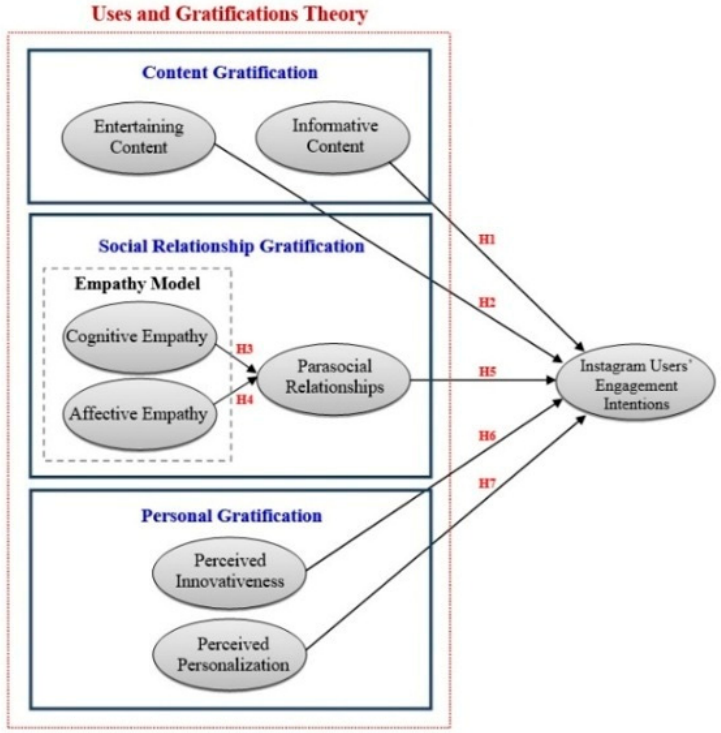
2.5. Research Framework and Formulation of Hypotheses
2.5.1. Informative/Entertaining Content and Instagram Users’ Engagement Intentions
2.5.2. Cognitive/Affective Empathy and Parasocial Relationships
2.5.3. Parasocial Relationships and Instagram Users’ Engagement Intentions
2.5.4. Perceived Innovativeness and Instagram Users’ Engagement Intentions
2.5.5. Perceived Personalization and Instagram Users’ Engagement Intentions
3. Methodology
3.1. Sample Characteristics
3.2. Sample Size
3.3. Data Collection Procedure
3.4. Instruments
4. Data Analysis and Results
4.1. Descriptive Analysis
4.2. Data Analysis
4.3. Nonresponse Bias Test and Normal Distribution
4.4. Common Method Variance and Multicollinearity
4.5. Measurement Model Analysis
4.6. Model Fit
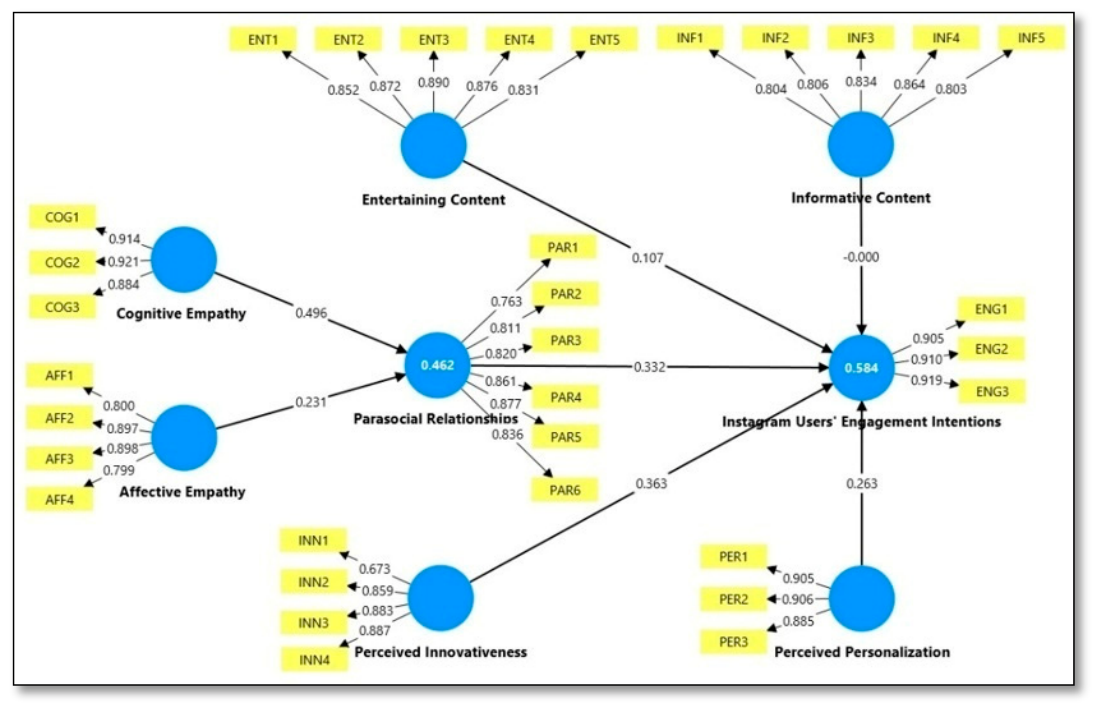
4.7. Structural Model Analysis
4.8. Hypothesis Testing
5. Discussion and Implications
5.1. Discussion
5.2. Theoretical Contributions
5.3. Managerial Implications
 ,” or emotional expressions through pictures and videos, such as facial expressions, eye expressions, body language, and tone of voice.
5.4. Limitations and Future Research
Author Contributions
Funding
Institutional Review Board Statement
Informed Consent Statement
Data Availability Statement
Conflicts of Interest
References
- Adomavicius, G., & Tuzhilin, A. (2005). Personalization technologies: A process-oriented perspective. Communications of the ACM, 48(10), 83–90. [Google Scholar] [CrossRef]
- Ahiabor, D. K., Kosiba, J. P. B., Gli, D. D., Tweneboah-Koduah, E. Y., & Hinson, R. E. (2023). Satellite fans engagement with social networking sites influence on sport team brand equity: A UGT perspective. Digital Business, 3, 100064. [Google Scholar] [CrossRef]
- Ahn, R. J., Cho, S. Y., & Tsai, S. W. (2022). Demystifying computer-generated imagery (CGI) influencers: The effect of perceived anthropomorphism and social presence on brand outcomes. Journal of Interactive Advertising, 22(3), 327–335. [Google Scholar] [CrossRef]
- Akgün, A. E., Keskin, H., Ayar, H., & Erdoğan, E. (2015). The influence of storytelling approach in travel writings on readers’ empathy and travel intentions. Procedia—Social and Behavioral Sciences, 207, 577–586. [Google Scholar] [CrossRef]
- Akour, I. M., Al-Maroof, R. S., Alfaisal, R., & Sallou, S. A. (2022). A conceptual framework for determining metaverse adoption in higher institutions of gulf area: An empirical study using hybrid SEM-ANN approach. Computer & Education: Artificial Intelligence, 3, 10052. [Google Scholar] [CrossRef]
- Alkawsi, G., Ali, N. A., & Baashar, Y. (2021). The moderating role of personal innovativeness and users’ experience in accepting smart meter technology. Applied Sciences, 11(8), 3297. [Google Scholar] [CrossRef]
- Ananyaa, R., & Shobana, T. (2025). How consumer brand experience drives engagement on Instagram: Application of uses and gratification theory. The IUP Journal of Brand Management, 22(2), 62–80. [Google Scholar] [CrossRef]
- Angmo, P., & Mahajan, R. (2024). Virtual influencer marketing: A study of millennials and gen Z consumer behaviour. Qualitative Market Research: An International Journal, 27(2), 280–300. [Google Scholar] [CrossRef]
- Aparicio, M., Costa, C. J., & Moises, R. (2021). Gamification and reputation: Key determinants of e-commerce usage and repurchase intention. Heliyon, 7(3), e06383. [Google Scholar] [CrossRef] [PubMed]
- Appel, G., Grewal, L., Hadi, R., & Stephen, A. T. (2020). The future of social media in marketing. Journal of the Academy of Marketing Science, 48, 79–95. [Google Scholar] [PubMed]
- Armstrong, J. S., & Overton, T. S. (1977). Estimating nonresponse bias in mail surveys. Journal of Marketing Research, 14(3), 396–402. [Google Scholar] [CrossRef]
- Arsenyan, J., & Mirowska, A. (2021). Almost human? A comparative case study on the social media presence of virtual influencers. International Journal of Human-Computer Studies, 155, 102694. [Google Scholar] [CrossRef]
- Barari, M. (2023). Unveiling the dark side of influencer marketing: How social media influencers (human vs virtual) diminish followers’ well-being. Marketing Intelligence & Planning, 41(8), 1162–1177. [Google Scholar] [CrossRef]
- Bareket-Bojmel, L., Moran, S., & Shaha, G. (2016). Strategic self-presentation on Facebook: Personal motives and audience response to online behavior. Computers in Human Behavior, 55, 788–795. [Google Scholar] [CrossRef]
- Berraies, S., Yahia, K. B., & Hannachi, M. (2017). Identifying the effects of perceived values of mobile banking applications on customers: Comparative study between baby boomers, generation X and generation Y. International Journal of Bank Marketing, 35(6), 1018–1038. [Google Scholar] [CrossRef]
- Bhatnagr, P. (2026). Virtual influencers on Instagram: A text mining study of consumer sentiments in China. Journal of Modeling in Management, 21(1), 392–418. [Google Scholar]
- Birnbaum, G. E., Mizrahi, M., Hoffman, G., Reis, H. T., Finkel, E. J., & Sass, O. (2016). What robots can teach us about intimacy: The reassuring effects of robot responsiveness to human disclosure. Computers in Human Behavior, 63, 416–423. [Google Scholar] [CrossRef]
- Block, E., & Lovegrove, R. (2021). Discordant storytelling, ‘honest fakery’, identity peddling: How uncanny CGI characters are jamming public relations and influencer practices. Public Relations Inquiry, 10(3), 265–293. [Google Scholar] [CrossRef]
- Bringé, A. (2022). The rise of virtual influencers and what it means for brands. Forbes Communications Council. Available online: https://www.forbes.com/councils/forbescommunicationscouncil/2022/10/18/the-rise-of-virtual-influencers-and-what-it- (accessed on 15 March 2025).
- Byun, K. J., & Ahn, S. J. (2023). A systematic review of virtual influencers: Similarities and differences between human and virtual influencers in interactive advertising. Journal of Interactive Advertising, 23(4), 293–306. [Google Scholar] [CrossRef]
- Calvo-Porral, C., & Perspeira-Sanchez, R. (2020). Generational differences in technology behaviour: Comparing millennials and generation X. Kybernetes, 49(11), 2755–2772. [Google Scholar]
- Caplan, S. E., & Turner, J. S. (2007). Bringing theory to research on computer-mediated comforting communication. Computers in Human Behavior, 23(2), 985–998. [Google Scholar] [CrossRef]
- Carré, A., Stefaniak, N., D’Ambrosio, F., Bensalah, L., & Besche-Richard, C. (2013). The basic empathy scale in adults (BES-A): Factor structure of a revised form. Psychological Assessment, 25(3), 679–691. [Google Scholar] [CrossRef] [PubMed]
- Casaló, L. V., Flavián, C., & Ibáñez-Sánchez, S. (2020). Influencers on Instagram: Antecedents and consequences of Opinion leadership. Journal of Business Research, 117, 510–519. [Google Scholar] [CrossRef]
- Chan, K. W., Septianto, F., Kwon, J., & Kamal, R. S. (2023). Color effects on AI influencers’ product recommendations. European Journal of Marketing, 57(9), 2290–2315. [Google Scholar] [CrossRef]
- Cheetham, M., Suter, P., & Jancke, L. (2011). The human likeness dimension of the uncanny valley hypothesis: Behavioral and functional MRI finding. Frontiers in Human Neuroscience, 5, e126. [Google Scholar] [CrossRef] [PubMed]
- Chen, ja-S., Truong, T. T. H., & Triprom, T. (2026). Beyond the screen: How virtual idol’s physical attractiveness, ability, and virtual setting shape purchase intention. International Journal of Human-Computer Interaction, 52(2), 854–869. [Google Scholar]
- Chow, C. M., Ruhl, H., & Buhrmester, D. (2013). The mediating role of interpersonal competence between adolescents’ empathy and friendship quality: A dyadic approach. Journal of Adolescence, 36(1), 191–200. [Google Scholar] [PubMed]
- Chung, S., & Cho, H. (2017). Fostering parasocial relationships with celebrities on social media: Implications for celebrity endorsement. Psychology & Marketing, 34(4), 481–495. [Google Scholar] [CrossRef]
- Ciechanowski, L., Przegalinska, A., Magnuski, M., & Gloor, P. (2019). In the shades of the uncanny valley: An experimental study of human-chatbot interaction. Future Generation Computer Systems, 92, 539–548. [Google Scholar] [CrossRef]
- Claessens, N., & Van den Bulck, H. (2015). Parasocial relationships with audiences’ favorite celebrities: The role of audience and celebrity characteristics in a representative Flemish sample. Communications, 40(1), 43–65. [Google Scholar] [CrossRef]
- Cohen, J. (1988). Statistical power analysis for the behavioral sciences (2nd ed., pp. 1–537). Lawrence Erlbaum Associates. [Google Scholar]
- Compos, B., Shiota, M. N., Keltner, D., Gonzaga, G. C., & Goetz, J. L. (2013). What is shared, what is different? Core relational themes and expressive displays of eight positive emotions. Cognition and Emotion, 27(1), 37–52. [Google Scholar] [CrossRef] [PubMed]
- Conti, M., Gathani, J., & Tricomi, P. P. (2022). Virtual influencers in online social media. IEEE Communications Magazine, 60(8), 86–91. [Google Scholar] [CrossRef]
- Crolic, C., Thomaz, F., Hadi, R., & Stephen, A. T. (2022). Blame the bot: Anthropomorphism and anger in customer-chatbot interactions. Journal of Marketing, 86(1), 132–148. [Google Scholar]
- Cvijikj, I. P., & Michahelles, F. (2013). Online engagement factors on Facebook brand pages. Social Network Analysis and Mining, 3, 843–861. [Google Scholar] [CrossRef]
- Čekić, E. (2025). Virtual empathy: A systematic review of the impact of digital communication on Interpersonal relationships and social dynamics. International Journal of Psychology, 10(2), 11–29. [Google Scholar] [CrossRef]
- Dadds, M. R., Hunter, K., Hawes, D. J., Frost, A. D. J., Vassallo, S., Bunn, P., Merz, S., & Masry, Y. E. (2008). A measure of cognitive and affective empathy in children using parent ratings. Child Psychiatry & Human Development, 39(2), 111–122. [Google Scholar]
- Dang, T.-Q., Nguyen, T.-M., Tran, P.-T., Phan, T.-T. C., Huynh, T.-B., & Nguyen, L.-T. (2025). From reality to virtuality: Unveiling Gen Z’s purchasing behavior through virtual influencers in the metaverse. Digital Business, 5(2), 100141. [Google Scholar] [CrossRef]
- De Jans, S., Cauberghe, R., & Hudders, L. (2018). How an advertising disclosure alerts young adolescents to sponsored vlogs: The moderating role of a peer-based advertising literacy intervention through an informational vlog. Journal of Advertising, 47(4), 309–325. [Google Scholar] [CrossRef]
- Deng, F., & Jiang, X. (2023). Effects of human versus virtual human influencers on the appearance anxiety of social media users. Journal of Retailing and Consumer Services, 71, 103233. [Google Scholar] [CrossRef]
- Derrick, J. L., Gabriel, S., & Tippin, B. (2008). Parasocial relationships and self-discrepancies: Faux relationships have benefits for low self-esteem individuals. Personal Relationships, 15, 261–280. [Google Scholar] [CrossRef]
- Diamantopoulos, A., & Siguaw, J. A. (2006). Formative versus reflective indicators in organizational measure development: A comparison and empirical illustration. British Journal of Management, 17(4), 263–282. [Google Scholar] [CrossRef]
- Dibble, J. L., Hartmann, T., & Rosaen, S. F. (2016). Parasocial interaction and parasocial relationship: Conceptual clarification and a critical assessment of measures. Human Communication Research, 42(1), 21–44. [Google Scholar]
- Dolan, R., Conduit, J., Frethey-Bentham, C., Fahy, J., & Goodman, S. (2019). Social media engagement behavior: A framework for engaging customers through social media content. European Journal of Marketing, 53(10), 2213–2243. [Google Scholar] [CrossRef]
- Dondapati, A., & Dehury, R. K. (2024). Virtual vs. human influencers: The battle for consumer hearts and minds. Computers in Human Behavior: Artificial Humans, 2(1), 100059. [Google Scholar] [CrossRef]
- Edwards, C., Edwards, A., Stoll, B., Lin, X., & Massey, N. (2019). Evaluations of an artificial intelligence instructor’s voice: Social identity theory in human-robot interactions. Computer in Human Behavior, 90, 357–362. [Google Scholar] [CrossRef]
- Fernandes, T., & Castro, A. (2020). Understanding drivers and outcomes of lurking vs. posting engagement behaviours in social media-based brand communities. Journal of Marketing Management, 36(7–8), 660–681. [Google Scholar] [CrossRef]
- Fornell, C., & Larcker, D. F. (1981). Evaluating structural equation models with unobservable variables and measurement error. Journal of Marketing Research, 18(1), 39–50. [Google Scholar] [CrossRef]
- Fu, J., Mouakket, S., & Sun, Y. (2023). The role of chatbots’ human-like characteristics in online shopping. Electronic Commerce Research and Applications, 16, 101304. [Google Scholar] [CrossRef]
- Fu, Y., Jiawan, L., Chen, R., Zafar, A. U., & Elgammal, I. (2026). A new era of rivalry for human influencers: Leveraging opportunities of virtual influencers for digital marketing strategies. Acta Psychologica, 263, 106196. [Google Scholar] [CrossRef] [PubMed]
- Gan, C. L., Lee, Y. Y., Liew, T. W., Tan, S.-M., Ahmad, F., & Prasetio, A. (2025). Cognitive and affective factors in AI virtual influencer marketing: A stimulus-organism-response and pleasure-arousal-dominance model approach. Digital Business, 5, 100150. [Google Scholar] [CrossRef]
- Gerlich, M. (2023). The power of virtual influencers: Impact on consumer behaviour and attitudes in the age of AI. Administrative Sciences, 13(8), 178. [Google Scholar] [CrossRef]
- Gratch, J., Wang, N., Okhmatovskaia, A., Lamothe, F., Morales, M., Van der Werf, R. J., Morency, L. P., & Jacko, J. A. (2007, July 22–27). Can virtual humans be more engaging than real ones? 12th International Conference on Human-Computer Interaction: Intelligent Multimodal Interaction Environments (pp. 286–297), Beijing, China. [Google Scholar]
- Gui, Y., & Huang, L. (2025). Willingness to share, comment, like: Mediating role of influencer credibility and parasocial relationship in gratifying Generation Z follower needs. Young Consumers: Insight and Ideas for Responsible Marketers, 26(6), 1046–1068. [Google Scholar] [CrossRef]
- Gursoy, D., Chi, O. H., Lu, L., & Nunkoo, R. (2019). Consumers acceptance of artificially intelligent (AI) device use in service delivery. International Journal of Information Management, 49, 157–169. [Google Scholar] [CrossRef]
- Gutuleac, R., Raima, G., Rizzo, C., & Bresciani, S. (2024). Will virtual influencers overcome the uncanny valley? The moderating role of social cues. Psychology & Marketing, 41(7), 1419–1431. [Google Scholar] [CrossRef]
- Hair, J. F., Black, W. C., Babin, B. J., & Anderson, R. E. (2010). Multivariate data analysis. Pearson Prentice Hall. [Google Scholar]
- Hair, J. F., Hult, G. T. M., Ringle, C. M., & Sarstedt, M. A. (2022). Primer on partial least squares structural equation modeling (PLS-SEM) (3rd ed., pp. 1–28). SAGE Publications. [Google Scholar]
- Hair, J. F., Risher, J. J., Sarstedt, M., & Ringle, C. M. (2019a). When to use and how to report the results of PLS-SEM. European Business Review, 31(1), 2–24. [Google Scholar] [CrossRef]
- Hair, J. F., Sarstedt, M., & Ringle, C. M. (2019b). Rethinking some of the rethinking of partial least squares. European Journal of Marketing, 53(4), 566–584. [Google Scholar] [CrossRef]
- Hanson, D., Olney, A., Prilliman, S., Mathews, E., Zielke, M., Hammons, D., Fernandez, R., & Stephanou, H. (2005, July 9–13). Upending the uncanny valley. 20th National Conference on Artificial Intelligence (pp. 1728–1729), Pittsburgh, PA, USA. [Google Scholar]
- Hanyang, Z., Ling, L. Y., Yusuf, S., Tahir, M. H. M., & Sakian, J. (2026). Beyond attractiveness: Influencer authenticity and purchase intention in live streaming commerce. International Journal of Research and Innovation in Social Science, 10(1), 2418–2428. [Google Scholar] [CrossRef]
- Haq, M. D., & Chiu, C.-M. (2024). Boosting online user engagement with short video endorsement content on TikTok via the image transfer mechanism. Electronic Commerce Research Applications, 64, 101379. [Google Scholar] [CrossRef]
- Hedhli, K. E., Zourrig, H., Khateeb, A. A., & Alnawas, I. (2023). Stereotyping human-like virtual influencers in retailing: Does warmth prevail over competence? Journal of Retailing and Consumer Services, 75, 103459. [Google Scholar] [CrossRef]
- Henseler, J., Hubona, G., & Ray, P. A. (2016). Using PLS path modeling in new technology research: Updated guidelines. Industrial Management & Data Systems, 116(1), 2–20. [Google Scholar] [CrossRef]
- Henseler, J., Ringle, C. M., & Sarstedt, M. (2015). A new criterion for assessing discriminant validity in variance-based structural equation modeling. Journal of the Academy of Marketing Science, 43, 115–135. [Google Scholar]
- Henseler, J., Ringle, C. M., & Sinkovics, R. R. (2009). The use of partial least squares path modeling in international marketing. In Advances in international marketing (pp. 277–319). Emerald Publishing Limited. [Google Scholar] [CrossRef]
- Henseler, J., & Sarstedt, M. (2013). Goodness of fit indices for partial least squares path modeling. Computational Statistics, 28, 565–580. [Google Scholar]
- Hofeditz, L., Nissen, A., Schütte, R., & Mirbabaie, M. (2022, June 18–24). Trust me, I’m an influencer! a comparison of perceived trust in human and virtual influencers. 30th European Conference on Information Systems (ECIS) (pp. 1–11), Timișoara, Romania. [Google Scholar]
- Hogan, R. (1969). Development of an empathy scale. Journal of Consulting and Clinical Psychology, 33(3), 307–316. [Google Scholar] [CrossRef] [PubMed]
- Hollebeek, L. D., Glynn, M. S., & Brodie, R. J. (2014). Consumer brand engagement in social media: Conceptualization, scale development and validation. Journal of Interactive Marketing, 28(2), 149–165. [Google Scholar] [CrossRef]
- Horton, D., & Wohl, R. R. (1956). Mass communication and para-social interaction: Observations on intimacy at a distance. Psychiatry, 19(3), 215–229. [Google Scholar] [CrossRef] [PubMed]
- Hu, L., & Bentler, P. M. (1999). Cutoff criteria for fit indexes in covariance structure analysis: Conventional criteria versus new alternatives. Structural Equation Modeling: A Multidisciplinary, 6(1), 1–55. [Google Scholar] [CrossRef]
- Hu, X. S., Hu, C. A., & Cheng, P. (2026). Converting viewers to tourists: Gratifications from food-hunting short videos and their impacts on destination visit intentions. Journal of Destination Marketing & Management, 40, 101086. [Google Scholar] [CrossRef]
- Huang, M. H., & Rust, R. T. (2018). Artificial intelligence in service. Journal of Service Research, 21(2), 155–172. [Google Scholar] [CrossRef]
- Hwang, J., Lee, J. S., & Kim, H. (2019). Perceived innovativeness of drone food delivery services and its impacts on attitude and behavioral intentions: The moderating role of gender and age. International Journal of Hospitality Management, 81, 94–103. [Google Scholar] [CrossRef]
- Hwang, K., & Zhang, Q. (2018). Influence of parasocial relationship between digital celebrities and their followers on followers’ purchase and electronic word-of-mouth intentions, and persuasion knowledge. Computers in Human Behavior, 87, 155–173. [Google Scholar] [CrossRef]
- Jahn, B., & Kunz, W. (2012). How to transform consumers into fans of your brand. Journal of Service Management, 23(3), 344–361. [Google Scholar] [CrossRef]
- Jamil, R., Gragg, M. N., & DePape, A. M. (2017). The broad autism phenotype: Implications for empathy and friendships in emerging adults. Personality and Individual Differences, 111, 199–204. [Google Scholar] [CrossRef]
- Jhawar, A., Kumar, P., & Varshney, S. (2023). The emergence of virtual influencers: A shift in the influencer marketing paradigm. Young Consumers: Insight and Ideas for Responsible Marketers, 24(4), 468–484. [Google Scholar] [CrossRef]
- Jin, S. V. (2023). To comply or to react, that is the question: The roles of humanness versus eeriness of AI-powered virtual influencers, loneliness, and threats to human identities in AI-driven digital transformation. Computers in Human Behavior: Artificial Humans, 1(2), 100011. [Google Scholar] [CrossRef]
- Jin, S. V., Muqaddam, A., & Ryu, E. (2019). Instafamous and social media influencer marketing. Marketing Intelligence & Planning, 37(5), 567–579. [Google Scholar] [CrossRef]
- Jung, N., & Im, S. (2021). The mechanism of social media marketing: Influencer characteristics, consumer empathy, immersion, and sponsorship disclosure. International Journal of Advertising, 40(8), 1265–1293. [Google Scholar] [CrossRef]
- Kabadayi, S., & Price, K. (2014). Consumer-brand engagement on Facebook: Liking and commenting behaviors. Journal of Research in Interactive Marketing, 8(3), 203–223. [Google Scholar] [CrossRef]
- Katz, E. (1959). Mass communications research and the study of popular culture: An editorial note on a possible future for this journal. Studies in Public Communication, 2, 1–6. [Google Scholar]
- Kefi, H., & Maar, D. (2020). The power of lurking: Assessing the online experience of luxury brand fan page followers. Journal of Business Research, 117, 579–586. [Google Scholar] [CrossRef]
- Khalfallah, D., & Keller, V. (2026). Virtual influencer-brand collaborations: A multiple-case study of strategic design and the credibility-engagement paradox. Cogent Business & Management, 13(1), 2653916. [Google Scholar] [CrossRef]
- Khan, M. L. (2017). Social media engagement: What motivates user participation and consumption on YouTube? Computers in Human Behavior, 66, 236–247. [Google Scholar] [CrossRef]
- Khan, S., & Wahab, A. (2024). Engaging customers through satisfaction; does social media marketing and perceived innovativeness really matter? A time-lagged study in the hospitality industry. Journal of Hospitality and Tourism Insights, 7(4), 2347–2366. [Google Scholar]
- Kim, B., de Visser, E., & Phillips, E. (2022). Two uncanny valleys: Re-evaluating the uncanny valley across the full spectrum of real-world human-like robots. Computers in Human Behavior, 135, 107340. [Google Scholar] [CrossRef]
- Kim, E., Kim, D., Zihang, E., & Shoenberger, H. (2023). The next hype in social media advertising: Examining virtual influencers’ brand endorsement effectiveness. Frontiers in Psychology, 14, 1089051. [Google Scholar] [CrossRef] [PubMed]
- Kim, H., & Park, M. (2023). Virtual influencers’ attractiveness effect on purchase intentions: A moderated mediation model of the product-endorser fit with the brand. Computers in Human Behavior, 143, 107703. [Google Scholar] [CrossRef]
- Kim, I., Ki, C. C., Lee, A. H., & Kim, Y. (2024). Virtual influencers marketing: Evaluating the influencer of virtual influencers’ form realism and behavioral realism on consumer ambivalence and marketing performance. Journal of Business Research, 176, 114611. [Google Scholar] [CrossRef]
- Kim, J., Giroux, M., & Lee, J. C. (2021). When do you trust AI? The effect of number presentation detail on consumer trust and acceptance of AI recommendations. Psychology & Marketing, 38(7), 1140–1155. [Google Scholar] [CrossRef]
- Kim, J., & Kim, M. (2026). Building connections with virtual influencers: The role of friendship and psychological well-being in driving social media engagement and purchase intention. Marketing Intelligence & Planning, 44(1), 22–42. [Google Scholar] [CrossRef]
- Kim, T., & Read, G. L. (2022). Influencers’ smiles work regardless of product and message. Marketing Intelligence & Planning, 40(4), 425–440. [Google Scholar] [CrossRef]
- Kocak, E., Nasir, V. A., & Turker, H. B. (2026). Exploring consumer motives for engagement with branded content on Instagram: A focus group study in Turkey. Atlantic Journal of Communication, 34(1), 56–78. [Google Scholar] [CrossRef]
- Kock, N. (2021). Harman’s single factor test in PLS-SEM: Checking for common method bias. Data Analysis Perspectives Journal, 2(2), 1–16. [Google Scholar]
- Kolbl, Ž., Diamantopoulos, A., Arslanagic-Kalajdzic, M., & Zabkar, V. (2020). Do brand warmth and brand competence add value to consumers? A stereotyping perspective. Journal of Business Research, 118, 346–362. [Google Scholar] [CrossRef]
- Krämer, N. C., Lucas, G., Schmitt, L., & Gratch, J. (2018). Social snacking with a virtual agent—On the interrelation of need to belong and effects of social responsiveness when interacting with artificial entities. International Journal of Human-Computer Studies, 109, 112–121. [Google Scholar] [CrossRef]
- Kujur, F., & Singh, S. (2017). Engaging customers through online participation in social networking sites. Asia Pacific Management Review, 22(1), 16–24. [Google Scholar] [CrossRef]
- Kujur, F., & Singh, S. (2019). Antecedents of relationship between customer and organization developed through social networking sites. Management Research Review, 42(1), 2–24. [Google Scholar] [CrossRef]
- Kumar, A., & Shankar, A. (2024). Investigating the role of metaverse influencers’ attributes for the next generation of services. Journal of Services Marketing, 38(7), 816–838. [Google Scholar] [CrossRef]
- Kumar, A., Shankar, A., Behl, A., & Wamba, S. F. (2025). Do you believe in the metaverse NFTs? Understanding the value proposition of NFTs in the metaverse. Technological Forecasting and Social Change, 210, 123880. [Google Scholar] [CrossRef]
- Kurtin, K. S., O.’Brien, N., Roy, D., & Dam, L. (2018). The development of parasocial interaction relationships on YouTube. Journal of Social Media in Society, 7(1), 233–252. [Google Scholar]
- Lee, J. Y., & Park, K. H. (2022, October 26–29). I am a digital human: Effectiveness of using virtual influencers as fashion brand endorsers. 79th International Textile and Apparel Association Annual Conference, Denver, Colorado. [Google Scholar]
- Lee, S. A., & Oh, H. (2021). Anthropomorphism and its implications for advertising hotel brands. Journal of Business Research, 129, 455–464. [Google Scholar] [CrossRef]
- Lee, Y.-H., & Yuan, C. W. (2023). I’m not a puppet, I’m a real boy! gender presentations by virtual influencers and how they are received. Computer in Human Behavior, 149, 107927. [Google Scholar] [CrossRef]
- Lee, Y. Y., Gan, C. L., Liew, T. W., Tan, S.-M., & Cheak, A. P. C. (2025). Emotional tug-of-war in virtual influencer marketing pleasure-arousal-dominance (PAD) model and hedonic factors in predicting willingness to buy product recommendations. Telematics and Informatics Reports, 20, 100268. [Google Scholar] [CrossRef]
- Li, Y., Xiang, X., & Wu, R. (2026). Display advertising or social media post? The impact of endorsement execution form on the effectiveness of virtual influencers’ advertising endorsements. Journal of Retailing and Consumer Services, 90, 104685. [Google Scholar] [CrossRef]
- Liang, T.-P., Yang, Y.-F., Chen, D.-N., & Ku, K.-C. (2008). A semantic-expansion approach to personalized knowledge recommendation. Decision Support Systems, 45(3), 401–412. [Google Scholar] [CrossRef]
- Lim, H., & Kumar, A. (2019). Variations in consumers’ use of brand online social networking: A uses and gratifications approach. Journal of Retailing and Consumer Services, 51, 450–457. [Google Scholar] [CrossRef]
- Lim, R. E., & Lee, S. Y. (2023). You are a virtual influencer!: Understanding the impact of origin disclosure and emotional narratives on parasocial relationships and virtual influencer credibility. Computers in Human Behavior, 148, 107897. [Google Scholar] [CrossRef]
- Liu, F. (2026). Who and how to pair with a virtual influencer? The impact of co-endorser type, perceived distance, and gender congruence on consumer responses in virtual influencer collaborations. Journal of Retailing and Consumer Services, 89, 104593. [Google Scholar] [CrossRef]
- Liu, F., & Wang, R. (2025). Fostering parasocial relationships with virtual influencers in the uncanny valley: Anthropomorphism, autonomy, and a multigroup comparison. Journal of Business Research, 186, 115024. [Google Scholar] [CrossRef]
- Liu, R., Li, X., & Liu, S. (2026). How emotional expression in human-like virtual influencers drives user engagement: Empathy model and its antecedents. Frontiers in Psychology, 16, 1544037. [Google Scholar] [CrossRef] [PubMed]
- Liu, Y., Zhang, K., Zhang, Y., Pang, H., & Liu, B. (2026). How personal anticipations and perceived gratifications influence continuous use intention toward AI-driven chatbots? Moderating roles of perceived innovativeness and active involvement. Acta Psychologica, 264, 106526. [Google Scholar] [CrossRef] [PubMed]
- Lou, C., Kiew, S. T. J., Chen, T., Lee, T. Y. M., Ong, J. E. C., & Phua, Z. X. (2022). Authentically fake? how consumer respond to the influence of virtual influencers. Journal of Advertising, 52(4), 540–557. [Google Scholar] [CrossRef]
- Lueck, J. A. (2015). Friend-zone with benefits: The parasocial advertising of Kim Kardashian. Journal of Marketing Communications, 21, 91–109. [Google Scholar] [CrossRef]
- Malik, M. A., Choo, K. A., Rahmat, H., Sharji, E. A., Hoon, T. S., Eni, S., & Yoong, L. K. (2025). Exploring the framework of online music use for motivation of studies and gratification needs for students’ well-being. International Journal of Mental Health Promotion, 28(1), 10. [Google Scholar] [CrossRef]
- Malthouse, E. C., Haenlein, M., Skiera, B., Wege, E., & Zhang, M. (2013). Managing customer relationships in the social media era: Introducing the social CRM house. Journal of Interactive Marketing, 27(4), 270–280. [Google Scholar] [CrossRef]
- Mehrabian, A., & Epstein, N. (1972). A measure of emotional empathy. Journal of Personality, 40, 525–543. [Google Scholar] [CrossRef] [PubMed]
- Memon, M. A., Ting, H., Cheah, J.-H., Thurasamy, R., Chuah, F., & Cham, T. H. (2020). Sample size for survey research: Review and recommendations. Journal of Applied Structural Equation Modeling, 4(2), i–xx. [Google Scholar] [CrossRef] [PubMed]
- Mirowska, A., & Arsenyan, J. (2023). Sweet escape: The role of empathy in social media engagement with human versus virtual influencers. International Journal of Human-Computer Studies, 174, 103008. [Google Scholar] [CrossRef]
- Modak, A., & Nath, A. (2024). Verbal and non-verbal communication in the digital age: Opportunities and challenges. International Journal of Multidisciplinary research, 2(8), 266–270. [Google Scholar]
- Molinillo, S., Rejón-Guardia, F., Anaya-Sánchez, R., & Liébana-Cabanillas, F. (2023). Impact of perceived value on intention to use voice assistants: The moderating effects of personal innovativeness and experience. Psychology & Marketing, 40(11), 2272–2290. [Google Scholar] [CrossRef]
- Mori, M. (1970). Bukimi no tani (the uncanny valley). Energy, 7, 33–35. [Google Scholar]
- Mouritzen, S. L. T., Penttinen, V., & Pedersen, S. (2024). Virtual influencer marketing: The good, the bad and the unreal. European Journal of Marketing, 58(2), 410–440. [Google Scholar] [CrossRef]
- Mrad, M., Ramadan, Z., & Nasr, L. I. (2022). Computer-generated influencers: The rise of digital personalities. Marketing Intelligence & Planning, 40(5), 589–603. [Google Scholar] [CrossRef]
- Nan, D., Sun, S., Zhang, S., Zhao, X., & Kim, J. H. (2025). Analyzing behavioral intentions toward generative artificial intelligence: The case of ChatGPT. Universal Access in the Information Society, 24(1), 885–895. [Google Scholar] [CrossRef]
- Ngan, H. F. B., & Yu, C.-E. (2019). To smile or not to smile—An eye-tracking study on service recovery. Current Issues in Tourism, 22(19), 2327–2332. [Google Scholar] [CrossRef]
- Nguyen, D. N., & Hoang, L. C. (2026). Customers’ engagement with virtual influencers: The roles of parasocial relationship, emotional attachment. Young Consumer, 27(1), 109–129. [Google Scholar] [CrossRef]
- Nguyen, T. H. D., Carstensdottir, E., Ngo, N., El-Nasr, M. S., Gray, M., Isaacowitz, D., & Desteno, D. (2015). Modeling warmth and competence in virtual characters. In International Conference on Intelligent Virtual Agents (pp. 167–180). Springer. [Google Scholar]
- Office of the Higher Education Commission. (2025). Higher education statistics: Academic year 2025. Available online: https://info.mhesi.go.th/stat_aca_uni.php?search_year=2568 (accessed on 15 October 2024).
- Omar, N. A., Kassim, A. S., Shah Alam, S., & Zainol, Z. (2021). Perceived retailer innovativeness and brand equity: Mediation of consumer engagement. Ther Service Industries Journal, 41(5–6), 355–381. [Google Scholar] [CrossRef]
- Omdahl, B. L. (1995). Cognitive appraisal, emotion, and empathy. Lawrence Erlbaum Associates. [Google Scholar]
- Paringan, A. T., & Novani, S. (2022). The roles of customer perception of innovativeness and engagement on loyalty through value co-creation behaviors: The case of food-delivery service. Binus Business Review, 13(1), 81–93. [Google Scholar] [CrossRef]
- Patil, P., Tamilmani, K., Rana, N. P., & Raghavan, V. (2020). Understanding consumer adoption of mobile payment in India: Extending meta-UTAUT model with personal innovativeness, anxiety, trust, and grievance redressal. International Journal of Information Management, 54, 102144. [Google Scholar] [CrossRef]
- Pei, Y., Han, J., Zhao, J., Liu, M., & Pang, W. (2022). The effects of the creator’s situation on creativity evaluation: The rater’s cognitive empathy and affective empathy matter in rating creative works. Journal of Intelligence, 10(4), 75. [Google Scholar] [CrossRef] [PubMed]
- Pei, Y., Wu, J., Wang, F., & Wang, S. (2026). Unwavering interests in influencers: Influencer-focused barrages in social media product review videos. Journal of Retailing and Consumer Services, 88, 104485. [Google Scholar] [CrossRef]
- Pelletier, M. J., Krallman, A., Adams, F. G., & Hancock, T. (2020). One size doesn’t fit all: A use and gratification analysis of social media platforms. Journal of Research in Interactive Marketing, 14(2), 269–238. [Google Scholar] [CrossRef]
- Podsakoff, P. M., & Organ, D. W. (1986). Self-reports in organizational research: Problems and prospects. Journal of Management, 12(4), 531–544. [Google Scholar] [CrossRef]
- Prado, B. G. L., & Siquara, G. M. (2023). Translation and evidence of validity of the basic empathy scale. Psicologia—Teoria e Prática, 25(5), ePTPPA14712. [Google Scholar] [CrossRef]
- Pushparaj, P., Kushwaha, B. P., & Prashar, S. (2025). Virtual influencers in digital marketing: A PRISMA-based systematic literature. review and thematic synthesis of engagement, trust, and ethical challenges. Future Business Journal, 11(1), 00441. [Google Scholar]
- Qu, Y., & Baek, E. (2024). Let virtual creatures stay virtual: Tactics to increase trust in virtual influencers. Journal of Research in Interactive Marketing, 18(1), 91–108. [Google Scholar] [CrossRef]
- Raacke, J., & Bonds-Raacke, J. B. (2008). MySpace and Facebook: Applying the uses and gratifications theory to exploring friend-networking sites. Cyberpsychology, Behavior, and Social Networking, 11(2), 169–174. [Google Scholar] [CrossRef] [PubMed]
- Rogers, E. M. (2003). Diffusion of innovations (5th ed.). Free Press. [Google Scholar]
- Rossi, C., & Rivetti, F. (2023, May 18–19). Virtual influencer marketing: Is it effective in engaging younger generations? 10th European Conference on Social Media (ECSM), Kraków, Poland. [Google Scholar]
- Ruggiero, T. E. (2000). Uses and gratifications theory in the 21st century. Mass Communication and Society, 3(1), 3–37. [Google Scholar] [CrossRef] [PubMed]
- Rungruangjit, W., Chankoson, T., & Charoenpornpanichkul, K. (2023). Understanding different types of followers’ engagement and the transformation of millennial followers into cosmetic brand evangelists. Behavioral Sciences, 13(3), 270. [Google Scholar] [CrossRef] [PubMed]
- Rungruangjit, W., & Charoenpornpanichkul, K. (2022). Building stronger brand evangelism for sustainable marketing through micro-influencer-generated content on Instagram in the fashion industry. Sustainability, 14(23), 15770. [Google Scholar] [CrossRef]
- Rungruangjit, W., Mongkol, K., Piriyakul, I., & Charoenpornpanichkul, K. (2024). The power of human-like virtual-Influencer-generated content: Impact on consumers’ willingness to follow and purchase intentions. Computers in Human Behavior Reports, 16, 100523. [Google Scholar] [CrossRef]
- Sands, S., Campbell, C. L., Plangger, K., & Ferraro, C. (2022). Unreal influencer: Leveraging AI in influencer marketing. European Journal of Marketing, 56(6), 1721–1747. [Google Scholar] [CrossRef]
- Schoner-Schatz, L., Hofmann, V., & Stokburger-Sauer, N. E. (2021). Destination’s social media communication and emotions: An investigation of visit intentions, word-of-mouth and travelers’ facially expressed emotions. Journal of Destination Marketing & Management, 22, 100661. [Google Scholar] [CrossRef]
- Schultz, C. D. (2017). Proposing to your fans: Which brand post characteristics drive consumer engagement activities on social media brand pages? Electronic Commerce Research and Applications, 26, 23–34. [Google Scholar] [CrossRef]
- Shao, Z. (2024). From human to virtual: Unmasking consumer switching intentions to virtual influencers by and integrated fsQCA and NCA method. Journal of Retailing and Consumer Services, 78, 103715. [Google Scholar] [CrossRef]
- Sheng, J., Lee, Y. H., & Lan, H. (2023). Parasocial relationships with micro-influencers: Do sponsorship disclosure and Electronic word-of-mouth disrupt? Internet Research, 34(3), 849–867. [Google Scholar] [CrossRef]
- Shin, D. (2018). Empathy and embodied experience in virtual environment: To what extent can virtual reality stimulate empathy and embodied experience? Computers in Human Behavior, 78, 64–73. [Google Scholar] [CrossRef]
- Shin, D., & Biocca, F. (2017). Explicating user behavior toward multi-screen adoption and diffusion: User experience in the multi-screen media ecology. Internet Research, 27(2), 338–361. [Google Scholar]
- Shin, M.-H., & Lee, W.-J. (2024). The impact of virtual influencer’s characteristics on brand attitude: The mediating effect of parasocial interaction. Journal of Economics Marketing, and Management, 12(51), 41–51. [Google Scholar]
- Shin, Y., & Lee, S. (2023). Issues of virtual fashion influencers’ reproduced bodies: A qualitative analysis based on body discourse. Fashion and Textiles, 10(30), 1–26. [Google Scholar] [CrossRef]
- Singh, S., Singh, N., Kalinić, Z., & Liébana-Cabanillas, F. J. (2021). Assessing determinants influencing continued use of live streaming services: An extended perceived value theory of streaming addiction. Expert Systems with Applications, 168, 114241. [Google Scholar] [CrossRef]
- Smock, A. D., Ellison, N. B., Lampe, C., & Wohn, D. Y. (2011). Facebook as a toolkit: A uses and gratification approach to unbundling feature use. Computers in Human Behavior, 27(6), 2322–2329. [Google Scholar] [CrossRef]
- Soper, D. S. (2020). A-priori sample size calculator for structural equation models (software). Available online: http://www.danielsoper.com/statcalc (accessed on 5 October 2024).
- Stein, J. P., Breves, P. L., & Anders, N. (2024). Parasocial interactions with real and virtual influencers: The role of perceived similarity and human-likeness. New Media and Society, 26(6), 3433–3453. [Google Scholar] [CrossRef]
- Tehseen, S., Ramayah, T., & Sajilan, S. (2017). Testing and controlling for common method variance: A review of available methods. Journal of Management Sciences, 4, 142–168. [Google Scholar] [CrossRef]
- Thi, T. D. P., & Duong, N. T. (2025). Consumers’ intentions to use AI chatbots on online shopping platforms. Journal of Computer Information Systems, 1–16. [Google Scholar] [CrossRef]
- Thomas, G. (2023). Demystifying the relationship between restaurant innovativeness, customer engagement, and customer willingness to pay a higher price. Sustainability, 15(10), 7995. [Google Scholar] [CrossRef]
- Thurman, N., Moeller, J., Helberger, N., & Trilling, D. (2019). My friends, editors, algorithms, and I: Examining audience attitudes to news selection. Digital Journalism, 7(4), 447–469. [Google Scholar]
- Tian, M., Hu, H., & Chen, M. (2026). Virtual influencers in interactive marketing: A state-of-the-art review and future research directions. Journal of Research in Interactive Marketing, 20(6), 794–811. [Google Scholar] [CrossRef]
- Truong, T. T. H., & Chen, J. S. (2025). When empathy is enhanced by human-AI interaction: An investigation of anthropomorphism and responsiveness on customer experience with AI chatbots. Asia Pacific Journal of Marketing and Logistics, 37(12), 3908–3925. [Google Scholar] [CrossRef]
- Tsiotsou, R. H. (2015). The role of social and parasocial relationships on social networking sites loyalty. Computers in Human Behavior, 48, 401–414. [Google Scholar] [CrossRef]
- Van Doorn, J., Lemon, K. N., Mittal, V., Ness, S., Pick, D., Pirner, P., & Verhoef, P. C. (2010). Customer engagement behavior: Theoretical foundations and research directions. Journal of Service Research, 13(3), 253–266. [Google Scholar] [CrossRef]
- Wang, K., Wu, J., Sun, Y., Chen, J., Pu, Y., & Qi, Y. (2024). Trust in human and virtual liver streamers: The role of integrity and social presence. International Journal of Human-Computer Interaction, 40(23), 8274–8294. [Google Scholar] [CrossRef]
- Wang, Y., Yuan, B., Roberts, K., Simons, R. F., & Lin, C. (2014). How friendly is a little friendly competition? evidence of self-interest and empathy during outcome evaluation. International Journal of Psychophysiology, 91(3), 155–162. [Google Scholar] [CrossRef] [PubMed]
- Wei, J., He, J., Chen, K., Zhou, Y., & Tang, Z. (2017). Collaborative filtering and deep learning based recommendation system for cold start items. Expert Systems with Applications, 69, 29–39. [Google Scholar] [CrossRef]
- West, A., Clifford, J., & Atkinson, D. (2018). “Alexa, build me a brand” An investigation into the impact of artificial intelligence on branding. Journal of Business and Economics, 9(10), 877–887. [Google Scholar] [CrossRef]
- Whang, C., & Im, H. (2021). I like your suggestion! The role of human likeness and parasocial relationship on the website versus voice shopper’s perception of recommendations. Psychology & Marketing, 38(4), 581–595. [Google Scholar] [CrossRef]
- Wold, H. (1985). Partial least squares. In S. Kotz, & N. L. Johnson (Eds.), Encyclopedia of statistical sciences (pp. 581–591). John Wiley. [Google Scholar]
- Xie-Carson, L., Benchendorff, P., & Hughes, K. (2023a). Keep it #unreal: Exploring Instagram users’ engagement with virtual influencers in tourism contexts. Journal of Hospitality & Tourism Research, 48(6), 1–14. [Google Scholar] [CrossRef]
- Xie-Carson, L., Benchendorff, P., & Hughes, K. (2023b). Not so different after all? A netnographic exploration of user engagement with non-human influencers on social media. Journal of Business Research, 167, 114149. [Google Scholar] [CrossRef]
- Xie-Carson, L., Magor, T., Benchendorff, P., & Hughes, K. (2023c). All hype or the real deal? Investigating user engagement with virtual influencers in tourism. Tourism Management, 99, 104779. [Google Scholar] [CrossRef]
- Xu, F., & Du, J. T. (2018). Factors influencing users’ perceived satisfaction and loyalty to digital libraries in Chinese universities. Computers in Human Behavior, 83, 64–72. [Google Scholar] [CrossRef]
- Yang, D., Qu, B., & Cudré-Mauroux, P. (2018). Privacy-preserving social media data publishing for personalized ranking-based recommendation. IEEE Transactions on Knowledge and Data Engineering, 31, 507–520. [Google Scholar] [CrossRef]
- Yi, M. R., & Lee, H. S. (2024). A Study on the regulatory fit effects of influencer types and message types. International Journal of Human-Computer Interaction, 40(18), 5161–5173. [Google Scholar] [CrossRef]
- Yoon, N., & Lee, H.-K. (2021). AI recommendation service acceptance: Assessing the effects of perceived empathy and need for cognition. Journal of Theoretical and Applied Electronic Commerce Research, 16(5), 1912–1928. [Google Scholar] [CrossRef]
- Yu, J., Dickinger, A., So, K. K. F., & Egger, R. (2024). Artificial intelligence-generated virtual influencer: Examining the effects of emotional display on user engagement. Journal of Retailing and Consumer Services, 76, 103560. [Google Scholar] [CrossRef]
- Zhou, B., Li, J., Abdullah, Z., Hashim, N., & Qi, M. (2026). Virtual influencer attributes and purchase intention: A systematic review. Frontiers in Human Dynamics, 8, 1816209. [Google Scholar] [CrossRef]
- Zweig, D., & Webster, J. (2003). Personality as a moderator of monitoring acceptance. Computers in Human Behavior, 19(4), 479–493. [Google Scholar] [CrossRef]



| Factor | Initial Eigenvalues | Extraction Sums of Squared Loading | ||||
|---|---|---|---|---|---|---|
| Total | % of Variance | Cumulative % | Total | % of Variance | Cumulative % | |
| 1 | 14.051 | 43.293 | 43.293 | 14.051 | 43.293 | 43.293 |
| 2 | 3.524 | 11.255 | 54.548 | |||
| 3 | 1.465 | 4.495 | 59.043 | |||
| 4 | 1.266 | 3.559 | 62.602 | |||
| Constructs | Items | Loading | CA | CR | AVE |
|---|---|---|---|---|---|
| Informative content | 0.880 | 0.913 | 0.676 | ||
| INF1: The content of human-like VIs is beneficial. | 0.804 | ||||
| INF2: The content of human-like VIs about products is fascinating. | 0.806 | ||||
| INF3: The content of human-like VIs provides product reviews. | 0.834 | ||||
| INF4: The content of human-like VIs provides product information. | 0.864 | ||||
| INF5: The content of human-like VIs provides trending. | 0.803 | ||||
| Entertaining content | 0.915 | 0.936 | 0.747 | ||
| ENT1: The content of human-like VIs is entertaining. | 0.852 | ||||
| ENT2: The content of human-like VIs is funny. | 0.872 | ||||
| ENT3: The content of human-like VIs is pleasant. | 0.890 | ||||
| ENT4: The content of human-like VIs is amusing. | 0.876 | ||||
| ENT5: The content of human-like VIs provides memes. | 0.831 | ||||
| Cognitive empathy | 0.891 | 0.933 | 0.822 | ||
| COG1: I feel like human-like VIs can understand my happy feelings | 0.914 | ||||
| through comments on her posts. | |||||
| COG2: I feel like human-like VIs can understand when I am feeling down. | 0.921 | ||||
| COG3: I feel like human-like VIs can understand my specific needs. | 0.884 | ||||
| Affective empathy | 0.871 | 0.912 | 0.723 | ||
| AFF1: I feel like human-like VIs are easily caught up in my feelings. | 0.800 | ||||
| AFF2: If I interact with human-like VIs, when I’m sad, I feel like she | 0.897 | ||||
| usually feel sad. | |||||
| AFF3: I feel like human-like VIs get upset when I am upset. | 0.898 | ||||
| AFF4: I feel like my emotions affect human-like VIs greatly. | 0.799 | ||||
| Parasocial relationships | 0.908 | 0.929 | 0.687 | ||
| PAR1: I do not feel uncomfortable if I interact with human-like VIs. | 0.763 | ||||
| PAR2: I want to have a friendly conversation with human-like VIs. | 0.811 | ||||
| PAR3: It seems that human-like VIs understand what I want to know. | 0.820 | ||||
| PAR4: I am captivated by the gentle smiles of my favorite human-like VIs. | 0.861 | ||||
| PAR5: When I have a conversation with human-like VIs, I feel as if I am | 0.877 | ||||
| talking to my friend. | |||||
| PAR6: Following human-like VIs on Instagram makes me feel closer to her. | 0.836 | ||||
| Perceived innovativeness | 0.848 | 0.898 | 0.689 | ||
| INN1: Among my peers, I am often the first to try new ways of interacting | 0.673 | ||||
| via human-like VIs. | |||||
| INN2: I like to interact with human-like VIs through liking, sharing, or | 0.859 | ||||
| commenting on their content. | |||||
| INN3: If I heard about new human-like VIs, I would start following them | 0.883 | ||||
| and experiment with engaging with them. | |||||
| INN4: I am not hesitant to try interacting with human-like VIs. | 0.887 | ||||
| Perceived personalization | 0.881 | 0.926 | 0.808 | ||
| PER1: I perceive that human-like VIs are able to offer products designed | 0.905 | ||||
| especially for me. | |||||
| PER2: I perceive that human-like VIs post content tailored to suit my needs. | 0.906 | ||||
| PER3: I perceive that human-like VIs are able to give advice on various | 0.885 | ||||
| matters that meet my needs. | |||||
| Instagram users’ engagement intentions | 0.898 | 0.936 | 0.831 | ||
| ENG1: In the near future, I intend to participate in content of human-like | 0.905 | ||||
| VIs on Instagram such as by liking, sharing, or commenting. | |||||
| ENG2: In the near future, I expect to interact with human-like VIs on | 0.910 | ||||
| Instagram. | |||||
| ENG3: In the near future, I plan to engage with human-like VIs’ content | 0.919 | ||||
| on Instagram. | |||||
| Variable | AFF | COG | ENT | INF | ENG | PAR | INN | PER |
|---|---|---|---|---|---|---|---|---|
| AFF | ||||||||
| COG | 0.808 | |||||||
| ENT | 0.588 | 0.628 | ||||||
| INF | 0.416 | 0.477 | 0.617 | |||||
| ENG | 0.565 | 0.568 | 0.650 | 0.543 | ||||
| PAR | 0.657 | 0.734 | 0.716 | 0.589 | 0.765 | |||
| INN | 0.586 | 0.667 | 0.711 | 0.685 | 0.780 | 0.767 | ||
| PER | 0.566 | 0.649 | 0.683 | 0.670 | 0.696 | 0.803 | 0.809 |
| Hypotheses | Path | Path Coefficients (β) | t-Statistic | p-Value | VIF | Results |
|---|---|---|---|---|---|---|
| H1 | INF → ENG | −0.000 ns. | 0.011 | 0.991 | 1.781 | Not supported |
| H2 | ENT → ENG | 0.107 ** | 2.746 | 0.006 | 2.098 | Supported |
| H3 | COG → PAR | 0.496 *** | 12.506 | 0.000 | 2.025 | Supported |
| H4 | AFF → PAR | 0.231 *** | 5.415 | 0.000 | 2.025 | Supported |
| H5 | PAR → ENG | 0.332 *** | 7.410 | 0.000 | 2.590 | Supported |
| H6 | INN → ENG | 0.363 *** | 8.615 | 0.000 | 2.473 | Supported |
| H7 | PER → ENG | 0.263 *** | 6.198 | 0.000 | 2.675 | Supported |
Disclaimer/Publisher’s Note: The statements, opinions and data contained in all publications are solely those of the individual author(s) and contributor(s) and not of MDPI and/or the editor(s). MDPI and/or the editor(s) disclaim responsibility for any injury to people or property resulting from any ideas, methods, instructions or products referred to in the content. |
© 2026 by the authors. Licensee MDPI, Basel, Switzerland. This article is an open access article distributed under the terms and conditions of the Creative Commons Attribution (CC BY) license.
Share and Cite
Rungruangjit, W.; Mongkol, K.; Charoenpornpanichkul, K. Challenges in the Digital Marketing Realm of Human-like Virtual Influencers: What Drives Instagram Users’ Engagement Intentions? Adm. Sci. 2026, 16, 383. https://doi.org/10.3390/admsci16080383
Rungruangjit W, Mongkol K, Charoenpornpanichkul K. Challenges in the Digital Marketing Realm of Human-like Virtual Influencers: What Drives Instagram Users’ Engagement Intentions? Administrative Sciences. 2026; 16(8):383. https://doi.org/10.3390/admsci16080383
Chicago/Turabian StyleRungruangjit, Warinrampai, Kulachet Mongkol, and Kitti Charoenpornpanichkul. 2026. "Challenges in the Digital Marketing Realm of Human-like Virtual Influencers: What Drives Instagram Users’ Engagement Intentions?" Administrative Sciences 16, no. 8: 383. https://doi.org/10.3390/admsci16080383
APA StyleRungruangjit, W., Mongkol, K., & Charoenpornpanichkul, K. (2026). Challenges in the Digital Marketing Realm of Human-like Virtual Influencers: What Drives Instagram Users’ Engagement Intentions? Administrative Sciences, 16(8), 383. https://doi.org/10.3390/admsci16080383