


Abstract
Leaders and managers frequently face the need to make highly complex decisions with incomplete or fragmented information. Traditional decision support systems largely emphasize the visualization of data but often fall short in producing context-sensitive insights that can directly inform decision-making. This paper examines how narrative techniques combined with machine learning can strengthen communication across organizational hierarchies, particularly by improving the transfer of tacit expertise and contextual knowledge. To explore this, a transdisciplinary literature review was conducted using articles published within the last five years from databases such as Scopus, Web of Science, and ScienceDirect. The review highlights that narrative-driven reporting has been most commonly applied in fields such as accounting and sustainability, where expert interpretation replaces purely numerical summaries with more meaningful analytical explanations. Such approaches can also embed sentiment and personalization, commonly referred to as Narrative Disclosure Tone. Building on this foundation, the study investigates how Artificial Intelligence-driven decision support can formally integrate narrative elements to enhance report clarity, usability, and strategic relevance. Findings suggest that combining machine learning with expert-driven narrative reporting supports more innovative decision support systems and facilitates the alignment of tacit knowledge with data-driven insights.
1. Introduction
Our goal with this literature review is to provide a comprehensive overview of the research directions related to decision support systems and narrative reporting in business reporting, including the examined processes, the research methods and tools applied, and the literature reviewed. As this study follows a theoretical and literature-based approach, particular emphasis is placed on the transparency of the review process, including database-based article selection and bibliometric mapping with VOSviewer 1.6.20 to support keyword co-occurrence and thematic relationship analysis. We aim to investigate the problem field through a transdisciplinary approach in order to understand the real-world challenges of practice and align them with academic findings. Cilliers and Nicolescu stated, transdisciplinary rejects linear, reductionist thinking in favor of acknowledging discontinuities, abrupt shifts in how systems function or relate to each other (Cilliers & Nicolescu, 2012). This contrasts with traditional scientific approaches based on continuity, local causality, and determinism. Discontinuity enables a richer understanding of complex, emergent phenomena across different domains. Transdisciplinary supports a deeper understanding of Bertrand Russell’s perspective that philosophy should aspire to the clarity, rigor, and logic characteristic of mathematics and the sciences. Russell argued that many philosophical problems arise from misunderstandings of language. His approach involved analyzing complex ideas into simpler components, often through the use of formal logic. This is reflected in his assertion: “Every proposition in which a denoting phrase occurs must be regarded as having a primary and a secondary occurrence, the primary occurrence is when the proposition is about the denoting phrase itself, the secondary when it is about the object denoted.” (Russell, 1905). This previously mentioned statement is relevant to our research as an important aspect of the report creation and decision support process. Within the examined problem area, a key assumption is that decisions are primarily based on visualized data and its interpretation. In such cases, logical processing and predefined rule sets receive less emphasis and are often perceived as less important than the data itself, which can lead to limitations in understanding.
This paper addresses a gap in the literature at the common section of business analytics, decision support systems, machine learning, and narrative reporting. While existing studies largely emphasize dashboards, metrics, automation, and predictive models, the role of narrative reporting as an analytical component of decision support remains insufficiently conceptualized. Accordingly, the objective of this literature review is to examine how narrative reporting is positioned within AI-enabled decision support and to clarify its potential contribution to context-based, strategically relevant decision-making. This study contributes by synthesizing fragmented research across these four domains and by identifying narrative reporting as an underexplored analytical layer rather than simply a communication output.
Our research aims to identify the key elements of decision-making processes, particularly when data from a specific domain is collected and processed to support decision-making and grounded in everyday practical experience. In this context, individuals engage with the data, interpret it based on their understanding, and apply it to the given situation. Currently, the role of data interpretation is often undervalued, as data-driven decision-making enjoys considerable emphasis. However, the effective use of data and the interpretation of tacit knowledge remain critical. Cao et al. describe data-driven decision-making as a significant concept, while also emphasizing the importance of analysis and the role of individuals capable of understanding patterns and insights (Cao et al., 2015). To better focus the research topic, we defined the problem space and identified the following core concepts: Business Analytics, Decision Support Systems, Narrative Reporting, and Machine Learning. This literature review builds upon these concepts, and their application and interrelationships provide the foundation for our analysis. We extracted key ideas related to these areas and referenced relevant scientific literature. Business Analytics plays a central role in ensuring that the right questions are posed and that the critical elements of the reporting process are identified, using techniques designed to understand the domain and recognize potential applications. It is essential that this understanding incorporates both legally mandated components and company-specific practices. Processing a substantial volume of information is not feasible when done exclusively by end users. The implementation of analytical frameworks, however, can be ably supported by a Decision Support System. These are designed to support business operations by improving decision-making. The output of the analytical process and the application of a DSS is typically a report. However, the literature does not yet clearly explain how narrative reporting can be integrated into decision support as more than a presentation layer. In order to ensure methodological integrity, the study combines iterative database searches with bibliometric support through VOSviewer. This software is utilised to visualise keyword co-occurrence patterns, thereby facilitating the identification of thematic concentration and research gaps. The central question guiding this systematic literature review is as follows: how is narrative reporting conceptualized in relation to business analytics, decision support systems, and machine learning, and what research gap remains regarding its use as an analytical component of AI-based decision support?
2. Theoretical Framework
The decision-making process within organizations can vary significantly based on company size, often becoming increasingly complex and involving multiple persons or subject matter experts across various levels of leadership. In many cases, information flow between these hierarchical levels is limited to brief reports, charts, and diagrams. While the demand for accurate decisions remains high, the relevant knowledge required for such decisions may become fragmented or lost within the reporting chain. Additionally, aggregated, data-driven reports may fail to present a comprehensive understanding of the issue, thus providing an insufficient foundation for well-informed decision-making. This literature review investigates the impact and role of narrative reporting practices on corporate decision-making and reporting processes. It summarizes key findings and identifies gaps in current decision support systems and machine learning solutions, particularly in the context of integrating expert tacit knowledge with available and relevant data. Marbun et al. highlight that clear and effective communication is crucial for organizations to achieve their objectives, as poor communication can prevent progress. They emphasize that communication between managers and employees can be significantly improved when it is consistent and supported by seamless information flow (Marbun et al., 2023). Kramer and Crespy show that effective communication supports shared decision-making. They find that leaders foster collaboration by framing issues strategically, building shared understanding and engagement, and by delegating authority so that organizational values and structures emerge through team interaction rather than hierarchical control (Kramer & Crespy, 2011). As previously demonstrated, decision-making processes can be accelerated and facilitated. Establishing the correct chain of command with effective communication is of significant importance. The authors examine in depth that decision-making processes can be accelerated and enhanced when supported by a well-structured communication framework, as the establishment of an effective communication chain is of critical importance. Business reporting plays a central role in the strategic and operational functioning of modern enterprises, delivering essential insights that guide decision-making and inform business strategy formulation. Scipione investigated in 1995 the extent to which textual language possesses the precision required to effectively communicate quantitative findings to business decision-makers. The potential discrepancies between readers’ and writers’ interpretations of descriptive terms used to convey numerical information (Scipione, 1995). Furthermore, Berger et al. apply advanced computational models to capture the semantic relationships between words. By representing words as vectors in a multidimensional space, embeddings facilitate nuanced analyses of language usage and meaning, offering deeper insights into consumer communication (Berger et al., 2022). To ensure accurate outputs and adequate computational capacity, it is essential to implement machine learning solutions that can efficiently process data and integrate it with domain expertise. Chakraborty and Bhattacharjee point out automated textual analysis in corporate disclosures, highlighting how advances from dictionary-based to machine learning methods have incrementally improved the accuracy of measuring disclosure tone (Chakraborty & Bhattacharjee, 2020). The implementation of technological solutions is necessitated by a variety of factors. Baracskai et al. found that, in decision-making, human experts can process only 5–7 attributes, highlighting the cognitive constraints they face when processing multiple factors simultaneously (Baracskai et al., 2005). In the context of reporting, this limitation is critical, as the compression of large volumes of information, common in many reports, can overwhelm cognitive processing and ultimately affect how decision-makers perceive and respond to the information. On the other hand, Bassyouny et al. reveal the importance of the Narrative Disclosure Tone, where the integration of advanced techniques, such as natural language processing, enhance the precision of tone analysis and report creation (Bassyouny et al., 2022). Martens et al. demonstrate that narrative-driven explainable AI can enhance users’ understanding and trust in decision-support outputs (Martens et al., 2025). The tone plays a pivotal role in shaping perceptions beyond the technical accuracy of the message. While technological solutions can provide robust data, the tone of communication significantly influences trust, engagement, and decision-making (Henry, 2008; Loughran & Mcdonald, 2016). The tone can either reinforce or undermine the intended impact of even the most advanced technological outputs.
3. Materials and Methods
This literature-based research applies a structured and iterative approach to explore the evolving combinations of business analytics, DSS, narrative reporting, and machine learning.
To ensure the research process was both transparent and accurate, it was guided by the qualitative review methodology proposed by Mueller-Bloch and Kranz (2015). The framework emphasizes a cyclical design of literature discovery, keyword refinement, gap identification, and thematic synthesis, a consideration that is especially relevant for studies situated at the convergence of transdisciplinary domains (Mueller-Bloch & Kranz, 2015).
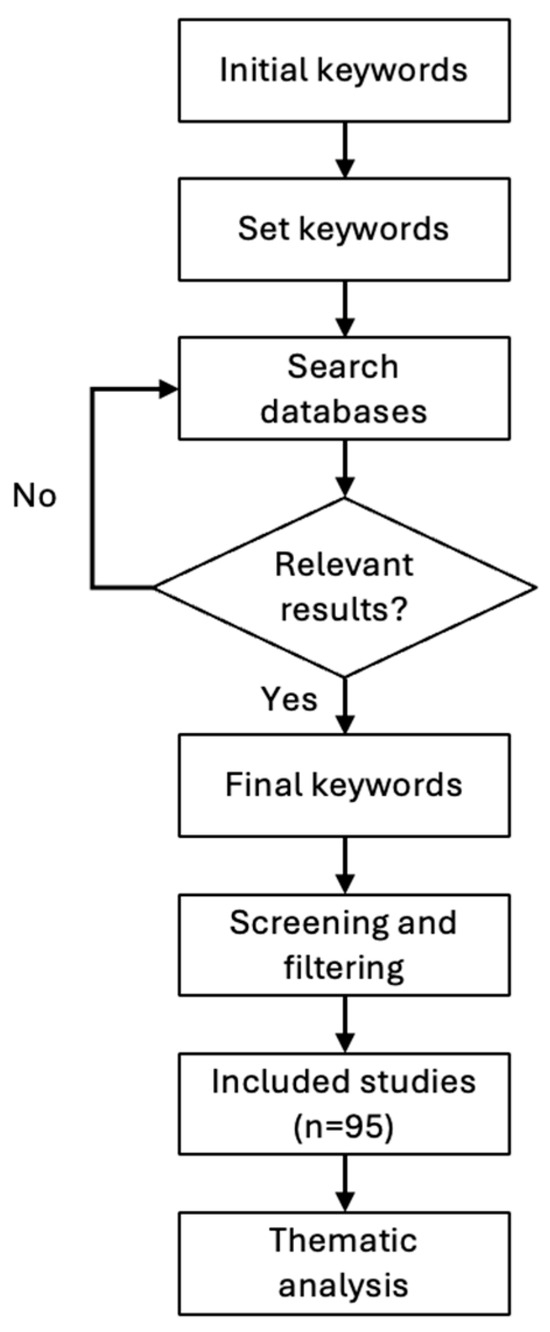
Figure 1 visualize the method used for literature search. The research was initiated with an exploratory approach, driven by an initial theoretical interest in the role of reporting mechanisms within business decision-making environments, supported by technologies based on artificial intelligence. However, the boundaries and scope of the domain were not yet well-defined. To map this broad theoretical landscape, an initial keyword strategy was adopted, including terms such as Business Reporting, Decision Support System, Machine Learning, Case-Based Reasoning, and Narrative. The selection of these search terms was informed by their recurrent presence in the literature on digital decision-making processes, knowledge representation, and AI-supported analytics and representation.
Figure 1.
Research method for literature search, Source: Own design.
The first round of literature searches was conducted using major academic databases, including Web of Science, Scopus, and ScienceDirect, selected for their comprehensive coverage of peer-reviewed scientific literature. While these searches returned a considerable number of publications, many of the results were either too generic or only marginally relevant. For instance, the term “business reporting” frequently returned results focused on financial or statutory reports, with minimal emphasis on narrative or AI-enhanced components. Mousa et al. argue that traditional business reporting focuses on financial and statutory outputs while overlooking the strategic value of narrative and AI-enhanced elements. Recent research challenges this view by showing that well-structured narrative disclosures can influence financial outcomes and support more advanced, technology-driven reporting. (Mousa et al., 2022). In a similar manner, the terms “case-based reasoning” and “machine learning” proved to be excessively broad when not accompanied by additional qualifiers. As discussed by Kino et al., Machine Learning (ML) has spread rapidly from computer science to a variety of other disciplines. Thanks to its predictive capacity, ML offers new opportunities (Kino et al., 2021). This resulted in the literature that was extensively focused on technical algorithms and had limited relevance to business application contexts.
In view of the lack of conceptual clarity and alignment with the research objectives, the process moved into a second literature search phase. In this round, the search strategy was adapted to test new keyword combinations, incorporating terminological and conceptual refinements based on preliminary readings. This iterative strategy was found to be pivotal in enhancing the specificity of search outcomes. The following combinations were included in the testing:
- Decision Support System AND Summary AND Case-Based reasoning OR Machine Learning AND Narrative
- Statement AND Decision Support System OR Machine Learning AND Narrative AND Business Analysis
- Report AND Machine Learning AND Business Analysis AND Narrative
These refined combinations resulted in more targeted outcomes, although they also demonstrated inconsistencies in the ways in which key themes such as narrative reporting or machine learning integration were addressed across different domains. This finding indicated the presence of a fragmented nature within the existing literature, with specific domains such as DSS and machine learning demonstrating a high level of technical complexity, while others, including narrative and reporting, exhibited a greater emphasis on conceptual or managerial aspects. The usage of technical solutions effecting on reporting as Berkin et al. reviewed with several cases, they demonstrate that machine learning methods can effectively support the reporting and analysis of attributional content in corporate disclosures, classifying performance-related attributional statements (Berkin et al., 2023). Bassyouny and Machokoto investigated how the narrative approach and textual explanations affect reports in the context of managerial decision-making and its negative effects (Bassyouny & Machokoto, 2024). Nevertheless, this phase revealed more relevant papers dealing with the integration of Natural Language Processing (NLP), automation in business reporting, and cognitive support systems for decision-makers.
Following a thorough evaluation of recurring themes, terminologies, and article structures, the final set of keywords was defined. The following were identified: Business Analytics, Decision Support Systems, Narrative Reporting and Machine Learning. This collection of refined sets most effectively captured the thematic focus of the research, which explored the potential for embedding data analytics and AI within narrative-based reporting systems to enhance decision quality. Furthermore, this combination reflects a transdisciplinary synthesis of business intelligence, computational and natural language processing, and human-centered system design.
Subsequent searches were then conducted using the final keywords in ScienceDirect and Web of Science, which had previously returned the highest proportion of domain-relevant publications. The second-level querying process was characterized by enhanced structure and deliberation. The methodology comprised the filtration of search results by publication type, date range and subject area. In this particular iteration, the relevance of search results underwent a substantial increase. This was due to the identification of several core studies that addressed the convergence of automated reporting systems, narrative framing in business communication, and AI-supported DSS solutions.
The present literature search strategy combined deductive and inductive approaches. The deductive aspect of the research involved the utilization of established theories and terminologies to inform the initial search strategy. Concurrently, the inductive component assumed significance as keywords were iteratively evaluated, outcomes appraised, and search strategies adapted in response to lacunae and incongruities in the extant literature. This dual approach enabled the research to maintain flexibility and reflexivity, qualities that are imperative in fields where disciplinary boundaries are permeable and undergoing rapid evolution.
It is important to note that this methodology revealed the interconnectedness and fragmentation of the research domains involved. For instance, the field of business analytics is frequently associated with the use of dashboards and the visualisation of KPIs. In contrast, narrative reporting often remains rooted in qualitative or managerial domains. However, the extant literature lacks explicit connections between the narrative framing of business insights and machine learning-enabled analysis. Concurrently, DSS research has progressively incorporated AI components, however, storytelling has rarely been integrated as a formal decision-enhancing tool. This observation underscores a key contribution of this study, to establish a conceptual synthesis that treats narrative as an analytical device, rather than merely a rhetorical or communicative instrument.
The literature selection process was based on explicit inclusion and exclusion criteria. Included studies were peer-reviewed journal articles published between 2021 and 2025 in Web of Science, Scopus, or ScienceDirect and showing clear relevance to business analytics, decision support systems, machine learning, or narrative reporting in organizational decision-making contexts. Screening was conducted through duplicate removal, title/keyword review, abstract screening, and full-text assessment, while irrelevant, duplicate, non-peer-reviewed, and purely technical studies without business-reporting relevance were excluded.
To enhance reliability and reduce selection bias, the review followed predefined inclusion and exclusion criteria and a multi-stage screening procedure consisting of duplicate removal, title and keyword screening, abstract review, and full-text assessment. Multiple academic databases reduced dependence on a single indexing source. Iterative keyword refinement helped to minimise the risk of overlooking relevant studies due to terminology differences. Peer-reviewed publications with clear relevance were kept. All this was done to improve the consistency, transparency and reproducibility of the selection process.
The chosen literature was evaluated based on how well it was related to the topic, how good the methods were, and how much it helps us understand how storytelling can help with using artificial intelligence to make decisions. Each article was carefully read to find out about its ideas and how they are used. Each article was read and evaluated in relation to its conceptual relevance, methodological quality, and contribution to understanding how narrative reporting and AI supporting decision-making. In order to provide a complementary analysis of the qualitative findings, VOSviewer was utilised as a bibliometric mapping tool to facilitate the analysis of keyword co-occurrence patterns within the final article set. The purpose of this step was not to replace interpretation, but rather to support it by visualising thematic proximity, dominant clusters, and weakly connected concepts across the literature. In this way, VOSviewer complemented the review by providing an additional structural perspective on how business analytics, decision support systems, machine learning, and narrative reporting are positioned in relation to one another, thereby helping to identify fragmentation and underexplored intersections within the field.
In conclusion, the literature search strategy adopted for this article is demonstrative of a methodologically reflective and iterative process. The research began with a broad exploration using conventional and established terminology, advanced through cycles of refinement, and culminated in a focused, high-relevance set of scholarly contributions. This methodological pathway not only ensured thematic alignment with the research goals but also reflects the dynamic nature of emerging interdisciplinary fields, where conceptual clarity is often achieved through recursive engagement with the literature.
4. Results
The review of 95 publications revealed three main results. First, the literature is dominated by business analytics, DSS, and machine learning studies emphasizing dashboards, automation, and predictive models. Second, narrative reporting appears far less frequently as a core analytical component and is usually treated as a complementary communication layer. Third, only a limited subset of recent studies explicitly connects narrative techniques with AI-enabled decision support, indicating a fragmented but emerging research area.
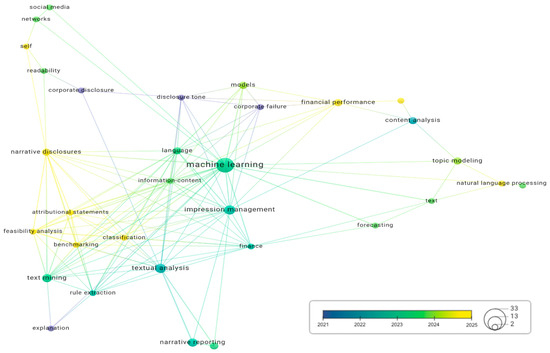
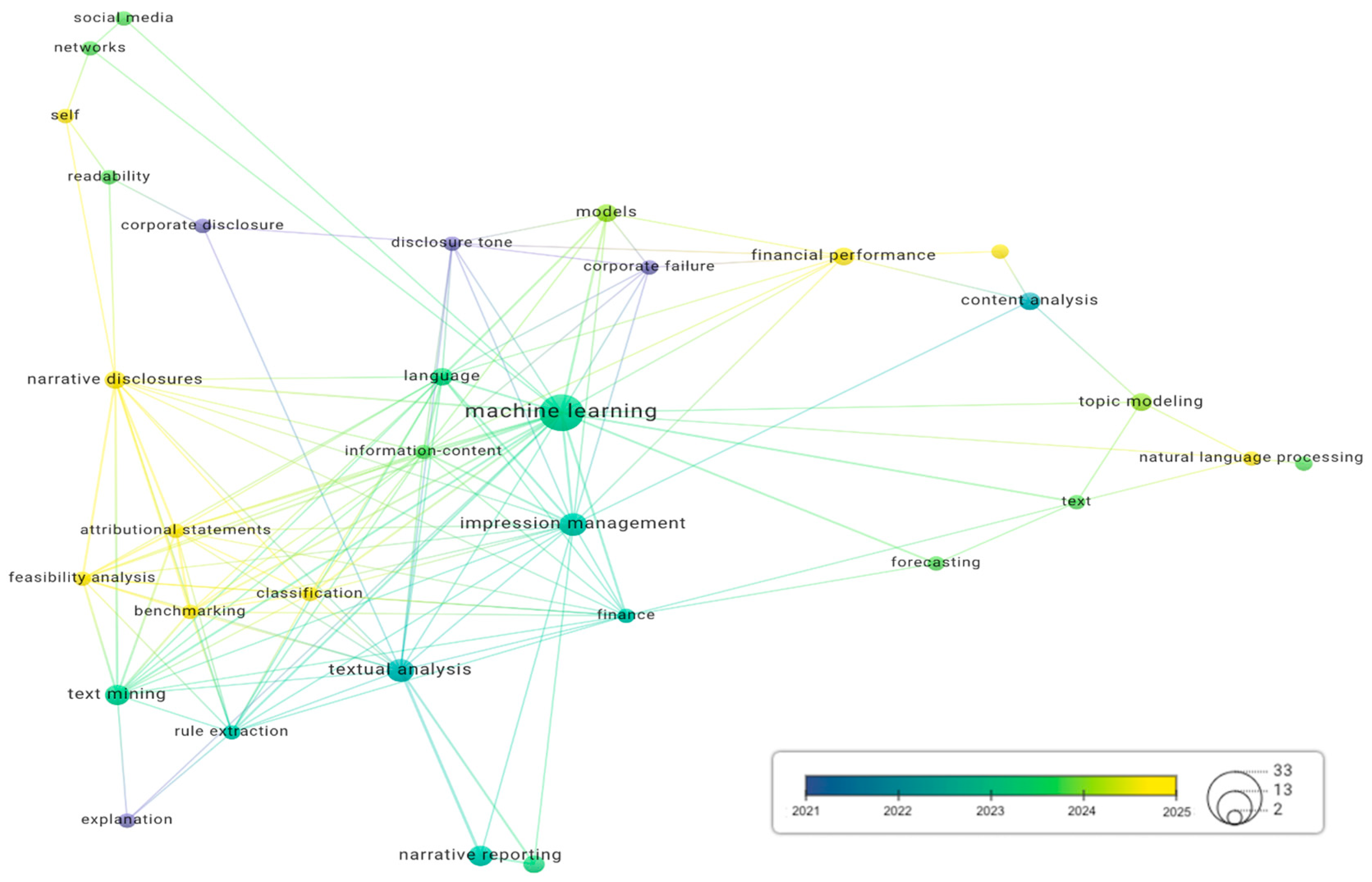
Following the initial screening process, our research focused on publications selected from the Web of Science, Scopus and ScienceDirect databases. To gain a comprehensive overview of the most commonly used keywords within these studies, we employed VosViewer, a software tool well-suited to analyzing keyword density. As shown in Figure 2, the analyzed publications, which met our criteria for keyword relevance, were published between 2021 and 2025. This timeframe enabled us to capture recent but mature developments in the field.
Figure 2.
Key word distribution between 2021 and 2025, Source: Own design.
Keyword density analysis is crucial for identifying dominant research themes and the methodologies and tools favored in current academic discourse. The reviewed literature offers diverse perspectives on the application of business analytics, decision support systems, narrative reporting and machine learning. While some studies delve into technical and methodological frameworks, others emphasize practical implementations and strategic implications. The widespread use of advanced techniques such as machine learning, textual analytics and narrative reporting across these publications highlights the growing sophistication of data-driven decision-making in business and economics. Meanwhile, narrative reporting is emerging as a valuable practice for contextualizing data and articulating meaningful connections between data points.
To support interpretation, Figure 2 presents a VOSviewer keyword co-occurrence network based on the final set of reviewed publications. In this visualization, each node represents a keyword, and node size indicates the frequency with which that keyword appears in the sample. The links between nodes represent co-occurrence relationships, while link strength reflects how often two keywords appear together in the same publications. Different colors indicate clusters of closely related terms, revealing thematic groupings within the literature.
The analysis indicates a gradual shift in reporting practices over time, particularly in the techniques and frameworks applied. As shown in Figure 2, the period from 2021 to 2025 reflects a transition away from traditional corporate-level disclosures and public reporting toward a more dynamic and nuanced mode of communication. This change is evident not only across different reporting levels but also in the broader evolution of external information dissemination.
By 2025, public reports will increasingly incorporate advanced approaches such as benchmarking and natural language processing. In addition, the literature highlights a growing focus on personalized and interactive reporting formats, pointing to a shift toward peer-to-peer communication and stronger integration across corporate reporting structures.
4.1. Business Analytics
We found that the term Business Analytics was used in most cases as part of the technological definition. Shiyyab et al. highlight the growing use of business analytics in corporate reporting and its role in improving operational insight. Their analysis shows that greater transparency about analytics tools is associated with better financial performance, including higher profitability and lower costs, underscoring their strategic value for reporting and decision-making (Shiyyab et al., 2023). Serag highlights big data analytics as a key factor in improving sustainability reporting and shaping management practices. The study shows that analytics strengthens the link between stakeholder engagement and sustainability reporting, helping align reporting with organizational goals and stakeholder expectations (Serag, 2024). In addition, Herhausen et al. show that text analysis methods, can transform business communication into actionable insights, reinforcing the role of business analytics not only in data preparation but also in extracting meaning from textual data for research and decision support (Herhausen et al., 2025). Business analytics is a key enabler for clear reporting, however, the focus is less on the interpretation of the data and more on its preparation.
4.2. Decision Support System
Business analytics supports decision-making by transforming available data into actionable insights through predefined rules, models, and key performance indicators. Within this process, DSS play a central role by integrating data from multiple sources and presenting information in ways that facilitate managerial interpretation. Martins et al. emphasize that DSS improve business performance by delivering timely and reliable information through meaningful KPI visualizations, thereby enhancing decision-making quality, productivity, and organizational responsiveness. (Martins et al., 2022) Similarly, Nahar et al. argue that DSS contribute to greater speed, consistency, and quality in decision-making while also supporting strategic planning and broader organizational performance. (Nahar et al., 2024) Collins and Mandel demonstrated that the format in which analytical results are communicated influences their perceived credibility, showing that numerical and verbal representations of probability can affect how decision-makers interpret and trust information. (Collins & Mandel, 2019) Effective decision support depends not only on data integration and analytical capability, but also on the clear and appropriate presentation of uncertainty. Although limitations related to data quality and methodological variation remain, the literature overall indicates that DSS provide significant strategic value in both research and practice. Moreover, these systems tend to rely heavily on visual and structured outputs, such as dashboards, KPI displays, and numerical indicators, rather than purely text-based explanations, highlighting the importance of presentation format in decision support.
4.3. Narrative Reporting
According to Abdallah, Narrative reporting serves as a strategic tool for enhancing transparency and legitimacy, shaped by both internal governance structures and external institutional pressures. Vu et al. provide empirical evidence that narrative-related disclosures in annual reports significantly influence corporate risk-taking behavior (Vu et al., 2025). The effectiveness of these internal mechanisms is influenced by the surrounding institutional context, emphasizing that the depth and quality of narrative reporting are products of both organizational practices and societal expectations (Abdallah, 2023). This broader view is consistent with Michelon et al., who describe narrative reporting as an increasingly important and often mandated reporting practice, while also stressing the managerial discretion involved in shaping narrative content and identifying important future challenges for the field (Michelon et al., 2022). Rybinski’s approach to evaluating professional forecasters ranks them based on the quality of their narratives. The methodology combines web data extraction, natural language processing and forecasting models. The findings reveal that incorporating narrative-based NLP indexes improves forecast performance (Rybinski, 2021). Narrative reporting appears in the reviewed literature, primarily in accounting, disclosure, sustainability, and risk communication contexts, but it is rarely modelled as a formal component of decision-support system architecture. Recent studies indicate that narratives influence interpretation, trust, risk perception, and forecast quality. In this respect, Dhami and Mandel show that how uncertainty is communicated substantially affects how information is interpreted, reinforcing the importance of narrative form in shaping judgment and decision-making under uncertainty (Dhami & Mandel, 2022). Even so, the literature continues to treat narrative mainly as a communication output rather than as a form of decision logic or an analytical layer. This creates a disconnect between contextual explanation and system-based decision support.
4.4. Machine Learning
Machine Learning has emerged as a transformative force in business reporting, enabling firms to process vast volumes of both structured and unstructured data with greater efficiency, accuracy, and predictive capability. Gupta et al. demonstrate how generative AI can automate data extraction, revision, and synthesis within reporting workflows (Gupta et al., 2025). Wang et al. shared that, by leveraging advanced ML models, organizations can automate routine reporting tasks, uncover hidden patterns, and generate real-time insights that support strategic decision-making (Wang et al., 2024). Yeo and Chu note that this shift improves the agility of corporate reporting systems, helping firms adapt to changing market conditions. They also show that ML enables deeper analysis, such as sentiment and trend forecasting, beyond traditional methods. (Yeo & Chu, 2024). Chen et al. show that integrating large language models with knowledge-graph reasoning enables automated generation of structured monitoring reports (Chen et al., 2025). The integration of ML into reporting systems not only improves data reliability and consistency but also supports transparency and accountability by reducing human bias and error (Belle & Papantonis, 2021). Collectively, these advancements underscore the pivotal role of machine learning in redefining the scope and impact of business reporting in the digital era.
When the four thematic areas are considered collectively, the reviewed literature discloses an imbalance. The fields of Business Analytics, DSS, and Machine Learning are frequently linked through data processing, visualization, and automation. However, the degree of connection between narrative reporting and these architectures remains limited, with the former generally occupying a position in the communication layer rather than the analytical core. This finding indicates that the field has evolved technically faster than cognitively or in interpretation. When considered as a whole, these findings indicate that the reviewed literature can be conceptualized as three partially disconnected streams: quantitative decision-support research, narrative disclosure research, and an emerging integrative stream combining AI and narrative explanation.
5. Discussion
5.1. Research Gap
The reviewed literature reveals a persistent gap at the intersection of decision support systems, business analytics, machine learning, and narrative reporting.
Firstly, a conceptual gap remains because narrative reporting is still primarily framed as a communicative or disclosure-oriented output rather than as a core analytical component of intelligent decision support.
Secondly, a methodological gap persists because existing studies mainly examine narrative disclosure, textual analysis, visualization, or technical machine-learning applications separately, while few studies empirically investigate integrated narrative-enhanced decision-support environments.
Thirdly, a practical and design-related gap is evident because the literature offers limited guidance on how tacit knowledge, contextual reasoning, uncertainty explanation, and machine-generated outputs can be embedded into reporting architectures used in real organizational settings.
While relevant advances have been achieved in data processing, visualization, and algorithm-driven analytics, current approaches continue to prioritize quantitative outputs, such as dashboards, key performance indicators, and numerical summaries. Rather than interpretive and context-rich narrative explanations (Latif et al., 2021; Shao et al., 2024).
Although interest in narrative reporting and natural language processing is increasing, narratives are still predominantly treated as supplementary communication mechanisms rather than integral analytical components within AI-enabled decision environments.
Consequently, human interpretation, tacit domain knowledge, and contextual reasoning remain insufficiently embedded in both theoretical practices and actual reporting architectures (Sigari & Gandomi, 2022).
This fragmentation reflects a structural disconnect between data generation and cognitively meaningful decision support, particularly in organizational contexts where shared understanding across hierarchical levels is essential. Addressing this gap requires revisiting the concept of narrative in terms of its functional analytical elements within intelligent decision support systems.
5.2. Limitations
Despite offering a structured synthesis of current knowledge, this study is subject to methodological and conceptual limitations.
Most notably, the literature search scope was restricted primarily to Web of Science, Scopus, and ScienceDirect, complemented by a limited number of individually known relevant publications. While these databases provide extensive peer-reviewed coverage, the exclusion of additional scientific databases and sources.
Furthermore, the underlying body of literature demonstrates a fragmented distribution of perspectives, with strong emphasis on quantitative analytics and visualization but comparatively limited exploration of narrative-driven or cognitively oriented decision support. This imbalance constrains the ability to draw fully comprehensive conclusions regarding integrated human–AI interpretive frameworks.
Accordingly, the findings should be interpreted as a conceptually grounded yet non-exhaustive synthesis of an evolving interdisciplinary domain.
5.3. Future Research Possibilities
The identified research gap and methodological constraints point toward several important directions for future investigation. Lo Duca and McDowell highlight the potential of generative AI to co-design data-driven stories that enhance interpretability and engagement in analytical contexts (Lo Duca & McDowell, 2025).
Future research should investigate how narrative reporting can be operationalized as a design feature of AI-enabled decision support systems, including the integration of explanatory text, reasoning traces, uncertainty communication, and role-specific reporting outputs.
Comparative empirical studies are needed to examine whether narrative-enhanced reporting environments improve comprehension, trust, decision quality, or strategic alignment relative to dashboard-only or metric-centered systems.
Further studies should explore how to combine human expertise, tacit knowledge, and machine-generated narratives effectively, especially in contexts where decision-making depends on interpretation rather than prediction alone.
Sector-specific research would also be valuable, particularly in sustainability, accounting, risk communication, and operational decision-making, where narrative reporting already plays a visible role but has not yet been fully integrated into decision-support architectures.
Finally, future work should define evaluation criteria for narrative-enhanced decision support, such as interpretability, actionability, cognitive load, trust, decision consistency, and cross-level communication effectiveness.
The development of these avenues would help establish a connection between data production and meaningful decision support, thereby facilitating the advancement of transparent, cognitively informed, and strategically effective business reporting systems.
6. Conclusions
This literature review demonstrates that research at the intersection of business analytics, decision support systems, machine learning, and narrative reporting is developing along three unevenly connected streams. The predominant paradigm emphasizes quantitative decision support through dashboards, KPIs, automation, and predictive analytics. The second stream demonstrates the importance of narrative reporting in shaping interpretation, trust, disclosure quality, and risk perception. However, it generally treats narrative as a communication output rather than a core analytical mechanism. A third emerging body of research combines explainable AI, natural language processing, and machine-generated reporting, yet these efforts remain conceptually fragmented.
The principal conclusion of this review is that current AI-enabled decision support research is technically advanced but still limited in its ability to embed contextual interpretation, tacit expertise, and cognitively meaningful explanation. It is therefore important to understand narrative reporting not as a supplementary presentation layer, but as a potential analytical layer that can connect data-driven outputs with human sense-making in complex organizational settings.
In this sense, the contribution of the present study is dual. Firstly, it synthesizes fragmented literature across four related domains. Secondly, it clarifies that the missing link in current research is the systematic integration of narrative reasoning into intelligent decision-support architectures. This provides a clearer foundation for future work on human-centered, interpretable, and strategically relevant reporting systems.
Author Contributions
Conceptualization, T.Z. and B.D.; Methodology, T.Z.; Formal analysis, B.D.; Investigation, T.Z.; Writing—original draft, T.Z.; Writing—review and editing, T.Z.; Visualization, T.Z.; Supervision, S.R. All authors have read and agreed to the published version of the manuscript.
Funding
Funded by Széchenyi István University’s publication support program for APC fees.
Institutional Review Board Statement
Not applicable.
Informed Consent Statement
Not applicable.
Data Availability Statement
The materials analyzed in this study consist of published articles retrieved from major academic databases. No original dataset was generated, as the study is based on a review and analysis of existing literature.
Conflicts of Interest
The authors declare no conflict of interest.
Abbreviations
The following abbreviations are used in this manuscript:
| AI | Artificial Intelligence |
| DSS | Decision Support System |
References
- Abdallah, M. A. M. (2023). Beyond the depth of narratives, does the multi-layer monitoring-driven view matter in disclosure? Evidence from MENA countries. Cogent Business and Management, 10(2), 2213958. [Google Scholar] [CrossRef] [Scilit]
- Baracskai, Z., Velencei, J., & Dörfler, V. (2005). Reductive reasoning. Montenegrin Journal of Economics, 1, 59–66. [Google Scholar]
- Bassyouny, H., Abdelfattah, T., & Tao, L. (2022). Narrative disclosure tone: A review and areas for future research. Journal of International Accounting, Auditing and Taxation, 49, 100511. [Google Scholar] [CrossRef] [Scilit]
- Bassyouny, H., & Machokoto, M. (2024). Does negativity matter under the principle-based approach? Evidence from narrative reporting in the UK. International Journal of Accounting and Information Management, 32(2), 207–227. [Google Scholar] [CrossRef] [Scilit]
- Belle, V., & Papantonis, I. (2021). Principles and practice of explainable machine learning. Frontiers in Big Data, 4, 688969. [Google Scholar] [CrossRef] [Scilit]
- Berger, J., Packard, G., Boghrati, R., Hsu, M., Humphreys, A., Luangrath, A., Moore, S., Nave, G., Olivola, C., & Rocklage, M. (2022). Wisdom from words: Marketing insights from text. Marketing Letters, 33, 365–377. [Google Scholar] [CrossRef] [Scilit]
- Berkin, A., Aerts, W., & Van Caneghem, T. (2023). Feasibility analysis of machine learning for performance-related attributional statements. International Journal of Accounting Information Systems, 48, 100597. [Google Scholar] [CrossRef] [Scilit]
- Cao, G., Duan, Y., & Li, G. (2015). Linking business analytics to decision making effectiveness: A path model analysis. IEEE Transactions on Engineering Management, 62(3), 384–395. [Google Scholar] [CrossRef] [Scilit]
- Chakraborty, B., & Bhattacharjee, T. (2020). A review on textual analysis of corporate disclosure according to the evolution of different automated methods. Journal of Financial Reporting and Accounting, 18(4), 757–777. [Google Scholar] [CrossRef] [Scilit]
- Chen, Z., Qiu, Y., Yang, L., Liao, B., & Cao, D. (2025). Automatic generation of monitoring report based on large language model and knowledge graph inference. Results in Engineering, 26, 104795. [Google Scholar] [CrossRef] [Scilit]
- Cilliers, P., & Nicolescu, B. (2012). Complexity and transdisciplinarity—Discontinuity, levels of reality and the hidden third. Futures, 44(8), 711–718. [Google Scholar] [CrossRef] [Scilit]
- Collins, R. N., & Mandel, D. R. (2019). Cultivating credibility with probability words and numbers. Judgment and Decision Making, 14(6), 683–695. [Google Scholar] [CrossRef] [Scilit]
- Dhami, M. K., & Mandel, D. R. (2022). Communicating uncertainty using words and numbers. Trends in Cognitive Sciences, 26(6), 514–526. [Google Scholar] [CrossRef] [Scilit]
- Gupta, R., Pandey, G., & Pal, S. K. (2025). Automating government report generation: A generative AI approach for efficient data extraction, analysis, and visualization. Digital Government: Research and Practice, 6, 4. [Google Scholar] [CrossRef] [Scilit]
- Henry, E. (2008). Are investors influenced by how earnings press releases are written? Journal of Business Communication, 45(4), 363–407. [Google Scholar] [CrossRef] [Scilit]
- Herhausen, D., Ludwig, S., Abedin, E., Ul Haque, N., & de Jong, D. (2025). From words to insights: Text analysis in business research. Journal of Business Research, 198, 115491. [Google Scholar] [CrossRef] [Scilit]
- Kino, S., Hsu, Y.-T., Shiba, K., Chien, Y.-S., Mita, C., Kawachi, I., & Daoud, A. (2021). A scoping review on the use of machine learning in research on social determinants of health: Trends and research prospects. SSM—Population Health, 15, 100836. [Google Scholar] [CrossRef] [Scilit]
- Kramer, M. W., & Crespy, D. A. (2011). Communicating collaborative leadership. The Leadership Quarterly, 22(5), 1024–1037. [Google Scholar] [CrossRef] [Scilit]
- Latif, S., Chen, S., & Beck, F. (2021). A deeper understanding of visualization-text interplay in geographic data-driven stories. Computer Graphics Forum, 40(3), 311–322. [Google Scholar] [CrossRef] [Scilit]
- Lo Duca, A., & McDowell, K. (2025). Using the S-DIKW framework to transform data visualization into data storytelling. Journal of the Association for Information Science and Technology, 76(5), 803–818. [Google Scholar] [CrossRef] [Scilit]
- Loughran, T., & Mcdonald, B. (2016). Textual analysis in accounting and finance: A survey. Journal of Accounting Research, 54(4), 1187–1230. [Google Scholar] [CrossRef] [Scilit]
- Marbun, T., Antarani, P., & Putri, M. (2023). Effective communication results in effective leadership. Daengku: Journal of Humanities and Social Sciences Innovation, 3, 571–578. [Google Scholar] [CrossRef] [Scilit]
- Martens, D., Hinns, J., Dams, C., Vergouwen, M., & Evgeniou, T. (2025). Tell me a story! Narrative-driven XAI with large language models. Decision Support Systems, 191, 114402. [Google Scholar] [CrossRef] [Scilit]
- Martins, A., Abbasi, M., Martins, P., & Sá, F. (2022). BigData oriented to business decision making: A real case study in constructel. Computational and Mathematical Organization Theory, 28(3), 271–291. [Google Scholar] [CrossRef] [Scilit]
- Michelon, G., Trojanowski, G., & Sealy, R. (2022). Narrative reporting: State of the art and future challenges. Accounting in Europe, 19(1), 7–47. [Google Scholar] [CrossRef] [Scilit]
- Mousa, G. A., Elamir, E. A. H., & Hussainey, K. (2022). The effect of annual report narratives on the cost of capital in the Middle East and North Africa: A machine learning approach. Research in International Business and Finance, 62, 101675. [Google Scholar] [CrossRef] [Scilit]
- Mueller-Bloch, C., & Kranz, J. (2015, December 13–16). A framework for rigorously identifying research gaps in qualitative literature reviews. Thirty Sixth International Conference on Information Systems, Dallas, TX, USA. [Google Scholar]
- Nahar, A., Paul, S., & Saikia, M. J. (2024). A systematic review on machine learning approaches in cerebral palsy research. PeerJ, 12, e18270. [Google Scholar] [CrossRef] [Scilit]
- Russell, B. (1905). On denoting. Mind, 14(56), 479–493. [Google Scholar] [CrossRef] [Scilit]
- Rybinski, K. (2021). Ranking professional forecasters by the predictive power of their narratives. International Journal of Forecasting, 37(1), 186–204. [Google Scholar] [CrossRef] [Scilit]
- Scipione, P. A. (1995). The value of words—Numerical perceptions associated with descriptive words and phrases in market-research reports. Journal of Advertising Research, 35(3), 36–43. [Google Scholar] [CrossRef] [Scilit]
- Serag, M. A. (2024). Enhancing quality of sustainability reporting based stakeholder engagement by using big data analytics: A higher order PLS-SEM analysis. International Journal of Business and Systems Research, 18(5), 483–513. [Google Scholar] [CrossRef] [Scilit]
- Shao, H., Martinez-Maldonado, R., Echeverria, V., Yan, L., & Gasevic, D. (2024, May 11–16). Data storytelling in data visualisation: Does it enhance the efficiency and effectiveness of information retrieval and insights comprehension? CHI Conference on Human Factors in Computing Systems (pp. 1–21), Honolulu, HI, USA. [Google Scholar] [CrossRef] [Scilit]
- Shiyyab, F. S., Alzoubi, A. B., Obidat, Q. M., & Alshurafat, H. (2023). the impact of artificial intelligence disclosure on financial performance. International Journal of Financial Studies, 11(3), 115. [Google Scholar] [CrossRef] [Scilit]
- Sigari, S., & Gandomi, A. H. (2022). Analyzing the past, improving the future: A multiscale opinion tracking model for optimizing business performance. Humanities and Social Sciences Communications, 9(1), 341. [Google Scholar] [CrossRef] [Scilit]
- Vu, L. P. T., Mai, A. N., Nguyen, T. H., Nguyen, T. H., Nguyen, T. T., & Bui, Q. T. (2025). Do narrative-related disclosures in annual reports influence corporate risk-taking? International Review of Economics & Finance, 103, 104489. [Google Scholar] [CrossRef] [Scilit]
- Wang, R., Salleh, H., Lyu, J., Abdul-Samad, Z., Radzuan, N. F. M., & Wen, K. C. (2024). Application and prospect of machine learning techniques in cost estimation of building projects. Engineering Construction and Architectural Management, 32(12), 8445–8471. [Google Scholar] [CrossRef] [Scilit]
- Yeo, T. E. D., & Chu, T. H. (2024). Adaptive self-reflection as a social media self-effect: Insights from computational text analyses of self-disclosures of unreported sexual victimization in a hashtag campaign. Social Science Computer Review, 43(2), 341–355. [Google Scholar] [CrossRef] [Scilit]
Disclaimer/Publisher’s Note: The statements, opinions and data contained in all publications are solely those of the individual author(s) and contributor(s) and not of MDPI and/or the editor(s). MDPI and/or the editor(s) disclaim responsibility for any injury to people or property resulting from any ideas, methods, instructions or products referred to in the content. |
© 2026 by the authors. Licensee MDPI, Basel, Switzerland. This article is an open access article distributed under the terms and conditions of the Creative Commons Attribution (CC BY) license.