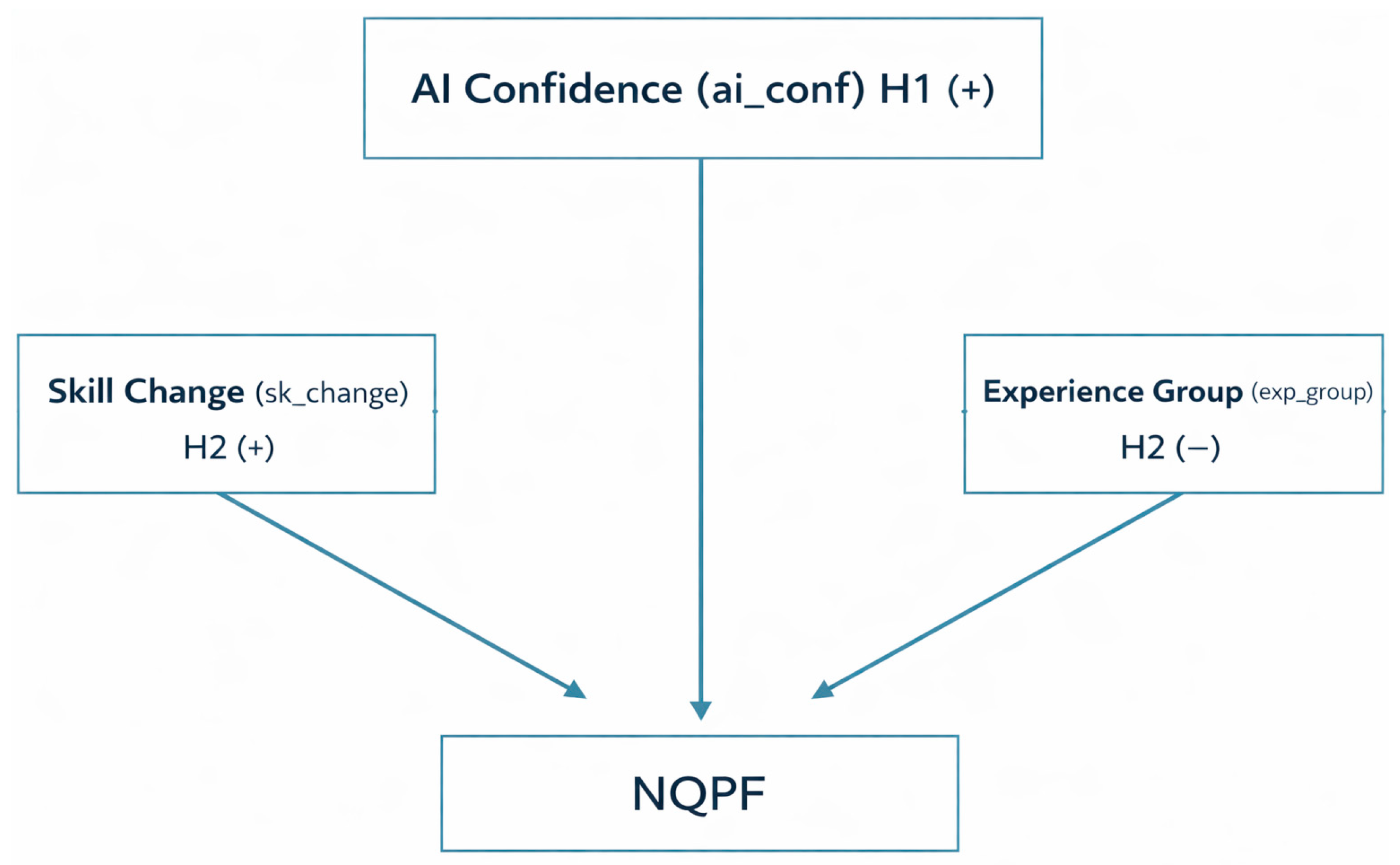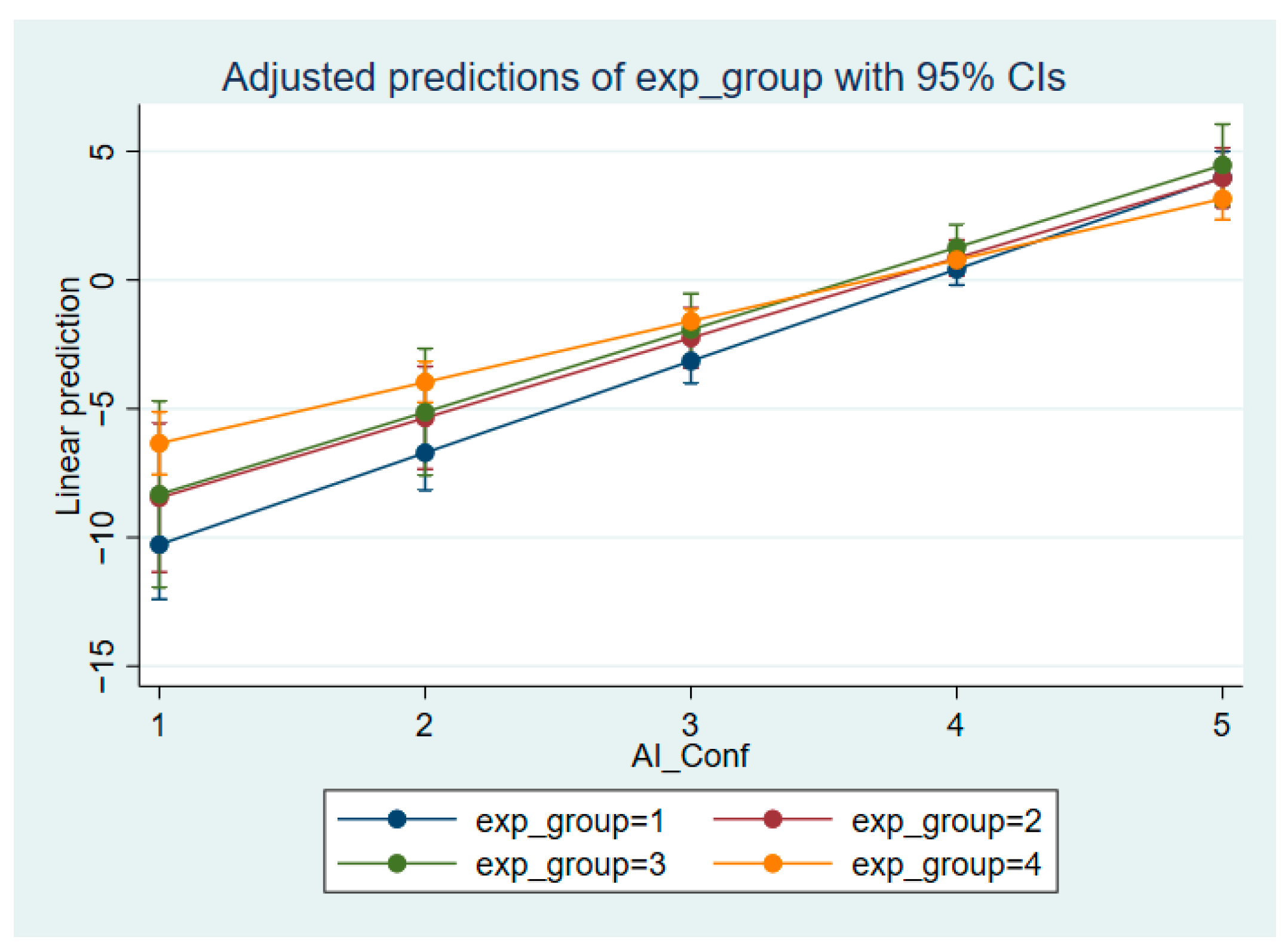
Artificial Intelligence and New Quality Productive Forces: Evidence from Vietnam’s Banking Sector


Abstract
1. Introduction
Theoretical Tension: AI as an External Driver or a Constitutive Element of NQPF?
2. Theoretical Framework and Hypotheses Development
2.1. New Quality Productive Forces
2.1.1. Philosophical Roots of NQPF: Marx’s Theory of Productive Force
2.1.2. The Emergence of NQPF Concept
2.2. AI Confidence
2.3. Experience
2.4. Skill Change
3. Research Methodology
3.1. Research Design
3.2. Sample Size and Recruitment
3.2.1. Selection Criteria
- (1)
- they must be full-time employees working in a commercial bank in Vietnam;
- (2)
- they must have direct or indirect exposure to AI-enabled systems or digital automation tools in their daily work;
- (3)
- they must have at least six months of work experience to ensure sufficient familiarity with organizational processes and AI applications.
3.2.2. Survey Procedure
3.2.3. Data Collection Period and Sample Size
3.2.4. Data Cleaning and Screening Procedures
3.3. Variable Measurement
3.4. Measurement Design
3.5. Ethics Considerations
4. Findings
4.1. Measurement Scale Reliability
4.2. EFA and PCA
4.2.1. Exploratory Factor Analysis (EFA)
4.2.2. Principal Component Analysis (PCA)
4.3. Hypothesis Testing
5. Discussion
5.1. Theoretical Implications
5.2. Practical Implications
5.3. Limitations and Future Research Directions
6. Conclusions
Author Contributions
Funding
Institutional Review Board Statement
Informed Consent Statement
Data Availability Statement
Acknowledgments
Conflicts of Interest
References
- Ahmed, M., Saha, T., Hossain, T., Hoque, E., & Miah, M. R. (2025). Adoption of cloud accounting and its impact on financial performance: A study on the banking industry of Bangladesh. Journal of Banking and Financial Technology, 9, 51–62. [Google Scholar] [CrossRef] [Scilit]
- Andriyansah, A., & Saputra, N. (2025). Product values in the digital era and the quest for sustainable competitive advantage: A bibliometric mapping of trends. International Review of Management and Marketing, 15(6), 252–268. [Google Scholar] [CrossRef] [Scilit]
- Argote, L., & Miron-Spektor, E. (2011). Organizational learning: From experience to knowledge. Organization Science, 22(5), 1123–1137. [Google Scholar] [CrossRef] [Scilit]
- Bowles, S. (1985). The production process in a competitive economy: Walrasian, neo-hobbesian, and Marxian models. The American Economic Review, 75(1), 16–36. [Google Scholar]
- Braverman, H. (1974). Labor and monopoly capital: The degradation of work in the twentieth century. Monthly Review Press. [Google Scholar]
- Burchell, B., Elliott, J., Rubery, J., & Wilkinson, F. (1994). Management and employee perceptions of skill. In R. Penn, M. Rose, & J. Rubery (Eds.), Skill and occupational change. Oxford University Press. [Google Scholar]
- Chin, T., Li, Z., Huang, L., & Li, X. (2025). How artificial intelligence promotes new quality productive forces of firms: A dynamic capability view. Technological Forecasting and Social Change, 216, 124128. [Google Scholar] [CrossRef] [Scilit]
- Chong, L., Zhang, G., Goucher-Lambert, K., Kotovsky, K., & Cagan, J. (2022). Human confidence in artificial intelligence and in themselves: The evolution and impact of confidence on adoption of AI advice. Computers in Human Behavior, 127, 107018. [Google Scholar] [CrossRef] [Scilit]
- Chowdhury, S., Dey, P., Joel-Edgar, S., Bhattacharya, S., Rodriguez-Espindola, O., Abadie, A., & Truong, L. (2023). Unlocking the value of artificial intelligence in human resource management through AI capability framework. Human Resource Management Review, 33(1), 100899. [Google Scholar] [CrossRef] [Scilit]
- Cohen, W. M., & Levinthal, D. A. (1990). Absorptive capacity: A new perspective on learning and innovation. Administrative Science Quarterly, 35(1), 128–152. [Google Scholar] [CrossRef] [Scilit]
- Dane, E. (2017). Reconsidering the trade-off between expertise and flexibility: A cognitive entrenchment perspective. Academy of Management Review, 35(4), 579–603. [Google Scholar] [CrossRef] [Scilit]
- Deci, E. L., & Ryan, R. M. (1985). The general causality orientations scale: Self-determination in personality. Journal of Research in Personality, 19(2), 109–134. [Google Scholar] [CrossRef] [Scilit]
- Gkinko, L., & Elbanna, A. (2023). Designing trust: The formation of employees’ trust in conversational AI in the digital workplace. Journal of Business Research, 158, 113707. [Google Scholar] [CrossRef] [Scilit]
- Glikson, E., & Woolley, A. W. (2020). Human trust in artificial intelligence: Review of empirical research. Academy of Management Annals, 14(2), 627–660. [Google Scholar] [CrossRef] [Scilit]
- Kolade, O., & Owoseni, A. (2022). Employment 5.0: The work of the future and the future of work. Technology in Society, 71, 102086. [Google Scholar] [CrossRef] [Scilit]
- Kong, H., Yin, Z., Baruch, Y., & Yuan, Y. (2023). The impact of trust in AI on career sustainability: The role of employee–AI collaboration and protean career orientation. Journal of Vocational Behavior, 146, 103928. [Google Scholar] [CrossRef] [Scilit]
- Li, J., Wu, T., Hu, B., Pan, D., & Zhou, Y. (2025). Artificial intelligence and corporate ESG performance. International Review of Financial Analysis, 102, 104036. [Google Scholar] [CrossRef] [Scilit]
- Li, Z., & Qi, H. (2014). Labor process and the social structure of accumulation in China. Review of Radical Political Economics, 46(4), 481–488. [Google Scholar] [CrossRef] [Scilit]
- March, J. G. (1991). Exploration and exploitation in organizational learning. Organization Science, 2(1), 71–87. [Google Scholar] [CrossRef] [Scilit]
- Marx, K. (1844). Economic and philosophical manuscripts. In Karl Marx: Early writings. Penguin Books. [Google Scholar]
- Marx, K., & Engels, F. (1975). Marx and Engels collected works (Vol. 5). Lawrence & Wishart. [Google Scholar]
- Marx, K., & Engels, F. (1988). The German ideology. Prometheus Book. [Google Scholar]
- McGuinness, S., Pouliakas, K., & Redmond, P. (2023). Skills-displacing technological change and its impact on jobs: Challenging technological alarmism? Economics of Innovation and New Technology, 32(3), 370–392. [Google Scholar] [CrossRef] [Scilit]
- Nelson, R. R., & Winter, S. G. (1985). An evolutionary theory of economic change. Harvard University Press. [Google Scholar]
- Perry, T. (2025). Marx and the big mac: An empirical exploration of Marx’s exploitation theory for introductory economics courses. Review of Radical Political Economics, 57(3), 403–410. [Google Scholar] [CrossRef] [Scilit]
- Petach, L., & Wilson, A. (2024). The rise of guard labor in the United States: Evidence from local labor markets. Review of Radical Political Economics, 56(2), 185–213. [Google Scholar] [CrossRef] [Scilit]
- Petriglieri, J. L. (2011). Under threat: Responses to and the consequences of threats to individuals’ identities. The Academy of Management Review, 36(4), 641–662. [Google Scholar]
- Prahalad, C. K., & Bettis, R. A. (1986). The dominant logic: A new linkage between diversity and performance. Strategic Management Journal, 7(6), 485–501. [Google Scholar] [CrossRef] [Scilit]
- Reineholm, C., Lundqvist, D., & Wallo, A. (2024). Change competence: An integrative literature review. Work, 79(2), 569–584. [Google Scholar] [CrossRef] [Scilit]
- Roncolato, L., & Willoughby, J. (2017). Job quality complexities: Self-employment within the low-income communities surrounding Cape Town, South Africa. Review of Radical Political Economics, 49(1), 30–53. [Google Scholar] [CrossRef] [Scilit]
- Rousseau, D. M., Sitkin, S. B., Burt, R. S., & Camerer, C. (1998). Not so different after all: A cross-discipline view of trust. Academy of Management Review, 23(3), 393–404. [Google Scholar] [CrossRef] [Scilit]
- Ryan, R. M., & Deci, E. L. (2000). Self-determination theory and the facilitation of intrinsic motivation, social development, and well-being. American Psychologist, 55(1), 68–78. [Google Scholar] [CrossRef]
- Ryan, R. M., & Deci, E. L. (2023). Self-determination theory. In Encyclopedia of quality of life and well-being research. Springer. [Google Scholar] [CrossRef] [Scilit]
- Saputra, N., Putera, R. E., Zetra, A., Azwar, A., Valentina, T. R., & Mulia, R. A. (2026). Enhancing public management through integrity and organizational citizenship behavior: A systematic review. International Journal of Public Administration, 1–16. [Google Scholar] [CrossRef] [Scilit]
- Shaikh, A. M., & Tonak, E. A. (1994). Measuring the wealth of nations: The political economy of national accounts. Cambridge University Press. [Google Scholar]
- Sydow, J., Schreyögg, G., & Koch, J. (2009). Organizational path dependence: Opening the black box. The Academy of Management Review, 34(4), 689–709. [Google Scholar] [CrossRef] [Scilit]
- Tan, L., Hu, S., Yeo, D., & Cheong, K. H. (2025). Artificial intelligence-enabled adaptive learning platforms: A review. Computers and Education: Artificial Intelligence, 9, 100429. [Google Scholar] [CrossRef] [Scilit]
- Teece, D. J. (2007). Explicating dynamic capabilities: The nature and microfoundations of (sustainable) enterprise performance. Strategic Management Journal, 28(13), 1319–1350. [Google Scholar] [CrossRef] [Scilit]
- Twyman, M., Harvey, N., & Harries, C. (2008). Trust in motives, trust in competence: Separate factors determining the effectiveness of risk communication. Judgment and Decision Making, 3(1), 111–120. [Google Scholar] [CrossRef] [Scilit]
- Wu, J., & Zhan, W. (2026). The impact of new quality productive forces on advanced manufacturing clusters: Empirical evidence from China. Sustainability, 18, 529. [Google Scholar] [CrossRef] [Scilit]
- Xie, F., Jiang, N., & Kuang, X. (2025). Towards an accurate understanding of ‘new quality productive forces’. Economic and Political Studies, 13(1), 1–15. [Google Scholar] [CrossRef] [Scilit]
- Yuan, Y., Kong, H., Baum, T., Liu, Y., Liu, C., Bu, N., Wang, K., & Yin, Z. (2022). Transformational leadership and trust in leadership impacts on employee commitment. Tourism Review, 77(5), 1385–1399. [Google Scholar] [CrossRef] [Scilit]



| NQPF components | Adapted definition to the AI-enabled transformation context |
| Laborer | Enhancement of labor power through skill upgrading, adaptability, and AI-related competencies |
| Resources of Labor | AI infrastructure, digital systems, training programs, and organizational support that constitute the means of production |
| Objects of Labor | Financial data, customer information, credit profiles, and risk assessments that are transformed through AI-mediated labor processes |
| Demographic Construct | Categories | Frequency | Percentage (%) |
|---|---|---|---|
| Age group | 25–34 | 118 | 38.9 |
| 35–44 | 90 | 29.7 | |
| 45–54 | 35 | 11.6 | |
| 55+ | 2 | 0.7 | |
| Work experience | <1 year | 65 | 21.5 |
| 1–3 years | 50 | 16.5 | |
| 4–6 years | 32 | 10.6 | |
| >6 years | 156 | 51.5 | |
| Bank Type | State-owned bank | 85 | 28.1 |
| Joint-stock commercial bank | 205 | 67.7 | |
| Foreign bank | 1 | 0.3 | |
| Others | 12 | 4.0 | |
| Job position | Customer relationship officer | 137 | 45.2 |
| Bank teller | 28 | 9.2 | |
| Branch manager | 20 | 6.6 | |
| Technology specialist | 7 | 2.3 | |
| Others | 111 | 36.6 | |
| Total | 303 | 100 |
| Variable Name | Definition |
|---|---|
| ai_use | Frequency of using AI tools |
| ai_conf | Self-confidence in using AI |
| ai_support | AI support in decision/tasks |
| inf_net | Network quality |
| inf_system | System stability |
| inf_error | Error frequency |
| inf_support | Technical support availability |
| inf_modern | Modernity of infrastructure |
| sk_change | Job transformation due to AI |
| sk_adapt | Adaptability to AI |
| sk_data | Data/digital skills |
| sk_auto | Ability to handle automation |
| sk_creat | Creativity in digital tasks |
| at_pos | Feeling threatened by AI |
| at_fear | Fear of AI displacement |
| at_mot | Motivation to learn |
| at_trust | AI Confidence and recognition |
| trn_form | Formal training programs |
| trn_self | Self-learning |
| trn_onjob | On-the-job learning |
| trn_eff | Training effectiveness |
| oc_collab | Collaboration culture |
| oc_innov | Innovation encouragement |
| oc_support | Internal communication about AI |
| fut_trust | Optimism about AI’s future role |
| fut_conf | Confidence in AI creating more opportunities |
| fut_opp | Willingness to recommend others to work in sector |
| Group of Related Variables | Items | Cronbach’s α |
|---|---|---|
| AI-related variables (ai_use, ai_conf, ai_support) | 3 | 0.880 |
| Technological Infrastructure (inf_net, inf_system, inf_error, inf_support, inf_modern) | 5 | 0.839 |
| Innovation-Supportive Culture (oc_collab, oc_innov, oc_support) | 3 | 0.948 |
| Future Orientation (fut_trust, fut_conf, fut_opp) | 3 | 0.931 |
| Skill Adaptation (sk_change, sk_adapt, sk_data, sk_auto, sk_creat) | 5 | 0.885 |
| AI Training (trn_form, trn_self, trn_onjob, trn_eff) | 4 | 0.938 |
| Observed Variable | Factor 1 | Factor 2 | Uniqueness |
|---|---|---|---|
| inf_net | 0.558 | 0.208 | 0.498 |
| inf_system | 0.544 | 0.245 | 0.475 |
| inf_support | 0.540 | 0.234 | 0.493 |
| sk_data | 0.575 | 0.334 | 0.314 |
| sk_auto | 0.536 | 0.342 | 0.363 |
| at_fear | 0.754 | 0.127 | 0.294 |
| at_mot | 0.696 | 0.148 | 0.364 |
| at_trust | 0.613 | 0.286 | 0.321 |
| trn_form | 0.735 | 0.119 | 0.334 |
| trn_self | 0.724 | 0.177 | 0.281 |
| trn_onjob | 0.847 | 0.048 | 0.228 |
| trn_eff | 0.878 | 0.019 | 0.208 |
| oc_collab | 0.888 | −0.053 | 0.268 |
| oc_innov | 0.930 | −0.094 | 0.236 |
| oc_support | 0.953 | −0.100 | 0.203 |
| fut_trust | 0.900 | −0.088 | 0.282 |
| fut_conf | 0.816 | −0.036 | 0.370 |
| fut_opp | 0.850 | −0.044 | 0.323 |
| Component | Eigenvalue | % Variance | Cumulative % |
|---|---|---|---|
| Comp1 | 12.1235 | 67.35 | 67.35 |
| Comp2 | 1.0480 | 5.82 | 73.18 |
| Comp3 | 0.7002 | 3.89 | 77.07 |
| NQPF (Model 1) | NQPF (Model 2) | |
|---|---|---|
| ai_conf | 1.6887 *** (0.210) | 3.070 *** (0.439) |
| exp_group | 0.353 * (0.165) | 1.556 ** (0.507) |
| sk_change | 0.893 *** (0.199) | 1.171 *** (0.190) |
| inf_error | −0.212 (0.153) | −0.059 (0.151) |
| age_group | −0.362 (0.218) | −0.323 (0.220) |
| ai_conf × exp_group | −0.333 (0.129) ** | |
| Constant | −15.517 *** (1.875) | −15.434 *** (1.625) |
Disclaimer/Publisher’s Note: The statements, opinions and data contained in all publications are solely those of the individual author(s) and contributor(s) and not of MDPI and/or the editor(s). MDPI and/or the editor(s) disclaim responsibility for any injury to people or property resulting from any ideas, methods, instructions or products referred to in the content. |
© 2026 by the authors. Licensee MDPI, Basel, Switzerland. This article is an open access article distributed under the terms and conditions of the Creative Commons Attribution (CC BY) license.
Share and Cite
Hoang, A.P.; Vu, V.T. Artificial Intelligence and New Quality Productive Forces: Evidence from Vietnam’s Banking Sector. Adm. Sci. 2026, 16, 182. https://doi.org/10.3390/admsci16040182
Hoang AP, Vu VT. Artificial Intelligence and New Quality Productive Forces: Evidence from Vietnam’s Banking Sector. Administrative Sciences. 2026; 16(4):182. https://doi.org/10.3390/admsci16040182
Chicago/Turabian StyleHoang, Anh Phuong, and Vinh Thi Vu. 2026. "Artificial Intelligence and New Quality Productive Forces: Evidence from Vietnam’s Banking Sector" Administrative Sciences 16, no. 4: 182. https://doi.org/10.3390/admsci16040182
APA StyleHoang, A. P., & Vu, V. T. (2026). Artificial Intelligence and New Quality Productive Forces: Evidence from Vietnam’s Banking Sector. Administrative Sciences, 16(4), 182. https://doi.org/10.3390/admsci16040182