


Abstract
Benthic communities are a fundamental component of coastal marine ecosystems, regulating energy flow, mediating trophic transfer, and supporting a wide range of ecological functions closely linked to habitat characteristics. In Marine Protected Areas (MPAs), integrative approaches that simultaneously address trophic and functional dimensions are essential to assess ecosystem functioning and resilience to environmental disturbances. This study aimed to characterize and compare the trophic structure and functional diversity of benthic communities in sub-Antarctic fjords and channels of the Magellan region (southern Chile), all of which are located within MPAs and represent contrasting environmental settings characterized by either proglacial influence or a documented history of recurrent harmful algal bloom (HAB) occurrence and paralytic shellfish toxin (PST) exposure. We hypothesized that benthic communities under these contrasting environmental stressors would differ in carbon assimilation pathways, community isotopic niche breadth, and functional organization. Trophic structure was evaluated using stable isotope analysis (δ13C and δ15N), Bayesian mixing models to estimate basal carbon source contributions, and community-level isotopic metrics. Functional diversity was quantified using biological and ecological traits to calculate community- and species-level functional indices. Our results revealed marked differences in trophic organization among localities, whereas global functional diversity indices were consistently low and similar across environmental settings. Communities from localities characterized by recurrent HAB/PST exposure showed limited trophic reliance on pelagic-derived organic matter, maintaining benthic-based energy pathways, whereas proglacial localities exhibited higher allochthonous subsidies and broader isotopic niches. Functional uniqueness and specialization metrics indicated strong functional redundancy and a high dependence on a small set of functionally distinctive species. These findings establish a baseline for remote MPAs and demonstrate the value of integrating trophic and functional metrics in long-term monitoring and adaptive management frameworks.
1. Introduction
Marine ecosystems are experiencing rapid environmental change driven by both natural and anthropogenic stressors. Understanding how these stressors alter biodiversity and ecosystem functioning is central to advancing ecosystem-based management and conservation [1,2]. Contemporary ecology increasingly recognizes that ecosystem stability depends not only on species richness, but also on the distribution of functional traits and the organization of trophic interactions that regulate energy flow [3,4]. Disruptions to either dimension may compromise key ecological processes, particularly under sustained environmental forcing [5,6].
Benthic communities play a pivotal role in coastal ecosystem functioning. They mediate nutrient recycling, organic matter (OM) remineralization, sediment stabilization, and energy transfer to higher trophic levels [7,8,9]. Yet, compared to pelagic systems, benthic communities remain comparatively underexplored, particularly in remote high-latitude environments where logistical constraints have limited long-term integrative studies [10,11]. This limitation is especially relevant in sub-Antarctic fjords of Chilean Patagonia, recognized as biodiversity hotspots harboring over 1600 benthic species and characterized by strong hydrographic gradients and complex habitat mosaics [8,12].
Although Patagonian fjords have been the focus of sustained ecological research over the past decades, investigations have progressed along complementary but largely parallel lines. Early and foundational studies in the Magellan region provided detailed descriptions of benthic composition, spatial heterogeneity, and community responses to physical disturbance, highlighting the strong influence of environmental variability on species dominance patterns and habitat structure [13]. Building on this baseline knowledge, subsequent work emphasized the role of hydrographic gradients, glacier-derived inputs, and substrate instability in shaping benthic communities and modifying the representation of functional groups along inner–outer fjord gradients [14,15,16]. Together, these studies have established environmental filtering as a central process structuring sub-Antarctic benthic systems. In parallel, trophic ecology studies have advanced our understanding of energy pathways in these fjords. Stable isotope analyses have revealed substantial assimilation of macroalgal carbon, widespread omnivory, and the importance of terrestrial and sedimentary OM as trophic subsidies, particularly in glacier-influenced environments [17,18,19,20,21,22].
Collectively, these contributions provide a robust ecological foundation for the region. However, the simultaneous evaluation of trophic structure and functional trait space within the same comparative framework remains limited, particularly under contrasting natural stress regimes. Integrating these dimensions improves our understanding of how environmental forcing reshapes both energy pathways and ecological functions in fjord ecosystems.
Moreover, sub-Antarctic fjord systems are increasingly exposed to contrasting environmental stressors. Glacier retreat intensifies freshwater discharge and terrigenous sediment inputs, altering salinity, turbidity, and resource availability [23,24]. Elevated loads of allochthonous particulate OM, particularly during the austral summer, can act as energetic subsidies of variable quality for benthic consumers [25]. In some Patagonian fjords, high terrestrial inputs have been associated with reduced trophic-functional diversity and increased trophic redundancy, with communities dominated by generalist or non-selective feeding strategies [19]. Inner–outer fjord gradients often reflect this shift, with increased sedimentary OM and simplified trophic structures in more glacier-influenced sectors [14,19,26].
In contrast, blooms of the toxic dinoflagellate Alexandrium catenella have shown recurrent occurrence and geographic expansion across Chilean Patagonia [27,28]. Harmful algal blooms (HABs) can modify energy pathways through several mechanisms, including toxin transfer, changes in food quality and, in high-biomass events, oxygen depletion associated with bloom decay [29]. However, the relative importance of these mechanisms varies considerably among bloom-forming taxa and environmental settings. For A. catenella specifically, experimental evidence in Chile indicates that exposure to toxic cells can alter feeding and digestive processes in benthic suspension feeders, although responses vary among species and some taxa may acclimate to prolonged exposure [30]. Moreover, paralytic shellfish toxins (PSTs) produced by A. catenella can accumulate in benthic consumers and be transferred to higher trophic levels through predator–prey interactions [31]. Field observations from southern South America further show that intense A. catenella blooms can be associated with adverse effects on benthic invertebrates and multispecies mortality events, while PSTs may propagate across multiple trophic levels [32,33]. The benthic–pelagic connection is further reinforced by the life cycle of A. catenella, which includes a resting-cyst stage that can persist in marine sediments and contribute to subsequent bloom initiation under favorable conditions [34]. Available evidence therefore indicates that recurrent A. catenella events have the potential to influence benthic trophic pathways and pelagic–benthic coupling. Nevertheless, their broader consequences for the organization and functioning of natural benthic communities remain poorly understood, particularly under field conditions in Chilean Patagonia.
Although the incorporation of bloom-forming microalgae into benthic food webs remains poorly documented, particularly for blooms caused by A. catenella in Chilean Patagonia, the few available stable isotope studies from other environments and involving different bloom-forming taxa provide evidence that bloom-derived OM can be traced within benthic consumers, sometimes accompanied by reduced benthic diversity and trophic simplification [35].
Despite growing evidence of environmental forcing in Patagonian fjords, ecological studies have often addressed structural, taxonomic, or habitat-based aspects separately. Integrative approaches that explicitly link trophic processes and functional organization remain limited. Stable isotope analysis (δ13C–δ15N) provides a robust framework for tracing OM sources, estimating trophic positions, and quantifying community-level niche structure [36,37]. Community-wide isotopic metrics proposed by Layman et al. [38]—including carbon range (CR), nitrogen range (NR), total area (TA), centroid distance (CD), and mean nearest neighbor distance (MNND)—allow quantitative evaluation of trophic diversity, trophic redundancy, and food web packing within isotopic space. These metrics have proven effective in detecting trophic niche compression under chronic disturbances such as bottom trawling [39] and in assessing early trophic responses to spatial protection in marine reserves [40], although context-dependent outcomes have also been documented [41,42].
Beyond trophic interactions, functional diversity offers a complementary perspective by quantifying how ecological roles are distributed within communities [43]. Trait-based approaches have demonstrated that ecosystem functioning depends more strongly on trait composition and distribution than on species richness per se [4,44]. Metrics such as functional richness (FRic), functional evenness (FEve), and functional divergence (FDiv) have revealed sensitive responses to environmental gradients in benthic systems worldwide [45,46]. In sub-Antarctic fjords, recent studies suggest relatively low functional richness but high functional evenness and divergence, indicating communities structured within a constrained functional space and often sustained by a limited number of dominant species [47,48]. Such configurations may confer short-term stability through redundancy, yet increase vulnerability if key species are selectively impacted.
Importantly, isotopic and functional metrics may not respond synchronously to environmental stress. Isotopic niche metrics can be interpreted as isotopic analogues of functional diversity [49], with total area (TA) approximating isotopic functional richness and MNND reflecting isotopic evenness. However, evidence from Arctic fjords indicates that higher taxonomic and functional diversity does not necessarily translate into larger isotopic niche breadths [50], highlighting the potential for decoupling between trophic and functional dimensions. In Patagonian fjords, where macroalgal and mixed benthic–pelagic subsidies may dominate energy pathways, this relationship remains unresolved.
From a management perspective, integrating trophic and functional dimensions strengthens the ecological basis for conservation and ecosystem-based management. Community-level isotopic metrics have been shown to detect shifts in energy pathways and trophic structure under environmental disturbance and fishing pressure, often preceding detectable changes in biomass or species richness [38,39]. Likewise, trait-based functional approaches provide mechanistic insight into how ecosystem processes are distributed across species and whether functional redundancy can buffer environmental perturbations [4,51,52]. Evaluating these dimensions simultaneously enhances the capacity to identify systems that may appear taxonomically stable yet functionally vulnerable, or that exhibit trophic reorganization without proportional functional restructuring [49]. Such multidimensional baselines are particularly relevant in Marine Protected Areas (MPAs), where ecosystem functioning and not solely species richness, underpins long-term conservation outcomes [53,54]. Integrative trophic-functional frameworks therefore provide critical tools for anticipating ecological responses to environmental variability and supporting adaptive spatial management strategies in rapidly changing marine systems [55].
Here, we investigate whether benthic communities occurring under two contrasting environmental settings—proglacial influence and recurrent HABs and associated PST exposure—differ in trophic structure and functional diversity across sub-Antarctic fjord localities within MPAs. Using stable isotope analysis (δ13C and δ15N) to quantify basal carbon source contributions and characterize community-level isotopic niche structure, together with trait-based functional diversity indices, we hypothesized that benthic communities occurring under these contrasting environmental settings would differ in basal carbon pathways, trophic niche breadth, and functional trait space. Specifically, we expected communities under proglacial influence, characterized by high sediment input, turbidity, and reduced salinity, to favor sediment-derived OM assimilation and functionally redundant, environmentally tolerant communities occupying reduced isotopic and functional space. In contrast, communities from localities with recurrent HAB and associated PST exposure were predicted to exhibit greater incorporation of recent phytoplankton-derived carbon and comparatively expanded trophic and functional structure.
2. Materials and Methods
2.1. Study Area
The study was conducted in fjords and channels of the Magellan Region (southern Chile), encompassing a latitudinal range between 51° S and 54° S (Figure 1A). Most sampling locations fall within designated MPAs, including Kawésqar National Reserve (KNR) (Figure 1B), Francisco Coloane Marine Park and Multiple-Use Marine and Coastal Protected Area (MU-MCPA) (Figure 1C), and the Almirantazgo Sound MU-MCPA (Figure 1D).
Figure 1.
Sampling stations where benthic samples were collected between 2023 and 2024 (A); view of Kawésqar National Reserve (B); Ballena Sound within the Francisco Coloane MU-MCPA (C); and Parry Bay within the Almirantazgo Sound MU-MCPA (D).
2.1.1. Ballena Sound-MU-MCPA Francisco Coloane
The Francisco Coloane Marine Park and Multiple-Use Marine Coastal Protected Area (MU-MCPA), located in the central Strait of Magellan, comprises a complex system of islands, channels, and fjords that supports high biological productivity and biodiversity [56,57,58]. Its hydrography is shaped by strong tidal forcing and Pacific–Atlantic water exchange, together with freshwater inputs from runoff and seasonal glacial melt that enhance thermal and haline stratification [58,59,60]. Within this system, Ballena Sound is a proglacial fjord characterized by heterogeneous rocky and sedimentary bottoms influenced by glacial and terrigenous inputs. A shallow sill (2–3 m depth) covered by extensive beds of the kelp Macrocystis pyrifera partially restricts the inflow of deep, nitrate-rich marine waters, contributing to strong surface stratification and tidally driven nutrient dynamics [61].
2.1.2. Parry Bay-MU-MCPA Almirantazgo Sound
Almirantazgo Sound, on Isla Grande de Tierra del Fuego, is a strongly glacially influenced fjord system characterized by freshwater inputs from glacial discharge and high precipitation [62]. At its head, Parry Bay comprises heterogeneous rocky and soft-bottom habitats shaped by glacial and terrigenous deposition [48]. These benthic habitats support natural beds of the southern scallop Austrochlamys natans, which has sustained artisanal fisheries in Parry Bay since the 1970s [63,64]. The bay represents a proglacial environment characterized by cold, moderately saline waters and marked seasonal hydrographic variability [65], while freshwater and nutrient inputs sustain high phytoplankton and zooplankton productivity [66,67,68]. The broader Almirantazgo Sound also supports extensive M. pyrifera forests and diverse marine fauna [69].
2.1.3. Kawésqar National Reserve
The Kawésqar National Reserve (KNR) encompasses an extensive system of fjords, channels, and islands in southern Patagonia, characterized by strong land–sea connectivity, heterogeneous coastal environments, and relatively low levels of human disturbance [70,71]. The region forms part of the ancestral territory of the Kawésqar people [72] and comprises rocky shores, M. pyrifera forests, and soft-bottom habitats influenced by glacial and terrigenous inputs [73]. Despite its conservation status, increasing salmon aquaculture represents an important anthropogenic pressure, with organic enrichment potentially contributing to conditions favorable to HAB development [71,73]. The region also has a documented history of A. catenella blooms associated with PST records in the water column and benthic consumers, including in sectors such as Piazzi Island and Port Fontaine [74,75].
Based on the environmental characteristics and available historical and contemporaneous records for each study area, localities were grouped according to contrasting environmental settings for comparative purposes. Ballena Sound and Parry Bay were characterized by proglacial influence (hereafter, proglacial localities), including glacier-derived freshwater discharge, meltwater inputs, and terrigenous sedimentation. In contrast, Piazzi Island and Port Fontaine were characterized by a documented history of recurrent A. catenella occurrence and associated PST exposure (hereafter, PST-associated localities). This characterization was supported by long-term monitoring records from the Magellan Region, where A. catenella has been associated with recurrent toxic events since the early 1990s and is included in regional HAB monitoring and regulatory programs [76,77]. Historical monitoring has further identified Piazzi Island, Port Fontaine and adjacent sectors as areas of recurrent toxicity and frequent occurrence of potentially hazardous A. catenella cell densities [78].
During November 2024, coinciding with the sampling period of this study, the Chilean Institute of Fisheries Development (IFOP) monitoring detected A. catenella at both Piazzi Island and Port Fontaine, with relative abundance classified as rare (level 1) at Piazzi Island and regular (level 3) at Port Fontaine [79]. Consistent with these observations, PSTs were also detected in benthic consumers collected at both localities as part of the present study (Andrade et al., in preparation). In contrast, A. catenella has not been reported to date at Parry Bay [77], while phytoplankton communities in Ballena Sound have been characterized by a predominance of diatoms [60]. Moreover, neither locality is included among the areas identified for routine surveillance of HABs and marine biotoxins by Chilean monitoring programs. PST detection was therefore interpreted as evidence of toxin exposure rather than as indicative of an active A. catenella bloom at the time of sampling, as toxins may persist in consumers after phytoplankton abundances have declined [77]. Accordingly, these environmental settings were used as an operational framework for comparative analyses and should not be interpreted as discrete or mutually exclusive ecosystem types.
Hydrographic measurements collected during the field campaigns further characterized environmental conditions at each locality (Table 1). Surface water temperature ranged from 7.6 to 9.4 °C, whereas salinity varied between 23.4 and 29.7 PSU. Together, these historical and contemporaneous records, and field-based environmental characteristics provided the framework for comparing trophic structure and functional diversity across the contrasting environmental settings considered in this study.
Table 1.
Mean (±SD) surface water temperature (°C) and salinity (PSU) recorded at the four study localities during sampling, together with their environmental setting used for comparative analyses.
2.2. Field Sampling
Field sampling was conducted at four localities distributed across sub-Antarctic fjord systems in the Magellan Region, southern Chile. Ballena Sound (Francisco Coloane MU-MCPA) was sampled between 6 and 15 January 2023 aboard the M/V Huracán as part of the IES-RED 21992 (RISUE) project. Parry Bay (Almirantazgo Sound MU-MCPA) was surveyed between 28 January and 2 February 2024 aboard the same vessel. Piazzi Island and Port Fontaine, located within Kawésqar National Reserve (KNR), were sampled between 19 and 24 November 2024 aboard the M/V Pelagic as part of FONDECYT project No. 11241322. One representative sampling station was established at each locality for each field survey.
Sampling of Benthic Communities and Stable Isotope Sample Collection
Biological sampling was conducted across intertidal and shallow subtidal habitats at each sampling station. Intertidal organisms were collected manually during low tide, whereas subtidal macroalgae and benthic invertebrates were sampled by SCUBA diving (≤11 m depth). Additional benthic samples were collected using a modified Agassiz trawl (0.45 m mouth opening, 5 mm mesh size) deployed at depths greater than 20 m through standardized 5 min bottom tows.
The sampled communities included the dominant benthic taxa characteristic of sub-Antarctic fjords in southern Chile, comprising macroalgae, mollusks, crustaceans, echinoderms, polychaetes, cnidarians, poriferans, bryozoans, and ascidians. Notothenioid fishes (Patagonotothen tessellata) were recorded only in Ballena Sound during the study period, where they were collected using gillnets deployed in shallow waters.
Basal resources and consumer taxa were selected for stable isotope analysis. Basal resources included plant tissues from macroalgae and terrestrial vegetation, phytodetritus (when available), surface sediments, and suspended particulate organic matter (SPOM). SPOM was collected using two complementary approaches: seawater collected at 3 m depth with a 5 L Niskin bottle (KC Denmark A/S, Silkeborg, Denmark) and 3 min surface plankton net tows (20 μm mesh size). Seawater samples were filtered onto pre-combusted Whatman GF/F glass fiber filters (JVLAB, Foshan, China; 0.45 μm pore size; combusted at 450 °C for 5 h), and the retained particulate material was used as a proxy for SPOM.
Consumer tissues were selected according to taxon-specific protocols: adductor muscle for bivalves, dorsal muscle for fishes, appendage muscle from large crustaceans, soft tissues for ascidians, and whole individuals for small-bodied crustaceans, polychaetes, and other small invertebrates. Tissue selection and preparation followed previously established protocols for Patagonian benthic food-web studies [17,19]. Whenever possible, stable isotope analyses were performed on at least three individuals per taxon and locality. For less abundant taxa, all available individuals were included in the isotopic dataset.
All samples were transferred to cryovials immediately after collection, preserved in liquid nitrogen aboard the research vessels, transported under cryogenic conditions, and stored at the Functional Ecology Laboratory of the University of Magallanes until laboratory processing.
2.3. Stable Isotope Analysis and Trophic Structure
Upon arrival at the laboratory, plant tissues and consumer samples were thawed, oven-dried at 60 °C for 48 h, and ground to a fine powder using porcelain or agate mortars. The homogenized material was transferred to Eppendorf tubes (Bioquimica.cl, Santiago, Chile) and shipped to the Stable Isotope Laboratory at the Centro de Apoyo Científico-Tecnológico a la Investigación (CACTI), University of Vigo, Spain.
Samples requiring carbonate removal (e.g., sediments, coralline algae, and other calcified tissues) were acidified following Fry [80] and Jacob et al. [81]. Subsequently, all samples were weighed into tin capsules for isotopic analysis. Carbon (13C/12C) and nitrogen (15N/14N) isotope ratios were determined using a Thermo Scientific MAT 253 isotope-ratio mass spectrometer coupled to an EA IsoLink CN Flash elemental analyzer (Thermo Fisher Scientific, Bremen, Germany).
Consumer specimens were identified to the lowest possible taxonomic level using specialized taxonomic keys and regional identification guides [82,83,84,85,86] (see Supplementary Table S1). Identified taxa were subsequently assigned to trophic groups (suspension/filter feeders, grazers, deposit feeders, and predators) following Andrade et al. [17] and Cari et al. [19].
Data normality and homogeneity of variances were assessed using the Shapiro–Wilk test and Bartlett’s or Levene’s tests, as appropriate [87]. Differences in δ13C and δ15N values among basal resources and trophic groups were evaluated using one-way ANOVA when assumptions were met or PERMANOVA otherwise using the adonis2 function in the vegan package [88], followed by appropriate pairwise comparisons. Bivariate δ13C–δ15N plots were generated to visualize trophic relationships.
Relative contributions of basal carbon sources to consumer diets were estimated using Bayesian mixing models implemented in the simmr package version 0.5.1.217 [89], derived from SIAR. Independent models were fitted for each trophic group within each study locality to account for spatial variation in basal resources and consumer communities. Trophic enrichment factors of 0.4‰ (SD = 1.3) for Δ13C and 3.4‰ (SD = 1.0) for Δ15N were applied following Post [37], consistent with previous studies conducted in Patagonian benthic ecosystems [17,19,90].
Community-level isotopic niche metrics were calculated separately for each study locality using the SIBER package version 2.1.10 [91] following Layman et al. [38], including carbon range (CR), nitrogen range (NR), total area (TA), centroid distance (CD), and mean nearest neighbor distance (MNND). These metrics were interpreted as isotopic proxies of trophic niche structure and functional organization [49,92]. Differences among localities were evaluated by comparing Bayesian posterior distributions and posterior density estimates following Abrantes et al. [93].
2.4. Functional Diversity Indices
Nine functional traits encompassing 34 trait categories were compiled based on Pacheco et al. [94] and Sepúlveda et al. [48], with particular emphasis on traits relevant to post-larval dispersal, including body size, reproduction, propagule dispersal, body design, living habitat, benthic position, diet type, movement, and feeding mode. Trait information was obtained from identification guides and an extensive literature review (Web of Science, Google Scholar). When species-level data were unavailable, information from the corresponding genus or family was used.
A fuzzy coding approach [95] was applied, assigning affinity scores ranging from 0 (no affinity) to 3 (full affinity) to each species–trait category combination [94]. Using this matrix, alpha functional diversity indices—functional richness (FRic), functional evenness (FEve), functional divergence (FDiv), and functional originality (FOri)—were calculated following Villéger et al. [96] and Mouillot et al. [97]. Gower distances were used to accommodate mixed and fuzzy-coded traits, and analyses were performed with the mFD package version 1.0.7 [98]. The quality of the functional space was evaluated using the mean absolute deviation (MAD) between the original Gower distances and Euclidean distances in PCoA spaces of increasing dimensionality. The five-dimensional space (PC1–PC5), which minimized MAD (0.048), was retained for the calculation of all multidimensional functional diversity indices.
Functionally important species were identified by estimating standardized functional uniqueness and standardized functional specialization [99,100], two complementary metrics describing the relative contribution of each species to overall functional diversity. Although the framework allows incorporation of global extinction probabilities following IUCN criteria [98], most benthic taxa lacked sufficient data for formal threat categorization. This trait-based approach provides an ecological basis for identifying functionally critical components of benthic ecosystems that may not be apparent from taxonomic assessments alone. Plots of species-level functional metrics were generated using the ggplot2 package [101].
3. Results
3.1. Isotopic Composition of Basal Resources and Consumer Trophic Groups Across Localities
In PST-associated localities, basal resources showed significant isotopic differentiation among source categories revealed by PERMANOVA (see Supplementary Table S1). At Piazzi Island, terrestrial OM was the most δ13C-depleted source (−28.63 ± 1.32‰, mean ± SD), whereas brown macroalgae (Macrocystis pyrifera + Dictyosiphon sp.) were the most enriched (−14.91 ± 1.97‰) (Figure 2A). Pairwise comparisons showed that brown macroalgae were significantly enriched in δ13C relative to terrestrial and sedimentary organic matter (p = 0.014). Similarly, at Port Fontaine, significant isotopic differences were detected among basal resources, where ANOVA was applied for δ15N given that the assumptions of normality and homoscedasticity were met (Supplementary Table S1). Terrestrial OM was the most δ13C-depleted source (−28.49 ± 0.30‰), whereas sediments exhibited the highest δ13C values (−18.36 ± 0.74‰) (Figure 2B). Sedimentary organic matter was significantly depleted in δ15N relative to brown algae (Macrocystis pyrifera), green algae (Ulva sp.), and suspended particulate organic matter (SPOM) (p ≤ 0.021).
Figure 2.
Isotopic distribution (δ13C–δ15N) of consumer trophic groups relative to basal resources in (A) Piazzi Island, (B) Port Fontaine, (C) Ballena Sound, and (D) Parry Bay. SPOM: Suspended particulate organic matter; OM: Organic matter.
In proglacial localities, PERMANOVA indicated that basal resources also differed significantly among source categories (Supplementary Table S1). At Ballena Sound, terrestrial OM represented the most δ13C-depleted source (−25.16 ± 4.74‰), whereas green algae (Ulva sp.) was the most enriched (−12.58 ± 0.54‰) (Figure 2C). Pairwise comparisons indicated that macroalgae were significantly enriched relative to sediments, SPOM and terrestrial OM. Likewise, in Parry Bay, basal resources differed significantly among source categories (Supplementary Table S1). Terrestrial OM was the most δ13C-depleted source (−26.51 ± 0.77‰), whereas brown macroalgae (M. pyrifera + Adenocystis spp.) were the most enriched (−13.26 ± 3.81‰) (Figure 2D). Brown macroalgae were significantly enriched relative to SPOM, terrestrial OM and sediments.
Consumer trophic structuring differed between PST-associated localities. At Piazzi Island, PERMANOVA for δ13C and ANOVA for δ15N indicated that consumers differed significantly among trophic groups (see Supplementary Table S2). Suspension feeders exhibited the lowest δ13C values (−19.63 ± 2.31‰), whereas predators were the most enriched (−16.39 ± 0.56‰). Predators also occupied the highest trophic positions (13.62 ± 1.49‰) (Figure 2A). Deposit feeders were not present in this location during sampling. Pairwise comparisons revealed that suspension feeders were significantly depleted in δ13C relative to grazers and predators (p = 0.001), while predators exhibited significantly higher δ15N values than all other trophic groups (p ≤ 0.001). In contrast, consumers did not differ significantly among trophic groups at Port Fontaine (Supplementary Table S2), and no significant pairwise differences were detected (Figure 2).
In proglacial localities, PERMANOVA showed that consumers differed significantly among trophic groups in both Ballena Sound and Parry Bay (Supplementary Table S2). At Ballena Sound, deposit feeders exhibited the lowest δ13C values (−18.07 ± 0.40‰), whereas predators were the most enriched (−15.25 ± 2.23‰) and occupied the highest trophic positions (15.33 ± 0.77‰) (Figure 2C). Similarly, in Parry Bay, predators exhibited the highest δ15N values (13.66 ± 1.11‰) and were consistently enriched relative to lower trophic groups (Figure 2D).
Across all four localities, basal resources exhibited clear isotopic separation, with δ13C values ranging from the most depleted values in terrestrial OM and SPOM to the most enriched values in benthic macroalgae. Consumers distributed within this isotopic space according to their feeding strategies, displaying site-specific patterns of source association.
In PST-associated localities, Piazzi Island showed consumers predominantly aligned with 13C-enriched benthic sources, particularly brown macroalgae and green algae (Acrosiphonia sp.). Grazers and predators clustered around these macroalgal values, whereas suspension feeders occupied intermediate positions closer to SPOM, suggesting mixed benthic–pelagic inputs. In contrast, Port Fontaine exhibited the narrowest isotopic niche among all localities, characterized by limited horizontal (δ13C) spread and a vertical expansion along the δ15N axis. All trophic groups clustered around M. pyrifera, Ulva sp., and sedimentary OM, indicating a largely benthic-based trophic structure with restricted carbon source diversification (Figure 2A,B).
In proglacial localities, broader isotopic distributions were observed (Figure 2C,D). In Ballena Sound, consumers were primarily associated with benthic sources such as phytodetritus, brown algae (M. pyrifera), and green algae (Ulva sp.), although suspension feeders and deposit feeders extended toward sedimentary OM and SPOM, reflecting partial integration of pelagic-derived inputs. Grazers and predators occupied the more 13C-enriched positions within this spectrum, maintaining strong associations with macroalgal sources. Similarly, in Parry Bay, consumers spanned a wide δ13C gradient from pelagic-derived SPOM to benthic macroalgae and phytodetritus. While some suspension feeders aligned with SPOM and terrestrial inputs, the community overall exhibited a dominant association with benthic OM, particularly sediments, green macroalgae, and phytodetritus. Grazers and predators were consistently positioned near the most 13C-enriched macroalgal sources, whereas deposit feeders occupied intermediate isotopic positions.
3.2. Basal Carbon Source Contributions to Consumer Trophic Groups
Relative contributions of basal carbon sources differed between PST-associated and proglacial localities (Figure 3). In PST-associated localities, macroalgal pathways dominated carbon assimilation at Piazzi Island. Suspension feeders incorporated primarily brown algae (M. pyrifera) (23.8 ± 13.3%), green algae (Acrosiphonia sp.) (25.7 ± 13.6%), and sedimentary OM (23.9 ± 11.2%), whereas grazers and predators showed strong reliance on macroalgae, particularly green algae (up to 56.4 ± 20.6% in predators). Contributions from SPOM and terrestrial OM were consistently secondary, although relatively more relevant for suspension feeders. In contrast, Port Fontaine exhibited a relatively sediment-dominated trophic base. Suspension feeders assimilated predominantly sedimentary OM (63.3 ± 9.7%), while grazers and deposit feeders displayed more balanced contributions from sediments, macroalgae, and SPOM. Predators were supported mainly by green algae (Ulva sp.) (41.9 ± 26.3%) and sedimentary OM (25.4 ± 22.2%), indicating a more homogenized resource use compared with Piazzi Island.
Figure 3.
Posterior proportional contributions of basal sources to the diets of consumer trophic groups across the four study localities. Panels represent suspension/filter feeders, grazers, deposit feeders, and predators. Boxplots show the posterior distributions of source contributions estimated by the Bayesian mixing models; boxes represent the interquartile range (25th–75th percentiles), the central line indicates the median, and whiskers represent the range of the posterior estimates. Empty panels indicate that the corresponding trophic group was not represented in that locality.
In proglacial localities, resource assimilation was comparatively more diversified. In Ballena Sound, suspension feeders incorporated phytodetritus (22.4 ± 13.8%), sedimentary OM (20.6 ± 5.6%), and brown algae (M. pyrifera) (18.6 ± 11.7%), whereas deposit feeders relied strongly on pelagic-derived SPOM (38.5 ± 5.7%). Predators were largely supported by green algae (Ulva sp.) (65.6 ± 6.0%) and SPOM (22.6 ± 3.1%). Similarly, in Parry Bay, sedimentary OM represented a major contribution across trophic groups, while grazers were primarily supported by benthic macroalgae such as Sarcopeltis skottsbergii (red algae) and brown algae. Predators assimilated mainly phytodetritus (34.6 ± 8.0%). Compared with Ballena Sound, pelagic and sediment-derived inputs were relatively more important, although benthic pathways remained predominant. Overall, when grouped by origin, benthic-derived carbon (macroalgae and sedimentary OM) dominated OM assimilation in all localities. However, proglacial fjords showed relatively greater incorporation of pelagic subsidies (SPOM) than PST-associated localities whereas terrigenous inputs were consistently minor.
3.3. Community-Level Isotopic Niche Metrics
Community-level isotopic niche metrics exhibited spatial variability among localities. Port Fontaine consistently showed the lowest values across most metrics, whereas Ballena Sound, Parry Bay, and Piazzi Island displayed broader trophic isotopic niche space and greater isotopic diversification. Carbon range (CR; Figure 4A) reached its maximum at Piazzi Island (3.46), indicating wider exploitation of basal carbon sources. In contrast, nitrogen range (NR; Figure 4B) and centroid distance (CD; Figure 4D) were highest in Ballena Sound (5.99 and 2.28, respectively), reflecting greater 15N enrichment and enhanced trophic dispersion within the community. Total area (TA; Figure 4C) was also largest in Ballena Sound (5.59) and Parry Bay (5.46), whereas Port Fontaine exhibited the smallest niche area (1.88), indicative of niche compression. Mean nearest neighbor distance (MNND; Figure 4E) was highest at Piazzi Island (2.75), followed by Ballena Sound (2.08) and Parry Bay (1.87). In contrast, Port Fontaine displayed the lowest MNND (1.10), suggesting comparatively higher trophic redundancy within that community.
Figure 4.
Community-level isotopic niche metrics (Layman metrics) for the four study localities: (A) carbon range (CR), (B) nitrogen range (NR), (C) total area (TA), (D) mean distance to centroid (CD), and (E) mean nearest neighbor distance (MNND). The black dots indicate the modes of the posterior distributions. For each locality, the darkest (central) box represents the 50% credibility interval, the intermediate box represents the 75% credibility interval, and the lightest (outer) box represents the 95% credibility interval of the posterior probability distributions.
3.4. Functional Diversity Patterns Across Communities and Species
Functional diversity indices, derived from the fuzzy-coded trait matrix and species presence–absence data, were calculated in a five-dimensional functional space (PC1–PC5) selected based on the minimum mean absolute deviation (MAD) between the original Gower distances and Euclidean distances in successive PCoA spaces. The resulting indices revealed limited spatial differentiation among localities (Table 2). Functional richness (FRic) varied markedly among study localities, ranging from 0.12 in Ballena Sound to 0.48 in Parry Bay, with Piazzi Island and Port Fontaine showing intermediate values. However, this variation did not follow the expected grouping according to environmental conditions, as the two proglacial localities occupied opposite ends of the FRic gradient, while the two PST-associated localities exhibited intermediate values. Consequently, FRic did not indicate a clear functional separation between PST-associated and proglacial localities.
Table 2.
Alpha functional diversity index values estimated for benthic communities across the four study localities.
Functional evenness (FEve) exhibited similar values across all four sites, suggesting a relatively uniform distribution of species within the functional space. Functional divergence (FDiv) remained consistently high in all communities, indicating that several species occupied extreme positions within the trait space. Functional originality (FOri) was low and showed minimal spatial variation, reflecting substantial overlap in trait combinations among species.
The PC1–PC2 projection of the five-dimensional functional trait space revealed substantial overlap among the four benthic communities (Figure 5). All communities occupied largely shared regions of the projected functional space, although Parry Bay and, to a lesser extent, Ballena Sound extended toward the margins of the ordination. Most species clustered within the central region of the projected trait space, with only a few taxa located near the outer limits of the convex hulls. The proglacial communities exhibited a wider dispersion across the PC1–PC2 ordination than the PST-associated communities, although considerable overlap was evident among all localities (Figure 5).
Figure 5.
Functional space occupancy of benthic communities at each study locality, illustrated by the convex hulls used to represent FRic in the PC1–PC2 projection.
Species with the highest functional uniqueness and specialization (FUS), estimated from standardized functional uniqueness and specialization indices, were unevenly distributed across communities (Figure 6). The notothenioid predator Patagonotothen tessellata exhibited the highest functional uniqueness, whereas the Patagonian red octopus Enteroctopus megalocyathus exhibited the highest functional specialization while also showing relatively high functional uniqueness. Both species were restricted to a single community.
Figure 6.
Schematic representation of standardized functional uniqueness and standardized functional specialization for each species recorded within the communities. Colors indicate species occurrence across all communities, in a single community, or in two to three communities. Species with standardized index values ≥ 0.5 are highlighted by triangles and images, whereas circles denote species with values <0.5. OTU acronyms and their presence/absence across localities are provided in Supplementary Material Table S3.
Additional taxa exhibiting moderate values of functional uniqueness and specialization included the amphipods Paramoera sp. and Talitridae indet., the bivalve Gaimardia trapesina, the gastropod Siphonaria lessonii, and the isopod Idoteidae indet., almost all recorded in only one community, except for S. lessonii. Species with elevated functional uniqueness further included the decapods Pinnixa bahamondei, Halicarcinus planatus, and Pagurus sp., the gastropods Fusitriton magellanicus and Fissurella oriens, and the holothuroid Cladodactyla crocea var. croceoides, several of which occurred in two to three communities.
Along the functional specialization axis, other predators stood out, including the crab Acanthocyclus albatrossis; the gastropods Trophon geversianus, T. plicatus, Fuegotrophon pallidus, and Xymenopsis muriciformis; the asteroid Anasterias antarctica; the sponges Myxilla sp. and Haliclona sp.; and the mussel Choromytilus chorus, most of which were restricted to a single community.
4. Discussion
4.1. Basal Resource Isotopic Structure and Dominance of Benthic Carbon Pathways
The isotopic composition of basal resources across all study localities revealed a clear gradient from depleted terrestrial values to progressively enriched marine sources. This pattern is consistent with previous reports for Patagonian fjords and channels [17,18,20,90,102]. Macroalgae from both PST-associated and proglacial localities showed δ13C values within the theoretical range described for marine macroalgae and seagrasses (−20‰ to −10‰). This reflects efficient bicarbonate utilization during photosynthesis and results in relatively 13C-enriched values [103,104]. In contrast, the more depleted δ13C values observed in some Rhodophyta taxa may indicate the use of dissolved CO2 as a carbon source during photosynthesis. This pattern has been documented in high-latitude environments [17,103]. The relatively consistent δ15N values found in macroalgae across sites suggest a predominance of regenerated or oceanic nitrogen sources. This is frequently observed in fjord systems with restricted water exchange and strong internal nutrient recycling [105].
Pelagic-derived particulate organic matter (SPOM) and sedimentary OM showed partially coupled isotopic signals. This pattern reflects the transformation and sedimentation of organic material from the water column to the benthos. SPOM values generally matched previously reported values for sub-Antarctic fjords [18,90,106]. In contrast, sediments had isotopic ranges consistent with those described for Patagonian fjord systems influenced by both marine production and terrigenous inputs [17,19,20,26]. The slightly enriched δ13C values observed in sediments relative to SPOM can be explained by preferential microbial degradation of 12C-rich compounds during early diagenesis. This process enriches residual OM in 13C [107,108].
Spatial differences reflected contrasting environmental forcing between localities. Fjords without direct glacial influence but with historical HAB occurrence showed relatively coupled SPOM–sediment values, indicating a predominance of marine-derived OM and limited terrigenous inputs. In contrast, proglacial localities exhibited a partial decoupling between SPOM and sediments, likely reflecting freshwater inputs, high suspended particle loads, and the strong stratification commonly observed in glacially influenced fjords [61,109,110,111]. In all sites, terrestrial OM exhibited the most depleted δ13C values, consistent with isotopic values typical of C3 plants [104], confirming the presence of terrigenous subsidies within the fjord OM pool.
Despite differences in basal resource composition, mixing model results consistently showed that benthic pathways dominated carbon assimilation across trophic groups. This pattern likely reflects the higher nutritional quality of benthic-derived OM compared with pelagic particulate matter or terrestrial inputs. Macroalgal detritus and benthic producers are typically richer in essential nutrients and organic compounds required by benthic consumers [112]. As a result, macroalgae, phytodetritus, and sedimentary OM were the primary carbon sources supporting benthic communities at all study localities. This is consistent with previous studies from Patagonian fjords and channels [17,18,20].
In contrast, pelagic and terrestrial inputs generally contributed secondarily to consumer groups’ OM assimilation. Although terrigenous OM can represent a substantial fraction of surface carbon in fjord sediments due to rapid deposition associated with river discharge [113], its relatively low nutritional quality and high C:N:P ratios often limit its direct assimilation by benthic consumers [114,115]. Nonetheless, in glacially influenced fjords, terrigenous inputs may still represent an important supplementary carbon source for benthic fauna [19,25,26], particularly through the sediment “food bank” formed by accumulated OM [113].
Macroalgal detritus likely plays a particularly important role in sustaining benthic food webs in these communities. Although living tissues of kelps such as Macrocystis pyrifera have relatively low nutritional value, decomposition processes increase nitrogen content and reduce C:N ratios, enhancing their palatability and nutritional quality [116]. This detrital material contributes to the benthic “brown food chain” and can be efficiently incorporated into benthic trophic pathways [117]. In addition, green macroalgae such as Ulva spp. provide highly nutritious resources that can be directly consumed by grazers, further strengthening benthic carbon pathways [117,118].
Differences between environmental settings further suggest contrasting trophic organization. At Port Fontaine, a PST-associated locality, the relatively low contribution of pelagic-derived carbon indicates a lower reliance on pelagic food sources. The episodic nature of A. catenella blooms suggests that their direct contribution to pelagic carbon is temporally restricted, whereas bloom-related effects and associated PST exposure may have broader ecological consequences.
Experimental studies have shown that some HAB-forming dinoflagellates (e.g., A. catenella) may constitute low-quality food resources for consumers because of their biochemical composition or inhibitory effects on ingestion and assimilation, potentially affecting pelagic energy transfer during bloom periods [119,120,121]. Such mechanisms could theoretically favor greater reliance on benthic-derived carbon sources; however, whether they contributed to the relatively compact isotopic niche and trophic convergence observed at Port Fontaine cannot be determined from the present data. Evidence for these mechanisms derives largely from experimental studies, and whether they operate similarly under natural field conditions remains to be tested. Thus, their potential role in shaping the trophic patterns observed at Port Fontaine should be considered a plausible hypothesis rather than a demonstrated effect of recurrent toxic events. In contrast, proglacial localities exhibited broader isotopic niches and a greater diversity of carbon sources, suggesting greater trophic flexibility under highly variable environmental conditions. Such diversification of energy pathways may enhance resilience to fluctuations in resource availability.
4.2. Spatial Variation in Community Isotopic Metrics Under Contrasting Environmental Stressors
Community-level isotopic metrics revealed clear differences in trophic organization between proglacial and PST-associated localities. Proglacial localities (Ballena Sound and Parry Bay) exhibited broader, more dispersed isotopic niches, whereas PST-associated localities showed a more compact trophic structure with greater overlap among consumer groups. These patterns suggest that the mechanisms regulating resource use and trophic organization differ between environmental contexts, even though similar basal resources are available across all localities.
The carbon range (CR) showed substantial overlap across all study localities, indicating that benthic communities exploit a broad spectrum of basal carbon sources regardless of environmental setting. According to Layman et al. [38], a broad CR reflects the integration of multiple sources of organic matter at the community level. Similar patterns have been described in proglacial fjords of the Arctic, where benthic communities maintain wide isotopic niches and trophic flexibility under highly variable environmental conditions [50,122]. In such systems, environmental filtering and limited local primary production often promote plastic feeding strategies and the simultaneous use of multiple carbon pathways, including resuspended detritus and sedimentary organic matter.
Consistently, proglacial sites in this study exhibited higher nitrogen ranges (NRs), larger centroid distances (CDs), and greater total areas (TAs), indicating greater trophic dispersion and a wider separation among consumer niches. These patterns have been reported in glacially influenced fjords where freshwater inputs, high sedimentation rates, and enhanced remineralization processes modify isotopic baselines and increase the heterogeneity of benthic food resources [50,123]. In addition, the presence of higher trophic-level consumers (e.g., fishes) may contribute to expanding NR, as this metric increases with the addition of trophic levels within food webs [124]. Together, these processes likely promote trophic diversification and a broader isotopic niche at the community level.
In contrast, PST-associated localities exhibited a more compact isotopic structure, particularly at Port Fontaine. This locality showed lower values of CD and TA, along with reduced mean nearest-neighbour distances (MNND), indicating a high degree of trophic redundancy and strong overlap in resource use among species. Such patterns suggest a community structure supported by a relatively limited set of basal resources, where multiple consumers rely on similar trophic pathways. Previous studies have shown that OM associated with HABs may reach the benthos through sedimentation and aggregation processes but may remain partially unavailable or selectively avoided by benthic consumers due to the presence of toxins [125]. Consequently, communities exposed to recurrent HAB influence may depend more strongly on benthic-derived resources such as macroalgal detritus and sedimentary organic matter, even when pelagic inputs remain present in the system [113].
Preliminary analyses detected paralytic shellfish toxins in the water column and benthic primary consumers exclusively at Port Fontaine (Andrade et al., in preparation). Although these findings remain unpublished, they are consistent with the interpretation that HAB influence may constrain the effective use of pelagic resources in this locality. Under such conditions, consumers may converge on fewer trophic pathways, generating compact isotopic niches and increased trophic redundancy. Similar trophic continua have been described in sub-Antarctic benthic systems [17] and in polar ecosystems where omnivory and dietary convergence generate diffuse trophic gradients rather than discrete trophic levels [123,126,127].
In general, dependence on a dominant basal resource implies a relative simplification of trophic structure, where a large proportion of species exploit similar energy pathways, resulting in high trophic redundancy [50,128]. From an ecological perspective, such redundancy can confer resilience to environmental disturbance, as multiple species may perform similar trophic roles and potentially compensate for the loss of others within the same energy pathway [49,129]. However, this resilience is likely to persist only as long as the dominant basal resources remain available and functionally accessible. In localities such as Port Fontaine, where energy flow appears concentrated in a limited number of benthic carbon pathways, disturbances affecting the quality or availability of these basal resources—particularly those linked to HAB dynamics—could propagate rapidly through the community.
In contrast, proglacial fjords such as Ballena Sound and Parry Bay, characterized by broader isotopic niches and greater trophic dispersion, appear to support a more diversified set of carbon pathways. This trophic flexibility may enhance the communities’ capacity to buffer fluctuations in resource availability, allowing consumers to shift among multiple organic matter sources under changing environmental conditions. Although both environmental contexts are subject to strong natural stressors, these results suggest that PST-associated localities may be more sensitive to disturbances affecting basal food resources, whereas proglacial fjords may exhibit greater trophic flexibility and potentially higher resilience under environmental variability.
Finally, when compared with other fjord ecosystems, the isotopic metrics reported here fall within the range described for glacial fjord systems, although absolute values were generally lower than those reported for Arctic fjords such as Hornsund (Svalbard) and Young Sound (NE Greenland), where communities exhibit broader isotopic niches and higher trophic redundancy [50,122]. These differences may partly reflect contrasts in the intensity of glacial forcing between polar regions. Recent evidence indicates that Arctic glaciers currently experience substantially higher mass-loss rates than glaciers in Antarctic and sub-Antarctic regions, potentially amplifying physical and biogeochemical gradients in Arctic fjords [130]. In contrast, the relatively moderate glacial influence in sub-Antarctic fjords may generate less extreme baseline variability and comparatively narrower community isotopic niches.
4.3. Functional Diversity Patterns Under Contrasting Environmental Stressors
Functional diversity indices showed no marked differences between PST-associated and proglacial localities, suggesting that both environments may be structured by strong environmental filtering, albeit driven by different mechanisms. In benthic ecosystems, functional diversity is closely linked to environmental conditions and habitat characteristics, which regulate the distribution and abundance of ecological traits within communities [131,132]. Under strong environmental filtering, communities often converge toward similar functional configurations even across contrasting environmental gradients [38]. Habitat heterogeneity and substrate complexity can further modulate the distribution of functional traits by influencing microhabitat availability, body-size distributions, and refuge availability within benthic communities [133]. In the present study, the similarity in functional diversity between communities may therefore reflect distinct but equally restrictive environmental filters, combined with comparable levels of habitat complexity that promote convergent functional organization. Across sites, communities were largely dominated by suspension feeders and filter feeders such as bivalves and brachiopods, taxa that often generate three-dimensional biogenic habitat and support associated species.
This pattern is consistent with evidence from high-latitude benthic systems, where strong environmental filtering commonly results in low functional richness (FRic), moderate to high functional evenness (FEve), and elevated functional divergence (FDiv). For example, studies on Arctic shelves have shown that taxonomically distinct communities may occupy comparable volumes of functional space, with differences emerging primarily in the internal organization of traits rather than in overall functional richness [43]. Similarly, glacially influenced fjords have been shown to host communities with reduced functional richness due to persistent physical filtering associated with sedimentation and turbidity [50]. Comparable patterns have also been reported in sub-Antarctic benthic communities, where communities often exhibit restricted functional space dominated by a limited number of functional strategies [134]. Regional analyses along the Chilean coast further support this interpretation, showing that although the Magellanic Province hosts high regional functional diversity, local communities frequently display low functional richness combined with moderate functional evenness and divergence, consistent with communities structured by environmental filtering [47].
At the local scale, functional diversity values for Parry Bay in this study (2024) were consistent with those reported by Sepúlveda et al. [48] in 2021. In both periods, the community showed low to moderate functional richness, high functional evenness, and low functional originality. This indicates restricted occupation of functional space with substantial redundancy. The persistence of this pattern over three years suggests that Parry Bay benthic community is maintained in a relatively stable functional state. Chronic environmental filtering, rather than short-term fluctuations or episodic events, likely structures this stability.
Despite these similarities in functional diversity metrics, the mechanisms underlying functional convergence may differ among localities and cannot be resolved from the present data. In PST-associated localities, recurrent phytoplankton blooms may alter benthic–pelagic coupling through changes in the magnitude and timing of OM supply, while toxic events may impose additional stress through PST exposure. Evidence from high-biomass phytoplankton blooms shows that benthic communities can be strongly modified through mechanisms unrelated to algal toxicity. Zhang et al. [135], for example, documented an unusually large and prolonged spring bloom dominated mainly by diatoms that initially enhanced benthic abundance, taxonomic richness, and biomass through increased food availability, but was followed by a rapid decline in several community attributes as phytoplankton biomass decreased. This decline was attributed primarily to changes in food availability and competition, although reduced oxygen associated with the large influx of organic matter to the seafloor was also considered a potential contributing factor. In toxic A. catenella blooms, additional effects have been documented, including physiological and behavioural impairment of benthic consumers, PST-induced paralysis and associated mortality [32], as well as toxin accumulation and trophic transfer across multiple components of the food web during a multispecies mortality event in the sub-Antarctic Beagle Channel [33].
This evidence suggests that bloom-related disturbances may operate through both resource-driven and toxin-mediated pathways. However, our observational data do not allow us to determine whether these processes contributed to the functional patterns observed at Piazzi Island and Port Fontaine, or whether other environmental filters were primarily responsible for the observed functional convergence. By comparison, proglacial fjords are characterized by strong physical variability driven by turbidity, sedimentation, and unstable substrates, conditions that may impose persistent environmental filtering while still allowing some transient exploration of functional space.
Across all study localities, the generally low values of functional richness indicate a restricted occupation of functional space and suggest that a limited set of trait combinations dominates community structure. Such patterns are consistent with strong environmental filtering, which favors only those functional strategies that can persist under prevailing environmental conditions [50,136]. This restricted functional space results in relatively high functional redundancy, where multiple species share similar ecological roles. Functional redundancy can enhance ecosystem resilience by allowing different species to perform comparable functions, thereby buffering ecosystem processes against species loss or environmental disturbance [53,131,137]. However, restricted functional space may also imply that certain ecological roles remain underrepresented, potentially increasing vulnerability to biological invasions or colonization by species capable of occupying vacant functional niches [134,138].
The relatively high values of functional evenness suggest efficient species distribution within occupied functional space. This may contribute to stable ecosystem functioning and resource use [96,138]. Notably, suspension-feeding organisms, especially bivalves, dominate all sites. These taxa are important in structuring benthic ecosystems. Suspension feeders, specifically bivalve mollusks, represent a key pathway for carbon transfer from the water column to the seafloor. They significantly contribute to benthic secondary production and carbon cycling in marine ecosystems [7,139,140]. Quantifying their contribution to benthic secondary production may help integrate functional diversity patterns with ecosystem-level estimates of productivity and carbon fluxes in future research.
4.4. Functionally Unique Species as Pillars of Benthic Ecosystem Functioning
Species performing rare or weakly redundant ecological functions often play disproportionate roles in maintaining ecosystem structure and functioning [52,99]. In this study, two taxa were identified as especially functionally singular: the notothenioid predator Patagonotothen tessellata, which had the highest standardized functional uniqueness, and the Patagonian red octopus Enteroctopus megalocyathus, which had the highest standardized functional specialization and moderate-to-high uniqueness. Both species occurred in only one community each, underscoring their unique contributions to the analyzed benthic communities.
In Ballena Sound, where overall functional diversity and functional space occupation were comparatively low, P. tessellata displayed the highest values of both functional uniqueness and specialization. This suggests that its presence contributes disproportionately to the remaining functional diversity of the local benthic system. Such functional singularity is consistent with its natural history. P. tessellata is a coastal necto-benthic species widely distributed in southern Chile and commonly associated with Macrocystis pyrifera forests, where it interacts with a wide range of resources and microhabitats [141]. It also exhibits high trophic plasticity and spatial variability in prey composition across Patagonian fjords and channels, allowing it to couple benthic and pelagic energy pathways in response to local resource availability [142]. At a broader regional scale, the species has also been identified as one of the most influential components of the Strait of Magellan’s trophic network by the Keystone Species Index, reflecting its high connectivity and potentially disproportionate influence on food-web architecture [22]. This consistency between local functional uniqueness and regional trophic importance suggests that P. tessellata may play a vital role in maintaining both functional diversity and trophic connectivity in proglacial habitats characterized by reduced functional diversity.
Similarly, E. megalocyathus emerged as the most functionally specialized species within the benthic community of Parry Bay, despite the overall high functional redundancy observed in this system. This result indicates that even in communities where most ecological functions are shared among multiple species, certain taxa may occupy extreme and poorly replaceable functional niches. A comparable pattern was previously reported by Sepúlveda et al. [48] in Austrochlamys natans beds from the same locality, where E. megalocyathus was also identified as the most functionally unique and specialized species. The concordance between the two studies suggests that the functional singularity of this species is a robust characteristic of the local benthic system rather than a habitat-specific artifact. This high functional specialization is consistent with its ecological traits as a large benthic predator whose diet includes brachyuran and anomuran crustaceans, fishes, and mollusks, and whose early life stages are particularly sensitive to thermal conditions [143]. In addition, the species holds significant socioeconomic importance as a target of artisanal fisheries in southern Chile, historically characterized by limited regulation and largely local-scale management, which may increase its vulnerability to fishing pressure and environmental disturbances [144,145]. The local loss of a highly specialized species such as E. megalocyathus could therefore imply the disappearance of specific ecological functions that are unlikely to be compensated by other taxa, even in systems with relatively high overall functional redundancy.
Beyond these two dominant functional outliers, several additional taxa also exhibited elevated levels of functional uniqueness or specialization associated with key ecological roles in benthic ecosystems. Amphipods (e.g., Paramoera sp. and Talitridae indet.) were particularly notable in this regard. Amphipods represent one of the most functionally important groups in sublittoral and benthic systems, especially in cold and sub-Antarctic environments, where they often reach high densities and biomass and constitute a major component of benthic macrofauna [146]. Their rapid population turnover, high functional diversity, and ability to exploit both primary producers and detrital pathways make them important conduits of energy between basal resources and higher trophic levels [147,148]. In addition to their direct functional contributions as consumers, amphipods also serve as an important prey base for higher trophic levels, underscoring their key role in structuring benthic trophic networks.
Another noteworthy case is the bivalve Gaimardia trapesina, which showed moderate levels of functional uniqueness and specialization consistent with its ecology as a suspension feeder strongly associated with M. pyrifera forests. In these habitats, G. trapesina contributes to the transfer of energy from the water column to higher trophic levels while also serving as prey for fishes and seabirds [149]. Although its feeding mode is not unique within the benthic community, its strong habitat association and life-history traits (e.g., brooding and limited larval dispersal) reinforce its ecological relevance while still reflecting partial functional redundancy within sub-Antarctic benthic communities [150].
Overall, species with elevated functional uniqueness or specialization were predominantly predators and habitat-forming taxa. Spatially, Parry Bay harbored the highest number of functionally distinctive species (n = 13), followed by Port Fontaine and Piazzi Island (n = 10 each), whereas Ballena Sound exhibited the lowest number (n = 5). Taken together, these patterns indicate that many species with relatively high functional uniqueness or specialization corresponded to two functional groups known to play central roles in structuring benthic ecosystems. Several of these species also represent commercially important resources characterized by slow growth, low biomass turnover, and long recovery times following disturbance or exploitation, including E. megalocyathus, Trophon geversianus, and Choromytilus chorus [151,152,153]. Such life-history characteristics increase their vulnerability to overexploitation, particularly in sub-Antarctic systems where ecological recovery processes are often slow [145,154].
Two functionally distinctive species, P. tessellata and E. megalocyathus, were observed only in proglacial sites, suggesting they may be absent or undersampled in PST-associated localities. In these environments, taxa with lower trophic complexity—amphipods, bivalves, habitat-forming sponges, and smaller predatory invertebrates such as Xymenopsis muriciformis and Anasterias antarctica—dominated the functional structure. Since functionally unique species have an outsized impact on ecosystem functioning, their loss could further reduce functional richness and increase vulnerability to disturbances such as climate change, overexploitation, or biological invasions [99,138]. Therefore, functionally singular species, especially those with commercial value and slow population turnover, should be prioritized in conservation and management strategies to maintain the stability of the sub-Antarctic benthic ecosystem.
4.5. Trophic-Functional Decoupling Under Contrasting Environmental Contexts
A central result of this study is evidence of decoupling between community trophic structure, defined by isotopic metrics, and trait-based functional diversity. Unlike in Arctic systems, this decoupling here arises under different environmental conditions and an opposite trophic gradient, highlighting that the link between functional diversity and trophic structure depends on the dominant environmental driver.
For instance, in Arctic fjords, Włodarska-Kowalczuk et al. [50] showed that communities exposed to strong physical filtering associated with glacial discharge can display isotopic niche widths comparable to those of communities not exposed to such filtering. This occurs despite significant differences in taxonomic and functional richness. In those systems, trophic diversity remains relatively high due to the integration of multiple benthic carbon sources and intense recycling of organic matter. However, functional space remains restricted by persistent environmental stress.
In contrast, sub-Antarctic fjords and channels show an inverse pattern: proglacial communities have broader, more dispersed isotopic niches, while PST-associated localities display compact trophic structures with high trophic redundancy. These trophic differences did not reflect equivalent contrasts in trait-based functional diversity. Thus, while trophic-functional decoupling here aligns with the pattern described by Włodarska-Kowalczuk et al. [50], the ecological mechanisms underlying this decoupling differ between localities.
This divergence likely reflects differences in dominant environmental forcing. In Arctic systems, glacial influence constrains functional diversity, but trophic structure remains flexible due to widespread use of recycled benthic resources. In contrast, in PST-associated sub-Antarctic localities, our results suggest that the main limiting factor for trophic organization is the quality and accessibility of pelagic resources. Thus, while Arctic trophic structures are flexible but glaciation-constrained, sub-Antarctic systems are limited by pelagic resource quality, creating compact isotopic niches by reduced use of suspended particulate organic matter from toxic blooms, even as functional trait diversity stays stable.
This pattern aligns with the framework proposed by Pool et al. [155]. They showed that functional similarity among communities does not imply trophic similarity. Isotopic niche structure can vary independently of functional trait composition. Thus, isotopic metrics capture a dynamic dimension of community organization, sensitive to changes in resource origin, availability, and quality. Trait-based functional diversity reflects a more conservative dimension shaped by environmental filtering over longer timescales.
Taken together, these results show that trophic-functional decoupling may be an emergent property of benthic communities under chronic environmental stress. However, the direction and magnitude of this decoupling depend on the dominant stressor. In proglacial localities, physical and biogeochemical heterogeneity may promote trophic niche expansion without a matching increase in functional diversity. In PST-associated localities, altered pelagic resource quality may constrain trophic organization while maintaining similar functional organization. Our findings show that trophic and functional diversity respond to different ecological mechanisms and timescales. This highlights the need to integrate both approaches for a clearer understanding of ecosystem function in sub-Antarctic benthic systems.
4.6. Implications for Ecosystem Monitoring and Conservation
The integration of functional diversity metrics and trophic structure developed in this study provides a useful framework for assessing ecosystem functioning and stability beyond taxonomic richness alone. Conservation and restoration strategies increasingly emphasize functional diversity because maintaining a diversity of ecological traits can buffer environmental variability and reduce ecosystem vulnerability to disturbance [52]. In this sense, functional diversity provides complementary information for conservation prioritization, particularly because functional components of biodiversity may be more vulnerable to anthropogenic pressures than species richness alone [52].
However, functional structure does not necessarily respond in parallel with trophic structure or taxonomic patterns. Habitat-based classifications or compositional descriptors may therefore fail to fully capture ecosystem functioning, particularly in trophic terms [156]. Integrating functional and trophic indicators is thus critical to avoid partial interpretations of ecosystem state. Trophic indicators can act as proxies for complex ecological processes and may detect reorganizations of energy pathways that occur independently of changes in taxonomic composition or functional trait diversity. Moreover, these indicators fulfill several operational criteria for ecosystem-based management, including sensitivity to environmental gradients, theoretical grounding, appropriate temporal responsiveness, and potential cost-effectiveness for long-term monitoring programs [157].
Marine monitoring frameworks increasingly recognize the need to incorporate holistic perspectives in ecosystem assessment. For instance, the European Marine Strategy Framework Directive explicitly includes trophic structure as a descriptor of ecosystem status, integrating indicators related to trophic guild diversity, size structure, and productivity across trophic levels [158,159]. Similarly, ecosystem-based governance frameworks, such as the Convention for the Conservation of Antarctic Marine Living Resources, emphasize the maintenance of ecological relationships within marine food webs, requiring that exploitation considers impacts on dependent species and predator–prey dynamics [160]. Despite these conceptual advances, the operational implementation of trophic indicators remains uneven across regions and ecosystems due to differences in data availability and methodological approaches [159,161].
In practice, many monitoring programs still rely primarily on structural descriptors such as species richness, abundance, biomass, or size distributions. While these metrics are operationally feasible and widely standardized, they only partially capture the functioning of marine food webs [158,162]. Trait-based functional approaches have therefore been proposed as complementary frameworks for linking biodiversity patterns to ecosystem processes, although their implementation in routine monitoring programs remains limited due to data gaps and the need for methodological standardization [162].
From a trophic perspective, the results presented here support the idea that ecosystem functioning does not depend equally on all species, but rather on a subset of taxa or trophic groups that exert disproportionate ecological influence across different trophic levels [163]. Long-term studies of benthic ecosystems have shown that although functional redundancy can buffer taxonomic turnover, the loss or replacement of key species may trigger abrupt functional shifts, revealing potentially non-linear relationships between biodiversity and ecosystem functioning [164]. These findings reinforce the value of integrated trophic and functional approaches for detecting early ecosystem reorganization and informing conservation strategies.
More specifically, the contrasting patterns observed between proglacial and PST-associated localities suggest that ecosystem vulnerability and resilience may depend not only on the availability of basal resources but also on how these resources are utilized by benthic communities. Proglacial environments tended to exhibit broader isotopic niches and multiple energy pathways, whereas PST-associated localities displayed more compact trophic structures characterized by higher trophic redundancy and reliance on a more limited subset of resources. Such contrasts highlight that trophic and functional organization may respond differently to environmental stressors, with important implications for ecosystem resilience and conservation prioritization.
4.7. Limitations and Perspectives
The present study provides an initial integrative assessment of trophic and functional organization in benthic communities across sub-Antarctic fjords; therefore, spatial differences in isotopic and functional metrics should be interpreted as ecological patterns rather than direct evidence of the mechanisms underlying community organization. Environmental gradients such as salinity, freshwater discharge, sediment inputs, and oceanic influence regulate resource availability, primary production, food-web structure, and benthic ecosystem functioning in fjord systems [19,93,165,166,167,168,169]. Consistent with this, the observed isotopic patterns suggest that trophic organization responds to environmental variability affecting estuarine mixing and the relative availability of marine and terrestrial basal resources [19,93,165]. In contrast, functional diversity showed comparatively limited spatial variation, suggesting greater stability of functional trait space across the environmental settings considered here. Nevertheless, broader gradients in salinity, temperature, and sediment characteristics can substantially alter benthic functional composition [167,168], emphasizing the need for studies encompassing wider environmental gradients to resolve the relative sensitivity of trophic and functional organization.
The single-period sampling design provides a temporal snapshot of community organization and does not capture seasonal variability in hydrography, freshwater discharge, productivity, and resource availability known to influence Patagonian fjord food webs [170]. This limitation is particularly relevant to HABs, which are episodic phenomena whose occurrence, intensity, and duration vary in response to environmental forcing [171]. Recurrent HAB/PST exposure should therefore not be interpreted as a constant selective pressure, and the temporal relationship between previous bloom events or toxin exposure and the patterns observed during sampling cannot be established. An additional limitation is the unequal representation of basal resources among localities, as mixing-model estimates depend on the identity and number of sources included [37,172,173]. Standardized isotopic baseline sampling across localities and seasons, together with high-resolution hydrographic and biogeochemical measurements, will be important for resolving spatiotemporal variability in trophic pathways and assessing ecosystem responses to recurrent HAB/PST exposure and other environmental stressors. Overall, these patterns should be interpreted as a snapshot of benthic community organization across localities with contrasting environmental histories, rather than as direct responses to recurrent HAB/PST exposure or other specific environmental drivers.
5. Conclusions
This study provides an integrative assessment of trophic and functional organization in benthic communities across sub-Antarctic fjords characterized by contrasting environmental settings. By combining community-level stable isotope metrics with trait-based functional diversity, we identified distinct trophic configurations between proglacial localities and those characterized by recurrent HAB/PST exposure. Proglacial localities exhibited broader isotopic niches and greater dispersion in carbon and nitrogen ranges, indicating higher trophic heterogeneity and the integration of multiple energy pathways. In contrast, Piazzi Island and Port Fontaine showed more compact isotopic niches and greater reliance on benthic-derived carbon, suggesting that bloom-derived pelagic inputs did not provide a stable trophic subsidy to benthic consumers during the study period.
Despite these trophic differences, functional diversity remained comparatively similar among localities, revealing a decoupling between trophic and functional dimensions of benthic community organization. This pattern suggests that environmental filtering may promote convergent functional configurations across contrasting environmental settings, allowing substantial variation in resource use and trophic niche structure without equivalent changes in overall functional trait space. Nevertheless, differences in the identity of functionally unique species, particularly predators and habitat-forming taxa, indicate that shifts in species composition may still have disproportionate consequences for ecosystem functioning and resilience.
Taken together, our findings demonstrate that benthic communities across contrasting environmental settings can differ substantially in trophic organization while maintaining relatively similar functional structure. These contrasting trophic configurations provide a basis for evaluating how environmental variability may shape benthic community organization, although temporally resolved studies are needed to determine the mechanisms underlying these patterns and their persistence through time. Integrating trophic and functional indicators into long-term monitoring may improve the detection of ecological change in benthic environments and support ecosystem-based management of sub-Antarctic fjords.
Supplementary Materials
The following supporting information can be downloaded at https://www.mdpi.com/article/10.3390/environments13100539/s1, Table S1: Results of PERMANOVA and one-way ANOVA (Port Fontaine) testing for differences in δ13C and δ15N values among basal resource categories at each study locality. PERMANOVA was applied when assumptions of normality and homoscedasticity were not met, whereas one-way ANOVA was used when these assumptions were satisfied; Table S2: Results of PERMANOVA and one-way ANOVA (Piazzi Island) results for δ13C and δ15N values among consumer trophic groups at each study locality. PERMANOVA was used when assumptions of normality and homoscedasticity were not met, whereas one-way ANOVA was performed when these assumptions were satisfied; Table S3: Presence (1) and absence (0) matrix of benthic species recorded across the four study localities: Piazzi Island, Port Fontaine, Ballena Sound, and Parry Bay. For each species, the acronym used in the functional diversity analyses is also provided.
Author Contributions
Conceptualization, T.S., C.D.A. and C.A.; methodology, T.S. and C.D.A.; software, T.S.; validation, T.S., C.D.A., C.R., J.S.T. and C.A.; formal analysis, T.S. and C.D.A.; investigation, C.D.A.; resources, C.D.A., J.S.T. and C.A.; data curation, T.S., C.D.A., C.R. and C.A.; writing—original draft preparation, T.S.; writing—review and editing, T.S., C.D.A., C.R., J.S.T. and C.A.; visualization, T.S., C.D.A. and C.A.; project administration, C.D.A.; funding acquisition, C.D.A. and C.A. All authors have read and agreed to the published version of the manuscript.
Funding
This research was supported by the projects FONDECYT de Iniciación 11241322 (ANID, Chile) “Tracing the impact of harmful algal blooms (HABs) on benthic communities: insights from fatty acids and stable isotopes analysis in the context of trophic structure and organization” granted to C.D.A., and IES-RED 21992 “Sistema articulado de investigación en cambio climático y sustentabilidad de zonas costeras de Chile” (RISUE) granted to C.A., which enabled field campaigns and provided essential data and biological samples for this study.
Institutional Review Board Statement
The study was conducted in accordance with the ethical guidelines approved by the Scientific Ethics Committee of the University of Magallanes (Certificate No. 011/CEC-UMAG/2024). Organisms were collected under permits issued by the Chilean National Forestry Corporation (CONAF; Resolution No. 238/2024) and the Undersecretariat for Fisheries and Aquaculture (SUBPESCA; Research Fishing Permits E-2023-214, E-2024-262 and E-2024-411).
Data Availability Statement
Stable isotope summary data (mean ± SD δ13C and δ15N values, trophic group classification, and the number of samples analyzed per taxon) together with the R script used for Bayesian mixing models (simmr version 0.5.1.217) are publicly available at Zenodo (https://doi.org/10.5281/zenodo.21839120). Raw stable isotope data are available from the corresponding author upon reasonable request. Functional trait matrices for each study locality and the R script used for functional diversity analyses (mFD version 1.0.7) are also publicly available at Zenodo (https://doi.org/10.5281/zenodo.21824576).
Acknowledgments
The authors are grateful to the National Agency for Research and Development (ANID, Chile) for supporting T.S. through the National Master’s Scholarship 2024 (Beca Magíster Nacional 2024; Exempt Resolution No. 1824/2024), under which this work was developed as part of the Master’s thesis of T.S., to the Centro de Apoio Científico-Tecnolóxico á Investigación (CACTI), Universidade de Vigo (Spain) for providing the facilities and equipment to carry out the stable isotope analyses with the support of J.S.T., to Leslie Novoa (UMAG) for her support in the taxonomic identification of sponges and Orlando Dollenz (UMAG) for his kind assistance with the identification of terrestrial vegetation. Additional support was provided by the MAG23992 project “Institutional Strengthening” from the Directorate of Graduate Studies, under the Vice-Rectorate for Research, Innovation and Graduate Studies at the University of Magallanes, funded by the Chilean Ministry of Education.
Conflicts of Interest
The authors declare no competing interests.
Abbreviations
The following abbreviations are used in this manuscript:
| HABs | Harmful Algal Blooms |
| PST | Paralytic Shellfish Toxin |
| MPAs | Marine Protected Areas |
| MU-MCPA | Multiple-Use Marine and Coastal Protected Area |
| CD | Centroid Distance |
| CR | Carbon Range |
| MNND | Mean Nearest Neighbor Distance |
| NR | Nitrogen Range |
| FDiv | Functional Divergence |
| FEve | Functional Evenness |
| FOri | Functional Originality |
| FRic | Functional Richness |
| FUS | Functional Uniqueness and Specialization |
| OM | Organic Matter |
| SPOM | Suspended Particulate Organic Matter |
References
- Hillebrand, H.; Jacob, U.; Leslie, H.M. Integrative Research Perspectives on Marine Conservation. Philos. Trans. R. Soc. B 2020, 375, 20190444. [Google Scholar] [CrossRef] [Scilit] [PubMed]
- Fuchs, G.; Kroos, F.; Scherer, C.; Seifert, M.; Stelljes, N. Exploring Marine Conservation and Climate Adaptation Synergies and Strategies in European Seas as an Emerging Nexus: A Review. Front. Mar. Sci. 2025, 12, 1542705. [Google Scholar] [CrossRef] [Scilit]
- Gamfeldt, L.; Hillebrand, H. Biodiversity Effects on Aquatic Ecosystem Functioning—Maturation of a New Paradigm. Int. Rev. Hydrobiol. 2008, 93, 550–564. [Google Scholar] [CrossRef] [Scilit]
- De Bello, F.; Lavorel, S.; Hallett, L.M.; Valencia, E.; Garnier, E.; Roscher, C.; Conti, L.; Galland, T.; Goberna, M.; Májeková, M.; et al. Functional Trait Effects on Ecosystem Stability: Assembling the Jigsaw Puzzle. Trends Ecol. Evol. 2021, 36, 822–836. [Google Scholar] [CrossRef] [Scilit] [PubMed]
- Törnroos, A.; Bonsdorff, E.; Bremner, J.; Blomqvist, M.; Josefson, A.B.; Garcia, C.; Warzocha, J. Marine Benthic Ecological Functioning over Decreasing Taxonomic Richness. J. Sea Res. 2015, 98, 49–56. [Google Scholar] [CrossRef] [Scilit]
- Jaureguiberry, P.; Titeux, N.; Wiemers, M.; Bowler, D.E.; Coscieme, L.; Golden, A.S.; Guerra, C.A.; Jacob, U.; Takahashi, Y.; Settele, J.; et al. The Direct Drivers of Recent Global Anthropogenic Biodiversity Loss. Sci. Adv. 2022, 8, eabm9982. [Google Scholar] [CrossRef] [Scilit] [PubMed]
- Gili, J.-M.; Coma, R. Benthic Suspension Feeders: Their Paramount Role in Littoral Marine Food Webs. Trends Ecol. Evol. 1998, 13, 316–321. [Google Scholar] [CrossRef] [Scilit] [PubMed]
- Försterra, G.; Häussermann, V.; Laudien, J. Animal Forests in the Chilean Fjords: Discoveries, Perspectives and Threats in Shallow and Deep Waters. In Marine Animal Forests; Rossi, S., Bramanti, L., Gori, A., Orejas Saco Del Valle, C., Eds.; Springer International Publishing: Cham, Switzerland, 2016; pp. 1–35. [Google Scholar]
- Betti, F.; Enrichetti, F.; Bavestrello, G.; Costa, A.; Moreni, A.; Bo, M.; Ortiz Saini, P.; Daneri, G. Hard-Bottom Megabenthic Communities of a Chilean Fjord System: Sentinels for Climate Change? Front Mar. Sci. 2021, 8, 635430. [Google Scholar] [CrossRef] [Scilit]
- Thurber, A.R.; Sweetman, A.K.; Narayanaswamy, B.E.; Jones, D.O.B.; Ingels, J.; Hansman, R.L. Ecosystem Function and Services Provided by the Deep Sea. Biogeosciences 2014, 11, 3941–3963. [Google Scholar] [CrossRef] [Scilit]
- Audzijonyte, A.; Delius, G.W.; Stuart-Smith, R.D.; Novaglio, C.; Edgar, G.J.; Barrett, N.S.; Blanchard, J.L. Changes in Sea Floor Productivity Are Crucial to Understanding the Impact of Climate Change in Temperate Coastal Ecosystems According to a New Size-Based Model. PLoS Biol. 2023, 21, e3002392. [Google Scholar] [CrossRef] [Scilit] [PubMed]
- Camus, P.A. Biogeografía Marina de Chile Continental. Rev. Chil. Hist. Nat. 2001, 74, 587–617. [Google Scholar] [CrossRef] [Scilit]
- Montiel, A.; Gerdes, D.; Hilbig, B.; Arntz, W. Polychaete Assemblages on the Magellan and Weddell Sea Shelves: Comparative Ecological Evaluation. Mar. Ecol. Prog. Ser. 2005, 297, 189–202. [Google Scholar] [CrossRef] [Scilit]
- Quiroga, E.; Ortiz, P.; González-Saldías, R.; Reid, B.; Tapia, F.; Pérez-Santos, I.; Rebolledo, L.; Mansilla, R.; Pineda, C.; Cari, I.; et al. Seasonal Benthic Patterns in a Glacial Patagonian Fjord: The Role of Suspended Sediment and Terrestrial Organic Matter. Mar. Ecol. Prog. Ser. 2016, 561, 31–50. [Google Scholar] [CrossRef] [Scilit]
- Bahamonde, F.; Pablo Rodríguez, J.; Rosenfeld, S.; Méndez, F.; López, Z.; Gerard, K.; Mansilla, A. Variability at Multiple Spatial Scales in Intertidal and Subtidal Macrobenthic Communities in a Fjord with Glaciers, Magellanic Subantarctic Ecoregion, Chile. Prog. Oceanogr. 2022, 208, 102879. [Google Scholar] [CrossRef] [Scilit]
- Jara, N.; Montiel, A.; Cáceres, C. The Roles of Alpha, Beta, and Functional Diversity Indices in the Ecological Connectivity between Two Sub-Antarctic Macrobenthic Assemblages. Diversity 2024, 16, 430. [Google Scholar] [CrossRef] [Scilit]
- Andrade, C.; Ríos, C.; Gerdes, D.; Brey, T. Trophic Structure of Shallow-Water Benthic Communities in the Sub-Antarctic Strait of Magellan. Polar Biol. 2016, 39, 2281–2297. [Google Scholar] [CrossRef] [Scilit]
- Riccialdelli, L.; Newsome, S.D.; Fogel, M.L.; Fernández, D.A. Trophic Interactions and Food Web Structure of a Subantarctic Marine Food Web in the Beagle Channel: Bahía Lapataia, Argentina. Polar Biol. 2017, 40, 807–821. [Google Scholar] [CrossRef] [Scilit]
- Cari, I.; Andrade, C.; Quiroga, E.; Mutschke, E. Benthic Trophic Structure of a Patagonian Fjord (47° S): The Role of Hydrographic Conditions in the Food Supply in a Glaciofluvial System. Estuar. Coast. Shelf Sci. 2020, 233, 106536. [Google Scholar] [CrossRef] [Scilit]
- Ortiz, P.; Quiroga, E.; Montero, P.; Hamame, M.; Betti, F. Trophic Structure of Benthic Communities in a Chilean Fjord (45° S) Influenced by Salmon Aquaculture: Insights from Stable Isotopic Signatures. Mar. Pollut. Bull. 2021, 173, 113149. [Google Scholar] [CrossRef] [Scilit] [PubMed]
- Andrade, C.; Rivera, C.; Daza, E.; Almonacid, E.; Ovando, F.; Morello, F.; Pardo, L.M. Trophic Niche Dynamics and Diet Partitioning of King Crab Lithodes Santolla in Chile’s Sub-Antarctic Water. Diversity 2022, 14, 56. [Google Scholar] [CrossRef] [Scilit]
- Andrade, C.D.; Sepúlveda, T.; Rivera, C.; Aldea, C.; Marina, T.I. Marine Trophic Architecture and Hidden Ecological Connections in the Strait of Magellan: Keystone Species and Ecosystem Resilience. Oikos 2025, 2026, e11711. [Google Scholar] [CrossRef] [Scilit]
- Iriarte, J.L. Natural and Human Influences on Marine Processes in Patagonian Subantarctic Coastal Waters. Front. Mar. Sci. 2018, 5, 360. [Google Scholar] [CrossRef] [Scilit]
- Rivera, A.; Aravena, J.C.; Urra, A.; Reid, B. Chilean Patagonian Glaciers and Environmental Change. In Conservation in Chilean Patagonia; Castilla, J.C., Armesto Zamudio, J.J., Martínez-Harms, M.J., Tecklin, D., Eds.; Integrated Science; Springer International Publishing: Cham, Switzerland, 2023; Volume 19, pp. 393–407. [Google Scholar]
- McLeod, R.J.; Wing, S.R. Strong Pathways for Incorporation of Terrestrially Derived Organic Matter into Benthic Communities. Estuar. Coast. Shelf Sci. 2009, 82, 645–653. [Google Scholar] [CrossRef] [Scilit]
- Quiroga, E.; Ortiz, P.; Soto, E.H.; Salinas, N.; Olguín, N.; Sands, C. Geographic Patterns of Soft-Bottoms Benthic Communities in Chilean Patagonian Fjords (47° S–54° S)—Influence of Environmental Stress on Diversity Patterns and Stable Isotope Signatures. Prog. Oceanogr. 2022, 204, 102810. [Google Scholar] [CrossRef] [Scilit]
- Barría, C.; Vásquez-Calderón, P.; Lizama, C.; Herrera, P.; Canto, A.; Conejeros, P.; Beltrami, O.; Suárez-Isla, B.A.; Carrasco, D.; Rubilar, I.; et al. Spatial Temporal Expansion of Harmful Algal Blooms in Chile: A Review of 65 Years Records. J. Mar. Sci. Eng. 2022, 10, 1868. [Google Scholar] [CrossRef] [Scilit]
- Díaz, P.A.; Figueroa, R.I. Toxic Algal Bloom Recurrence in the Era of Global Change: Lessons from the Chilean Patagonian Fjords. Microorganisms 2023, 11, 1874. [Google Scholar] [CrossRef] [Scilit] [PubMed]
- Burkholder, J.M.; Shumway, S.E.; Glibert, P.M. Food Web and Ecosystem Impacts of Harmful Algae. In Harmful Algal Blooms; Shumway, S.E., Burkholder, J.M., Morton, S.L., Eds.; Wiley: Hoboken, NJ, USA, 2018; pp. 243–336. [Google Scholar]
- Fernandez-Reiriz, M.; Navarro, J.; Contreras, A.; Labarta, U. Trophic Interactions between the Toxic Dinoflagellate Alexandrium Catenella and Mytilus Chilensis: Feeding and Digestive Behaviour to Long-Term Exposure. Aquat. Toxicol. 2008, 87, 245–251. [Google Scholar] [CrossRef] [Scilit] [PubMed]
- Ortiz, A.; Navarro, J.M.; Krock, B.; Müller, A. Linking Physiological Response and Toxin Transfer: Effects of Ocean Warming on Paralytic Shellfish Toxins in Concholepas concholepas. Harmful Algae 2026, 155, 103108. [Google Scholar] [CrossRef] [Scilit] [PubMed]
- Álvarez, G.; Díaz, P.A.; Godoy, M.; Araya, M.; Ganuza, I.; Pino, R.; Álvarez, F.; Rengel, J.; Hernández, C.; Uribe, E.; et al. Paralytic Shellfish Toxins in Surf Clams Mesodesma Donacium during a Large Bloom of Alexandrium Catenella Dinoflagellates Associated to an Intense Shellfish Mass Mortality. Toxins 2019, 11, 188. [Google Scholar] [CrossRef] [Scilit] [PubMed]
- Cadaillon, A.M.; Mattera, B.; Albizzi, A.; Montoya, N.; Maldonado, S.; Raya Rey, A.; Riccialdelli, L.; Almandoz, G.O.; Schloss, I.R. Multispecies Mass Mortality in the Beagle Channel Associated with Paralytic Shellfish Toxins. Harmful Algae 2024, 132, 102581. [Google Scholar] [CrossRef] [Scilit] [PubMed]
- Rodríguez-Villegas, C.; Lee, M.R.; Salgado, P.; Figueroa, R.I.; Baldrich, Á.; Pérez-Santos, I.; Tomasetti, S.J.; Niklitschek, E.; Díaz, M.; Álvarez, G.; et al. Drivers of Dinoflagellate Benthic Cyst Assemblages in the NW Patagonian Fjords System and Its Adjacent Oceanic Shelf, with a Focus on Harmful Species. Sci. Total Environ. 2021, 785, 147378. [Google Scholar] [CrossRef] [Scilit]
- Street, G.; Montagna, P.; Parker, P. Incorporation of Brown Tide into an Estuarine Food Web. Mar. Ecol. Prog. Ser. 1997, 152, 67–78. [Google Scholar] [CrossRef] [Scilit]
- Fry, B.; Sherr, E.B. δ13C Measurements as Indicators of Carbon Flow in Marine and Freshwater Ecosystems. In Stable Isotopes in Ecological Research; Rundel, P.W., Ehleringer, J.R., Nagy, K.A., Eds.; Ecological Studies; Springer: New York, NY, USA, 1989; Volume 68, pp. 196–229. [Google Scholar]
- Post, D.M. Using Stable Isotopes to Estimate Trophic Position: Models, Methods, and Assumptions. Ecology 2002, 83, 703–718. [Google Scholar] [CrossRef] [Scilit]
- Layman, C.A.; Arrington, D.A.; Montaña, C.G.; Post, D.M. Can Stable Isotope Ratios Provide for Community-Wide Measures of Trophic Structure? Ecology 2007, 88, 42–48. [Google Scholar] [CrossRef] [Scilit]
- Ponce, T.; Cubillos, L.A.; Ciancio, J.; Castro, L.R.; Araya, M. Isotopic Niche and Niche Overlap in Benthic Crustacean and Demersal Fish Associated to the Bottom Trawl Fishing in South-Central Chile. J. Sea Res. 2021, 173, 102059. [Google Scholar] [CrossRef] [Scilit]
- Olson, A.M.; Trebilco, R.; Salomon, A.K. Expanded Consumer Niche Widths May Signal an Early Response to Spatial Protection. PLoS ONE 2019, 14, e0223748. [Google Scholar] [CrossRef] [Scilit] [PubMed]
- Blanco, A.; Beger, M.; Planes, S.; Miller, M.; Olabarria, C. Estimating Benthic Trophic Levels to Assess the Effectiveness of Marine Protected Area Management. Sci. Total Environ. 2021, 790, 148234. [Google Scholar] [CrossRef] [Scilit] [PubMed]
- Cardona, L.; Reñones, O.; Gouraguine, A.; Saporiti, F.; Borrell, A.; Aguilar, A.; Moranta, J. Effects of Fishing on the Trophic Structure of Carnivorous Fish Assemblages from Shallow Rocky Bottoms of the Mediterranean Sea and the Temperate Atlantic Ocean. ICES J. Mar. Sci. 2023, 80, 751–765. [Google Scholar] [CrossRef] [Scilit]
- Sutton, L.; Iken, K.; Bluhm, B.; Mueter, F. Comparison of Functional Diversity of Two Alaskan Arctic Shelf Epibenthic Communities. Mar. Ecol. Prog. Ser. 2020, 651, 1–21. [Google Scholar] [CrossRef] [Scilit]
- Martini, S.; Larras, F.; Boyé, A.; Faure, E.; Aberle, N.; Archambault, P.; Bacouillard, L.; Beisner, B.E.; Bittner, L.; Castella, E.; et al. Functional Trait-based Approaches as a Common Framework for Aquatic Ecologists. Limnol. Oceanogr. 2021, 66, 965–994. [Google Scholar] [CrossRef] [Scilit]
- Gusmao, J.B.; Brauko, K.M.; Eriksson, B.K.; Lana, P.C. Functional Diversity of Macrobenthic Assemblages Decreases in Response to Sewage Discharges. Ecol. Indic. 2016, 66, 65–75. [Google Scholar] [CrossRef] [Scilit]
- Pedelacq, M.E.; Garaffo, G.; Llanos, E.; Venturini, N.; Muniz, P. Pollution Has Negative Effects on Macrozoobenthic Trait Diversity in a Large Subtropical Estuary. Mar. Pollut. Bull. 2022, 184, 114101. [Google Scholar] [CrossRef] [Scilit] [PubMed]
- Pino, L.; Webb, T.J. Limited Complementarity of Functional and Taxonomic Diversity in Chilean Benthic Marine Invertebrates. Divers. Distrib. 2024, 30, e13835. [Google Scholar] [CrossRef] [Scilit]
- Sepúlveda, T.; Andrade, C.; Almonacid, E.; Daza, E.; Rivera, C.; Vargas, C.; Aldea, C. Functional Traits and Ecosystem Implications in the Multiple Use Marine Protected Area Almirantazgo Sound: A Baseline Study of Scallop Banks and Benthic Communities. Reg. Stud. Mar. Sci. 2024, 79, 103836. [Google Scholar] [CrossRef] [Scilit]
- Rigolet, C.; Thiébaut, E.; Brind’Amour, A.; Dubois, S.F. Investigating Isotopic Functional Indices to Reveal Changes in the Structure and Functioning of Benthic Communities. Funct. Ecol. 2015, 29, 1350–1360. [Google Scholar] [CrossRef] [Scilit]
- Włodarska-Kowalczuk, M.; Aune, M.; Michel, L.N.; Zaborska, A.; Legeżyńska, J. Is the Trophic Diversity of Marine Benthic Consumers Decoupled from Taxonomic and Functional Trait Diversity? Isotopic Niches of Arctic Communities. Limnol. Oceanogr. 2019, 64, 2140–2151. [Google Scholar] [CrossRef] [Scilit]
- Bremner, J. Species’ Traits and Ecological Functioning in Marine Conservation and Management. J. Exp. Mar. Biol. Ecol. 2008, 366, 37–47. [Google Scholar] [CrossRef] [Scilit]
- Cadotte, M.W.; Carscadden, K.; Mirotchnick, N. Beyond Species: Functional Diversity and the Maintenance of Ecological Processes and Services: Functional Diversity in Ecology and Conservation. J. Appl. Ecol. 2011, 48, 1079–1087. [Google Scholar] [CrossRef] [Scilit]
- Halpern, B.S.; Lester, S.E.; McLeod, K.L. Placing Marine Protected Areas onto the Ecosystem-Based Management Seascape. Proc. Natl. Acad. Sci. USA 2010, 107, 18312–18317. [Google Scholar] [CrossRef] [Scilit] [PubMed]
- Grorud-Colvert, K.; Sullivan-Stack, J.; Roberts, C.; Constant, V.; Horta E Costa, B.; Pike, E.P.; Kingston, N.; Laffoley, D.; Sala, E.; Claudet, J.; et al. The MPA Guide: A Framework to Achieve Global Goals for the Ocean. Science 2021, 373, eabf0861. [Google Scholar] [CrossRef] [Scilit] [PubMed]
- Thrush, S.F.; Dayton, P.K. What Can Ecology Contribute to Ecosystem-Based Management? Annu. Rev. Mar. Sci. 2010, 2, 419–441. [Google Scholar] [CrossRef] [Scilit] [PubMed]
- Domínguez, E.; Aravena, J.C. Estudio Florístico Del Area Marina Costera Protegida Francisco Coloane, Región de Magallanes, Chile. Gayana Bot. 2012, 69, 167–183. [Google Scholar] [CrossRef] [Scilit]
- Aguayo Lobo, A.; Acevedo Ramírez, J.; Cornejo Erices, S. La ballena jorobada: Conservación en el Parque Marino Francisco Coloane, 2nd ed.; Ocholibros: Santiago, Chile; Fundación Biomar: Santiago, Chile, 2011. [Google Scholar]
- Zaixso, H.; León, R.; Palacios, M.; Cárdenas, C.; Olave, C.; Hromic, T.; Cárdenas, J.; Aldea, C.; Araos, J.; Hüne, M.; et al. Diagnóstico Del Macrobentos En El Área Marina Costera Protegida de Múltiples Usos Francisco Coloane; Código BIP N 30061434-0; Informe Final; Fundación CEQUA, Centro de Estudios del Cuaternario Fuego Patagonia y Antártica: Punta Arenas, Chile, 2007; p. 84. [Google Scholar]
- Sievers, H. Temperatura y Salinidad En Canales y Fiordos Australes. In Avances en el Conocimiento Oceanográfico de las Aguas Interiores Chilenas, Puerto Montt a Cabo de Hornos; Comité Oceanográfico Nacional (CONA): Valparaíso, Chile, 2006; pp. 31–36. [Google Scholar]
- Haro, D.; Aguayo-Lobo, A.; Acevedo, J. Características Oceanográficas y Biológicas de Las Comunidades Del Plancton y Necton Del Área Marina Costera Protegida Francisco Coloane: Una Revisión. An. Inst. Patagon. 2013, 41, 77–90. [Google Scholar] [CrossRef] [Scilit]
- Torres, R.; Frangópulos, M.; Hamamé, M.; Montecino, V.; Maureira, C.; Pizarro, G.; Reid, B.; Valle-Levinson, A.; Luis Blanco, J. Nitrate to Silicate Ratio Variability and the Composition of Micro-Phytoplankton Blooms in the Inner-Fjord of Seno Ballena (Strait of Magellan, 54° S). Cont. Shelf Res. 2011, 31, 244–253. [Google Scholar] [CrossRef] [Scilit]
- Fernández, R.; Gulick, S.; Rodrigo, C.; Domack, E.; Leventer, A. Seismic Stratigraphy and Glacial Cycles in the Inland Passages of the Magallanes Region of Chile, Southernmost South America. Mar. Geol. 2017, 386, 19–31. [Google Scholar] [CrossRef] [Scilit]
- Santa Cruz, S.; González, L.; Hernández, J.; Montero, G. Estudio, Manejo y Propagación de Ostiones, XII Región; Instituto de Fomento Pesquero: Valparaíso, Chile, 1979; p. 34. [Google Scholar]
- Daza, E.; Almonacid, E.; Vargas Avila, C.; Montenegro, C.; Canales, C.; Gallardo, P. Evaluación Poblacional Del Ostión Del Sur Austrochlamys Natans (Philippi, 1845) (Bivalvia: Pectinidae), En La Bahía Parry, Área Marina Costera Protegida de Múltiples Usos, Seno Almirantazgo y Recomendaciones Para Su Conservación. An. Inst. Patagon. 2023, 51, 1–29. [Google Scholar] [CrossRef] [Scilit]
- Cornejo, S.; Daza, E.; Guzmán, L. Diagnóstico Del Recurso Ostión Del Sur; Informe Final FIP N° 2003-14; Fondo de Investigación Pesquera—Instituto de Fomento Pesquero (IFOP): Valparaíso, Chile, 2005; p. 50. [Google Scholar]
- Palma, S.; Aravena, G. Distribución de Quetognatos, Eufáusidos y Sifonóforos En La Región Magallánica. Rev. Cienc. Tecnol. Mar 2001, 24, 47–59. [Google Scholar]
- Avaria, S.; Cáceres, C.; Castillo, P.; Muñoz, P. Distribución Del Microfitoplancton Marino En La Zona Estrecho de Magallanes-Cabo de Hornos, Chile, En La Primavera de 1998 (Crucero Cimar-3 Fiordos). Rev. Cienc. Tecnol. Mar 2003, 26, 79–96. [Google Scholar]
- Vila, A.; Püschel, N.; Rodríguez, M.; Guijón, R.; Kusch, A. Propuesta Área Marina Costera Protegida de Múltiples Usos Seno Almirantazgo. Tierra Del Fuego, Región de Magallanes y de La Antártica Chilena; Informe Técnico; Wildlife Conservation Society—Chile: Santiago, Chile, 2017; p. 140. [Google Scholar]
- Ministerio del Medio Ambiente. Decreto 11/2018 Crea Área Marina Costera Protegida de Múltiples Usos Seno Almirantazgo. 2018. Available online: https://www.bcn.cl/leychile/navegar?idNorma=1120885 (accessed on 21 August 2026).
- Rozzi, R.; Armesto, J.J.; Gutiérrez, J.R.; Massardo, F.; Likens, G.E.; Anderson, C.B.; Poole, A.; Moses, K.P.; Hargrove, E.; Mansilla, A.O.; et al. Integrating Ecology and Environmental Ethics: Earth Stewardship in the Southern End of the Americas. BioScience 2012, 62, 226–236. [Google Scholar] [CrossRef] [Scilit]
- Friedlander, A.M.; Ballesteros, E.; Goodell, W.; Hüne, M.; Muñoz, A.; Salinas-de-León, P.; Velasco-Charpentier, C.; Sala, E. Marine Communities of the Newly Created Kawésqar National Reserve, Chile: From Glaciers to the Pacific Ocean. PLoS ONE 2021, 16, e0249413. [Google Scholar] [CrossRef] [Scilit] [PubMed]
- Legoupil, D.; Sellier, P. La Sepultura de La Cueva Ayayema (Isla Madre de Dios, Archipiélagos Occidentales de Patagonia). Magallania 2004, 32, 115–124. [Google Scholar]
- Arancibia, C.; Belemmi, V.; Burdiles, G.; Carocca, C.; Ceballos, M.; Ortuzar, F. Incompatibilidad de La Salmonicultura Con La Reserva Nacional Kawésqar: Antecedentes y Contribuciones Para El Proceso de Elaboración Del Plan de Manejo de La Reserva Nacional Kawésqar; AIDA: Santiago, Chile; Greenpeace: Santiago, Chile; FIMA: Santiago, Chile, 2022; p. 59. [Google Scholar]
- Uribe, J.; Guzmán, L.; Pizarro, G.; Alarcón, C.; Iriarte, J. Informe Final Monitoreo de La Marea Roja En Las Aguas Interiores de La XII Regiones; Fondo de Investigación Pesquera (FIP): Santiago, Chile, 1997; p. 74. [Google Scholar]
- Guzmán, L.; Pacheco, H.; Pizarro, G.; Alarcón, C. Alexandrium Catenella y Veneno Paralizante de Los Mariscos En Chile. In Floraciones Algales Nocivas en el Cono Sur Americano; Sar, E., Ferrario, M., Reguera, B., Eds.; Instituto Español de Oceanografía: Madrid, Spain, 2002; pp. 235–255. [Google Scholar]
- Lembeye, G. Florecimiento Algal Nocivo Causado Por Alexandrium Catenella: Propuesta de Área FAN (D.S. MINECON N° 345/2005); Subsecretaría de Pesca, Departamento de Acuicultura: Valparaíso, Chile, 2008; pp. 1–46. Available online: https://www.subpesca.cl/portal/616/articles-9021_documento.pdf (accessed on 7 September 2026).
- Pizarro, G.; Garrido, C.; Zamora, C.; Alarcón, C.; Raimapo, R.; Salgado, P.; Pacheco, H.; Guzmán, L.; Paz, B.; Álvarez, P.; et al. Distribución de Alexandrium Catenella y de Toxinas Paralizantes En El Fitoplancton y Mariscos Entre El Estrecho de Magallanes y Tierra Del Fuego (Primavera 2010). Rev. Cienc. Tecnol. Mar 2015, 36, 36–68. [Google Scholar]
- Pizarro, G.; Henriquez, E.; Sotomayor, G.; González, R.; Vidal, G.; Guzmán, L. Análisis Del Riesgo de Ocurrencia de Eventos de Floraciones Algales Nocivas a Través de La Evaluación de La Información Histórica Del Programa de Sanidad de Moluscos Bivalvos (PSMB) de SERNAPESCA; Instituto de Fomento Pesquero (IFOP): Valparaíso, Chile, 2010; pp. 1–132. Available online: https://www.subpesca.cl/fipa/613/articles-89229_informe_final.pdf (accessed on 7 September 2026).
- Guzmán, L.; Pizarro, G.; Carbonell, P.; Martínez, R.; Salgado, P.; Vogel, M.; Fuenzalida, G.; Norambuena, L.; Paredes, J.; Espinoza, C.; et al. Programa Manejo y Monitoreo de Las Mareas Rojas En El Sistema de Fiordos y Canales de Chile, Etapa XVIII, 2024–2025; Instituto de Fomento Pesquero (IFOP): Valparaíso, Chile, 2025; pp. 1–348. Available online: https://www.ifop.cl/busqueda-de-informes/ (accessed on 7 September 2026).
- Fry, B. Food Web Structure on Georges Bank from Stable C, N, and S Isotopic Compositions. Limnol. Oceanogr. 1988, 33, 1182–1190. [Google Scholar] [CrossRef] [Scilit]
- Jacob, U.; Mintenbeck, K.; Brey, T.; Knust, R.; Beyer, K. Stable Isotope Food Web Studies: A Case for Standardized Sample Treatment. Mar. Ecol. Prog. Ser. 2005, 287, 251–253. [Google Scholar] [CrossRef] [Scilit]
- Aldea, C.; Novoa, L.; Hernández, C.; Hüne, M. Koy-fauna: Guía visual de animales marinos de Magallanes; 2023; Available online: https://koy-fauna.umag.cl/.
- Forcelli , D. Moluscos magallánicos: Guía de los moluscos de la Patagonia y del sur de Chile; Vázquez Mazzini: Buenos Aires, Argentina, 2000; pp. 1–200. [Google Scholar]
- Häussermann, V.; Försterra, G. (Eds.) Marine Benthic Fauna of Chilean Patagonia: Illustrated Identification Guide, 1st ed.; Nature in Focus: Santiago, Chile, 2009; pp. 1–1000. [Google Scholar]
- Osorio, C. Moluscos marinos en Chile: Especies de importancia económica: Guía para su identificación, 1a ed.; Facultad de Ciencias, Universidad de Chile: Santiago, Chile, 2002; pp. 1–211. [Google Scholar]
- Retamal, M.A.; Ferrada, P. Catálogo Ilustrado de Crustáceos Decápodos de la Patagonia Chilena; COPAS Sur-Austral (PFB-31), Universidad de Concepción: Concepción, Chile, 2016; pp. 1–96. [Google Scholar]
- Fox, J.; Weisberg, S. An R Companion to Applied Regression, 3rd ed.; Sage: Thousand Oaks, CA, USA, 2019. [Google Scholar]
- Oksanen, J.; Simpson, G.L.; Blanchet, F.G.; Kindt, R.; Legendre, P.; Minchin, P.R.; O’Hara, R.B.; Solymos, P.; Stevens, M.H.H.; Szoecs, E.; et al. Vegan: Community Ecology Package; Comprehensive R Archive Network: Vienna, Austria, 2022. [Google Scholar]
- Govan, E.; Jackson, A.L.; Inger, R.; Bearhop, S.; Parnell, A.C. Simmr: A Package for Fitting Stable Isotope Mixing Models in R; Comprehensive R Archive Network: Vienna, Austria, 2023. [Google Scholar]
- Zapata-Hernández, G.; Sellanes, J.; Mayr, C.; Muñoz, P. Benthic Food Web Structure in the Comau Fjord, Chile (∼42° S): Preliminary Assessment Including a Site with Chemosynthetic Activity. Prog. Oceanogr. 2014, 129, 149–158. [Google Scholar] [CrossRef] [Scilit]
- Jackson, A.L.; Inger, R.; Parnell, A.C.; Bearhop, S. Comparing Isotopic Niche Widths among and within Communities: SIBER—Stable Isotope Bayesian Ellipses in R: Bayesian Isotopic Niche Metrics. J. Anim. Ecol. 2011, 80, 595–602. [Google Scholar] [CrossRef] [Scilit] [PubMed]
- Mavraki, N.; Degraer, S.; Moens, T.; Vanaverbeke, J. Functional Differences in Trophic Structure of Offshore Wind Farm Communities: A Stable Isotope Study. Mar. Environ. Res. 2020, 157, 104868. [Google Scholar] [CrossRef] [Scilit] [PubMed]
- Abrantes, K.G.; Barnett, A.; Bouillon, S. Stable Isotope-based Community Metrics as a Tool to Identify Patterns in Food Web Structure in East A Frican Estuaries. Funct. Ecol. 2014, 28, 270–282. [Google Scholar] [CrossRef] [Scilit]
- Pacheco, A.S.; Uribe, R.A.; Thiel, M.; Oliva, M.E.; Riascos, J.M. Dispersal of Post-Larval Macrobenthos in Subtidal Sedimentary Habitats: Roles of Vertical Diel Migration, Water Column, Bedload Transport and Biological Traits’ Expression. J. Sea Res. 2013, 77, 79–92. [Google Scholar] [CrossRef] [Scilit]
- Chevene, F.; Doleadec, S.; Chessel, D. A Fuzzy Coding Approach for the Analysis of Long-Term Ecological Data. Freshw. Biol. 1994, 31, 295–309. [Google Scholar] [CrossRef] [Scilit]
- Villéger, S.; Mason, N.W.H.; Mouillot, D. New Multidimensional Functional Diversity Indices for a Multifaceted Framework in Functional Ecology. Ecology 2008, 89, 2290–2301. [Google Scholar] [CrossRef] [Scilit] [PubMed]
- Mouillot, D.; Graham, N.A.J.; Villéger, S.; Mason, N.W.H.; Bellwood, D.R. A Functional Approach Reveals Community Responses to Disturbances. Trends Ecol. Evol. 2013, 28, 167–177. [Google Scholar] [CrossRef] [Scilit] [PubMed]
- Magneville, C.; Loiseau, N.; Albouy, C.; Casajus, N.; Claverie, T.; Escalas, A.; Leprieur, F.; Maire, E.; Mouillot, D.; Villéger, S. mFD: An R Package to Compute and Illustrate the Multiple Facets of Functional Diversity. Ecography 2022, 2022, ecog.05904. [Google Scholar] [CrossRef] [Scilit]
- Mouillot, D.; Bellwood, D.R.; Baraloto, C.; Chave, J.; Galzin, R.; Harmelin-Vivien, M.; Kulbicki, M.; Lavergne, S.; Lavorel, S.; Mouquet, N.; et al. Rare Species Support Vulnerable Functions in High-Diversity Ecosystems. PLoS Biol. 2013, 11, e1001569. [Google Scholar] [CrossRef] [Scilit] [PubMed]
- Pimiento, C.; Leprieur, F.; Silvestro, D.; Lefcheck, J.S.; Albouy, C.; Rasher, D.B.; Davis, M.; Svenning, J.-C.; Griffin, J.N. Functional Diversity of Marine Megafauna in the Anthropocene. Sci. Adv. 2020, 6, eaay7650. [Google Scholar] [CrossRef] [Scilit] [PubMed]
- Wickham, H. Ggplot2: Elegant Graphics for Data Analysis; Springer: New York, NY, USA, 2016. [Google Scholar]
- Mayr, C.; Försterra, G.; Häussermann, V.; Wunderlich, A.; Grau, J.; Zieringer, M.; Altenbach, A. Stable Isotope Variability in a Chilean Fjord Food Web: Implications for N- and C-Cycles. Mar. Ecol. Prog. Ser. 2011, 428, 89–104. [Google Scholar] [CrossRef] [Scilit]
- Raven, J.A.; Johnston, A.M.; Kübler, J.E.; Korb, R.; McInroy, S.G.; Handley, L.L.; Scrimgeour, C.M.; Walker, D.I.; Beardall, J.; Vanderklift, M.; et al. Mechanistic Interpretation of Carbon Isotope Discrimination by Marine Macroalgae and Seagrasses. Funct. Plant Biol. 2002, 29, 355. [Google Scholar] [CrossRef] [Scilit] [PubMed]
- Fry, B. Stable Isotope Ecology; Springer: New York, NY, USA, 2006. [Google Scholar]
- Santos-Garcia, M.; Ganeshram, R.S.; Tuerena, R.E.; Debyser, M.C.F.; Husum, K.; Assmy, P.; Hop, H. Nitrate Isotope Investigations Reveal Future Impacts of Climate Change on Nitrogen Inputs and Cycling in Arctic Fjords: Kongsfjorden and Rijpfjorden (Svalbard). Biogeosciences 2022, 19, 5973–6002. [Google Scholar] [CrossRef] [Scilit]
- Riccialdelli, L.; Becker, Y.; Fioramonti, N.; Torres, M.; Bruno, D.; Raya Rey, A.; Fernández, D. Trophic Structure of Southern Marine Ecosystems: A Comparative Isotopic Analysis from the Beagle Channel to the Oceanic Burdwood Bank Area under a Wasp-Waist Assumption. Mar. Ecol. Prog. Ser. 2020, 655, 1–27. [Google Scholar] [CrossRef] [Scilit]
- Wong, W.W.; Sackett, W.M. Fractionation of Stable Carbon Isotopes by Marine Phytoplankton. Geochim. Cosmochim. Acta 1978, 42, 1809–1815. [Google Scholar] [CrossRef] [Scilit]
- Macko, S.A.; Estep, M.L.F. Microbial Alteration of Stable Nitrogen and Carbon Isotopic Compositions of Organic Matter. Org. Geochem. 1984, 6, 787–790. [Google Scholar] [CrossRef] [Scilit]
- Bertrand, S.; Lange, C.B.; Pantoja, S.; Hughen, K.; Van Tornhout, E.; Wellner, J.S. Postglacial Fluctuations of Cordillera Darwin Glaciers (Southernmost Patagonia) Reconstructed from Almirantazgo Fjord Sediments. Quat. Sci. Rev. 2017, 177, 265–275. [Google Scholar] [CrossRef] [Scilit]
- Vargas, C.A.; Cuevas, L.A.; Silva, N.; González, H.E.; De Pol-Holz, R.; Narváez, D.A. Influence of Glacier Melting and River Discharges on the Nutrient Distribution and DIC Recycling in the Southern Chilean Patagonia. JGR Biogeosci. 2018, 123, 256–270. [Google Scholar] [CrossRef] [Scilit]
- Vellojin, J.P.; Saldías, G.S.; Allen, S.E.; Torres, R.; Vergara-Jara, M.; Sobarzo, M.; DeGrandpre, M.D.; Iriarte, J.L. Understanding the Implications of Hydrographic Processes on the Dynamics of the Carbonate System in a Sub-Antarctic Marine-Terminating Glacier-Fjord (53° S). Front. Mar. Sci. 2022, 9, 643811. [Google Scholar] [CrossRef] [Scilit]
- Campanyà-Llovet, N.; Snelgrove, P.V.R.; Parrish, C.C. Rethinking the Importance of Food Quality in Marine Benthic Food Webs. Prog. Oceanogr. 2017, 156, 240–251. [Google Scholar] [CrossRef] [Scilit]
- Cui, X.; Bianchi, T.S.; Savage, C.; Smith, R.W. Organic Carbon Burial in Fjords: Terrestrial versus Marine Inputs. Earth Planet. Sci. Lett. 2016, 451, 41–50. [Google Scholar] [CrossRef] [Scilit]
- Dias, E.; Morais, P.; Cotter, A.; Antunes, C.; Hoffman, J. Estuarine Consumers Utilize Marine, Estuarine and Terrestrial Organic Matter and Provide Connectivity among These Food Webs. Mar. Ecol. Prog. Ser. 2016, 554, 21–34. [Google Scholar] [CrossRef] [Scilit]
- Mäkelin, S.; Lewandowska, A.M.; Rodil, I.F.; Karlson, A.M.L.; Humborg, C.; Villnäs, A. Linking Resource Quality and Biodiversity to Benthic Ecosystem Functions Across a Land-to-Sea Gradient. Ecosystems 2024, 27, 329–345. [Google Scholar] [CrossRef] [Scilit]
- Krumhansl, K.; Scheibling, R. Production and Fate of Kelp Detritus. Mar. Ecol. Prog. Ser. 2012, 467, 281–302. [Google Scholar] [CrossRef] [Scilit]
- Le Bourg, B.; Saucède, T.; Charpentier, A.; Lepoint, G.; Michel, L.N. What Is the Menu Today in a Subantarctic Kelp Food Web from the Kerguelen Islands? Phytodetritus, Phytoplankton and Phytobenthos; Not Living Kelp. Mar. Biol. 2022, 169, 118. [Google Scholar] [CrossRef] [Scilit]
- Wessels, H.; Hagen, W.; Molis, M.; Wiencke, C.; Karsten, U. Intra- and Interspecific Differences in Palatability of Arctic Macroalgae from Kongsfjorden (Spitsbergen) for Two Benthic Sympatric Invertebrates. J. Exp. Mar. Biol. Ecol. 2006, 329, 20–33. [Google Scholar] [CrossRef] [Scilit]
- Yang, C.; Tian, Y.; Mingjiang, Z. Effects of Prorocentrum Donghaiense and Alexandrium Catenella on the Material Transfer in a Simulated Marine Food Chain. Acta Ecol. Sin. 2007, 27, 3964–3972. [Google Scholar] [CrossRef] [Scilit]
- Griffith, A.W.; Gobler, C.J. Harmful Algal Blooms: A Climate Change Co-Stressor in Marine and Freshwater Ecosystems. Harmful Algae 2020, 91, 101590. [Google Scholar] [CrossRef] [Scilit] [PubMed]
- Turner, J.T.; Tester, P.A. Toxic Marine Phytoplankton, Zooplankton Grazers, and Pelagic Food Webs. Limnol. Oceanogr. 1997, 42, 1203–1213. [Google Scholar] [CrossRef] [Scilit]
- Bridier, G.; Olivier, F.; Chauvaud, L.; Sejr, M.K.; Grall, J. Food Source Diversity, Trophic Plasticity, and Omnivory Enhance the Stability of a Shallow Benthic Food Web from a high-Arctic Fjord Exposed to Freshwater Inputs. Limnol. Oceanogr. 2021, 66, S259–S272. [Google Scholar] [CrossRef] [Scilit]
- Kędra, M.; Kuliński, K.; Walkusz, W.; Legeżyńska, J. The Shallow Benthic Food Web Structure in the High Arctic Does Not Follow Seasonal Changes in the Surrounding Environment. Estuar. Coast. Shelf Sci. 2012, 114, 183–191. [Google Scholar] [CrossRef] [Scilit]
- Perkins, M.J.; McDonald, R.A.; Van Veen, F.J.F.; Kelly, S.D.; Rees, G.; Bearhop, S. Application of Nitrogen and Carbon Stable Isotopes (δ15N and δ13C) to Quantify Food Chain Length and Trophic Structure. PLoS ONE 2014, 9, e93281. [Google Scholar] [CrossRef] [Scilit] [PubMed]
- Kvitek, R.; Goldberg, J.; Smith, G.; Doucette, G.; Silver, M. Domoic Acid Contamination within Eight Representative Species from the Benthic Food Web of Monterey Bay, California, USA. Mar. Ecol. Prog. Ser. 2008, 367, 35–47. [Google Scholar] [CrossRef] [Scilit]
- Iken, K.; Bluhm, B.; Dunton, K. Benthic Food-Web Structure under Differing Water Mass Properties in the Southern Chukchi Sea. Deep.-Sea Res. Part II Top. Stud. Oceanogr. 2010, 57, 71–85. [Google Scholar] [CrossRef] [Scilit]
- Gillies, C.L.; Stark, J.S.; Smith, S.D.A. Research Article: Small-Scale Spatial Variation of δ13C and δ15N Isotopes in Antarctic Carbon Sources and Consumers. Polar Biol. 2012, 35, 813–827. [Google Scholar] [CrossRef] [Scilit]
- Ziółkowska, M.; Sokołowski, A. Variation of Food Web Structure in Macrobenthic Communities in Low Diversity System as Determined by Stable Isotope-Based Community-Wide Metrics. Estuar. Coast. Shelf Sci. 2022, 274, 107931. [Google Scholar] [CrossRef] [Scilit]
- Borrvall, C.; Ebenman, B.; Tomas Jonsson, T.J. Biodiversity Lessens the Risk of Cascading Extinction in Model Food Webs. Ecol. Lett. 2000, 3, 131–136. [Google Scholar] [CrossRef] [Scilit]
- The GlaMBIE Team; Zemp, M.; Jakob, L.; Dussaillant, I.; Nussbaumer, S.U.; Gourmelen, N.; Dubber, S.; A, G.; Abdullahi, S.; Andreassen, L.M.; et al. Community Estimate of Global Glacier Mass Changes from 2000 to 2023. Nature 2025, 639, 382–388. [Google Scholar] [CrossRef] [Scilit] [PubMed]
- Hewitt, J.E.; Thrush, S.F.; Dayton, P.D. Habitat Variation, Species Diversity and Ecological Functioning in a Marine System. J. Exp. Mar. Biol. Ecol. 2008, 366, 116–122. [Google Scholar] [CrossRef] [Scilit]
- Belley, R.; Snelgrove, P.V.R. Relative Contributions of Biodiversity and Environment to Benthic Ecosystem Functioning. Front. Mar. Sci. 2016, 3, 242. [Google Scholar] [CrossRef] [Scilit]
- Taniguchi, H.; Tokeshi, M. Effects of Habitat Complexity on Benthic Assemblages in a Variable Environment. Freshw. Biol. 2004, 49, 1164–1178. [Google Scholar] [CrossRef] [Scilit]
- Lelièvre, Y.; Specq, L.; Lamy, T.; Boyé, A.; Downey, R.V.; Saucède, T. Taxonomic and Functional Diversity of Subtidal Benthic Communities Associated with Hard Substrates at Crozet Archipelago (Sub-Antarctic, Southern Ocean). Front. Mar. Sci. 2023, 10, 1291038. [Google Scholar] [CrossRef] [Scilit]
- Zhang, Q.; Warwick, R.M.; McNeill, C.L.; Widdicombe, C.E.; Sheehan, A.; Widdicombe, S. An Unusually Large Phytoplankton Spring Bloom Drives Rapid Changes in Benthic Diversity and Ecosystem Function. Prog. Oceanogr. 2015, 137, 533–545. [Google Scholar] [CrossRef] [Scilit]
- Cornwell, W.K.; Schwilk, D.W.; Ackerly, D.D. A Trait-Based Test for Habitat Filtering: Convex Hull Volume. Ecology 2006, 87, 1465–1471. [Google Scholar] [CrossRef] [Scilit]
- Levin, S.A.; Lubchenco, J. Resilience, Robustness, and Marine Ecosystem-Based Management. BioScience 2008, 58, 27–32. [Google Scholar] [CrossRef] [Scilit]
- Mason, N.W.H.; Mouillot, D.; Lee, W.G.; Wilson, J.B. Functional Richness, Functional Evenness and Functional Divergence: The Primary Components of Functional Diversity. Oikos 2005, 111, 112–118. [Google Scholar] [CrossRef] [Scilit]
- Brey, T.; Gerdes, D. Benthic Community Productivity in the Magellan Region and in the Weddell Sea. Sci. Mar. 1999, 63, 145–148. [Google Scholar] [CrossRef] [Scilit]
- Dame, R.; Bushek, D.; Allen, D.; Lewitus, A.; Edwards, D.; Koepfler, E.; Gregory, L. Ecosystem Response to Bivalve Density Reduction: Management Implications. Aquat. Ecol. 2002, 36, 51–65. [Google Scholar] [CrossRef] [Scilit]
- Reyes, P.; Hüne, M. Peces del sur de Chile; OchoLibros: Santiago, Chile, 2012. [Google Scholar]
- Hüne, M.; Vega, R. Spatial Variation in the Diet of Patagonotothen Tessellata (Pisces, Nototheniidae) from the Fjords and Channels of Southern Chilean Patagonia. Polar Biol. 2015, 38, 1613–1622. [Google Scholar] [CrossRef] [Scilit]
- Ortiz, N.; Ibáñez, C.M.; Farías, A.; Pardo-Gandarillas, M.C.; Uriarte, I. Enteroctopus Megalocyathus, Patagonian Red Octopus. In Octopus Biology and Ecology; Elsevier: Amsterdam, The Netherlands, 2024; pp. 397–417. [Google Scholar]
- Uriarte, I.; Espinoza, V.; Gutiérrez, R.; Zúñiga, O.; Olivares, A.; Rosas, C.; Pino, S.; Farías, A. Key Aspects of Egg Incubation in Patagonian Red Octopus (Enteroctopus Megalocyathus) for Cultivation Purposes. Aquaculture 2014, 424–425, 158–166. [Google Scholar] [CrossRef] [Scilit]
- Truant, A.; Giacometti, F.; Hernández, J.; Espinoza, V.; Farías, A.; Uriarte, I.; Godoy, C.; Miotti Scapin, R.; Alberghini, L.; Catellani, P.; et al. Overview of Patagonian Red Octopus (Enteroctopus Megalocyathus) Fisheries in Chilean Regions and Their Food Safety Aspects. Animals 2025, 15, 1464. [Google Scholar] [CrossRef] [Scilit] [PubMed]
- Jażdżewski, K.; Teodorczyk, W.; Siciński, J.; Kontek, B. Amphipod Crustaceans as an Important Component of Zoobenthos of the Shallow Antarctic Sublittoral. Hydrobiologia 1991, 223, 105–117. [Google Scholar] [CrossRef] [Scilit]
- Duffy, J.E.; Hay, M.E. Strong Impacts of Grazing Amphipods on the Organization of a Benthic Community. Ecol. Monogr. 2000, 70, 237–263. [Google Scholar] [CrossRef]
- Podlesińska, W.; Dąbrowska, H. Amphipods in Estuarine and Marine Quality Assessment—A Review. Oceanologia 2019, 61, 179–196. [Google Scholar] [CrossRef] [Scilit]
- Puccinelli, E.; Von Der Meden, C.E.O.; McQuaid, C.D.; Ansorge, I.J. Biological Characteristics of the Rafting Bivalve Gaimardia Trapesina in the Southern Ocean. Mar. Biol. 2018, 165, 172. [Google Scholar] [CrossRef] [Scilit]
- Ituarte, C. Unusual Modes of Oogenesis and Brooding in Bivalves: The Case of Gaimardia Trapesina (Mollusca: Gaimardiidae). Invertebr. Biol. 2009, 128, 243–251. [Google Scholar] [CrossRef] [Scilit]
- Perez, M.C.; Lopez, D.A.; Aguila, K.; Gonzalez, M.L. Feeding and Growth in Captivity of the Octopus Enteroctopus Megalocyathus Gould, 1852. Aquac. Res. 2006, 37, 550–555. [Google Scholar] [CrossRef] [Scilit]
- Andrade, C.; Montiel, A.; Quiroga, E. Estimación de Producción Secundaria y Productividad Para Una Población Intermareal de Trophon Geversianus (Bahía Laredo, Estrecho de Magallanes). An. Inst. Patagon. 2009, 37, 73–84. [Google Scholar] [CrossRef] [Scilit]
- Pozorski, S.; Pozorski, T. The Mystery of Choromytilus Chorus: Factors Affecting the Apparent Demise of a Culturally Important Mollusk Along Western South America. J. Ethnobiol. 2025, 45, 358–379. [Google Scholar] [CrossRef] [Scilit]
- González, J.; Daza, E.; Vargas, C.; Cortes, C.; Miranda, H. Diagnóstico Para La Administración y Conservación Del Recurso Caracol Trophon En Bahía Gente Grande, XII Región; Fondo de Investigación Pesquera y Acuicultura (FIPA): Valparaíso, Chile, 2007. [Google Scholar]
- Pool, T.K.; Cucherousset, J.; Boulêtreau, S.; Villéger, S.; Strecker, A.L.; Grenouillet, G. Increased Taxonomic and Functional Similarity Does Not Increase the Trophic Similarity of Communities. Glob. Ecol. Biogeogr. 2016, 25, 46–54. [Google Scholar] [CrossRef] [Scilit]
- Törnroos, A.; Nordström, M.C.; Bonsdorff, E. Coastal Habitats as Surrogates for Taxonomic, Functional and Trophic Structures of Benthic Faunal Communities. PLoS ONE 2013, 8, e78910. [Google Scholar] [CrossRef] [Scilit] [PubMed]
- Tam, J.C.; Link, J.S.; Rossberg, A.G.; Rogers, S.I.; Levin, P.S.; Rochet, M.-J.; Bundy, A.; Belgrano, A.; Libralato, S.; Tomczak, M.; et al. Towards Ecosystem-Based Management: Identifying Operational Food-Web Indicators for Marine Ecosystems. ICES J. Mar. Sci. 2017, 74, 2040–2052. [Google Scholar] [CrossRef] [Scilit]
- Rombouts, I.; Beaugrand, G.; Fizzala, X.; Gaill, F.; Greenstreet, S.P.R.; Lamare, S.; Le Loc’h, F.; McQuatters-Gollop, A.; Mialet, B.; Niquil, N.; et al. Food Web Indicators under the Marine Strategy Framework Directive: From Complexity to Simplicity? Ecol. Indic. 2013, 29, 246–254. [Google Scholar] [CrossRef] [Scilit]
- Machado, I.; Costa, J.L.; Cabral, H. Response of Food-Webs Indicators to Human Pressures, in the Scope of the Marine Strategy Framework Directive. Front. Mar. Sci. 2021, 8, 699566. [Google Scholar] [CrossRef] [Scilit]
- Agnew, D.J. Review—The CCAMLR Ecosystem Monitoring Programme. Antarct. Sci. 1997, 9, 235–242. [Google Scholar] [CrossRef] [Scilit]
- Hummel, H.; Frost, M.; Juanes, J.A.; Kochmann, J.; Castellanos Perez Bolde, C.F.; Aneiros, F.; Vandenbosch, F.; Franco, J.N.; Echavarri, B.; Guinda, X.; et al. A Comparison of the Degree of Implementation of Marine Biodiversity Indicators by European Countries in Relation to the Marine Strategy Framework Directive (MSFD). J. Mar. Biol. Ass. 2015, 95, 1519–1531. [Google Scholar] [CrossRef] [Scilit]
- Strong, J.A.; Andonegi, E.; Bizsel, K.C.; Danovaro, R.; Elliott, M.; Franco, A.; Garces, E.; Little, S.; Mazik, K.; Moncheva, S.; et al. Marine Biodiversity and Ecosystem Function Relationships: The Potential for Practical Monitoring Applications. Estuar. Coast. Shelf Sci. 2015, 161, 46–64. [Google Scholar] [CrossRef] [Scilit]
- Ortiz, M.; Levins, R.; Campos, L.; Berrios, F.; Campos, F.; Jordán, F.; Hermosillo, B.; Gonzalez, J.; Rodriguez, F. Identifying Keystone Trophic Groups in Benthic Ecosystems: Implications for Fisheries Management. Ecol. Indic. 2013, 25, 133–140. [Google Scholar] [CrossRef] [Scilit]
- Frid, C.L.J.; Caswell, B.A. Is Long-Term Ecological Functioning Stable: The Case of the Marine Benthos? J. Sea Res. 2015, 98, 15–23. [Google Scholar] [CrossRef] [Scilit]
- Kim, C.; Kang, H.Y.; Lee, Y.-J.; Yun, S.-G.; Kang, C.-K. Isotopic Variation of Macroinvertebrates and Their Sources of Organic Matter Along an Estuarine Gradient. Estuaries Coasts 2020, 43, 496–511. [Google Scholar] [CrossRef] [Scilit]
- Sievers, H.; Silva, N. Water Masses and Circulation in Austral Chilean Channels and Fjords. In Progress in the Oceanographic Knowledge of Chilean Interior Waters, from Puerto Montt to Cape Horn; Comité Oceanográfico Nacional-Pontificia Universidad Católica de Valparaíso: Valparaíso, Chile, 2008; pp. 53–58. [Google Scholar]
- Van Der Linden, P.; Patrício, J.; Marchini, A.; Cid, N.; Neto, J.M.; Marques, J.C. A Biological Trait Approach to Assess the Functional Composition of Subtidal Benthic Communities in an Estuarine Ecosystem. Ecol. Indic. 2012, 20, 121–133. [Google Scholar] [CrossRef] [Scilit]
- Ghodrati Shojaei, M.; Gutow, L.; Dannheim, J.; Pehlke, H.; Brey, T. Functional Diversity and Traits Assembly Patterns of Benthic Macrofaunal Communities in the Southern North Sea. In Towards an Interdisciplinary Approach in Earth System Science; Lohmann, G., Meggers, H., Unnithan, V., Wolf-Gladrow, D., Notholt, J., Bracher, A., Eds.; Springer Earth System Sciences; Springer International Publishing: Cham, Switzerland, 2015; pp. 183–195. [Google Scholar]
- Andrade, C.D.; Gerdes, D.; Quiroga, E.; Montiel, A.; Sepúlveda, T.; Cárdenas, C.; Johnson, E.; Aldea, C.; Brey, T. Benthic Carbon Processing in the Sub-Antarctic Magellan Region: Hotspots and Coldspots of Secondary Production. Polar Biol. 2026, 49, 71. [Google Scholar] [CrossRef] [Scilit]
- Iriarte, J.L.; Pantoja, S.; Daneri, G. Oceanographic Processes in Chilean Fjords of Patagonia: From Small to Large-Scale Studies. Prog. Oceanogr. 2014, 129, 1–7. [Google Scholar] [CrossRef] [Scilit]
- Iriarte, J.L.; Pizarro, G.; Frangopulos, M. Harmful Algal Blooms in Patagonian Fjords and Channels Systems: Recent Advances, Gaps, and Priorities in a Changing Ocean. Prog. Oceanogr. 2023, 217, 103087. [Google Scholar] [CrossRef] [Scilit]
- Layman, C.A.; Araujo, M.S.; Boucek, R.; Hammerschlag-Peyer, C.M.; Harrison, E.; Jud, Z.R.; Matich, P.; Rosenblatt, A.E.; Vaudo, J.J.; Yeager, L.A.; et al. Applying Stable Isotopes to Examine Food-Web Structure: An Overview of Analytical Tools. Biol. Rev. 2012, 87, 545–562. [Google Scholar] [CrossRef] [Scilit] [PubMed]
- Phillips, D.L.; Inger, R.; Bearhop, S.; Jackson, A.L.; Moore, J.W.; Parnell, A.C.; Semmens, B.X.; Ward, E.J. Best Practices for Use of Stable Isotope Mixing Models in Food-Web Studies. Can. J. Zool. 2014, 92, 823–835. [Google Scholar] [CrossRef] [Scilit]
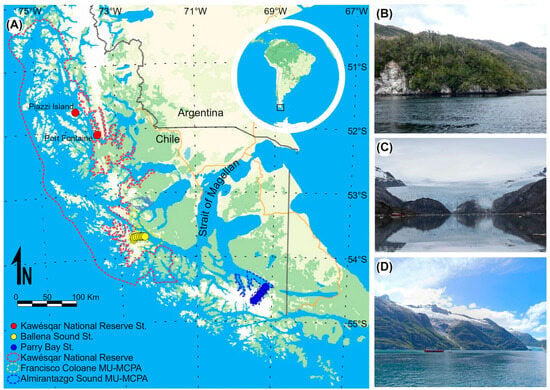
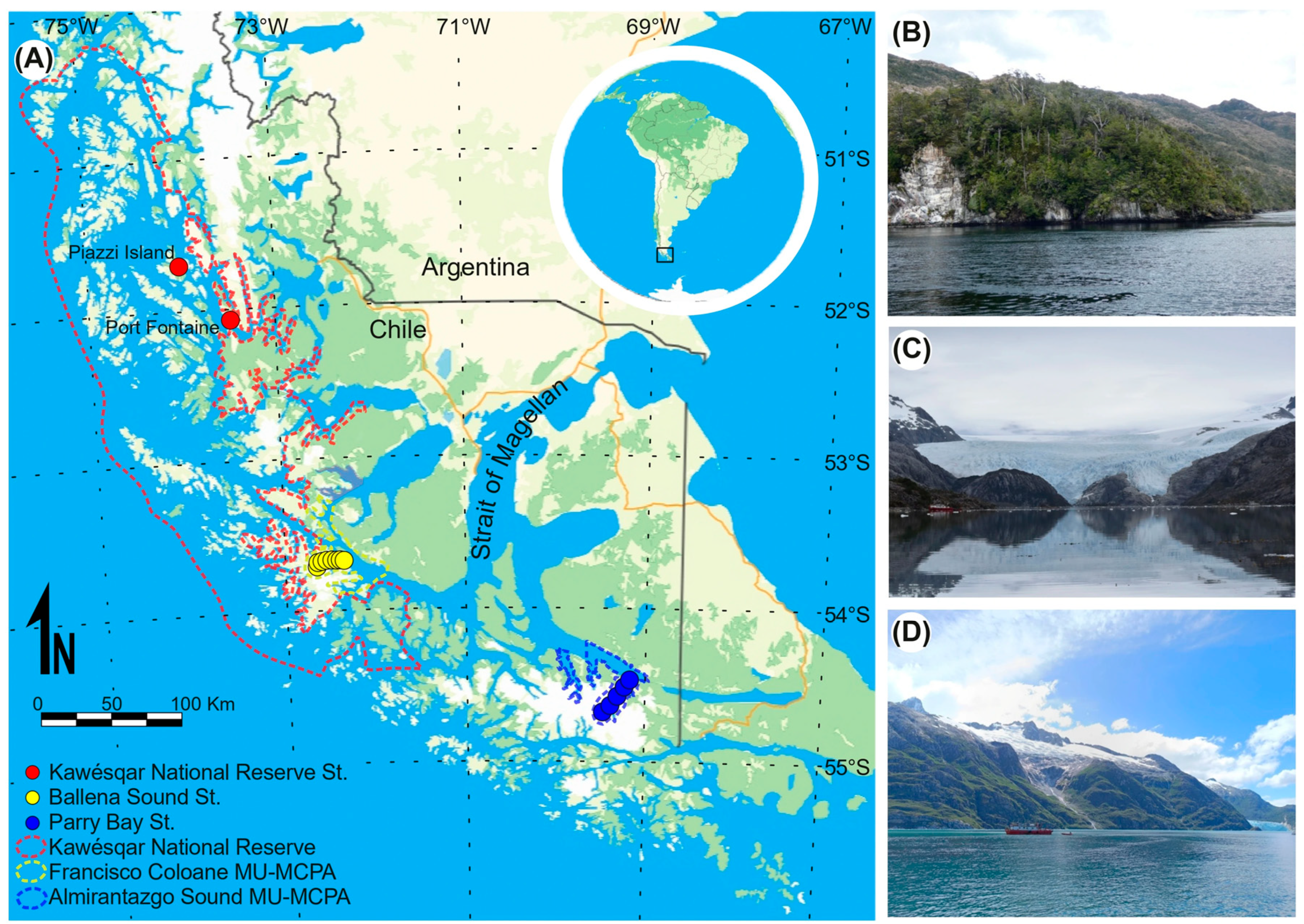
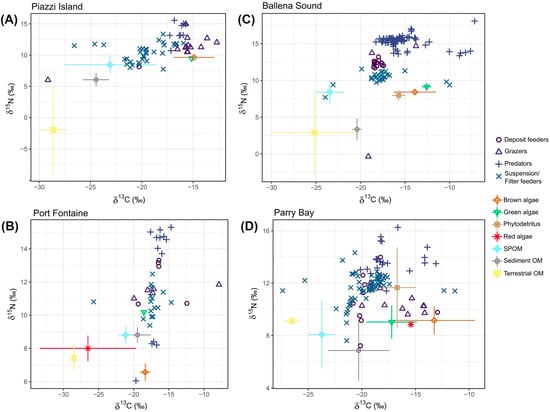
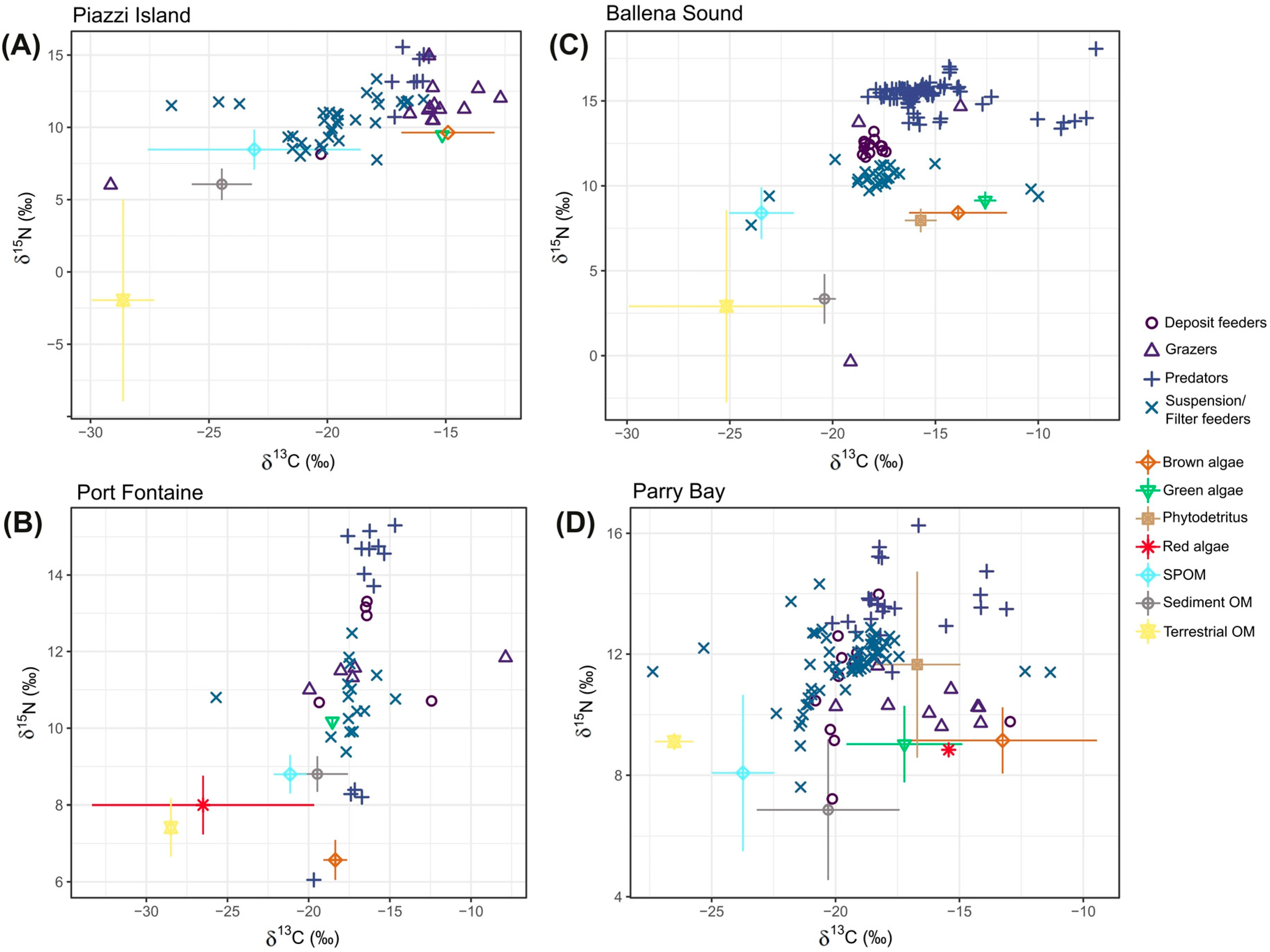
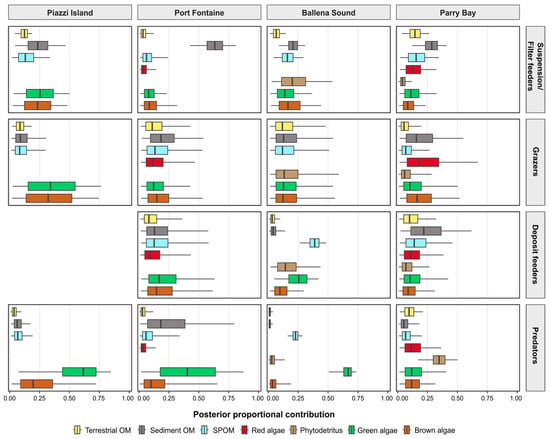
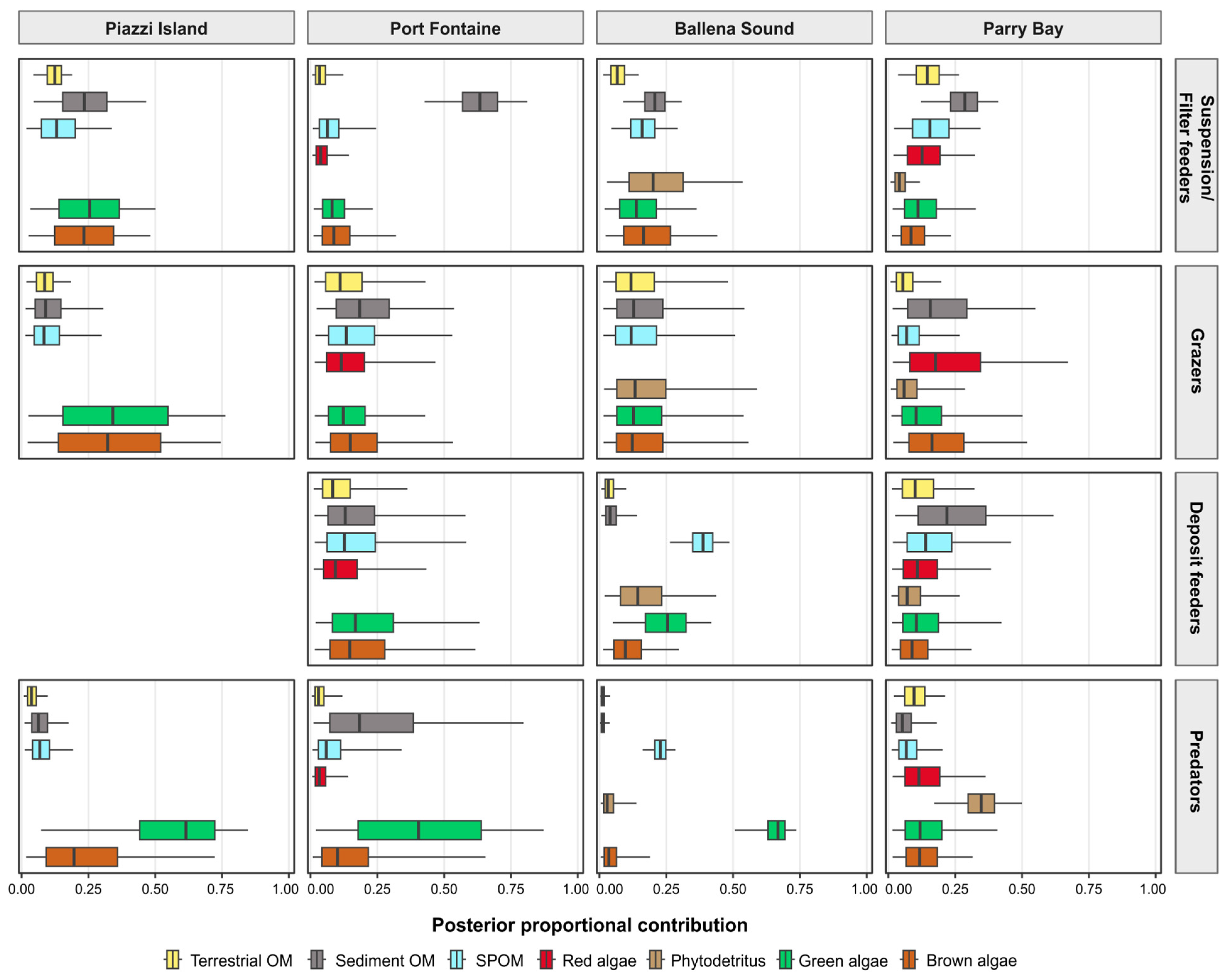
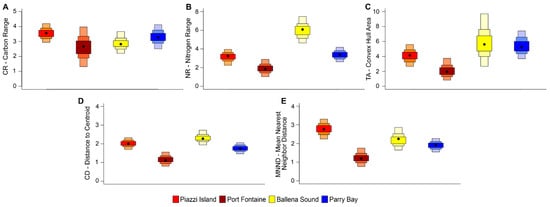
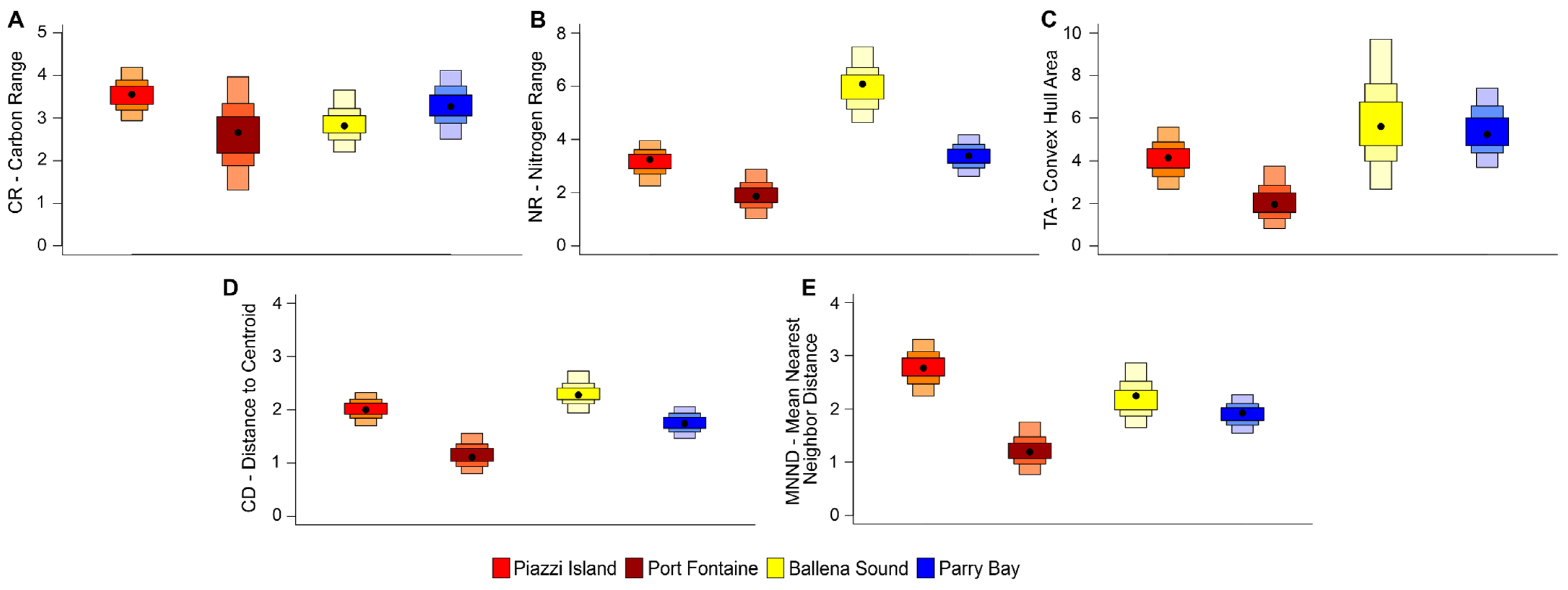
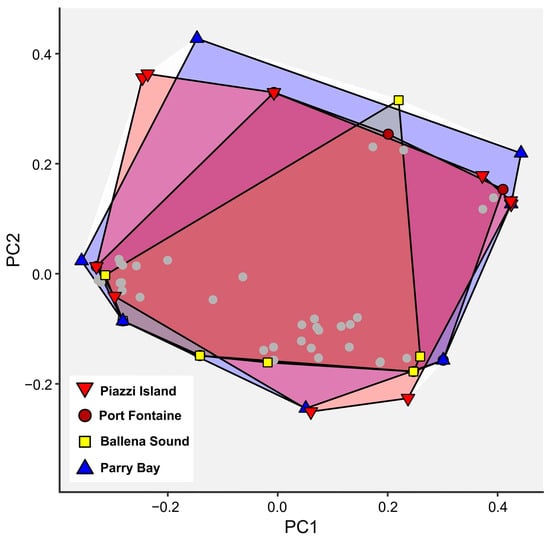
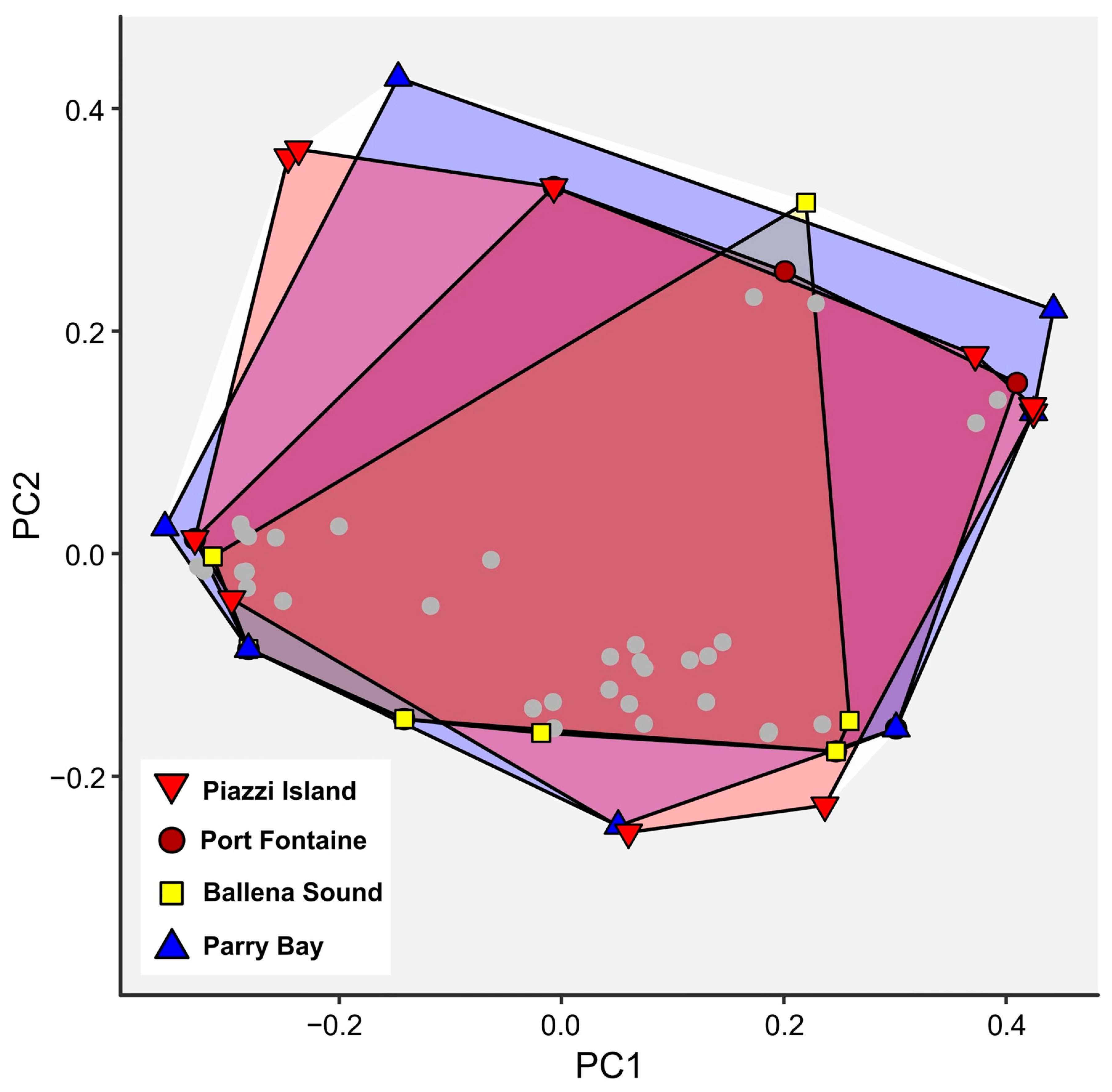
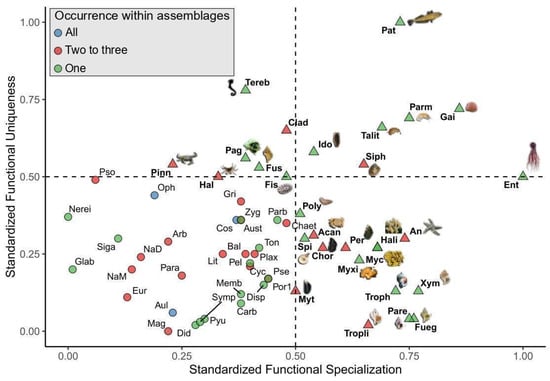
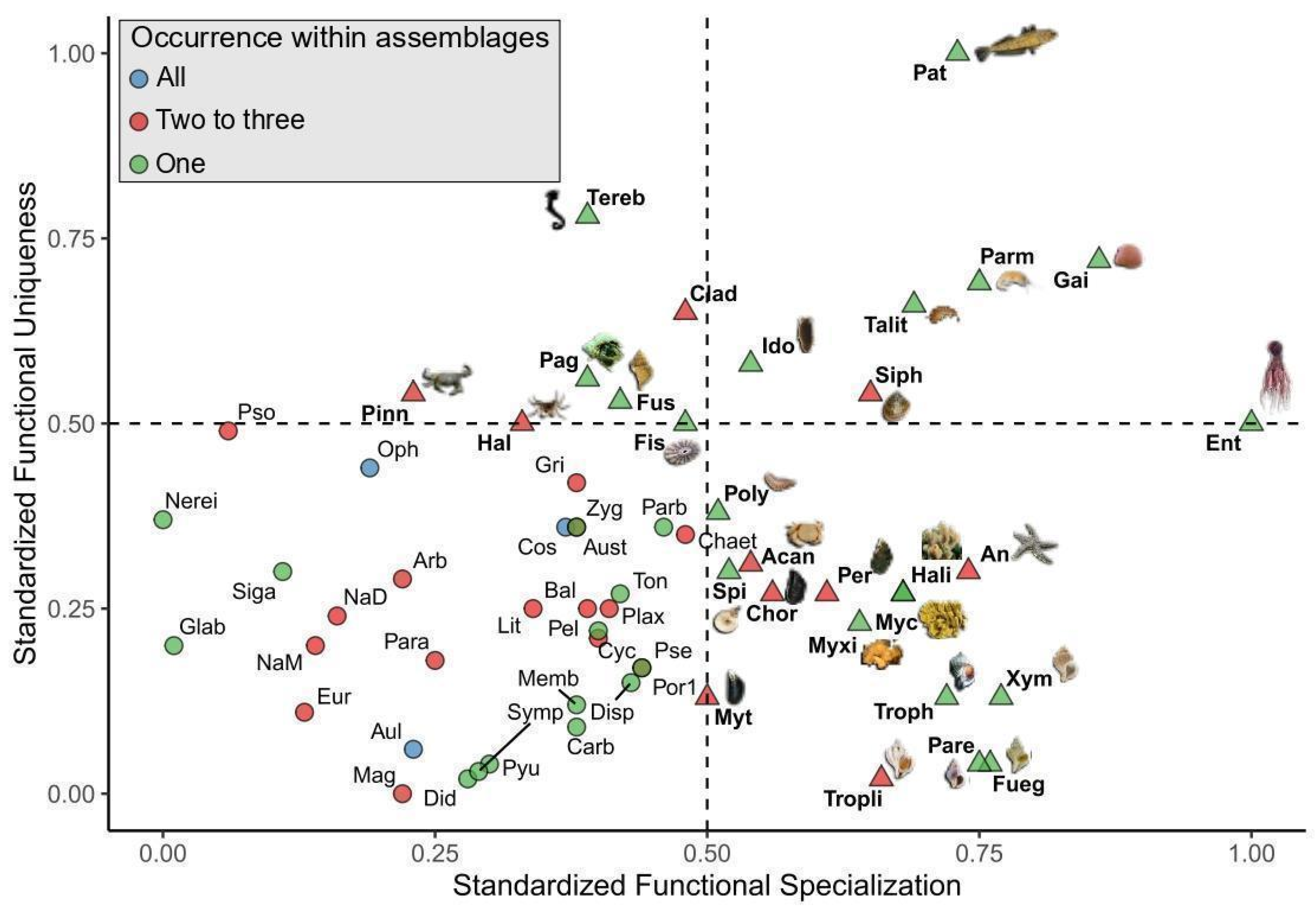

Disclaimer/Publisher’s Note: The statements, opinions and data contained in all publications are solely those of the individual author(s) and contributor(s) and not of MDPI and/or the editor(s). MDPI and/or the editor(s) disclaim responsibility for any injury to people or property resulting from any ideas, methods, instructions or products referred to in the content. |
© 2026 by the authors. Licensee MDPI, Basel, Switzerland. This article is an open access article distributed under the terms and conditions of the Creative Commons Attribution (CC BY) license.