


Abstract
A synthesis of current knowledge on the composition and dynamics of marine biofouling, and its role in altering the ecological setting of Southern Ocean benthic communities, is presented here. Current research on biofouling focuses on two main drivers of change: the introduction of invasive marine species (IMS) via hull biofouling, and plastic debris, and the dispersal of antibiotic-resistant bacteria through the development of microbial biofilms, often mediated by the persistence of artificial substrates. Despite the logistical difficulties of conducting experimental studies in such a harsh polar environment, macrofouling communities have been found to display high levels of complexity, a feature also observed within microbial communities. Macrofouling assemblages are dominated by bryozoans and spirorbid polychaetes; however, colonization by these communities is extremely slow compared to temperate regions. The emerging role of plastic-associated microbial biofilms (plastisphere) as novel ecological niches in Antarctic waters is also addressed. These microbial assemblages may act as reservoirs and potential dispersal vectors of antibiotic resistance, raising new concerns regarding ecosystem health under increasing anthropogenic pressure and climate-driven environmental changes.
1. Introduction
Coastal Antarctic marine ecosystems have long been regarded as among the most isolated marine systems on Earth. These habitats are usually thermally stable but characterized by extremely strong seasonal variation in light availability, primary production, sea-ice cover, and physical disturbance, functioning in fact as a global climate regulator and an important ecoregion housing a diverse range of endemic flora and fauna. This is an extreme environment and is generally defined as bounded between the Antarctic continent and the Sub-Tropical Front. The benthic communities are characterized by exceptionally high levels of endemism, resulting from prolonged geographic isolation and the extreme environmental conditions of the “ice continent”, including persistently low seawater temperatures, strongly seasonal primary production, and recurrent physical disturbance caused by sea ice, land-fast ice, and iceberg scour [1,2]. These environmental constraints have shaped unique biological communities whose structure and functioning differ markedly from those of temperate and tropical marine ecosystems.
Despite its apparent isolation, the Southern Ocean is increasingly exposed to global environmental change. Rising seawater temperatures, ocean acidification, glacier retreat, and the rapid expansion of human activities—including scientific research, fisheries, tourism, and maritime transport—are progressively altering the ecological balance of Antarctic coastal ecosystems [3,4,5]. Understanding how these environmental drivers influence community assembly and ecosystem functioning has therefore become a major priority for Antarctic research.
Benthic communities provide particularly valuable indicators of environmental change because their composition reflects the combined effects of recruitment, growth, competition, disturbance, and recovery processes operating over relatively long temporal scales. Studies conducted during the last three decades have substantially improved our understanding of disturbance regimes in Antarctic shallow waters, quantifying ice-scour frequency, colonization dynamics, larval recruitment, and succession patterns [6,7,8,9]. Remarkably, despite recurrent physical disturbance and inherently slow biological processes, Antarctic benthic ecosystems support a very rich and diverse fauna. This fauna is characterised by exceptionally high levels of endemism, high biodiversity in many invertebrate groups (sponges, bryozoans, polychaetes, echinoderms, ascidians, molluscs, cnidarians) higher than it would be expected under such extreme environmental conditions, and complex trophic interactions [1].
Within this ecological framework, biofouling communities have emerged as an increasingly valuable model for investigating benthic colonization and ecological succession in Antarctic coastal environments. Biofouling encompasses both microfouling, consisting of microbial and microalgal biofilms, and macrofouling, formed by sessile invertebrates and macroalgae that progressively colonize submerged natural and artificial substrates. Because microbial biofilms represent the first colonizers of newly available surfaces, they may influence the subsequent settlement of macroorganisms. At the same time, biofilm composition and taxonomic structure may be influenced by substrate type, highlighting its fundamental role in community assembly and ecosystem development [10].
Beyond its ecological significance, Antarctic biofouling has recently attracted growing attention because it represents the interface through which several major environmental drivers converge. Biofouling communities may facilitate the introduction of non-indigenous marine species through ship hulls, while plastic debris provide a novel artificial substrate for microbial colonization, giving rise to the so-called “plastisphere”. These plastic-associated biofilms may also act as reservoirs and dispersal vectors of antibiotic-resistant bacteria and resistance genes, linking plastic pollution with emerging One Health concerns in one of the world’s most remote and pristine marine environments [11,12,13,14]. Consequently, Antarctic biofouling should no longer be viewed solely as a process of benthic colonization, but rather as an ecological interface connecting climate change, biological invasions, plastic pollution, microbial ecology, and ecosystem health.
This review synthesizes current knowledge on Antarctic biofouling during the period 2000–2025, with particular emphasis on the early stages of microbial and macrofouling colonization, which remain poorly understood owing to the severe logistical constraints associated with Antarctic field research and the strong influence of sea ice on the shallow coastal zone, where most colonization studies are conducted [15]. We further examine two major emerging ecological challenges associated with Antarctic biofouling colonizing artificial substrates: the introduction of invasive marine species through hull fouling and the development of the Antarctic plastisphere as a potential reservoir of antimicrobial resistance. By integrating evidence from benthic ecology, microbial ecology, and recent studies on plastic-associated biofilms, this review highlights the increasingly important role of Antarctic biofouling as a sensitive indicator of environmental change in the Southern Ocean.
To fulfill these objectives an initial consultation was made of the bibliographic database Thomson’s Scientific Citation Index (SCI) with over 9000–9500 peer-reviewed scientific and technical journals. The main search term was Antarctic biofouling and biofilms. The period considered was 2000 to 2025, with 32 papers that meet the criteria of addressing subjects related to Antarctic fouling with a combination of keywords for plastisphere ecology, antimicrobial resistance, artificial substrates, biological invasions and hull fouling. Moreover, older seminal studies and very recent relevant papers were included outside the principal search period. The program AI (Claude, sonnet 5) was utilized in this phase to facilitate data selection. This program can furnish a small abstract of the topic of the selected papers, facilitating the final inclusion/exclusion decisions by the authors. Thereafter, the consultation of the selected papers was exclusively made by them.
2. State of Knowledge on Antarctic Biofouling and Colonization of Artificial Substrates
In recent decades, the investigation on this topic has been of great interest to researchers from a wide range of different scientific disciplines. The Southern Ocean represents one of the most challenging environments for benthic colonization due to its combination of persistently low temperatures, highly seasonal primary production, recurrent ice disturbance, and prolonged evolutionary isolation. These conditions have generated benthic communities characterized by high biodiversity, endemism, and cryptic diversity, despite extremely slow biological processes [2,15,16,17,18].
Unlike many temperate marine ecosystems, Antarctic benthic assemblages are generally persistent and exhibit relatively limited seasonal fluctuations in community composition. However, individual growth rates are considerably lower than those observed at lower latitudes because of physiological constraints imposed by low temperatures and reduced food availability outside the short summer phytoplankton bloom [19,20,21,22]. Growth and feeding activity are therefore strongly seasonal, while the predominance of direct development among many benthic taxa results in limited dispersal capacity and slow re-colonization following disturbance [19,23,24].
Physical disturbance, which remains the principal driver controlling the spatial organization of Antarctic benthic communities, was investigated on natural substrates. Ice scour, anchor ice, and glacial disturbance are particularly intense in shallow coastal waters, where they repeatedly remove established assemblages and generate a mosaic of habitats at different successional stages [7,25,26]. Consequently, mature encrusting communities dominated by bryozoans and polychaetes generally occur only on deeper or less frequently disturbed rocks [9].
Artificial settlement panels have become a widely used and particularly useful experimental approach for investigating colonization dynamics because they provide standardized surfaces on which recruitment, succession, and community development can be monitored over time. Nevertheless, compared with temperate and tropical regions, Antarctic colonization studies remain remarkably scarce. This reflects the severe logistical constraints associated with Antarctic fieldwork, including limited diving opportunities, short operational windows, frequent equipment loss due to sea ice, and the inherently slow pace of biological succession under polar conditions.
Considering the colonization of hard natural substrates, the first successful long-term study was conducted in McMurdo Sound (Ross Sea) by Dayton [27], while Antarctic hard substrates in Terra Nova Bay were studied from 1987 to 1994 under the Italian National Antarctic Research Programme (PNRA). Other studies were conducted at Signy Island (South Orkney Islands, maritime Antarctic), where a wide range of rock surface areas and depths were examined and where frequent disturbance appeared to be responsible for maintaining diversity and preventing monopolization. Bryozoans and polychaetes were the most abundant encrusting animal groups, although tunicates and sponges were the dominant overgrowth competitors [9].
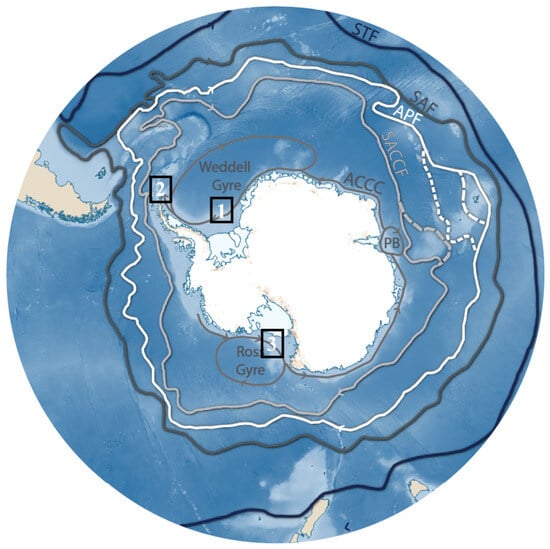
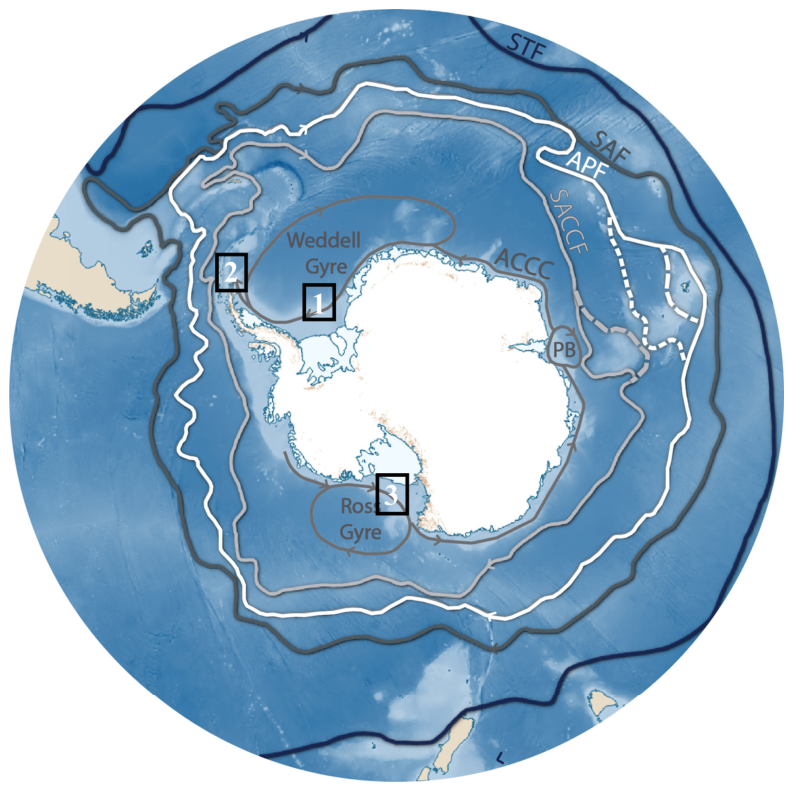
The Antarctic areas investigated for these benthic studies are shown in Figure 1, where also the major fronts are indicated.
Figure 1.
Map of Antarctica, showing Southern Ocean (SO) major fronts, currents, and gyres. Sub-Tropical Front (STF), Sub-Antarctic Front (SAF), Antarctic Polar Front (APF), Southern Antarctic Circumpolar Current Front (SACCF), Antarctic Coastal Current Front (ACCC) (or Antarctic Slope Front). The numbers indicate the main Antarctic investigation areas: 1 Weddell Sea; 2 Antarctic Peninsula and Scotia Arc; 3 Ross Sea (mainly McMurdo Sound. Redrawn from Arntz and Gallardo [1] and Maroni and Wilson [2]).
The first study on artificial panels investigating colonization patterns was carried out at Signy Island [28]. The experimental design combined “permanent” panels, kept continuously immersed for up to 21 months and photographed in situ monthly, with panels replaced every eight weeks to capture short-term seasonality of recruitment. Recruitment levels of the colonizing taxa suggested seasonal and interannual variation. The study revealed cyclostome and cheilostome bryozoans and spirorbid polychaetes as the dominant taxa in terms of cover, although with very low colonization rates. In cheilostome bryozoans, a significant recruitment peak was observed between June and February, with considerable inter- and intra-specific variation. Mean growth rates ranged from 1.7 mm2/month to 7.1 mm2/month (for Arachnopusia inchoata, the fastest-growing species); this represents the first growth rate measurement of a colonizing bryozoans on artificial settlement panels.
Subsequent studies on colonization processes on the Antarctic Peninsula (Ryder Bay) using artificial substrates [29,30,31,32] have shown that community development is extremely slow, confirming the generally slow growth rate of Antarctic organisms [15]—but with high levels of complexity that are also found within microbial communities [31,32,33]—and highlighting the presence of taxa including Porifera, Cnidaria, Annelida, Mollusca, Bryozoa, Brachiopoda, Chordata and algae [1]. The potential effects of temperature increase have also been assessed [4,34,35].
The two classic experimental studies at Signy Island [28] and at Ryder Bay, Antarctic Peninsula [29] conducted almost a decade apart in two different sectors of the Antarctic continent, remain, even today, the main experimental benchmarks for early colonization of artificial substrata in Antarctica. They are widely cited in more recent literature, including Italian research carried out in the Ross Sea, as the comparative baseline for understanding fouling dynamics in the Southern Ocean. A more recent and methodologically different Italian contribution, the dedicated checklist of pioneer benthic taxa collected with Autonomous Reef Monitoring Structures (ARMSs) in the Ross Sea, further extends the geographic and taxonomic picture to a third Antarctic sector [36].
As a whole, the above studies, conducted in three different Antarctic sectors (maritime Antarctic, Antarctic Peninsula within the Polar Circle, and continental Ross Sea) with partly different methodologies (flat settlement panels vs. three-dimensional ARMS units), converge on several points that can be considered recurrent patterns emerging from the available Antarctic studies:
- (i)
- Consistent taxonomic dominance by bryozoans (cheilostomatids in particular) and spirorbid/serpulid polychaetes, that represent the dominant pioneer taxa, in terms of both abundance and area/occurrence, across all three regions—maritime, peninsular and continental Antarctic settings. This pattern is, irrespective of whether colonization is assessed as percentage cover or as species occurrences. It should be noted, however, that spirorbids were generally not identified to species level. Table 1 summarizes the typical encrusting organisms associated with Antarctic macrofouling. Cheilostome bryozoans dominate in terms of species number; the most abundant among them are: Fenestrulina rugula, Arachnopusia inchoata, Ellisina antarctica, Chaperiopsis protecta, Aimulosia antarctica, Celleporella bougainvillei, Escaroides tridens, and Micropora brevissima.Table 1. List of the most frequent fouling taxa detected in Antarctica. Modified especially from [29].
- (ii)
- Extremely slow colonization: where percentage cover has been measured (Signy Island, Ryder Bay), levels remain, even after 2–3 years of continuous immersion, far lower than those observed at comparable temperate or tropical latitudes over similar timescales.
- (iii)
- Strongly seasonal but non-zero winter growth: some species (e.g., Arachnopusia inchoata) continue to grow, albeit slowly, even in the coldest months, indicating an ability to exploit residual food resources (nanoplankton, resuspension) outside the summer phytoplankton peak.
- (iv)
- Primary role of post-settlement disturbance in shaping the community, rather than growth rate alone: physical disturbance (glacial/ice scour) and biological disturbance (grazing, predation, spatial competition)—notably by the sea urchin Sterechinus neumayeri, identified as a key control both at Ryder Bay and in Terra Nova Bay—shape the final community structure, with marked local variability even over scales of a few hundred metres to a few kilometres.
- (v)
- High inter-annual and inter-site variability, underlining the need for long-term (multi-year) monitoring to distinguish genuine seasonal patterns from episodic events—a rationale that directly motivated the 5-year ARMS deployments of the Ross Sea study.
- (vi)
- The use of complementary, rather than redundant, methodologies: the flat-panel approach (Signy Island, Ryder Bay) is the most suitable approach to quantifying growth rates and percentage cover through time, while the three-dimensional ARMS approach (Ross Sea) is best suited to capturing overall pioneer biodiversity, including cryptic and vagile fauna, in a standardized and internationally comparable format. Used together, they provide complementary lines of evidence on Antarctic fouling dynamics.
3. The Antarctic Plastisphere as an Emerging Ecological Niche
A second line of research, equally central to recent Italian research performed in the Ross Sea within the National Antarctic Research Program (PNRA), concerns the microbial component of biofouling: the prokaryotic and microalgal biofilms that are the first to colonize any submerged surface, including those of anthropogenic origin such as plastics.
Microbial biofilms constitute the earliest stage of biofouling development and play a fundamental role in shaping the subsequent succession of benthic communities. Beyond their ecological function on natural substrates, biofilms have recently gained considerable attention because they readily colonize anthropogenic materials, particularly plastic debris, giving rise to a distinct microbial habitat known as the “plastisphere” [37]. In Antarctic marine ecosystems, where plastic pollution has historically been considered limited but is steadily increasing [38], the plastisphere represents a unique opportunity to investigate how human-derived substrates influence microbial community assembly and ecosystem functioning.
Recent investigations carried out in the Ross Sea within the PNRA research programs have substantially advanced our understanding of Antarctic plastisphere ecology [31,32,33,34,35,36,37,38,39]. These studies demonstrated that microbial communities colonizing plastic panels differ markedly from the surrounding planktonic assemblages in both taxonomic composition and metabolic functioning, irrespective of polymer type. Such findings support the concept of the plastisphere as a self-contained ecological niche rather than a simple extension of the free-living microbial community, consistent with the conceptual framework proposed by Amaral-Zettler et al. [40]. Plastic-associated biofilms should therefore be regarded as active microbial microhabitats rather than passive surface deposits. Compared with polyethylene, PVC panels supported greater prokaryotic abundance and higher metabolic activity, indicating that polymer properties may influence microbial functioning even when community composition remains broadly comparable. Furthermore, biofilms developing at sites exposed to anthropogenic disturbance or glacial influence exhibited significantly higher microbial abundance and metabolic activity than those from less impacted locations. These observations suggest that Antarctic biofilms integrate multiple environmental signals, including local anthropogenic inputs and natural climatic disturbances, making them promising biological indicators of ecosystem change [39].
Experimental evidence further indicates that plastisphere assembly follows a well-defined ecological succession. In a 33-day microcosm experiment conducted with Antarctic seawater from the South Shetland Islands, Monràs-Riera et al. [41] demonstrated that plastic particles are rapidly colonized, with microbial settlement occurring within 48 h and a mature extracellular biofilm matrix developing within five days of immersion. As colonization progressed, microbial communities increased in complexity through the inclusion of diatoms, choanoflagellates, and a progressively more diverse bacterial assemblage. Although succession occurred more slowly than in temperate marine environments, the overall dynamic closely resembled the classical ecological succession described for biofilms developing in other oceans.
Interestingly, temporal succession emerged as the principal factor governing community assembly, whereas polymer type exerted only a limited influence. Throughout the experiment, the plastisphere communities remained consistently distinct from the free-living seawater microbiota, confirming that plastic surfaces represent selective habitats capable of recruiting specific microbial assemblages. Pioneer biofilms were dominated by the psychrophilic genus Colwellia, whereas later successional stages became enriched in Gammaproteobacteria, Alphaproteobacteria and Bacteroidota, including genera such as Sulfitobacter, Glaciecola, Paraglaciecola, Arenicella and Lewinella. This temporal turnover suggests that Antarctic plastisphere development follows deterministic ecological processes comparable to those governing natural biofilm succession. Antarctic plastisphere communities also harbour microorganisms including hydrocarbon-degrading bacteria (i.e., Oleispira antarctica and Colwellia spp.) able to exploit complex organic substrates under permanently cold conditions. Conversely, no evidence of selective enrichment of pathogenic microorganisms was observed, suggesting that the Antarctic plastisphere acts primarily as a reservoir of specialized psychrophilic microorganisms rather than as a hotspot of pathogen proliferation [33,42].
Based on the literature currently available on the Antarctic plastisphere, including recent studies from King George Island and Ross Sea colonization experiments, and Antarctic inland environments, Table 2 summarizes the current knowledge on microbial diversity of the Antarctic plastisphere. Current evidence indicates that the Antarctic plastisphere is dominated by psychrophilic Proteobacteria and Actinobacteria.
Table 2.
Microbial diversity of the Antarctic plastisphere.
Overall, these studies indicate that the Antarctic plastisphere should be viewed not simply as the result of microbial growth on plastic surfaces but as a novel ecological niche in which microbial succession, environmental selection and anthropogenic pressures converge. As plastic inputs into the Southern Ocean continue to increase under ongoing climate change and expanding human activities, plastisphere communities are likely to become increasingly valuable sentinels of environmental change and useful model systems for investigating microbial adaptation, ecosystem resilience and emerging ecological risks in polar marine environments.
4. Plastic Pollution and the Spread of Antibiotic Resistance as Emerging Issues
The discovery of antibiotic-resistant bacteria within Antarctic plastisphere communities has opened a new scenario on the ecological significance of marine plastic pollution [43]. Antimicrobial resistance (AMR) has also been detected in microbial communities populating different Antarctic ecosystems, once regarded as one of the most pristine environments on Earth, raising important questions regarding the origin, persistence and dissemination of resistance determinants in remote polar ecosystems. Plastic-associated biofilms may therefore represent not only novel microbial habitats but also potential reservoirs and vectors for antibiotic resistance genes (ARGs), linking plastic pollution with the broader One Health framework [46].
The first evidence supporting this hypothesis was obtained in King George Island, where Laganà et al. [44] isolated antibiotic-resistant bacteria from plastic debris collected along Antarctic coasts. Several isolates exhibited multidrug resistance, including resistance to β-lactams, cephalosporins and quinolones, and belonged primarily to the genera Pseudomonas, Alteromonas, Thalassopira, and Halomonas. These findings demonstrated that plastic debris provides suitable substrates for microbial colonization while simultaneously acting as potential vectors for microorganisms carrying antibiotic resistance traits.
Subsequent investigations further confirmed that Antarctic plastic debris supports distinct microbial biofilms. Cappello et al. [42] demonstrated that plastic fragments recovered from King George Island hosted specialized prokaryotic communities differing from the surrounding environment and including several antibiotic-resistant strains affiliated with the same dominant bacterial genera. The repeated detection of multidrug-resistant bacteria in multiple studies of Antarctic plastics suggests that resistance is not confined to isolated contamination events but represents a recurring characteristic of plastisphere microbial communities.
More recently, colonization experiments performed in the Ross Sea have expanded this ecological framework by comparing microbial biofilms developing on polyvinyl chloride (PVC) and polyethylene (PE) settlement panels deployed under contrasting environmental conditions [33]. Plastisphere communities were largely dominated by Psychrobacter and Pseudoalteromonas, together with less abundant representatives of Arthrobacter and Winogradskyella, whereas Planococcus halocryophilus was isolated from the surrounding seawater. Interestingly, PVC biofilms developing at the control station displayed greater taxonomic diversity than those at the impacted site, suggesting that anthropogenic disturbance may favour the selection of more specialized microbial assemblages. Despite these compositional differences, antibiotic resistance was detected in bacteria isolated from both PVC- and PE-associated biofilms as well as from free-living planktonic communities. Although some variation was observed among sampling sites and polymer types, no consistent pattern of selective enrichment associated with either substrate or local anthropogenic disturbance emerged. The lowest abundance of antibiotic-resistant bacteria occurred on PE panels deployed at the relatively pristine Punta Stocchino station, whereas the highest abundance was detected on PVC biofilms from Tethys Bay. Resistance encompassed antibiotics targeting cell wall synthesis, nucleic acid metabolism, and protein synthesis, confirming the widespread distribution of antibiotic-resistant bacteria throughout Antarctic microbial communities.
The ecological scenario revealed by these findings is that microbial abundance, metabolic activity, and biofilm development clearly respond to local environmental disturbance, whereas antibiotic resistance appears to be much more broadly distributed and largely independent of local impact gradients. This suggests that the Antarctic resistome cannot be explained solely by contemporary anthropogenic contamination but likely results from the interaction between natural environmental reservoirs and resistance determinants introduced through long-range human activities. Plastic surfaces therefore appear to function primarily as ecological interfaces where resistant microorganisms can accumulate and persist, rather than as selective environments generating antibiotic resistance de novo [45,47].
At present, the relative contribution of natural vs. anthropogenic sources to the Antarctic resistome remains unresolved. Likewise, the mechanisms regulating horizontal gene transfer within Antarctic biofilms, the persistence of resistance genes in plastisphere communities, and the influence of climate-driven environmental change on these processes are still poorly understood. In freshwater inland environments, a recent study by Valenzuela-Lázaro et al. [47] has reviewed the role of the plastisphere as a vector of AMR, confirming that plastics in Antarctic lakes and soils act as hotspots for antibiotic resistance, harboring enriched and potentially mobile antibiotic-resistant genes and bacteria, thereby enhancing the environmental dissemination of this threat even in remote protected ecosystems.
Addressing these questions will be essential for understanding whether the Antarctic plastisphere acts simply as a passive reservoir of resistant microorganisms or represents an active hotspot for resistance dissemination within Southern Ocean ecosystems.
Some main knowledge gaps persist on this topic, as summarized in Table 3.
Table 3.
Knowledge gaps and priorities regarding antibiotic resistance and its spread across the Antarctic region (*).
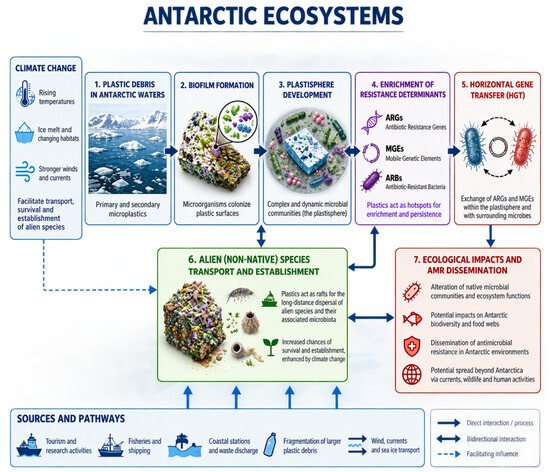
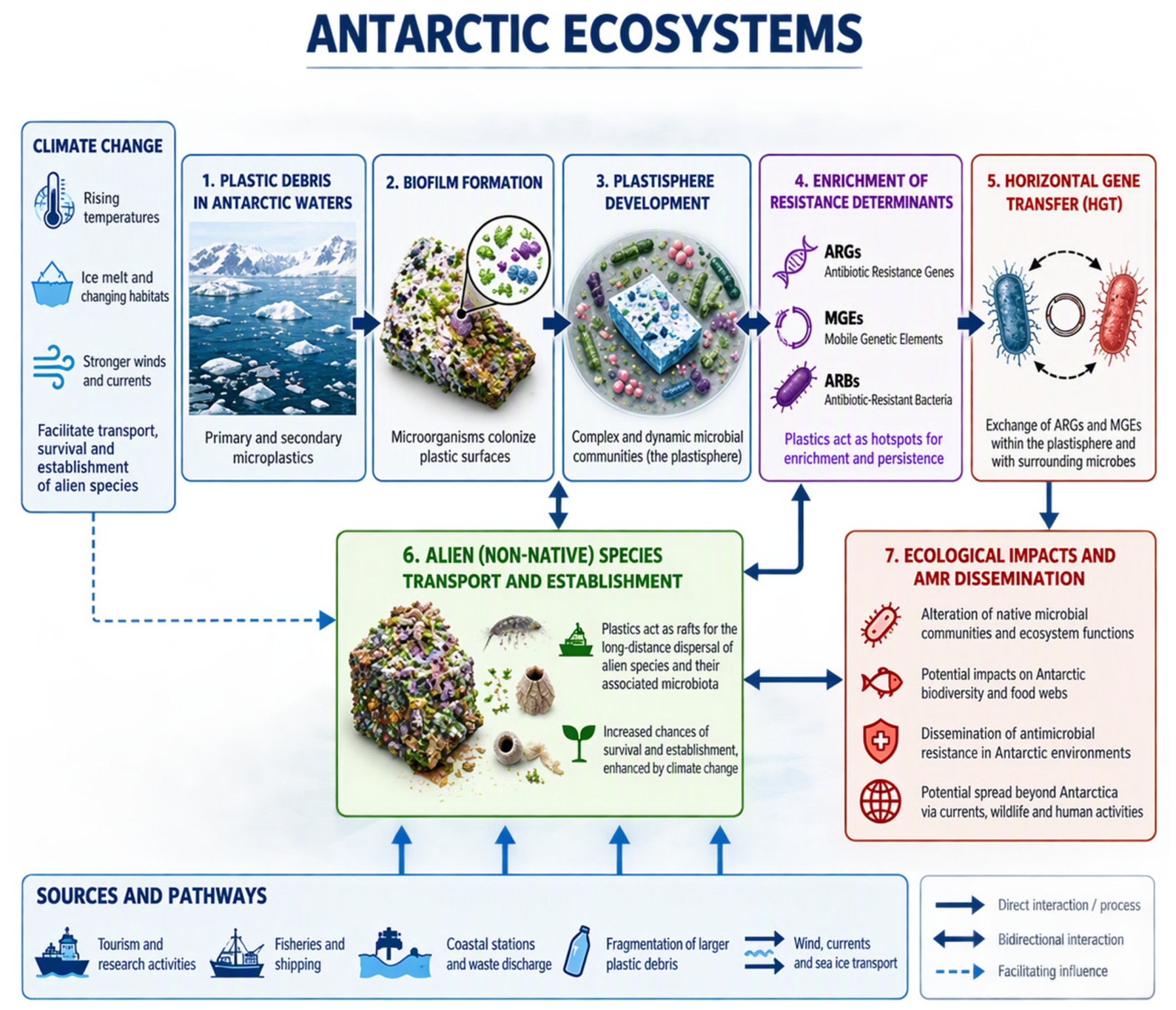
A conceptual framework of the plastic pollution and related ecosystem health risk is shown in Figure 2.
Figure 2.
Conceptual framework showing the plastisphere-associated risks in the Antarctic region. Antarctic biofouling can be considered as a link among climate change, plastisphere formation, biological invasions and antimicrobial resistance.
5. Biofouling and the Introduction of Alien Species
For much of the twentieth century, the Southern Ocean was regarded as one of the most invasion-resistant marine regions on Earth. The Antarctic Circumpolar Current, the Polar Front, persistently low seawater temperatures, extensive seasonal sea ice and the deep ocean surrounding the continent were collectively considered effective barriers limiting the dispersal and establishment of non-indigenous marine species. However, this view is being progressively revised as climate change and increasing human presence and activities enhance opportunities for biological introductions into Antarctic coastal ecosystems.
Current evidence suggests that the main bottleneck for biological invasions is not necessarily post-settlement survival, but rather the successful transport of organisms across the Southern Ocean. The predominance of species lacking pelagic larval stages among successful long-distance dispersed organisms indicates that transport frequently occurs through attached adult individuals rather than planktonic propagules. Consequently, the ecological importance of vectors capable of carrying established biofouling communities has received increasing attention.
Three major pathways currently contribute to overcoming the natural isolation of Antarctica:
- (i)
- The first is natural rafting. Floating kelp has been shown to transport living invertebrate communities across thousands of kilometres of the Southern Ocean, including species with documented invasive potential. These observations demonstrate that natural dispersal across Antarctic biogeographic barriers is possible, although probably infrequent [13].
- (ii)
- The second pathway is ship-mediated biofouling. Although transit through Antarctic pack ice removes more than 99% of macroscopic fouling organisms from exposed hull surfaces, complete decontamination does not occur. Protected structures such as sea chests, water intakes and thruster compartments provide refuges where microbial biofilms, algae and sessile invertebrates can survive prolonged voyages. Species such as the cosmopolitan goose barnacle Conchoderma auritum have repeatedly been detected in these sheltered microhabitats, demonstrating that vessels can transport viable fouling communities despite the natural cleaning effect of sea ice [11,12]. Declining sea-ice cover reduces the natural abrasive action that historically limits hull fouling, while warming of coastal waters improves the likelihood that transported organisms will survive and establish reproducing populations. Risk assessments related to the introduction of alien species through biofouling in the coastal waters of East Antarctica (Davis, Mawson and Casey stations) indicate that the current probability of successful introductions remains relatively low but is likely to increase as environmental conditions become progressively more favorable [14].
- (iii)
- A third and more recently recognized pathway involves plastic pollution. Unlike hull fouling, plastic debris does not require the transport of entire macrofouling assemblages. Instead, submerged plastic surfaces rapidly develop specialized microbial biofilms that constitute the Antarctic plastisphere. Besides representing novel microbial habitats, these biofilms may facilitate the dispersal of microorganisms and antibiotic resistance genes, linking biological invasions with the broader ecological consequences of marine plastic pollution. The effectiveness of these spreading pathways is expected to increase under ongoing climate change. Several taxa have already been identified as priority invasion threats, including the northern Pacific Sea star Asterias amurensis, the mussel Geukensia demissa, the red alga Hypnea musciformis, and the kelp Undaria pinnatifida. The Antarctic Peninsula represents the area of greatest concern because it combines the highest concentration of research stations and tourist activities with rapidly declining sea-ice duration. Similarly, Subantarctic islands such as Macquarie, Heard, McDonald, Marion and Gough are particularly vulnerable because vessels frequently reach these islands without first crossing extensive pack ice, thereby retaining larger fouling communities accumulated during prolonged stays in temperate ports. Despite these concerns, relatively few non-indigenous species have so far established persistent Antarctic populations. This suggests that environmental filtering continues to represent an important constraint, although one that is progressively weakening. Continuous surveillance, long-term monitoring of coastal areas surrounding research stations and shipping routes, and rigorous biosecurity measures therefore remain essential for limiting future biological invasions [11,12,13,14]. Although ballast water remains an additional pathway for species introductions, its management under the Antarctic Treaty System has substantially reduced its relative importance, leaving hull biofouling as the main pathway for the introduction of non-native marine species into the Southern Ocean [48]. The risk of survival and introduction of alien species through biofouling in the coastal waters of East Antarctica appears, therefore, to be low, but plausible under future scenarios. The reduction in sea ice may in fact diminish the “natural cleaning” effect and increase the probability of survival and settlement [14].
Climate change is also modifying Antarctic coastal habitats themselves. Glacier retreat and the expansion of newly ice-free areas create novel habitats that become available for colonization by pioneer benthic organisms. As an example, in Potter Cove (South Shetland Islands) Lagger et al. [49] documented the progressive colonization of recently exposed soft-bottom habitats following the retreat of the Fourcade Glacier. In contrast to many classical hard-substrate fouling studies dominated by bryozoans, ascidians emerged as the main pioneer organisms in these newly available habitats, highlighting how climate-driven habitat creation may alter succession dynamics and increase ecosystem susceptibility to future biological invasions.
Recorded Alien Marine Invertebrates in the Antarctic Region
Unlike the Arctic, which has 34 recorded non-native marine species from 54 documented introduction events, the Southern Ocean has, to date, no confirmed established populations of alien marine invertebrates [50]. Records instead fall into several distinct categories, ranging from isolated free-living individuals to species intercepted only in ship-hull niche areas or predicted as high-risk under future climate scenarios. Table 4 summarizes the non-native marine invertebrates reported to date in Antarctic and sub-Antarctic waters, compiled from the wider literature on marine biological invasions in the region.
Table 4.
Non-native marine invertebrates recorded in Antarctic and sub-Antarctic waters, by detection status.
The most notable single event remains the 2019 settlement of juvenile mussels (Mytilus cf. platensis) in Fildes Bay, King George Island: 47 individuals were found across four of 75 samples, and genetic and shipping-route analyses linked their origin to southern Patagonia. Subsequent surveys failed to relocate the mussels, leaving their capacity to persist under Antarctic conditions unresolved [54]. A further 55 taxa, including barnacles, bryozoans, polychaetes, amphipods, isopods and mussels, have been recorded on the hulls of Antarctic-bound vessels, 15 of which already have Arctic or sub-Antarctic distributions and may therefore tolerate Antarctic conditions [50].
6. Antarctic Biofouling in a Broader Polar Context
In contrast to the rapid, intense and continuous development of fouling in tropical and temperate seas, in polar areas fouling shows a slower colonization rate, with an extremely slow growth, characterized by high seasonality [29,55,56,57]. Temperature is obviously a key driver of fouling growth rates and explains much of the seasonal variation. Tropical and temperate waters provide favourable conditions year-round; by contrast, owing to low temperatures, seasonal ice cover, and reduced propagule supply, biofouling is generally poorly developed in polar zones and strongly concentrated during the productive summer period when water warms enough for organisms to grow. These extreme conditions are reflected in biodiversity, with temperate and tropical waters characterized by several groups of sessile invertebrates often in balanced proportions, while polar communities exhibit a lower phyletic diversity with an almost exclusive dominance by bryozoans [56].
The comparison between Antarctic and Arctic areas reveals a similarity in the taxa composition, with bryozoans and spirorbids as the dominant taxa (even if with different species). Spirorbids are dominant in the number of individuals, while bryozoans are the most species-rich group. It must be stressed that Spirorbids in the Antarctic panels were never identified at specific level and always indicated only as subfamily, by contrast in the Arctic area it is reported an almost monospecific colonization of Spirorbis tridentatus [56]. However, although the higher taxonomic groups are scarce, the variety of species is high and in the Arctic area is comparable to that of the Pacific or North Atlantic coasts [56,57]. Seasonal ice scour is a common ecological disturbance in these areas, and communities tend to be in a young stage because of the frequent and intense impact of ice scour. It is well known that in the Arctic coastal ocean a large pulse of terrestrial freshwater can transform the ice-covered sea surface to open water in just weeks.
The number of reported marine non-indigenous species (NIS) in polar waters is also relatively low compared to other global regions However, while the Arctic has 34 recorded non-native marine species from 54 introduction events [57,58], Antarctica has no confirmed populations of non-native marine species, with only five free-living marine species potentially transported by human activity. This occurs because Antarctica benefits from a much stronger natural isolation, whilst the Arctic is connected to the North Atlantic and North Pacific through relatively open ocean gateways, facilitating natural range expansions of boreal species alongside human-mediated introductions. In addition, Antarctica has a unique, unified legal framework: the Protocol on Environmental Protection to the Antarctic Treaty, in force since 1998, by contrast the Arctic does not have an equivalent and human presence and interference is higher. In addition, maritime activity is relatively higher in the Arctic area and climate warming and sea-ice retreat are expanding shipping routes, driving resource development and increasing tourism.
Both polar areas are expected to change [59,60], and become more prone to invasion as warming continues, but the mechanism differs: in Antarctica, warming primarily removes a physiological barrier to alien species establishment, which will likely weaken under future climate change scenarios. In the Arctic, warming primarily removes a physical barrier (sea ice, allowing new shipping routes and range shifts in boreal species already adapted to cold-temperate conditions). In addition, while plastic pollution has been widely documented throughout Arctic marine compartments, including sediments and fjords [59,60], the composition and ecological role of benthic plastisphere communities in this polar area remain largely unexplored and, to our knowledge, studies addressing microbial communities associated with floating plastic debris are at their beginning [61,62,63,64,65]. Indeed, existing studies have focused mainly on the occurrence and transport of plastics, whereas the microbial assemblages colonizing plastic debris after deposition on the Arctic seafloor and their potential role in antibiotic resistance dissemination are still poorly understood.
7. Conclusions
Over the past three decades, studies of Antarctic biofouling have revealed that colonization of artificial substrates is an exceptionally slow and strongly seasonal process, shaped by low recruitment rates and by continuous physical and biological disturbances. Despite the limited number of long-term investigations—due to the fact that deploying and recovering equipment after an interval of months or years risks damage from ice, with iceberg scour being a major source of disruption to Antarctic nearshore marine communities—remarkably consistent patterns have been reported across geographically distant regions, from the Antarctic Peninsula to the Ross Sea. Microbial biofilms represent the first stage of colonization, facilitating the settlement of sessile organisms, while bryozoans frequently dominate pioneer macrofouling assemblages. Once established, communities continue to be regulated by grazing pressure, competition, substrate characteristics and environmental stressors, demonstrating that succession in Antarctica is slow but highly structured.
Research using settlement panels and ARMSs has considerably improved our understanding of colonization dynamics, highlighting recurring ecological drivers across sites. At the same time, biofouling studies have expanded beyond classical succession research. Plastic debris represents a new ecological niche that hosts distinct microbial communities, forming an Antarctic plastisphere with potential implications for ecosystem functioning and AMR dissemination. Furthermore, increasing maritime traffic, natural rafting and floating debris may facilitate the transport of non-native species, while climate warming and reduced sea-ice cover are expected to increase establishment success. These findings indicate that Antarctic biofouling communities are not only key components of benthic ecosystems but also valuable sentinels of environmental change. They provide a unique framework for investigating biodiversity responses to climate change, biological invasions, plastic pollution, and emerging microbiological risks. Considering the limited knowledge available so far on colonization processes in Antarctica, further data on the growth and survival of communities after initial recruitment are needed. Furthermore, the biodiversity of Antarctic fouling must be interpreted in its complexity, in which several factors play a key role, such as the properties of the substrate, the presence of stressors and local gradients (wastewater, glacial influence), human vectors (shipping, hull niches, research stations…) and emerging microbiological risks, with climate acting as a potential risk multiplier. Future research should combine long-term ecological observations with molecular, genomic, and functional approaches, supported by standardized international monitoring programs. Such integrated efforts are essential for understanding community assembly processes, assessing ecosystem resilience, and developing effective conservation and biosecurity strategies for the rapidly changing Southern Ocean.
Author Contributions
Conceptualization, A.G., M.C.G. and C.G.; formal analysis, A.G., M.C.G.; writing—original draft preparation, A.G., C.G., M.C.G., L.M., M.A., F.S., C.A., O.D., P.L., G.C. a; visualization, A.G.; supervision, A.G.; project administration, G.C. funding acquisition, G.C. All authors have read and agreed to the published version of the manuscript.
Funding
This research was funded by National Antarctic Research Program (Italian PNRA), grant number PNRA16_00105 ANT-Biofilm (Microbial colonization of benthic ANTarctic environments: response of microbial abundances, diversity, activities and larval settlement to natural or anthropogenic disturbances and search for secondary metabolites) and grant number PNRA22_0000040 STORAGE (PlaSTic cOlonization in maRitime Antarctica as a challenGe trEasure of bioactive molecules).
Data Availability Statement
No new data were created or analyzed in this study. Data sharing is not applicable to this article.
Acknowledgments
Special thanks are due to ENEA-UTA (E. Campana, R. Ascione, C. Ubaldi) and to the Comitè Polar Espanol (A. Quesada, Sonia) and UTM-CSIC (M.A. Ojeda) for their invaluable support to field research activities. The authors acknowledge the technicians and crew of the R/V Hesperides during the cruise 2025 and the managers of UTM-CSIC the staff and technicians at the BAE Juan Carlos I and Gabriel de Castilla research stations during the Antarctic campaign 2026. During the preparation of this manuscript/study, the author(s) used coPilot (version Microsoft 365 based on the GPT-5 chat) for the purposes of generating Figure 2. The authors have reviewed and edited the output and take full responsibility for the content of this publication.
Conflicts of Interest
The authors declare no conflicts of interest. The funders had no role in the design of the study; in the collection, analyses, or interpretation of data; in the writing of the manuscript; or in the decision to publish the results.
References
- Arntz, W.E.; Gallardo, V.A. Antarctic benthos: Present position and future prospects. In Antarctic Science; Hempel, G., Ed.; Springer: Berlin, Germany, 1994; pp. 243–277. [Google Scholar]
- Maroni, P.J.; Wilson, N.G. Multiple Doris “kerguelenensis” (Nudibranchia) species span the Antarctic Polar Front. Ecol. Evol. 2022, 12, e9333. [Google Scholar] [CrossRef] [Scilit] [PubMed]
- Chown, S.L.; Clarke, A.; Fraser, C.I.; Cary, S.C.; Moon, K.L.; McGeoch, M.A. The changing form of Antarctic biodiversity. Nature 2015, 522, 431–438. [Google Scholar] [CrossRef] [Scilit] [PubMed]
- Barnes, D.K.A.; Sands, C.J.; Paulsen, M.L.; Moreno, B.; Moreau, C.; Held, C.; Downey, R.; Bax, N.; Stark, J.S.; Zwerschke, N. Societal importance of Antarctic negative feedback on climate change: Blue carbon gains from sea ice, ice shelf and glacier losses. Naturwissenschaften 2021, 108, 43. [Google Scholar] [CrossRef] [Scilit] [PubMed]
- Bargagli, R.; Rota, E. Environmental contamination and climate change in Antarctic ecosystems: An updated overview. Environ. Sci. Adv. 2024, 3, 543–560. [Google Scholar] [CrossRef] [Scilit]
- Barnes, D.K.A. Low levels of colonisation in Antarctica: The role of bryozoans in early community development. In Bryozoans in Space and Time; Gordon, D.P., Smith, A.M., Grant-Mackie, J.A., Eds.; National Institute of Water and Atmospheric Research: Wellington, New Zealand, 1996; p. 44. [Google Scholar]
- Barnes, D.K.A. The influence of ice on polar nearshore benthos. J. Mar. Biol. Assoc. UK 1999, 79, 401–407. [Google Scholar] [CrossRef] [Scilit]
- Barnes, D.K.A.; Rothery, P. Competition in encrusting Antarctic bryozoan assemblages: Outcomes, influences and implications. J. Exp. Mar. Biol. Ecol. 1996, 196, 267–284. [Google Scholar] [CrossRef] [Scilit]
- Barnes, D.K.A.; Clarke, A.; Rothery, P. Colonisation and development in encrusting communities from the Antarctic intertidal and sublittoral. J. Exp. Mar. Biol. Ecol. 1996, 196, 251–265. [Google Scholar] [CrossRef] [Scilit]
- Caruso, G. Microbial colonization in marine environments: Overview of current knowledge and emerging research topics. J. Mar. Sci. Eng. 2020, 8, 78. [Google Scholar] [CrossRef] [Scilit]
- Lee, J.E.; Chown, S.L. Temporal development of hull-fouling assemblages associated with an Antarctic supply vessel. Mar. Ecol. Progr. Ser. 2009, 386, 97–105. [Google Scholar] [CrossRef] [Scilit]
- Hughes, K.A.; Ashton, G.V. Breaking the ice: The introduction of biofouling organisms to Antarctica on vessel hulls. Aquat. Conserv. Mar. Freshw. Ecosyst. 2017, 27, 158–164. [Google Scholar] [CrossRef] [Scilit]
- Avila, C.; Angulo-Preckler, C.; Martín-Martín, R.; Figuerola, B.; Griffiths, H.J.; Waller, C.L. Invasive marine species discovered on non-native kelp rafts in the warmest Antarctic island. Sci. Rep. 2020, 10, 1639. [Google Scholar] [CrossRef] [Scilit] [PubMed]
- Holland, O.; Shaw, J.; Stark, J.S.; Wilson, K.A. Hull fouling marine invasive species pose a very low, but plausible, risk of introduction to East Antarctica in climate change scenarios. Divers. Distrib. 2021, 27, 973–988. [Google Scholar] [CrossRef] [Scilit]
- Peck, L.S. Antarctic Marine Biodiversity: Adaptations, Environments and Responses to Change; CRC Press eBooks; CRC Press: Boca Raton, FL, USA, 2018; pp. 105–236. [Google Scholar]
- Wilson, N.G.; Schrödl, M.; Halanych, K.M. Ocean barriers and glaciation: Evidence for explosive radiation of mitochondrial lineages in the Antarctic sea slug Doris kerguelenensis (Mollusca, Nudibranchia). Mol. Ecol. 2009, 189, 965–984. [Google Scholar] [CrossRef] [Scilit] [PubMed]
- De Broyer, C.; Koubbi, P.; Griffiths, H.J.; Raymond, B.; Udekem d’Acoz, C.d’; Van de Putte, A.P.; Danis, B.; David, B.; Grant, S.; Grant, J.; et al. (Eds.) Biogeographic Atlas of the Southern Ocean; Scientific Committee on Antarctic Research (SCAR): Cambridge, UK, 2014; pp. XII + 498. [Google Scholar]
- Maroni, P.J.; Baker, B.J.; Moran, A.L.; Woods, H.A.; Avila, C.; Johnstone, G.J.; Stark, J.S.; Kocot, K.M.; Lockhart, S.; Saucède, T.; et al. One Antarctic slug to confuse them all: The underestimated diversity of Doris kerguelenensis. Invertebr. Syst. 2022, 36, 419–435. [Google Scholar] [CrossRef] [Scilit]
- Pearse, J.S.; McClintock, J.B.; Bosch, I. Reproduction of Antarctic benthic marine invertebrates—Tempos, modes, and timings. Am. Zool. 1991, 31, 65–80. [Google Scholar] [CrossRef] [Scilit]
- Clarke, A. What is cold adaptation and how should we measure it? Am. Zool. 1991, 31, 81–92. [Google Scholar] [CrossRef] [Scilit]
- Hoegh-Guldberg, O.; Pearse, J.S. Temperature, food availability, and the development of marine invertebrate larvae. Am. Zool. 1995, 35, 415–425. [Google Scholar] [CrossRef] [Scilit]
- Fraser, K.P.P.; Clarke, A.; Peck, L.S. Low-temperature protein metabolism: Seasonal changes in protein synthesis and RNA dynamics in the Antarctic limpet Nacella concinna Strebel 1908. J. Exp. Biol. 2002, 205, 3077–3086. [Google Scholar] [CrossRef] [Scilit] [PubMed]
- Barnes, D.K.A.; Clarke, A. Seasonal variation in the feeding activity of four species of Antarctic bryozoan in relation to environmental factors. J. Exp. Mar. Biol. Ecol. 1994, 181, 117–133. [Google Scholar] [CrossRef] [Scilit]
- Barnes, D.K.A.; Clarke, A. Seasonality of feeding activity in Antarctic suspension feeders. Polar Biol. 1995, 15, 335–340. [Google Scholar] [CrossRef] [Scilit]
- Dayton, P.K. Polar benthos. In Pola r Oceanography; Smith, W.O., Ed.; Academic Press: London, UK, 1990; pp. 631–685. [Google Scholar]
- Gutt, J.; Starmans, A. Quantification of iceberg impact and benthic recolonisation patterns in the Weddell Sea (Antarctica). Polar Biol. 2001, 24, 615–619. [Google Scholar] [CrossRef] [Scilit]
- Dayton, P.K. Interdecadal variation in an Antarctic sponge and its predators from oceanographic climate shifts. Science 1989, 245, 1484–1486. [Google Scholar] [CrossRef] [Scilit] [PubMed]
- Stanwell-Smith, D.; Barnes, D.K.A. Benthic community development in Antarctica: Recruitment and growth on settlement panels at Signy Island. J. Exp. Mar. Biol. Ecol. 1997, 212, 61–79. [Google Scholar] [CrossRef] [Scilit]
- Bowden, D.; Clarke, A.; Peck, L.; Barnes, D. Antarctic sessile marine benthos: Colonisation and growth on artificial substrata over three years. Mar. Ecol. Progr. Ser. 2006, 316, 1–16. [Google Scholar] [CrossRef] [Scilit]
- Dayton, P.; Jarrell, S.; Kim, S.; Thrush, S.; Hammerstrom, K.; Slattery, M.; Parnell, E. Surprising episodic recruitment and growth of Antarctic sponges: Implications for ecological resilience. J. Exp. Mar. Biol. Ecol. 2016, 482, 38–55. [Google Scholar] [CrossRef] [Scilit]
- Caruso, G.; Maimone, G.; Rappazzo, A.C.; Dell’Acqua, O.; Laganà, P.; Azzaro, M. Microbial Biofilm Colonizing Plastic Substrates in the Ross Sea (Antarctica): First Overview of Community-Level Physiological Profiles. J. Mar. Sci. Eng. 2023, 11, 1317. [Google Scholar] [CrossRef] [Scilit]
- Caruso, G.; Azzaro, M.; Dell’Acqua, O.; Papale, M.; Lo Giudice, A.; Laganà, P. Plastic Polymers and Antibiotic Resistance in an Antarctic Environment (Ross Sea): Are We Revealing the Tip of an Iceberg? Microorganisms 2024, 12, 2083. [Google Scholar] [CrossRef] [Scilit] [PubMed]
- Papale, M.; Fazi, S.; Severini, M.; Scarinci, R.; Dell’Acqua, O.; Azzaro, M.; Venuti, V.; Fazio, B.; Fazio, E.; Crupi, V.; et al. Structural properties and microbial diversity of the biofilm colonizing plastic substrates in Terra Nova Bay (Antarctica). Sci. Tot. Environ. 2024, 943, 173773. [Google Scholar] [CrossRef] [Scilit] [PubMed]
- Ashton, G.V.; Morley, S.A.; Barnes, D.K.A.; Clark, M.S.; Peck, L.S. Warming by 1 °C Drives Species and Assemblage Level Responses in Antarctica’s Marine Shallows. Curr. Biol. 2017, 27, 2698–2705. [Google Scholar] [CrossRef] [Scilit] [PubMed]
- Moreno, B.; Peck, L.S.; Clark, M.S.; Dunlop, K.M.; Barnes, D.K.A.; Bluhm, B.; Molis, M.; Ziegler, A.; Longsden, J.; Hatt, A.; et al. Heated settlement plates (HSPI) in global experimentation: Experiences, research questions, future applications and collaborations. Res. Ideas Outcomes 2025, 11, e174994. [Google Scholar] [CrossRef] [Scilit]
- Cometti, V.; Cecchetto, M.; Guzzi, A.; Grillo, M.; Noli, N.; Corsolini, S.; Schiaparelli, S. Checklist of pioneer benthic taxa found on Autonomous Reef Monitoring Structures (ARMS) in Terra Nova Bay (Ross Sea, Antarctica). Biodivers. Data J. 2025, 13, e148863. [Google Scholar] [CrossRef] [Scilit] [PubMed]
- Zettler, E.R.; Mincer, T.J.; Amaral-Zettler, L.A. Life in the “Plastisphere”: Microbial Communities on Plastic Marine Debris. Environ. Sci. Technol. 2013, 47, 7137–7146. [Google Scholar] [CrossRef] [Scilit] [PubMed]
- Monràs-Riera, P.; Lozoya, J.P.; Teixeira de Mello, F.; Avila, C. Stranded beach debris in the West Antarctic Peninsula: Quantification and distribution of marine litter. Environ. Pollut. 2025, 375, 126366. [Google Scholar] [CrossRef] [Scilit] [PubMed]
- Caroppo, C.; Azzaro, M.; Dell’Acqua, O.; Azzaro, F.; Maimone, G.; Rappazzo, A.C.; Raffa, F.; Caruso, G. Microbial Biofilms Colonizing Plastic Substrates in the Ross Sea (Antarctica). J. Mar. Sci. Eng. 2022, 10, 1714. [Google Scholar] [CrossRef] [Scilit]
- Amaral-Zettler, L.A.; Zettler, E.R.; Mincer, T.J. Ecology of the plastisphere. Nat. Rev. Microbiol. 2020, 18, 139–151. [Google Scholar] [CrossRef] [Scilit] [PubMed]
- Monràs-Riera, P.; Avila, C.; Ballesté, E. Plastisphere in an Antarctic environment: A microcosm approach. Mar. Poll. Bull. 2024, 208, 116961. [Google Scholar] [CrossRef] [Scilit] [PubMed]
- Cappello, S.; Caruso, G.; Bergami, E.; Macrì, A.; Venuti, V.; Majolino, D.; Corsi, I. New insights into the structure and function of the prokaryotic communities colonizing plastic debris collected in King George Island (Antarctica): Preliminary observations from two plastic fragments. J. Hazard. Mater. 2021, 414, 125586. [Google Scholar] [CrossRef] [Scilit] [PubMed]
- Roscales, G.; Marquez-Puchol, N.; Avila, C.; Ballesté, E. Antibiotic resistance genes in seawater and sediments along the Antarctic Peninsula. Mar. Pollut. Bull. 2026, 228, 119571. [Google Scholar] [CrossRef] [Scilit] [PubMed]
- Laganà, P.; Caruso, G.; Corsi, I.; Bergami, E.; Venuti, V.; Majolino, D.; La Ferla, R.; Azzaro, M.; Cappello, S. Do plastics serve as a possible vector for the spread of antibiotic resistance? First insights from bacteria associated to a polystyrene piece from King George Island (Antarctica). Int. J. Hyg. Environ. Health 2019, 222, 89–100. [Google Scholar] [CrossRef] [Scilit] [PubMed]
- Dell’Agnese; Cappello, S.; Patania, S.; Lunetta, A.; Caruso, G.; Sherry, A. Impact of Microplastics on Microbial Communities in Polar Environments. In Polar Microbes and Climate Change; Fernandes Duarte, A.W., Passarini, M.R.Z., Elster, J., Singh, P.K., Kumar, A., Eds.; Springer: Cham, Switzerland, 2026. [Google Scholar] [CrossRef] [Scilit]
- Caruso, G. Microplastics as vectors of contaminants. Mar. Pollut. Bull. 2019, 146, 921–924. [Google Scholar] [CrossRef] [Scilit] [PubMed]
- Valenzuela-Lázaro, J.M.; Krojmal, E.; De Feo, B.; Lacerot, G.; Lozoya, J.P.; Mello, F.T.-D.; Bueno, M.J.M.; Fernández-Alba, A.R.; Rosal, R.; Fernández-Piñas, F.; et al. Inland Antarctic plastispheres harbour unique and diverse antibiotic resistance genes and mobile genetic elements. Commun. Earth Environ. 2026, 7, 573. [Google Scholar] [CrossRef] [Scilit]
- Perry, F.; Avila, C.; Griffiths, H.; Hughes, K.A. Vessel biofouling management in Antarctica. Antarct. Environ. Portal 2026. Available online: https://environments.aq/publications/vessel-biofouling-management-in-antarctica/ (accessed on 12 February 2026).
- Lagger, C.; Servetto, N.; Torre, L.; Sahade, R. Benthic colonization in newly ice-free soft-bottom areas in an Antarctic fjord. PLoS ONE 2017, 12, e0186756. [Google Scholar] [CrossRef] [Scilit] [PubMed]
- McCarthy, A.H.; Peck, L.S.; Hughes, K.A.; Aldridge, D.C. Antarctica: The final frontier for marine biological invasions. Glob. Change Biol. 2019, 25, 2221–2241. [Google Scholar] [CrossRef] [Scilit] [PubMed]
- Thatje, S.; Fuentes, V. First record of anomuran and brachyuran larvae (Crustacea: Decapoda) from Antarctic waters. Polar Biol. 2003, 26, 279–282. [Google Scholar] [CrossRef] [Scilit]
- Aronson, R.B.; Frederich, M.; Price, R.; Thatje, S. Prospects for the return of shell-crushing crabs to Antarctica. J. Biogeogr. 2015, 42, 1–7. [Google Scholar] [CrossRef] [Scilit]
- Tavares, M.; De Melo, G. Discovery of the first known benthic invasive species in the Southern Ocean: The North Atlantic spider crab Hyas araneus found in the Antarctic Peninsula. Antarct. Sci. 2004, 16, 129–131. [Google Scholar] [CrossRef] [Scilit]
- Cárdenas, L.; Leclerc, J.-C.; Bruning, P.; Garrido, I.; Détrée, C.; Figueroa, A.; Astorga, M.; Navarro, J.M.; Johnson, L.E.; Carlton, J.T.; et al. First mussel settlement observed in Antarctica reveals the potential for future invasions. Sci. Rep. 2020, 10, 5552. [Google Scholar] [CrossRef] [Scilit] [PubMed]
- Bonsell, C.; Dunton, K.H. Slow Community Development Enhances Abiotic Limitation High Arctic Kelp Bed. Front. Mar. Sci. 2021, 8, 592295. [Google Scholar] [CrossRef] [Scilit]
- Barnes, D.K.A.; Kukliński, P. Low colonisation on artificial substrata in arctic Spitsbergen. Polar Biol. 2005, 29, 65–69. [Google Scholar] [CrossRef] [Scilit]
- Kuklinski, P.; Berge, J.; McFadden, L.; Dmoch, K.; Zajaczkowski, M.; Nygård, H.; Piwosz, K.; Tatarek, A. Seasonality of occurrence and recruitment of Arctic marine benthic invertebrate larvae in relation to environmental variables. Polar Biol. 2013, 36, 549–560. [Google Scholar] [CrossRef] [Scilit]
- Chan, F.T.; Stanislawczyk, K.; Sneekes, A.C.; Dvoretsky, A.; Gollasch, S.; Minchin, D.; David, M.; Jelmert, A.; Albretsen, J.; Bailey, S.A. Climate change opens new frontiers for marine species in the Arctic: Current trends and future aos. Glob. Change Biol. 2018, 25, 25–38. [Google Scholar] [CrossRef] [Scilit] [PubMed]
- Chown, S.L.; Leihy, R.I.; Naish, T.R.; Brooks, C.M.; Convey, P.; Henley, B.J.; Mackintosh, A.N.; Phillips, L.M.; Kennicutt, M.C., II; Grant, S.M. Antarctic Climate Change and the Environment: A Decadal Synopsis and Recommendations for Action; Scientific Committee on Antarctic Research: Cambridge, UK, 2022; Available online: https://ro.uow.edu.au/smhpapers1/1806 (accessed on 12 February 2026).
- Convey, P.; Peck, L.S. Antarctic environmental change and biological responses. Sci. Adv. 2019, 5, eaaz0888. [Google Scholar] [CrossRef] [Scilit] [PubMed]
- Bergmann, M.; Collard, F.; Fabres, J.; Gabrielsen, G.W.; Provencher, J.F.; Rochman, C.M.; van Sebille, E.; Tekman, M.B. Plastic pollution in the Arctic. Nat. Rev. Earth Environ. 2022, 3, 323–337. [Google Scholar] [CrossRef] [Scilit]
- Singh, N.; Granberg, M.; Collard, F.; Caruso, G.; Lu, Z.; Kögel, T.; Gabrielsen, G.W. Microplastics in the realm of Svalbard: Current knowledge and future perspective (MIRES). In The State of Environmental Science in Svalbard (SESS) Report 2020; Moreno-Ibáñez, M., Hagen, J.O., Hübner, C., Lihavainen, H., Zaborska, A., Eds.; Svalbard Integrated Arctic Earth Observing System (SIOS): Longyearbyen, Norway, 2021; pp. 118–141. [Google Scholar] [CrossRef] [Scilit]
- Caruso, G.; Papale, M.; Rappazzo, A.C.; Azzaro, M. Culturable Plastisphere From the 75° N Subarctic Transect as a Potential Vector of Pathogens and Antibiotic-Resistant Bacteria. J. Mar. Sci. Eng. 2025, 13, 448. [Google Scholar] [CrossRef] [Scilit]
- Caruso, G.; Iannilli, V.; Vitale, G.; Vardè, M.; Oliverio, M.; Bogialli, S.; Litti, L.; Setini, A.; Rosso, B.; Corami, F. Small Microplastics: A yet Unknown Threat in the Svalbard (Norway) Region. J. Mar. Sci. Eng. 2023, 11, 2330. [Google Scholar] [CrossRef] [Scilit]
- Lacerda, A.L.; Proietti, M.C.; Kessler, F.; Mendes, C.R.; Secchi, E.R.; Taylor, J.D. Oceanic regions shape the composition of the Antarctic plastisphere. Comm. Earth Environ. 2025, 6, 462. [Google Scholar] [CrossRef] [Scilit] [PubMed]

Disclaimer/Publisher’s Note: The statements, opinions and data contained in all publications are solely those of the individual author(s) and contributor(s) and not of MDPI and/or the editor(s). MDPI and/or the editor(s) disclaim responsibility for any injury to people or property resulting from any ideas, methods, instructions or products referred to in the content. |
© 2026 by the authors. Licensee MDPI, Basel, Switzerland. This article is an open access article distributed under the terms and conditions of the Creative Commons Attribution (CC BY) license.