

You are currently viewing a new version of our website. To view the old version click .

Animals, Volume 9, Issue 11

November 2019 - 146 articles

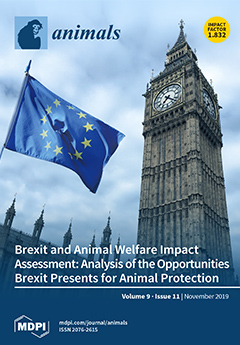
Cover Story: The British public voted to leave the European Union in 2016. Brexit presents substantial threats and significant opportunities for animal protection in the UK, EU, and internationally. Opportunities include radical reform of agricultural policy outside the Common Agricultural Policy, prohibition of live exports, and banning the import of fur and foie gras. Despite this, the UK Government seems uncommitted to major reform. The Agriculture Bill does not suggest a progressive animal welfare agenda. The government will consult on how to improve welfare of live exports, rather than outright prohibition. Rather than ban the import and sale of fur, the Government aims to improve welfare of fur-farmed animals outside the UK. Dr Steven McCulloch at the University of Winchester concludes, “the UK Conservative Government has not demonstrated the political will to realise animal welfare opportunities”. View this paper
  • Issues are regarded as officially published after their release is announced to the table of contents alert mailing list .
  • You may sign up for email alerts to receive table of contents of newly released issues.
  • PDF is the official format for papers published in both, html and pdf forms. To view the papers in pdf format, click on the "PDF Full-text" link, and use the free Adobe Reader to open them.

Articles (146)

  • Article
  • Open Access
25 Citations
5,291 Views
19 Pages

The Effect of Animal Welfare Training on the Knowledge and Attitudes of Abattoir Stakeholders in China

  • Kris Descovich,
  • Xiaofei Li,
  • Michelle Sinclair,
  • Yan Wang and
  • Clive Julian Christie Phillips

18 November 2019

Globally, China is one of the largest producers and exporters of meat, and animal welfare is an emerging focal issue for Chinese society and for primary producers. We assessed the effectiveness of a “train the trainer” program to increase...

  • Article
  • Open Access
45 Citations
4,657 Views
14 Pages

18 November 2019

Although flavonoids or yeast have been used as feed additives to improve the production efficiency and health of adult cattle, little information is available on their effects on rumen fermentation in calves. The objective of this study was to invest...

  • Review
  • Open Access
21 Citations
11,970 Views
11 Pages

18 November 2019

This review focuses on wolf sociobiology to delineate the traits of cooperative baggage driven by natural selection (wolf-wolf cooperation) and better understand the changes obtained by artificial selection (dog-human cooperation). We selected some b...

  • Article
  • Open Access
45 Citations
4,733 Views
14 Pages

18 November 2019

Natural plant extracts and probiotics has been proved as the most preferred and effective alternatives for antibiotics in animal feeding. The current study aimed to investigate the facilitating effect of tartary buckwheat flavonoids and Lactobacillus...

  • Article
  • Open Access
2 Citations
2,718 Views
9 Pages

Impact of Bovine Lipocalin-2 Gene on the Antioxidant Activity of Milk from Polish Holstein-Friesian Cows

  • Joanna Pokorska,
  • Dominika Kułaj,
  • Agata Piestrzyńska-Kajtoch and
  • Anna Radko

18 November 2019

In the recent years, antioxidant properties of food products have become an important aspect for consumers. Milk is a very good source of easily absorbable proteins and minerals, as well as a valuable source of antioxidants. Lipocalin-2 (LCN2), given...

  • Article
  • Open Access
16 Citations
5,015 Views
13 Pages

Changes in Saliva Analytes Correlate with Horses’ Behavioural Reactions to An Acute Stressor: A Pilot Study

  • María D. Contreras-Aguilar,
  • Séverine Henry,
  • Caroline Coste,
  • Fernando Tecles,
  • Damián Escribano,
  • Jose J. Cerón and
  • Martine Hausberger

18 November 2019

Acute stress induces an array of behavioural reactions in horses that vary between individuals. Attempts to relate behavioural patterns and physiological responses have not always given clear-cut results. Here, we measured the changes in a panel of s...

  • Feature Paper
  • Article
  • Open Access
5 Citations
4,180 Views
13 Pages

Decision Trees for Predicting the Physiological Responses of Rabbits

  • Patrícia Ferreira Ponciano Ferraz,
  • Yamid Fabián Hernández-Julio,
  • Gabriel Araújo e Silva Ferraz,
  • Raquel Silva de Moura,
  • Giuseppe Rossi,
  • Jairo Alexander Osorio Saraz and
  • Matteo Barbari

18 November 2019

The thermal environment inside a rabbit house affects the physiological responses and consequently the production of the animals. Thus, models are needed to assist rabbit producers in decision-making to maintain the production environment within the...

  • Article
  • Open Access
14 Citations
4,848 Views
12 Pages

18 November 2019

Reptiles undergo worldwide decline driven mostly by habitat change. Detailed recognition of factors underlying spatial structure and habitat utilization is therefore a prerequisite of effective conservation of this group. While the body of data on sp...

  • Article
  • Open Access
9 Citations
8,752 Views
12 Pages

17 November 2019

Some domestic dogs aggressively guard resources. Canine resource guarding impacts public health through dog bites and affects dog welfare through adoption and euthanasia policies at animal shelters. However, little is known about the demographic char...

  • Article
  • Open Access
17 Citations
3,821 Views
13 Pages

The Relationship between S. aureus and Branched-Chain Amino Acids Content in Composite Cow Milk

  • L. Grispoldi,
  • M. Karama,
  • F. Ianni,
  • A. La Mantia,
  • L. Pucciarini,
  • E. Camaioni,
  • R. Sardella,
  • P. Sechi,
  • B. Natalini and
  • B. T. Cenci-Goga

16 November 2019

The early diagnosis of mastitis is an essential factor for the prompt detection of the animal for further actions. In fact, if not culled, infected cows must be segregated from the milking herd and milked last, or milked with separate milking units....

of 15

Get Alerted

Add your email address to receive forthcoming issues of this journal.

XFacebookLinkedIn
Animals - ISSN 2076-2615