


Skip to Content

Animals, Volume 8, Issue 4

2018 April - 17 articles

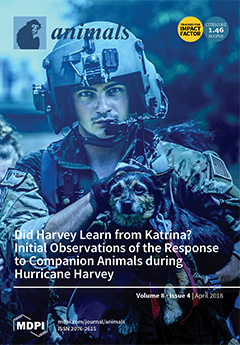
Cover Story: In the months following Hurricane Harvey, interviews were held with key officials within the state of Texas to ascertain if the reforms as a result of Hurricane Katrina twelve years previously—including the passage of the Pets Emergency and Transportation Standards Act 2006—had made any difference to the response. Culturally, the US now has a stronger collective understanding to ensure that companion animals are rescued along with their human counterparts in order to improve the safety of citizens and public safety responders. However, official planning efforts remain sub-optimal and many of the lessons from Hurricane Katrina were repeated. Without any "carrot or stick" the PETS Act remains impotent and, along with other findings, this research shows more effort is required to improve future response to animals in disaster. View this paper
  • Issues are regarded as officially published after their release is announced to the table of contents alert mailing list .
  • You may sign up for email alerts to receive table of contents of newly released issues.
  • PDF is the official format for papers published in both, html and pdf forms. To view the papers in pdf format, click on the "PDF Full-text" link, and use the free Adobe Reader to open them.

Articles (17)

  • Article
  • Open Access
15 Citations
9,799 Views
12 Pages

Does Flooring Substrate Impact Kennel and Dog Cleanliness in Commercial Breeding Facilities?

  • Judith Stella,
  • Moriah Hurt,
  • Amy Bauer,
  • Paulo Gomes,
  • Audrey Ruple,
  • Alan Beck and
  • Candace Croney

21 April 2018

Evaluation of kennel flooring surfaces is needed to understand their impacts on dog health and well-being. This pilot study aimed to characterize aspects of physical health, kennel cleanliness, and dog body cleanliness on flooring types common in US...

  • Feature Paper
  • Article
  • Open Access
18 Citations
5,229 Views
13 Pages

Use of a Non-Penetrating Captive Bolt for Euthanasia of Neonate Goats

  • Andrew Grist,
  • Jeff A. Lines,
  • Toby G. Knowles,
  • Charles W. Mason and
  • Stephen B. Wotton

20 April 2018

A non-penetrating captive bolt device, powered by a 1 grain 0.22″ cartridge delivering a calculated kinetic energy of 47 Joules was tested as a euthanasia method on 200 neonate goats (Capra aegagrus hircus) of mean dead weight = 4.425 kg (SD (S...

  • Review
  • Open Access
26 Citations
15,990 Views
17 Pages

17 April 2018

Acceptable methods for the euthanasia of cattle include overdose of an anesthetic, gunshot and captive bolt. The use of anesthetics for euthanasia is costly and complicates carcass disposal. These issues can be avoided by use of a physical method suc...

  • Review
  • Open Access
15 Citations
5,561 Views
15 Pages

14 April 2018

Unpalatable forage resources (low nutrient density, potentially toxic metabolites) are widespread and represent a challenge for ruminant nutrition, health, and welfare. Our objective was to synthesize the role of biophysical and social experience on...

  • Article
  • Open Access
41 Citations
18,830 Views
14 Pages

13 April 2018

Available evidence indicates that overall levels of feline intake and euthanasia at U.S. shelters have significantly declined in recent decades. Nevertheless, millions of cats, many of them free-roaming, continue to be admitted to shelters each year....

  • Article
  • Open Access
18 Citations
7,388 Views
10 Pages

Influence of Dietary Supplementation of Propolis and Bee Pollen on Liver Pathology in Broiler Chickens

  • Ivana Klaric,
  • Mirela Pavic,
  • Ivan Miskulin,
  • Valerija Blazicevic,
  • Albina Dumic and
  • Maja Miskulin

9 April 2018

One of the major problems in intensive breeding of chickens is liver damage. The objective of this study was to determine the influence of dietary supplementation with propolis and bee pollen on liver pathology in broiler chickens. The study was cond...

  • Article
  • Open Access
10 Citations
7,183 Views
15 Pages

4 April 2018

Current methods of euthanizing piglets are raising animal welfare concerns. Our experiment used a novel two-step euthanasia method, using nitrous oxide (N2O) for six minutes and then carbon dioxide (CO2) on compromised 0- to 7-day-old piglets. A comm...

  • Review
  • Open Access
9 Citations
4,471 Views
11 Pages

3 April 2018

Genetic selection of farm animals for productivity, and intensification of farming practices have yielded substantial improvements in efficiency; however, the capacity of animals to cope with environmental challenges has diminished. Understanding how...

  • Article
  • Open Access
8 Citations
4,237 Views
15 Pages

A Novel Protocol to Assess Acclimation Rate in Bos taurus Heifers during Yard Weaning

  • Jessica E. Monk,
  • Brad C. Hine,
  • Ian G. Colditz and
  • Caroline Lee

3 April 2018

The speed with which animals acclimate to a new environment could be an important measure of ability to cope with management induced stress. This study developed a measure of acclimation rate in a group of 50 Bos taurus heifers during yard weaning ov...

  • Feature Paper
  • Article
  • Open Access
17 Citations
11,962 Views
17 Pages

The Use of a Non-Penetrating Captive Bolt for the Euthanasia of Neonate Piglets

  • Andrew Grist,
  • Jeff A. Lines,
  • Toby G. Knowles,
  • Charles W. Mason and
  • Stephen B. Wotton

2 April 2018

The most common method for the on-farm euthanasia of neonate piglets is reported to be manual blunt force trauma. This paper presents the results of research to evaluate a mechanical non-penetrating captive bolt (the Accles and Shelvoke CASH small an...

  • Feature Paper
  • Article
  • Open Access
18 Citations
8,707 Views
18 Pages

The Use of a Mechanical Non-Penetrating Captive Bolt Device for the Euthanasia of Neonate Lambs

  • Andrew Grist,
  • Jeff A. Lines,
  • Toby G. Knowles,
  • Charles W. Mason and
  • Stephen B. Wotton

2 April 2018

A non-penetrating captive bolt device, powered by a 1-grain 0.22″ cartridge delivering a calculated kinetic energy of 47 Joules was tested as a euthanasia method on 200 neonate lambs (Ovis aries) of 4.464 kg (SD (Standard deviation) ± 1....

  • Article
  • Open Access
23 Citations
12,028 Views
9 Pages

30 March 2018

The aftermath of Hurricane Katrina in 2005 became the genesis of animal emergency management and created significant reforms in the US particularly the passage of the Pets Emergency and Transportation Standards Act in 2006 that required state and loc...

  • Article
  • Open Access
45 Citations
15,732 Views
15 Pages

28 March 2018

Better understanding of factors contributing to live release (rehoming) may help shelters improve outcomes. In this cross-sectional, exploratory, non-interventional study, data for all intakes (n = 21,409) for dogs eligible for rehoming from 1 Januar...

  • Article
  • Open Access
12 Citations
6,079 Views
19 Pages

Can a Red Wood-Ant Nest Be Associated with Fault-Related CH4 Micro-Seepage? A Case Study from Continuous Short-Term In-Situ Sampling

  • Gabriele M. Berberich,
  • Aaron M. Ellison,
  • Martin B. Berberich,
  • Arne Grumpe,
  • Adrian Becker and
  • Christian Wöhler

28 March 2018

We measured methane (CH4) and stable carbon isotope of methane (δ13C-CH4) concentrations in ambient air and within a red wood-ant (RWA; Formica polyctena) nest in the Neuwied Basin (Germany) using high-resolution in-situ sampling to detect microbial,...

  • Article
  • Open Access
20 Citations
6,127 Views
15 Pages

23 March 2018

The Dutch animal welfare law includes so-called principle-based standards. This means that the objective is described in abstract terms, enabling farmers to comply with the law in their own way. Principle-based standards are, however, difficult for t...

  • Article
  • Open Access
33 Citations
10,065 Views
11 Pages

Analysis of Stress Indicators for Evaluation of Animal Welfare and Meat Quality in Traditional and Jewish Slaughtering

  • Giancarlo Bozzo,
  • Roberta Barrasso,
  • Patrizia Marchetti,
  • Rocco Roma,
  • Giorgio Samoilis,
  • Giuseppina Tantillo and
  • Edmondo Ceci

21 March 2018

Sixty Charolais male beef cattle of eight months of age were divided into two groups according to the slaughtering method, i.e., traditional or Kosher (religious Jewish rite). The aim of the study was to detect and compare the plasma concentrations o...

Get Alerted

Add your email address to receive forthcoming issues of this journal.

XFacebookLinkedIn
Animals - ISSN 2076-2615