A Randomized, Placebo-Controlled Clinical Trial of Famciclovir in Shelter Cats with Naturally Occurring Upper Respiratory Tract Disease



1
Department of Clinical Sciences and Advanced Medicine, University of Pennsylvania School of Veterinary Medicine, Philadelphia, PA 19104, USA
2
Department of Clinical Sciences, Cummings School of Veterinary Medicine at Tufts University, North Grafton, MA 01536, USA
3
Department of Clinical Studies, New Bolton Center, University of Pennsylvania School of Veterinary Medicine, Kennett Square, PA 19348, USA
4
School of Veterinary Medicine, College of Science, Health, Engineering and Education, Murdoch University, Murdoch 6150, Australia
*
Author to whom correspondence should be addressed.
Animals 2020, 10(9), 1448; https://doi.org/10.3390/ani10091448
Submission received: 7 July 2020
/
Revised: 28 July 2020
/
Accepted: 15 August 2020
/
Published: 19 August 2020
(This article belongs to the Special Issue Veterinary Clinical Research: Veterinary Microbiology and Companion Animal Health)
Simple Summary
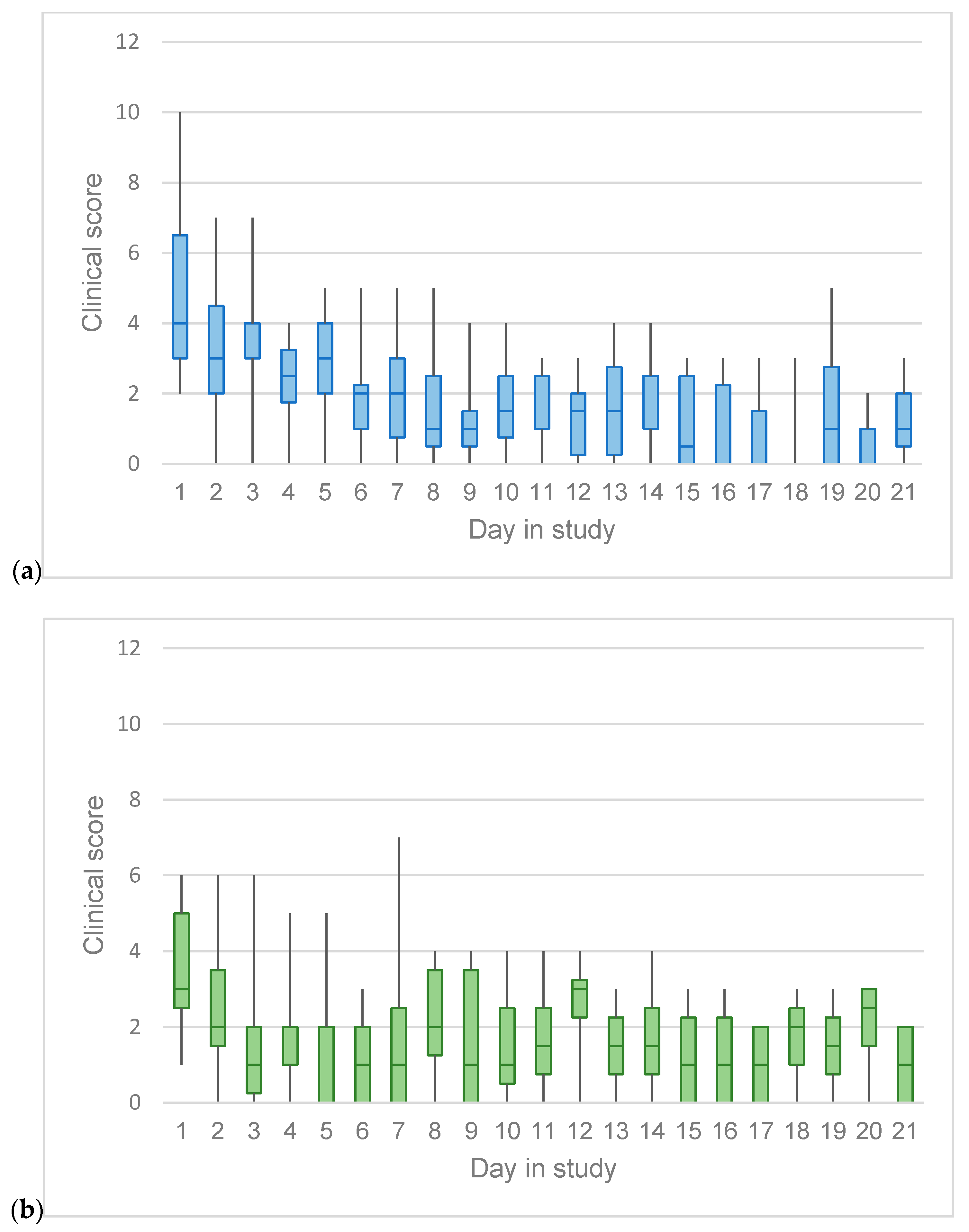
Upper respiratory tract disease (URTD) impacts the health and welfare of shelter cats. Mitigation strategies include stress reduction and population-level approaches; effective treatment plans focus on reducing the clinical signs in cats affected by URTD. This study evaluated the use of famciclovir, an antiviral therapy, in reducing clinical signs in shelter cats with URTD when administered at a target dose range of 40–90 mg/kg twice daily for up to 21 days. Cats were randomized into either a famciclovir treatment group (n = 11) or placebo group (n = 11). Testing for viral pathogen identification was performed at enrollment in the study, and clinical scoring was completed daily to evaluate the severity of signs. With each day of treatment, cats in both groups were less likely to experience worsening clinical scores; however, cats in the famciclovir treatment group had a significantly lower risk of worsening clinical signs with each day compared to the placebo group. Feline herpesvirus, a common pathogen causing URTD, was identified in 11/21 cats. The results of this small study justify the need for further research to determine the utility of famciclovir as part of treatment protocols for improving clinical signs and overall impacts of URTD in shelter cats.
Abstract
Upper respiratory tract disease (URTD) is a clinically relevant infectious disease in shelter cats, with individual and population-level welfare implications. The purpose of this study was to evaluate the effectiveness of famciclovir in reducing clinical signs of URTD in shelter cats during a therapeutic period of up to 21 days. Cats at two Northeastern United States animal shelters with URTD clinical signs were enrolled in a pragmatic, prospective, randomized, placebo-controlled clinical trial. Cats received either famciclovir (n = 11, target dose range 40–90 mg/kg) or placebo (n = 11), administered orally twice daily for up to 21 days with once-daily clinical scoring. At enrollment, conjunctival and oropharyngeal samples were collected for respiratory pathogen identification by RT-PCR. Zero-inflated Poisson regression was used to evaluate the treatment group effects and changes in clinical scoring over time. With each day of treatment, cats in both groups were less likely to experience worsening clinical scores; however, the risk of worsening scores with each day of treatment was significantly less in the famciclovir group compared to placebo (p = 0.006). Feline herpesvirus (FHV-1) DNA was detected in 11/21 cats. The findings justify further pragmatic studies to determine whether famciclovir treatment can contribute to a clinically relevant reduction in URTD morbidity in shelter cats.