You are currently viewing a new version of our website. To view the old version click .

Microorganisms, Volume 8, Issue 3

March 2020 - 149 articles

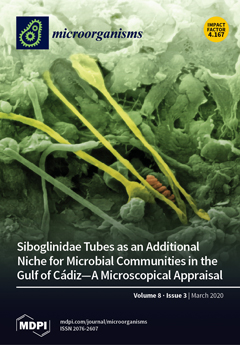
Cover Story: Siboglinidae worms are known to host chemosynthetic endosymbionts in a dedicated trophosome organ. However, little is known about their tube as a potential niche for other microorganisms. In this study, siboglinids sampled from four mud volcanoes in the Gulf of Cádiz (El Cid MV, Bonjardim MV, Al Gacel MV, and Anastasya MV) revealed that the tube was colonized by a thick microbial biofilm. This external biofilm of the tubes was mostly composed of cell-aggregations of methanotrophic bacteria, but other morphotypes such as filamentous, prosthecate, spirillum-like and rod-shaped bacteria were also observed. Yet, these microorganisms seem to influence in the structure and composition of the tube. Thus, siboglinids’ tubes remarkably increase the microbial biomass related to the worms and provide an additional microbial niche in deep-sea ecosystems.View this paper.
  • Issues are regarded as officially published after their release is announced to the table of contents alert mailing list .
  • You may sign up for email alerts to receive table of contents of newly released issues.
  • PDF is the official format for papers published in both, html and pdf forms. To view the papers in pdf format, click on the "PDF Full-text" link, and use the free Adobe Reader to open them.

Articles (149)

  • Article
  • Open Access
8 Citations
6,459 Views
20 Pages

Formate Utilization by the Crenarchaeon Desulfurococcus amylolyticus

  • Ipek Ergal,
  • Barbara Reischl,
  • Benedikt Hasibar,
  • Lokeshwaran Manoharan,
  • Aaron Zipperle,
  • Günther Bochmann,
  • Werner Fuchs and
  • Simon K.-M. R. Rittmann

Formate is one of the key compounds of the microbial carbon and/or energy metabolism. It owes a significant contribution to various anaerobic syntrophic associations, and may become one of the energy storage compounds of modern energy biotechnology....

  • Article
  • Open Access
64 Citations
6,470 Views
13 Pages

Quorum sensing (QS) plays an important role during infection for the opportunistic human pathogen Pseudomonas aeruginosa. Quorum sensing inhibition (QSI) can disrupt this initial event of infection without killing bacterial cells, and thus QS inhibit...

  • Article
  • Open Access
19 Citations
4,958 Views
18 Pages

Fungal Microbiota of Sea Buckthorn Berries at Two Ripening Stages and Volatile Profiling of Potential Biocontrol Yeasts

  • Juliana Lukša,
  • Iglė Vepštaitė-Monstavičė,
  • Violeta Apšegaitė,
  • Laima Blažytė-Čereškienė,
  • Ramunė Stanevičienė,
  • Živilė Strazdaitė-Žielienė,
  • Bazilė Ravoitytė,
  • Dominykas Aleknavičius,
  • Vincas Būda and
  • Raimondas Mozūraitis
  • + 1 author

Sea buckthorn, Hippophae rhamnoides L., has considerable potential for landscape reclamation, food, medicinal, and cosmetics industries. In this study, we analyzed fungal microorganism populations associated with carposphere of sea buckthorn harveste...

  • Article
  • Open Access
26 Citations
6,493 Views
28 Pages

Whole Genome Sequencing Differentiates Presumptive Extended Spectrum Beta-Lactamase Producing Escherichia coli along Segments of the One Health Continuum

  • Emelia H. Adator,
  • Matthew Walker,
  • Claudia Narvaez-Bravo,
  • Rahat Zaheer,
  • Noriko Goji,
  • Shaun R. Cook,
  • Lisa Tymensen,
  • Sherry J. Hannon,
  • Deirdre Church and
  • Calvin W. Booker
  • + 4 authors

Antimicrobial resistance (AMR) has important implications for the continued use of antibiotics to control infectious diseases in both beef cattle and humans. AMR along the One Health continuum of the beef production system is largely unknown. Here, w...

  • Article
  • Open Access
50 Citations
4,940 Views
12 Pages

Prevalence, Antimicrobial Resistance, Virulence Genes and Genetic Diversity of Salmonella Isolated from Retail Duck Meat in Southern China

  • Zhengquan Chen,
  • Jie Bai,
  • Shaojun Wang,
  • Xibin Zhang,
  • Zeqiang Zhan,
  • Haiyan Shen,
  • Hongxia Zhang,
  • Junping Wen,
  • Yuan Gao and
  • Ming Liao
  • + 1 author

Salmonella is an important cause of foodborne diseases. This study was undertaken to investigate the prevalence, serotype distribution, antimicrobial resistance, virulence genes, and genetic diversity of Salmonella isolates recovered from fresh duck...

  • Article
  • Open Access
19 Citations
3,554 Views
11 Pages

Evaluation of Cyprinid Herpesvirus 2 Latency and Reactivation in Carassius gibel

  • Wenjun Chai,
  • Lin Qi,
  • Yujun Zhang,
  • Mingming Hong,
  • Ling Jin,
  • Lijuan Li and
  • Junfa Yuan

Cyprinid herpesvirus 2 (CyHV-2, species Cyprinid herpesvirus 2) causes severe mortality in ornamental goldfish, crucian carp (Carassius auratus), and gibel carp (Carassius gibelio). It has been shown that the genomic DNA of CyHV-2 could be detected i...

  • Review
  • Open Access
38 Citations
6,870 Views
12 Pages

Do Foliar Endophytes Matter in Litter Decomposition?

  • Emily R. Wolfe and
  • Daniel J. Ballhorn

Litter decomposition rates are affected by a variety of abiotic and biotic factors, including the presence of fungal endophytes in host plant tissues. This review broadly analyzes the findings of 67 studies on the roles of foliar endophytes in litter...

  • Article
  • Open Access
28 Citations
5,914 Views
15 Pages

Most double-stranded (ds) DNA phages utilize holin proteins to secrete endolysin for host peptidoglycan lysis. In contrast, several holin-independent endolysins with secretion sequences or signal-arrest-release (SAR) sequences are secreted via the Se...

  • Article
  • Open Access
22 Citations
3,913 Views
14 Pages

Brucellosis is a major zoonotic public health threat worldwide, causing veterinary morbidity and major economic losses in endemic regions. However, no efficacious brucellosis vaccine is yet available, and live attenuated vaccines commonly used in ani...

  • Article
  • Open Access
59 Citations
5,309 Views
19 Pages

The Interplay between Mucosal Microbiota Composition and Host Gene-Expression is Linked with Infliximab Response in Inflammatory Bowel Diseases

  • Nikolas Dovrolis,
  • George Michalopoulos,
  • George E. Theodoropoulos,
  • Kostantinos Arvanitidis,
  • George Kolios,
  • Leonardo A. Sechi,
  • Aristidis G. Eliopoulos and
  • Maria Gazouli

Even though anti-TNF therapy significantly improves the rates of remission in inflammatory bowel disease (IBD) patients, there is a noticeable subgroup of patients who do not respond to treatment. Dysbiosis emerges as a key factor in IBD pathogenesis...

of 15

Get Alerted

Add your email address to receive forthcoming issues of this journal.

XFacebookLinkedIn
Microorganisms - ISSN 2076-2607