You are currently viewing a new version of our website. To view the old version click .

Microorganisms, Volume 12, Issue 1

January 2024 - 230 articles

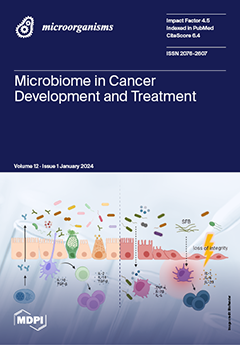
Cover Story: Cancer treatment negatively affects gut homeostasis via a disrupted mucosal barrier, leading to bacterial translocation and a significant inflammatory immune response. The scientific and clinical communities have widely accepted the crucial role of the microbiome in tumor development. Moreover, mounting evidence described the impact of the microbiome composition on chemo- and immunotherapy efficacy and treatment-induced late toxicity. Gut microbiota modulation via probiotics and fecal microbiota transplantation represents an emerging trend for increasing bacterial diversity, preventing inflammatory processes, and improving response to cancer therapies while minimizing side effects. A deep understanding of the host–microbiome crosstalk will help to bring a microbiome-based approach to routine clinical practice. View this paper
  • Issues are regarded as officially published after their release is announced to the table of contents alert mailing list .
  • You may sign up for email alerts to receive table of contents of newly released issues.
  • PDF is the official format for papers published in both, html and pdf forms. To view the papers in pdf format, click on the "PDF Full-text" link, and use the free Adobe Reader to open them.

Articles (230)

  • Article
  • Open Access
3 Citations
3,072 Views
10 Pages

Recurrent herpetic keratitis is a leading cause of blindness worldwide. In this population-based cross-sectional study, the medical records of Israeli adolescents and young adults who underwent systematic preconscription evaluation for mandatory mili...

  • Communication
  • Open Access
8 Citations
3,652 Views
6 Pages

The rise of macrolide-resistant Mycoplasma pneumoniae (MRMP), marked by point mutations in the 23S rRNA gene, poses a growing global concern since its initial detection in 2001. The prominence of the A2063G mutation during this emergence remains unex...

  • Review
  • Open Access
30 Citations
6,834 Views
27 Pages

The Gram-negative, strictly anaerobic bacterium Megasphaera elsdenii was first isolated from the rumen in 1953 and is common in the mammalian gastrointestinal tract. Its ability to use either lactate or glucose as its major energy sources for growth...

  • Article
  • Open Access
4 Citations
2,690 Views
13 Pages

Aquaculture plays a crucial role in addressing the growing global demand for food. However, diseases associated with intensive aquaculture practices, especially those affecting the skin, can present significant challenges to both fish health and the...

  • Article
  • Open Access
3 Citations
2,006 Views
14 Pages

The rumen is divided into multiple rumen sacs based on anatomical structure, and each has its unique physiological environment. Tarim wapiti preserved roughage tolerance after domestication, and adaptation to the desertified environment led to the de...

  • Article
  • Open Access
3 Citations
2,612 Views
16 Pages

Methanobrevibacter massiliense and Pyramidobacter piscolens Co-Culture Illustrates Transkingdom Symbiosis

  • Virginie Pilliol,
  • Mamadou Beye,
  • Laureline Terlier,
  • Julien Balmelle,
  • Idir Kacel,
  • Romain Lan,
  • Gérard Aboudharam,
  • Ghiles Grine and
  • Elodie Terrer

Among oral microbiota methanogens, Methanobrevibacter massiliense (M. massiliense) has remained less studied than the well-characterised and cultivated methanogens Methanobrevibacter oralis and Methanobrevibacter smithii. M. massiliense has been asso...

  • Article
  • Open Access
5 Citations
3,253 Views
15 Pages

Association of the Infant Gut Microbiome with Temperament at Nine Months of Age: A Michigan Cohort Study

  • Tengfei Ma,
  • Sihan Bu,
  • Adannaya C. Nzerem,
  • Nigel Paneth,
  • Jean M. Kerver,
  • Cybil Nicole Cavalieri and
  • Sarah S. Comstock

Though studies in animals and humans link the gut microbiota to brain development and control of behavior, little research has examined this connection in healthy infants. This prospective study could determine associations between infant gut microbi...

  • Review
  • Open Access
33 Citations
25,597 Views
16 Pages

Hospital-Acquired Pneumonia and Ventilator-Associated Pneumonia: A Literature Review

  • Mihnea Miron,
  • Mihaela Blaj,
  • Anca Irina Ristescu,
  • Gabriel Iosep,
  • Andrei-Nicolae Avădanei,
  • Diana-Gabriela Iosep,
  • Radu Crișan-Dabija,
  • Alexandra Ciocan,
  • Mihaela Perțea and
  • Carmen Doina Manciuc
  • + 3 authors

Hospital-acquired pneumonia (HAP) and its subtype, ventilator-associated pneumonia (VAP), remain two significant causes of morbidity and mortality worldwide, despite the better understanding of pathophysiological mechanisms, etiology, risk factors, p...

  • Article
  • Open Access
19 Citations
3,616 Views
12 Pages

Emerging life-threatening multidrug-resistant (MDR) species such as the C. haemulonii species complex, Clavispora lusitaniae (sin. C. lusitaniae), and other Candida species are considered as an increasing risk for human health in the near future. (1)...

  • Article
  • Open Access
1 Citations
1,828 Views
18 Pages

Deconstructing the Dimensions of Mycobiome Fingerprints in Luohandu Cave, Guilin, Southern China

  • Bai-Ying Man,
  • Xing Xiang,
  • Xiao-Yu Cheng,
  • Hong-Mei Wang,
  • Chun-Tian Su,
  • Qi-Bo Huang,
  • Yang Luo,
  • Chao Zhang,
  • Gang Cheng and
  • Yu-Yang Ni
  • + 1 author

Subterranean karst caves are windows into the terrestrial subsurface to deconstruct the dimensions of mycobiome fingerprints. However, impeded by the constraints of remote locations, the inaccessibility of specimens and technical limitations, the myc...

of 23

Get Alerted

Add your email address to receive forthcoming issues of this journal.

XFacebookLinkedIn
Microorganisms - ISSN 2076-2607