

You are currently viewing a new version of our website. To view the old version click .

Microorganisms, Volume 11, Issue 8

August 2023 - 260 articles

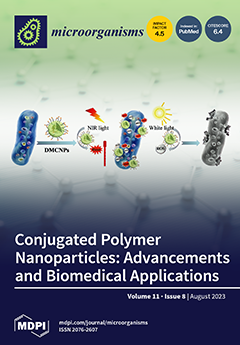
Cover Story: Conjugated polymer nanoparticles (CPNs) have emerged as promising nanomaterials for biomedical applications due to their unique photophysical and physicochemical characteristics. They play a crucial role in bioimaging, therapeutics, fluorescence, and sensing. In addition, they outperform small molecules and quantum dots as fluorescent probes, with high brightness, stability, quantum yield, and biocompatibility, and low toxicity. Challenges include, but are not limited to, optimizing CPNs’ particle size for biomedical use and making them scalable through cost-effective and eco-friendly preparation methods. The review highlights the growing interest in CPNs and focuses on their recent achievements and high performance. The potential of CPNs to advance biomedical research and healthcare is emphasized, along with the challenges and future perspectives. View this paper
  • Issues are regarded as officially published after their release is announced to the table of contents alert mailing list .
  • You may sign up for email alerts to receive table of contents of newly released issues.
  • PDF is the official format for papers published in both, html and pdf forms. To view the papers in pdf format, click on the "PDF Full-text" link, and use the free Adobe Reader to open them.

Articles (260)

  • Review
  • Open Access
8 Citations
3,904 Views
21 Pages

Multiomic Investigations into Lung Health and Disease

  • Sarah E. Blutt,
  • Cristian Coarfa,
  • Josef Neu and
  • Mohan Pammi

Diseases of the lung account for more than 5 million deaths worldwide and are a healthcare burden. Improving clinical outcomes, including mortality and quality of life, involves a holistic understanding of the disease, which can be provided by the in...

  • Review
  • Open Access
36 Citations
5,415 Views
22 Pages

Acinetobacter baumannii is a Gram-negative coccobacillus with exceptional survival skills in an unfavorable environment and the ability to rapidly acquire antibiotic resistance, making it one of the most successful hospital pathogens worldwide, repre...

  • Article
  • Open Access
6 Citations
4,078 Views
17 Pages

Comparative Genomic Analyses of Virulence and Antimicrobial Resistance in Citrobacter werkmanii, an Emerging Opportunistic Pathogen

  • José R. Aguirre-Sánchez,
  • Beatriz Quiñones,
  • José A. Ortiz-Muñoz,
  • Rogelio Prieto-Alvarado,
  • Inés F. Vega-López,
  • Jaime Martínez-Urtaza,
  • Bertram G. Lee and
  • Cristóbal Chaidez

Citrobacter werkmanii is an emerging and opportunistic human pathogen found in developing countries and is a causative agent of wound, urinary tract, and blood infections. The present study conducted comparative genomic analyses of a C. werkmanii str...

  • Article
  • Open Access
4 Citations
2,844 Views
16 Pages

Yeast Deletomics to Uncover Gadolinium Toxicity Targets and Resistance Mechanisms

  • Nicolas Grosjean,
  • Marie Le Jean,
  • Jordan Ory and
  • Damien Blaudez

Among the rare earth elements (REEs), a crucial group of metals for high-technologies. Gadolinium (Gd) is the only REE intentionally injected to human patients. The use of Gd-based contrasting agents for magnetic resonance imaging (MRI) is the primar...

  • Article
  • Open Access
4 Citations
2,582 Views
21 Pages

Physiological and Transcriptomic Analyses of Escherichia coli Serotype O157:H7 in Response to Rhamnolipid Treatment

  • Shuo Yang,
  • Lan Ma,
  • Xiaoqing Xu,
  • Qing Peng,
  • Huiying Zhong,
  • Yuxin Gong,
  • Linbo Shi,
  • Mengxin He,
  • Bo Shi and
  • Yu Qiao

Rhamnolipid (RL) can inhibit biofilm formation of Escherichia coli O157:H7, but the associated mechanism remains unknown. We here conducted comparative physiological and transcriptomic analyses of cultures treated with RL and untreated cultures to el...

  • Article
  • Open Access
1 Citations
3,906 Views
10 Pages

Neurodevelopment is influenced by complex interactions between environmental factors, including social determinants of health (SDOH), nutrition, and even the microbiome. This longitudinal cohort study of 142 infants tested the hypothesis that microbi...

  • Article
  • Open Access
4 Citations
4,347 Views
18 Pages

The Probiotic Bacillus subtilis MB40 Improves Immunity in a Porcine Model of Listeriosis

  • Sean M. Garvey,
  • Nima K. Emami,
  • Justin L. Guice,
  • Nammalwar Sriranganathan,
  • Christopher Penet,
  • Robert P. Rhoads,
  • Jessica L. Spears,
  • Rami A. Dalloul and
  • Samer W. El-Kadi

Probiotics for humans and direct-fed microbials for livestock are increasingly popular dietary ingredients for supporting immunity. The aim of this study was to determine the effects of dietary supplementation of Bacillus subtilis MB40 (MB40) on immu...

  • Article
  • Open Access
5 Citations
2,302 Views
16 Pages

The surveillance of foods for Salmonella is hindered by bias in common enrichment media where serovars implicated in human illness are outgrown by less virulent serovars. We examined four Salmonella serovars, two common in human illness (Enteritidis...

  • Article
  • Open Access
10 Citations
4,089 Views
15 Pages

Gut Microbiota and Respiratory Infections: Insights from Mendelian Randomization

  • Shengyu Huang,
  • Jiaqi Li,
  • Zhihao Zhu,
  • Xiaobin Liu,
  • Tuo Shen,
  • Yusong Wang,
  • Qimin Ma,
  • Xin Wang,
  • Guangping Yang and
  • Guanghua Guo
  • + 1 author

The role of the gut microbiota in modulating the risk of respiratory infections has garnered increasing attention. However, conventional clinical trials have faced challenges in establishing the precise relationship between the two. In this study, we...

  • Article
  • Open Access
5 Citations
2,809 Views
17 Pages

Identification of Virulence Factors in Entomopathogenic Aspergillus flavus Isolated from Naturally Infected Rhipicephalus microplus

  • Cesar A. Arreguin-Perez,
  • Estefan Miranda-Miranda,
  • Jorge Luis Folch-Mallol and
  • Raquel Cossío-Bayúgar

Aspergillus flavus has been found to be an effective entomopathogenic fungus for various arthropods, including ticks. In particular, natural fungal infections in cattle ticks show promise for biocontrol of the Rhipicephalus (Boophilus) microplus tick...

of 26

Get Alerted

Add your email address to receive forthcoming issues of this journal.

XFacebookLinkedIn
Microorganisms - ISSN 2076-2607