


Abstract
Morphing aerospace structures have attracted increasing attention as an efficient solution for improving aerodynamic efficiency by enabling continuous variation of wing geometry under different flight conditions. Among the available actuation technologies, Shape Memory Alloys (SMAs) are particularly attractive because of their high actuation force, compactness, and shape recovery capability. The aim of this work is to develop and numerically assess a lightweight morphing airfoil integrating SMA wire actuators within an additively manufactured lattice structure. A progressive numerical methodology has been adopted, starting from the analysis of a simplified section and extending to the complete morphing airfoil under representative aerodynamic loading. The simulations reproduced the complete actuation cycle, including mechanical deformation, unloading, thermal activation of the SMA wires, cooling, and structural recovery. The results demonstrate that the proposed architecture enables reversible shape adaptation while maintaining structural integrity throughout the loading cycle. Furthermore, the optimized design preserves its self-recovery capability under aerodynamic loads, confirming the effectiveness of combining lattice structures, SMA actuation, and Additive Manufacturing (AM). The proposed design methodology provides a promising framework for the development of lightweight adaptive aerospace structures with reduced mechanical complexity.
1. Introduction
The aerospace industry is currently facing increasing pressure to develop more efficient, sustainable, and adaptive aircraft capable of reducing fuel consumption, greenhouse gas emissions, and operating costs while maintaining high aerodynamic performance [1,2,3]. Conventional aircraft wings are generally optimized for a limited number of operating conditions, typically cruise flight, whereas take-off, landing, climb, manoeuvring, and high-speed operations require significantly different aerodynamic configurations. Consequently, modern aircraft rely on discrete movable control surfaces such as flaps, slats, spoilers, and ailerons to modify lift and stability characteristics. Although these devices have proven highly effective over decades of operation, they inevitably introduce geometric discontinuities, increase structural complexity, require numerous mechanical components and actuators, and generate additional aerodynamic drag due to gaps and hinge mechanisms [4].
Morphing technology has emerged as one of the most promising approaches to overcome these limitations by enabling continuous and reversible geometric adaptation of lifting surfaces according to different flight conditions [2]. Unlike conventional articulated control surfaces, morphing structures distribute the deformation over the entire aerodynamic profile, producing smoother external geometries, reducing flow separation, improving lift-to-drag ratio, and extending the operational flight envelope [3,4]. Consequently, morphing concepts have become an active research topic for both civilian and military aerospace applications.
The concept of adaptive wings originates directly from biological flight. Birds continuously modify wingspan, camber, twist, sweep angle, and surface curvature to maximize aerodynamic efficiency during different phases of flight. Although wing warping has been progressively abandoned following the introduction of metallic airframes because of their increased structural stiffness, recent advances in smart materials, computational optimization, mechanisms, and AM have renewed interest in adaptive aerodynamic structures [4].
Several morphing strategies have been proposed during the last two decades [5,6]. According to Barbarino et al. [1], morphing concepts can be classified into span morphing, chord morphing, sweep morphing, twist morphing and camber morphing, each providing specific aerodynamic advantages depending on the flight mission. Span morphing improves aerodynamic efficiency by varying the wing aspect ratio but generally requires telescopic mechanisms that increase structural weight and mechanical complexity. Twist morphing enables active load redistribution and enhanced manoeuvrability, although it often requires distributed actuation systems and sophisticated control algorithms. Camber morphing has attracted considerable attention because it enables continuous airfoil deformation while eliminating the aerodynamic discontinuities associated with conventional flaps. However, maintaining structural stiffness during large recoverable deformations remains one of the principal engineering challenges [7,8].
Recent review papers consistently identify the conflicting requirements of structural flexibility and load-carrying capability as the major limitation in the development of practical morphing wings [8]. A successful morphing structure must simultaneously undergo large elastic deformations while maintaining sufficient stiffness to withstand aerodynamic loads without excessive deflection, local instability, or structural failure. As highlighted by Ajaj et al. [4], this trade-off requires a completely new design philosophy in which materials, internal architecture, actuation system, and manufacturing process are conceived as an integrated adaptive structure rather than independent subsystems.
Among the various actuation technologies investigated for morphing applications, Shape Memory Alloys (SMAs) have emerged as one of the most promising solutions owing to their high actuation force, compact dimensions, silent operation, and ability to recover large strains through reversible thermoelastic martensitic transformations [8,9,10]. Unlike conventional hydraulic or electromechanical actuators, SMA wires can be directly integrated into lightweight aerospace structures, significantly reducing mechanical complexity and installation volume.
Several studies have successfully demonstrated the feasibility of SMA-driven morphing concepts. In [11] it is presented one of the first comprehensive reviews of SMA applications in morphing aircraft is presented, highlighting their high-power density and compactness. Bil et al. [12] demonstrated the effectiveness of SMA wires for active wing morphing control, while Kang et al. [13] developed an SMA-driven morphing wing mechanism capable of generating continuous trailing-edge deformation. More recently, Costanza and Tata [9] reviewed the most recent aerospace applications of shape memory alloys, emphasizing their increasing relevance for adaptive aerospace structures.
Despite these promising developments, several technical challenges remain. The relatively slow thermal response of SMA actuators, thermal management during repeated activation cycles, material fatigue, and the integration of actuators within lightweight structures continue to limit their widespread implementation in aerospace applications.
Recent advances in AM have significantly expanded the design possibilities for adaptive aerospace structures by enabling the fabrication of highly complex geometries that are difficult or impossible to produce using conventional subtractive manufacturing techniques [14,15,16,17]. The layer-by-layer manufacturing approach allows engineers to tailor the internal architecture of structural components by locally modifying density, stiffness, and topology while simultaneously reducing structural weight. This capability has promoted the development of lightweight lattice structures and mechanisms that integrate structural support and controlled flexibility within a single monolithic component.
Several recent studies have demonstrated the advantages of combining structures with AM for adaptive aerospace applications. De Gaspari and Ricci [18,19] proposed innovative wing architectures capable of generating continuous camber variation while reducing the number of moving mechanical components. Their numerical and experimental investigations demonstrated that distributed structural compliance represents a viable alternative to conventional articulated morphing mechanisms. Similarly, Pecora [7] presented the evolution of morphing trailing-edge flaps developed within the European Clean Sky programme, highlighting the importance of structures for achieving smooth aerodynamic shape adaptation in large civil aircraft. These studies confirm that morphing concepts can effectively improve aerodynamic performance while reducing the discontinuities associated with traditional flap systems.
Despite these significant advances, the implementation of morphing structures remains a multidisciplinary design challenge. According to Vasista et al. [8], the internal architecture must simultaneously satisfy conflicting requirements involving structural stiffness, geometric flexibility, fatigue resistance, manufacturability, actuator integration, and aeroelastic stability. Consequently, the design of the right structure cannot be considered independently from the actuation system or the manufacturing technology. Instead, these three elements must be developed as a single integrated adaptive system.
The integration of SMA actuators with additively manufactured structures has therefore emerged as a promising research direction. SMA wires provide compact actuation capable of generating relatively large recovery forces, whereas lattice structures distribute the resulting deformation over the entire aerodynamic surface without requiring rigid transmission systems or complex kinematic mechanisms. Furthermore, the design freedom provided by additive manufacturing allows dedicated channels, actuator housing, reinforcement regions, and lattice architectures to be incorporated directly into the structural component, considerably simplifying assembly and reducing overall system weight. Despite the significant advances achieved in SMA-actuated morphing structures, several practical challenges still limit their widespread implementation in aerospace applications. The relatively slow thermal response of SMA actuators may reduce the actuation frequency, particularly in applications requiring rapid shape adaptation. Furthermore, repeated thermo-mechanical cycles may affect both the fatigue life of the SMA actuators and the durability of the lattice structure. In addition, the dimensional tolerances and geometric imperfections inherently associated with additive manufacturing may influence the stiffness distribution and, consequently, the overall morphing performance. Although these aspects are beyond the scope of the present numerical investigation, they represent important considerations for future experimental validation and design optimization of adaptive aerospace structures.
Therefore, a clear research gap still exists regarding the systematic design of lightweight morphing structures capable of integrating smart material actuation, structural behaviour, and AM technologies within a single optimized architecture. There remains a need for numerical methodologies capable of evaluating the complete interaction between structural response, SMA actuation, and external aerodynamic loads during the entire morphing cycle. To address these limitations, the present work proposes the numerical design and structural assessment of an additively manufactured self-recovering morphing airfoil actuated by SMA wires. Unlike previously proposed morphing solutions, the present approach directly integrates SMA wire actuators into an additively manufactured lattice structure (Table 1), eliminating the need for complex transmission mechanisms while reducing the number of moving components.
Table 1.
Comparison of representative morphing airfoil concepts in terms of actuation technology, structural concept, additive manufacturing integration, numerical methodology, and shape recovery capability.
Monolithic architecture simplifies manufacturing and assembly and provides an optimized balance between structural flexibility and stiffness. Furthermore, the developed thermo-mechanical finite element methodology enables the complete actuation cycle to be simulated, leading to an optimized configuration capable of achieving approximately 98% shape recovery under representative aerodynamic loading conditions. A progressive finite element methodology is adopted, beginning with simplified structural sections and subsequently extending the investigation to the complete morphing airfoil subjected to representative aerodynamic loading conditions. The novelty of the proposed approach lies not only in the integration of shape memory alloy actuation with an additively manufactured structure, but also in the definition of a systematic numerical design methodology for evaluating the complete actuation cycle, including mechanical deformation, unloading, thermal activation, cooling, and structural recovery under aerodynamic loads. The proposed methodology provides useful design guidelines for the development of lightweight adaptive aerospace structures characterized by reduced mechanical complexity, improved manufacturability, and enhanced structural recoverability.
Section 2 presents the materials and methods adopted in the study, including the numerical framework and the constitutive modelling of the SMA actuators. Section 3 describes the conceptual design of the proposed morphing airfoil together with the preliminary numerical investigations carried out to optimize the structural configuration. Section 4 presents the finite element analyses of the complete airfoil, discussing its thermo-mechanical response throughout the actuation cycle and under representative aerodynamic loading. Conclusions are reported in Section 5.
2. Materials and Methods
The proposed morphing airfoil has been conceived as an adaptive lightweight structure capable of undergoing reversible geometric modifications through the combined action of an internal additive architecture and SMA wire actuators. The design philosophy has been based on minimizing the mechanical complexity typically associated with conventional morphing mechanisms by replacing articulated joints and transmission systems with distributed structural compliance. The internal architecture has therefore been designed to deform elastically under the action of embedded SMA wires while preserving sufficient stiffness to withstand the aerodynamic loads acting during the recovery phase.
The structural configuration has been progressively developed through a hierarchical numerical procedure. Initially, simplified sections have been analysed to evaluate the deformation capability and the self-recovery behaviour of the proposed architecture. These preliminary analyses allowed the optimization of the best geometry before extending the numerical investigation to the complete morphing airfoil. The optimized configuration has been subsequently subjected to the complete actuation cycle, including mechanical deformation, release, thermal activation of the SMA actuators, cooling, and finally aerodynamic loading to evaluate the capability of recovering the initial aerodynamic profile under external loads. This progressive approach reduced the computational cost while allowing the identification of the most effective structural configuration before analysing the complete system.
The internal supporting structure has been specifically conceived according to the principles of Design for Additive Manufacturing (DfAM). Unlike conventional subtractive manufacturing processes, AM allows the fabrication of highly integrated components characterized by complex internal geometries that cannot be produced through traditional machining. This design freedom enables the realization of lattice architectures with locally tailored stiffness, reducing the structural weight while maintaining adequate load-carrying capability. Furthermore, the layer-by-layer manufacturing process allows the direct integration of actuator channels, internal reinforcements and mechanisms within a single monolithic component, eliminating several assembly operations and reducing the number of mechanical parts. From a structural standpoint, the mechanical response of lightweight cellular architectures can be related to the relative density according to the Gibson–Ashby formulation
where and denote the elastic modulus of the lattice and solid material, respectively, is the relative density, while and are geometry-dependent constants. This relationship highlights how the internal architecture can be optimized to obtain the desired compromise between flexibility and structural stiffness, a fundamental requirement for morphing systems.
The adaptive behaviour of the proposed structure has been achieved through SMA wire actuators integrated within the framework. Their mechanical response has been simulated using a user-defined constitutive model implemented through an ABAQUS UMAT subroutine. The constitutive formulation describes the thermo-mechanical coupling associated with the reversible martensitic transformation occurring between the low-temperature martensitic phase and the high-temperature austenitic phase. Assuming small strains, the total strain tensor is decomposed into elastic, transformation and thermal contributions according to
where is the elastic strain, represents the transformation strain associated with the evolution of martensite, and denotes the thermal strain induced by temperature variation.
The constitutive relationship adopted within the UMAT can therefore be expressed as
where is the elastic stiffness tensor and is the Cauchy stress tensor. The transformation process is governed by the evolution of the martensitic volume fraction , which varies continuously between the fully austenitic and fully martensitic states,
and evolves as a function of both stress and temperature,
2.1. UMAT Implementation
The constitutive behaviour of the SMA actuator has been implemented in ABAQUS through a User-defined MATerial (UMAT) subroutine based on the thermo-mechanical constitutive model previously developed and validated by the authors, as described in [6]. This formulation enables the nonlinear thermo-mechanical response of the alloy to be accurately evaluated throughout the entire actuation cycle. During each load increment, the subroutine updates the material state variables by solving the coupled evolution of temperature, martensitic volume fraction and stress field.
The first quantity evaluated is the thermal strain resulting from the local temperature variation,
where is the coefficient of thermal expansion and () is the reference temperature. This contribution is added to the constitutive formulation to account for the thermal expansion of the actuator before the phase transformation is evaluated.
Subsequently, the martensitic volume fraction is updated according to the adopted transformation kinetics,
where the evolution function describes the dependence of the phase transformation on the current stress and temperature fields. This incremental procedure allows the forward and reverse transformations to be continuously tracked during the simulation.
The updated martensitic fraction is then employed to compute the stress tensor through the constitutive relationship
where represents the phase-dependent elastic modulus and is the maximum transformation strain. This formulation simultaneously accounts for elastic deformation, thermal expansion and transformation-induced strain, providing a consistent description of the nonlinear mechanical behaviour of the SMA.
The thermal field is solved simultaneously through the transient energy balance equation. The mechanical response of the SMA wire is described through a one-dimensional phenomenological constitutive model based on the phase-dependent elastic modulus,
where the effective Young’s modulus is interpolated between the martensitic and austenitic phases according to
and the transformation strain is defined as
The temperature evolution directly affects both the thermal strain and the transformation kinetics, establishing the coupling between the thermal and mechanical fields. At every increment, the updated temperature modifies the martensitic fraction, which changes the elastic modulus and the stress distribution. This iterative solution procedure enables the UMAT to accurately reproduce the complete thermo-mechanical response of the SMA actuator, including loading, unloading, thermal activation, cooling and final shape recovery within a single finite element analysis.
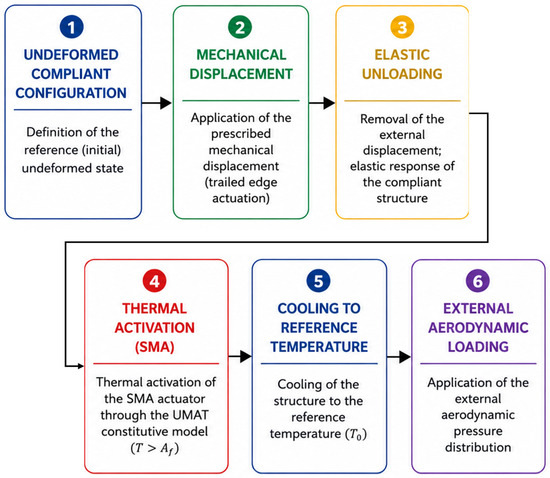
Within each increment, the UMAT updates the internal state variables describing the phase transformation, computes the corresponding transformation strain, evaluates the stress tensor and returns the consistent tangent constitutive matrix required by the Newton–Raphson iterative procedure adopted by ABAQUS. This fully coupled thermo-mechanical implementation enables the simulation of the complete actuation cycle, including mechanical loading, unloading, thermal activation, reverse transformation and final shape recovery, providing a realistic description of the SMA behaviour during the morphing process. The numerical investigation has been performed using the commercial finite element software ABAQUS 2020 Standard. The entire morphing process has been reproduced through a fully coupled sequential thermo-mechanical analysis capable of describing the interaction between the structure and the embedded SMA actuators throughout the complete operating cycle (Figure 1).
Figure 1.
Numerical workflow adopted for the finite element simulation of the SMA-actuated morphing airfoil, including mechanical loading, unloading, thermal activation, cooling, and aerodynamic loading.
The experimental validation of the UMAT subroutine has been previously performed in a preliminary study investigating the thermo-mechanical activation of the SMA actuator and the associated actuation time, as reported in [20].
2.2. Material
The morphing airfoil is actuated by two parallel NiTi SMA wires, selected for their high recoverable strain, elevated energy density and stable thermo-mechanical response under repeated actuation cycles. The constitutive behaviour of the actuator is governed by the reversible martensitic–austenitic phase transformation, which enables the generation of recovery forces sufficient to deform the trailing-edge structure and subsequently restore the original aerodynamic profile.
The mechanical response of the SMA wires depends on the phase-dependent elastic modulus, transformation strain and characteristic transformation temperatures, which define the operating range of the actuator. These material properties have been considered in the numerical model to ensure that the recovery force generated during thermal activation is sufficient to actuate the morphing mechanism while maintaining the actuator within its recommended operating conditions.
The two SMA wires have been arranged in a parallel configuration to provide a more uniform transmission of the recovery force to the structure. This arrangement improves the load distribution along the morphing section, promotes a smooth deformation of the trailing edge and reduces localized stress concentrations within both the actuator and the surrounding structure. In addition, the initial pre-strain imposed on the SMA wires allows elastic energy to be stored during the loading phase, which is subsequently released through the thermo-mechanical transformation, enabling stable and repeatable shape recovery throughout the complete actuation cycle.
The specific properties of the SMA wires used in this study are summarized in Table 2, providing a detailed overview of all electro-thermo-mechanical properties.
Table 2.
Nickel–titanium (NiTiNOL) thermo-mechanical–electrical properties [20,21,22].
3. Conceptual Design
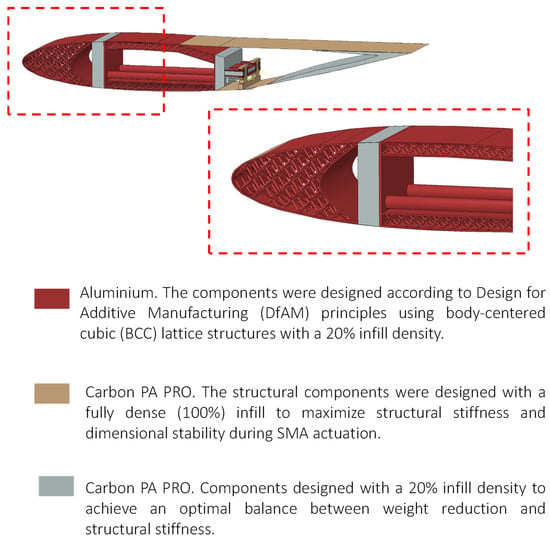
The proposed morphing airfoil has been conceived as a lightweight adaptive structure integrating SMA wire actuation within an architecture specifically designed according to DfAM principles. The objective of the structural redesign has been to minimize the overall weight while preserving the mechanical stiffness required to withstand the actuation loads and the external aerodynamic forces acting during operation. The aerodynamic profile consists of three main structural subsystems: an additively manufactured external shell, an internal metallic guide supporting the SMA actuator, and the SMA wire responsible for the morphing action (Figure 2). The shell has been manufactured using Carbon PA PRO [23,24], selected for its high specific stiffness, good dimensional stability and suitability for lightweight aerospace applications. The external skin incorporates an optimized lattice architecture that reduces structural mass while maintaining adequate rigidity and allowing the controlled deformation required during the morphing process.
Figure 2.
CAD model of the proposed morphing airfoil showing the hybrid structural configuration. The detailed view illustrates the internal lattice architecture adopted to reduce weight while preserving structural stiffness.
Unlike conventional morphing mechanisms employing multiple hinges and articulated transmission systems, the proposed configuration exploits distributed structural compliance. The architecture accommodates the deformation induced by the SMA actuator without introducing significant stress concentrations or geometric discontinuities on the external aerodynamic surface. A dedicated aluminium guide has been introduced inside the airfoil to ensure the correct alignment of the SMA wire during activation. Besides providing accurate actuator positioning, the guide prevents undesirable lateral displacements and minimizes friction during the contraction–recovery cycle, thus improving the repeatability of the morphing motion. The guide also acts as the structural interface between the actuator and the profile, ensuring an efficient transfer of the recovery force generated during the austenitic transformation. The SMA wire is anchored at both ends of the guide and operates in tension. During the mechanical loading phase, the wire is elongated while remaining in the martensitic phase. Subsequent thermal activation above the austenite finish temperature produces the recovery stress responsible for restoring the original wire length partially. The generated recovery force is transferred to the structure, producing a smooth deformation of the trailing-edge region without requiring additional transmission mechanisms. Special attention has been given to the integration of the different structural components to ensure efficient load transfer and reliable actuation throughout the morphing cycle. The additively manufactured shell has been designed with dedicated housing features for the metallic guide, allowing precise assembly while reducing the number of fastening elements. This integrated design significantly simplifies manufacturing and improves structural continuity compared with traditional morphing concepts based on multiple independent components.
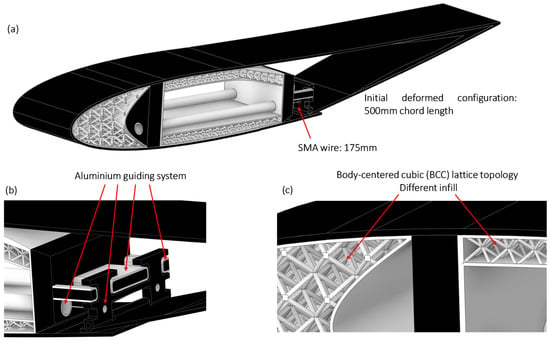
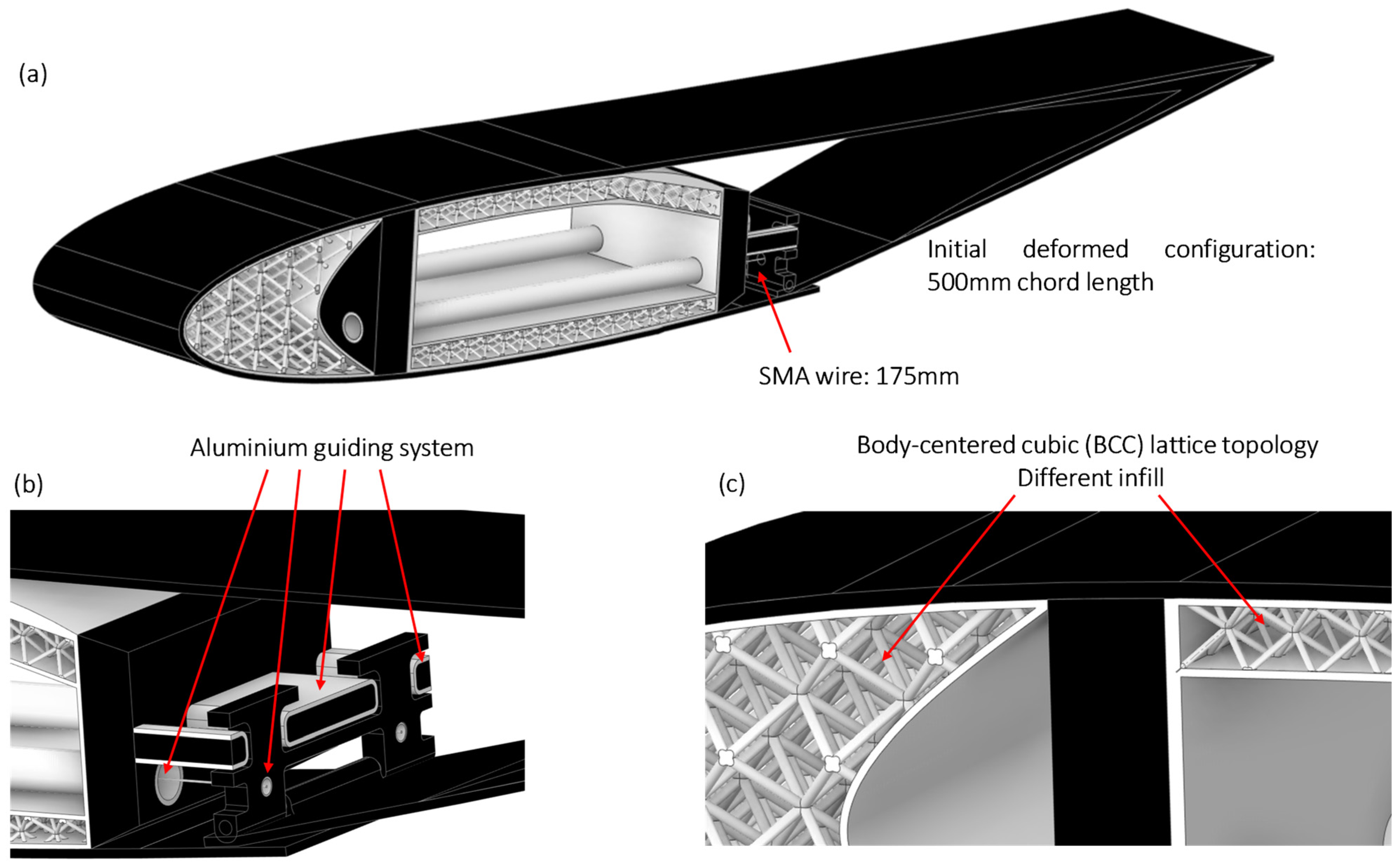
Figure 3a illustrates the proposed morphing airfoil architecture and two key details of the proposed morphing airfoil architecture. The enlarged view in Figure 3b illustrates the integration of the SMA wire within the aluminium guiding system. The guide ensures the correct alignment of the actuator throughout the thermo-mechanical cycle, preventing undesired lateral displacements and guaranteeing an efficient transfer of the recovery force to the structure. The views in Figure 3c highlight the additively manufactured lattice architecture adopted for the structural components. A body-centered cubic (BCC) lattice topology has been adopted to reduce the structural mass while maintaining the stiffness required for morphing actuation. The leading-edge support has been designed with a unit cell size of 13.5 mm and a strut diameter of 1.3 mm, whereas the lattice integrated into the skin has been characterized by a unit cell size of 8 mm and a strut diameter of 0.8 mm. Each unit cell consists of eight corner nodes connected to a central node through inclined struts, ensuring an efficient distribution of stiffness and load transfer throughout the structure. The finite element analyses have been performed on the explicit three-dimensional geometry of the lattice rather than using an equivalent homogenized representation. Different infill densities have been intentionally adopted according to the mechanical function of each component. Regions primarily subjected to structural loads have been manufactured with a higher infill to maximize stiffness and ensure an efficient transfer of the SMA recovery force, whereas secondary regions have been designed with a lower infill density to reduce weight and locally increase structural flexibility. This functionally graded approach enables a more efficient distribution of stiffness within the airfoil, improving the overall balance between lightweight design, deformation and structural integrity.
Figure 3.
Proposed morphing airfoil architecture. (a) CAD model of the adaptive airfoil in the initial deformed configuration, showing the integrated Shape Memory Alloy (SMA) wire, the aluminium guiding system, and the additively manufactured structure. (b) Detailed view of the aluminium guide ensuring accurate alignment and load transfer of the SMA actuator. (c) Details of the body-centered cubic (BCC) lattice topology manufactured with different infill densities to locally tailor the structural stiffness while minimizing the overall weight.
The combination of an integrated SMA guiding system with locally optimized lattice architecture demonstrates the potential of DfAM for the realization of highly integrated adaptive aerospace structures. By tailoring the internal architecture according to the local mechanical requirements, the proposed design simultaneously improves manufacturability, reduces structural mass and enhances the effectiveness of the SMA-driven morphing mechanism.
The proposed architecture has been developed as an evolution of a previous configuration manufactured using a conventional steel–aluminium assembly. By replacing most of the metallic structural components with Carbon PA PRO elements manufactured through AM, the total mass of the morphing module has been reduced from approximately 790 g to 700 g, corresponding to an overall weight reduction of about 11% [20]. Despite this reduction, the optimized configuration preserves the structural integrity required for the transmission of the SMA recovery force while simultaneously improving manufacturability and reducing assembly complexity.
Preliminary Numerical Investigation
A preliminary numerical investigation has been performed to identify the geometric and actuation parameters required to achieve an effective self-recovering behaviour of the proposed morphing airfoil before analysing the complete configuration. To reduce the computational cost while preserving the essential mechanical behaviour of the adaptive system, the analysis has been intentionally limited to the actuated portion of the airfoil, corresponding to the trailing-edge region where the SMA wire is embedded and the morphing deformation takes place. Since the remaining portion of the profile does not actively participate in the actuation mechanism, its contribution to the preliminary optimization has been neglected. This simplified approach enabled an efficient parametric investigation while accurately reproducing the local interaction between the structure and the SMA actuator.
Unlike the structural thickness, the initial pre-strain of the SMA wire has not been considered as an optimization variable. Following the recommendations commonly adopted in the literature for SMA wire actuators [25], the imposed mechanical displacement has been fixed to 10% of the initial wire length, ensuring an adequate recoverable strain while preventing excessive loading conditions that could compromise the functional reliability of the actuator. Consequently, the optimization process focused exclusively on the influence of the structural thickness on the morphing performance.
The structural thickness represents one of the most influential parameters governing the behaviour of morphing structures. Reducing the thickness increases structural flexibility and facilitates the deformation induced by the SMA actuator; however, excessively thin configurations may exhibit localized instability, reduced load-carrying capability and incomplete shape recovery. Conversely, increasing the thickness improves structural stiffness and recovery capability but simultaneously requires larger recovery forces from the SMA actuator. Therefore, an appropriate balance between structural compliance and stiffness is essential to guarantee both efficient actuation and stable structural behaviour. Each numerical simulation consisted of four sequential analysis stages: application of the prescribed mechanical displacement to the SMA wire while the alloy remained in the martensitic phase, elastic unloading of the structure, thermal activation of the actuator through the martensite-to-austenite transformation, and cooling and evaluation of the final recovered configuration.
A parametric investigation has then been performed by analysing four different structural thicknesses while maintaining the same SMA pre-strain throughout all simulations. The recovery stage has been thoroughly evaluated to assess the effectiveness of the SMA-driven actuation, since the capability of restoring the initial aerodynamic profile represents the primary performance requirement of the proposed morphing concept.
The numerical results clearly demonstrated that the structural thickness strongly influences the adaptive response of the morphing section. Thin configurations generated large deformations but were unable to completely recover the initial geometry because of their limited stiffness. Conversely, increasing the structural thickness improved the recovery capability but progressively increased the mechanical demand imposed on the SMA actuator. Among all the investigated configurations, the section characterized by a thickness of 2.8 mm provided the most favourable compromise between structural flexibility and stiffness, achieving approximately 98% shape recovery while maintaining the SMA actuator within the prescribed operating conditions (Table 3). Consequently, the #1 configuration has been selected and subsequently implemented in the complete morphing airfoil model for the final numerical analyses under representative aerodynamic loading conditions.
Table 3.
Comparison of the preliminary numerical analyses and identification of the optimal airfoil thickness for SMA actuation.
4. Results
Following the identification of the optimal section, the corresponding geometric parameters have been implemented in the complete morphing airfoil to evaluate its structural response under representative operating conditions. The numerical investigation reproduced the entire thermo-mechanical actuation cycle using the finite element model described in the previous section.
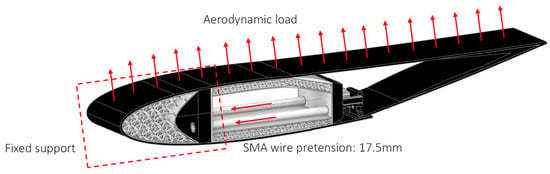
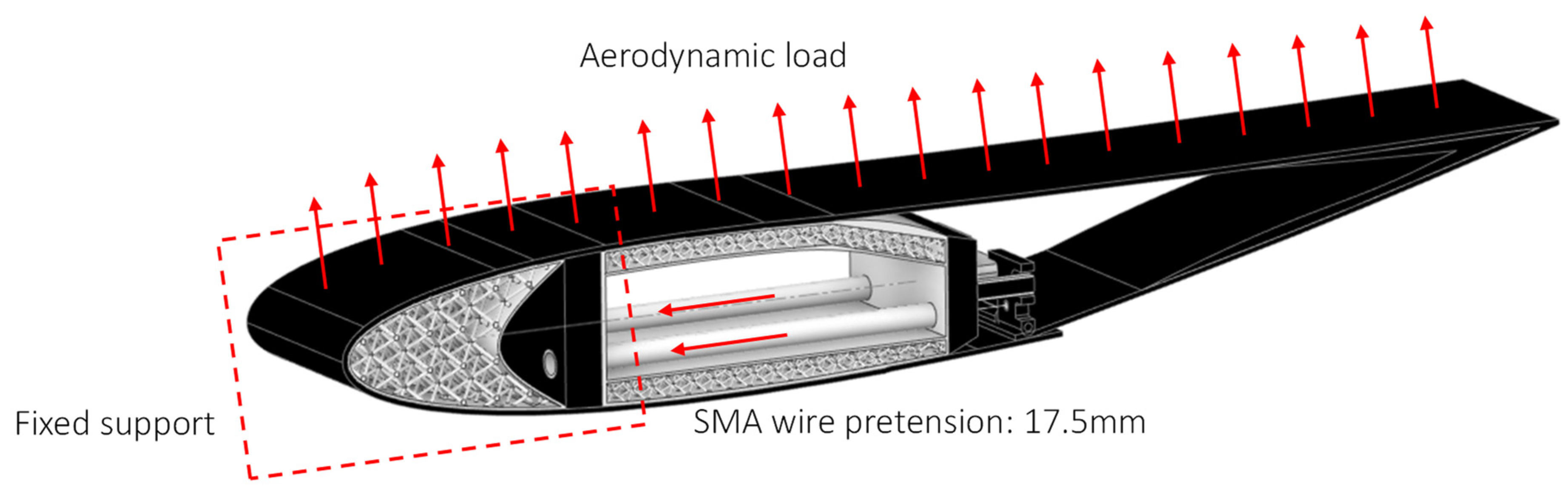
The leading-edge region has been constrained to reproduce the structural attachment of the airfoil, while the trailing-edge remained free to deform under the action of the embedded SMA wires. The complete analysis consisted of four consecutive loading steps. First, a prescribed mechanical displacement corresponding to 10% of the SMA wire length has been applied to generate the initial pre-deformed configuration. Subsequently, the external displacement has been removed, allowing the structure to elastically unload. The recovery phase has then been simulated by thermally activating the SMA actuator through the UMAT constitutive model, inducing the martensite-to-austenite transformation and the corresponding recovery force. Consequently, a distributed aerodynamic load of 225 N, applied at 25% of the airfoil chord, has been imposed on the upper aerodynamic surface to evaluate the capability of the optimized configuration to preserve the recovered geometry under representative operating conditions (Figure 4). The applied aerodynamic load of 225 N, acting at 25% of the chord, has been adopted as a representative reference loading condition.
Figure 4.
Finite element boundary conditions used for the thermo-mechanical simulation of the optimized morphing airfoil. The actuation cycle has been initiated by imposing a 10% pre-strain to the SMA wires, followed by the application of a distributed aerodynamic load of 225 N acting on the upper aerodynamic surface.
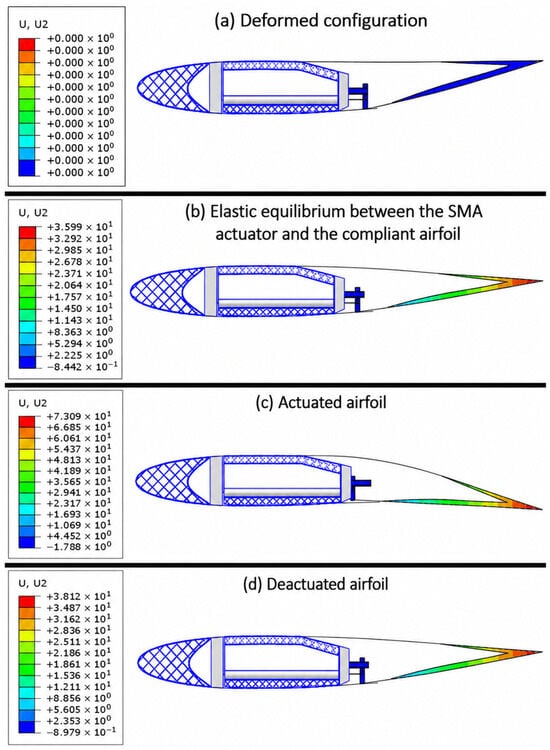
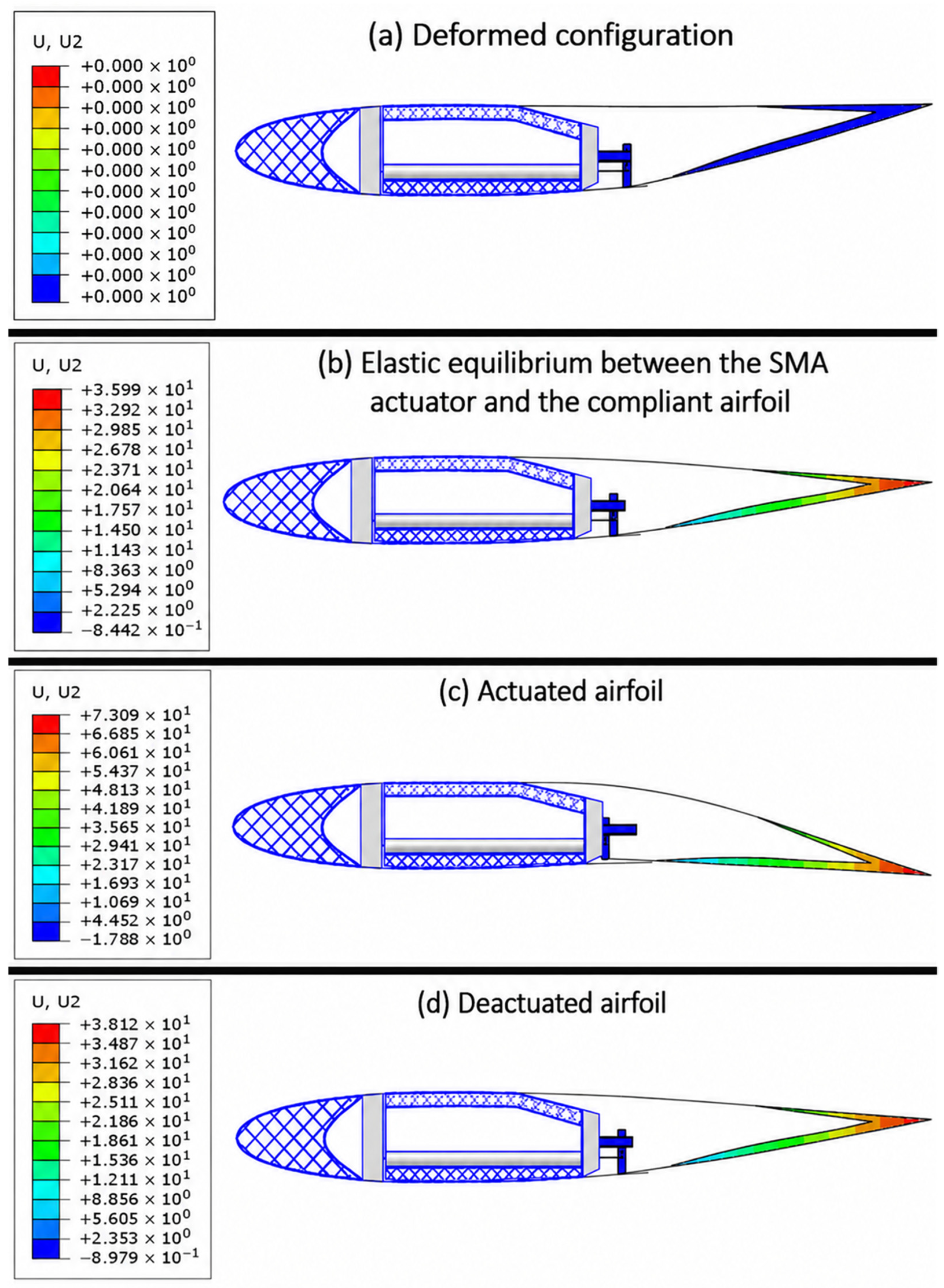
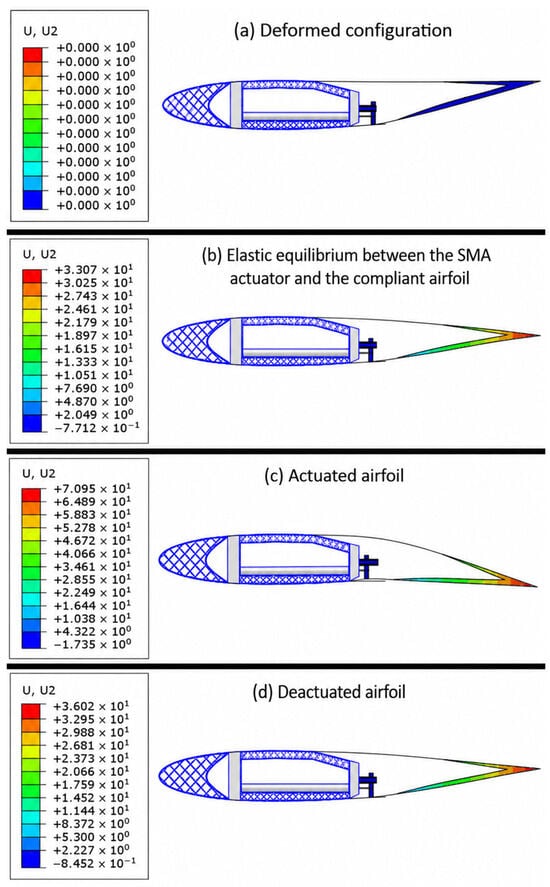
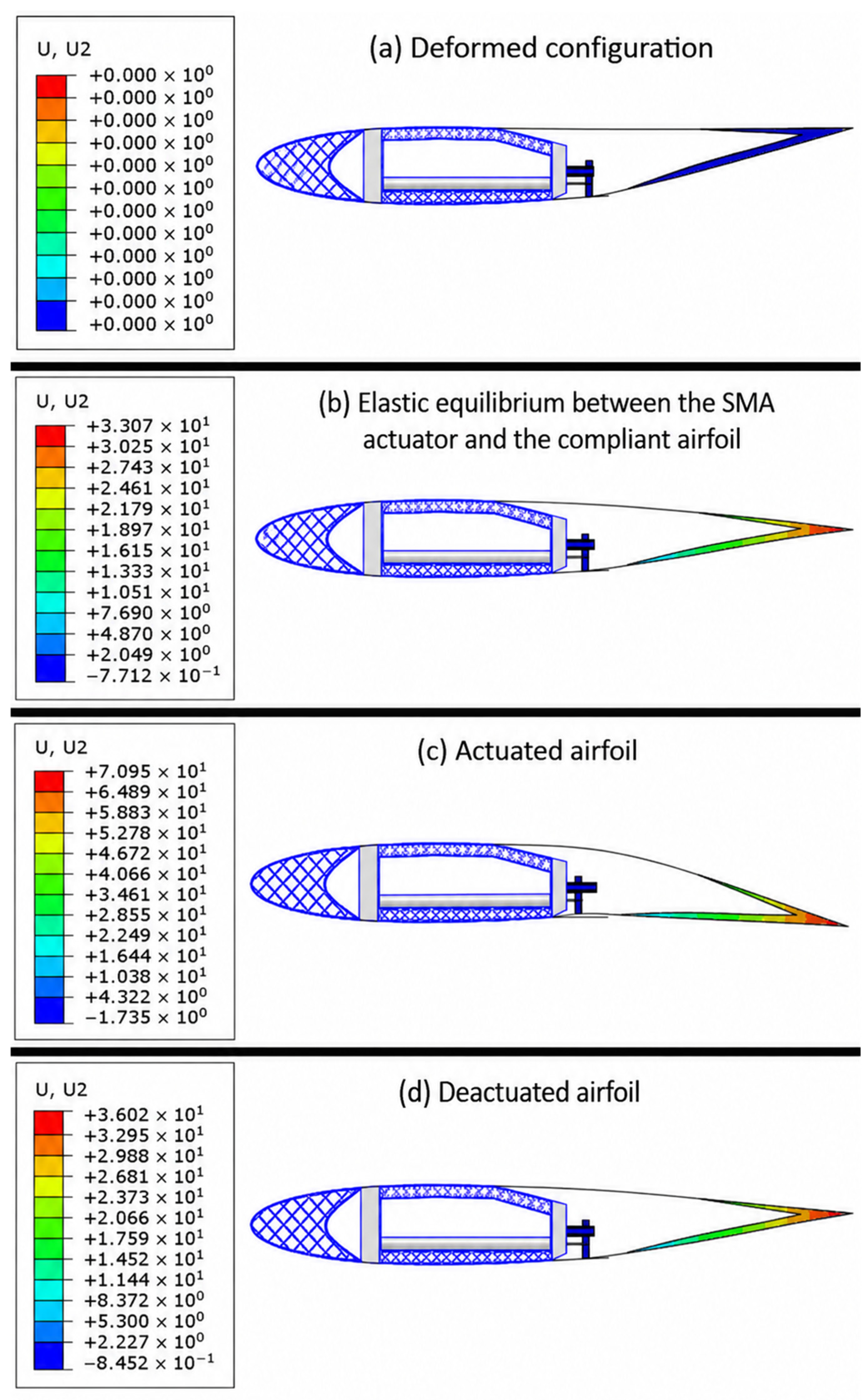
Figure 5 illustrates the complete thermo-mechanical actuation sequence of the optimized morphing airfoil obtained through the finite element simulations. The contour plots represent the displacement field during the different stages of the actuation cycle. The initial configuration (Figure 5a) corresponds to the mechanically pre-deformed state generated by imposing a prescribed displacement equal to 10% of the SMA wire length. This loading step stores the recoverable strain within the actuator while producing the desired deformation of the trailing-edge region. After removing the external mechanical constraint, the structure reaches an elastic equilibrium between the recovery force generated by the SMA actuator and the elastic reaction of the airfoil (Figure 5b). Following thermal activation (Figure 5c), the martensite-to-austenite phase transformation induces the contraction of the SMA wires, generating the recovery force responsible for restoring and actuating the aerodynamic profile. The displacement contours clearly indicate that the deformation is concentrated in the trailing-edge region. After removing the external thermal load, the structure reaches an elastic equilibrium between the recovery force generated by the SMA actuator and the elastic reaction of the airfoil (Figure 5d). At this stage, the internal forces become balanced, and the structure progressively approaches its deformed configuration. The displacement field confirms that only negligible residual deformation remains at the trailing edge, demonstrating the effectiveness of the proposed architecture and the capability of the integrated SMA actuator to provide stable and repeatable shape recovery.
Figure 5.
Thermo-mechanical actuation sequence of the optimized morphing airfoil. (a) Initial pre-strained configuration obtained by applying a prescribed displacement equal to 10% of the SMA wire length; (b) elastic equilibrium between the SMA actuator and the airfoil; (c) airfoil deformation during thermal activation of the SMA actuator; (d) final recovered configuration following completion of the thermo-mechanical cycle. The contour plots represent the displacement field.
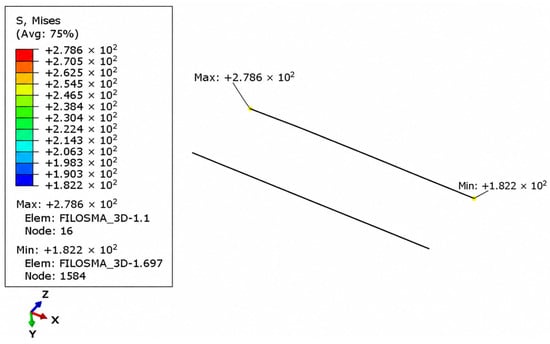
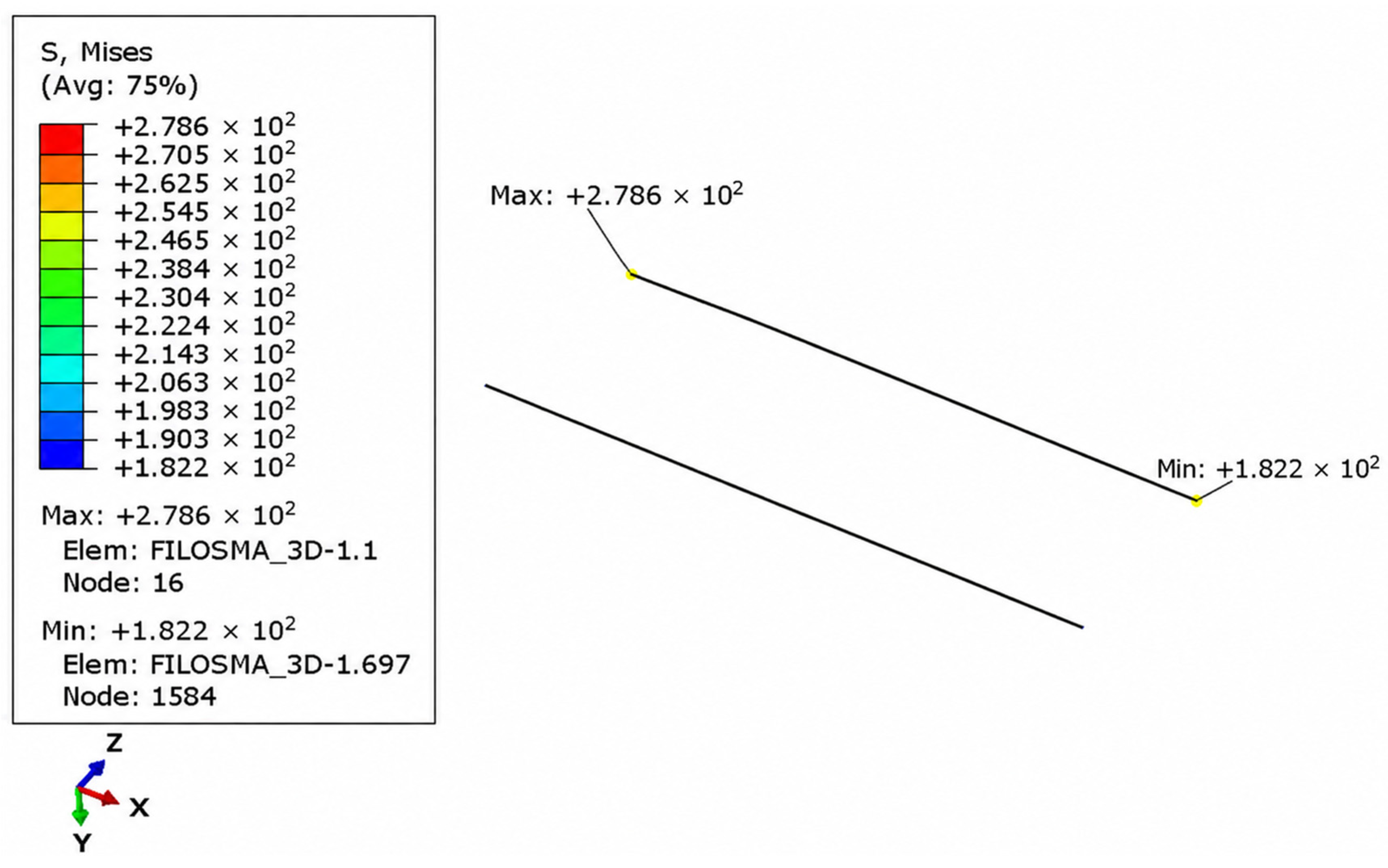
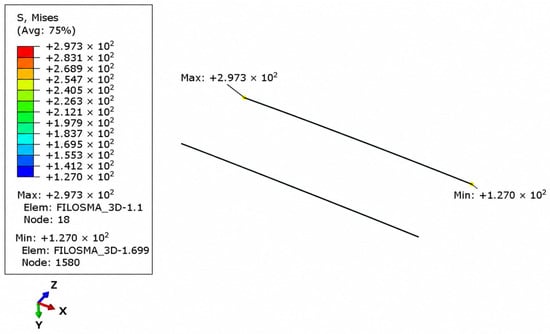
To further assess the structural integrity of the proposed morphing airfoil, the stress state of both the airfoil and the SMA actuators has been evaluated at the end of the thermo-mechanical cycle. The maximum Von Mises stress in the airfoil has been approximately 30 MPa, indicating that the structural stresses remain relatively low despite the large reversible deformation. The corresponding Von Mises stress distribution in the SMA wires is reported in Figure 6, where a maximum stress of approximately 280 MPa is observed. These stress levels confirm that the SMA actuators effectively generate the recovery force required to restore the initial airfoil configuration while operating within the expected mechanical range of the material.
Figure 6.
Maximum Von Mises stress distribution in the SMA wires during the thermo-mechanical actuation cycle.
Following the complete thermo-mechanical actuation cycle, the structural response of the optimized morphing airfoil has been further evaluated under representative aerodynamic loading conditions. A distributed aerodynamic load of 225 N, applied at 25% of the airfoil chord, has been imposed on the upper surface of the recovered configuration to assess the capability of the adaptive structure to preserve its geometry during operation.
Figure 7 shows the displacement field obtained after the application of the aerodynamic load. The results indicate that the morphing structure reaches a stable elastic equilibrium in which the recovery force generated by the SMA actuator is balanced by the elastic reaction of the airfoil and the external aerodynamic load. No significant loss of the recovered aerodynamic profile is observed after the application of the external load, demonstrating that the optimized architecture provides sufficient stiffness to withstand representative service conditions while preserving the morphing capability. The smooth displacement distribution also indicates that the load is efficiently transferred through the lattice structure without localized structural instability or geometric discontinuities. These results confirm that the proposed hybrid design successfully combines reversible SMA actuation with the structural integrity required for lightweight adaptive aerospace applications.
Figure 7.
Displacement field of the optimized morphing airfoil at the equilibrium configuration after thermal activation and application of the distributed aerodynamic load (225 N). The recovery force generated by the SMA actuator balances the elastic response of the structure and the external aerodynamic loading, preserving the recovered airfoil geometry.
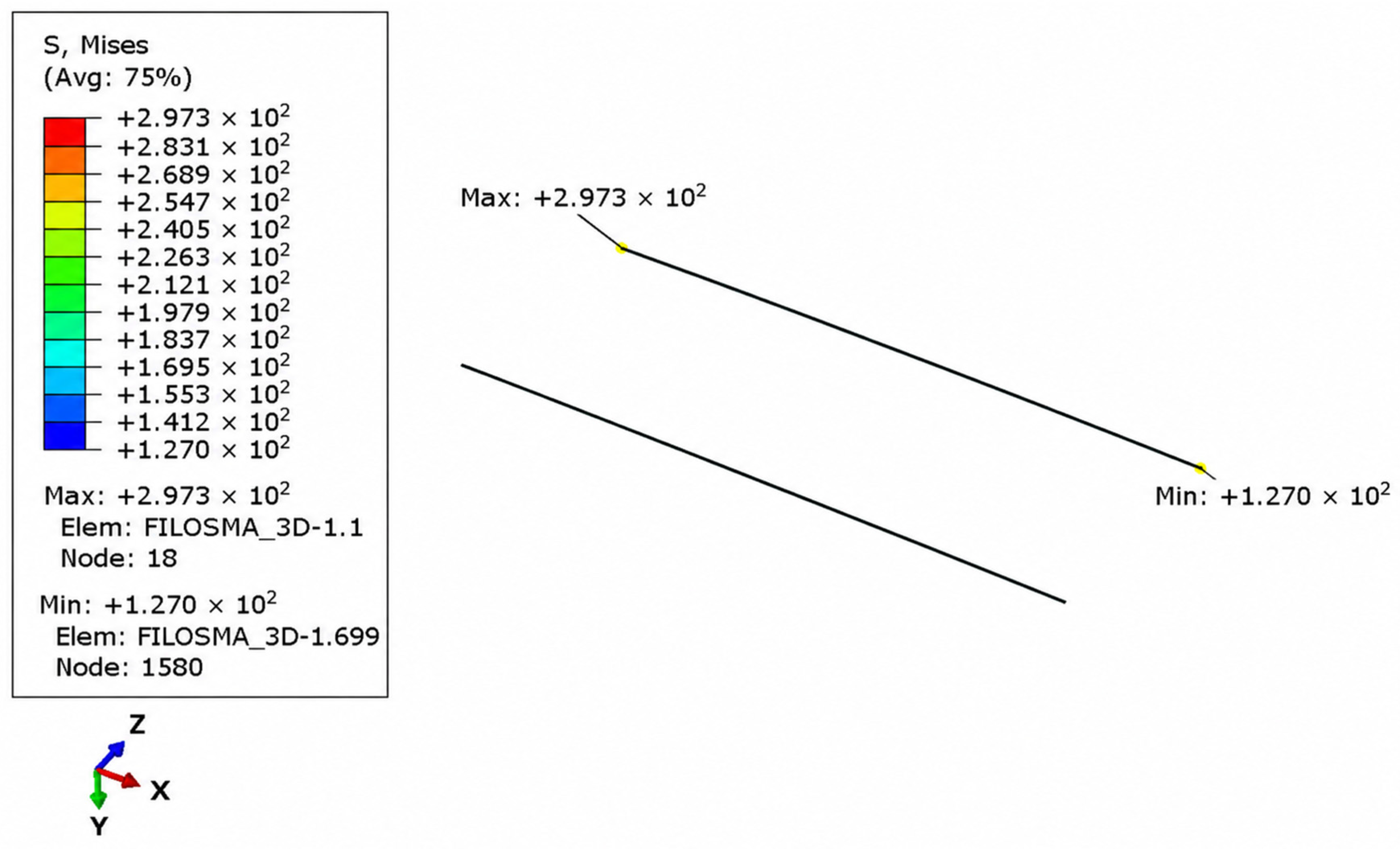
The stress state at the end of the thermo-mechanical actuation cycle has been evaluated to verify the structural integrity of the proposed morphing airfoil. The airfoil experiences a maximum Von Mises stress of approximately 32 MPa, confirming that the structural stresses remain limited despite the large reversible deformation induced by the SMA actuation. Figure 8 presents the corresponding Von Mises stress distribution in the SMA wires, where a peak value of approximately 297 MPa is reached during the actuation cycle.
Figure 8.
Maximum Von Mises stress distribution in the SMA wires during the thermo-mechanical actuation cycle with the aerodynamic load.
A quantitative comparison between the recovered configuration with and without aerodynamic loading is reported in Table 4. The results show that the application of the representative aerodynamic load of 225 N produces only a limited influence on the overall actuation performance of the morphing airfoil. The maximum actuation displacement decreases slightly from 73.09 mm to 70.95 mm, corresponding to a reduction of approximately 2.9%, while the displacement measured at the elastic equilibrium configuration decreases from 35.99 mm to 33.07 mm. Similarly, the recovered displacement after the complete thermo-mechanical cycle changes from 38.12 mm to 36.02 mm, confirming that the external aerodynamic load only marginally affects the recovery capability of the structure.
Table 4.
Comparison of the structural response of the optimized morphing airfoil before and after the application of a distributed aerodynamic load of 225 N. The reported parameters include the equilibrium displacement, maximum actuation displacement, recovered displacement and shape recovery ratio.
The most significant performance indicator is the shape recovery ratio, which decreases from 94.26% in the unloaded configuration to 92.21% after the application of the aerodynamic load. Despite this slight reduction, the recovery remains above 90%, demonstrating that the recovery force generated by the SMA actuator is sufficient to overcome the external loading while preserving the desired aerodynamic profile. These results confirm that the optimized architecture provides an appropriate balance between structural flexibility and stiffness, allowing the morphing mechanism to operate effectively under representative service conditions.
Overall, the numerical analyses confirm that the proposed morphing airfoil successfully combines reversible SMA actuation with adequate structural stiffness, maintaining both the recovered aerodynamic profile and the mechanical integrity of the structure under external loading.
5. Conclusions
This work demonstrated the feasibility of a lightweight morphing airfoil integrating Shape Memory Alloy (SMA) wire actuators with an additively manufactured lattice structure. The proposed concept combines the high actuation capability of SMA wires with the geometric flexibility offered by Additive Manufacturing, providing a compact morphing architecture without the need for conventional hinges or complex transmission mechanisms. The numerical analyses highlighted the strong influence of the structural stiffness on the overall morphing performance. An appropriate balance between structural compliance and stiffness proved to be essential to ensure an effective interaction between the airfoil structure and the SMA actuators. Among the investigated configurations, the optimized design, characterized by a structural thickness of 2.8 mm, achieved approximately 98% shape recovery under representative aerodynamic loading conditions while maintaining the actuator within acceptable operating conditions. The developed thermo-mechanical finite element framework, based on a dedicated UMAT implementation, successfully reproduced the complete actuation cycle and proved to be an effective tool for predicting the coupled response of SMA actuators and adaptive structures. The proposed methodology provides a reliable numerical approach for the preliminary design and optimization of SMA-actuated morphing systems. Overall, the obtained results demonstrate that the integration of SMA technology with additively manufactured lattice structures represents a promising strategy for the development of lightweight adaptive aerospace components.
Author Contributions
Conceptualization, M.B. and A.R.; methodology, M.B. and A.R.; validation, M.B. and A.R.; formal analysis, M.B. and A.R.; investigation, M.B. and A.R.; data curation, M.B. and A.R.; writing—original draft preparation, M.B. and A.R. All authors have read and agreed to the published version of the manuscript.
Funding
This research received no external funding.
Institutional Review Board Statement
Not applicable.
Informed Consent Statement
Not applicable.
Data Availability Statement
Dataset available on request from the authors.
Conflicts of Interest
The authors declare no conflict of interest.
References
- Barbarino, S.; Bilgen, O.; Ajaj, R.M.; Friswell, M.I.; Inman, D.J. A review of morphing aircraft. J. Intell. Mater. Syst. Struct. 2011, 22, 823–877. [Google Scholar] [CrossRef] [Scilit]
- Sun, J.; Guan, Q.; Liu, Y.; Leng, J. Morphing aircraft based on smart materials and structures: A state-of-the-art review. J. Intell. Mater. Syst. Struct. 2016, 27, 2289–2312. [Google Scholar] [CrossRef] [Scilit]
- Zhu, J.; Yang, J.; Zhang, W.; Gu, X.; Zhou, H. Design and applications of morphing aircraft and their structures. Front. Mech. Eng. 2023, 18, 34. [Google Scholar] [CrossRef] [Scilit]
- Ajaj, R.M.; Beaverstock, C.S.; Friswell, M.I. Morphing aircraft: The need for a new design philosophy. Aerosp. Sci. Technol. 2016, 49, 154–166. [Google Scholar] [CrossRef] [Scilit]
- Battaglia, M.; Sellitto, A.; Giamundo, A.; Visone, M.; Riccio, A. Shape memory alloys applied to automotive adaptive aerodynamics. Materials 2023, 16, 4832. [Google Scholar] [CrossRef] [Scilit] [PubMed]
- Battaglia, M.; Sellitto, A.; Giamundo, A.; Visone, M.; Riccio, A. Advanced material thermomechanical modelling of shape memory alloys applied to automotive design. Shape Mem. Superelasticity 2024, 10, 297–313. [Google Scholar] [CrossRef] [Scilit]
- Pecora, R. Morphing wing flaps for large civil aircraft: Evolution of a smart technology across the Clean Sky program. Chin. J. Aeronaut. 2021, 34, 13–28. [Google Scholar] [CrossRef] [Scilit]
- Vasista, S.; De Gaspari, A.; Ricci, S.; Riemenschneider, J.; Monner, H.P.; van de Kamp, B. structures-based wing and wingtip morphing devices. Aircr. Eng. Aerosp. Technol. Int. J. 2016, 88, 311–330. [Google Scholar] [CrossRef] [Scilit]
- Costanza, G.; Tata, M.E. Shape memory alloys for aerospace, recent developments, and new applications: A short review. Materials 2020, 13, 1856. [Google Scholar] [CrossRef] [Scilit] [PubMed]
- Jani, J.M.; Leary, M.; Subic, A.; Gibson, M.A. A review of shape memory alloy research, applications and opportunities. Mater. Des. (1980–2015) 2014, 56, 1078–1113. [Google Scholar] [CrossRef] [Scilit]
- Sellitto, A.; Riccio, A. Overview and future advanced engineering applications for morphing surfaces by shape memory alloy materials. Materials 2019, 12, 708. [Google Scholar] [CrossRef] [Scilit] [PubMed]
- Bil, C.; Massey, K.; Abdullah, E.J. Wing morphing control with shape memory alloy actuators. J. Intell. Mater. Syst. Struct. 2013, 24, 879–898. [Google Scholar] [CrossRef] [Scilit]
- Kang, W.R.; Kim, E.H.; Jeong, M.S.; Lee, I.; Ahn, S.M. Morphing wing mechanism using an SMA wire actuator. Int. J. Aeronaut. Space Sci. 2012, 13, 58–63. [Google Scholar] [CrossRef] [Scilit]
- DebRoy, T.; Wei, H.L.; Zuback, J.S.; Mukherjee, T.; Elmer, J.W.; Milewski, J.O.; Beese, A.M.; Wilson-Heid, A.; De, A.; Zhang, W. Additive manufacturing of metallic components–process, structure and properties. Prog. Mater. Sci. 2018, 92, 112–224. [Google Scholar] [CrossRef] [Scilit]
- Gibson, I.; Rosen, D.; Stucker, B.; Khorasani, M.; Rosen, D.; Stucker, B.; Khorasani, M. Additive Manufacturing Technologies; Springer: Cham, Switzerland, 2021; Volume 17, pp. 160–186. [Google Scholar]
- Herzog, D.; Seyda, V.; Wycisk, E.; Emmelmann, C. Additive manufacturing of metals. Acta Mater. 2016, 117, 371–392. [Google Scholar] [CrossRef] [Scilit]
- Ngo, T.D.; Kashani, A.; Imbalzano, G.; Nguyen, K.T.; Hui, D. Additive manufacturing (3D printing): A review of materials, methods, applications and challenges. Compos. Part B Eng. 2018, 143, 172–196. [Google Scholar] [CrossRef] [Scilit]
- De Gaspari, A.; Ricci, S. A two-level approach for the optimal design of morphing wings based on structures. J. Intell. Mater. Syst. Struct. 2011, 22, 1091–1111. [Google Scholar] [CrossRef] [Scilit]
- De Gaspari, A.; Riccobene, L.; Ricci, S. Design, manufacturing and wind tunnel validation of a morphing wing. J. Aircr. 2018, 55, 2313–2326. [Google Scholar] [CrossRef] [Scilit]
- Battaglia, M.; Acanfora, V.; Riccio, A. Influence of electrical parameters in a composite wing actuated by shape memory alloys wires: A numerical–experimental study. J. Compos. Sci. 2025, 9, 460. [Google Scholar] [CrossRef] [Scilit]
- Riccio, A.; Saputo, S.; Zarrelli, M.; Sellitto, A.; Napolitano, C.; Acanfora, V. Shape Memory Alloy-based actuator: Experimental and modelling. In Proceedings of the 2021 IEEE 8th International Workshop on Metrology for Aerospace (MetroAeroSpace), Naples, Italy, 23–25 June 2021; IEEE: New York, NY, USA, 2021; pp. 665–671. [Google Scholar]
- Riccio, A.; Napolitano, C.; Sellitto, A.; Acanfora, V.; Zarrelli, M. Development of a combined micro-macro mechanics analytical approach to design shape memory alloy spring-based actuators and its experimental validation. Sensors 2021, 21, 5506. [Google Scholar] [CrossRef] [Scilit] [PubMed]
- Roboze Spa. «Roboze Carbon PA PRO». 24 November 2022. Available online: https://www.roboze.com/it/technology/materials/carbon-pa-pro (accessed on 30 June 2026).
- Battaglia, M.; Acanfora, V.; Garofano, A.; Maisto, G.; Riccio, A. An innovative approach to a UAV tails structural design for additive manufacturing. Polym. Compos. 2024, 45, 11149–11161. [Google Scholar] [CrossRef] [Scilit]
- Lagoudas, D.C.; Lagoudas, D.C. Shape Memory Alloys; Springer: Boston, MA, USA, 2008; Volume 1. [Google Scholar]

Disclaimer/Publisher’s Note: The statements, opinions and data contained in all publications are solely those of the individual author(s) and contributor(s) and not of MDPI and/or the editor(s). MDPI and/or the editor(s) disclaim responsibility for any injury to people or property resulting from any ideas, methods, instructions or products referred to in the content. |
© 2026 by the authors. Licensee MDPI, Basel, Switzerland. This article is an open access article distributed under the terms and conditions of the Creative Commons Attribution (CC BY) license.