


Abstract
The durability and serviceability of steel-fiber-reinforced concrete (SFRC) tunnel linings in cold regions are significantly challenged by repeated freeze–thaw actions, making the accurate prediction of frost resistance a critical engineering problem. Although extensive research has been conducted on the freeze–thaw characteristics of concrete, the existing empirical and mechanism-based models remain limited in capturing the complex nonlinear interactions among mixture proportions, steel fiber characteristics, and environmental conditions. Therefore, a data-driven prediction framework based on machine learning was developed in this study. A database containing 277 groups of standardized SFRC freeze–thaw test results was established, incorporating key variables including mixture design parameters, fiber properties, and freeze–thaw cycle conditions. Four machine-learning models, namely, support vector regression, back-propagation neural network, gradient boosting, and extreme gradient boosting (XGB), were constructed and systematically compared. Model accuracy was assessed using MAE, MAPE, MSE, RMSE, and R2. The results demonstrate that all models can reflect the nonlinear relationship between the input variables and mass loss rate, while the XGB model exhibits superior predictive performance with a testing R2 of 0.91, representing an improvement of approximately 3–28% compared with other models. Meanwhile, the prediction errors are reduced significantly, with RMSE and MAE decreased by about 19–58% and 22–65%, respectively. The proposed approach provides an improved and reliable tool for predicting frost resistance and supports the durability design and optimization of SFRC tunnel linings in severe cold-region environments.
1. Introduction
Cold regions are widely distributed across China, and, with the rapid development of society and the economy, numerous highway tunnel projects have been constructed in these areas [1]. Concrete, as a representative non-uniform porous composite medium, is inherently vulnerable to environmental actions [2]. Exposure to aggressive environmental conditions—such as carbonation, chloride ingress, alkali–aggregate reactions, and freeze–thaw cycling—gradually weakens the concrete performance and may lead to reduced structural reliability and durability [3,4,5,6,7,8]. Among these factors, freeze–thaw cycles are recognized as one of the primary causes of premature concrete deterioration in cold regions [9]. Existing studies indicate that freeze–thaw action can cause the progressive accumulation and propagation of cracks, leading to macroscopic damage and the deterioration of concrete [10,11]. Moreover, the formation of cracks facilitates the ingress of aggressive agents, such as carbon dioxide and chloride ions, thereby accelerating carbonation and chloride-induced corrosion processes and further promoting premature concrete failure [12,13,14,15,16]. Therefore, tunnels in cold regions are prone to multiple types of deterioration, such as lining cracking and internal water leakage [17,18]. These defects can significantly impair tunnel serviceability and accelerate structural degradation.
For enhancing the ability of concrete structures in frigid regions to resist freeze–thaw damage, various modification methods have been proposed, among which steel-fiber-reinforced concrete (SFRC) has attracted increasing attention [19,20]. SFRC shows superior mechanical properties, including an improved tensile response, crack resistance, and energy absorption capacity, owing to the irregular dispersion of fibers within the cementitious matrix [21,22,23,24]. Prior research has also verified the efficacy of fiber reinforcement in enhancing structural performance under various loading conditions. For instance, adding steel fibers has been shown to significantly improve the compressive behavior of circular CFST columns [25], while theoretical models of FRP-reinforced UHPC tubular members have further highlighted the function of fiber reinforcement in promoting structural integrity under complex stress states [26]. In addition, the incorporation of steel fibers can prominently constrain the initiation and propagation of microcracks induced by freeze–thaw actions, thereby improving the integrity and durability of concrete linings in tunnel engineering applications [27,28]. Consequently, SFRC has been increasingly applied in tunnel linings and other underground structures exposed to severe freeze–thaw environments.
During the frost damage assessment of concrete, the mass loss rate (MLR) serves as a straightforward visual parameter. It can reflect well the surface peeling, material shedding, and long-term performance degradation induced by repeated freeze–thaw loading [29]. Compared with mechanical indices, the MLR can more effectively reflect the cumulative damage evolution and material degradation caused by repeated freeze–thaw cycles, and thus has been extensively adopted in experimental studies on concrete freeze–thaw resistance [30,31]. In addition to freeze–thaw deterioration, growing research efforts in recent years have also focused on the long-term performance of fiber-reinforced concrete exposed to various harsh service environments [32]. Studies have shown that exposure to chloride ingress, sulfate attack, wetting–drying cycles, and temperature variations can significantly affect the mechanical performance and durability of concrete materials [33,34,35,36,37]. For instance, under chloride and sulfate environments, the ingress of aggressive ions accelerates chemical degradation and internal cracking, while wetting–drying cycles can intensify shrinkage-induced damage and microcrack propagation. Temperature fluctuations further exacerbate internal stress development and deterioration processes.
At present, most investigations on the freeze–thaw mass loss behavior of fiber-reinforced concrete are still primarily based on laboratory experiments, focusing on the effects of mix proportions, fibers, and environmental conditions [38,39]. Although experimental methods provide reliable results, they usually require long testing periods, a massive manpower input, and high economic costs, particularly for the durability evaluation involving long-term freeze–thaw cycling. Moreover, conventional analytical or empirical models typically rely on simplified assumptions and thus have a limited capability in capturing the highly nonlinear behavior and complex multi-parameter coupling mechanisms inherent in freeze–thaw damage processes [40,41]. In contrast, data-driven methods, especially machine-learning (ML) techniques, offer a more flexible and efficient alternative for durability prediction. These methods are capable of modeling complex nonlinear relationships without requiring explicit physical assumptions and can simultaneously process high-dimensional input variables, including material composition, fiber characteristics, and environmental conditions.
In recent years, ML techniques have demonstrated strong capabilities in modeling complex nonlinear systems and handling multi-parameter coupling problems. These methods have been successfully applied in various civil engineering fields, including concrete strength prediction, durability assessment, and service life estimation. For instance, Chen et al. [42] applied a long short-term memory (LSTM) model to forecast the concrete compressive strength and demonstrated that the LSTM model significantly outperformed traditional support vector regression (SVR) regarding the prediction accuracy and dependability. With respect to the freeze–thaw durability, Li et al. [11] established ML-based prediction models for concrete freeze–thaw MLR using random forest, gradient boosting (GB), SVR, and extreme gradient boosting (XGB) algorithms, and found that ensemble learning models exhibited a superior generalization ability, with the sand content, natural coarse aggregate, and count of freeze–thaw cycles identified as the key influential elements governing freeze–thaw resistance. To further improve prediction accuracy under complex degradation mechanisms, Yang et al. [43] proposed a hybrid model integrating recurrent neural networks with physical damage theories for analyzing the freeze–thaw damage evolution in basalt-fiber-reinforced concrete, and confirmed that adding fibers significantly enhanced frost resistance while the hybrid framework remained stable under limited data conditions. In addition to the freeze–thaw deterioration, ML techniques have also been applied to other durability-related problems. Taffese et al. [44] utilized multiple classification algorithms for the chloride penetration resistance grade of concrete according to the mix composition and reported that support vector machines achieved the highest prediction accuracy. Chen et al. [45] further combined random forest models with multi-objective optimization algorithms to simultaneously predict and optimize the frost resistance of concrete in cold regions, achieving notable improvements in the durability performance and cost efficiency. Moreover, durability studies under aggressive environments have been extended to sulfate erosion and marine conditions [46,47]. Although ML techniques have been widely applied for estimating various durability-related properties of concrete, such as the compressive strength, chloride resistance, and general freeze–thaw performance, most existing studies primarily focus on mechanical indices or overall durability indicators. In comparison, relatively limited attention has been paid to the prediction of freeze–thaw MLR, which directly reflects the surface deterioration and cumulative damage evolution. In addition, previous research rarely addresses SFRC under conditions representative of cold-region tunnel environments, nor does it systematically consider the combined effects of material composition, fiber characteristics, and freeze–thaw exposure within a unified predictive framework.
To overcome the above limitations, this study establishes a dedicated database comprising 277 freeze–thaw test data points of SFRC and develops an integrated data-driven framework to estimate the freeze–thaw-induced MLR. Key input parameters are selected from three aspects, including the concrete material composition (water, cement, coarse and fine aggregate, fly ash, silica fume, and superplasticizer), steel fiber characteristics (fiber content and aspect ratio), and freeze–thaw exposure conditions (number of freeze–thaw cycles), so as to capture the coupled mechanisms governing freeze–thaw deterioration. Considering the limitations of traditional empirical and linear models in describing highly nonlinear damage behavior, four representative ML models, namely, SVR, back-propagation (BP) neural network, GB, and XGB, are developed and systematically compared. The prediction performance of each model is evaluated using multiple statistical indicators combined with visual analysis, and both the prediction accuracy and generalization capability are quantitatively validated. The proposed approach provides a more accurate, efficient, and practical data-driven tool for the durability assessment and long-term performance optimization of SFRC tunnel lining in cold regions.
2. Materials and Methods
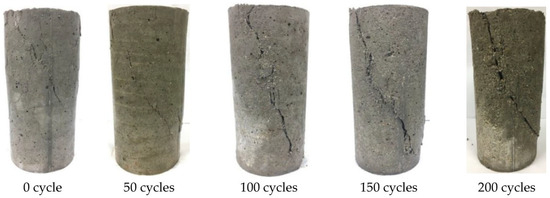
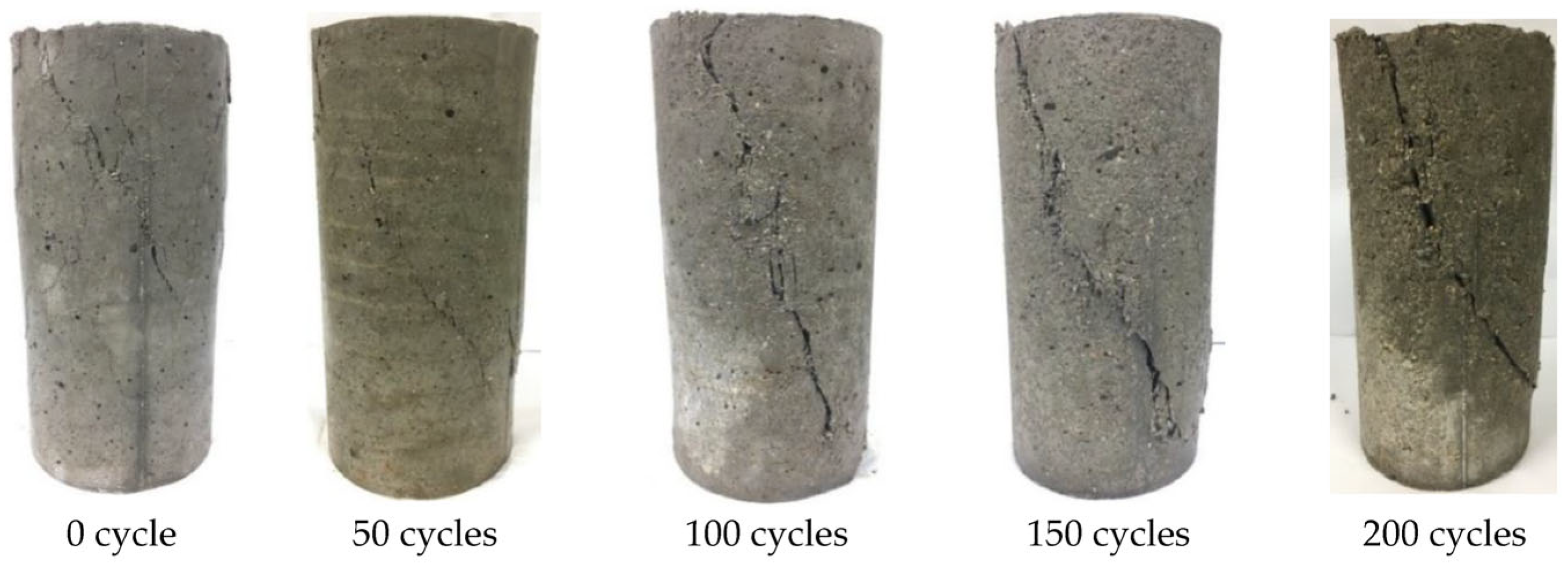
The surface deterioration development of the SFRC specimens under different freeze–thaw cycles is shown in Figure 1. This study follows a systematic data-driven methodology to predict the freeze–thaw-induced MLR of SFRC. First, a comprehensive database was constructed by collecting experimental data from published studies, and key input parameters were selected based on physical relevance to freeze–thaw damage mechanisms. Then, multiple machine-learning models, including SVR, BP neural network, GB, and XGB, were developed to establish prediction relationships between input variables and MLR. Subsequently, grid search integrated with cross-validation was adopted for hyperparameter calibration. The collected database was further partitioned into two independent portions to examine the comprehensive behavioral performance of the established model. Finally, the prediction accuracy and generalization ability of different models were systematically compared using multiple statistical indicators, including R2, MAE, MAPE, MSE, and RMSE, to identify the most effective prediction model.
Figure 1.
Surface appearance and crack characteristics of concrete specimens after different freeze–thaw cycle [48].
2.1. Dataset Construction and Input Parameter Selection
The reliability of ML-based prediction models largely depends on the quality of the dataset and the rationality of input parameter selection. For freeze–thaw deterioration of concrete, the MLR is a cumulative damage index that reflects surface scaling, material spalling, and progressive degradation under repeated freeze–thaw cycles. Unlike mechanical properties measured at discrete loading states, MLR is dominated by the synergistic influences of material composition, fiber reinforcement characteristics, and environmental exposure conditions. Therefore, the selection of input parameters in this study focuses on factors that are physically relevant to freeze–thaw damage mechanisms and directly influence mass loss evolution.
2.1.1. Dataset Description
The dataset employed in this study was compiled from published experimental studies centered on the freeze–thaw performance of SFRC [49,50,51,52,53,54,55,56,57]. To guarantee data reliability, consistency, and comparability, a strict screening strategy was implemented during dataset construction. Only studies reporting standardized freeze–thaw testing procedures and complete experimental information—including mixture proportions, steel fiber characteristics, freeze–thaw cycle conditions, and corresponding mass loss results—were retained, while those with incomplete data, inconsistent methodologies, or unclear test conditions were excluded. Through this systematic process, a total of 277 valid samples were obtained, forming a unified and consistent database.
A statistical analysis of the input parameters was subsequently executed, and the results are presented in Table 1. Key statistical indicators, including the maximum (Max), mean, minimum (Min), and standard deviation, were used to systematically characterize the range, central tendency, and variability of each parameter. The resulting dataset encompasses a wide range of material compositions, fiber configurations, and freeze–thaw exposure conditions, representing practical engineering scenarios, particularly for tunnel linings in cold-region environments.
Table 1.
Ranges of input parameters.
2.1.2. Selection of Input Parameters
In light of the inherent characteristics of SFRC, input parameters were selected from three core aspects: SFRC mixture composition, steel fiber characteristics, and freeze–thaw exposure conditions. These parameters have been widely reported in the literature to significantly influence the development of frost damage and mass loss behavior of concrete; more importantly, they are commonly measurable and accessible in experimental studies, which ensures the practical applicability and generalization potential of the proposed ML models.
(1) SFRC mixture composition
SFRC mixture composition directly determines the pore structure, frost resistance, and water absorption capacity of the matrix, which are the fundamental factors governing freeze–thaw-induced deterioration. Therefore, five key mixture parameters were selected to characterize the basic properties of SFRC, including water content, fine aggregate content, coarse aggregate content, cement content, and superplasticizer content. These quantitative parameters are more consistently reported and exert a dominant effect on controlling the pore structure and freeze–thaw performance of concrete; hence, they were adopted as the primary input variables, while the specific types and gradations (e.g., different types of cement, aggregates, and superplasticizers) were not explicitly considered.
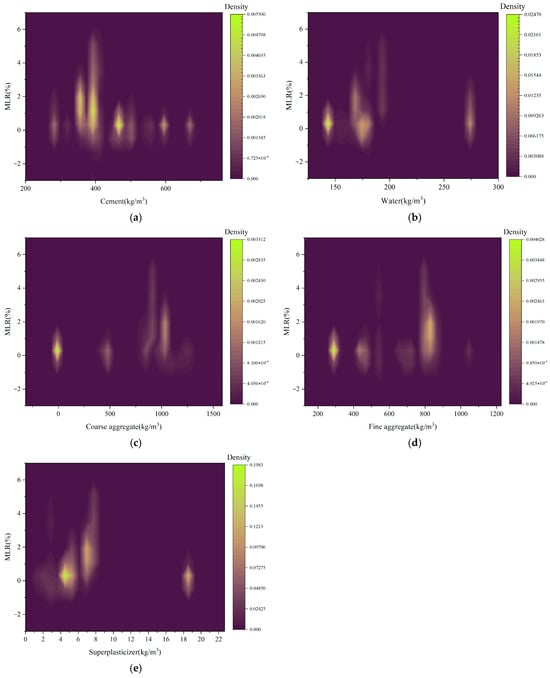
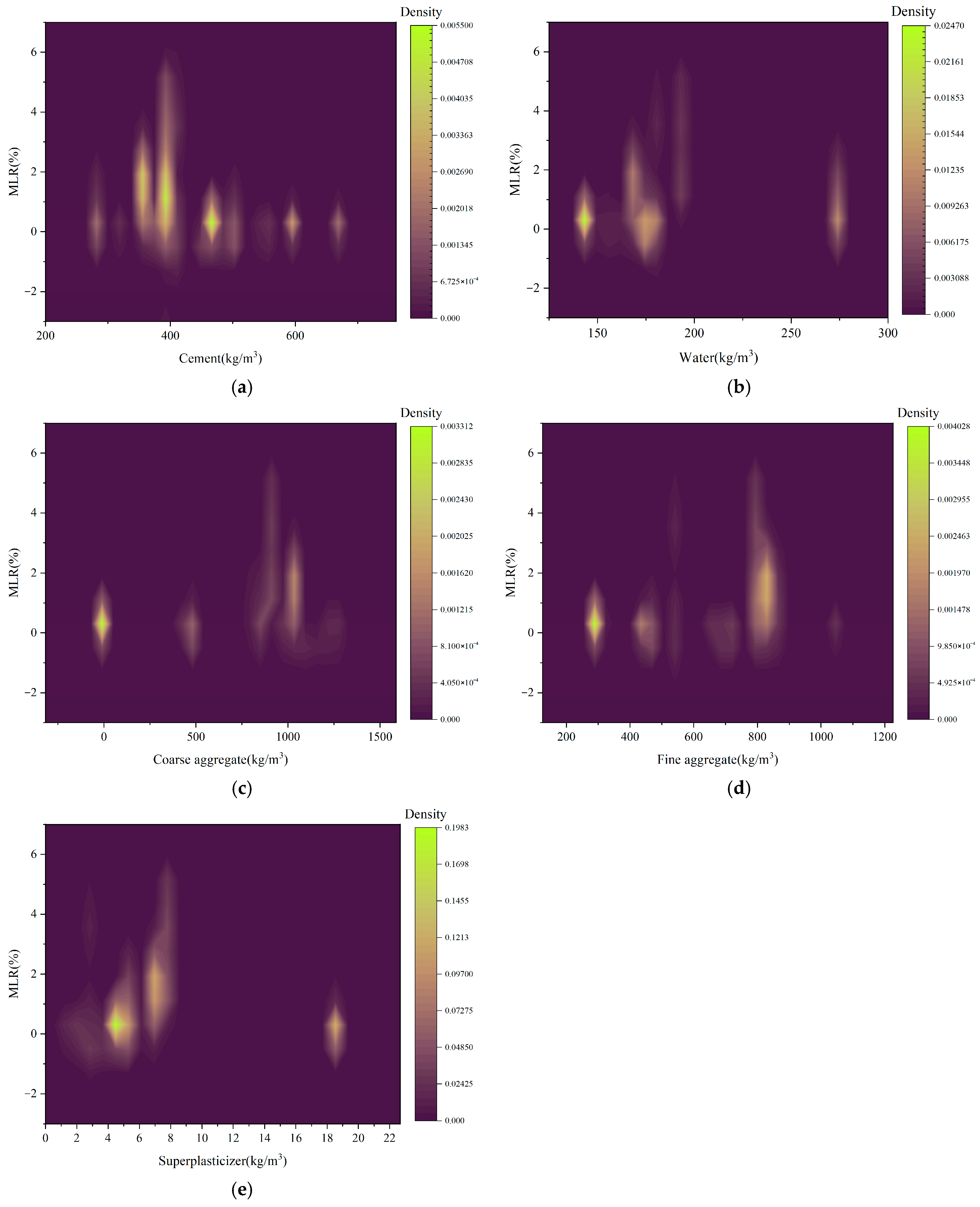
To further clarify the quantitative distribution characteristics of each SFRC mixture parameter and its inherent correlation with the MLR under freeze–thaw action, 2D kernel density plots were constructed, as depicted in Figure 2. The results indicate that cement, water, fine aggregate, coarse aggregate, and superplasticizer all exhibit relatively wide and practically relevant distribution ranges, with prominent high-density regions concentrated within the common engineering mix proportions. Correspondingly, the MLR values show considerable fluctuations and obvious gradient changes across the entire interval of each mixture parameter. Notably, the data points are sufficiently distributed in both low-MLR (minor freeze–thaw damage) and high-MLR (severe freeze–thaw damage) regions, without obvious aggregation in a single damage level. This observation confirms that the dataset adequately covers various degrees of freeze–thaw deterioration induced by different SFRC mixture compositions. It should be noted that certain parameter intervals, such as water content between 200–270 kg/m3 and superplasticizer content between 9–17 kg/m3, are not represented in the dataset, primarily because these ranges are rarely adopted in practical SFRC mix designs due to workability and durability constraints. Therefore, the dataset remains representative of realistic engineering conditions, although caution is required when extrapolating the model predictions beyond the covered parameter ranges.
Figure 2.
2D kernel density plots of concrete mixture parameters: (a) cement content; (b) water content; (c) coarse aggregate content; (d) fine aggregate; and (e) superplasticizer content.
(2) Steel fiber characteristics
Steel fibers exert a vital influence on restraining the development of microcracks during freeze–thaw cycles, as their crack-bridging capacity and stress redistribution ability effectively enhance the surface integrity and mass loss resistance of SFRC under repeated freeze–thaw actions. In this study, the dataset primarily consists of deformed steel fibers, particularly hooked-end fibers, which are extensively adopted in both academic research and engineering applications due to their superior bond performance, pull-out resistance, and crack-bridging capacity compared with straight fibers. Accordingly, two key fiber-related parameters—fiber volume fraction and fiber aspect ratio—were selected as input variables to characterize the influence of fibers on freeze–thaw deterioration, as they are widely recognized as the dominant factors governing fiber reinforcement efficiency.
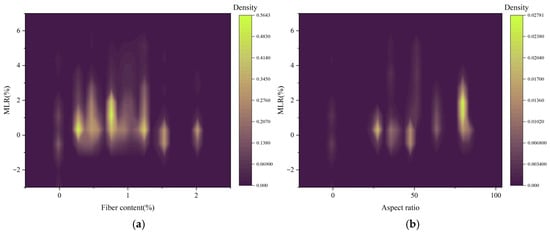
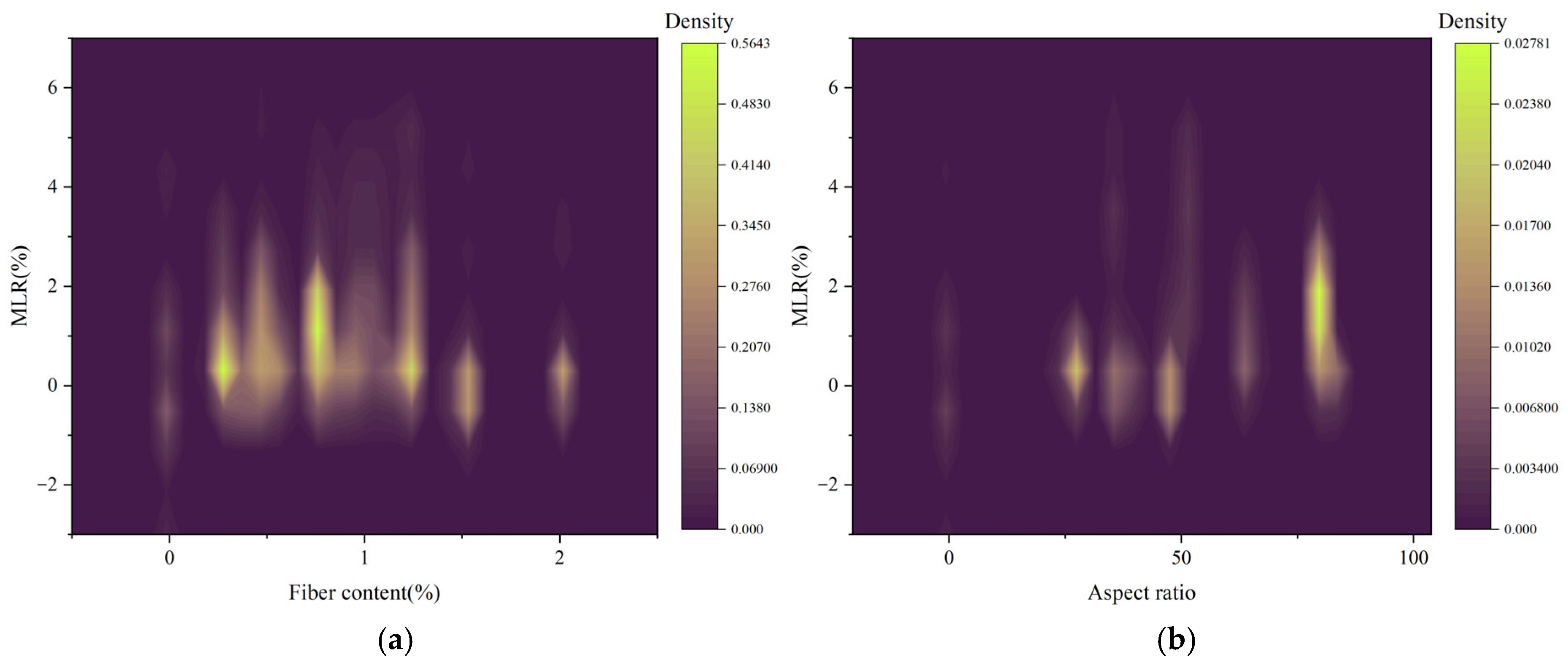
To further examine the quantitative relationship between steel fiber characteristics and the freeze–thaw MLR, 2D kernel density plots were constructed, as depicted in Figure 3. The results show that MLR values are unevenly distributed across different fiber volume fractions and aspect ratios, with noticeable clustering behavior within specific ranges. For fiber volume fraction, most data points are concentrated within 0.5–1.5%, where relatively lower MLR values are observed; this phenomenon suggests that an appropriate dosage of steel fibers can effectively mitigate surface scaling and material spalling during freeze–thaw cycles by inhibiting microcrack expansion. Similarly, the distribution of fiber aspect ratio versus MLR demonstrates that fiber geometry exerts a non-negligible influence on the freeze–thaw performance of SFRC. Notably, MLR values do not vary monotonically with increasing aspect ratio; instead, they exhibit a scattered and nonlinear distribution pattern. This observation indicates the existence of complex interactions between fiber geometry and the concrete matrix—for instance, excessively high or low aspect ratios may compromise fiber dispersion and interfacial bonding, thereby weakening the crack-bridging effect and increasing mass loss.
Figure 3.
2D kernel density plots of steel fiber characteristics: (a) fiber content; and (b) aspect ratio.
The kernel density distributions clearly reveal that the effects of fiber content and aspect ratio on MLR are highly nonlinear and closely coupled with other influencing factors (e.g., SFRC mixture). This further confirms that traditional linear or empirical models are insufficient to accurately capture such complex relationships, thereby justifying the adoption of ML approaches for predicting the freeze–thaw mass loss behavior of SFRC.
(3) Freeze–thaw exposure conditions
Freeze–thaw cycles serve as the primary external driving force governing the cumulative damage of SFRC, as repeated freezing and thawing processes continuously induce internal frost pressure, leading to microcrack propagation, surface scaling, and eventual mass loss. Therefore, the number of freeze–thaw cycles was used as a key environmental input parameter to characterize the progression of freeze–thaw deterioration. Unlike static performance indicators that only reflect single-point properties, this variable captures the progressive and time-dependent nature of freeze–thaw damage, enabling the ML models to distinguish different degradation stages and learn the cumulative evolution of MLR rather than just a discrete performance index.
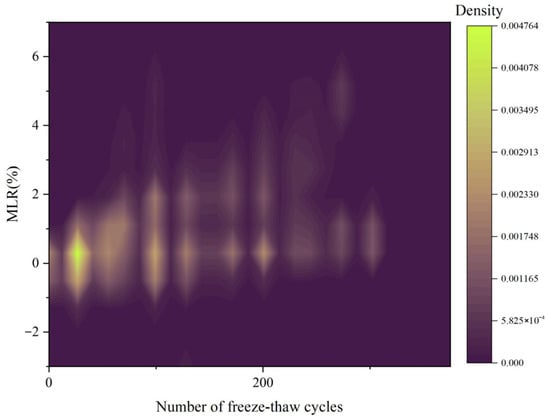
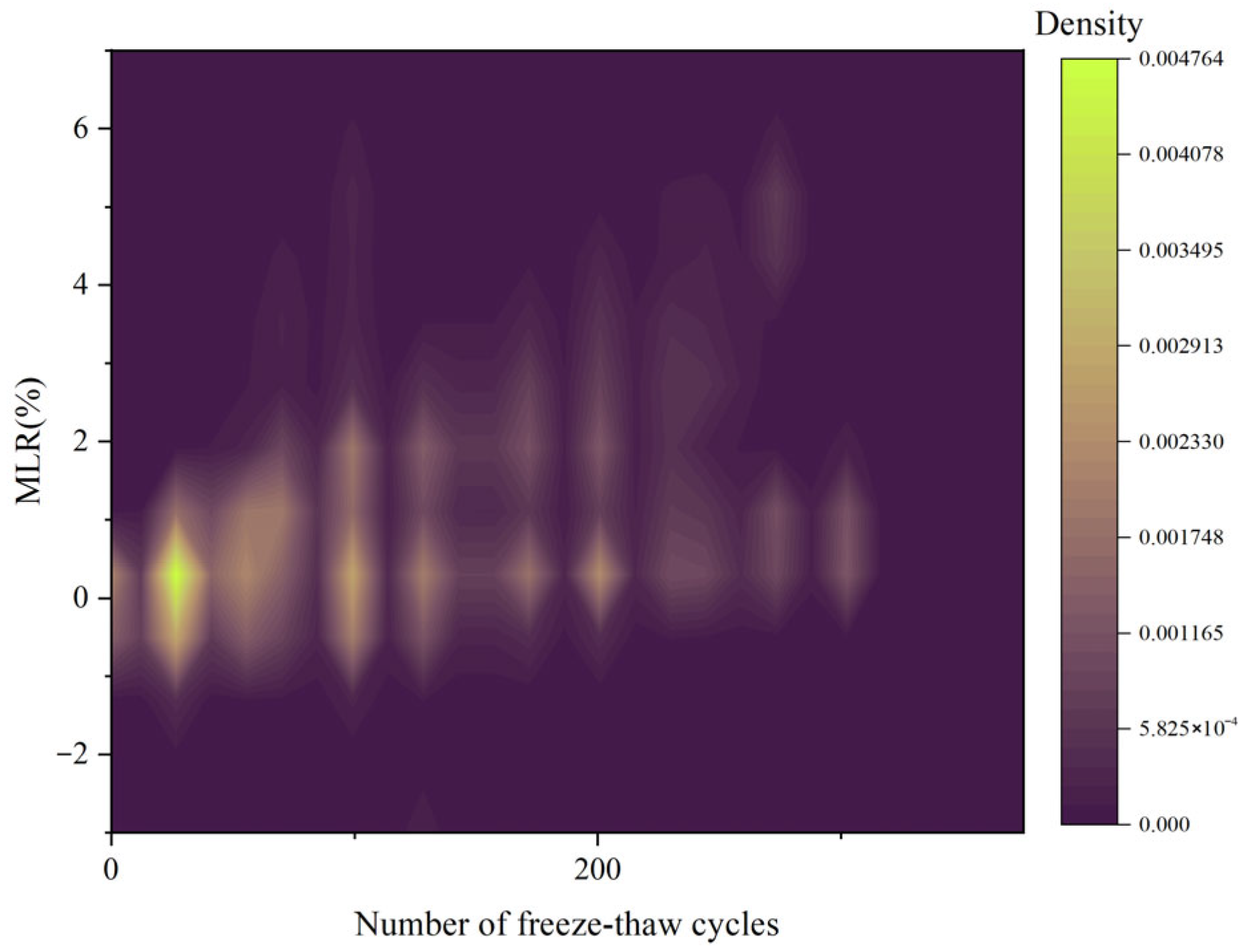
To further access the quantitative impact of freeze–thaw cycles on MLR, a 2D kernel density plot between the number of freeze–thaw cycles and MLR is presented in Figure 4. It can be clearly observed that MLR generally exhibits an increasing trend with enhancing freeze–thaw cycles, which is consistent with the fundamental damage mechanism of concrete: repeated freeze–thaw cycles continuously exacerbate internal pore structure damage, causing cumulative surface spalling and mass loss. At lower cycle numbers (e.g., 0–50 cycles), MLR values are predominantly concentrated near zero, indicating limited surface scaling and minor material degradation, as the concrete matrix still maintains good integrity. As the number of cycles increases (e.g., above 100 cycles), the MLR distribution gradually shifts toward higher values, accompanied by a broader spread of data points; this phenomenon reflects the intensified deterioration process and increased variability in material response, as the cumulative damage begins to manifest significantly.
Figure 4.
2D kernel density plots of freeze–thaw exposure conditions.
The relationship between freeze–thaw cycles and MLR is not strictly linear. Even at similar cycle levels, noticeable dispersion in MLR values can be observed, which implies that the degradation process is strongly influenced by the interaction between environmental exposure (freeze–thaw cycles) and intrinsic material properties, such as SFRC mixture and steel fiber characteristics. This coupling effect further complicates the damage evolution mechanism, making it difficult to capture with traditional linear models.
According to Table 1, the statistical results are highly consistent with the findings from the kernel density analysis. All input variables exhibit relatively wide value ranges, encompassing a rich variety of combinations of concrete mixture proportions, steel fiber characteristics, and freeze–thaw exposure conditions. This broad and comprehensive data coverage is favorable for enhancing the generalization ability of the ML models, as it enables the models to fully learn the complex nonlinear relationships between the adopted factors and the MLR under diverse practical engineering scenarios.
2.1.3. Output Variable
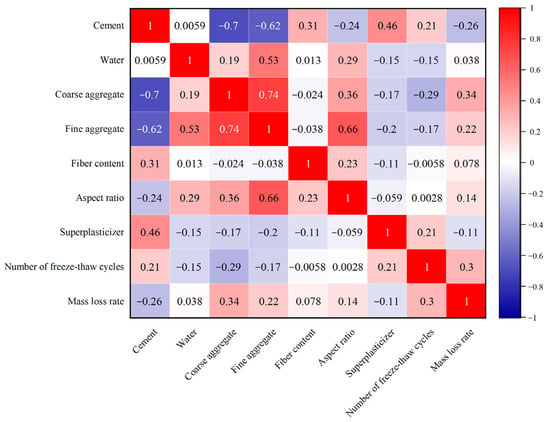
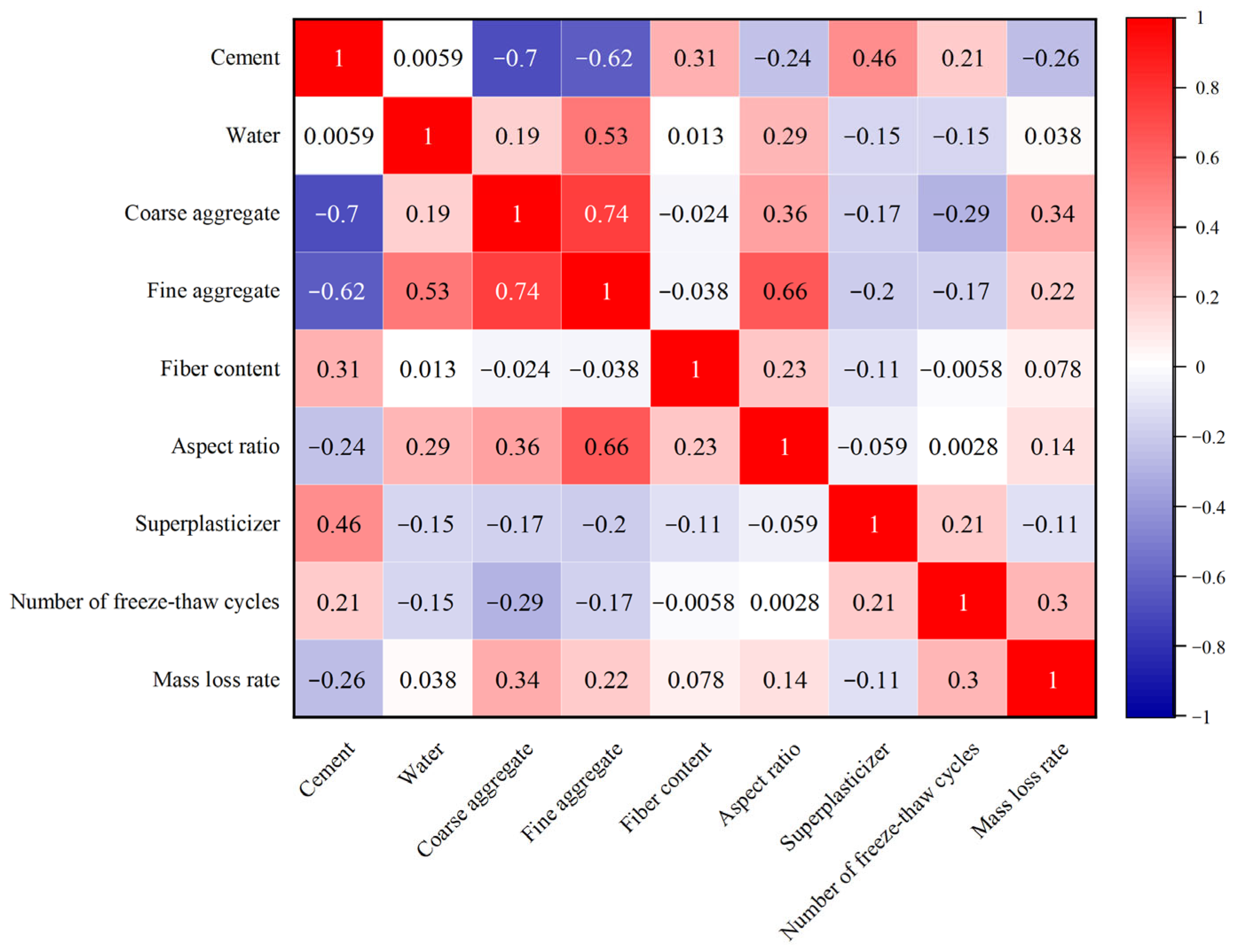
The MLR was selected as the output variable. Notably, MLR represents the cumulative mass loss at specific freeze–thaw cycle levels rather than a single final value after a fixed number of cycles. Accordingly, the number of freeze–thaw cycles is included as an input variable, and each data sample corresponds to a particular stage of deterioration. Therefore, the model is designed to capture the evolution of MLR throughout the freeze–thaw procedure. To further explore the relationships among the input variables and the target MLR, a correlation matrix was constructed, as shown in Figure 5.
Figure 5.
Correlation matrix between input parameters and MLR of SFRC.
The number of freeze–thaw cycles exhibits the strongest positive correlation with MLR, which aligns with the fundamental damage mechanism: longer exposure to freeze–thaw cycles directly exacerbates surface scaling and mass loss by continuously inducing internal frost pressure and microcrack propagation. Moderate positive correlations are also found for coarse aggregate content and water content, while cement shows weak negative correlations with MLR—suggesting their potential mitigating effects on freeze–thaw-induced damage by optimizing the concrete matrix pore structure.
2.2. ML Algorithms
ML has become a powerful tool for characterizing complex nonlinear relationships in civil engineering and material science, especially for problems involving multi-factor coupling effects that cannot be adequately described by traditional linear or empirical models. In this study, the freeze–thaw-induced MLR of SFRC is dominated by the combined influences of mixture composition, steel fiber characteristics, and environmental loadings, which interact in a highly nonlinear manner. Such inherent complexity strongly supports the use of data-driven ML methods to establish reliable prediction models. Accordingly, four typical nonlinear regression algorithms with distinct advantages were adopted in this work: SVR, BP, GB, and XGB.
SVR, a kernel-driven supervised learning algorithm, projects input features into a high-dimensional domain to resolve nonlinear regression problems, with strict control over model complexity. The core principle revolves around constructing a regression hyperplane that ensures most samples fall within an ε-insensitive tube, which, in turn, confers resistance to noise and experimental variability. By solving the dual problem using kernel functions (e.g., RBF kernel), SVR can efficiently handle the nonlinearity between mix parameters and MLR without explicitly computing high-dimensional feature mappings. The primal optimization problem of SVR is defined as follows [58]:
where w and b represent the weight vector and bias of the regression function; ϕ(xi) denotes the kernel-induced feature mapping; C is the penalty coefficient that balances fitting error and model complexity; ε is the width of the insensitive tube; and ξi and ξi* are slack variables accounting for deviations beyond the tube.
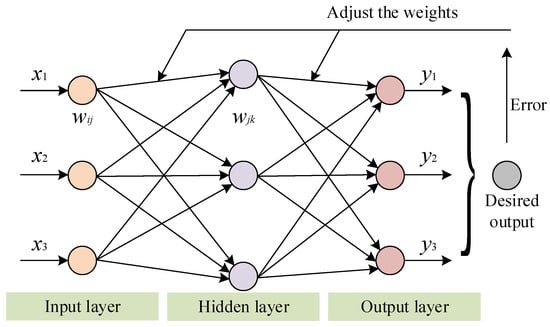
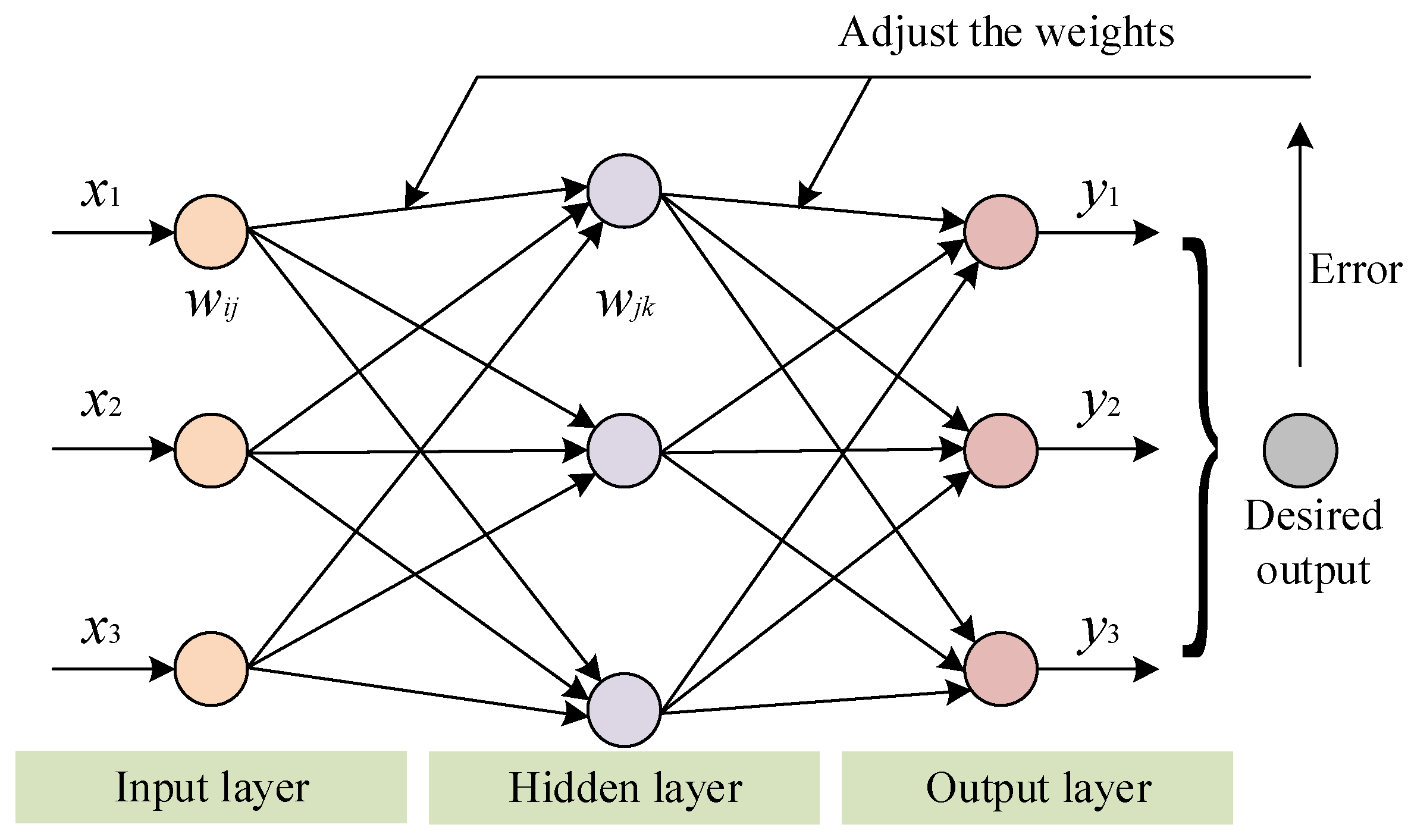
The BP neural network, a multi-layer feedforward model, is trained through the implementation of the error back-propagation algorithm and is widely employed to capture complex nonlinear relationships. The schematic architecture of the BP neural network is shown in Figure 6. The network generally comprises an input layer, one or more hidden layers, and an output layer. Within the network, each neuron executes a weighted aggregation of its input signals, subsequent to which a nonlinear activation function is deployed, and transmits the resulting signal to the subsequent layer. For a typical three-layer BP network, the output of the j-th neuron in the hidden layer is expressed as follows [59]:
and the final output is as follows:
where xi are the input features (mix proportions, fiber parameters, and freeze–thaw cycles); wij, and vj are weights between layers; bj, and c are biases; f(⋅) and g(⋅) are activation functions (e.g., ReLU, and sigmoid); and d and m denote the number of input and hidden neurons, respectively.
Figure 6.
BP neural network topology diagram.
Training proceeds by minimizing the mean squared error between predicted and observed MLR via gradient descent, iteratively updating weights and biases to reduce prediction error. This makes BP suitable for capturing the intricate relationships governing freeze–thaw degradation.
GB is a stage-wise ensemble method in which multiple weak learners, typically decision trees, are integrated to construct a robust predictive model [60]. During training, each tree is optimized to capture the gradient of the loss function, enabling the model to iteratively update itself and improve prediction capability. Given the current model Ft−1(x), the t-th tree ht(x) is optimized to align with the negative gradient of the loss function L(y,F(x)):
The ensemble is then updated as follows:
where η is the learning rate to control overfitting. By iteratively fitting residuals, GB can capture subtle nonlinear trends and cumulative effects, making it well-suited for modeling the progressive freeze–thaw degradation process.
XGB is an advanced implementation of gradient boosting designed to improve both computational efficiency and model generalization [61]. Its key features include the application of a second-order Taylor expansion of the loss function and the incorporation of explicit regularization terms to effectively control model complexity. The objective function at iteration t is as follows:
where the regularization term is formulated as follows:
where T represents the number of leaf nodes in the tree; wj are the leaf weights; and γ and λ represent regularization coefficients to control tree complexity and prevent overfitting.
2.3. Data Preprocessing and Model Training Procedure
To achieve optimal predictive performance for each model, the hyperparameters of the four ML algorithms were systematically tuned using a grid search strategy. In this approach, predefined ranges of hyperparameters were combined exhaustively to generate multiple candidate model configurations. To enhance the reliability of model evaluation and minimize the bias arising from random data splitting, cross-validation was applied in the hyperparameter tuning stage. This approach also helps mitigate overfitting. Compared with holdout and bootstrapping methods, cross-validation improves data utilization efficiency and effectively mitigates the overfitting risk associated with a single train-validation split. Therefore, a 5-fold cross-validation strategy was adopted. In detail, the training dataset (70% of the total data) was partitioned into five equally sized and mutually exclusive subsets. The dataset was split into five equal partitions. For every iteration of the five-fold scheme, four partitions were adopted for model fitting, while the fifth was reserved for validation. This cyclic workflow ran across five rounds, ensuring each partition acted as the validation set in sequence. The final performance for each hyperparameter setting was obtained by averaging the results across all folds, providing a more stable and reliable evaluation.
The hyperparameters tuned for each algorithm were targeted to their respective characteristics, and the optimal configurations were screened and optimized by combining grid search and 5-fold cross-validation, which are fully compatible with the dataset scale (277 samples) and input dimensionality (8 input parameters) in this study. In addition, model complexity was carefully controlled (e.g., simple network architecture, shallow tree depths, and regularization in XGB) to further prevent overfitting. For SVR, the radial basis function served as the core kernel function, with the penalty parameter calibrated at 10, the kernel coefficient set to 0.01, and the ε-insensitive loss parameter fixed at 0.05; these moderate values balance model fitting accuracy and generalization ability, avoiding overfitting to the limited sample size. For the BP neural network, the optimal structure was determined as a single hidden layer with 10 neurons, coupled with a learning rate of 0.005 and 500 training epochs—this simple network structure is suitable for small-sample regression tasks and prevents overfitting caused by excessive complexity. For the GB model, the optimal hyperparameters included 100 estimators, a maximum tree depth of 4, and a learning rate of 0.1; the moderate number of trees and shallow tree depth are tailored to the dataset scale, ensuring stable prediction without excessive computational cost. For XGB, the optimal configuration was 150 estimators, a learning rate of 0.05, a maximum tree depth of 3, and regularization parameters (γ = 0.05, λ = 0.5); the shallow tree depth and weak regularization are designed to adapt to the small sample size, effectively suppressing overfitting while maintaining good predictive performance. This unified training and hyperparameter optimization framework ensures a fair and rigorous comparison among the four ML models, while enhancing their adaptability to the complex nonlinear freeze–thaw degradation behavior of SFRC.
2.4. Model Evaluation Metrics
Five mainstream regression metrics were applied to quantitatively compare the predictive capacity of the four ML approaches, namely, R2, MAE, MAPE, MSE, and RMSE, to comprehensively characterize accuracy, stability, and generalization ability.
The R2 serves to characterize the explanatory capacity of the model regarding the variation of dependent variables. A value closer to 1 represents a stronger linear correlation and superior fitting performance:
The MAE represents the average absolute deviation, which is robust to outliers and reflects the overall prediction accuracy:
The MAPE serves to measure relative errors as percentages, enabling intuitive comparisons among datasets that differ in magnitude:
The MSE amplifies large prediction errors by squaring residuals, making it sensitive to extreme deviations:
The RMSE is the square root of MSE, with the same unit as the target variable, facilitating physical interpretation of prediction error:
where yi represents the experimental MLR value; represents the predicted value; represents mean of experimental values; and n is number of samples.
3. Results and Discussions
The prediction performance and generalization ability of the four ML models established in this study were systematically analyzed and compared from both visual and quantitative perspectives. Based on the scatter plots, prediction sequence diagrams, and five statistical evaluation indicators, the applicability of different algorithms in predicting the freeze–thaw MLR of SFRC was fully demonstrated, and the optimal model was determined.
3.1. Analysis of Prediction Accuracy
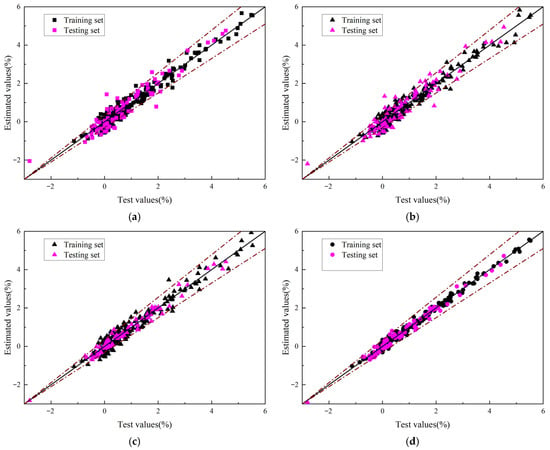
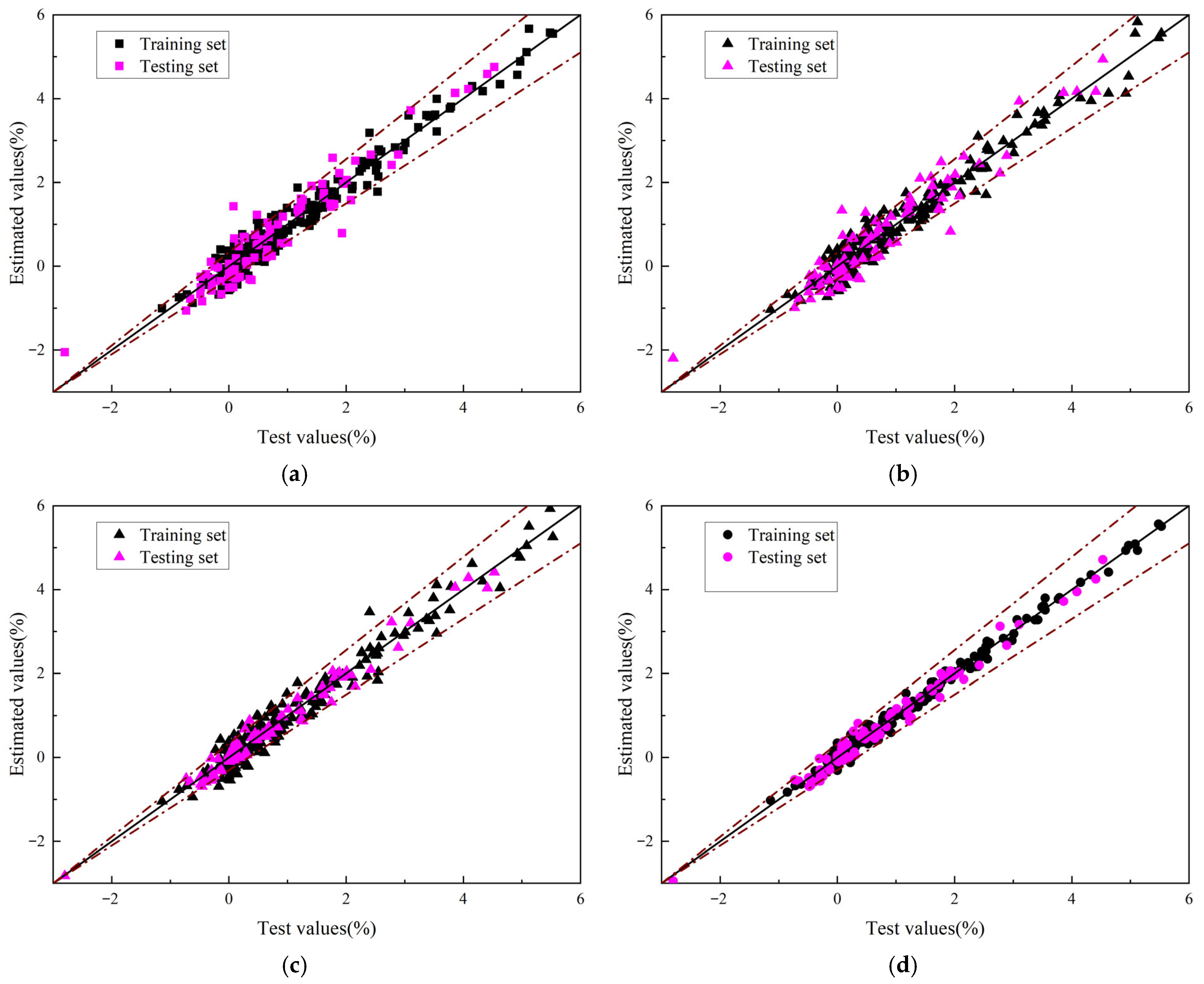
To intuitively reflect the consistency among the predicted data and the MLR values obtained from experiments, correlation scatter plots of the four models are depicted in Figure 7. In each subplot, the solid diagonal line represents a completely ideal prediction result, and the two dotted lines represent the range where the relative error is controlled within ±10%. The prediction accuracy improves as the data points approach the solid diagonal line, whereas a greater dispersion of points indicates an increased prediction bias.
Figure 7.
The correlation between test and estimated data for different models: (a) SVR; (b) BP; (c) GB; and (d) XGB.
It can be clearly observed from Figure 7a that the data points of the SVR model are relatively scattered, and a considerable number of points are distributed outside the ±10% error interval. This phenomenon indicates that the SVR model has difficulty in fully fitting the complex nonlinear relationship between material parameters, fiber characteristics, freeze–thaw cycles, and MLR, resulting in relatively large prediction deviations. As shown in Figure 7b, in terms of the overall distribution, the BP neural network exhibits a higher degree of concentration than the SVR model, and the number of points beyond the error range is significantly reduced, indicating that the BP model has improved the expression ability of nonlinear mapping. However, some individual points still show obvious deviations, reflecting certain limitations in stability.
In contrast, the data points of the GB model shown in Figure 7c are more closely clustered near the diagonal line, with a tiny fraction of scattered samples slightly exceeding the ±10% error range, demonstrating a significantly enhanced prediction accuracy and stability. The XGB model in Figure 7d exhibits the optimal distribution state: most scattered samples are tightly distributed near the ideal diagonal line, and only very few individual points deviate slightly. This result fully proves that the XGB model has the strongest ability to capture the nonlinear characteristics of freeze–thaw damage evolution, and can accurately reflect the change law of MLR under different material combinations and cycle conditions.
3.2. Analysis of Prediction Stability and Error Distribution
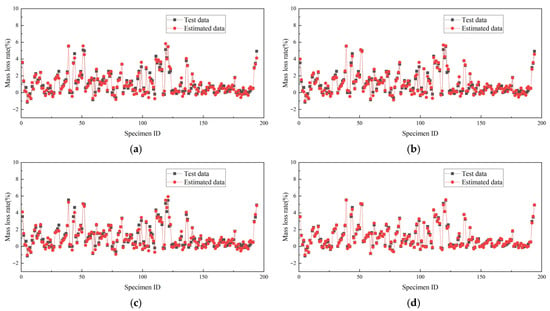
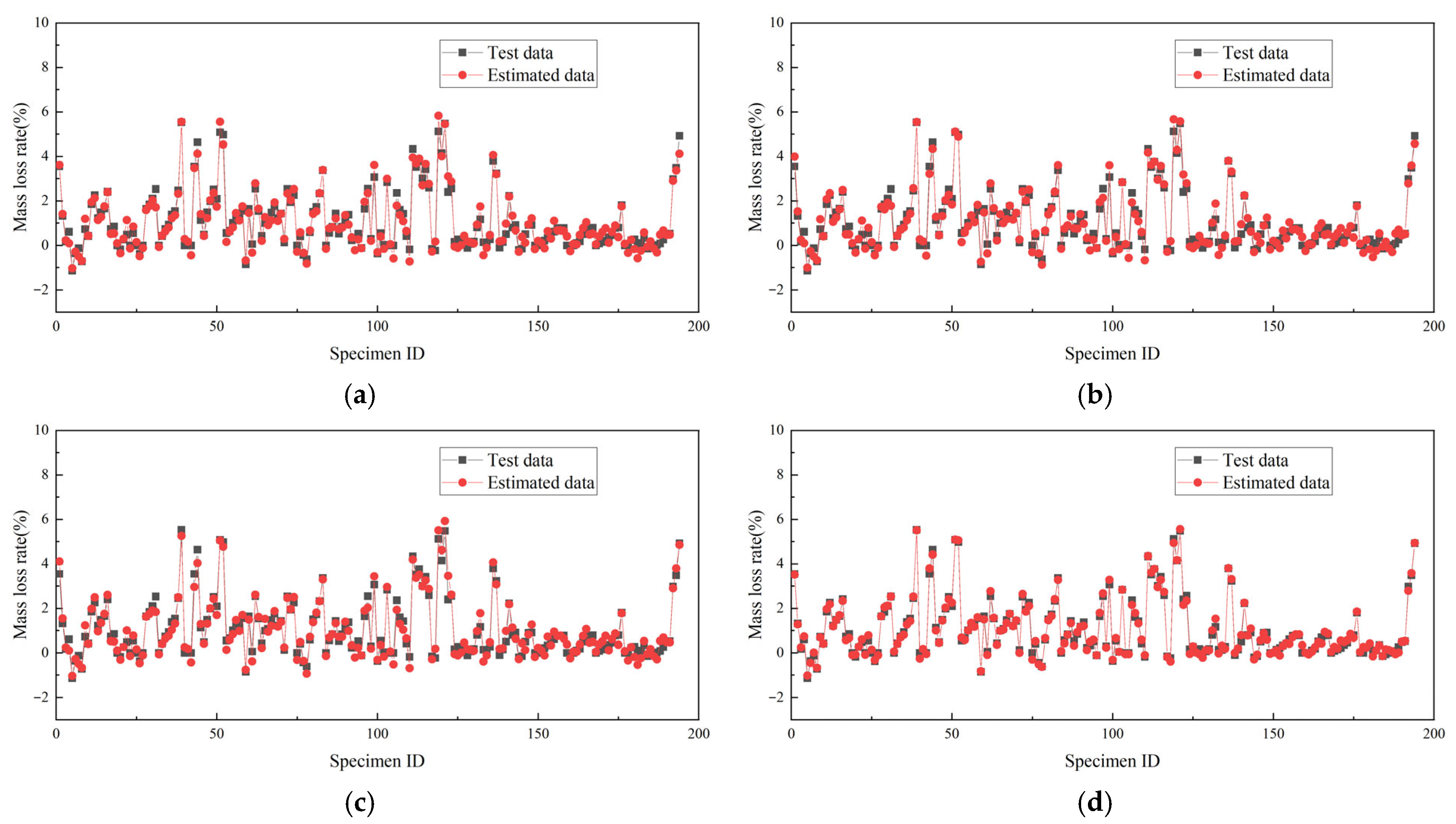
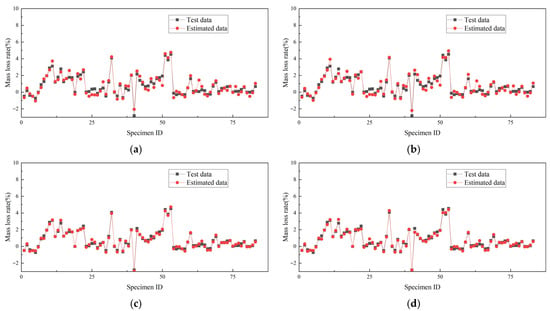
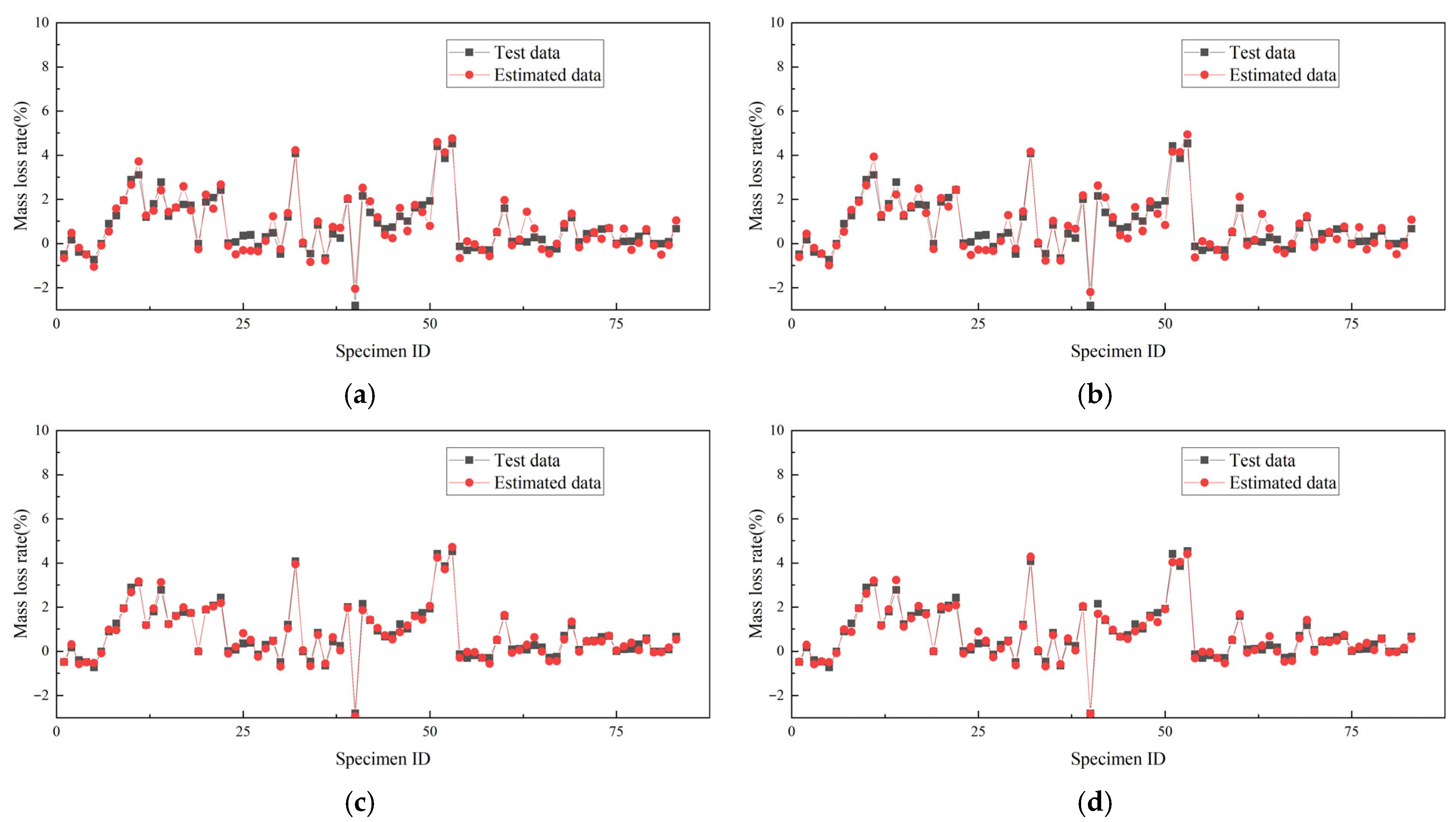
To further verify the stability and continuous prediction ability of each model, the fitting effects on the training set and testing set are displayed in Figure 8 and Figure 9, respectively. These figures reflect the fitting degree of each model to the overall trend of MLR and the error distribution corresponding to each sample.
Figure 8.
Contrasting the test and estimated data across distinct model training sets: (a) SVR; (b) BP; (c) GB; and (d) XGB.
Figure 9.
Contrasting the test and estimated data across distinct model testing sets: (a) SVR; (b) BP; (c) GB; and (d) XGB.
It can be seen from Figure 8 that four models can capture the evolutionary characteristics of MLR in the training process, and there is no obvious overall deviation. However, the SVR model has relatively large local fluctuations, and the error amplitude is higher than those of other models. The BP model is more stable than SVR, but still shows certain fluctuations at individual sample points. The prediction curve of the GB algorithm shows a superior fitting agreement with the observed data, and the XGB model almost coincides with the measured values, showing the strongest fitting ability.
For the testing set shown in Figure 9, all models maintain a certain prediction ability, but significant differences in accuracy and stability can still be distinguished. The SVR model has the largest prediction error, and some individual samples show obvious deviations. The BP model is better than SVR, but the error is still higher than that of the two ensemble learning models. The GB model maintains good prediction stability, while the XGB model shows the highest consistency with the test data. The above results showed that the gradient-boosting-based models have obvious advantages in suppressing overfitting and improving the generalization ability, especially the XGB model with an optimized regularization strategy.
3.3. Quantitative Evaluation Based on Statistical Indicators
The statistical results of each model on the training and testing set are listed in Table 2. The SVR model shows the highest error values and the lowest R2 among the four models, which means that it has the weakest ability to fit the nonlinear relationship between input variables and MLR. The MAE, MAPE, MSE, and RMSE of the BP model are all lower than those of SVR, and the R2 is also improved, indicating that the BP neural network has a better nonlinear expression ability. However, compared with ensemble learning models, BP still has a certain gap in prediction accuracy and stability.
Table 2.
Comprehensive statistical results of four optimized machine-learning models.
The GB model shows a significant improvement in all indicators, with greatly reduced error values and a significantly increased R2, which proves that the gradient boosting framework can more effectively mine the internal relationship between the influencing factors and freeze–thaw damage. The XGB model demonstrates optimal comprehensive performance, attaining the minimum MSE, RMSE, MAE, and MAPE across the training and test datasets, as well as the highest R2 value of 0.91 on the testing set. Moreover, it shows the smallest performance gap between the training and testing sets, indicating superior out-of-sample adaptability and a low risk of overfitting.
The SVR model, constrained by its kernel function and learning strategy, shows a limited capability in capturing the highly coupled and nonlinear behavior of SFRC freeze–thaw damage. The BP model has a certain nonlinear fitting ability, but its stability is insufficient, and it is easy to produce large deviations at individual points. By combining numerous decision trees, the GB model effectively boosts the overall prediction precision, while the XGB model further incorporates regularization and optimized iteration strategies, leading to an enhanced accuracy as well as an improved robustness and generalization ability. The XGB model can accurately and stably predict the freeze–thaw-induced MLR of SFRC by using conventional mixture parameters, fiber characteristics, and freeze–thaw cycle numbers as input variables. It delivers a credible data-driven solution to support the durability evaluation and structural safety design of cold-area concrete linings.
3.4. Discussion
In contrast to conventional methods used to forecast concrete frost resistance, the ML methods exhibit several distinct differences in terms of modeling philosophy, predictive capability, and practical applicability. Traditional methods generally rely on empirical regression correlations or durability metrics (e.g., mass loss thresholds, and relative dynamic modulus), which are obtained through controlled laboratory tests. These approaches benefit from a clear physical meaning and straightforward implementation, making them widely adopted in engineering practice. However, they generally rely on simplified assumptions and limited influencing factors, which restrict their ability to capture the complex and nonlinear interactions among mixture composition, fiber characteristics, and freeze–thaw exposure conditions.
In contrast, the ML methods adopt a data-driven framework, enabling the automatic extraction of nonlinear relationships from multi-source experimental data without requiring explicit assumptions about the underlying mechanisms. As demonstrated in the results, ensemble learning methods, particularly the XGB model, show superior performance in terms of prediction accuracy and generalization ability. This advantage is mainly attributed to their capability to effectively handle multi-factor coupling effects and nonlinear degradation processes.
Nevertheless, the proposed approach also presents certain limitations and potential risks. The predictive accuracy of ML methods is heavily influenced by the quality, size, and representativeness of the dataset. Although a comprehensive database was established, the available data are still limited compared with large-scale industrial datasets, which may affect the robustness of the model under extreme conditions. Furthermore, compared with traditional methods, machine-learning models generally lack explicit physical interpretability, which may limit their direct adoption in design specifications and engineering codes. In addition, extrapolating beyond the scope of the training data is likely to result in a decline in the reliability of the predictions.
Overall, the main originality of this study lies in integrating multi-source experimental data with advanced machine-learning techniques to predict the freeze–thaw-induced mass loss behavior of SFRC. The proposed approach provides an improved prediction accuracy and flexibility compared with traditional methods, while its limitations highlight the need for future research to combine data-driven models with physically informed frameworks to enhance interpretability and engineering applicability.
4. Conclusions
- (i)
- Among the four machine-learning models applied in predicting the freeze–thaw-induced MLR of SFRC, the gradient-boosting-based ensemble models (GB and XGB) show a significantly better performance than SVR and BP. The XGB model reduces the prediction error by more than 60% compared with the lowest-precision SVR model, presenting a substantial improvement in predictive capability.
- (ii)
- The optimized XGB model attains the best forecasting precision, with an R2 of 0.91, exceeding SVR, BP, and GB in all quantitative indicators. The trained model can be directly applied to evaluate the freeze–thaw durability of SFRC without additional retraining or parameter adjustment.
- (iii)
- Visual analysis indicates that SVR produces the largest prediction deviation and weakest stability, while BP provides a moderate improvement. In contrast, GB and XGB yield a more concentrated data distribution and smaller errors, enabling the precise characterization of the accumulated freeze–thaw damage progression.
- (iv)
- The proposed XGB model allows the fast and reliable assessment of MLR using conventional mix design parameters and freeze–thaw conditions, offering an efficient, low-cost data-driven solution for the durability design, long-term performance evaluation, and safety optimization of SFRC tunnel linings in cold regions.
Apart from the comparative evaluation of machine-learning algorithms, this study delivers further insights into the freeze–thaw degradation behavior of SFRC based on a data-driven approach. The results indicate that the mass loss rate is governed by strong nonlinear interactions among mixture composition, steel fiber characteristics, and freeze–thaw exposure, highlighting the limitations of traditional empirical approaches. In particular, the dominant role of freeze–thaw cycles, together with the coupled effects of water content, aggregate proportion, and fiber reinforcement, reflects the underlying mechanisms of pore pressure evolution, microcrack propagation, and surface scaling. From an engineering perspective, the proposed XGB-based model provides a practical tool for a rapid durability assessment and parameter optimization using conventional mix design variables, which is especially valuable for tunnel lining applications in cold regions where experimental evaluation is costly and time-consuming.
The proposed framework is established based on widely available and quantifiable input parameters, ensuring its applicability in typical engineering scenarios. Future work may further improve the model by incorporating more refined material descriptors, such as detailed fiber geometry and interfacial properties, as well as by integrating data-driven approaches with physically based models to enhance interpretability and facilitate engineering implementation. In addition, expanding the database to include more diverse environmental conditions and material compositions would improve the model robustness and generalization capability, while extending the framework to other durability-related properties—such as the surface scaling resistance, internal damage evolution, and coupled environmental effects—would contribute to a more comprehensive and reliable assessment methodology for concrete structures in cold regions.
Author Contributions
Conceptualization, T.-T.Z.; methodology, Y.Y., X.Z. and H.L.; validation, H.L., J.T. and F.Z.; formal analysis, Y.Y. and B.-Y.L.; investigation, X.Z., H.L., B.-Y.L., Y.Y., T.-T.K., J.T. and F.Z.; writing—original draft preparation, Y.Y.; writing—review and editing, Y.Y., T.-T.Z., X.Z., H.L., B.-Y.L., T.-T.K., J.T. and F.Z.; visualization, T.-T.K.; supervision, T.-T.Z.; project administration, T.-T.Z.; funding acquisition, T.-T.Z. All authors have read and agreed to the published version of the manuscript.
Funding
This project was supported by the Natural Science Foundation of Inner Mongolia Autonomous Region of China (2025QN05102) and the Science and Technology of Plan Inner Mongolia Autonomous Region of China (2025YFHH0113).
Data Availability Statement
The original contributions presented in this study are included in the article. Further inquiries can be directed to the corresponding author.
Conflicts of Interest
The authors declare no conflicts of interest.
References
- Li, L.; Mu, Y.; Zhu, X.; Ma, W.; Zhang, L.; Zhang, K.; Yang, X. Assessment of the frost damage susceptibility of highway tunnels in plateau transition regions: Example taken from Gansu Province in Northwest China. J. Cold Reg. Eng. 2025, 39, 04025039. [Google Scholar] [CrossRef] [Scilit]
- Nguyen, T. Experimental investigation and numerical modeling on mechanical behavior of highly porous cement-based material: An overview. Mech. Adv. Mater. Struct. 2024, 31, 9040–9061. [Google Scholar] [CrossRef] [Scilit]
- Mashayekhi, A.; Hassanli, R.; Zhuge, Y.; Ma, X.; Chow, C.W.K. Synergistic effects of fiber hybridization on the mechanical performance of seawater sea-sand concrete. Constr. Build. Mater. 2024, 416, 135087. [Google Scholar] [CrossRef] [Scilit]
- Qian, R.; Li, Q.; Fu, C.; Zhang, Y.; Wang, Y.; Jin, N.; Jin, X. Investigations on atmospheric carbonation corrosion of concrete structure beam exposed to real marine-environment for 7 years. J. Build. Eng. 2023, 71, 106517. [Google Scholar] [CrossRef] [Scilit]
- Du, T.; Xiao, J.; Li, C.; Gan, Y.; Jiang, X. Experimental and numerical study on the chloride ions penetration in recycled aggregate concrete. Constr. Build. Mater. 2024, 451, 138702. [Google Scholar] [CrossRef] [Scilit]
- Yuan, X.; Dai, M.; Gao, Y.; Liu, F.; Zhang, M. Pore morphology of graphene oxide modified steel fibre concrete for freeze-thaw resistance. Constr. Build. Mater. 2023, 409, 133877. [Google Scholar] [CrossRef] [Scilit]
- Han, J.; Zhang, W.; Liu, Y. Experimental study on freeze-thaw resistance of steel fiber-reinforced hydraulic concrete with two-grade aggregate. J. Build. Eng. 2022, 60, 105181. [Google Scholar] [CrossRef] [Scilit]
- Tai, Y.; Yang, L.; Gao, D.; Kang, K.; Cao, Z.; Zhao, P. Properties evolution and deterioration mechanism of steel fiber reinforced concrete under the coupling effect of carbonation and chloride attack. J. Build. Eng. 2024, 95, 110275. [Google Scholar] [CrossRef] [Scilit]
- Mi, L.; Mao, J.; Li, L.; Shi, Q.; Fang, K.; Li, S.; Deng, X.; Li, G. Microstructural damage and durability of plateau concrete: Insights into freeze-thaw resistance and improvement strategies. Structures 2024, 60, 105888. [Google Scholar] [CrossRef] [Scilit]
- Wang, R.; Hu, Z.; Li, Y.; Wang, K.; Zhang, H. Review on the deterioration and approaches to enhance the durability of concrete in the freeze-thaw environment. Constr. Build. Mater. 2022, 321, 126371. [Google Scholar] [CrossRef] [Scilit]
- Li, Y.; Jin, K.; Lin, H.; Shen, J.; Shi, J.; Fan, M. Analysis and prediction of freeze-thaw resistance of concrete based on machine learning. Mater. Today Commun. 2024, 39, 108946. [Google Scholar] [CrossRef] [Scilit]
- Zeng, W.; Wang, W.; Pan, J.; Liu, G. Effect of steel fiber on the permeability of freeze-thaw damaged concrete under splitting tensile and compressive loads. J. Build. Eng. 2023, 80, 108086. [Google Scholar] [CrossRef] [Scilit]
- Lu, J.; Liu, J.; Yang, H.; Wan, X.; Gao, J.; Zhang, J.; Li, P. Experimental investigation on the mechanical properties and pore structure deterioration of fiber-reinforced concrete in different freeze-thaw media. Constr. Build. Mater. 2022, 350, 128887. [Google Scholar] [CrossRef] [Scilit]
- Dong, Q.; Zhang, W.; Zhang, W.; Xiang, L.; Zhang, J.; Jiang, J. Transport behaviors of concrete under complex coupled effects of freeze-thaw, high-frequency load, and chloride attack: An experimental and numerical study. J. Build. Eng. 2024, 94, 109973. [Google Scholar] [CrossRef] [Scilit]
- Wang, Y.; Gu, H.; Gu, C.; Shao, C.; Jiang, Z.; Wang, Y.; Chen, X. Analysis of concrete damage evolution in cold regions under combined freeze-thaw cycle-crack effect. Constr. Build. Mater. 2024, 456, 139296. [Google Scholar] [CrossRef] [Scilit]
- Xiao, Q.; Wu, Z.; Qiu, J.; Dong, Z.; Shi, S. Capillary water absorption performance and damage constitutive model of recycled concrete under freeze-thaw action. Constr. Build. Mater. 2022, 353, 129120. [Google Scholar] [CrossRef] [Scilit]
- Wang, H.; Wang, Y.; Sun, Z.; Wang, L.; Zhang, H.; Zheng, W.; Wang, Q. Comprehensive assessment and freeze-thaw durability prediction of wet-sprayed concrete for cold-region tunnels. Materials 2025, 18, 2955. [Google Scholar] [CrossRef] [Scilit]
- Xia, W.; Li, W.; Rao, J.; Jiang, Z.; Ju, J.W.; Cui, S. The multi-scale damage evolution of nano-modified concrete under the cold region tunnel environment based on micromechanical model. Compos. Struct. 2025, 351, 118612. [Google Scholar] [CrossRef] [Scilit]
- Liu, S.; Xu, X.; Li, W.; Liu, Y. Salt freeze-thaw resistance and damage evolution model of concrete reinforced with corrosion-resistant coated steel fiber. Structures 2025, 76, 108900. [Google Scholar] [CrossRef] [Scilit]
- Zhang, H.; Liu, X.; Bai, L.; Ji, S.; Pan, L.; Li, X. Acoustic emissions evaluation of the dynamic splitting tensile properties of steel fiber reinforced concrete under freeze–thaw cycling. Front. Struct. Civ. Eng. 2023, 17, 1341–1356. [Google Scholar] [CrossRef] [Scilit]
- Liu, H.; Yang, L.; Kang, K.; Gao, D.; Liu, G.; Zhang, Y.; Zhang, Y. Mechanical properties and corrosion mechanism of steel fiber reinforced concrete subjected to stray current. J. Build. Eng. 2024, 96, 110519. [Google Scholar] [CrossRef] [Scilit]
- Li, Y.; Kong, X.; Cao, Z.; Yang, L.; Xu, W.; Gao, D. Mechanical properties of steel fiber reinforced concrete mixed with NaCl solutions of varying concentrations. Case Stud. Constr. Mater. 2025, e05389. [Google Scholar] [CrossRef] [Scilit]
- Wang, Y.; Jin, H.; Demartino, C.; Chen, W.; Yu, Y. Mechanical properties of steel fiber reinforced concrete: Database construction and model prediction. Case Stud. Constr. Mater. 2022, 17, e01484. [Google Scholar]
- Cao, S.; Tian, Y.; Liu, S.; Hao, Y. Systematic analysis of fracture mechanical properties of cementitious composites with high steel fiber content. Constr. Build. Mater. 2025, 487, 141981. [Google Scholar] [CrossRef] [Scilit]
- Hu, X.; Su, T.; Zeng, J.; Long, Y.; Wang, J.; Liao, J.; Ouyang, Y. Effect of steel fibres and expansive agents on compressive behaviour of circular CFST columns. Case Stud. Constr. Mater. 2024, 20, e02789. [Google Scholar] [CrossRef] [Scilit]
- Hu, X.; Sun, H.; Zhu, D.; Fan, T.; Zeng, J. Theoretical model for FRP-reinforced UHPC tubular beams under torsion. Structures 2025, 82, 110407. [Google Scholar] [CrossRef] [Scilit]
- Yang, J.; Zhang, Y.; Huang, J. The strengthening theory of steel fiber reinforced concrete and its application in tunnel engineering: A review. J. Eng. Fibers Fabr. 2024, 19, 15589250241239242. [Google Scholar] [CrossRef] [Scilit]
- Wu, L.; Gao, F.; Wang, Z.; Li, L.; Huang, H.; Luo, W. Experimental Investigation of the Mechanical Performance of Steel Fiber-Reinforced Concrete Tunnel Linings Under Freeze–Thaw Cycles. Appl. Sci. 2026, 16, 3178. [Google Scholar] [CrossRef] [Scilit]
- Yang, W.; Huang, Y.; Li, C.; Tang, Z.; Quan, W.; Xiong, X.; He, J.; Wu, W. Damage prediction and long-term cost performance analysis of glass fiber recycled concrete under freeze-thaw cycles. Case Stud. Constr. Mater. 2024, 21, e03795. [Google Scholar] [CrossRef] [Scilit]
- Bai, W.; Song, Z.; Yuan, C.; Guan, J.; Xie, C.; Huang, H.; Ma, Y. Study on mechanical properties and damage mechanism of recycled concrete containing silica fume in freeze-thaw environment. Constr. Build. Mater. 2023, 375, 130872. [Google Scholar] [CrossRef] [Scilit]
- Wang, Y.; Xie, M.; Zhang, J. Mechanical properties and damage model of modified recycled concrete under freeze-thaw cycles. J. Build. Eng. 2023, 78, 107680. [Google Scholar] [CrossRef] [Scilit]
- Afroughsabet, V.; Ozbakkaloglu, T. Mechanical and durability properties of high-strength concrete containing steel and polypropylene fibers. Constr. Build. Mater. 2015, 94, 73–82. [Google Scholar] [CrossRef] [Scilit]
- Xue, Q.; Zheng, T.; Wang, J.; Zhang, J.; Xia, W.; Cui, S. Study on chloride permeability and chloride ion transport of fiber-reinforced cementitious composite repair system. Buildings 2025, 15, 975. [Google Scholar] [CrossRef] [Scilit]
- Hu, Y.; Qiao, S.; Wang, Y.; Yu, S.; Chen, J. Multi-scale numerical investigation of chloride ion transport mechanisms in fiber-reinforced concrete using a three-dimensional finite difference approach. Constr. Build. Mater. 2026, 525, 146419. [Google Scholar] [CrossRef] [Scilit]
- Liang, N.; Guo, Y.; Geng, S.; Liao, M.; Li, L. Study on deterioration mechanism and corrosion resistance grade prediction of basalt-polypropylene fiber reinforced concrete under sulfate attack. Constr. Build. Mater. 2026, 518, 145720. [Google Scholar] [CrossRef] [Scilit]
- Ren, G.; Gao, X.; Wen, X.; Su, A. Experimental study on the long-term performance of sisal fiber reinforced high-performance concrete subjected to drying-wetting cycles. Case Stud. Constr. Mater. 2024, 21, e03911. [Google Scholar] [CrossRef] [Scilit]
- Gong, F.; Jiang, X.; Gamil, Y.; Iftikhar, B.; Thomas, B. An overview on spalling behavior, mechanism, residual strength and microstructure of fiber reinforced concrete under high temperatures. Front. Mater. 2023, 10, 1258195. [Google Scholar] [CrossRef] [Scilit]
- Wang, Y.; Hu, Z.; Liu, J. Freeze-thaw resistance of concrete containing azodicarbonamide expansive agent. Constr. Build. Mater. 2023, 367, 130335. [Google Scholar] [CrossRef] [Scilit]
- Chi, K.; Li, J.; Shao, R.; Wu, C. Experimental study on dynamic characterisation of ultra-high performance concrete after cryogenic freeze-thaw cycles. Cem. Concr. Compos. 2025, 160, 106011. [Google Scholar] [CrossRef] [Scilit]
- Qin, S.; Chen, C.; Zhang, M. Modeling of concrete deterioration under external sulfate attack and drying-wetting cycles: A review. Materials 2024, 17, 3334. [Google Scholar] [CrossRef] [Scilit]
- Atkins, C.; Lambert, P. Limitations in modelling reinforced concrete durability. Corros. Mater. Degrad. 2022, 3, 320–332. [Google Scholar] [CrossRef] [Scilit]
- Chen, H.; Li, X.; Wu, Y.; Zuo, L.; Lu, M.; Zhou, Y. Compressive strength prediction of high-strength concrete using long short-term memory and machine learning algorithms. Buildings 2022, 12, 302. [Google Scholar] [CrossRef] [Scilit]
- Yang, Q.; Wang, H.; Zheng, J.; Cheng, W.; Xia, S. Prediction of mechanical properties of basalt fiber concrete using hybrid recurrent neural networks based on freeze-thaw damage quantification. J. Build. Eng. 2024, 98, 111360. [Google Scholar] [CrossRef] [Scilit]
- Taffese, W.Z.; Espinosa-Leal, L. Prediction of chloride resistance level of concrete using machine learning for durability and service life assessment of building structures. J. Build. Eng. 2022, 60, 105146. [Google Scholar] [CrossRef] [Scilit]
- Chen, H.; Cao, Y.; Liu, Y.; Qin, Y.; Xia, L. Enhancing the durability of concrete in severely cold regions: Mix proportion optimization based on machine learning. Constr. Build. Mater. 2023, 371, 130644. [Google Scholar] [CrossRef] [Scilit]
- Gong, W.; Yu, H.; Ma, H.; Zhu, H. A comprehensive assessment of durability and service life prediction of concrete structures in the simulated tidal zone of the South China Sea considering measures to enhance concrete durability. J. Build. Eng. 2023, 76, 107194. [Google Scholar] [CrossRef] [Scilit]
- Cheng, X.; Tian, W.; Gao, J.; Gao, Y. Performance evaluation and lifetime prediction of steel slag coarse aggregate concrete under sulfate attack. Constr. Build. Mater. 2022, 344, 128203. [Google Scholar] [CrossRef] [Scilit]
- Li, Y.; Zhang, Q.; Wang, R.; Xiong, X.; Li, Y.; Wang, J. Experimental investigation on the dynamic mechanical properties and microstructure deterioration of steel fiber reinforced concrete subjected to freeze–thaw cycles. Buildings 2022, 12, 2170. [Google Scholar] [CrossRef] [Scilit]
- Lin, Y.; Jiang, S.; Guo, S.; Sun, L. Experimental research on the mechanical properties of steel fiber-reinforced concrete under freeze-thaw cycles. Indust. Constr. 2025, 55, 73–85. [Google Scholar] [CrossRef] [Scilit]
- Fan, Y. Study on properties of steel fiber reinforced concrete under freeze-thaw cycle. J. Xinxiang Univ. 2024, 41, 67–69. [Google Scholar]
- Guler, S.; Akbulut, Z.F. Effect of freeze-thaw cycles on strength and toughness properties of new generation 3D/4D/5D steel fiber-reinforced concrete. J. Build. Eng. 2022, 51, 104239. [Google Scholar] [CrossRef] [Scilit]
- Liu, H.; Zhang, C.; Jia, C.; Tao, D. Freeze-thaw cycle characteristics of graphite tailing concrete and steel fiber reinforced-graphite tailing concrete. Constr. Build. Mater. 2025, 462, 140006. [Google Scholar] [CrossRef] [Scilit]
- Li, D.; Guo, Q.; Liu, S. Influence of steel fiber on durability performance of concrete under freeze-thaw cycles. Adv. Mater. Sci. Eng. 2021, 2021, 5460844. [Google Scholar] [CrossRef] [Scilit]
- Cheng, Y.; Sun, L.; Li, Y.; Liu, M.; He, R.; Jin, X.; Jin, H. Damage model of steel fiber-reinforced coal gangue concrete under freeze-thaw cycles based on Weibull distribution. Materials 2023, 16, 6775. [Google Scholar] [CrossRef] [Scilit]
- Zhao, M.; Zhang, X.; Song, W.; Li, C.; Zhao, S. Development of steel fiber-reinforced expanded-shale lightweight concrete with high freeze-thaw resistance. Adv. Mater. Sci. Eng. 2018, 2018, 9573849. [Google Scholar] [CrossRef] [Scilit]
- Zhang, Y.; Zhu, H. Uniaxial tension properties and stress-strain relation of steel fiber reinforced concrete subjected to salt and freeze-thaw cycles. Constr. Build. Mater. 2025, 489, 142396. [Google Scholar] [CrossRef] [Scilit]
- Liu, J.; Li, A.; Chen, J.; Zhou, L. Influence mechanism of sulfate freeze-thaw cyclic erosion on mechanical behavior of steel fiber reinforced high-strength self-compacting concrete. Case Stud. Constr. Mater. 2025, 22, e04406. [Google Scholar] [CrossRef] [Scilit]
- Awad, M.; Khanna, R. Support vector regression. In Efficient Learning Machines: Theories, Concepts, and Applications for Engineers and System Designers; Apress: Berkeley, CA, USA, 2015; pp. 67–80. [Google Scholar]
- Li, J.; Cheng, J.; Shi, J.; Huang, F. Brief introduction of back propagation (BP) neural network algorithm and its improvement. In Advances in Computer Science and Information Engineering; Springer: Berlin/Heidelberg, Germany, 2012; Volume 2, pp. 553–558. [Google Scholar]
- Natekin, A.; Knoll, A. Gradient boosting machines, a tutorial. Front. Neurorobot. 2013, 7, 21. [Google Scholar] [CrossRef] [Scilit] [PubMed]
- Chen, T.; He, T.; Benesty, M. XGBoost: Extreme Gradient Boosting, R Package Version 0.4-2; Scientific Research Publishing: Irvine, CA, USA, 2015; Volume 1, pp. 1–4.

Disclaimer/Publisher’s Note: The statements, opinions and data contained in all publications are solely those of the individual author(s) and contributor(s) and not of MDPI and/or the editor(s). MDPI and/or the editor(s) disclaim responsibility for any injury to people or property resulting from any ideas, methods, instructions or products referred to in the content. |
© 2026 by the authors. Licensee MDPI, Basel, Switzerland. This article is an open access article distributed under the terms and conditions of the Creative Commons Attribution (CC BY) license.