


Abstract
This study investigated the feasibility of using hydroxyapatite (HAp) derived from pyrolyzed waste chicken bones as a sustainable cement replacement material for cement mortar. Commercial tricalcium phosphate (TCP), which belongs to the same calcium phosphate family but possesses distinct crystalline characteristics, was used as a comparative material. HAp and TCP were incorporated as partial cement replacements at 2, 5, 10, and 20% by weight, and the workability, compressive strength, flexural strength, microstructure, and CO2 emission characteristics of the resulting mortars were evaluated. The results showed that low replacement ratios improved early-age strength owing to the micro-filler effect of fine calcium phosphate particles. In particular, the HAp mixtures exhibited superior long-term performance compared with the TCP mixtures, with the 2% HAp mixture achieving the highest compressive strength of 54.5 MPa at 56 days. Flexural strength results showed a similar trend, with HAp effectively suppressing microcrack propagation through improved matrix densification and interfacial bonding. However, replacement ratios exceeding 10% reduced mechanical performance due to cement dilution, increased porosity, and particle agglomeration. SEM observations confirmed that HAp replacement levels of 2–5% densified the mortar matrix, whereas excessive replacement caused localized agglomeration and microstructural defects. The carbon emission assessment indicated that pyrolysis reduced direct CO2 emissions compared with incineration by immobilizing part of the carbon in solid char; however, laboratory-scale pyrolysis increased total emissions because of high electricity consumption. Nevertheless, process integration with cement clinker production could enable waste valorization and carbon reduction by utilizing existing high-temperature kiln systems. Overall, chicken bone-derived HAp–carbon composite demonstrated strong potential as an eco-friendly cement replacement material, with an optimal replacement ratio of 5% or less.
1. Introduction
The construction industry is experiencing a steady increase in the demand for cement-based concrete, driven by ongoing urbanization and the expansion of infrastructure development. However, the cement production process involves both chemical reactions and fuel combustion, which emit substantial amounts of carbon dioxide (CO2), making it one of the major contributors to global greenhouse gas emissions. It has been reported that more than 4 billion tons of cement are produced annually, and approximately 0.9 kg of CO2 is emitted per kilogram of cement produced [1]. Consequently, CO2 emissions from cement production account for approximately 5% of total global emissions [2]. To mitigate the environmental impact of cement production, extensive research has been conducted on the utilization of industrial and agricultural wastes as alternative construction materials [3].
Meanwhile, the global increase in meat consumption has led to a continuous rise in the generation of livestock by-products. The global production of chicken meat was approximately 87.2 million tons in 2010 and has steadily increased, reaching approximately 128.3 million tons in 2024, according to the latest statistics from the Food and Agriculture Organization (FAO) [4]. Correspondingly, the generation of chicken bones, one of the major by-products of poultry processing, has also increased significantly.
By-products from the food industry, particularly chicken bones, are generally treated as waste. Since animal bones are not easily biodegradable, their disposal may cause environmental concerns [5,6]. However, when animal bones are calcined at temperatures ranging from approximately 600 °C to 1000 °C, organic components are removed, leaving behind an inorganic material primarily composed of pure hydroxyapatite (pure HAp). This process is relatively cost-effective and simple, and the resulting HAp is known to have a composition close to stoichiometric proportions [7,8]. HAp is characterized by a porous structure containing both micropores and macropores, and these pore characteristics are closely related to the mechanical properties of materials [9].
Research on pure HAp has been extensively conducted in the fields of dentistry and biomedicine; however, its application as a construction material remains in its early stages. Recent studies have reported the use of bone ash derived from thermally treated animal bones or calcium phosphate-based materials as partial cement replacements, with evaluations of their mechanical performance [10,11]. According to previous studies, cement incorporating HAp exhibits excellent resistance to carbonation caused by the reaction of CO2 with moisture, thereby effectively mitigating carbonation, which is a major durability concern in reinforced concrete structures [12]. Furthermore, HAp derived from chicken bones has demonstrated excellent adsorption capacity for harmful ions such as fluoride in aqueous environments. When incorporated into concrete, these adsorbed hazardous substances can be safely immobilized within the mortar matrix, preventing their leaching and ensuring environmental safety [13].
Despite the promising potential of HAp as an eco-friendly construction material, it remains unclear whether the observed enhancement in mechanical performance within the cement matrix is primarily attributed to the general effects of calcium phosphate-based compounds or to the intrinsic material characteristics resulting from the calcination of animal bones. To clarify this, it is necessary to conduct a comparative analysis using a control material. While commercially available tricalcium phosphate (TCP) belongs to a similar calcium phosphate family, it possesses a different crystal phase structure and symmetry, exhibiting its own unique lattice and mechanical properties [14]. Therefore, this study aims to comparatively investigate the effects of hydroxyapatite–carbon composite (hereinafter referred to as HAp) extracted from chicken bones via pyrolysis and commercially available TCP when used as cement replacement materials on the mechanical properties of mortar.
In contrast to previous studies that primarily focused on relatively high replacement ratios (typically above 5%), this study introduces a lower replacement level of 2% as an experimental variable to evaluate the subtle filler effect in the early low-replacement regime, thereby providing a distinct contribution. Based on this approach, HAp and TCP were incorporated as partial replacements for cement at proportions ranging from 0% to 20% by weight of cement. The variations in compressive and flexural strength at different curing ages were systematically evaluated, and the optimal replacement ratio was determined through comparison with the plain mixture.
In addition, to verify the environmental sustainability of the proposed mixtures, the reduction in CO2 emissions was further analyzed. Based on the methodology outlined in the IPCC guidelines, a quantitative comparison was conducted between the CO2 emissions associated with conventional waste disposal through incineration and those resulting from the utilization of pyrolyzed chicken bone as a cement replacement material. Through this analysis, the potential of chicken bone-derived HAp–carbon composite as a multifunctional and eco-friendly construction material was comprehensively assessed.
2. Experiments
2.1. Materials
Ordinary Portland cement (Type I) was used as the binder. For fine aggregates, No. 5 sand with a particle size range of 0.85–1.4 mm and No. 6 sand with a particle size range of 0.25–0.7 mm were mixed at a ratio of 1:1 by weight.
Pure Hydroxyapatite (pure HAp), a calcium phosphate compound with the chemical formula Ca10(PO4)6(OH)2, has a theoretical Ca/P ratio of approximately 1.67. In this study, waste chicken bones discarded from LeeGa Co., Ltd. (a chicken processing plant located in Daegu, Republic of Korea) were collected, thoroughly washed, and crushed, followed by drying at 100 °C for 24 h. The dried bones were then calcined at 600 °C for 180 min under a nitrogen (N2) atmosphere to prevent oxidation, with a heating rate of 10 °C/min. Subsequently, to obtain a finer particle size, the calcined product was ground using a vibratory disc mill, resulting in particles with an average size of less than 75 μm.
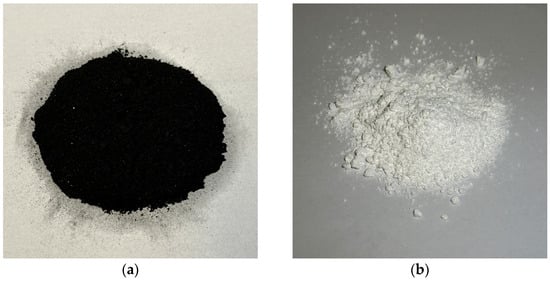
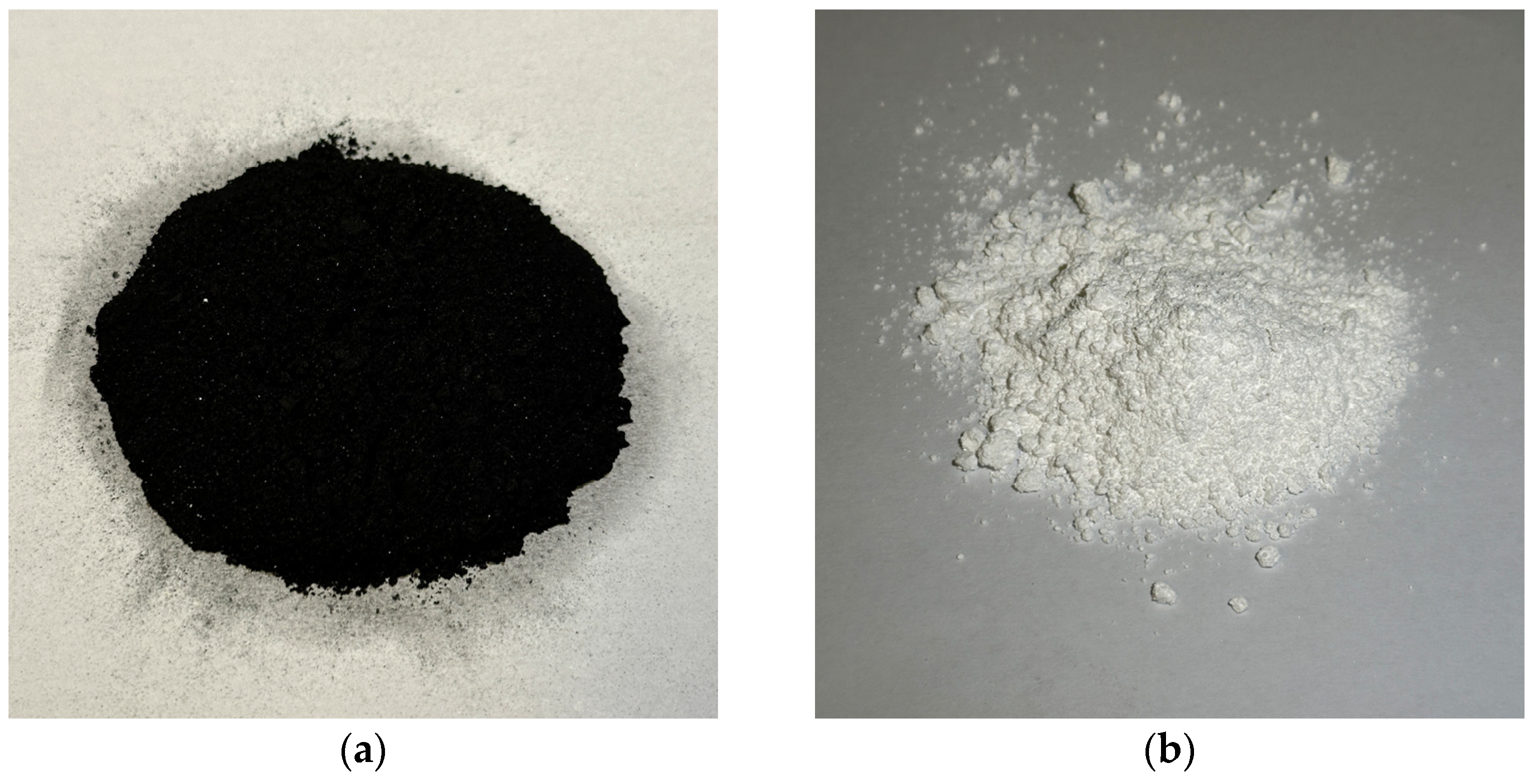
Tricalcium phosphate (TCP), with the chemical formula Ca3(PO4)2, is a calcium phosphate-based compound that belongs to a similar calcium phosphate family as pure HAp but possesses a different crystal structure [14]. In this study, TCP was used as a comparative material at the same replacement ratios as HAp. Commercial TCP with a purity of over 90% and a particle size of less than 74 μm was employed. The ground materials used in this study are shown in Figure 1.
Figure 1.
Ground materials used in this study: (a) HAp derived from calcined chicken bones; (b) commercial TCP.
2.2. Experimental Variables and Mix Proportions
To evaluate the changes in the mechanical properties of mortar, the type of cement replacement material, replacement ratio, and curing age were selected as the main experimental variables. The detailed variables are summarized in Table 1.
Table 1.
Experimental variables.
The replacement ratios of the cementitious materials were set to five levels 0, 2, 5, 10, and 20% by weight of cement. In particular, to strictly control environmental variations such as temperature and humidity that may arise due to differences in the experimental timing of HAp and TCP, separate control specimens (0% replacement) were prepared for each of the HAp and TCP mixtures.
For curing age, 7 and 28 days were commonly evaluated to compare the early- and mid-term strength development between HAp and TCP. In addition, for HAp, which is the primary material of interest in this study, a 56-day curing age was further included to investigate long-term stability and strength enhancement. Accordingly, a total of 25 different mix conditions were prepared.
Table 2 presents the mix proportions of the mortar according to each variable. The water-to-cement ratio (W/C) was set to 48.5% in accordance with ASTM C109 [15], and the cement-to-fine aggregate ratio was fixed at 1:2.75.
Table 2.
Mix Proportions.
2.3. Specimen Preparation and Curing
Mortar specimens were prepared in prismatic molds with dimensions of 40 × 40 × 160 mm in accordance with ASTM C348 [16]. To ensure uniform mixing of the materials, a mechanical mixer was used for batching. After casting, the specimens were compacted on a vibrating table for 30 s to minimize internal voids and achieve a dense structure.
To ensure the statistical significance and reproducibility of the mechanical properties, triplicate experiments were performed for all variable conditions (mix proportion and curing age), with three individual prismatic specimens prepared for each batch.
The molded specimens were subjected to initial curing under controlled temperature and humidity conditions for 24 h, after which they were demolded. Subsequently, all specimens were cured in water at a constant temperature of 20 ± 5 °C until the designated testing ages.
2.4. Test Methods
A series of tests was conducted to comprehensively evaluate the chemical, physical, mechanical, and microstructural properties of the mortar.
First, to verify whether the HAp produced from processed chicken bones possesses an appropriate chemical composition and Ca/P ratio for use as a cement replacement material, quantitative analysis was performed on dried powder samples using a wavelength dispersive X-ray fluorescence (XRF) spectrometer (Rh target, 40 kV, 95 mA) based on the fundamental parameter (FP) method.
The workability of fresh mortar was evaluated using a flow table test in accordance with ASTM C1437 [17]. The mortar was placed into the flow mold in two layers, with each layer tamped 20 times. The flow table was then dropped 25 times within 15 s, and the average diameter was measured in two orthogonal directions.
Mechanical strength tests were conducted in accordance with ASTM C348 [16] and ASTM C349 [18]. Flexural strength was determined via a three-point loading method using the three prismatic specimens prepared for each batch. Specifically, for the specimens incorporating HAp (evaluated at 3 curing ages across 5 batches), a total of 45 individual flexural specimens were tested, while for the specimens incorporating TCP (evaluated at 2 curing ages across 5 batches), a total of 30 individual flexural specimens were tested. This resulted in a cumulative total of 75 flexural specimens evaluated across the entire experimental program. Compressive strength testing was subsequently performed using the broken halves obtained after the flexural failure. Consequently, a total of six fractured specimen fragments derived from the three initial flexural specimens were tested for each mix condition. This accounted for 90 compressive strength tests for the specimens incorporating HAp and 60 tests for the specimens incorporating TCP, leading to a total of 150 compressive strength tests in sum to ensure the statistical consistency and reliability of the mechanical properties.
Finally, scanning electron microscopy (SEM) analysis was performed to observe the internal microstructure and hydration products of the mortar incorporating the replacement materials. The samples for SEM analysis were taken from the fractured surfaces of specimens after strength testing. The surfaces were coated with platinum (Pt) to ensure electrical conductivity, and the pore structure and bonding characteristics were subsequently examined.
3. Results and Discussion
3.1. XRF Analysis
Waste chicken bones were thermally treated under an inert atmosphere by injecting N2 gas to prevent oxidation. X-ray fluorescence (XRF) analysis was conducted to identify the chemical composition of the chicken bone powder, and the results confirmed that CaO and P2O5 were the dominant components. The detailed composition is presented in Table 3.
Table 3.
Chemical composition of chicken bone powder.
According to the XRF results in Table 3, the CaO content of the extracted powder was notably high at 62.22%. In particular, the Ca/P molar ratio calculated based on the oxide composition was approximately 2.45, which significantly exceeds the theoretical value of 1.67 for pure HAp. This non-stoichiometric characteristic is considered to result from the oxygen-deficient thermal treatment under an N2 atmosphere.
In a combustion process under ambient conditions, organic components are oxidized and removed; however, thermal treatment under oxygen-limited conditions does not fully oxidize the organic matter, leaving residual carbon in the solid phase and forming a carbon-rich composite [19]. During this process, volatile elements such as hydrogen (H), oxygen (O), and nitrogen (N) are released in gaseous form, thereby increasing the relative mass fraction of chemically stable inorganic components (ash) and calcium (Ca) within the total mass. As a result, the Ca/P molar ratio may increase beyond the theoretical value, with values reported up to approximately 3.37 [20].
In conclusion, the extracted material is not merely a simple ash but can be characterized as an HAp–carbon composite in which carbon and high calcium content coexist. This indicates that the material possesses a distinct chemical basis with the potential to enhance the performance of cementitious composites.
3.2. Slump Flow
A slump flow test was conducted to evaluate the workability of mortar mixtures incorporating HAp and TCP at different replacement ratios. The results are summarized in Table 4. Overall, both materials exhibited a decreasing trend in flowability with increasing replacement ratio.
Table 4.
Slump flow results of mortar specimens.
For the mixtures containing HAp, the plain specimen exhibited a slump flow of 132.6 mm. As the replacement ratio increased, a gradual reduction in flowability was observed, with a more pronounced decrease beyond 10% replacement. At a 20% replacement level, the slump flow decreased to 102.7 mm, corresponding to a maximum reduction of approximately 22% compared to the plain mixture.
Similarly, the TCP-incorporated mixtures also showed a decreasing trend in slump flow with increasing replacement ratio. However, the reduction was relatively moderate, with a maximum decrease of approximately 11% at 20% replacement compared to the plain mixture. Under identical high replacement conditions, the TCP mixtures demonstrated better retention of flowability than the HAp mixtures.
Overall, increasing the replacement ratio of both materials adversely affected the workability of the mortar. The more significant reduction observed in the HAp mixtures is attributed to the intrinsic porous structure of pure HAp particles, which likely absorbed a portion of the free water during mixing, thereby reducing the effective water content and consequently lowering the flowability.
3.3. Mechanical Strength Properties
The comprehensive experimental results for both flexural and compressive strengths, including their respective standard deviations to illustrate data variability, are summarized in Table 5.
Table 5.
Compressive and flexural strengths of HAp and TCP mortars (Avg, SD, CV).
3.3.1. Compressive Strength
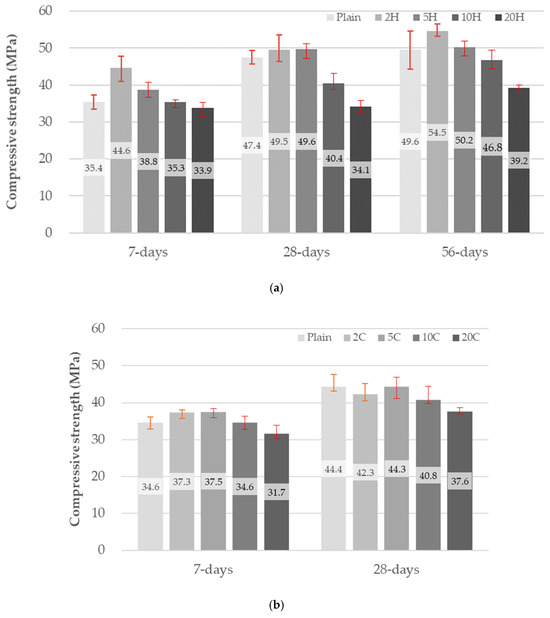
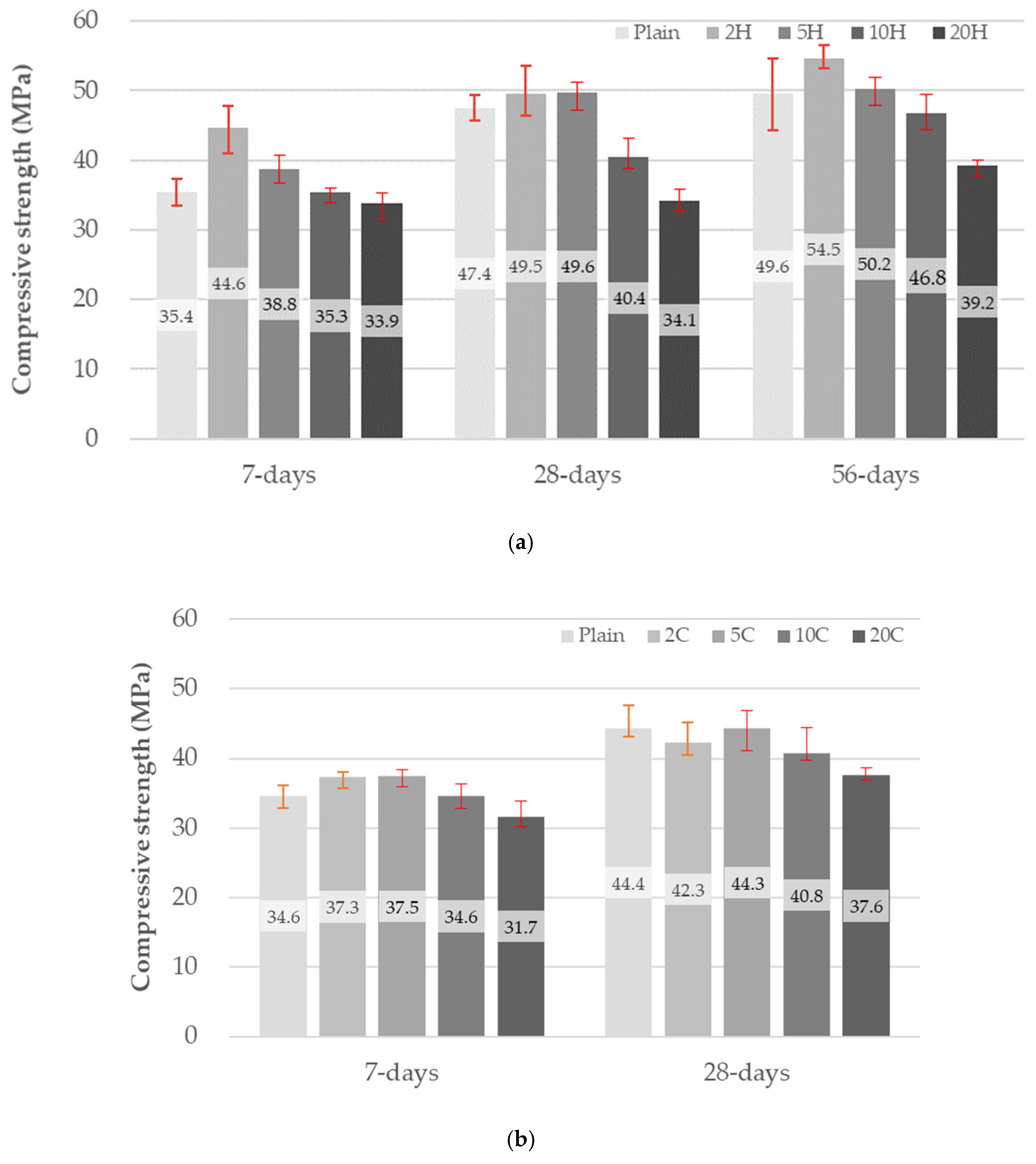
The compressive strength results of mortar specimens with varying replacement ratios of HAp and TCP are presented in Figure 2. An overall analysis of the strength development behavior indicates that both HAp- and TCP-incorporated mixtures exhibited enhanced early-age strength compared to the plain mixture at low replacement levels. However, as curing progressed, the HAp mixtures demonstrated a distinctly superior strength development and higher strength gain rate than the TCP mixtures.
Figure 2.
Compressive strength of mortar specimens at different curing ages: (a) HAp specimens; (b) TCP specimens.
At 7 days of age, the 2H and 5C mixtures showed increases in compressive strength of approximately 26% and 8%, respectively, compared to the plain specimen. This early-age strength enhancement at low replacement levels can be attributed to the physical filler effect of fine particles, which densely fill the voids between cement grains. As reported in previous studies [21], the incorporation of HAp fine powders improves the efficiency of early hydration reactions.
At 28 days of age, the HAp mixtures (2H and 5H) consistently outperformed the plain mixture, maintaining a continuous improvement in strength. In contrast, the TCP mixtures (2C and 5C) exhibited stabilization behavior, reaching strength levels comparable to the plain mixture. This difference in strength development is deeply related to the crystallographic characteristics of the materials. Although direct X-ray diffraction (XRD) analysis was not performed in this study due to material constraints, the specific crystal phase structure of the pyrolyzed HAp is well-supported by the literature. Specifically, the XRD spectra of bone-derived HAp constituting the crystalline phase of the pyrolyzed matrix under an N2 atmosphere demonstrate highly defined, narrow diffraction peaks, verifying a stable and well-crystallized hexagonal structure [20]. This high crystallinity and elevated calcium content within the crystalline framework contribute to the enhanced structural stability of the material. In particular, this highly crystalline HAp is considered to reinforce the pore structure between the cement paste and aggregates even at later hydration stages, sustaining a dense filler effect [10,11]. This mechanism contributed to the highest compressive strength of 54.5 MPa observed in the 2H mixture at 56 days.
On the other hand, the TCP mixtures showed a tendency to contribute primarily to early hydration acceleration, followed by a plateau in strength development around 28 days. This behavior reflects the different hydration contribution mechanisms associated with the distinct phase characteristics of the materials.
Meanwhile, for high replacement ratios exceeding 10%, a reduction in compressive strength was commonly observed in both HAp and TCP mixtures. This is primarily attributed to the dilution effect caused by the reduction in cement content, as well as the negative influence of particle agglomeration, which adversely affects the microstructural integrity of the matrix.
3.3.2. Flexural Strength
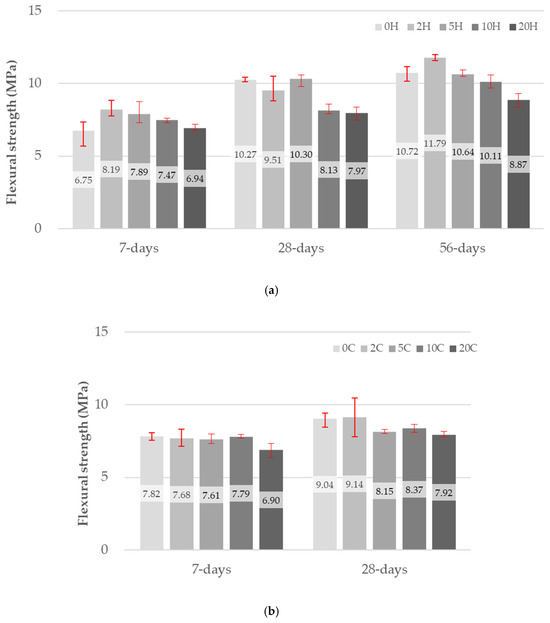
The overall flexural strength development trend exhibited a pattern similar to that of compressive strength discussed in Section 3.3. However, due to the inherent material characteristics of flexural strength—being more sensitive to microstructural defects and interfacial bonding—the performance variation with respect to replacement ratio was more pronounced than that observed in compressive strength. The detailed results are presented in Figure 3.
Figure 3.
Flexural strength of mortar specimens at different curing ages: (a) HAp specimens; (b) TCP specimens.
At 7 days of age, the 2H mixture achieved a flexural strength of 8.19 MPa, representing an improvement of approximately 21.3% compared to the plain specimen. This enhancement is attributed to the early hydration acceleration induced by fine particles, as previously identified in the compressive strength results. At 28 days, the 5H mixture exhibited the highest flexural strength of 10.30 MPa, while the 2H mixture maintained superior performance, reaching 11.79 MPa at 56 days.
These results indicate that the highly crystalline HAp constituting the crystalline phase of the pyrolyzed matrix under an N2 atmosphere provides enhanced long-term phase stability within the crystalline framework [20], thereby maximizing physical bonding performance and effectively suppressing crack propagation under flexural loading [10,11]. In contrast, the TCP mixtures generally showed either maintained or reduced flexural strength across all replacement ratios, indicating relatively limited improvement in flexural performance compared to HAp.
Furthermore, for both materials, replacement ratios exceeding 10% resulted in a more significant reduction in flexural strength compared to compressive strength. This is attributed to the presence of internal micropores acting as critical stress concentrators under flexural loading. Consequently, both the 10H and 20H mixtures exhibited a noticeable decrease in flexural strength below that of the plain specimen at 28 days.
3.4. Microstructural Characteristics
SEM analysis was conducted to investigate the overall changes in the internal microstructure and pore distribution of mortar as a function of the replacement ratio of HAp powder, extracted from chicken bones via pyrolysis (0, 2, 5, 10, and 20% by weight of cement).
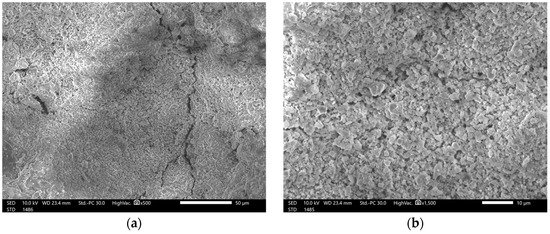
The microstructure of the plain specimen without HAp incorporation is presented in Figure 4. As shown in the images, relatively large and irregularly shaped pores were frequently observed between cement hydration products. In general, the matrix exhibited a loose structure with weak interfacial bonding and clearly visible voids.
Figure 4.
SEM images of plain mortar specimens: (a) low magnification (×500); (b) high magnification (×1500).
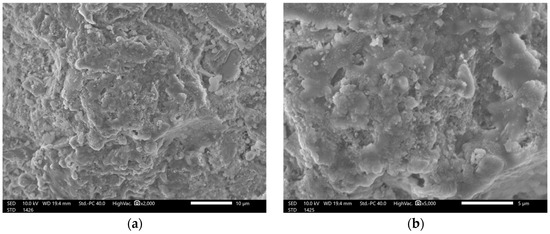
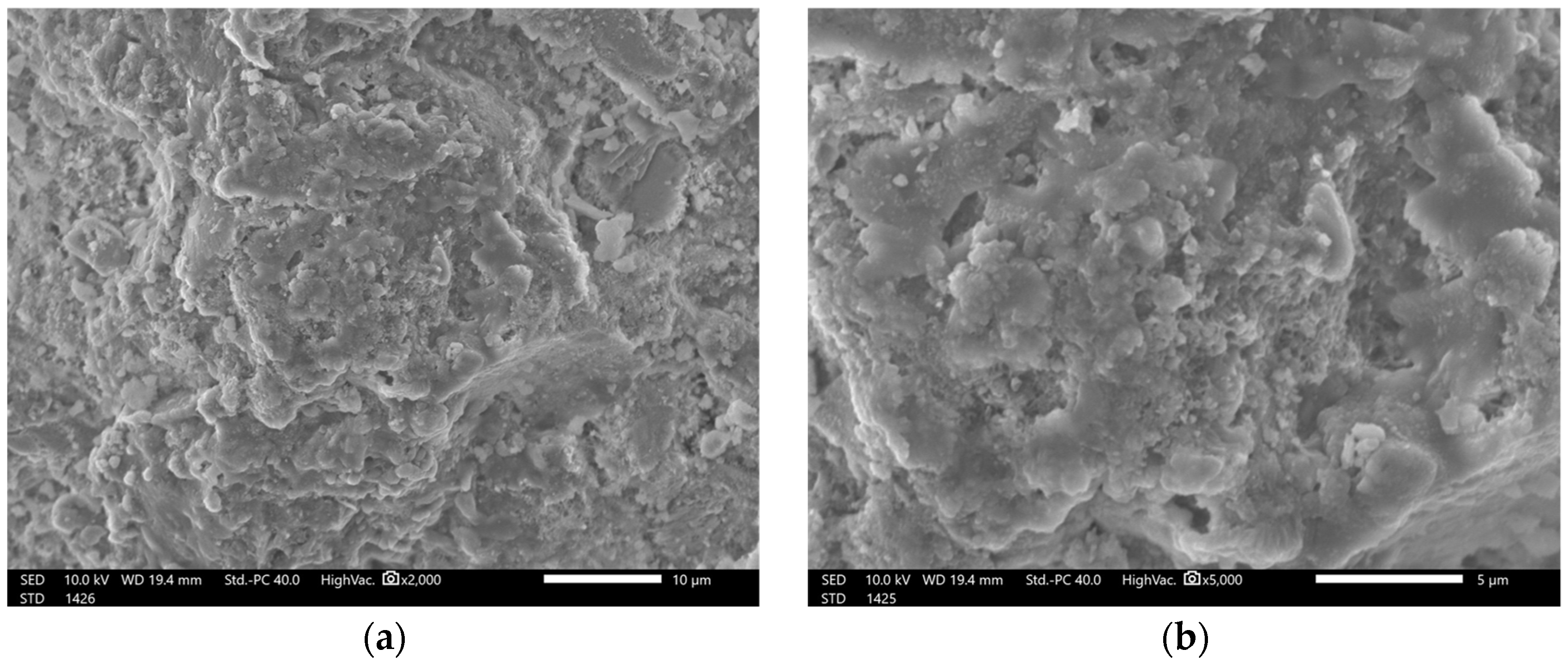
In contrast, as the HAp was replaced by 2%, a noticeable reduction in the relatively large pores observed in the plain specimen can be seen in Figure 5a. A more detailed view in Figure 5b indicates that fine particles began to occupy the interstitial spaces within the matrix, leading to a decrease in the frequency of exposed pores.
Figure 5.
SEM images of mortar specimens with 2% HAp replacement: (a) low magnification (×2000); (b) high magnification (×5000).
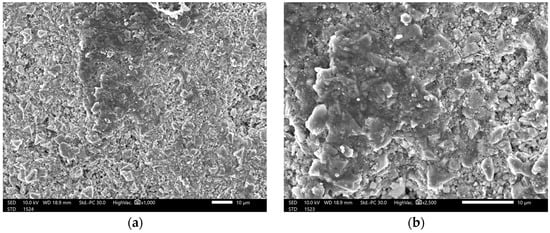
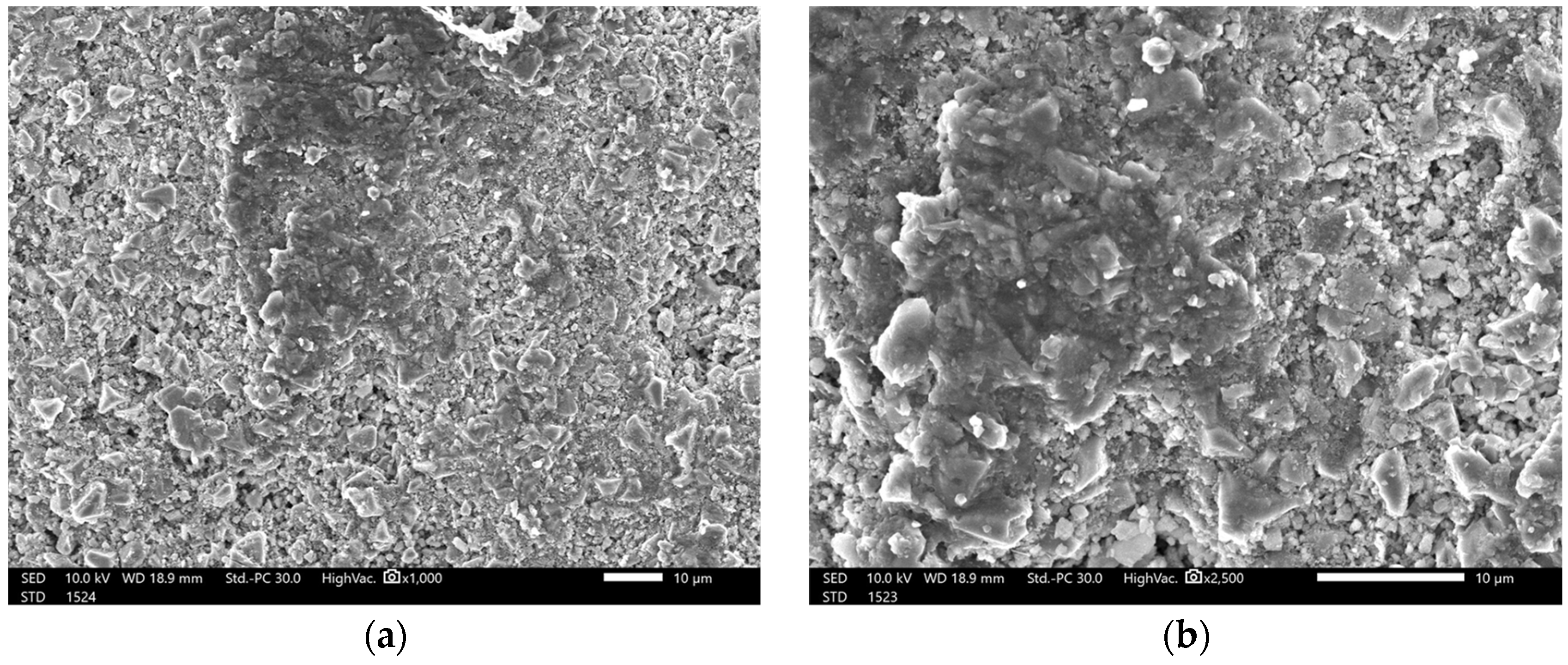
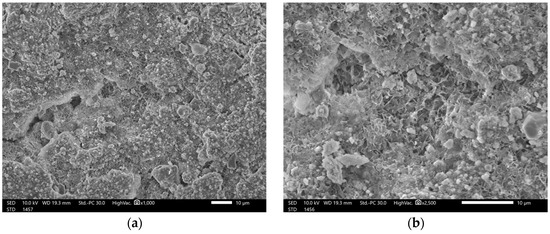
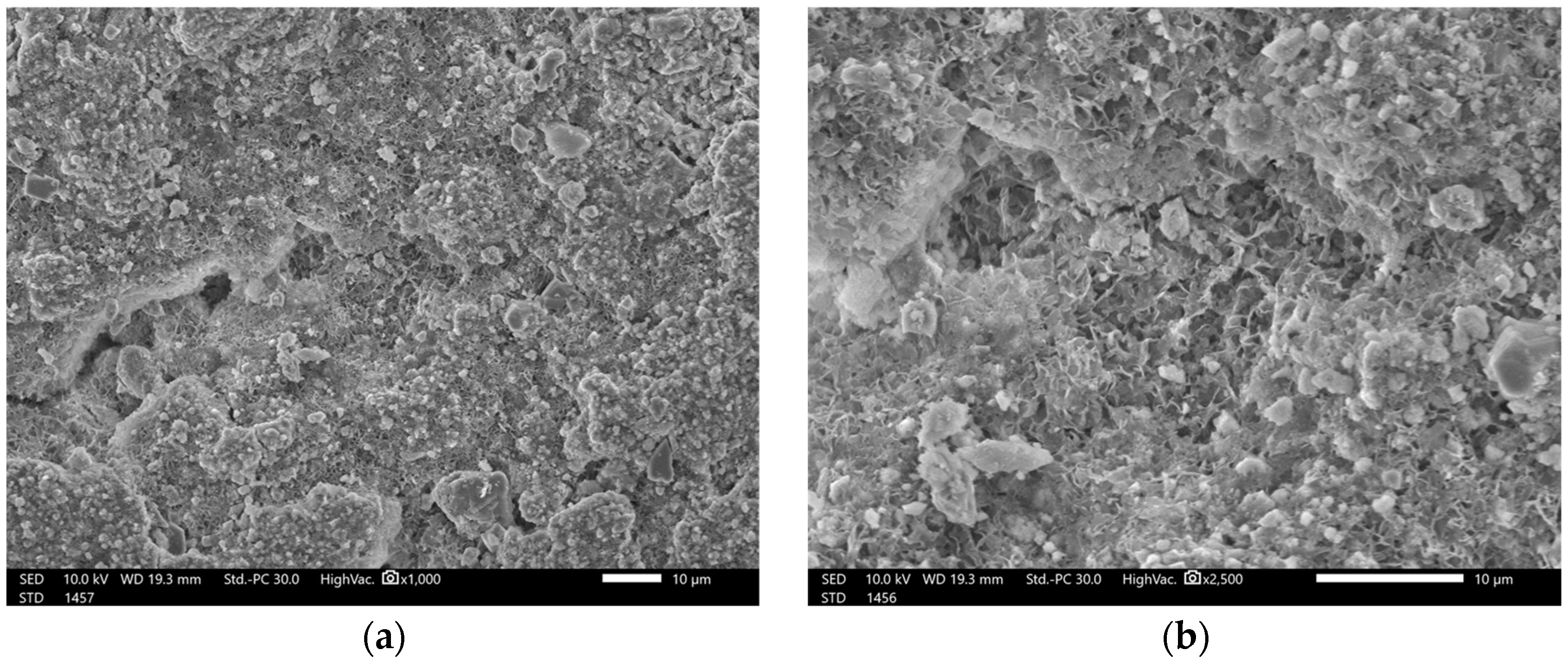
When the HAp replacement ratio increased to 5%, the overall microstructure became relatively denser, as shown in Figure 6a. In particular, Figure 6b demonstrates that the incorporated fine particles effectively filled the voids between hydration products, acting as a filler material. This resulted in a compact matrix with a significant reduction in microporosity.
Figure 6.
SEM images of mortar specimens with 5% HAp replacement: (a) low magnification (×1000); (b) high magnification (×2500).
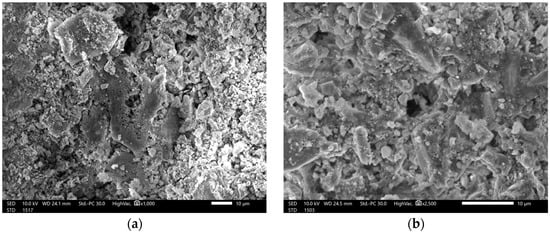
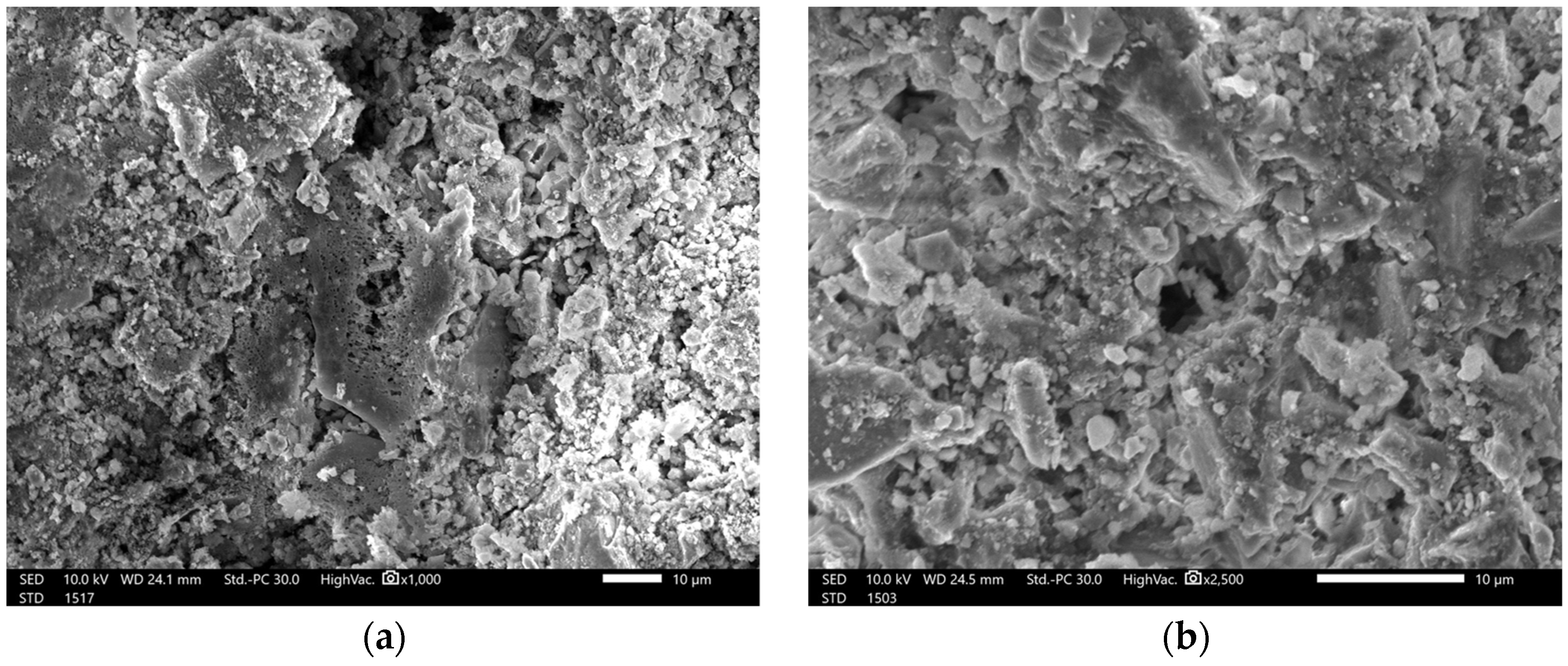
However, when the replacement ratio increased to 10%, the particle density within the specimen increased, leading to a more complex surface morphology, as observed in Figure 7a. As shown in Figure 7b, although the particles were densely distributed, the interparticle spacing became narrower compared to the 5% specimen, indicating a tendency toward particle crowding.
Figure 7.
SEM images of mortar specimens with 10% HAp replacement: (a) low magnification (×1000); (b) high magnification (×2500).
Furthermore, at an excessive replacement ratio of 20%, the fine particles were not uniformly dispersed within the matrix but instead formed localized agglomerations, as shown in Figure 8a. The magnified image in Figure 8b clearly reveals these clustered formations. Such agglomeration is considered to reduce the continuity of the paste matrix and create surface inhomogeneity, potentially acting as microstructural defects.
Figure 8.
SEM images of mortar specimens with 20% HAp replacement: (a) low magnification (×1000); (b) high magnification (×2500).
4. Estimation of Carbon Dioxide Emissions
4.1. Method for Estimating Carbon Dioxide Emissions
In this study, the material balance approach proposed in the Intergovernmental Panel on Climate Change 2006 IPCC Guidelines was applied to quantitatively compare and analyze the CO2 emission characteristics associated with different treatment processes of waste chicken bones (i.e., simple incineration and pyrolytic recycling) [22]. The functional unit for the analysis was defined as 1 kg of waste chicken bones on a dry basis, in order to eliminate uncertainties arising from moisture content and to ensure consistency with international accounting standards. For methodological consistency, the system boundary excluded transportation and equipment manufacturing stages. The total CO2 emissions for each treatment process were calculated as the sum of direct emissions (carbon oxidation) and indirect emissions (electricity consumption). First, the direct CO2 emissions from the incineration process were calculated using Equation (1), which is a simplified form of the IPCC guideline structure adapted to a single waste type:
where M represents the mass of the waste input on a dry basis (kg), and OX is the oxidation factor. In this study, a value of 1.0 was applied, assuming near-complete oxidation of carbon during incineration [22]. The constant 44/12 represents the molecular weight ratio for the conversion of carbon (C) to CO2. The dry-basis carbon content of chicken bones (Cdry) was set to a representative value of 28%, based on a comprehensive review of experimental data and reported ranges (23–37%) in previous studies [23].
In contrast, the pyrolysis process occurs under oxygen-limited conditions, where carbon is not fully oxidized but instead partitioned into solid residues such as char. Therefore, the direct CO2 emissions from pyrolysis were estimated using a material balance concept, as expressed in Equation (2), by introducing the fraction of initial carbon converted to CO2 (FCO2) as a variable. The conversion factor was determined based on previous studies that investigated differences in emission pathways between pyrolysis and combustion processes [24,25].
The indirect CO2 emissions associated with energy consumption during the process were calculated using Equation (3). Since the pyrolysis process requires external energy input to maintain high-temperature conditions, the electricity consumption per unit mass (E, kWh/kg) was multiplied by the national greenhouse gas emission factor of South Korea (EF = 0.417 kg-CO2/kWh) [26]:
Instead of directly measuring the electricity consumption of a laboratory-scale electric furnace, this study adopted a value from a previous study with similar heating rates, holding times, and equipment characteristics [27]. The reported total energy consumption of 9.1 kWh was converted to a unit mass basis, resulting in an estimated value of approximately 4.67 kWh/kg, which was applied in the analysis.
To further investigate the comprehensive eco-efficiency of the proposed approach by incorporating mechanical performance alongside these process emissions, the Carbon Intensity (CI) indicator was introduced based on the established [28].
where CE represents the total CO2 emissions of the binder mixture (kg-CO2/kg) derived from the environmental balance, and fc denotes the compressive strength (MPa) of the mortar specimens at specific curing ages.
4.2. Results of Carbon Dioxide Emission Estimation
Assuming a scenario in which 1 kg of waste chicken bones is generated, a comparative life-cycle carbon emission assessment was conducted between (i) the conventional approach, where the waste is entirely incinerated and 1 kg of cement is used, and (ii) the proposed approach, where chicken bones are pyrolyzed and reused as a cement substitute. The direct CO2 emissions for each process were calculated using Equations (1) and (2). For the incineration process, applying a carbon content (Cdry) of 0.28 and a complete oxidation factor (OX) of 1.0 resulted in emissions of approximately 1.03 kg-CO2/kg. In contrast, for the pyrolysis process, a conversion factor of FCO2 = 0.4 was adopted based on previous studies indicating that approximately 40–80% of the initial carbon remains as char [24,25]. Accordingly, the direct CO2 emissions from pyrolysis were estimated at 0.41 kg-CO2/kg, representing a reduction of approximately 60% compared to incineration.
However, when accounting for indirect emissions associated with electricity consumption, the total emissions of the pyrolysis process increased significantly. Using an electricity consumption of 4.67 kWh/kg [27], the corresponding indirect emissions were calculated as 1.95 kg-CO2/kg, resulting in a total emission of 2.36 kg-CO2/kg for the pyrolysis process.
To evaluate the overall system efficiency, the emissions associated with producing 1 kg of binder were assessed. The control case (ordinary Portland cement, OPC) was assigned a baseline emission factor of 0.9 kg-CO2/kg. For the experimental case with a 5% replacement ratio, the emissions were calculated by summing (i) the reduced cement-related emissions due to 5% substitution (0.95 × 0.9 = 0.855) and (ii) the emissions associated with pyrolyzing 0.05 kg of chicken bones (0.05 × 2.36 = 0.118). In addition, the emissions that would have been generated if the same amount of chicken bones (0.05 kg) had been incinerated under the conventional process (0.05 × 1.03 = 0.0515) were deducted as avoided emissions. As a result, the total emission for the 5% replacement case was calculated as 0.9215 kg-CO2. The detailed results for each replacement ratio are summarized in Table 6.
Table 6.
Comparison of carbon emission estimations.
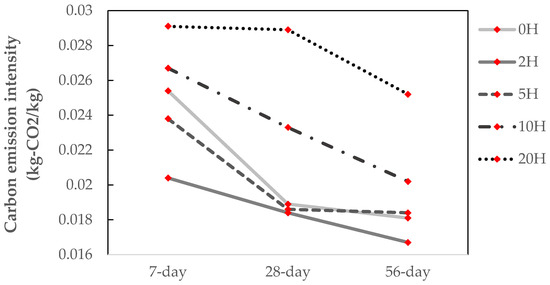
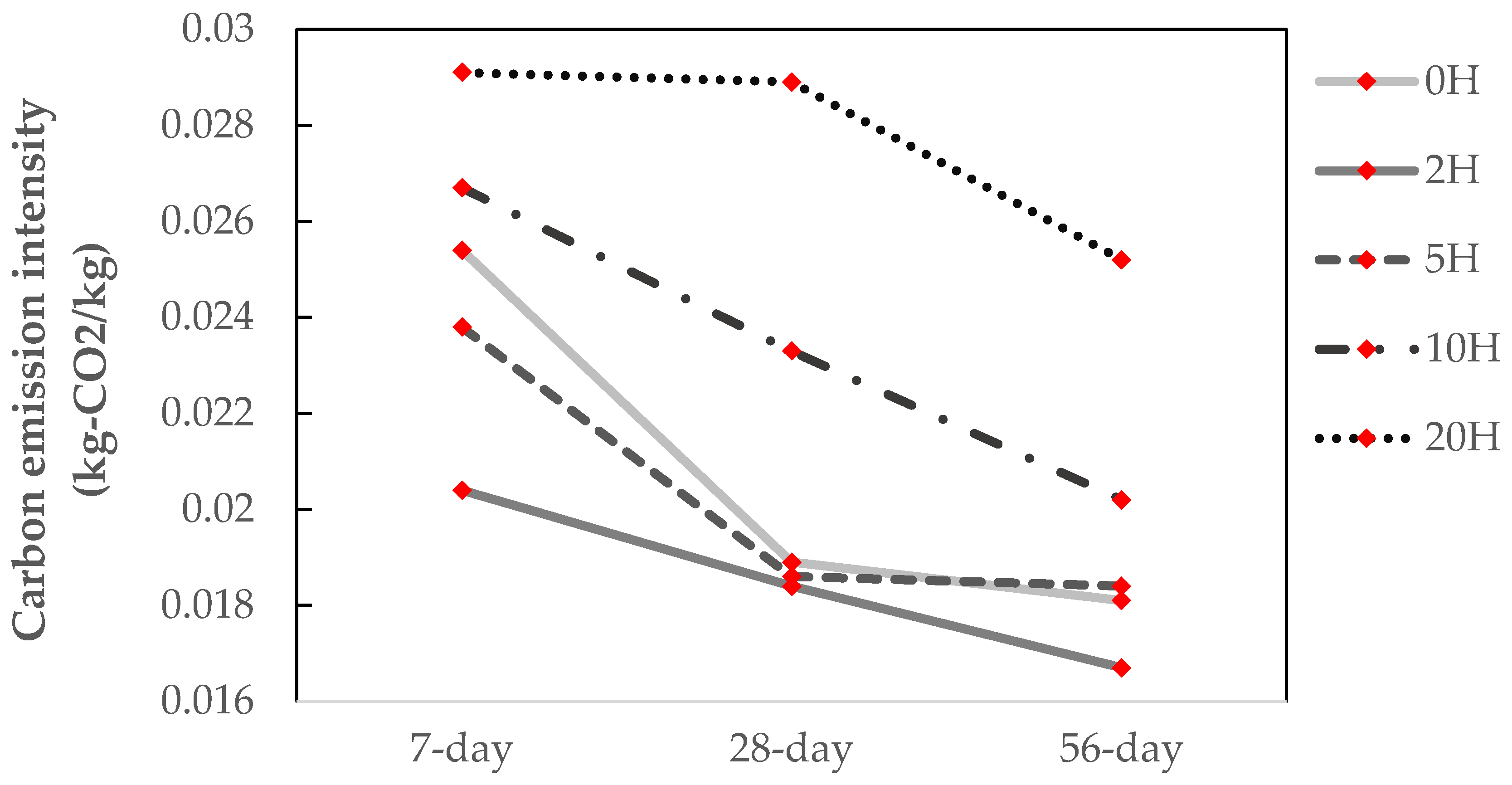
From the above results, the total emissions of the proposed approach were found to be approximately 0.96–9.56% higher than those of the control case. This increase is attributed to process inefficiencies inherent to laboratory-scale equipment, including reduced energy efficiency and heat losses. which temporarily inflate the carbon footprint at the material-production stage. To complement the total carbon footprint from Table 6 and account for the mechanical performance of the HAp mixtures, the Carbon Intensity (CI) index was utilized to evaluate the practical eco-efficiency per unit strength (1 MPa). This index quantitatively correlates the environmental burden with structural capacity. Based on Equation (4), the calculated CI values across different curing ages (7, 28, and 56 days) are summarized in Table 7.
Table 7.
Carbon emission intensity (CI) of mixtures by curing age.
For the OPC control mixture, the CI value slightly decreased from 0.0254 at 7 days to 0.0181 (kg-CO2/kg∙MPa) at 56 days as mechanical strength developed. Notably, the HAp 2% replacement mixture exhibited the lowest CI value of 0.0167 (kg-CO2/kg∙MPa) at 56 days, representing a 7.7% improvement in eco-efficiency compared to the control case. Although the incorporation of pyrolyzed HAp incrementally increased the total emissions (CE) at the material production stage due to laboratory-scale equipment inefficiencies, the substantial enhancement in compressive strength fundamentally offset the incremental environmental load. This visually presented changing trend in Figure 9 underscores that optimizing the replacement ratio at 2% establishes a superior structural-environmental balance, minimizing the carbon footprint per unit mechanical performance (1 MPa) at later curing stages.
Figure 9.
Carbon emission intensity (CI) of mortar specimens with different HAp replacement ratios.
Consequently, despite the minor carbon inflation observed under the limited laboratory-scale setup, the proposed sustainable binder architecture demonstrates clear thermodynamic and structural viability for industrial scaling. More importantly, as demonstrated by the quantitative trend obtained via Equation (4), the HAp 2% replacement successfully reconciles the trade-off between structural performance and environmental sustainability by optimizing the eco-efficiency profile.
Building upon these material-level advantages, future research focusing on full-scale process integration can maximize the systemic utility of this binder system. It is important to note that cement clinker is conventionally produced in high-temperature kilns exceeding approximately 1400 °C. If process integration is implemented in the future, where chicken bones are directly introduced into the cement production line, the energy limitations associated with small-scale experimental setups can be fundamentally overcome. From a quantitative perspective, incorporating 5% chicken bone waste into the actual cement production process would result in a reduction of approximately $0.0515 kg-CO2 per kg of binder. This reduction arises from the integration of previously separate emission sources, namely cement production and waste incineration, into a single process, thereby achieving a net carbon offset effect. Consequently, an overall carbon reduction of approximately 2.7% at the system level can be expected. Furthermore, hydroxyapatite (HAp), the primary inorganic component of chicken bones, contains a high calcium (Ca) content, enabling it to partially replace conventional limestone in clinker production. Crucially, this chemical substitution bypasses the traditional limestone decarbonation process which is fundamentally responsible for major process CO2 emissions in cement manufacturing, thereby establishing a highly optimized and eco-efficient pathway for future practical engineering applications.
5. Conclusions
This study investigated the potential for reducing carbon emissions in the cement industry and promoting waste valorization by incorporating hydroxyapatite (HAp) derived from waste chicken bones and tricalcium phosphate (TCP) as a control into cement as partial replacement materials. The mechanical performance of the resulting mortars was comparatively evaluated. The main conclusions are summarized as follows:
(1) Mixtures with low replacement ratios exhibited significantly improved early-age compressive strength compared to the plain mixture, reaching 44.6 MPa and 37.5 MPa at 7 days, respectively. This improvement is attributed to the fine HAp and TCP particles acting as physical micro-fillers, effectively filling voids between cement particles, thereby densifying the early hydration matrix and enhancing load transfer efficiency.
(2) At later ages, HAp demonstrated superior performance compared to TCP. The N2-based pyrolysis process suppressed oxidation of organic matter, thereby preserving the high calcium content and highly crystalline structure of HAp. As hypothesized in the introduction, the strength enhancement is governed not merely by the similar chemical composition of calcium phosphate compounds, but by the intrinsic phase stability of HAp. This phase stability contributes to a sustained filler effect at later hydration stages, enabling the 2H mixture to achieve the highest compressive strength (54.5 MPa) at 56 days.
(3) The flexural strength development followed a trend similar to that of compressive strength; however, due to the higher sensitivity of flexural properties to internal micro-defects, performance differences between materials were more pronounced. Structurally stable HAp effectively suppressed microcrack propagation under flexural loading through improved interfacial bonding within pore structures. In contrast, TCP mixtures, characterized by relatively higher solubility and lower stability, exhibited clear limitations in long-term flexural performance.
(4) The critical replacement ratio for optimizing mechanical performance was determined to be within 5%. When the replacement ratio exceeded 10%, the reduction in cement content led to insufficient hydration reactions and increased porosity, resulting in a progressive deterioration of mechanical properties.
(5) Comprehensive eco-efficiency analysis based on the Carbon Intensity (CI) indicator demonstrated that the HAp 2% replacement mixture minimizes the carbon footprint per unit mechanical performance (1 MPa), yielding a 7.7% improvement in structural-environmental efficiency compared to the control mixture at 56 days. Crucially, the 5% replacement mixture exhibited a 56-day CI profile with a marginal difference in only 1.6% compared to the control case, confirming that there is virtually no performance degradation in terms of practical eco-efficiency. This qualitative evaluation demonstrates that the 5% replacement ratio is highly viable as an upper critical threshold, maintaining an eco-efficiency profile nearly equivalent to the control mixture while expanding waste utilization limits. Although the laboratory-scale pyrolysis process features initial energy consumption inefficiencies, incorporating this material integration into industrial high-temperature clinker kilns (exceeding 1400 °C) can fundamentally overcome these limitations. Such process integration enables the high calcium content of HAp to partially substitute for conventional limestone, thereby bypassing the traditional thermal decarbonation process. Quantitatively, implementing this 5% waste incorporation within the actual cement production line consolidates previously separate emission sources to achieve a net carbon offset effect of approximately 0.0515 kg-CO2 per kg of binder, ultimately resulting in a 2.7% reduction in greenhouse gas emissions at the macro system level.
Overall, the results demonstrate that HAp derived from pyrolyzed chicken bones is a highly effective cement replacement material, capable of maximizing the mechanical reliability of mortar when incorporated at levels up to 5%. Furthermore, recent studies have reported that HAp-incorporated cement exhibits enhanced resistance to carbonation induced by CO2 ingress and possesses excellent adsorption capacity for hazardous substances such as fluoride in aqueous environments, enabling their stable immobilization within the mortar matrix. Therefore, the HAp-modified mortar developed in this study not only contributes to carbon emission reduction through cement substitution but also highlights its broader potential as an advanced eco-friendly construction material.
Author Contributions
Conceptualization, J.-M.Y.; methodology, J.-M.Y. and K.-C.K.; writing—original draft preparation, K.-C.K. and S.-M.H.; writing—review and editing, J.-M.Y.; validation, S.-M.H. and J.-M.Y.; investigation, K.-C.K. and S.-M.H.; project administration, J.-M.Y.; funding acquisition, J.-M.Y. All authors have read and agreed to the published version of the manuscript.
Funding
The research presented in this study was supported by the KAIA Research program on Development of Materials and Design/Construction Technologies for High-Strength Cementless Concrete, funded by the Ministry of Land, Infrastructure and Transport [Grant number: RS-2025-02306285].
Data Availability Statement
The data used to support the findings of this study are included within the article.
Conflicts of Interest
The authors declare no conflicts of interest.
References
- Benhelal, E.; Zahedi, G.; Shamsaei, E.; Bahadori, A. Global strategies and potentials to curb CO2 emissions in cement industry. J. Clean. Prod. 2013, 51, 142–161. [Google Scholar] [CrossRef] [Scilit]
- Summerbell, D.L.; Barlow, C.Y.; Cullen, J.M.J. Potential reduction of carbon emissions by performance improvement: A cement industry case study. J. Clean. Prod. 2016, 135, 1327–1339. [Google Scholar] [CrossRef] [Scilit]
- Akinyele, J.O.; Adekunle, A.A.; Ogundaini, O. The effect of partial replacement of cement with bone ash and wood ash in concrete. Ann. Fac. Eng. Hunedoara–Int. J. Eng. 2016, 14, 199–204. [Google Scholar]
- Food and Agriculture Organization of the United Nations (FAO). FAOSTAT: Crops and Livestock Products; FAO: Rome, Italy, 2024; Available online: https://www.fao.org/faostat/en/#data/QCL (accessed on 14 April 2026).
- Bee, S.L.; Mariatti, M.; Ahmad, N.; Yahaya, B.H.; Abdul Hamid, Z.A. Effect of the calcination temperature on the properties of natural hydroxyapatite derived from chicken bone wastes. Mater. Today Proc. 2019, 16, 1876–1885. [Google Scholar] [CrossRef] [Scilit]
- Teshome, B.B.; Mohammed, T.A.; Aure, T.W. Investigating mechanical properties of animal bone powder partially replaced cement in concrete production. Int. J. Sci. Res. Eng. Dev. 2019, 2, 477–490. [Google Scholar]
- Rajesh, R.; Hariharasubramanian, A.; Ravichandran, Y.D. Chicken bone as a bioresource for the bioceramic (hydroxyapatite). Mater. Manuf. Process. 2012, 27, 914–925. [Google Scholar] [CrossRef] [Scilit]
- Mustafa, N.; Ibrahim, M.H.I.; Asmawi, R.; Amin, A.M. Hydroxyapatite extracted from waste fish bones and scales via calcination method. Appl. Mech. Mater. 2015, 773–774, 287–290. [Google Scholar] [CrossRef] [Scilit]
- Veljović, D.; Jančić-Hajneman, R.; Balać, I.; Jokić, B.; Putić, S.; Petrović, R.; Janaćković, D. The effect of the shape and size of the pores on the mechanical properties of porous HAP-based bioceramics. Ceram. Int. 2011, 37, 471–479. [Google Scholar] [CrossRef] [Scilit]
- Kotb, M.; Assas, M.; Abd-Elrahman, H. Effect of grounded bone powder addition on the mechanical properties of cement mortar. WIT Trans. Ecol. Environ. 2010, 138, 201–212. [Google Scholar] [CrossRef] [Scilit]
- Singh, H.; Bansal, R.S. Study on partial replacement of cement with animal bone powder along with the addition of polypropylene fiber in concrete. Int. J. Eng. Res. Technol. 2019, 8, 74–77. [Google Scholar]
- Ahmed, R.; Salehi, S.; Srivastava, A. Evaluation of hydroxyapatite-based cement for geothermal well applications. Geothermics 2022, 104, 102462. [Google Scholar] [CrossRef] [Scilit]
- Ismail, Z.Z.; AbdelKareem, H.N. Sustainable approach for recycling waste lamb and chicken bones for fluoride removal from water followed by reusing fluoride-bearing waste in concrete. Waste Manag. 2015, 45, 66–75. [Google Scholar] [CrossRef] [Scilit]
- Liang, L.; Rulis, P.; Ching, W.Y. Mechanical properties, electronic structure and bonding of α- and β-tricalcium phosphates with surface characterization. Acta Biomater. 2010, 6, 3763–3771. [Google Scholar] [CrossRef] [Scilit] [PubMed]
- ASTM C109/C109M-24; Standard Test Method for Compressive Strength of Hydraulic Cement Mortars (Using 2-in. or [50-mm] Cube Specimens). ASTM International: West Conshohocken, PA, USA, 2024.
- ASTM C348-21; Standard Test Method for Flexural Strength of Hydraulic-Cement Mortars. ASTM International: West Conshohocken, PA, USA, 2021.
- ASTM C1437; Standard Test Method for Flow of Hydraulic Cement Mortar. ASTM International: West Conshohocken, PA, USA, 2020.
- ASTM C349; Standard Test Method for Compressive Strength of Hydraulic-Cement Mortars (Using Portions of Prisms Broken in Flexure). ASTM International: West Conshohocken, PA, USA, 2018.
- Batista, R.R.; Gomes, M.M. Effects of Chemical Composition and Pyrolysis Process Variables on Biochar Yields: Correlation and Principal Component Analysis. Floresta E Ambiente 2021, 28, e20210007. [Google Scholar] [CrossRef] [Scilit]
- Patel, S.; Han, J.; Qiu, W.; Gao, W. Synthesis and characterisation of mesoporous bone char obtained by pyrolysis of animal bones, for environmental application. J. Environ. Chem. Eng. 2015, 3, 2368–2377. [Google Scholar] [CrossRef] [Scilit]
- John, E.; Matschei, T.; Stephan, D. Nucleation seeding with calcium silicate hydrate—A review. Cem. Concr. Res. 2018, 113, 74–85. [Google Scholar] [CrossRef] [Scilit]
- IPCC. 2006 IPCC Guidelines for National Greenhouse Gas Inventories; Eggleston, S., Buendia, L., Miwa, K., Ngara, T., Tanabe, K., Eds.; IGES: Kanagawa, Japan, 2006. [Google Scholar]
- Haque, M.A.; Hasan, M.M.; Miah, M.Y.; Ahmed, S. Kinetics study and Py-GC-MS analysis of pyrolysis in chicken bone waste for sustainable utilisation in thermal conversion. J. Environ. Manag. 2024, 350, 119611. [Google Scholar]
- Neves, D.; Thunman, H.; Matos, A.; Tarelho, L.; Gómez-Barea, A. Characterization and prediction of biomass pyrolysis products. Prog. Energy Combust. Sci. 2011, 37, 611–630. [Google Scholar] [CrossRef] [Scilit]
- Chen, D.; Yin, L.; Wang, H.; He, P. Estimation of industrial emissions during pyrolysis and combustion of different wastes using laboratory data. Sci. Rep. 2020, 10, 7018. [Google Scholar] [CrossRef] [Scilit]
- Ministry of Environment; National Institute of Environmental Research. National Greenhouse Gas Emission Factors; Ministry of Environment: Sejong, Republic of Korea, 2022.
- Cobos-Torres, J.-C.; Idrovo-Ortiz, L.-H.; Cobos-Mora, S.L.; Santillan, V. Energy Efficiency of Lignocellulosic Biomass Pyrolysis in Two Types of Reactors: Electrical and with Primary Forest Biomass Fuel. Energies 2024, 17, 2943. [Google Scholar] [CrossRef] [Scilit]
- Yang, X.; Zhao, X.; Lv, Y.; Wang, J.; Bai, W.; Qiao, M.; Hu, K.; Liu, Q.; Song, C.; Jin, W. Study on workability and mechanical strength of low cement ultra-high performance concrete with ultrafine quartz powder as alternative material under high temperature curing. Case Stud. Constr. Mater. 2024, 21, e04074. [Google Scholar] [CrossRef] [Scilit]

Disclaimer/Publisher’s Note: The statements, opinions and data contained in all publications are solely those of the individual author(s) and contributor(s) and not of MDPI and/or the editor(s). MDPI and/or the editor(s) disclaim responsibility for any injury to people or property resulting from any ideas, methods, instructions or products referred to in the content. |
© 2026 by the authors. Licensee MDPI, Basel, Switzerland. This article is an open access article distributed under the terms and conditions of the Creative Commons Attribution (CC BY) license.