

Skip to Content
You are currently on the new version of our website. Access the old version .

Metals, Volume 7, Issue 11

2017 November - 65 articles

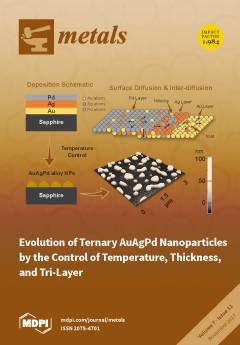
Cover Story: Metallic alloy nanoparticles (NPs) are of great importance in order to optimize the corresponding device performances through the control of physical and chemical properties. Various AuAgPd alloy NPs in terms of size, shape, arrangement and elemental composition are fabricated via the solid-state dewetting of tri-metallic layers by the systematic control of tri-metallic layer thickness, deposition order and temperature. The effect of various growth conditions and parameters on the evolution of surface morphologies and corresponding optical properties are demonstrated. View this paper
  • Issues are regarded as officially published after their release is announced to the table of contents alert mailing list .
  • You may sign up for email alerts to receive table of contents of newly released issues.
  • PDF is the official format for papers published in both, html and pdf forms. To view the papers in pdf format, click on the "PDF Full-text" link, and use the free Adobe Reader to open them.

Articles (65)

  • Article
  • Open Access
9 Citations
5,598 Views
10 Pages

22 November 2017

K465 superalloy with high titanium and aluminum contents was easy to crack during laser metal deposition. In this study, the crack-free sample of K465/Stellite-6 laminated material was formed by laser metal deposition shaping to control the cracking...

  • Article
  • Open Access
33 Citations
10,141 Views
15 Pages

21 November 2017

The effect of Ni-content on phase transformation behavior of NiTi-20 at. % Zr high temperature shape memory alloy (HTSMA) is investigated over a small composition range, i.e., 49.8, 50.0 and 50.2 at. % Ni, by differential scanning calorimetry (DSC),...

  • Feature Paper
  • Article
  • Open Access
18 Citations
6,472 Views
15 Pages

Effect of the Ultrasonic Nanocrystalline Surface Modification (UNSM) on Bulk and 3D-Printed AISI H13 Tool Steels

  • In-Sik Cho,
  • Chang-Soon Lee,
  • Chang-Ha Choi,
  • Hyung-Gyu Lee,
  • Moon Gu Lee and
  • Yongho Jeon

21 November 2017

A comparative study of the microstructure, hardness, and tribological properties of two different AISI H13 tool steels—classified as the bulk with no heat treatment steel or the 3D-printed steel—was undertaken. Both samples were subjected to ultrason...

  • Article
  • Open Access
4 Citations
5,426 Views
13 Pages

Optimization of Thermo-Mechanical Processing for Forging of Newly Developed Creep-Resistant Magnesium Alloy ABaX633

  • Kamineni Pitcheswara Rao,
  • Chalasani Dharmendra,
  • Yellapregada Venkata Rama Krishna Prasad,
  • Norbert Hort and
  • Hajo Dieringa

21 November 2017

The compressive strength and creep resistance of cast Mg-6Al-3Ba-3Ca (ABaX633) alloy has been measured in the temperature range of 25 to 250 °C, and compared with that of its predecessor ABaX422. The alloy is stronger and more creep-resistant than AB...

  • Article
  • Open Access
14 Citations
6,417 Views
20 Pages

Wear of Shaped Surfaces of PVD Coated Dies for Clinching

  • Miroslav Džupon,
  • Ľuboš Kaščák,
  • Emil Spišák,
  • René Kubík and
  • Janka Majerníková

21 November 2017

A clinching method that uses a simple toolset consisting of a punch and a die, is utilized for joining lightweight materials. This paper is aimed at investigating the wear of the die cavity of a clinching tool. A clinching tool with a specially shape...

  • Feature Paper
  • Review
  • Open Access
25 Citations
7,569 Views
14 Pages

The Biological Responses to Magnesium-Based Biodegradable Medical Devices

  • Lumei Liu,
  • Juan Wang,
  • Teal Russell,
  • Jagannathan Sankar and
  • Yeoheung Yun

21 November 2017

The biocompatibility of Magnesium-based materials (MBMs) is critical to the safety of biodegradable medical devices. As a promising metallic biomaterial for medical devices, the issue of greatest concern is devices’ safety as degrading products are p...

  • Article
  • Open Access
6 Citations
4,945 Views
12 Pages

19 November 2017

The contour method is one of the newest techniques for obtaining residual stress fields from friction stir welded (FSW) parts, experimentally. This method has many advantages; however, edge effects coming from the process itself might introduce artif...

  • Article
  • Open Access
1 Citations
4,277 Views
11 Pages

Entropy Change Caused by Martensitic Transformations of Ferromagnetic Shape Memory Alloys

  • Victor A. L’vov,
  • Eduard Cesari,
  • Anna Kosogor,
  • Joan Torrens-Serra,
  • Vicente Recarte and
  • José Ignacio Pérez-Landazábal

19 November 2017

In this paper, our most recent findings on the influence of magnetic order on the main transformational caloric and elastic properties of shape memory alloys (SMAs) are reviewed. It is argued that ferromagnetic order has a strong influence on the tem...

  • Feature Paper
  • Review
  • Open Access
49 Citations
11,222 Views
16 Pages

16 November 2017

Electrical and electronics equipment and automotive and industrial catalysts are some examples of top technological devices whose functioning rely on the use of platinum-group metals (PGMs). The PGMs’ high economic value and difficult to replace tech...

  • Article
  • Open Access
7 Citations
7,567 Views
21 Pages

Thermo-Calc Prediction of Mushy Zone in AlSiFeMn Alloys

  • Piotr Mikolajczak,
  • Amber Genau,
  • Jerzy Janiszewski and
  • Lorenz Ratke

16 November 2017

Convection forces can cause significant segregation within the liquid during directional solidification, influencing the structure of the mushy zone and the type and distribution of phases present in the solidified alloy. The solidification behavior...

  • Article
  • Open Access
14 Citations
5,152 Views
12 Pages

Effect of High-Pressure Torsion on Structure and Microhardness of Ti/TiB Metal–Matrix Composite

  • Sergey Zherebtsov,
  • Maxim Ozerov,
  • Nikita Stepanov,
  • Margarita Klimova and
  • Yulia Ivanisenko

16 November 2017

Effect of high-pressure torsion (HPT) at 400 °C on microstructure and microhardness of a Ti/TiB metal–matrix composite was studied. The starting material was produced by spark plasma sintering of a mixture of a pure Ti and TiB2 (10 wt %) powders at 1...

  • Feature Paper
  • Article
  • Open Access
9 Citations
5,859 Views
12 Pages

Laser Welding of BTi-6431S High Temperature Titanium Alloy

  • Zhi Zeng,
  • J. P. Oliveira,
  • Xianzheng Bu,
  • Mao Yang,
  • Ruoxi Li and
  • Zhimin Wang

15 November 2017

A new type of high temperature titanium alloy, BTi-6431S, has recently become the focus of attention as a potential material for aircraft engine applications, which could be used up to 700 °C. Pulsed laser welding was used to butt join the BTi-6431S...

  • Article
  • Open Access
27 Citations
7,355 Views
11 Pages

14 November 2017

With increasing impurity contents in concentrates, the control of the minor elements is an important issue for the oxygen bottom blown copper smelting process (Shuikoushan process or SKS process). In this work, the distribution behaviors of the minor...

  • Article
  • Open Access
34 Citations
8,400 Views
14 Pages

Reduced Graphene Oxide Reinforced 7075 Al Matrix Composites: Powder Synthesis and Mechanical Properties

  • Youhong Sun,
  • Chi Zhang,
  • Baochang Liu,
  • Qingnan Meng,
  • Shaoming Ma and
  • Wenhao Dai

13 November 2017

Reduced graphene oxide (rGO) reinforced 7075 Al matrix composites were fabricated by electrostatic self-assembly and powder metallurgy. 7075 Al powders were surface modified by introducing a cetyl trimethyl ammonium bromide (CTAB) membrane on the sur...

  • Article
  • Open Access
14 Citations
6,187 Views
9 Pages

13 November 2017

The effect of nitrogen on deformation-induced martensitic transformation (DIMT) in metastable 301 austenitic stainless steel has been studied based on the inelastic deformation theory. DIMT is regarded here as continuous relaxation process of interna...

  • Article
  • Open Access
9 Citations
4,798 Views
9 Pages

13 November 2017

The joining of porous Si3N4 to dense Si3N4 ceramics has been successfully performed using mixed RE2O3 (RE = Y or Yb), Al2O3, SiO2, and α-Si3N4 powders. The results suggested that the α-Si3N4 powders partly transformed into β-SiAlON and partly dissolv...

  • Article
  • Open Access
22 Citations
6,738 Views
14 Pages

Fabrication and Characterization of a Low Magnetic Zr-1Mo Alloy by Powder Bed Fusion Using a Fiber Laser

  • Xiaohao Sun,
  • Weiwei Zhou,
  • Keiko Kikuchi,
  • Naoyuki Nomura,
  • Akira Kawasaki,
  • Hisashi Doi,
  • Yusuke Tsutsumi and
  • Takao Hanawa

13 November 2017

A low magnetic Zr-1Mo alloy was fabricated by a powder bed fusion (PBF) process using a fiber laser. The microstructure, surface morphology, and pore distribution of the as-built Zr-1Mo alloy were observed. Its magnetic susceptibility and Vickers har...

  • Article
  • Open Access
15 Citations
5,771 Views
13 Pages

The Formation of Composite Ti-Al-N Coatings Using Filtered Vacuum Arc Deposition with Separate Cathodes

  • Ivan A. Shulepov,
  • Egor B. Kashkarov,
  • Igor B. Stepanov,
  • Maxim S. Syrtanov,
  • Alina N. Sutygina,
  • Ivan Shanenkov,
  • Aleksei Obrosov and
  • Sabine Weiß

12 November 2017

Ti-Al-N coatings were deposited on high-speed steel substrates by filtered vacuum arc deposition (FVAD) during evaporation of aluminum and titanium cathodes. Distribution of elements, phase composition, and mechanical properties of Ti-Al-N coatings w...

  • Article
  • Open Access
14 Citations
5,020 Views
12 Pages

Investigation of the Deformation Mechanism of a near β Titanium Alloy through Isothermal Compression

  • Jie Wu,
  • Zhidan Lü,
  • Changjiang Zhang,
  • Jianchao Han,
  • Hongzhou Zhang,
  • Shuzhi Zhang,
  • Muhammad Hayat and
  • Peng Cao

12 November 2017

This study investigated the hot deformation behavior of Ti-4Al-1Sn-2Zr-5Mo-8V-2.5Cr alloy through isothermal compression tests at temperatures from 780 to 930 °C with strain rates ranging from 0.001 to 1 s−1. The flow stress decreases with a decrease...

  • Article
  • Open Access
16 Citations
6,544 Views
14 Pages

Virtual Testing of Composite Structures Made of High Entropy Alloys and Steel

  • Victor Geantă,
  • Tudor Cherecheș,
  • Paul Lixandru,
  • Ionelia Voiculescu,
  • Radu Ștefănoiu,
  • Daniel Dragnea,
  • Teodora Zecheru and
  • Liviu Matache

11 November 2017

High entropy alloys (HEA) are metallic materials obtained from a mixture of at least five atomic-scale chemical elements. They are characterized by high mechanical strength, good thermal stability and hardenability. AlCrFeCoNi alloys have high compre...

  • Article
  • Open Access
23 Citations
10,298 Views
12 Pages

Effect of Si and Zr on the Microstructure and Properties of Al-Fe-Si-Zr Alloys

  • Anna Morozova,
  • Anna Mogucheva,
  • Dmitriy Bukin,
  • Olga Lukianova,
  • Natalya Korotkova,
  • Nikolay Belov and
  • Rustam Kaibyshev

11 November 2017

The effects of Si and Zr on the microstructure, microhardness and electrical conductivity of Al-Fe-Si-Zr alloys were studied. An increase in the Zr content over 0.3 wt. % leads to the formation of primary Al3Zr inclusions and also decreases mechanica...

  • Article
  • Open Access
3 Citations
3,861 Views
8 Pages

Effect of Hydrogen on the Elastic and Anelastic Properties of the R Phase in Ti50Ni46.1Fe3.9 Alloy

  • Konstantin Sapozhnikov,
  • Joan Torrens-Serra,
  • Eduard Cesari,
  • Jan Van Humbeeck and
  • Sergey Kustov

10 November 2017

The linear and non-linear internal friction, effective Young’s modulus, and amplitude-dependent modulus defect of a Ti50Ni46.1Fe3.9 alloy have been studied after different heat treatments, affecting hydrogen content, at temperatures of 13–300 K, and...

  • Article
  • Open Access
18 Citations
5,255 Views
14 Pages

Experimental Validation of an FSW Model with an Enhanced Friction Law: Application to a Threaded Cylindrical Pin Tool

  • Narges Dialami,
  • Miguel Cervera,
  • Michele Chiumenti,
  • Antonio Segatori and
  • Wojciech Osikowicz

10 November 2017

This work adopts a fast and accurate two-stage computational strategy for the analysis of FSW (Friction stir welding) processes using threaded cylindrical pin tools. The coupled thermo-mechanical problem is equipped with an enhanced friction model to...

  • Article
  • Open Access
34 Citations
7,363 Views
19 Pages

10 November 2017

Dissimilar Al/steel butt joints of 6.0 mm thick plates have been achieved using fiber laser keyhole welding autogenously. The cross sections, interface microstructures, hardness and tensile properties of Al/steel butt joints obtained under different...

  • Article
  • Open Access
12 Citations
6,990 Views
10 Pages

10 November 2017

This study investigated the effects of heat treatment (annealing) on the microstructure of ultrafine grained 6061 Al alloy samples fabricated by a differential speed rolling (DSR) process. The samples were fabricated using two passes DSR with 75% thi...

  • Article
  • Open Access
42 Citations
6,529 Views
15 Pages

An Investigation of the Micro-Electrical Discharge Machining of Nickel-Titanium Shape Memory Alloy Using Grey Relations Coupled with Principal Component Analysis

  • Mustufa Haider Abidi,
  • Abdulrahman M. Al-Ahmari,
  • Arshad Noor Siddiquee,
  • Syed Hammad Mian,
  • Muneer Khan Mohammed and
  • Mohammed Sarvar Rasheed

9 November 2017

Shape memory alloys (SMAs) are advanced engineering materials which possess shape memory effects and super-elastic properties. Their high strength, high wear-resistance, pseudo plasticity, etc., makes the machining of Ni-Ti based SMAs difficult using...

  • Article
  • Open Access
11 Citations
4,185 Views
11 Pages

Evaluation of Surface Mechanical Properties and Grindability of Binary Ti Alloys Containing 5 wt % Al, Cr, Sn, and V

  • Hae-Soon Lim,
  • Moon-Jin Hwang,
  • Ha-Na Jeong,
  • Woon-Young Lee,
  • Ho-Jun Song and
  • Yeong-Joon Park

9 November 2017

This study aimed to investigate the relationship between the surface mechanical properties and the grindability of Ti alloys. Binary Ti alloys containing 5 wt % concentrations of Al, Cr, Sn, or V were prepared using a vacuum arc melting furnace, and...

  • Article
  • Open Access
5 Citations
4,756 Views
9 Pages

Revisiting Mg–Mg2Ni System from Electronic Perspective

  • Zhao Qian,
  • Weimin Guo,
  • Guanzhong Jiang,
  • Shaokun Xu,
  • Rajeev Ahuja and
  • Xiangfa Liu

9 November 2017

Both Mg and Mg2Ni are promising electrode materials in conversion-type secondary batteries. Earlier studies have shown their single-phase prospects in electro-devices, while in this work, we have quantitatively reported the electronic properties of t...

  • Article
  • Open Access
4 Citations
6,486 Views
15 Pages

9 November 2017

The importance of the additional growth and/or transformation of the austenite phase that occurs in weld metals of super duplex stainless steel upon reheating is known. However, the effects have not been fully investigated, especially with respect to...

  • Feature Paper
  • Article
  • Open Access
21 Citations
8,396 Views
13 Pages

Inhibition of Brass (80/20) by 5-Mercaptopentyl-3-Amino-1,2,4-Triazole in Neutral Solutions

  • Ivan А. Arkhipushkin,
  • Khidmet S. Shikhaliev,
  • Andrei Y. Potapov,
  • Lyudmila V. Sapronova and
  • Leonid P. Kazansky

9 November 2017

The effect of the adsorption of 5-mercaptopentyl-3-amino-1,2,4-triazole (MPATA) on the corrosive behavior of brass (Cu80/Zn20) in neutral (pH 7.4) borate buffer solutions with and without 0.01 M NaCl was studied. Electrochemical methods show signific...

  • Communication
  • Open Access
20 Citations
4,268 Views
7 Pages

Rapid Degradation of Azo Dyes by Melt-Spun Mg-Zn-Ca Metallic Glass in Artificial Seawater

  • Peng Chen,
  • Ximei Hu,
  • Yumin Qi,
  • Xin Wang,
  • Zongjia Li,
  • Lichen Zhao,
  • Shuiqing Liu and
  • Chunxiang Cui

8 November 2017

Mg-Zn-Ca metallic glass (MG) is effective for degrading azo dyes; however, the related surface evolution and degradation mechanisms are little known. We comparatively investigated the initial surface corrosion morphologies of melt-spun Mg66Zn30Ca4 MG...

  • Article
  • Open Access
20 Citations
4,686 Views
13 Pages

Numerical Study on Solidification Behavior and Structure of Continuously Cast U71Mn Steel

  • Qing Fang,
  • Hongwei Ni,
  • Hua Zhang,
  • Bao Wang and
  • Chengsong Liu

7 November 2017

The solidification behavior and structure of continuous casting high rail U71Mn bloom, under different secondary cooling conditions and superheat, were numerically investigated using the Cellular Automaton-Finite Element (CAFE) model implemented with...

  • Article
  • Open Access
33 Citations
8,353 Views
15 Pages

7 November 2017

The incremental sheet forming (ISF) process is an emerging flexible sheet-forming process, which is adequate for the manufacturing of unique or small-volume batches. Single-point incremental forming (SPIF) is the original technology of incremental sh...

  • Article
  • Open Access
21 Citations
6,854 Views
11 Pages

Thermally-Induced Crack Evaluation in H13 Tool Steel

  • Hassan Abdulrssoul Abdulhadi,
  • Syarifah Nur Aqida Syed Ahmad,
  • Izwan Ismail,
  • Mahadzir Ishak and
  • Ghusoon Ridha Mohammed

6 November 2017

This study reported the effect of thermal wear on cylindrical tool steel (AISI H13) under aluminum die-casting conditions. The AISIH13 steels were immersed in the molten aluminum alloy at 700 °C before water-quenching at room temperature. The process...

  • Article
  • Open Access
20 Citations
7,264 Views
18 Pages

6 November 2017

This study aimed to develop and evaluate the ECO-friendly Mg-5Zn-0.5Zr (ECO505) alloy for application in dental-guided bone regeneration (GBR). The microstructure and surface properties of biomedical Mg materials greatly influence anti-corrosion perf...

  • Article
  • Open Access
69 Citations
9,699 Views
15 Pages

6 November 2017

The properties of a material are sensitive to chemically-ordered structure in multi-element alloys. Understanding the effects of chemical short-range order (SRO) on magnetic and mechanical properties is important. In this work, we use the Monte Carlo...

  • Article
  • Open Access
17 Citations
5,812 Views
9 Pages

A Method to Determine the Electrical Resistance of a Metallic Powder Mass under Compression

  • Juan Manuel Montes,
  • Francisco Gómez Cuevas,
  • Fátima Ternero,
  • Raquel Astacio,
  • Eduardo Sánchez Caballero and
  • Jesús Cintas

6 November 2017

In this paper, a phenomenological model to predict the value of the electrical resistance of a compressed metal powder mass is proposed. The model, based on the experimental compressibility and resistivity-porosity curves, is useful in the field of t...

  • Feature Paper
  • Article
  • Open Access
30 Citations
8,966 Views
14 Pages

Anisotropic Hardening Behaviour and Springback of Advanced High-Strength Steels

  • Jaebong Jung,
  • Sungwook Jun,
  • Hyun-Seok Lee,
  • Byung-Min Kim,
  • Myoung-Gyu Lee and
  • Ji Hoon Kim

6 November 2017

Advanced high-strength steels (AHSSs) exhibit large, and sometimes anisotropic, springback recovery after forming. Accurate description of the anisotropic elasto-plastic behaviour of sheet metals is critical for predicting their anisotropic springbac...

  • Feature Paper
  • Article
  • Open Access
11 Citations
7,244 Views
20 Pages

Evolution of Ternary AuAgPd Nanoparticles by the Control of Temperature, Thickness, and Tri-Layer

  • Sundar Kunwar,
  • Puran Pandey,
  • Mao Sui,
  • Sushil Bastola and
  • Jihoon Lee

4 November 2017

Metallic alloy nanoparticles (NPs) possess great potential to enhance the optical, electronic, chemical, and magnetic properties for various applications by the control of morphology and elemental composition. This work presents the fabrication of te...

  • Feature Paper
  • Article
  • Open Access
42 Citations
6,482 Views
15 Pages

4 November 2017

Microstructure evolution within the post-dynamic regime following hot deformation was investigated in Inconel 718 samples with different dynamically recrystallized volume fractions and under conditions such that no δ-phase particles were present. In...

  • Article
  • Open Access
80 Citations
7,781 Views
15 Pages

Effect of Fly Ash Addition on the Physical and Mechanical Properties of AA6063 Alloy Reinforcement

  • Alaa Mohammed Razzaq,
  • Dayang Laila Majid,
  • Mohamad R. Ishak and
  • Uday M. Basheer

4 November 2017

Aluminum-fly ash particulate-reinforced composites (AA6063-FA) have been used in various engineering fields, such as automotive and aerospace industries, due to their low density and good mechanical properties. There are many fabrication techniques a...

  • Feature Paper
  • Article
  • Open Access
16 Citations
5,528 Views
14 Pages

Microstructure Formation and Resistivity Change in CuCr during Rapid Solidification

  • Ulla Hauf,
  • Alexander Kauffmann,
  • Sandra Kauffmann-Weiss,
  • Alexander Feilbach,
  • Mike Boening,
  • Frank E. H. Mueller,
  • Volker Hinrichsen and
  • Martin Heilmaier

4 November 2017

The formation of the surface-near microstructure after a current interruption of CuCr contact materials in a vacuum interrupter is characterized by a fast heating and subsequently rapid solidification process. In the present article, we reveal and an...

  • Article
  • Open Access
4 Citations
4,459 Views
12 Pages

Structure and Martensitic Transformation in Rapidly Solidified CoNiAlFe Alloy

  • Huiling Chen,
  • Jia Ju,
  • Liguo Shuai,
  • Huan Liu,
  • Chen Yan and
  • Zhuang Liu

3 November 2017

Housler based magnetic controlled shape memory alloys are characterized by a large magnetic field induced strain. The strain was dependent on the twin martensite structure rearrangement, and the rapid solidification technology had a significant influ...

  • Feature Paper
  • Article
  • Open Access
28 Citations
6,748 Views
22 Pages

Three-Dimensional Lattice Boltzmann Modeling of Dendritic Solidification under Forced and Natural Convection

  • Mohsen Eshraghi,
  • Mohammad Hashemi,
  • Bohumir Jelinek and
  • Sergio D. Felicelli

3 November 2017

A three-dimensional (3D) lattice Boltzmann (LB) model is developed to simulate the dendritic growth during solidification of Al-Cu alloys under forced and natural convection. The LB method is used to solve for solute diffusion and fluid flow. It is a...

  • Article
  • Open Access
14 Citations
7,650 Views
16 Pages

2 November 2017

Several grain sizes were obtained by heat treatment at different temperatures for interstitial-free (IF) and 2.25Cr-1Mo steels. Samples of the steels with different grain sizes were aged at 600 and 680 °C for IF steel and 520 and 560 °C for 2.25Cr-1M...

  • Article
  • Open Access
27 Citations
5,409 Views
12 Pages

2 November 2017

The effects of vibration amplitude on the interface reaction and mechanical strength of the Cu/Al joints were systematically investigated in ultrasonic spot welding (USW) experiments. The appropriate vibration amplitude (22.5 μm) was beneficial for o...

  • Article
  • Open Access
12 Citations
5,396 Views
16 Pages

On the Use of Maximum Force Criteria to Predict Localised Necking in Metal Sheets under Stretch-Bending

  • Domingo Morales-Palma,
  • Andrés J. Martínez-Donaire and
  • Carpóforo Vallellano

2 November 2017

The maximum force criteria and their derivatives, the Swift and Hill criteria, have been extensively used in the past to study sheet formability. Many extensions or modifications of these criteria have been proposed to improve necking predictions und...

  • Article
  • Open Access
27 Citations
6,047 Views
11 Pages

1 November 2017

We investigated both the microstructures and tensile properties of 7Mn steel, which was either hot-rolled, warm-rolled or cold-rolled before intercritical annealing at 700 °C for 5 h. It can be concluded that the warm-rolled and annealed microstructu...

  • Article
  • Open Access
16 Citations
9,656 Views
18 Pages

Fatigue Crack Growth Behavior of Austempered AISI 4140 Steel with Dissolved Hydrogen

  • Varun Ramasagara Nagarajan,
  • Susil K. Putatunda and
  • James Boileau

1 November 2017

The focus of this investigation was to examine the influence of dissolved hydrogen on the fatigue crack growth behavior of an austempered low-alloy AISI 4140 steel. The investigation also examined the influence of dissolved hydrogen on the fatigue th...

  • Article
  • Open Access
51 Citations
8,670 Views
17 Pages

Influence of the Composition of the Hank’s Balanced Salt Solution on the Corrosion Behavior of AZ31 and AZ61 Magnesium Alloys

  • Jakub Tkacz,
  • Karolína Slouková,
  • Jozef Minda,
  • Juliána Drábiková,
  • Stanislava Fintová,
  • Pavel Doležal and
  • Jaromír Wasserbauer

1 November 2017

The electrochemical corrosion characteristics of AZ31 and AZ61 magnesium alloys were analyzed in terms of potentiodynamic tests and electrochemical impedance spectroscopy. The influence of the solution composition and material surface finish was exam...

of 2

Get Alerted

Add your email address to receive forthcoming issues of this journal.

XFacebookLinkedIn
Metals - ISSN 2075-4701