


You are currently viewing a new version of our website. To view the old version click .

Insects, Volume 16, Issue 1

January 2025 - 104 articles

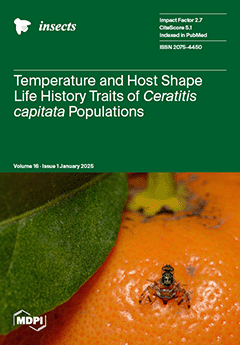
Cover Story: The Mediterranean fruit fly (Ceratitis capitata) is a major pest for many fresh fruit commodities globally. It is extremely polyphagous (>300 hosts) and an aggressive invasive species which has dispersed to almost all continents. Developmental temperature and host fruit type may affect the key biological traits and life history of C. capitata thus determining its invasion potential. Nevertheless, different populations may express different responses to both biotic and abiotic conditions. Understanding the plastic and adaptive responses of the Mediterranean fruit fly to different hosts and developmental temperatures is an important element for elucidating its invasion dynamics and developing effective management strategies, especially in the context of climate change and its impact on agroecosystems. View this paper
  • Issues are regarded as officially published after their release is announced to the table of contents alert mailing list .
  • You may sign up for email alerts to receive table of contents of newly released issues.
  • PDF is the official format for papers published in both, html and pdf forms. To view the papers in pdf format, click on the "PDF Full-text" link, and use the free Adobe Reader to open them.

Articles (104)

  • Article
  • Open Access
2,364 Views
18 Pages

Morphological Comparisons of Adult Worker Bees Developed in Chinese and Italian Honey Bee Combs

  • Shunhua Yang,
  • Hui Li,
  • Pingqing Wu,
  • Dan Yue,
  • Yulong Guo,
  • Wenzheng Zhao and
  • Kun Dong

20 January 2025

The size of comb cells is a key factor influencing the body size of honey bee workers. Comb cells and the body size of Chinese honey bee workers are smaller than those of Italian honey bee workers. To increase the size of Chinese honey bee workers, t...

  • Article
  • Open Access
5 Citations
1,741 Views
17 Pages

Precise Crop Pest Detection Based on Co-Ordinate-Attention-Based Feature Pyramid Module

  • Chenrui Kang,
  • Lin Jiao,
  • Kang Liu,
  • Zhigui Liu and
  • Rujing Wang

20 January 2025

Insect pests strongly affect crop growth and value globally. Fast and precise pest detection and counting are crucial measures in the management and mitigation of pest infestations. In this area, deep learning technologies have come to represent the...

  • Article
  • Open Access
4 Citations
2,439 Views
20 Pages

SP-YOLO: A Real-Time and Efficient Multi-Scale Model for Pest Detection in Sugar Beet Fields

  • Ke Tang,
  • Yurong Qian,
  • Hualong Dong,
  • Yuning Huang,
  • Yi Lu,
  • Palidan Tuerxun and
  • Qin Li

20 January 2025

Beet crops are highly vulnerable to pest infestations throughout their growth cycle, which significantly affects crop development and yield. Timely and accurate pest identification is crucial for implementing effective control measures. Current pest...

  • Article
  • Open Access
2 Citations
1,445 Views
14 Pages

19 January 2025

Psocids are difficult to manage using grain protectants and phosphine hence research on non-chemical control methods. This study evaluated the effectiveness of Xylocoris flavipes (Reuter) (Hemiptera: Anthocoridae) at managing Liposcelis decolor...

  • Article
  • Open Access
1,110 Views
11 Pages

18 January 2025

The horned-gall aphid, Schlechtendalia chinensis, is the most economically valuable Chinese gallnut aphid species, playing a decisive role in the production of Chinese gallnuts. The method of cultivating the gallnut species with artificial moss and i...

  • Article
  • Open Access
1,583 Views
25 Pages

18 January 2025

Epipsylla Kuwayama, 1908, constitutes an Old World genus of psyllids with 15 described species. Based on characters of immatures, Epipsylla was recently assigned to Ciriacreminae (Psyllidae). The genus is morphologically well circumscribed but specie...

  • Article
  • Open Access
1 Citations
5,211 Views
17 Pages

Essential Oils as Bioinsecticides Against Blattella germanica (Linnaeus, 1767): Evaluating Its Efficacy Under a Practical Framework

  • Ana Manzanares-Sierra,
  • Eduard Monsonís-Güell,
  • Crisanto Gómez,
  • Sílvia Abril and
  • Mara Moreno-Gómez

18 January 2025

Concerns about the negative effects of traditional insecticides and increasing insecticide resistance have prompted the exploration of botanical alternatives like essential oils (EOs). The registration of biocides is a mandatory procedure, and some r...

  • Review
  • Open Access
8 Citations
5,979 Views
12 Pages

An Overview of the Nutritional Requirements of Honey Bees (Apis mellifera Linnaeus, 1758)

  • Leticia S. Ansaloni,
  • Janja Kristl,
  • Caio E. C. Domingues and
  • Aleš Gregorc

18 January 2025

Honey bees are known for their wide global distribution, their ease of handling, and their economic and ecological value. However, they are often exposed to a wide variety of stress factors. Therefore, it is essential for beekeepers to maintain healt...

  • Article
  • Open Access
1,223 Views
17 Pages

Interspecific Competition Between Eotetranychus sexmaculatus Riley and Oligonychus biharensis Hirst (Acari: Tetranychidae)

  • Lijiu Zheng,
  • Yong Zhang,
  • Xia Shi,
  • Wei Gan,
  • Fangping Zhang,
  • Yueguan Fu,
  • Ya Liu,
  • Junyu Chen and
  • Zhengpei Ye

17 January 2025

Eotetranychus sexmaculatus has long been recognized as an important spider mite pest of rubber trees. Recently, increasing damage from Oligonychus biharensis has elevated its importance as a key spider mite pest. These two species share highly overla...

  • Review
  • Open Access
5 Citations
4,722 Views
29 Pages

Bioacaricides in Crop Protection—What Is the State of Play?

  • Dejan Marčić,
  • Ismail Döker and
  • Haralabos Tsolakis

17 January 2025

Growing demands for environmentally safe and sustainable pest management have increased interest in biopesticides as alternatives to synthetic chemical pesticides. This review presents the current status of bioacaricides, defined as commercial biopes...

of 11

Get Alerted

Add your email address to receive forthcoming issues of this journal.

XFacebookLinkedIn
Insects - ISSN 2075-4450