Overwintering of Thrips (Thysanoptera) Under the Bark of the Plane Tree (Platanus x hispanica Mill. ex Münchh.) in Southeastern Poland


Simple Summary
Abstract
1. Introduction
2. Materials and Methods
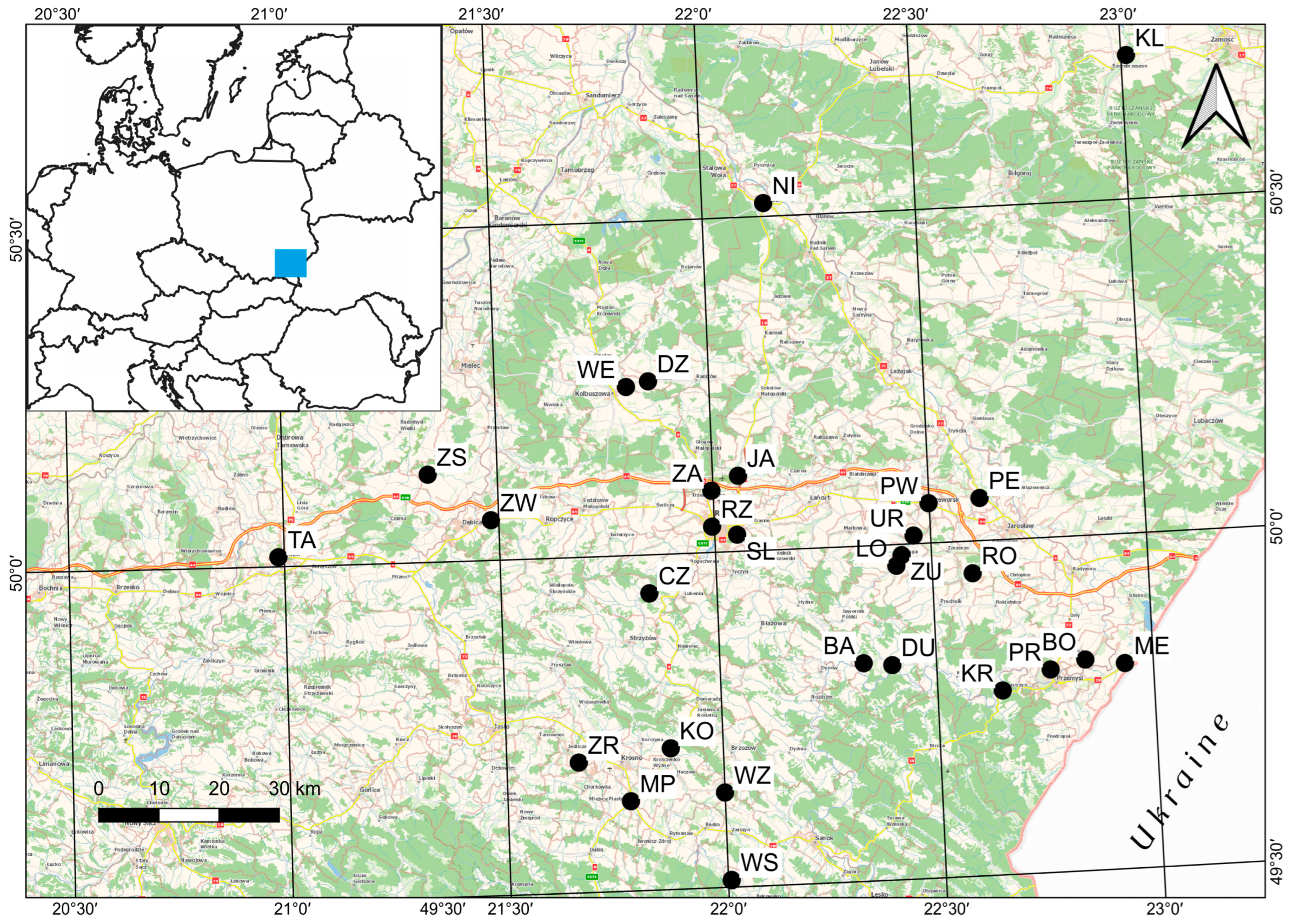
2.1. Study Area

2.2. Sampling Methods
2.3. Environmental Data
2.4. Data Analysis
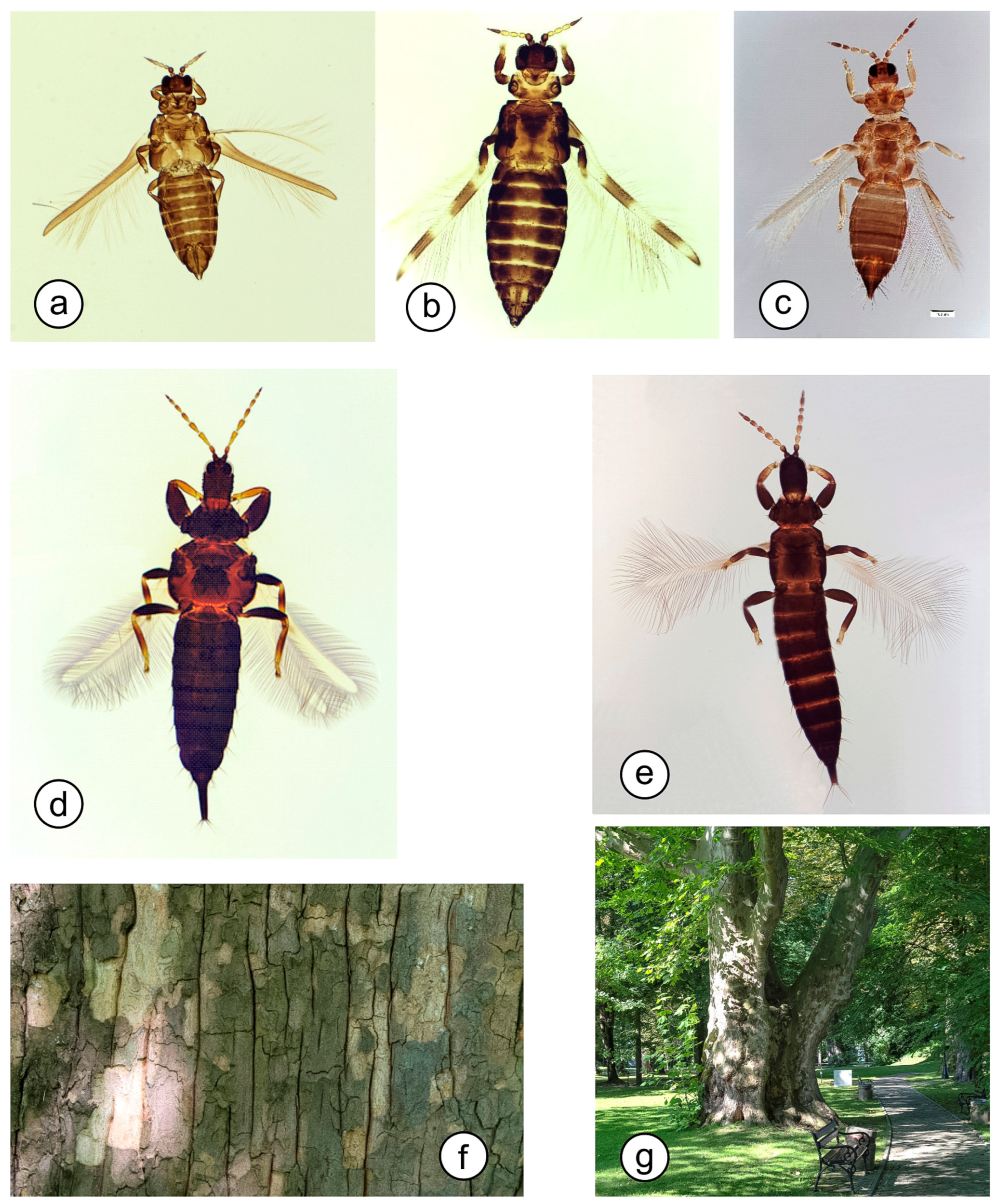
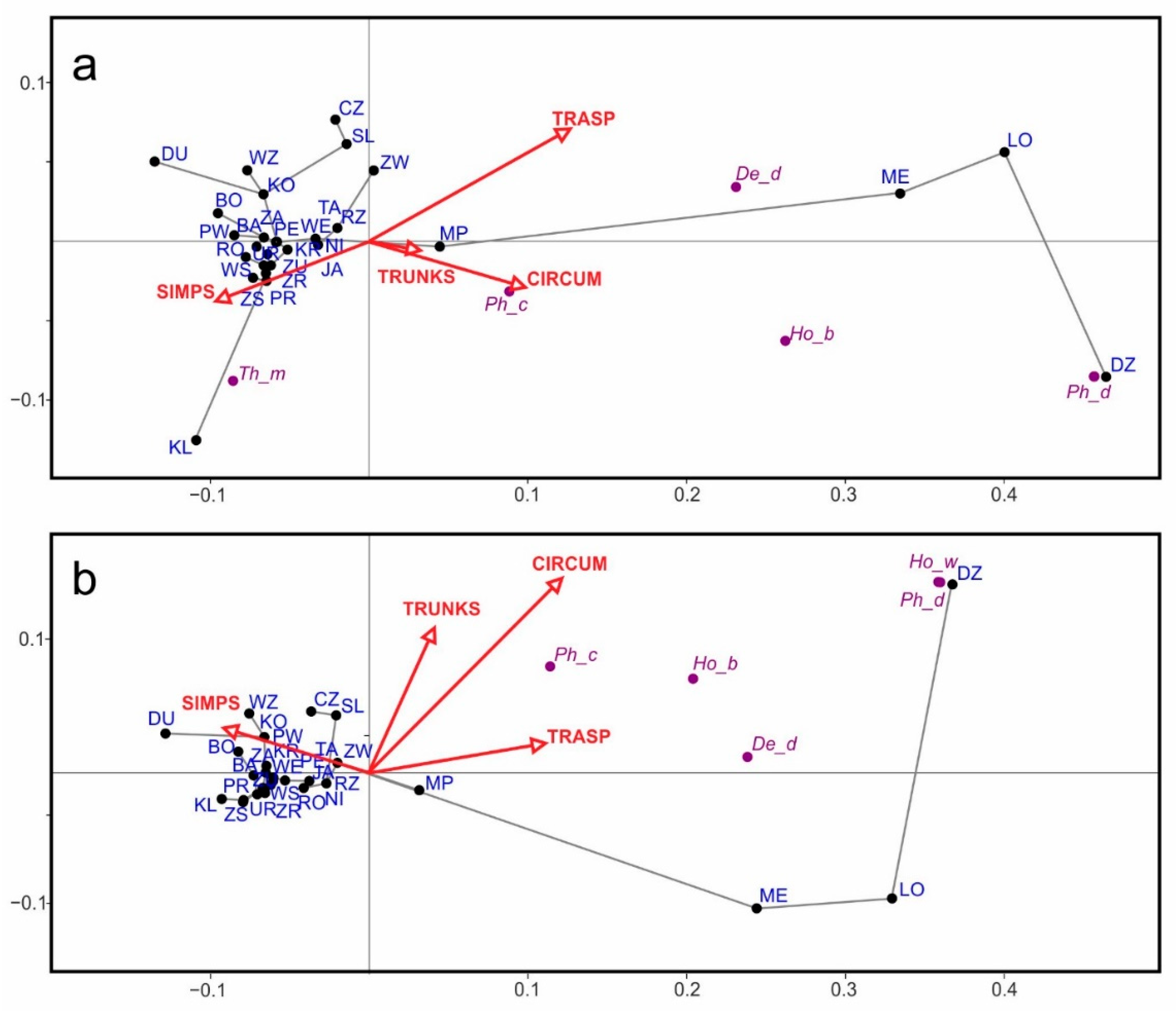
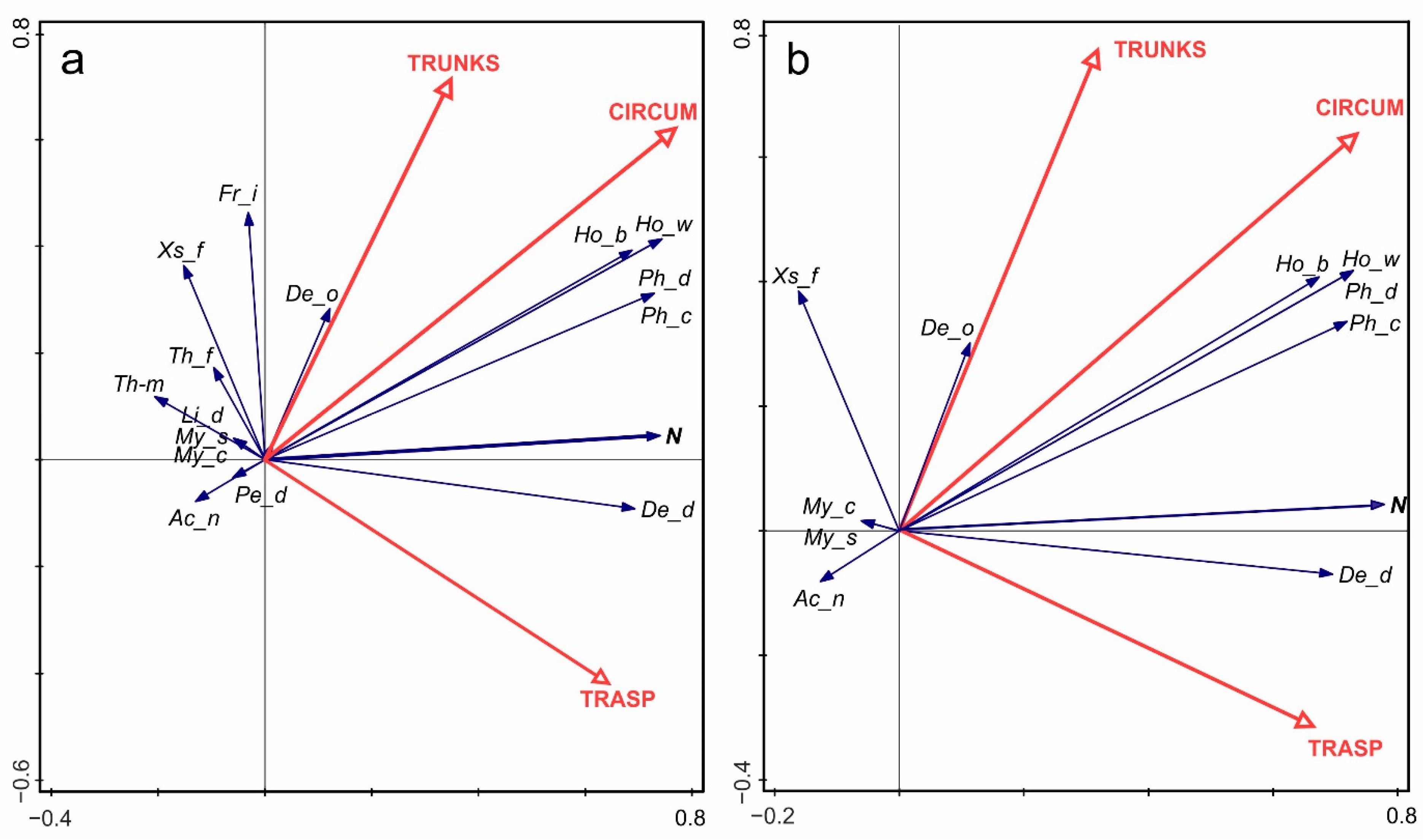
3. Results

| Species | Acronym | No. of Specimens | Characteristics |
|---|---|---|---|
| suborder Terebrantia | |||
| Dendrothrips degeeri Uzel 1895 | De_d | 337 ♀♀ | D, Fol (Fraxinus and other deciduous trees), E |
| Dendrothrips ornatus (Jablonowski 1894) | De_o | 31 ♀♀ | D, Fol (Fraxinus, Ligustrum, Syringa, Corylus, Tilia), P, introduced in North America |
| Frankliniella intonsa (Trybom 1895) | Fr_i | 3 ♀♀ | Pol, Flor (herbaceous plants), P, introduced in Canada and southeastern Asia |
| Limothrips denticornis Haliday 1836 | Li_d | 2 ♀♀ | Pol, G (leaf blades of various grass species), E–S, introduced in North America and Australia |
| Mycterothrips consociatus (Targioni-Tozzetti 1886) | My_c | 1 ♀ | D, Fol (Alnus, Betula, Corylus, Quercus, Salix), E–S |
| Mycterothrips salicis (O.M. Reuter 1879) | My_s | 1 ♀ | D, Fol (Populus, Salix, less often Alnus and Tilia), E-S, introduced in North America |
| Pezothrips dianthi (Priesner 1921) | Pe_d | 1 ♀ | Mon, Flor (Dianthus carthusianorum), W-P |
| Thrips fuscipennis Haliday 1836 | Th_f | 6 ♀♀ | Pol, Flor (herbaceous plants, preferred Rosaceae), P, introduced in North America |
| Thrips major Uzel 1895 | Th_m | 32 ♀♀, 1 ♂ | Pol, Flor (herbaceous plants and Sambucus nigra), P |
| suborder Tubulifera | |||
| Acanthothrips nodicornis (O.M. Reuter 1880) | Ac_n | 4 ♀♀ | D, F (under bark of dead deciduous trees), P |
| Hoplandrothrips bidens (Bagnall 1910) | Ho_b | 3 ♀♀, 1♂ | D, F (under bark of dead deciduous trees), E, introduced in New Zealand |
| Hoplandrothrips williamsianus Priesner 1923 | Ho_w | 3 ♀♀ | D, F (dry branches of Salix), |
| Phlaeothrips coriaceus Haliday 1836 | Ph_c | 46 ♀♀, 12 ♂♂ | D, F (on branches and under bark of deciduous trees), E and North America |
| Phlaeothrips denticauda Priesner 1914 | Ph_d | 1 ♀ | D, F, Hyg (on branches and under bark of Salix and Alnus), E |
| Xylaplothrips fuliginosus (Schille 1911) | Xy_f | 7 ♀♀, 2 ♂♂ | D, Pred (bark and leaves of trees), E |


| Estimate | Standard Error | Z Value | p | |
|---|---|---|---|---|
| Intercept | 1.162 | 0.1600 | 7.260 | <0.001 |
| CIRCUM | 0.103 | 0.0100 | 10.233 | <0.001 |
| TRUNKS | −0.333 | 0.0538 | −6.194 | <0.001 |
| TRASP | 2.169 | 0.1930 | 11.239 | <0.001 |
| Estimate | Standard Error | Z Value | p | |
|---|---|---|---|---|
| Intercept | 0.047 | 0.2385 | 0.198 | 0.843 |
| CIRCUM | 0.100 | 0.0107 | 9.346 | <0.001 |
| TRUNKS | −0.340 | 0.0580 | −5.857 | <0.001 |
| TRASP | 3.416 | 0.2730 | 12.513 | <0.001 |
4. Discussion
5. Conclusions
Supplementary Materials
Author Contributions
Funding
Data Availability Statement
Acknowledgments
Conflicts of Interest
References
- ThripsWiki. Providing information on the World’s thrips (version 2022-10-07). In Catalogue of Life; Bánki, O., Roskov, Y., Döring, M., Ower, G., Hernández Robles, D.R., Plata Corredor, C.A., Stjernegaard Jeppesen, T., Örn, A., Vandepitte, L., Pape, T., et al., Eds.; version 2024-10-22; Catalogue of Life: Amsterdam, The Netherlands, 2024. [Google Scholar] [CrossRef]
- Kirk, W.D.J. Feeding. In Thrips as Crop Pests; Lewis, T., Ed.; CAB International, University Press: Cambridge, UK, 1997; pp. 119–174. [Google Scholar]
- Mound, L.; Collins, D.; Hastings, A. Thysanoptera Britannica et Hibernica. A Guide to British Thrips; Lucidcentral.org, Identic Pty Ltd.: Queensland, Australia, 2018; Available online: https://keys.lucidcentral.org/keys/v3/british_thrips/ (accessed on 20 October 2024).
- Moritz, G. Structure, growth and development. In Thrips as Crop Pests; Lewis, T., Ed.; CAB International, University Press: Cambridge, UK, 1997; pp. 15–63. [Google Scholar]
- Lewis, T.; Navas, E. Thysanopteran populations overwintering in hedge bottoms, grass litter and bark. Ann. Appl. Biol. 1962, 50, 299–311. [Google Scholar] [CrossRef]
- Lewis, T. Thrips, Their Biology, Ecology and Economic Importance; Academic Press: London, UK; New York, NY, USA, 1973; p. 349. [Google Scholar]
- Kirk, W.D.J. Distribution, abundance and population dynamics. In Thrips as Crop Pests; Lewis, T., Ed.; CAB International, University Press: Cambridge, UK, 1997; pp. 217–257. [Google Scholar]
- Lee, G.S.; Lee, J.H.; Kang, S.H.; Woo, K.S. Thrips species (Thysanoptera: Thripidae) in winter season and their vernal activities on Jeju Island, Korea. J. Asia Pac. Entomol. 2001, 4, 115–122. [Google Scholar] [CrossRef]
- Lewis, T. The effect of weather on emergence and take-off of overwintering Limothrips cerealium Haliday (Thysanoptera). Ann. Appl. Biol. 1963, 51, 489–502. [Google Scholar] [CrossRef]
- McDonalds, J.R.; Head, J.; Bale, J.S.; Walters, K.F.A. Cold tolerance, overwintering and establishment potential of Thrips palmi. Physiol. Entomol. 2000, 25, 159–166. [Google Scholar] [CrossRef]
- Larenzaki, E.; Shelton, A.M.; Musser, F.R.; Nault, B.A.; Plate, J. Overwintering Locations and Hosts for Onion Thrips (Thysanoptera: Thripidae) in the Onion Cropping Ecosystem in New York. J. Econ. Entomol. 2007, 100, 1194–1200. [Google Scholar] [CrossRef]
- Sampson, C.; Bennison, J.; Kirk, W.D.J. Overwintering of the western flower thrips in outdoor strawberry crops. J. Pest Sci. 2021, 94, 143–152. [Google Scholar] [CrossRef]
- Orosz, S.; Kovács, C.; Juhász, M.; Tóth, F. Observations on the overwintering of Frankliniella occidentalis (Pergande) (Thysanoptera: Thripidae) under climatic conditions in Hungary. Acta Phytopathol. Entomol. Hung. 2009, 44, 267–276. [Google Scholar] [CrossRef]
- Kobro, S. Sampling Phlaeothrips annulipes O.M. Reuter (Thysanoptera: Tubulifera) from its habitat, dead birch branches. Acta Phytopathol. Entomol. Hung. 2007, 42, 353–360. [Google Scholar] [CrossRef]
- Kettunen, J.; Kobro, S.; Martikainen, P. Thrips (Thysanoptera) from dead aspen (Populus tremula) trees in Eastern Finland. Entomol. Fenn. 2005, 16, 246–250. [Google Scholar] [CrossRef]
- Kobro, S.; Solheim, H. Hoplothrips carpathicus PELIKÁN, 1961 (Thysanoptera, Phlaeothripidae) in Norway. Nor. J. Entomol. 2002, 49, 143–144. [Google Scholar]
- Hornák, O.; Šarapatka, B.; Machač, O.; Mock, A.; Tuf, I.H. Characteristics of Fragments of Woodland and Their Influence on the Distribution of Soil Fauna in Agricultural Landscape. Diversity 2023, 15, 488. [Google Scholar] [CrossRef]
- Heidari Latibari, M.; Sepahi, S.; Ghafouri Moghaddam, M. Presence of Thysanoptera species in the green spaces of Iran: New records along with illustrated type specimens. J. Entomol. Res. Soc. 2022, 24, 141–171. [Google Scholar] [CrossRef]
- Czepiel, K. Thrips (Thysanoptera, Insecta) collected in wooded areas of the city of Lublin (South-Eastern Poland). Acta Phytopathol. Entomol. Hung. 2004, 39, 271–279. [Google Scholar] [CrossRef]
- Szwałko, P. Osmoderma eremita (Scopoli 1763) Pachnica dębowa. Hermit beetle. In Polish Red Data Book of Animals. Invertebrates; Głowaciński, Z., Nowacki, J., Eds.; Instytut Ochrony Przyrody PAN, Akademia Rolnicza im. A. Cieszkowskiego: Kraków, Poland; Poznań, Poland, 2004; pp. 103–104. [Google Scholar]
- Oleksa, A.; Gawroński, R. Pachnica dębowa Osmoderma eremita s.l. in Poland—Monitoring, resourses and protection. Przegląd Przyrodniczy 2008, 19, 67–78. (In Polish) [Google Scholar]
- Olbrycht, T.; Kucharska-Świerszcz, M. Pierwsze obserwacje zgniotka cynobrowego Cucujus cinnaberinus (Scopoli, 1763) (Coleoptera, Cucujidae) na terenie Rzeszowa. Entomol. News 2020, 39, 8–9. [Google Scholar] [CrossRef]
- Liere, H.; Cowal, S. Local and landscape factors differentially influence predatory arthropods in urban agroecosystems. Ecosphere 2024, 15, e4816. [Google Scholar] [CrossRef]
- Litavský, J.; Majzlan, O.; Langrav, V.; Žarnovicčan, H. Influence of habitat management and selected environmental parameters on the ground-leaving communities of harvestmen (Opiliones) in the historical park in Rusovce (Slovakia). Environ. Monit. Assess. 2024, 196, 1056. [Google Scholar] [CrossRef]
- Santamour, F.S., Jr.; McArdle, A.J. Checklist of cultivated Platanus (Plane tree). Arboric. J. 1986, 12, 78–83. [Google Scholar]
- Danika, D.; Adroit, B.; Velitzelos, D.; Denk, T. On the origin of the Oriental plane tree (Platanus orientalis L.). Pap. Paleontol. 2024, 10, e1576. [Google Scholar] [CrossRef]
- Cedro, A.; Cedro, B. Wpływ warunków klimatycznych na szerokość przyrostu rocznego platana klonolistnego (Platanus × hispanica Mill. ex Münchh. ‘Acerifolia’). Studia i Materiały CEPL w Rogowie 2018, 20, 26–35. [Google Scholar]
- Suspatashvili, A.; Goginashvili, N.; Kereselidze, M. Distribution and some biological data of sycamore lace bug—Corythucha ciliata Say (Heteroptera, Tingidae) in Georgia. Ann. Agrar. Sci. 2016, 14, 42–45. [Google Scholar] [CrossRef]
- Lis, B. Corythucha ciliata (Say, 1832) (Hemiptera: Heteroptera: Tingidae)—Gatunek pluskwiaka nowy dla fauny Polski. Opole Sci. Soc. Nat. J. 2009, 42, 119–122. [Google Scholar]
- Gil, R.; Lis, B.; Kadej, M. Arocatus longiceps Stal (Hemiptera: Heteroptera: Lygaeidae)—A species new for the Polish fauna, and other true-bugs overwintering under the bark of plane trees in Wrocław (Lower Silesia). Heteroptera Pol.—Acta Faun. 2011, 3, 25–35. (In Polish) [Google Scholar]
- Hebda, G.; Olbrycht, T.; Konieczny, K.; Melke, A.; Rutkowski, T.; Wojtaszyn, G. True-bugs (Hemiptera: Heteroptera) overwintering under bark of the London planes Platanus x acerifolia in Poland. Rocz. Muz. Górnośląskiego w Bytomiu—Przyr. 2020, 26, 1–20. (In Polish) [Google Scholar] [CrossRef]
- Rozwałka, R.; Olbrycht, T. New records of several rare spider species (Araneae) from south-eastern Poland. Fragm. Faun. 2017, 60, 67–81. [Google Scholar] [CrossRef]
- Mazurek, J. Prześwietlik platanowy Corythucha ciliata (Say, 1832) (Hemiptera: Heteroptera: Tingidae) we Wrocławiu (Dolny Śląsk). Heteroptera Pol.—Acta Heteroptera Faun. 2011, 2, 7–10. [Google Scholar]
- Mound, L.A.; Kibby, G. Thysanoptera: An Identification Guide; CAB International, University Press: Cambridge, UK, 1998; p. 70. [Google Scholar]
- Zur Strassen, R. Die terebranten Thysanopteren Europas und des Mittelmeer-Gebietes; Goecke & Evers: Keltern, Germany, 2003; p. 277. [Google Scholar]
- Schliephake, G.; Klimt, K. Thysanoptera Fransenf1ügler; Veb Gustav Fischer Verlag: Jena, Germany, 1979; p. 477. [Google Scholar]
- Roberts, D.W.; Cooper, S.V. Concepts and techniques of vegetation mapping. In Land Classifications Based on Vegetation: Applications for Resource Management, General Technical Report INT-257; Ferguson, D., Morgan, P., Johnson, F.D., Eds.; US Department of Agriculture, Forest Service, Intermountain Research Station: Odgen, UT, USA, 1989; pp. 90–96. [Google Scholar]
- Pielou, E.C. An Introduction to Mathematical Ecology; Wiley: New York, NY, USA, 1969; p. 286. [Google Scholar]
- Hammer, R.D.; Harper, A.T.; Ryan, P.D. PAST: Paleontological statistics software package for education and data analysis. Palaeontol. Electron. 2001, 4, 1–9. [Google Scholar]
- Burnham, K.P.; Anderson, D.R.; Huyvaert, K.P. AIC model selection and multimodel inference in behavioral ecology: Some background, observations, and comparisons. Behav. Ecol. Sociobiol. 2011, 65, 23–35. [Google Scholar] [CrossRef]
- Marschner, I.C. glm2: Fitting generalized linear models with convergence problems. R J. 2011, 3, 12–15. [Google Scholar] [CrossRef]
- ter Braak, C.J.F.; Šmilauer, P. CANOCO Reference Manual and CanoDraw for Windows User’s Guide Version 4.5; Biometris-Plant Research International: Wageningen, České Budějovice; Wageningen, The Netherlands; Prague, Czech Republic, 2002. [Google Scholar]
- Raven, P.H.; Wagner, D.L. Agricultural intensification and climate change are rapidly decreasing insect biodiversity. Proc. Natl. Acad. Sci. USA 2021, 118, e2002548117. [Google Scholar] [CrossRef] [PubMed]
- Czerniakowski, Z.; Olbrycht, T. Historic Rzeszów parks as a mainstay of precious invertebrates. Czas. Tech.—Archit. 2014, 6A, 149–156. (In Polish) [Google Scholar] [CrossRef]
- Oleksa, A.; Gawroński, R. Forest insects in an agricultural landscape—Presence of old trees is more important than existence of nearby forest. Ecol. Quest. 2006, 7, 29–36. [Google Scholar]
- European Habitats Directive. Annex II 2007. Available online: http://ec.europa.eu/environment/index_en.htm (accessed on 30 November 2024).
- Kucharczyk, H. Thrips (Insecta:Thysanoptera) as an element of ecological monitoring in Białowieża Primeval Forest. Leśne Pr. Badaw. 2004, 3, 85–94. (In Polish) [Google Scholar]
- Ulitzka, M. thrips-iD. Available online: https://www.thrips-id.com/ (accessed on 30 November 2024).
- Zvariková, M.; Masarovič, R.; Prokop, P.; Fedor, P. An updated checklist of thrips from Slovakia with emphasis on economic species. Plant Protect. Sc. 2020, 56, 292–304. [Google Scholar] [CrossRef]
- Trigos-Peral, G.; Rutkowski, T.; Witek, M.; Ślipiński, P.; Babik, H.; Czechowski, W. Three categories of urban green areas and the effect of their different management on the communities of ants, spiders and harvestmen. Urban Ecosyst. 2020, 23, 803–818. [Google Scholar] [CrossRef]
- Nicolai, V. The bark of trees: Thermal properties, microclimate and fauna. Oecologia 1986, 69, 148–160. [Google Scholar] [CrossRef]
- Dubovský, M.; Fedor, P.; Kucharczyk, H.; Masarovič, R.; Balkovič, J. Zgrupowania wciornastków (Thysanoptera) pni drzew w różnowiekowych lasach dębowych Słowacji. Sylwan 2010, 154, 659–668. [Google Scholar]
- Dubovský, M.; Masarovič, R. Bark-dwelling thrips (Thysanoptera) and other arthropods in xerothermophiloua oak woods in SW Slovakia (Preliminary results). Thysanopteron. Pismo Entomol. 2007, 3, 9–13. [Google Scholar]
- Kucharczyk, H.; Kucharczyk, M.; Wyrozumski, Ł. Screen traps as an efficient method in faunal research on fungus-feeding thrips (Tubulifera: Phlaeothripidae). Pol. J. Entomol. 2015, 84, 201–210. [Google Scholar] [CrossRef][Green Version]
- Kucharczyk, H.; Kucharczyk, M. Wciornastki (Thysanoptera, Insecta) zbiorowisk roślinnych centralnej części Kotliny Sandomierskiej. Nowy Pam. Fizjogr. 2023, 8, 67–81. [Google Scholar]
- Wonderlich, J. Mitteleuropäische Spinnen (Araneae) der Baumrinde. J. Appl. Entomol. 2009, 94, 9–21. [Google Scholar] [CrossRef]
- Machač, O.; Tuf, I.H. Spiders and harvestmen on tree trunks obtained by three sampling methods. Arachnol. Mitteilungen/Arachnol. Lett. 2016, 51, 67–72. [Google Scholar] [CrossRef]
- Szinetár, C.; Horváth, R. A review of spiders on tree trunks in Europe (Araneae). Acta Zool. Bulg. 2005, 1, 221–257. [Google Scholar]
- Leather, S.R.; Walters, K.R.A.; Bale, J.S. The Ecology of Insect Overwintering; Cambridge University Press: New York, NY, USA, 1993; p. 255. [Google Scholar]
- Lewis, T. The effects of temperature and relative humidity on mortality in Limothrips cerealium Haliday (Thysanoptera) overwintering in bark. Ann. Appl. Biol. 1962, 50, 313–326. [Google Scholar] [CrossRef]
- Pobożniak, M.; Bisaga, A.; Bussler, M. Atrakcyjność kwiatów drzew i krzewów dla wciornastków Thysanoptera w Ogrodzie Botanicznym w Krakowie. In Fauna Miast: Ochronić Różnorodność Biotyczną w Miastach; Indykiewicz, P., Jerzak, L., Barczak, T., Eds.; SAR “Pomorze”: Bydgoszcz, Poland, 2008; pp. 373–382. [Google Scholar]
- Kucharczyk, H. Digital Catalogue of Biodiversity of Poland—Animalia: Arthropoda: Hexapoda: Insecta: Thysanoptera. Version 1.3. Polish Biodiversity Information Network. Checklist Dataset. Available online: https://www.gbif.org/dataset/fc58e9b3-0fad-48d9-b87b-596676629c1b (accessed on 30 November 2024).
Disclaimer/Publisher’s Note: The statements, opinions and data contained in all publications are solely those of the individual author(s) and contributor(s) and not of MDPI and/or the editor(s). MDPI and/or the editor(s) disclaim responsibility for any injury to people or property resulting from any ideas, methods, instructions or products referred to in the content. |
© 2025 by the authors. Licensee MDPI, Basel, Switzerland. This article is an open access article distributed under the terms and conditions of the Creative Commons Attribution (CC BY) license (https://creativecommons.org/licenses/by/4.0/).
Share and Cite
Kucharczyk, H.; Kucharczyk, M.; Olbrycht, T. Overwintering of Thrips (Thysanoptera) Under the Bark of the Plane Tree (Platanus x hispanica Mill. ex Münchh.) in Southeastern Poland. Insects 2025, 16, 92. https://doi.org/10.3390/insects16010092
Kucharczyk H, Kucharczyk M, Olbrycht T. Overwintering of Thrips (Thysanoptera) Under the Bark of the Plane Tree (Platanus x hispanica Mill. ex Münchh.) in Southeastern Poland. Insects. 2025; 16(1):92. https://doi.org/10.3390/insects16010092
Chicago/Turabian StyleKucharczyk, Halina, Marek Kucharczyk, and Tomasz Olbrycht. 2025. "Overwintering of Thrips (Thysanoptera) Under the Bark of the Plane Tree (Platanus x hispanica Mill. ex Münchh.) in Southeastern Poland" Insects 16, no. 1: 92. https://doi.org/10.3390/insects16010092
APA StyleKucharczyk, H., Kucharczyk, M., & Olbrycht, T. (2025). Overwintering of Thrips (Thysanoptera) Under the Bark of the Plane Tree (Platanus x hispanica Mill. ex Münchh.) in Southeastern Poland. Insects, 16(1), 92. https://doi.org/10.3390/insects16010092