3. Description of New Species
Empis (Euempis) sanrossorensis Barták sp. nov.
Type material: HOLOTYPE ♂, Italy: San Rossore NP, Pisa prov., forest, 43.725, 10.313 MT, A. Belcari, 6-16.iv.2021, deposited in CULSP. PARATYPES: The same data as for holotype, three males, two females; same locality but 27.iv.-7.v.2021 one male, one female; San Rossore NP, Pinus grove, 43.695, 10.341, MT, A. Belcari, 21-31.viii.2021, two males, four females; San Rossore NP, Pisa prov. forest + seashore, 43.7, 10.3 MT, A. Belcari, 7-17.v.1922, one male. All the type material is pinned and deposited in CULSP.
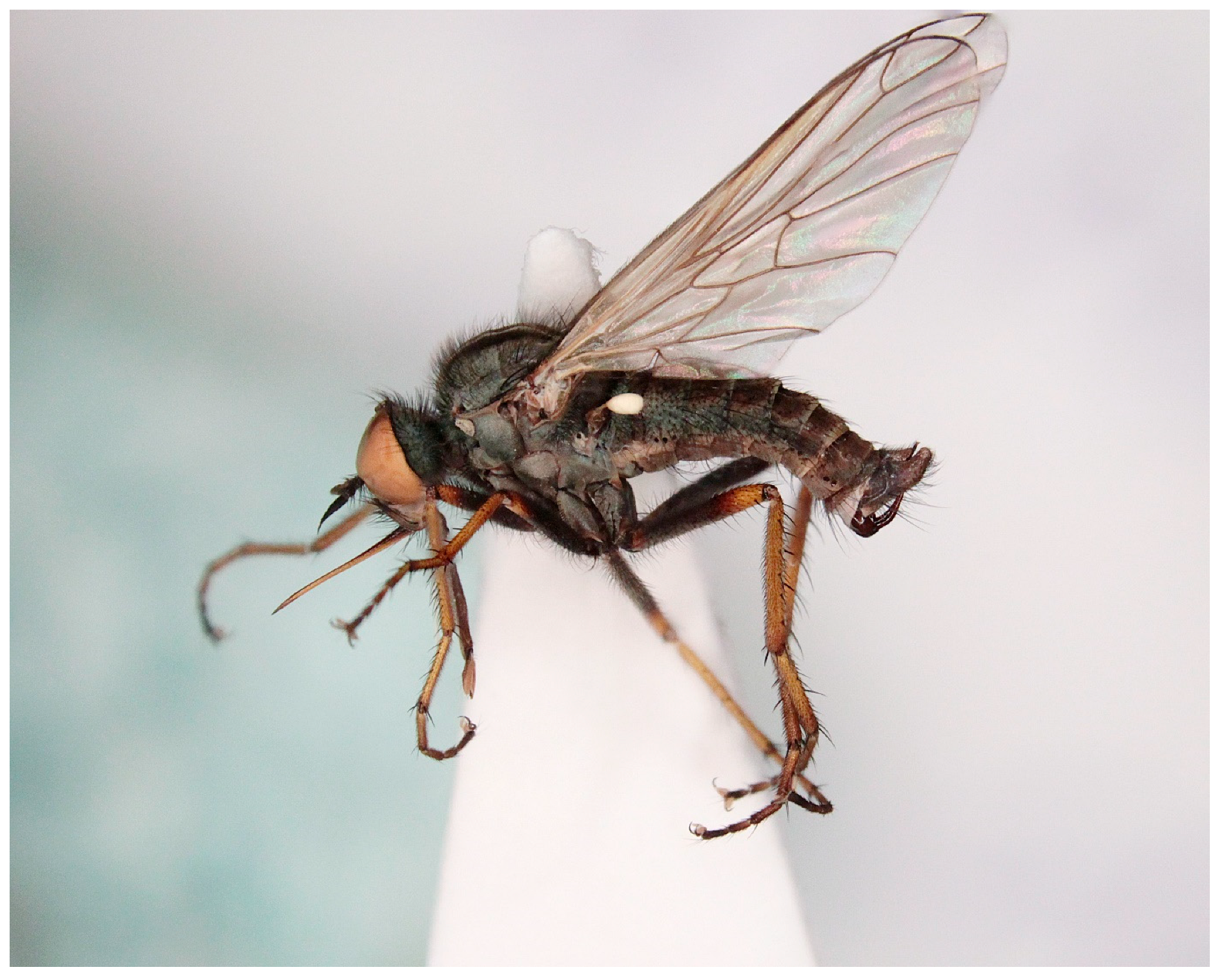
Diagnosis: Middle-sized species, entirely black setose; palpus brown; mesoscutum almost uniformly covered with fine setae. Large setae: notopleurals and supralars; acrostichal and dorsocentral setae multiserial; legs with at least tibiae yellow (in male) or entirely yellow (in female); halter yellow; male abdominal segments with strong and elongated posteromarginal setae laterally on tergite 4 but without shiny spots or conspicuous outgrowths; epandrial lamella narrowed apically, with one to three long strong setae; cercus simple.
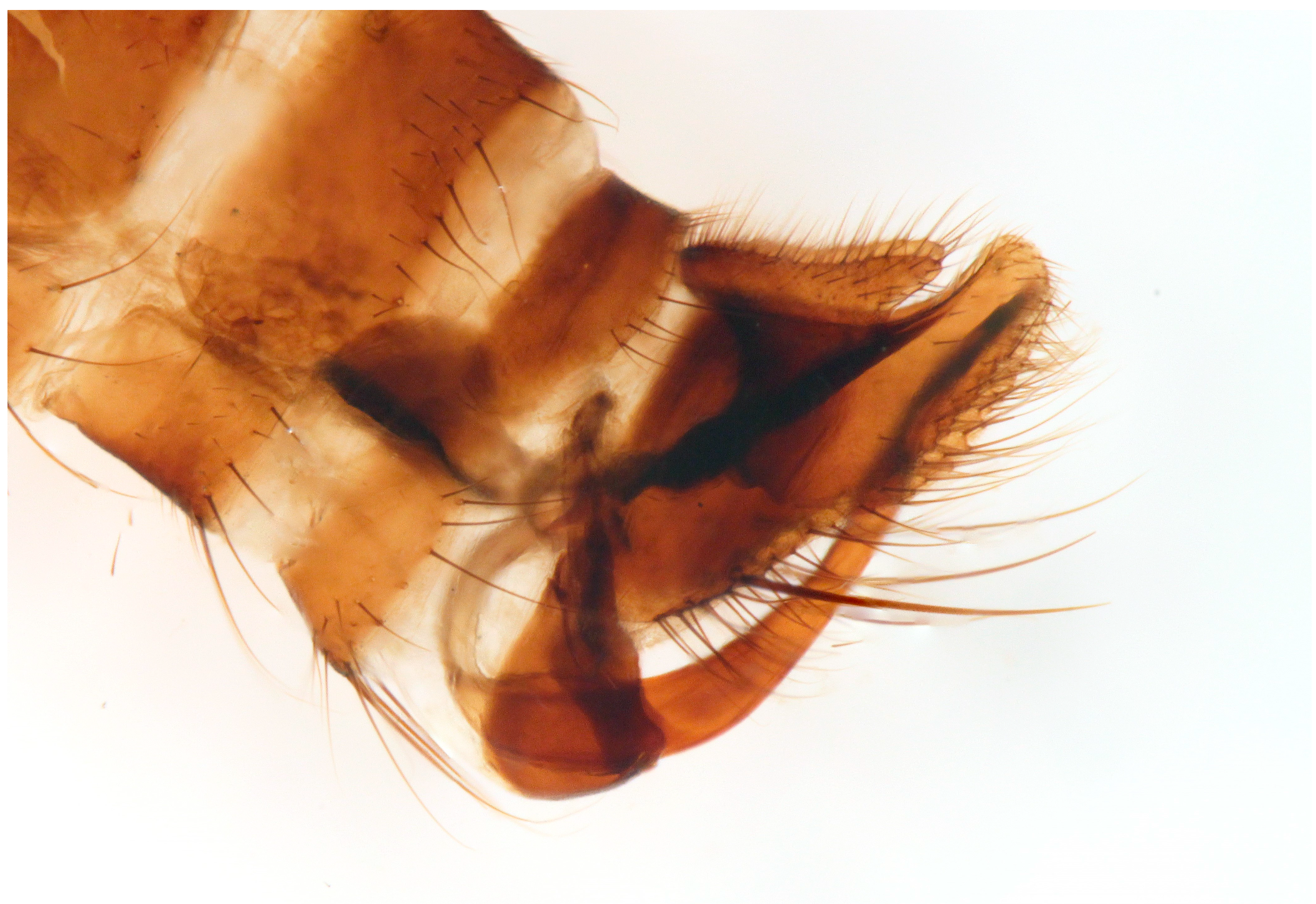
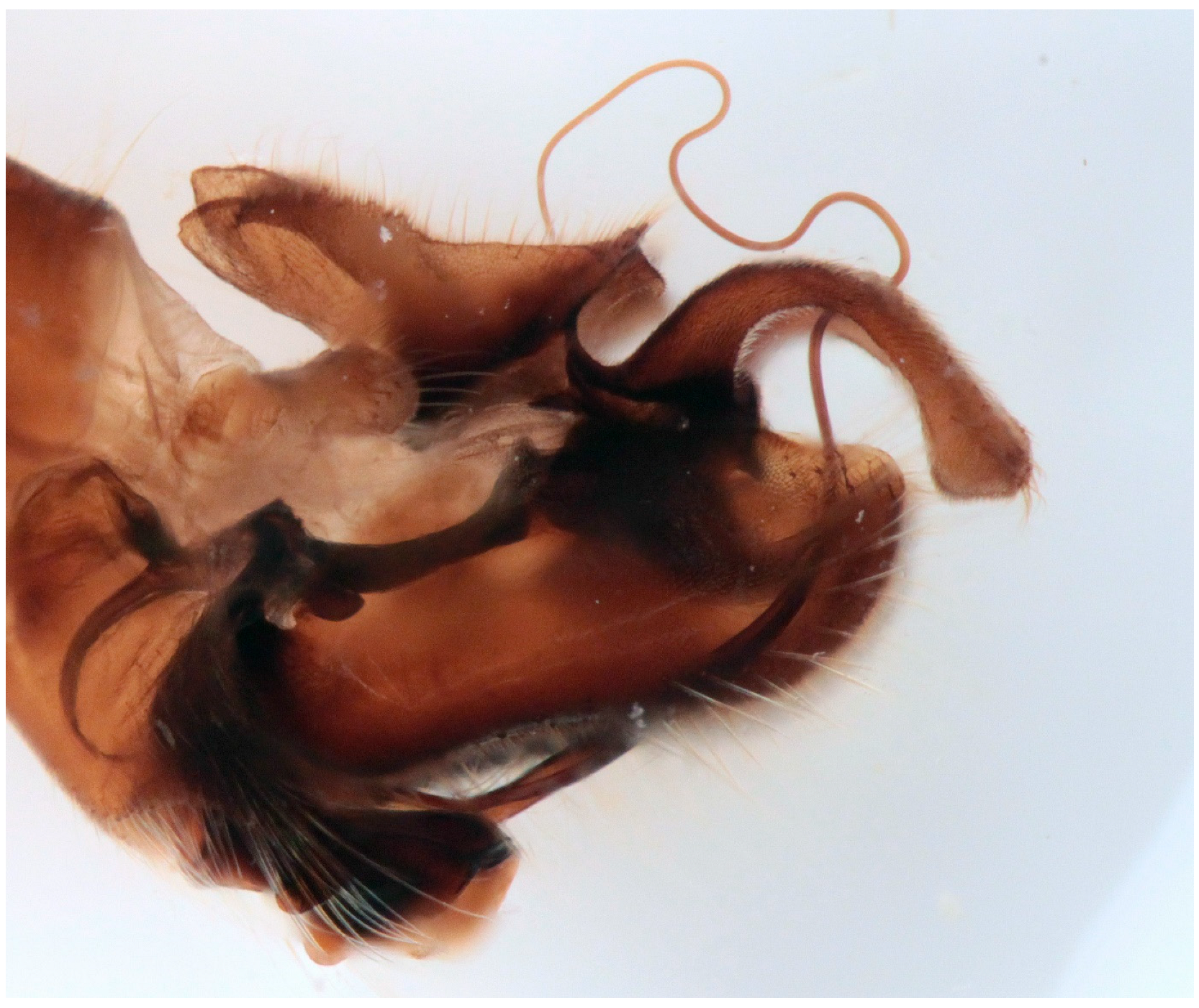
Description: Male. Head: Black, rather light grey microtrichose, holoptic (eyes meeting over long distance). Frons (small triangle just above antennae and much smaller below front ocellus) without setae. Dorsal half of eye with distinctly larger facets than ventral half. Ocellar setae fine, black, half as long as frons and ocellar triangle with several additional fine setae half as long. Occiput densely setose in mid and lower parts (setae as long as or even longer than ocellars). Face about 0.35 mm broad ventrally, microtrichose, without setae. Clypeus shiny dorsally, gena very narrow. Palpus brown, with long (0.30 mm distally up to 0.40 mm proximally) black setae. Labrum brown, lustrous, nearly twice head height. Antenna black, both basal segments long setose; length of antennal segments (scape: pedicel: postpedicel: basal joint of stylus: last joint of stylus) = 0.13–0.15 mm: 0.10–0.11 mm: 0.39–0.43 mm: 0.02–0.03 mm: 0.14–0.17 mm, respectively. Thorax: black, light grey microtrichose, entirely black setose; mesoscutum with three blackish brown stripes down rows of acrostichal and dorsocentral setae. Both anterior and posterior spiracles pale. Chaetotaxy: pronotum with irregular row of black setae (about as long as occipitals), prosternum, proepisternum, and propleura with numerous fine setae; acrostichals multiserial (not arranged in rows but some 4–6 setae across rows, anteriorly only narrowly separated from dorsocentrals) and about 0.20 mm long; dorsocentrals sub-equally long and multiserial, ending in several irregularly arranged prescutellars; sides of mesoscutum densely setose with setae similar to dorsocentrals, even prescutellar area with several inclinate setae; stronger setae (postpronotal, presutural intra- or supra-alars and prealars) not differentiated from fine setae; 1–2 supraalars; notopleuron with irregular row of 5–7 strong setae posteriorly and fine additional setae; one very long and strong postalar; two pairs of long scutellars; laterotergite with black setae. Coxae black, similar in colour to pleura, femora mostly brown except yellowish tips and bases, tibiae and proximal parts of tarsi yellow, distal parts of tarsi darkened. Fore femur anteriorly with bare stripe, anteroventrally with setae as long as femur depth, posteriorly and posteroventrally with setae up to twice as long as femur depth in distal part, shorter in proximal part. Fore tibia with a row of 8–10 rather strong anterodorsal setae about as long as tibia depth and somewhat finer, more numerous and slightly longer posterodorsals; ventrally very short and fine setose. Mid femur dorsally and anteroventrally with fine setae shorter than femur depth and a row of posteroventrals about as long as femur depth, apically with several longer and finer setae. Mid tibia with several (4–6) antero- and posteroventral and anterodorsal setae being slightly longer than tibia depth and with 2–3 posterodorsal setae only in basal half of tibia up to three times tibia depth. Hind femur short setose dorsally except several longer and stronger dorsal setae on apical part and basally, posterior row of rather strong setae as long as femur depth, posteroventrally short and fine setose, anteroventrally with a row of setae up to as long as femur depth apically, shorter basally. Hind tibia with short ventral ciliation, anterodorsally with 6–8 setae as long as tibia depth and posterodorsally with similar row of setae nearly twice as long. Fore basitarsus with several setae dorsally slightly longer that basitarsus depth; mid basitarsus dorsally short setose, ventrally with several somewhat longer setae and hind basitarsus dorsally with setae up to twice basitarsus depth, following hind tarsomeres with rather long dorsal and preapical setae. Comb at tip of hind tibia with long and strong seta. Wing membrane colourless; veins yellowish brown; axillary angle strongly acute; costal seta long; CuA + CuP complete. Halter yellow, calypter whitish with yellow margin and black fringes. Abdomen: brownish black, light grey microtrichose, black setose. Lateral marginal setae on tergites 2–4 longer than respective segments, very long on segment 4, segments 5–7 with progressively shorter setae; discal setae on dorsum of abdomen very short; venter with posteromarginal setae as long as segments, discal setae short, sternite 1 bare. Genitalia (
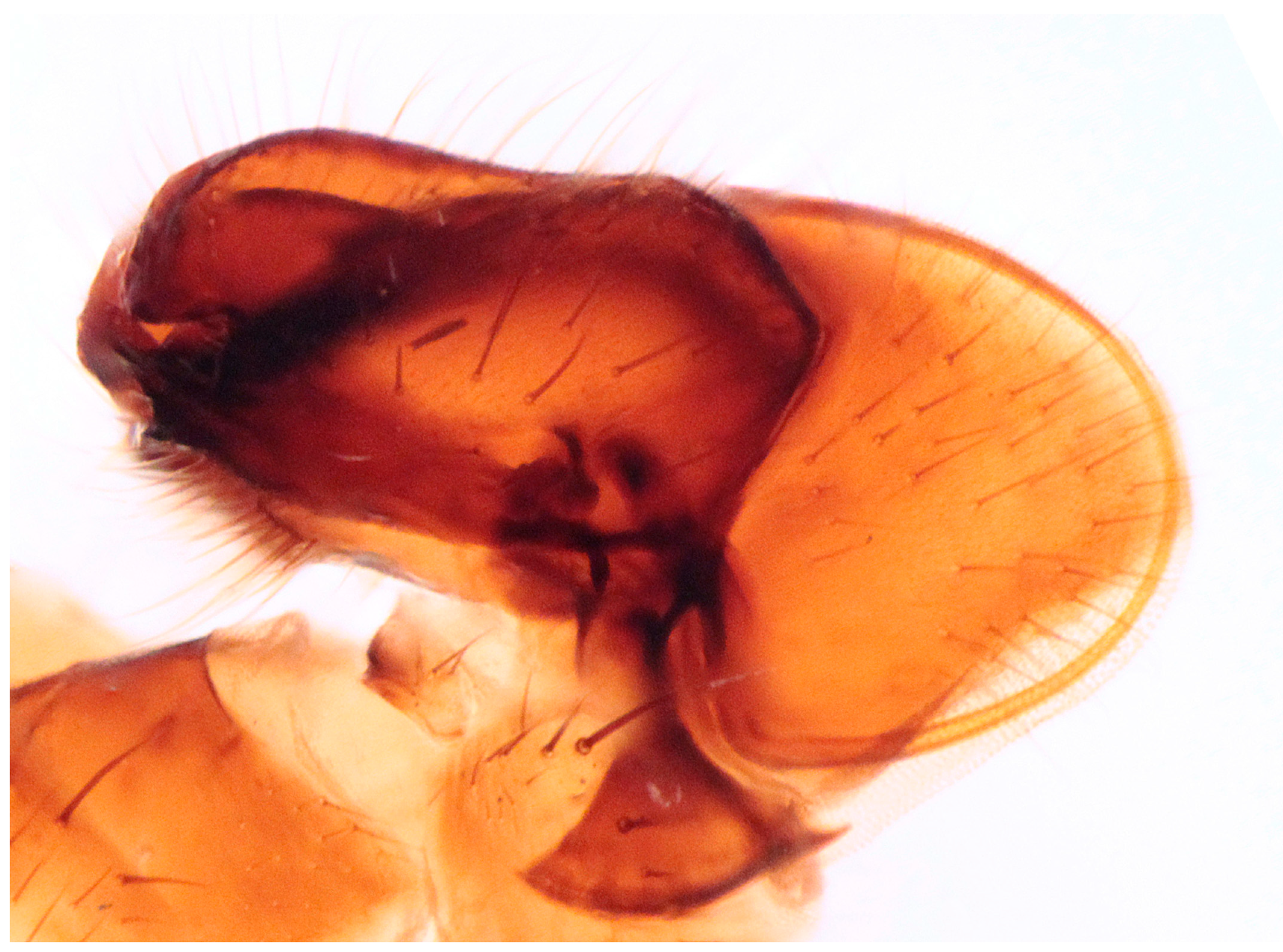
Figure 6): hypandrium small, bare; epandrium boat-shaped, with one to three long setae, cercus simple and small, phallus narrowed apically. Length: body 6.0–6.1 mm, wing 5.5–5.9 mm.
Female: Dichoptic, all facets equal in size, frons about 0.30 mm broad with about 10 long black setae on each side. Thoracic chaetotaxy as in male but all body setae shorter than in male. Legs yellow including tarsi, last tarsal segment darkened, coxae black as in male, similarly setose as in male, only setae shorter. Exceptions: posterodorsal setae on mid tibia much shorter than in male (about as long as tibia depth), hind tibia with distinct setae also ventrally. Abdomen with sternite 8 lustrous, other parts grey microtrichose; posteromarginal setae are on tergites 2–4 shorter than respective segments, on following segments very short (about as long as discal ones). Length: body 7.1–7.4 mm, wing 6.1–6.9 mm.
Etymology: The species epithet is an adjective derived from the name of the Italian Natural Park San Rossore near Pisa, where this species was collected.
Remarks: The new species resembles
Empis (
E.)
dasycera (Collin, 1960),
Empis (
E.)
picipes Meigen, 1804, and
Empis (
E.)
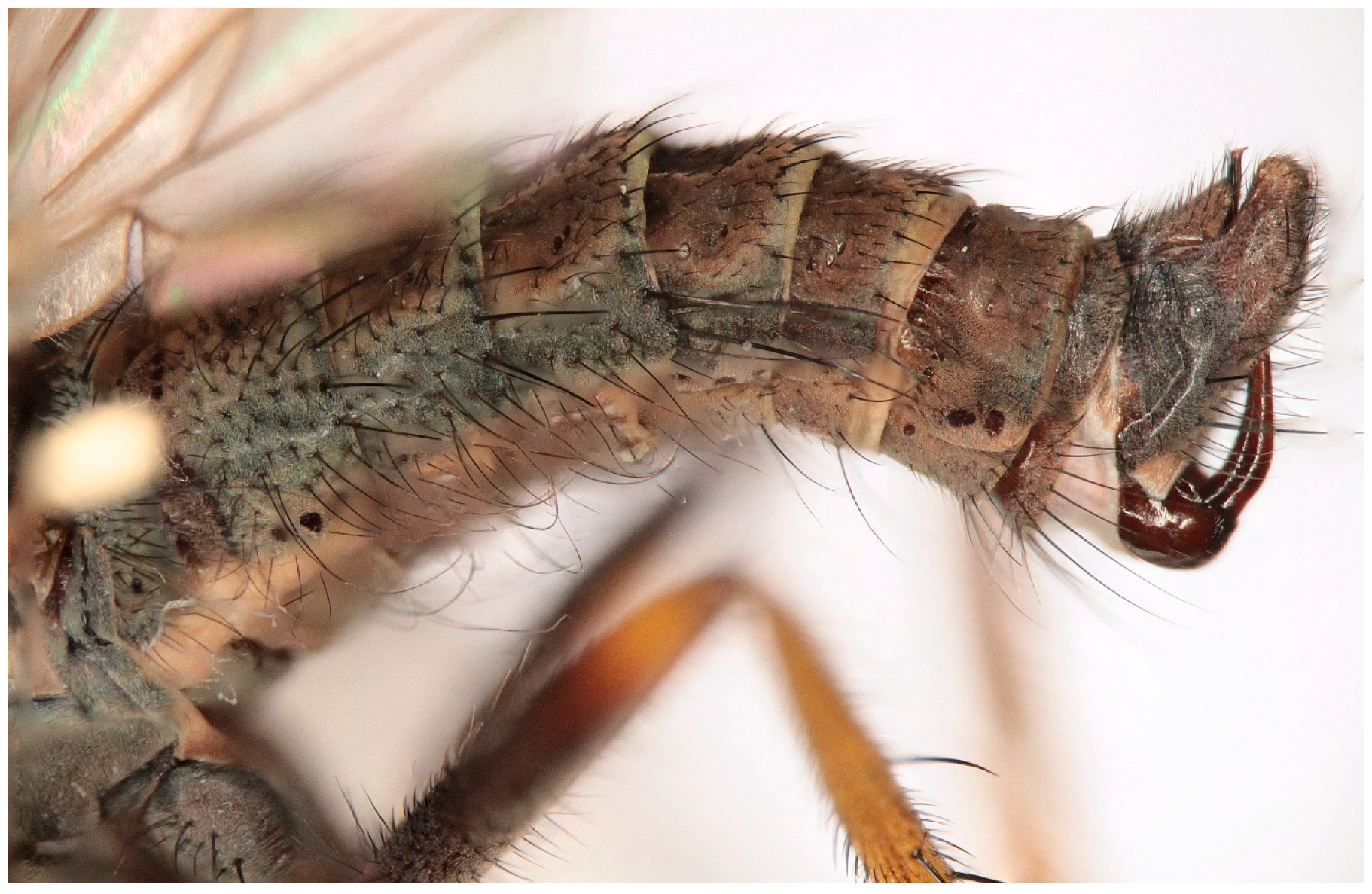
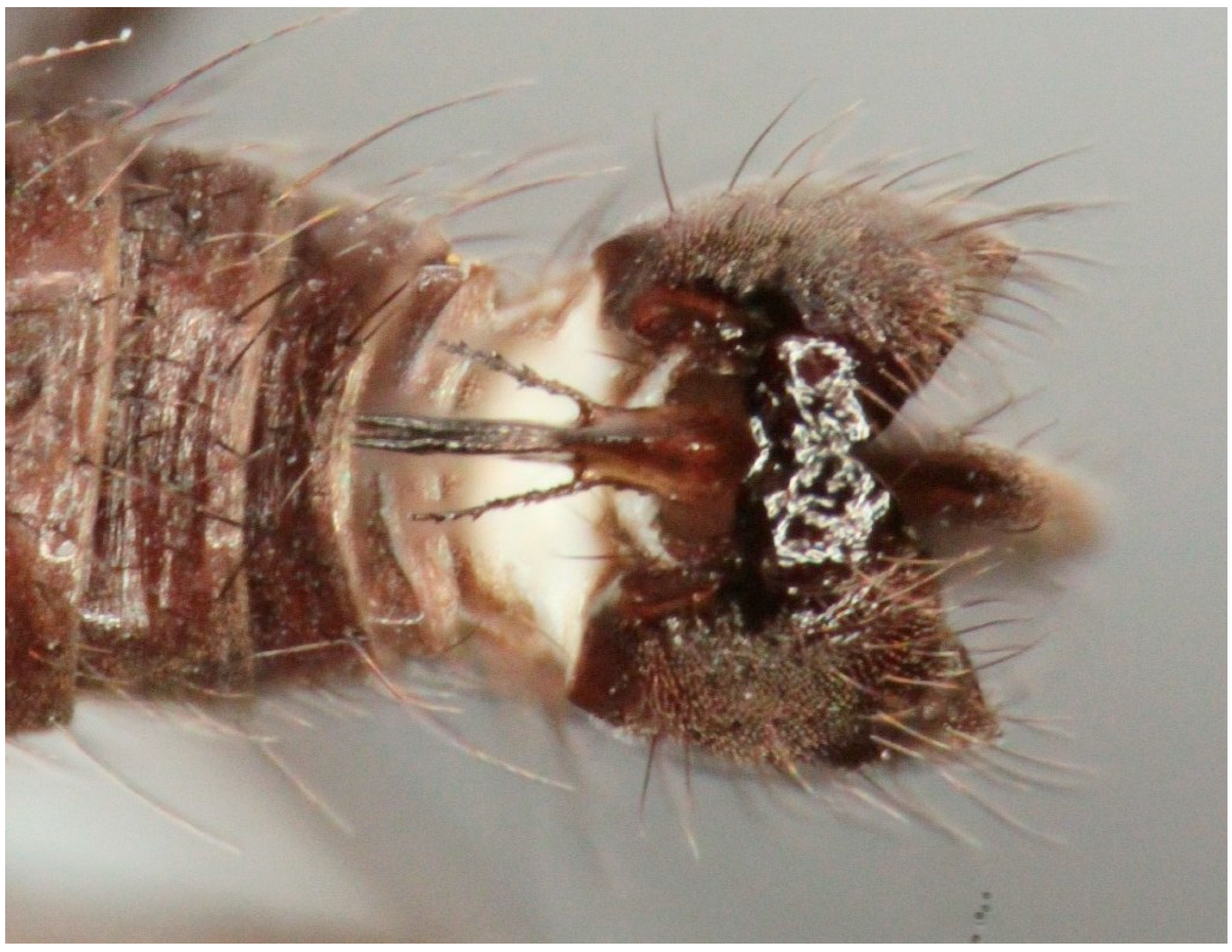
pleurica (Collin, 1960). All four species have modified (long and strong) posteromarginal setae on sides of abdominal tergite 4 (
Figure 5). In the male of
E. picipes (distributed mostly in temperate central regions of Europe, Greece, Italy, and north-western part of European Russia [
18]) and
E. dasycera (Jordan, Israel, Turkey [
18]), the posterior lateral corner of abdominal tergite 4 is produced and bears some strong setae ([
19] p. 402, Figure 3; [
20] p. 509, Figure 187; [
21] p. 28, Figure 19). In the male of
E. pleurica (Croatia, Iran, Israel, Russia (North Caucasus), Turkey [
22]), abdominal tergite 4 is not produced posterolaterally but, contrastingly with the new species, tergite 4 has a more or less distinct shiny patch on each side and tergite 5 is shiny black and convex laterally. In the new species, tergite 4 has neither a shiny spot nor produced margin, only modified long and strong setae. Considering its general appearance (
Figure 4) and especially the male genitalia (
Figure 6), the new species is similar to
Empis (
E.)
azrouensis Shamshev, 2022, however it is larger (body longer than 6 mm in the new species but 4.3 mm in
E. azrouensis), its hind tibiae do not have anteroventral setae (one seta in
E. azrouensis), and there are slight differences in the genitalia (basal part of phallus narrower and apical part slightly bent in the new species, broader in basal part and straight apically in
E. azrouensis), but most striking is the modified setosity of tergite 4 (unremarkable in
E. azrouensis)
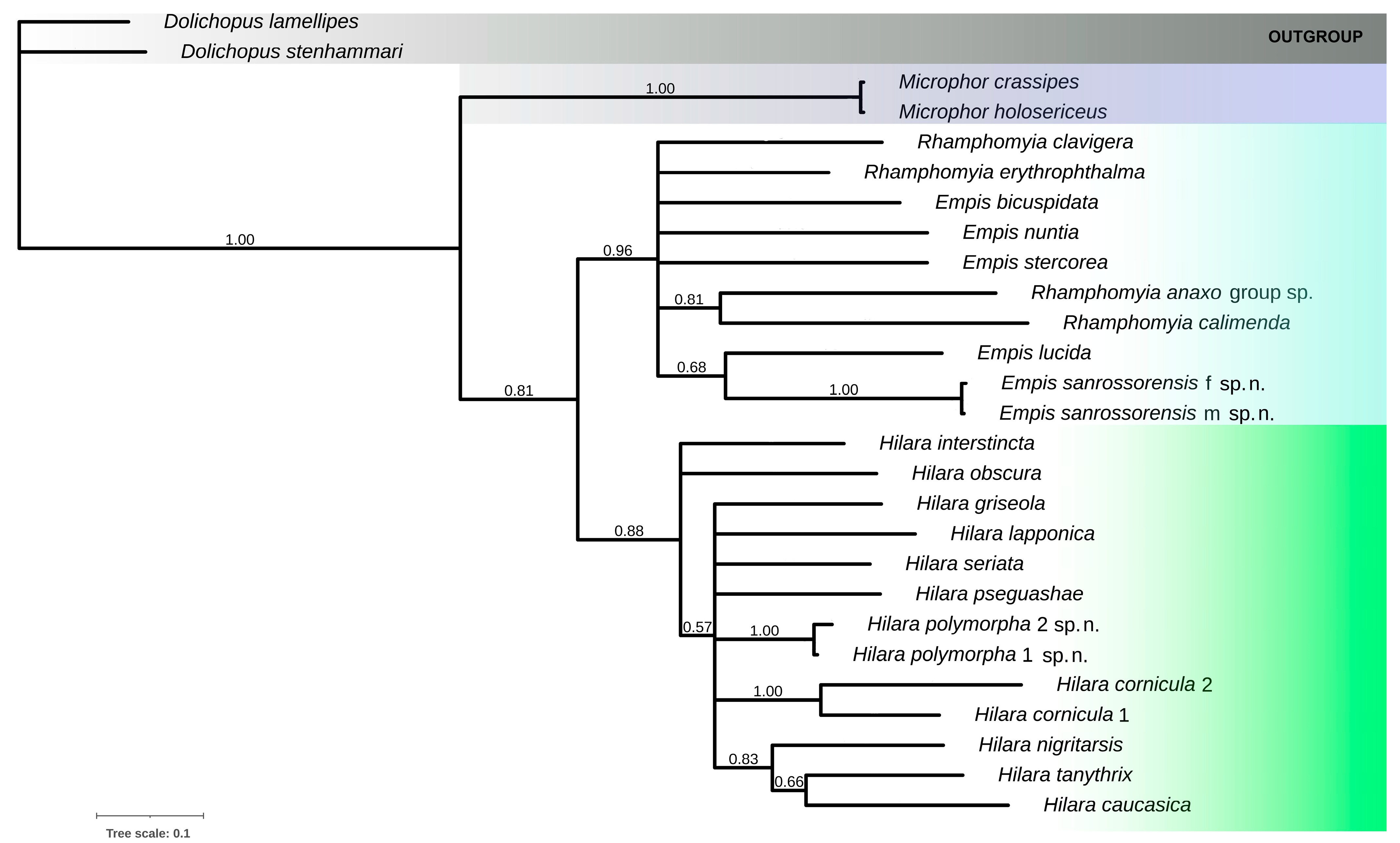
The barcoding sequences are deposited in GenBank under access numbers PQ344943 (male) and PQ344944 (female).
Hilara polymorpha Barták sp. nov.
Type material: HOLOTYPE ♂, Italy: San Rossore NP, Pisa prov. seashore, 43.723, 10.280 MT, A. Belcari, 16-27.iv.2021 (type I fore leg, deposited in CULSP). PARATYPES: type I foreleg: same data as for holotype, 17 males; same locality but 6-16.iv.2021 4 males; San Rossore NP, Pinus grove, 43.695, 10.341, MT, A. Belcari, 27.iv.-7.v.2021, 2 males; same locality but 6.-14.vi.2021, 2 males; same locality but 21.-31.viii.2021, 1 male; San Rossore NP, Pisa prov. forest, 43.725, 10.313 MT, A. Belcari, 6-16.iv.2021, 6 males; same locality but 17-27.v.2021, 2 males; same locality but 27.iv.-7.v.2021, 3 males. Type II foreleg: same data as for holotype, 12 males; same locality but 6.-16.iv.2021, 8 males; San Rossore NP, Pisa prov. forest, 43.725, 10.313 MT, A. Belcari, 27.iv.-7.v.2021, 2 males; San Rossore NP, Pinus grove, 43.695, 10.341, MT, A. Belcari, 27.iv.-7.v.2021, 3 males; same locality but 6-16.vi.2021 3 males. Females: same data as for holotype, 22 females; same locality but 6-16.iv.2021 2 females; San Rossore NP, Pinus grove, 43.695, 10.341, MT, A. Belcari, 16-27.iv.2021, 1 female; same locality but 27.iv.-7.v.2021, 3 females; same locality but 17-27.v.2021, 1 female; same locality but 6.-14.vi.2021, 1 female; San Rossore NP, Pisa prov. forest, 43.725, 10.313 MT, A. Belcari, 6-16.iv.2021, 2 females; same locality but 27.iv.-7.v.2021, 6 females; same locality but 17-27.v.2021, 2 females. All the type material is pinned and deposited in CULSP.
Distribution: Pisa province, Italy.
Diagnosis: Middle-sized black species of Hilara with black legs, halter, and occiput, quadriserial acrostichals and mesoscutum with three dark brown stripes on lines of setae. Male hypandrium produced with long finger-like lateral projections near apex. Male forelegs polymorphic, specimens differing especially in the ratio of length of tibia and basitarsus, shape of basal joints of fore tarsus and chaetotaxy as described below. Female hind tibia slightly swollen, flattened and curved.
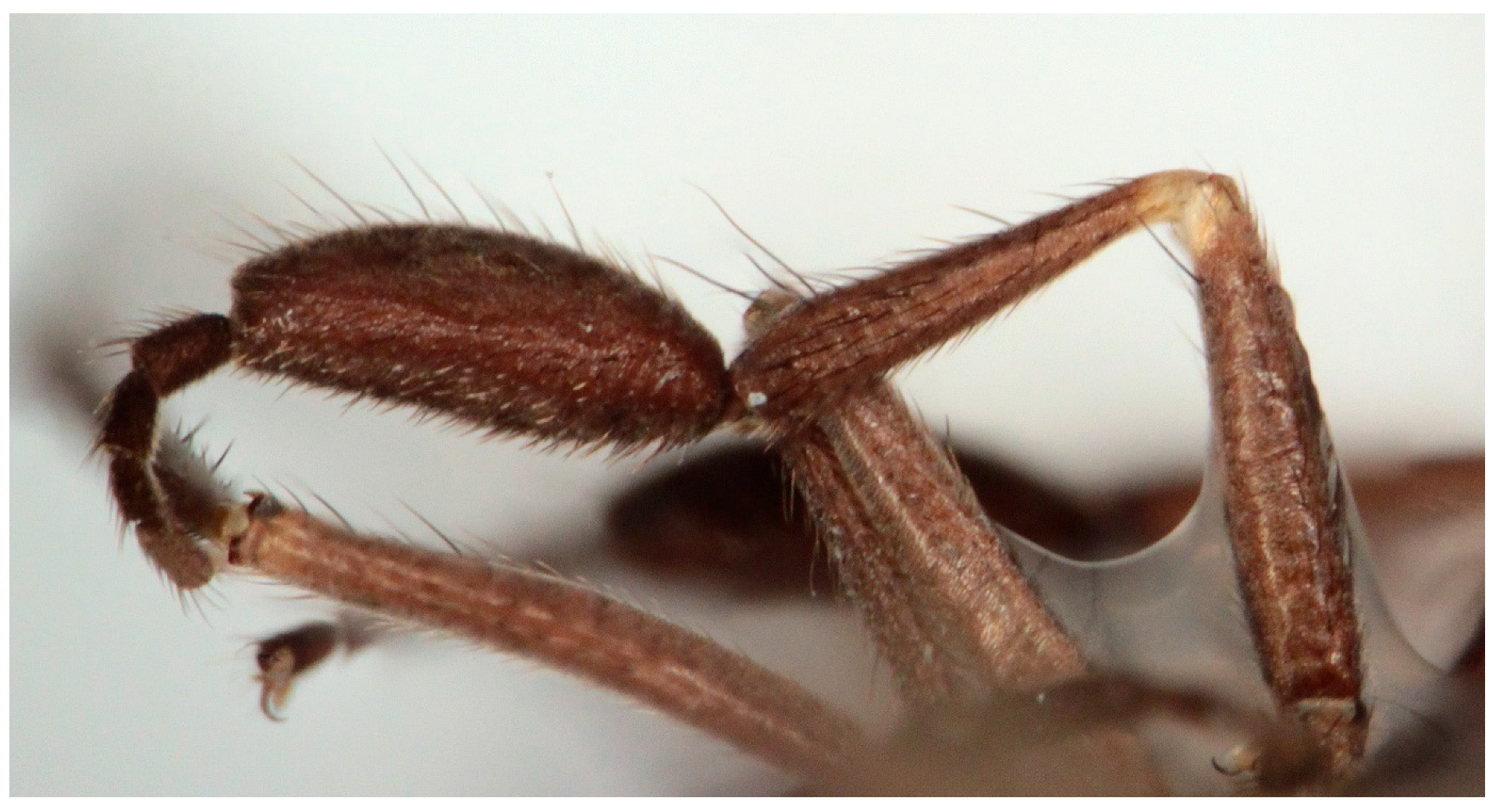
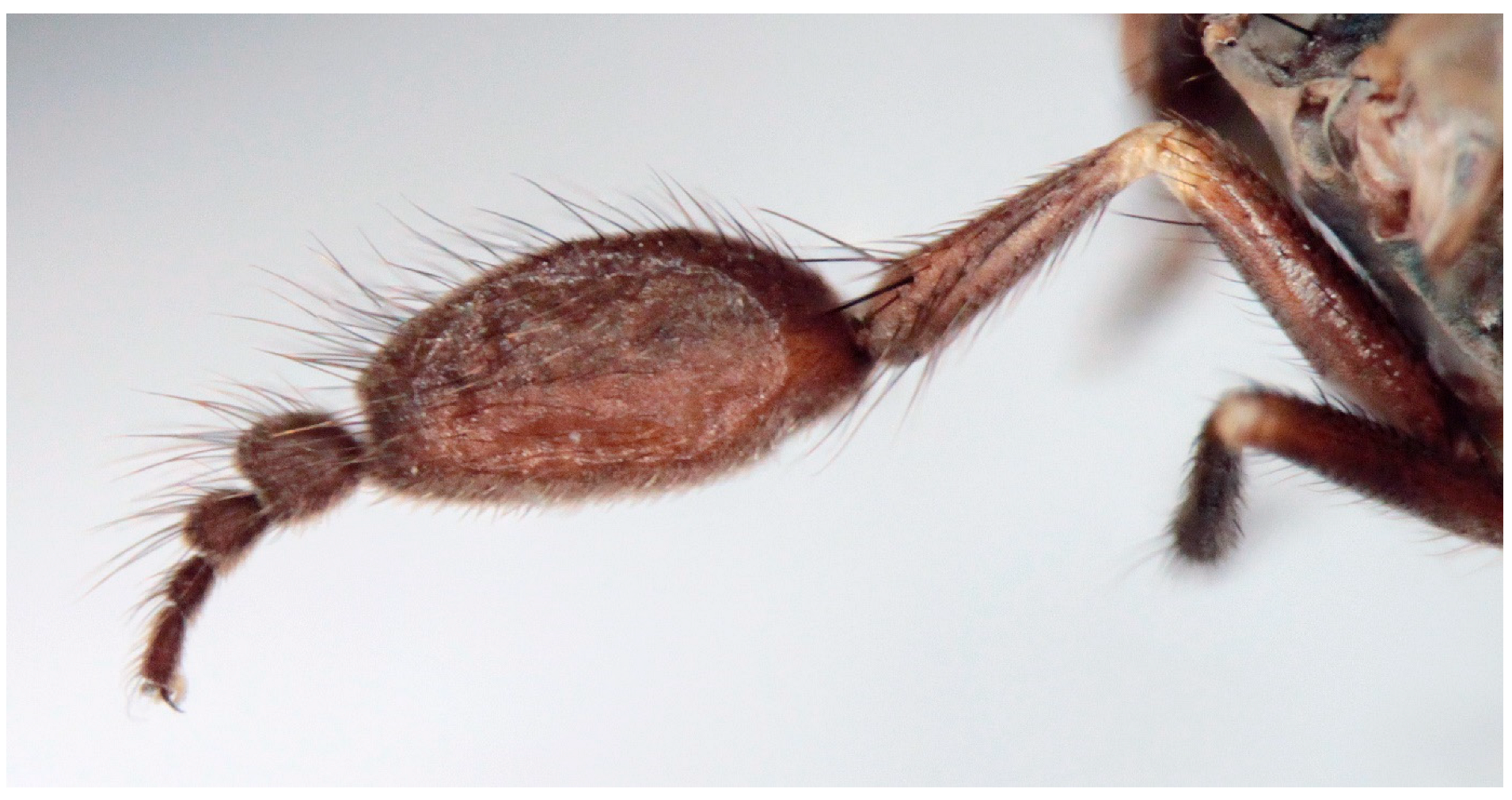
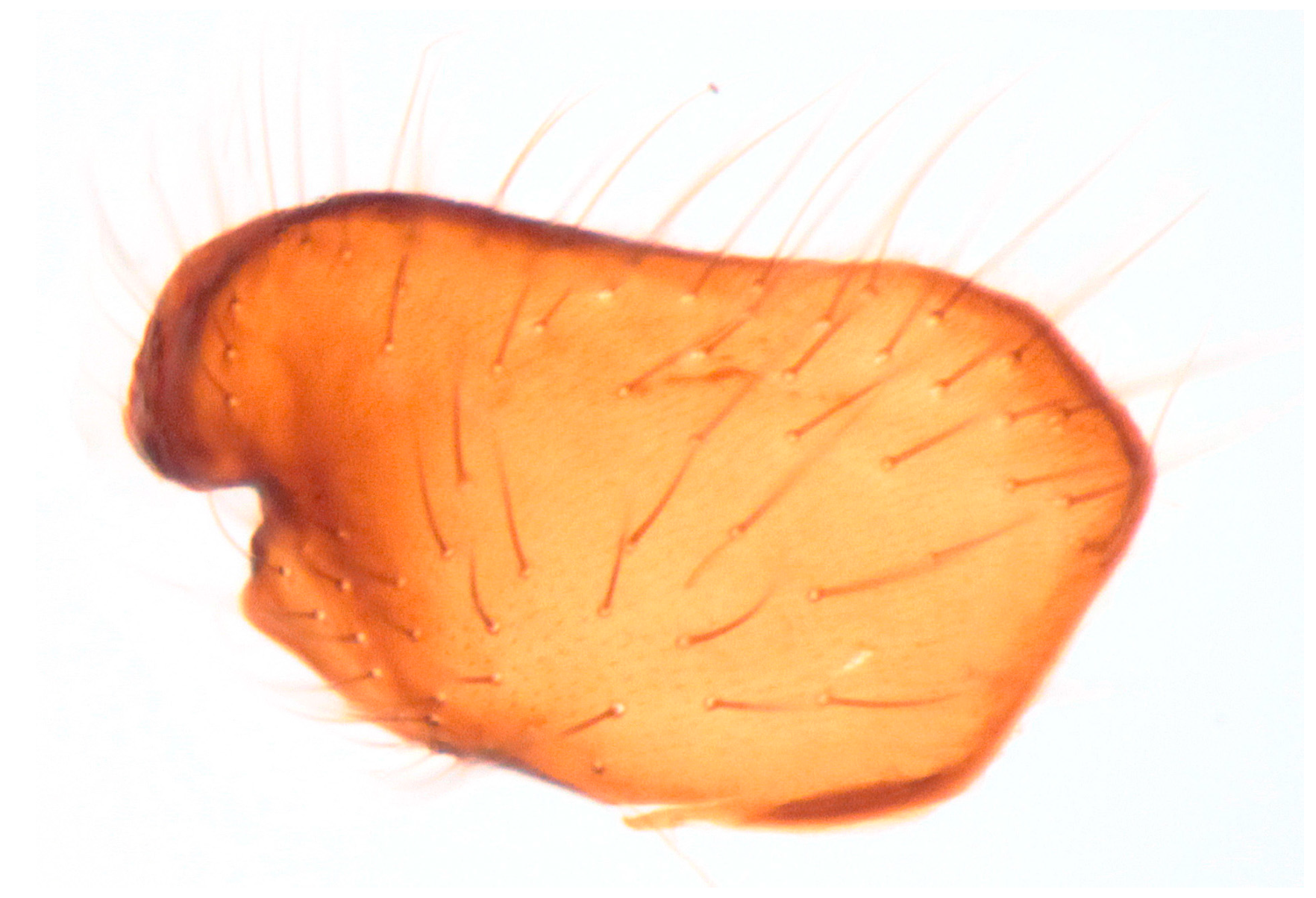
Male. Head: dichoptic, all facets approximately of same size. Head black, occiput deep velvety black in dorsal view, dark brownish grey microtrichose in posterior view. Frons broad (0.10 mm above antennae and 0.20 mm at level of front ocellus), velvety black with lighter grey triangle reaching from antennal bases to about two thirds, with one pair of frontal setae (0.20 mm long) and several additional setae on sides. Ocellar setae black, about 0.25 mm long, ocellar triangle with several additional short hair-like setae. Face rather light grey, about 0.11 mm broad at middle, slightly widening ventrally, bare. Occiput in dorsal half with only postocular row of setae slightly shorter than frontal pair, distinctly incurved and second row of several setae half as long, in ventral half irregularly and sparsely covered with fine black setae, postocular row complete. Clypeus lustrous, genae microtrichose. Antennae black, ratio of antennal segments (scape: pedicel: postpedicel: basal segment of stylus: apical bare mechanoreceptor) = 0.06–0.07 mm: 0.06–0.07 mm: 0.22–0.24 mm: 0.15–0.17 mm: 0.02–0.03 mm, respectively), both basal antennomeres rather short setose. Labrum brown, shiny, two thirds as long as head height, labellae broad and rather long setose. Palpus brown, short, with several short setae and long subapical seta. Thorax: brownish black, light grey microtrichose, mesoscutum with broad brown stripe below acrostichals and narrower brown stripes below dorsocentrals. All setae black, only proepisternum with very short pale setulae. Chaetotaxy: prosternum bare, proepisternal depression with 1–2 setulae; antepronotum with a single long and strong black seta on each side; postpronotum with one longer seta and several much shorter setulae; fine irregularly quadriserial acrostichals (about 15 setae in a row), about 0.10–0.15 mm long, some specimens with almost biserial acrostichals in anterior part; dorsocentrals uniserial and slightly longer than acrostichals, ending in 1–3 times longer and stronger prescutellars; presutural area nearly bare except 0–1 dorsocentral seta outside row, one fine well differentiated presutural intraalar and one long and strong presutural supraalar; two black notopleurals (anterior part of notopleuron with several very small black setulae); 1–2 short supraalar and several praealar setae in a row; one long postalar; four scutellars (two pairs, outer pair shorter). Legs brown with yellow knees, microtrichose, black setose. Coxae brownish black, black setose. Seta in comb at tip of hind tibia absent. Fore femur with short setae, posterodorsally and posteriorly with elongate setae about as long as femur depth. Forelegs of two different types: type I with basitarsus about as long as tibia, about three times as long as broad and dorsally with only several setae shorter than basitarsus depth, fore tarsi not or very slightly swollen, dorsally with ordinary setulae, tibia with elongate fine setae posterodorsally (slightly longer than tibia depth) and with 3–4 preapical long and strong setae (
Figure 7); type II with basitarsus about 1.5 times as long as tibia, nearly twice as long as broad, dorsally rather densely covered with setae slightly shorter than basitarsus depth, tarsal joints 2–3 swollen, almost as broad as long, dorsally with long setae, also remaining tarsomeres often rather long setose dorsally, tibia with similar posterodorsal setae as in type I but with more numerous (up to 10) strong preapicals (
Figure 8). Mid femur with complete row of long and strong anterior setae, other setae short. Mid tibia short setose, without stronger setae, posteriorly with elongate fine ciliation being slightly longer than tibia depth. Hind femur with short setose, anteroventral setae somewhat longer in apical third. Hind tibia anteroventrally with several setae slightly longer than tibia depth, dorsally short setose except long preapical anterodorsal seta. Mid and hind tarsi unremarkable, basitarsi thin and short setose. Wing clear, veins yellowish brown, CuA + CuP incomplete. Discal medial cell elongated, longer than vein M
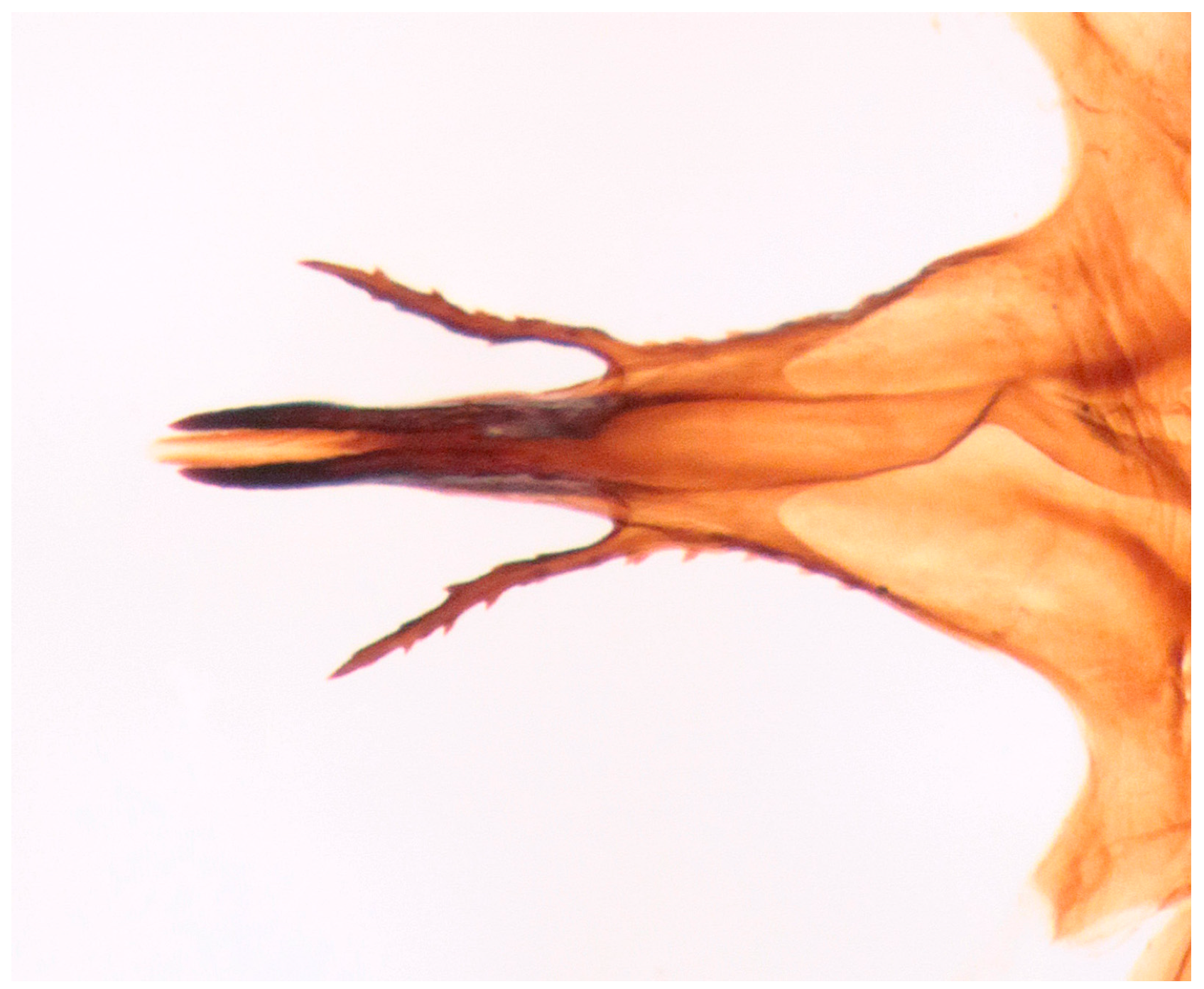
2. Costal seta long and black, axillary angle slightly obtuse. Halter brown, calypter dirty yellow with slightly darkened lateral margin and yellow fringes. Abdomen: brown, tergites sublustrous, venter microtrichose. Setae mostly black, sometimes first tergites on sides with paler setosity. Sternite 1 bare. Posteromarginal setae on sides of tergites about as long as respective segments, discal setae shorter than marginals; sternites almost bare, with only indistinct small setulae. Terminalia (
Figure 9,
Figure 10,
Figure 11 and
Figure 12) enlarged, with produced hypandrium; dorsal process of epandrium short and broad, lustrous (
Figure 11); tip of hypandrium with two serrate long lateral processes very visible in dorsal view (
Figure 11 and
Figure 12). Length of body 2.7–3.8 mm, wing 3.3–4.1 mm.
Female. Similar to male. Femora as in male, tibiae short setose, without remarkable setae. Hind tibia slightly swollen, flattened and curved. Abdomen shorter setose, posteromarginal setae shorter than respective segments, sternite 8 slightly produced, cerci slightly broadened. Length of body 3.0–3.5 mm, wing 2.8–3.7 mm.
Etymology: The species epithet is an adjective reflecting the polymorphism of male forelegs (from New Latin “polymorphus” meaning “multiform shape”).
Remarks: The species described above is distinctive due to its pronounced polymorphism in the shape of the fore tibia and basitarsus. In most
Hilara species, the shape and bristling of the foreleg are considered crucial species-specific characteristics. Roach [
23] studied the North American species of
Hilara and gave his results in his PhD thesis in 1971. The results of this revision were never published. The author mentioned a species under an MS name, which reflects the existence of different morphs (“
dimorpha”). Males of
H. polymorpha with type II legs resemble
H. balearica Chvála, 2008, characterized by greatly swollen and long setose first three fore tarsomeres. Both types share a similarly produced hypandrium and mesoscutum with three dark stripes. However, they differ in several significant features: acrostichals are quadriserial (biserial in
H. balearica); the costal seta is very long (very small in
H. balearica); the halter is blackish brown (dirty yellow in
H. balearica); and the legs have different setosity, particularly the fore tibia with long, fine posterior and posteroventral setae and a circlet of long setae preapically (short setose in
H. balearica). The mid femur has a complete row of long and strong black anterior setae (fine brownish in
H. balearica), and the abdomen is mostly black setose (including genitalia) with strong posteromarginal setae (pale setose with hind marginal bristles scarcely differentiated in
H. balearica). Several specimens exhibited intermediate characteristics between the two types of forelegs, primarily in the ratio of tibia and basitarsus length. We selected the holotype from males with type I legs because this type was significantly more common (we estimate that type II represented less than 5 percent of the total unselected material).
The barcoding sequences are deposited in GenBank under access numbers PQ344941 (leg type I) and PQ344942 (leg type II). Sequences of both specimens are similar, thus indicating that the leg types are in the scope of intraspecific variability.
Rhamphomyia (Megacyttarus) sanrossorensis Barták sp. nov.
Type material: HOLOTYPE ♂, Italy:, San Rossore NP, Pisa prov. forest, 43.725, 10.313 MT, A. Belcari, 6-16.iv.2021, deposited in CULSP. PARATYPES: same data as holotype, four males, two females; same locality but 27. iv.-7.v.2021 one male, one female; San Rossore NP, Pinus grove, 43.695, 10.341, MT, A. Belcari, 21-31.viii.2021, two males (CULSP).
Distribution: Pisa province, Italy.
Diagnosis: Rather large black species of Rhamphomyia subgenus Megacyttarus, being very similar to R. crassirostris (Fallén, 1816) in male (phallus with two loops, both fore and mid basitarsi narrow with short setae) but female with quite different wing venation (without closed discal medial cell and without any trace of vein M2).
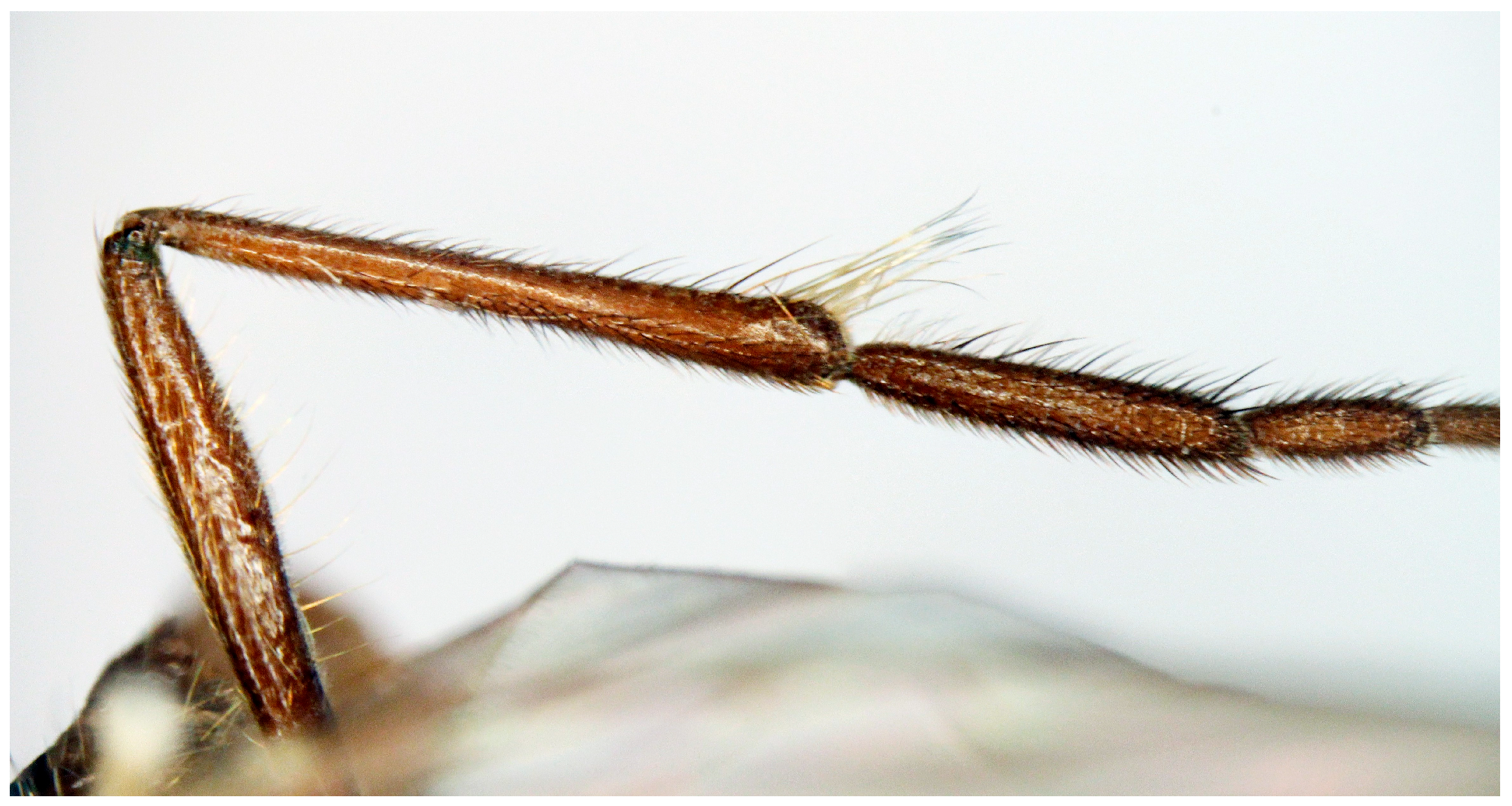
Male. Head: dichoptic, all facets approximately of same size. Head including frons, face, occiput, clypeus, and very narrow genae black, light grey microtrichose. Frons slightly broader than front ocellus, slightly widening ventrally, with two rows of 6–8 setae up to 0.20 mm long. Ocellar setae black, fine, about as long as frons (0.40 mm), ocellar triangle with several additional short setae. Face broader than frons, widening ventrally, bare. Occiput sparsely covered with short black setae, some longer white setae ventrally, postocular row complete but irregular. Antennae black, length of antennal segments (scape: pedicel: postpedicel: stylus including basal segment) = 0.18–0.20 mm: 0.08–0.11 mm: 0.38–0.42 mm: 0.11–0.13 mm, respectively. Both basal antennomeres rather short setose (longest setae about 0.15 mm long). Labrum brown, shiny, as long as or slightly longer than head height. Palpus brown, short, with several short setae. Thorax: black, light grey microtrichose, mesoscutum with two sharp blackish brown stripes between acrostichals and dorsocentrals and similar much broader stripes outside of dorsocentrals; mostly light grey stripes below acrostichals and dorsocentrals are somewhat obscured, not very light grey but rather brownish grey, especially in anterodorsal view. Large setae including acrostichals and dorsocentrals black, fine setae outside of dorsocentrals, on front part of notopleuron and proepisternum yellowish white. Laterotergite with fan of yellow setae. Chaetotaxy: proepisternum with several rather long white setae; prosternum and proepisternal depression bare; antepronotum with usual collar of setae (black, laterally yellow); postpronotum with a single long set and several shorter pale setae; fine biserial diverging acrostichals about 0.15 mm long; dorsocentrals slightly longer than acrostichals, irregularly biserial and divergent, ending mostly in several longer and stronger prescutellars; presutural intraalar not clearly differentiated from fine setae on their areas; presutural supraalar usually stronger, yellow to black; 2–4 black notopleurals (anterior part of notopleuron with rather long and fine white setae); 1–2 supraalar and 0–3 praealar setae; 1 long black and several small white postalars; 2–4 scutellars (1–2 pairs) and further 2–4 shorter setae. Legs, including coxae, brownish black, microtrichose, both black and yellow setose. Very short seta in comb at tip of hind tibia. Fore femur with short setae dorsally, anteroventrally with pale setae about as long as femur depth, almost bare posteroventrally, except several setae on basal part. Fore tibia with short and fine homogeneous ventral setation, dorsally with setae shorter than tibia depth, only several anterodorsal setae slightly longer. Mid femur with anteroventral setae about as long as femur depth (ending in short rather spinose black setae), posteroventrally with incomplete row of longer setae, all mostly yellow. Mid tibia with all setae shorter than tibia depth, only several posterodorsals slightly longer. Hind femur with very distinct posterior tubercle, dorsally short setose, ventrally with mostly yellow setae sub-equally long as femur depth. Hind tibia (
Figure 14) anteroventrally in apical part with dense homogeneous setation about as long as tibia depth and with prepical tuft of some ten long, mostly yellow setae, all other setae short. Fore basitarsus short setose, mid basitarsus thin and short setose, with short ventral spines; hind basitarsus narrow, dorsally with several setae slightly longer than its depth. Wing very slightly brownish, stigma darker, veins brown, CuA + CuP depigmented, vanishing before tip. Costal seta very small to indistinct, axillary angle right. Halter pale yellow, calypter yellow with yellow fringes. Abdomen: brownish black, venter light grey microtrichose, tergites in dorsal view dark blackish brown. Setae nearly all pale (whitish yellow to yellow) except sometimes several black hind marginals on tergites. Sternite 1 bare. Posteromarginal setae on sides of tergite 1 long, on tergite 2 as long as this segment, on remaining tergites slightly shorter, discal setae slightly shorter than marginals; sternites with sparse and somewhat longer setae on posterior margin. Terminalia (
Figure 13) very similar to nearly all other members of
R. crassirostris group of the subgenus
Megacyttarus, differing from
R. crassirostris mainly by medially incised hypandrium. Length of body 5.2–5.8 mm, wing 5.8–6.5 mm.
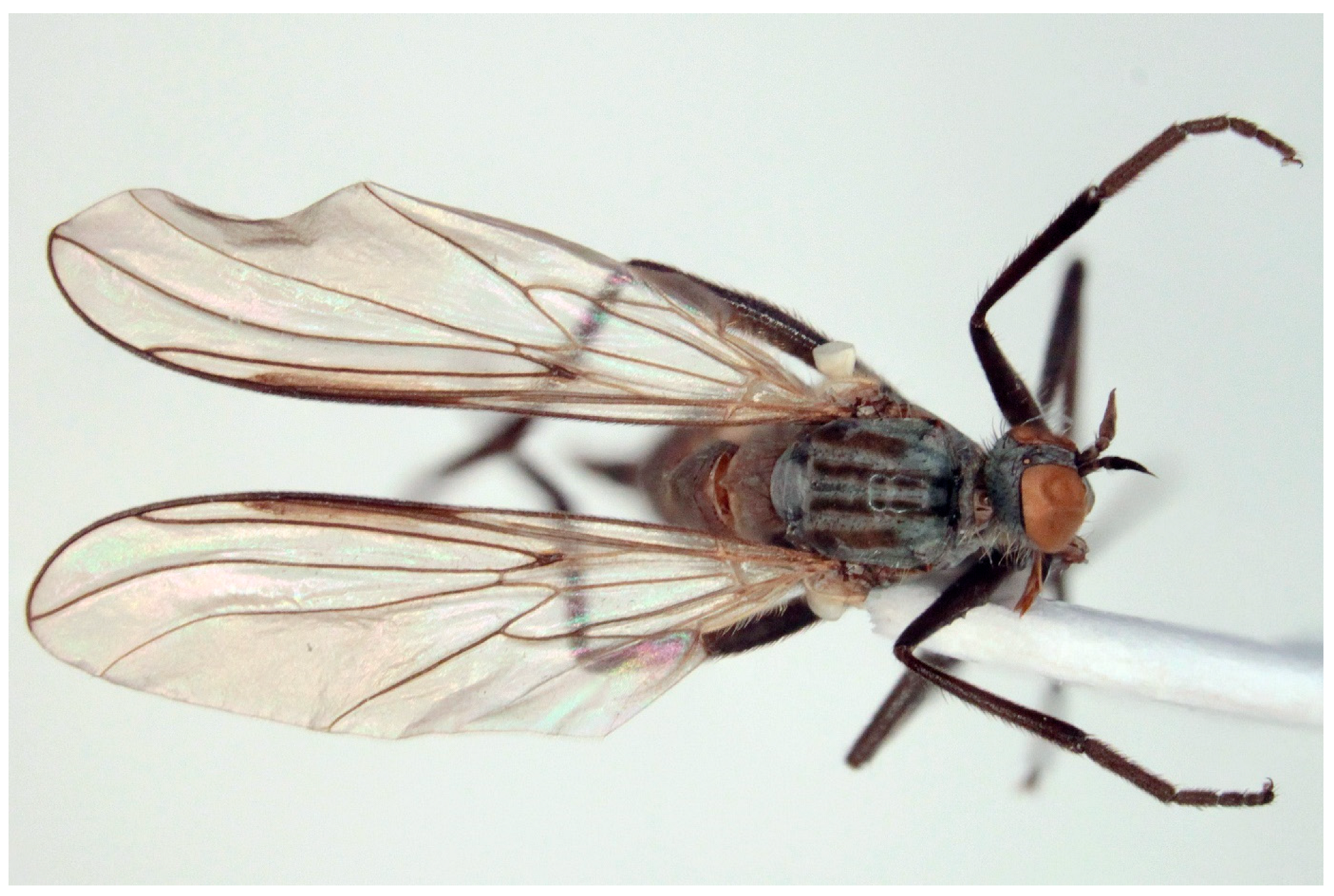
Female. Dichoptic, facets subequal in diameter. Frons about 0.20 mm wide, parallel-sided. Thorax as in male, light grey colour under acrostichals and dorsocentrals more sharply differentiated from brown stripes under setae. Fore femur with irregularly arranged anterior to anteroventral pale setae as long as or slightly longer than femur depth. Fore and mid tibia short setose. Mid femur dorsally and posteroventrally with very short mostly black setae, anteroventrally almost bare. Hind femur and tibia very short setose. Basitarsi of all legs thin and very short setose. Wing (
Figure 15) without discal medial cell. Abdomen brown, light grey microtrichose, with very short setae (except somewhat longer on basal two tergites). All setae white except several dark on last segments including cerci. Length of body 6.1–6.8 mm, wing 5.9–6.4 mm.
Etymology: The species epithet is an adjective derived from the name of the Italian Natural Park San Rossore near Pisa, where this species was collected.
Remarks: Male
Rhamphomyia sanrossorensis Barták sp. nov. is a member of the
R. crassirostris group of the subgenus
Megacyttarus (as delimited by [
24]) superficially very similar to male
Rhamphomyia (
M.)
crassirostris, having two loops on phallus and narrow and short setose fore and mid basitarsi. However, it may be separated by the tip of the tibia having a tuft of about 10 mostly yellow setae, which are much longer than dorsal setae on hind basitarsus (smaller number of mostly black setae similarly long as dorsal setae on hind basitarsus in
R. crassirostris) and prominent posterior tubercle on hind femur (similar to that in
Rhamphomyia (
M.)
poissoni Trehen, 1966, only very indistinct in
R. crassirostris). There is a small difference in the genitalia: the ventral margin of hypandrium is incised medially (best visible in lateral view) in the newly described species and simply curved in
R. crassirostris. Females have quite different wing venation without discal medial cell and without any trace of the vein M
2. This character occurs among female
Megacyttarus only in nearctic
Rhamphomyia (
M.)
rhytmica Barták, 2002 belonging to quite different species group (and sometimes, as monstrosity, in other species, but in this case mostly with at least a stub of vein M2). Moreover, female fore femora have long irregularly arranged setae anteroventrally (about as long or longer as femur depth) but only very short setae in
R. crassirostris.