

Skip to Content

Galaxies, Volume 6, Issue 1

2018 March - 38 articles

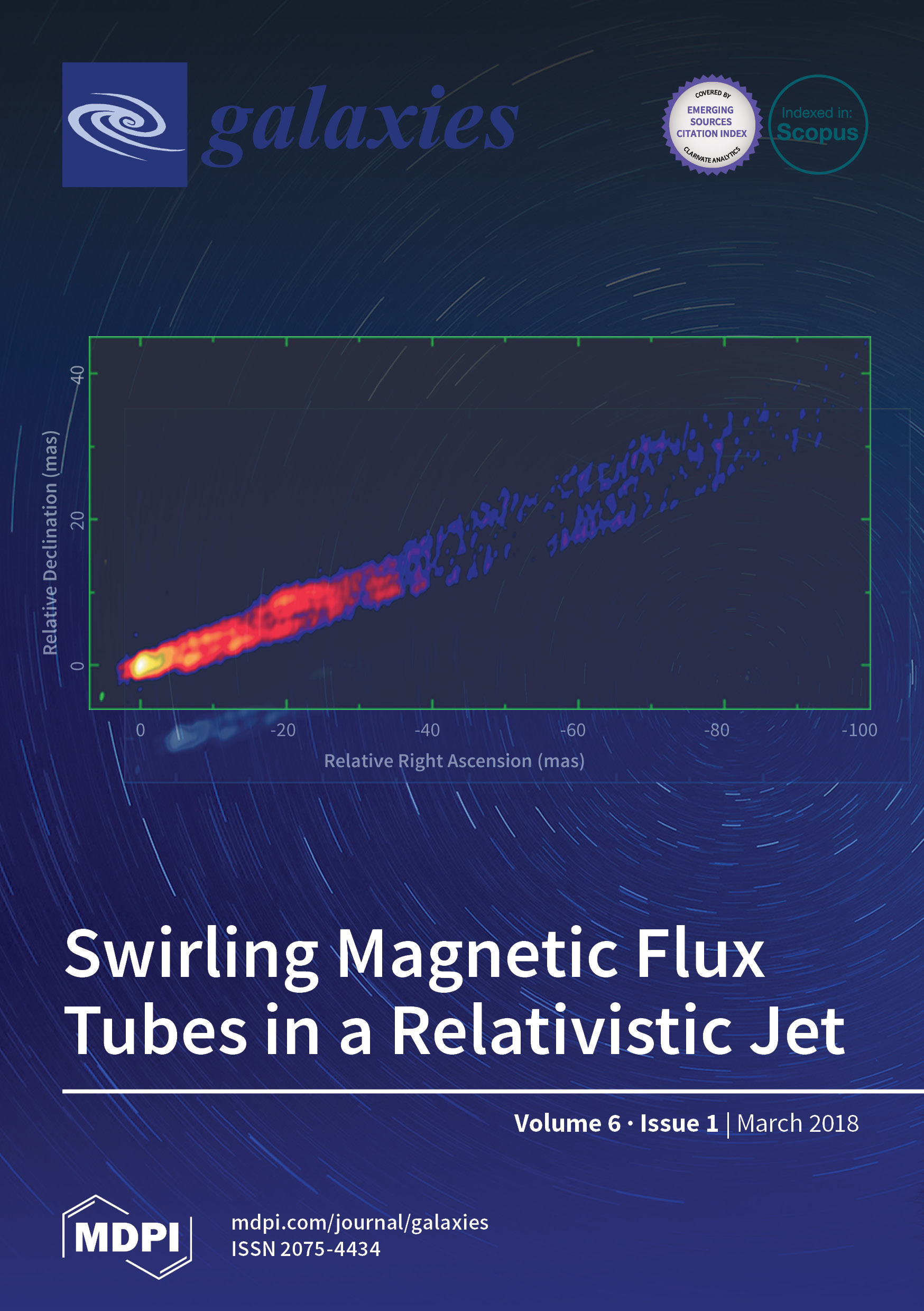
Cover Story: M87 jet magnetic flux tubes are observed here at 15 GHz by the VLBA (courtesy of Kellermann, K.; et al.), possibly indicative of the magnetic Kelvin-Helmholtz instability. This pattern also appears in simulation models (Anantua et al. 2018) when the energy density of relativistic electrons in the radio jet does not decline with magnetic field strength at increasing radii from the black hole. With observation length scales over an order of magnitude greater than simulation scales, more remote processes such as coupling to the rotating interstellar medium may be responsible for the twisting flux tubes observed than in the simulation. Finite VLBA imaging resolution may restrict observers to seeing only the largest structures (the m = ±1 modes), while it may be possible to resolve smaller-scale structure in simulations. With the “Observing” Jet/Accretion Disk/Black Hole (JAB) simulations methodology, we may analyze disk/jet magnetohydrodynamic interactions to be exhibited by the EHT.
  • Issues are regarded as officially published after their release is announced to the table of contents alert mailing list .
  • You may sign up for email alerts to receive table of contents of newly released issues.
  • PDF is the official format for papers published in both, html and pdf forms. To view the papers in pdf format, click on the "PDF Full-text" link, and use the free Adobe Reader to open them.

Articles (38)

  • Feature Paper
  • Article
  • Open Access
6 Citations
4,073 Views
7 Pages

Astronomical X-ray polarimetry was first explored in the end of the 1960s by pioneering rocket instruments. The craze arising from the first discoveries of stellar and supernova remnant X-ray polarization led to the addition of X-ray polarimeters to...

  • Feature Paper
  • Article
  • Open Access
3,931 Views
17 Pages

The study of multi-wavelength flux variability in BL Lacertae objects is very important to discern unstable processes and emission mechanisms underlying their extreme observational features. While the innermost regions of these objects are not access...

  • Feature Paper
  • Article
  • Open Access
10 Citations
5,006 Views
14 Pages

Isolated neutron stars are known to be endowed with extreme magnetic fields, whose maximum intensity ranges from 10 12 10 15 G, which permeates their magnetospheres. Their surrounding environment is also strongly magnetized, especiall...

  • Feature Paper
  • Conference Report
  • Open Access
1 Citations
3,822 Views
8 Pages

Bursts and flares are among the distinctive observational manifestations of magnetars, isolated neutron stars endowed with an ultra-strong magnetic field ( B 10 14 10 15 G). It is believed that these events arise in a hot electron-...

  • Feature Paper
  • Article
  • Open Access
5 Citations
3,726 Views
7 Pages

Multiwavelength blazar variability is produced by noise-like processes with the power-law form of power spectral density (PSD). We present the results of our detailed investigation of multiwavelength ( γ -ray and optical) light curves covering...

  • Feature Paper
  • Article
  • Open Access
22 Citations
7,963 Views
15 Pages

We review the history of astronomical X-ray polarimetry based on the author’s perspective, beginning with early sounding-rocket experiments by Robert Novick at Columbia University and his team, of which the author was a member. After describing vario...

  • Feature Paper
  • Article
  • Open Access
2 Citations
3,437 Views
6 Pages

Studying Microquasars with X-Ray Polarimetry

  • Giorgio Matt and
  • Francesco Tamborra

Microquasars are Galactic black hole systems in which matter is transferred from a donor star and accretes onto a black hole of, typically, 10–20 solar masses. The presence of an accretion disk and a relativistic jet made them a scaled down analogue...

  • Feature Paper
  • Article
  • Open Access
12 Citations
6,553 Views
10 Pages

This work summarizes a program intended to unify three burgeoning branches of the high-energy astrophysics of relativistic jets: general relativistic magnetohydrodynamic (GRMHD) simulations of ever-increasing dynamical range, the microphysical theory...

  • Feature Paper
  • Article
  • Open Access
14 Citations
6,957 Views
9 Pages

The PoGO+ Balloon-Borne Hard X-ray Polarimetry Mission

  • Mette Friis,
  • Mózsi Kiss,
  • Victor Mikhalev,
  • Mark Pearce and
  • Hiromitsu Takahashi

The PoGO mission, including the PoGOLite Pathfinder and PoGO+, aims to provide polarimetric measurements of the Crab system and Cygnus X-1 in the hard X-ray band. Measurements are conducted from a stabilized balloon-borne platform, launched on a 1 mi...

  • Feature Paper
  • Article
  • Open Access
38 Citations
8,010 Views
9 Pages

Unveiling the Origin of the Fermi Bubbles

  • H.-Y. Karen Yang,
  • Mateusz Ruszkowski and
  • Ellen G. Zweibel

28 February 2018

The Fermi bubbles, two giant structures above and below the Galactic center (GC), are among the most important discoveries of the Fermi Gamma-ray Space Telescope. Studying their physical origin has been providing valuable insights into cosmic-ray tra...

  • Feature Paper
  • Article
  • Open Access
2 Citations
4,169 Views
10 Pages

27 February 2018

Combined cosmological, astrophysical and numerical tests may shed some light on the viability of theories of gravity beyond Einsteinian relativity. In this letter, we present two different techniques providing complementary ways of testing new physic...

  • Feature Paper
  • Review
  • Open Access
52 Citations
9,785 Views
20 Pages

X-Ray and Gamma-Ray Observations of the Fermi Bubbles and NPS/Loop I Structures

  • Jun Kataoka,
  • Yoshiaki Sofue,
  • Yoshiyuki Inoue,
  • Masahiro Akita,
  • Shinya Nakashima and
  • Tomonori Totani

26 February 2018

The Fermi bubbles were possibly created by large injections of energy into the Galactic Center (GC), either by an active galactic nucleus (AGN) or by nuclear starburst more than ~10 Myr ago. However, the origin of the diffuse gamma-ray emission assoc...

  • Feature Paper
  • Conference Report
  • Open Access
18 Citations
5,142 Views
10 Pages

25 February 2018

Deep-sea archives all over the world show an enhanced concentration of the radionuclide 60Fe, isolated in layers dating from about 2.2 Myr ago. Since this comparatively long-lived isotope is not naturally produced on Earth, such an enhancement can on...

  • Feature Paper
  • Article
  • Open Access
4 Citations
6,426 Views
23 Pages

21 February 2018

The first part of this paper contains a brief description of the beginnings of modern cosmology, which, the author will argue, was most likely born in the year 1912. Some of the pieces of evidence presented here have emerged from recent research in t...

  • Feature Paper
  • Article
  • Open Access
3 Citations
3,324 Views
8 Pages

18 February 2018

In arXiv:1601.02203 and arXiv:1702.07063, we have proposed a topological model with a simple Lagrangian density and have tried to solve one of the cosmological constant problems. The Lagrangian density is the BRS exact and therefore the model can be...

  • Feature Paper
  • Article
  • Open Access
27 Citations
4,227 Views
7 Pages

Unitary Issues in Some Higher Derivative Field Theories

  • Manuel Asorey,
  • Leslaw Rachwal and
  • Ilya Shapiro

14 February 2018

We analyze the unitarity properties of higher derivative quantum field theories which are free of ghosts and ultraviolet singularities. We point out that in spite of the absence of ghosts most of these theories are not unitary. This result confirms t...

  • Feature Paper
  • Conference Report
  • Open Access
5 Citations
3,591 Views
8 Pages

Galactic Structures from Gravitational Radii

  • Salvatore Capozziello,
  • Duško Borka,
  • Vesna Borka Jovanović and
  • Predrag Jovanović

7 February 2018

We demonstrate that the existence of a Noether symmetry in f ( R ) theories of gravity gives rise to an additional gravitational radius, besides the standard Schwarzschild one, determining the dynamics at galactic scales. By this feature, it...

  • Feature Paper
  • Article
  • Open Access
7 Citations
3,647 Views
13 Pages

The Avoidance of the Little Sibling of the Big Rip Abrupt Event by a Quantum Approach

  • Imanol Albarran,
  • Mariam Bouhmadi-López,
  • Franciso Cabral and
  • Prado Martín-Moruno

6 February 2018

We address the quantisation of a model that induces the Little Sibling of the Big Rip (LSBR) abrupt event, where the dark energy content is described by means of a phantom-like fluid or a phantom scalar field. The quantisation is done in the framewor...

  • Feature Paper
  • Article
  • Open Access
3 Citations
3,868 Views
7 Pages

Statistical Analysis of the Microvariable AGN Source Mrk 501

  • Alberto C. Sadun,
  • Masoud Asadi-Zeydabadi,
  • Brian Mills and
  • Joseph Ward Moody

5 February 2018

We report on the optical observations and analysis of the high-energy peaked BL Lac object (HBL), Mrk 501, at redshift z = 0.033. We can confirm microvariable behavior over the course of minutes on several occasions per night. As an alternative to th...

  • Feature Paper
  • Conference Report
  • Open Access
2 Citations
3,920 Views
8 Pages

The Third Quantization: To Tunnel or Not to Tunnel?

  • Mariam Bouhmadi-López,
  • Manuel Krämer,
  • João Morais and
  • Salvador Robles-Pérez

2 February 2018

Within the framework of the third quantization, we consider the possibility that an initially recollapsing baby universe can enter a stage of near de Sitter inflation by tunnelling through a Euclidean wormhole that connects the recollapsing and infla...

  • Feature Paper
  • Article
  • Open Access
3 Citations
3,339 Views
7 Pages

Optical Polarimetry and Radio Observations of PKS1510-089 between 2009 and 2013

  • Pedro P. B. Beaklini,
  • Tânia P. Dominici and
  • Zulema Abraham

1 February 2018

The blazar PKS 1510-089 has shown intense activity at γ -rays in the recent years. In this work, we discussed the results of our 7 mm radio continuum and optical polarimetric monitoring between 2009 and 2013. In 2009, we detected a large rotatio...

  • Feature Paper
  • Article
  • Open Access
6 Citations
3,780 Views
8 Pages

Constraints on Particles and Fields from Full Stokes Observations of AGN

  • Daniel C. Homan,
  • Talvikki Hovatta,
  • Yuri Y. Kovalev,
  • Matthew L. Lister,
  • Alexander B. Pushkarev and
  • Tuomas Savolainen

29 January 2018

Combined polarization imaging of radio jets from Active Galactic Nuclei (AGN) in circular and linear polarization, also known as full Stokes imaging, has the potential to constrain both the magnetic field structure and particle properties of jets. Al...

  • Feature Paper
  • Article
  • Open Access
25 Citations
5,200 Views
7 Pages

The Global Jet Structure of the Archetypical Quasar 3C 273

  • Kazunori Akiyama,
  • Keiichi Asada,
  • Vincent L. Fish,
  • Masanori Nakamura,
  • Kazuhiro Hada,
  • Hiroshi Nagai and
  • Colin J. Lonsdale

24 January 2018

A key question in the formation of the relativistic jets in active galactic nuclei (AGNs) is the collimation process of their energetic plasma flow launched from the central supermassive black hole (SMBH). Recent observations of nearby low-luminosity...

  • Feature Paper
  • Article
  • Open Access
4 Citations
3,278 Views
4 Pages

Polarimetric Monitoring of Jets with Kanata Telescope

  • Ryosuke Itoh,
  • Makoto Uemura,
  • Yasushi Fukazawa and
  • Koji Kawabata

24 January 2018

The polarization of relativistic jets is of interest for the understanding of their origin, confinement, and propagation. However, even though numerous measurements have been performed, the mechanisms behind jet variability, creation, and composition...

  • Feature Paper
  • Article
  • Open Access
7 Citations
4,251 Views
7 Pages

Polarimetric Evidence of the First White Dwarf Pulsar: The Binary System AR Scorpii

  • David A.H. Buckley,
  • Stephen B. Potter,
  • Pieter J. Meintjes,
  • Tom R. Marsh and
  • Boris T. Gänsicke

22 January 2018

The binary star AR Scorpii was recently discovered to exhibit high amplitude coherent variability across the electromagnetic spectrum (ultraviolet to radio) at two closely spaced ∼2 min periods, attributed to the spin period of a white dwarf and the...

  • Feature Paper
  • Article
  • Open Access
1 Citations
4,161 Views
4 Pages

Polarization: A Method to Reveal the True Nature of the Dusty S-Cluster Object (DSO/G2)

  • Banafsheh Shahzamanian,
  • Andreas Eckart,
  • Michal Zajacek,
  • Monica Valencia-S. and
  • Nadeen B. Sabha

17 January 2018

There have been different scenarios describing the nature of a dusty source, noted as Dusty S-cluster Object (DSO) or G2, orbiting around the Galactic centre super-massive black hole. Observing the polarized continuum emission of this source provides...

  • Feature Paper
  • Article
  • Open Access
1 Citations
3,740 Views
7 Pages

Time in Quantum Cosmology of FRW f(R) Theories

  • C. Ramírez and
  • V. Vázquez-Báez

17 January 2018

The time problem is a problem of canonical quantum gravity that has long been known about; it is related to the relativistic invariance and the consequent absence of an explicit time variable in the quantum equations. This fact complicates the interp...

  • Feature Paper
  • Article
  • Open Access
22 Citations
4,652 Views
8 Pages

Ultra Light Axionic Dark Matter: Galactic Halos and Implications for Observations with Pulsar Timing Arrays

  • Ivan De Martino,
  • Tom Broadhurst,
  • S.-H. Henry Tye,
  • Tzihong Chiueh,
  • Hsi-Yu Schive and
  • Ruth Lazkoz

16 January 2018

The cold dark matter (CDM) paradigm successfully explains the cosmic structure over an enormous span of redshifts. However, it fails when probing the innermost regions of dark matter halos and the properties of the Milky Way’s dwarf galaxy satellites...

  • Feature Paper
  • Article
  • Open Access
2 Citations
3,225 Views
17 Pages

16 January 2018

Supersymmetry arises in certain theories of fermions coupled to gauge fields and gravity in a spacetime of 11 dimensions. The dynamical brane background has mainly been studied for the class of purely bosonic solutions only, but recent developments i...

  • Feature Paper
  • Article
  • Open Access
3 Citations
3,124 Views
11 Pages

12 January 2018

The unimodular theory of gravity admits a canonical quantization of minisuperspace models without the problem of time. We derive instead a kind of Schrödinger equation. We have found unitarily evolving wave packet solutions for the special case of a...

  • Feature Paper
  • Article
  • Open Access
11 Citations
3,666 Views
6 Pages

12 January 2018

It is theoretically expected that active galactic nucleus (AGN) jets should carry helical magnetic (B) fields, which arise due to the rotation of the central black hole and accretion disk combined with the jet outflow. The direction of the toroidal c...

  • Feature Paper
  • Conference Report
  • Open Access
2 Citations
3,212 Views
8 Pages

We review the computation of the power spectra of inflationary gauge-invariant perturbations in the context of canonical quantum gravity for generic slow-roll models. A semiclassical approximation, based on an expansion in inverse powers of the Planc...

  • Feature Paper
  • Article
  • Open Access
26 Citations
5,438 Views
8 Pages

We briefly review how opacity affects the observed polarization in synchrotron emitting jets. We show some new multi-frequency observations of 3C 273 made with the VLBA in 1999–2000, which add significantly to the available rotation measure (RM) obse...

  • Feature Paper
  • Article
  • Open Access
6 Citations
3,056 Views
7 Pages

We discuss a black hole generated by some matter fluid, whose stress-energy tensor is known. We show that it is regular and that it satisfies the Weak Energy Condition (WEC) and the null energy condition (NEC). Finally, we look for its asymptotic beh...

  • Feature Paper
  • Article
  • Open Access
4 Citations
3,692 Views
6 Pages

Recently, evidence for synchrotron emission in both black-hole (BH) and neutron star X-ray binaries has been mounting, from optical/infrared spectral, polarimetric, and fast timing signatures. The synchrotron emission of jets can be highly linearly p...

  • Feature Paper
  • Article
  • Open Access
31 Citations
4,989 Views
14 Pages

In this work, we present the results of our multi-band microvariability study of the famous blazar BL Lac. We performed microvariablity observations of the source in the optical VRI bands for four nights in 2016. We studied the intranight flux and sp...

  • Feature Paper
  • Article
  • Open Access
35 Citations
4,833 Views
14 Pages

25 December 2017

We reviewed multi-wavelength blazars variability and detection of quasi-periodic oscillations on intra-day timescales. The variability timescale from a few minutes to up to less than a days is commonly known as intra-day variability. These fast varia...

Get Alerted

Add your email address to receive forthcoming issues of this journal.

XFacebookLinkedIn
Galaxies - ISSN 2075-4434