


Abstract
The Earth Pressure Balance (EPB) shield machine plays a pivotal role in underground tunnel excavation, where precise control of chamber pressure is essential for maintaining tunnel stability and minimizing risks. Traditional EPB control methods heavily rely on operator experience, resulting in delays and limited responsiveness to sudden geological changes. This paper presents an improved EPB mechanism model that builds upon traditional approaches, which primarily consider chamber pressure changes caused by soil volume variations. The improved model further incorporates the effects of excavation face pressure variations, arising from factors such as cutterhead soil extrusion and changing geological conditions. By integrating these additional influences, the model achieves more accurate predictions of chamber pressure. To further enhance performance, a hybrid modeling approach is proposed, combining the improved mechanism model with a data-driven component that compensates for residual prediction errors. The hybrid model is validated using field data from two distinct tunneling projects, demonstrating superior prediction accuracy and generalization capability compared to standalone mechanisms and data-driven models. The results confirm that the proposed hybrid model significantly improves pressure prediction accuracy and provides a more reliable solution for intelligent control of the EPB process.
1. Introduction
The earth pressure balance (EPB) shield machine is a critical piece of engineering machinery used for underground tunnel excavation. It is regarded as a national strategic equipment and a key indicator of a country’s capabilities in heavy equipment manufacturing. The EPB process plays a critical role in controlling ground settlement and maintaining tunnel stability. Reliable chamber pressure prediction is therefore important not only for construction safety, but also for enhancing the resilience of underground infrastructure under complex geological and operational disturbances [1].
Currently, shield operators manually adjust the screw conveyor rotational speed and advance speed to regulate the inflow and outflow of excavated soil, thereby controlling the chamber pressure to achieve a dynamic balance between the excavation face pressure and the support pressure [2,3]. However, this method heavily relies on operator experience. It has significant time delays and struggles to respond quickly to sudden changes in hydrostatic pressure during extreme conditions. This poses substantial risks to the shield machine’s safety. To achieve intelligent control of the EPB process, it is essential to determine chamber pressure based on comprehensive tunneling parameters [4]. Accurate modeling of the earth pressure balance process is, therefore, a key prerequisite for achieving this goal.
Existing EPB models can generally be classified into mechanism models and data-driven models. For mechanism models, research mainly focuses on how different factors affect the EPB process. These factors include geological conditions, interactions at the excavation face, screw conveyor discharge, and the propulsion system. Lu [5] investigated the influence of seepage on the EPB process through a modified wedge model under seepage conditions and numerical simulations calibrated with field monitoring data. The results obtained from both methods showed strong consistency. Zhang [6] derived a decoupled description of the interaction between the cutterhead and surrounding soil by solving the equilibrium differential equations of the excavation face under specified boundary conditions. They further developed a formula for calculating the excavation face stress, laying a solid foundation for the accurate computation of chamber pressure. Liu et al. [7] proposed a geological adaptive intelligent control method for EPB shield machines based on the DDPG algorithm, in which an environmental model was established using the relationship between chamber pressure and screw conveyor speed. The current mechanism model research can basically grasp the influence law of shield tunneling parameters and geometric parameters, realize trend prediction, and has good generalization performance. However, due to the nonlinearity, high coupling, and significant time delays inherent in the EPB process, as well as the influence of multiple factors such as geometric parameters, tunneling parameters, and geological conditions, existing mechanism models suffer from oversimplified physical formulas and incomplete consideration of variables, leading to reduced accuracy in practical projects.
For data-driven models, considering the challenge of accurately describing the relationship between chamber pressure and various influencing parameters using explicit formulas, some researchers have employed machine learning and artificial intelligence techniques to develop data-driven models. Samadi et al. [8] applied machine learning algorithms to predict earth pressure balance in EPB-TBM tunneling and demonstrated their potential for improving construction safety and tunneling efficiency. Gao et al. [9] proposed a chamber pressure prediction method based on a Gated Recurrent Unit (GRU) neural network with an improved loss function. By integrating a genetic algorithm, they used the active and passive earth pressures as boundary constraints to identify optimal control parameters, ensuring that the chamber pressure remained within a safe range. Current data-driven models for shield machine chamber pressure prediction mainly adopt neural networks [10,11] or machine learning techniques [12,13], and they demonstrate good accuracy on training and testing datasets. However, these models rely solely on available data and fail to thoroughly investigate the underlying mechanisms between input variables and chamber pressure. Data-driven models suffer from poor generalization performance and are difficult to apply reliably across the entire tunnel construction process.
Achieving intelligent control of shield chamber pressure relies on a highly accurate and strongly generalizable EPB model. However, existing modeling approaches either lack sufficient accuracy or fail to generalize well, and thus still fall short of meeting practical requirements. Therefore, this paper aims to address these key limitations in current research: mechanism models often inadequately consider multi-factor coupling and exhibit poor fitting accuracy, while data-driven models suffer from poor interpretability and generalization capabilities that are highly sensitive to dataset size and quality. The main new contributions of this study are as follows.
- (1)
- An improved EPB mechanism model that incorporates the influence of excavation face pressure variations on chamber pressure is proposed. Validation with field construction data shows that the improved mechanism model significantly outperforms traditional models in accuracy.
- (2)
- A hybrid EPB modeling approach is proposed, which combines both mechanism and data-driven methods. It achieves higher fitting accuracy and better generalization compared to a standalone model, effectively broadening its applicability across various tunneling scenarios.
The remainder of the paper is organized as follows. Section 2 outlines the data preparation process for parameter identification and model training, including outlier removal and tunneling segment selection. Section 3 describes the derivation and formulation of the mechanism model, as well as the identification of unknown parameters using parameter identification methods. Section 4 covers the development of the hybrid model and compares the prediction performance of the data-driven, mechanism, and hybrid models. Section 5 demonstrates the application of the hybrid model across different tunneling segments and projects, validating its generalization capability. Finally, Section 6 presents the concluding remarks.
2. Data Preparation
Some parameters in mechanism models vary across different tunneling sections and, therefore, cannot be directly determined based on empirical values. Identifying these uncertain parameters using field monitoring data is an effective way to address this issue. Similarly, data-driven models also require real-world construction data for training and testing. Therefore, this chapter will screen engineering data to extract geological information and shield machine parameters relevant to the tunneling section, and perform data preprocessing on field monitoring data to extract stable tunneling segments suitable for parameter identification and model training.
2.1. Project Overview
The data used in this study were collected from a water conveyance tunnel project in Hangzhou and an urban rail transit project in Nanjing, both employing 6 m class shield machines. The Hangzhou project data were used to train the improved mechanism model and the residual component of the hybrid model. The Nanjing project data were used to validate the generalization performance of the proposed models. Preprocessing methods for both datasets were identical. The Hangzhou project is analyzed below as an example.
The tunnel sections are primarily composed of moderately weathered sandstone, siltstone, and intrusive crystalline limestone. Based on the differences in soil characteristics, genesis, and physical-mechanical properties, the tunnel alignment is divided into nine major layers, each divided into some layers and sublayers. The tunnel was constructed using the CTE6440 Shield Machine developed by China Railway Engineering Equipment Group Co., Ltd. The key parameters of the shield machine are listed in Table 1.
Table 1.
Key technical parameters of CTE6440 shield machine.
2.2. Data Processing
Field monitoring data exhibit the following characteristics:
- (1)
- Large sample size: Data were recorded at 1 Hz by the shield machine data acquisition system, containing 145 parameters. Daily data volume exceeds 80,000 entries, totaling over 2.5 million entries.
- (2)
- Abundant non-tunneling data: The shield machine halts for segment assembly after each ring excavation and undergoes regular maintenance, resulting in a high proportion of non-tunneling data.
- (3)
- Significant outliers and data loss: Due to harsh construction conditions or sensor malfunctions, outliers and data loss are common.
High-quality datasets serve as the prerequisite and foundation for training a high-precision pressure prediction model. Given the aforementioned conditions, appropriate preprocessing of the construction data is necessary.
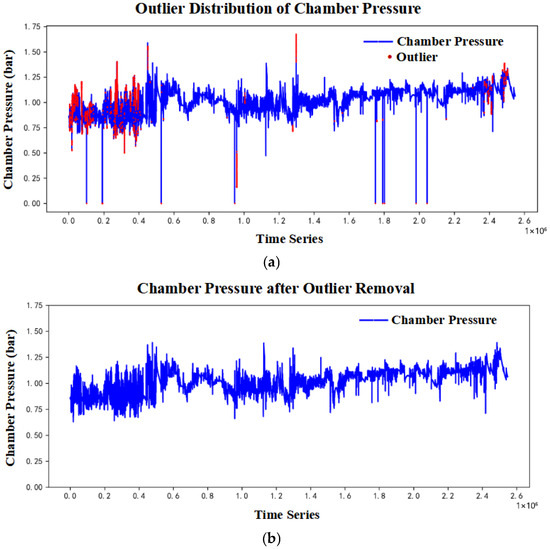
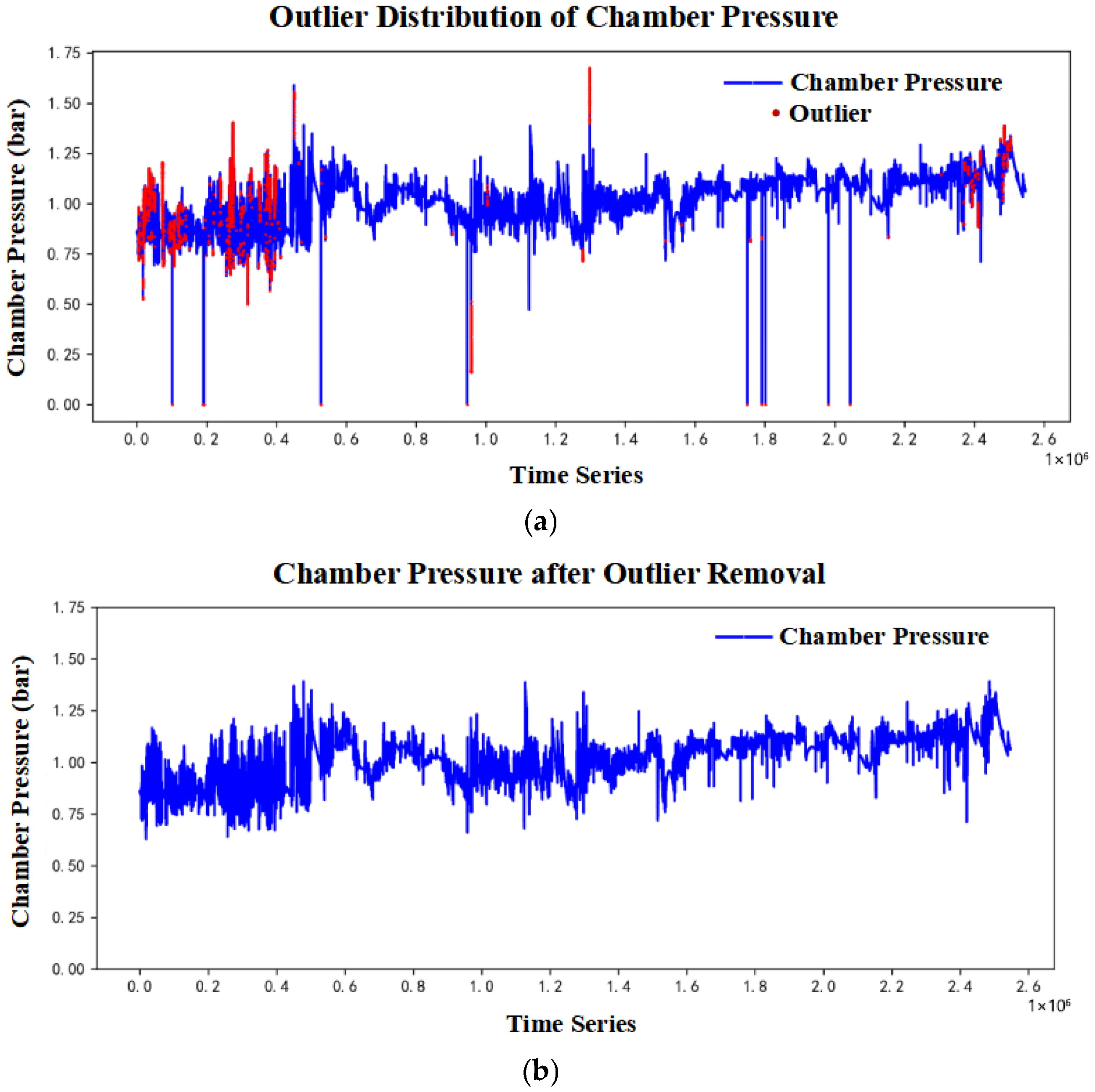
After integration, the field monitoring data files contain over 2.5 million samples. For such massive high-dimensional datasets, the Isolation Forest Algorithm provides an efficient and effective method for outlier removal [14]. The Isolation Forest parameters are configured as follows: n_estimators = 100, max_samples = 0.1, max_features = 2, contamination = 0.002, random_state = 42, n_jobs = −1. The contamination parameter defines the expected proportion of outliers. In this study, contamination = 0.002 was selected as a conservative setting according to the preliminary inspection of raw monitoring data, where abnormal sensor points accounted for only a small proportion. A larger value may incorrectly remove normal pressure fluctuations, while a smaller value may retain abnormal points. In addition, the subsequent stable tunneling segment selection further excludes non-tunneling and unstable data, reducing the dependence of the final dataset on a single Isolation Forest parameter. As shown in Figure 1, outliers in the datasets have been successfully eliminated.
Figure 1.
Outlier distribution of chamber pressure and the situation after removal: (a) before filtering; (b) after filtering.
During the shield machine start and stop phases, it operates under unstable tunneling conditions. For instance, during the shield machine start phase, the thrust not only affects excavation face pressure but also primarily serves to accelerate/decelerate the shield machine and balance frictional forces against its body. The operational mechanisms during this phase are complex, and the shield machine’s operating state is highly unstable, causing the data to be unsuitable for utilization. In contrast, under stable tunneling conditions, frictional forces can be approximated as constant, rendering a direct relationship between thrust and excavation face pressure variations. Therefore, the data from the start and stop phases are excluded from this study.
Under stable tunneling conditions, the advance system thrusts the shield machine forward, the cutterhead excavates soil, and the screw conveyor discharges it. Consequently, in tunneling states, the sensor-monitored parameters–total thrust , advance speed , cutterhead torque , cutterhead rotational speed , and screw conveyor rotational speed should not be zero. Conversely, if any parameter equals zero, the shield machine is deemed to be in an unstable tunneling state. Based on this criterion, the following discriminant function is established to preliminarily filter construction data:
where is a binary discriminant function. Based on this function, each collected data entry is evaluated. If the tunneling function returns 0, the data entry is identified as an unstable tunneling state and subsequently removed. To ensure sufficient data samples, tunneling data with durations shorter than 1200 s are also excluded. Ultimately, over 2.5 million data entries were screened and consolidated into 25 segments, each consisting of thousands of stable tunneling data.
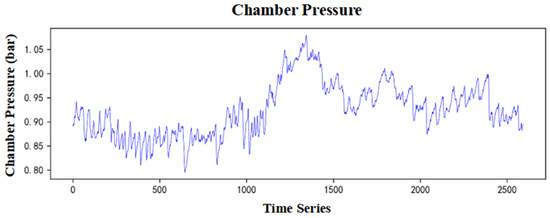
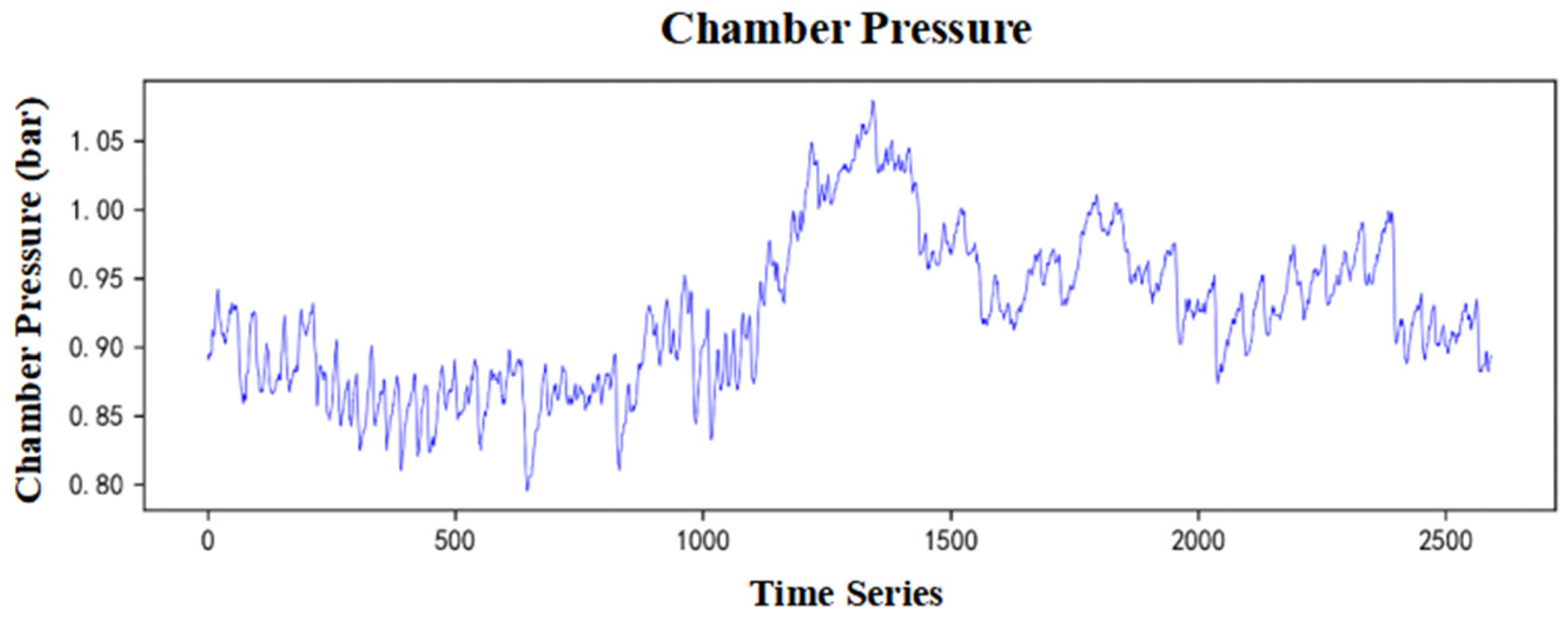
After the aforementioned processing, the data can be utilized for subsequent tasks, including developing the improved mechanism model, training the residual model in the hybrid earth pressure balance model, and validating the model’s generalization performance. As an example, the left-upper chamber pressure from a stable tunneling segment is illustrated in Figure 2.
Figure 2.
Chamber pressure in a 2682 s stable tunneling segment.
3. Improved Mechanism Model for Earth Pressure Balance
Accurate control of the EPB process relies on the development of a high accuracy EPB model. This section analyzes the underlying mechanisms of the EPB process and identifies key factors influencing chamber pressure variations. Based on this analysis, an improved EPB model is constructed. Finally, the preprocessed field monitoring data from Section 2 is used for parameter identification, and the improved model is compared with traditional mechanism models to verify its validity.
3.1. Chamber Pressure Composition
Chamber pressure variations are directly linked to changes in soil volume within the chamber. When soil inflow and outflow are balanced, the soil volume in the excavation chamber remains stationary, and the chamber pressure remains constant. When soil inflow exceeds outflow, the accumulated soil generates compressive forces, leading to an increased chamber pressure. Conversely, when soil inflow is less than outflow, it leads to a drop in chamber pressure.
In addition, research and experiments [15,16] indicate that variations in excavation face pressure–caused by cutterhead rotation, advance, and geological changes–propagate into the chamber through cutterhead panel openings, thereby affecting chamber pressure. The relationship is mathematically expressed as follows:
where represents chamber pressure influenced by excavation face pressure, represents the pressure transfer coefficient, and is the excavation face pressure. The pressure transfer coefficient is primarily influenced by the cutterhead opening ratio , with secondary effects from shield machine operational parameters and geological conditions. When the opening ratio is fixed, the pressure transfer coefficient can be approximated as a constant, showing a linear mapping relationship between chamber pressure and excavation face pressure.
Based on the aforementioned analysis, chamber pressure variations are composed of two components: (1) Chamber pressure changes caused by soil volume variations within the shield chamber; (2) Chamber pressure changes induced by excavation face pressure variations due to cutterhead soil extrusion and geological condition changes. The excavation face pressure variation caused by cutterhead soil extrusion is denoted as , and that induced by geological condition changes is denoted as . The cutterhead soil extrusion can be categorized into two types: disturbance-induced extrusion resulting from cutterhead rotation and advance-induced extrusion resulting from thrust variations. The excavation face pressure changes caused by these two mechanisms are respectively denoted as and , and the above relationship is mathematically expressed as follows:
where represents the total variation of chamber pressure.
3.2. Chamber Pressure Change Due to Soil Volume Variation
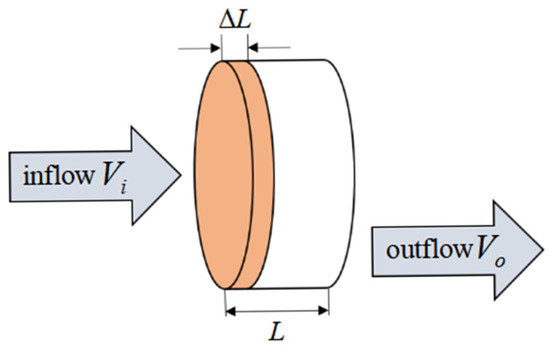
The variation in soil volume within the chamber is related to the soil inflow and outflow controlled by the shield advance speed and screw conveyor rotational speed , as illustrated in Figure 3. During a time interval , the soil volume entering the chamber via cutterhead excavation can be expressed as:
where represents the soil volume inflow into the chamber, represents the cutterhead diameter, and represents the shield advance speed.
Figure 3.
Soil volume variation in the chamber.
During the time interval , the soil volume discharged via the screw conveyor can be expressed as:
where represents the effective discharge area of the screw conveyor, represents the screw pitch, represents the soil discharge efficiency, and represents the screw conveyor rotational speed.
Based on the stress-strain relationship of conditioned soil, the relationship between soil volume variation and chamber pressure change is defined as:
where represents the tangent deformation modulus of the conditioned soil, represents the axial strain in the tunneling direction, represents the unbalanced excavation volume caused by over-excavation or under-excavation, represents the cross-sectional area of the shield machine, and represents the chamber volume.
After soil conditioning, the soil in the shield chamber exhibits enhanced flow-plasticity. Letting the maximum principal stress be , the minimum principal stress be , and for any soil element, it can be considered . For cohesive and sandy soils, according to the Duncan-Chang hyperbolic model, the simplified relationship is:
where and are equivalent fitting coefficients in the Duncan-Chang-type hyperbolic relationship for conditioned soil, and is atmospheric pressure. In this study, and are not obtained from laboratory tests on conditioned soil samples, but are identified from field monitoring data together with other uncertain mechanism parameters. By combining Equations (4)–(8), the chamber pressure change caused by soil volume variation is derived as:
In current engineering practice, EPB control is primarily based on traditional mechanism models that only consider pressure changes . This approach controls pressure by adjusting the rates of soil inflow and outflow, while overlooking the influence of chamber pressure changes induced by excavation face pressure variations. This oversimplified method often results in significant control errors and serious instability incidents. Therefore, the following section will further derive the mathematical formulation of the excavation face pressure variation .
3.3. Chamber Pressure Change Due to Excavation Face Pressure Variation
As mentioned in Section 3.1, variations of excavation face pressure are composed of three components: geological conditions, soil compaction from cutterhead rotation and soil compaction from cutterhead thrust.
To calculate the excavation face pressure variation caused by geological condition changes during multi-stratum tunneling, the separate calculation method for soil and water pressures can be expressed as:
where is the coefficient of static lateral pressure, is the saturated gravity of the ith soil layer, is the thickness variation of the ith soil layer during time interval due to shield machine advancement, is water density, is gravitational acceleration, is the groundwater level variation during the time interval .
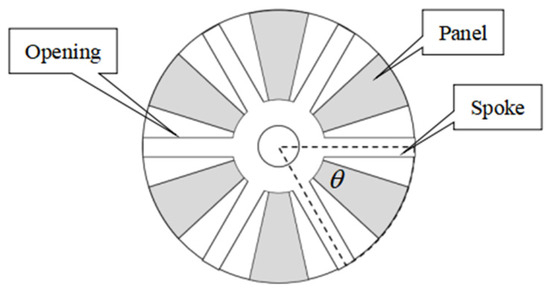
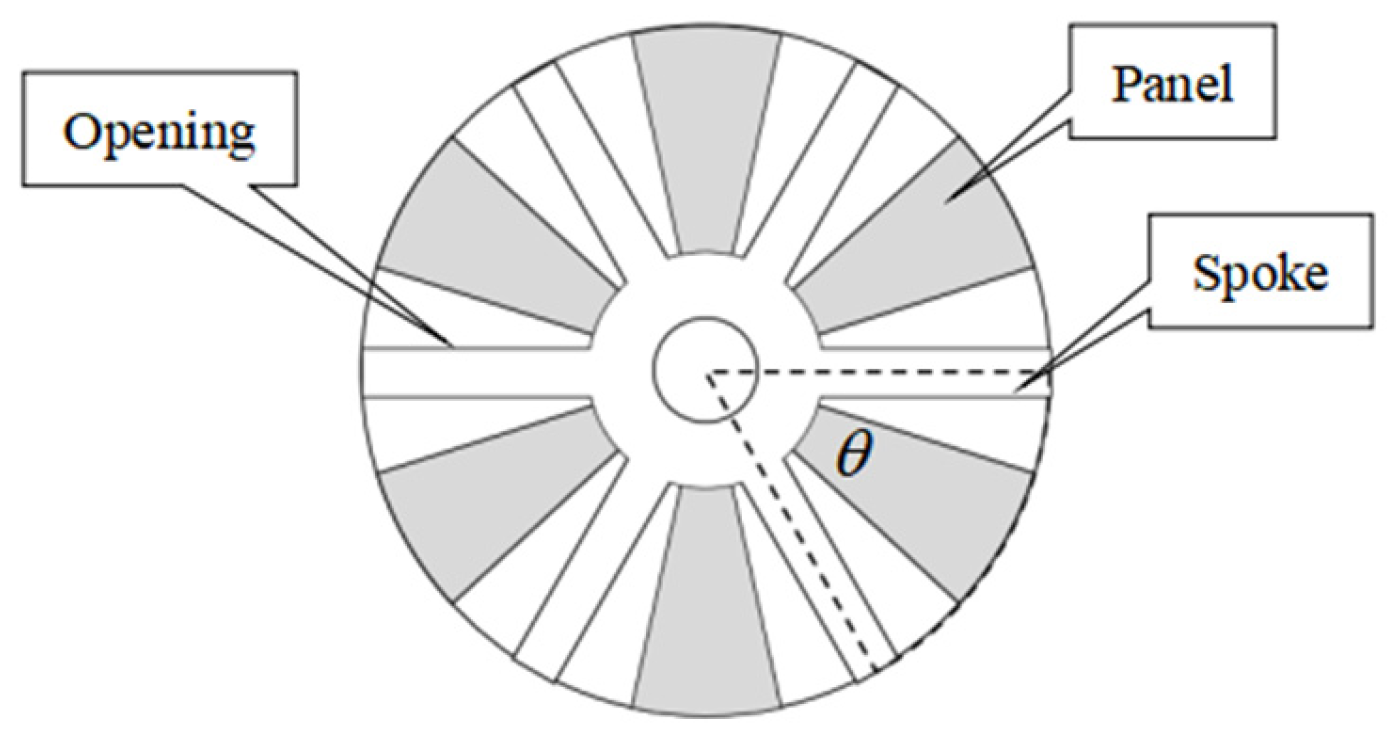
Regarding the excavation face pressure variation induced by soil extrusion from cutterhead disturbance, this change results from the cutterhead panel compacting the forward soil during shield machine advance. The spoke-type cutterhead structure with 6 segments (m = 6) can be simplified as shown in Figure 4, where one segment is analyzed for its compaction volume. By neglecting the spoke components, the following approximate relationship can be established:
where is the central angle occupied by a single panel segment (unit: rad), is the cutterhead opening ratio and is the number of cutterhead segments.
Figure 4.
Structural model of spoke-type cutterhead.
The soil remains in a compacted state from entering the panel front until reaching the next opening, thus its maximum compaction volume can be calculated as follows:
where is the maximum soil compaction volume, is the cutterhead rotational speed and is the advance speed.
Taking a radial differential element of the cutterhead panel, its average compaction volume is:
After integration, the compaction volume of soil before the panel segment during time interval is:
Letting , the average compaction volume across the entire cutterhead panel is:
where is the variation in shield penetration depth during time interval .
Assuming the forward soil satisfies elastic theory under small deformations, the excavation face pressure variation induced by soil compaction from cutterhead disturbance can be expressed as:
where is the approximate stiffness coefficient of the compacted forward soil.
For the excavation face pressure variation caused by soil compaction from cutterhead thrust, under steady tunneling conditions, it can be calculated by the variation of total thrust force:
where is the variation of total shield thrust force during time interval .
3.4. Improved Mechanism Model
During shield machine tunneling, factors such as the shield machine’s advance speed, screw conveyor rotational speed, penetration rate, total thrust force, and geological conditions can all influence the chamber pressure. After analyzing the soil compaction effect, unbalanced excavation factors, pressure transfer coefficient, and other factors during tunneling, Equations (3), (9), (10), (16) and (17) are combined to derive the relationship between chamber pressure variation and the relevant variables as follows:
Based on this, the differential form of the EPB mechanism model can be derived as follows:
In Equation (19), the first term corresponding to the chamber pressure change caused by soil volume variation is the traditional mechanism model baseline, which is derived from Equation (9). This term describes the pressure variation induced by the imbalance between soil inflow and screw conveyor discharge. The remaining terms related to excavation face pressure variation are the newly introduced components in the improved mechanism model. These additional terms describe the effects of geological condition changes, cutterhead-induced soil compaction, and thrust-induced extrusion on chamber pressure. Therefore, compared with the traditional model, the improved model extends the pressure prediction from a single soil-volume-balance mechanism to a coupled formulation involving both chamber volume variation and excavation face pressure transmission.
In the improved EPB mechanism model, the parameters , , , , are unknown. Since the conditioned soil in the chamber is remolded and foam-treated, the parameters and are treated as equivalent coefficients rather than directly measured Duncan-Chang parameters of intact soil. To develop a completely improved mechanism model, these unknown parameters’ ranges are firstly determined based on physical meaning and empirical experience, as listed in Table 2. Subsequently, tunneling construction data is used in conjunction with machine learning techniques to iteratively search for the optimal values that yield the best-fitting performance.
Table 2.
Ranges of parameters to be identified.
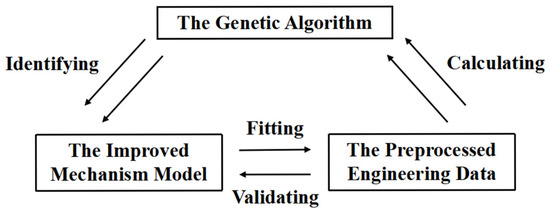
This study employs a genetic algorithm (GA) [17] to identify the unknown parameters of the improved EPB mechanism model. Since this task is a bounded nonlinear optimization problem with difficult-to-obtain analytical gradients, GA is adopted as a derivative-free global optimization method suitable for uncertain parameter identification. Recent studies on CO2 laser cutting quality prediction for FFF-printed ABS and ASA thermoplastics have also shown that intelligent prediction and optimization methods are effective for nonlinear engineering processes with multiple coupled parameters [18,19]. This further supports the use of data-assisted optimization methods for complex parameter identification tasks. The relationship among the GA, the improved mechanism model, and the data is shown in Figure 5.
Figure 5.
Schematic diagram of the mechanism model workflow.
The GA is executed according to the following steps:
Step 1: Generate the initial population. Step 2: Calculate the fitness of each individual in the population. If the termination condition is met, the optimal solution is obtained, and parameter identification is considered successful; otherwise, proceed to Step 3. Step 3: Use a selection operator to retain a certain number of individuals as parents. Step 4: Perform crossover on the parents’ chromosomes according to the crossover operator to generate the next generation. Step 5: Apply mutation to the offspring’s chromosomes based on the mutation operator, then return to Step 2. Therefore, before running the GA, it is essential to define the encoding method, construct a fitness function, and specify the selection, crossover, and mutation operators.
In this study, the encoding method adopts floating-point encoding, the crossover operator is set as single-point crossover with a probability of 0.5, the mutation operator uses adaptive mutation, and the selection operator employs roulette wheel selection. The fitness function is defined as:
where is the fitness function, represents the square of difference between the actual chamber pressure and the pressure calculated by Equation (18) with a small constant 0.001 added to avoid division by zero and is a penalty term.
Other GA parameters are optimized as follows: the maximum number of iterations is 80, with early termination if the fitness function shows no improvement for 8 consecutive generations, the population size is 20, and the number of genes is 5. Using preprocessed data from a 2400 s stable tunneling segment, 10 rounds of parameter identification converge to optimal values. The identified parameters are presented in Table 3.
Table 3.
Parameter identification results.
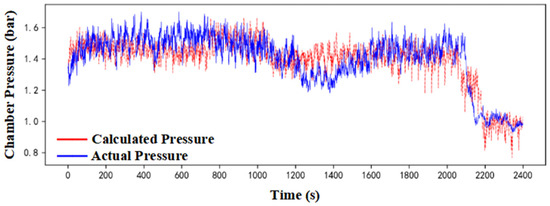
Taking the left-center chamber pressure as an example, the identified parameters are substituted into the improved EPB mechanism model, and the pressure prediction result of the improved model is shown in Figure 6.
Figure 6.
The pressure prediction situation in the left-center chamber of the improved model.
A slight phase lag can be observed during the sharp pressure drop near 2000 s. This lag is mainly related to the differential formulation of the mechanism model, which is designed to capture the dominant pressure variation trend rather than highly localized transient fluctuations. Since GA only identifies constant model parameters and does not introduce additional dynamic delay compensation, this local lag is more likely associated with the dynamic representation of the mechanism model rather than an artifact of the GA optimization.
3.5. Earth Pressure Prediction Results Comparison
This study employs two metrics–Mean Absolute Error (MAE) and Root Mean Square Error (RMSE)–to evaluate the discrepancies between model predictions and actual values.
- (1)
- MAE is the average of absolute errors between model predictions and actual values, reflecting the actual value of errors. Its mathematical definition is:
- (2)
- RMSE is the square root of the average of squared absolute errors, sensitive to large deviations. Its mathematical definition is:
In Equations (21) and (22), represents the actual value of the i-th sample, represents the model predicted value of the i-th sample and is the total number of samples.
For comparison, the traditional mechanism model was identified using the same tunneling segment data in Section 2. The performance of both traditional and improved mechanism models on this dataset is summarized in Table 4.
Table 4.
Performance of traditional and improved mechanism models.
It is evidenced from Table 4 that the traditional and improved mechanism model effectively captures the overall trend of chamber pressure variation. The improved EPB mechanism model exhibits smaller prediction deviations across all chamber pressure points compared to the traditional model. This indicates that incorporating thrust force and penetration rate contributes to building a more accurate mechanism model. It also validates the influence of excavation face pressure variations on chamber pressure and confirms the rationality of accounting for the soil displacement effect of the cutterhead. In practical engineering applications, employing the improved mechanism model in place of the traditional one for chamber pressure prediction has been shown to effectively reduce prediction errors and mitigate the occurrence of instability-related incidents.
However, discrepancies of approximately 10%~16% still persist between the improved model’s predictions and actual chamber pressures, suggesting the need for higher-precision earth pressure prediction models.
4. Hybrid Earth Pressure Balance Model
4.1. Hybrid Earth Pressure Balance Model Structure
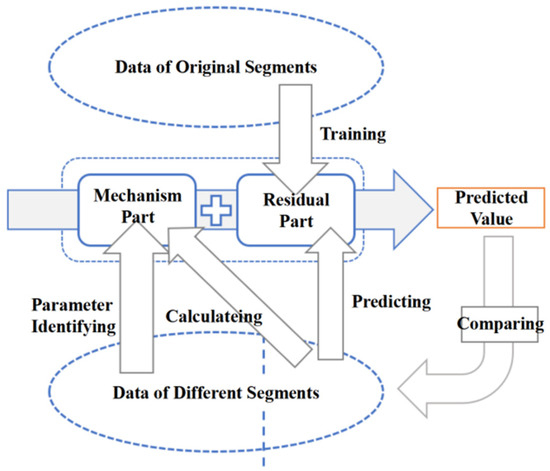
The hybrid modeling method integrates mechanism models and data-driven models, also referred to as “gray-box” modeling. By thoroughly understanding the intrinsic mechanisms of the modeling subject, this approach uses data-driven models to compensate for the prediction error of mechanism models. It has advantages such as ease of development, low cost, and strong performance in both fitting and generalization accuracy [20].
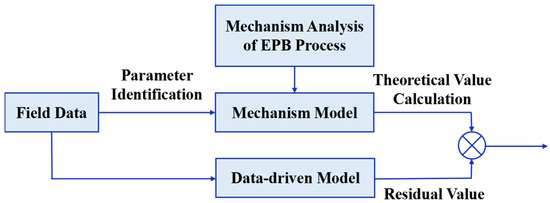
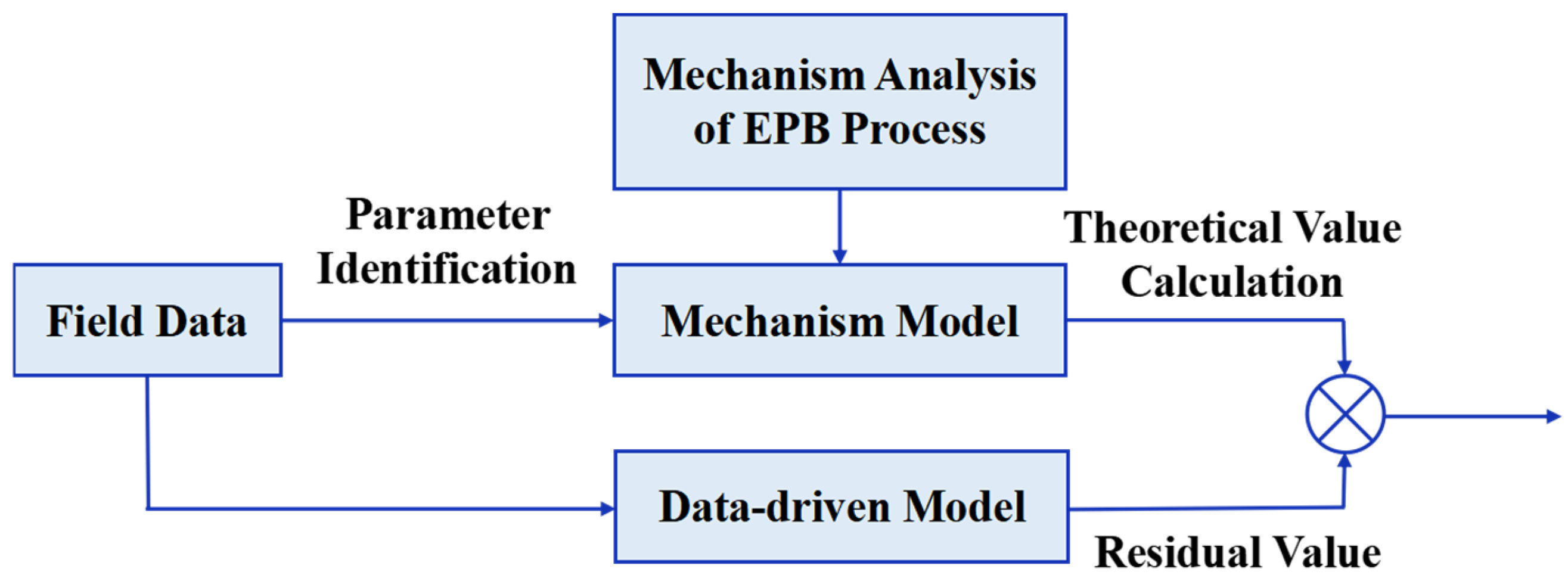
The current hybrid structure of mechanism and data-driven models can generally be categorized into four types: parallel, series, gated, and prior-constrained structures [21,22,23,24]. In the parallel hybrid structure, the mechanism model governs global characteristics, while the data-driven model acts as an approximator to supplement local details. When the mechanism model fails to achieve high fitting accuracy due to simplifications or assumptions during modeling, the nonlinear data-driven model compensates for these shortcomings. This preserves the mechanism model’s global reasoning capability while enhancing nonlinear fitting accuracy–a critical requirement for high-precision and strongly generalizable EPB process modeling. Therefore, this study adopts a parallel hybrid structure for earth pressure balance modeling, as illustrated in Figure 7.
Figure 7.
Parallel hybrid earth pressure balance model structure.
Although hybrid modeling has been widely used in engineering systems, the proposed framework is not a simple combination of physical and data-driven models. As summarized in Table 5, its main distinction lies in the use of an improved EPB mechanism model as the physical backbone and a residual-learning data-driven model as the compensation component. This structure improves prediction accuracy while preserving the interpretability and generalization ability of the mechanism model.
Table 5.
Main differences between existing hybrid models and the proposed model.
The construction of the parallel hybrid model involves two key steps:
Firstly, a mechanism model is built by deeply analyzing the physical relationships between chamber pressure variations and influencing factors. After model construction, undetermined constants (e.g., experimental coefficients in the nonlinear Duncan-Chang soil model, screw conveyor discharge efficiency) are identified using field construction data to ensure parameter accuracy. Then, for the less accurate portions of the mechanism model, a data-driven model is developed to fit the residuals between mechanism predictions and actual chamber pressure values. Leveraging the high-dimensional parameter features in the field construction data, a data-driven model is trained to capture residual patterns and is combined additively with the mechanism model.
Theoretically, the mechanism model ensures robust generalization by governing global trends, while the data-driven model enhances prediction accuracy by refining local deviations. The parallel integration of both models achieves a hybrid earth pressure balance model that balances accuracy and generalizability. Based on the improved mechanism model derived in Section 3, this study establishes a residual data-driven model using prediction residuals and fuses the two to form a higher-precision hybrid model.
4.2. Residual Data-Driven Model
During the EPB process, incomplete soil filling may occur in the upper chamber, while the lower chamber is significantly influenced by screw conveyor soil discharge. Considering the identification results of the mechanism model, this study prioritizes data from the central chamber region. Consequently, the output of the residual data-driven model (acting as the approximator) is defined as the difference between the actual central chamber pressure and the mechanism model’s predicted value. Through feature selection on field construction data, 6 input parameters are determined for the residual model: advance speed, screw conveyor rotational speed, cutterhead rotational speed, cutterhead torque, total thrust, and penetration rate. It should be noted that these parameters are used as real-time state feedback inputs for chamber pressure estimation. Since they are synchronously collected by the shield monitoring system during tunneling, they are available at each sampling instant for real-time pressure prediction.
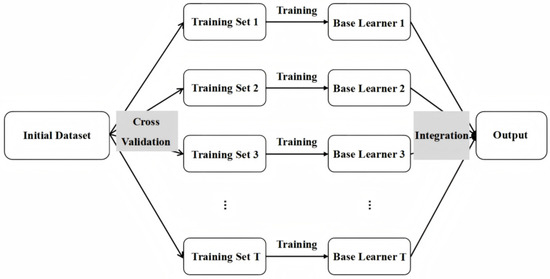
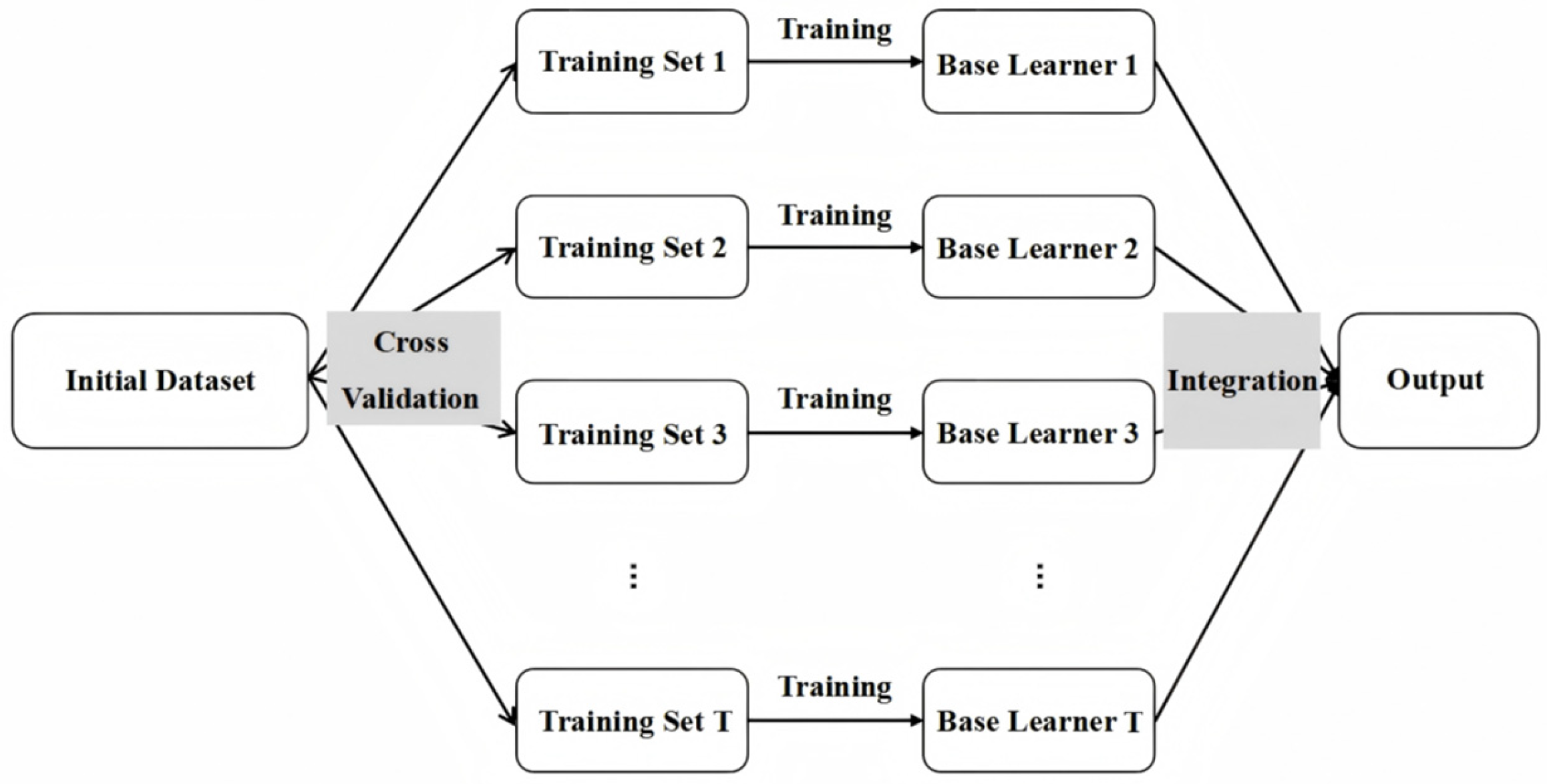
Two methods are employed to train the residual model, and the one with superior fitting accuracy is selected as the final model. The bagging algorithm is first adopted to train the residual model. As shown in Figure 8, the bagging algorithm operates by training multiple base learners in parallel using bootstrapped training sets (sampled with random selection-return method from the original datasets) and aggregating their outputs [25,26]. For regression tasks, the final prediction is the average of all base learners’ outputs. Key parameters for the residual model are listed in Table 6.
Figure 8.
Bagging algorithm framework.
Table 6.
Key parameters of the bagging algorithm.
A backpropagation neural network (BPNN) is alternatively trained [27,28,29]. To balance simplicity and nonlinear fitting capability, the network structure is configured with 2 hidden layers. The number of neurons and learning rate are optimized via KerasTuner under the Keras framework using cross-validation. Other key hyperparameters are summarized in Table 7.
Table 7.
BPNN model structure.
4.3. Residual Data-Driven Model Comparison
To comprehensively evaluate the two data-driven models, this study introduces the Coefficient of Determination () in addition to MAE and RMSE to evaluate model outputs.
The measures the goodness-of-fit of a regression model. A value closer to 1 indicates stronger explanatory power, and in multivariate regression models, > 0.3 is generally considered acceptable. Its mathematical definition is:
where represents the sample mean.
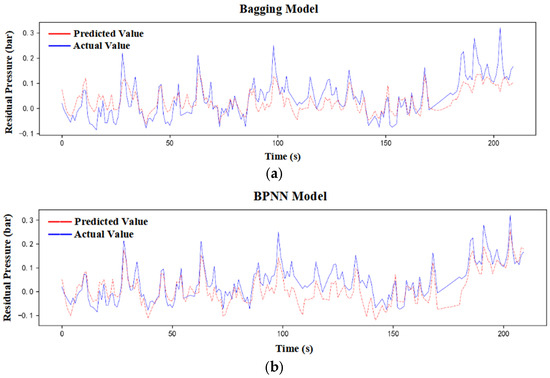
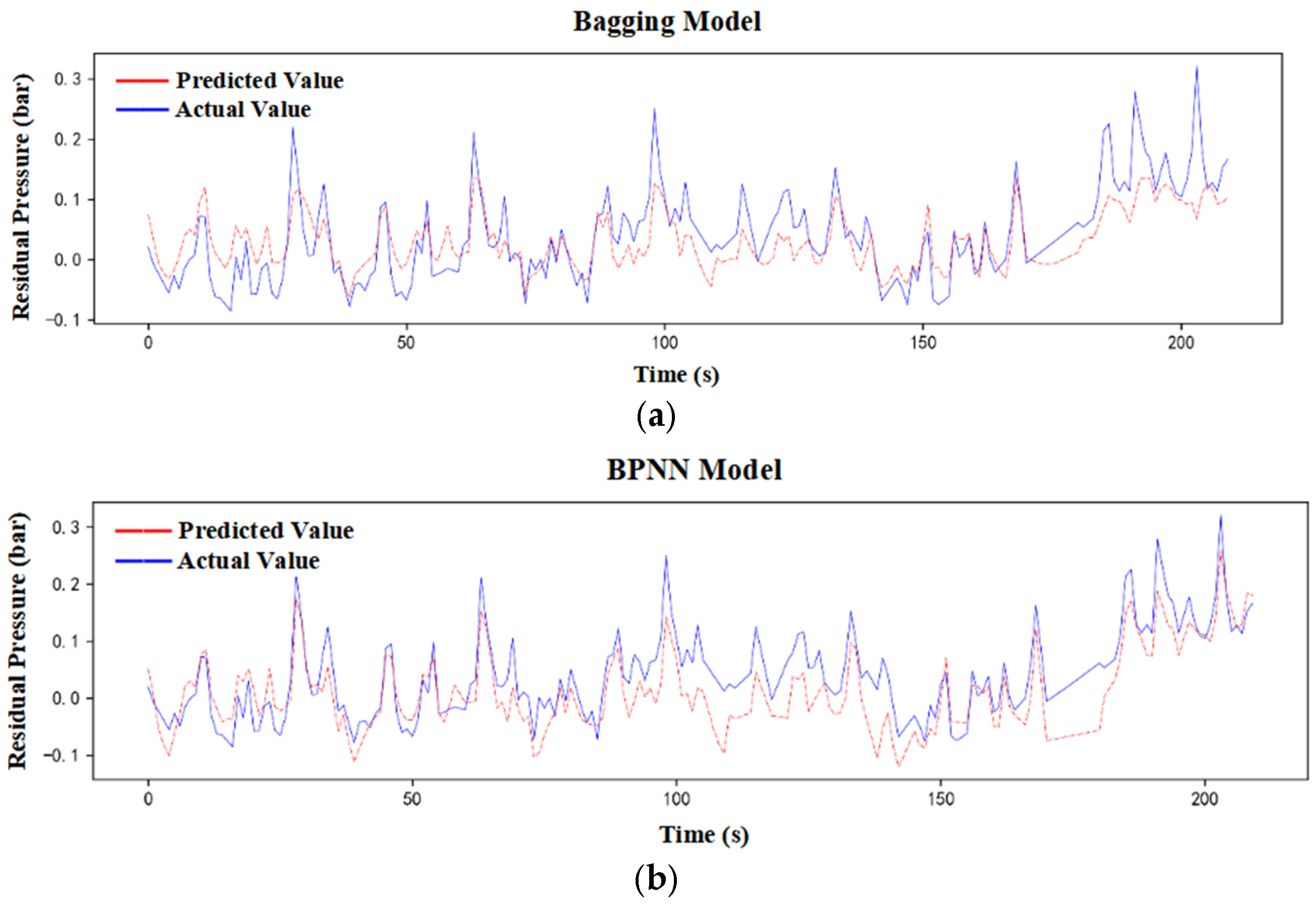
Both residual models were trained on the same stable tunneling segment data of left-center chamber in Section 2. After normalization, the datasets were split into training, validation, and test sets in an 8:1:1 ratio using the hold-out method. Training sets were shuffled in each epoch. The performance metrics of both models are summarized in Table 8, and their prediction-actual value comparisons are illustrated in Figure 9.
Table 8.
Performance metrics of residual models.
Figure 9.
Prediction-actual value comparisons of two models: (a) bagging model predicted and actual values; (b) BPNN model predicted and actual values.
As shown in Table 8 and Figure 9, under the same dataset, data split, and evaluation metrics, the Bagging model achieves lower RMSE and MAE and higher than the BPNN model. This indicates that the Bagging model has better residual fitting capability and prediction stability. Therefore, the Bagging method is selected as the residual compensation model in the proposed parallel hybrid framework.
4.4. Hybrid Earth Pressure Balance Model Construction
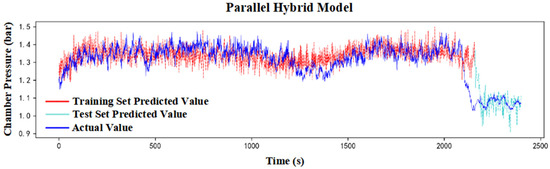
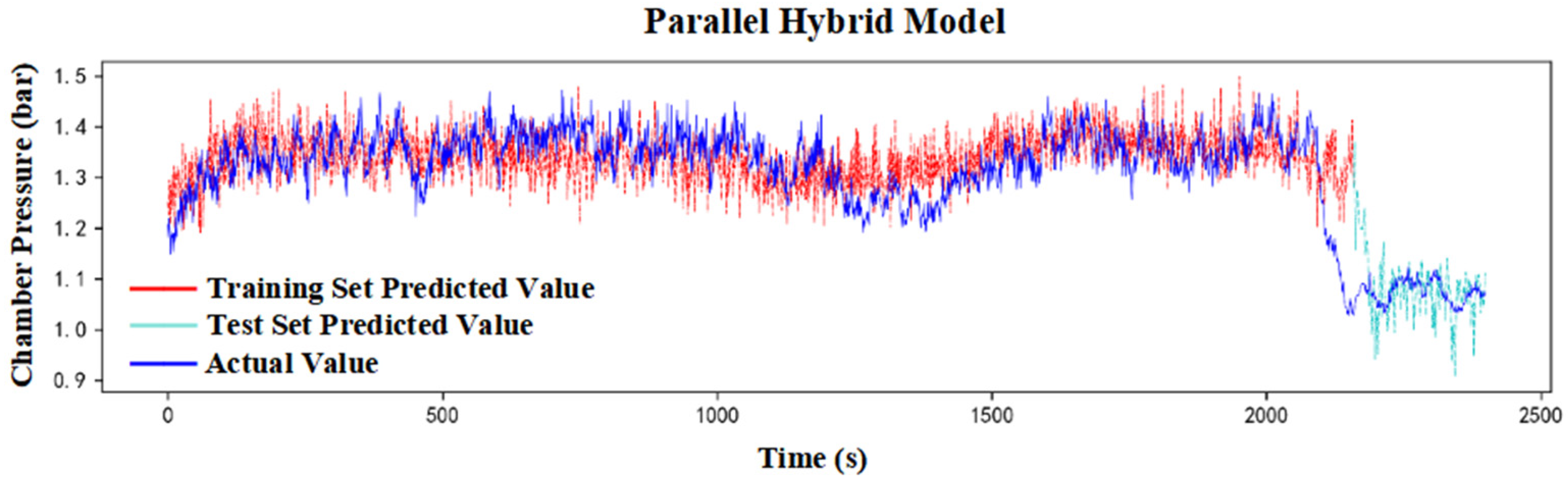
The bagging model is integrated in parallel with the improved mechanism model to form the proposed hybrid EPB model. The fitting performance of the hybrid model’s predictions and actual chamber pressures (left-center chamber) across the entire tunneling datasets (including training and test sets) is shown in Figure 10.
Figure 10.
Hybrid model predicted and actual values.
The hybrid model’s prediction accuracy is compared against standalone mechanisms and data-driven models. The mechanism model refers to the improved mechanism model proposed in Section 3. The standalone data-driven model is a BPNN trained on the same stable tunneling datasets using the method described in Section 4.2. It should be noted that the standalone data-driven model and the Bagging model in the hybrid framework serve different purposes. The former directly predicts chamber pressure from the input variables, whereas the latter learns the residual between the mechanism model prediction and the measured pressure. For the direct chamber pressure prediction task, a preliminary comparison indicated that BPNN provided better fitting performance than Bagging. Therefore, BPNN was selected as the standalone data-driven benchmark in this study.
To evaluate whether the model performance is affected by data splitting, two different training-testing splits were used for comparison. Due to structural differences among models (e.g., the standalone data-driven model predicts chamber pressure directly, while the data-driven model in the hybrid model predicts residuals), is no longer a suitable metric. RMSE and MAE are thus used for evaluation. The performance metrics of all three models are given in Table 9.
Table 9.
Performance metrics of three earth pressure balance models.
From Table 9, the hybrid EPB model achieves superior prediction accuracy compared to standalone models. This indicates that the improvement of the hybrid model is consistent under different data splits. By leveraging the mechanism model to govern global trends and the data-driven residual model to refine local deviations, the hybrid framework effectively balances precision and generalization.
5. Generalization Performance Analysis
In Section 3, an improved EPB mechanism model is established. In Section 4, a hybrid modeling framework is proposed by integrating the improved mechanism model and the residual data-driven model in parallel, which has better prediction accuracy. However, since these models were trained on partial tunneling segments, their applicability to the entire shield machine construction process requires validation of generalization performance across different segments within the same tunnel and across different tunnels. This section will compare the generalization capabilities of the proposed hybrid model, improved mechanism model, and data-driven model.
5.1. Generalization Validation Strategy
Prior to analyzing model accuracy and generalization, the validation methodology must be clarified. The generalization validation strategy for the proposed models is illustrated in Figure 11.
Figure 11.
Generalization validation strategy.
For a standalone mechanism model, as model parameters vary with geological conditions and soil conditioning, parameter identification is first conducted for corresponding working conditions. The tunneling segment data are split into two parts: the first portion identifies undetermined parameters, while the second evaluates generalization performance. For a standalone data-driven model, trained on multiple stable tunneling segments, it shares the same test data as the mechanism model for fair comparison. For the hybrid model, the mechanistic component follows the same training method as the mechanism model, while the residual model is trained on multiple stable segments. The generalization performance is evaluated by comparing the sum of residual and mechanistic outputs with the actual value on the same test set.
To comprehensively assess prediction errors, maximum absolute error (MaxAE) is introduced alongside RMSE and MAE. The Coefficient of Determination is excluded due to structural differences among models.
5.2. Generalization Performance on Different Segments of the Same Tunnel
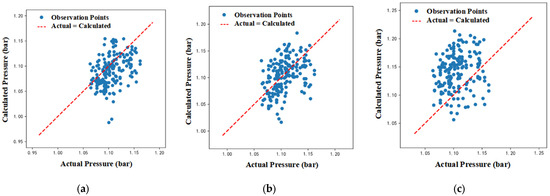
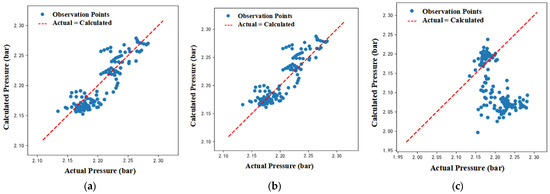
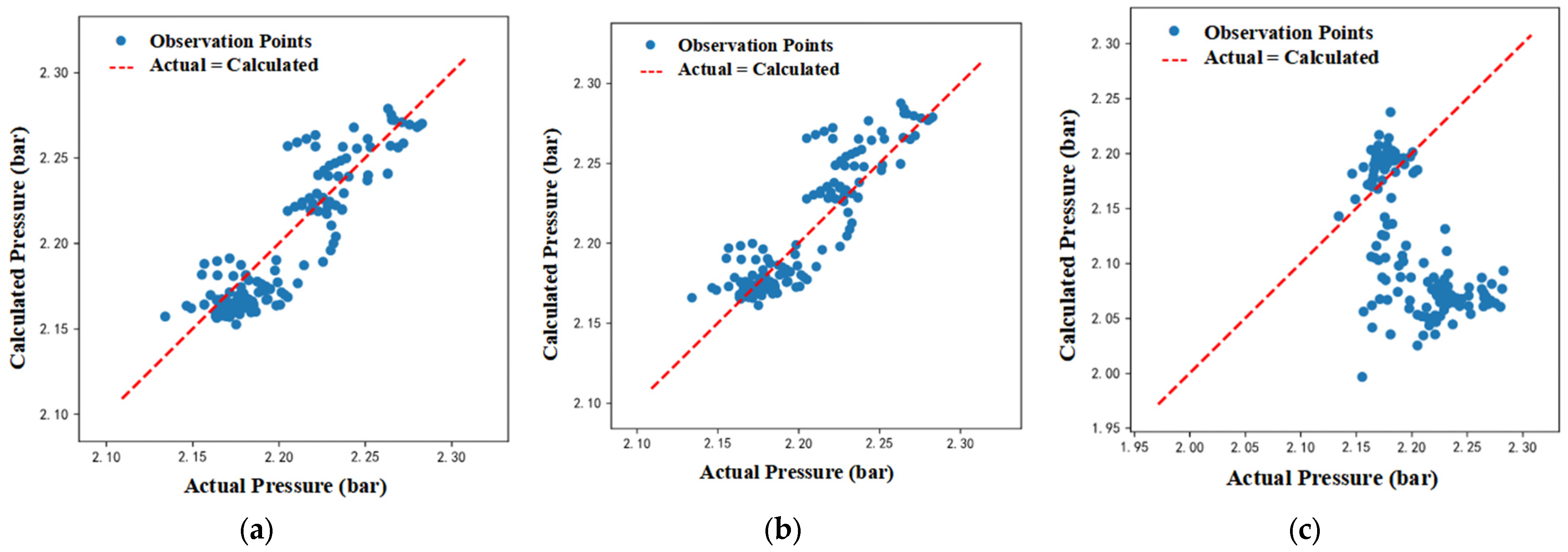
Using 80% of 25 stable tunneling segments from a Hangzhou water conveyance project for training (after normalization), Segment 113 of the same project is used for generalization testing. The performances of the three models are illustrated in Figure 12, and quantitative metrics are listed in Table 10.
Figure 12.
Generalization performance of models on segment 113 of the Hangzhou Project: (a) mechanism model; (b) hybrid model; (c) data-driven model (BPNN).
Table 10.
Performance metrics of models on segment 113 of the Hangzhou Project.
In Figure 12, the horizontal axis represents actual chamber pressures, and the vertical axis represents predicted values. The red dashed line indicates perfect prediction (predicted value equaling the actual value). Observations closer to this line reflect higher accuracy. The hybrid and pure mechanism models exhibit tightly clustered points along the line, indicating superior prediction performance. In contrast, the distribution of observation points in the data-driven model is relatively more scattered, and some are far away from the red dotted line, indicating poorer prediction accuracy.
Quantitative analysis in Table 10 reveals that the data-driven model has significantly larger errors compared to the hybrid and mechanism models. While the mechanism model achieves comparable accuracy to the hybrid model, the latter demonstrates marginally better performance. This highlights the hybrid model’s optimal generalization ability, where the mechanistic component captures global trends, and the residual model refines local deviations.
5.3. Generalization Performance on Different Tunnels
The trained models were validated on Segment 181 of a Nanjing metro tunneling project. For this cross-project validation, the mechanism parameters were re-identified using the initial local data of Segment 181, and the subsequent data were used for testing. Although both the Hangzhou and Nanjing projects are located in eastern China, their geological conditions differ in terms of water content, ground hardness, and stratum composition. Therefore, this cross-project validation can still reflect the model’s transferability between different tunneling projects under varying geological and operational conditions. The performance of the three EPB models is visualized in Figure 13, and quantitative metrics are listed in Table 10.
Figure 13.
Generalization performance of models on segment 181 of the Nanjing Project: (a) mechanism model; (b) hybrid model; (c) data-driven model (BPNN).
As shown in Figure 13, the hybrid and mechanism models exhibit good performance on different tunnels, with predictions closely aligned along the red dashed line. In contrast, the data-driven model deviates significantly, achieving a MaxAE of 0.219 bar–exceeding 50% of the pressure variation range (about 0.4 bar) in this segment, indicating its inadequacy for different tunnels’ predictions. Its poor cross-project performance is mainly because the pressure range and data distribution differ between the Hangzhou and Nanjing projects, and the direct prediction target has a much larger variation range than the residual target used in the hybrid model. In contrast, the hybrid model first uses the mechanism model to capture the dominant pressure trend, while the residual model only needs to compensate for local deviations around this trend. Therefore, even a moderate positive correction from the residual model can improve the final prediction, making the hybrid model more robust than the standalone data-driven model under cross-project conditions.
Quantitative analysis in Table 11 reveals that the hybrid model’s metrics are substantially better than those of the standalone models, with some metrics being half of the mechanism model’s values. It demonstrates the hybrid model’s high accuracy, strong generalization, and structural simplicity, making it widely applicable to diverse construction scenarios.
Table 11.
Performance metrics of models on Segment 181 of the Nanjing Project.
In addition, the proposed hybrid model has potential for real-time application because the computationally intensive steps, including Isolation Forest-based preprocessing and GA-based parameter identification, are performed offline using historical data. During online prediction, only the explicit improved mechanism model and the trained residual compensation model are executed. The required input variables are directly available from the shield machine monitoring system, and the field data are recorded at 1 Hz. Therefore, the online computational burden is relatively low, making the proposed model suitable for real-time chamber pressure prediction.
6. Conclusions
In this paper, the following conclusions can be drawn:
Firstly, an improved EPB mechanism model is proposed, which additionally considers the influence of excavation face pressure variations on chamber pressure changes. After parameter identification using the GA, the improved model–taking Left-Center Chamberas an example–achieves a 50% reduction in both MAE and RMSE compared to the traditional model, demonstrating significantly improved prediction accuracy. However, discrepancies of approximately 10% to 16% still persist between the improved model’s predictions and the actual chamber pressures. As a result, based on this improved model, a parallel hybrid EPB model is developed. In pressure prediction tasks across different segments within the same tunnel, the hybrid model achieves RMSE of 0.031, MAE of 0.024, and MaxAE of 0.093. For segments from different tunnels, the model achieves RMSE of 0.017, MAE of 0.013, and MaxAE of 0.028. Compared to standalone mechanisms and data-driven models, the hybrid model consistently delivers the highest prediction accuracy under various conditions. Results confirm that the hybrid model outperforms the EPB process in tunneling, supporting its broad application.
Due to time and resource constraints, certain aspects remain unexplored. Although the transferability of the proposed model was validated using data from two tunneling projects, further verification is still needed using field data from more tunnel projects under different regional and geological conditions.
Author Contributions
Y.Z. and J.S. designed the research. C.P. and S.Y. wrote the first draft of the manuscript. X.Y. and F.W. revised this work and contributed via discussion. S.Y. and Y.Z. revised and edited the final version. All authors have read and agreed to the published version of the manuscript.
Funding
This research was funded by the Natural Science Foundation of Zhejiang Province, China (Grant No. LQK26E050001), and the Open Project of the State Key Laboratory of Shield Machine and Boring Technology (Grant No. SKLST-2021-K02).
Data Availability Statement
The data presented in this study are available on request from the corresponding author.
Conflicts of Interest
Author Chunlin Peng were employed by the company China South-to-North Water Diversion Jianghan Water Network Construction and Development Co., Ltd. Author Xiaowei Yuan were employed by the company China Railway Engineering Equipment Group Co., Ltd. Author Fei Wang were employed by the company Beijing Institute of Space Launch Technology. The remaining authors declare that the research was conducted in the absence of any commercial or financial relationships that could be construed as a potential conflict of interest.
References
- Guo, L.; Shen, Y.; Lyu, M.; Zhang, D.; Huang, Z. Non-Parametric Seismic Fragility Assessment of Underground Structures Incorporating Stochastic Ground Motion. Soil Dyn. Earthq. Eng. 2026, 200, 109893. [Google Scholar] [CrossRef] [Scilit]
- Wang, J.; Lin, G.; Tian, N.; Feng, K.; Xu, G.; Hu, X.; Chen, Z.; He, C. Face Failure of EPB Shield Tunnels in Dry Dense Sand: A Model Test and DEM Study. Can. Geotech. J. 2023, 61, 1832–1856. [Google Scholar] [CrossRef] [Scilit]
- Gholipour, M.; Narimani, S.; Davarpanah, S.M.; Vásárhelyi, B. Evaluating Minimum Support Pressure for Tunnel Face Stability: Analytical, Numerical, and Empirical Approaches. J. Exp. Theor. Anal. 2025, 3, 2. [Google Scholar] [CrossRef] [Scilit]
- Zhou, C.; Gao, Y.; Chen, E.J.; Ding, L.; Qin, W. Deep Learning Technologies for Shield Tunneling: Challenges and Opportunities. Autom. Constr. 2023, 154, 104982. [Google Scholar] [CrossRef] [Scilit]
- Lu, X.; Zhou, Y.; Huang, M.; Li, F. Computation of the Minimum Limit Support Pressure for the Shield Tunnel Face Stability Under Seepage Condition. Int. J. Civ. Eng. 2017, 15, 15. [Google Scholar] [CrossRef] [Scilit]
- Zhang, Q.; Su, C.; Qin, Q.; Cai, Z.; Hou, Z.; Kang, Y. Modeling and prediction for the thrust on EPB TBMs under different geological conditions by considering mechanical decoupling. Sci. China Technol. Sci. 2016, 59, 7. [Google Scholar] [CrossRef] [Scilit]
- Liu, X.; Zhang, W.; Shao, C.; Wang, Y.; Cong, Q. Geological Adaptive Intelligent Control of Earth Pressure Balance Shield Machine Based on Deep Reinforcement Learning. Artif. Intell. Rev. 2024, 57, 219. [Google Scholar] [CrossRef] [Scilit]
- Samadi, H.; Hassanpour, J.; Rostami, J. Prediction of Earth Pressure Balance for EPB-TBM Using Machine Learning Algorithms. Int. J. Geo-Eng. 2023, 14, 21. [Google Scholar] [CrossRef] [Scilit]
- Gao, M.; Zhang, N.; Shen, S.L.; Zhou, A. Real-time dynamic earth-pressure regulation model for shield tunneling by integrating GRU deep learning method with GA optimization. IEEE Access 2020, 8, 64310–64323. [Google Scholar] [CrossRef] [Scilit]
- Chen, R.; Zhang, P.; Kang, X.; Zhong, Z.Q.; Liu, Y.; Wu, H.N. Prediction of maximum surface settlement caused by earth pressure balance (EPB) shield tunneling with ANN methods. Soils Found. 2019, 59, 12. [Google Scholar] [CrossRef] [Scilit]
- Elbaz, K.; Shen, S.L.; Zhou, A.; Yuan, D.J.; Xu, Y.S. Optimization of EPB Shield Performance with Adaptive Neuro-Fuzzy Inference System and Genetic Algorithm. Appl. Sci. 2019, 9, 780. [Google Scholar] [CrossRef] [Scilit]
- Chen, R.; Zhang, P.; Wu, H.; Wang, Z.; Zhong, Z. Prediction of shield tunneling-induced ground settlement using machine learning techniques. Front. Struct. Civ. Eng. 2019, 13, 16. [Google Scholar] [CrossRef] [Scilit]
- Zhang, P.; Yin, Z.; Jin, Y.; Chan, T. A novel hybrid surrogate intelligent model for creep index prediction based on particle swarm optimization and random forest. Eng. Geol. 2020, 265, 105328. [Google Scholar] [CrossRef] [Scilit]
- Hariri, S.; Kind, M.C.; Brunner, R.J. Extended isolation forest. IEEE Trans. Knowl. Data Eng. 2019, 33, 1479–1489. [Google Scholar] [CrossRef] [Scilit]
- Park, B.; Lee, C.; Choi, S.W.; Kang, T.H.; Chang, S.H. Discrete-Element Analysis of the Excavation Performance of an EPB Shield TBM under Different Operating Conditions. Appl. Sci. 2021, 11, 5119. [Google Scholar] [CrossRef] [Scilit]
- Bilgin, N.; Yüksel, A. The effect of EPB face pressure on TBM performance parameters in different geological formations of istanbul. Tunn. Undergr. Space Technol. 2023, 138, 105184. [Google Scholar] [CrossRef] [Scilit]
- Ostaszewicz, D.; Rogowski, K. Application of Genetic Algorithms for Strejc Model Parameter Tuning. Electronics 2024, 13, 3652. [Google Scholar] [CrossRef] [Scilit]
- Basar, G. Experimental Evaluation and Machine Learning-Based Prediction of Laser Cutting Quality in FFF-Printed ABS Thermoplastics. Polymers 2025, 17, 1728. [Google Scholar] [CrossRef] [Scilit] [PubMed]
- Der, O. Multi-Output Prediction and Optimization of CO2 Laser Cutting Quality in FFF-Printed ASA Thermoplastics Using Machine Learning Approaches. Polymers 2025, 17, 1910. [Google Scholar] [CrossRef] [Scilit]
- Al Yemni, M.; Yang, R.Y.K. Hybrid neural-networks modeling of an enzymatic membrane reactor. J. Chin. Inst. Eng. 2005, 28, 1061–1067. [Google Scholar] [CrossRef] [Scilit]
- Yu, S.; Ma, J. Deep Learning for Geophysics: Current and Future Trends. Rev. Geophys. 2021, 59, e2021RG000742. [Google Scholar] [CrossRef] [Scilit]
- Raissi, M.; Perdikaris, P.; Karniadakis, G.E. Physics-informed neural networks: A deep learning framework for solving forward and inverse problems involving nonlinear partial differential equations. J. Comput. Phys. 2019, 378, 686–707. [Google Scholar] [CrossRef] [Scilit]
- Jagtap, A.D.; Kharazmi, E.; Karniadakis, G.E. Conservative physics-informed neural networks on discrete domains for conservation laws: Applications to forward and inverse problems. Comput. Methods Appl. Mech. Eng. 2020, 365, 113028. [Google Scholar] [CrossRef] [Scilit]
- Roehrl, M.A.; Runkler, T.A.; Brandtstetter, V.; Tokic, M.; Obermayer, S. Modeling System Dynamics with Physics-Informed Neural Networks Based on Lagrangian Mechanics. IFAC-PapersOnLine 2020, 53, 9195–9200. [Google Scholar] [CrossRef] [Scilit]
- Zhao, D.; Sun, Z.; He, Y.; Chen, X.; Liu, R. Prediction of Ground Subsidence by Shield Tunneling Using Ensemble Learning. Tunn. Undergr. Space Technol. 2023, 141, 105343. [Google Scholar] [CrossRef] [Scilit]
- Agi, O.; Rokach, L. Ensemble learning: A survey. Wiley Interdiscip. Rev. Data Min. Knowl. Discov. 2018, 8, e1249. [Google Scholar]
- Liang, Y.; Jiang, K.; Gao, S.; Yin, Y. Prediction of Tunnelling Parameters for Underwater Shield Tunnels, Based on the GA-BPNN Method. Sustainability 2022, 14, 13420. [Google Scholar] [CrossRef] [Scilit]
- Fu, X.; Gong, Q.; Wu, Y.; Zhao, Y.; Li, H. Prediction of EPB Shield Tunneling Advance Rate in Mixed Ground Condition Using Optimized BPNN Model. Appl. Sci. 2022, 12, 5485. [Google Scholar] [CrossRef] [Scilit]
- Li, G.; Xue, Y.; Su, M.; Qiu, D.; Wang, P.; Liu, Q.; Jiang, X. Probabilistic evaluation of tunnel boring machine penetration rate based on case analysis. KSCE J. Civ. Eng. 2022, 26, 4840–4850. [Google Scholar] [CrossRef] [Scilit]

Disclaimer/Publisher’s Note: The statements, opinions and data contained in all publications are solely those of the individual author(s) and contributor(s) and not of MDPI and/or the editor(s). MDPI and/or the editor(s) disclaim responsibility for any injury to people or property resulting from any ideas, methods, instructions or products referred to in the content. |
© 2026 by the authors. Licensee MDPI, Basel, Switzerland. This article is an open access article distributed under the terms and conditions of the Creative Commons Attribution (CC BY) license.