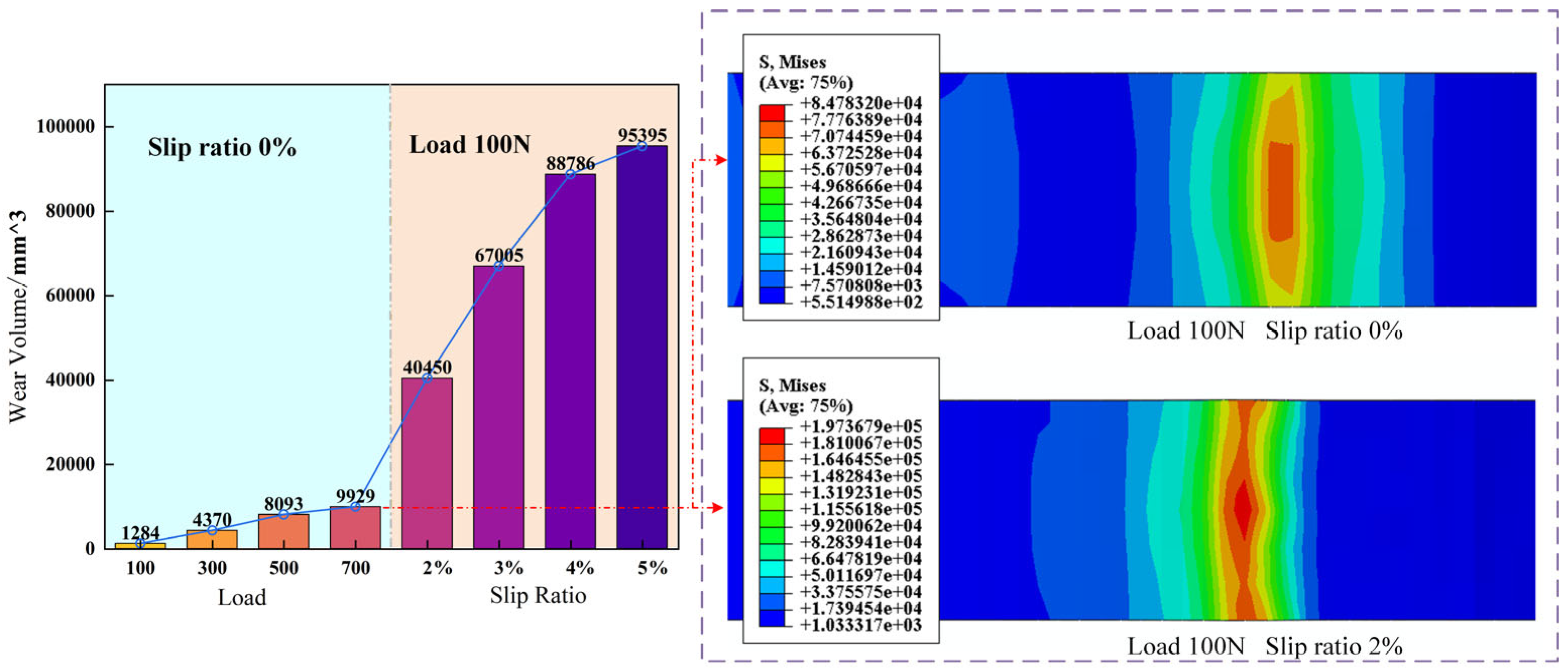
Simulation Analysis of Non-Pneumatic Tire Wear Based on Temperature-Corrected Archard Model


Abstract
1. Introduction
2. Rubber Thermal-Mechanical Coupled Wear Simulation Method Based on Wear Testing
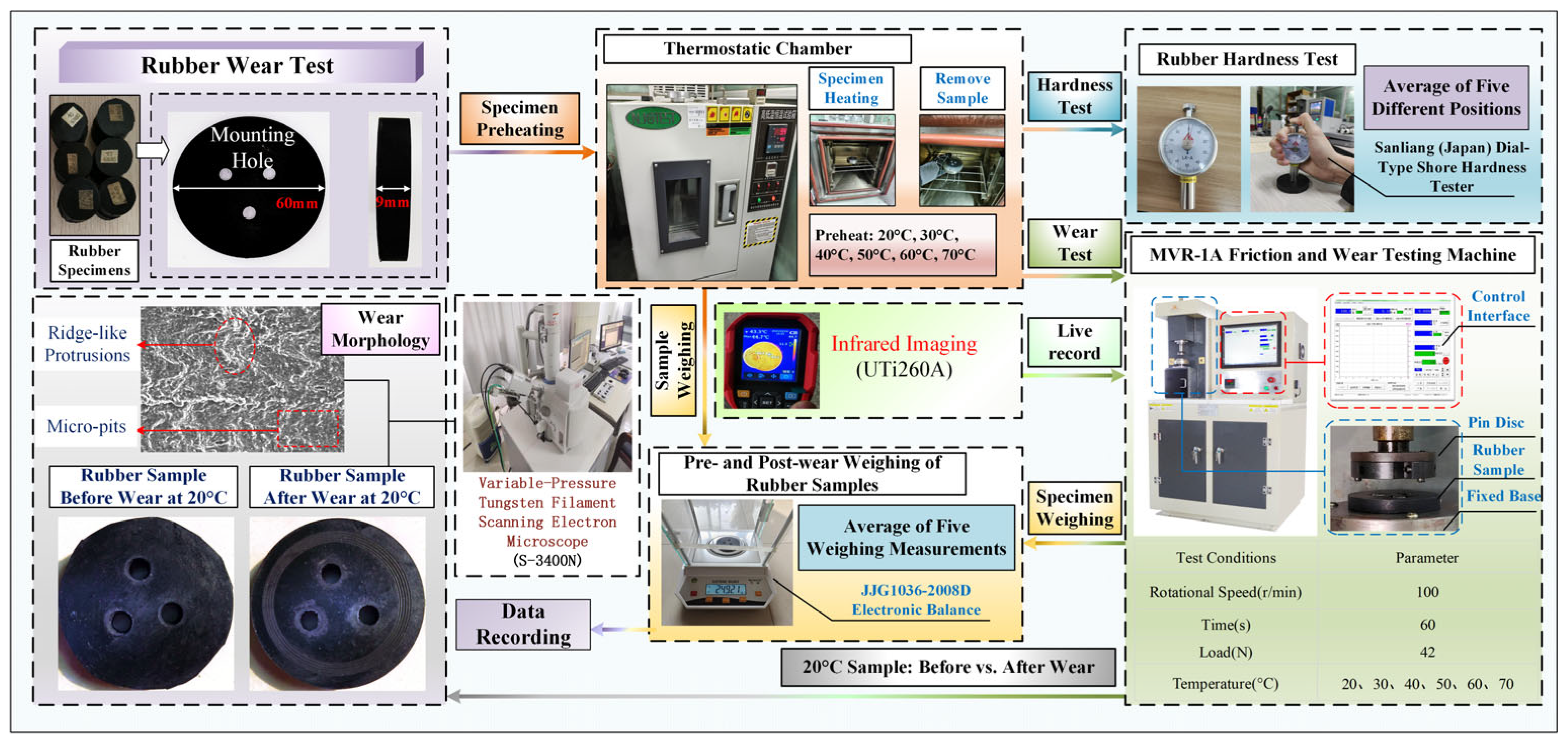
2.1. Rubber Wear Experiment
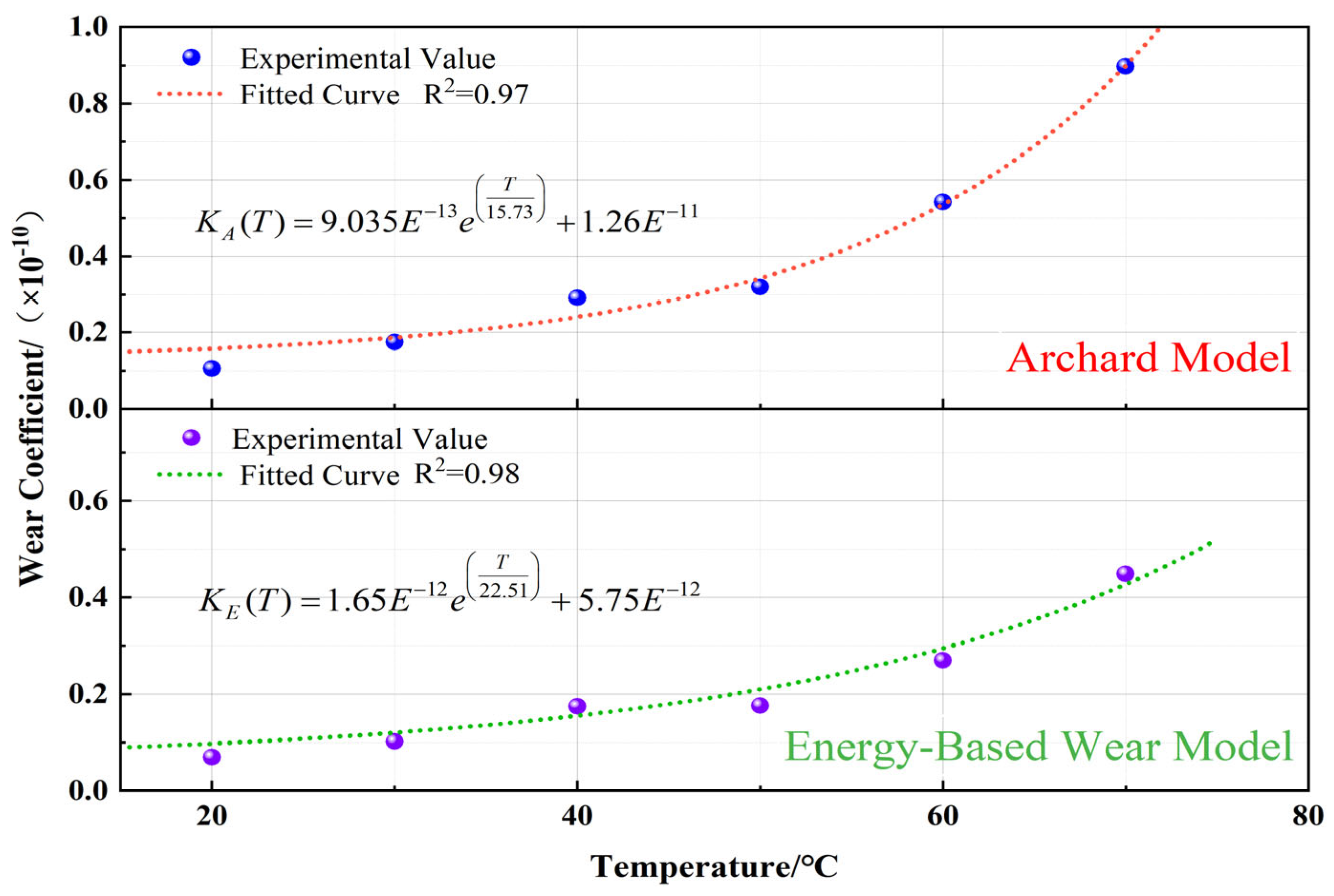
2.2. Establishment of the Modified Archard Wear Model
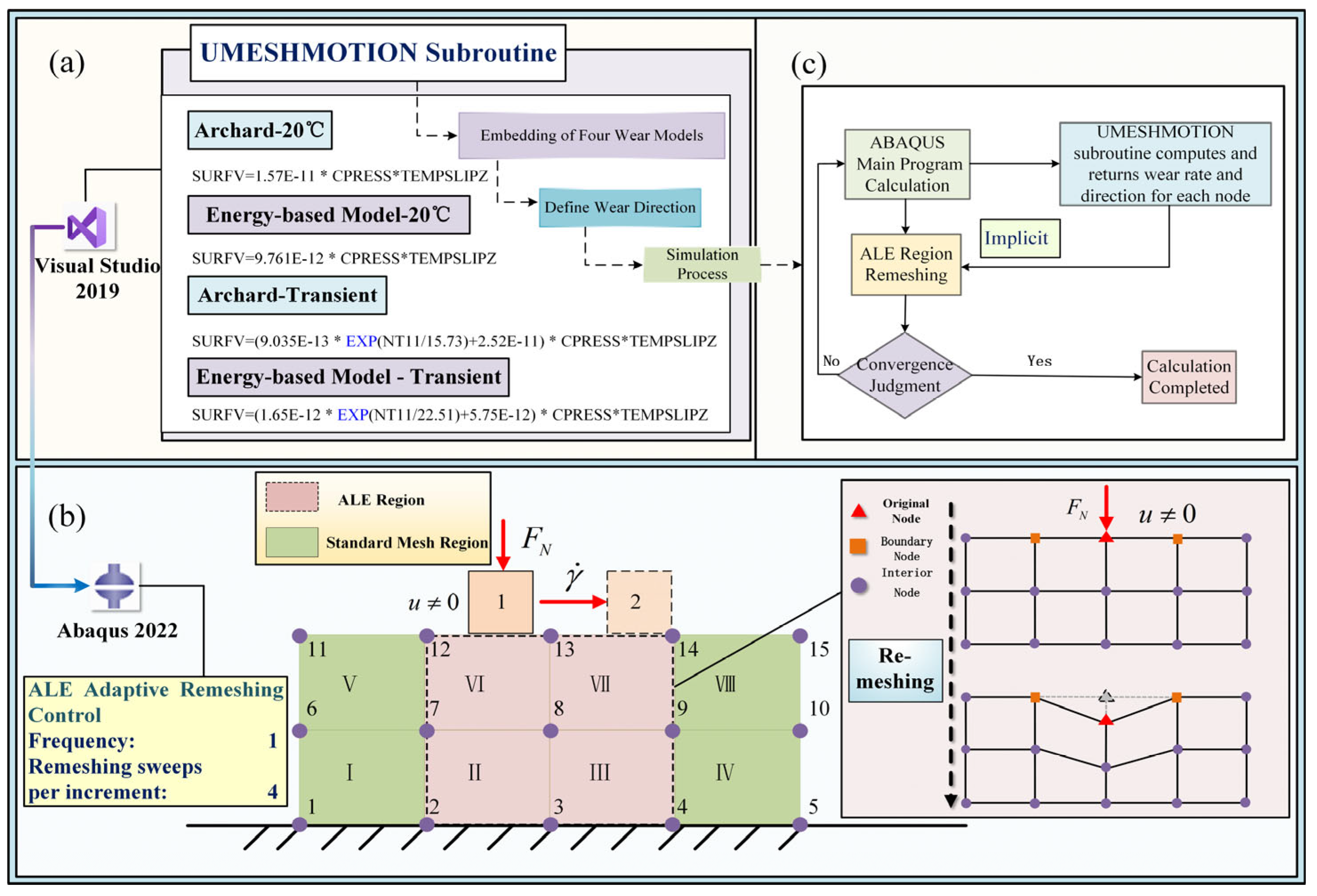
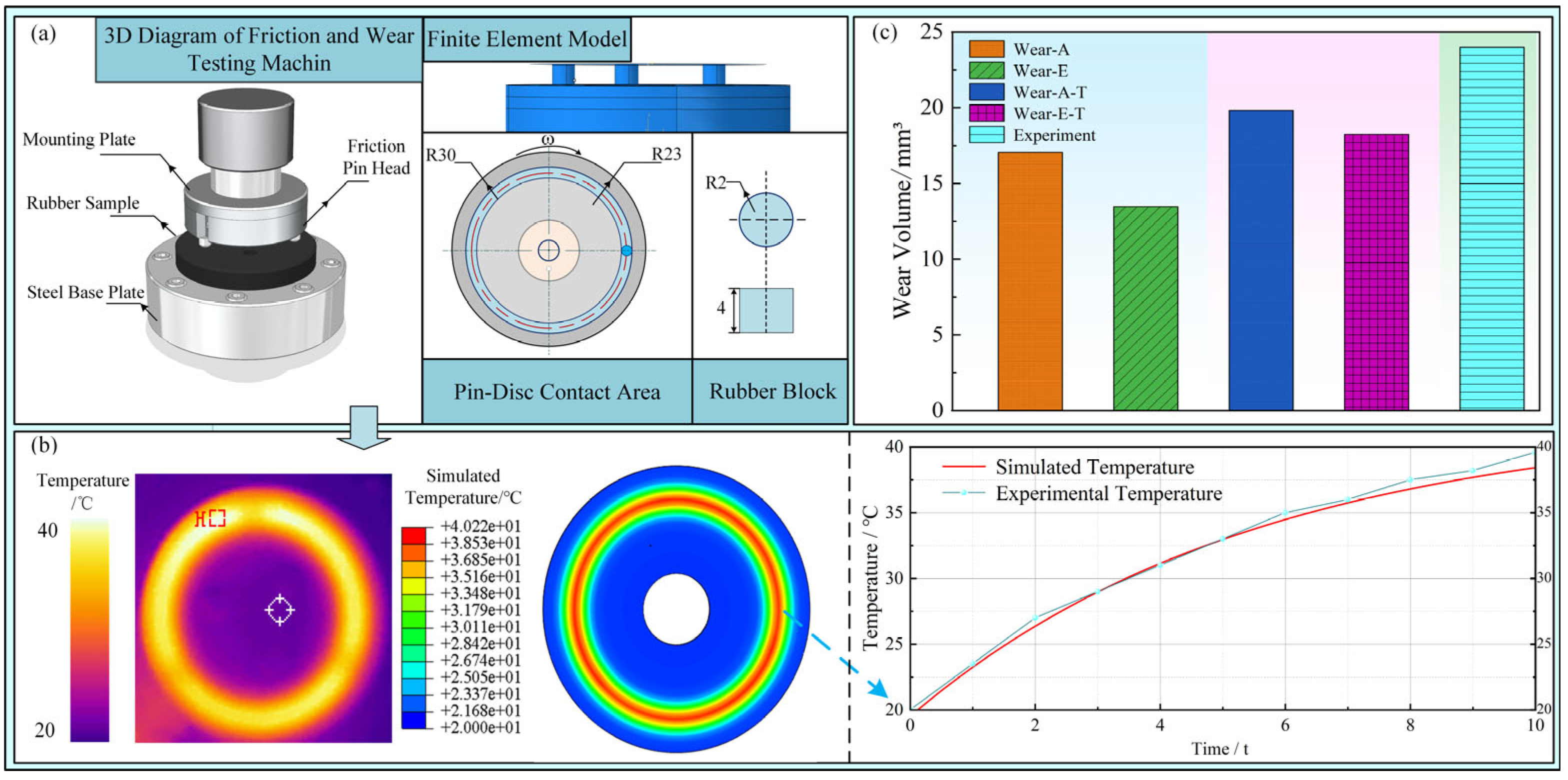
2.3. Rubber Thermal-Mechanical Coupled Wear Simulation Method and Validation
3. Establishment and Validation of the Non-Pneumatic Tire Model
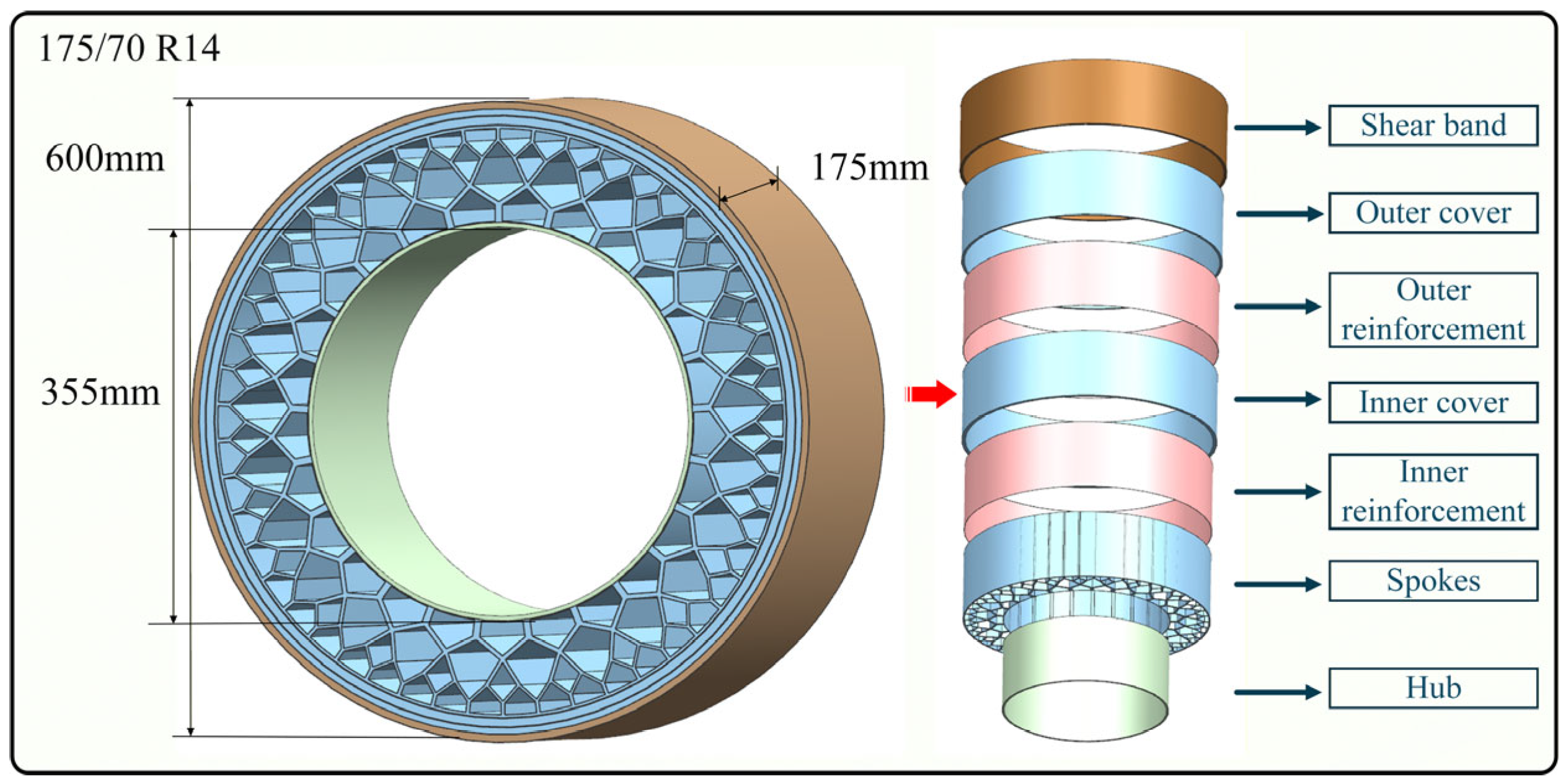
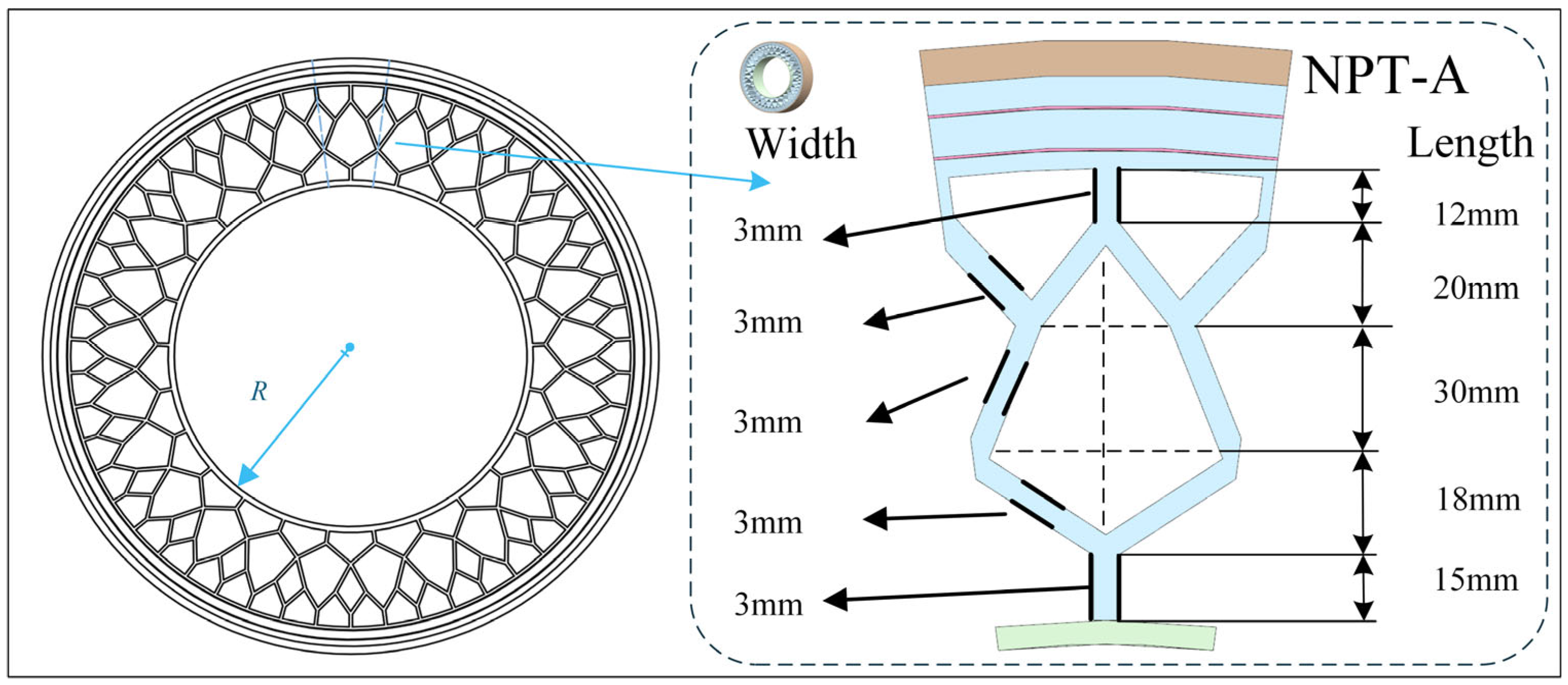
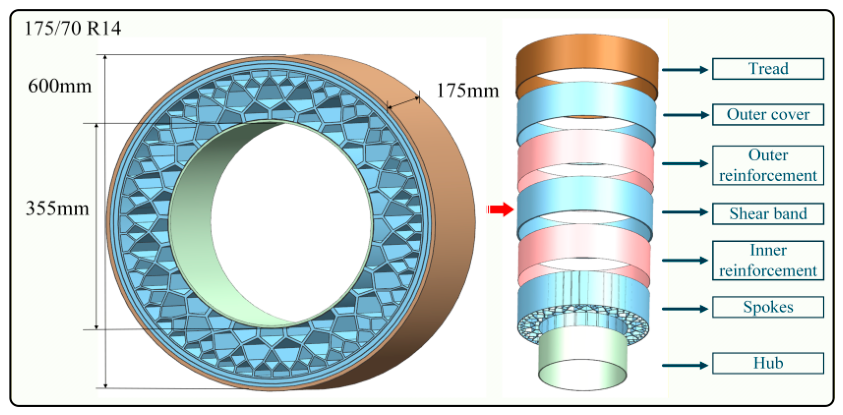
3.1. Geometric and Material Parameters
3.2. Establishment and Validation of the NPT Model
4. NPT Wear Simulation Analysis
4.1. Compilation of the NPT Wear Subroutine
4.2. Establishment of the NPT-Road Wear Simulation Model
4.3. Analysis of the Influence of Different Factors on the Wear Characteristics of Non-Pneumatic Tires
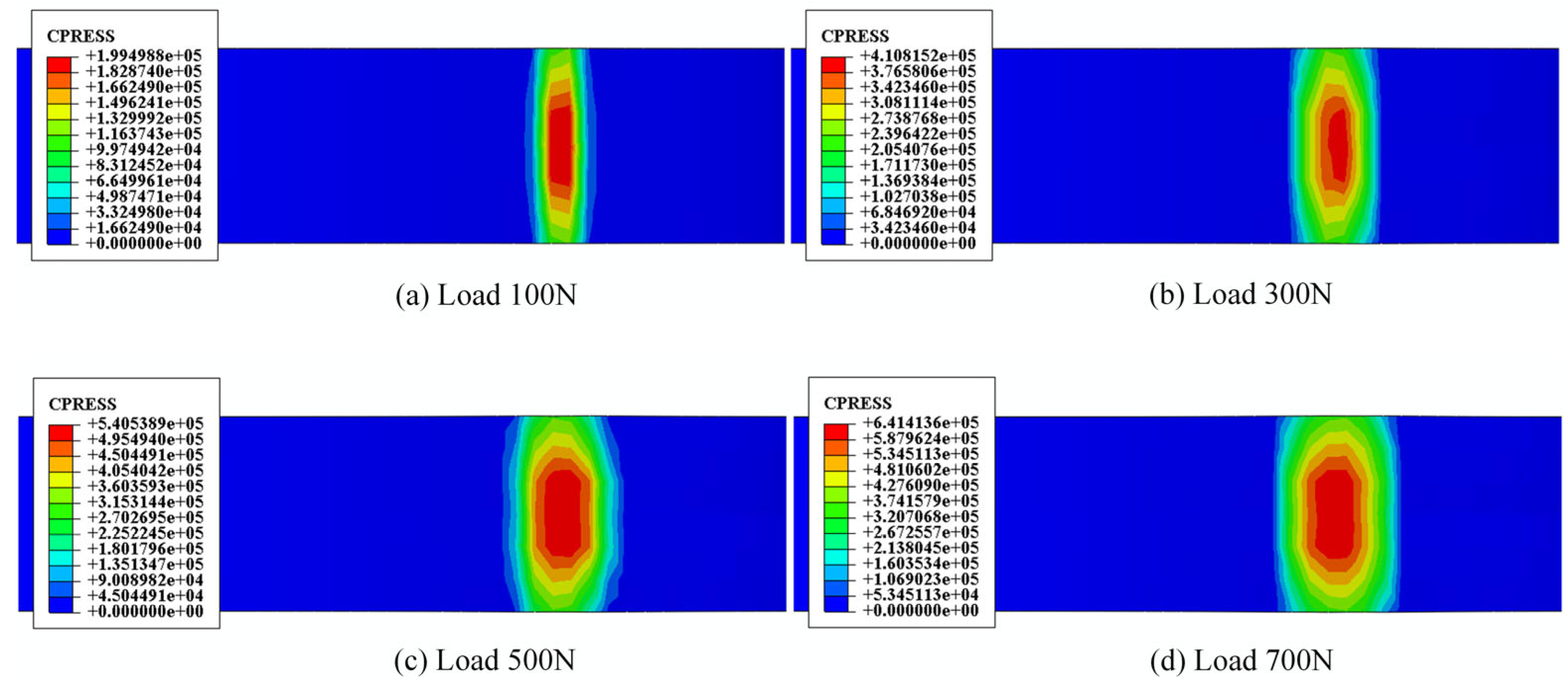
4.3.1. Analysis of Wear Characteristics of Non-Pneumatic Tires Under Different Vertical Loads
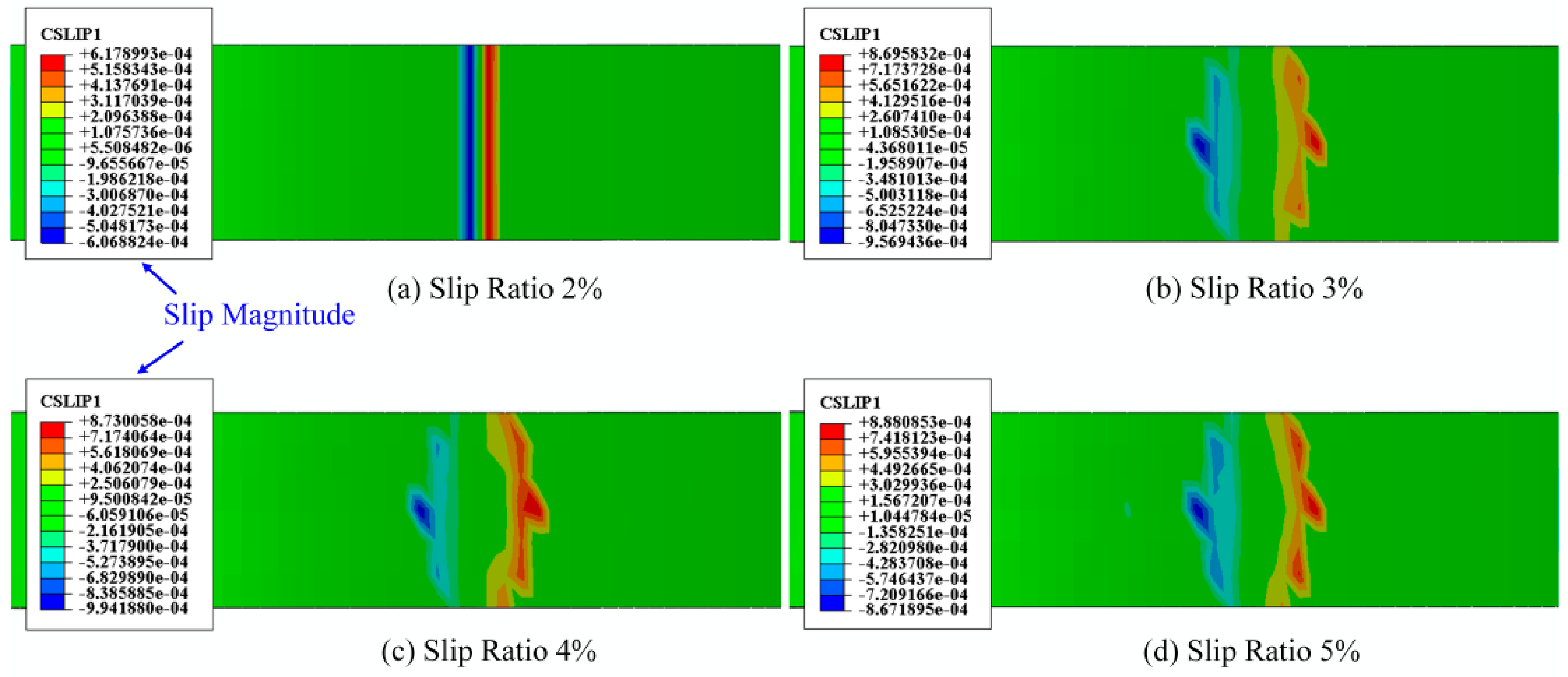
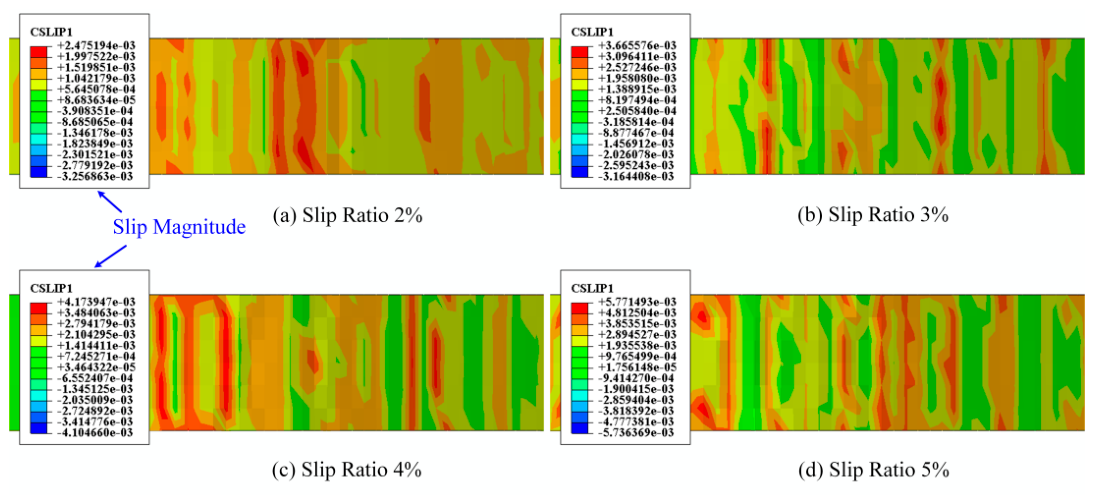
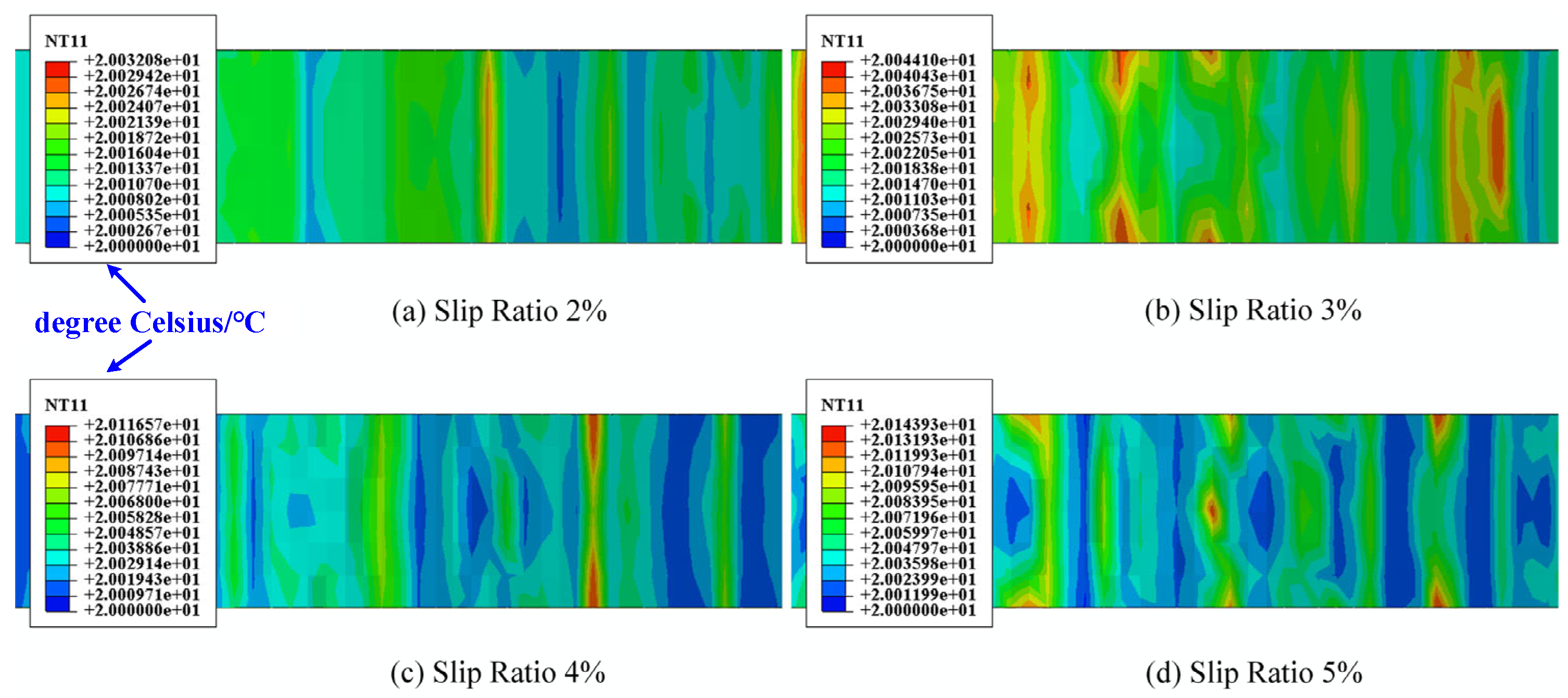
4.3.2. Analysis of Wear Characteristics of Non-Pneumatic Tires Under Different Slip Ratios
5. Conclusions
Author Contributions
Funding
Data Availability Statement
Conflicts of Interest
References
- Wang, W.; Liang, R.; Sun, H. Research on the key influencing factors of road wear for battery electric vehicles tyres. In Proceedings of the 2021 9th International Conference on Traffic and Logistic Engineering (ICTLE), Macau, China, 9–11 August 2021. [Google Scholar]
- Zheng, Z.; Rakheja, S.; Sedaghati, R. Multi-axis stiffness and road contact characteristics of honeycomb wheels: A parametric analysis using Taguchi method. Compos. Struct. 2022, 279, 114735. [Google Scholar] [CrossRef] [Scilit]
- Zheng, Z.; Rakheja, S.; Sedaghati, R. A comparative study of static and dynamic properties of honeycomb non-pneumatic wheels and a pneumatic wheel. Proc. Inst. Mech. Eng. Part D J. Automob. Eng. 2021, 235, 3631–3646. [Google Scholar] [CrossRef] [Scilit]
- Karpenko, M.; Skačkauskas, P.; Prentkovskis, O. Methodology for the composite tire numerical simulation based on the frequency response analysis. Eksploat. I Niezawodn. 2023, 25, 1–11. [Google Scholar] [CrossRef] [Scilit]
- Karpenko, M.; Prentkovskis, O.; Skačkauskas, P. Numerical simulation of vehicle tyre under various load conditions and its effect on road traffic safety. Promet-Traffic Transp. 2024, 36, 1–11. [Google Scholar] [CrossRef] [Scilit]
- Wei, Y.; Pan, F.; Du, J.; Xiang, J.; Chen, Y. Tensegrity metamaterial-based shear band structure for non-pneumatic tires. Forces Mech. 2025, 100341. [Google Scholar]
- Deng, Y.; Wang, Z.; Liu, T.; Liang, W.; Shen, H.; Xiao, Z. Static and dynamic mechanical characteristics of honeycomb non-pneumatic tire under structural damage condition. Eur. J. Mech. A/Solids 2023, 102, 105120. [Google Scholar]
- Cho, J.R.; Choi, J.H.; Kim, Y.S. Abrasive wear amount estimate for 3D patterned tire utilizing frictional dynamic rolling analysis. Tribol. Int. 2011, 44, 850–858. [Google Scholar]
- Zhang, H.; Zhang, S.; Zhang, Y.; Huang, X.; Dai, Y. Abrasion Status Prediction with BP Neural Network Based on an Intelligent Tire System. In Proceedings of the 2020 4th CAA International Conference on Vehicular Control and Intelligence (CVCI), Hangzhou, China, 18–20 December 2020; pp. 619–622. [Google Scholar]
- Wang, G.; Li, X.; Jing, Z.; Wang, X.; Zhang, Y. Improvement in and Validation of the Physical Model of an Intelligent Tire Considering the Wear. Sensors 2025, 25, 2490. [Google Scholar] [CrossRef] [Scilit]
- Zhou, T. Simulation Analysis of Tire Tread Wear Behavior Based on the Geometric Update Method. Master’s Thesis, South China University of Technology, Guangzhou, China, 2018. [Google Scholar]
- Chen, D.; Wu, J.; Wang, Y.; Su, B.; Liu, Y. High-speed tribology behaviors of aircraft tire tread rubber in contact with pavement. Wear 2021, 486, 204071. [Google Scholar] [CrossRef] [Scilit]
- Wu, J.; Chen, L.; Chen, D.; Wang, Y.; Su, B.; Cui, Z. Experiment and simulation research on the fatigue wear of aircraft tire tread rubber. Polymers 2021, 13, 1143. [Google Scholar] [CrossRef] [Scilit]
- Wu, J.; Chen, L.; Wang, Y.; Su, B.; Cui, Z.; Wang, D. Effect of temperature on wear performance of aircraft tire tread rubber. Polym. Test. 2019, 79, 106037. [Google Scholar] [CrossRef] [Scilit]
- Zuo, S.G.; Ni, T.X.; Wu, X.D.; Wu, K.; Yang, X.W. Prediction procedure for wear distribution of transient rolling tire. Int. J. Automot. Technol. 2014, 15, 505–515. [Google Scholar] [CrossRef] [Scilit]
- Zhou, H.; Wang, R.; Liang, C.; Wang, G.; Zhang, L. Research on simulation method of rubber friction and wear considering temperature influence. J. Mech. Eng. 2025, 61, 253–264. [Google Scholar]
- Schallamach, A.; Turner, D.M. The wear of slipping wheels. Wear 1960, 3, 1–25. [Google Scholar] [CrossRef] [Scilit]
- Dionisio, H.J.; Calhabeu, A.M. Evaluating Tire Tread Wear and Its Dependence on Tire Working Conditions by Using the Finite Element Method and Archard’s Wear Theory. Tire Sci. Technol. 2022, 50, 285–298. [Google Scholar] [CrossRef] [Scilit]
- Li, Y.; Zuo, S.; Duan, X.; Guo, X.; Jiang, C. Theory analysis of the steady-state surface temperature on rolling tire. Proc. Inst. Mech. Eng. Part C J. Mech. Eng. Sci. 2012, 226, 1278–1289. [Google Scholar] [CrossRef] [Scilit]
- Žuraulis, V.; Garbinčius, G.; Skačkauskas, P.; Prentkovskis, O. Experimental study of winter tyre usage according to tread depth and temperature in vehicle braking performance. Iran. J. Sci. Technol. Trans. Mech. Eng. 2020, 44, 83–91. [Google Scholar] [CrossRef] [Scilit]
- Yan, L.; Guan, L.; Wang, D.; Xiang, D. Application and prospect of wear simulation based on ABAQUS: A review. Lubricants 2024, 12, 57. [Google Scholar] [CrossRef] [Scilit]
- Bastola, A.; Stewart, D.; Dini, D. Three-dimensional finite element simulation and experimental validation of sliding wear. Wear 2022, 504, 204402. [Google Scholar] [CrossRef] [Scilit]
- Wei, A.; Li, Y.; Feng, L.; Feng, Y.; Xie, Z. Frictional study on 30CrNi2MoVA steel based on experiments and finite element simulation: Wear prediction. Coatings 2024, 14, 265. [Google Scholar] [CrossRef] [Scilit]
- Yang, J.; Zhou, H.-F.; Zhou, H.-C.; Zheng, Z.; Wang, G.-L. Comparative study of static and dynamic characteristics of non-pneumatic tires with gradient honeycomb structure. J. Braz. Soc. Mech. Sci. Eng. 2024, 46, 366. [Google Scholar] [CrossRef] [Scilit]
- Yang, J.; Wang, Y.J.; Zhou, H.C.; Zhou, H.F.; Liu, H.R.; Wang, X.R. Optimizing the Honeycomb Spoke Structure of a Non-Pneumatic Wheel to Reduce Rolling Resistance. Appl. Sci. 2024, 14, 5425. [Google Scholar] [CrossRef] [Scilit]
- Zhou, H.C.; Ren, H.Z.; Zhou, H.F.; Xu, T.; Wang, G.L. Investigation of the Spoke Lateral Thickness Effects on Non-pneumatic Tire Radial and Lateral Stiffness. Int. J. Automot. Technol. 2024, 26, 505–523. [Google Scholar] [CrossRef] [Scilit]
- Ren, H.Z.; Zhou, H.F.; Xu, T.; Wang, G.L. Parameter analysis and multi-stiffness performance optimization for honeycomb non-pneumatic tires using spoke thickness gradient. J Braz. Soc. Mech. Sci. Eng. 2025, 47, 332. [Google Scholar]
- Zang, L.; Peng, X.; Sun, J.; Cui, S.; Bai, Y. Investigation on structural design and grounding characteristics of two dimensional double-U honeycomb non-pneumatic tires. Eur. J. Mech.-A/Solids 2025, 111, 105599. [Google Scholar] [CrossRef] [Scilit]
- Li, S.; Sun, Y.; Xu, L. Mechanical response analysis of CRC+AC composite pavement asphalt layer during thermo-mechanical coupling. J. Cent. South Univ. (Sci. Technol.) 2023, 54, 183–196. [Google Scholar]
- Wang, J.; Li, Z.; Li, Z. Research on tread wear behavior of tires with different slip rates under braking condition. China Rubber Ind. 2021, 68, 563–568. [Google Scholar]




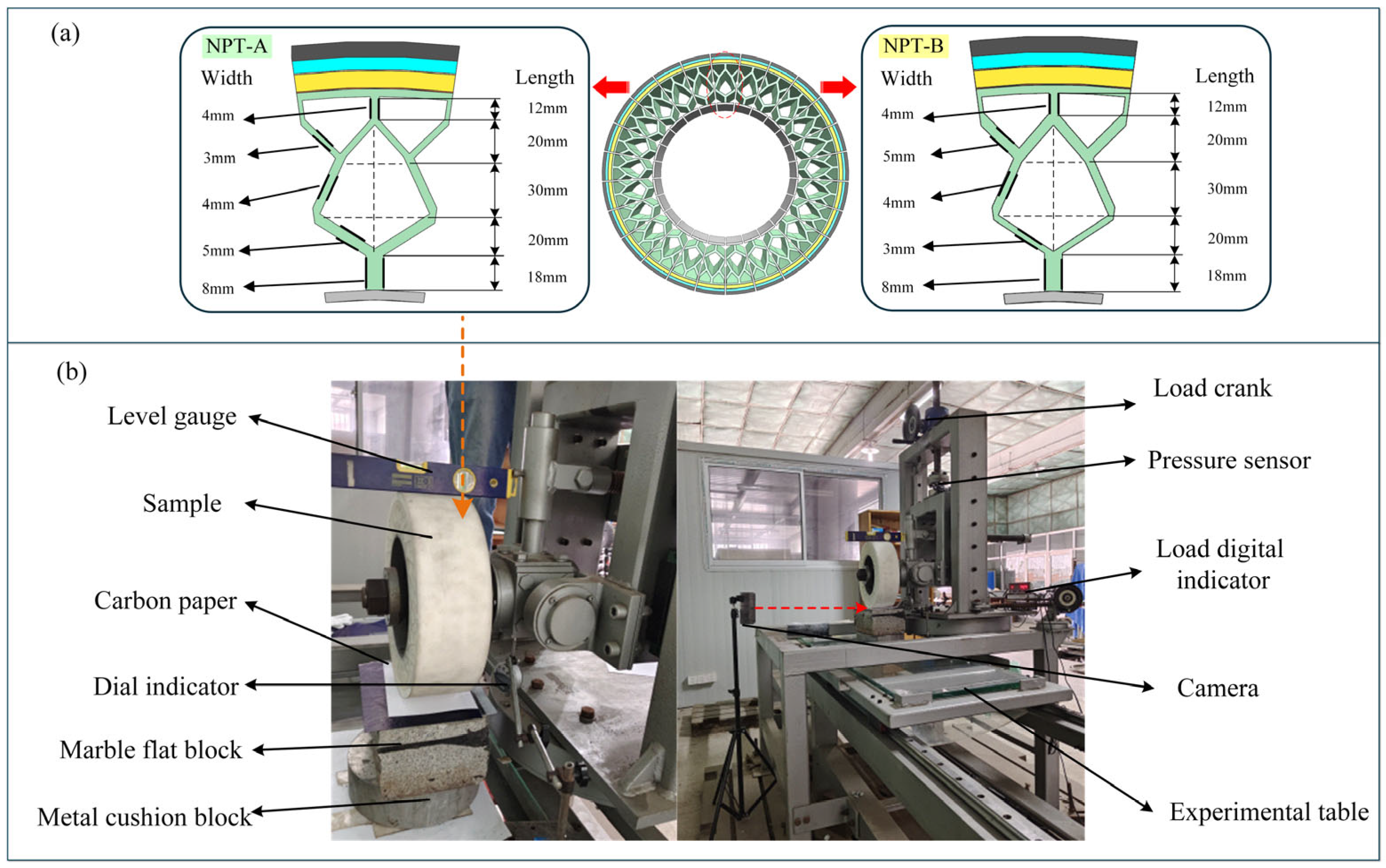
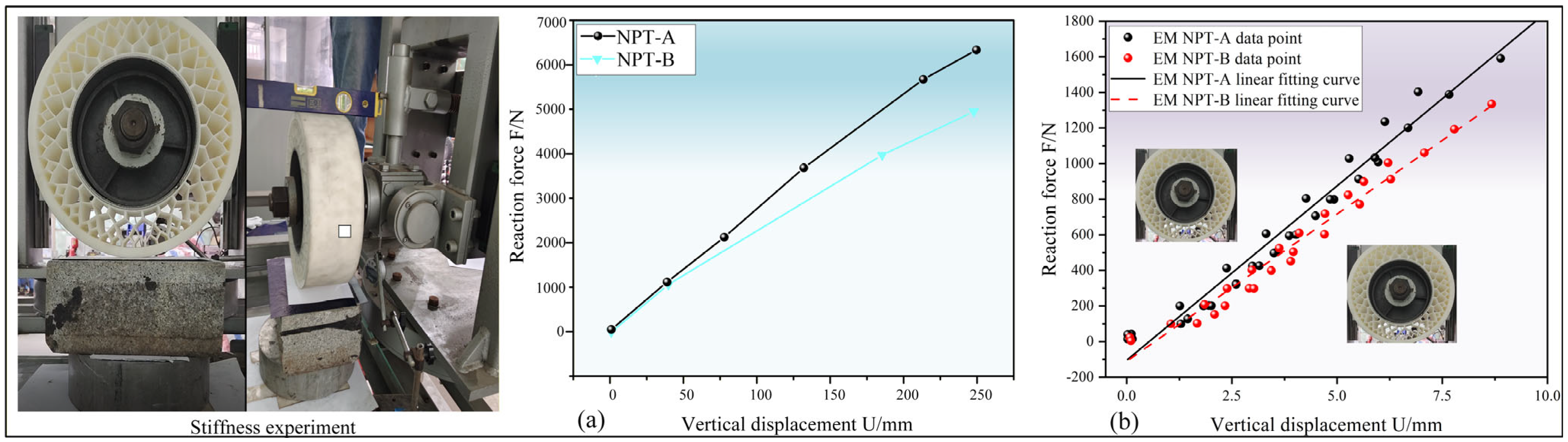

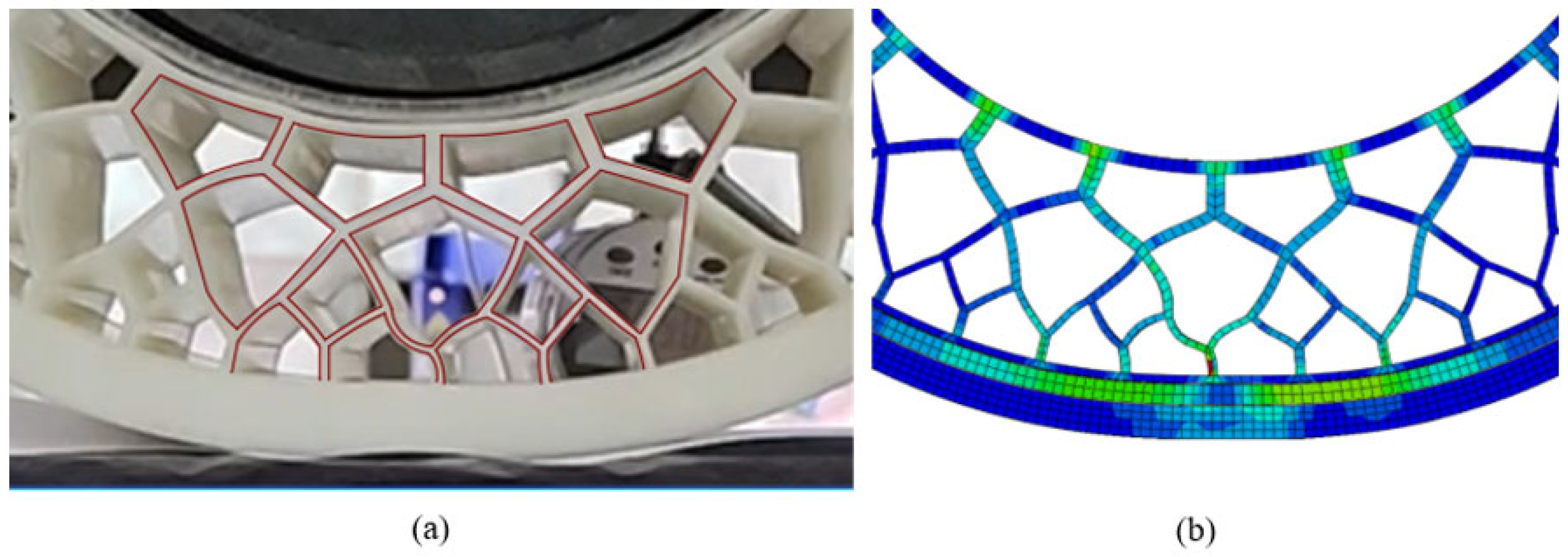
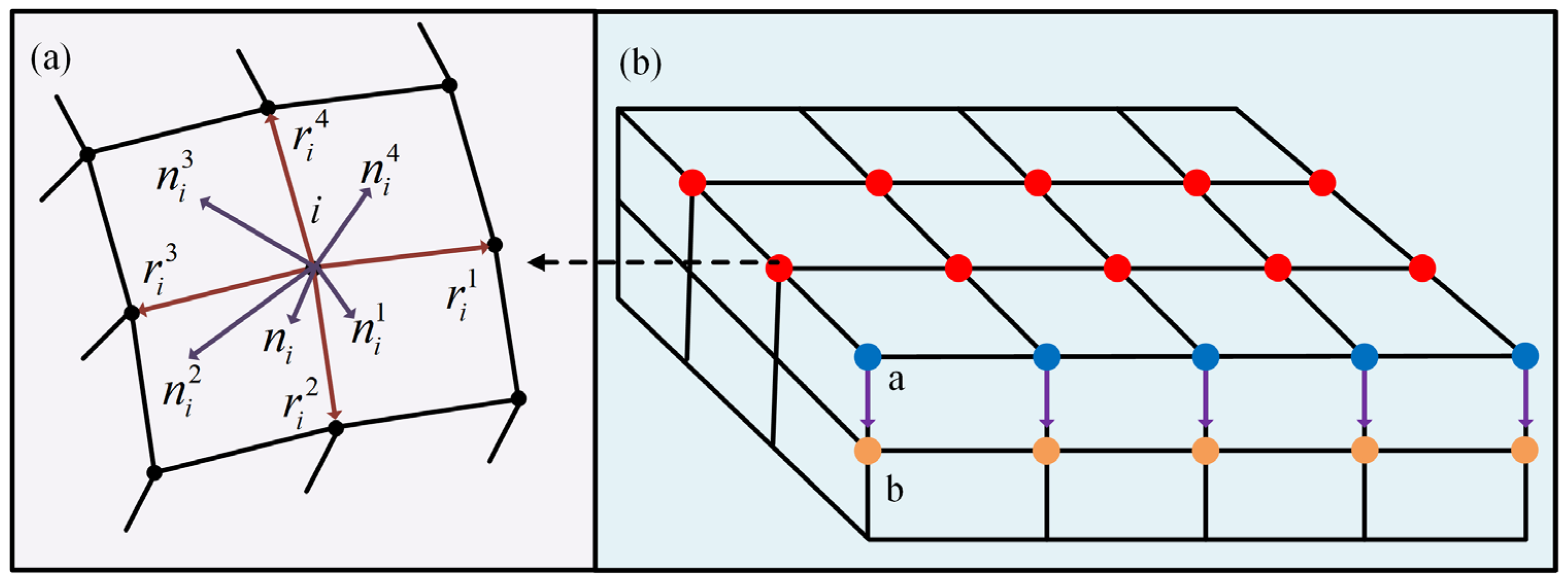


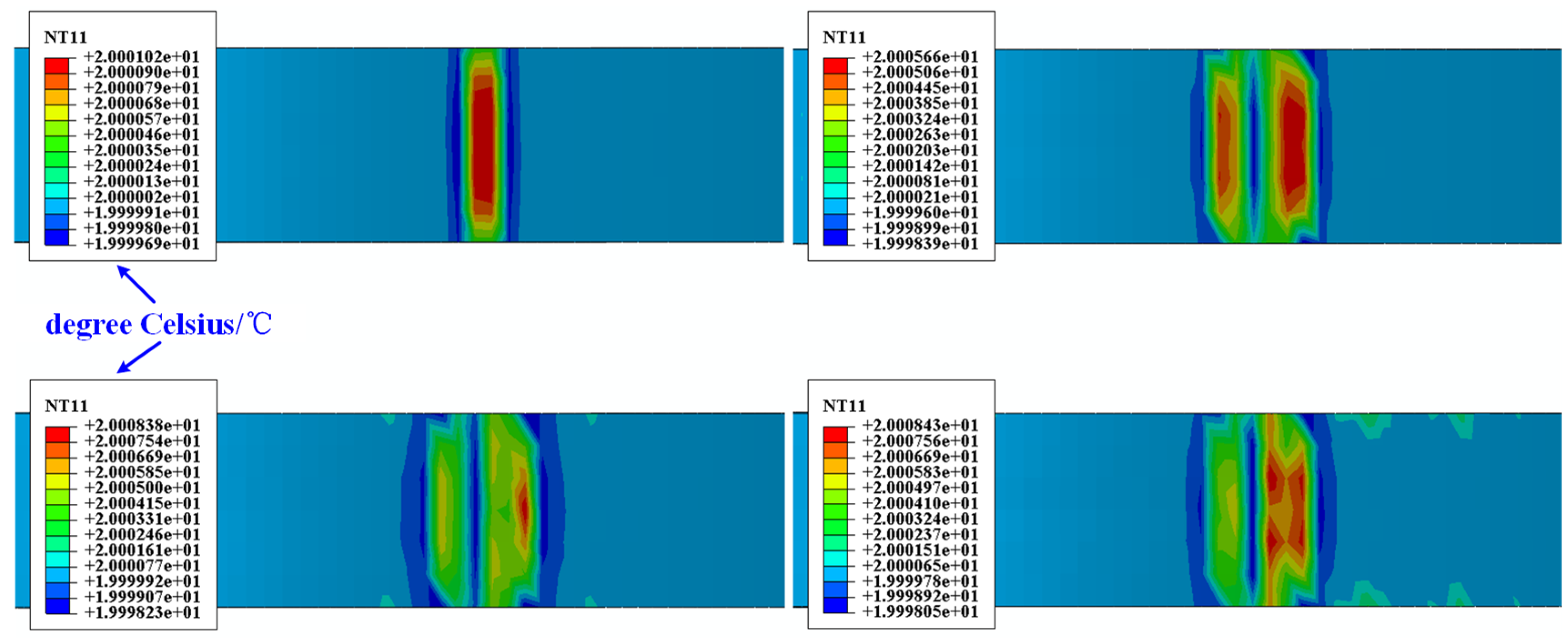





| Category | First Group of Specimens | Second Group of Specimens | ||||||||
|---|---|---|---|---|---|---|---|---|---|---|
| Hardness/HA | 77.3 | 77 | 76.2 | 76 | 76 | 76.5 | 76.8 | 77 | 77 | 78 |
| Mass Before Wear/g | 24.278 | 24.279 | 24.279 | 24.281 | 24.279 | 24.423 | 24.425 | 24.426 | 24.424 | 24.425 |
| Mass After Wear/g | 24.274 | 24.274 | 24.276 | 24.277 | 24.274 | 24.421 | 24.421 | 24.422 | 24.421 | 24.423 |
| Mass Loss/g | 0.004 | 0.005 | 0.003 | 0.004 | 0.005 | 0.002 | 0.004 | 0.004 | 0.003 | 0.002 |
| Average Mass Loss per Group/g | 0.0042 | 0.003 | ||||||||
| Average Mass Loss of Two Groups/g | 0.0036 | |||||||||
| Material | Elastic Modulus (Pa) | Poisson’s Ratio | Thermal Conductivity (W·m−1·K−1) | Specific Heat Capacity (J·kg−1·K−1) | Temperature (℃) |
|---|---|---|---|---|---|
| Rubber | 10,500,000 | 0.485 | 0.231 | 10,500,000 | 20 |
| 9,580,000 | 0.485 | 0.251 | 9,580,000 | 30 | |
| 8,940,000 | 0.485 | 0.267 | 8,940,000 | 40 | |
| 6,970,000 | 0.485 | 0.267 | 6,970,000 | 50 | |
| 5,870,000 | 0.485 | 0.285 | 5,870,000 | 60 | |
| 3,850,000 | 0.485 | 0.293 | 3,850,000 | 70 |
| Tread | Outer Cover | Outer Reinforcement | Shear Band | Inner Reinforcement | Inner Cover | Rim | |
|---|---|---|---|---|---|---|---|
| Radius (mm) | 292.5 | 286.19 | 285.58 | 276.69 | 276.08 | 272.8 | 177.8 |
| Thickness (mm) | 7.5 | 6.31 | 0.61 | 8.89 | 0.61 | 3.28 | 5 |
| Material | Synthetic rubber | Polyurethane | High-strength steel | Polyurethane | High-strength steel | Polyurethane | Aluminum alloy |
| Component | Density (Kg/m3) | Elastic Modulus (pa) | Poisson’s Ratio | |
|---|---|---|---|---|
| NPT | N | 2800 | 72,000,000,000 | 0.33 |
| PU | 1100 | 32,000,000,000 | - | |
| S | 7800 | 210,000,000,000 | 0.29 | |
| Rubber | 1085 | 10,500,000 | 0.485 |
| i | PU | ||||
|---|---|---|---|---|---|
| µi (MPa) | ai | gi | τi | Di | |
| 1 | 13.546 | 1.513 | 0.125 | 0.002 | 5 × 10⁹ |
| 2 | −2.338 | 2.212 | 0.125 | 0.020 | 0 |
| 3 | 0.093 | −2.471 | 0.125 | 0.200 | 0 |
| Model Parameter | Density/ kg·m−3 | Elastic Modulus/ Mpa | Poisson’s Ratio/ μ | Specific Heat Capacity/ [J·(kg·k)−1] | Thermal Conductivity/ [J·(m·h·k)−1] |
|---|---|---|---|---|---|
| Asphalt Concrete Pavement Layer | 2300 | 600 | 0.27 | 924.9 | 4680 |
Disclaimer/Publisher’s Note: The statements, opinions and data contained in all publications are solely those of the individual author(s) and contributor(s) and not of MDPI and/or the editor(s). MDPI and/or the editor(s) disclaim responsibility for any injury to people or property resulting from any ideas, methods, instructions or products referred to in the content. |
© 2026 by the authors. Licensee MDPI, Basel, Switzerland. This article is an open access article distributed under the terms and conditions of the Creative Commons Attribution (CC BY) license.
Share and Cite
Ren, H.; Zhou, H.; Zhang, W.; Gao, Z.; Xu, T. Simulation Analysis of Non-Pneumatic Tire Wear Based on Temperature-Corrected Archard Model. Machines 2026, 14, 168. https://doi.org/10.3390/machines14020168
Ren H, Zhou H, Zhang W, Gao Z, Xu T. Simulation Analysis of Non-Pneumatic Tire Wear Based on Temperature-Corrected Archard Model. Machines. 2026; 14(2):168. https://doi.org/10.3390/machines14020168
Chicago/Turabian StyleRen, Haoze, Haichao Zhou, Wei Zhang, Zhiwei Gao, and Ting Xu. 2026. "Simulation Analysis of Non-Pneumatic Tire Wear Based on Temperature-Corrected Archard Model" Machines 14, no. 2: 168. https://doi.org/10.3390/machines14020168
APA StyleRen, H., Zhou, H., Zhang, W., Gao, Z., & Xu, T. (2026). Simulation Analysis of Non-Pneumatic Tire Wear Based on Temperature-Corrected Archard Model. Machines, 14(2), 168. https://doi.org/10.3390/machines14020168