


Abstract
To address the insufficient near-wall prediction capability of the traditional Partially Averaged Navier–Stokes (PANS) model in simulating curvature flows, a new nonlinear PANS model with near-wall correction was developed in this study. The model, referred to as the CLS PANS model, is constructed based on Craft’s nonlinear stress formulation and incorporates additional dissipation source and length-scale correction terms to enhance accuracy in curved, rotating, and separated flow fields. To evaluate its applicability and reliability, the new nonlinear PANS model was applied to three representative cases: Taylor–Couette flow, flow past a circular cylinder, and internal flow in a centrifugal pump. Numerical results were systematically compared with experimental data, Direct Numerical Simulation (DNS) results, and results from conventional Reynolds-Averaged Navier–Stokes and k-ε PANS models. The results show that the new nonlinear PANS model can accurately predict complex flow structures such as Taylor vortices and herringbone streaks with lower computational cost, demonstrating improved scale-resolving capability and near-wall performance. For flow past a circular cylinder, the predicted drag coefficient, Strouhal number, and velocity distribution in the wake agree well with experiments. In the centrifugal pump case, the model effectively captured the low-speed and separated flow regions near the blade pressure surfaces, yielding results consistent with experimental observations. Overall, the new nonlinear PANS model achieves a favorable balance between accuracy and efficiency and exhibits strong potential for simulating curvature- and rotation-dominated turbulent flows.
1. Introduction
Curvature effects are prominent, such as in turbomachinery [1,2]. The curvature effect enhances turbulent fluctuations in concave surfaces and is depressed in convex surfaces [3]. In curvature flow, both the Coriolis force and centrifugal force make the pressure gradient of the boundary layer change rapidly and induce nonlinear waves, which enhance the anisotropy of turbulent flow and disturb the stability.
Simulation of curvature effects in turbulent flow is a real challenge for Computational Fluid Dynamics (CFD). There is no doubt that Direct Numerical Simulation (DNS) is the most accurate way to obtain all turbulence scales by solving the transient Navier–Stokes equations directly. Nevertheless, it is difficult to satisfy the requirements of the resolution scales, both in time and space, which will result in a large amount of computational cost. So, it is still impractical to apply this method to complex flows with high Reynolds numbers [4]. As an alternative, Large Eddy Simulations (LESs) have been applied in more and more turbulence simulations with the development of computer technology; however, the near-wall grid resolution requirement of LESs is strict, which leads to a high cost and great limitations on its application to complex flows with significant rotation effects [5]. It is known that Reynolds-Averaged Navier–Stokes (RANS) models based on the Boussinesq hypothesis show inadequate performance in simulating rotating turbulence due to the isotropy assumption and overestimates of turbulent eddy viscosity. These restrictions indicate the need for a desirable turbulence model that can reproduce both curvature effects precisely at an affordable cost.
The Partially Averaged Navier–Stokes (PANS) method proposed by S. S. Girimaji [6] is a variable-resolution turbulence model assembling RANS and DNS using the bridging method. PANS is able to make the transition from RANS to DNS smoothly and can capture arbitrary scales of turbulence according to different requirements. Different from other variable-resolution turbulence models, such as Detached Eddy Simulation (DES) [7], Delayed Detached Eddy Simulation (DDES) [8], Very Large Eddy Simulation (VLES) [9], and so on, in which the RANS model is employed in the near-wall region and the LES is used far away from the wall, the PANS method does not seek to combine RANS and LES in different regions; instead, it provides a closure model for any intermediate degrees of scale resolution. The PANS method accomplishes variable resolutions by varying the unresolved-to-total ratio of turbulence kinetic energy, fk, and unresolved-to-total ratio of dissipation rate, fε [6,10,11,12]. The relationship of the two sub-filter control parameters is 0 ≤ fk ≤ fε ≤ 1. The PANS model converts to DNS when fk = fε = 0, and it is equivalent to RANS when fk = fε = 1. Normally, the parameter fε is regarded as unity at highly turbulent flows, so the filtered width of the PANS model is mainly controlled by the parameter fk for flow with a high Reynolds number [6,13]. The PANS method can resolve various flows by adjusting control filter parameters and parent models, offering broad applicability and high accuracy for multiple engineering flows [14,15,16,17,18,19,20,21,22]. It shows great potential for applications in curvature and rotation flow. The CLS model, constructed based on the nonlinear eddy viscosity formulation proposed by Craft, Launder, and Suga (CLS) [23], is a powerful approach that has been successfully applied to flows with separation and curvature [23,24]. Among various nonlinear eddy viscosity closures, Craft’s nonlinear stress formulation is adopted in the present study due to its proven capability in representing turbulence anisotropy and curvature effects without introducing excessive model complexity. Compared with linear eddy viscosity models and other higher-order nonlinear closures, Craft’s model provides a favorable balance between physical fidelity and computational robustness, making it well suited for integration into the PANS framework. Building on this, a nonlinear PANS model with near-wall correction, named CLS PANS, was developed in a previous work [25]. The CLS PANS model was validated in typical separated flows, demonstrating its effectiveness in capturing near-wall flow fields and separated flows. In this paper, we aim to evaluate the applicability of the CLS PANS model to curvature flow.
This paper addresses the fidelity of the CLS PANS model with a fixed fk value in simulating three typical curvatures: Taylor–Couette flow, flow past a circular cylinder, and flow in a centrifugal impeller. The paper is organized as follows: In Section 2, the basic equations of the CLS PANS model are introduced. Then, the numerical setup of three cases and their results are illustrated in Section 3. The main conclusions are summarized in Section 4.
2. Governing Equations for CLS PANS Model
The application of an arbitrary constant preserving a filtering operator that commutes with spatial and temporal differentiation to incompressible Navier–Stokes equations leads to PANS equations:
where xi is the Cartesian coordinates; Vi and p are instantaneous velocity components and pressure; <Vi> is the filtered velocity components; and <p> is the filtered pressure, where < > represents the partial-averaging filter. ρ is the fluid density, ν is the molecular kinematic viscosity, and τ(Vi, Vi) is the sub-filtered scale (SFS) stress. Typically, the SFS stress in the PANS method is modeled by a linear eddy viscosity model (LEVM) based on the Boussinesq hypothesis, which can be expressed as the following equation in the standard k-ε PANS model:
where is unresolved eddy viscosity, ku is the unresolved turbulence kinetic energy, and is the Kronecker delta. The unresolved eddy viscosity in the sub-filtered scale stress can be expressed as
where Cμ is a constant coefficient, and εu is the unresolved dissipation rate. The range of resolved scales in the PANS model is controlled by two parameters:
where k and ε are the total turbulence kinetic energy and total dissipation rate, as would be predicted by the parent RANS model. fk is the unresolved-to-total ratio of turbulence kinetic energy, and fε is the unresolved-to-total ratio of dissipation rate.
As mentioned before, the present study focuses on evaluating the applicability of the CLS PANS model to curvature and rotation flow. In the CLS PANS model, the SFS stress is calculated using the following equation:
where
where unresolved is isotropic dissipation, and is a quantity that vanishes at the wall. The model coefficients of Equation (7) are listed in reference [23]. and are stress rate and vorticity tensors, respectively, and their definitions are also in reference [23].
where and are dimensionless strain and vorticity invariants. δku and δεu are the Prandtl numbers for the unresolved turbulent kinetic energy and dissipation rate, respectively.
The closed transport equations for and based on Craft’s model, named CLS PANS, can be written as
The additional terms Eεu and Yapu, used in Equations (13)–(15), are the near-wall source term and Yap’s length-scale correction, respectively. The incorporation of Eεu and Yapu into the equations can significantly enhance computational accuracy in the near-wall region. Additionally, the nonlinear terms in the SFS stress offer advantages in capturing separated and curved flows. Building on these principles, the CLS PANS model is designed to improve the accuracy of complex flow simulations and enhance the ability to capture characteristic flow features.
3. Applications of the CLS PANS Model
To test the performance of the proposed CLS PANS model, three classical separated flow cases are analyzed below in detail.
3.1. Taylor–Couette Flow
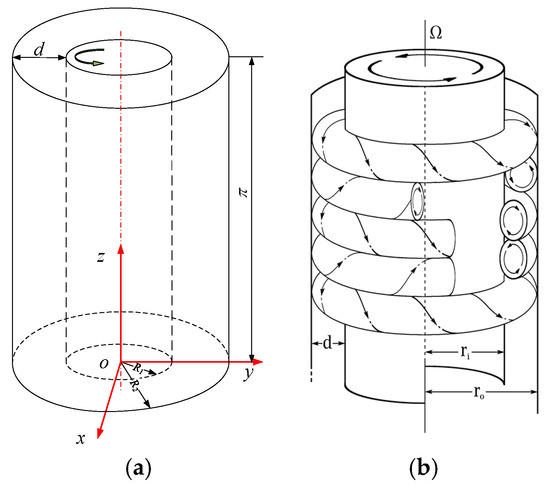
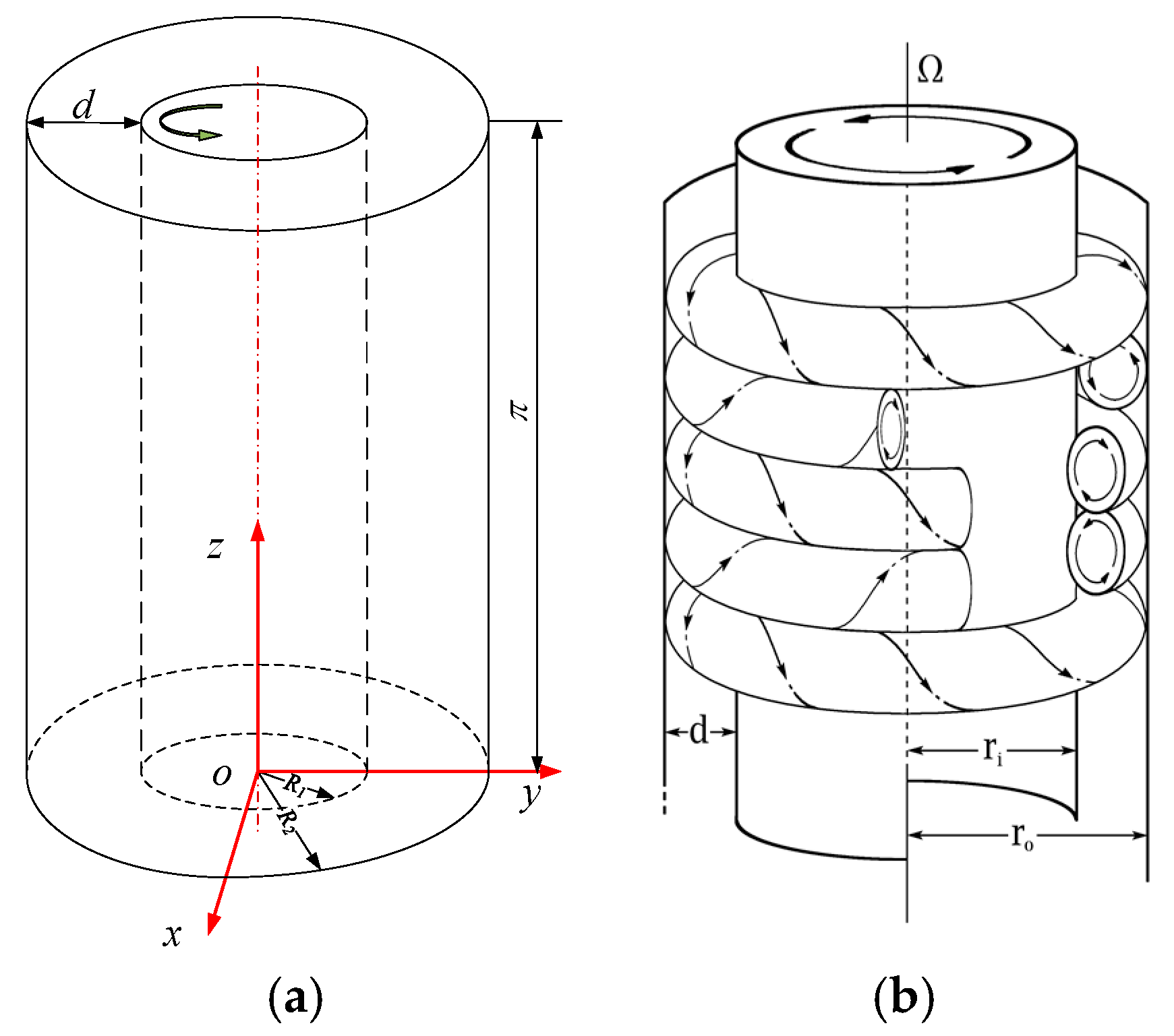
The present Taylor–Couette flow field consists of two concentric cylindrical surfaces, where the inner surface rotates at a fixed circumferential velocity, U0, and the outer surface is stationary. Owing to the opposite curvatures, convex and concave at both cylinder walls, the instability is notable in the near-wall region, and the mean shear-driven flow is prominent due to the rotating cylinder surface [26]. Pressure gradient and axial flow in the axial direction are not included. The flow domain and a sketch of the flow field are shown in Figure 1. The inner and outer radius of the cylinders are R1 and R2 respectively, the length of the gap between the inner and outer cylinder walls is defined as d = R2 − R1, and the radius ratio is η = R1/R2 = 0.5, which may lead to strong curvature effects [27]. The length of the axial direction is Lz, and the aspect ratio is defined as Γ = Lz/d. It has been found that a smaller aspect ratio is more adaptable to initial conditions [28]. Here, the aspect ratio is set as Γ = π, which is only half of the axial length used in the study by S. Dong [29] and has little impact on the results of the flow field according to Huang et al. [3] and Bazilevs et al. [27].
Figure 1.
Sketch of Taylor–Couette flow (a) computational domain and (b) flow field.
The Reynolds number is defined as Re = U0d/ν, where U0 is the circumferential velocity of the inner surface, and d is the gap width between the inner and outer surfaces. Two flow conditions studied by S. Dong [29] using the DNS method are chosen for validation and verification of the present CLS PANS model. In this paper, two Reynolds numbers are studied, 5000 and 8000.
The whole numerical simulation is carried out in the open-source code OpenFOAM 2.3.0, which is written in C++ using object-oriented techniques. During simulation, the incompressible transient solver pisoFoam is used. The Pressure-Implicit with Splitting of Operators (PISO) scheme is applied for pressure–velocity coupling. The movingWall condition with rotation speed U0 is set at the inner cylinder wall, and the NoSlip condition is set at the outer wall. As for the pressure condition, the Neuman boundary (zeroGradient) condition is adopted at both the inner and outer cylinder walls. The periodic conditions are set at both the end surfaces normal to the axial direction. All the discretization schemes have second-order accuracy. In the process of simulation, the averaged Courant–Friedrichs–Lewy (CFL) number is less than 1.0, and the iterative convergence criteria are set to be 1 × 10⁻⁵ for all the scaled residuals. The averaging process is turned on when the flow field is statistically stable. The simulation results for velocity and Reynolds stress in this study were averaged over time, circumferential direction, and axial direction and nondimensionalized by the inner surface circumferential velocity, U0.
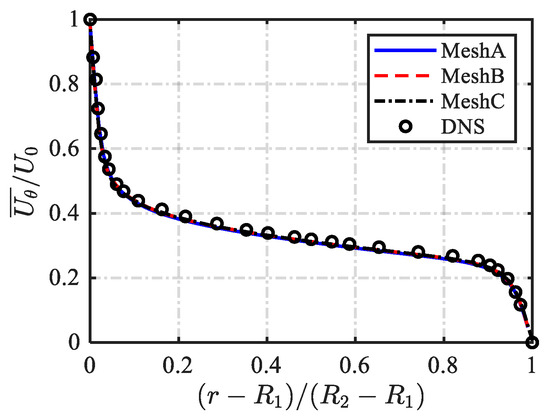
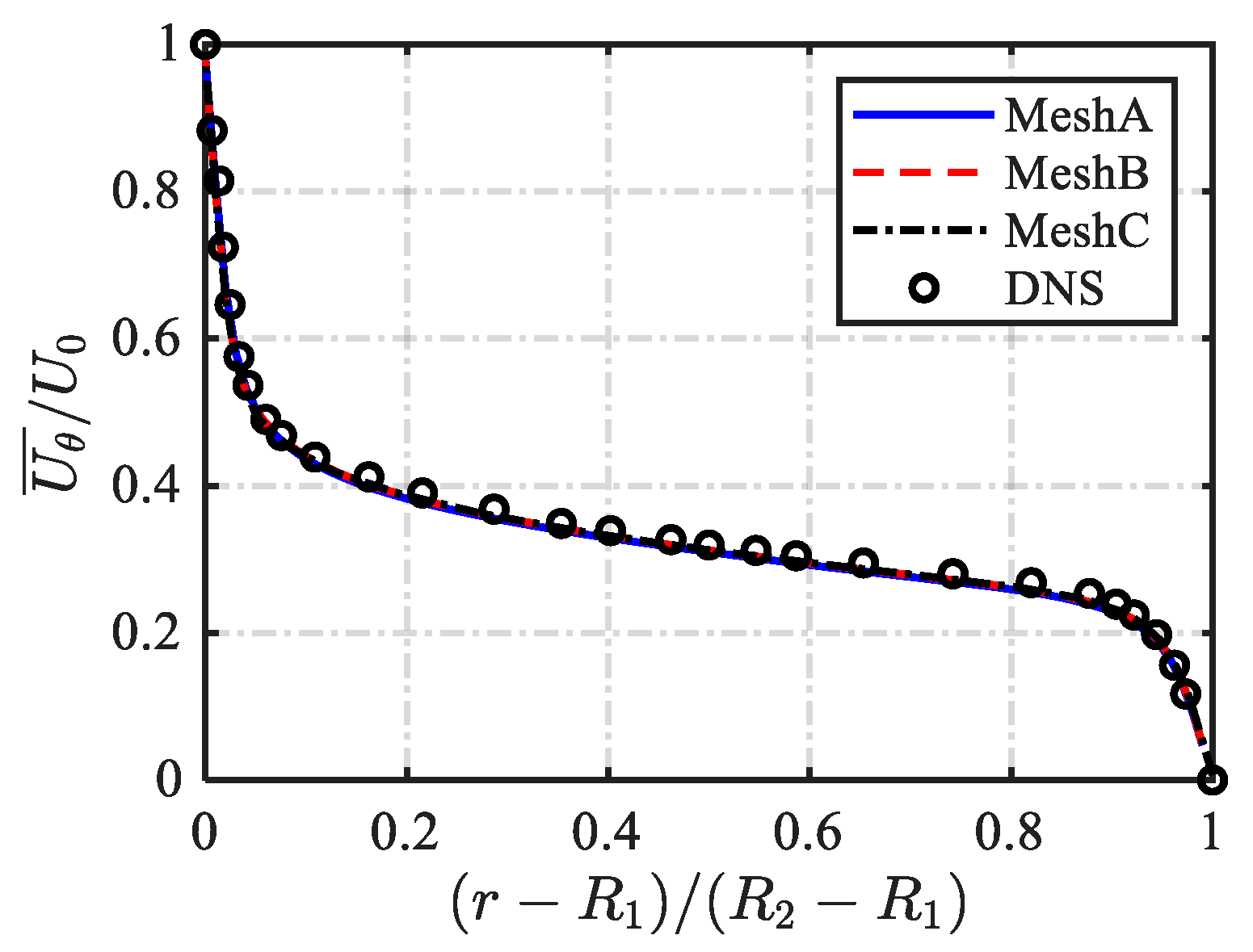
To validate numerical accuracy, a grid convergence study was conducted at a Reynolds number of 5000 using the CLS PANS model with fk = 0.5. The selection of fk = 0.5 is motivated not only by its empirical performance but also by physical considerations of scale resolution in curved turbulent flows. In the PANS framework, fk controls the fraction of turbulent kinetic energy that is resolved. For flows dominated by coherent vortical structures—such as Taylor vortices—the energy-containing eddies typically constitute a significant portion of the total turbulent energy. The mean circumferential velocity, , is selected as the key evaluation parameter. Structured hexahedral grids were generated in ICEM CFD, with three grid configurations tested: MeshA (1.48 million points), MeshB (0.646 million points), and MeshC (0.315 million points). Figure 2 presents the circumferential-, axial-, and time-averaged circumferential velocity profiles for these grids. The results demonstrate good agreement across all three configurations, with the coarsest grid (MeshC) still providing acceptable accuracy. As a result, MeshC was selected for subsequent analyses to balance precision and computational cost.
Figure 2.
Mean circumferential velocity of 3 meshes at Re = 5000.
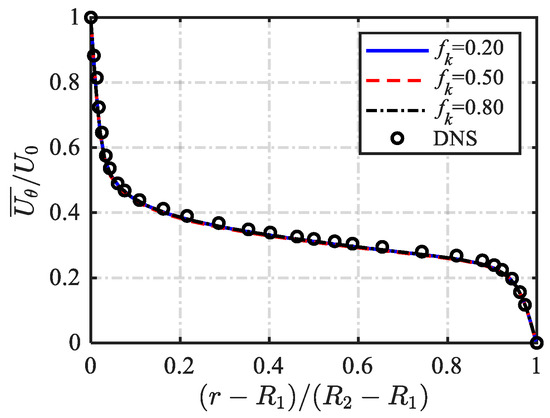
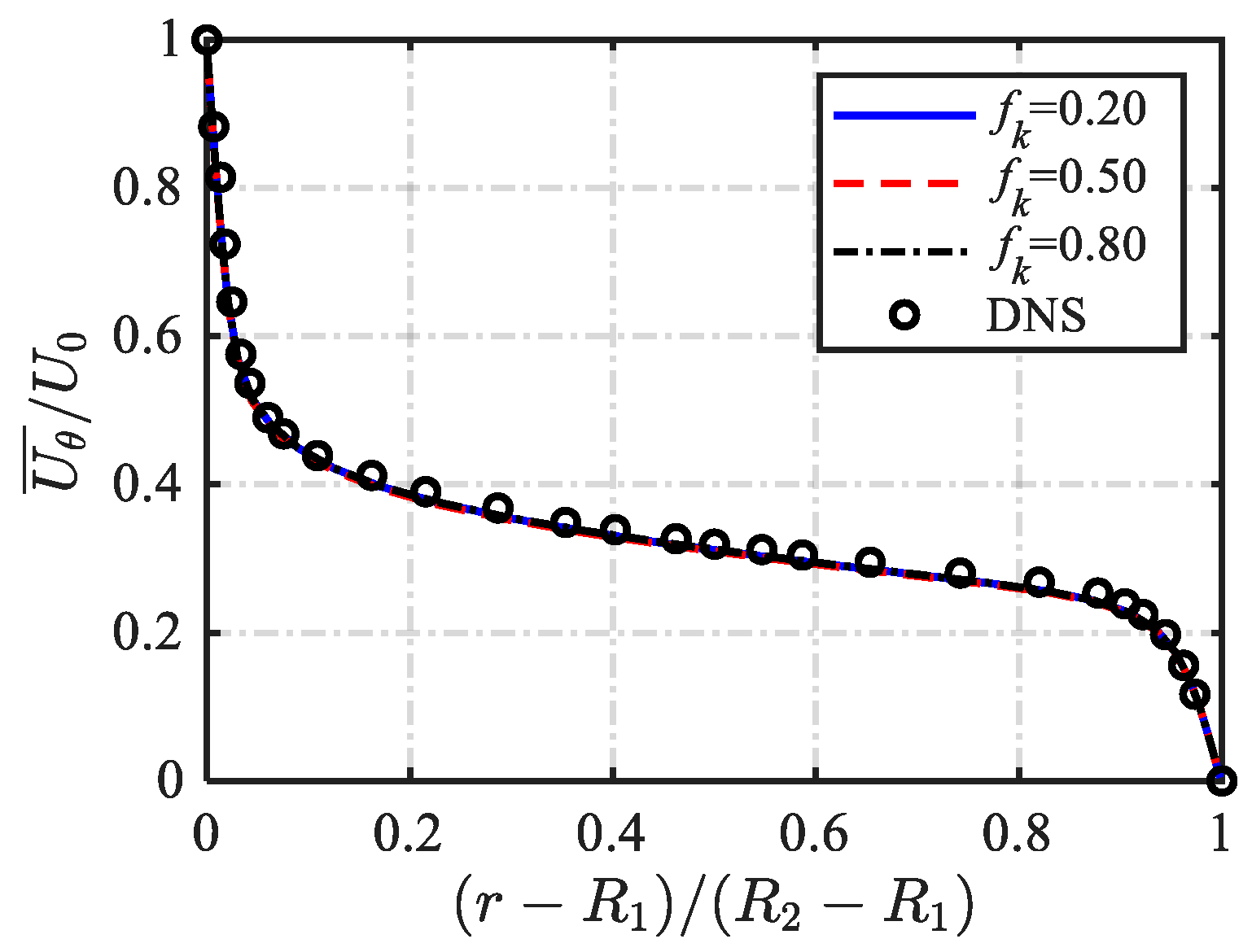
A convergence analysis of fk was conducted for the fixed fk PANS model. Simulations were performed on Taylor–Couette flow using MeshC, with fk values set to 0.2, 0.5, and 0.8. Figure 3 depicts the mean circumferential velocity profiles for these fk values. The results indicate that higher fk values, such as fk = 0.8, introduce noticeable deviations, whereas fk = 0.5 and fk = 0.2 yield results that closely match the DNS data. Considering the trade-off between accuracy and computational efficiency, fk = 0.5 was selected for further analysis.
Figure 3.
Mean circumferential velocity in three fk values at Re = 5000.
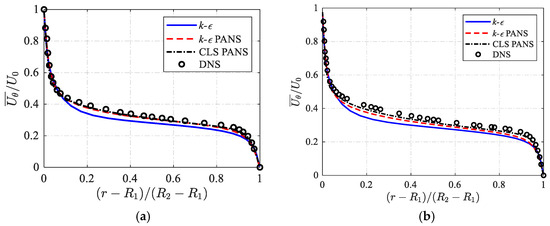
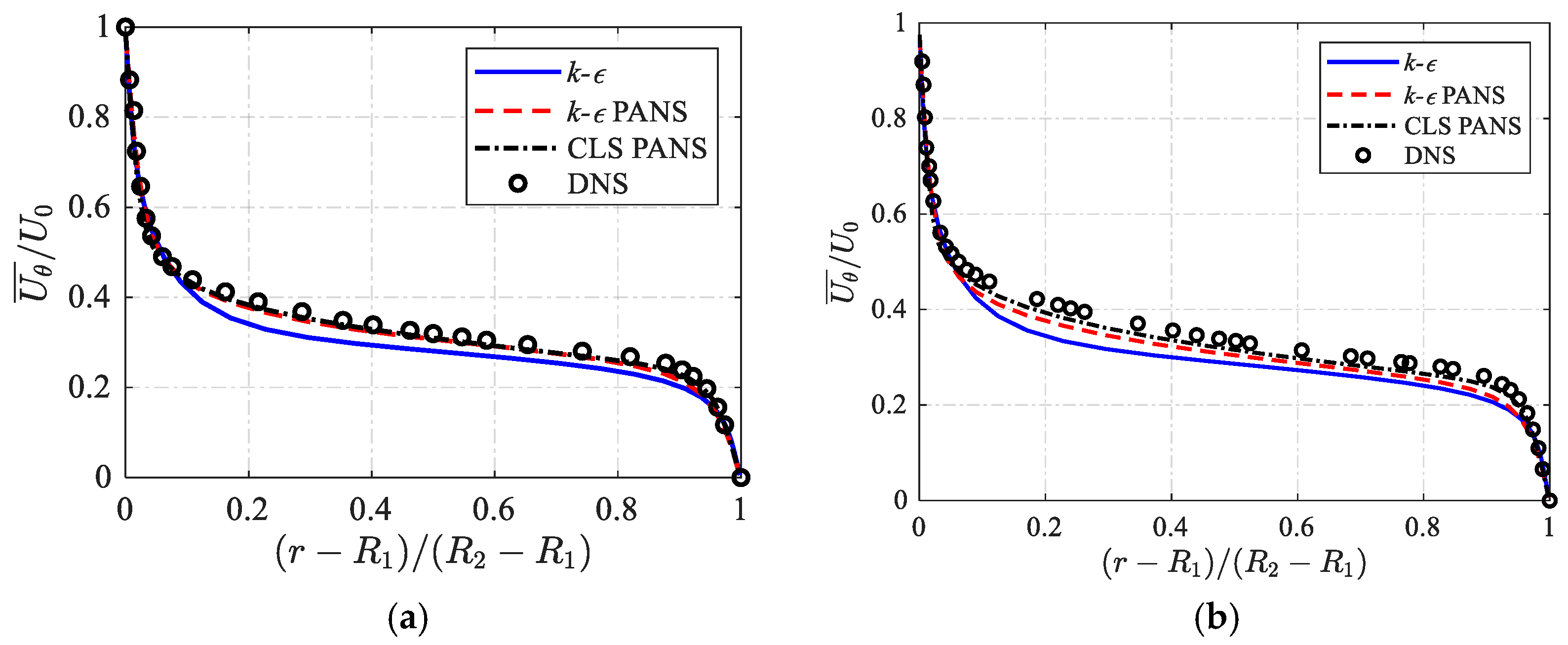
To evaluate the computational accuracy of the CLS PANS model, comparisons were made between the PANS, RANS, and DNS results. As previously mentioned, the subsequent computations use MeshC with fk = 0.5. Figure 4 shows the mean circumferential velocity. As shown in the figure, the mean circumferential velocity decreases rapidly from the inner wall to the outer wall under shear effects. All turbulence models accurately predict the velocity distribution trend; however, the RANS model results are significantly lower than those of PANS and DNS. For the two PANS results, the computational outcomes are relatively consistent.
Figure 4.
Comparison of mean circumferential velocity: (a) Re = 5000; (b) Re = 8000.
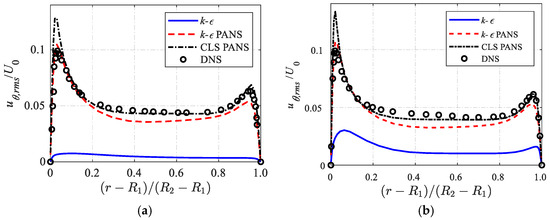
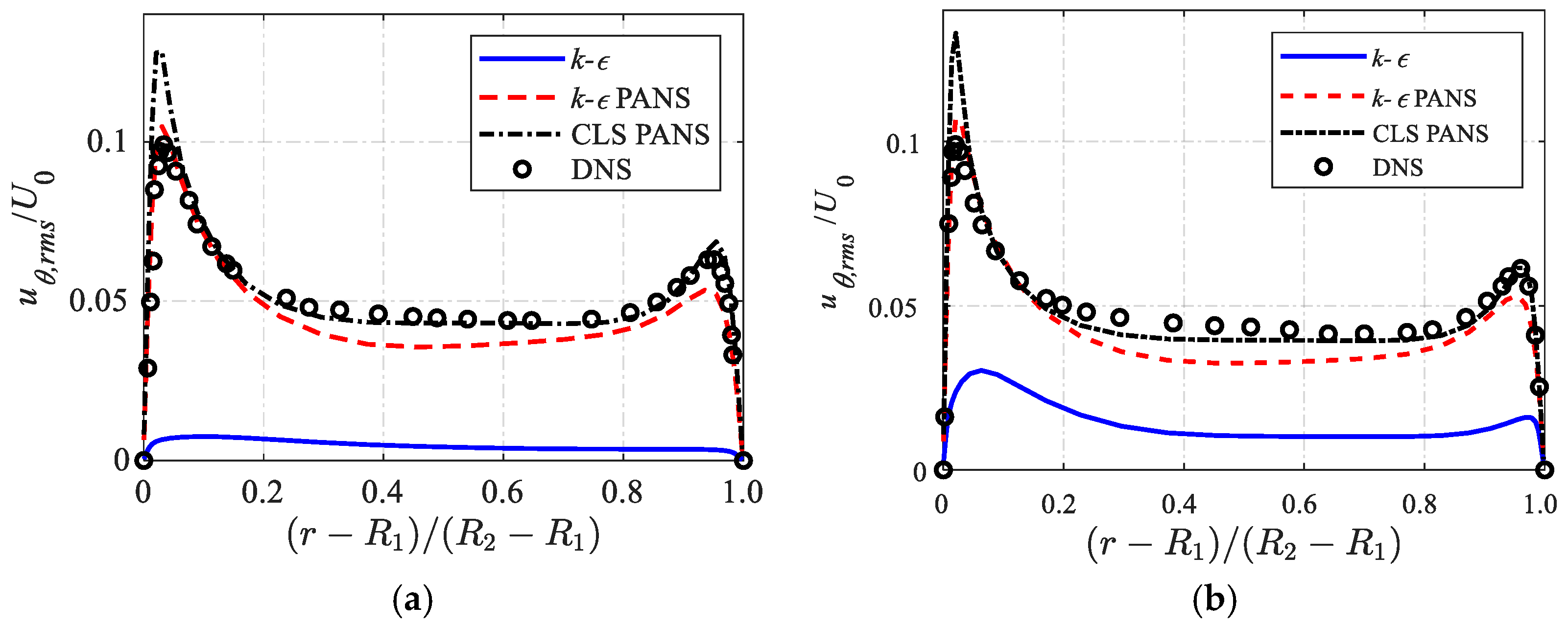
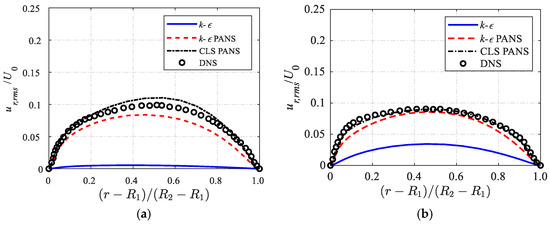
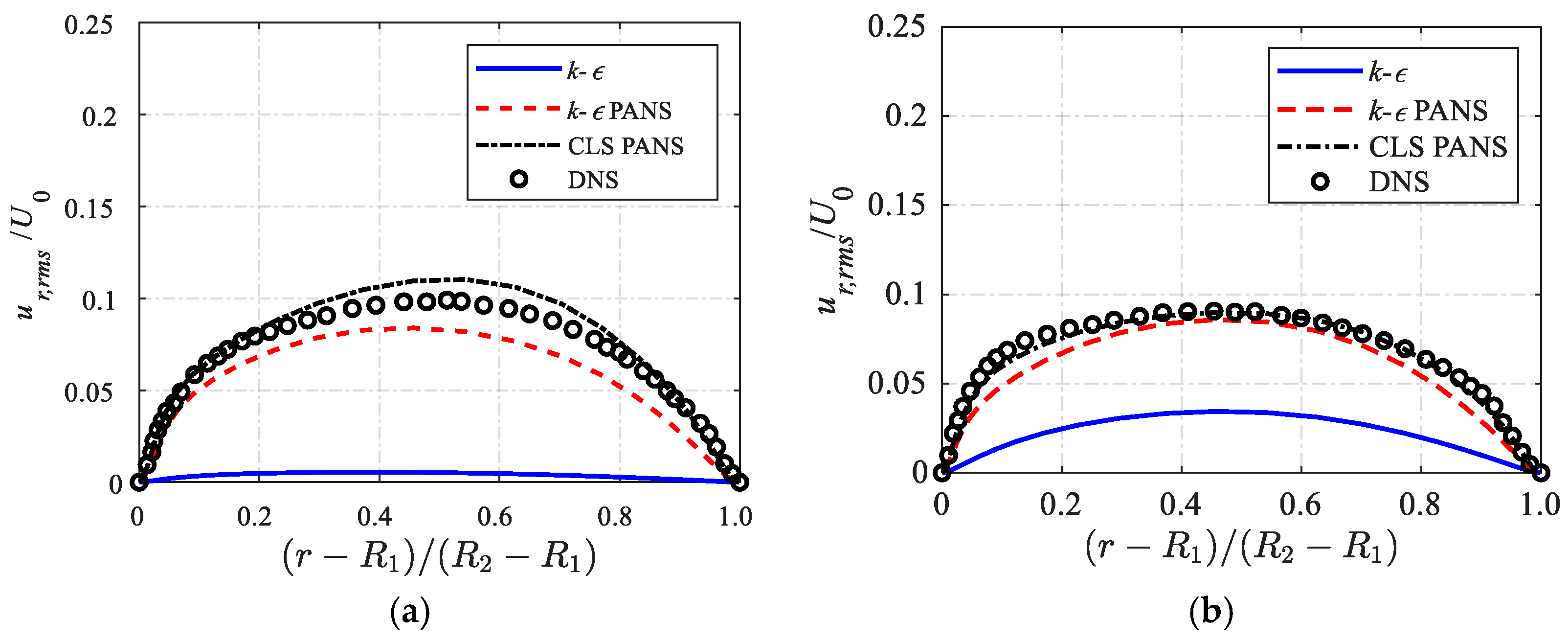
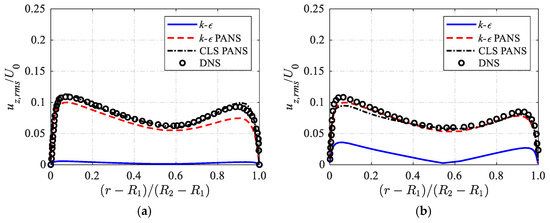
Figure 5, Figure 6 and Figure 7 present a comparison of root mean square (RMS) velocity results. The DNS results for the circumferential RMS velocity are referenced from [29], while the DNS results for radial and axial RMS velocities are referenced from [30]. From Figure 5a, it can be observed that the circumferential RMS velocity exhibits a peak near the inner wall and a smaller peak near the outer wall, caused by the shear effects of the mean velocity in the near-wall region. The circumferential RMS velocity decreases rapidly in the near-wall region and remains approximately constant in the core flow region. The RANS model fails to predict the RMS velocity trend, while the PANS model provides a better prediction. Although the CLS PANS model overestimates the peak Reynolds stress near the inner wall, it demonstrates good predictive performance across the overall domain. The overprediction of RMS velocity near the inner wall is likely related to the strong curvature and rotation effects in Taylor–Couette flow, which amplify near-wall turbulence fluctuations. In addition, the nonlinear stress formulation may enhance resolved turbulent activity close to the wall, leading to slightly higher RMS levels. Figure 5 and Figure 6 further show that the CLS PANS model achieves higher computational accuracy for radial and axial RMS velocities.
Figure 5.
Comparison of circumferential RMS velocity: (a) Re = 5000; (b) Re = 8000.
Figure 6.
Comparison of radial RMS velocity: (a) Re = 5000; (b) Re = 8000.
Figure 7.
Comparison of axial RMS velocity: (a) Re = 5000; (b) Re = 8000.
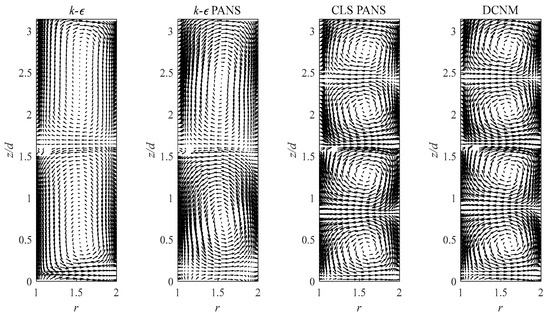
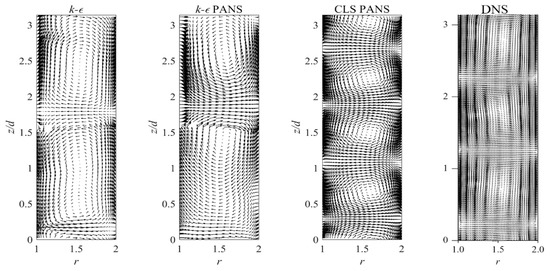
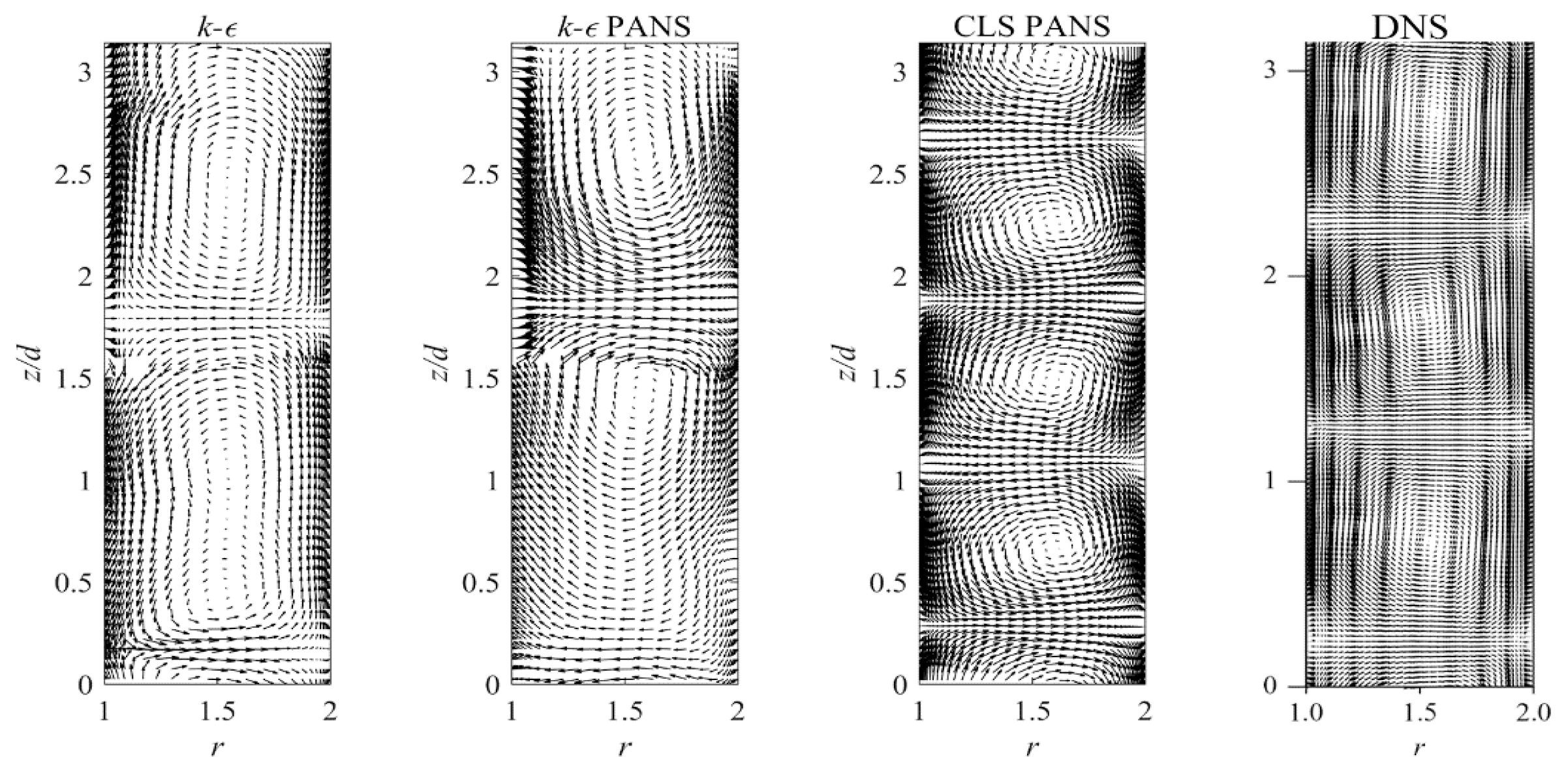
Taylor vortices are a typical flow feature of Taylor–Couette flow. Predictions of Taylor vortices using different turbulence models are compared in this study. Figure 8 and Figure 9 show the time-averaged velocity vector fields on the radial–axial plane at two Reynolds numbers.
Figure 8.
Time-averaged velocity field in a radial–axial plane at Re = 5000.
Figure 9.
Time-averaged velocity field in a radial–axial plane at Re = 8000.
At a Reynolds number of 5000, both the RANS and PANS models predict only two vortex structures, whereas the CLS PANS model predicts two distinct pairs of Taylor vortices. At a Reynolds number of 8000, the computational results are compared with DNS results from reference [29]. Similar to the case at Re = 5000, RANS and PANS capture only one pair of large vortex structures. In contrast, the CLS PANS results are more consistent with DNS, although slight discrepancies in the size and axial position of the predicted Taylor vortices can still be observed.
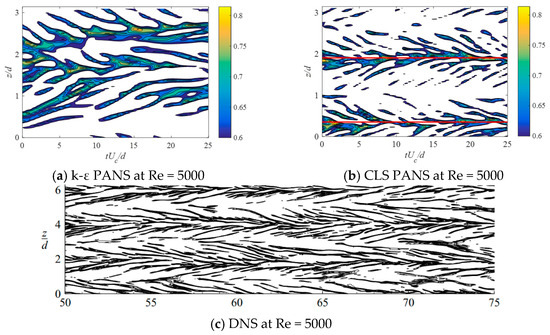
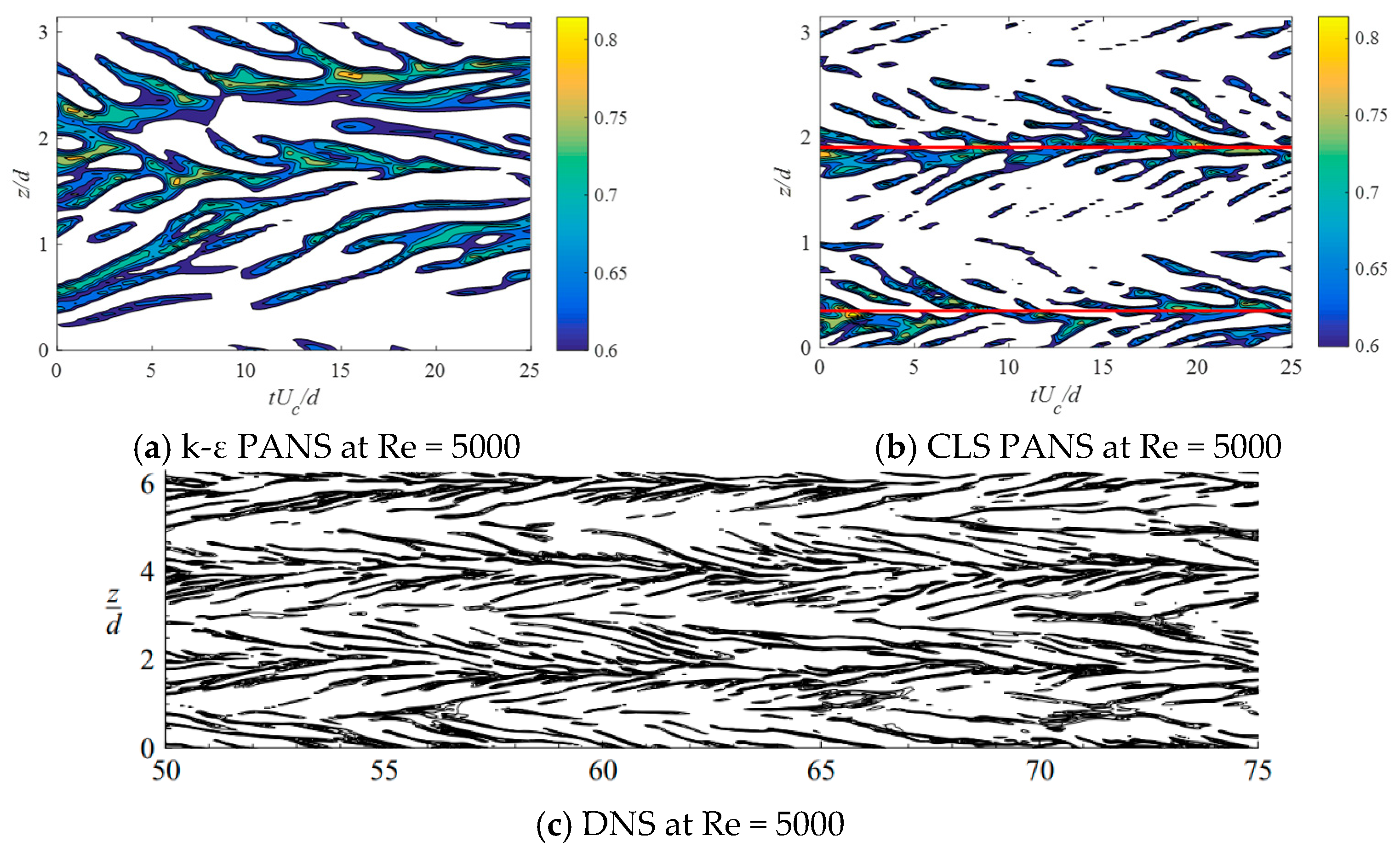
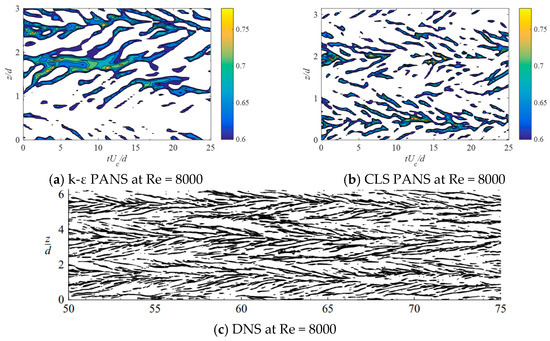
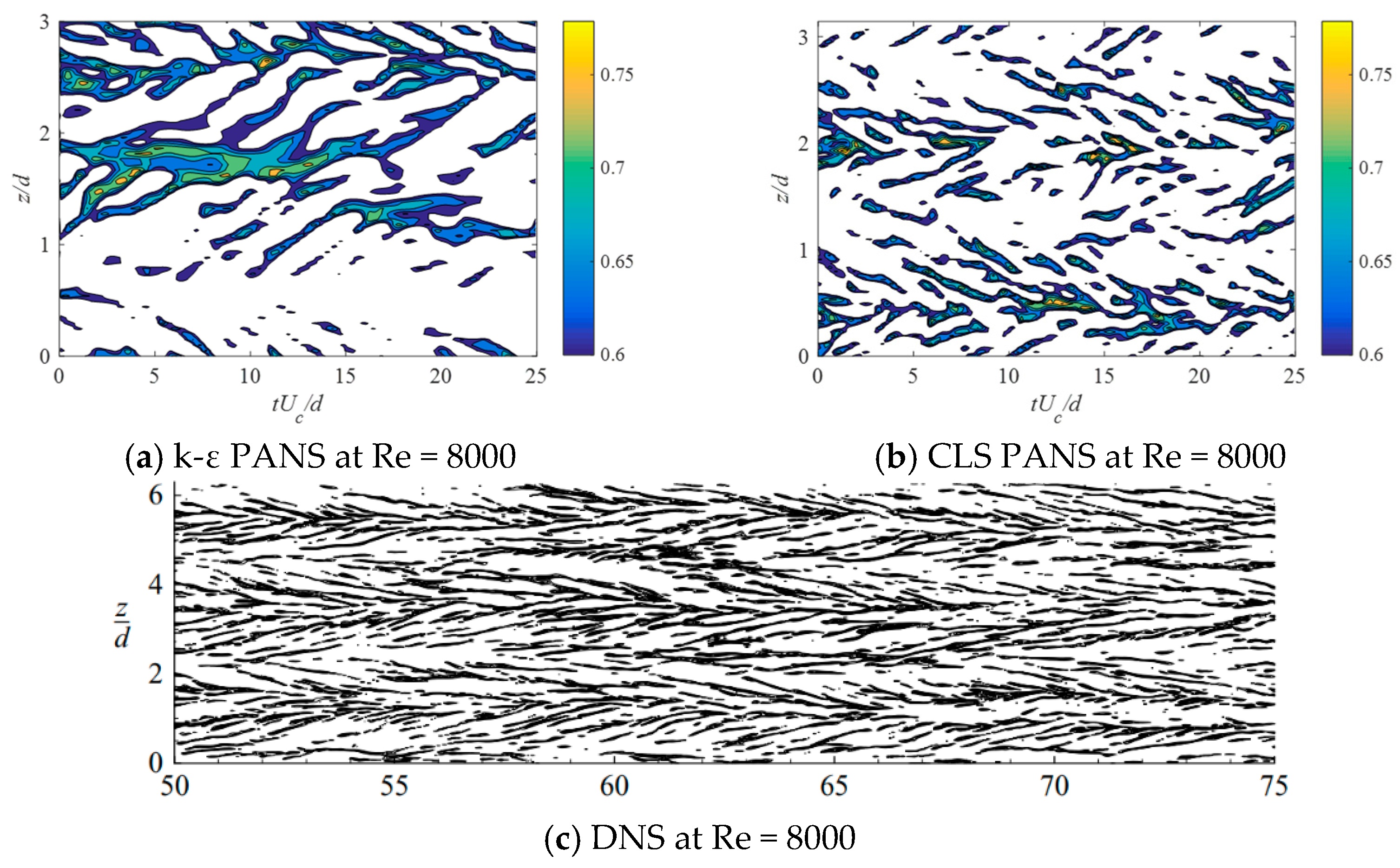
Figure 10 and Figure 11 illustrate the contour plots of the circumferential velocity at both Reynolds numbers with eight equi-levels between 0.65U0 and 0.9U0, which can plot the herringbone streaks in the DNS results. These structures are obtained by plotting the distribution of axial velocity in the time–space domain along a line segment located at 0.033d from the inner wall and parallel to the Z-axis. These streak structures reflect the flow characteristics in the near-wall region of Taylor–Couette flow.
Figure 10.
Contour plots of the temporal circumferential velocity along an axial line at Re = 5000: (a) k-ε PANS; (b) CLS PANS; (c) DNS.
Figure 11.
Contour plots of the temporal circumferential velocity along an axial line at Re = 8000.
DNS data indicate that the herringbone streaks appear at the boundaries between two pairs of Taylor vortices. At Re = 5000, two herringbone streaks are predicted by the CLS PANS model at z/d = 0.3 and z/d = 1.9, consistent with the DNS results and aligned with the Taylor vortex boundaries shown in Figure 8. However, the k-ε PANS model fails to predict complete herringbone streaks, just as it cannot predict paired Taylor vortices in Figure 7. Figure 11 presents the circumferential velocity contour at Re = 8000. The DNS results reveal that at this Reynolds number, the herringbone streaks become more fragmented, and the locations of aggregated herringbone streaks are less distinguishable. The k-ε PANS model predicts unrealistic velocity contours, while the CLS PANS results align with DNS outcomes.
Overall, the CLS PANS model demonstrates better predictive accuracy for the near-wall region compared to the k-ε PANS model.
It is evident that the CLS PANS model has higher predictive accuracy compared to the standard PANS model. To investigate the reasons for this phenomenon, the distribution of SFS (sub-filter-scale) stress in the CLS PANS model is analyzed. The SFS stress expression inherits the form of Reynolds stress from the RANS model, and the SFS stress in CLS PANS is expressed as follows:
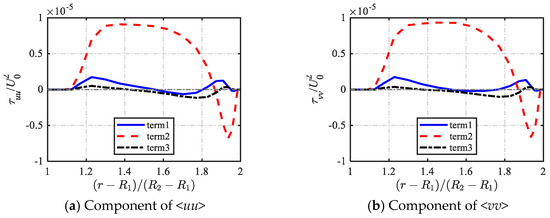
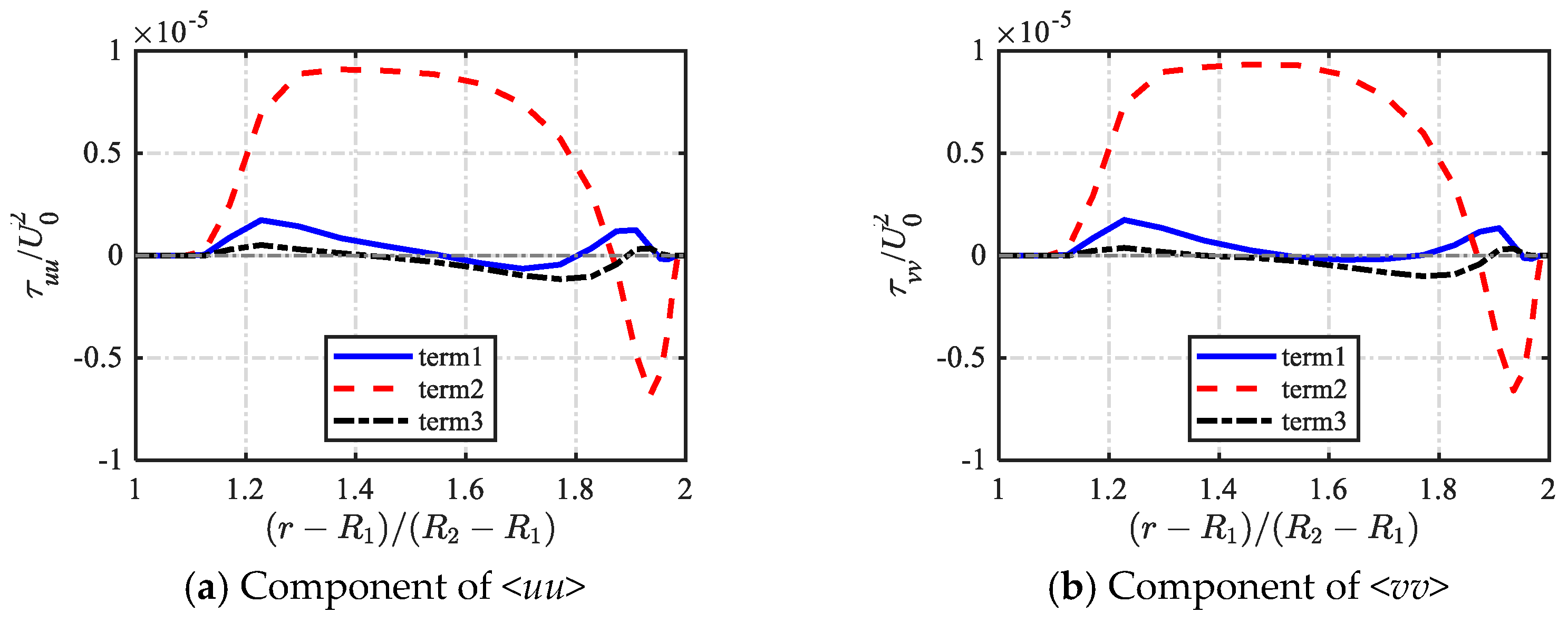
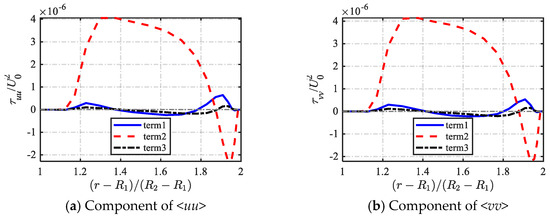
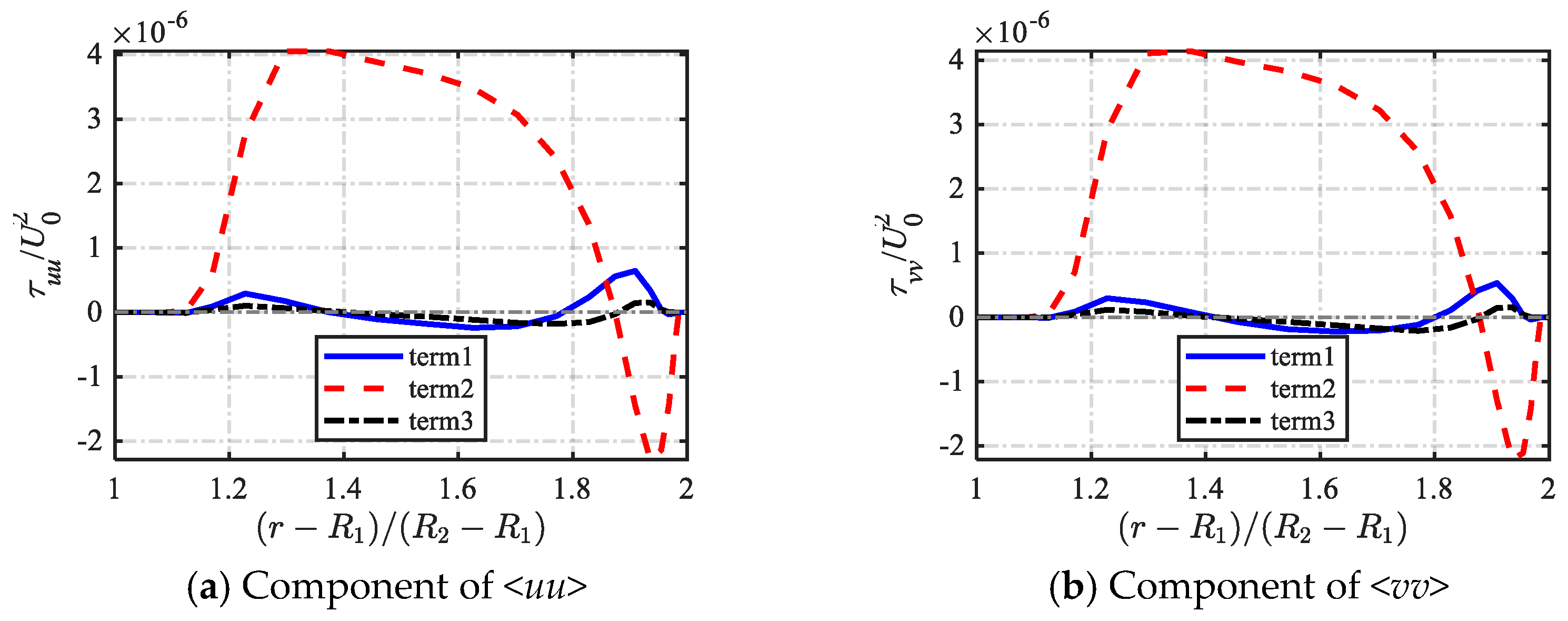
To examine the distribution of each term in the CLS PANS model, distribution plots of the terms in the SFS stress, derived from Equation (16), are presented in Figure 12 and Figure 13. In the figures, τuu represents the uu-component of the SFS stress, while τvv denotes the vv-component, and the components of SFS stress are averaged over time, circumferential direction, and axial direction. Figure 12 and Figure 13 reveal that the first-order and third-order terms tend toward zero and have negligible contributions to the SFS stress calculation. The second-order term exhibits large values in the outer wall region ((r − R1)/(R2 − R1) = 2) and the turbulent core, indicating that it plays a dominant role in the computation of SFS stress. However, its distribution is smaller in the inner wall region ((r − R1)/(R2 − R1) = 1), leading to certain deviations near the inner wall, as shown in Figure 12. This could be one of the reasons for the inaccurate prediction of circumferential velocity fluctuations in the inner wall region (Figure 5). Quantitative analysis shows that the first- and third-order terms contribute less than 5% to the total SFS stress magnitude across most of the domain, while the second-order term accounts for over 90% of the stress in the core region and near the outer wall. This confirms that the second-order nonlinear term dominates the SFS stress, justifying its central role in the model. The results at Re = 8000 (Figure 13) exhibit a similar trend to those at Re = 5000.
Figure 12.
Distribution of SFS stress terms at Re = 5000.
Figure 13.
Distribution of SFS stress terms at Re = 8000.
3.2. Flow Past a Circular Cylinder
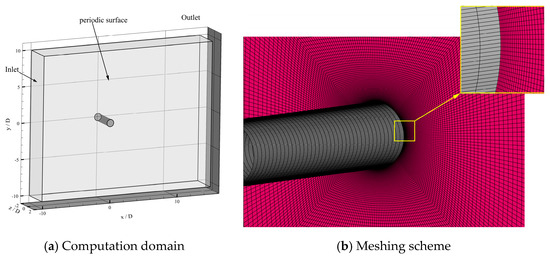
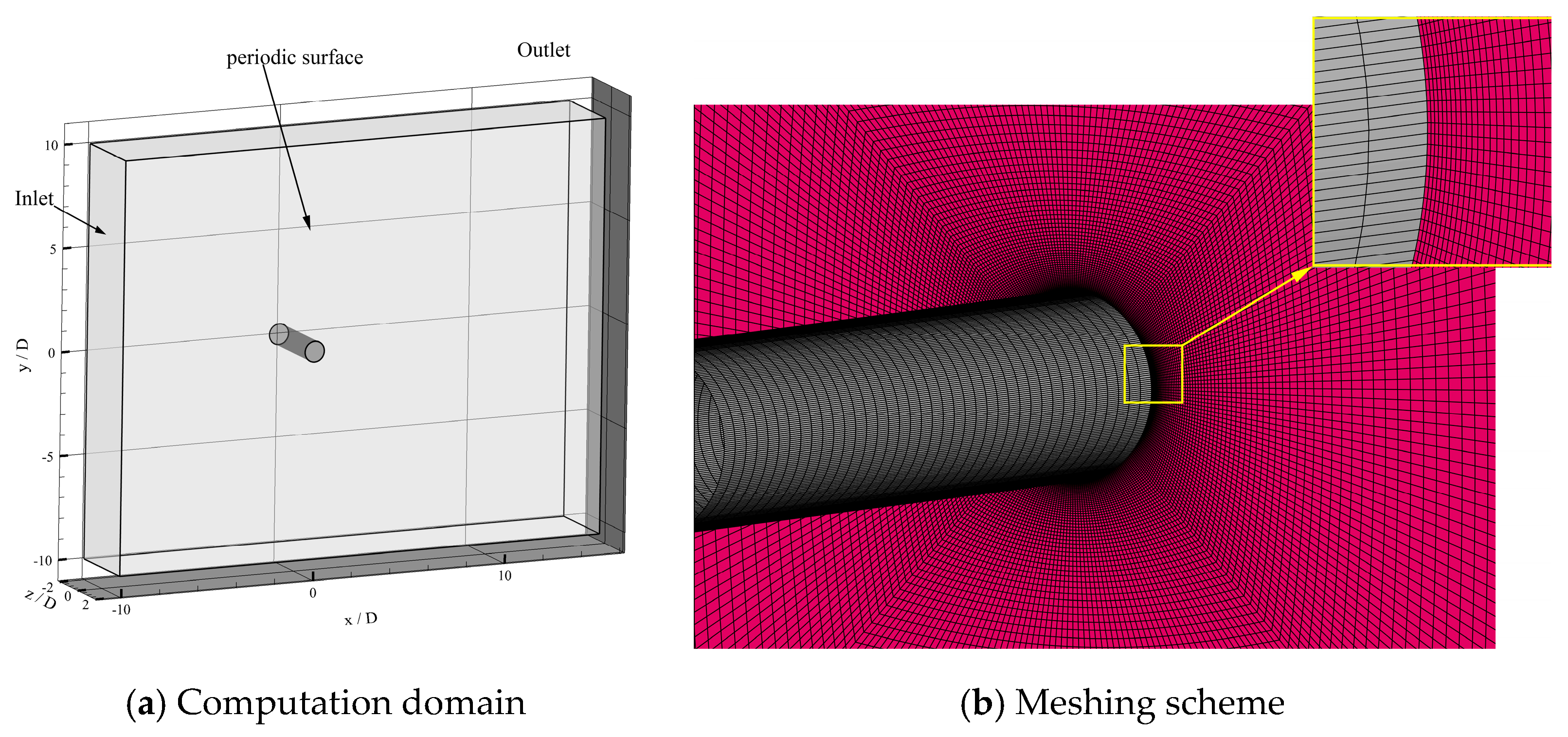
Flow past a circular cylinder represents a classic and fundamental case of unsteady three-dimensional flow, characterized by phenomena such as separation, reattachment, and vortex shedding. It has been extensively studied through both experimental [31] and numerical [10,32,33,34,35,36] investigations. In the present paper, the Reynolds number based on the circular cylinder diameter, D, and the free-stream velocity, Uin, is 3900. The computation domain and mesh scheme of a circular cylinder are shown in Figure 14, corresponding to the experiment [37]. The domain of flow past the circular cylinder is in the x, y, and z directions. High-quality hexahedral grids with 2,502,560 nodes and 2,589,103 elements are adopted to discretize the domain.
Figure 14.
Computation domain and meshing scheme of the circular cylinder.
This study conducted simulations within the OpenFOAM framework, utilizing the incompressible transient solver pisoFoam and its built-in PISO scheme for pressure–velocity coupling. The boundary conditions consisted of no-slip walls for the domain boundaries and periodic conditions for the front and back surfaces. A transient analysis was carried out with a time step selected to comply with the CFL condition for numerical stability. For the dependence study on the parameter fk, simulations were performed using the CLS PANS model with fk set to 0.2, 0.5, and 0.8. Furthermore, the predictions from the k-ε PANS model (at fk = 0.5) and the unsteady k-ε model were compared with those obtained from the CLS PANS model.
A comparison of the predicted Strouhal number (St) and drag coefficient (Cd) with the reference data is presented in Table 1. To provide a quantitative assessment of model accuracy, relative errors with respect to the experimental data are also reported. The CLS PANS model with fk = 0.2 and 0.5 yields St values that converge well with the experimental results. In contrast, the result from the CLS PANS model with fk = 0.8 agrees with that of the k-ε PANS model (fk = 0.5), both of which show a relatively large deviation from the experiment. The relative insensitivity of the surface drag coefficient to fk can be attributed to the fact that drag is an integrated quantity dominated by large-scale flow structures and global flow separation, which are reasonably captured even at coarser resolutions (fk = 0.8). For the drag coefficient, the CLS PANS model predictions are within a 2% error margin, whereas the k-ε PANS model (fk = 0.5) exhibits a marked overprediction. The unsteady k-ε model demonstrates the greatest divergence, significantly underpredicting both the Strouhal number and the drag coefficient.
Table 1.
Comparisons of the Strouhal number and drag coefficient, including relative errors with respect to experimental data.
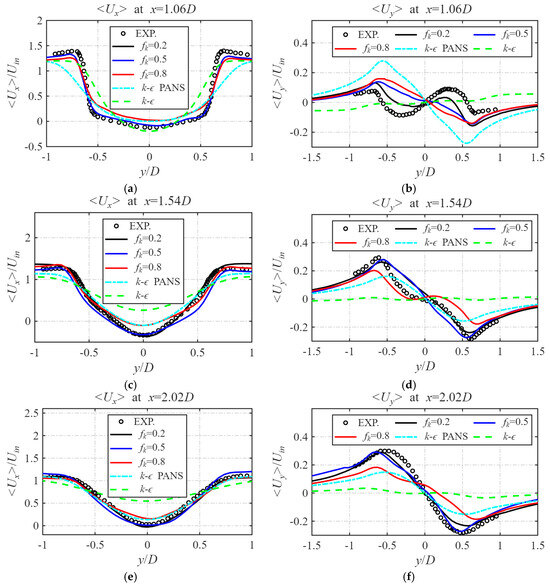
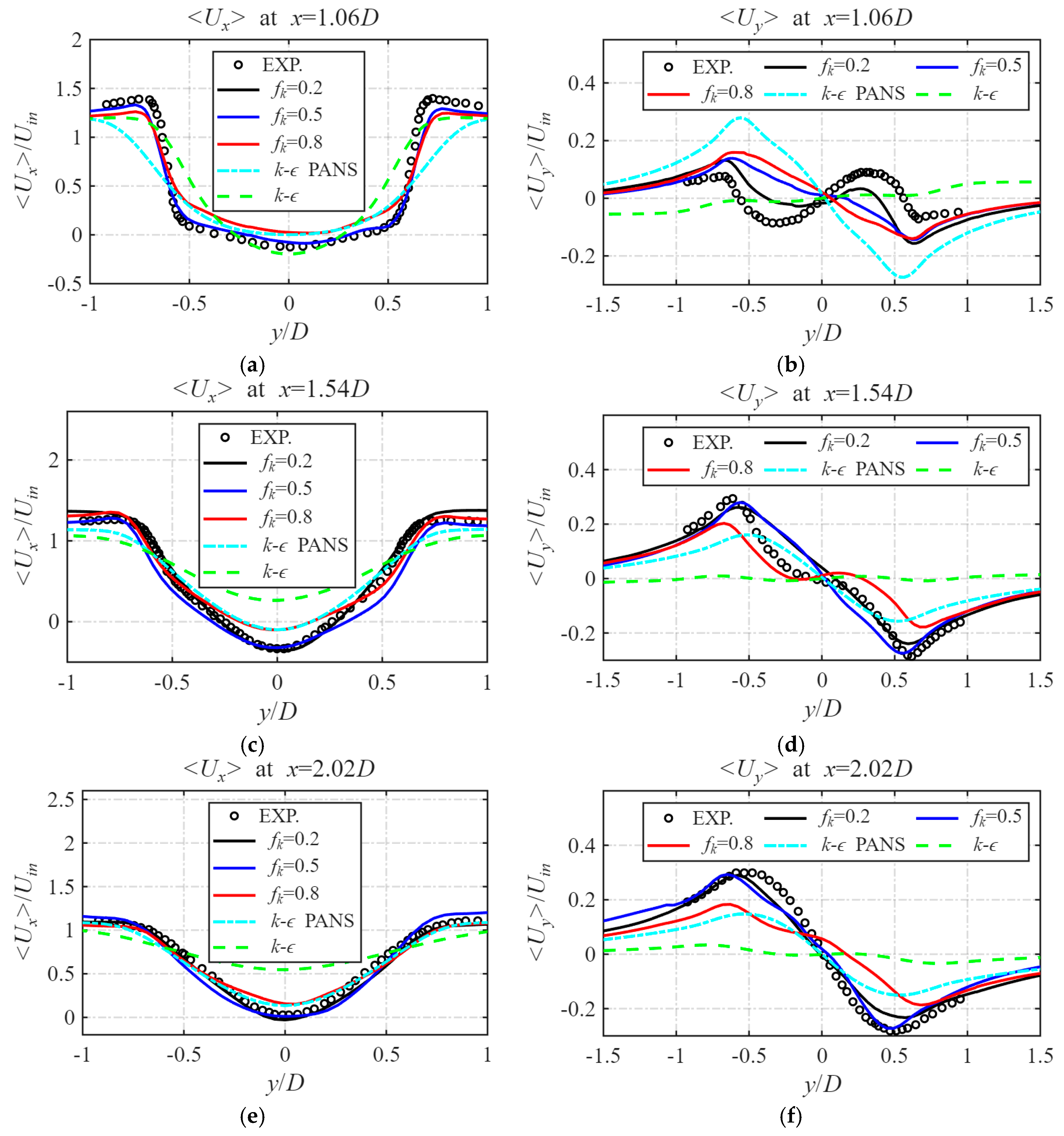
For clarity, the following abbreviations are used in the figures due to layout size limitations. The CLS PANS model with fk values of 0.2, 0.5, and 0.8 is abbreviated as “fk = 0.2”, “fk = 0.5”, and “fk = 0.8”, respectively. Similarly, the k-ε PANS model with fk = 0.5 and the unsteady k-ε model are abbreviated as “k-ε PANS” and “k-ε”, respectively. The complete nomenclature is detailed in Table 1 and applied in Figure 15.
Figure 15.
Profiles of streamwise velocity and normal velocity at three locations: (a) streamwise velocity at x = 1.06D; (b) normal velocity at x = 1.06D; (c) streamwise velocity at x = 1.54D; (d) normal velocity at x = 1.54D; (e) streamwise velocity at x = 2.02D; (f) normal velocity at x = 2.02D.
As shown in Figure 15, the time- and space-averaged streamwise and normal velocities are presented at three locations. In the near-wake region (x = 1.06D), both the k-ε PANS and CLS PANS models predict a U-shaped profile for the streamwise velocity, whereas the unsteady k-ε model yields a V-shaped profile that deviates from the experimental data. Overall, the CLS PANS model with fk = 0.2 and 0.5 demonstrates excellent agreement with the experimental results for all measured velocities at the three locations. In contrast, the results from the CLS PANS model with fk = 0.8 are close to those of the k-ε PANS model, and consequently, both show certain deviations from the experimental value.
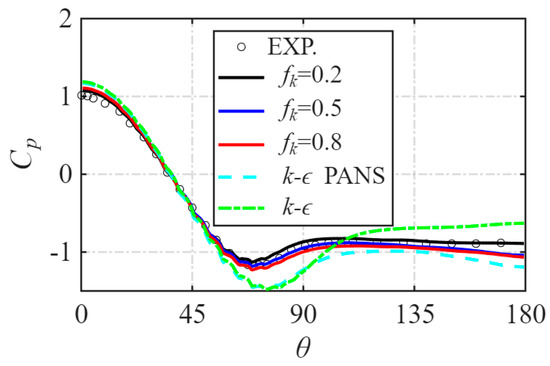
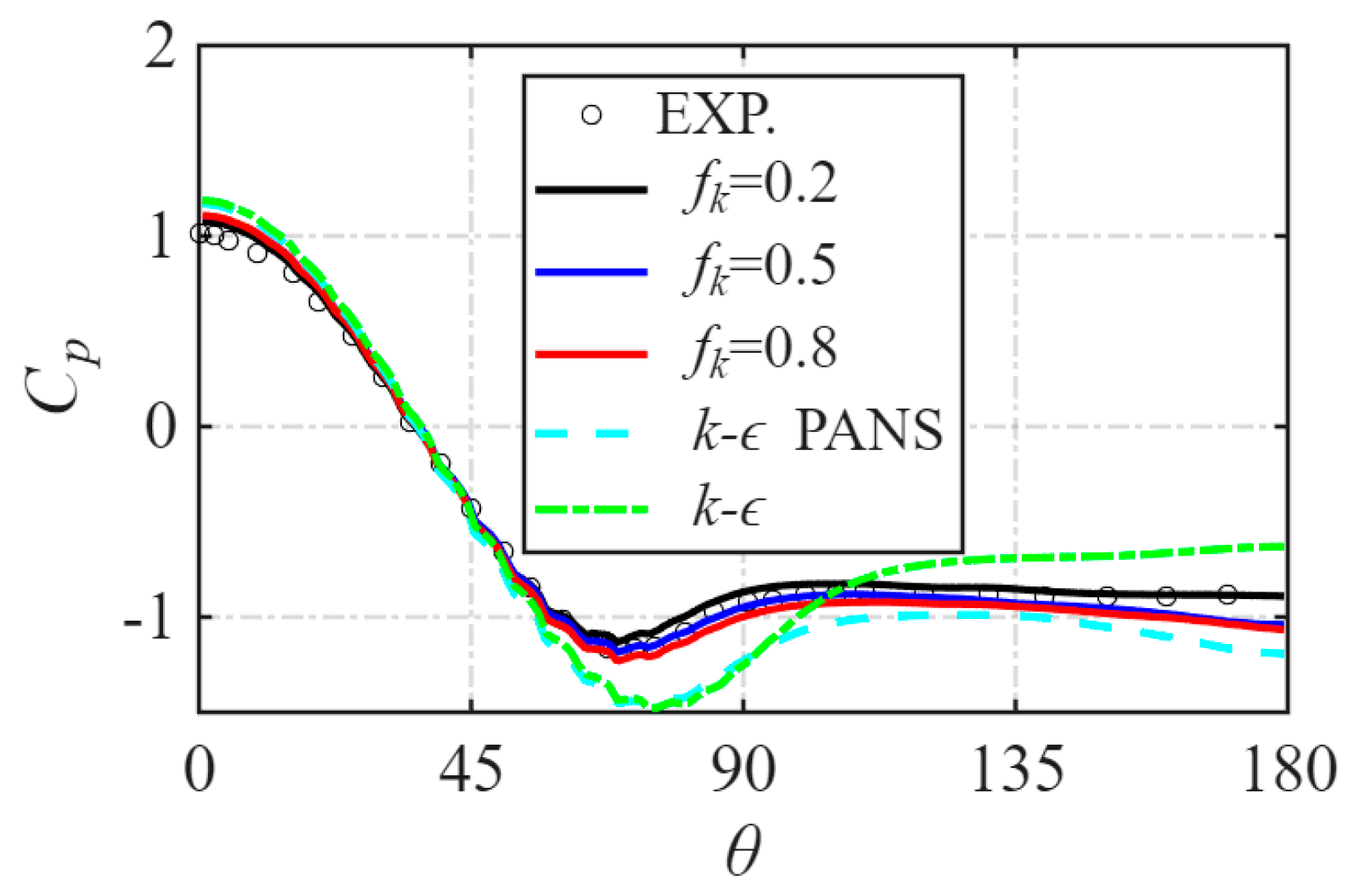
Figure 16 compares the computed surface pressure distributions with the experimental data, where θ = 0° defines the front stagnation point. A key finding is that the CLS PANS model yields accurate predictions across a wide range of resolutions (fk = 0.2 to 0.8), showing minimal sensitivity to the parameter fk for this quantity. However, the k-ε PANS and the unsteady k-ε (URANS) models both fail to accurately capture the pressure distribution, underscoring their limitations for this flow configuration.
Figure 16.
Azimuthal distributions of pressure coefficient along the cylinder surface.
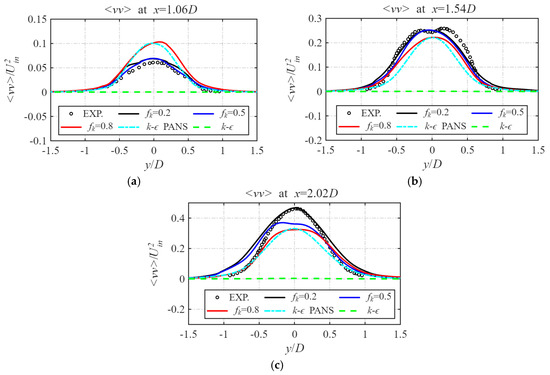
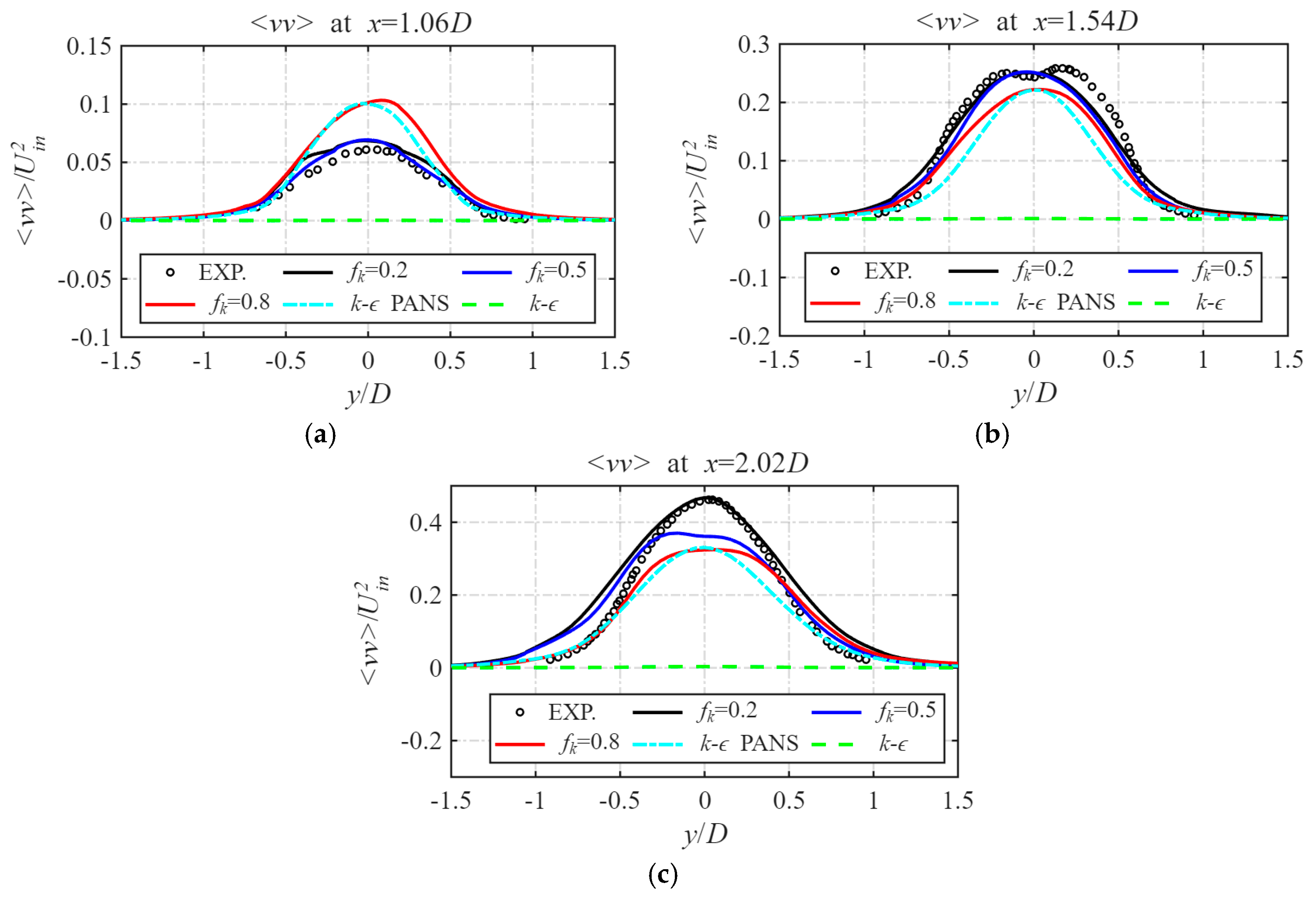
In addition to the mean flow quantities, higher-order turbulence moments are also compared with the available experimental data. Figure 17 presents the time- and space-averaged dimensionless <vv> component of the Reynolds stress profiles at three locations. As shown, the unsteady k-ε model excessively dampens the turbulence, resulting in a Reynolds stress distribution that is vanishingly small. Consistent with prior observations, the CLS PANS model at fk = 0.2 and 0.5 shows excellent agreement with the experiments. In contrast, the results for fk = 0.8 deviate significantly from the measured values and align closely with the predictions of the k-ε PANS model.
Figure 17.
<vv> components of Reynolds stress profiles: (a) at x = 1.06D; (b) at x = 1.54D; (c) at x = 2.02D.
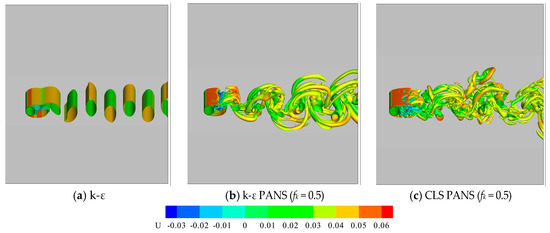
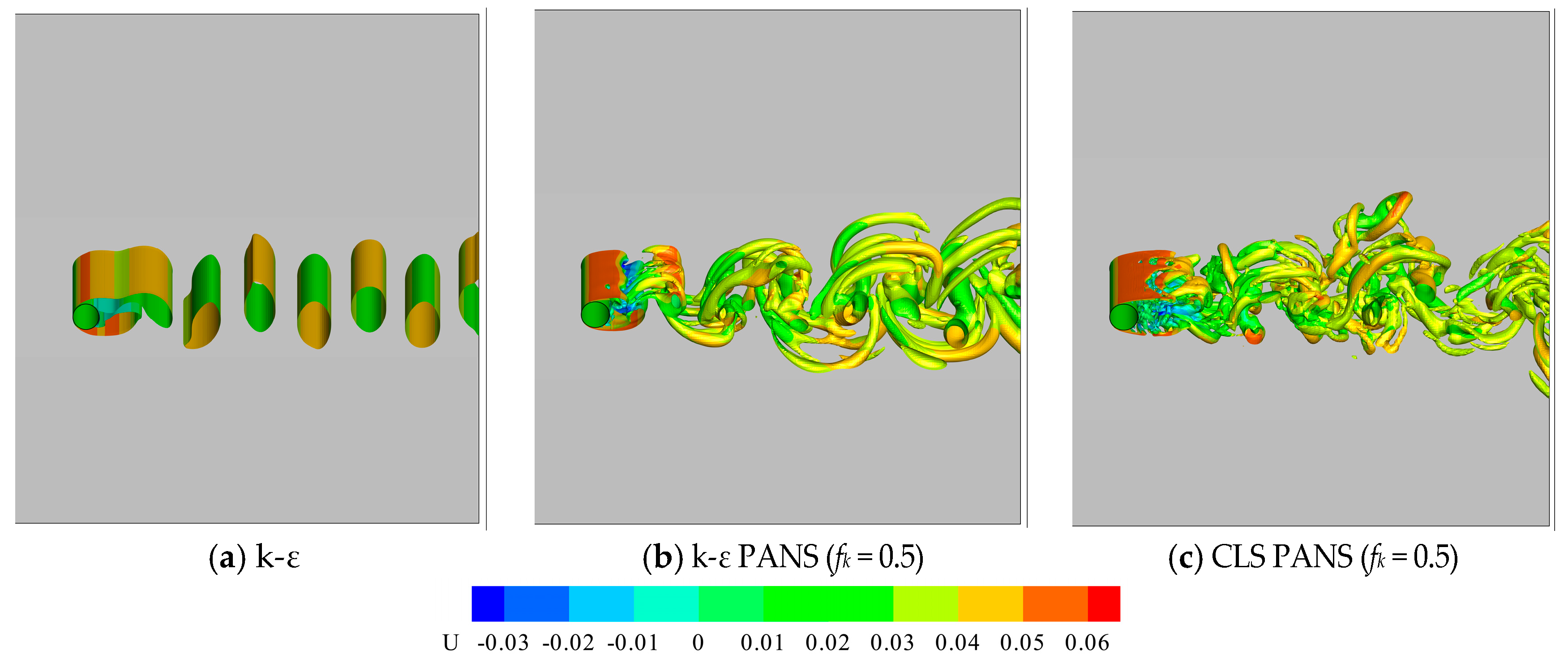
The vortical structures downstream of the cylinder are further compared in Figure 18, visualized by Ω-criterion [38] iso-surfaces (Ω = 0.52) and colored by the local instantaneous streamwise velocity. A clear distinction is observed: the CLS PANS model successfully resolves a more detailed and physically rich vortex street, highlighting its superior capability in capturing the inherent unsteady flow dynamics.
Figure 18.
Vortex street visualized by Ω-criterion (Ω = 0.52).
3.3. Flow in a Centrifugal Pump
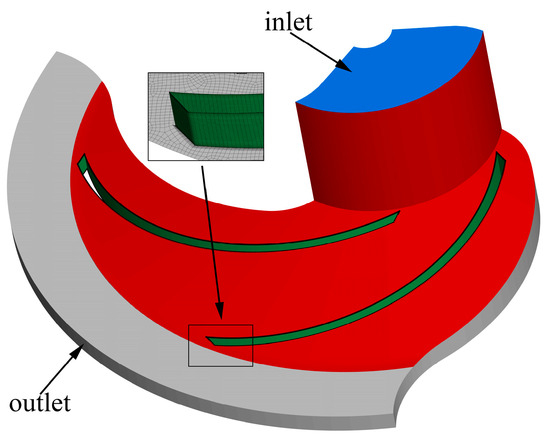
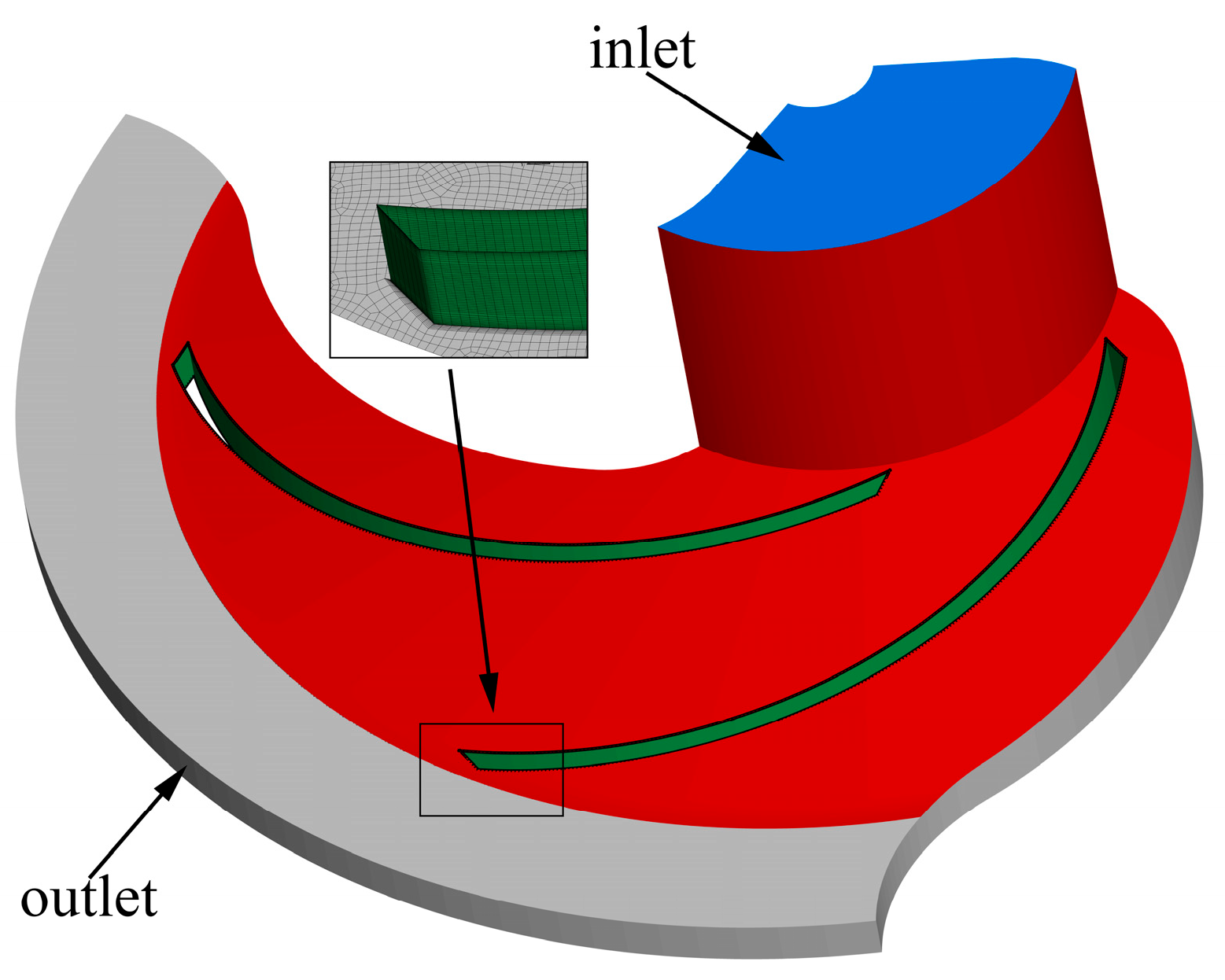
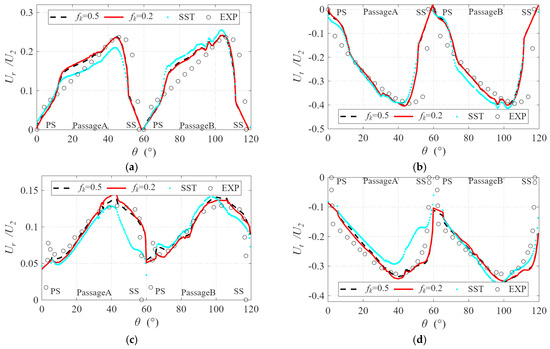
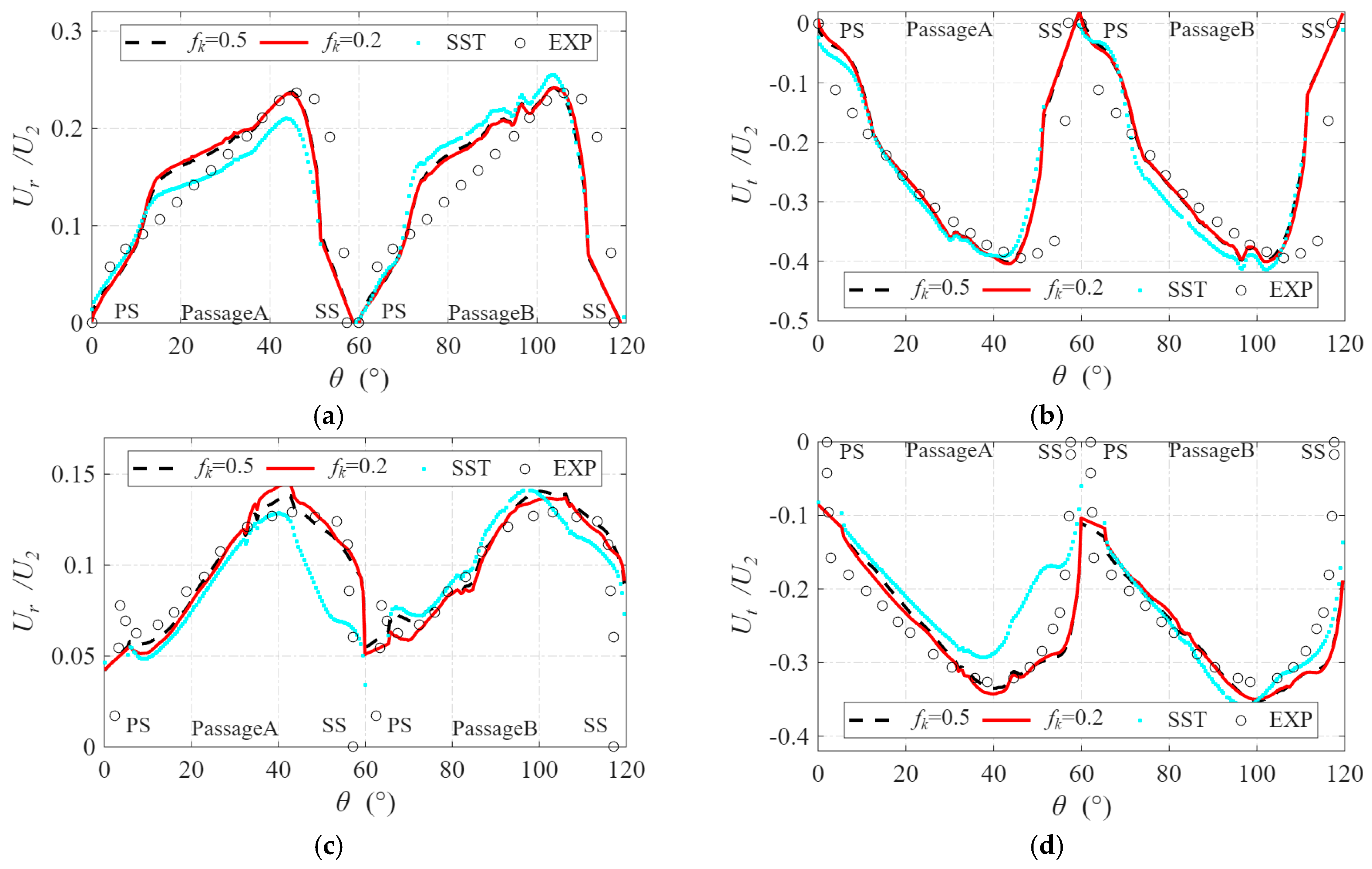
The flow within a centrifugal pump represents another classic case featuring prominent flow separation. The complex geometry, characterized by high curvature and multiple bounding walls, renders accurate prediction of its internal flow particularly challenging. The simulated pump operates at a rotational speed of 725 r/min, with an inlet diameter of D1 = 71 mm, an outlet radius of R2 = 95 mm, and a flow rate of 3.06 L/s at the design condition. The Reynolds number, based on the inlet diameter, D1, and the rated flow rate, Q0, is approximately 5.5 × 10⁴. The tangential velocity of the impeller outlet, U2, based on the impeller outlet diameter, D2, and the rotating speed is approximately 7.21 m/s. The computational domain and a grid of approximately 2.78 million nodes (see Figure 19) were adopted from well-established studies of this specific pump [39,40], whose experimental and simulation data serve as benchmarks for validation. The present simulation was performed using OpenFOAM, employing the same mesh scheme, boundary conditions, discretization schemes, time step, and transient solver as described by Huang et al. The predictions of the CLS PANS model (with fk = 0.2 and 0.5) are compared against the SST k-ω model (labeled “SST” in the figure) and experimental data from two adjacent flow passages. The SST model is chosen as a reference RANS model due to its widespread use in industrial turbomachinery simulations. However, it is known to over-dissipate turbulence in rotating and curved flows due to its linear eddy viscosity assumption and inadequate sensitivity to rotation/curvature effects [1,2].
Figure 19.
Computation domain of the centrifugal pump.
Figure 20 presents the blade-to-blade distributions of the normalized mean relative tangential velocity (Ut/U2) and radial velocity (Ur/U2) at the 0.5 spanwise height under the 1.0Q0 condition. The profiles are plotted for different radial locations (D/D2 = 0.5, 0.75). The results demonstrate that the CLS PANS model provides reasonably accurate predictions across the measured locations, while the SST k-ω model exhibits larger deviations from the experimental data [41].
Figure 20.
Mean relative radial velocity and tangential at D/D2 = 0.5, 0.75: (a) mean relative radial velocity at D/D2 = 0.5; (b) mean relative tangential velocity at D/D2 = 0.5; (c) mean relative radial velocity at D/D2 = 0.75; (d) mean relative tangential velocity at D/D2 = 0.75.
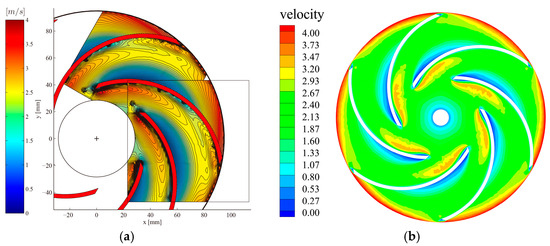
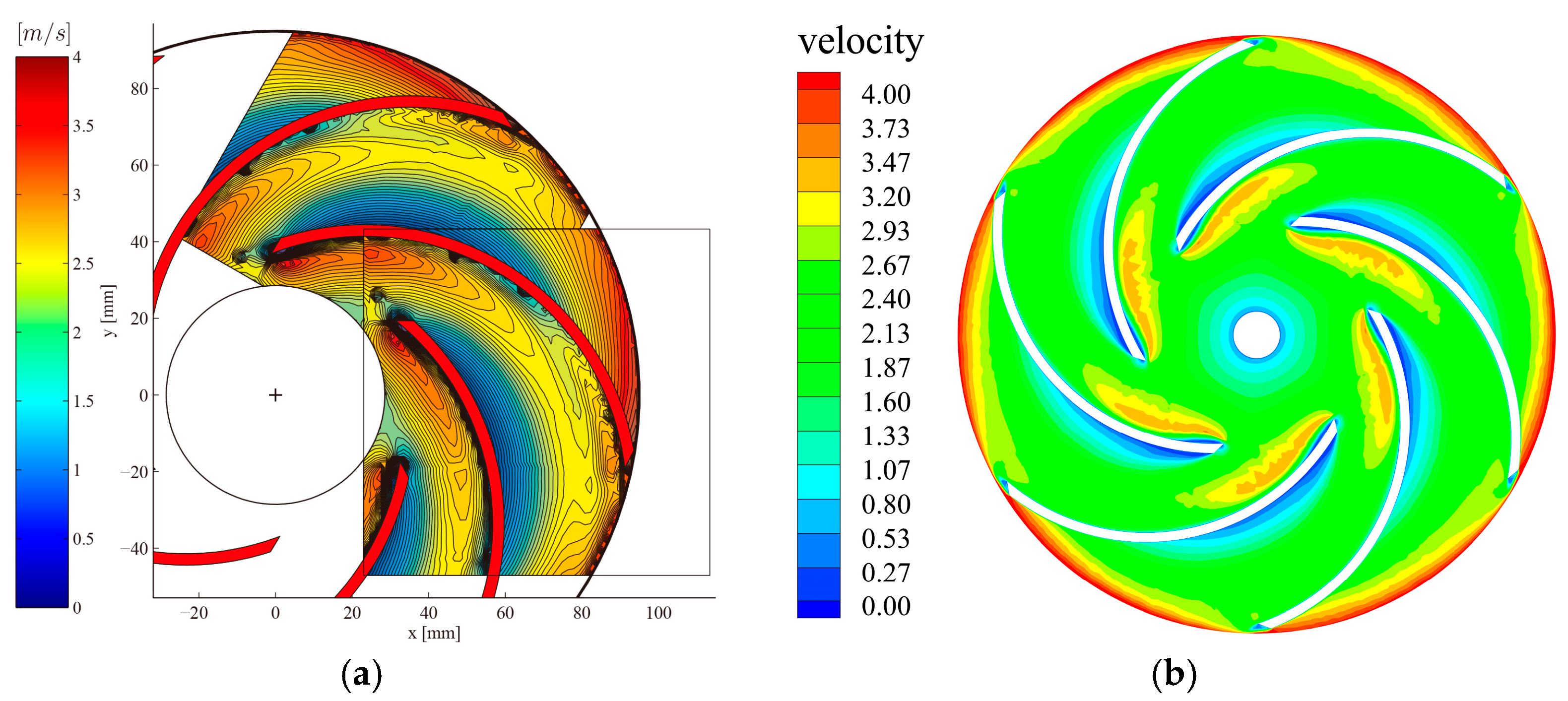
As depicted in Figure 21, the velocity contours at the 0.5 spanwise height of the impeller are compared with the experimental data from two adjacent flow passages [42]. The CLS PANS model demonstrates a strong capability in capturing the key flow features observed in the experiment. Notably, it accurately resolves the low-speed regions induced by rotational instability and flow separation near the blade pressure surfaces while also correctly representing the high-velocity zones adjacent to the blade suction surfaces and at the impeller outlet.
Figure 21.
Velocity contours in the impeller (0.5-spanwise height): (a) EXP. [42]; (b) CLS PANS (fk = 0.5).
4. Conclusions
This study developed a near-wall corrected nonlinear CLS PANS model for flows with curvatures and validated its accuracy using Taylor–Couette flow, flow past a circular cylinder, and flow in a centrifugal pump. The computational results were compared with those of the k-ε RANS model, the k-ε PANS model, experimental data, and DNS. The findings are as follows:
- (1)
- The CLS PANS model, by incorporating nonlinear stress terms and near-wall source corrections, significantly improves the prediction of near-wall turbulence structures in curved flows while maintaining the variable-resolution feature of the PANS framework.
- (2)
- In Taylor–Couette flow, the CLS PANS model accurately reproduces Taylor vortices and herringbone streaks, providing better agreement with the DNS results than the conventional k-ε PANS model and demonstrating high reliability under strong shear and curvature effects.
- (3)
- For the flow past a circular cylinder at Re = 3900, the CLS PANS model maintains stable accuracy across different fk values, with fk = 0.2–0.5 yielding results closest to experimental data, indicating good parameter robustness. It should be noted that the applicability of this range to other flow conditions remains to be verified.
- (4)
- In the centrifugal pump case, the CLS PANS model successfully captures low-velocity and high-vorticity regions within the impeller passages. Compared with the SST k–ω model, its predictions show better agreement with experimental measurements, confirming its applicability to complex engineering flows.
- (5)
- Overall, the CLS PANS model achieves a good balance between computational cost and physical fidelity, offering an effective modeling approach for curvature-, rotation-, and separation-dominated turbulent flows in engineering applications.
The current validation of the CLS PANS model is limited to incompressible, moderate-Reynolds-number flows. Future studies should extend its application to compressible and higher-Reynolds-number regimes, and explore adaptive fk strategies for broader engineering use.
Author Contributions
B.L.: Conceptualization; Formal Analysis; Investigation; Methodology; Validation; Writing—Original Draft; Resources. G.Z.: Writing—Original Draft; X.Z.: Writing—Original Draft; Software; Writing—Review and Editing; Supervision. L.C.: Supervision. J.L.: Supervision. All authors have read and agreed to the published version of the manuscript.
Funding
This research was funded by YANGZHOULVYANGJINFENGJIHUA, grant number: YZLYJFJH2022YXBS128, and the Key Laboratory of Fluid and Power Machinery (Xihua University), Ministry of Education, grant number: LTDL-2024012.
Data Availability Statement
The data that support the findings of this study are available from the corresponding author upon reasonable request.
Conflicts of Interest
The authors have no conflicts to disclose.
Nomenclature and Abbreviations
The following abbreviations are used in this manuscript:
| aij | Normalized stress anisotropy |
| c1~c7 | Constant coefficient of the CLS PANS model |
| Cε1, Cε2 | Constant coefficient of the CLS PANS model |
| Cd | Drag coefficient |
| d | Length of the gap between the inner and outer cylinder of the Taylor–Couette flow |
| D, D1 | Circular cylinder diameter, inlet diameter of centrifugal pump |
| ε, εu | Total turbulence kinetic energy dissipation rate, unresolved dissipation rate |
| Isotropic dissipation | |
| fk | Unresolved-to-total ratio of turbulence kinetic energy |
| fε | Unresolved-to-total ratio of dissipation rate |
| fμ | Damping function |
| k | Total turbulence kinetic energy |
| ku | Unresolved turbulence kinetic energy |
| Lz | Length of axial direction of the Taylor–Couette flow |
| p | Instantaneous pressure |
| R2 | Outer radius of the cylinder’s Taylor–Couette flow, outlet radius of the centrifugal pump |
| Re, Rt | Reynolds number, turbulent Reynolds number |
| Sij, Ωij | Stress rate tensors and vorticity tensors |
| St | Strouhal number |
| U0 | Inner surface circumferential velocity |
| Mean circumferential velocity | |
| Ur | Radial velocity of centrifugal pump |
| Ut | Tangential velocity of centrifugal pump |
| U2 | Tangential velocity of impeller outlet |
| Ux | Streamwise velocity of circular cylinder flow |
| Uy | Normal velocity of circular cylinder flow |
| Uin | Free-stream velocity of circular cylinder flow |
| Vi | Instantaneous velocity components |
| y+ | Yplus |
| Yapu | Yap’s length-scale correction |
| σku, σεu | Prandtl number |
| ν, νu | Dynamic viscosity, unresolved eddy viscosity |
| ρ | density |
| τ(Vi, Vj) | Sub-filtered scale stress |
| Γ | Aspect ratio |
| δij | Kronecker delta |
References
- Huang, X.; Yang, W.; Li, Y.; Qiu, B.; Guo, Q.; Zhuqing, L. Review on the sensitization of turbulence models to rotation/curvature and the application to rotating machinery. Appl. Math. Comput. 2019, 341, 46–69. [Google Scholar] [CrossRef] [Scilit]
- Wang, C.; Wang, F.; Li, C.; Ye, C.; Yan, T.; Zou, Z. A modified STRUCT model for efficient engineering computations of turbulent flows in hydro-energy machinery. Int. J. Heat Fluid Flow 2020, 85, 108628. [Google Scholar] [CrossRef] [Scilit]
- Huang, X.; Zhuqing, L.; Wei, Y.; Yaojun, L.; Zixuan, Y. A cubic nonlinear subgrid-scale model for large eddy simulation. J. Fluids Eng. 2017, 139, 041101. [Google Scholar] [CrossRef] [Scilit]
- Zhang, Y.; Zhang, D.P.; Jiang, H.Y. Review of challenges and opportunities in turbulence modeling: A comparative analysis of data-driven machine learning approaches. J. Mar. Sci. Eng. 2023, 11, 1440. [Google Scholar] [CrossRef] [Scilit]
- Pang, K.W.; Huang, X.B.; Liu, Z.Q.; Li, Y.J.; Yang, W. A hybrid model based on the bifurcation approach for internal turbulent flow with rotation and streamline curvature effects. J. Mar. Sci. Eng. 2022, 10, 2022. [Google Scholar] [CrossRef] [Scilit]
- Girimaji, S.S. PANS model for turbulence: A RANS to DNS bridging method. J. Appl. Mech. 2006, 73, 413–421. [Google Scholar] [CrossRef] [Scilit]
- Spalart, P.; Jou, W.H.; Strelets, M.; Allmaras, S. Comments on the feasibility of LES for wings, and on a hybrid RANS/LES approach. In Advances in DNS/LES; Greyden Press: Dayton, OH, USA, 1997. [Google Scholar]
- Spalart, P.R.; Deck, S.; Shur, M.L.; Squires, K.D.; Strelets, M.; Travin, A.K. A new version of detached-eddy simulation, resistant to ambiguous grid densities. Theor. Comput. Fluid Dyn. 2006, 20, 181–195. [Google Scholar] [CrossRef] [Scilit]
- Speziale, C.G. Turbulence modeling for time-dependent RANS and VLES: A review. AIAA J. 1998, 36, 173–184. [Google Scholar] [CrossRef] [Scilit]
- Lakshmipathy, S.; Girimaji, S.S. Partially averaged Navier–Stokes (PANS) method for turbulence simulations: Flow past a circular cylinder. J. Fluids Eng. 2010, 132, 121201. [Google Scholar] [CrossRef] [Scilit]
- Foroutan, H.; Yavuzkurt, S. A partially averaged Navier–Stokes model for the simulation of turbulent swirling flow with vortex breakdown. Int. J. Heat Fluid Flow 2014, 50, 402–416. [Google Scholar] [CrossRef] [Scilit]
- Saroha, S.; Sinha, S.S.; Lakshmipathy, S. Evaluation of PANS method in conjunction with non-linear eddy viscosity closure using OpenFOAM. Int. J. Numer. Methods Heat Fluid Flow 2019, 29, 949–980. [Google Scholar] [CrossRef] [Scilit]
- Girimaji, S.S.; Jeong, E.; Srinivasan, R. PANS method for turbulence fixed point analysis and comparison with URANS. J. Appl. Mech. 2006, 73, 422–429. [Google Scholar] [CrossRef] [Scilit]
- Wang, X.; Wang, Y.; Yuan, X.; Liu, H.; Jiang, L.; Xiong, W. Numerical investigation of cavitating flow in centrifugal pump with improved partially-averaged Navier–Stokes method. J. Hydraul. Res. 2023, 61, 809–823. [Google Scholar] [CrossRef] [Scilit]
- Yang, G.; Shen, X.; Xu, B.; Meng, Q.; Chang, C.; Tang, R.; Zhang, D. Numerical study on unsteady cavitation flow and vortex dynamics characteristics around the Delft Twist 11 hydrofoil. Ocean Eng. 2023, 286, 115580. [Google Scholar] [CrossRef] [Scilit]
- Jia, X.; Shen, S.; Zhang, S.; Lv, H.; Lin, Z.; Zhu, Z. Influence of tip clearance on internal energy loss characteristics of axial flow pumps under different operating conditions. Phys. Fluids 2024, 36, 013101. [Google Scholar] [CrossRef] [Scilit]
- Gu, Y.; Yang, A.; Bian, J.; Shariff, A.M.; Stephen, C.; Wang, Q.; Cheng, L. Investigation of energy performance and unsteady flow characteristics of a multi-stage centrifugal pump under various seal wear conditions for renewable energy pumping systems. Renew. Energy 2026, 256, 123998. [Google Scholar] [CrossRef] [Scilit]
- Taghizadeh, S.; Witherden, F.D.; Girimaji, S.S. Scale-resolving simulations of turbulent flows with coherent structures: Toward cut-off dependent data-driven closure modeling. Phys. Fluids 2024, 36, 063101. [Google Scholar] [CrossRef] [Scilit]
- Ye, W.; Qian, Z.; Zeng, Y.; Ma, W.; Geng, X.; Luo, X.; Wang, H. Numerical investigation on the unstable flow and its interaction with the hump characteristic in a pump turbine at pump mode. J. Energy Storage 2024, 101, 113853. [Google Scholar] [CrossRef] [Scilit]
- Mao, X.; Zhong, P.; Li, Z.; Liu, Z.; Hu, J.; Yan, J. Development and application of modified partially averaged Navier–Stokes in the internal flow field of a Francis turbine. Phys. Fluids 2025, 37, 053101. [Google Scholar] [CrossRef] [Scilit]
- Sahu, P.; Subbarao, P.M.V.; Goyal, R. Exploring cloud cavitation and cavitation vortex dynamics with partially averaged Navier–Stokes turbulence models. Phys. Fluids 2025, 37, 013101. [Google Scholar] [CrossRef] [Scilit]
- Ye, W.; Luo, X.; Wang, H. Rationale of partially averaged Navier–Stokes model and its applications in turbomachinery: A historical review. Phys. Fluids 2025, 37, 033301. [Google Scholar] [CrossRef] [Scilit]
- Craft, T.J.; Launder, B.E.; Suga, K. Prediction of turbulent transitional phenomena with a nonlinear eddy-viscosity model. Int. J. Heat Fluid Flow 1997, 18, 15–28. [Google Scholar] [CrossRef] [Scilit]
- Saghafian, M.; Stansby, P.K.; Saidi, M.S.; Apsley, D.D. Simulation of turbulent flows around a circular cylinder using non-linear eddy-viscosity modelling. J. Fluids Struct. 2003, 17, 1213–1236. [Google Scholar] [CrossRef] [Scilit]
- Liu, B.; Yang, W.; Li, S.; Huang, X. A nonlinear partially-averaged Navier–Stokes model with near-wall correction for separated turbulent flow. Mod. Phys. Lett. B 2021, 35, 2150262. [Google Scholar] [CrossRef] [Scilit]
- Mochalin, I.; Cai, J.C.; Shiju, E.; Brazhenko, V.; Wang, D.Y. Numerical study of the flow through an annular gap with filtration by a rotating porous cylinder. Eng. Appl. Comput. Fluid Mech. 2022, 16, 469–483. [Google Scholar] [CrossRef] [Scilit]
- Bazilevs, Y.; Akkerman, I. Large eddy simulation of turbulent Taylor–Couette flow using isogeometric analysis. J. Comput. Phys. 2010, 229, 3402–3414. [Google Scholar] [CrossRef] [Scilit]
- van der Veen, R.; Huisman, S.G.; Merbold, S.; Harlander, U.; Egbers, C.; Lohse, D.; Sun, C. Taylor–Couette turbulence at radius ratio η = 0.5. J. Fluid Mech. 2016, 799, 334–351. [Google Scholar] [CrossRef] [Scilit]
- Dong, S. Direct numerical simulation of turbulent Taylor–Couette flow. J. Fluid Mech. 2007, 587, 373–393. [Google Scholar] [CrossRef] [Scilit]
- Chouippe, A.; Climent, E.; Legendre, D.; Gabillet, C. Numerical simulation of bubble dispersion in turbulent Taylor–Couette flow. Phys. Fluids 2014, 26, 043304. [Google Scholar] [CrossRef] [Scilit]
- Molochnikov, V.M.; Mikheev, N.I.; Mikheev, A.N.; Paereliy, A.A.; Dushin, N.S.; Dushina, O.A. SIV measurements of flow structure in the near wake of a circular cylinder at Re = 3900. Fluid Dyn. Res. 2019, 51, 055501. [Google Scholar] [CrossRef] [Scilit]
- Norberg, R.B.; Kandasamy, A.; Majumdar, S. LES of flow past circular cylinder at Re = 3900. J. Appl. Fluid Mech. 2016, 9, 1421–1435. [Google Scholar] [CrossRef] [Scilit]
- Ji, M.; You, Y.X.; Han, P.P.; Qiu, X.P.; Ma, Q.; Wu, K.J. A wall-modeled hybrid RANS/LES model for flow around circular cylinder. Acta Phys. Sin. 2024, 73, 054701. [Google Scholar] [CrossRef] [Scilit]
- Wu, Q.H.; Chen, Z.G.; Xu, H.; Cai, Y.L. A novel wall model for large-eddy simulation of the flow around a circular cylinder. Phys. Fluids 2024, 36, 063603. [Google Scholar] [CrossRef] [Scilit]
- Xing, F.D.; Lei, C.W. Effects of circumferential groove spacing on flow over a circular cylinder: A large eddy simulation. Ocean Eng. 2025, 340, 122435. [Google Scholar] [CrossRef] [Scilit]
- Luo, D.; Yan, C.; Liu, H.; Zhao, R. Comparative assessment of PANS and DES for simulation of flow past a circular cylinder. J. Wind Eng. Ind. Aerodyn. 2014, 134, 65–77. [Google Scholar] [CrossRef] [Scilit]
- Parnaudeau, P.; Carlier, J.; Heitz, D.; Lamballais, E. Experimental and numerical studies of the flow over a circular cylinder at Re = 3900. Phys. Fluids 2008, 20, 085101. [Google Scholar] [CrossRef] [Scilit]
- Liu, C.; Wang, Y.; Yang, Y.; Duan, Z. New omega vortex identification method. Sci. China Phys. Mech. Astron. 2016, 59, 081711. [Google Scholar] [CrossRef] [Scilit]
- Huang, X.; Liu, Z.; Yang, W. Comparative study of SGS models for simulating the flow in a centrifugal-pump impeller. Eng. Comput. 2015, 32, 2120–2135. [Google Scholar] [CrossRef] [Scilit]
- Byskov, R.K.; Jacobsen, C.B.; Pedersen, N. Flow in a centrifugal pump impeller—Part II: Large eddy simulations. J. Fluids Eng. 2003, 125, 73–83. [Google Scholar] [CrossRef] [Scilit]
- Pedersen, N.; Larsen, P.S.; Jacobsen, C.B. Flow in a centrifugal pump impeller—Part I: PIV and LDV measurements. J. Fluids Eng. 2003, 125, 61–72. [Google Scholar] [CrossRef] [Scilit]
- Pedersen, N. Flow in Centrifugal Pump Impellers. Ph.D. Thesis, Technical University of Denmark, Lyngby, Denmark, 2000. [Google Scholar]

Disclaimer/Publisher’s Note: The statements, opinions and data contained in all publications are solely those of the individual author(s) and contributor(s) and not of MDPI and/or the editor(s). MDPI and/or the editor(s) disclaim responsibility for any injury to people or property resulting from any ideas, methods, instructions or products referred to in the content. |
© 2026 by the authors. Licensee MDPI, Basel, Switzerland. This article is an open access article distributed under the terms and conditions of the Creative Commons Attribution (CC BY) license.